Introduction
The eighteenth century might appear as a golden age for zoological sciences. Besides the great development of many fields concerning animals, such as systematics or physiology, and the emergence of new concepts such as irritability or transformism, a very wide audience showed interest in the study of nature in general. This success of natural history gave rise to the publication of an abundance of books or journals for scientists and/or amateurs, many of which focused on animals. In fact, animals were omnipresent, not only in the sciences and scientific publications, but in literature, arts, and the intellectual landscape in general, including visual culture (see e.g. Robbins Reference Robbins2002; Senior Reference Senior2007; Ridley Reference Ridley2010; Berchtold and Guichet Reference Berchtold and Guichet2010; Schmitt Reference Schmitt2011). However, from the standpoint of the institutional organization of sciences and the classification of knowledge, their status was quite ambiguous when compared with plants. While botany was clearly defined as the science dealing with plants in all their features and was represented as such in scientific institutions, there was no “zoology” gathering all research on animals. Studies on animals were parts of disciplines whose main topics were not animals, such as anatomy, a science essentially devoted to man, or natural history, whose scope was far more general. Paradoxically, studies on animals took place and flourished throughout the eighteenth century without a special science of animals.
The situation changed considerably in the last decade of the century, with the rise of comparative anatomy. This new discipline, unlike traditional anatomy, was centered on animals, even though it dealt only with certain features of animals. After 1795, it rapidly became institutionalized, many chairs were founded, new concepts and research programs emerged, and this field enjoyed phenomenal success among scientists as well as non-specialists in the first decades of the nineteenth century, as revealed for example by the media sensation created by the debate between Cuvier and Geoffroy Saint-Hilaire in 1830 (Russell Reference Russell1916; Appel Reference Appel1987; Corsi Reference Corsi2001; Schmitt Reference Schmitt2004 and Reference Schmitt2006). But, unlike botany, which encompassed all kinds of studies on plants, comparative anatomy only considered animals from a particular standpoint, namely, their structural organization and the relationships between the different species in that respect. This had many consequences. For example, the focus on comparison and interspecific similarities favored such notions as homology, common plan, archetypes, and eventually evolution. Furthermore, since the practices of comparative anatomy (i.e. especially dissection) required skills and means (such as money, large-scale networking for acquiring more or less common specimens, just dead or killed, proper places and instruments to anatomize them) that made it less open to amateurs than, for example, botany, the field moved more quickly toward professionalization.
In order to understand the conditions which permitted this mutation and the rapid emergence of a science devoted to animals around 1800, it is helpful to examine the ways in which knowledge and research on animals were organized during the century before and how animal anatomy was connected to other fields. This paper is a contribution to that project. It considers the particular case of one of the main European scientific institutions where comparative anatomy emerged in the late eighteenth century, namely, the Parisian Académie Royale des Sciences (hereafter ARS), and it analyzes the different studies on animals undertaken there, in order to propose a descriptive typology of them and to determine their status and significance, especially regarding the rise of comparative anatomy. We emphasize the importance of two factors which had an influence on these studies. First, the tradition of research on animal anatomy initiated in the late seventeenth century by Claude Perrault and his colleagues, just after the foundation of the ARS, represented a model throughout the eighteenth century (section 1). Second, the official organization of the sciences in the ARS structured research on animals in a very different way from research on plants, and this framework had some consequences for the contents of academic publications on animals (section 2). In the third section, all papers concerning animals in the volumes published annually by the ARS from 1699 to 1790 are analyzed quantitatively and qualitatively. Different kinds of research are identified, and their characteristics, relationships, and significance are discussed. The last section is devoted to one of the main works dealing with animals in the Enlightenment, Buffon and Daubenton's Histoire naturelle. Both authors were members of the ARS and were influenced by its traditions to different extents; their respective conceptions of the status of animal studies and anatomy in the natural sciences are considered.
1. The Legacy of the First Ages of the Académie: Anatomy in Perrault's Program on the “Natural History of Animals”
Many studies on animals were undertaken at the ARS from its foundation by Colbert in 1666 to its reform in 1699. They fell largely within the framework of a specific anatomical program. This program had a considerable influence on later works, and its legacy was of prime importance for the history of the life sciences at the ARS throughout the eighteenth century, especially regarding the status of animals. The driving force behind it was Claude Perrault, who expressed its principles as early as 1667, but it involved many other members of the ARS such as Joseph-Guichard Duverney, Jean Pecquet, and Louis Gayant. This group carried out dissections of a number of animals for more than two decades (Schiller Reference Schiller1964; Salomon-Bayet [1978] Reference Salomon-Bayet2008; Guerrini Reference Guerrini2006, Reference Guerrini2010, Reference Guerrini2012, and Reference Guerrini2015).
Non-scientific factors played an important part in those studies. The works of the Academicians were supported by the king himself, who gave them exotic animals from the royal Menagerie in Versailles and sometimes attended public dissections (Fontenelle et al. Reference Fontenelle1733, 322–323). Indeed, science-as-spectacle had an important function in the patronage system of the Old Regime: by supporting such an ambitious and expensive enterprise, the king presented himself as the protector of sciences and enhanced the prestige of the monarchy as well as the ARS. Such considerations partly explain the publication by Perrault and his collaborators of selected anatomical descriptions in two beautiful folio volumes of Mémoires pour servir à l'histoire naturelle des animaux, with lavish engraved plates by the best artists (1671-1676). These rare and precious books, given to distinguished persons, constituted, as it were, a virtual extension of the royal Menagerie, of which they served to reveal the richness. Furthermore, descriptions of exotic animals proclaimed the influence of France and its colonial or diplomatic relations with remote countries.
But true scientific motivations also underlay Perrault and his colleagues’ anatomical program, as they explained in the preface of the Mémoires (Perrault et al. 1671–Reference Perrault1676, unpaginated preface). First, they promoted a kind of epistemology based on rigorous observation, where speculative generalizations were completely banished, and they stressed that their anatomical descriptions, as the result of collective work, were as accurate as possible and devoid of any prejudice. In the title of each chapter, they used only indefinite articles or numeral adjectives (“Anatomical description of one Lion,” “of three Eagles,” etc.), in order to emphasize that they were describing real individual animals, rather than abstractly conceived species. Such empiricist principles, more or less inspired by Bacon, were widespread in Europe in the late seventeenth century, especially in scholarly societies like the ARS (Shapin and Shaffer Reference Shapin and Schaffer1985; Licoppe Reference Licoppe1996).
Second, however, the anatomists of the ARS did not reject all explanatory considerations. Beyond mere empiricism, their studies of animal structures provided them with abundant material for a mechanistic understanding of living functions. This research fell within the context of the success of mechanism throughout Europe, as illustrated, for example, by Borelli's De Motu animalium (Reference Borelli1680-Reference Borelli1681): many scientists refused ancient, Aristotelian-like explanations of vital phenomena, but they tried to make sense of these phenomena by using the general laws of modern mechanics, whether they accepted mechanism as an ontology or as a mere method of explanation (Roger [1963] Reference Roger1993, 163–254; Grmek Reference Grmek1990; Des Chene Reference Des Chene2005; Roux Reference Roux2012). Perrault adopted such a position, and, as a consequence, he clearly distinguished between two anatomies, the one being an accurate description of structures while the other used these data to make sense of vital functions such as digestion or locomotion; he insisted on the complementarity of these two aspects (Fontenelle et al. Reference Fontenelle1733, 18). As a matter of fact, these two anatomies were, to a great extent, separated in his work: the Mémoires pour servir à l'histoire naturelle des animaux were devoted to mere description, while his Essais de Physique (Perrault 1680–Reference Perrault1688) dealt with mechanistic explanations and discussion of causes. But for him all these studies belonged to one and a same research program, and even in the Mémoires he did not refrain from “adding some reflections when [he] thought it was pertinent” (Perrault 1671–1676, unpaginated preface; Perrault Reference Perrault1733, xii).Footnote 1
Third, these studies generally had an underlying interest in comparing animal structures with human ones. Perrault and his collaborators were convinced that knowledge acquired from animals could help to understand human anatomy and function and, as a consequence, that it had medical significance (Perrault Reference Perrault1733, xviii). In 1681, the secretary of the Academy wrote, on the occasion of the dissection of an elephant, that such work would “contribute to throwing light on the structure of many parts which were very obscure in man” (Registres des séances de l'Académie 1681, fº 82). This idea was a very old one, since the use of animals was traditional in medical research at least since Galen: animal bodies were much easier to obtain than human corpses, and it was possible to do experiments on living animals that would have been, ethically or in practice, impossible on man. But the claim of a utilitarian dimension of the sciences had a particularly strong resonance in the late seventeenth century, especially at the ARS. In that respect too, even if we cannot exclude the possibility that Perrault rhetorically emphasized this point to justify his research on animals, his program fell within general scientific trends of its time.
Thus, for about two decades, a collective research program concerning animals was developed at the ARS; it was supported by the royal government, rested on strong epistemological and theoretical principles (accuracy of description, mechanistic explanations), used well-defined methods and practices (dissection, production of textual descriptions and illustrations in accordance with a certain style), and could be claimed as useful for medical purposes. This program shared similarities with other contemporaneous projects, since many other works on animal anatomy were undertaken throughout Europe in the late seventeenth century. Although publications in this field continuously appeared from the mid-sixteenth century, they reached a first peak between 1670 and 1690 (Cole and Eales Reference Cole and Eales1917). Cole (Reference Cole1944, 312–315) attributed the peak, above all, to the development of collective work, especially in new scientific institutions such as the ARS, the Royal Society in London, the Private College of Amsterdam, the Academia Naturae Curiosorum in Germany, or in more informal groups, such as the cluster of physicians led by Thomas Bartholin in Copenhagen. But another important factor was the general epistemological context, which favored direct observations connected to mechanistic interpretations of animal structures. Animal anatomy appeared as a promising field to many scientists like Tyson, a member of the Royal Society who saw it as a new frontier and compared anatomical research with the discovery of new worlds (Tyson Reference Tyson1680, 1–2). A number of the publications of this period would remain reference works through the late eighteenth or even the nineteenth century.
However, Perrault's research program on animal anatomy, when compared with others, had distinctive features. First, it enjoyed particularly good material conditions. The Academicians received financial support and resources from the king, and the royal patronage supplied them with many rare or exotic animals to dissect. Furthermore, they had an original conception of the relationship between different disciplines, since they did not respect the Baconian categories set forth in The Advancement of Learning (Bacon Reference Bacon1605), which were highly influential in the seventeenth and the eighteenth centuries. Francis Bacon had divided the sciences according to three human faculties: memory, imagination, and reason, corresponding, respectively, to “history,” “poetry,” and “philosophy.” One consequence was that knowledge of nature, especially of animals, was fragmented into natural history and natural philosophy. The latter, including metaphysics as well as mathematics and “physics” (i.e. the science of all natural phenomena, including physiological functions), dealt with causes, whereas natural history was considered purely descriptive, like civil history or geography (Sloan Reference Sloan and Olby1990). On the other hand, anatomy, according to Bacon, was a part of philosophy, particularly the part of anatomy he called anatomia comparata, whose aim was to reveal the relationship between organisms of the same or different species, humans and animals (Bacon Reference Bacon1605, Part 2, 41–42). Perrault agreed that anatomy belonged to natural philosophy (Fontenelle et al. Reference Fontenelle1733, 18), but, at the same time, he claimed he was doing natural history and he viewed anatomy as a central part of it. In the preface of the Mémoires pour servir à l'histoire naturelle des animaux, he explained that the internal structure of animals was not as well known as other features like external morphology or behavior, which had already been studied by the Ancients. As a result, he thought that modern natural history should focus on organisms’ internal characteristics. Thus, by associating anatomy with natural history, Perrault altered both of them and blurred the Baconian distinctions in several ways: he acknowledged the explanatory (“philosophical”) dimension of the natural history of animals, but he tended to specialize it and to subordinate it to anatomical research; at the same time, he turned anatomy into a far more general field (i.e. the study of nature) than its traditional scope, and he contributed to its emancipation from medicine.Footnote 2
Perrault's program also revealed a strong contrast between the status of animals and plants. Indeed, a botanical program was developed at the same time at the ARS (Stroup Reference Stroup1990, 65–166). Similarly, it tended not to distinguish between “philosophy” and “history”; but unlike studies on animals, research on plants was not limited to a particular approach and concerned morphology, chemical analysis, etc., as well as internal structures. Interestingly, when Perrault expounded the “two most useful and curious parts of the natural philosophy” which the ARS had to deal with, he called them anatomy (of animals) and knowledge of plants or botany (Fontenelle et al. Reference Fontenelle1733, 18–19). This suggested a dissymmetry between, on the one hand, botany as an autonomous and comprehensive science, encompassing all and only characteristics of plants, and, on the other hand, studies of animals limited to anatomical features. Even if Perrault and his colleagues’ program was actually centered on animals rather than man, the focus on anatomy alone closely connected this program to a discipline whose main subject was traditionally, and basically remained, the human being.
The program of a natural history of animals launched by Perrault and his colleagues waned after 1690. This decline was partly due to accidental reasons: a number of anatomists died (Gayant in 1673, Pecquet in 1674, and, above all, Perrault himself in 1688), and the ARS, less supported by the government after Colbert's death in 1683, endured a difficult period until 1699. The planned third volume of the Mémoires pour servir à l'histoire naturelle des animaux never appeared, for lack of money, and its materials were published only in 1733. But more general factors also explain this decrease of research on animals. Animal anatomy, which seemed to be a capital element of the new science in the 1670s and 1680s, not only at the ARS, but in many other institutions throughout Europe, underwent a severe decline after 1690, the cause of which is not clear (Cole and Eales Reference Cole and Eales1917, 384–385). In any case, it did not form an autonomous discipline and remained a satellite of human anatomy and a secondary activity for physicians. In France, nobody undertook an ambitious program of animal dissections between Perrault's death and the beginning of Daubenton's work for the Histoire naturelle in the 1740s.
This gap raises the question of the legacy of Perrault's program and the relationship between the seventeenth-century tradition of animal anatomy and the rise of comparative anatomy more than six decades later. A part of the answer lies in the nature and organization of studies on animals at the ARS after the reform of 1699.
2. The Organization of Knowledge at the ARS after 1699 and the Differences between Studies of Plants and Animals
Before analyzing the studies undertaken on animals at the ARS in the eighteenth century, we propose to examine how knowledge and research were organized in this institution. This analysis is helpful if we want to understand how the works on animals and animal anatomy were distributed in the ARS, to which fields they were considered to belong, and what consequences this distribution had on the contents of these works, in comparison with the studies on plants.
At first sight, the organization of knowledge at the ARS was quite simple since its members were divided into sections corresponding to disciplines. However, the situation was more complex since these divisions were not sufficient to classify the contributions published by the Academicians. More categories were needed, but it was difficult to define them clearly. One of the reasons was that, at the ARS as in other scientific institutions and in the scientific world in general, several ways of classifying the sciences coexisted at variously intersecting levels that did not coincide: theoretical claims, institutions, and concrete research programs. The intricacies of different organizing principles led, among other things, to uncertainties in the position of non-anatomical animal studies.
On the theoretical level, the classification of the sciences was a common issue among philosophers and scientists in the seventeenth and the eighteenth centuries, and many views were expressed, in particular in programmatic or encyclopaedic works, defining ideal disciplines and their mutual relationships (Daston Reference Daston and Rubin1992; Kelley Reference Kelley and Kelley1997; Yeo Reference Yeo2001, 22–32, 61–66; Yeo Reference Yeo2003). These views, more or less inspired by Bacon, generally distinguished between descriptive “history” and explanatory “philosophy” (or “science”). One of the most famous examples of such a classification in French literature was Diderot and d'Alembert's diagrammatic “Systême figuré des connoissances humaines” in the “Discours préliminaire” of the Encyclopédie (1751-1765, vol. 1, lii), which followed Baconian divisions: “natural history” (corresponding to the faculty of memory) was clearly separated from the “science of nature” (corresponding to reason). Thus, knowledge on animals was divided in the following way: one part of it (the history of animals and monstrous animals, professional knowledge such as tanning, etc.) belonged to natural history, while another part, called “zoology” (including simple and comparative anatomy, physiology, medicine, veterinary science, horsemanship, hunting, fishing and falconry) belonged to the science of nature. Similarly, studies of plants were portioned out into “history” and “science.” In principle, animals and plants were thus dealt with symmetrically. But in fact, there was a lot of hesitation about the concrete distribution of knowledge, and inconsistencies existed between the theoretical classification given at the beginning of the Encyclopédie and certain entries in the same work. For example, regarding the distinction between “science” and “history,” the entry word “Zoologie” was categorized as a term of “general physics” and defined as the “science dealing with all animals of nature;” but in the related text, zoology was divided into the history of quadrupeds, the history of birds, etc. (Diderot and d'Alembert 1751–Reference Diderot and d'Alembert1765, vol. 17, 744). Furthermore, comparison of the entries “Botanique” and “Zoologie” reveals that the symmetry between plants and animals was but a utopian aim: whereas the latter had only a few lines, the former filled five pagesFootnote 3 (ibid., vol. 2, 340). This was not an isolated case, and similar differences were frequent in most dictionaries and encyclopaedias,Footnote 4 which shows that the notion of “zoology,” unlike botany, did not correspond to something precise or concrete in the minds of their authors.
If Baconian distinctions were not respected by the authors who promoted them, they were still less respected in the official organization of the scientific institutions, where only the boundaries of well-known and traditional disciplines were acknowledged. In the ARS, such an organization appeared in the distribution of the Academicians into different “classes” as well as in the arrangement of the volumes it published annually. From the reform of 1699, each member was attached to one of the three classes of “mathematics” (geometry, astronomy, and mechanics) or one of the three classes of “physics” (anatomy, chemistry, and botany) (Registres des séances de l'Académie 1699, fº 107; Hahn Reference Hahn1971; Sturdy Reference Sturdy1995). This organization remained almost unchanged until 1785. Even though the actual research of each Academician was not always in accordance with his class, these divisions can help us to understand what fields were considered important and autonomous enough to define official sections of a scientific institution around 1700. In particular, they show that three disciplines, namely, anatomy, botany, and chemistry, formed the institutional framework where non-mathematical works, in particular on animals and plants, had to develop. Not only did this framework not distinguish between “history” and “physics,” but it also offered no specific category for studies on animals (anatomy being devoted to humans and animals), whereas “botany” was officially acknowledged.Footnote 5
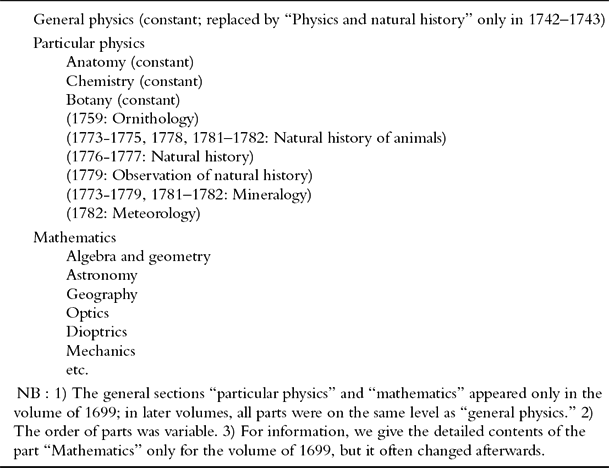
We find similar divisions in the ninety-three volumes annually published by the ARS from 1699 to 1790. Each of them comprised two parts: a general presentation by the secretary of the activities of the year (Histoire de l'Académie Royale des Sciences: hereafter HARS), and a collection of papers written by the members (Mémoires de Mathématique et de Physique, tirés des Registres de l'Académie Royale des Sciences: hereafter MMP). Whereas the MMP were presented in no particular order, the HARS was thematically organized (until 1782) and divided into several parts which partly matched up with the structure of the Academy, including sections on “anatomy,” “botany,” and “chemistry.” These three categories constituted “particular physics.” In principle, they offered a framework for all research on plants, but only for studies on animals limited to anatomy and chemical analysis. However, they were supplemented by two others which did not correspond to classes but were, to some extent, acknowledged by the institution, and which could include, among other things, works on animals: “general physics” and “natural history” (see Table 1).
Sections of the HARS and their evolution from 1699 to 1782 (afterwards the HARS was no longer organized according to disciplines).

The section devoted to “general physics” constantly appeared in the HARS from 1699 to 1782. The sense of this expression was not very clear, and the adjective “general” was ambiguous: the contents of this section suggested that it did not mean more universal questions than those dealt with in “anatomy” or “botany,” but rather a diversity of studies on natural things whose only commonality was to be non-mathematical and not to fall into the categories “anatomy,” “botany,” or “chemistry.” This category “general physics” contained some works on animals (mostly invertebrates: ant-lions, “insects of orange trees,” spiders. . .) or animal productions (silk, wool. . .), but also on minerals, metals, or physical phenomena such as light, heat, or magnetism. Thus, at the ARS “general physics” seemed to be a default category, whose outline was vague. But, more generally, this vagueness concerned the notion of “physics” itself, at the ARS as elsewhere. If we consider other classifications in contemporaneous publications, we find that this notion too was either poorly defined, or defined in various ways, combining descriptive with explicative elements (i.e. “history” and “physics” in the Baconian sense), more or less mixed up with “natural philosophy”Footnote 6 or “experimental philosophy,”Footnote 7 and sometimes separated from mathematical sciences (as at the ARS), sometimes connected to them.Footnote 8 Its definitions in dictionaries were rather vague,Footnote 9 and its scope was variable: sometimes it was a huge corpus of (possibly experimental) knowledge on nature, including, among other sciences, botany, anatomy, and chemistry, as well as medicine. But it could also have a more limited meaning and apply only to the part of the knowledge on nature that belonged neither to mathematics nor to any well-defined discipline. Thus, “physics,” as well as “general physics,” offered a possible framework for various non-anatomical studies on animals, but a very unspecific one.
Another category partly devoted to animals, “natural history,” sometimes appeared as a section in the HARS after 1770.Footnote 10 Natural history was a successful field at that time (see e.g. Mornet Reference Mornet1911; Gillispie Reference Gillispie1980; Bedel, Hahn, Laissus and Torlais Reference Bedel, Hahn, Laissus and Torlais1986; Ehrard Reference Ehrard1994; Jardine, Secord, and Spary Reference Jardine, Secord and Spary1996; Spary Reference Spary, Clark, Golinski and Schaffer1999, Reference Spary2000), and it had a more precise scope than physics. However it too presented ambiguities. First, in practice, it did not always respect the Baconian distinction since it often included explanatory as well as descriptive elements (for example in Buffon: see section 4); in that respect, natural history was not so different from “physics.” Second, its spectacular development in the eighteenth century resulted, in large part, from the work of amateurs and collectors. It ended up being more or less acknowledged by most scientific institutions in the last decades of the century, but this process was long and difficult, because some scientists considered natural history too general and not scientific enough. For that reason, the first attempt to create a class of natural history at the ARS failed in 1773 (Spary Reference Spary, Clark, Golinski and Schaffer1999, 273–274). Third, whereas, in principle, natural history should have dealt with animals, plants, and mineral equally, such was not the case, and when this category appeared in the organization of institutions or scientific publications, it was more often devoted to plants or minerals than to animals. Significantly, when a class of natural history was eventually created at the ARS after the reform of 1785, it was named “Histoire naturelle et minéralogie,” and all but one of its members worked on mineral substances.Footnote 11 A similar evolution took place in the late eighteenth century in other French scientific institutions, where “natural history” generally consisted of botany and mineralogy rather than zoology.Footnote 12
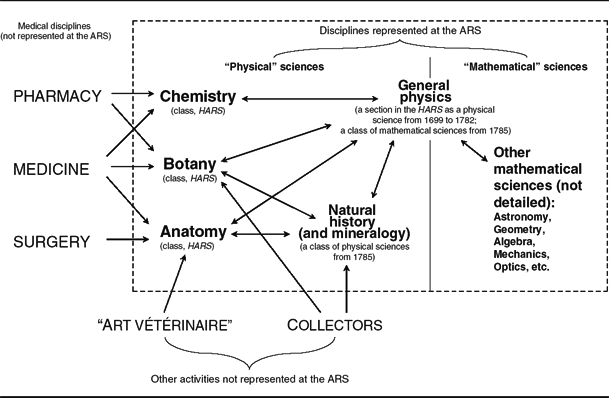
The sciences and their relationship at the ARS is represented in a diagram that shows the framework in which knowledge and research on animals had to fit (see Table 2). Three traditional disciplines (anatomy, botany, and chemistry) constituted a basis for non-mathematical research throughout the century. They did not correspond to Baconian categories but were, above all, legacies from earlier periods, since anatomy, botany, and chemistry had been developing and gradually acquiring autonomy since the sixteenth century, within or on the fringe of medicine, surgery and pharmacy, around relatively well defined objects and methods. In this schema, there was a strong dissymmetry between plants and animals. All kinds of studies on plants (observations on morphology or internal structures, experiments on physiological functions, classification, medicinal properties, etc.) fell within one and the same comprehensive science of plants, namely, botany.Footnote 13 By contrast, there were no such centripetal tendencies among studies on animals, which were broken up and incorporated in several fields where animals were never the main focus. Some of them could be undertaken within the scope of anatomy, that is, a field limited to certain approaches (dissection) and originally devoted to the description of the internal structures of the human body. In addition, two fields could provide a framework for research on animals that did not come within anatomy: physics (or the part of physics called “general physics” until 1785) and natural history; but both were very general, including a great diversity of knowledge and research on the whole of nature, and their scope and limits were rather vague and changing. Thus, until the late eighteenth century, there was no formally designated or autonomous discipline embracing all research on animals at the ARS, nor even a discipline specifically devoted to one kind of study on animals.Footnote 14 And the ARS was, in that respect, representative of the situation in all scientific institutions in France and in Europe.
Disciplines represented at the ARS and their main connections with each other and with others. Three main “physical” sciences (anatomy, botany, and chemistry) were present throughout the century as classes of the ARS and sections in the HARS. New classes of “general physics” and “natural history and mineralogy” were created in 1785. “General physics” had an ambiguous status: after 1785 it was considered a “mathematical science,” but in earlier volumes of the HARS it was separated from mathematics as a “physical science.”
There were multiple reasons for this contrast between the scientific status of plants and animals (Daudin Reference Daudin1926a, 48–58; Stroup Reference Stroup1990, 66–67; Ogilvie Reference Ogilvie2006, 49–51). First, plants had more pharmacological importance than animals, and the number of known plant species had increased more dramatically than the number of known animal species since the sixteenth century: there was more need for methods of identifying and classifying plants, which led to the emergence of botany as an independent field. Second, while plants could very easily be grown in gardens, collected and studied by everybody, it was far more difficult, time-consuming, and expensive to do research on and collect animals (except perhaps insects). Given the importance of the role of amateurs and collectors in the development of the natural sciences in the Enlightenment, this difference contributed to accentuating the imbalance. Third, since man could be considered an animal to some extent, many investigations on animals could be applied to humans. This was undoubtedly an important factor in the development of zoological studies; but, at the same time, every field potentially concerning animals tended to be engulfed by investigations on human beings, which made it difficult to conceive an autonomous science of animals where man would not have been central.
As a consequence, whereas every Academician working on plants in the eighteenth century was considered a “botanist,” one who studied an animal could be referred to as an “anatomist,” a “physicist,” or a “naturalist,” not a “zoologist” (even if the term existed). The knowledge of animals was always subordinate to other kinds of knowledge. In that respect, Perrault's program was not perpetuated, at least from a formal and institutional standpoint.
However, there was a lot of research concerning animals at the ARS throughout the eighteenth century. It is, thus, interesting to analyze the contents of these concrete works, and to examine how they could have developed in such a context, what scientific status animals could assume in the absence of any specific science for animals, and what significance anatomy could have had in the different traditions of research.
3. The Different Kinds of Studies on Animals in the MMP, 1699–1790
Since the different kinds of investigations on animals undertaken at the ARS were scattered into different disciplines, we consider in this section the nature of these investigations, we establish a descriptive typology of them, and we compare it with the formal organization of sciences in order to make sense of the structuration of zoological knowledge and its scientific consequences. Our method consists of analyzing the papers concerning animals published in the MMP from 1699 to 1790 systematically and quantitatively, and classifying them according to their approaches, their methods, the professions of their authors, and the status they gave to animals. Even though some works presented by Academicians at the meetings of the society were not published,Footnote 15 or only mentioned in the HARS, or published separately (e.g. Réaumur's Mémoires pour servir à l'histoire des insectes), the MMP are quite representative, qualitatively as well as quantitatively, of the scientific activities at the ARS throughout the eighteenth century. Thus, this analysis enables us to identify different traditions of studies on animals at the ARS and to determine their significance and their evolution, especially as regards the anatomical studies and the rise of comparative anatomy in the late eighteenth century.
All mémoires totally or partially dealing with animals in the ninety-three volumes of the MMP have been listed and analysed (see Table 3).Footnote 16 Our first observation is that, out of 3406 mémoires published from 1699 to 1790, 269 (i.e. 7.9 percent) somehow related to animals.Footnote 17 This number is rather low since, by comparison, 295 papers (8.6 percent) were devoted to plants, and 353 (10.4 percent) to man.Footnote 18 Furthermore, in many of these 269 papers, animals were not the main topic and just represented models for human beings (see below). If we consider periods of five years, there are some noticeable variations (e.g. 10–15 percent of papers on animals between 1745 and 1760), but we do not find any clear evolution throughout the century. This constant underrepresentation of animals in the works of the Academicians may be connected to their ambiguous position in the organization of knowledge in the ARS, as explained in the previous section.
Papers of the MMP partially or wholly devoted to animals. First column: year, number of the first page and name of the author(s) (*: physicians; **: surgeons; ***: apothecaries). Second column: category of the paper according to the HARS up to 1782: A: anatomy; B: botany; C: chemistry; G: geography; HN: natural history; HNA: natural history of animals; M: mechanics; O: optics; PG: general physics; PHN: physics and natural history; brackets mean that the HARS does not make explicit reference to the mémoire (because of an oversight, or because the author is a member of the Société Royale des Sciences de Montpellier, a contribution of which was regularly published at the end of the MMP) and that we have suggested a category by comparison with other papers in the same volume. Third column: category in our taxonomy.
Apart from some noteworthy exceptions, such as Réaumur (who had studied philosophy, civil law and mathematics, and was the author of 36 of these mémoires), the studies on animals were dominated by physicians and other health professionals. Among the 76 authors involved in these studies, 35 (46 percent) were physicians, 10 (13 percent) surgeons, 6 (8 percent) apothecaries, and 25 (33 percent) had other training (Anon. 1979; Sturdy Reference Sturdy1995).Footnote 19 This is not a surprise, since the faculties or schools of medicine, pharmacy and surgery were the main places where biological knowledge was taught, and the results are similar if we consider studies on plants. What is more astonishing is that this domination became a little stronger in the last four decades of the ARS: from 1751 to 1790, 77.5 percent of papers on animals were written by physicians (66 percent), surgeons (7.5 percent), or apothecaries (4 percent). This point is not uninteresting: in the second half of the eighteenth century, whereas many people with no medical training played an important part in the development of sciences such as natural history in and out the ARS, those people seem to have been proportionally less interested in animals than before 1750, and they preferred to study other natural productions (plants or minerals) or phenomena.
Whereas nearly all papers on plants were referenced as “botany” in the HARS (and, in turn, all papers referenced as “botany” dealt with plants), papers on animals were distributed into several categories (see Table 3, second column): more than half of them were included in “anatomy” (they represented 41 percent of the papers classified in this category), about a quarter in “general physics” (where they were a minority) or in “natural history” after this category was introduced in 1773.Footnote 20 Thus, most animal studies were considered either “anatomy,” whatever their contents might be (not necessarily “anatomy” in modern sense, as we shall see), or, to a lesser extent, “general physics;” but they were in the minority in both categories.
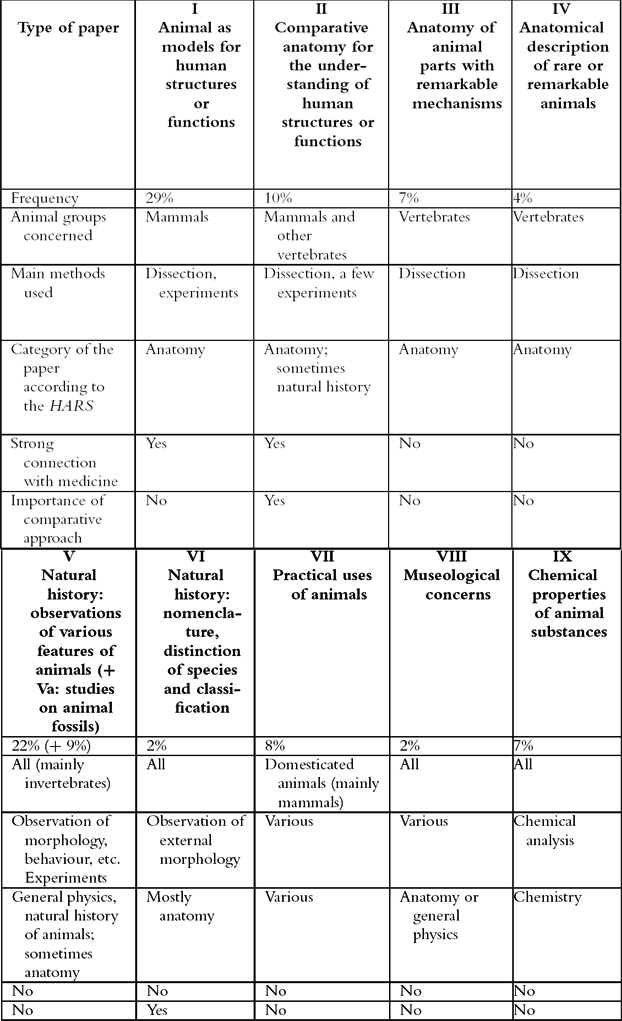
However, the concrete contents of the 269 papers on animals suggest an alternative taxonomy, depending on several criteria: the status of and the role played by animals in each mémoire, and its aims, methods and approach. We can distinguish thus nine types (see Table 3, third column, and Table 4) representing the organization of works on animals at the ARS.
Different types of papers devoted to animals in the MMP, and their characteristics. Elements of Perrault's programme can be found in types III and IV, and, to a lesser extent, in type II.
In the first type, animals are studied as mere models or guinea-pigs for the understanding of a human structure, function (circulation, digestion, secretion, etc.) or dysfunction (illness, injury, malformation, etc.).Footnote 21 An example is the “Mémoire dans lequel il est démontré que les nerfs intercostaux fournissent des rameaux qui portent des esprits dans les yeux” by the physician François Petit (MMP 1727, 1–19). This paper observes anatomical features of human corpses, dead wolves, dogs, cats, oxen, and sheep, and combines these observations with experiments of nerve severing in living dogs; but its main aim is to acquire knowledge on the human being and to determine the course and function of certain human nerves, which is interesting from a surgical standpoint, in particular for the removal of cataracts. The author is by no means interested in animals themselves: they just replace man, on whom observations or experiments would have been impossible or very difficult. Papers of this kind have, above all, medical purposes, and most of them (84 percent) are written by physicians or surgeons. The methods used in them are dissection, vivisection, and other experiments.Footnote 22 These mémoires are mostly categorized as “anatomy” in the HARS, even when they do not focus on anatomical structures: they include, for example, research on surgical procedures or methods of treatment.Footnote 23 This shows the significance of anatomy in the mechanistic paradigm prevailing in the life sciences since the late seventeenth century: human and animal bodies are seen as machines whose functioning can be understood just as we can understand how a clock works, namely, by describing its components. Every study on normal physiological functions or on medical practice can be, at least virtually, reduced to the study of organs. Furthermore, underlying all type-I papers, is the old and common, although rarely expressed, notion that, when they are considered as machines, animals are so similar to humans that the results obtained from the former can be immediately extrapolated to the latter. Here possible differences are neglected and remain unquestioned. Since the animal has to be rather close to man, it is generally a mammal; but the species by itself has little, if any, importance. Sometimes it is not even indicated by the author, who just writes that he has done an observation or an experiment on “an animal,” without any further information (e.g. Duverney in MMP 1700, 199). This type I is by far the most frequent (29 percent) of all papers on animals in MMP, even if this proportion decreases a little after 1770 (only 17 percent for the period 1771–1790). The most common status of animals at the ARS was thus to be a mere substitute for man, which fell within a tradition well-established in medicine since Antiquity.
Papers of the second type also aim at understanding structures and functions of the human body by dissecting animals. However, in these studies animals are considered, not only because of their similarity with man, but also because of the differences in their organization. For example, Duverney dissects many animals, including tortoises, in order to make sense of the circulation of blood in the human foetus (“Observations sur la circulation du sang dans le fœtus: et description du cœur de la tortue et de quelques autres animaux,” in MMP 1699, 227–274): the analysis of common and different characteristics throws light on the mechanism of respiration and circulation both in man and animals. Thus the comparison is more complicated than in the type I: Duverney establishes a correspondence between the whole heart of the tortoise and the left ventricle of man, so that extrapolation is not immediate. Similarly, in the study of the horse stomach by Lamorier (MMP 1733, 511–516) and Bertin (MMP 1746, 23–54), both authors try to understand why vomiting cannot happen in horses, not only because it is of interest for veterinarian surgeons, but, above all, because “knowledge of the causes preventing horse from vomiting can contribute to establishing the causes of vomiting in man” (Lamorier in MMP 1733, 511). In other cases, some hard-to-see structures in man appear much clearer in other species where they are proportionally larger or differently conformed. This idea that the study of differences in animal anatomy can be helpful in understanding human beings is not unusual,Footnote 24 but it is particularly often expressed in type-II papers, as if to justify such anatomical studies on animals when their medical interest is not as obvious as in type I.Footnote 25 Indeed, even though the ultimate aim of type-II mémoires is to acquire knowledge on man (all their authors are physicians or surgeons), they tend to become more independent from medicine, and anatomical comparison tends to be undertaken for itself as well as for medical purposes. For example, in Vicq d'Azyr's papers, human anatomy is used as a point of reference, but the accent is put on the specificity of animal structures very different from their human counterparts. The comparative approach is carried out much further in type-II than in type-I papers: while in the latter, animals are seen as perfect (or almost perfect) substitutes for human beings, and similarity is emphasized without any discussion, the former rely on dialectics between similarities and differences. As a consequence, the scientific status of animals is higher in type-II papers, which attach more importance to the nature and the diversity of the studied species. Sometimes one single animal is chosen because of a specific feature (e.g. absence of vomiting in horses), but these mémoires often concern more diverse animals than the type I, their variety being precisely a source of knowledge: in 1726 and 1730, Petit describes the eyes of many quadrupeds, birds, and fishes; in 1753 Hérissant compares voice organs in many birds and quadrupeds, etc.
From a quantitative standpoint, this type was less represented in the MMP than type I: about one-tenth of papers on animals from 1699 to 1790 belonged to it. However, it was constantly present throughout the century, and its proportion became significantly higher after 1770 (24 percent from 1771 to 1790), essentially because of the numerous publications of Vicq d'Azyr. Furthermore, unlike studies of the type I, which were as frequent in the MMP as in other academic publications, type II seems to have been more specific to the ARS.
Type II was important historically, at least for two reasons. First, it was far richer than type I regarding the emergence of new concepts, since its true comparative approach led to a lot of reflection on the nature of similarities and the laws of anatomical variation through different species. Second, as to the history of scientific disciplines and the organization of knowledge, it corresponded to the tendency of some scientists who, following Perrault's example, tried to make comparative anatomy independent from human anatomy and to establish a link between it and natural history; this tendency existed in the first part of the century, but it increased after 1750, in particular in the work of Daubenton and Vicq d'Azyr (see Schmitt Reference Schmitt2009). Thus it played a major part in the building of an independent comparative anatomy in the late eighteenth century. The labelling of type-II papers in the HARS reveals that people were aware of this disciplinary evolution at the ARS since such papers were always classified as “anatomy” until 1772, but some of them were considered “natural history” afterwards, not without some inconsistencies.Footnote 26
The third type corresponds to papers where single structures or functions of given animals or animal groups are described in order to understand how they work, for instance the respiration of fishes (Broussonet in MMP 1785, 174–196) or the digestion of birds (Réaumur in MMP 1752, 461–495). Sometimes they focus on some remarkable property: for example, Mery studies the unusual structure of the tongue and hyoid apparatus of the woodpecker, whose mechanisms enable this bird to search for insects in long holes in wood; he gives an accurate description of it and tries to understand how it works (MMP 1709, 85–91). Other more or less curious adaptations are examined in a similar way, such as the eyes of owls (Petit in MMP 1736, 121–146) or the gut of the cuckoo (Hérissant in MMP 1752, 417–423). Such studies use dissection and experiments, and, unsurprisingly, they are almost always classified as “anatomy” in the HARS.Footnote 27 Like the previous types, they rely on a mechanistic conception of vital functions, but, unlike them, they are completely freed from medical considerations: here animal structures are studied per se, not in order to learn something about man; no connection is established with corresponding organs in humans, but they are considered interesting by themselves. There can be an incidental utility for medical purposes (e.g. in Morand's study on the sucking devices in leeches in MMP 1739, 189–197), but it is by no means necessary. Indeed, if the authors of type-III papers are mainly physicians (55 percent) and surgeons (20 percent), medical professions are not as dominant as in the types I and II. Another important difference between types I and II on the one hand and type III on the other hand, is that in the latter there are few if any comparisons between species. Each species or group is studied for itself, and what is emphasized here is its singularity. Petit writes, for example: “I dissected owl eyes with no other intention but to show some distinctive features that are not in other birds” (MMP 1736, 121). As a consequence, a greater diversity of animals is studied than in types I and II, some of them being chosen because they are uncommon or exotic.
Studies of this kind were published at the ARS throughout the eighteenth century, even if they were always in the minority (only 7 percent of papers on animals). Their historical significance is threefold. First, they were partly similar to Perrault's program as presented in the Essais de Physique, and corresponded more or less to the tradition of anatomical works on animals that considerably developed in Europe in the mechanistic context of the last decades of the seventeenth century and waned after 1690 (see section 1); thus they were, in a sense, a continuation of this tradition during a period when it could appear outdated as compared to other approaches such as Réaumurian studies (see below). Second, they represented a field even more centered on animals, farther from mere human anatomy, and closer to the general sciences of nature (“general physics” or natural history: see section 2) than type II. Third, from a conceptual standpoint, they involved an explanatory as much as a descriptive dimension, and they promoted a functional interpretation of anatomical structures, whereas type II focused rather on morphology per se: this foreshadowed future tensions, since the pre-eminence of form versus function would be a major factor in the development of different trends in comparative anatomy from the late eighteenth century (Russell Reference Russell1916; Appel Reference Appel1987).
Type-IV papers are complete or partial descriptions of the external and/or internal parts of a given animal species, or even of a single individual. In this type, there are few if any comparative or functional considerations: animal structures are described just for themselves, because they are remarkable or still poorly known, not in order to understand how they work or to compare several species in that respect. For example, in the “Description anatomique d'un animal connu sous le nom de musc” (MMP 1731, 443–463), La Peyronie examines an African animal offered by Maurepas to Louis XV which lived for several years in the royal Menagerie; he briefly observes the external morphology, and describes more carefully the organ that secretes aromatic substances. Like this “musc,” the animals studied in type-IV papers often belong to exotic species (e.g. American beaver, hippopotamus. . .) which are not very often seen in Paris. In some cases, these are European wild species whose organization has not been described accurately enough in the extant literature (e.g. mole, carp). Such mémoires are almost always classified as “anatomy” in the HARS,Footnote 28 and all their authors but one are physicians or surgeons. Their main subjects are morphology and anatomy and their main methods are mere observation and dissection. However, they sometimes give other information, for instance on behavior, hunting, or utility for man; the relationship between different species and questions of classification can even be broached a little. So they are closer to natural history and type-V papers (see below) than are type-III.
These studies share many features with Perrault's program, particularly with the part of it corresponding to the Mémoires pour servir à l'histoire naturelle des animaux. In both cases we find at work the patronage system that links the ARS with the French monarchy, since many animals are supplied by the royal Menagerie, or come from French colonies: for example, Sarrazin, a French surgeon in North America, sends mémoires on beavers, muskrats, and porcupines (MMP 1704, 48–65; 1725, 323–345; 1727, 383–395). Thus, type-IV papers in the MMP, such as Perrault's Mémoires, recall the influence of France in the world. But they also share an original scientific aim, namely, a mere descriptive anatomy which is conceived as a natural history of animals. This point is historically important since, just as type III preserved one part of Perrault's program (i.e. functional explanatory anatomy of animals) at the ARS throughout the eighteenth century, type IV perpetuated the other part of the same program (i.e. descriptive anatomy of animals), and both of them suggested a connection between natural history and anatomy when the official framework did not. Even though type-IV papers were rather few (4 percent of papers on animals in the MMP), they contributed to avoiding the complete disappearance of this tradition of research specifically devoted to animals between the collapse of Perrault's program after 1690 and the emergence of new projects (e.g. Daubenton's) in the mid-eighteenth century.
Type-V mémoires are more various since they deal with a greater diversity of topics concerning animals, including external morphology, behavior, reproduction, secretions, and animal productions; one single paper generally contains many of these aspects.Footnote 29 However, they have a number of features in common: above all, they rely on mere observation of nature and refuse any research of causes: in that respect, they correspond to a tradition of natural history in the Baconian sense, very successful in the eighteenth century and most famously represented at the ARS by Réaumur's works (on Réaumur's conception and approaches of natural history, see Terrall Reference Terrall2014). Besides the six volumes of his Mémoires pour servir à l'histoire des insectes (1734-1742), Réaumur published several papers of this kind in the MMP. For example, in his “Histoire des Guespes” (MMP 1719, 230–277) he describes the body of the wasp as well as different aspects of its life, such as diet, nesting habits, or reproduction cycle. He does not try to explain these phenomena but just to depict them. The main method involved in papers of this kind is observation (sometimes done out in the field, or made easier by special devices, such as the “glass hives” used by Réaumur), more rarely dissection or simple experiments. Type-V mémoires can include a little anatomy, but, unlike all previous types, it is not quite central here. Similarly, nomenclature and classification are minimally treated (a difference from type VI): in his “Histoire des Guespes,” Réaumur deals with this question very briefly and just gives a cursory classification of wasps according to the feature he is the most interested in (namely, the form of nests). Utility for man is sometimes examined (for example, papermaking in the above mentioned mémoire by Réaumur, or the purple dye substance of murex in another contribution by the same author in MMP 1711, 168–198), but it is not the main purpose here (unlike type VII). Another frequent dimension of these papers is the notion of “curiosity” or “wonder”: morphological or behavioral adaptations of insects, for example, are often admired with a flavor of natural theology. In that respect too, type-V papers are closely connected with a broader popular trend in natural history in the eighteenth century, of which they represent, as it were, the most scholarly component if compared with publications for the general public such as Pluche's Spectacle de la nature or Lesser's Théologie des insectes.
These type-V mémoires are well represented in the MMP throughout the eighteenth century, and are almost as numerous as those of type I (22 percent of papers on animals in MMP). Furthermore, other similar works undertaken by members of the ARS and published independently (e.g. Réaumur's Mémoires pour servir à l'histoire des insectes) show that this kind of study was favored in the institution. They attest to the success of this tradition of natural history which is at the meeting point of the general interest in nature and its curiosities, the Baconian/empiricist approach of natural phenomena, the providentialist interpretation of biological adaptations, and the quest for new ways of exploiting nature. They belong to the vast fields referred to as “general physics” and “natural history,” which are independent from medicine and, to a lesser extent, from anatomy.Footnote 30 Two-thirds of these papers were written by people who were neither physicians nor surgeons and only one quarter by physicians.Footnote 31 As a consequence of their independence from any purpose of comparison with man, we find in this type V a greater variety of species than in the previous types, in particular “lower” animals such as arthropods.
As regards the approach to animals, the field represented by type-V papers was the most comprehensive. When compared to others, it alone included knowledge on every aspect of animal organization and life. It was able to give rise to research programs specifically devoted to animals, freed from medicine, not focused on anatomy but dealing with morphological as well as behavioral features, and concerning all groups. Réaumur's important work on insects and other arthropods was an illustrative example of such programs. However, in spite of their great success, they were never united into a consistent science on animals, neither institutionally nor conceptually. One reason for this was that they lacked epistemological ambition since they neglected causes and rejected general views (unlike, for example, the search for mechanistic explanations in types II-III, or the search for an order of nature in type VI). Furthermore, they were thematically scattered, and people who undertook such studies, such as Réaumur himself, were generally interested in many other topics besides animals. Lastly, they were challenged by another tradition in natural history, represented by Linnaeus and his followers, whose program was more precise and more ambitious.
This Linnaean tradition is represented in the MMP by our type VI. It corresponds to taxonomy in the largest sense, including the identification and nomenclature of species and the definition of higher groups in order to establish a classification of natural objects (animals, plants, and minerals). This approach has very little success at the ARS: this contrasts strongly with the development of such questions in Europe and their importance in other academic journals from the 1740s. It expresses resistance to artificial classifications (especially the Linnaean system) at the ARS and, more generally, in France in the eighteenth century (Stafleu Reference Stafleu1971; Duris Reference Duris1993; Stevens Reference Stevens1994). The most famous attack comes from Buffon (1749-1767, vol. 1, 1–62), but many non-Buffonian scientists such as Réaumur are also suspicious about this conception of natural history and develop other approaches corresponding to our type V. Only six type-VI papers can be found in the MMP from 1699 to 1790; furthermore, they do not deal with all aspects of systematics, but they focus on nomenclature and microtaxonomy. For example, in his works on bats and shrews (MMP 1756, 203–213; 1759, 374–398), Daubenton gives a very detailed description of these animals in order to distinguish between previously confused species and to give a complete list of those present in France, but he does not attempt to establish connections with other kinds of animals. Only Guettard is interested in higher levels of classification and proposes new criteria to classify shells (MMP 1756, 145–183). The method of type-VI mémoires is mainly the observation of external morphology, and the comparison of different species. Apart from the paper by Guettard mentioned above (which is referred to as “general physics”), they are mostly classified as “anatomy” in the HARS, although they do not deal with anatomy in the strictest sense, which shows that this tradition hardly represents “true” natural history or physics according to the Academicians.
Animals are no more central in the Linnaean than in the Réaumurian conception of natural history. Not only does this tradition concern all natural objects and aim at a general knowledge of the natural system, but it was originally developed by botanists, like Linnaeus himself, so that the classification of plants remains much more advanced than the classification of animals until the late eighteenth century. Thus, it does not give rise, by itself, to the emergence of a science of animals. However, it becomes so successful in the last decades of the century that it plays an important part in any attempt to reform all the life sciences, including those concerning animals. In particular, the establishment of a connection between anatomy and classification is at stake in the programs of Vicq d'Azyr and Cuvier, which both aim at bringing together the search for a natural order and the structural comparison of organisms (Daudin Reference Daudin1926b; Duris Reference Duris1993; Spary Reference Spary2000; Corsi Reference Corsi2001).
We have identified three other minor types of mémoires concerning animals in the MMP, but they are of peripheral interest for our purpose. In type VII (8 percent of papers on animals), animals are viewed only as sources of raw materials or energy. These papers aim at improvement of the economical exploitation of animals by finding new techniques for their breeding, for using their force, increasing, preserving, or working their productions (e.g. pigments, wool, or silk). Unlike other types (especially I and V), where such utilitarian considerations are sometimes present, but always in association with the observation and/or understanding of some properties of animals, this kind of study focuses on purely practical questions for different trades and crafts. A few veterinary studies belong to this type. As to type-VIII mémoires (2 percent of papers on animals), they have museological concerns and present techniques for preserving samples in collections of natural history or anatomy.Footnote 32 Lastly, type-IX papers (7 percent) belong to chemistry: animal substances (like blood or urine) are analyzed in the same way as any other substance, sometimes with pharmacological considerations, and/or connections with physiological questions such as respiration.
In spite of its inaccuracy in a few cases,Footnote 33 this classification gives a good idea of the different traditions of research more or less concerning animals at the ARS. Apart from types VII to IX, these studies on animals were organized in the following way. Quantitatively, the most important ones were by far types I and V, namely, traditional medico-anatomy, of which the main object was the structures and functions of man, and Réaumurian natural history, which dealt with the mere observation of all natural objects and phenomena. This corresponded to the situation described in the previous section and prevailing in all scientific institutions in Europe since the late seventeenth century: most animal knowledge was torn between these two fields, which were not specifically devoted to it. Beside this, the Linnaean conception of natural history (type VI) was strongly underrepresented at the ARS, which exemplifies the difficulties this tradition encountered in France in comparison with the rest of Europe. Meanwhile, there was a series of anatomical works more specifically devoted to animals (types II to IV). They were quantitatively a minority in the MMP, but constantly represented at the ARS during the eighteenth century and formed, as it were, a bridge between types I and V, i.e. between traditional (human) anatomy and natural history.
This “bridge” played an important part in the constitution of a new science of animals since it permitted the preservation of a field that was, at least partially, freed from medicine and pure human anatomy as well as natural history in the common contemporary sense, and centered on animals. In that respect, the role of the ARS was all the more important since these kinds of anatomical studies focused on animals were less represented in other scientific institutions in France and in other countries until the late eighteenth century.Footnote 34 One possible reason for this is that such works required financial resources as well as the possibility of getting a great number and variety of living or dead animals: such facilities could be supplied by the ARS itself and by the relationship between this institution and other royal foundations such as the collections of the Jardin du Roi,Footnote 35 or the Menagerie of Versailles. But another reason was the precedent of Perrault's program. Indeed, works belonging to types II, III, and IV corresponded to different elements of this program, and they continued it throughout the eighteenth century. Thus, they represented not only a synchronic bridge between the two disciplines of anatomy and natural history, but also a diachronic link between works undertaken at the ARS before 1690 and the rise of comparative anatomy at and around the same ARS after 1750. The anatomical descriptions of Perrault and his colleagues, although uncompleted, remained a model for diverse ways of doing animal anatomy, and they provided these studies with the framework that institutions and the official organization of knowledge did not. They were republished in 1733 and 1758 (Guerrini Reference Guerrini2012), and many papers produced at the ARS were clearly inspired by them, not only in the MMP, but in other publications of the ARS such as the so-called Recueils des Savants étrangers, where French or foreign scientists, not (or not yet) members of the Academy, could bring out papers, some of which corresponded to our types II-IV (see e.g. Geoffroy Reference Geoffroy1755; Süe Reference Süe1755).Footnote 36 By keeping alive an autonomous tradition of research on animal anatomy in a context where such studies were not favored by the disciplinary or institutional organization of knowledge, the ARS made it available for new developments from the mid-eighteenth century, when new conditions and new demands emerged. One of the most important of those developments was the program of Vicq d'Azyr, a physician and member of the ARS who tried to reorganize all biomedical sciences around comparative anatomy after 1770, by using elements of the anatomical tradition at the ARS as well as the Linnaean approach (Schmitt Reference Schmitt2009). But Vicq d'Azyr also had the example of an ambitious research program on animals that was undertaken from the late 1740s by two Academicians, Buffon and Daubenton.
4. Zoological Studies around the ARS: The Status of Animals and Anatomy in Buffon and Daubenton's Histoire naturelle
In addition to the MMP, many works concerning animals were published separately by members of the ARS throughout the eighteenth century. Most of them can be related to one of the types described in the previous section: for example, as we have seen above, Réaumur's six volumes of Mémoires pour servir à l'histoire des insectes (1734-1742) correspond to our type V and show the success of this kind of natural history characterized by pure observation, a focus on external morphology and behavior, with some interest for practical applications and a touch of natural theology. Réaumur wrote these books as an Academician, he had them officially approved by the ARS and they were viewed as an extension of the works he published in the MMP (long summaries of them appeared in the HARS). But another more original work was written close to the sphere of influence of the ARS, namely, Buffon and Daubenton's Histoire naturelle. Although this work was not published under the patronage of the ARS, it had connections with it since the authors were Academicians and both of them, particularly Daubenton, were inspired by the tradition of studies on animals that had emerged in this institution in the late seventeenth century; as a matter of fact, as we shall see, their work can be interpreted to some extent as a development of Perrault's program. This point is all the more interesting since the Histoire naturelle is often considered emblematic of the advances in zoology in the eighteenth century. Indeed, it was one of the most significant and influential works in natural history in the Enlightenment, and its zoological part was overwhelming: out of the 44 volumes of the first edition, 32 were devoted to animals.Footnote 37 Furthermore, many of Buffon's most famous texts concerned animals (the horse, the dog. . .), and the lavish zoological illustrations of the numerous complete or partial editions (including extracts for young people) had a great impact on the visual culture of a variety of audiences. Not surprisingly, thus, Buffon's books came to eclipse other zoological works of the eighteenth century, and they probably contributed to revitalizing the study of animals in the scientific context.
There are some common points between Perrault's Mémoires pour servir à l'Histoire naturelle des Animaux and the Histoire naturelle. In fact, the very project of the latter was more or less inspired by Perrault's example: when the minister Maurepas made Buffon intendant of the Jardin du Roy, in 1739, he put him in charge of cataloging the collections of the Royal Cabinet and publishing lavish volumes on them (Roger Reference Roger1989). This implication of the government in Buffon's enterprise was very similar to the king's (and Colbert's) support to the Academicians in the 1660s. In both cases, the main aim was to enhance the prestige of the monarchy by publishing beautifully illustrated volumes that would show the richness of the royal collections and the munificence of royal patronage. Buffon's conception of his work evolved, and the Histoire naturelle was eventually far more ambitious than a simple catalogue, but the initial aim remained, at least in the first series, the Histoire naturelle, générale et particulière, avec la description du Cabinet du Roi (Buffon and Daubenton 1749–1765).
These first fifteen volumes were devoted to general topics such as the theory of the Earth or the reproduction of man and animals (Vols. 1–2), as well as the natural history of man (Vols. 2–3), and viviparous quadrupeds (Vols. 4–15). In these twelve volumes on quadrupeds, there were contributions by Buffon and Daubenton: for each species, a general chapter (“History”), by Buffon, expounded various aspects including morphology, life and behavior, with some philosophical considerations, while two other parts, by Daubenton, dealt with the anatomy and the description of the corresponding objects in the collections of the Jardin du Roi (i.e. the initial aim of the Histoire naturelle). Daubenton's contributions were considerable, quantitatively, since they represented more than half of the text of volumes 4 to 15. From a scientific standpoint, Buffon left him relatively autonomous, so that he could develop his own approach quite freely. Interestingly, thus, we find juxtaposed in the Histoire naturelle two conceptions of the science and the status of animals: Daubenton perpetuated and renewed the tradition of animal anatomy initiated by Perrault, so that he focused on animals, whereas Buffon had a different, more grandiose aim.
Indeed, Buffon did not attempt to build an autonomous science specifically devoted to animals. Rather he tried to reorganize the sciences of nature completely and to place natural history at the center of all knowledge (see the “Premier Discours” by Buffon, in Buffon and Daubenton 1749–Reference Buffon and Daubenton1767, vol. 1, 1–62, and Schmitt's introduction to this text in Buffon 2007–Reference Buffon2014, vol. 1, 14–69). He represented, as it were, a critical synthesis of several trends in natural history. On the one hand, like Réaumur, he took on the Baconian legacy, he acknowledged the necessity of making accurate observations on a diversity of animal characteristics (including behavior) and avoided pure speculation; but, unlike Réaumur, he did not reject general views, he strove to find physical causes acting in the whole of nature, and refused simple teleological explanations. On the other hand, he shared with the Linnaeans the pursuit of an order of nature, but he harshly criticized their systems of classification, considering the criteria they used artificial and arbitrary, and he attempted to determine true physical relationships between organisms. For instance, an important part of his program consisted of defining biological species and studying their potential variations in response to different factors.
The approach and ideas promoted by Buffon had a great influence on the development of the life sciences in general. For example, they incontestably played an important part in the emergence of evolutionary theories, since such themes as the historical conception of nature, the variability of species, the effects of climates or nutrition on organisms, etc. favored transformist views (even if Buffon himself was quite cautious in that respect: see e.g. Farber Reference Farber1972; Bowler Reference Bowler1973; Sloan Reference Sloan1976, Reference Sloan1979, and 1987). More specifically, the huge work achieved by Buffon on animals influenced later zoological sciences. In particular, the focus on behavioral or biogeographical topics (instead of pure morpho-anatomy), especially for taxonomy and the definition of species, contributed to offering new perspectives for research on animals from the late eighteenth century. However, from the strict standpoint of the status of animals in the natural sciences, Buffon's program did not change anything in the situation we have described in the previous sections. He was not interested in animals by themselves, and they were by no means the most important objects to be studied in his project. He had never worked on animals before his appointment as intendant of the Jardin du Roi, and the quantitative significance of animals in the published volumes of the Histoire naturelle can be explained by contingent reasons. Buffon wrote a lot on quadrupeds and birds simply because animals had to be dealt with just after man and before plants and minerals, according to the rather conventional plan he had chosen before starting his work.Footnote 38 In fact, he originally thought that seven volumes (out of the 15 volumes planned for the whole work) would be enough for all animals. But, despite the help of Daubenton, to whom he had left all anatomical chapters, he gradually realized that this zoological part was far more considerable (Buffon 2007–Reference Buffon2014, vol. 4, 8–9; vol. 6, 7 and 95), and he understood that he would not be able to finish it. As this point, he decided to give up the anatomical part and put an end to his collaboration with Daubenton. The reasons for this break are not clear: Buffon may have found Daubenton's descriptions too long and too dry, but their divergent views about the significance of anatomy in natural history (see below) were probably the deciding factor. Buffon delegated some remaining parts of the Histoire naturelle to other collaborators such as Guéneau de Montbeillard, Bexon, and Lacepède, and his own priority became to finish the Histoire naturelle des minéraux. He explicitly wrote that he preferred to study minerals since they were “more in keeping with [his] taste, because of the beautiful discoveries and the great views to which they [were] able to give rise” (Buffon and Guéneau de Montbeillard 1770–1783, vol. 3, i).
In Buffon's project, the study of animals was always subordinate to higher scientific purposes. On the one hand, he aimed at a global knowledge of nature, in which animals were elements among many others, including the geological and vegetal environment or the climate: the most important thing for him was to understand the general laws that governed the relationship between all natural objects and phenomena, rather than to describe each object separately. On the other hand, he used animals for the understanding of man by means of comparison since, for him, comparison was the source of all knowledge, and a thing could not be grasped unless it could be compared to another. Interestingly, he stated this principle at the beginning of his “Discourse on the nature of animals,” the introductory text for the zoological part of the Histoire naturelle: “As all our knowledge turns upon the relations by which one object differs from another, if there existed no brute animals the nature of the human being would be still more incomprehensible. Having considered man in himself, ought we not to derive every assistance, by comparing him with the other parts of the animal creation? We will proceed then to examine the nature of animals, to compare their organization, to study their general economy, thereby to make particular applications, to mark resemblances, to reconcile the differences; and, from the assemblage of those combinations, to distinguish the principal effects of the living mechanism, and to make further progress in that important knowledge of which man is the object” (Buffon in Buffon and Daubenton 1749–Reference Buffon and Daubenton1767, vol. 4, 3–4; we give the English translation by Barr: Buffon Reference Buffon1792, vol. 5, 1–2). Thus he subsumed all his subsequent studies on animals under the science of man. As a consequence, the status of animals in the Buffonian conception of science was similar to their status as described in the previous sections: unlike plants, they were generally not considered for themselves, but in connection with either man or nature.
Daubenton did not try to establish a new comprehensive science of animals either; however, his approach was more focused on animals, and in that respect his program was much closer to Perrault's. In fact, even though Buffon and Daubenton were in agreement on many points, there were important differences between them (Daudin Reference Daudin1926a, 153–156; Farber Reference Farber1975; Loveland Reference Loveland2006; Schmitt's introductions in Buffon 2007–Reference Buffon2014, vol. 3, 10–40; vol. 4, 44–71). It was the case with the position they assigned to anatomy and comparative anatomy in relation to natural history. For Buffon, anatomy was not central in his program of reorganization of the natural sciences; even though he did not neglect anatomical data, he did not attach as much importance to them as to other biological or behavioral criteria. For example he showed that, although the dog and the wolf were very similar from a morphological and anatomical standpoint, they had a very different “nature” (naturel), that their biological characteristics such as gestation periods were so incompatible that they were not able to have fertile offspring, and, consequently, that they belonged to distinct species (Buffon in Buffon and Daubenton 1749–Reference Buffon and Daubenton1767, vol. 7, 41–44). For the opposite reasons, he assigned all dog breeds to a single species, in spite of their considerable differences in size and form, and he tried to explain their origin and to establish their relationship, which he represented in a diagram (Buffon in Buffon and Daubenton 1749–Reference Buffon and Daubenton1767, vol. 5, 228). In both cases, morphology and anatomy were misleading, which had consequences for Buffon's view of the status and mutual relationship of biological disciplines. For him, there was a considerable difference between comparative anatomy and natural history: while the former aimed at the comprehensive description of animal structures, with no explanation, the latter had to select among a variety of data and to keep the most interesting ones, with the goal of understanding causes and finding general views (Buffon in Buffon and Daubenton 1749–Reference Buffon and Daubenton1767, vol. 1, 30). Thus he viewed anatomy and comparative anatomy as collections of data intended for serving the highest science, natural history.
Daubenton agreed with Buffon in that he clearly distinguished between natural history and anatomy: he acknowledged that the former was far more comprehensive than the latter, since it included a variety of knowledge on natural objects from which it aimed to reach general laws by the means of comparison, whereas the purpose of anatomy was to describe all structures as completely and accurately as possible (Daubenton in Buffon and Daubenton 1749–Reference Buffon and Daubenton1767, vol. 4, 127–128, 132–133). He did not consider himself an anatomist in the strictest sense; instead, like Buffon, he claimed he was a naturalist. However, unlike Buffon, he considered anatomy of prime importance within natural history (Schmitt Reference Schmitt2009). For him, anatomy alone was able to provide the naturalist with the data that could lead him to understanding the “animal economy,” i.e. all characteristics, functions and behaviors of animals (Daubenton in Buffon and Daubenton 1749–Reference Buffon and Daubenton1767, vol. 4, 127–130). Interestingly, like Buffon, he criticized naturalists such as Réaumur because they contented themselves with pure observation and did not look for causes; but he specifically reproached them for neglecting the internal organization of animals (ibid., 119). Thus, Daubenton shared with Buffon a conception of natural history as a science of higher epistemological status, relying on a comparative method, but he centered it on the study of structures: by doing that, he made comparative anatomy the keystone of natural history.
The explanatory dimension and high epistemological status both Buffon and Daubenton gave to natural history was an important common point between their programs and Perrault's (Guerrini Reference Guerrini2012). But the close relationship Daubenton acknowledged between anatomy and natural history made him, much more than Buffon, an heir to Perrault. In his anatomical descriptions, he adopted a style similar to Perrault's.Footnote 39 He borrowed some data from the Mémoires pour servir à l'histoire naturelle des animaux, especially for rare exotic animals that he could not dissect himself.Footnote 40 Even the illustrations of the Histoire naturelle, which were much more connected to Daubenton's than to Buffon's contributions,Footnote 41 showed some similarity with those of the Mémoires. For example, many plates of the Mémoires used a two-part arrangement: the whole animal was represented in a landscape at the bottom, whereas, at the top, anatomical details were exposed on a piece of cloth. This organization was imitated in some plates of the Histoire naturelle.Footnote 42
In many respects, Daubenton's work was thus significantly different from Buffon's, and there were in the Histoire naturelle (at least in the fifteen volumes of the first series) two coexisting programs, each of which could be connected to distinct trends of the ARS. Buffon represented a tradition of natural history which was interested in, among other things, all features of animal form, function, and behavior, but did not focus on them and aimed at a knowledge of nature in general. In that respect, Buffon's project had links with the Réaumurian as well as the Linnaean traditions (types V-VI of the MMP), in spite of his strong divergence from both of them. On the other hand, Daubenton worked within the framework of the anatomical tradition, centered on the study of animal structures. His work cannot be understood without reference to Perrault's example and to the papers of types II-IV in the MMP (see previous section). This essential difference between Buffon and Daubenton probably explains, at least partly, why their collaboration ended after 1767; in any case, Buffon decided not to include anatomical chapters in the Histoire naturelle des oiseaux, which shows that anatomy was of secondary importance in his program, and that he probably considered his collaborator's work somewhat condescendingly.
The nature and specificity of Daubenton's program resulted from several causes. His appointment by Buffon as garde et démonstrateur at the Royal Cabinet in 1745 was a determining factor, since he had every opportunity to observe and dissect all kinds of animals. Furthermore, when Buffon entrusted him with the task of writing the anatomical part of the Histoire naturelle, he was encouraged to undertake his own ambitious study of all animal species, which he would probably not have conceived by himself. But, most importantly, the anatomical tradition he encountered at the Jardin du Roi when he was a young student had a profound influence on him: there he attended lectures by anatomists from the ARS, who passed this tradition on to him.Footnote 43 All this led him to have an important role as historical intermediary, between, on the one hand, Perrault and his immediate followers, and, on the other hand, founders of a new comparative anatomy such as Vicq d'Azyr and Cuvier.
Conclusion
Animals had a curious position in the French scientific landscape of the Enlightenment since, unlike plants, they had no science specifically devoted to them, and the only framework for studies on them was offered by disciplines whose main object was either man or nature in general. But, in turn, animals remained available, as it were, when attempts to reorganize the natural sciences emerged in the second half of the eighteenth century at and around the ARS. Admittedly Buffon himself was not particularly interested in animals (even though he worked a lot on them), and he aimed rather at a deep reform of natural history that would lead to the understanding of general laws of nature; but his collaborator, Daubenton, developed as early as the 1750s a research program centered on animal anatomy, before he turned to other topics. After him, Vicq d'Azyr more ambitiously tried to reorganize all biomedical sciences around comparative anatomy from the 1770s. He died in 1794, but from the mid-1790s a new generation of scientists led by Cuvier went further and succeeded in making comparative anatomy one of the most important scientific disciplines of the nineteenth century, conceptually as well as institutionally.
This evolution is remarkable since it eventually led at the turn of the century to the triumph of a science centered on animals, but a science which considered animals from a particular standpoint since it was essentially focused on their structural organization (whether it emphasized form by itself, such as in Geoffroy Saint-Hilaire's conception, or in connection with functions, such as in Cuvier's views), with scant regard for other features such as behavior, and a science turned towards relationships between animals as much as, or more than animals themselves. Even though other zoological disciplines (including “zoology” itself) emerged around 1800 in French scientific institutions, comparative anatomy tended to prevail over them.Footnote 44
There is undoubtedly a continuity between the boom of comparative anatomy in Paris after 1790 and the development of Daubenton's and Vicq d'Azyr's programs many decades before. Apart from a great quantity of data, Cuvier borrowed a lot from them: anatomical concepts and methods, a style for descriptions, reflections on the relationship between anatomy and natural history, theoretical foundations for the pre-eminence of anatomy, connections with Linnaeism, etc. They provided him with a model of science different from Buffon's, a science that was less speculative, more rigorous, but also more specialized and less open to amateurs. The Buffonian tradition certainly did not disappear after 1800, but it was strongly challenged by this alternative approach, which would represent the main framework for studies on animals for several decades (Corsi Reference Corsi2001).
Just as Daubenton's and Vicq d'Azyr's work had a determining influence on the type of science of animals that arose in French institutions from the late eighteenth century, they were themselves deeply influenced by a tradition of studies on animal anatomy that went back to the program developed by Perrault and his colleagues at the ARS in the 1670s, in a context where animal anatomy had flourished in many scientific institutions in Europe. The ARS was able to pass on this tradition even after the context changed and after these kinds of studies declined: Perrault's program continued being a model for anatomist Academicians, and a certain number of mémoires corresponding to its different parts (our types II, III, and IV) were regularly published in the MMP throughout the eighteenth century. This persistence can be partly explained by the nature of Perrault's scientific project itself, which was the most original and ambitious to be conceived regarding animal anatomy before 1700. But another important factor was institutional continuity at the ARS, where co-option and patronage relationships ensured the perpetuation of internal traditions, while the king's support and the links with other royal institutions (Jardin du Roi, Ménagerie Royale) furnished a sufficient quantity of dead or living animals for observation and dissection. Thus this legacy was kept available for many decades, until a new context emerged which made possible the rise of a new comparative anatomy from this basis.