Intramammary infections (IMI) in primigravid heifers is a relevant problem. Many studies in the last 20 years show that IMI in heifers prepartum, and at parturition, are much higher than previously thought (Trinidad et al. Reference Trinidad, Nickerson and Alley1990c; Pankey et al. Reference Pankey, Drechsler and Wildman1991; Oliver et al. Reference Oliver, Lewis, Gillespie and Dowlen1992; Matthews et al. Reference Matthews, Harmon and Langlois1992; Roberson et al. Reference Roberson, Fox, Hancock and Gay1994; Nickerson et al. Reference Nickerson, Owens and Boddie1995; Myllys et al. Reference Myllys1995; Fox et al. Reference Fox, Chester, Hallberg, Nickerson, Pankey and Weaver1995; Waage et al. Reference Waage, Mork, Roros, Aasland, Hunshamar and Ødegaard1999; Owens et al. Reference Owens, Nickerson, Boddie, Tomita and Ray2001; Oliver et al. Reference Oliver, Lewis, Gillespie, Dowlen, Jaenicke and Roberts2003). According to many authors (Trinidad et al. Reference Trinidad, Nickerson, Alley and Adkinson1990a, Reference Trinidad, Nickerson and Alleyc; Fox et al. Reference Fox, Chester, Hallberg, Nickerson, Pankey and Weaver1995; Oliver et al. Reference Oliver, Gillespie, Ivey, Lewis, Johnson, Lamar, Moorehead, Dowlen, Chester and Hallberg2004; Roy et al. Reference Roy, Du Tremblay, DesCôteaux, Messier and Bouchard2005; Borm et al. Reference Borm, Fox, Leslie, Hogan, Andrew, Moyes, Oliver, Schukken, Hancock, Gaskins, Owens and Norman2006), besides coagulase-negative staphylococci, one of the major pathogens, representing up to 37% of IMI in heifers, is Staphylococcus aureus.
In a herd with a high prevalence of Staph. aureus infections, a mastitis control programme should be implemented to deal with this contagious pathogen, including appropriate milking hygiene. Mastitis control programmes do not usually involve heifers, even though heifers represent the herd replacements and, consequently, the future of the milking herd. It is important that these animals have a good start to their first lactation, with a low prevalence of IMI at parturition to ensure good future milk production and udder health. Staph. aureus infection, once established in the udder, can persist through the prepartum period and into the first lactation. Trinidad et al. (Reference Trinidad, Nickerson and Adkinson1990b) reported that even mild IMI can cause damage to the developing secretory tissue that can lead to decreased milk production followed by higher SCC.
In recent years, research has focused on prepartum antibiotic treatment of dairy heifers (Owens et al. Reference Owens, Nickerson, Boddie, Tomita and Ray2001; Oliver et al. Reference Oliver, Gillespie, Ivey, Lewis, Johnson, Lamar, Moorehead, Dowlen, Chester and Hallberg2004; Bryan & Friton, Reference Bryan and Friton2005; Roy et al. Reference Roy, Du Tremblay, DesCôteaux, Messier and Bouchard2005; Borm et al. Reference Borm, Fox, Leslie, Hogan, Andrew, Moyes, Oliver, Schukken, Hancock, Gaskins, Owens and Norman2006). Some of these studies report excellent cure rates for Staph. aureus infections (Trinidad et al. Reference Trinidad, Nickerson, Alley and Adkinson1990a; Owens & Ray, Reference Owens and Ray1996; Owens et al. Reference Owens, Nickerson, Boddie, Tomita and Ray2001; Oliver et al. Reference Oliver, Gillespie, Ivey, Lewis, Johnson, Lamar, Moorehead, Dowlen, Chester and Hallberg2004). Times of treatment ranged from before breeding to 1–2 weeks before calving, using a variety of lactating and dry cow formulations. In most studies, intramammary treatment was used even though the intramuscular route of administration might be easier to perform on non-dairy heifers that were not used to being handled (Bryan & Friton, Reference Bryan and Friton2005; Oliver, Reference Oliver, Gillespie, Headrick, Lewis and Dowlen2005). The success of such therapy, such as increased milk yield and decreased SCC, might differ depending on prevalence of mastitis across herds (Borm et al. Reference Borm, Fox, Leslie, Hogan, Andrew, Moyes, Oliver, Schukken, Hancock, Gaskins, Owens and Norman2006).
The aim of the present pilot study was to test the hypothesis that parenteral treatment of heifers with penethamate hydriodide in Staph. aureus problem herds around parturition and 1 d after parurition is effective in preventing periparturient mastitis and decreasing SCC and increasing milk yield during the first 200 d of lactation, and to quantify the economic benefit associated with periparturient antibiotic treatment.
Materials and Methods
Seven Austrian dairy herds were used. The herds were selected on the following criteria: (1) at least 20% of cows per herd infected with Staph. aureus 6 months before the trial, (2) free stall housing, (3) minimum herd size of 30 cows, (4) Holstein Friesian and Simmental breeds, (5) annual milk yield of 6000–10 000 kg, (6) practised culling of chronically infected animals within 6 months of diagnosis and (7) introduction of a standardized milking management including teat cleaning before milking with P3-Oxyfoam (Ecolab, Vienna, Austria), use of disposable paper towels and teat dipping after milking with P3-Veloucid (Ecolab, Austria).
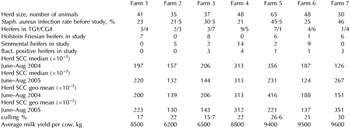
The first 60 heifers (Table 1) that calved were included in the study and were randomly assigned to two groups, a treatment group and a control group. Animals in the treatment group received an i.m. administration of 10 million i.u. penethamate hydriodide (Mamyzin®, Boehringer Ingelheim, Ingelheim, Germany; 30 ml) on the day of calving and then 24 h later, 5 million i.u. (15 ml). The product had been administered according to label instructions of the manufacturer with a 5-d withholding period for milk after the last treatment. Heifers of the control group were left untreated. Heifers were kept together with lactating cows before parturition and no concomitant therapy around calving of the heifers was conducted.
Summary statistics for herds participating in the study

† Treatment group
‡ Control group
Sampling
After pre-selection of herds based on pre-trial sampling, quarter milk samples for microbiological examination were collected and California mastitis test was performed on heifers 7, 14, 21, 35 and 49 d pp for evaluation of udder health status. All samples were collected immediately before regular milking time as described by Baumgartner (Reference Baumgartner2005). All samples at 7 d pp were taken by the first author followed by a clinical examination and brought immediately to the laboratory. Subsequent samples were taken by the farmers themselves after precise instructions from the first author or by the first author. These samples were either brought to the laboratory of the veterinary institute in Ehrental (Carinthia, Austria) immediately after sampling or were frozen and stored at −18°C for a maximum period of 6 weeks before being transported to the laboratory for investigation.
Individual milk yield data as well as SCC were recorded from each heifer the first 200 d of lactation in 5-week intervals. Samples for SCC, fat and protein content were taken by the authorized persons of the Austrian cattle breeding association (Landeskontrollverband) on the regular test days (every 5 weeks) and were transported to the corresponding laboratory immediately. The first six test days after calving have been included in the statistical analysis. Milk yield was recorded at the same time.
Laboratory procedure
Milk samples were centrifuged at 1500 g for 10 min before 0·01 ml of the sediment was inoculated onto Columbia agar (containing 5% sheep blood; Diernhofer, Reference Diernhofer1950). Agar plates were incubated for 48 h at 37°C and examined after 24 h and 48 h of incubation. Bacterial examination was conducted according to NMC (1999) recommendations. Gram staining and catalase test were used to differentiate streptococci and staphylococci. Clumping factor test as well as coagulase tube test with rabbit plasma was used to differentiate Staphylococcus aureus and coagulase negative staphylococci. Escherichia coli was identified growing on selective MacConkey agar as pink, dry and flat colonies. SCC, fat and protein contents were determined with a Fossomatic 360 electronic milk cell counting machine (Foss Electric, Hillerød, Denmark). A sample was considered contaminated when three or more dissimilar colony types were isolated.
Health protocol
A health record was established for each heifer in the study, for which the farmer had to record the following data: results of udder inspection and palpation at all sampling days, incidence of retained placenta and endometritis, insemination dates, metabolic disorders, orthopaedic diseases and reasons for culling. In the case of mastitis, results of inspection and palpation as well as symptoms of inflammation were recorded.
A mammary quarter was considered infected if the same pathogen was isolated in two consecutive samples, two out of three samples, or a pathogen came from one milk sample with the cell count elevated compared with the other quarter cell counts (Berry & Hillerton, Reference Berry and Hillerton2002). Mastitis cases were defined as subclinical mastitis (isolation of a mastitis pathogen, SCC>150 000 cells/ml and no visible signs of the disease) and clinical mastitis cases (Schroeder, Reference Schroeder1997). In cases of clinical mastitis, each case was classified as either mild or severe. Occurrence of flakes or clots in the milk and slight swelling of the infected quarter was defined as mild clinical mastitis. Occurrence of abnormal secretion, hot and swollen quarter or udder, fever, rapid pulse, loss of appetite, dehydration and depression was defined as a severe clinical mastitis case.
Economic analysis
A partial budgeting method (Oliver et al. Reference Oliver, Lewis, Gillespie, Dowlen, Jaenicke and Roberts2003) was used to estimate the net revenue increase for the antibiotic-treated group compared with the untreated control group. This economic analysis method only accounts for revenues and costs that change from one management practice to another; variable costs like feed consumption are not included. Milk production data of the first 200 d of lactation of both groups and an average milk price of € 0.31/kg was used for this economic analysis. Losses due to withholding milk for antibiotic residues were considered in the calculation. EU standards for withholding of colostrum from freshly calved cows take up to 5 d. In Austria, a 5-d period has to be considered which is equal to the 5-d withhold period for milk according to label instructions of the product. Owing to retreatment an additional 1-d milk withhold period was included in the calculations as an average of 30 kg discarded milk/d. The per-heifer net revenue change from treatment was calculated using the following formula: NR=p(QT−QU)−CT−CD where NR is the net revenue change from treatment, p is the price of milk, QT−QU is the difference in milk production for treated and untreated groups, CT is the cost of treatment and CD is the cost of discarded milk of day 6 pp. Treatment costs of € 34.72 per heifer under current conditions included antibiotics, syringes and needles and partial veterinary consulting costs. Prices are based on Austrian standards and may vary in other countries (Anonymous, 2002). Cost of discarded milk was € 9.30 per heifer.
Statistics
The analysis is based on Fisher's exact test for frequency tables (Hartung, Reference Hartung1989). For the comparison of the two treatment groups the non-parametric Wilcoxon test (Mann-Whitney U-test) (Hartung, Reference Hartung1989) was used. Test of significant differences in changes to baseline was calculated using the signed rank test of Wilcoxon (Hartung, Reference Hartung1989). Probabilities <0·05 were considered significant. In both groups, SCC from the milking immediately following treatment for mastitis was excluded from the analyses.
An analysis of milk production was made by modelling the milk yield in consideration of treatment group, breed, herd and time. The milk yield is used as response variable. Breed, herd and treatment group are independent variables, which may have an influence on the amount of milk produced. These three variables are measured on a nominal scale. The milk production of a heifer was observed at six different time points. The time effect was included in the form of these measuring time points. Bearing in mind the dependence of the six different milk yields of a heifer a repeated measurement model was used. Therefore a mixed model with heifer as random effect was considered:

This model has an AIC of −423·28 and a BIC of −234·26. As a measure of goodness of fit in the mixed model framework, it is suggested to look at the squared correlation between the fitted and observed values instead of R 2. In this case the squared correlation is 0·8703. The amount of milk production is the same for all breeds. Therefore this fixed effect was dropped. The resulting model

has an AIC of −463·42, a BIC of −293·29 and a squared correlation of 0·8695.
There is just a slight significant difference in milk production between the two treatment groups (P=0·0529). The model shows a significant difference in milk yield for some farms. Two farms had markedly lower milk production than all others (farm 2 and farm 3). Farm 4 has also a significantly lower milk yield than the remaining farms, especially at time points 4 and 5.
Results
From the 60 dairy heifers included in this study 59 were evaluated. One heifer was excluded because of a teat injury 2 d pp. The antibiotic-treated group consisted of 13 Holstein Friesian and 16 Simmental heifers. The untreated control group consisted of 15 Holstein Friesian and 15 Simmental heifers (Table 1).
Udder health
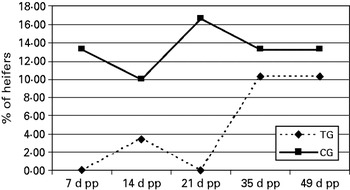
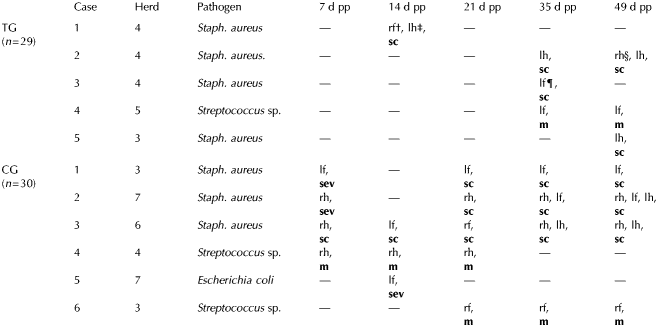
In total, 11 heifers suffered from intramammary infections during the first 49 d pp. Occurrence and severity of the mastitis cases of both groups are shown in Table 2. The incidence of IMI was higher in the control group than in the treatment group (Fig. 1); no significant difference could be observed, however. IMI in the control group occurred earlier in lactation with more severe and more persistent cases. In the antibiotic-treated group, no IMI were detected in the first week pp and no mastitis case required treatment during the study period of 7 weeks pp. In the control group, infections were present in four heifers in the first week. Two heifers were affected with severe Staph. aureus infection and required immediate treatment (cases 1, 2). Both cases recurred as subclinical mastitis at subsequent samplings. Two moderate mastitis cases (4, 6) caused by streptococci had to be treated during the study period. One severe Esch. coli mastitis case (5) occurred in the second week of lactation and had to be treated. Most of the new infections could be observed in farms 3, 4 and 7 (Table 1).
Clinical and subclinical mastitis cases in treatment (TG) and control (CG) groups.

Occurrence of intramammary infections and their clinical appearance (sc, subclinical mastitis; m, mild clinical mastitis; sev, severe clinical mastitis) in the treatment group (TG) and the control group (CG)
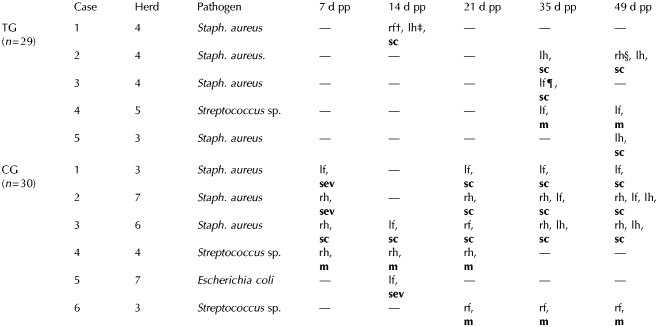
† right front quarter; ‡left hind quarter, §right hind quarter, ¶left front quarter
Animal health
The incidence of retained placenta and endometritis was recorded in both groups. In the untreated control group, three heifers did not pass the placenta, but no endometritis was detected. In the antibiotic-treated group, all heifers cleaned properly. However, two animals showed signs of endometritis. These differences were not statistically significant.
There was no significant difference between groups in the period to commencement of the next pregnancy. The control group had a median of 86 d and the antibiotic-treated group of 85 d. The incidence of metabolic disorders and orthopaedic diseases was very low in both groups. Two heifers of the untreated control group suffered from claw disorders and two heifers of the antibiotic treated group had to be culled because of metabolic disorders.
Somatic cell count
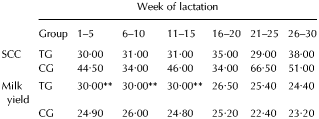
No significant differences in SCC were detected between the two groups (Table 3). Within each group, no significant changes from baseline were observed.
Median SCC (×10−3 cells/ml) and milk yield (kg/d) of treatment (TG) and control group (CG) during 30 weeks of lactation
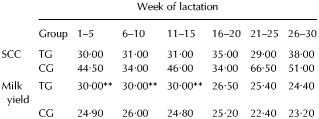
** P<0·05
Milk yield data
Heifers in the antibiotic-treated group produced more milk than untreated control heifers. The differences between the two groups are significant for the first three measuring time points (P<0·05, Table 3). Milk yield of antibiotic-treated heifers at time points 1, 2, and 3 was 5·1 kg/d, 4 kg/d and 5·2 kg/d higher than the yields of untreated control heifers. At the last measuring time point, milk yield was 1·2 kg/d higher in the antibiotic-treated group. However, milk yield in both groups slowly decreased as normal at the end of lactation. No significant differences between the two groups were found for fat and protein composition.
Economic analysis
Periparturient antibiotic-treated heifers produced 323 kg more milk in the first 200 d of lactation than untreated control heifers. Actual milk production averaged 5599 kg for antibiotic-treated animals and 5276 kg for untreated animals. Multiplying the increase of milk production of 323 kg by the actual milk price of € 0.31/kg resulted in an increase in gross revenue of € 100.13 per heifer. Subtracting the costs of treatment and the costs of discarded milk from gross revenue yielded a net revenue of € 56.11 per heifer.
Discussion
The results demonstrate the positive effects of preventive treatment of dairy heifers on udder health, even though the number of animals involved in this study was very low.
In the present study, the preventive treatment was conducted immediately after calving in order to combine advantages of i.m. treatment with the specific physicochemical properties of the drug and to investigate the direct effect (first week pp) and long term effect of drug use. Advantages of i.m. treatment are: reduced risk of injury to operators while working with heifers that are not used to handling; reduced risk of damage to the teat canal; no risk of accidental introduction of new infections into the mammary gland; no additional facilities required for restraint of heifers.
Penethamate hydriodide is a weak base, which reaches high concentrations in the mammary gland after systemic administration (Friton et al. Reference Friton, Van Hattum and Hoerstermann2003). Furthermore, recent studies in vitro show that penethamate hydriodide is highly effective in killing Streptococcus uberis, Streptococcus dysgalactiae subsp. dysgalactiae and Staph. aureus that internalize bovine mammary epithelial cells (Almeida et al. Reference Almeida, Patel, Friton and Oliver2006), which is of beneficial value when treating mastitis. St.Rose (Reference St.Rose, Swinkels, Kremer, Kruitwagen and Zadoks2003) demonstrated in a field trial, that penethamate hydriodide treatment of chronic subclinical Streptococcus uberis and Streptococcus dysgalactiae infections results in a bacteriological cure rate of 59% and in a significant decrease in SCC with no significant effect on milk yield.
The effect of reducing IMI after calving has also been observed in recently conducted studies after antibiotic therapy of heifers by using either intramammary therapy with formulations for dry or lactating cows before calving or systemic treatment with penethamate hydriodide (Trinidad et al. Reference Trinidad, Nickerson, Alley and Adkinson1990a; Oliver & Jayarao, Reference Oliver and Jayarao1997; Owens et al. Reference Owens, Nickerson, Boddie, Tomita and Ray2001; Oliver et al. Reference Oliver, Lewis, Gillespie, Dowlen, Jaenicke and Roberts2003; Oliver et al. Reference Oliver, Gillespie, Ivey, Lewis, Johnson, Lamar, Moorehead, Dowlen, Chester and Hallberg2004; Roy et al. Reference Roy, Du Tremblay, DesCôteaux, Messier and Bouchard2005; Bryan & Friton, Reference Bryan and Friton2005; Borm et al. Reference Borm, Fox, Leslie, Hogan, Andrew, Moyes, Oliver, Schukken, Hancock, Gaskins, Owens and Norman2006).
The reduction of clinical infections after calving in the antibiotic-treated group can be explained by the killing of invading bacteria during the periparturient period. Recent data show that, in up to 37% of heifers, staphylococci can be isolated from samples from the non-lactating udder (Trinidad et al. Reference Trinidad, Nickerson, Alley and Adkinson1990a, Reference Trinidad, Nickerson and Alleyc; Fox et al. Reference Fox, Chester, Hallberg, Nickerson, Pankey and Weaver1995; Oliver et al. Reference Oliver, Gillespie, Ivey, Lewis, Johnson, Lamar, Moorehead, Dowlen, Chester and Hallberg2004; Roy et al. Reference Roy, Du Tremblay, DesCôteaux, Messier and Bouchard2005; Borm et al. Reference Borm, Fox, Leslie, Hogan, Andrew, Moyes, Oliver, Schukken, Hancock, Gaskins, Owens and Norman2006), which can lead to the explanation that preventive antibiotic therapy could have eliminated already existing IMI before calving.
After calving, many factors, including milking management, milking hygiene, udder hygiene and bedding, influence the development of new infections (Reinecke et al. Reference Reinecke, Hansen, Tenhagen and Heuwieser2006) and possibly can displace a beneficial effect of any treatment performed before or at parturition. The combination of periparturient treatment and an udder hygiene programme might have reduced the number of infections after parturition in both groups. The infection pressure was decreased, and farmers worked more observantly by taking milk samples and watching the results on a weekly basis.
Our results may show that treated udders were more resistant to the development of clinical and subclinical infections at and shortly after calving. In the antibiotic-treated group, IMI occurred later, were less severe and had higher spontaneous cure than in the control group, where IMI occurred earlier, were more severe, required treatment and in some instances progressed to chronic and recurrent infections. Furthermore, no effect of treatment was observed on reproductive health. Despite the presence of some new infections in the antibiotic-treated group, SCC remained constant over the 200-d lactation period. This contrasts with the control group, where SCC levels were more variable, perhaps in part due to the persistence of chronic infections established in the first 2 weeks of lactation. Reinecke et al. (Reference Reinecke, Hansen, Tenhagen and Heuwieser2006) reported that primiparous cows with periparturient clinical mastitis showed significantly higher SCC over the whole lactation period.
The increase of milk yield in heifers treated with penethamate hydriodide at calving was marked. These heifers showed a significant increase in milk yield from 4·0 to 5·2 kg/d for the first 15 weeks of lactation, which is similar to that in recent studies (Owens et al. Reference Owens, Nickerson, Washburn and Ray1991; Nickerson et al. Reference Nickerson, Owens and Boddie1995; Oliver et al. Reference Oliver, Lewis, Gillespie, Dowlen, Jaenicke and Roberts2003; Bryan & Friton, Reference Bryan and Friton2005, Roy et al. Reference Roy, Du Tremblay, DesCôteaux, Messier and Bouchard2005) that report increased milk yield following intramammary or i.m. treatment of heifers prepartum.
The significant increase seen in the present study may be due to the absence of severe clinical infections and the absence of recurrent infections, which is in accord with Reinecke et al. (Reference Reinecke, Hansen, Tenhagen and Heuwieser2006). No severe clinical mastitis cases around parturition and generally milder forms of mastitis in the treatment group may lead to healthier udders and better milking performance. Staph. aureus IMI induce large amounts of interalveolar connective tissue, reductions in epithelial and luminal areas and hyperplasia of ducts and cisterns (Trinidad et al.Reference Trinidad, Nickerson and Adkinson1990b). In heifers, developing secretory tissue may be affected by infection, leading to deposition of connective tissue instead of secretory tissue and a subsequent deleterious effect on future milk production.
Economic benefits can be calculated from the lower occurrence of clinical mastitis cases, higher milk yield and lower SCC levels after therapy in Staph. aureus problem herds. A net revenue increase of € 56.11 from the extra milk produced in the first 200 d of lactation was estimated for each heifer treated with penethamate hydriodide. Periparturient treatment of heifers was definitely economically rewarding. Benefits were found by Oliver et al. (Reference Oliver, Lewis, Gillespie, Dowlen, Jaenicke and Roberts2003), who calculated a net revenue increase of US$ 200.64 per heifer per 305-d lactation, and Nickerson et al. (Reference Nickerson, Owens and Boddie1995), who reported economic benefits of US$ 42.00 per heifer in the first 2 months of lactation. Bryan & Friton (Reference Bryan and Friton2005) used a deterministic model, which showed an overall return on investment of NZ$ 186 per heifer treated 7 d before expected calving with penethamate hydriodide. A greater feed consumption in the healthier animals, however, could lead to increased costs of production, and profitability would be reduced accordingly.
The presence of antibiotic residues in colostrum following preventive treatment needs to be considered because Langford (Reference Langford, Weary and Fisher2003) showed that resistance of gut bacteria to antibiotics increases with increasing concentrations of penicillin in the milk fed to dairy calves. To prevent exposure of calves to antibiotics in colostrum, it may be necessary to create a pool of colostrum from non-treated animals for feeding to newborn calves. Furthermore, Staph. aureus-free colostrum fed to calves after therapy might be seen as beneficial in order to avoid infection of calves with Staph. aureus. Therefore, it should be taken into account and weighed carefully whether colostum from treated heifers with antibiotics, or colostrum from successfully treated heifers without Staph. aureus should be fed to calves.
In summary, the present study showed that preventive treatment of heifers at parturition offered a viable option for managing Staph. aureus problem herds. Furthermore, partial budgeting revealed that economic benefits accompany the improved management of mastitis provided by this treatment.
In conclusion periparturient antibiotic treatment of dairy heifers with penethamate hydriodide is an efficacious way to protect the udder from Staph. aureus mammary infections in the first week after calving and to minimize new Staph. aureus IMI over a period of 21 d pp. In herds with high prevalence of Staph. aureus mastitis, introducing periparturient antibiotic treatment of heifers protects these animals, which represent the future of the milking herd, from IMI and leads to higher milk production.
The study was funded by Boehringer Ingelheim Germany and Austria. Special thanks are due to Ecolab Austria for providing P3 Oxyfoam and P3 Veloucid and to the Carinthian Herd Health service and the Veterinary Laboratories Ehrenthal, Austria for financing the bacteriological examinations. The authors thank the Austrian Cattle Breeding Association (Landeskontrollverband), the local dairies, the local veterinarians and farmers for their cooperation and DI Birigt Kornberger, Institute of Applied Statisitics, Joanneum Research, Graz Austria for performing the statistical analysis.