Introduction
Rhynchophorus ferrugineus (Olivier, 1790) (Coleoptera: Curculionidae), commonly called the Red Palm Weevil (RPW), is native to Southern Asia and Melanesia where it infests coconut palms (Nirula, Reference Nirula1956a, Reference Nirulab). The RPW life cycle starts with the eggs laid in holes made by the female at the base of the host leaves. Oviposition holes contain chemical signals that discourage other females from laying eggs in the same spot, influencing the distribution of eggs on the host plant (Salem et al., Reference Salem, Belal, Nour and Sayed2012). Neonate larvae dig tunnels within the palm core, feeding on its inner tissues. As larvae grow and molt, their food requirements lead them to feed primarily on the soft tissues surrounding the apical meristem, frequently causing the death of the infested plant (Giblin-Davis et al., Reference Giblin-Davis, Oehlschlager, Pérez, Gries, Gries, Weissling, Chinchilla, Peña, Hallet, Pierce and González1996; Dembilio et al., Reference Dembilio, Tapia, Téllez and Jacas2012).
Following its accidental introduction into North Africa and Europe two decades ago, R. ferrugineus has become established in countries of the coastal fringe of the Mediterranean basin and now it represents one of the major pests of ornamental palm species in the urban areas of Mediterranean countries. In 2009, its presence was reported for the first time in America, on the islands of Curaçao, Aruba and the Netherland Antillas; in 2010, a sibling species, Rhynchophorus vulneratus (Rugman-Jones et al., Reference Rugman-Jones, Hoddle, Hoddle and Stouthamer2013), was reported as R. ferrugineus in the Laguna Beach area of Orange County, California (EPPO, 2010; Roda et al., Reference Roda, Kairo, Damian, Franken, Heidweiller, Johanns and Mankin2011). R. ferrugineus is included in the EPPO A2 list for quarantine pests in Europe, where it was reported on 19 species of Arecaceae, comprehending 15 different genera (EPPO, 2008). Malumphy & Moran (Reference Malumphy and Moran2009) reported it as a pest of 26 palm species belonging to 16 different genera in diverse agro-ecosystems worldwide. Its host range is still expanding and currently, R. ferrugineus is considered to infest up to 40 palm species (SAP, 2015). RPW ability to infest host plants belonging to different species is extremely variable: for instance, in Peoples Republic of China and India, R. ferrugineus has been reported as a primary pest of coconut palms (Cocos nucifera), while in the Arabian Peninsula this weevil mainly attacks date palm (Phoenix dactylifera) plantations (Hussain et al., Reference Hussain, Haq, Al-Jabr and Al-Ayied2013). In the Mediterranean basin, it has become the major pest of the Canary palm (Phoenix canariensis), which is extremely sensitive to its attack (Dembilio & Jacas, Reference Dembilio and Jacas2012). In Italy, the RPW has been found recently on the endemic palm Chamaerops humilis (Giovino et al., Reference Giovino, Scibetta, Gugliuzza, Longo, Suma and La Mantia2012), and also on Brahea armata, Brahea edulis, Howea forsteriana and Jubaea chilensis (Longo et al., Reference Longo, Anderson, Smith, Stanley and Inserra2011).
The susceptibility degree of each host plant species to R. ferrugineus is not well known and, depending on the case, it could be correlated to different mechanisms of plant defense. Painter (Reference Painter1958) defined three mechanisms of plant defense to insects: non-preference, antibiosis and tolerance. According to this classification, non-preference occurred when the plant was not attractive to the insect. Kogan & Ortman (Reference Kogan and Ortman1978) later replaced the term non-preference by antixenosis to indicate a kind of resistance to insect attacks due to mechanical barriers or repellent substances produced by the plant. Antixenosis can affect different kinds of insect behavior such as orientation, colonization, feeding and oviposition. Antibiosis instead displays its effects at the level of insect development, especially during juvenile stages, inducing a decrease in reproductive capacity and premature death. Finally, tolerance occurs when the plant is able to cope with certain levels of infestation and stands insect attacks without suffering important damages. Both antixenosis and antibiosis are currently recognized as mechanisms of plant resistance, i.e. a constitutive or induced plant response against herbivory to avoid or reduce the amount of damage (Núñez-Farfán et al., Reference Núñez-Farfán, Fornoni and Valverde2007).
In a previous study, C. humilis, one of the two palm species native to Europe, was considered resistant to R. ferrugineus (Barranco et al., Reference Barranco, de la Peña, Martín and Cabello2000). Nevertheless, the European Union included this species in the list of R. ferrugineus-susceptible plants (EPPO, 2008). The list also included Washingtonia spp., but infestation trials conducted in Spain showed that although Washingtonia robusta was susceptible to R. ferrugineus, the congeneric W. filifera was not (Llácer et al., Reference Llácer, Negre and Jacas2012). In a series of semi-field assays (Dembilio et al., Reference Dembilio, Jacas and Llácer2009), it was shown that both W. filifera and C. humilis could not be naturally infested by R. ferrugineus adult females. Antibiosis was designated as the main mechanism operating in W. filifera, since a viscous secretion produced by the plant resulted in complete mortality of R. ferrugineus young instars. In the case of C. humilis, antixenosis was proposed as the major mechanism of resistance involved. In fact, it was possible to by-pass this resistance by inserting neonate larvae in holes made with a drill (Dembilio et al., Reference Dembilio, Jacas and Llácer2009).
Although antibiosis has been proposed as an important defense mechanism against the RPW in some palm species, its underlying nature – chemical, physical or physico-chemical – remains unclear. In this study, we assessed the potential for chemical antibiosis resistance in the palm species P. dactylifera, C. humilis and W. filifera against infestation by the palm weevil R. ferrugineus. Since these palm species are known to contain significant amounts of diverse secondary metabolites similar to those involved in the defense response of other plants to biotic and abiotic stresses (Hirai et al., Reference Hirai, Sanada, Ida and Shoji1986; Asami et al., Reference Asami, Hirai and Shoji1991, El-Sayed et al., Reference El-Sayed, Ammar, Al-Okbi, El-Kassem and Mabry2006), we hypothesized: (1) that palm tissues can show chemical antibiosis activity against R. ferrugineus; and (2) that the intensity of the chemical antibiosis activity differs among the studied palm species. Accordingly, palm resistance against the RPW should be the result of multiple factors involving both antibiosis and antixenosis mechanisms. To test these hypotheses we have applied a combined test approach involving toxicity bioassays as well as natural and forced infestation experiments.
Material and methods
Insects
RPW larvae and adult females used all over the experiments were supplied by UTAGRI Institute Eco Enea, Casaccia, Rome, Italy. The larvae originated from eggs laid by females captured through pheromone traps and kept under laboratory conditions (20°C, 16 h photoperiod). Both the females and the larvae were fed with apple slices (Malus domestica, cv Golden delicious) and monitored until they were used in the experiments.
Palm species and tissue sampling
The palm species P. dactylifera, W. filifera and C. humilis were used as tissue donors for the chemical bioassays. Tissue samples were obtained from the lower part of the leaf rachis of 15-year-old adult individuals planted in the garden of the Centro Studi e Ricerche per le Palme (CSRP Sanremo, Italy). Leaf rachis tissues between the base of the leaf and the insertion of the first leaflets were chosen because this part of the rachis is known to represent a major oviposition spot for R. ferrugineus in P. canariensis and several other palm species (Ferry & Gómez, Reference Ferry and Gómez2002; El-Mergawy & Al-Ajlan, Reference El-Mergawy and Al-Ajlan2011). The plants were taxonomically identified at the CSRP and tissue samples were deposited in the center herbarium.
Preparation of leaf tissue extracts
Leaf rachis tissues of P. dactylifera, W. filifera and C. humilis (about 80 g of fresh tissue for each species) were chopped and extracted with MeOH in a soxhlet apparatus for 45 min. Methanolic extracts (about 250 ml for each species) were evaporated to dryness through a rotary evaporator (Buchi, Rotovapor L-200) and stored at −20°C until needed. All the residues were re-suspended in distilled water (70 ml) before use in bioassays with RPW.
Bioassays with RPW larvae
The obtained extracts were screened for their toxic effects on four groups of 10 two-week old larvae of R. ferrugineus. The larvae were individually placed in 50 ml plastic jars with perforated caps. They were fed for one week with apple pieces 1.5 cm diameter and 1 cm thick that were dipped for 60 s in one of the different leaf extracts. A control group was established by dipping apple slices in distilled water for the same time, since this was the solvent used to resuspend the dry extracts from the leaves. Extracts from P. canariensis, the most preferred host of RPW in the Northern Mediterranean basin, were not tested on the basis of the reported lack of toxicity of date palm tissues to R. ferrugineus larvae (Sacco et al., Reference Sacco, Cangelosi, Arato, Littardi and Pasini2011). The apple pieces were replaced every 2 days to prevent microbial contamination. Larval mortality was monitored daily; the weight of each individual was recorded before the start and at the end of the experiment. During the experimental period, the larvae were maintained in a growth chamber at 26°C with a 16 h daily photoperiod. The test was repeated three times over a 10-month period.
Forced infestation trials
Six-year old palm trees, 1.5 m diameter, 2.5 m tall, belonging to the three abovementioned species and grown in 1 m diameter clay pot, were used to check for palm resistance to forced infestation at semi-field scale. The age of the plants was within the reported age range for maximum RPW infestation rates in P. dactylifera (Sallam et al., Reference Sallam, El-Shafie and Al-Abdan2012). In order to contrast the results from the selected palm species with the expected results from a RPW susceptible species, an additional set of plants of P. canariensis was included in the experimental trials. These plants were of the same age and size as those from the other species. Three potted plants per palm species were individually isolated in cylindrical cages 1.5 m width × 2.5 m height made of an insect-proof steel net of 0.5 cm mesh size. The trials were performed in early spring; plants were regularly watered and kept in a greenhouse at 25 ± 2°C temperature, 14 h photoperiod and 3000 lux illumination. Pot substrate was commercial soil (Flortis universal soil, Orvital S.p.A, Settimo Milanese, Italy). In each palm trunk, six holes 35 mm diameter and 5 cm depth were symmetrically drilled all around the leaf crown in the insertion area of the leaves on the stem. A RPW two-month old larva was introduced in each hole and the hole rim was tightly closed with a loose-texture cotton stopper to ensure air exchange. After 4 weeks, the palms were thoroughly sliced with a saw in order to determine the percentage of infested plants and the percentage of larval survival.
Natural infestation trials
The ability of R. ferrugineus to naturally colonize the considered palm species was investigated by means of additional no-choice infestation trials. Each trial involved two individual plants per palm species. The age and size of the plants, as well as the growing conditions and type of cage, were the same as those used for the forced infestation trials. No holes were drilled, but three adult RPW females were freed within each palm-containing cage to allow them to lay eggs on the host plant. Most of these females were assumed to be inseminated because previous field monitoring studies have shown that more than 80% of the females captured in pheromone traps had sperm in their spermathecae and contained fecundated eggs (Lo Bue et al., Reference Lo Bue, Guarino, Lucido, Peri, Pulizzi and Colazza2010). Six weeks later, the plants were thoroughly dissected to determine the percentage of infestation and the average number of larvae per plant.
Statistical analysis
Data were analyzed using the R environment (R Core Team, 2015). In the laboratory bioassays, the effect of palm rachis extracts on larval survival was assessed by means of χ2tests using the function chisq.test(). The effect of palm rachis extract on larval growth was estimated through a meta-analysis of the replicated tests using the functions escalc() and rma() from the metafor package (Viechtbauer, Reference Viechtbauer2010). Differences in initial weight between the weevil larvae used in the different growth tests were checked through analysis of variance (ANOVA) and Tukey HSD tests with the functions aov() and TukeyHSD(), respectively. In the semi-field experiments, differences in larval survival after forced infestation of different palm species were tested by means of the Kruskal–Wallis test using the kruskaltest() function. Data presented through the text are means ± SE.
Results
Bioassays
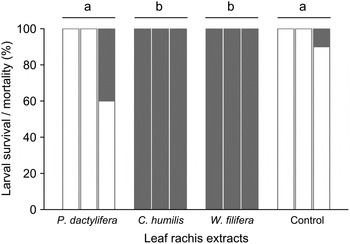
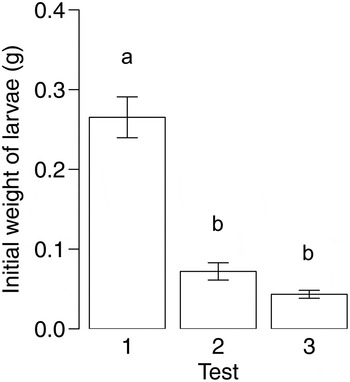
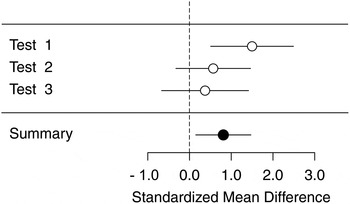
The effect of rachis extracts on the survival of R. ferrugineus larvae depended on the palm species considered. In the three tests performed, rachis extracts from C. humilis and W. filifera caused 100% larval mortality after 2 days of exposure, while extracts of P. dactylifera did not impair larval survival. The 40% mortality observed in the third test with P. dactylifera extracts did not differ significantly from that observed in the related control (χ2 = 1.07, df = 1, P = 0.30; n = 10; fig. 1). The larvae used in the three growth tests differed in their initial weight (ANOVA F 2,57 = 58.07, P < 0.001; n = 10; fig. 2), suggesting an association between the smallest size of the larvae in the third test and the recorded mortality. In the growth tests, the addition of rachis extracts from P. dactylifera to the food provided to RPW larvae had an overall positive effect in their growth (Random-effects model, Z = 2.41, P = 0.016; fig. 3), increasing larval weight by 34.2 ± 8.3% after 7 days.
Effect of leaf rachis extracts from Phoenix dactylifera, Chamaerops humilis and Washingtonia filifera on the survival of neonate larvae of Red Palm Weevil (RPW). For each palm species, bars indicate the percentage of either survival (white background) or mortality (grey background) of the weevil larvae (n = 10) after 1 week in three different tests. Mortality induced by P. dactylifera extracts was not significantly different from that observed in controls with distilled water according to χ2 tests at P ≤ 0.05.

Differences in initial weight of RPW larvae used in the bioassay tests with leaf rachis extracts from Phoenix dactylifera. Vertical bars and whiskers represent mean larval weight ± SE in the three tests performed (n = 10). Different letters indicate significant differences in body weight by the Tukey HSD test at P ≤ 0.05.

Forest plot showing the effect of leaf rachis extract from Phoenix dactylifera on the growth of neonate larvae of RPW after 1 week. White symbols indicate larval average growth relative to controls in three different tests (n = 10). The black symbol represents the summary estimate of the effect of the extract on larval growth, following a meta-analysis based on a random effects model of the data. Horizontal lines through the symbols represent 95% confidence intervals. The dashed vertical line indicates the line of no effect, i.e., the lack of differences between treatment and control.

Infestation trials
In the case of forced infestation, when the larvae were directly introduced into the stipe of the palm trees, 100% of infestation was scored on all the tested species. The boring activity operated by the larvae was well evident in all the plants, with the presence of deep feeding galleries in the inspected plant tissues. In W. filifera and in C. humilis, in correspondence with the galleries dug by the larvae, the production of viscous secretions was observed. This response was more intense in W. filifera than in C. humilis, forming tubular-like structures, several centimeter long, that protruded from the holes initially drilled on the stipe of the palms. These tubular-like structures were made of sawdust produced by the larvae mixed with viscous substances produced by the plants. Larval survival exceeded 75% of the inserted larvae and did not significantly differ between palm species (χ2 = 2.42, df = 3, P = 0.49; n = 3; table 1).
Percentage of infestation and survival of individuals of R. ferrugineus in forced and natural infestation trials. Values followed by the same letter are not significantly different according to the Kruskal–Wallis test at P ≤ 0.05. P. canariensis was included as a positive infestation control.

In the natural infestation trials, neither larvae of R. ferrugineus nor larval trails were retrieved from the main study species after 6 weeks. The presence of larvae was only recorded in P. canariensis individuals, where infestation took place in both the tested plants (table 1).
Discussion
Our results show that toxic substances can play a significant role in palm resistance against RPW in some species (hypothesis 1). Antibiosis-like responses of palms against natural and forced infestation by R. ferrugineus have been previously reported, but such responses were based on the excretion of large quantities of viscous substances resulting in the obstruction of the RPW larval galleries (Barranco et al., Reference Barranco, de la Peña, Martín and Cabello2000). The composition of these excretions is poorly known and, as far as we know, there is no information about their toxic or repellent effect on the larvae of R. ferrugineus. In the present case, however, the observed effect of the leaf extracts of W. filifera and C. humilis on the RPW larvae indicates the presence of a true chemical antibiosis resistance in these species. This chemical effect was absent in the extracts of P. dactylifera. Not only extracts of P. dactylifera did not impair larval survival, but they had a positive effect on larval growth, excluding any potential toxicity due to the extraction procedure. These results indicate that leaf extracts are not necessarily toxic to R. ferrugineus larvae, which is in partial agreement with our hypothesis 2 regarding the species-specificity of the palm resistance mechanisms against the RPW.
The diversity and specificity of the chemical compounds responsible for the observed effects of the rachis extracts from W. filifera and C. humilis on the larvae of R. ferrugineus are not known, but a recent study regarding W. filifera (Cangelosi et al., Reference Cangelosi, Clematis, Monroy, Roversi, Troiano, Curir and Lanzotti2015) points to the existence of previously undescribed molecules with specific toxic effects for insects. Despite the presence of specific molecules, the chemical resistance of palms to the RPW does not necessarily rely on single compounds. In C. humilis, leafs show a significant concentration of secondary metabolites such as tannins, flavonoids and saponins (Benmehdi et al., Reference Benmehdi, Hasnaoui, Benali and Salhi2012), which are generally involved in both the constitutive and induced resistance of most plants species to the attack of parasites and pathogens (Yamane et al., Reference Yamane, Konno, Sabelis, Takabayashi, Sassa, Oikawa, Mander and Liu2010). The ability of RPW to infest a certain palm species may be influenced by the identity of these metabolites and their leaf concentration in the palm. Our results suggest that P. dactylifera leaf extracts contain either a lower concentration or a different type of defense compounds as compared with the extracts from the other two test species. The latter possibility is in agreement with the reported differences in flavonoid composition between C. humilis and P. dactylifera (Hirai et al., Reference Hirai, Sanada, Ida and Shoji1986; Asami et al., Reference Asami, Hirai and Shoji1991).
It is known that RPWs use chemical cues to locate their hosts (Giblin-Davis et al., Reference Giblin-Davis, Oehlschlager, Pérez, Gries, Gries, Weissling, Chinchilla, Peña, Hallet, Pierce and González1996) and therefore chemical interspecific variation may play a significant role in the preference of R. ferrugineus for certain palm species. This variation may be associated to factors such as plant age, type of cultivar, phenology and health status (Farazmand, Reference Farazmand2002; Al-Ayedh, Reference Al-Ayedh2008; Faleiro et al., Reference Faleiro, El-Shafie, Ajlan and Sallam2014). This is in agreement with the observation that in the Northern Mediterranean basin, R. ferrugineus preferentially infests P. canariensis over P. dactylifera (Dembilio & Jacas, Reference Dembilio and Jacas2012), but does not explain the complete absence of P. dactylifera infestation in our natural infestation experiment. Taking into account the statistical limitation posed by our two replicates per palm species, such a result may be due to the presence of resistance factors reducing infestation success to less than 50%. Dembilio et al. (Reference Dembilio, Jacas and Llácer2009) found an infestation success of 66.7% in C. humilis under similar experimental conditions, revealing a limited resistance of this palm species against RPW. Intraspecific variability in resistance may explain the occurrence of date palm individuals that escape episodic infestation events. In this regard, recent results showed differences in RPW oviposition depending on the P. dactylifera cultivar (Faleiro et al., Reference Faleiro, El-Shafie, Ajlan and Sallam2014), suggesting that sometimes date palms can avoid infestation by R. ferrugineus. We exclude that methodological issues might have prevented RPW infestation of our plants in the natural infestation assay because infestation did take place in all the P. canariensis individuals as expected. The average reproductive output we found in P. canariensis was 33.3 ± 21.3 (n = 2) larvae per RPW female, very similar to values previously reported (33.25 eggs per female) for the same palm species (Dembilio & Jacas, Reference Dembilio and Jacas2012).
The antixenosis resistance of P. dactylifera as based on the toughness of its leaves seems unlikely to explain the observed differences between this species and P. canariensis in our natural infestation experiment, particularly when considering the morphological similarity between these congeneric species and the fact that P. dactylifera constitutes a major host for R. ferrugineus in other geographical areas (Abraham et al., Reference Abraham, Al Shuaby, Faleiro, Abouzuharah and Vidyasagar1998). Whatever mechanism was involved in the observed lack of infestation of P. dactylifera by R. ferrugineus, it was circumvented by the forced inoculation of larvae. This reinforces the hypothesis that antixenosis mechanisms may play an important role in P. dactylifera and it is in agreement with the early observed habit of R. ferrugineus females of choosing wounds in the cuticle of the palms to lay their eggs (Wattanapongsiri, Reference Wattanapongsiri1966). Forced infestation also succeeded in the other two tested species, revealing not only that infestation can take place in palm species which produce toxic substances, but also that the observed antibiosis effect may be restricted to the leaves. Accordingly, the relative role of antixenosis and antibiosis may depend on the part of the palm considered. Ju et al. (Reference Ju, Wang, Wan and Li2011) found that trunk tissues of W. filifera are a suitable food source for neonate RPW larvae, which agrees with the results of our forced infestation trial. The ability of R. ferrugineus to feed on trunk tissues but not on the leaves leads again to the hypothesis that the antibiosis compounds of this palm species accumulate, or are synthesized, at the leaf level.
In conclusion, our experiments suggest that the lower susceptibility of P. dactylifera to the RPW is not due to antibiosis, while in W. filifera and C. humilis, although we cannot exclude the presence of antixenosis mechanisms, chemical antibiosis factors seem to have a significant role in the resistance against R. ferrugineus. In this regard, the production by certain palm species of endogenous molecules involved in antibiosis resistance represents a potential new resource for the control of this pest.
Acknowledgements
The authors are grateful to Cosimo Graniglia, Massimo Serra and Gianni Pallavicino, who took an active part in the practical tests and whose collaboration was invaluable. This work was carried out with the financial support of Project PROPALMA, financed by the Italian Ministry of Agriculture, Food and Forestry (Mi.P.A.A.F.) (D.M. 25618/7301/11, 01/12/2011).