Introduction
In wheat, high-molecular-weight glutenin subunits (HMW-GS) represent about 10% of the total endosperm protein. They are encoded by three sets of paralogous loci on the long arms of group 1 chromosomes (Payne et al., Reference Payne, Law and Mudd1980). At each locus, two tightly linked x and y genes encode a larger x and a smaller y subunit. Owing to the varying degrees of gene silencing, the numbers of expressed HMW-GS genes range from 3 to 5 among hexaploid wheat cultivars (Payne et al., Reference Payne, Law and Mudd1980, Reference Payne, Holt and Law1981). The types and numbers of HMW-GS are critical determinants of the baking and processing quality of wheat flour (Payne et al., Reference Payne, Holt, Jackson and Law1984).
Aegilops umbellulata (
 $$2 n = 2 x = 14, $$
UU) and A. uniaristata (
$$2 n = 2 x = 14, $$
NN) are diploid donors of many polyploid Aegilops species (Kilian et al., Reference Kilian, Mammen, Millet, Sharma, Graner, Salamini, Hammer, Özkan and Kole2011). However, their HMW-GS and qualities are not well documented (Castilho et al., Reference Castilho, Miller and Heslop-Harrison1996, Reference Castilho, Miller and Heslop-Harrison1997; De Bustos and Jouve, Reference De Bustos and Jouve2006; Rodríguez-Quijano et al., Reference Rodríguez-Quijano, Nieto-Taladriz and Carrillo2001; Liu et al., Reference Liu, Yan, Wan, Liu, Zheng and Wang2003). One way to evaluate the quality of HMW-GS in these Aegilops species is to produce hexaploid amphidiploids from crosses between Aegilops species and T. turgidum. The most successful examples of using HMW-GS in the D genome of diploid A. tauschii involved synthetic hexaploid wheats (Peña et al., Reference Peña, Zarco-Hernandez and Mujeeb-Kazi1995; Mujeeb-Kazi et al., Reference Mujeeb-Kazi, Rosas and Roldan1996; Pflüger et al., Reference Pflüger, D'Ovidio, Margiotta, Peña, Mujeeb-Kazi and Lafiandra2001; Rasheed et al., Reference Rasheed, Safdar, Gul-Kazi, Mahmood, Akram and Mujeeb-Kazi2012; Hu et al., Reference Hu, Dai, Pu, Liu, Pu, Jiang, Wei, Wu, Lan, Zheng and Yan2013).
In the present study, five amphidiploids were produced by spontaneous chromosome doubling of unreduced triploid F1 gametes (
 $$2 n = 3 x = 21, $$
ABU or ABN) from the crosses between T. turgidum ssp. dicoccum (accessions PI 94 668 and PI 349045) or ssp. durum (cultivar Langdon) and A. umbellulata (accessions CIae 29 and PI 226500) or A. uniaristata (accession PI 554419). The composition of HMW-GS in these amphidiploids and their parental diploid species was investigated.
Experimental
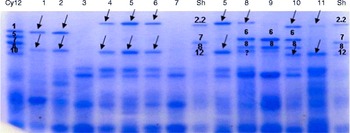
The composition of HMW-GS in amphidiploids and their parental species was analysed by 10% sodium dodecyl sulphate–polyacrylamide gel electrophoresis (SDS–PAGE) gels (Yan et al., Reference Yan, Wan, Liu, Zheng and Wang2002). Amphidiploids with AABBNN genomes derived from A. uniaristata accession PI 554419 and T. turgidum ssp. dicoccum accession PI 94 668 produced the same HMW-GS patterns as those of the accession PI 554419, because all of the HMW-GS genes in accession PI 94 668 were silenced (Fig. 1; Hu et al., Reference Hu, Dai, Pu, Liu, Pu, Jiang, Wei, Wu, Lan, Zheng and Yan2013).
Sodium dodecyl sulphate–polyacrylamide gel electrophoresis pattern of high-molecular-weight glutenin subunits (HMW-GS) in five amphidiploids from the crosses of Aegilops umbellulata and A. uniaristata with Triticum turgidum ssp. durum and ssp. dicoccum. Lane 1, PI 554419 (A. uniaristata); lane 2, PI 94 668/PI 554419 amphidiploids; lane 3, PI 94 668 (T. turgidum ssp. dicoccum); lane 4, PI 94 668/CIae 29 amphidiploids; lane 5, CIae 29 (A. umbellulata); lane 6, PI 349045/CIae 29 amphidiploids; lane 7, PI 349045 (T. turgidum ssp. dicoccum); lane 8, Langdon/CIae 29 amphidiploids; lane 9, Langdon (T. turgidum ssp. durum); lane 10, Langdon/PI 226500 amphidiploids; lane 11 PI 226500 (A. umbellulata). Two hexaploid wheat varieties (Chuanyu 12 (Cy12) and Shinchunaga (Sh)) with the HMW-GS combinations 1, 7+8, 5+10 and 7+8, 2.2+12 were used as references. The arrows indicate the HMW-GS that originate from the A. uniaristata and A. umbellulata parents. The question mark indicates the unconfirmed source of the band.

Amphidiploids with AABBUU genomes derived from A. umbellulata accession PI 226500 and T. turgidum ssp. durum cultivar Langdon and from two T. turgidum ssp. dicoccum accessions (PI 94 668 and PI 349045) and A. umbellulata accession CIae 29 inherited all of the HMW-GS genes from both parents (Fig. 1, lanes 10, 4 and 6). However, amphidiploids derived from CIae 29 and Langdon inherited exactly the same HMW-GS patterns as those of their parents except for the Uy type (Fig. 1, lane 8). The Ux and Uy types in these amphidiploids were very similar to the Dx 2.2 and Dy 12 types in the wheat cultivar Shinchunaga (with the HMW-GS combination 7+8, 2.2+12).
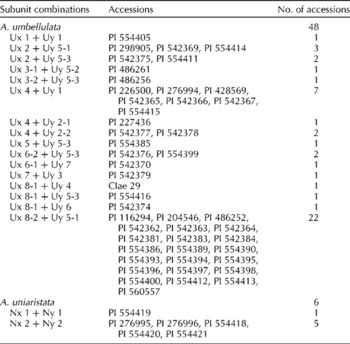
HMW-GS in diploid A. umbellulata and A. uniaristata species were preliminarily grouped by 10% SDS–PAGE and further differentiated by 15% SDS–PAGE and 10% urea/SDS–PAGE (Yan et al., Reference Yan, Hsam, Yu, Jiang and Zeller2003; Hu et al., Reference Hu, Dai, Pu, Liu, Pu, Jiang, Wei, Wu, Lan, Zheng and Yan2013). A total of eight Ux and seven Uy types were initially detected in 48 A. umbellulata accessions by 10 and 15% SDS–PAGE gels (Table 1; Figs. S1(a) and (b) and S2(a) and (b), available online). Subunits with equal electrophoretic mobility were differentiated by 10% urea/SDS–PAGE. The Ux 3, Ux 6 and Ux 8 proteins in 2, 3 and 25 accessions, respectively, were further divided into two subunits each: Ux 3-1 (one accession) and Ux 3-2 (one accession), Ux 6-1 (one accession) and Ux 6-2 (two accessions), and Ux 8-1 (three accessions) and Ux 8-2 (22 accessions) (Fig. S1(c), available online; Table 1). The Uy 2 and Uy 5 proteins in 3 and 33 accessions, respectively, were differentiated as the following subunits: Uy 2-1 (one accession) and Uy 2-2 (two accessions), and Uy 5-1 (25 accessions), Uy 5-2 (one accession) and Uy 5-3 (seven accessions) (Fig. S2c, available online; Table 1). In the 48 A. umbellulata accessions, 22 accessions with the HMW-GS combination Ux 8-2+Uy 5-1 represented the predominant HMW-GS type (Table 1).
Composition of high-molecular-weight glutenin subunits in Aegilops umbellulata and A. uniaristata

In six accessions of A. uniaristata, two Nx, two Ny and two combinations of HMW-GS were observed by 10 and 15% SDS–PAGE and 10% urea/SDS–PAGE (Fig. S3(a)–(c); Table 1).
Discussion
Amphidiploids are considered as bridges for transferring genes from T. turgidum and Aegilops species, or even more distantly related wild species, into hexaploid wheat (Sharma and Gill, Reference Sharma and Gill1983; Jiang et al., Reference Jiang, Friebe and Gill1994). The quality of HMW-GS specific to A. tauschii was effectively evaluated in amphidiploid crosses between T. turgidum and A. tauschii (Peña et al., Reference Peña, Zarco-Hernandez and Mujeeb-Kazi1995; Hu et al., Reference Hu, Dai, Pu, Liu, Pu, Jiang, Wei, Wu, Lan, Zheng and Yan2013). However, the quality of HMW-GS in amphidiploids derived from A. uniaristata and A. umbellulata has not been evaluated due to a lack of materials. In this study, five amphidiploids from crosses between T. turgidum ssp. durum or ssp. dicoccum and A. uniaristata or A. umbellulata were produced, and HMW-GS from two A. umbellulata accessions (CIae 29 and PI 226500) and one A. uniaristata accession (PI 499516) were introduced into hexaploid species with AABBUU and AABBNN genomes, respectively. They provide ideal materials for evaluating the quality of HMW-GS. Quality tests will be performed when enough seeds are produced.
Polymorphisms were identified in the HMW-GS of the diploid parental species A. uniaristata and A. umbellulata. Preliminary identification with 10 and 15% SDS–PAGE detected eight Ux and seven Uy types. SDS–PAGE gels containing 4 M urea are generally used to differentiate polymorphic HMW-GS with similar electrophoretic mobilities in SDS–PAGE. Using such methods, five novel Dx and Dy types were distinguished from a collection of 43 synthetic hexaploid wheat lines (Xu et al., Reference Xu, Khan, Klindworth and Nygard2010). In this study, three additional Ux and three Uy proteins were differentiated from A. umbellulata accessions by 10% urea/SDS–PAGE gels. Therefore, we identified a total of 11 Ux and 10 Uy proteins in 16 combinations among the 48 accessions of A. umbellulata. We also analysed the composition of HMW-GS in six accessions of A. uniaristata, but only two Nx and two Ny types in two combinations were detected as only a few accessions were used. These HMW-GS variants may provide new genetic resources for improving the quality of wheat.
Supplementary material
To view supplementary material for this article, please visit http://dx.doi.org/10.1017/S1479262114000719
Acknowledgements
The authors acknowledge financial support from the National Key Technologies R&D Program (no. 2011BAD35B03) and the National Natural Science Foundation of China (no. 31230053).