Implications
Fibrolytic enzymes have been included in ruminant diets with the aim of increasing fibre digestibility and consequently growth, milk yield and feed efficiency. The goal of this work was to study the effects of different fibrolytic enzyme mixtures on a tropical grass silage-concentrate diet. An overall increase in fibre degradation after 24 h of incubation in in vitro batch cultures was observed for all the enzyme mixtures investigated. However, the same result was not observed using an artificial rumen (Rusitec). Enzyme application increased microbial attachment to the silage, but did not increase fibre degradation in the Rusitec.
Introduction
Andropogon gayanus is an important C4 tropical grass because of its high biomass production and ability to tolerate long dry seasons, as well as the low fertile acidic soils typical of tropical savannas (Centro Internacional de Agricultura Tropical, 1990). Ensiling of tropical grasses is a common management approach to overcoming the scarcity of forage and avoiding the reduction in forage quality that occurs during the dry season of tropical savannahs. Ribeiro et al. (Reference Ribeiro, Teixeira, Velasco, Faria, Pereira, Chaves, Gonçalves and McAllister2014) reported CP levels <70 g/kg of dry matter (DM) and NDF levels ranging from 705 to 765 g/kg of DM in A. gayanus grass ensiled at increasing stages of maturity in southeastern Brazil. High NDF and ADF levels for A. gayanus grass at the vegetative stage (VS) were also reported by Phengvichith and Ledin (Reference Phengvichith and Ledin2007) in Laos (724±17.9 and 418±30.5 g/kg of DM, respectively) and Ouédraogo-Koné et al. (Reference Ouédraogo-Koné, Kaboré-Zoungrana and Ledin2008) in Burkina Faso (701±19.9 and 385±13.5 g/kg of DM, respectively). These findings suggest that there is merit in using technologies that could enhance the degradability of fibre and increase microbial protein synthesis in ruminants fed A. gayanus silage.
Ruminants fed tropical forages obtain their energy mainly from rumen microbial fermentation of structurally complex carbohydrates within plant cell walls. However, this hydrolysis is not complete due to the complexity of cell wall architecture and the limited residence time of chopped forages in the rumen (Wang and McAllister, Reference Wang and McAllister2002). Enzymes have been included in ruminant diets with the aim of increasing plant cell wall digestibility, but responses have been variable (Meale et al., Reference Meale, Beauchemin, Hristov, Chaves and McAllister2014). Factors such as formulation, dosage, method of application and the nature of the substrate to which they are applied contribute to this variability (Beauchemin et al., Reference Beauchemin, Colombatto, Morgavi and Yang2003). Some studies have examined the application of enzymes to tropical forages, with little benefit to the feed value of bermudagrass (Cynodon dactylon) silages (Mandebvu et al., Reference Mandebvu, West, Froetschel, Hatfield, Gates and Hill1999), bermudagrass, Pensacola bahiagrass (Paspalum notatum) (Dean et al., Reference Dean, Adesogan, Krueger and Littell2008) or Guinea grass (Panicum maximum var. Mombasa; Avellaneda et al., Reference Avellaneda, Pinos-Rodríguez, González, Bárcena, Hernández, Cobos, Hernández and Montañez2009). The large variation in nutritional quality among tropical grasses, along with differences in preservation method (fresh forage, hay and silage), suggest that there is a need to further screen fibrolytic enzyme additives for their ability to improve the digestibility of tropical forages.
The objectives of this study were to screen four fibrolytic enzyme additives for their ability to improve the in vitro ruminal fermentation of an A. gayanus grass silage-concentrate diet using batch cultures. One enzyme mixture was then selected and assessed for its ability to improve ruminal fermentation and microbial protein synthesis of this diet using the rumen simulation technique.
Material and methods
Preparation of silage and silage diets
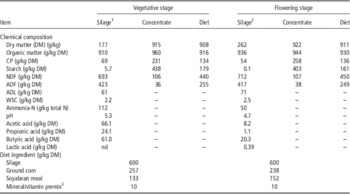
A. gayanus grass was produced in the rainy season of 2006–2007 using a previously established pasture in Lagoa Santa County, Minas Gerais, Brazil (19°35'36"S and 43°51'56"W; altitude 747 m). Soil samples were collected for analysis at a depth of 0–20 cm before the start of the experiment. To reduce acidity, limestone was applied (2000 kg/ha) at the beginning of the rainy season. After 30 days of growth, grass was cut 20 cm above the soil level and 250 kg/ha of 08 : 24 : 12 (N : P : K) and 100 kg/ha of 30 : 00 : 20 (N : P : K) were applied (Ribeiro et al., Reference Ribeiro, Teixeira, Velasco, Faria, Pereira, Chaves, Gonçalves and McAllister2014b). A. gayanus grass was harvested using a clearing saw (Stihl Ltd, Sao Leopoldo, RS, Brazil) after 56 (VS; 797 growing degree days (GDD)) and 112 (flowering stage (FS); 1604 GDD) days with 10°C as a baseline for GDD. Forages were chopped to a theoretical length of 10–25 mm and ensiled as described previously (Ribeiro et al., Reference Ribeiro, Teixeira, Velasco, Faria, Jayme, Maurício, Gonçalves and McAllister2015). Chopped grass was ensiled in plastic bags within 200 l steel barrels (15 barrels/growth stage), packed by trampling and sealed. Five barrels of each treatment were randomly selected and opened after 150 days of ensiling. Silage (500 g) from five different locations within each barrel were collected and pooled by treatment. Subsamples were then dried at 55°C for 48 h and ground to pass through a 5-mm screen (Arthur Thomas Co., Philadelphia, PA, USA). A second subsample (500 g) of each treatment was pressed using a hydraulic press (2 kgf/cm3) to obtain ≈100 ml of extract. The pH of the extract was immediately measured (Orion Model 260A; Fisher Scientific, Toronto, ON, Canada) and subsamples were stored at −20°C. Diets were formulated to contain 60% silage and 40% of a corn–soyabean-based concentrate on a DM basis. Both silages and concentrate were ground to pass a 1-mm screen for diets in Experiment 1 and 4 and through 2-mm screens, respectively, for diets in Experiment 2. Silage and concentrate in Experiment 1 were thoroughly mixed for each diet before filling of the filter bags and treatment with enzymes. Chemical composition of silage and concentrate are shown in Table 1.
Experiment 1 Screening enzyme products and determination of the optimal application dosage using batch cultures.
Ingredients and chemical composition of silages and concentrate used to formulate diets

WSC=water-soluble carbohydrates.
1 Adropogon gayanus grass was ensiled at the vegetative stage (56 days of re-growth).
2 A. gayanus grass was ensiled at the flowering stage (112 days of re-growth).
3 Per kg of dietary DM: 1.2 g of salt, 4.7 g of calcium carbonate, 3.6 g of dicalcium phosphate, 65 mg of Zn, 28 mg of Mn, 15 mg of Cu, 0.7 mg of I, 0.2 mg of Co, 0.3 mg of Se, 6000 IU of vitamin A, 600 IU of vitamin D and 60 IU of vitamin E.
The exogenous fibrolytic enzymes (EFE) were applied to complete diets at dosages of 0 (Control), 2 and 4 µl/g of substrate DM. A series of in vitro incubations were carried out in a completely randomized design with two runs and four replicates per run. The runs in each series were conducted on separate days.
The EFE evaluated were as follows: a 75 : 25 mixture of Cellulase Plus and Xylanase Plus (E1; from Trichoderma longibrachiatum; Dyadic International, Jupiter, FL, USA); Rovabio Excel LC2 (E2; from Penicillium funiculosum; Adisseo France SAS, Antony, France); Rovabio Rips (E3; from P. funiculosum; Adisseo France SAS) and Econase RDE (E4; from T. longibrachiatum; AB Vista, Marlborough, UK), and were characterized for enzyme activities as previously described (Colombatto and Beauchemin, Reference Colombatto and Beauchemin2003; Phakachoed et al., Reference Phakachoed, Suksombat, Colombatto and Beauchemin2013). Formulations contained mainly xylanase activity (1804, 1372, 616 and 3034 μmoles of xylose released from oat spelt xylan per min per ml of product for E1, E2, E3 and E4, respectively) and endoglucanase activity (352, 159, 59 and 360 μmoles of glucose released from medium-viscosity carboxymethylcellulose per min per ml for E1, E2, E3 and E4, respectively). Dosages were selected based on previous in vitro work with the same enzymes using corn silage (Phakachoed et al., Reference Phakachoed, Suksombat, Colombatto and Beauchemin2013).
Rumen fluid for in vitro incubations was obtained from three ruminally cannulated Angus×Hereford cattle fed a mixed diet of barley silage, rolled barley grain and a mineral/vitamin supplement (70 : 27 : 3, % DM basis). Cows used as donors of rumen fluid were cared for in accordance with the guidelines of the Canadian Council of Animal Care (1993). Rumen fluid was collected 2 h after the morning feeding, filtered through four layers of cheesecloth, combined in equal portions and transported in a pre-warmed thermos to the laboratory. Rumen fluid and mineral buffer with 0.5 ml of a cysteine sulphide solution (Menke et al., Reference Menke, Raab, Salewski, Steingass, Fritz and Schneider1979) were mixed 1 : 2 under a stream of O2-free CO2 at 39°C.
For each in vitro incubation, 0.5 g DM of substrate was weighed into an acetone-washed, pre-weighed filter bag (model F57; Ankom Technology Corp., Macedon, NY, USA). Four replicates were prepared for each treatment for each incubation time. The EFE was diluted with distilled water and sprayed (50 µl) directly onto the substrates in filter bags (before sealing) at either 0 (control), 2 or 4 µl/g of DM. Bags were heat-sealed and placed into empty 125-ml amber serum vials and retained at room temperature for 2 h before incubation.
Inoculum was transferred (80 ml) into vials under a stream of O2-free CO2. Vials were sealed with rubber stoppers and incubated at 39°C on an orbital shaker set at 90 oscillations/min for 24 and 48 h. Four blank vials containing empty filter bags and inoculum were incubated to correct for gas production (GP) and DM disappearance. GP from each vial was measured after 3, 6, 12, 24 and 48 h using a water-displacement apparatus (Fedorak and Hrudey, Reference Fedorak and Hrudey1983). After 24 and 48 h, four bottles from each treatment were removed from the incubator and placed on ice. Filter bags were removed from the bottles, thoroughly rinsed with cold water and dried at 55°C for 48 h to calculate apparent DM disappearance. The residues in the bags were also analysed for NDF and ADF to estimate NDF and ADF disappearance using the sequential method with ANKOM200 Fibre Analyzer (Ankom Technology Corp.) and reagents, as described by Van Soest et al. (Reference Van Soest, Robertson and Lewis1991). Sodium sulphite and α-amylase were used during NDF determination and values were expressed exclusive of ash. Total cumulative gas production (TGP, ml) at 24 and 48 h, corresponding with DM disappearance, was calculated by summing the blank-corrected gas volumes recorded at previous measurement times.
Experiment 2 Determination of EFE on ruminal digestion and rumen microbial protein production using Rusitec.
Experimental design and treatments
As all enzyme preparations had a positive impact on NDF disappearance at 24 h in Experiment 1, E2 (Rovabio Excel LC2) applied at 4 µl/g substrate DM was selected for further assessment in the Rusitec, as it was commercially available at the least cost per unit. The experiment was a completely randomized 2×2 factorial design using two eight-vessel Rusitecs (Czerkawski and Breckenridge, Reference Czerkawski and Breckenridge1977). Diets were as described in Experiment 1, with the silage either not treated or treated with E2 at 4 µl/g of diet DM. Four replicate vessels were used for each treatment. Silage and concentrate were incubated in separate polyester bags (for concentrate: 50×100 mm; pore size=50 µm; for silage: 100×200 mm; pore size=50 µm; ANKOM; Ankom Technology Corp.). For the Rusitec, E2 was applied only to the silage at the same rate as for the complete diet described above, as it was felt that improved 24 h disappearance in the in vitro batch culture studies arose mainly from the impact of the additive on silage NDF. As per batch cultures, silage was retained at room temperature for 2 h after treatment with E2 before being placed in the fermenters.
Experimental procedure
To begin the experiment, each fermenter was filled with 180 ml of pre-warmed artificial saliva (McDougall, Reference McDougall1948) modified to contain 0.3 g/l of (NH4)2SO4, and 720 ml of filtered rumen fluid. Solid rumen digesta (20 g), silage (6 g) and concentrate (4 g) for each respective treatment were placed in three separate polyester bags within each fermenter. Rumen fluid was obtained from the same three ruminally fistulated cattle, as described in Experiment 1. Rumen solids were obtained from composited samples collected from four locations within the rumen. Fermenters were immersed in a water bath at 39°C and bags within the vessels were moved up and down within the fermentation fluid at eight cycles per min. After 24 h, the nylon bag containing solid rumen digesta was replaced with one bag containing silage and one containing concentrate. Thereafter, polyester bags were replaced daily, resulting in each bag remaining in the fermenter for 48 h.
Artificial saliva (pH 8.2) was infused continuously into each fermenter at 2.9%/h, replacing 70% of the fermenter volume daily. The experiment consisted of 8 days of adaptation (day 1 to 8) and 7 days of sampling (day 9 to 15). Effluent from each fermenter was collected into a 1 l flask, and gas was collected into a re-usable 2 l vinyl collection bag (Curity®; Conviden Ltd, Mansfield, MA, USA) attached to each effluent flask. Daily total GP and effluent volume from each fermenter were recorded at the time of feed-bag exchange and measurement of fluid pH. During feed-bag exchange, fermenters were flushed with O2-free CO2.
Sample collection and analysis
From day 9 to 11, the feed bags removed at 48 h were washed under cold tap water until the water was clear. Bags were dried at 55°C to a constant weight. The residue in the silage bags was kept separately for each of the 3 days, whereas the residues in concentrate bags were pooled over 3 days to ensure sufficient sample for chemical analysis. All samples were ground to pass through a 1-mm screen before chemical analysis.
Daily total GP was determined throughout the experiment using a gas metre (Model DM3A, Alexander-Wright, London, England, UK). From day 9 to 14, a 20-ml gas sample was taken from the septum of each collection bag using a 26-gauge needle (Becton Dickinson, Franklin Lakes, NJ, USA) and transferred to evacuated 6.8-ml exetainers (Labco Ltd, Wycombe, Bucks, UK) for immediate analysis of CH4.
To determine daily volatile fatty acids (VFA) and NH3-N production, effluent was collected daily from day 9 to 11 in flasks containing 20 ml of 3.66 M H2SO4 (20%, vol/vol; Giraldo et al., Reference Giraldo, Tejido, Ranilla and Carro2007b). Subsamples of the fermenter effluent (2.5 ml) were taken directly from the effluent flask at the time of feed-bag exchange and were placed in screw-capped vials containing 0.5 ml of 25% (wt/wt) metaphosphoric acid and stored at −20°C until VFA analysis. At the same time, a 2.5 ml subsample of fermenter effluent was also placed in a screw-capped vial with 0.5 ml of 65% (wt/vol) trichloroacetic acid until analysed for NH3-N.
To estimate microbial protein synthesis, bacteria in the fermenters were labelled using 15N. On day 8, effluent and feed residue solids were sampled for the determination of background 15N and 0.3 g/l (NH4)2SO4 in McDougall’s buffer was replaced with 0.3 g/l 15N-enriched (NH4)2SO4 (Sigma Chemical Co., St. Louis, MO, USA; minimum 15N enrichment 10.01 atom%) until the end of the experiment. On days 12, 13 and 14, 24 h accumulation of effluent in each flask was preserved with 20% (wt/vol) sodium azide (3 ml) and 50 ml was subsampled for isolation of liquid-associated bacteria.
Feed particle-associated (FPA) and feed particle-bound (FPB) bacterial fractions were prepared from 48-h feed residues on days 12, 13 and 14. Upon removal from the fermenters, solids were squeezed to expel excess liquid from both the silage and concentrate feed bags. Bags were placed together in a plastic bag with 20 ml of McDougall (Reference McDougall1948) buffer and processed for 60 s in a Stomacher 400 Laboratory Blender (Seward Medical Ltd, London, England, UK). The processed liquid was squeezed out, poured off and retained. Feed residues were washed twice with 10 ml of McDougall’s buffer in each wash. The wash buffer was retained and pooled with the initially expressed fluid to obtain the FPA bacterial fraction, and the total volume was recorded. Washed solid feed residues were considered to represent the FPB bacterial fraction.
To determine 15N concentration, effluent liquid samples were centrifuged (20 000×g, 30 min, 4°C) and the resulting pellets were washed with de-ionized water and centrifuged three times (20 000×g, 30 min, 4°C). The pellet was then re-suspended in distilled water and lyophilized for N and 15N determination. The FPA bacterial samples collected from the stomaching process were centrifuged (500×g, 10 min, 4°C). The supernatant was subsequently centrifuged (20 000×g, 30 min, 4°C) and the resulting pellet was washed three times as previously described. The pellet was then re-suspended in distilled water and lyophilized for N and 15N determination. Washed feed residues (FPB fraction) were dried at 55°C for 48 h, weighed for DM determination and ball ground using a mixer mill (MM 400; Retsch Inc., Newtown, PA, USA) before analysis of total N and 15N concentrations.
Protozoa counts were determined daily from day 9 to 11 using pooled fluid samples collected daily from both the 48 h silage and concentrate feed bags from each fermenter. Bags were pressed to expel fermentation fluid and a 2.5 ml subsample was obtained and preserved using 2.5 ml of methyl green formalin-saline solution. Protozoa samples were stored in the dark at room temperature until enumerated by light microscopy with a Levy–Hausser counting chamber (Hausser Scientific, Horsham, PA, USA).
Feed and fermentation residues were analysed for DM (Association of Official Analytical Chemists (AOAC), 2006; method 930.15) and ash (AOAC, 2006; method 942.05). The NDF and ADF contents were determined by the sequential method with the ANKOM200 Fibre Analyzer using reagents as described by Van Soest et al. (Reference Van Soest, Robertson and Lewis1991) and expressed exclusive of ash. Sodium sulphite and α-amylase were used during NDF determination. Lignin analyses were performed on ADF residues, using the direct sulphuric acid method (Robertson and Van Soest, Reference Robertson and Van Soest1981). Total N (AOAC, 2006; method 990.03) and atom per cent excess (APE) of 15N were analysed using a MS (NA 1500; Carlo Erba Instruments, Rodano, Italy). Starch was determined in concentrate and silage samples as described by Karkalas (Reference Karkalas1985), and water-soluble carbohydrates were determined in silage according to Bailey (Reference Bailey1967).
Silage extract was analysed for NH3-N using the Kjeldahl method, with the volatile N fraction distilled by heating extracts at pH>7 with ~2 g of MgO, and for VFA using a GC-17A Gas Chromatograph (Shimadzu Corp., Kyoto, Japan), equipped with a flame ionization detector and fitted with a Nukol fused silica capillary column (15 m; 0.53 mm i.d.; 0.5 µm film thickness; Supelco, Bellefonte, PA, USA), as described by Playne (Reference Playne1985). The gas chromatograph was operated isothermally at 200°C (column), with the inlet and detectors maintained at 225°C.
Concentrations of VFA and NH3-N in the liquid effluent were analysed by gas chromatography (Wang et al., Reference Wang, McAllister, Rode, Beauchemin, Morgavi, Nsereko, Iwaasa and Yang2001) and the modified Berthelot method (Rhine et al., Reference Rhine, Mulvaney, Pratt and Sims1998), respectively. Methane concentration in gas was determined using a Varian gas chromatograph equipped with GS-CarbonPLOT 30 m×0.32 mm×3 µm column and thermal conductivity detector (Agilent Technologies Canada Inc., Mississauga, ON, Canada) at an isothermal oven temperature of 35°C with helium as the carrier gas (27 cm/s).
Calculations
Total daily effluent microbial N (MN) production (mg/day) was calculated based on N concentrations in the bacterial pellet from the effluent and sample size (weight and volume). The MN production (mg/day) from the FPA fraction obtained from the stomacher extraction process was estimated as described for the effluent microbial fraction. The MN production (mg/day) from the FPB fraction was estimated using the following equation:
 $${\rm MN}={{{\rm APE in RN}} \over {{\rm APE in MN}}}{\times}{\rm RN}$$
where APE in residue nitrogen (RN) is the per cent excess of 15N in the solid residue, APE in MN is the per cent excess of 15N in the microbial fraction of the effluent and RN is the total N in the residues (in mg; Wang et al., Reference Wang, McAllister, Yanke, Xu, Cheeke and Cheng2000). Total daily MN production (mg/day) was calculated as the sum of microbial production in the effluent, FPA, FPB of silage residues and FPB of concentrate residues.
True DM disappearance was calculated by subtracting the microbial mass from feed residues. Microbial mass in feed residues was calculated by multiplying MN production (mg) in feed residues by the microbial mass per mg of MN (g of DM of microbial pellet/mg of MN). Microbial mass per mg of MN was determined in FPA bacterial pellets.
Ammonia-N and daily VFA production were calculated by multiplying the concentration of the fermentation end product in the effluent by the daily production of effluent.
Statistical analysis
Data were analysed using the MIXED procedure of SAS (SAS Inc., Cary, NC, USA). In Experiment 1, data obtained from the two diets were analysed separately as completely randomized design with enzyme additive, dose and enzyme×dose interactions included in the model as fixed effects according to the model below:
 $$Y_{{ijkl}} =\mu {\plus}{\rm E}_{i} {\plus}{\rm D}_{j} {\plus}{\rm ED}_{{ij}} {\plus}{\rm R}_{k} {\plus}e_{{ijkl}} $$
where Y ijkl is the observation, µ the overall mean effect, E i the effect of enzyme additive (E1, E2, E3 or E4; d.f.=3), D j the effect of dose (0, 2 or 4 µl/g DM; d.f.=2), ED ij the effect of enzyme×dose interactions (d.f.=6), R k the random effect of run (1–2) and e ijkl the residual error. When the main effect of dose was significant (P<0.05), orthogonal polynomial contrasts were performed to test for linear or quadratic dose responses. For the Rusitec (Experiment 2), the MIXED procedure model included the fixed effects of diet, enzyme, day of sampling, diet×enzyme, diet×day, enzyme×day and diet×enzyme×day, with the day of sampling from each fermenter treated as a repeated measure accordingly to the following model:
 $$Y_{{ijklm}} =\mu {\plus}{\rm E}_{i} {\plus}{\rm F}_{j} {\plus}{\rm D}_{k} {\plus}{\rm EF}_{{ij}} {\plus}{\rm ED}_{{ik}} {\plus}{\rm FD}_{{jk}} {\plus}{\rm EFD}_{{ijk}} {\plus}{\rm R}_{l} {\plus}e_{{ijklm}} $$
where Y ijklm is the observation, µ the overall mean effect, E i the effect of enzyme (enzyme or no enzyme; d.f.=1), F j the effect of diet (VS or FS; d.f.=1), D k the effect of day of sampling, EF ij the effect of enzyme×diet interactions (d.f.=1), ED ik the effect of enzyme×day of sampling interactions, FD jk the effect of diet×day of sampling interactions, EFD ijk the effect of enzyme×diet×day of sampling interactions, R l the random effect of fermenter (1–4) and e ijklm the residual error. Therefore, the individual fermenter was used as the experimental unit for statistical analysis. The minimum values of Akaike’s Information Criterion were used to select the covariance structure among compound symmetry, heterogeneous compound symmetry, autoregressive, heterogeneous autoregressive, Toeplitz, unstructured and banded for each parameter. Means were compared using the least square mean linear hypothesis. Significance was declared at P⩽0.05. There were no diet×day, enzyme×day and diet×enzyme×day effects for all the parameters evaluated, and as a result neither day nor interactions involving day are reported in the tables.
Results
Enzyme screening
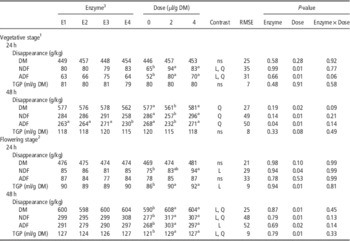
There was no enzyme or enzyme×dose interaction (P>0.05) for DM or NDF disappearances or TGP after 24 and 48 h of incubation for either the FS or VS diets (Table 2). There was also no enzyme or enzyme×dose interaction (P>0.05) for ADF disappearance after 24 h of incubation for either diet and after 48 h for the FS diet. An enzyme effect (P<0.05) for ADF disappearance after 48 h of incubation for the VS diet was observed, with lower (P<0.05) ADF disappearance for E4 compared with the other enzyme products. However, dosage did affect (P<0.05) NDF or ADF disappearance after 24 h or DM, NDF and ADF disappearance after 48 h when the diet contained VS silage. For the diet containing grass ensiled at the FS, a dosage effect (P<0.05) was observed for NDF and TGP disappearance at 24 h and for TGP and disappearances of DM, NDF and ADF after 48 h of incubation.
Effect of enzyme (E) and dose (D) on the disappearance of dry matter (DM), NDF, ADF and total cumulative gas production (TGP) from Andropogon gayanus grass silage-concentrate diet after 24 and 48 h of incubation in ruminal fluid (n=8)

L, Q: within a row, the main effect of dose is linear or quadratic, respectively (P<0.05). ns: within a row, the main effect of dose is not linear or quadratic (P>0.05).
a,bMeans within a row within the main effect of enzyme or dose having different superscript letters are different at P<0.05.
1 Andropogon gayanus grass was ensiled at the vegetative stage (56 days of re-growth) and was mixed with a corn–soyabean-based concentrate at the ratio of 60 : 40 (silage : concentrate, DM basis).
2 A. gayanus grass was ensiled at the flowering stage (112 days of re-growth) and was mixed with a corn–soyabean-based concentrate at the ratio of 60 : 40 (silage : concentrate, DM basis).
3 E1: 75 : 25 combination of Cellulase Plus and Xylanase Plus (source organism Trichoderma longibrachiatum; Dyadic International, FL, USA); E2: Rovabio Excel LC2 (source organism Penicillium funiculosum; Adisseo France SAS, Antony, France); E3: Rovabio Rips (source organism P. funiculosum; Adisseo France SAS) and E4: Econase RDE (T. longibrachiatum; AB Vista, Marlborough, UK).
For the VS diet, a higher dose quadratically influenced (P<0.05) NDF and ADF disappearance after 24 h of incubation. With 48 h of incubation, increasing enzyme dose also resulted in a quadratic effect (P<0.05) on DM, NDF and ADF disappearances of the VS diet, with a lower disappearance being observed for 2 µl/g of substrate DM. Increasing enzyme dose linearly increased (P<0.05) NDF disappearance and TGP in the FS diet after 24 h and ADF disappearance after 48 h of incubation. Increasing enzyme dose for FS diet also quadratically impacted (P<0.05) DM and NDF disappearances and TGP after 48 h of incubation.
In general, an increase in NDF disappearance after 24 h was observed with all enzyme mixtures investigated for both VS and FS diets. Of the enzymes screened, E2 was selected for the Rusitec experiment, because it increased NDF disappearance after 24 h incubation of the VS and the FS diet by 10% and 33%, respectively, and was commercially available at the least cost price. The significant quadratic effect of dose suggested that maximal response was achieved at 4 µl/g of diet DM.
Rusitec
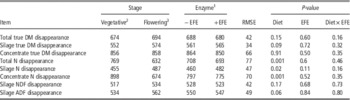
There were no enzyme or diet×enzyme interactions (P>0.05) on total (silage+concentrate), silage or concentrate true DM and N disappearances (Table 3). Similarly, no enzyme or diet×enzyme interactions (P>0.05) were observed for silage NDF or ADF disappearance. There was also no effect of diet (P>0.05) on total, silage or concentrate true DM disappearance. Higher (P<0.05) silage N disappearance was observed for the FS diet compared with the VS diet, but disappearance of concentrate N was higher (P<0.05) for the VS diet. As a result, total N disappearance was higher (P<0.05) for the VS diet than for the FS diet. No difference was observed (P>0.05) between diets for silage NDF or ADF disappearance.
Effect of exogenous fibrolytic enzymesFootnote 1 (EFE) on true DM, nitrogen (N), NDF and ADF disappearance of Andropogon gayanus grass silage-concentrate diet differing in grass maturity at ensiling in the rumen simulation technique (n=4)

1 Rovabio Excel LC2 (source organism Penicillium funiculosum; Adisseo France SAS, Antony, France) at 4 µl/g of substrate DM. −EFE=diet without enzyme; +EFE=diet with enzyme.
2 Andropogon gayanus grass was ensiled at the vegetative stage (56 days of re-growth) and was incubated with a corn–soyabean-based concentrate at the ratio of 60 : 40 (silage : concentrate, DM basis).
3 A. gayanus grass was ensiled at the flowering stage (112 days of re-growth) and was incubated with a corn–soyabean-based concentrate at the ratio of 60 : 40 (silage : concentrate, DM basis).
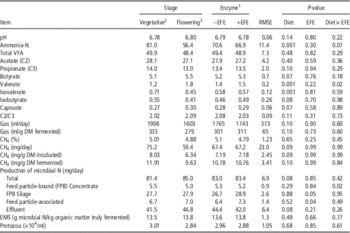
There were no enzyme or diet×enzyme interactions (P>0.05) for pH, daily NH3-N and VFA production or acetate : propionate ratio (C2 : C3) (Table 4). The pH, daily production of total VFA, acetate, propionate, butyrate, isobutyrate and caproate or C2 : C3 ratio also did not differ (P>0.05) among diets. Daily production of ammonia-N and isovalerate were higher (P<0.05) for the VS diet compared with the FS diet. However, valerate production was higher (P<0.05) for the FS diet than for the VS diet.
Effect of exogenous fibrolytic enzymeFootnote 1 (EFE) on pH, ammonia-N (mg/day), volatile fatty acid (VFA, mmol/day), gas, methane (CH4) and microbial N production, efficiency of microbial synthesis (EMS) and protozoa numbers of Andropogon gayanus grass silage-concentrate diet differing in grass maturity at ensiling in the rumen simulation technique (n=4)

−EFE=diet without enzyme; +EFE=diet with enzyme.
1 Rovabio Excel LC2 (source organism Penicillium funiculosum; Adisseo France SAS, Antony, France) at 4 µl/g of substrate DM.
2 Andropogon gayanus grass was ensiled at the vegetative stage (56 days of re-growth) and was incubated with a corn–soyabean-based concentrate at the ratio of 60 : 40 (silage : concentrate, DM basis).
3 A. gayanus grass was ensiled at the flowering stage (112 days of re-growth) and was incubated with a corn–soyabean-based concentrate at the ratio of 60 : 40 (silage : concentrate, DM basis).
No significant effect (P>0.05) of diet, enzyme or diet×enzyme was observed for GP (ml/day and ml/g DM fermented) or CH4 production (as % of total gas, mg/day and mg/g of DM incubated or fermented).
Diet and diet×enzyme interactions were not observed (P>0.05) for total, silage FPB fraction, FPA or effluent MN production, but there was a diet×enzyme interaction (P<0.05) for the concentrate FPB MN fraction. Enzyme application reduced (P<0.05) MN associated with the concentrate FPB fraction of the VS diet, but increased (P<0.05) its association with the FS diet. Enzyme application also increased (P<0.05) the MN associated with the FPA and silage FPB fractions in both diets. No enzyme effect (P>0.05) on MN production was observed in the other fractions (effluent and total). There were no effects (P>0.05) of diet, enzyme or diet×enzyme on the efficiency of microbial synthesis or numbers of protozoa.
Discussion
Enzyme screening
It has been suggested that a major limitation to the widespread commercial use of fibrolytic enzymes for ruminants is the variability of responses for a given product depending upon the diet and feeding conditions (Beauchemin et al., Reference Beauchemin, Colombatto, Morgavi and Yang2003). Phakachoed et al. (Reference Phakachoed, Suksombat, Colombatto and Beauchemin2013) tested the same four EFE as used in this study with corn silage, and reported that all enzymes resulted in an overall increase in DM, NDF and ADF disappearance after 24 and 48 h of in vitro ruminal incubation. An overall increase in fibre (NDF and ADF) degradation was also observed for all enzyme mixtures investigated in our in vitro batch cultures. The C4 grasses are the main forage for livestock farming in tropical and subtropical regions of the world, and their nutritive value is often intrinsically low. Therefore, the performance of ruminants fed tropical grasses is often suboptimal (Facchini et al., Reference Facchini, Reis, Roth, Magalhães, Peixoto-Nogueira, Casagrande, Reis and MDLTM2012). Increasing the digestibility and consequently the intake of metabolizable energy by ruminants fed tropical forages may have a huge impact on livestock production, contributing to sustainable food production and increased profitability in the agricultural sector of many developing nations.
According to Colombatto et al. (Reference Colombatto, Mould, Bhat, Morgavi, Beauchemin and Owen2003a and Reference Colombatto, Mould, Bhat and Owen2003b), EFE have their greatest impact on fibre digestion within the first 6 to 12 h of incubation, with little impact on total GP or the extent of fibre digestion after 24 to 96 h. Eun and Beauchemin (Reference Eun and Beauchemin2007) observed increases in GP and apparent organic matter degradability after 18 h of incubation when EFE were applied to alfalfa hay. Short-term, rather than long-term (e.g., 48 h), incubations have been used to assess the effect of fibrolytic enzymes, because long-term incubations are not representative of the residence time of fibre in the rumen of high producing dairy cows (Colombatto et al., Reference Colombatto, Mould, Bhat, Morgavi, Beauchemin and Owen2003b; Eun and Beauchemin, Reference Eun and Beauchemin2007). However, in beef cattle fed high tropical forage (C4) diets (Wylie et al., Reference Wylie, Ellis, Matis, Bailey, James and Beever2000), ruminal residence times can be substantially longer, possibly making a longer incubation period (48 h) more relevant to studying responses to EFE. In the present study, the DM disappearance of the FS diet after 48 h of incubation was increased with EFE application.
Rusitec
The higher total N disappearance and levels of silage ammonia-N in the VS diet resulted in higher NH3-N in the fermenter fluid. Supplementing FS silage with concentrate promoted silage DM disappearance, resulting in values that were similar to the diets containing the VS silage. In a previous metabolism study, conducted with rams receiving these same silages but with no concentrate, grass ensiled at the FS exhibited a lower apparent DM digestibility than grass ensiled at the VS (380 and 526 g/kg DM, respectively; Ribeiro et al., Reference Ribeiro, Teixeira, Velasco, Faria, Jayme, Maurício, Gonçalves and McAllister2015). The CP content in the grass ensiled at the FS was <70 g/kg DM and most probably limited microbial growth in the rumen of the rams, resulting in reduced diet digestibility.
Only minor differences in VFA profile were noted across diets, with higher isovalerate production from the VS than the FS diet, a result that is likely reflective of the higher protein content leading to increased deamination of leucine. However, no differences in daily acetate, propionate, total VFA production or C2 : C3 ratio were observed. The similarities between the VS and FS diets observed for gas (ml/day and ml/g DM fermented) and CH4 production (mg/day and mg/g of DM incubated or fermented) are consistent with the total true DM disappearance, VFA production and C2 : C3 ratio, which did not differ between these two diets.
Application of EFE 2 h before feeding did not impact DM, N, NDF or ADF disappearance after 48 h of incubation in the Rusitec. Daily NH3-N, VFA and CH4 productions were also not affected by EFE in this study. Wang et al. (Reference Wang, McAllister, Rode, Beauchemin, Morgavi, Nsereko, Iwaasa and Yang2001) reported that applying an enzyme preparation to the feed 24 h before feeding increased barley grain DM disappearance after 48 h of incubation, but had no effect when enzymes were directly infused into the fermenters. Although Giraldo et al. (Reference Giraldo, Ranilla, Tejido and Carro2007a) have shown an increase in 48 h DM, NDF and ADF disappearance in the Rusitec with enzyme application to a forage-based diet 24 h before feeding, additional work by this same group observed these responses after 6 and 24 h of incubation, but not after 48 h (Giraldo et al., Reference Giraldo, Tejido, Ranilla and Carro2007b). In addition, Wang et al. (Reference Wang, McAllister, Rode, Beauchemin, Morgavi, Nsereko, Iwaasa and Yang2001) did not observe higher DM or NDF disappearance of alfalfa hay after 48 h of incubation when enzymes were applied 24 h before feeding. According to Nsereko et al. (Reference Nsereko, Morgavi, Rode, Beauchemin and McAllister2000), most of the release of reducing sugars from high DM feeds as a result of the addition of EFE occurs within 2 h after application. The enzyme-mediated increase in NDF and ADF disappearance after 24 h of incubation in our batch culture study also supports the contention that applying enzymes 2 h before feeding provides sufficient time for the hydrolysis of sugars from plant cell walls. Supplementing ruminant diets with EFE has been reported to increase the rate, but seldom the extent of feed digestion (Meale et al., Reference Meale, Beauchemin, Hristov, Chaves and McAllister2014). The lack of an effect of EFE on daily NH3-N, VFA and CH4 production in this study agrees with the lack of an effect of this additive on DM and fibre digestibility. The results from this Rusitec study are in agreement with previous in situ work carried out with bermudagrass (C. dactylon) silages (Mandebvu et al., Reference Mandebvu, West, Froetschel, Hatfield, Gates and Hill1999) and with bermudagrass hay and Pensacola bahiagrass (P. notatum) hay (Dean et al., Reference Dean, Adesogan, Krueger and Littell2008) and in vivo with Guinea grass (P. maximum var. Mombasa) hay (Avellaneda et al., Reference Avellaneda, Pinos-Rodríguez, González, Bárcena, Hernández, Cobos, Hernández and Montañez2009), studies which did not find any effects of fibrolytic enzymes on the digestion of these high-fibre tropical grasses.
A synergistic relationship between EFE and rumen microbiota and an increase in bacterial attachment are proposed modes of action, whereby exogenous enzymes may improve feed digestion in the rumen (Morgavi et al., Reference Morgavi, Beauchemin, Nsereko, Rode, Iwaasa, Yang, McAllister and Wang2000). However, the exact mechanism that stimulates microbial attachment is unknown. According to Cheng and McAllister (Reference Cheng and McAllister1997), metabolic products of primary colonizers of feedstuffs are thought to attract secondary colonizers to feed surfaces and stimulate attachment. Wang et al. (Reference Wang, McAllister, Rode, Beauchemin, Morgavi, Nsereko, Iwaasa and Yang2001) proposed that products released as a result of hydrolysis by EFE accumulate on the surface of the feed particles and serve as chemoattractants to ruminal microbes. Increased 15N incorporation into FPA and FPB fraction by EFE in the Rusitec has been previously observed (Wang et al., Reference Wang, McAllister, Rode, Beauchemin, Morgavi, Nsereko, Iwaasa and Yang2001; Giraldo et al., Reference Giraldo, Ranilla, Tejido and Carro2007a). Applying an EFE to tropical silage 2 h before feeding in this study increased microbial colonization of silage, as shown by increased MN production in FPA and silage FPB fractions; however, DM and fibre degradation remained unaffected. These results suggest that enzyme application 2 h before feeding was sufficient to promote interaction between the enzyme and substrate, but in these tropical silage diets degradation may not be limited by microbial colonization, but rather by the ability of fibrolytic enzymes to degrade these recalcitrant substrates. Other factors such as organization of forage plant tissues (Wilson, Reference Wilson1993), anatomical limitations to digestion of thick-walled fibre particles (Wilson and Mertens, Reference Wilson and Mertens1995) and lignin cross-linkages (Jung and Allen, Reference Jung and Allen1995) may all hinder the degradation of plant cell walls. In the Rusitec, silage samples were ground to pass through a 4-mm screen compared with the batch cultures where samples were ground to pass through a 1-mm screen. The increase in surface area by finer grinding may have facilitated enzyme access to substrates, resulting in an increase in fibre disappearance observed with EFE application. Care must be taken when recommending enzyme additives for ruminants based on batch culture results, as the substrate presented for fermentation often differs in particle size from that which is normally consumed.
In conclusion, all EFE products tested increased NDF disappearance after 24 h of incubation in batch culture. However, applying EFE enzymes to A. gayanus grass silage diets under continuous fermentation conditions in the Rusitec did not affect diet DM, NDF and ADF degradation but increased microbial attachment to the silage. Further studies are needed to evaluate different enzyme products, application methods, pre-treatments and dosages of enzymes for tropical forage diets.
Acknowledgements
This study was conducted with funding from FAPEMIG – Minas Gerais State Research Foundation (process CAG – 2653/06) and Alberta Meat and Livestock Foundation (ALMA). The first author gratefully acknowledges CNPq (Conselho Nacional de Desenvolvimento Científico e Tecnológico) for the Doctorate Sandwich Scholarship. The authors also thank K. Munns, W. Smart, M. L. He and D. Vedres (Agriculture and Agri-food Canada – Lethbridge Research Centre) for their technical assistance and Dyadic International Ltd (Florida, USA), AB Vista (Marlborough, UK) and Adisseo France SAS (Antony, France) for providing samples of their commercial enzymes.