Introduction
Massive hemorrhage with coagulopathy is one of the leading causes of preventable death in combat.Reference Gellerfors, Linde and Gryth 1 - Reference Katzenell, Ash, Tapia, Campino and Glassberg 3 On the battlefield, logistical constraints limit the use of blood products.Reference Maegele, Spinella and Schochl 4 The development of freeze-dried plasma (FDP), which can be stored at ambient temperatures, allows for early treatment with coagulation-optimizing resuscitation fluid in the prehospital setting.Reference Borgman, Spinella and Perkins 5
Case Report
A 35-year-old Afghan National Police Officer sustained a high-velocity gunshot wound (HVGSW) to the right side of his neck in northern Afghanistan. The Afghan medical personnel compressed the wound with their fingers and administered Saline 1,000 ml, ceftriaxone (dose unknown), and diclofenac (dose unknown). The Swedish military Black Hawk ambulance helicopter responded to the call at 10:15 pm.
On arrival, the patient was confused with vital signs at: heart rate (HR) 130 beats/minute, blood pressure (BP) 105/55 mmHg, respiratory rate (RR) 25 breaths/minute, saturation 95% without oxygen, and Glasgow Coma Scale of 11. Examination revealed a wound to the right of his lower cervical vertebras and a wound below his right mandible. There was no active external bleeding, but there was major swelling of the adjacent tissues. The patient was in-flight managed according to the Battlefield Advanced Trauma Life Support algorithm in the Medevac Helicopter. Hypotensive resuscitation concept was utilized. Since the patient was affected mentally, he received a bolus dose of 200 ml Lyoplas N - w (lyophilized, freeze-dried, single-donor plasma; DRK-Blutspendedienst [German Red Cross]; West Germany) and high-flow oxygen. Additionally, he received Ketalar (ketamine; Pfizer Inc.; New York, New York USA) intravenous (IV) 20 mg and Cyklokapron (tranexamic acid; Pfizer Inc.) IV 1 g during the seven minute flight. On arrival to Marmal Role 3 Military Hospital (Mazar-i-Sharif, Afghanistan), the patient’s condition had improved with vital signs at: HR 105 beats/minute, BP 115/55 mmHg, RR 20 breaths/minute, saturation 100% with oxygen, and he was calm.
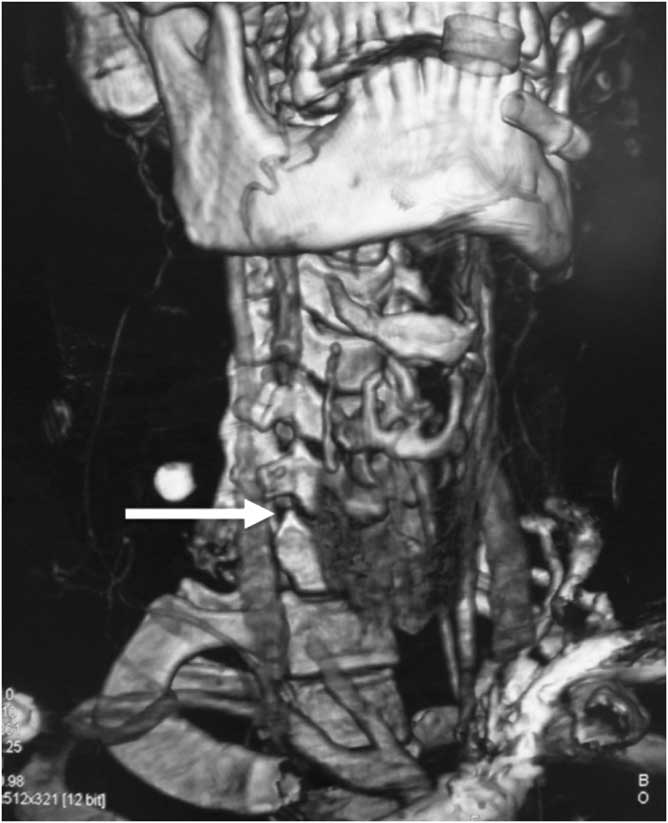
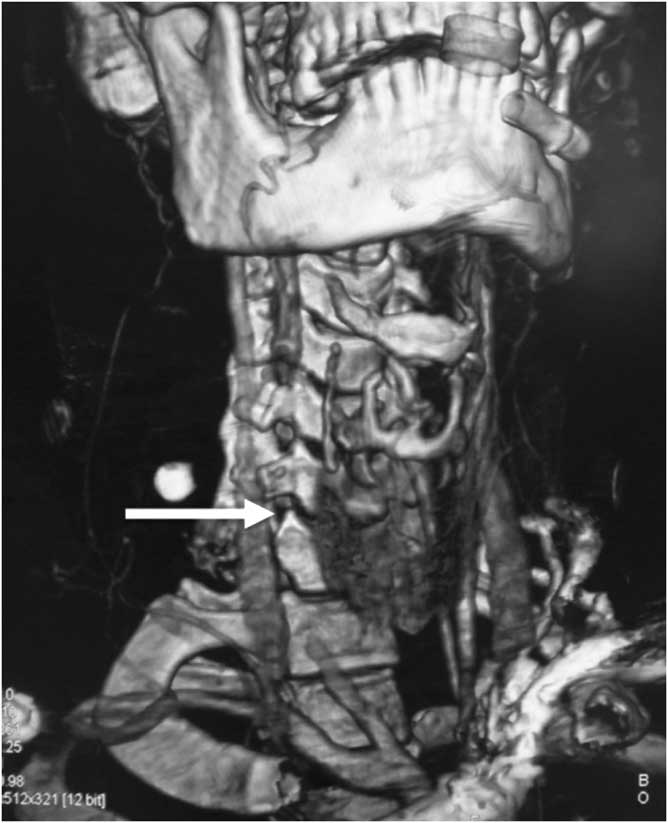
A computed tomography scan revealed an injury to the right internal carotid artery and lateral C7 fracture without spinal cord affection (Figure 1). The patient underwent vascular surgery repair of the artery and became hemodynamic stable. After three days, he was discharged from the intensive care unit.
Image of 35-year-old Male with Right Carotid Artery Injury due to HVGSW. (Courtesy of the Department of Radiology, Marmal Role 3 Military Hospital, Afghanistan.) Abbreviation: HVGSW, high-velocity gunshot wound.
Discussion
The majority of combat deaths occur before the patients reach a medical treatment facility. Twenty-five percent of these deaths potentially are survivable with improved strategies of patient care at the point-of-injury and en route to a treatment facility.Reference Holcomb, Wade and Michalek 6
In patients with significant bleeding requiring a massive transfusion, a high plasma-to-red blood cell (RBC) transfusion ratio has been associated with decreased mortality.Reference Maegele, Spinella and Schochl 4 , Reference Borgman, Spinella and Perkins 5 , Reference Eastridge, Mabry and Seguin 7 Additionally, earlier plasma administration was associated with improved survival, an effect that weakened with delayed infusion.Reference Eastridge, Mabry and Seguin 7 - Reference de Biasi, Stansbury, Dutton, Stein, Scalea and Hess 9
Thirty-four percent of combat causalities are admitted with a clinically significant acute coagulopathy.Reference Gonzalez, Moore and Holcomb 10 - Reference MacLeod, Lynn, McKenney, Cohn and Murtha 13 These patients have an up to four-fold increase in mortality compared with patients without coagulopathy.Reference Katzenell, Ash, Tapia, Campino and Glassberg 3 , Reference MacLeod, Lynn, McKenney, Cohn and Murtha 13 Since most of the military deaths occur before the soldier reaches a medical facility, there is a need for prehospital treatment of coagulopathy. Plasma has demonstrated superiority over colloids at reversing trauma-induced coagulopathy and improving survival in animal models, even in cases without RBC transfusion.Reference Niles, McLaughlin and Perkins 14 , Reference Alam, Bice and Butt 15 Early plasma administration is therefore increasingly advocated for prevention of trauma-induced acute coagulopathy.Reference Gonzalez, Moore and Holcomb 10 For this reason, rapid availability of plasma is important. However, fresh frozen plasma (FFP) requires a substantial amount of time to thaw before it can be used. Since carrying and thawing FFP is difficult on the battlefield, freeze-dried versions of plasma have been developed. The German Red Cross produces the FDP LyoPlas N-w and the French Blood Bank (La Plaine Saint-Denis, France) produces the product French Lyophilized Plasma (FLYP).
LyoPlas N-w is a powder that quickly can be reconstituted with sterile water.Reference Sondeen, Prince and Kheirabadi 16 , Reference Pennardt 17 The German Red Cross has recorded more than 200,000 Units of LyoPlas N-w without any signs of an increased incidence of major adverse reactions compared to FFP. 18 Each unit of LyoPlas N-w comes from a single donor who is screened for blood-borne pathogens. The activity of the enzymes and inhibitors measured in the thawed plasma is subject to individual variations, but it has to be at least 70% of their original activity. It remains effective for at least 12 months when stored in a temperature between four and 25 degrees Celsius.
During the last few years, there has been an increasing use of FDP in the military setting. In a French military intensive care unit in Afghanistan, 87 casualties, of whom 67% were in hemorrhagic shock, received a median of three units FDP (FLYP). The 24-hour mortality was 10% and there were no complications associated with the use of FDP.Reference Bux, Dickhorner and Scheel 19
Today, the Israel Defense Forces (IDF; Tel Aviv, Israel) Medical Corps have a policy of plasma as resuscitation fluid of choice for selected severely wounded patients. The Israel Defense Forces Medical Corps have included FDP as part of its armamentarium for use at the point-of-injury by advanced lifesavers.Reference Martinaud, Ausset, Deshayes, Cauet, Demazeau and Sailliol 20 Preliminary data from the first 10 patients treated at the point-of-injury, with median one to five units FDP, demonstrate 20% mortality. The first use of FDP at the point-of-injury was in a motor vehicle accident patient with a injury severity score of 22.Reference Glassberg, Nadler and Gendler 21
Swedish Armed Forces (Stockholm, Sweden) also use FDP, and the first civilian helicopter emergency medical systems in Sweden will carry the product from 2015.Reference Glassberg, Nadler and Rassmussen 22
To the authors’ knowledge, this is the first report of prehospital FDP use in penetrating carotid artery injury due to HVGSW, and also the first report of in-flight constitution and administration of FDP in a Medevac Helicopter. The constitution of LyoPlas N-w powder took about four minutes in the dark Black Hawk helicopter cabin. The hemodynamic stability of the patient improved after administration of FDP. Although the encouraging response in this case cannot solely be attributed to the administration of FDP, FDP may have contributed to the stabilization of the patient while preventing possible negative effects of synthetic colloids.
Conclusion
Freeze-dried plasma may have several potential advantages in the prehospital resuscitation of major hemorrhage. These include easy reconstitution, good intravascular volume effect, and coagulation factor content. Blood transfusions should be done with caution. Yet, early administration of FDP may contribute to reduce trauma-induced coagulopathy and acidosis, especially when the administration is followed by a balanced transfusion of RBC, plasma, and platelets. However, large-scale studies are needed to define the prehospital use of FDP and other blood products.