Introduction
Rapid population ageing in South-East Asia is recognised as a major demographic challenge for the 21st century, even though the working-age population will remain in the majority with a peak around the middle of the century (Attané and Barbieri Reference Attané and Barbieri2009). At the same time, Thailand was the first Asian country affected by the AIDS epidemic in the late 1980s. It is estimated that over 1 million of the 64 million population have been infected with HIV, of which over half have died. At the end of 2009, there were an estimated 530,000 persons in the country living with HIV (UNAIDS and World Health Organization 2010).
It has been shown worldwide that families are considerably affected emotionally and economically by the disease, which preferentially strikes young adults. Demographic and health survey data from 22 countries in Africa indicate that AIDS mortality is inducing major changes in the living conditions of older people, in particular an increase in the number living alone or with young children (Kautz et al. Reference Kautz, Bendavid, Bhattacharya and Miller2010). Yet, previous studies of the impact of AIDS on intergenerational relationships have been mainly undertaken before treatments became available, and from the viewpoint of the ageing parents of adult HIV-infected children (Boshoff, Klemz and Mazibuko Reference Boshoff, Klemz and Mazibuko2010; Dayton and Ainsworth Reference Dayton and Ainsworth2004; Knodel and Im-Em Reference Knodel and Im-Em2004; Merli and Palloni Reference Merli, Palloni, Cohen and Menken2006; Ssengonzi Reference Ssengonzi2009). With the availability of antiretrovirals, which have transformed HIV infection from a lethal to a chronic disease, it is crucial to re-examine the interaction between adult HIV-infected children and their older parents.
The objective of this paper is to study intergenerational relationships from the viewpoint of adults infected with HIV and receiving treatment in the era of generalised access to antiretrovirals. To undertake such an analysis, use is made of the conceptual framework elaborated by Bengston and Roberts (Reference Bengston and Roberts1991). The data source is the LIWA (Living with Antiretrovirals) project in Northern Thailand (Le Cœur et al. Reference Le Cœur, Collins, Pannetier and Lelièvre2009).
Background
Demographic transition in Thailand: an ageing population
Thailand has experienced major changes in its age structure over the last four decades, as a result of steep fertility decline and a continuing decrease in mortality. Indeed, the total fertility rate (TFR) decreased from 6.4 children per woman in 1950–55 to about 1.8 in 2000–05. In parallel, life expectancy at birth increased from 50 years to an estimated 68.6 years (UNDP 2007). From 2000 to 2050, the proportion of Thais aged under 15 will decline from 24.5 per cent to 15.8 per cent, while the proportion aged 60 and above will increase substantially from 9.4 per cent to 29.8 per cent (UNDP 2007). This is reflected at the individual and family level by major transformations in family composition: in 2007, older Thais had on average four children, by 2020 it is expected that 60 per cent of them will only have two.Footnote 1 This demographic pattern is reflected in our study population who, on average, have surviving parents, many siblings and fewer children than their parents had.
An overview of the situation of older persons in Thailand
The ageing of the Thai population, even though recent, is well documented with a series of national surveys collected since 1986. The latest round, the 2007 National Survey of Older Persons, provides information on the situation of Thais aged 60 and above which has recently been detailed in a United Nations Population Fund (UNFPA) report (Knodel and Chayovan Reference Knodel and Chayovan2008). Among the many aspects of older peoples’ lives described in this national survey of old age in Thailand, the general picture of their living arrangements, economic situation and social support are briefly presented here.
Older people in Thailand traditionally live with their children or close to them, and this was still the case in 2007 with more than eight out of ten elderly Thai parents having their nearest child in the same village. The proportion of persons age 60 and over who live in the same household with one of their children reaches 60 per cent, and among the 8 per cent who live alone, one-half live very close to their children in a separate but adjacent home, a very frequent setting in rural Thailand. Urbanisation has not altered living arrangements, although the migration of young adults, mainly for work purposes, has resulted in young children left to the care of the grandparents. The resulting living arrangement known as a ‘skip generation household’ is more frequently found in rural areas. Social ‘isolation’ remains uncommon and only 3 per cent of older Thais with non-co-resident children declare less than monthly contact with them. The widespread availability of inexpensive cell phones (76% of persons aged 60 and above possess one) allows frequent contact between family members and facilitates interaction with children.
Despite the major economic and social transformations in Thailand, the central role of intergenerational support has changed little between 1994 (the previous survey round) and 2007. Paid work is still the main source of income for 30 per cent of elderly Thais. Nevertheless their children provide the main source of income (62% of Thais aged 60 and above receive their main income from children), and this share increases with age: almost three-quarters of Thais aged 80 and above receive financial support from their children. The importance of intergenerational transfers is confirmed when all types of income are detailed: more than 80 per cent of older Thais have received some income from their children in the past 12 months. Income from work is the second source of support, while a quarter of older Thais also receive the government elderly person's allowance. The expected gender differences are observed, with men more likely to receive an income from paid work.
The public provision of government allowances began in the early 1990s and it was primarily targeted towards poorer older Thais. In recognition of the future ageing of the population, both government and the private sector are working towards developing pensions and universal old-age allowances. Finally, in line with the general population, older Thais are entitled to free health care. Over the years, an increasing number report their health as good or very good.
Intergenerational relationships
Intergenerational relationships are often studied to analyse the nature of solidarity within family networks. These relationships present certain specificities: the services exchanged among kin noticeably differ from the forms of support provided in the community, especially in terms of availability, diversity, permanence, cost and obligations. They generally imply some degree of reciprocity which is flexible and often deferred in time: a gift and counter-gift relationship that binds individuals together. These relationships have been described as a type of long-term ‘insurance scheme’, with a highly flexible guarantee of reciprocal support (for Western societies, see Attias-Donfut Reference Attias-Donfut2000; Coenen-Huther, Kellerhals and Von Allmen Reference Coenen-Huther, Kellerhals and Von Allmen1994; Déchaux Reference Déchaux and Kaufmann1996; Litwak Reference Litwak1985; Wellman Reference Wellman1999; for Thailand, see Knodel et al. Reference Knodel, Chayovan, Graiurapong, Suraratdecha and Phillips2000; Knodel and Chayovan Reference Knodel and Chayovan2008).
This specific system of reciprocity clearly implies that all family members must be simultaneously considered in their role of donor (or ‘care-giver’) and of ‘recipient’ (or ‘receiver’). Relationships are also built in a context of norms based on mutual expectations. It is traditionally a filial obligation to take care of ageing parents and this is particularly true in Thailand (Knodel and Im-Em Reference Knodel and Im-Em2004) where a high value is placed on support to elderly parents. Previous research on the psychological wellbeing of older Thais indicates the importance of constructive interaction with other people (Ingersoll-Dayton et al. Reference Ingersoll-Dayton, Saengtienchai, Kespichayawattana and Aungsuroch2001). In the context of the HIV epidemic, which alters the capabilities of adult children and may affect their capacity to fulfil their expected filial duties, an examination of the nature of intergenerational relationships within families affected by the disease forms the basis of the paper.
Thai HIV epidemic and government response
Since 1989, the Thai government has made considerable efforts to curtail the HIV epidemic with a multi-sector AIDS programme. Among the preventive strategies in this programme, the ‘100 per cent condom campaign’ has been successful in limiting the number of new infections from the commercial sex trade in the general population (UNAIDS 2000), and Thailand is recognised as one of the few countries where the HIV prevention programme was particularly effective (Ainsworth, Beyrer and Soucat Reference Ainsworth, Beyrer and Soucat2003; UNAIDS 2006).
In terms of the provision of antiretroviral treatment, the Department of Health piloted the Access to Care (ATC) treatment programme in 2002, which first prioritised HIV-infected mothers. However, the cost of the patented antiretroviral drugs that were saving the lives of patients in the industrialised world was out of reach for Thailand. The launch of the National Access to Antiretroviral Treatment Program (NAPHA) in 2003, providing free access to antiretroviral therapy (Thanprasertsuk, Lertpiriyasuwat and Chasombat Reference Thanprasertsuk, Lertpiriyasuwat, Chasombat and Narain2004) was made possible because of the production by the Government Pharmaceutical Organisation of a generic one-pill formulation containing three antiretroviral drugs at a significantly reduced cost (about €30 per month). This programme was subsequently integrated into the universal health insurance coverage system. By the end of 2009, the scale-up of antiretroviral treatment was estimated to have reached 216,118 persons – 61 per cent of the HIV-infected people in need of treatment (UNAIDS and World Health Organization 2010).
It is important to note that a major health-care reform was implemented in 2001, with the introduction of a universal coverage system providing health care to all Thai citizens (Tangcharoensathien, Wibulpholprasert and Nitayaramphong Reference Tangcharoensathien, Wibulpholprasert and Nitayaramphong2004). The universal coverage system runs parallel with other existing health coverage schemes.Footnote 2 The antiretroviral treatments are therefore available, free of charge, to all Thai citizens aware of their HIV-positive status when they satisfy the clinical or immunological criteria for treatment. Yet, there is concern about the sustainability of this programme, especially because of the need for more expensive therapies that are not available as generics, when patients fail their first-line of treatment (World Bank 2005).
A quantitative approach of intergenerational relations in families of HIV-infected adults
The Living with Antiretrovirals (LIWA-ANRS,Footnote 3 grant 12 141) project
The LIWA project was primarily designed to investigate the impact of antiretroviral treatments on the lives of the HIV-infected adults and more broadly of their families and their communities. It comprises two quantitative life-event history surveys: one of persons living with HIV/AIDS receiving antiretroviral treatment (completed in November 2007); and the second conducted in the autumn of 2008 on a sample of the general population, matched on the village of residence, sex and age of the previously interviewed HIV-infected respondents.Footnote 4
All HIV-infected adults receiving antiretroviral treatment in four community hospitals in Chiang Mai province, Northern ThailandFootnote 5 were approached. These four hospitals were selected because they had initiated, in January 2002, one of the first pilot community-based antiretroviral treatment programmes in Thailand with the support of Oxfam Great Britain (Jourdain et al. Reference Jourdain, Fregonese, Kanabkaew, Pattanapornpun, Peongjakta, Kanjanavanit, Thanasri, Cowatcharagul, Sirijittrakorn, Ngo-Giang-Huong and Lallemant2004). The programme has since been fully integrated into the national health system. While the respondents may not be representative of the whole population of HIV-infected adults in Thailand, they are typical of the majority of those in rural or sub-urban communities of Northern Thailand who are aware of their HIV status, who need treatment and, as Thai citizens, have access to, and have used the free antiretroviral treatments under the universal coverage health-care system or other schemes. The life-event history survey in the general population approached same age and sex individuals, randomly selected in the health centres corresponding to the residence of the interviewed HIV-infected respondents.Footnote 6
The methodology of the LIWA survey is a retrospective life-event history where participants were interviewed face to face about the situation at the time of the interview but also about their personal history. Developed for quantitative surveys in demography (Courgeau and Lelièvre Reference Courgeau and Lelièvre1992; GRAB 1999), individual life-event histories provide a means to study different types of events or situations and their interactions in relation to the periods of a person's life. The data collected include socio-demographic characteristics such as sex, age, marital status, number of children, household size and composition, education and financial situation, and disease and health history and sources of support in the event of a crisis.
A conceptual framework of intergenerational relationships
The exploration of intergenerational relationships within the families of HIV-infected adults receiving treatment, draws on work conducted in the United states of America, in Europe and Canada (Bengston and Roberts Reference Bengston and Roberts1991; Bonvalet and Ogg Reference Bonvalet and Ogg2007; Kempeneers, Lelièvre and Bonvalet Reference Kempeneers, Lelièvre and Bonvalet2007). In particular, we refer to the dimensions of family solidarityFootnote 7 identified in the 1970s by Vern Bengston and colleagues who conceptualised and developed a micro-social framework of intergenerational solidarity (Bengston et al. 1976, Reference Bengston and Roberts1991) based on six different dimensions.
According to this conceptual framework, financial help and support belong to the ‘functional’ dimension of family solidarity. However, some other forms of help in addition to functional or direct help can be identified. Under Bengston's classification, these dimensions are referred to as structural, associative and affective, and they can be seen as indirect forms of support. Even though measuring exchanges within these three dimensions can pose some methodological problems, they are the least problematic dimensions of solidarity from which to construct empirical indicators. The next step is to establish who gives to whom.
The main body of research on the impact of HIV/AIDS concerns young adults and the orphans that they eventually leave behind. In Thailand, the role of older parents and their implications have been identified mainly before the era of generalised access to antiretrovirals, when older parents were heavily solicited for the care of their terminally ill adult children and had to cope not only emotionally but also suffered economic loss and poverty (Knodel Reference Knodel2008; Knodel and Im-Em Reference Knodel and Im-Em2004; Lee et al. Reference Lee, Li, Jiraphongsa and Rotheram-Borus2010).
A study population of adults with at least one parent alive
From August to November 2007, 513 HIV-infected adults under antiretroviral therapy in the four hospitals were interviewed out of the total of 578 patients (response rate 89%). It should be kept in mind that although HIV-infected people receiving antiretroviral treatment are usually not ill, their treatment requires strict adherence and they must be closely monitored with regular hospital visits. From June to October 2008, the 500 matched individuals – on sex, age and place of residence – were interviewed. This group, having the same demographic structure as the patient's population, provides an adequate reference. Selected respondents in the general population who knew that they were HIV-infected were excluded from this control group.
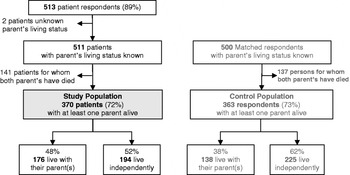
Current child–parent relationships can only be studied directly if both parties exist. The LIWA study was undertaken from the adult children's point of view, and some had lost both parents. The analysis is therefore focused on adults who still have parent(s) alive. Figure 1 shows how the two study-populations with at least one parent alive derive from the surveyed populations after excluding those who had lost both parents.
Study population.

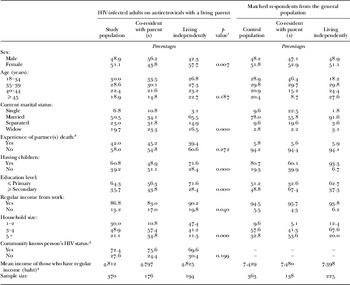
The socio-demographic characteristics of the respondents are summarised in Table 1. Among the 370 HIV-infected adults who have surviving parent(s), 51 per cent are women (see Le Cœur et al. Reference Le Cœur, Collins, Pannetier and Lelièvre2009, for an analysis of gender differences in access to treatment), they are 38.9 years old on average, with 5.7 per cent aged 50 and above, the survivors of the epidemic being themselves in old age. Concerning their family situation, approximately one-half are married (or remarried), the others being separated or widowed, while very few are single. Note that nearly half (42%) of the HIV-infected adults who ever had a spouse have experienced the death of their spouse. Sixty-one per cent have children. In terms of education, 36 per cent of the HIV-infected adults attended secondary school or higher, which is comparable to the expected average in this age group of a semi-rural population in Northern Thailand (UNDP 2007). For three-quarters of them, their HIV status is known by their community. The HIV-infected adults under treatment differ from the matched sample in the general population in that they are less likely to be currently married, more likely to be separated, seven times more likely to be widowed, and less likely to have had children. They are also on average less educated and less often in paid work (87% versus 95%), thus having lower income. To sum up, the study population of HIV-infected adults receiving antiretroviral treatments with at least one parent alive represent a low-income (with a mean income of 4,812 bahts ≈ £99 ≈ €110 per month), middle-aged population, often parents themselves, with a history of widowhood and, in the vast majority of cases, a regular income from work (87%). It should be noted that among HIV-infected respondents who have at least one parent alive, 13 per cent had lost their mothers and 41 per cent their fathers. The median age of the surviving parents is 64 years for the mothers and 66 years for the fathers. The majority of the parents who are living with their adult child are still working (50% of the mothers and 58% of the fathers) as expected in a northern Thai rural environment.
Patients’ socio-demographic characteristics of the study population

Notes:
1. Comparison between HIV-infected adults living with their parents and those living independently.
2. For HIV-infected adults with at least one parent alive N=345 who ever had a spouse. For controls with at least one parent alive N=318 who ever had a spouse.
3. One respondent did not know.
4. N=321 for those with at least one parent alive, 146 for those living with their parents and 175 for those living independently.
Source: LIWA survey of HIV-infected adults on antiretrovirals, 2007.
Finally, the sub-sample of those who have at least one parent alive does not differ from the overall sample of HIV-infected respondents, except that by excluding respondents who have lost both parents, a slightly younger population has been selected. Obviously, as they become older, this sub-sample is less likely to have surviving parents, and it is important to keep in mind that our results pertain to those who indeed have elderly parents.
Different dimensions of intergenerational relationships
To assess the terms of the intergenerational relationships between the HIV-infected adults receiving antiretroviral treatment and their parents, we refer to Bengston's conceptual framework presented earlier and examine the corresponding indicators available in the LIWA survey. Even if the survey was not designed specifically to collect data on all the various forms of support exchanged among family members, it is possible to examine four dimensions of solidarity defined in Bengston's framework: structural (co-residence), associational (frequency of contacts), functional (financial transfers and care-giving) and affective solidarity. The question of the direction of exchanges and their reciprocity within the broader family network are subsequently addressed. Finally, potential future trends are considered, taking into account the ageing of the HIV-infected population.
Structural solidarity: living arrangements
As discussed above, co-residence with parents is widespread in a traditional Thai semi-rural community. First, households with several generations are the usual way to take care of older parents who in turn help with household chores and child care. Second, such households are a way of providing housing for adult children in times of need such as economic hardship, divorce, widowhood or ill health. In terms of solidarity, residential proximity and co-residence is a fundamental system of support which shapes all the other dimensions. In order to understand the relationships between adult children, the first results examined are whether their characteristics differ according to their living arrangements, i.e. co-residence with the parents or independent residence. What do HIV-infected adults get from staying with their parents: A family? A place to stay? A place where they feel secure with regard to their HIV status? A place where they get financial support, emotional support, care, child care for their own children?
Figure 1 shows that 48 per cent of the HIV-infected respondents live with their parents, a larger proportion than observed in the sample from the general population (38%), and 52 per cent live independently. Compared to those who live independently, the HIV-infected adults who live with their parents are significantly more likely to be men (56% versus 47%), younger (98% versus 91% under 50 years old), and slightly more educated (Table 1). However, they are less likely to be married (34% versus 66%), have children (49% versus 72%), and have a regular income from work (83% versus 90%). Yet, both groups do not differ in terms of having lost one of their parents. In summary, the HIV-infected adults who live with their parents are significantly more likely to be men and less likely to be married and to have children than those who live independently. This situation differs from the respondents in the matched population where those living with their parents are more likely to be younger, unmarried, with no children, a more balanced sex-ratio. This is consistent with our previous findings which show that HIV-infected men are less likely to have started a family of their own than women (Le Cœur et al. Reference Le Cœur, Collins, Pannetier and Lelièvre2009).
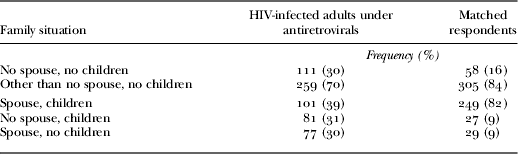
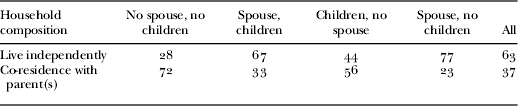
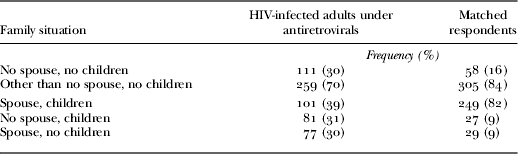
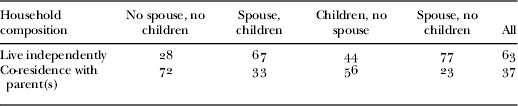
Details of the family situation of the HIV-infected respondents and their co-residence status with their elderly parents are next presented in order to understand why the HIV-infected adults live more often with their parents (Tables 2 and 3). HIV-infected respondents are twice as likely to be without a family of their own, i.e. spouse or children (30% versus 16%). However, when they do have a family, their own family is less likely to comprise both spouse and children (39% versus 82%) when compared to the matched population (Table 2). And in these circumstances, Table 3 shows that especially in the case of single parenthood (children, no spouse), co-residence with older parents is very common (56%), child care being readily offered by the grandparents to help their adult children, most of whom are in paid work.
Respondents’ family situation
Source: LIWA survey of HIV-infected adults on antiretrovirals, 2007.
HIV-infected adults under antiretroviral treatment household composition and family situation (percentages)
Source: LIWA survey of HIV-infected adults on antiretrovirals, 2007.
In fact, the pattern of co-residence with older parents of HIV-infected adults who have a family of their own is not significantly different from that of the matched population (results not shown). Therefore, the fact that the HIV-infected adults more often live with their parents results more from the differences in their own marital and parental situation than from their HIV status; HIV-infected adults being twice more often without a spouse and children, and when they have a family, more likely to be a single parent than in the general population.
In terms of household composition, two-generation households are the most frequent (respondents living either with older or younger family members), representing 50 per cent of households with an HIV-infected adult versus 62 per cent in the matched general population. Three-generation households, where respondents (whatever their HIV status) with children live with older family members, account for about one-third of the households (32 and 33%, respectively). But the proportion of one-generation households of HIV-infected respondents is three times larger than in the general population (18% versus 6%, respectively). Indeed, HIV-infected respondents more often live in one-generation households as they are more frequently single, widowed or separated, or in a couple without children.
Associational solidarity (frequency of contacts)
As the geographical location of parents was not recorded, the frequency of visits between parents and children is a good proxy of associational solidarity, and it is indeed very high between HIV-infected adult children and their parents: 60 per cent of those who live independently visit their parents, father and/or mother, more than once a week and an additional 11 per cent several times a month. Among HIV-infected respondents with at least one surviving parent, 79 per cent either live with their parents or see them more than once a week. As discussed above, this very close proximity is related to the traditional family way of life in Thailand, where even though generations may not share the same house, they often live in the same compound or close by (Knodel and Chayovan Reference Knodel and Chayovan2008).
Health status and care-giving
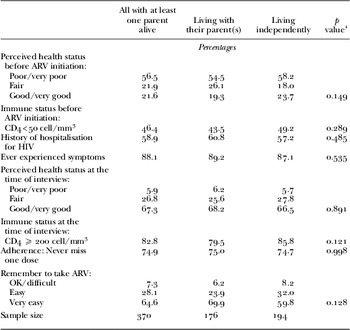
One hypothesis of the research, based on previous evidence before the era of antiretroviral treatment (Knodel and Saengtienchai Reference Knodel, Saengtienchai and Llyod-Sherlock2004; Knodel et al. Reference Knodel, Saengtienchai, Im-Em and VanLandingham2001), was that HIV-infected adults living with their parents would have a worse health profile than those living independently, since parents were the main care-givers of HIV/AIDS patients. Several health indicators were used to evaluate the health status of HIV-infected respondents under antiretroviral treatment. Respondents were asked to assess their health status before they began the antiretroviral treatment. The results show that perceived health and immune status before taking antiretroviral treatments are not significantly different between respondents living with their parents and those living independently (Table 4). Also there is no indication that those living with their parents have experienced more severe health events in terms of hospitalisation and symptoms histories. Finally, when considering their health status at the time of the interview, both groups have a comparable clinical and immune status, indicating a similar health improvement related to the treatment. Also, the level of adherence to their treatment is not different in both groups, and when asked about the difficulties of following the treatment schedule, the responses were similar. This result suggests that there is no specific benefit of parental presence, nor a particular involvement for the management of the treatment of their adult children. Interestingly, there is no significant difference between the perceived health status of the HIV-infected adults receiving antiretroviral treatments and the matched general population, with even slightly more of the adults under treatment reporting a good and very good perceived health status at the time of the interview (67% versus 54%).
Health situation of HIV-infected adults receiving antiretroviral treatment, according to their residence status with their parents

Notes: ARV: antiretrovirals.
1. Comparison between HIV-infected adults living with their parents and those living independently.
Source: LIWA survey of HIV-infected adults on antiretrovirals, 2007.
Before the availability of antiretroviral treatments, HIV-infected adults when sick would turn to their closest kin for care and support. HIV care at that time often consisted in the treatment of infections or the palliative care of terminally ill patients, the cost of funerals representing the ultimate economic burden for the family. Therefore AIDS care-giving was synonymous with expenses, debts, lost time, no filial support of their elderly parents, emotional distress and poverty (Knodel Reference Knodel2008). It appears from the data that the effective use of antiretroviral treatment has completely altered this situation. HIV-infected adults with antiretroviral treatment and their spouses can remain in work or return to the labour force. Indeed, in our sample, the vast majority of them (87%) are currently working (Table 1, column 1), and 71 per cent declare that their situation did not deteriorate or has improved since antiretroviral treatment. It is likely that, as treatments become more widespread, an increasing proportion of HIV-infected persons will initiate treatment at an earlier stage,Footnote 8 before experiencing the debilitating impact of the disease, and will therefore spare their family the economic consequences in terms of loss of work and poverty.
Yet, because HIV infection affects several aspects of individuals’ lives such as partnership, fertility, work and social life, it still acts as a trigger to bring family solidarities into play. HIV-infected adults rely on their closest adult kin (spouse, parents and others) to help them cope with the emotional distress and consequences of their infection. What clearly appears from the data is that already the radical changes in their health status that have been achieved because of antiretroviral therapy have relieved their family members from most of the burden of everyday care and the stress of having a dying relative (often with offspring whose future also has to be considered). In this evolving context, our data provide new information on the nature of intergenerational relationships.
Functional solidarity (financial transfers)
Functional solidarity in Bengston's conceptual framework represents tangible help such as the exchange of services, information or money. In the LIWA survey, such support is captured through the information provided by the respondents on the direct financial assistance they receive, as well as through analysis of their answers when asked about the persons they could turn to in case of financial crisis. Half of the HIV-infected adults have contracted debts (52%) for various reasons, mostly to cover basic household needs, children's schooling and investments related to economic activity (typical answers to the open-ended question were ‘to start a tailor shop’, ‘to open a food stall’, ‘to buy a cow’, etc.). Doctors’ fees or other medical costs are hardly ever mentioned, reflecting the favourable context of health-care coverage in Thailand. The matched respondents are more likely to have a loan (74%) than the HIV-infected adults for the simple reason that an HIV test is required by most co-operatives and banks before lending money. Indeed, 32 per cent of the respondents from the general population reported that their last HIV test was undertaken before applying for a loan, insurance or an association (Pannetier et al. Reference Pannetier, Le Coeur, Collins and Lelièvre2009).
Interestingly, when the HIV-infected adults who currently have a loan were asked who they borrowed the money from, most (64%) responded that they had borrowed from an institution (a bank, a co-operative or a village fund) and only 7 per cent had turned to a relative.Footnote 9 This reflects the economic development of Thailand where financial institutions are a resource even for poor rural citizens rather than resorting to private arrangements within their family. Yet, it should be kept in mind that in a context of low income, as is the case for most respondents in our study, parents may simply not be able to help financially without putting their own situation in jeopardy.
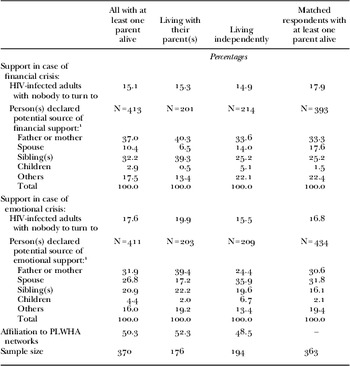
In terms of potential support in the case of financial crisis, the HIV-infected adults indicated the persons they would turn to. The question referred to a person and not an institution.Footnote 10 The results presented in Table 5 show that only 15 per cent of them had nobody to turn to in case of financial crisis. There is a massive mobilisation of adult next-of-kin. Among them, the parents are paramount (37%), together with in-laws, aunt and uncles (in the ‘others’ category). Clearly, people from the older generation are primarily designated as potential providers of financial help. The next in line are the collaterals, namely brothers and sisters, who are reported for potential financial help three times more often than the spouses. Indeed, couples generally share financial hardship and spouses are therefore not in a position to provide support. Interestingly enough, children as well as nephews and nieces (in the category ‘others’) were also quoted, referring here to the filial support that parents (here the adult respondents) can call upon in time of need. In the matched respondents (Table 5, last column), the overall pattern is quite similar with the parent's contribution only slightly lower (33%).
Support person(s) mentioned in case of crisis and affiliation to PLWHA networks, according to the HIV-infected adults’ co-residence status with their parents

Notes: PLWHA: People Living with HIV/AIDS.
1. Percentages calculated on the total number of persons quoted.
Source: LIWA survey of HIV-infected adults on antiretrovirals, 2007.
To pinpoint the specific role of the elderly parents of HIV-infected adults receiving treatment, the analysis investigated whether those living with their parents or independently anticipate different sources of help. Table 5 shows that HIV-infected adults not living with their parents would turn to a more diversified resource network in case of an economic crisis (21% versus 13% in the category ‘others’). Employers, neighbours, friends and the extended family on the spouse's side were mentioned in the ‘others’ category. In terms of financial help, a direct contribution is needed when people are unable to function, work or care for themselves and their children. Parents are then major providers as observed for HIV-infected patients before the availability of antiretroviral therapy. Money transfers as a form of structural solidarity exist between generations and the network of potential support appears very similar for the interviewed adults whether infected or not.
Affective solidarity
The questionnaire included a number of items to explore more intangible bonds such as feelings of trust and affection. The circumstances of learning the HIV-positive test result reveal the level of trust that exists between relatives. Who are the persons close enough to have been at the hospital or the clinic for the test results? Who are those with whom the positive result was first shared? And who are the persons designated by the respondents as those they can turn to in case of emotional crisis?
Nearly one-third of the HIV-infected adults were accompanied when they received their results, mostly by their spouse (56%), and in equal proportion (15%) by their mother, or a sister or brother. In the order of priority for subsequent disclosure of HIV status, spouse and parents come first, followed closely by siblings. In the vast majority of cases (90%), when living in the same household, respondents report that their parents were aware of their HIV status. This remarkably high level of disclosure to parents reveals the close bonds between parents and children, especially in the presence of a highly stigmatised infection. However, a small proportion of them did not disclose their HIV status to their co-habiting parents, even though they take their treatment every day. This suggests that some HIV-infected adults are keen to spare their parents the emotional distress of knowing that they have a potentially lethal infection. This information is not available when HIV-infected respondents live independently from their parents but it cannot be excluded that the proportion of parents not aware of their child's HIV-positive status is higher.
Finally, a question was put to the respondents about who they would confide in, in case of an emotional crisis. It appears that they would turn toward a variety of adults. The parents are quoted preferentially (32%), followed by spouse (27%), then siblings (21%) or others (Table 5). In the general population, the pattern is strikingly similar. The parents and spouse come first (31 and 32%), because the matched respondents are more often married than the HIV-infected adults. When HIV-infected adults do not live with their parents, their spouse would be the first person they solicit in the case of an emotional crisis.
It is also interesting to note that irrespective of whether they live with their parents, half of the HIV-infected adults belong to PWHA (People Living with HIV/AIDS) groups (Table 5). This suggests again that the emotional burden is not solely shared within the household or within the family and that many find solidarity and emotional support outside the kinship network and sometimes even re-marry within these networks (Le Cœur et al. Reference Le Cœur, Im-Em, Koetsawang and Lelièvre2005).
To sum up, in terms of emotional support, parents are largely solicited but spouses, brothers and sisters are high on the list of resource persons. Our data also suggest that HIV-infected adults find support outside the family which can somehow alleviate the burden upon their elderly parents. This pattern is very similar to what is observed in the general population.
Multidirectional exchanges
After examining the different dimensions of intergenerational solidarity available in the LIWA questionnaire, the reciprocity of the exchanges remains to be determined. It is crucial to decipher how, in turn, the individuals become either a donor or receiver and how the disease and its treatment have altered or maintained the expected functioning of the relationship between parents and children. Our data cannot provide an insight on the situation of HIV-infected adults before the availability of the treatments. Nevertheless, existing literature in South-East Asia abundantly documents the emotional and financial burden imposed on elderly parents of young HIV-infected adults, which could sometimes result in extreme poverty (Knodel Reference Knodel2008; Knodel and Saengtienchai Reference Knodel, Saengtienchai and Llyod-Sherlock2004; Knodel and Im-Em Reference Knodel and Im-Em2004). It has been observed that before the availability of effective treatment, the infection radically altered and reversed the direction of intergenerational exchanges at a time when filial duties towards older parents were expected.
HIV-infected adults as receivers and givers of support: a reciprocal exchange
To evaluate the reciprocity of exchanges and modifications, the clues identified in our results are numerous but difficult to interpret. The HIV-infected adults are the centre of a triad: they have at least one parent alive and most of the time they are themselves parents, so that when asked about their relationships they quote both, in different roles, and describe themselves as the provider or the receiver. While their parents are clearly a significant source of support for the adult children, whether they live together or not, there is also evidence of reciprocity. This can be illustrated in cases where respondents live with their parents. In fact, the parents can either support their children by offering them a home or, reciprocally, the children may provide housing to their ageing parents. Our data give an insight into who is hosting whom, through the ownership of the common dwelling. This indicator can be used as a crude proxy of the direction of support. In our study, when HIV-infected adults live with their parents, the house belongs to the parents in 64 per cent of cases – 52 per cent of the matched respondents from the general population – suggesting that the HIV-infected respondents in this situation live in their parents’ home and that support flows in a downward direction. In addition, even when they live independently, one-third live in a house owned by their parents. This is not surprising in a rural environment where small land ownership is the norm and where land belongs to the elders. In fact, land ownership represents a safety net for old age. Providing a house for one's offspring insures that the bonds remain strong between the generations. From this perspective, such solidarity is not dramatically disrupted by the disease in the favourable circumstances where treatments are available. The other third (34%) of the HIV-infected adults who live with their parents own the house, i.e. accommodate their ageing parents – 46 per cent of the matched respondents – and the direction of support is upward.
A question concerning financial support provided to people outside the household indicated that 13 per cent of respondents regularly provide such financial support. A slightly higher proportion was found in the general population (17%) which is not surprising considering their better economic position. For most of the HIV-infected adults (more than 75%) their parents are the main recipients of this financial support, the remainder being mostly their children. These results show that some of the filial obligations Thai children are expected to fulfil can be met.
To investigate the situation where respondents are recipients of both generations (their parents and their children), the role of children as resource persons for financial and emotional support should be emphasised. Note that even though most of the children are still quite young and ineligible to provide help, they are quoted by up to 5 per cent of the HIV-infected adults for functional solidarity, and by up to 7 per cent for affective solidarity; in the general population children are less likely to be designated as a potential source of support (Table 5, column 3). In response to the question ‘from whom do you receive help?’ the HIV-infected adults often specify my ‘oldest daughter’, ‘my son who has a job’, etc. This again confirms that the relationship works both ways. These upward exchanges can normally be expected to increase as children grow older. Finally, another strong bond exhibited in our results is the important role of the HIV-infected adults’ siblings. After the parents, they are second on the list of persons to whom the HIV-infected adults would turn to in case of financial crisis. For emotional support they are also very important, especially when HIV-infected adults are not married or have lost their partner. They are often the ones to accompany their brother or sister to get their HIV test results and who are the first to be told about it.
Conclusion
Our study provides a new perspective on intergenerational solidarity within the families of HIV-infected adults in the context of the wide availability of antiretroviral treatments. Using data collected from adults under treatment and a matched sample in the general population, we applied Bengston's framework to deconstruct and discuss the different aspects of the interactions between generations, i.e. adult children with their elderly parents, with their siblings and spouses and with their children. The data allowed us to examine four of the six dimensions of intergenerational relationships identified by Bengston.
In the Thai context and the specific circumstances of families affected by HIV, we explored in detail structural solidarity, of which a main indicator is the co-residence of the HIV-infected adults and their older parents. Studies undertaken before treatments became available showed that older parents, at the time when they traditionally expect to receive attention and help, were heavily solicited for the care of their terminally ill adult children. Our results show that in the new context of wide access to antiretroviral treatment, such situations are no longer observed. Furthermore, the difference in co-residence of older Thais in families with or without HIV-infected adults results primarily from the specific marital and family status of their adult children and not from the direct consequences of the disease. This is confirmed by the fact that the health status and care-giving needed by HIV-infected adults under treatment appears similar whether they live with their older parents or not. By maintaining and/or restoring their health, antiretroviral treatments allow HIV-infected individuals to keep their job or return to work (87% are currently working), and as a result we no longer observe unbalanced intergenerational exchanges that exist when treatments were not available. Concerning financial transfers as a form of functional solidarity between generations, in the low-income context of Northern Thailand, families with HIV-infected adults do not appear to be more disadvantaged and their network of potential support appears very similar to those of unaffected families. Turning to affective solidarity, elderly parents are certainly largely solicited for emotional support and their presence appears crucial at period of crisis, such as the time of disclosure of one's HIV status. Finally, we have demonstrated the reciprocity of exchanges within affected Thai families: exchanges are multidirectional, downward from parents to their children; upward from sons and daughters to parents; but also lateral between spouses who play a central role, and between siblings.
It appears that by alleviating the burden of everyday care and the stress and the economic consequences of the disease, the availability of free treatments in Thailand restores the balance between generations. The patients are no longer the sole recipients of all attention and support and there is evidence that they can engage in reciprocal relationships as expected in a society where intergenerational bonds are highly valued (Ingersoll-Dayton et al. Reference Ingersoll-Dayton, Saengtienchai, Kespichayawattana and Aungsuroch2001). In the debate on the balance between private and public sources of support and care, our study argues in favour of a combination of complementary forms of solidarity based on an alliance between the State, the family and civil society. Indeed, we have shown that patients can and will turn to their elderly parents and their brothers and sisters or even their children, for support. However, because society provides free health care and accessible microcredit, they are also able, to a certain extent, to spare their relatives a financial burden and even engage in their filial duties. The central role of elderly parents within the family is maintained, co-residence and proximity, daily contacts are the norm, with the renewed possibility that they receive the expected returns that filial duties prescribe.
In terms of future research, the situation of childless ageing HIV-infected adults needs to be investigated. These ageing patients will face increasing needs while the number of potential providers, in particular their children, is limited. In the current study, the mean age of HIV-infected adults receiving treatment was 40 years and fairly representative of the national average. It has been shown that the quality of life of Thai elders depends on the respect and attention shown by younger generations and the support they are entitled to (Ingersoll-Dayton et al. Reference Ingersoll-Dayton, Saengtienchai, Kespichayawattana and Aungsuroch2001; Knodel and Chayovan Reference Knodel and Chayovan2008). It is therefore important to envisage the quality of the interactions with other family members. Finally, it is interesting to see that the choices made by the Thai government to invest massively in public policies to prevent transmission of the disease were made to safeguard the labour force in a period of rapid economic development (Phoolcharoen Reference Phoolcharoen1998). The recent provision of free access to antiretroviral treatments is allowing the HIV-infected population to grow old. Their welfare will become a major challenge for the Thai government and families alike.
Acknowledgements
The ‘Living with Antiretrovirals’ (LIWA) study is funded by the French Agency on AIDS Research (ANRS 12141). The authors are grateful to Peter Kundstater for his valuable comments and useful discussions.