Archaeology as heritage practice
Since its emergence as a scientific discipline in the nineteenth century, archaeology has had no difficulty in evoking the interest of a wide audience. Just like the discoveries of astronomers, archaeological finds and excavations easily find their way into the media, both locally and worldwide. Whereas astronomy opens up a world that is far away through new observations that look outside into eternity, archaeology – in contrast – reopens a lost world that is unexpectedly nearby, by breaking the ground under our feet that holds temporal and passing things. In the last two decades, newspapers, journals (notably National geographic), film and television have been joined by the Internet and games among the important media for framing archaeological images of this lost world.
Although archaeologists have always been aware of the opportunities of this public interest, or maybe just because they have, the position of the discipline within society was not reflected upon in a fundamental and critical way until the 1980s; that is, until the emergence of postprocessual archaeology. Yet still, most archaeologists draw a sharp dividing line between archaeology as a scientific discipline on the one hand, and a heritage archaeology as part of more encompassing heritage practices on the other. Following this distinction, scientific archaeology is primarily driven by intellectual interest in the past per se, whereas heritage reflects an interest in the use of the past for present-day purposes (cf. Lowenthal Reference Lowenthal1996). In this view heritage also acts as a buffer between science and society, offering archaeologists the opportunity to communicate their discoveries and research with local communities and the international public, while at the same time safeguarding the academic discipline against fringe archaeologies, unwarranted fantasies and misuses of the past. In a sense, heritage practices are seen as rites of passage within which scientific and cultural values are mediated and exchanged at a safe distance from the epicentres of archaeological science within the universities. In short, heritage is often seen as secondary and ‘additional’ to archaeological science, except where it is understood in a narrow sense as the material source of authorized (academic) archaeological research.
In a recent article in Archaeological dialogues, Kathryn Lafrenz Samuels (Reference Lafrenz Samuels2008) rightly criticizes this view of the relationship between the discipline of archaeology, heritage practices and inherited landscapes. She defends the idea that modern archaeology can be understood in terms of anthropological key notions, viewing value as residing in all archaeological practice (cf. Munn Reference Munn1986; Graeber Reference Graeber2001), although it is transmitted specifically and most effectively by objects, monuments and places that act as symbols of power and authority (Weiner Reference Weiner1992). It is the perceived inalienability of artefacts and places that is crucial to the authentication of core values, and to the preservation of these highly valued possessions for future generations. Lafrenz Samuels cites the UNESCO World Heritage sites as an example, as their ‘outstanding universal value’ recalls the cosmological authentication of inalienable possessions in non-Western societies.
Lafrenz Samuels's proposition paves the way for a more encompassing concept of archaeological heritage practices, which, in her vision, includes not only the management of material traces but also the transmission of values through archaeological practice, method and theory (see Bazelmans Reference Bazelmans2006 for a comparable view). This is consistent with the opinion of the more progressive heritage ‘thinkers’, who define heritage as everything from the past which is intentionally given (new) form and meaning by a dynamic, present-day society which designs a future for itself (cf. Frijhoff Reference Frijhoff2007). However, the idea that all archaeological thinking and acting entails the (re)production of cultural values has been well settled within archaeology since the appearance of Shanks and Tilley's Re-constructing archaeology (Reference Shanks and Tilley1992), at least for those who have overlooked this crucial message in Leone's, Hodder's and Trigger's earlier writings (e.g. Trigger Reference Trigger1978; Hodder Reference Hodder1982; Leone Reference Leone, Miller and Tilley1984). The point that archaeological experience is value-laden, in itself a very late reception of similar critiques within philosophy and the social and political sciences, has been put forward strongly since then. Nevertheless, Lafrenz Samuels should be congratulated for broadening the discussion about archaeological heritage along these lines.
By introducing anthropological concepts into the debate on archaeological heritage (and archaeology as heritage practice), Lafrenz Samuels joins a much broader tendency within heritage studies that propagates a (self-)reflexive approach (see also Byrne Reference Byrne1991; Burke, Jones and Smith Reference Burke, Jones and Smith1994; Thorley Reference Thorley1996; Hamilakis and Yalouri Reference Hamilakis and Yalouri1996; Meskell Reference Meskell1998; Hodder Reference Hodder2000; Bender and Winer Reference Bender and Winer2001; Mathers, Darvill and Little Reference Mathers, Darvill and Little2005; Bazelmans Reference Bazelmans2006). Adherents of this approach hold that anthropologically informed reflection on value production is crucial for archaeology to become engaged with or attuned to present-day society in a more critical way: ‘value can be turned self-reflexively to produce a discipline of archaeology that is more engaged with contemporary social issues and situated ethical concerns’ (Lafrenz Samuels Reference Lafrenz Samuels2008, 72).
A heritage anthropology focusing on matters of value is in itself a valuable (and understandable) reaction against misuses of archaeology's authority in the recent past (see Herzfeld Reference Herzfeld1991; Bender Reference Bender and Bender1993; Hamilakis and Yalouri Reference Hamilakis and Yalouri1996 for examples). However, defending the view that all archaeology is essentially about producing cultural values is one thing; it remains to be seen if reflecting on value production will automatically better equip archaeology for ethical concerns or improve its engagement with society. In this contribution I will explore the opposite proposition: that in most cases it is desirable that archaeologists tell stories about the past, not about archaeological practice and about themselves, in order to be really engaged with public and ethical issues. Although preserving archaeology's identity among the other social, historical and geographical disciplines is not a valid goal in itself, and anthropological reflection on archaeological heritage practices would not necessarily transform archaeologists into bad anthropologists (or bad archaeologists), there is sufficient reason for a distinctive archaeological contribution to heritage. To start with, arguments can be derived from the discipline's specific articulation of discovery, difference and time depth, which traditionally shape archaeological research and narrative to a high degree, not only within academic discourse but also in a wider social setting. Unfortunately, these particular strengths of the discipline have moved to the background of archaeological heritage studies in recent years.
Discovery
Ironically it is an anthropologist, Tim Ingold, who came up with an alternative view of the role of the archaeologist that comes closest to my proposition. He compares the archaeologist with the native dweller, as ‘for both the archaeologist and the native dweller, the landscape tells – or rather is – a story, “a chronicle of life and dwelling” (Adam Reference Adam1998: 54)’ (Ingold Reference Ingold2000, 189; citation in original). He continues,
It unfolds the lives and times of predecessors who, over the generations, have moved around in it and played their part in its formation. To perceive the landscape is therefore to carry out an act of remembrance, and remembering is not so much a matter of calling up an internal image, stored in the mind, as of engaging perceptually with an environment that is itself pregnant with the past’.
It is inevitable that this role lends some authority to the work of the archaeologist:
It is . . . part of an archaeological training to learn to attend to those clues which the rest of us might pass over (literally, when they are below the surface), and which make it possible to tell a fuller or richer story (ibid., 199).
The phrase ‘an environment that is itself pregnant with the past’ is crucial, as it underlines the possibility and importance of discovery. The notion and act of discovery has shaped archaeological fieldwork – and indeed the discipline as a whole – from its very beginnings, from the Rosetta Stone, Troy, Knossos and Machu Picchu to the find of Ötzi, the extraction and sequencing of Neanderthal DNA and the discovery of the wreckage of the German raider Kormoran off the Western Australian coast. In certain branches of the discipline, such as Palaeolithic archaeology, it is even possible to owe one's scientific fame solely to the discovery of some fossil human remains or an archaeological site, instead of a challenging theory or innovative interpretation of some account of the past. And it is the discoverers who also act prominently in the media, making things even more frustrating for the theoreticians.
The excavation articulates this moment of discovery most prominently, albeit it in a ‘staged’ form. Few archaeological practices are more complex in terms of value production than archaeological excavation. First of all, ‘the archaeological past will not excavate and record itself; people are needed to make knowledge’ (Shanks in Bazelmans et al. Reference Bazelmans, Dommelen, Kolen and Shanks1994, 57). Moreover, excavation as such, Lemaire (Reference Lemaire1997) says, entails the discovery of landscape and the invention of a new story about the past, while at the same time removing the source of that story from the living environment of the community. Archaeology is among the few disciplines that necessarily destroy their object while studying it. Excavating therefore immediately stands for both the construction and destruction of values, for gaining and losing heritage, which makes it – at least from a modern perspective on landscape and heritage – a highly paradoxical and contested undertaking. Still, archaeological discovery has a straightforward power to unfold, activate, confront or disturb – in other words, to ‘work out’ and be effective in the original sense of the word (cf. Gadamer's (Reference Gadamer1990) ‘effective history’ or Wirkungsgeschichte). This aspect of archaeology may be easily overlooked from an anthropological perspective on heritage, as conventional anthropological (but also cultural-geographical) discourse on memory generally makes human–land relationships intelligible in terms of social appropriations of the past and cultural constructions of place. It therefore comes as no surprise that the interest in discovery and excavation remains rather limited in postprocessual archaeologies, as these are heavily influenced by anthropological discourses on heritage, leaving aside some interesting and creative studies of the ‘archaeological experience’ (Shanks Reference Shanks1992) and innovative experiments with community archaeology in excavation projects (e.g. Hodder Reference Hodder2000).
Traditionally, a considerable impact has been attributed to archaeological discovery and the unearthing of an ancient artefact or other traces from the past. Experiences reported after excavating or making a discovery, by both archaeologists and the public, often remind one of what the historian Johan Huizinga once called ‘the historical sensation’: a very intense, unexpected and ‘immediate’ encounter with the past, combined with the feeling that time distance disappears for a moment (1995; see also Tollebeek and Verschaffel Reference Tollebeek and Verschaffel1992; Ankersmit Reference Ankersmit2005). For Huizinga this was not, however, a kind of sense datum that simply originated from a pre-existing (historical) or extra-cognitive reality. Rather he used the term for a sudden and pre-logical understanding of coherence in which the historical object – whether a document, an archaeological find, an ancient building or ‘just’ a place – plays an active and prominent role. In a somewhat similar vein, Michael Shanks speaks of the aura of archaeological objects and monuments (cf. Benjamin Reference Benjamin1969), meaning ‘the sense of associations and evocations that cluster around the object; correspondences and interrelations engendered by an object’ (in Bazelmans et al. Reference Bazelmans, Dommelen, Kolen and Shanks1994, 64; see also Shanks Reference Shanks1992). For an archaeological discipline to take its engagement with society seriously, Shanks states, it is important to recognize this phenomenon and explore it in a dialogue between past and present, between object and subject, and between the archaeologist and others within society.
Albeit driven by academic research questions, curiosity or political interest, excavations enable archaeologists to encounter traces, aspects and dimensions of the past that simply could not have been foreseen by the scientific community, remembered by inhabitants or anticipated by politicians (cf. Bintliff Reference Bintliff and Bintliff2004a). This means that whereas all archaeological practice is imbued with and involves the production of cultural values, our accounts of the past are not simply ‘decided’ by those values (Putnam Reference Putnam1985, 21). In this sense heritage, too, is always a joint venture of subject and object. The ‘past in the present’ is as much a contemporary subjective construction as it is the (interim) outcome of the long life histories of societies, objects, landscapes and places.
The potential of archaeological discovery and excavation, and therefore of archaeological heritage, to contribute to a ‘richer or fuller story’ (Ingold) is also relevant to the position of archaeology vis-à-vis other historical disciplines, such as regional history and historical geography. An example that well illustrates this point is the archaeological research at Little Lonsdale in Melbourne, an urban neighbourhood that was gradually demolished after the end of the 19th century (Mayne and Murray Reference Mayne and Murray2002). Popular representations of the area (such as in the poetry of C.J. Dennis) and ‘official’ archives and sources stereotyped Little Lonsdale as the heart of slumdom and a den of iniquity. ‘Little Lon’ always had a bad reputation: it was the red light district of the city, highly industrialized, and housing the poorest residents and the highest percentage of criminals in Melbourne. The archaeological excavations carried out in 1987–88, and the time-consuming and detailed analysis of excavated archaeological materials and data that followed in recent years, reveal that life and community in this part of the city between 1850 and 1950 was poorly understood. The slum myth turns out to be partly misleading, although it is represented straightforwardly and uncritically in both historical sources and public opinions. The archaeological inheritance, combined with ‘inside’ oral information and ego-documents, presents a different and colourful picture – of a hard-working and dynamic community which valued friendship, loyalty, family ties and tolerance, and of individuals who managed to find success in business in spite of bad starting positions and conditions.
Difference
Little Lon brings us to a second important characteristic of archaeological heritage: it makes a difference – literally speaking. Because of its potential to unfold, activate and confront, the archaeological discovery (or excavation) is also a suitable medium for showing the existence of difference within our living environment (see also Leone and Silberman Reference Leone and Silberman1995). Archaeologists, or at least the theoreticians among them, will most probably associate ‘difference’ with the idea (or fact) that the past was fundamentally different from the present, as in Lowenthal's The past is a foreign country (Reference Lowenthal1985), which was inspired by L.P. Hartley's The go-between (‘the past is a foreign country. They do things differently there’). Or otherwise they will identify difference with the general anthropological concept of ‘otherness’ (Fabian Reference Fabian1983) or Derrida's notion of différence. Here, however, I shall use the word in a rather mundane sense, not so much referring to discontinuities between past and present, but to the fact that the past was not always how we, or specific interest groups within society, think or would like to think it was.
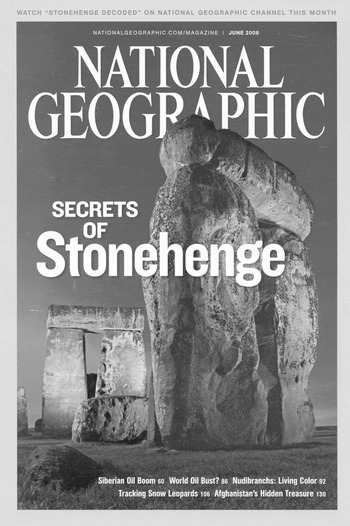
One of the good habits of modern archaeology is the critique or deconstruction of narratives that one-sidedly and uncritically connect past and present in terms of continuities, origins and feelings of belonging. Yet archaeological discoveries may also have the opposite effect, namely tempering the differences that we are inclined to attribute to the past. A good example of this can be found in the June 2008 issue of National geographic about ‘Secrets of Stonehenge’ (figure 1). This issue discusses the Neolithic graves that were recently discovered near Stonehenge (Darvill Reference Darvill2006). Isotopic tooth enamel analysis indicates that the ‘Amesbury Archer’, buried around 2400 B.C. only a few miles from Stonehenge and unearthed in 2002, appears to have been grown up not in the area itself, but in the northern foothills of the Alps. A second grave was found in the immediate vicinity, supposedly containing the body of a younger relative, perhaps his son. The new find even inspired one cartoonist to make a drawing of Stonehenge flying a German flag. Less than a quarter of a mile away and within a year another grave was discovered dating from roughly the same period, containing the remains of seven individuals, at least four of whom were males. In this case, analysis of premolars and molars showed that three adults spent their infancy together in north-western Britain, Wales or Brittany. The recent discoveries give rise to an unexpected picture of travel and mobility – a world in which people moved over large distances across Europe.
‘Secrets of Stonehenge’: front cover of the June 2008 issue of National geographic.

These new findings show that the Neolithic was quite different from the widely held romantic view, supported by intellectual antimodernism during the last century, that premodern societies were ‘small-scale’ and predominantly organized within well-defined geographical areas, within which individuals established a lifelong relationship with their local homelands. According to the traditional view, this stable society of ‘topophilia’ would only have eroded rapidly in the last century as a result of the ongoing process of urbanization, industrialization and globalization. This eventually paved the way, it is believed, for the network society of modern times, producing a living environment in which movement is the rule rather than social attachment to places or the constitution of a fixed home. The transformation towards this new living space is beautifully and densely described in Marc Augé's well-known Non-Lieux (published as Non-places in 1995), which set the agenda for an anthropology of Western living space. Although such conceptions of premodern landscapes have not been falsified in all their aspects, archaeological discoveries and detailed historical studies have shown that life in the premodern past must have differed considerably from this picture in certain periods, such as the Roman period and the later Middle Ages (Gotthard Reference Gotthard2007). Likewise, the new discoveries on Salisbury Plain show that rural life may have been highly mobile even in the third millennium B.C.
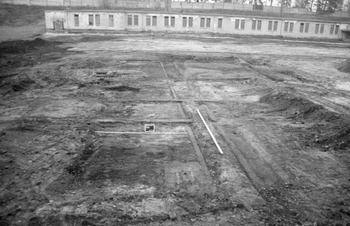
Archaeological discoveries may even have a stronger public impact when excavations or finds confront local wished-for pasts with alternative and disenchanting pictures of the region's history (figure 2). In an essay for a Dutch newspaper with the title ‘Excavating the grave. Archaeologists set Nazi-memories straight’, journalist and archaeologist Theo Toebosch (Reference Toebosch2006) describes the cultural–political consequences of archaeological excavations at the disputed sites of the Second World War (see also Antkowiak Reference Antkowiak2002). In 2004 archaeologists of the Landesamt Brandenburg discovered the remains of camp Rathenow, a so-called Außenlager of concentration camp Sachsenhausen. The present community of the city of Rathenow denied the existence of the former camp and concluded that archaeological research was unnecessary. But the finds of watchtower foundations, double-row barbed wire and ceramics from SS factory ‘Bohemia’ undoubtedly point to the former existence of an SS concentration camp, which was hinted at already in personal testimonies and by aerial photographs. The archaeological excavations reveal data ‘that should not exist according to the ideology of the wrongdoers and accomplices’, says Landesamt archaeologist M. Antkowiak; ‘the aim of the Nazis, the destruction of all evidence of their deeds (and thereby of the memory of the victims), is radically turned by the preservation of material traces’. The German archaeologists who have specialized in the Second World War do not believe, of course, that their discoveries will change the picture of world history, but they do fill in crucial parts of the local past and may have an important impact on debate and popular views.
Excavating at the Ravensbrück concentration camp. Archaeological research in former concentration camps will gain in importance in the near future, as it reveals details about everyday events and the use of space that remained unanticipated or unacknowledged in official plans and archival documents. At the same time it may evoke strong reactions and emotions, as in the case of Rathenow (photograph Brandenburgisches Landesamt für Denkmalpflege und Archäologisches Landesmuseum).

In cases such as Rathenow an anthropological approach to the archaeological heritage can clarify and contextualize the different positions within the heritage debate as a whole. Yet in such a cultural–political setting, archaeology contributes most by revealing a past that contrasts with that already known – by producing or discovering a history that has remained hidden from personal memories, written documents and ethnographic accounts of the past (see also Hall Reference Hall2000). When combined within one and the same project by archaeologists, archaeological narratives about the past run the risk of being neutralized by anthropological reflection and contextualization.
Time depth and biographies of place and landscape
For some, like Huizinga and Shanks (albeit in different ways), the archaeological discovery evokes a strong sense of the past's immediacy. For others, archaeological heritage stands for time distance. The German philosopher Hans-Georg Gadamer, for instance, believed that the ‘Überreste vergangenen Lebens, Reste von Bauten, Werkzeuge, der Inhalt der Gräber’ (1990, 156–57) have been eroded so much by the enduring storms of time that interpreting them becomes an extremely difficult undertaking. This would make the archaeological find different from the historical text, which according to Gadamer is ‘so sehr reiner Geist, daß sie wie gegenwärtig zu uns spricht’. Yet both positions exemplify that ‘time’ should be considered the core business of archaeology. This is also evident from the previous discussions on discovery and difference, which will somehow be associated with matters of time and time depth by most archaeologists, be it not so much of logical necessity as of professional intuition.
Surprisingly, beyond such terms as dating, chronology and evolution, time and temporality remained virtually nonexistent in archaeological key debates until the 1980s, and it took at least another ten years before the topic acquired a firm place within archaeological debate (Murray Reference Murray1999; Lucas Reference Lucas2005). One of the first to tackle time in archaeology was Geoff Bailey (Reference Bailey1983), who not only argued that time deserved a better place in archaeological practice and theory, but also offered concrete suggestions for making an archaeological contribution to the handling of time within the historical sciences in general. He delineated two main topics. The first concerns the connection between past perceptions of time on the one hand, and the archaeologist's time perception(s) on the other. Secondly, he discussed the possibility of further developing the theory of timescales, suggesting that archaeology's specific contribution to the history of societies and landscapes resides in the long term – the longue durée of Braudel. This gave rise to a series of important studies on the long-term development of landscape and society in the Mediterranean (Bintliff Reference Bintliff1991; Knapp Reference Knapp1992; Barker Reference Barker1995), in which the methodological problems defined by Braudel, however, such as the interaction between timescales (évènements, conjonctures and the longue durée) remained largely untouched (but see Moreland Reference Moreland and Knapp1992; Bintliff Reference Bintliff and Bintliff2004b).
In the 1990s, archaeology gradually moved away from these issues, as their emphasis on social construction inspired most postprocessual archaeologists to adopt ‘anthropological’ concepts of time. Using insights from philosophy (phenomenology and hermeneutics) and cultural geography, and exploring a growing body of ethnographic literature on memory (see Stewart and Strathern Reference Stewart and Strathern2003 for examples), archaeologists such as Chris Tilley, Julian Thomas, Richard Bradley, Andrew Jones and others shifted to time as experienced ‘from within’; that is, the constitution of memories and the experience of time within the horizons of past life worlds (e.g. Jones Reference Jones2007). In this way, they did good service to archaeological interpretation, as past experiences of time and place had formed a hidden and unexplored dimension of archaeological study thus far. On the other hand, the ethnographic focus within postprocessual landscape archaeology has made the long term almost unattainable, thereby reducing the time depth of archaeological study considerably.
In the meantime, memory has also replaced ‘long-stretched’ time in the archaeological discourse on heritage. In this respect, again, archaeology is rather late in comparison with geographical and anthropological studies of heritage and landscape. As early as the 1980s, for example, Cosgrove and Daniels stated (1988, 13) that ‘landscape is often regarded as the materialization of memory, fixing social and individual histories in space . . . Human memory constructs rather than retrieves, and the past thus originates from the elaboration of cultural memory, which itself is socially constructed’.
It seems that it is now time for ‘time’ to return to the archaeological research and heritage agenda in other ways than as a constructivist notion of memory. Archaeological heritage contains traces which are forgotten, repressed by collective memory or traces of events that were never intended to be remembered – traces, moreover, that led part of their lives outside the sphere of human intentions and cultural transmission, remaining unacknowledged in the soil under our feet. Albeit an act of remembrance itself, archaeology's relationship with both conventional Western and ethnographically documented forms of memory is therefore complex and problematic. Archaeology is thus facing the challenge of reloading heritage practices with time depth and new notions of time and temporality.
So-called biographical approaches to landscapes and places seem especially promising in this respect. They start from the observation that people write their life histories into places and the land, making them ‘authors’ of landscapes. But that is just part of the story: places and landscapes also play an active role in the life histories of people, binding persons and generations together, while at the same transcending human life histories and creating their own biographies at different timescales through successive social contexts. In fact, this observation extends the use of the biography metaphor introduced by Kopytoff (Reference Kopytoff and Appadurai1990) and Appadurai (Reference Appadurai and Appadurai1990) in social anthropology to describe the life paths of goods, including land, which are exchanged frequently within society and thereby go through modifications and shifts in their social meanings and economic functions. Earlier, the idea that landscapes in this sense have a life history and bear the imprint of human ‘authorship’ was put forward by the geographer Marwyn Samuels (Reference Samuels and Meinig1979). Biographical landscape studies have been conducted in both British and Continental European archaeology. They cover wide-ranging topics like the changing use, ordering and experience of unique monuments such as Stonehenge (Bender Reference Bender and Bender1993; Darvill Reference Darvill2006) and Avebury (Pollard and Reynolds Reference Pollard and Reynolds2002); categories of landscape features such as prehistoric megaliths and urnfields (Kolen Reference Kolen1995; Roymans Reference Roymans1995; Holtorf Reference Holtorf1998); regional landscapes (Roymans et al. Reference Roymans, Gerritsen, van Der Heijden, Bosma and Kolen2009); and particular places that play a prominent role in the living environment of present-day local communities (Kolen Reference Kolen1995).
Landscape biography should now be taken a step further, for example by linking memory to the long term, connecting the micro-histories of places to large-scale developments, and integrating experience and process. One of the routes to this end is by the study of how, in different mnemonic, religious and social systems, memories and the biographies of values and ideas (Hoskins Reference Hoskins1998) interact with the material world (e.g. Küchler Reference Küchler2002; Descola Reference Descola and Kuper1992; Reference Descola, Descola and Pálsson1996). These systems may, in fact, include very different modes of transformation and cultural transmission (cf. Rowlands Reference Rowlands1993; Whitehouse Reference Whitehouse2004), each mode exhibiting distinct temporal characteristics at different timescales. Moreover, different mnemonic systems may even generate quite different processes of environmental and ecological change. On New Ireland, for example, rituals and life-cycle ceremonies that involve the frequent destruction of objects and land features, such as malanggan grave sculptures, dwellings and garden plots, create diverse environments that change rapidly, in both social and ecological respects (Küchler Reference Küchler and Bender1993; Reference Küchler2002). This even caused confusion on the part of the anthropologist:
It was some time into my fieldwork before I realised that the relation between garden land and settlement is not fixed, but subject to a process of inversion . . . Mercifully I was told one day when sweating in the sun drawing maps of a village on the northwest coast, that nobody could understand what I was doing because what I was drawing would soon disappear. Instead, I was instructed not to draw the village as I could see it, but to notate a mental map of places which once were house sites and now were gardens or had been gardens some time ago and were now covered by secondary forest (Küchler Reference Küchler and Bender1993, 96).
Indeed, Küchler concludes, the process of landscape formation and its articulation in ritual and visual representations is inseparable from the emergence of a political economy of memory under specific social and historical conditions (Kühler Reference Küchler and Bender1993, 104). This indicates that archaeologists should conduct more research on the interactions between mnemonic systems, values and perceived time on the one hand, and environmental rhythms and ecological changes on the other. In doing so, they should take up the challenge of linking the ethnographically observed temporalities with the longue durée (e.g. Ingold Reference Ingold2000). New theoretical perspectives and detailed empirical studies of landscapes and places could improve archaeology's specific contribution to understanding how landscapes came to be, and how they may change in the future.
Conclusion: archaeology of its own
In a living environment that is characterized by rapid spatial transformations and highly cultivated decision-making, heritage specialists increasingly play the role of process managers and cultural mediators. In this context, an anthropological attitude (or having a background in anthropology) is important for grasping some of the complexities of the interactions between the academic archaeological narrative, personal and shared memories and other public accounts of the past. This is why this contribution to Archaeological dialogues is entitled ‘The “anthropologization” of archaeological heritage’ and not ‘Against the anthropologization of archaeological heritage’. However, it is the production of narratives in the first place, not the study of the production of values through storytelling or reflecting on the multivocality of heritage, that enables archaeology to tell a richer or fuller story about the past. It is therefore crucial that heritage archaeologists do not focus their activities one-sidedly on managing present-day change, organizing public participation and initiating dialogue, but that they also stay sufficiently trained ‘to attend to those clues which the rest of us might pass over’ (Ingold Reference Ingold2000, 199). Furthermore, they should continue to explore discovery, difference and time depth as key elements that shape these clues into narratives for the community, in order to make a contribution that really makes sense amongst the manifold and colourful memories of dwellers and the stories of other historians, such as historical geographers and historical anthropologists.
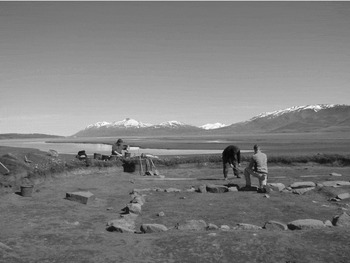
A reappraisal of discovery, difference and time depth should not be taken as ‘positivist’. It is not so much by the mapping of present-day practices, memories and sentiments that surround lieux de mémoire, but by explicit storytelling alone that archaeologists can make a strong contribution to the multivocality of the archaeological heritage. Different groups and individuals often raise very different questions about the landscape's history (Herzfeld Reference Herzfeld1991; Bender and Winer Reference Bender and Winer2001). Furthermore, memories and heritage are transformed, experienced and valued in constantly differing ways, because the perspectives and self-images of individuals and groups are subject to change. Until now, at least on the European continent, heritage projects have failed to acknowledge sufficiently the dynamic way in which the past is perceived and dealt with. Traditional heritage management is a rather closed system, with a small group of insiders deciding which aspects of the past are valuable and which are not. In recent years, however, this closed system has been prised open to create room for the memories and historical views of other interest groups. Yet it is a task for archaeologists to add time depth, nuances or alternative stories to other widely held views of the landscape's history. They have the intellectual and methodological tools to show that the landscape has also been formed and passed down in different worlds, by societies with different economies, social structures and beliefs, that in it processes operate at the time scale of centuries and millennia, and that our intimate landscape houses unexpected (figure 3) and even unwanted or unpopular histories. In this way, archaeology can contribute to a layered experience of the environment, where layerdness and multivocality are important barometers for a societies’ capacity for creating a climate for a differentiated appreciation of heritage (Roymans et al. Reference Roymans, Gerritsen, van Der Heijden, Bosma and Kolen2009).
Archaeological discovery and excavation have the potential to produce alternative narratives about the landscape. This excavation reveals a medieval trading site and church under the surface of an ‘archetypical’ natural landscape on the northern coast of Iceland (Gásir, Eyjafjördur, 2006; photograph by Howell Magnus Roberts).

Even in a time when heritage is being increasingly democratized, an anthropological approach to archaeological heritage should not overshadow the straightforward goal of archaeological heritage practices to communicate stories about the past that potentially enrich the experience of our living environment. In the heritage arena, anthropologists and archaeologists play different roles that remain partly incommensurable. Archaeologists, therefore, should consciously invest in the further development of methods and techniques for recovery as well as the temporal frames that best fit archaeological interpretation and experience. In addition, they should use anthropological reflection for the better communication of their stories, not for the sake of an ‘ethnography of themselves’.
Acknowledgements
This article has been based on many discussions on the subject with Roel Brandt (1940–2009), architect of Dutch archaeology after 1980. I am grateful to the editors of Archaeological dialogues and to Laura Crowley (VU University Amsterdam) for improving the English translation. I also thank Sabine Eickhoff, Petra Woidt and Dr Christof Krauskopf of the Brandenburgisches Landesamt für Denkmalpflege und Archäologisches Landesmuseum for kindly providing photographs of excavations in concentration camps (figure 2), and Howell Magnus Roberts and Orri Vésteinsson of the Fornleifastofnun Íslands for providing the photograph in figure 3.