Introduction
Sinonasal malignancies are uncommon and account for only 1 per cent of all malignanciesReference Tufano, Mokadam, Montone, Weinstein, Chalian and Wolf1, Reference Rinaldo, Ferlito, Shaha and Wei2 and 3–5 per cent of all head and neck malignancies.Reference Le, Fu, Kaplan, Terris, Fee and Goffinet3, Reference Tiwari, Hardillo, Mehta, Slotman, Tobi and Croonenburg4 They are relatively rare in the UK, although common in South East Asia and in the Arctic regions. About 300 cases are diagnosed each year in the UK, the annual incidence rate between 1994 and 2002 being 0.8 per 100 000 for men and 0.5 per 100 000 for women.5 Relatively high rates for sinonasal malignancy have been found in Asian populations, with the highest age-adjusted rates of between 2.5 and 2.6 per 100 000 per annum in Japanese men.Reference Muir and Nectoux6
Materials and methods
This was a retrospective audit of all patients diagnosed with sinonasal malignancy in the Plymouth Hospitals NHS Trust, a tertiary referral centre in the south-west of the UK, between 2007 and 2012. Patients were identified through the coding system and multidisciplinary team (MDT) database. The clinical records were retrieved and data were collated using an Excel collection tool (see Appendix I) and analysed with Microsoft Office Excel 2007.
Results
Thirty patients with sinonasal malignancy were identified out of 570 head and neck patients (5 per cent), recorded from January 2007 to August 2012. There were 19 men and 11 women (1.7:1 ratio). The mean age of the patients was 65.6 years (range: 37–92 years). Seven out of 30 patients (23 per cent) were two-week, fast-track referrals and the rest were routine. All patients, bar one, were referrals by general practitioners.
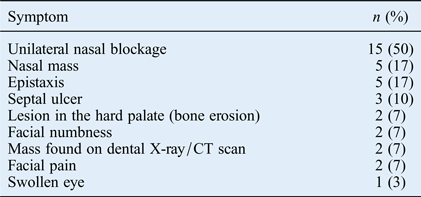
By far the most common presenting symptom was a unilateral nasal obstruction followed by a nasal mass and epistaxis (Table I). The most common site affected at presentation was the nasal cavity in 57 per cent of patients followed by the maxillary sinuses in 27 per cent, the ethmoid sinuses in 10 per cent and the sphenoid sinuses in 6 per cent (Figure 1).
Site affected at presentation in our patient cohort. The most common site affected at presentation was the nasal cavity followed by the maxillary, ethmoid and sphenoid sinuses.

Presenting symptoms of patients with sinonasal malignancy
CT = computed tomography
Some patients presented with more than one symptom
Histopathology
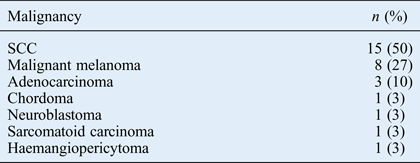
Half of the sinonasal malignancies in our series were squamous cell carcinomas (SCCs) while malignant melanoma was diagnosed in 27 per cent of patients. Adenocarcinoma was diagnosed in 10 per cent of patients, whereas chordoma, neuroblastoma, sarcomatoid carcinoma and haemangiopericytoma each formed 3 per cent of the cases (Table II).
Type of malignancy
SCC = squamous cell carcinoma
Imaging
Computed tomography (CT) and magnetic resonance imaging (MRI) scans were used for tumour staging. Malignancies were staged using the tumour–node–metastasis (TNM) classification of malignant tumours; the TNM classification of malignant melanoma of the upper aerodigestive tract was used for malignant melanoma staging. Most patients presented late (20 per cent at stage III and 50 per cent at stage IV) with only 13 per cent of patients presenting with a stage I tumour and 17 per cent with stage II cancer (Figure 2).
Stage of malignancy at presentation in our patient cohort. The majority of patients in our series presented at a late stage of malignancy, with only about one-third of patients presenting at an early stage.
Ninety per cent of patients had CT of the sinuses as their primary investigation while 10 per cent had MRI as the primary investigation; 37 per cent of patients subsequently had MRI scans and 6.7 per cent positron emission tomography scans for staging of the disease. These scans were performed after discussion in the MDT meeting. Only 27 per cent of all diagnosed malignancies had a repeat MRI scan at one year. However, none of the patients had an MRI at 3–4 months into their surveillance period as recommended by the European Position Paper on Endoscopic Management of Tumours of the Nose, Paranasal Sinuses and Skull Base guidelines.Reference Lund, Stammberger, Nicolai, Castelnuovo, Beal and Beham7
Treatment
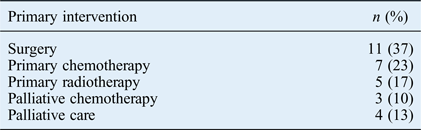
All patients were discussed by the MDT before considering treatment. Out of 30 patients in our study, 11 (37 per cent) had surgery (6 treated endoscopically, 3 had rhinotomy and 2 had maxillectomy), whereas 7 (23 per cent) had primary chemotherapy, 5 (17 per cent) primary radiotherapy, 3 (10 per cent) palliative chemotherapy and 4 (13 per cent) palliative care (Table III).
Treatment modalities
Six endoscopic surgeries, three rhinotomies and two maxillectomies
The follow-up period ranged from four months to five years and four months. A total of 8 (27 per cent) patients in our series had disease recurrence. Of these, five had been treated using primary surgery (the histology of four of them was malignant melanoma; one had neuroblastoma), two were treated with chemotherapy and one with radiotherapy.
Nine patients (30 per cent) died within 5 years of being diagnosed with cancer. Three of them had SCC, three malignant melanoma, two adenocarcinoma and one sarcomatoid carcinoma.
Discussion
Our audit, which spans a period of five years and eight months, identified patients with sinonasal cancer as representing 5 per cent of all new head and neck cancer patients. This is comparable to other reports in the literature, with a range of 3–5 per cent of head and neck cancers.Reference Le, Fu, Kaplan, Terris, Fee and Goffinet3, Reference Tiwari, Hardillo, Mehta, Slotman, Tobi and Croonenburg4 The predominance of men seen in our study (M:F ratio = 1.7:1) is also similar to other reports in the literature.Reference Zyłka, Bień, Kamiński, Postuła and Ziołkowska8, Reference Barbieri, Lombardi, Candela and Festa9
Only 23 per cent of patients in our audit were 2-week, fast-track referrals from general practitioners and the rest of the patients were routine referrals to the ENT out-patient clinic. The delay in presentation could be attributed to the non-specific nature of sinonasal malignancy symptoms at an early stage of the disease and to the hidden nature of the mucosal covering of the nose and sinuses, which makes direct visualisation by primary care physicians difficult. Brent and Michael have shown a six-month average duration between the first symptom and diagnosis of sinonasal malignancy.Reference Brent, Michael, Micheal, George, Ray, Valerie and John10 There is a need to educate general practitioners regarding the ‘red flag’ symptoms of head and neck cancer in general, and sinonasal malignancy, in particular. There is also need for increasing patient awareness of the early symptoms of sinonasal malignancy.
The origin and histological type of sinonasal malignancy varies in different series. The preponderance of SCCs in our series is reflected in most published series. The high incidence of malignant melanoma in our audit is not universally reflected in the literature. Svane-Knudsen et al.Reference Svane-Knudsen, Jørgensen, Hansen, Lindgren and Marker11 reported that 64 per cent had well-differentiated SCCs, adenocarcinomas and adenocystic carcinomas. Non-Hodgkin's lymphomas and undifferentiated carcinomas represented 9 per cent and 2.6 per cent, respectively. A German study by Zbären et al.Reference Zbären, Richard, Schwaab and Mamelle12 found 56 per cent to be epidermoid carcinomas and 14 per cent to be adenocarcinomas. Similarly, in a study of 60 Japanese patients, Haraguchi et al.Reference Haraguchi, Ebihara, Saikawa, Mashima, Haneda and Hirano13 found a predominance of well-differentiated SCCs (25 per cent) followed by melanomas and non-Hodgkin's lymphomas (23 per cent), and a small number of undifferentiated carcinomas (5 per cent). There is a difference in the spectrum of presentation in areas where there is a high incidence of nasal-paranasal neoplasms, with histopathological findings being different from the one described in low-risk areas. Undifferentiated carcinomas in Chinese high-risk areas (i.e. Hong Kong) constitute more than 80 per cent of all sinonasal malignancies.Reference Van Hasselt and Skinner14 Hence, incidence, site and histological type can vary in different geographical areas; this may be due to occupational, social and genetic factors.Reference Lund, Stammberger, Nicolai, Castelnuovo, Beal and Beham7
The European Position Paper on Endoscopic Management of Tumours of the Nose, Paranasal Sinuses and Skull Base recommends endoscopy at the first presentation, scanning and biopsy of the lesion and discussion by the MDT for management.Reference Lund15 All patients in this study were discussed in head and neck MDT meetings. All patients seen in the clinic had endoscopy. The vast majority of patients (90 per cent) had CT of the sinuses as their primary investigation with only 10 per cent of patients having MRI as the primary investigation. None of the patients had MRI at 3–4 months in their surveillance period, as recommended by the European Position Paper on Endoscopic Management of Tumours of the Nose, Paranasal Sinuses and Skull Base guidelines.Reference Lund, Stammberger, Nicolai, Castelnuovo, Beal and Beham7
The majority of patients in our series presented at a late stage of malignancy (50 per cent at stage IV and 20 per cent at stage III), with only about one-third of patients presenting at an early stage. This is in concordance with the series by Spiro et al. in which 82 per cent of non-squamous sinonasal malignancy presented at stage III and stage IV.Reference Spiro, Soo and Spiro16
Possible reasons for late presentation included the non-specificity of the early symptoms of sinonasal malignancy, difficult early detection by primary care physicians and a lack of high-profile campaigns highlighting sinonasal malignancy to the public.
• We reviewed the treatment and outcomes in 30 patients with sinonasal malignancy over a 5-year period in a tertiary referral hospital in the UK
• Our audit identified patients with sinonasal cancer as representing 5 per cent of all new head and neck cancer patients
• The mortality rate in our sinonasal malignancy case series was 30 per cent over a 5-year period
• Sinonasal malignancy cases in our series presented late, with a higher than expected proportion being malignant melanomas
The management of sinonasal malignancy should have combined modular approaches, as mandated by the lesion and its location.Reference Kassam, Snyderman, Mintz, Gardner and Carrau17–Reference Kassam, Gardner, Snyderman, Mintz and Carrau19 When a lesion cannot be completely removed through an endoscopic approach, an open route may be considered as a surgical option.Reference Carrabba, Dehdashti and Gentili20–Reference Fatemi, Dusick, de Paiva Neto, Malkasian and Kelly22 Out of 30 patients in our study, 11 (37 per cent) had surgery: 6 had endoscopic surgery, 3 had rhinotomies and 2 had maxillectomies. There was a 30 per cent mortality rate in our series with a follow up ranging from 4 months to 5 years and 4 months. Three patients with SCCs died, giving an 80 per cent, 5-year survival rate in contrast to a 60–64 per cent, 5-year survival rate in the study by Lee et al.Reference Lee, Hur, Roh, Rha, Jin and Rhee23 Malignant melanoma had a 50 per cent recurrence rate and a 62.5 per cent, 5-year survival rate compared to the 22 per cent reported in some studies.Reference Dauer, Lewis, Rohlinger, Weaver and Olsen24–Reference Wagner, Morris, Werning and Mendenhall27 This interestingly reflects on the higher incidence of malignant melanoma found in our study population with high survival rates. Perhaps, this is due to the detection of malignant melanoma at an early stage and treatment, including early surgical management.
Conclusion
Most sinonasal malignancies presented late in a significant number of patients. Squamous cell carcinoma remains the most common histological type. Our series shows a relatively high incidence of malignant melanoma with high recurrence and survival rates. The audit highlights the need to adhere to European Position Paper on Endoscopic Management of Tumours of the Nose, Paranasal Sinuses and Skull Base guidelines when using MRI scans as a primary investigation and as follow up after treatment. Further multicentre prospective studies are required to identify the treatment outcomes of this rare type of head and neck malignancy.
APPENDIX I
Data collection tool in microsoft office excel 2007