Introduction
Domestication is one of the foremost research topics in archaeology (Kintigh et al. Reference Kintigh, Altschul and Beaudry2014; Zeder Reference Zeder2015). The study of animal domestication, especially its initial timing and geographical origins, is most often examined by assessing genetic and morphological changes in faunal remains from archaeological contexts (e.g. Larson & Burger Reference Larson and Burger2013; Russel Reference Larson and Burger2012; Zeder Reference Zeder2015). Animal imagery is an additional but often-underutilized line of evidence for understanding how domestication was enacted (Bökönyi Reference Bökönyi1974; Clutton-Brock Reference Clutton-Brock2012; Russel Reference Russel2012, 13–14). For example, studies of rock art have been employed to argue for the use of early dogs in hunting (Guagnin et al. Reference Guagnin, Perri and Petraglia2018), changes in camelid body proportions related to domestication (Gallardo & Yacobaccio Reference Gallardo and Yacobaccio2005) and corralling of reindeer during the Middle Holocene (Helskog Reference Helskog2011). Such proposals are often controversial because the imagery in question is not precisely dated or the images themselves are considered ambiguous. At the same time, domestication is widely described as a process that dramatically transforms human–animal relationships, but also notions of property, identities and eventually whole ecosystems (e.g. Hodder Reference Hodder1990; McClure Reference McClure2015; Robinson et al. Reference Robinson, Korisettar and Koshy2008; Russell Reference Russel2012; Vigne Reference Vigne2011). How could such transformations occur without related changes in the production and meaning of imagery, particularly that related to the animals at the centre of such relationships?
Reindeer provide a particularly compelling case for exploring relationships between imagery and domestication. Today domestic reindeer in much of northern Eurasia are kept in relatively large herds where they primarily act as sources of food and hides (Anderson Reference Anderson2000; Golovnev et al. Reference Golovnev, Garin and Kukanov2016; Ingold Reference Ingold1980; Stammler Reference Stammler2005). This is large-scale pastoralism, and in some cases involves relatively limited close interaction with individual reindeer. However, these ways of being with reindeer are relatively recent phenomena. Prior to the mid eighteenth century ce, domestic reindeer's primary role was in transport—carrying riders or pulling sleds—and even today such roles persist in parts of Siberia (Bjørklund Reference Bjørklund2013; Krupnik Reference Krupnik1993; Stépanoff Reference Stépanoff2017). Such working relationships often took place within societies where fishing and hunting was predominant and domestic herds were comparatively small. Domestic reindeer in such settings were eaten, but in general, killing of transport reindeer was avoided because these animals were precious. Relationships with working animals can be time-intensive and intimate. Training a working animal, engaging with it on daily tasks and providing it food and veterinary care requires mutual enskillment, cross-species communication and attending to one another's needs and tendencies (Ingold Reference Ingold2013; Losey et al. Reference Losey, Nomokonova, Arzyutov, Gusev, Plekhanov, Fedorova and Anderson2020a; Paine Reference Paine1994). None of this can be brought about quickly or at a distance. This is intimate work that takes place over many years (Allentuck Reference Allentuck2015; Armstrong Oma Reference Armstrong Oma2010; Knight Reference Knight and Knight2005; Losey et al. Reference Losey, Nomokonova, Arzyutov, Gusev, Plekhanov, Fedorova and Anderson2020a). Such long-standing and close relationships can build and have built interdependence and kinship between human and animal.
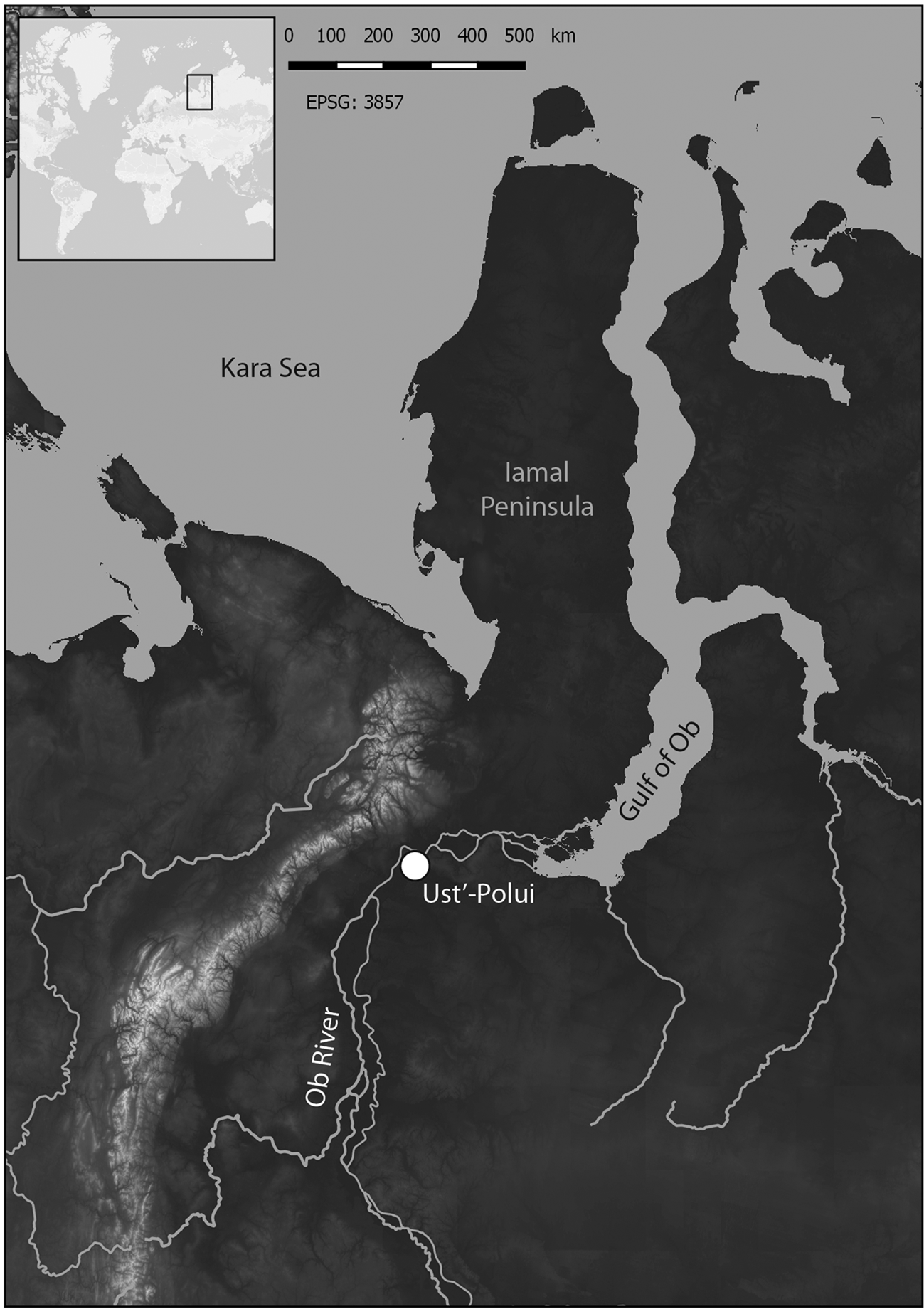
People also have intimate relationships with the animals they hunt (Ingold Reference Ingold2000; Willerslev Reference Willerslev2007). Reindeer have been hunted throughout much of northern Eurasia for millennia, including in the Iamal-Nenets region of northwest Siberia, which is our area of research (Fig. 1). Arguably, these ways of knowing and being with reindeer are distinct from those involving domestic transport reindeer. Hunted reindeer are most closely interacted with when they are being stalked and killed, but also when their bodies are being converted into food, clothing and other items. Close physical interactions with hunted reindeer as living beings are short-lived, especially when compared to the duration of interaction involved with reindeer that carry riders or pull sleds. Historically in Iamal, a transport reindeer can have a working life of up to 10 years (Khomich Reference Khomich1966, 91). When such animals are past their prime, they too can be killed and their bodies used as food and clothing. Such long-standing personal relationships, which appear to have emerged just over 2000 years ago in Iamal among local hunters and fishers (Losey et al. Reference Losey, Nomokonova, Arzyutov, Gusev, Plekhanov, Fedorova and Anderson2020a), were personally transformative for some humans and reindeer. Here we explore the seemingly sudden appearance of reindeer imagery at the Ust’-Polui site, which co-occurs there with some of the region's earliest evidence of reindeer keeping.
Map of the study area with location of the Ust’-Polui site indicated.

Iamal's domestic reindeer and Ust’-Polui
The Iamal-Nenets region is a global centre of reindeer pastoralism (Klokov Reference Klokov2011), and in turn has been the focus of significant research on reindeer domestication (Anderson et al. Reference Anderson, Harrault, Milek, Forbes, Kuoppamaa and Plekhanov2019; Fedorova Reference Fedorova and Golovnev2000; Reference Fedorova2006; Golovnev Reference Golovnev1995; Golovnev et al. Reference Golovnev, Garin and Kukanov2016; Gusev et al. Reference Gusev, Plekhanov and Fedorova2016; Krupnik Reference Krupnik1993; Losey et al. Reference Losey, Nomokonova, Arzyutov, Gusev, Plekhanov, Fedorova and Anderson2020a; Nomokonova et al. Reference Nomokonova, Losey, Plekhanov and McIntyre2018; Røed et al. Reference Røed, Kvie and Losey2020; Stépanoff Reference Stépanoff2017). Several lines of evidence have been used to suggest that reindeer domestication and transport first emerged in the region around 2200 years ago. Nearly all of this comes from the Ust’-Polui site, located on the banks of the Ob’ River within the modern city of Salekhard (Fig. 1). This Iron Age site was a regional gathering centre utilized for various ritual purposes from ~260 bce to ce 140 (Gusev & Fedorova Reference Gusev and Fedorova2012; Reference Gusev and Fedorova2017; Losey et al. Reference Losey, Fleming and Nomokonova2017). Potential evidence at Ust’-Polui for reindeer domestication takes several forms. First, multiple items thought to be transport reindeer headgear were found at the site. These include barbed L-shaped items and several forms of swivels, all made from antler, which are similar to parts of transport reindeer headgear now used in Iamal and adjacent regions (Gusev Reference Gusev2014; Losey et al. Reference Losey, Nomokonova, Arzyutov, Gusev, Plekhanov, Fedorova and Anderson2020a). Nenets reindeer herders who examined replicas of these items described some of the swivels as identical to those used in their own reindeer headgear, and suggested that the barbed L-shaped pieces were employed to train young transport reindeer (Losey et al. Reference Losey, Nomokonova, Arzyutov, Gusev, Plekhanov, Fedorova and Anderson2020a). Second, the remains of several wood sleds were found at Ust’-Polui, which might also be evidence of reindeer transport. These sleds had ski-like runners and raised beds supported by stanchions. However, they are lightly built compared to modern reindeer sleds from the region, and it is possible they were used with dogs, remains of which are abundant at the site (Losey et al. Reference Losey, Nomokonova, Gusev, Bachura, Fedorova, Kosintsev and Sablin2018). Third, the site has produced a wide range of imagery, including multiple depictions of reindeer, some of which have interpreted as domestic animals being sacrificed (Fedorova Reference Fedorova and Golovnev2000, 57; Reference Fedorova, Gusev and Fedorova2017, 123). This paper focuses on this imagery and what it might reveal about human–reindeer relations in this critical early period of domestication.
Domestic reindeer herds in Iamal appear to have remained quite small for nearly a millennium following the occupation of Ust’-Polui. Widespread occupation of the tundra to the north of Ust’-Polui began around the tenth century ce, and several scholars have proposed that this was enabled by increasing numbers of domestic transport reindeer (Fedorova Reference Fedorova and Golovnev2000; Reference Fedorova2006; Fedorova & Gusev Reference Fedorova and Gusev2019; Gusev et al. Reference Gusev, Plekhanov and Fedorova2016). Further, geoarchaeological research at Iarte VI on the central Iamal peninsula suggests small herds were kept near this site by roughly this same time (Anderson et al. Reference Anderson, Harrault, Milek, Forbes, Kuoppamaa and Plekhanov2019). Genetic analysis of archaeological reindeer remains indicates that contemporary domestic reindeer arrived in the region sometime between the fifteenth and eighteenth centuries ce (Røed et al. Reference Røed, Kvie and Losey2020). These reindeer seem to have mostly originated from a non-local population. This genetic transition likely reflects the early emergence of large scale reindeer pastoralism rather than the initial appearance of domestic reindeer in Iamal (Røed et al. Reference Røed, Kvie and Losey2020). The earliest historic records from Iamal, which are from the seventeenth century, indicate that domestic herds were moderate in size and were used mostly for transport and sacrifice (Krupnik Reference Krupnik1993; Stépanoff Reference Stépanoff2017). Subsistence at that time was based mainly on hunting wild reindeer and fishing. In the mid to late eighteenth century, historic records report that many Indigenous groups in Iamal and surrounding areas (primarily Nenets, Northern Khanty and Mansi) had transitioned to keeping far larger domestic reindeer herds. This involved reliance on domestic reindeer as dietary staples, a restructuring of human mobility practices around the needs of the larger herds and a sharp decline in wild reindeer.
Imagery in context at Ust’-Polui
Ust’-Polui was first excavated in the 1930s and ’40s, with the latest phases of work at the site occurring from 1990 to 2015 (Chernetsov Reference Chernetsov, Chernetsov, Moshinskaia and Talitskaia1953; Gusev & Fedorova Reference Gusev and Fedorova2012; Reference Gusev and Fedorova2017). The general interpretation of the site as a multi-community ritual location is based on its similarity to historically described ritual places, and the site's unique structure and contents. For example, the site core was enclosed by a moat-like ditch and wood fence, and a wood foot bridge spanned the moat. The moat appears too small to function as a fortification, and instead is thought to have functioned as a symbolic enclosure for the site. Ust’-Polui contained scattered human remains and two burials, numerous anthropomorphic and zoomorphic items, and many butchered, eaten, and buried dogs (Aleksashenko et al. Reference Aleksashenko, Brusnitsina and Popova2003; Chernetsov Reference Chernetsov, Chernetsov, Moshinskaia and Talitskaia1953; Gusev & Fedorova Reference Gusev and Fedorova2012; Reference Gusev and Fedorova2017; Losey et al. Reference Losey, Fleming and Nomokonova2017; Reference Losey, Nomokonova, Gusev, Bachura, Fedorova, Kosintsev and Sablin2018; Reference Losey, Guiry, Nomokonova, Gusev and Szpak2020b; Moszyńska Reference Moszyńska, Chernetsov and Moszyńska1974). At least some of the dog remains appear to come from animals that were sacrificed on site. No evidence for living structures has ever been found at the site. Ust’-Polui also has some areas of permafrost, leading to the preservation of many unique perishable items, including parts of sleds, skis, birch-bark containers and figurines. Overall, the site has produced over 50,000 artefacts. During the early historic period, Nenets and Northern Khanty gathered together just a few kilometres from Ust’-Polui to conduct shared rituals (Perevalova Reference Perevalova2004, 292–3). These rituals involved sacrifices of dogs and domestic reindeer, sharing of meals and the offering of a suite of goods (including personal items) and food. These practices had numerous functions, including maintaining regional peace, improving health and increasing success in hunting, fishing and herding.
Imagery from Ust’-Polui collected during the earliest phases of excavation is not well quantified. The collections from the 1930s–40s excavations are curated at the Peter the Great Museum of Anthropology and Ethnography, St Petersburg. Fortunately, all reindeer imagery from these collections is shown in earlier publications (Aleksashenko et al. Reference Aleksashenko, Brusnitsina and Popova2003; Chernetsov & Moszyńska Reference Chernetsov and Moszyńska1974; Fedorova Reference Fedorova, Gusev and Fedorova2017). All objects from the 1990 and later excavations, curated at the Iamal-Nenets Region Museum Complex of I.S. Shemanovskii, Salekhard, were fully accessible to us for analysis and are shown in the paper. Two recent publications also provide some quantitative data on imagery from the 1930s–40s collections (Fedorova Reference Fedorova, Gusev and Fedorova2017; Gusev & Fedorova Reference Gusev and Fedorova2012).
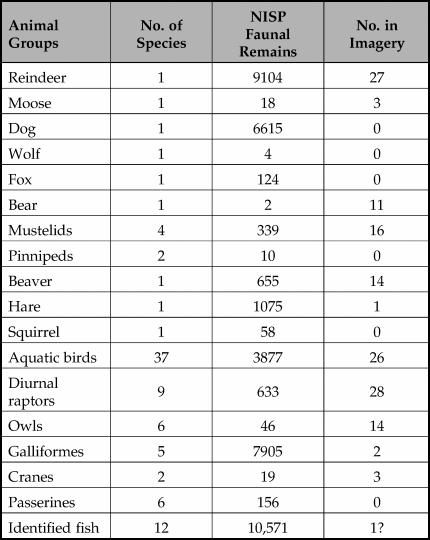
Overall, Ust’-Polui produced ~146 items with animal imagery (Fedorova Reference Fedorova, Gusev and Fedorova2017, 108). The images were made from antler, ivory, wood, birch bark and bronze. Nearly half depict waterfowl and birds of prey (~70 items), but reindeer (27), small fur-bearing animals (perhaps mustelids, 16), beavers (14), bears (11) and a few examples of elk, cranes, ptarmigans, hare, fish, and caterpillars also are present (Fedorova Reference Fedorova, Gusev and Fedorova2017). A bronze medallion depicting a rider on a horse was also found at the site, but this object was surface collected and could be intrusive (Aleksashenko et al. Reference Aleksashenko, Brusnitsina and Popova2003, 17, not included in Table 1). Imagery at Ust’-Polui, including the objects depicting reindeer, was found in nearly all excavated portions of the site, but none is from burials or other constructed features. Use-wear studies on some antler and ivory objects from Ust’-Polui, particularly those from the earlier phases of excavation, suggest that the objects bearing zoomorphic designs were often used more intensively and for longer periods than the items lacking imagery (Aleksashenko Reference Aleksashenko2018). Further, some of the spoons with imagery on their handles have residue and wear traces from being repeatedly utilized and cleaned.
NISP* of identified animal species and zoomorphic images at Ust’-Polui (species are grouped by types of imagery; data from Bachura et al. Reference Bachura, Kosintsev, Gimranov, Korona, Nekrasov, Panteleev, Gusev and Fedorova2017; Fedorova Reference Fedorova, Gusev and Fedorova2017; Losey et al. Reference Losey, Nomokonova, Gusev, Bachura, Fedorova, Kosintsev and Sablin2018; Potapova & Panteleyev Reference Potapova and Panteleyev1999). (*NISP = Number of identified specimens. Please note that NISP in bones provided in this table are summed by imagery types, which sometime can only be identified broadly such as mustelids or diurnal raptors.)

Almost 48,000 faunal remains were recovered from Ust’-Polui during the 1993 and later excavations (Table 1; Bachura et al. Reference Bachura, Kosintsev, Gimranov, Korona, Nekrasov, Panteleev, Gusev and Fedorova2017, 81). Those from earlier excavations were not systematically collected, but some details on the dog and bird remains from them are available (Losey et al. Reference Losey, Nomokonova, Gusev, Bachura, Fedorova, Kosintsev and Sablin2018; Potapova & Panteleyev Reference Potapova and Panteleyev1999). Overall, faunal remains include at least 15 mammalian, 65 avian, and 12 fish species (Bachura et al. Reference Bachura, Kosintsev, Gimranov, Korona, Nekrasov, Panteleev, Gusev and Fedorova2017; Potapova & Panteleyev Reference Potapova and Panteleyev1999), the majority of which belong to reindeer (NISP = 9104), burbot (NISP = 7837), dog (NISP = 6615) and willow ptarmigan (NISP = 6899). Fish are underrepresented due to the intermittent use of sieves for field recovery of faunal remains. Analysis of stable carbon and nitrogen isotope values of bone collagen from three sets of human remains at the site indicates a heavy reliance of freshwater fauna, most likely fish (Losey et al. Reference Losey, Fleming and Nomokonova2017). Dog diets often closely parallel those of their human counterparts (Guiry Reference Guiry2012; Guiry & Grimes Reference Guiry and Grimes2013), and at Ust’-Polui these too were heavily dependent on freshwater fish (Losey et al. Reference Losey, Fleming and Nomokonova2017). In other words, despite the abundance of reindeer remains at Ust’-Polui, fish also were important local dietary staples.
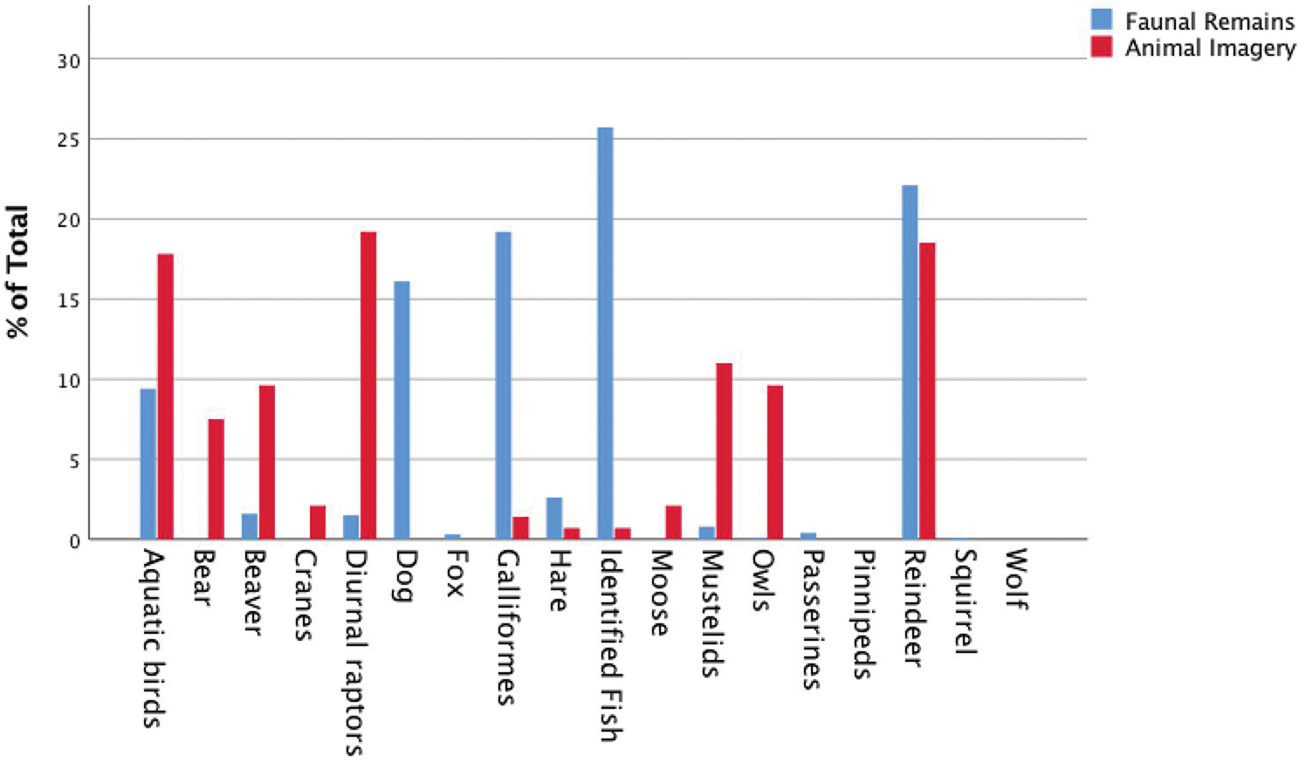
The relative abundances of the types of animals in the imagery have few direct parallels in the structure of the site's faunal remains and little relationship with human diet. In both the imagery and faunal remains, reindeer constitute around 20 per cent of the specimens present (Table 1; Fig. 2). Beyond this, however, the imagery and faunal remains are strikingly different. For example, dogs are the second most abundant mammals at the site, but they are seemingly absent in the imagery. The only potential image of a dog is an incised design found on one knife handle (Losey et al. Reference Losey, Nomokonova, Gusev, Bachura, Fedorova, Kosintsev and Sablin2018, 119), which alternatively might depict another type of carnivore (a wolverine, for example). Diurnal raptors constitute 19.2 per cent of the imagery, but only 1.5 per cent of the overall faunal assemblage. Finally, fish remains account for just over 25 per cent of the identified faunal remains and a significant portion of both human and dog diets at Ust’-Polui, but only a single fish image is present.
Comparison of the structure of the faunal remains at Ust’-Polui compared to the animals in the imagery from the site. (Data organized following Table 1.)

The skeletal remains of reindeer found at Ust’-Polui show several noteworthy patterns. First, many skeletal elements were fragmented and show cut and chop marks that evidence butchery, suggesting that reindeer were butchered and eaten on site (Bachura et al. Reference Bachura, Kosintsev, Gimranov, Korona, Nekrasov, Panteleev, Gusev and Fedorova2017). Second, reindeer remains were found throughout the site mixed with remains of other species, and while all elements of the body are present, those of the head are underrepresented. One exception to this pattern is the 2010–11 excavation trenches in the northern portion of the site. These trenches were located along the moat near the wooden foot-bridge where several dog burials were found (Losey et al. Reference Losey, Nomokonova, Gusev, Bachura, Fedorova, Kosintsev and Sablin2018). In comparison to other areas of the site, this area produced the largest quantities of mostly complete reindeer antlers (Bachura et al. Reference Bachura, Kosintsev, Gimranov, Korona, Nekrasov, Panteleev, Gusev and Fedorova2017). These two patterns suggest that reindeer heads and antlers were differentially deposited at Ust’-Polui compared to postcranial elements (Bachura et al. Reference Bachura, Kosintsev, Gimranov, Korona, Nekrasov, Panteleev, Gusev and Fedorova2017). Note that reindeer heads continue to be distinctly treated in Nenets, Khanty and Mansi communities in the region (described below).
Reindeer imagery
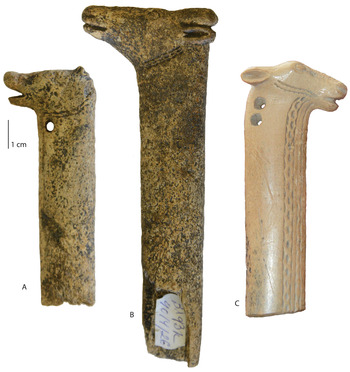
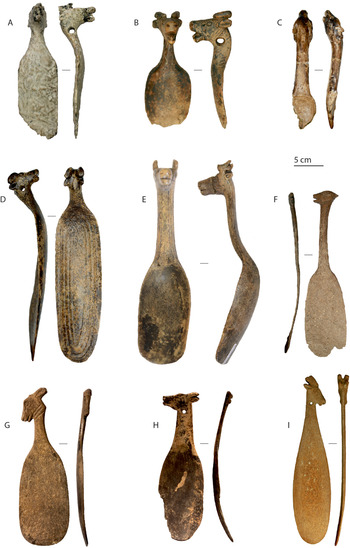
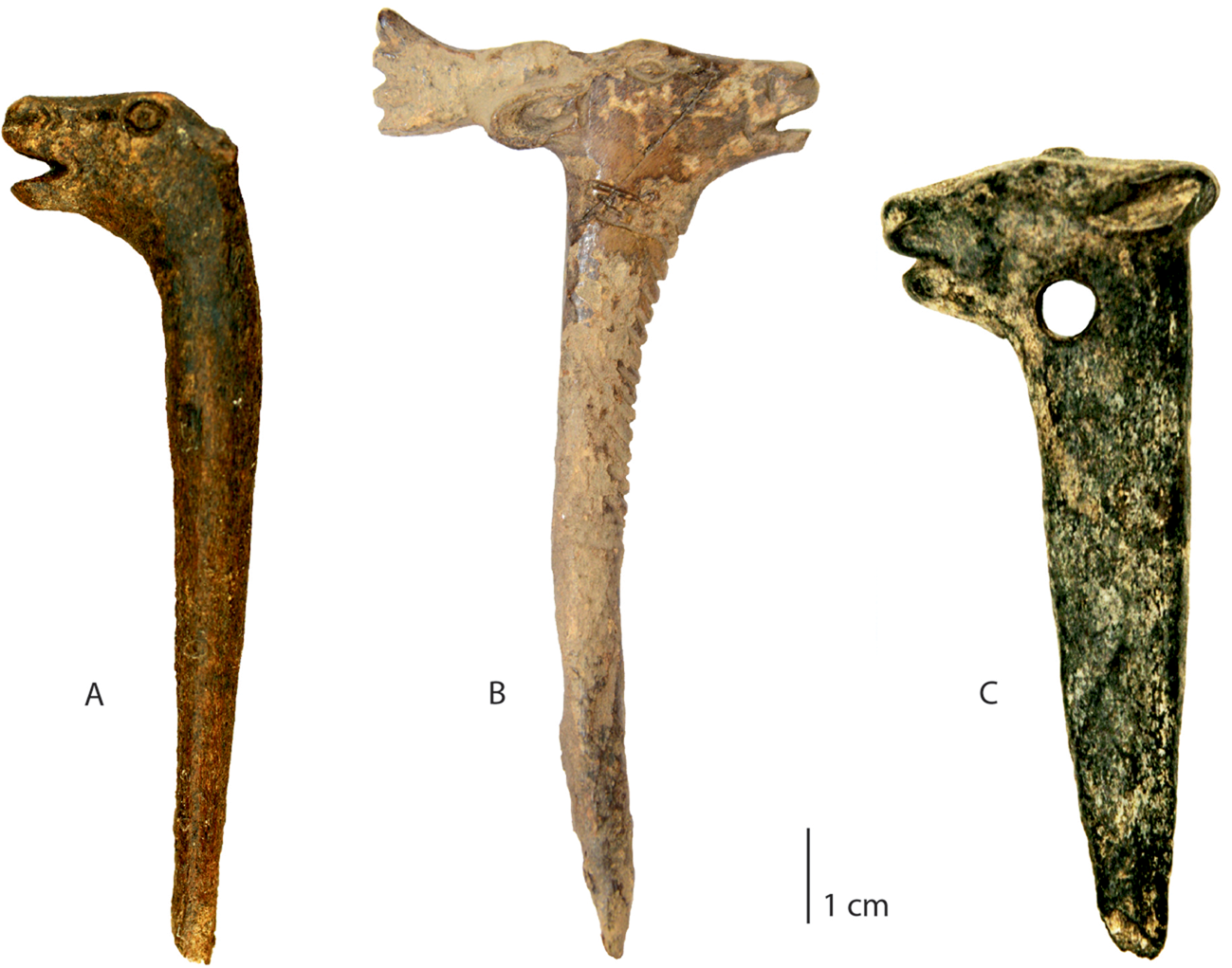
Reindeer are depicted on as many as 27 artefacts, with 21 being made of antler, four of ivory and two of bronze. The vast majority (23 items) depict reindeer heads without the rest of the body, with such images being on the handles of 15 spoons, four pins/awls, three knife hafts and one reworked comb/pin. Seventeen of these heads are sculpture in the round, and seven others show the heads in profile only. This design difference is due to the nature of the material being shaped—thicker handles allow sculptural forms while thinner, plate-like pieces are more conducive to cut out incised forms. Knife handles, for example, are made from antler beams or the bases of fairly large tines (Fig. 3). These pieces provide carvers with 2–4 cm sections of dense material suitable for sculpting. Conversely, some of the spoons are formed on plate-like pieces of antler that are 3–5 mm thick, all probably cut from the relatively broad palm-like brow tines (Figs 4F–I). Carvers worked with the dense outer layer of these tines, which is relatively thin, avoiding the crumbly and sponge-like interior of the antler.
Antler handles for iron knives from Ust’-Polui with sculptural images of reindeer heads at their bases. (A) (UP-12/51) and (B) (BXFZK 4014/26; UP-12/50) have incised design elements at their necks, while (C) (UP-12/52) has such design features extending from near its mouth and also down the body of the handle. The ear/antler area of (A) is broken off. (Photographs: Authors.)

Spoons from Ust’-Polui: (C) is ivory and the remainder antler. (A) (OF 11500/200); (B) (UP-10/437); (C) (UP-11/1103); (D) (UP-14/452); (E) (IAHM-16741/347); (F) (UP-11/1097); (G) (5331/2308); (H) (5455-4823); (I) (UP-10/422). (G) and (I) from Gusev & Fedorova (Reference Gusev and Fedorova2017, 227). (Photographs: Authors.)

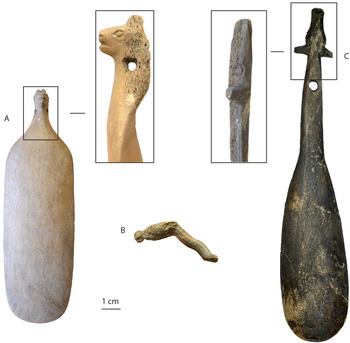
Nearly all of the sculptured reindeer heads are naturalistic, with clearly identifiable eyes, ears, nostrils, and mouths. Some of the eyes have an incised line extending from their front margins (Figs 3B–C, 5A–C, 8A–C, 8E–J, and possibly 11A–B). These probably depict the reindeer's prominent orbital pouch, which holds the preorbital gland (Anderson Reference Anderson1979). Two spoons have reindeer heads with open mouth and protruding tongue (Figures 4A–B, 8A, 8H). Antlers are evident on some specimens, albeit in highly variable form and often reduced in size and swept backward—they do not exhibit the C-shaped form seen in mature living reindeer (Figs 4C, 4E, 5B, 8C). In other cases, antlers are indicated by small pegs, lobes, or spike-like projections in front of the ears (Figs 3B; 4A–B, D, H–I, 5C, 8A, 8E–I). Less naturalistic sculptural heads are found on three spoon handles. A flat spatula-like spoon (Fig. 6A) has a small, short head of what may be a reindeer. Here the length of the head appears to have been limited by the presence of spongy antler encountered while carving. Another thin and flat spatula-like spoon (Fig. 6C) has a dorsoventrally flattened head, also probably due to the thinness of the antler being carved. Lateral projections extend from the head, perhaps representing the ears or antlers. Finally, an eroded spoon handle (Fig. 6B) made from ivory (possibly mammoth tusk) is naturalistic in overall form, but its snout is girdled just posterior to the nostrils. This may have facilitated attachment of materials to the head, but the spoon also has a hole further down the handle for the attachment of a cord, perhaps for suspending the item. Note that none of the sculptural heads co-occur with anthropomorphic or zoomorphic images.
Antler pins/awls from Ust’-Polui with reindeer heads. (A) (UP-09/1033); (B) (UP-11/1094); (C) (OF 11500/199). (Photographs: Authors.)

Spoons and a spoon handle fragment with stylized head sculptures. (A) (UP-10/465) is made from antler; (B) (UP-10/4010) is ivory; (C) (IAHM-16741/347) is antler. The boxes show close views of the sides of the spoon handles. (Photographs: Authors.)

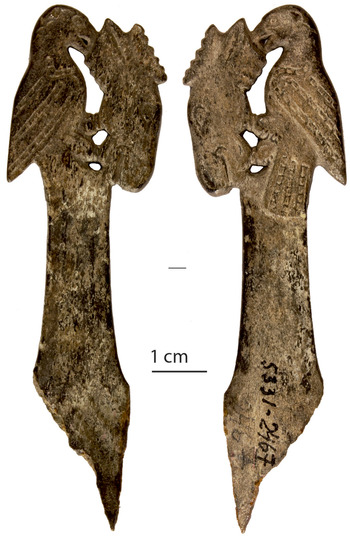
The seven incised or non-sculptural reindeer heads also range from naturalistic to stylized (Figs 4F–I, 7, 8F, 8I–J). All but one of these head images has antlers, either swept back or as peg-like projections, with one having both antlers in a swept-back but upward curving form (Aleksashenko et al. Reference Aleksashenko, Brusnitsina and Popova2003, pl. 116). Two of the incised objects, one a reworked comb fragment and the other a spoon handle, show reindeer heads with birds of prey. In both cases, the birds appear to be feeding on the heads of the deer. On the spoon handle (Fig. 7), the bird clearly feeds at the base of the head or neck, indicating that it was detached from the rest of the body. On the comb fragment (Aleksashenko et al. Reference Aleksashenko, Brusnitsina and Popova2003, pl. 147), the bird eats at the nose while standing on top of the head, perhaps also indicating that the head of a decapitated reindeer is being depicted.
The handle of an antler spoon (5331/2467) with incised images on both faces showing a bird of prey feeding on the head of a reindeer. The antlers are swept back and have a saw-like edge just above the ears. (Gusev & Fedorova Reference Gusev and Fedorova2017, 224.)

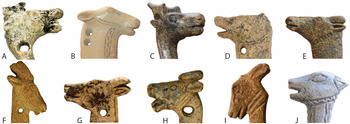
Close views of knife and spoon handles from Ust’-Polui that exhibit lines or rope-like design elements in the neck area, or just posterior to the mouth. (A) (OF 11500/200); (B) (UP-12/52); (C) (IAHM-16741/346); (D) (UP-12/51); (E) (BXFZK 4014/26); (F) (UP-10/422); (G) (5455-4823; (H) (UP-10/437); (I) (5331/2308) (Aleksashenko et al. Reference Aleksashenko, Brusnitsina and Popova2003, pl. 117); (J) (UP-11/1097). (Photographs: Authors.)

An additional pattern in 13 of the reindeer head images (sculptural and incised) is incised lines, zig-zag elements, or rope-like patterns in the neck area (Figs 5B, 8A, 8D–J; Aleksashenko et al. Reference Aleksashenko, Brusnitsina and Popova2003, pls 116, 147), or in a few cases extending backward from the mouth (Figs 8B–C). Among the sculptural heads, 7 of 17 have such designs, while 6 of the 7 incised heads are similarly marked. Further, as many as 16 out of all possible reindeer images are depicted with open mouth. Finally, note that the reindeer head image on one spoon only (Fig. 4E) faces in the direction of the spoon bowl, but also note that even it is not directed into the bowl but rather would have faced the person eating from it. All other sculptural heads face the opposite direction of the bowl, and all incised heads face perpendicular to their bowls.
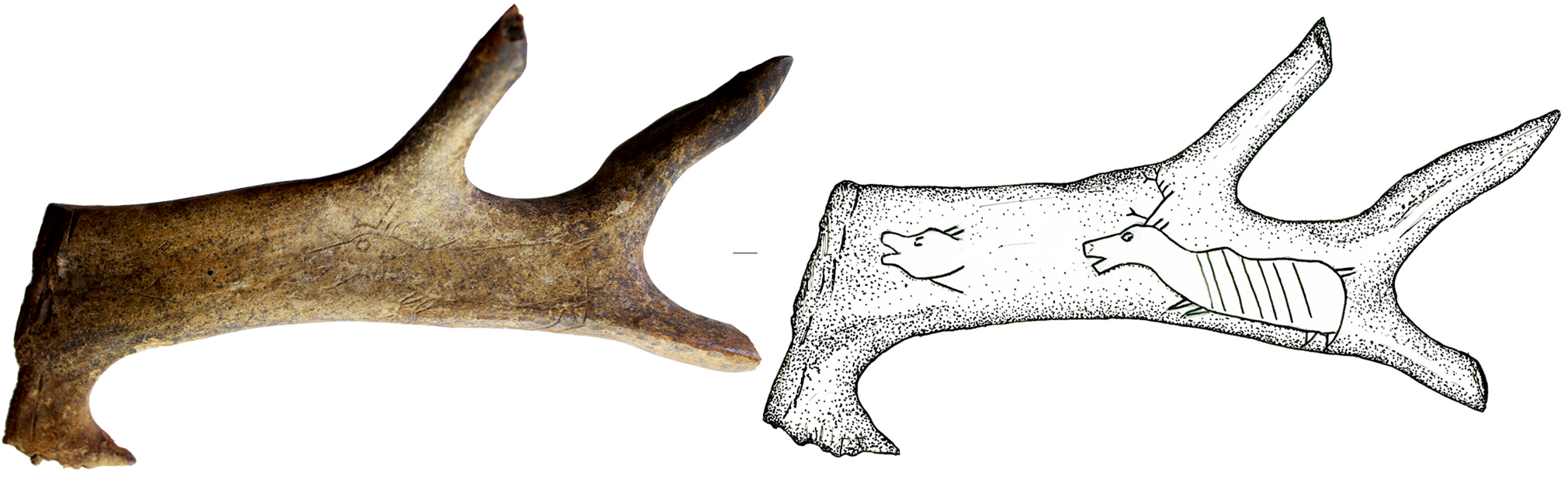
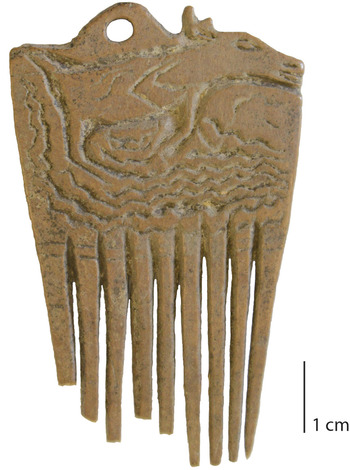
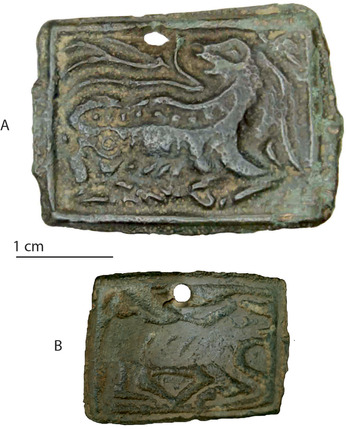
Full-body depictions of reindeer are seen on just four items. First, a section of antler was incised with an outline of a reindeer body, complete with naturalistic antlers, an eye, nostril, open mouth, both ears and tail (Fig. 9). The legs are simply formed and may indicate a running animal. The torso of the deer has seven parallel lines tilting forward. A few centimetres in front of the reindeer is an incised zoomorphic head image with no nostrils or antlers. Second, a full reindeer body is also incised into the handle of a comb (Fig. 10). This image is relatively naturalistic, and the positions of the legs seem to indicate an animal in motion, perhaps running or swimming. Two incised chevrons and two S-shaped lines are present on the torso. Below and behind the deer are a series of incised zig-zag lines. The back of the comb has horizontal zig-zag lines across most of the grip. Finally, full body images of possible reindeer are present on two cast bronze plaques (Fig. 11). Both have holes on their upper margins for attachment to straps or cords and have images on one face only. They show animals with bent legs, perhaps indicating motion, and both appear to have antlers that are flattened or twisted out of natural position, probably to accommodate the small rectangular form of the objects. One has a row of dots running down its torso, the other at least three lines leaning forward.
A section of reindeer antler (OF 4000/3097) incised with a full-body image of a reindeer, with a zoomorphic head to its left. (Photograph and illustration: Authors.)

An antler comb from Ust’-Polui (BXFZK 4014/13) with a full-body depiction of a reindeer. (Photographs: Authors.)

Bronze plaques from Ust’-Polui with possible depictions of reindeer. (A) (OF 11500/193); (B) (UP-09/7). (Photographs: Authors.)

Archaeological reindeer imagery in Siberia
Depictions of reindeer appear in the Siberian archaeological record by at least the second millennium bce. These are found in rock art, and none are directly dated. For example, reindeer appear in rock art assigned to the second millennium bce in Sakha (Alekseev Reference Alekseev2014; Okladnikov & Kochmar Reference Okladnikov and Kochmar1994) and at the Pegtymel’ panel in Chukotka, which is thought to date to the first millennium bce (Dikov Reference Dikov1971). In both cases, dating is based on stylistic comparisons. These rock-art images show grazing reindeer, reindeer being hunted from boats and reindeer near human figures. All have been interpreted as representations of wild animals. Claims for the earliest images of domestic reindeer come from Khakassia in southwest Siberia. Images of a human figure riding an antlered animal and a group of herded or pursued deer have been found on a several rock-art panels in this region, with the best known being Boiarsk, stylistically dated to the seventh–third centuries bce, at the earliest (Devlet Reference Devlet1965; Reference Devlet1976; Kyzlasov Reference Kyzlasov1952). It is possible, however, that the Boiarsk deer-rider image instead depicts a horse with a human rider. The Boiarsk panel has been repeatedly linked with Scythian cultures, some of which are known for riding horses fitted with elaborate headgear bearing antlers (e.g. Metz Reference Metz2013; Ochir-Goriaeva Reference Ochir-Goriaeva2014). Further, other images in these same panels show humans on the back of animals lacking antlers, which also could be riders on horseback. Bovids and caprids seem to be abundant on the panels, perhaps indicating domestic cattle, sheep and goats. Further, the antlers on the deer-like images in the panel are unlike those of reindeer. These images could easily represent roe deer or red deer being hunted on horseback, and both types of these deer are common in the region (Danilkin Reference Danilkin1996; Geptner & Naumov Reference Geptner and Naumov1961).
The most widely cited potential domestic reindeer imagery from southwest Siberia are two sculptural figures from the Syrskii Chaa-Tas kurgan of the Tashtyk culture, dated typologically to the first century bce–ce fourth century (Kyzlasov Reference Kyzlasov1952; Reference Kyzlasov1955). One burial vault at this site contained wooden figurines interpreted as reindeer, both carved with designs that clearly represent head gear (Kyzlasov Reference Kyzlasov1955, 231–2). These sculptures were used by Kyzlasov (Reference Kyzlasov1955, 230–33) to argue that Khakassia was the earliest centre of reindeer domestication, and the headgear depicted on the figures was said to represent that employed for riding reindeer. However, no indications of antlers or preorbital pouches are present, and the feet look more like those of horses than of reindeer. In our opinion, these figures could depict other ungulates or even mythical creatures—they are not clearly sculptures of reindeer.
Unlike the previously discussed sites, the chronology for Ust-Polui has been assessed through multiple (n = 64) radiocarbon dates (Losey et al. Reference Losey, Fleming and Nomokonova2017), placing the imagery there in secure temporal context. Further, many of the images from Ust’-Polui unambiguously depict reindeer. Ust’-Polui thus seems to have the oldest portable imagery of reindeer anywhere in Siberia. Earlier portable zoomorphic imagery can be widely found in Siberia, including in Iamal, so we suspect this pattern is not simply an issue of preservation or sampling. For example, portable zoomorphic items, including depictions of elk, birds and mustelids, have been found at the Eneolithic settlement Gornyi Samotnel-1 in Iamal, which dates to ~3060–2920 bce (Nomokonova et al. Reference Nomokonova, Losey, Typakhina and Typakhin2017, 147–8; Tupakhina & Tupakhin Reference Tupakhina and Typakhin2018). Further, numerous sites post-dating Ust’-Polui have been excavated in Iamal, but reindeer imagery is not evident in them, nor in adjacent regions, until the medieval period. A possible exception is the Early Iron Age and medieval period site of Niaksimvol’ in the Khanty-Mansiisk region to the south. This site has abundant imagery, some stylistically similar to that at Ust’-Polui (Fedorova Reference Fedorova, Gusev and Fedorova2017). Niaksimvol’ has one potential reindeer image, with the remainder of the artwork largely depicting raptors, beavers and bears (Iakovlev Reference Iakovlev2014). An antler comb from this site has two raptors eating at the heads of what appear to be two reindeer (Iakovlev Reference Iakovlev2014, 31), a theme reminiscent of the raptor-reindeer images at Ust’-Polui (Fig. 7). This site also contains a single antler item that may be reindeer headgear, which is nearly identical to the barbed L-shaped antler items found at Ust’-Polui (Iakovlev Reference Iakovlev2014, 31). Unfortunately, Niaksimvol’ lacks radiocarbon dates, so its age remains unclear. A few metal objects with potential depictions of reindeer have been found in the Surgut and Tomsk Cis-Ob regions further to the south, and to the west of the Ural Mountains in Komi, all appearing to date to the eighth–tenth centuries ce (Baulo Reference Baulo2011a, Reference Baulob; Murygin Reference Murygin2011; Turkina & Shablavina Reference Turkina and Shablavina2017; Zykov et al. Reference Zykov, Koksharov, Terekhova and Fedorova1994). Archaeological depictions of reindeer in Iamal post-dating Ust’-Polui are limited to one silver plaque. This object, a surface find from Salekhard, shows a whole reindeer body in profile, and is typologically dated to the tenth–twelfth centuries ce (Fedorova et al. Reference Fedorova, Govorukhina and Samburov2003, 86). Clearly, the reindeer images at Ust’-Polui are unique in terms of their age, abundance and variability—they are without close parallels anywhere in Siberia, regardless of period.
Reindeer and reindeer imagery in the historic period
Over the last few centuries, reindeer have had prominent roles in the imagery of Nenets, Khanty and Mansi of northwest Siberia. This is unsurprising, given the central role of reindeer pastoralism in this region, and the fact that domestic reindeer are critical elements of cuisines, clothing, shelter, social relations, ritual practices and cosmologies (e.g. Arzyutov & Liublinskaia Reference Arzyutov and Liublinskaia2018; Gemuev & Sagalaev Reference Gemuev and Sagalaev1986; Gemuev et al. Reference Gemuev, Molodin and Sokolova2005; Golovnev Reference Golovnev1995; Golovnev et al. Reference Golovnev, Garin and Kukanov2016; Khariuchi Reference Khariuchi2001; Kharyuchi Reference Kharyuchi2018; Khomich Reference Khomich1966; Lekhtisalo Reference Lekhtisalo1998; Niglas Reference Niglas1997; Reference Niglas2000; Sokolova Reference Sokolova2009; Zen'ko-Nenchinova Reference Zen'ko-Nemchinova2006). Today, many mobile Indigenous families manage herds of hundreds and even thousands of reindeer, but individual animals are still recognized by their distinct characteristics and abilities, and are often named. Names most often are tied to the appearance of the reindeer, particularly their colouration and the antler forms (Pyrerka Reference Pyrerka, Arzyutov and Lubinskaia2018, 75–9, 86–7; Verbov Reference Verbov, Arzyutov and Lubinskaia2018, 135). Some are also named in relation to how they were acquired—animals as gifts might be named after those who provided them (Niglas Reference Niglas1997, 31). Even with the widespread use of snowmobiles in this region, highly trained transport reindeer and reindeer sledding remain fairly common (Gemuev et al. Reference Gemuev, Molodin and Sokolova2005, 85, 425; Khomich Reference Khomich1966, 89, 96). Relatively few reindeer develop the disposition and skills necessary to pull sleds effectively, particularly as ‘lead’ animals, a process that involves several years of close interaction and training (Losey et al. Reference Losey, Nomokonova, Arzyutov, Gusev, Plekhanov, Fedorova and Anderson2020a). Herders also prefer some transport animals to others, with particularly attractive reindeer chosen for pulling sleds when travelling for special occasions (Niglas Reference Niglas1997, 28). Calves that lose their mothers often develop into another distinct type of reindeer. Such animals are hand-fed, including with lichens, soup and bread, live in and around the household and develop close bonds with their people (Niglas Reference Niglas2000; Verbov Reference Verbov, Arzyutov and Lubinskaia2018, 136). For example, a commonly followed tenet is that one never kills and eats their home-raised reindeer. As one Nenets herder stated, ‘How could I kill my Навка [Nenets for home-raised reindeer]? We have almost eaten from the same plate’ (Niglas Reference Niglas1997, 30). Select reindeer also can be dedicated as living beings to spirits or deities, particularly reindeer that are strong and considered beautiful (Dolgikh Reference Dolgikh1960; Kostikov Reference Kostikov1930; Kushelevskii Reference Kushelevskii1868, 66; Niglas Reference Niglas1997, 26).
As clean and pure animals, reindeer also are by far the most commonly sacrificed animals (e.g. Gemuev & Baulo Reference Gemuev and Baulo1999, 16, 172; Gemuev & Sagalaev Reference Gemuev and Sagalaev1986, 29, 42, 87, 177; Golovnev Reference Golovnev1995, 200, 309, 312; Kostikov Reference Kostikov1930; Niglas Reference Niglas1997, 25–6; Perevalova & Karacharov Reference Perevalova and Karacharov2006, 314; Sokolova Reference Sokolova2009, 441, 529). Reindeer, including transport animals, are sacrificed at various special events and for a variety of purposes (Prokof'eva Reference Prokof'eva1953), but their routine slaughter for household consumption also can be considered a form of sacrifice (Niglas Reference Niglas1997, 25). In all traditional contexts, sacrifice is carried out through strangulation using a rope or lasso (Arzyutov & Okotetto Reference Arzyutov and Okotetto2018; Gemuev & Baulo Reference Gemuev and Baulo1999, 12; Golovnev Reference Golovnev1995, 332; Lekhtisalo Reference Lekhtisalo1998, 96). Some reindeer are sacrificed at sacred sites, where they are eaten and the remains of their bodies deposited. The heads and antlers are typically treated separately from the rest of the body at these places, a practice also followed at the homes of mobile herders (Golovnev Reference Golovnev1995, 260, 313; Haakanson & Jordan Reference Haakanson, Jordan and Jordan2011; Khariuchi Reference Khariuchi2001, 115–16, 147; Kharyuchi Reference Kharyuchi2018; Prokof'eva Reference Prokof'eva1953, 224–5). Khanty sometimes hang skulls and antlers of reindeer in trees (Sokolova Reference Sokolova2009, 528–9, 602), and Mansi also kept them together with other sacrificial items in the attics of their wooden homes (Gemuev Reference Gemuev1990, 39; Gemuev & Baulo Reference Gemuev and Baulo1999, 72, 173).
Some Nenets, Khanty and Mansi create images of reindeer to teach their children about these animals (Gemuev et al. Reference Gemuev, Molodin and Sokolova2005, 150; Ivanov Reference Ivanov1970; Khomich Reference Khomich, Kon and Taksami1988, 71), but also for use as family signatures on documents (Zen'ko-Nemchinova Reference Zen'ko-Nemchinova2006, 60), as part of clothing, and as substitutes for living domestic reindeer during healing and sacrifice rituals (e.g. Ivanov Reference Ivanov1970). Such images are carved from wood and antler, made from dough, cut from birch bark, cast in metal (as plaques) and sewn on clothing, blankets and bags (e.g. Gemuev Reference Gemuev1990, 129; Gemuev & Baulo Reference Gemuev and Baulo1999, 159; Ivanov Reference Ivanov1970, 50–51, 86; Sokolova Reference Sokolova2009, 552). Nearly all of these images are of whole bodies of reindeer shown in profile, or in the case of those made of dough, three-dimensional forms. Some Mansi, for example, made profile images of reindeer designed to ‘kneel’ before wolves, presumably as a means of offering themselves to these predators in an effort to prevent their attacks on their herds (Gemuev Reference Gemuev1990, 129). Mansi also used such images in rituals to restore luck in hunting (Gemuev & Baulo Reference Gemuev and Baulo1999, 41) and to act as temporary substitutes until a living animal could be sacrificed (Ivanov Reference Ivanov1970, 61). Further, Mansi leave specially made blankets and hats with reindeer (and other animal) images on them at sacred places as forms of offerings (Gemuev & Baulo Reference Gemuev and Baulo1999, 126, 159; Sokolova Reference Sokolova2009, 572–3). Such offerings and sacrifices have numerous purposes, including (but not limited to) honouring spirits and deities, protecting domestic reindeer herds and healing sick people and reindeer. Imagery seemingly was not made at sacred places but rather was taken to them as part of community gathering events, although ethnographic accounts of these practices are meagre. Nenets and Khanty also made reindeer images to be worn by shamans, to heal their sick domestic reindeer and as substitutes for sacrificial animals at sacred sites and graves (Ivanov Reference Ivanov1970, 58–9, 61, 95–6). We are unaware, however, of accounts of reindeer heads or other reindeer imagery on knives, spoons, pins, or combs. Notably, the handles of some spoons used in seasonal sacrifices were carved with birds or their heads, and these birds were considered ancestors (Gemuev Reference Gemuev2001). Metal images of such ancestral beings also were sometimes worn on women's hair braids.
Metal working and wood and antler carving are gendered tasks reserved for men in the region, and reindeer images made from such materials are made exclusively by men (Khariuchi Reference Khariuchi2001, 54; Randymova Reference Randymova2004, 13–15). Nenets men make copper and bronze plates up to ~16 cm in diameter with whole reindeer bodies shown in profile, which are worn by some women as parts of their belts (Ivanov Reference Ivanov1970, 70). Women, too, make imagery of reindeer, specifically depictions of antlers and occasionally footprints, which are incorporated into ornamentation on clothing, bags and other fabric and fur items, some of which is worn by both genders (Siazi & Samburov Reference Siazi and Samburov2003; Reference Siazi and Samburov2005). Reindeer antlers depicted in such ornamentation are considered by Mansi and Khanty to be of ancient origin (Gemuev Reference Gemuev2001, 11; Ivanov Reference Ivanov1963, 29). The ornamentation references people's knowledge and experience with these animals, particularly in regard to variation in antler form. Some motifs, for example, depict antlers of young, small or large reindeer, individuals with broken antlers, or the antlers of forest or tundra reindeer (Siazi & Samburov Reference Siazi and Samburov2003; Reference Siazi and Samburov2005).
Discussion and conclusion
The forms and styles of reindeer imagery at Ust’-Polui in many ways contrast with those seen historically in Iamal. Only the two bronze plaques, which may show whole reindeer bodies in profile, have direct parallels in regional ethnographic literature, which describes such objects as being made for various ritual purposes. Most reindeer imagery at Ust’-Polui otherwise consists of unique depictions of reindeer heads on the handles of knives, pins, and spoons. These specific material practices are not historically documented in the region, nor is the carving of reindeer on combs and sections of antlers.
We propose that human–reindeer relations in the Iamal region were undergoing critical and novel changes during time Ust’-Polui was occupied. Around 260 bce, reindeer headgear first appears in the region at Ust’-Polui. We have argued that some of this equipment was utilized for training young reindeer to pull sleds, which today is an intensive process of mutual enskillment developed through long-term intimate interaction (Losey et al. Reference Losey, Nomokonova, Arzyutov, Gusev, Plekhanov, Fedorova and Anderson2020a). Currently, training domestic reindeer for pulling sleds in the Iamal region begins when the animals are two to three years of age. Simply put, over a one- to three-year period, such training involves recurrently corralling the animals, picking a few for training, fitting them with headgear and harnesses and attaching them to sleds with more experienced reindeer. The trainee and experienced reindeer then pull the sled and driver across the landscape. While carrying out this process, herders learn individual reindeer's tendencies and temperament, and reindeer learn those of people, including how to respond to a sled driver's vocalizations and commands communicated through the headgear. Further, the younger reindeer learn from experienced and older individuals alongside which they are harnessed during training sessions. As mentioned in the introduction, the working life of a transport reindeer might last 10 years. Moszyńska (Reference Moszyńska, Chernetsov and Moszyńska1974, 84–5) had earlier argued that the headgear at Ust’-Polui was used for controlling decoy reindeer in hunting, but decoy headgear from the last century period differs in both form and size from that at the site (Losey et al. Reference Losey, Nomokonova, Arzyutov, Gusev, Plekhanov, Fedorova and Anderson2020a). Historically, all decoy reindeer were highly trained domestic animals, not individuals plucked from wild herds and fitted with headgear for use in hunting. In either interpretation, reindeer as transport animals or as hunting decoys, the headgear present at Ust’-Polui can be taken as early evidence for intimate engagement with reindeer in working relationships. The duration of this intimate interaction was far more extensive and intensive than that involved in reindeer hunting, which had long occurred in Iamal and much of the rest of northern Eurasia.
Creating, utilizing and depositing the reindeer imagery objects at Ust’-Polui was a way of acknowledging these specific emergent human–reindeer relationships. We suspect that some of the images may reference individual domestic reindeer rather than representing a generalized member of the species. All of the reindeer depictions are unique, and this is most evident in the variable forms of their antlers. Some of the antler forms are likely to relate to limitations placed on the designs due to pragmatic use of the objects. Full-sized naturalistic adult antlers on the handles of knives or spoons, for example, would render these objects difficult to use and the antlers themselves would have been easily broken. Reducing the size of the antlers addresses such issues, but even in this form much variability is present. For example, several of the objects bear spike- or peg-like antlers. These may be stylized renditions of ‘full’ adult antlers, representation of the smaller antlers of female reindeer, antlers early in their period of growth, pedicles of animals that recently shed their antlers, or even trimmed antlers of transport animals (a widespread practice in Siberia). Specimens without antlers potentially could be newborn calves. Others show swept-back or reduced antlers with multiple tines, surely representing adult individuals with unmodified and well-established antlers. The point here is not which of these possibilities bets fits each object, but rather that animals people knew well were seemingly being depicted. We suspect that such attention to reindeer uniqueness would have been particularly acute when reindeer were first becoming working members of communities. Such animals were rare and precious, and working with them effectively required years of intensive training and interaction, focusing human attention and care on specific individuals.
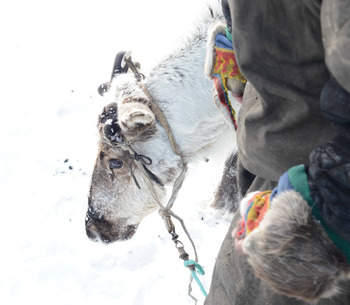
The rope-like design elements on the reindeer necks can be interpreted in several ways, some potentially relating to these animals’ roles as domestic animals. First, one could propose that the neck designs are ornamental and serve merely to demarcate the reindeer head from the rest of the implement. Note that no such marks are present on the whole body depictions of reindeer, indicating that this design element is used when only heads are being carved. Second, the design elements could indicate that the heads were cut off—they are from butchered reindeer, wild or domestic. This does not account for the rope-like form seen in some of the elements, nor would it account for the incised lines leading backward from the mouths of some of the pieces (Figs 8B & C). Third, the designs might depict lassoes that were used for strangling or capturing domestic reindeer. As mentioned, strangulation is the most common means of killing domestic reindeer among the region's Indigenous groups, and this is always done using a lasso. The open mouths seen in many of the reindeer images, particularly the heads carved with protruding tongues (Figs 8A & H), could be viewed as animals gasping for air while being strangled or lassoed. Killing wild reindeer by strangulation is undocumented in the region and seems a highly unlikely practice. The designs posterior to the mouths of two of the reindeer images, though, do not fit with this interpretation. Finally, the design elements could denote headgear employed with domestic transport reindeer. Headgear presently used in the region with sled reindeer involves a strap that passes under the head just posterior to the jaw, similar to the neck design elements seen in the Ust’-Polui pieces, but also includes strapping and antler elements that extend across the forehead (Fig. 12). The barbed antler pieces found at Ust’-Polui are thought to be such forehead pieces, albeit for training rather than daily use in transport (Losey et al. Reference Losey, Nomokonova, Arzyutov, Gusev, Plekhanov, Fedorova and Anderson2020a). Such forehead elements are not visible on the Ust’-Polui reindeer imagery. Further, current headgear used in the region (or elsewhere in Siberia: Levin & Potapov Reference Levin and Potapov1961, 11–54) has no elements that extend backward from the mouth. If these design elements represent headgear, perhaps the early equipment used in the region differed from that now employed with transport reindeer.
A lead Nenets reindeer fitted with headgear for sledding in 2018. Very similar headgear is also used by Northern Khanty and Mansi. (Photograph: R. Losey.)

The spoon and reworked comb with reindeer heads being eaten by birds of prey are compelling indications of respectful treatment or sacrifice of reindeer (Fedorova Reference Fedorova, Gusev and Fedorova2017, 123). Hunters in Siberia and other areas of the north often treat the heads of prey animals distinctly in acts of deference to these animals and their spirit masters or keepers (Losey et al. Reference Losey, Bazaliiskii, Lieverse, Waters-Rist, Faccia, Weber and Watts2013; Willerslev et al. Reference Willerslev, Vitebsky and Alekseyev2015). This can involve placing heads out of the reach of unclean animals such as dogs by placing them in trees or on platforms. Such acts help preserve the integrity of the head (and often other skeletal elements) as well as the animal's enduring spiritual elements or ‘souls’. The differential treatment of reindeer crania and antlers at Ust’-Polui may relate to such practices, but so too might the reworked comb and spoon handle. For example, the birds depicted on the heads of the reindeer may represent entities that accept, transport, or even regenerate hunted reindeer ‘souls’. The birds bear them skyward after consuming them from trees, platforms, or other elevated structures. Domestic animal sacrifice and ritualized treatment of the head can be offered as an alternative explanation, and perhaps a more likely one. Sacrifice, which can be defined as intentionally giving up something that one owns, is typically reserved for domestic animals, which can be owned (Ingold Reference Ingold1980, 223; Valeri Reference Valeri1994; Willerslev et al. Reference Willerslev, Vitebsky and Alekseyev2015). If the spoon and reworked comb depict domestic reindeer sacrifice, the birds eating the heads could be ancestors or other spiritual beings (which sometimes take the form of birds among the region's Indigenous groups) that accepted or transported these food offerings or the reindeer ‘souls’. Recall that the bird of prey and reindeer head motif is seen at only one other site in Siberia, Niaksimvol’, which also contains early headgear for training transport reindeer (Iakovlev Reference Iakovlev2014, 31), and which may be of the same age as Ust’-Polui. While we clearly cannot rule out that the birds eating heads imagery depicts ritual practices with the heads of hunted reindeer (or even a combination of hunted and domestic reindeer), such an interpretation fails to address why such imagery appears at the same times and places as the earliest transport reindeer training gear in Siberia. Further, the hunting ritual explanation is unable to account for the absence of any portable reindeer imagery in Siberia prior to the occupation of Ust’-Polui. Namely, why did such imagery first appear at Ust’-Polui and not among Siberia's numerous earlier or even contemporaneous reindeer-hunting societies?
Perhaps more revealing than the forms of reindeer imagery at Ust’-Polui is their abundance at this regional ritual site and the fact that most are found on spoons, knives, pins/awls and combs. These are all personal items, and all appear to have been relatively common artefact types in the region (e.g. Fedorova et al. Reference Fedorova, Kosintsev and Fitzhugh1998; Gusev & Fedorova Reference Gusev and Fedorova2017; Plekhanov Reference Plekhanov2014). Spoons and knives are, of course, used in feeding oneself and others, and in all cases at Ust’-Polui, the reindeer heads face away from the blades and spoon bowls. When using these implements, it does not appear that one is feeding a reindeer, but rather that the reindeer body perhaps extended to the blade or bowl, providing for or feeding the user. Perhaps a unique reindeer is providing sustenance, life itself. The pins/awls and combs with reindeer heads may have similar meanings, with the animals acting to provide personal beauty in the form of clothing (worked hides) or combed and cleaned hair. Transporting numerous personal items bearing reindeer imagery to an important regional ritual site may also attest to the emerging importance of reindeer, including the importance of their relationships to the individuals depositing them at Ust’-Polui. Their abundance at the site is not remotely matched in any regional archaeological site, including those with tens of thousands of reindeer remains (Nomokonova et al. Reference Nomokonova, Losey, Plekhanov and McIntyre2018), nor those with remarkable permafrost preservation and dating to the period of large-scale reindeer pastoralism (e.g. Kardash Reference Kardash2013a, Reference Kardashb). Reindeer were a significant focus of attention and production by ~260 bce in Iamal, co-occurring with the earliest appearance of reindeer headgear in this region as part of their emerging place as domestic animals.
Imagery alone is unlikely to be widely accepted as evidence for domestication, particularly when such images long predate other archaeological data supporting its existence. For example, reindeer and other ungulates are depicted in Upper Palaeolithic imagery in Europe (Guthrie Reference Guthrie2005), and arguments have been made that some of these images indicate domestication, corralling, or harnessing of these animals (e.g. Bahn Reference Bahn1978; Kehoe Reference Kehoe, Davis and Reeves1998). These interpretations are largely dismissed because supporting data—changes in morphology or genetics, pathological lesions or entheseal changes related to new habitual activities, physical remains of harnesses or corrals—have not been found, and when found significantly post-date such images. In Iamal, the opposite seemingly occurs. Copious portable reindeer imagery appears in the same site that holds other potential evidence of reindeer domestication. Clearly this imagery and its connections to reindeer domestication must be interpreted cautiously. Conversely, ignoring imagery as a source of information on domestication seems unwise. Early forms of animal domestication, including those involving reindeer, were probably small in scale (Losey et al. Reference Losey, Nomokonova, Arzyutov, Gusev, Plekhanov, Fedorova and Anderson2020a), meaning that their osteological and genetic signatures in the archaeological record will be very subtle. Imagery might well be the only testament to their existence, but more than this, also can potentially assist in understanding how early domestication practices affected beliefs, ritual practices and the personal aspects of these emerging human–animal relationships.
Acknowledgements
The authors would like to thank the staff of the Peter the Great Museum of Anthropology and Ethnography in St Petersburg (Kunstkamera) and Iamal-Nenets Region Museum Complex of I.S. Shemanovski, Salekhard, for granting access to the Ust’-Polui reindeer images. Funding for this project was provided by grants from the Wenner-Gren Foundation (SFR1725) and Social Sciences and Humanities Research Council of Canada [#SSHRC IG 435-2014-0075] to Robert Losey and by the Russian Foundation for Basic Research to Natalia Fedorova (18-09-40011). Special thanks to Mikhail Bronshtein for his consultation on reindeer rock images from Chukotka.