


Introduction
Shame: a painful self-conscious emotion
Later in life, people develop a distinct class of self-conscious emotions which contribute to evaluations about one’s identity and self-worth and include pride, shame and guilt (Lewis, Reference Lewis, Lewis, Haviland-Jones and Barrett2008; Tangney et al., Reference Tangney, Wagner and Gramzow1992). Shame follows negative self-evaluations and connotes an exposed sense of self, as it requires a set of culturally informed Standards, Rules or Goals (SRGs) upon which people evaluate the success or failure of their actions (Lewis, Reference Lewis1971; Lewis, Reference Lewis1992; Lewis, Reference Lewis, Lewis, Haviland-Jones and Barrett2008). Although SRGs provide immediate and salient feedback on social and moral acceptability (Tangney et al., Reference Tangney, Stuewig and Mashek2007), shame is more likely to occur when people are characterised by an internal attribution style that puts the blame on the whole self, following perceived failure (Gilbert, Reference Gilbert1997; Lewis, Reference Lewis1992; Lewis, Reference Lewis, Lewis, Haviland-Jones and Barrett2008).
Shamed individuals evaluate themselves as inadequate or inferior in both their own and other people’s eyes (Gilbert, Reference Gilbert1997). This renders shame an acutely painful emotion that elicits the wish to hide (Tangney and Tracy, Reference Tangney, Tracy, Leary and Tangney2012) and is accompanied by constricted and collapsed posture, gaze aversion and blushing (Darwin, Reference Darwin1872; Keltner and Harker, Reference Keltner, Harker, Gilbert and Andrews1998). The automatic adoption of such submissive behaviours reflects feelings of helplessness and inferiority and originates from the pervasive fear of being negatively evaluated by others (Beck et al., Reference Beck, Emery and Greenberg1985; Gilbert et al., Reference Gilbert, Pehl and Allan1994).
Nevertheless, shame aims to protect the self from threats that might create a sense of default identity and thwart social survival. Shameful submissive behaviours communicate subordination that facilitates gaining or regaining Social Attention Holding Power (SAHP), which emerges from the positive attention of others towards socially attractive features (Gilbert, Reference Gilbert1997; Gilbert et al., Reference Gilbert, Pehl and Allan1994). In fact, shame alerts the self and others of SAHP losses and de-escalates tension and hostility, thereby leading to reconciliation (Gilbert, Reference Gilbert1997; Keltner et al., Reference Keltner, Young and Buswell1997). Likewise, it can act as an emotional response to ‘social self’ threats with accompanied physiological changes that resemble stress responses to actual dangers (Dickerson et al., Reference Dickerson, Gruenewald and Kemeny2004). The evaluation of such threats reinforces people to fulfil their innate need of belongingness, which in turn gives them a sense of identity and purpose (Baumeister and Leary, Reference Baumeister and Leary1995). Shame occurs when negative social evaluations transform into negative self-evaluations (Dickerson et al., Reference Dickerson, Gruenewald and Kemeny2004).
Although shame is beneficial for a short time, it can become unbearable in the long run, because it constantly condemns the self even for the slightest transgressions (Tangney and Tracy, Reference Tangney, Tracy, Leary and Tangney2012). Consequently, it predicts various types of psychopathology, including depression (Gilbert et al., Reference Gilbert, Pehl and Allan1994; Lewis, Reference Lewis1971; Mollon, Reference Mollon1984; Tangney et al., Reference Tangney, Wagner and Gramzow1992); social anxiety (Beck et al., Reference Beck, Emery and Greenberg1985; Clark and Wells, Reference Clark, Wells, Heimberg, Liebowitz, Hope and Schneier1995; Gilbert and Trower, Reference Gilbert, Trower and Crozier1990); stress (Lewis and Ramsay, Reference Lewis and Ramsay2002); eating disorders (Blythin et al., Reference Blythin, Nicholson, Macintyre, Dickson, Fox and Taylor2018); addiction (Brown, Reference Brown1991); and suicidality (Mokros, Reference Mokros1995). Shame can also result from the stigma related to severe psychiatric disorders (Gilbert and Trower, Reference Gilbert, Trower and Crozier1990; Keen et al., Reference Keen, George, Scragg and Peters2017; Tangney et al., Reference Tangney, Wagner and Gramzow1992).
The default sense of self and self-criticism
Self-criticism is an intense and persistent internal, evaluative conflict between two self-aspects characterised by the establishment of extremely high standards of performance and a subsequent punitive attitude towards the self (Shahar et al., Reference Shahar, Carlin, Engle, Hegde, Szepsenwol and Arkowitz2011; Shahar, Reference Shahar2015). Although it is a stable personality construct, it can fluctuate according to certain moods, biological factors and social contexts (Zuroff et al., Reference Zuroff, Blatt, Sanislow, Bondi and Pilkonis1999; Zuroff et al., Reference Zuroff, Sadikaj, Kelly and Leybman2015). When people are self-critical, they either dwell on the self and feel inadequate or hurt the self and feel self-hatred and self-disgust. Hence, self-criticism aims at either improving or harming the self for failures and shortcomings (Gilbert et al., Reference Gilbert, Clarke, Hempel, Miles and Irons2004). It can also act as a defensive strategy to prevent anticipated rejection or competitive responses by others (Zuroff et al., Reference Zuroff, Sadikaj, Kelly and Leybman2015).
Self-critics have a perfectionistically demanding nature and are unable to demonstrate resilience against their own self-attacks, thus adopting submissive postures with shamed and sad facial expressions (Gilbert et al., Reference Gilbert, Baldwin, Irons, Baccus and Palmer2006; Whelton and Greenberg, Reference Whelton and Greenberg2005). They derive their self-worth from performance-related accomplishments and are ruled by a pervasive fear of failure in both achievement and interpersonal contexts (Lueke and Skeel, Reference Lueke and Skeel2017; Shahar, Reference Shahar2015). In fact, their prolonged fear of being judged, disapproved of, and controlled by others leads to interpersonal problems that could result in depression (Blatt and Zuroff, Reference Blatt and Zuroff1992; Mongrain et al., Reference Mongrain, Vettese, Shuster and Kendal1998; Schanche, Reference Schanche2013; Shahar, Reference Shahar2015). Self-criticism also predicts depression (Beck, Reference Beck, Clayton and Barrett1983; Blatt and Shichman, Reference Blatt and Shichman1983; Greenberg et al., Reference Greenberg, Watson, Goldman, Greenberg, Watson and Lietaer1998; Schiller et al., Reference Schiller, Hammen and Shahar2016) and anxiety-related conditions (Cox et al., Reference Cox, MacPherson, Enns and McWilliams2004b; Gruen et al., Reference Gruen, Silva, Ehrlich, Schweitzer and Friedhoff1997; Shahar et al., Reference Shahar, Carlin, Engle, Hegde, Szepsenwol and Arkowitz2011; Zuroff et al., Reference Zuroff, Koestner and Powers1994). However, it could also stem from psychological distress and chronic acute stress (Schiller et al., Reference Schiller, Hammen and Shahar2016), socially stressful events and phobias (Cox et al., Reference Cox, Fleet and Stein2004a; Lazarus and Shahar, Reference Lazarus and Shahar2018) and low self-esteem (Dunkley and Grilo, Reference Dunkley and Grilo2007; Fennell, Reference Fennell1997; Shahar, Reference Shahar2015).
The relationship between self-criticism and distress is less straightforward than it first appears, with rumination playing a potential mediating role (Schiller et al., Reference Schiller, Hammen and Shahar2016). Rumination is the process of repeatedly thinking about one’s negative emotions and problems without acting to find solutions or improve felt predicaments (Kolubinski et al., Reference Kolubinski, Marino, Nikčević and Spada2019; Nolen-Hoeksema et al., Reference Nolen-Hoeksema, Wisco and Lyubomirsky2008). As such, it is considered a neurotic type of self-attentiveness (Trapnell and Campbell, Reference Trapnell and Campbell1999) characterised by avoidance and activated by negative mood that thwarts cognitive flexibility (Genet and Siemer, Reference Genet and Siemer2012; Treynor et al., Reference Treynor, Gonzalez and Nolen-Hoeksema2003; Whitmer and Gotlib, Reference Whitmer and Gotlib2013). Hence, it acts as a maladaptive emotion-regulation mechanism (Naragon-Gainey et al., Reference Naragon-Gainey, McMahon and Chacko2017; Rusting and Nolen-Hoeksema, Reference Rusting and Nolen-Hoeksema1998). Specific forms of rumination have been identified for depression (Nolen-Hoeksema, Reference Nolen-Hoeksema1991), anxiety (Rector et al., Reference Rector, Antony, Laposa, Kocovski and Swinson2008), anger (Rusting and Nolen-Hoeksema, Reference Rusting and Nolen-Hoeksema1998) and self-criticism (Smart et al., Reference Smart, Peters and Baer2016). This last type of Self-Critical Rumination focuses specifically on self-critical thoughts and is related to depression, anxiety and low self-esteem (Kolubinski et al., Reference Kolubinski, Nikčević, Lawrence and Spada2016; Kolubinski et al., Reference Kolubinski, Nikčević, Lawrence and Spada2017; Smart et al., Reference Smart, Peters and Baer2016). Altogether, it seems that self-criticism and shame can manifest themselves through this specific ruminative form.
Self-critical rumination: links to shame and stress
To better understand self-critical rumination, its underlying elements need to be dismantled, beginning with self-criticism and shame. Both components share a multi-faceted nature, act as defensive responses to perceived inferiority of the self and focus on self-devaluing and self-attacking thoughts (Gilbert, Reference Gilbert1997; Tangney et al., Reference Tangney, Stuewig and Mashek2007). Although self-criticism usually regulates shame with regard to various types of psychopathology (Lazarus and Shahar, Reference Lazarus and Shahar2018; Pinto-Gouveia et al., Reference Pinto-Gouveia, Castilho, Matos and Xavier2013; Shahar et al., Reference Shahar, Doron and Szepsenwol2015), shame has also been found to mediate the relationship between self-criticism and psychological distress (Castilho et al., Reference Castilho, Pinto-Gouveia and Duarte2016). Focus on the separate links of rumination to self-criticism and shame could shed light on this complex relationship.
People often refer to self-criticism as an intrusive inner voice manifested via rehearsing, which is ruminative by default (Gilbert, Reference Gilbert, Gilbert and Bailey2000). Indeed, rumination plays a major role in maintaining levels of self-critical thinking and subsequent psychological distress, including unhealthy perfectionism, parental stress, depression and anxiety (James et al., Reference James, Verplanken and Rimes2015; Moreira and Canavarro, Reference Moreira and Canavarro2018; Schiller et al., Reference Schiller, Hammen and Shahar2016; Smart et al., Reference Smart, Peters and Baer2016). Similarly, shame produces rumination usually in the form of repetitive thoughts on a ‘spoilt’ identity, which in turn predict psychopathologies such as depression, social and generalised anxiety, and post-traumatic stress disorder (Beck et al., Reference Beck, Emery and Greenberg1985; Bravo et al., Reference Bravo, Kelley, Mason, Ehlke, Vinci and Redman2019; Cheung et al., Reference Cheung, Gilbert and Irons2004; Clark and Wells, Reference Clark, Wells, Heimberg, Liebowitz, Hope and Schneier1995).
Aims and objectives
Self-critical rumination, shame and stress share certain features and predict overlapping psychopathologies; hence, their relationship is worth exploring. Research on self-critical rumination is still narrow due to the novelty of the concept, whilst concurrent evidence is primarily correlational. There are few experimental studies on self-critical perfectionism where failure feedback was manipulated and found decreased self-efficacy, positive affect and confidence (Stoeber et al., Reference Stoeber, Hutchfield and Wood2008a); performance dissatisfaction, cognitive rumination and irrational task importance (Besser et al., Reference Besser, Flett and Hewitt2004); and increased shame and guilt (Stoeber et al., Reference Stoeber, Kempe and Keogh2008b). There are even fewer experiments on self-critical thinking and/or self-critical rumination where failure experiences were self-generated and found elevated over-generalisation and subsequent low mood (Thew et al., Reference Thew, Gregory, Roberts and Rimes2017).
Kolubinski and colleagues (in press) recently reported an exploratory study which demonstrated that manipulating self-critical rumination had a significant impact on acute distress during an impossible task. The purpose of this study was to experimentally investigate the effects of self-critical rumination on shame and stress following perceived failure. To ensure participants would think in a self-critical way, self-critical rumination had to be manufactured via relative cues. Likewise, to create negative self-evaluative conditions, performance expectations had to be manipulated with regard to western SRGs. In particular, intelligence was taken into account due to its unique role within Western culture as proven by the manifold scientific endeavours to define and measure it (Nisbett et al., Reference Nisbett, Aronson, Blair, Dickens, Flynn, Halpern and Turkheimer2012). From this perspective and in contrast to Asian and African cultures, intelligence is primarily cognitive and reflects an individualistic and achievement-related orientation (Cocodia, Reference Cocodia2014).
It was predicted that induced self-critical rumination combined with high performance expectations would lead to higher levels of shame and stress (Hypothesis 1). These effects would apply to all participants following perceived failure on an SRGs-related task (Hypothesis 2). Most importantly, participants experiencing self-critical rumination accompanied by high performance expectations were expected to report higher levels of shame and stress following perceived failure (Hypothesis 3). Finally, there would be a relationship between reported levels of trait self-critical rumination, shame and stress across time (Hypothesis 4).
Method
Participants
The sample consisted of 60 volunteers (24 females; mean age = 33.08 years; SD = 10.62; age range: 19–64) equally assigned to each of the four experimental conditions (n = 15). Group membership was assigned by the first author by randomly assigning each number between 1 and 60 to each of the four groups prior the start of the study. The ethnic background was 80% White, followed by 10% Black, African, Caribbean or Black British; 6.7% Asian or British Asian; and 3.3% other ethnic groups. Recruitment was conducted via opportunity sampling, where participants answered a call for volunteers. They were required to: (1) be at least 18 years old; (2) have normal or corrected to normal vision; and (3) not be experiencing moderate to severe levels of distress. Entry ensured a chance to win a £50 voucher and additional course credit in case volunteers were students.
Materials
Experiential Shame Scale (ESS; Turner, Reference Turner2014)
This 11-item measure assesses physiological, emotional and social aspects of state shame. Items such as ‘pale-flushed’ represent physical; ‘content-distressed’ emotional; and ‘being sociable-hiding’ social phenomena of shame. These are displayed directly opposite to one another, and participants are asked to circle the number closest to what best describes their momentary state on a 7-point Likert scale. The original questionnaire used a 9-point scale and had acceptable internal consistency (Turner, Reference Turner1998). However, the latest version of ESS seems a better match for this study. Not only it has shown high reliability (α = .81) but also low face validity which would not trigger socially desirable answers.
Short Stress State Questionnaire (SSSQ; Helton, Reference Helton2004)
This is a 24-item self-report that measures the multiple dimensions of stress state in a pre-task and post-task form. The SSSQ was initially developed as a short version of the 90-item Dundee Stress State Questionnaire (DSSQ; Matthews et al., Reference Matthews, Joyner, Gilliland, Huggins, Falconer, Merville, Deary, DeFruyt and Ostendorf1999). Following the DSSQ trilogy, it includes subscales of distress, engagement and worry that reflect the affective, motivational and cognitive aspects of conscious experience respectively (Mayer et al., Reference Mayer, Chabot and Carlsmith1997). Items such as ‘dissatisfied’ represent distress; ‘I wanted to succeed on the task’ represents engagement; and ‘I was worried what other people think of me’ represents worry. Participants are required to indicate the truth of each statement using a 5-point Likert scale in which 1 denotes ‘not at all’ and 5 ‘extremely’. All dimensions have high internal consistency (α > .80), and the test has proven stable over time (Helton, Reference Helton2004). This implies that the SSSQ captures actual momentary changes in states, and thus is appropriate for the current study.
Self-Critical Rumination Scale (SCRS; Smart et al., Reference Smart, Peters and Baer2016)
This 10-item measure captures the ruminative process associated with self-critical thoughts. Participants are called to evaluate statements such as ‘I criticise myself a lot for how I act around other people’ or ‘My attention is often focused on aspects of myself that I’m ashamed of’ on a Likert-type scale that ranges from ‘1 = not at all’ to ‘4 = very much’. The SCRS has excellent internal consistency (α = .92) and good test–re-test reliability (α = .86). The scale is also valid due to its moderate to strong correlations with self-criticism (r = .62–.81), rumination (r = .53–.81) and shame measures (r = .55–.73). Herein, SCRS was administered once at the beginning to control for the effects of trait self-critical rumination.
Design
This experimental study utilised a 4 × 3 mixed design. With regard to the between-subjects factor, four groups were formed in terms of self-critical rumination and performance expectations: high expectations plus self-critical rumination (HSCR); low expectations plus self-critical rumination (LSCR); high expectations without self-critical rumination (HNON); and low expectations without self-critical rumination (LNON). The latter (LNON) was the control group. With regards to the within-subjects factor, changes in shame and stress were assessed across three different time points: before the task (T1); immediately after the task (T2); and following debrief (T3).
Procedure
The current study was approved by the London South Bank University Research Ethics Committee. Shortly after, it was advertised as a research on observation and distraction so that potential participants would not be biased in their reactions. Recruitment was conducted via the Research Participation Scheme platform; and posters displayed at the campus, a charity, and a military base. Although this primarily served a convenience purpose, it constituted a diverse sample which was thereby more representative of the general population.
Volunteers took part one at a time in a quiet room for approximately 30 minutes. The location of the room depended on the location of recruitment to ensure convenience for each entrant and facilitate data collection. After being given a generic consent form, participants were asked to fill out all the aforementioned self-reports. The SCRS was administered only at this time point because it sought to capture pre-disposition to self-critical rumination that could affect the experimental manipulations.
All participants were given 10 minutes to find the word ‘NINA’ in 7 sketches of Al Hirschfeld. Although this task has been mainly put forward in studies examining motivation (e.g. Neighbors and Raymond Knee, Reference Neighbors and Raymond Knee2003; Ryan, Reference Ryan1982), it was selected due to its challenging nature and its previous successful but untruthful links to intelligence that herein acts as an SRG upon which some participants are expected to compare their performance. All sketches were printed on separate pages, with the number of hidden words written on top of each page. The difficulty of the experimental task was supposed to be increasing; it began with identifying one hidden word in the first item and ended with seven words in the seventh. Two of the items were difficult and other two impossible to complete, thus resulting in guaranteed failure unbeknown to the participants. Impossible items indicated that there were more hidden NINAs in the sketches than the actual number. Instructions and information about the task differed in response to allocated groups.
First, self-critical rumination was induced following the response-style manipulation paradigm (Nolen-Hoeksema and Morrow, Reference Nolen-Hoeksema and Morrow1993), according to which participants were either primed to think in a self-critical way or distracted with a random thought for 3 minutes. Members of the self-critical rumination conditions were asked to think of a recent shortcoming, mistake or failure and focus on their own part of the blame. Members of the distraction conditions were asked to mentally wander around the building where the experiment took place, think of its size, and recount its rooms. In this way, the former groups were primed to engage in self-critical rumination in the next part of the study, whilst the latter were not.
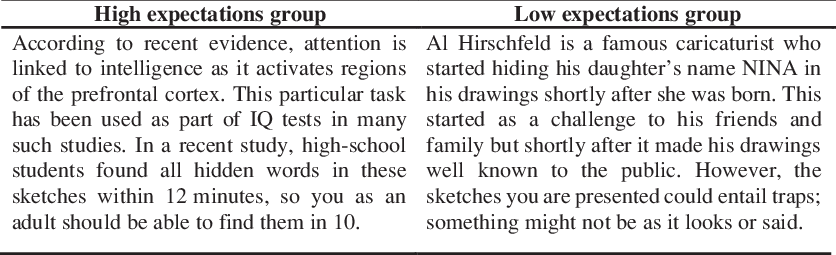
Afterwards, participants were given task-related information that would create different types of performance expectations. As achievement-domains and intelligence are highly valued in modern Western culture (e.g. Nisbett et al., Reference Nisbett, Aronson, Blair, Dickens, Flynn, Halpern and Turkheimer2012), expectations were manufactured using equivalent SRGs. Therefore, high expectations were created by linking the experimental task to intelligence and reporting results of a fictional study with successful high school students. Low expectations were created by telling the true story about the sketches, while highlighting the possibility of traps (see Fig. 1). As a result, the former groups were expected to engage in negative self-evaluations about their intelligence, which would be intensified by an upward comparison with supposedly intellectually ‘inferior’ students. The latter were likely to be more lenient in their self-evaluations as failure would not represent a weakness or deficiency in themselves. To ensure engagement in the task, all participants were told that their answers would be discussed with the researcher at the end.
Performance expectations manipulation/task-related instructions.

Shortly after, the experimental task started. When the10-minute time passed, the self-reports were administered for a second time. Following that, participants were provided with written and oral debrief accompanied by a brief talk about their thoughts and emotions in order to alleviate potential distress caused by the experimental manipulations. After having reassured that everything was fully understood, the measurements were administered one last time to control for potential persistence of discomfort. Finally, participants were given a new, valid consent form that replaced the first.
Results
Test of normality
The data analysis began by testing the assumption of normality using a series of Shapiro–Wilk tests in SPSS (version 20; IBM Corporation, 2011). The scores on the SCRS were found not normally distributed (all p < 0.05) most likely because they were moderate to low (mean = 13.7, SD = 3.68). Thus, a non-parametric method was used to explore the relationship between levels of trait self-critical rumination, shame and stress.
Spearman correlations at T1
Spearman’s rho were calculated between the measures and self-reported self-critical rumination prior to the intervention, which was conducted via SPSS (version 20; IBM Corporation, 2011). The correlation between the SCRS and ESS was moderate (r s = .39, p < .01) and the correlation between the SCRS and SSSQ was weak (r s = .22, p < .05). The correlation between the ESS and SSSQ was also weak (r s = .27, p < .05). This demonstrates the usefulness of measuring stress and shame concurrently.
Multivariate analysis of variance
The relationship between induced self-critical rumination, shame and stress across time was explored using R code (R Core Team, 2018) via the Jamovi statistical package (version 1.0; The jamovi project, 2019). In particular, a repeated measures MANOVA was conducted to test the effects of group membership (HSCR, HNON, LSCR and LNON) on shame and stress across three different time-points of testing (T1, T2 and T3).
With regard to the between-subject effects, the data analysis showed that the measurements were significantly different, F (1,56) = 401.73 (p < .001). However, there were no significant interaction effects between measurements and group, F (3,56) = .061 (not significant), measurements and time, F (2,112) = 2.73 (not significant), or all three factors, F (6,112) = 0.56 (not significant). Therefore, both stress and shame were manipulated at similar levels throughout the experiment and measurements were combined for the duration of the analysis.
A significant difference was found between groups, F (3,56) = 2.97 (p < 0.05). This indicates that ESS and SSSQ scores varied in response to manipulations of self-critical rumination and performance expectations in each group (see Table 1). On average, the HNON group tended to score higher on the ESS and SSSQ, followed closely by the HSCR group and then by the LSCR group and the LNON group (see Table 2).
MANOVA effects on shame and stress

ESS, Experiential Shame Scale; SSSQ, Short State Stress Questionnaire.
Means and standard deviations for each group across all three time-points

HSCR, high expectations plus self-critical rumination; LSCR, low expectations plus self-critical rumination; HNON, high expectations without self-critical rumination; LNON, low expectations without self-critical rumination; ESS, Experiential Shame Scale; SSSQ, Short State Stress Questionnaire.
Within-subject and interactive effects were explored using the afex package in R due to its capacity to conduct several multilevel analyses (Singmann, Reference Singmann2018). A significant effect across time was found, F (2, 112) = 14.52 (p < 0.001), meaning that ESS and SSSQ scores differed before and following the task. There was also a significant interaction between time of testing and group membership, F (6, 112) = 4.51 (p < 0.001). Therefore, ESS and SSSQ scores changed due to the joint effect of time of testing and manipulations of self-critical rumination and performance expectations within the different groups (see Table 1).
Post-hoc Tukey’s comparisons were performed using emmeans package in order to correct for the false positive rate stemming from multiple test comparisons (Lenth, Reference Lenth2018). The analysis revealed two significant differences of interest. Firstly, there was a significant difference between T1 and T2 for the HSCR group (meandiff = –6.77, SE = 1.40, p < 0.001); thus, the ESS and SSSQ scores increased immediately after the task for the HSCR group. Secondly, at T2, HSCR and LNON groups also differed significantly with one another (meandiff = 11.03, SE = 2.62, p = 0.003); thus, the ESS and SSSQ scores were higher for the HSCR group compared with the LNON group immediately after the task. There was no significant difference between the two self-critical groups at T2 (meandiff = 7.57, SE = 2.62, p > 0.05) – i.e. the HSCR group did not score significantly higher than the LSCR group on the ESS and SSSQ (see Table 3).
Significant Tukey’s pairwise comparisons of the interaction effect between time and group

T1 = Time 1/baseline; T2 = Time 2/immediately after the task; HSCR, high expectations plus self-critical rumination; LNON, low expectations without self-critical rumination; LSCR, low expectations plus self-critical rumination.
Non-parametric partial correlations
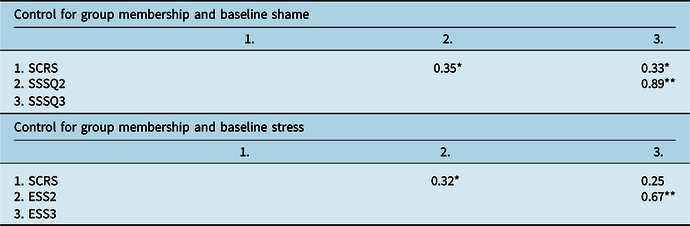
Partial correlations using Spearman’s rho were conducted via SPSS (version 20; IBM Corporation, 2011) to better understand the relationship between self-critical rumination, shame and stress regardless of the experimental manipulations (see Table 4). Baseline levels of shame and stress at T1 were accounted for, as they were considered independent of the relationships under evaluation.
Partial Spearman’s correlations

*p < .05; **p < .001. SCRS, Self-Critical Rumination Scale; SSSQ2, Short Stress State Questionnaire at Time 2; SSSQ3, Short Stress State Questionnaire at Time 3; ESS2, Experiential Shame Scale at Time 2; ESS3, Experiential Shame Scale at Time 3.
When controlling for group membership and baseline shame, trait self-critical rumination was moderately correlated with stress both at T2 (r s = 0.35, p < 0.05) and T3 (r s = 0.33, p < 0.05); thus the higher the SCRS scores, the higher the SSSQ scores following the task, regardless of the allocated group and initial levels of shame. In addition, there was a strong correlation between stress levels at T2 and T3 (r s = 0.89, p < 0.001), which reveals that SSSQ scores heightened similarly at both time points after the experimental task when the aforementioned conditions applied. This echoes the finding above: that there was no statistical difference between each of the groups between T2 and T3.
Finally, when controlling for group membership and baseline stress, trait self-critical rumination was moderately correlated with shame at T2 (r s = 0.32, p < 0.05). Thus, the higher the SCRS scores, the higher the ESS scores immediately following the task, regardless of the allocated group and initial levels of stress. In addition, there was a strong correlation between shame levels at T2 and T3 (r s = 0.67, p < 0.001), which shows that ESS scores increased similarly in both post-task time points when the aforementioned conditions applied and also reflects the aforementioned non-significant difference between the groups at T2 and T3.
Discussion
This study sought to explore the effects of self-critical rumination on shame and stress using an experimental design. Participants engaged in an impossible task that resulted in guaranteed failure and subsequent negative self-evaluations and the results partially support the hypotheses set prior to study. Levels of shame and stress heightened following perceived failure, especially for those in the HSCR condition. In fact, members of this group experienced more shame and stress immediately after the impossible task compared with baseline. Their levels at that time point were also higher in comparison with the opposite LNON group but not significantly higher in comparison with the LSCR group. Therefore, it seems that self-critical rumination, accompanied by high performance expectations, increased shame and stress after perceived failure. This confirms that self-criticism is related to feelings of shame (Castilho et al., Reference Castilho, Pinto-Gouveia and Duarte2016), and predicts sensitivity to failure-stress (Gruen et al., Reference Gruen, Silva, Ehrlich, Schweitzer and Friedhoff1997). Rumination seems to be the key process behind these effects (Schiller et al., Reference Schiller, Hammen and Shahar2016); not only does it result in shame, rather than merely stemming from it (Joireman, Reference Joireman2004), but it also preserves self-critical thinking, which in turn predicts stress, acute distress and various types of psychopathology (Nolen-Hoeksema et al., Reference Nolen-Hoeksema, Wisco and Lyubomirsky2008; Kolubinski et al., Reference Kolubinski, Nikčevićb and Spadain press).
The HNON group reported slightly higher levels of shame and stress overall. This means that high performance expectations might have led to more shame and stress because of evaluative threats on social survival (Dickerson et al., Reference Dickerson, Gruenewald and Kemeny2004). Highly evaluative conditions could have initiated a ‘fear of fear’ cycle that resulted in repetitive thinking regardless of the self-critical priming (Beck et al., Reference Beck, Emery and Greenberg1985). Indeed, when people feel negatively evaluated by either the self or others, they tend to ruminate on how they come across and would want to be instead (Clark and Wells, Reference Clark, Wells, Heimberg, Liebowitz, Hope and Schneier1995). This could also account for the similar average scores on shame and stress between the HSCR and HNON groups.
Furthermore, all participants experienced more shame and stress following perceived failure, possibly due to their engagement in negative self-evaluations. After realising their inability to perform adequately on the task, participants proceeded to evaluate their performance negatively, which in turn elicited shame (Tangney et al., Reference Tangney, Wagner and Gramzow1992). The researcher’s presence during the task must also be taken into consideration. This possibly activated representations of being exposed (Lewis, Reference Lewis1992). Similar changes in stress levels could be explained by the fact that negative self-evaluations following manufactured failure are related to elevated shame and subsequent high cortisol response to stress (Lewis and Ramsay, Reference Lewis and Ramsay2002).
Moreover, a relationship between self-reported levels of trait self-critical rumination and shame was found immediately after the impossible task. Thus, the more participants identified with the process of self-critical rumination, the more shame they experienced immediately following the task, because perceived failure might have activated a ‘spoilt identity’ schema (Beck et al., Reference Beck, Emery and Greenberg1985). However, trait self-critical rumination was not related to shame following debrief on the actual purposes of the study, perhaps due to being used in an adaptive, self-repairing way (Tangney and Tracy, Reference Tangney, Tracy, Leary and Tangney2012). Hence, state self-critical rumination could have accounted for increases in shame only in the face of failure and remitted when truth was revealed.
A relationship between self-critical rumination and stress over time was also revealed. Indeed, rumination predicts increased difficulty in recovering from stress (LeMoult et al., Reference LeMoult, Arditte, D’Avanzato and Joormann2013). Levels of self-critical rumination aligned with levels of stress both immediately after the impossible task and following debrief. This confirms that self-critical rumination propels people to experience more stressful situations that in turn increase it (Shahar, Reference Shahar2015). The relationship between self-critical rumination and stress is so pervasive that it appeared at both time points following perceived failure, even though this study included moderate to low self-critical ruminators.
The findings also showed that high levels of shame and stress persisted over time, regardless of reported self-critical rumination. This might be due to the presence of evaluative threats from which participants had difficulty disengaging (Dickerson et al., Reference Dickerson, Gruenewald and Kemeny2004; Gruen et al., Reference Gruen, Silva, Ehrlich, Schweitzer and Friedhoff1997). Therefore, changes in the levels of shame and stress following debrief reflected changes in the levels of shame and stress right after the impossible task. In the case of shame levels, this could also mirror the acutely painful and long-lasting effects of shame (Tangney and Tracy, Reference Tangney, Tracy, Leary and Tangney2012). Nevertheless, it is also likely that the time between the second and third administration of the measures was not long enough for participants to become desensitised to the effects of negative self-evaluation.
Altogether, the findings add valuable advances to the existing literature. First, whilst most research has found associations between self-criticism, rumination and shame, herein all these components are brought together in a causative relationship that adds stress to the equation. In addition, this was one of the few studies that combined self-critical rumination with performance expectations, due to the acknowledgment of its significance in self-evaluative and achievement-relevant contexts. As self-critical rumination had stronger effects when combined with high performance expectations, it is indeed more likely to occur under evaluative and/or achievement-related instances. This also denotes its ubiquitous nature. In conclusion, this study put forward an experimental design to delve into the effects of self-critical rumination, which differentiates from generic self-critical thinking (Thew et al., Reference Thew, Gregory, Roberts and Rimes2017) or trait self-critical perfectionism (Besser et al., Reference Besser, Flett and Hewitt2004; Stoeber et al., 2008). Thus, it distinguishes from prior research based on self-reports that sought to explore the relationship of rumination with proneness to self-criticism (Smart et al., Reference Smart, Peters and Baer2016) or shame (Joireman, Reference Joireman2004).
Study limitations and future research
This study has several limitations. The fact that self-critical rumination and performance expectations were manufactured might have impeded ecological validity of the results. In particular, the high-expectations conditions could have been extremely acute and thereby not representative of real-world situations. Similarly, the experimental task might have been overtly challenging, thus resulting in increased discomfort, even after debrief. Moreover, the two post-task assessments were relatively close to one another and possibly did not permit desensitisation to the effects of negative self-evaluations. Also, the findings were based only on self-reports that are subject to response biases and demand effects, especially as administration was conducted at three different time points. The fact that shame and stress were examined jointly and that there were no manipulation checks for self-critical rumination following the 3-minute priming/distraction task are equally important limitations.
Self-critical rumination and performance expectations could have been assessed in real-time situations. Furthermore, if only moderate and impossible items were included, the task might have been less challenging, thus predicting less discomfort following potential incapacity to succeed in the difficult ones. Physiological measures such as salivatory cortisol samples or blood pressure indications (e.g. Gruenewald et al., Reference Gruenewald, Kemeny, Aziz and Fahey2004; Smith et al., Reference Smith, Birmingham and Uchino2012) could have been more accurate measurements, whilst findings would have been more concrete if shame and stress were examined in two separate but identical experiments. Lastly, the differences between the HSCR and HNON groups could have been explained better if an assessment tool of state self-critical rumination was included after the priming/distraction task.
Herein, participants were low- to mid-level ruminators. Recruiting high self-critical ruminators could be interesting in exploring differences in shame and stress across time. Due to the associations of self-criticism, rumination and shame with overlapping psychopathologies, it could be useful to explore how self-critical rumination impacts levels of shame and/or stress in clinical samples as well. Alternatively, concurrent literature could benefit from exploring ways of either targeting self-critical rumination in people with dysfunctional shame levels or reducing performance expectations in evaluative contexts and subsequently prevent negative effects of self-critical rumination.
Conclusions
The findings suggest that self-critical rumination, when accompanied by high-performance expectations, leads to increased levels of shame and stress. Even though high-performance expectations predicted higher average levels of shame and stress, participants in these conditions could have engaged in self-critical rumination regardless of self-critical priming due to the intensity of negative self-evaluations. In fact, raising the bar on performance expectations resembles the uncompromising demands for high standards in performance that characterise self-critical individuals (Shahar, Reference Shahar2015). Therefore, self-critical rumination and high-performance expectations complement one another and are equally embedded in negative self-evaluative contexts. Hence, self-critical rumination can be addressed as a separate transdiagnostic phenomenon in psychological therapy with beneficial outcomes in various types of psychopathology. Interventions focusing on reducing levels of rumination could be particularly useful and require further study.
Acknowledgements
There are no acknowledgements to make.
Financial support
This research received no specific grant from any funding agency, commercial or not-for-profit sectors.
Conflicts of interest
The authors have no conflicts of interest with respect to this publication.
Ethical statement
The authors have abided by the Ethical Principles of Psychologists and Code of Conduct as set out by the BPS. Ethical approval was received by the Ethics Committee at London South Bank University.






Comments
No Comments have been published for this article.