Introduction
In the southern part of the Mediterranean region, most livestock farming systems are characterized by low productivity because of low-feed availability and quality (Tegegne, Reference Tegegne, Mondragon and Gonzalez2001). Local ruminant diets are based essentially on rangeland; however, over-use of the rangeland can cause its degradation (Alary et al., Reference Alary, Nefzaoui and Ben Jemaa2007; Chebli et al., Reference Chebli, Chentouf, Ozer, Hornick and Cabaraux2018). To avoid this problem, breeders have to adopt alternative feeding solutions (Chebli et al., Reference Chebli, Chentouf, Mrabet and Keli2014, Reference Chebli, Chentouf, Ozer, Hornick and Cabaraux2018).
In harsh environments, by-products and multi-purpose shrubs and trees are used as an alternative way to feed livestock (Topps, Reference Topps1992). In the Mediterranean region, olive cake (OC) and cactus cladodes (CCs) are two alternative resources widely available.
About 0.95 of the world's olive trees are cultivated in the Mediterranean region in order to produce olives and oil (Aktas et al., Reference Aktas, Imre and Ersoy2001). In addition, this sector generates large quantities of waste and by-products such as olive oil mill wastewater and OC. The large quantities of these by-products present an environmental problem. To solve this problem, OC is mainly used as a fuel for olive-pomace oil production, and could also be used as ruminant feed (Ben Salem and Nefzaoui, Reference Ben Salem and Nefzaoui2003; Molina Alcaide et al., Reference Molina Alcaide, Yáñez Ruiz, Moumen and Martín García2003; Sadeghi et al., Reference Sadeghi, Teimouri Yansari and Ansari-Pirsarai2009; Arco-Pérez et al., Reference Arco-Pérez, Ramos-Morales, Yáñez-Ruiz, Abecia and Martín-García2017). The composition of OC differs according to many factors including cultivar, climate and extraction processes (Clemente et al., Reference Clemente, Sánchez-Vioque, Vioque, Bautista and Millán1997). Classically, olive oil mills use one of three extraction processes (mechanical press, or 2-phase or 3-phase centrifugation). Press extraction is the traditional process used for many centuries. In the 1970s, the 3-phase centrifugation process was developed to obtain extra oil (Sánchez Moral and Ruiz Méndez, Reference Sánchez Moral and Ruiz Méndez2006). From the early 1990s, the 2-phase centrifugation process was developed to be eco-friendly by reducing water use and wastewater by 75% (Roig et al., Reference Roig, Cayuela and Sánchez-Monedero2006).
Cactus (Opuntia ficus-indica) is a multi-purpose shrub used as a fence to delimit lands, while its edible fruits and young cladodes are used as food, its seed oil as cosmetics and cladodes and inedible fruits as feed (Atti et al., Reference Atti, Mahouachi and Rouissi2006; Vieira et al., Reference Vieira, Batista, Guim, Carvalho, Nascimento, Araújo and Mustafa2008a, Reference Vieira, Batista, Mustafa, Araújo, Soares, Ortolane and Mori2008b; Abidi et al., Reference Abidi, Ben Salem, Vasta and Priolo2009b; Gusha et al., Reference Gusha, Halimani, Katsande and Zvinorova2014, Reference Gusha, Halimani, Katsande and Zvinorova2015). The composition of CCs is variable, depending on many factors such as age, season, variety, soil type and growing and climate conditions (Mondragón-Jacobo and Pérez-González, Reference Mondragón-Jacobo and Pérez-González2001). The majority of nutritional studies have focused on cultivated spineless CCs (Opuntia ficus-indica f. inermis) (Ben Salem et al., Reference Ben Salem, Nefzaoui and Ben Salem2004; Atti et al., Reference Atti, Mahouachi and Rouissi2006; Mahouachi et al., Reference Mahouachi, Atti and Hajji2012), while wild spiny CCs are present in many sub-regions and studied less. Moreover, according to the age and collection period, spiny CCs present variations in chemical composition and digestibility (Pinos-Rodriguez et al., Reference Pinos-Rodríguez, Velázquez, González, Aguirre, García, Álvarez and Jasso2010).
Research studying the impact of processing and phenology on OC and CCs chemical composition and digestibility is limited. Thus, the aim of the present paper was to report the chemical composition, degradation kinetics and in vitro digestibility parameters of OC according to the period and process of extraction, and of wild spiny CCs (Opuntia ficus-indica) according to the collection period and age, in order to better point out their introduction potential in ruminant diets.
Material and methods
Sample collection
Olive cake
The OC samples were collected from different olive oil mills in the Ouazzane region (northern Morocco). This region, located in 34°79′ N, 5°61′ W, is characterized by a Mediterranean climate with warm winters and irregular precipitation (400 mm/year), and dry warm summers (Chebli et al., Reference Chebli, Chentouf, Ozer, Hornick and Cabaraux2018). The mills used all three kinds of extraction processes, i.e. mechanical press and 2-phase and 3-phase centrifugation. Mechanical pressing consists of crushing olives into a paste before mechanically pressing it to extract liquid oil and wastewater, which are then separated further. The 2-phase centrifugation method consists of crushing, mixing and centrifuging olive to produce oil and pomace (OC and wastewater). The 3-phase method is similar but requires the addition of water, allowing the separate production of oil, OC and wastewater. These processes have been described in detail by Vlyssides et al. (Reference Vlyssides, Loizides and Karlis2004). Generally, the olives used for oil extraction varied in pigmentation colour according to maturity (green at early maturity, semi-black or purple at intermediate maturity and black at complete maturity). Samples were collected once a month during the period of oil extraction (P1: November, P2: December and P3: January) from nine mills with three mills per process, i.e. mechanical pressure OC (MPOC); 2-phase centrifugation OC (2POC) and 3-phase centrifugation OC (3POC).
Cactus cladodes
A total of 24 samples of wild spiny CCs (Opuntia ficus-indica) were collected at three different places in the Tangier region of northern Morocco: Chraka (35°68′ N, 5°91′ W), Ain Zaytoune (35°64′ N, 5°91′ W) and Hjar Nhal (35°61′ N, 5°92′ W). In this region, the climate is characterized by temperate winters with irregular precipitation (700–800 mm/year), and warm summers (Chebli et al., Reference Chebli, Chentouf, Ozer, Hornick and Cabaraux2018). In order to study the effect of CCs maturity, samples were collected four times (fortnightly) in spring during the period of CCs growth, i.e. from the end of April to mid-June. Moreover, at each sampling, two types of CCs depending on age (young CCs from the current year ‘YCC’ and mature CCs from the previous year ‘MCC’) were collected and measured immediately (weight, length, width and thickness).
Chemical analysis
Samples of OC and CCs were analysed in the laboratory of the National Institute of Agricultural Research (INRA-Tangier, Morocco). They were dried in a ventilated oven at 60 °C until constant weight, and then ground using a cutting mill, sieved at 1 mm and stored in Kraft bags in a desiccator. Dry matter (DM) was obtained by drying 100 g of fresh samples in a ventilated oven at 105 ± 1.0 °C until constant weight. Ash content was determined after incineration of 2 g DM in a muffle furnace at 550 °C for 12 h (AOAC, 1997; No. 942.05). Ether extract (EE) was obtained using the Soxhlet method (AOAC, 1997; No. 963.15). Crude protein (CP) was determined by multiplying nitrogen by 6.25 and carried out using the Kjeldahl method (AOAC, 1997; No. 977.02). Fibre contents (crude fibre, CF; neutral detergent fibre, NDF; acid detergent fibre, ADF, and acid detergent lignin, ADL) were analysed using an ANKOM® 200 Fibre Analyser (ANKOM Technology, Macedon, NY, USA); CF was determined according to AOAC (1997; No. 962.09) and NDF, ADF and ADL were analysed following the method of Van Soest et al. (Reference Van Soest, Robertson and Lewis1991). Determination of NDF was carried out using α-amylase and sodium sulphite. The nitrogen-free extract (NFE) was estimated using the following formula:

Quantification of total phenols (TP), non-tannic phenols (NTP) and total tannins (TT) was performed according to the method described by Makkar et al. (Reference Makkar, Blummel, Borowy and Becker1993) using the Folin–Ciocalteu reagent with spectrophotometry at 725 nm of absorbance. Condensed tannins (CT) were assayed by spectrophotometry (acid-butanol method) according to Porter et al. (Reference Porter, Hrstich and Chan1985) with an absorbance of 550 nm. Hydrolysable tannins (HT) were estimated by the difference of TT and CT.
In vitro digestibility
In vitro digestibility was determined using gas production (GP) and enzymatic methods. The GP method was carried out according to Menke et al. (Reference Menke, Raab, Salewski, Steingass, Fritz and Schneider1979) as improved by Menke and Steingass (Reference Menke and Steingass1988). Briefly, 300 mg of samples was incubated in 100 ml syringes with 30 ml of culture media and rumen liquor. Rumen fluid used as an inoculum was collected at Ain Dalia slaughterhouse from adult goats. Goat rumen liquor was chosen because this species is dominant among ruminants found in northern Morocco. Rumen fluid was filtered and conserved in a thermos that had contained warm water (40 °C) just before collection, in order to keep rumen fluid at a temperature of 39 °C and microbiota alive. The GP volumes were recorded after 2, 4, 8, 12, 24, 48 and 72 h of incubation. At the end of incubation, syringe contents were collected in nylon bags to quantify residual DM and organic matter (OM), and to determine in vitro DM (IVDMD) and in vitro OM digestibility (IVOMD). Microbial biomass production (MBP), efficiency of microbial biomass (EMP), partitioning factor (PF) – which presents the truly in vitro degraded substrate for 1 ml produced gas – short chain fatty acids (SCFA) produced by incubated DM and metabolizable energy (ME) were calculated according to the following formulas:
Blümmel (Reference Blümmel2000):

Blümmel (Reference Blümmel2000):

Blümmel et al. (Reference Blümmel, Makkar, Chisanga, Mtimuni and Becker1997):

Makkar (Reference Makkar and Makkar2002):

Makkar (Reference Makkar and Makkar2002):

where CP [% of DM] is CP, GP [ml] is GP, SF is the stoichiometric factor (2.20–2.34 mg/ml with a mean of 2.26 mg/ml) and IVDOM [mg] is quantity of in vitro degradable OM.
Also, pepsin-cellulase enzymatic digestibility of DM (CDDM) and OM (CDOM), as well as protease enzymatic CP degradation after 1 h incubation (CPD) were performed following Aufrère and Michalet-Doreau (Reference Aufrère, Michalet-Doreau and Boucque1983), and Aufrère and Cartailler (Reference Aufrère and Cartailler1988), respectively.
Statistical analysis
For chemical composition and in vitro digestibility of OC, the data were analysed as a 3 × 3 factorial design (3 periods, 3 extraction processes) according to a mixed model allowing inclusion of a covariance effect associated with repeated measures performed on the same experimental unit, i.e. the mill (proc mixed; SAS, 2002). The model was:

where Y ijk is the dependent variable, μ is the mean, α i is a fixed effect of the i th modality of the 1st factor (extraction period), β j is a fixed effect of the j th modality of the 2nd factor (extraction process), γ ij is the effect of interaction between factors, б ijk is a random effect associated with k repeated observations and ε ijk is the random residual effects associated with k observations.
For CCs data, statistical analysis was performed with SAS (2002) software using the general linear model procedure. Data were analysed as a 2 × 4 factorial design (two ages, four collection periods). The general model used was:

where Y ijk is the dependent variable, μ is the mean, α i is a fixed effect of the i th modality of the 1st factor (age of CCs), β j is a fixed effect of the j th modality of the 2nd factor (collection period), γ ij is the effect of interaction between factors and ε ijk is the random residual effects associated with k observations.
Data were analysed using orthogonal polynomial contrast to test the linear and the quadratic effect of the extraction period on OC, and the linear, the quadratic and the cubic effect of the collection period on CCs.
Results
Olive cake
Chemical composition
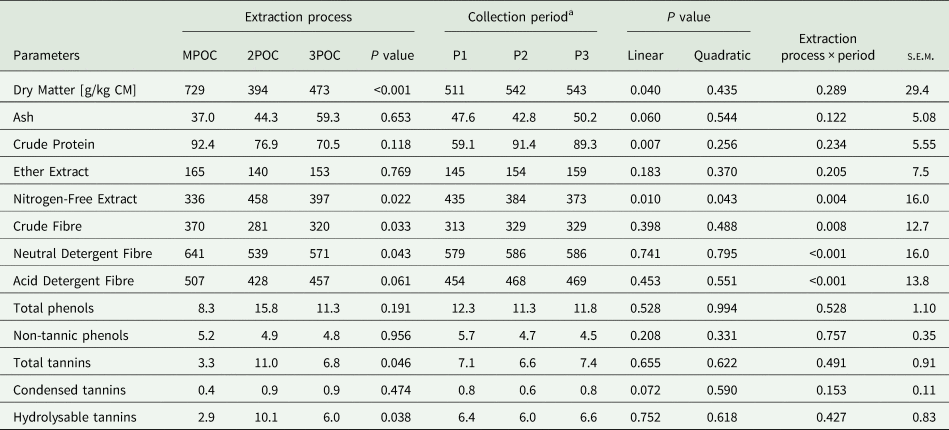
Table 1 presents the chemical composition of OC by the extraction process and collection period. The collection period had some linear impacts on DM, CP and NFE contents: DM and CP increased with the collection period (P = 0.040 and 0.007, respectively) while NFE decreased with a high reduction in the second period (P = 0.010). The extraction process impacted significantly on DM, NFE, CF, NDF, TT and HT contents of OC. The MPOC DM was higher; almost double that of 2POC. The content of NFE was low in MPOC, and high in 2POC with an intermediate level for 3POC. The CF and NDF contents were higher with MPOC while the TT and HT contents were higher with 2POC. Ash, EE, ADF, TP, NTP and CT contents were not affected by the two factors. The NFE decreased significantly in 2POC by period. In 3POC and MPOC, NFE was time-stable with lower values in MPOC. As for NFE, CF content was time-stable in MPOC and 3POC. However, in 2POC, it was the lowest in the first period only. The NDF and ADF content decreased in MPOC, increased in 2POC and remained largely constant in 3POC by the extraction period.
Chemical composition of olive cake [g/kg DM] by the extraction process and collection period

DM, dry matter; MPOC, OC obtained by mechanical press; 2POC, OC obtained by 2-phase centrifugation; 3POC, OC obtained by 3-phase centrifugation; SEM, standard error of means; CM, crude matter.
a P1: November; P2: December; P3: January.
In vitro digestibility
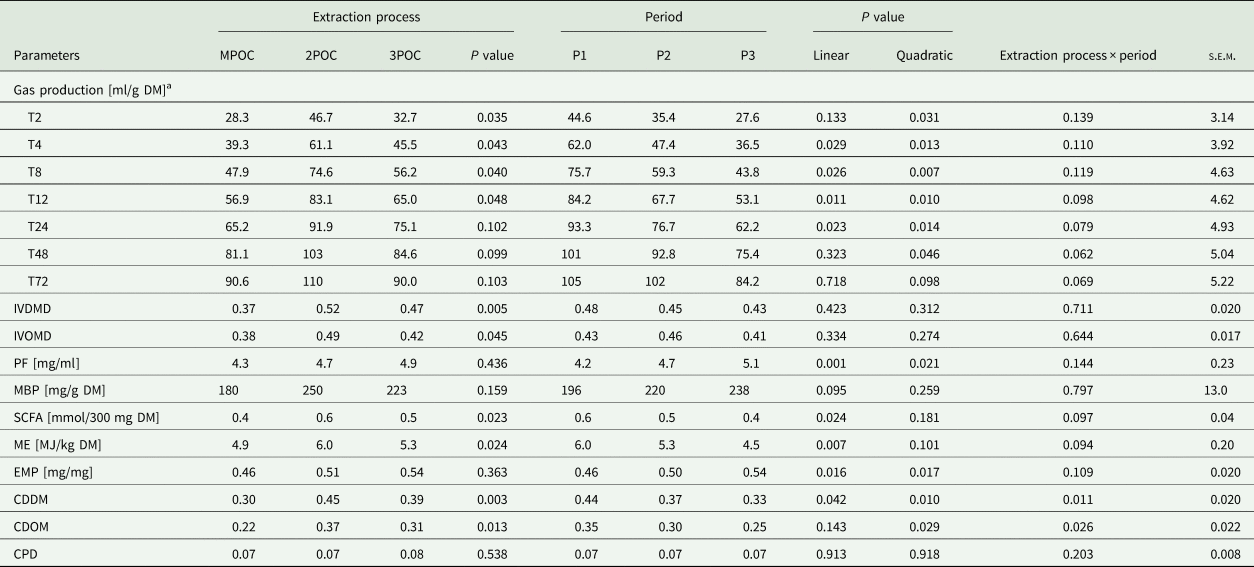
Table 2 presents degradation kinetics and in vitro GP, as well as enzymatic digestibility parameters of OC by the extraction process and period. GP was significantly higher in 2POC (P < 0.05) during the first 12 h of incubation but this extraction process effect was lost after 24 h (P > 0.05); however, 2POC showed a tendency for higher GP at 48 h (P < 0.1). The extraction period had a quadratic effect, with a decrease in the second period from 2 to 48 h of incubation (P < 0.05) to be lost at 72 h. This effect was not purely quadratic between 4 and 24 h because of the significance of the linear effect (P < 0.05).
Degradation kinetic and in vitro digestibility parameters of olive cake by the extraction process and period
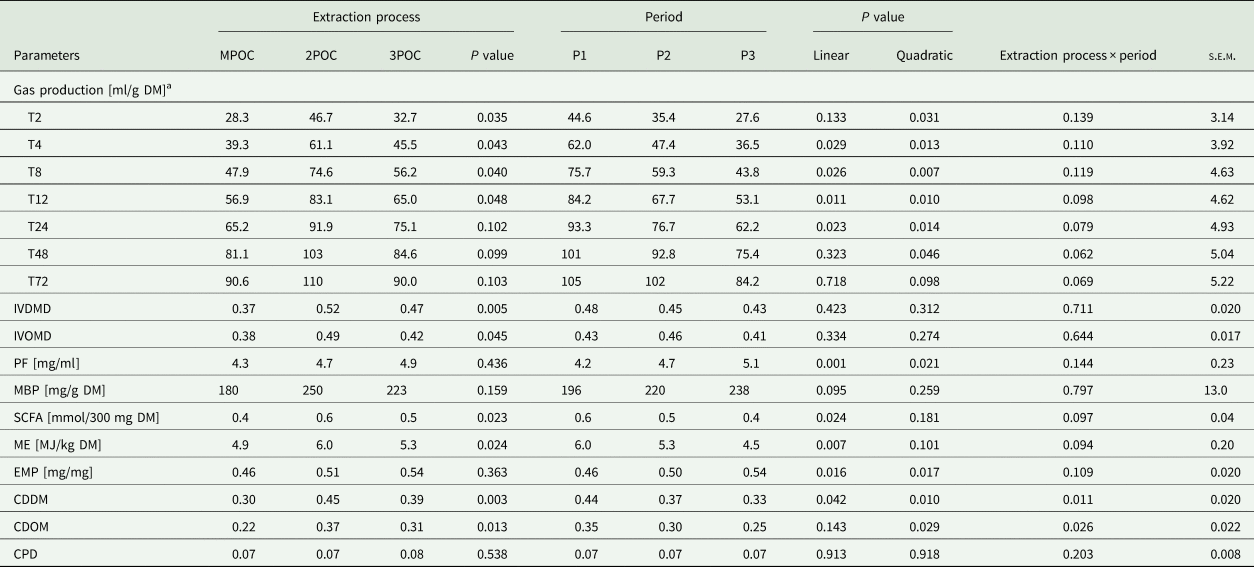
MPOC, mechanical press olive cake; 2POC, 2-phase centrifugation olive cake; 3POC, 3-phase centrifugation olive cake; P1, November; P2, December; P3, January; SEM, standard error of means; DM, dry matter; IVDMD, in vitro gas production dry matter digestibility; IVOMD, in vitro gas production organic matter digestibility; PF, partitioning factor; MBP, microbial biomass production; SCFA, short chain fatty acids; ME, metabolizable energy; EMP, efficiency of microbial production; CDDM, pepsin-cellulase enzymatic digestibility of dry matter; CDOM, pepsin-cellulase enzymatic digestibility of organic matter; CPD, protease enzymatic crude protein degradability at 1 h of incubation.
a Tx; gas production after x hours of incubation, where x = 2; 4; 8; 12; 24; 48 and 72.
The IVDMD, IVOMD, CDDM, CDOM, SCFA and ME were significantly affected by the extraction process with lower values of MPOC (P = 0.005, 0.045, 0.003, 0.013, 0.023 and 0.024, respectively). The SCFA and ME decreased linearly (P = 0.024 and 0.007, respectively), but EMP and PF were positively correlated with the extraction period (P = 0.016 and 0.001, respectively). However, this factor had a quadratic effect on CDDM and CDOM (P = 0.010 and 0.029, respectively). The MBP and CPD were stable by the extraction process and period. Except for CDDM and CDOM, the interaction between the extraction process and period had no effect on in vitro digestibility parameters.
Cactus cladodes
Morphological measurements
As shown in Table 3, the age effect was very highly significant on morphological measurements with the superiority of MCC (P < 0.001). For the period factor, length, width and weight increased linearly with time (P < 0.001, <0.001 and = 0.015, respectively). However, the thickness was constant with a tendency to have a quadratic effect by period (P = 0.051). The interaction between age and period had an effect on the CCs length and thickness (P = 0.009 and 0.001, respectively). The length and thickness of MCC were stable, contrary to YCC which showed a significant increment during the period.
Morphological measurements of spiny cactus cladodes by age and collection period

P1, 1st period; P2, 2nd period; P3, 3rd period; P4, 4th period; SEM, error standard of means.
Chemical composition
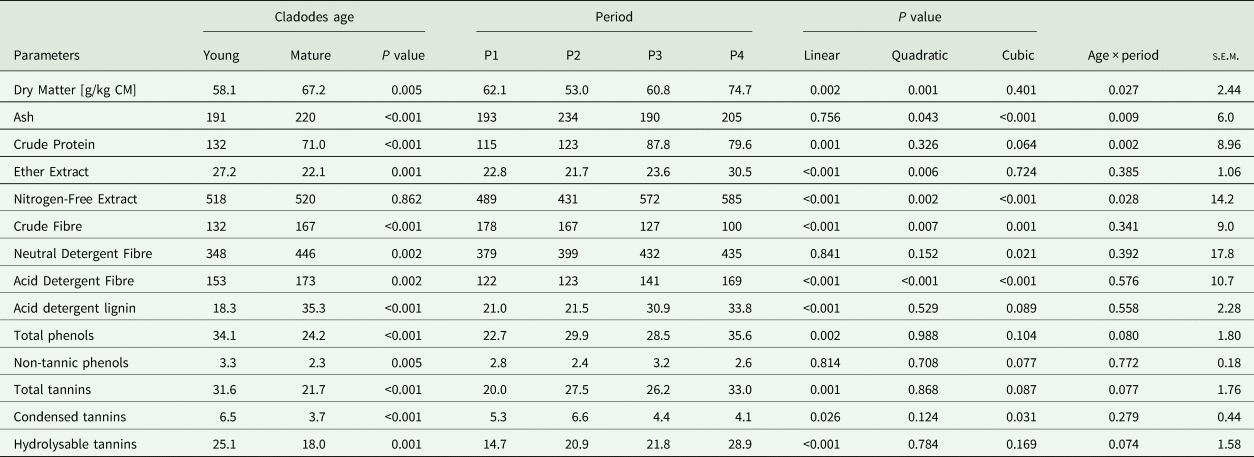
According to Table 4, except for NFE, all chemical composition parameters were significantly affected by CCs age (P < 0.01). These parameters were higher in YCC than MCC excluding DM, ash and fibre. The collection period effect was observed on all chemical composition parameters (P < 0.05) except for NTP. A quadratic effect with a linear tendency of the collection period was recorded on DM (P = 0.001). Ash and NDF were cubically related to period (P < 0.001 and = 0.021, respectively). A linear effect of period was significant for CP, EE, NFE, CF, ADF, ADL and secondary compounds (P < 0.01). These parameters were positively correlated with time except for CP, CF and CT, which decreased by period.
Chemical composition of spiny cactus cladodes [g/kg DM] by age and collection period

CM, crude matter; P1, 1st period; P2, 2nd period; P3, 3rd period; P4, 4th period; SEM, error standard of means.
The interaction between age and period had a significant effect on DM, ash, CP and NFE (P = 0.027, 0.009, 0.002 and 0.028, respectively). The DM and NFE had the same tendency to increase by period according to age with a decrease in P2. The CP in YCC decreased by period to achieve the same content as MCC in the last period. Ash content of YCC and MCC increased in the second period to be stable for YCC, and to be decreased for MCC in P3 and P4.
In vitro digestibility
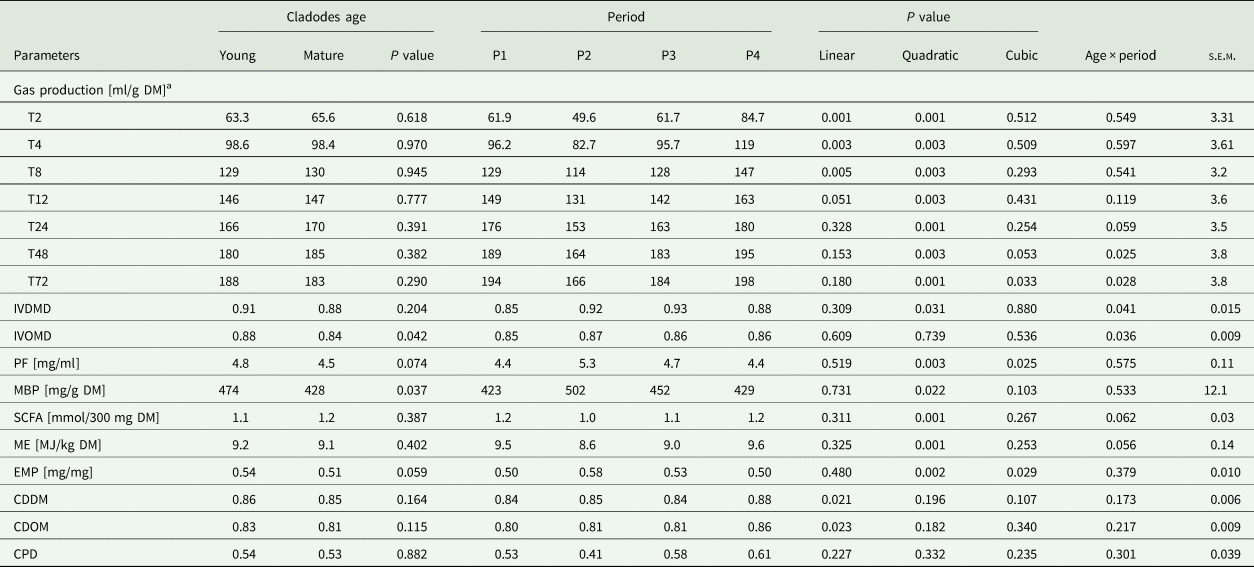
Table 5 presents GP and in vitro digestibility parameters of CCs by age and collection period. The GP up to 72 h of incubation was similar for YCC and MCC. During 72 h of incubation, GP was quadratically related to period (P < 0.01) with a linear tendency in the first 8 h.
Degradation kinetic and in vitro digestibility parameters of spiny cactus cladodes by age and collection period

P1, 1st period; P2, 2nd period; P3, 3rd period; P4, 4th period; SEM, error standard of means; DM, dry matter; IVDMD, in vitro gas production dry matter digestibility; IVOMD, in vitro gas production organic matter digestibility; PF, partitioning factor; MBP, microbial biomass production; SCFA, short chain fatty acids; ME, metabolizable energy; EMP, efficiency of microbial production; CDDM, pepsin-cellulase digestibility of dry matter; CDOM, pepsin-cellulase digestibility of organic matter; CPD, protease protein degradability at 1 h time.
a Tx, gas production after x hours of incubation, where x = 2; 4; 8; 12; 24; 48 and 72.
In vitro digestibility parameters were similar in YCC and MCC, except for IVOMD and MBP, which were higher in YCC (P = 0.042 and 0.037, respectively). The PF and EMP had a tendency to be higher in YCC (P = 0.074 and 0.059, respectively). Digestibility parameters, except IVOMD and CPD, were significantly affected by the collection period (P < 0.05). Similar to GP, IVDMD, PF, MBP, SCFA, ME and EMP were quadratically related to time. As for CDDM and CDOM, they increased linearly by period. The interaction between age and period had a significant effect on GP at 48 and 72 h, IVDMD and IVOMD (P = 0.025, 0.028, 0.041 and 0.036, respectively).
Discussion
Olive cake
Chemical composition
Generally, OCs are characterized by high content of fibres (CF, NDF and ADF) and a low CP level, and by the presence of secondary compounds.
The 2POC had the highest moisture content compared to 3POC and MPOC because it is a thick sludge composed of olive pulp, stone and vegetation water, classified as olive pomace (Borja et al., Reference Borja, Raposo and Rincón2006). It is a product of an eco-friendly process that reduces olive mill wastewater by 75% (Roig et al., Reference Roig, Cayuela and Sánchez-Monedero2006; Molina Alcaide and Yáñez-Ruiz, Reference Molina Alcaide and Yáñez-Ruiz2008). The high content of moisture in 2POC affects the shelf-life and promotes mould development. In the current experiment, OC DM content was similar (2POC) or lower (MPOC and 3POC) to data from the literature (Al-Masri, Reference Al-Masri2003; Molina Alcaide et al., Reference Molina Alcaide, Yáñez Ruiz, Moumen and Martín García2003; Borja et al., Reference Borja, Raposo and Rincón2006; Mioč et al., Reference Mioč, Pavić, Vnučec, Prpić, Kostelić and Sušić2007; Dermeche et al., Reference Dermeche, Nadour, Larroche, Moulti-Mati and Michaud2013). The linear increase of OC DM by period might be linked to moisture decrease in olive fruits: Mafra et al. (Reference Mafra, Lanza, Reis, Marsilio, Campestre, De Angelis and Coimbra2001) reported a moisture content of 0.77 and 0.61 in green and black olives, respectively. Ash content was similar (MPOC), close (2POC) and higher (3POC) than values reported in the literature (Vlyssides et al., Reference Vlyssides, Loizides and Karlis2004; Borja et al., Reference Borja, Raposo and Rincón2006; Weinberg et al., Reference Weinberg, Chen and Weinberg2008; Dermeche et al., Reference Dermeche, Nadour, Larroche, Moulti-Mati and Michaud2013). For CP, values in the literature were lower (MPOC and 3POC) and similar (2POC) to the current results (Al-Masri, Reference Al-Masri2003; Molina Alcaide et al., Reference Molina Alcaide, Yáñez Ruiz, Moumen and Martín García2003; Vlyssides et al., Reference Vlyssides, Loizides and Karlis2004; Mioč et al., Reference Mioč, Pavić, Vnučec, Prpić, Kostelić and Sušić2007; Dermeche et al., Reference Dermeche, Nadour, Larroche, Moulti-Mati and Michaud2013; Neifar et al., Reference Neifar, Jaouani, Ayari, Abid, Ben Salem, Boudabous, Najar and Ghorbel2013). The CP increase by period might be explained by late varieties' composition, growing conditions, origin and maturity levels of olives used in these periods, which is often black and completely mature, that could affect OC composition (Leouifoudi et al., Reference Leouifoudi, Harnafi and Zyad2015). Zamora et al. (Reference Zamora, Alaiz and Hidalgo2001) found an increase of CP in olive fruit of Arbequina cultivar by a maturity stage (from 1.3 to 1.6% DM), correlated positively with oil content and explained by oleosin proteins that participate in the storage of lipids in oilseeds. The EE by the extraction process was higher than values in the literature (Borja et al., Reference Borja, Raposo and Rincón2006; Mioč et al., Reference Mioč, Pavić, Vnučec, Prpić, Kostelić and Sušić2007; Sadeghi et al., Reference Sadeghi, Teimouri Yansari and Ansari-Pirsarai2009; Dermeche et al., Reference Dermeche, Nadour, Larroche, Moulti-Mati and Michaud2013; Neifar et al., Reference Neifar, Jaouani, Ayari, Abid, Ben Salem, Boudabous, Najar and Ghorbel2013), probably due to the methods and programmes used by extraction mills and also by extraction process management. The high contents of NFE, which represents the highly digestible carbohydrates, in 2POC and 3POC might be related to the soluble sugars in wastewater that is higher in these OCs than in MPOC. The decrease of NFE by period was due to increments of CP content and the decrease of sugar in olives with maturity. Marsilio et al. (Reference Marsilio, Campestre, Lanza and De Angelis2001) found that green olive fruits contain more galactose, glucose and sucrose than cherry and black olives. Fibre content (CF, NDF and ADF) was variable compared to the literature (Al-Masri, Reference Al-Masri2003; Martín García et al., Reference Martín García, Moumen, Yáñez Ruiz and Molina Alcaide2003, Reference Martín García, Yáñez Ruiz, Moumen and Molina Alcaide2004; Molina Alcaide et al., Reference Molina Alcaide, Yáñez Ruiz, Moumen and Martín García2003; Neifar et al., Reference Neifar, Jaouani, Ayari, Abid, Ben Salem, Boudabous, Najar and Ghorbel2013): this could be explained by the dependence of OC composition on a number of factors such as olive varieties, culture conditions, origin of olives, year and extraction degree (Molina Alcaide et al., Reference Molina Alcaide, Yáñez Ruiz, Moumen and Martín García2003; Alburquerque et al., Reference Alburquerque, Gonzálvez, García and Cegarra2004; Dermeche et al., Reference Dermeche, Nadour, Larroche, Moulti-Mati and Michaud2013). The finding that MPOC had the highest content of CF and NDF could be a consequence of endocarp proportion (Sadeghi et al., Reference Sadeghi, Teimouri Yansari and Ansari-Pirsarai2009). This superiority could also be due to the washing and sorting steps, which are not automated in mechanical press mills and allow the transit of leaves and branches during extraction operation, or to the extraction degree.
Secondary compounds were present in OCs. These compounds are available in olives (especially in green olives) and the use of water during oil extraction allows the passage of these hydro-soluble compounds in by-products (wastewater and OC). The TP values of MPOC, 3POC and 2POC were similar to those reported by Dermeche et al. (Reference Dermeche, Nadour, Larroche, Moulti-Mati and Michaud2013), while TT and CT of 2POC were close to those reported by Martín García et al. (Reference Martín García, Moumen, Yáñez Ruiz and Molina Alcaide2003). The 2-phase extraction process provided the highest rates of TT and HT in OC because this process produces an OC with high moisture because it is mixed with vegetation water which is higher in hydro-soluble phenolic compounds owing to its low water requirement (Dermeche et al., Reference Dermeche, Nadour, Larroche, Moulti-Mati and Michaud2013). Generally, CT concentration was lower than 20 g/kg DM, which means that OC does not negatively affect protein digestibility in the rumen (Min et al., Reference Min, Barry, Attwood and McNabb2003).
In vitro digestibility
The OC was characterized by a low GP, DM and OM digestibility and CP degradation. The rapid fermentability of 2POC could be explained by its lower fibre content and its higher NFE content that made it more easily degradable by rumen microbial flora. The variability of GP during the sampling period might be caused by different varieties and maturity degree of the olives used. The GP decrease suggests less available fermentable components with increasing maturity of fruit, because NFE decreases by period. The IVDMD, IVOMD, CDDM and CDOM were lower in MPOC because of its high-fibre content. The reduced digestibility of OC is a result of high fibre and low-protein content, which negatively influences microbial proliferation in the rumen and thus digestibility. In addition, high-fat content limits accessibility of microorganisms to carbohydrates (Doreau and Chilliard, Reference Doreau and Chilliard1997). On the other hand, olive oil is known for its antimicrobial effect, either directly by cytotoxicity or by inhibition of microbial growth (Jenkins, Reference Jenkins1993; Pantoja et al., Reference Pantoja, Firkins, Eastridge and Hull1994), which implicitly affects bacterial proliferation and digestibility. To improve OC digestibility, Weinberg et al. (Reference Weinberg, Chen and Weinberg2008) found that removing stones from OC increased the in vitro digestibility by 5%. The PF of OC, that is the in vitro degraded substrate by the volume of produced gas, indicated the stability of the microbial production efficiency according to the extraction process, but a linear increase by period due to IVOMD stability and GP over time. Values of MBP, which present microbial production due to the substrate, were similar to that reported by Al-Masri (Reference Al-Masri2003) with 240 mg for OC. The SCFA, known as an indicator of available energy for the animal, are linked to high GP that explained its linear decrease by period. Compared to other feed resources, SCFA in OC were similar to wheat straw (0.47 mmol/300 mg; Shrivastava et al., Reference Shrivastava, Nandal, Sharma, Jain, Khasa, Das, Mani, Kewalramani, Kundu and Kuhad2012). The ME of OCs was in the range of results in the literature (3–12 MJ/kg DM; Molina Alcaide and Nefzaoui, Reference Molina Alcaide and Nefzaoui1996; Al-Masri, Reference Al-Masri2003; Rowghani et al., Reference Rowghani, Zamiri and Seradj2008; Sadeghi et al., Reference Sadeghi, Teimouri Yansari and Ansari-Pirsarai2009). Abbeddou et al. (Reference Abbeddou, Riwahi, Iñiguez, Zaklouta, Hess and Kreuzer2011) reported a ME of OCs similar to the current results (4.92–6.40 MJ/kg DM). Similar to SCFA, the ME decreases over time because it is dependent mainly on GP, while EMP is negatively correlated with this parameter, reflected by the EMP increase by period. The EMP of OCs was similar to a diet that contained ryegrass silage and a mineral/vitamin premix (Grings et al., Reference Grings, Blümmel and Südekum2005) with 8 MJ/kg DM. The quadratic decrease of CDDM and CDOM is linked to a NFE decrease over time. The CPD was lower than 0.08, but higher than that reported by Molina Alcaide and Nefzaoui (Reference Molina Alcaide and Nefzaoui1996) (0.04). Generally, OC composition and digestibility parameters were low and could be compared to a cereal straw or a lignified fodder. Nitrogen supplementation with OC is recommended to improve its digestibility.
Cactus cladodes
Morphological measurements
The CCs length, width and weight increased significantly with time because sample collection was performed during the CCs growth period, which explains changes according to age and period. Pinos-Rodriguez et al. (Reference Pinos-Rodríguez, Velázquez, González, Aguirre, García, Álvarez and Jasso2010) found an increment of weight and length with age for spineless CCs between 30 and 90 days of age that is in agreement with the current result. The length and width of YCC were similar to that of spineless YCC in the fourth growth stage (Hadj Sadok et al., Reference Hadj Sadok, Aid, Bellal and Abdul Hussain2008).
Chemical composition
The CCs contained low quantities of DM, OM and CP, with the presence of secondary compounds. The large amount of water in CCs allows them to be a water source for ruminants in arid areas and during the drought season (Negesse et al., Reference Negesse, Makkar and Becker2009), because CCs consumption reduces drinking of water (Abidi et al., Reference Abidi, Ben Salem, Vasta and Priolo2009b; Pinos-Rodríguez et al., Reference Pinos-Rodríguez, Velázquez, González, Aguirre, García, Álvarez and Jasso2010). The DM of MCC and YCC was similar to values reported in the literature (Hadj Sadok et al., Reference Hadj Sadok, Aid, Bellal and Abdul Hussain2008; Abidi et al., Reference Abidi, Ben Salem, Martín-García and Molina-Alcaide2009a; Bensadón et al., Reference Bensadón, Hervert-Hernández, Sáyago-Ayerdi and Goñi2010). Moisture in YCC was higher than MCC, which is in agreement with Jose et al. (Reference Jose, Dubeux, Ben Salem, Nefzaoui, Inglese, Mondragon, Nefzaoui and Saenz2017). The CCs DM variability during period could be explained by the weather. Indeed, there were precipitation events during the week before the second period and temperature increased gradually after this period. As reported by Jose et al. (Reference Jose, Dubeux, Ben Salem, Nefzaoui, Inglese, Mondragon, Nefzaoui and Saenz2017), CCs contain less water in the dry season compared to winter and spring. Rodríguez-Felix and Cantwell (Reference Rodriguez-Felix and Cantwell1988) reported that cladode moisture depends mainly on available water for the plant. Also, the increment of DM in the last period could be a result of flowering and fructification or of the development of mucilage. The CCs were characterized by high-ash content. Their mineral matter contains a high rate of calcium, phosphorus and magnesium (Batista et al., Reference Batista, Mustafa, McAllister, Wang, Soita and McKinnon2003; Hadj Sadok et al., Reference Hadj Sadok, Aid, Bellal and Abdul Hussain2008). The current result is in agreement with Hadj Sadok et al. (Reference Hadj Sadok, Aid, Bellal and Abdul Hussain2008), who reported a very highly significant increase of ash in spineless CCs by age. The YCC ash was similar to that reported in the literature (114–198 g/kg DM; Batista et al., Reference Batista, Mustafa, McAllister, Wang, Soita and McKinnon2003; Hadj Sadok et al., Reference Hadj Sadok, Aid, Bellal and Abdul Hussain2008; Vieira et al., Reference Vieira, Batista, Guim, Carvalho, Nascimento, Araújo and Mustafa2008a; Negesse et al., Reference Negesse, Makkar and Becker2009; Bensadón et al., Reference Bensadón, Hervert-Hernández, Sáyago-Ayerdi and Goñi2010). However, ash in MCC was higher than in the literature. This difference might be ascribed to the fact that most previous authors studied cultivated, irrigated and fertilized spineless CCs. Also, the soil might be a factor in ash content differences. However, the high content of ash in CCs might cause a limitation for microbiota growth in the rumen (Gregory and Felker, Reference Gregory and Felker1992). Many authors have reported lower CP values than in the present results for MCC (Ben Salem et al., Reference Ben Salem, Nefzaoui and Ben Salem2004, Reference Ben Salem, Makkar, Nefzaoui, Hassayoun and Abidi2005; Vieira et al., Reference Vieira, Batista, Guim, Carvalho, Nascimento, Araújo and Mustafa2008a; Bensadón et al., Reference Bensadón, Hervert-Hernández, Sáyago-Ayerdi and Goñi2010). However, Negesse et al. (Reference Negesse, Makkar and Becker2009) and Pinos-Rodriguez et al. (Reference Pinos-Rodríguez, Velázquez, González, Aguirre, García, Álvarez and Jasso2010) found a CP in YCC similar to the current result. The CP decreased significantly by age and period, which agrees with Tegegne (Reference Tegegne, Mondragon and Gonzalez2001), Pinos-Rodríguez et al. (Reference Pinos-Rodríguez, Velázquez, González, Aguirre, García, Álvarez and Jasso2010) and Jose et al. (Reference Jose, Dubeux, Ben Salem, Nefzaoui, Inglese, Mondragon, Nefzaoui and Saenz2017), who reported a linear CP decline with growth. In a diet containing high CCs, nitrogen supplementation is required to improve animals' performance (Jose et al., Reference Jose, Dubeux, Ben Salem, Nefzaoui, Inglese, Mondragon, Nefzaoui and Saenz2017). The EE of CCs was higher than in the literature (9–19 g/kg DM; Vieira et al., Reference Vieira, Batista, Guim, Carvalho, Nascimento, Araújo and Mustafa2008a; Negesse et al., Reference Negesse, Makkar and Becker2009; Bensadón et al., Reference Bensadón, Hervert-Hernández, Sáyago-Ayerdi and Goñi2010). Negesse et al. (Reference Negesse, Makkar and Becker2009) confirmed the YCC superiority for EE. The CCs were characterized by a high content of NFE. This parameter increased significantly by growth period because of mucilage development, according to Hadj Sadok et al. (Reference Hadj Sadok, Aid, Bellal and Abdul Hussain2008) who found an increment of sugar during the development stage of CCs. This result is in agreement with Rodríguez-Felix and Cantwell (Reference Rodriguez-Felix and Cantwell1988), who reported an increase of NFE during CCs development. The NFE decreased in the second period because soluble carbohydrates in cladodes moved to reproductive organs during fructification (Tegegne Reference Tegegne2007). The CF was higher than reported by Tegegne (Reference Tegegne, Mondragon and Gonzalez2001) and Hadj Sadok et al. (Reference Hadj Sadok, Aid, Bellal and Abdul Hussain2008) (80–116 g/kg DM). In agreement with the current results, Rodríguez-Felix and Cantwell (Reference Rodriguez-Felix and Cantwell1988) observed that CF decreased during the development stage of CCs and explained this decrease by the increment of water-storing parenchyma proportion. The NDF of CCs was estimated in the literature at 186–400 g/kg DM (Abidi et al., Reference Abidi, Ben Salem, Vasta and Priolo2009b; Negesse et al., Reference Negesse, Makkar and Becker2009; Pinos-Rodriguez et al., Reference Pinos-Rodríguez, Velázquez, González, Aguirre, García, Álvarez and Jasso2010; Jose et al., Reference Jose, Dubeux, Ben Salem, Nefzaoui, Inglese, Mondragon, Nefzaoui and Saenz2017), close to the present results. The ADF and ADL were low in CCs and remained in the range reported by the above authors with 109–217 g/kg DM and 6–69 g/kg DM, respectively. The NDF and ADF had a cubic tendency with maturity and period: this does not agree with Pinos-Rodriguez et al. (Reference Pinos-Rodríguez, Velázquez, González, Aguirre, García, Álvarez and Jasso2010) who observed a linear increase of NDF and ADF. This disparity might be because of the coincidence of collection with growth, flowering and fructification period. Secondary compounds (TP, NTP, TT, CT and HT) were present in CCs. These compounds decreased significantly with age because phenols and tannins are known to decrease during plant growth owing to the fact that they are converted to lignin (Kefeli et al., Reference Kefeli, Kalevitch and Borsari2003). For the collection period, TP, TT and HT increased, while CT decreased, which means that secondary compounds are variable during the growth period. The increment of TP, TT and HT might be caused by the increase of temperature, because Opuntia cladodes accumulate phenolic compounds under stressed growth conditions (Aruwa et al., Reference Aruwa, Amoo and Kudanga2018), and Wang and Zheng (Reference Wang and Zheng2001) reported an increment of phenols in strawberry growing fruits exposed to higher temperatures. The TP values were similar to spiny CCs values in summer as reported by Abidi et al. (Reference Abidi, Ben Salem, Martín-García and Molina-Alcaide2009a) and remained in the interval reported by Jose et al. (Reference Jose, Dubeux, Ben Salem, Nefzaoui, Inglese, Mondragon, Nefzaoui and Saenz2017) (10–34 g/kg DM). However, TT and CT were higher than that cited by Jose et al. (Reference Jose, Dubeux, Ben Salem, Nefzaoui, Inglese, Mondragon, Nefzaoui and Saenz2017) (1 g/kg DM and <1 g/kg DM, respectively). Phenols are affected by stress factors as drought, water and solar radiation (Kefeli et al., Reference Kefeli, Kalevitch and Borsari2003), which could explain the difference from the literature. In CCs, the CT was lower than the anti-nutritional dose for ruminant (20 g/kg DM; Min et al., Reference Min, Barry, Attwood and McNabb2003).
In vitro digestibility
The GP of CCs was faster during 12 h of incubation, and lower after 24 h, in agreement with values reported by Negesse et al. (Reference Negesse, Makkar and Becker2009). This degradability is explained by the high contents of carbohydrates in CCs, such as soluble sugars, with a major part as fructose, that are rapidly fermented in the rumen (Batista et al., Reference Batista, Mustafa, McAllister, Wang, Soita and McKinnon2003; Hadj Sadok et al., Reference Hadj Sadok, Aid, Bellal and Abdul Hussain2008; Abidi et al., Reference Abidi, Ben Salem, Vasta and Priolo2009b; Ayadi et al., Reference Ayadi, Abdelmaksoud, Ennouri and Attia2009). The GP was not affected by age because of the similarity of NFE in YCC and MCC. Indeed, as reported by Tegegne (Reference Tegegne, Mondragon and Gonzalez2001), the level of CP that presents a limit for microbial activity in the rumen and an efficient feed utilization is 60–70 g/kg DM. All the observed results were above this level. The observed GP was close to the finding of Batista et al. (Reference Batista, Mustafa, McAllister, Wang, Soita and McKinnon2003) for three varieties of spineless CCs. The higher GP at the last period during 8 h of incubation could be explained by the higher content of soluble carbohydrates in this high level of growth. This inferiority of GP in the second period from 12 h might be a result of the lower content of NFE, the higher content of ash and probably due to the weather changes (15 °C/18 °C, 86% humidity and 10.6 mm of precipitations) in this period, which is a flowering and fructification period. The IVDMD was quadratically affected by period, which is in agreement with Pinos-Rodríguez et al. (Reference Pinos-Rodríguez, Duque-Briones, Reyes-Agüeroa, Aguirre-Rivera, García-López and González-Muñoz2006) who found a quadratic effect of growth on IVDMD. Tegegne (Reference Tegegne, Mondragon and Gonzalez2001) found an IVDMD lower than the current values. The lower values of IVOMD and MBP in MCC comparing to YCC is justified by the high content in ash, which limits the development of ruminal microbiota (Gregory and Felker, Reference Gregory and Felker1992). The PF, MBP and EMP changed quadratically and decreased after P2, because these parameters are negatively correlated with GP, which is quadratically affected by period and the stability of IVOMD over time. The SCFA and ME were positively correlated with GP at 24 h with the inferiority in P2. The CDDM and CDOM linearly increased because of CF, GP and NFE increment by period. Generally, CCs degradability and digestibility parameters were higher and could be similar to quality forages (Batista et al., Reference Batista, Mustafa, McAllister, Wang, Soita and McKinnon2003) which allows consideration of CCs as a good forage for ruminants, especially in the drought season because of their high content of water.
Conclusions
The results of the current study showed that chemical composition and in vitro digestibility of olive cake are sensitive to the process and period of extraction. Although their overall nutritive and nitrogen value are poor, olive cake is more suitable for ruminant feeding when obtained by the centrifugation method. Their modest nutritional values require development of a conservation mode, to use them throughout the year, and by adding nitrogen supplementation to improve their nutritional quality. Chemical composition and in vitro organic matter digestibility of cactus cladodes depended mainly on age, but these parameters were highly variable during the growth period, especially in drought season. The cactus cladodes dietary value appears dependent on climatic conditions. Their high digestibility ranks cactus cladodes similar to good-quality forage. Both by-products are worth being complemented with nitrogen to optimize their utilization in rumen. To introduce these feed resources in ruminant diet, feeding studies are required to determine the effect of spiny cactus cladodes and olive cake on ruminant performance and products.
Acknowledgements
The authors are sincerely grateful to ARES-CCD for providing funds and facilities for this study. Special thanks to PRD project collaborators, especially Mrs. Marianne Raes who deserves a special acknowledgement. The authors wish to thank staff of INRA-Morocco, Regional Centre of Tangier –where this work was performed–, especially to Mr. Mohamed Ouatik and Mr. Mohamed El Faitah who helped in samples collection. This paper is dedicated to the memory of our wonderful colleague, Dr Boughaleb Farahat Laroussi, who passed away on 15 June 2017.
Financial support
The current work was funded by the ARES-CCD (Academy of Research and Higher Education – Development Cooperation Committee), Brussels, Belgium.
Conflict of interest
No potential conflict of interest was reported by the authors.
Ethical standards
Not applicable.