Introduction
Since its discovery in North America and Europe in 2008, spotted-wing drosophila (Drosophila suzukii (Matsumura) (Diptera: Drosophilidae)) has spread to many temperate regions worldwide and significantly altered pest management practices in tender fruit and berry crops (Asplen et al. Reference Asplen, Anfora, Biondi, Choi, Chu and Daane2015; Diepenbrock et al. Reference Diepenbrock, Olivieri Rosensteel, Hardin, Sial and Burrack2016). Adult female flies lay eggs in ripening and harvested fruit rendering them unmarketable due to internal larval feeding and secondary rots (Walsh et al. Reference Walsh, Bolda, Goodhue, Dreves, Lee and Bruck2011; Lee et al. Reference Lee, Dalton, Swoboda-Bhattarai, Bruck, Burrack and Strik2015). In optimal conditions, D. suzukii completes its life cycle in 10 days (Tochen et al. Reference Tochen, Dalton, Wiman, Hamm, Shearer and Walton2014), resulting in rapid population growth and requiring at least weekly applications of insecticides in some regions during fruit ripening and harvest periods to maintain control (Beers et al. Reference Beers, Van Steenwyk, Shearer, Coates and Grant2011; Van Timmeren and Isaacs Reference Van Timmeren and Isaacs2013; Diepenbrock et al. Reference Diepenbrock, Olivieri Rosensteel, Hardin, Sial and Burrack2016; Wiman et al. Reference Wiman, Dalton, Anfora, Biondi, Chiu and Daane2016). Frequent insecticide use in conventional and organic systems has been linked to resurgence of secondary pests, likely due to negative impacts of insecticides on natural enemies, and raises concerns regarding development of insecticide resistance that would further challenge D. suzukii pest management (Smirle et al. Reference Smirle, Zurowski, Ayyanath, Scott and MacKenzie2017; Gress and Zalom Reference Gress and Zalom2019; Lee et al. Reference Lee, Wang, Daane, Hoelmer, Isaacs, Sial and Walton2019). To build an integrated pest management strategy and reduce insecticide use, alternative control methods for D. suzukii are needed.
Recent research has shown that naturally occurring compounds may be effective repellents and deterrents for D. suzukii. In controlled assays, volatile compounds such as geosmin, 1-octenol, butyl anthranilate, plant-derived essential oils, and a food-grade gum repelled D. suzukii flies, were toxic or deterred oviposition in ripe fruit (Erland et al. Reference Erland, Rheault and Mahmoud2015; Krause-Pham and Ray Reference Krause-Pham and Ray2015; Wallingford et al. Reference Wallingford, Hesler, Cha and Loeb2015, Reference Wallingford, Connelly, Dore Brind’Amour, Boucher, Mafra-Neto and Loeb2016; Jang et al. Reference Jang, Kim, Yoon, Lee and Park2016; Renkema et al. Reference Renkema, Wright, Buitenhuis and Hallett2016; Tait et al. Reference Tait, Kaiser, Rossi-Stacconi, Dalton, Anfora and Walton2018). A subset of these compounds have been tested in the field; however, reduction of D. suzukii infestations has been challenging to achieve due to volatility of some compounds, lack of suitable application methods, and high costs if frequent reapplications are necessary (Wallingford et al. Reference Wallingford, Connelly, Dore Brind’Amour, Boucher, Mafra-Neto and Loeb2016; Renkema et al. Reference Renkema, Buitenhuis and Hallett2017). For example, Renkema et al. (Reference Renkema, Wright, Buitenhuis and Hallett2016, Reference Renkema, Buitenhuis and Hallett2017) showed that peppermint (Mentha × piperita Linnaeus (Lamiaceae)) essential oil effectively repelled D. suzukii flies and deterred oviposition in fruit in the laboratory and was somewhat effective when formulated in biopolymer flakes and spread by hand in small plots in a strawberry (Fragaria × ananassa Duchesne (Rosaceae)) field. Constant release of repellent and/or deterrent volatiles in the field may be necessary to reduce D. suzukii infestations and could be achieved by the incorporation of aromatic plants into a fruit crop.
Volatile aromatic compounds from interplanted or intercropped plants have been shown to directly alter herbivore pest behaviour through deterrent or repellent effects. In pear (Pyrus Linnaeus; Rosaceae) orchards, Satureja hortensis Linnaeus (Lamiaceae) and Centaurea cyanus Linnaeus (Asteraceae) reduced abundances of major pests, Maladera orientalis (Motschulsky) and M. castanea (Arrow) (Coleoptera: Scarabaeidae), Cacopsylla chinensis (Yang and Li) (Hemiptera: Pysillidae), Aphis citricola Groot (Hemiptera: Aphididae), and Pseudococcus comstocki Kuwana (Hemiptera: Pseudococcidae), due primarily to strong repellent effects (Song et al. Reference Song, Wu, Kong, Zhang, Du, Hu and Yao2010; Beizhou et al. Reference Beizhou, Jie, Jinghui, Hongying, Yun and Yuncong2011; Tang et al. Reference Tang, Song, Zhao, Sang, Wan, Zhang and Yao2013). Intercropping guava (Psidium guajava Linnaeus (Myrtaceae)) in Citrus Linnaeus (Rutaceae) reduced abundance of Diaphorina citri Kuwayama (Hemiptera: Psyllidae), due to repellent volatiles from guava leaves (Zaka et al. Reference Zaka, Zeng, Holford and Beattie2010). In beans, (Vicia faba Linnaeus (Fabaceae)), interplanting basil (Ocimum basilicum Linnaeus (Lamiaceae)) and S. hortensis reduced abundance of Aphis fabae Scopoli (Hemiptera: Aphididae) due to deterrent effects (Basedow et al. Reference Basedow, Hua and Aggarwal2006).
Since peppermint essential oil effectively repelled and deterred D. suzukii in the laboratory, and peppermint is easily cultivated and grows rapidly, the primary objective of this study was to determine the effect of interplanting peppermint on D. suzukii in strawberry. We also evaluated peppermint growth and strawberry growth and fruit yield. In the first year of the study, we observed the pest Lygus lineolaris (Palisot de Beauvois) (Hemiptera: Miridae) and also identified Ligyrocoris diffusus (Uhler) (Hemiptera: Rhyparochromidae) and Neortholomus scolopax (Say) (Hemiptera: Lygaeidae) in large numbers on strawberries. Therefore, in the second year of the study, we sampled for these species to determine possible effects of the presence of peppermint.
Materials and methods
Plot set-up and maintenance
Bare-root day-neutral strawberries (cultivar Albion) were transplanted on 26 and 27 May 2014 into two adjacent (aisle width = 1.4 m) 200 m long by 1.2 m wide raised earthen beds covered with white plastic mulch. Four rows of strawberry plants were spaced evenly across the bed, with 30–35 cm between plants within rows. Plants were drip fertigated twice weekly according to recommended growing practices and routinely treated with Pristine WG Fungicide (BASF Canada, Mississauga, Ontario, Canada) and Maestro 80 DF (Arysta Life Science North America, Cary, North Carolina, United States of America) for disease control. Fungicides were applied at recommended label rates with a CO2 backpack sprayer and handheld boom equipped with Teejet 8002VS nozzles (Teejet Technologies, Springfield, Illinois, United States of America).
Each strawberry plot was two adjacent beds (eight strawberry rows) and was 4 m wide by 8 m long. There were three plot types: strawberries + untrimmed peppermint plants, strawberries + trimmed peppermint plants and a control with only strawberries. Each plot type was replicated five times in a randomised complete block, with a 4-m unplanted buffer between plots within blocks and 7-m unplanted buffer between blocks.
Peppermint cuttings were taken from potted plants (Richters Herbs, Goodwood, Ontario, Canada), rooted (throughout April and May 2014) in 10-cm plastic pots filled with potting mix (PRO-MIX; Premier Tech, Riviere-du-Loup, Québec, Canada), and maintained in a greenhouse. On 26 June 2014, peppermint was transplanted along both edges of each raised bed at 1.2-m plant spacing. On 23 July 2014, additional transplants were added to plots, filling in the spacing to 60 cm. At planting, peppermint was fertilised with 280 mg of granular urea per transplant hole and on 29 August 2014 with urea at 50 mg/120 mL water per plant. Peppermint was hand-watered during periods of low rainfall. Fertiliser was not added nor was peppermint watered in 2015.
Peppermint growth
The height of and distance between peppermint plants along the aisle between the two beds were measured to the nearest centimetre in each plot, and the average height and interplant distance per plot were calculated. Measurements were taken 29 July, 29 August, and 24 October 2014, and 12 June and 20 July 2015. Measurements were not taken past 20 July 2015 because plants had filled-in the row.
To promote spreading of peppermint plants, increase release of peppermint volatiles, and reduce shading of strawberries, peppermint was trimmed every two weeks throughout the growing season (June–September both years) with hand shears to remove flowers and vigorous upright growth. Trimmed plant material was left in the plot aisles adjacent to the plant from which it was removed.
Strawberry growth and yield
Strawberry growth was inferred from assessing leaf area using a visual rating scale. Each trifoliate on 10 randomly selected plants in the aisle rows and 10 plants in the middle rows was matched to one of five trifoliate images with known area that best approximated its size. The area of the matched images was summed to determine total leaf area per plant, and the average leaf area per plant per aisle or middle row per plot was calculated. Leaves were measured on 3 July 2014, 17 July 2014, 1 August 2014, 14 August 2014, 12 June 2015, and 20 July 2015.
Strawberry yield was assessed by hand-harvesting and counting all ripe strawberries in aisle and middle rows on 1, 6, 11, 15 September, and 1, 24 October 2014, and 11, 19, 25 August, and 1, 16, 23 September 2015. Harvested berries were categorised as marketable or unmarketable (diseased, misshapen, and too small).
Drosophila suzukii infestation
Drosophila suzukii infestation levels were determined by extracting and counting the number of larvae in a subset of the marketable strawberries harvested on 1, 6, 11 September and 1 October 2014, and 11, 19, 15 August 2015. For most samples, 10 marketable strawberries were randomly chosen, weighed, and placed in plastic containers (500 mL) with mesh-ventilated lids. All ripe strawberries were used when there were fewer than 10 marketable strawberries per sample. Containers were held in the laboratory for three to four days to allow eggs to hatch and larvae to develop. Salt solution (16:1, water:table salt by volume) was poured into containers, and the decaying strawberries were gently mashed with a fork and stirred. Floating larvae were removed and counted. Mashed strawberries were stirred repeatedly until no more floating larvae were found. The salt solution and mashed strawberries were then poured through a sieve, and any larvae caught on the sieve were counted. The mashed strawberries were returned to the plastic container, and fresh salt solution was used to float and count any remaining larvae.
Up to 25 live larvae per sample were placed in a small, lidded Petri-dish with a thin layer of diet (Renkema et al. Reference Renkema, Wright, Buitenhuis and Hallett2016), and held in the laboratory for two weeks until flies emerged. Dishes were then frozen to kill flies, and flies were identified as either D. suzukii or other Drosophila Fallén species.
Plant vacuuming for Hemipteran pests
An insect vacuum was used to sample arthropods in strawberry plots. The vacuum was a modified, gas powered, reversible leaf blower (Model tb320bv; Troy-Built, Cleveland, Ohio, United States of America), attached to a circular, metal scaffold (38.1-cm diameter) to provide support for mesh insect net bags (BioQuip Products, Rancho Dominguez, California, United States of America) (Brunke Reference Brunke2011). On 21, 28 August and 3, 23 September 2015, five plants per plot from aisle rows were sampled in the morning (8–10 AM) and another five were sampled from opposite aisle rows in the afternoon (2–4 PM). For each sample, the opening of the vacuum was placed over an individual strawberry plant for 30 seconds. Vacuum samples contained mainly Hemiptera, and abundant L. diffusus and N. scolopax were identified by Steven Paiero and voucher specimens deposited in the University of Guelph Insect Collection (Guelph, Ontario, Canada).
Data analysis
Mixed-model analysis of variance was used to determine effects of plot types on peppermint height and distance between plants, strawberry growth and yield, and D. suzukii infestation levels. Data for 2014 and 2015 and for aisle and middle rows were analysed separately. Sample date and the date by plot type interaction were included as factors in analyses of peppermint and strawberry growth and yield. Drosophila suzukii infestation levels were analysed separately for each date strawberries were assessed. Hemiptera in vacuum samples were summed across all sample times and dates and analysed to determine the effect of plot type. Block was included as a random effect in all models; all plots in block one were excluded from the 2015 analyses of strawberry growth and yield and D. suzukii infestation levels because of high rates of overwintering plant mortality. Drosophila suzukii infestation level data were square-root transformed to normalise residuals of error variance; data for other factors did not require transformation. Means were separated using Tukey’s honestly significant difference test at α = 0.05. JMP 14.0.0 (SAS Institute 2018) was used for all analyses.
Results
Peppermint growth
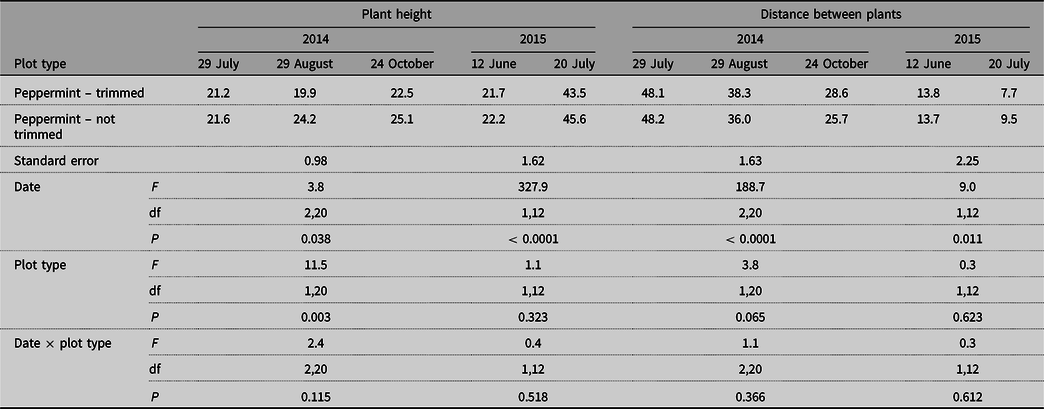
In 2014, but not 2015, trimming of peppermint resulted in significantly shorter plants, but trimming did not affect the distance between plants in either year (Table 1). In both years, peppermint plant height increased, and the distance between plants decreased over the sampling periods (Table 1).
Mean height of and distance (cm) between peppermint (Mentha × piperita) plants in a row adjacent to strawberry (cultivar Albion) in raised, plastic beds in 2014 and 2015 in research plots near Simcoe, Ontario. Peppermint transplants were set 26 June and 23 July 2014 at an initial spacing of 60 cm and trimmed every two weeks once plants began to flower.

Strawberry growth and yield
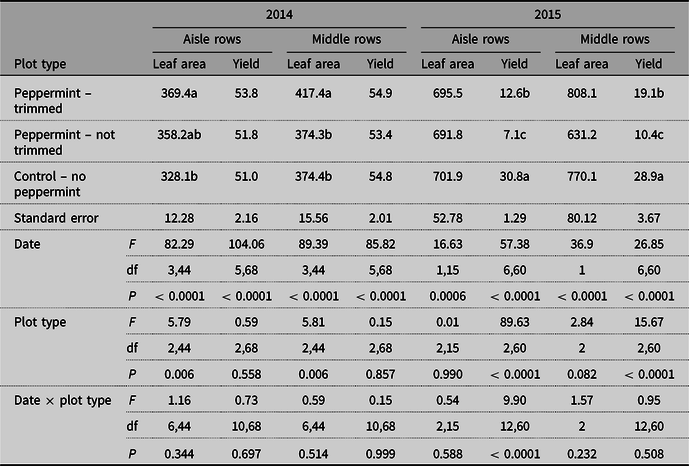
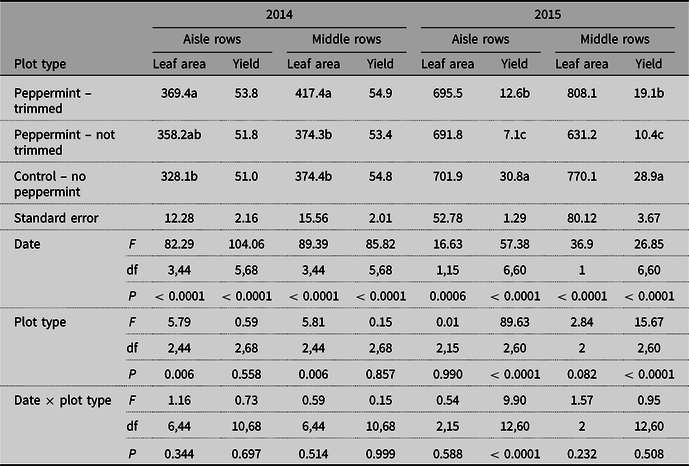
In 2014, leaf area but not yield was affected by growing peppermint next to strawberry plants (Table 2). In 2014, strawberry plants in aisle rows were larger in plots next to trimmed peppermint than in plots without peppermint, and in middle rows, strawberry plants next to trimmed peppermint were larger than plants in plots with peppermint that was not trimmed or without peppermint (Table 2). However, in 2015, yield but not leaf area was affected by growing peppermint next to strawberry plants (Table 2). In both aisle and middle rows in 2015, yield was highest in control plots without peppermint and lowest in plots with untrimmed peppermint (Table 2).
Results of analysis of variance on leaf area (cm2) and yield (number of ripe strawberries) per strawberry plant (cultivar Albion) from two strawberry rows adjacent to aisles or two rows in bed middles on four and five harvest dates in 2014 and 2015, respectively, in research plots near Simcoe, Ontario. Plots had a row of peppermint (Mentha × piperita) in the aisles along both sides of raised beds that was either trimmed every two weeks to minimise shading of the strawberries or not trimmed. For each column, means with the same letter are not significantly different (Tukey’s honestly significant difference test, α = 0.05).
Spotted-wing drosophila infestation
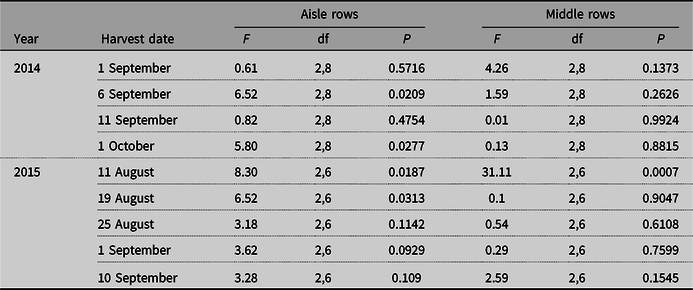
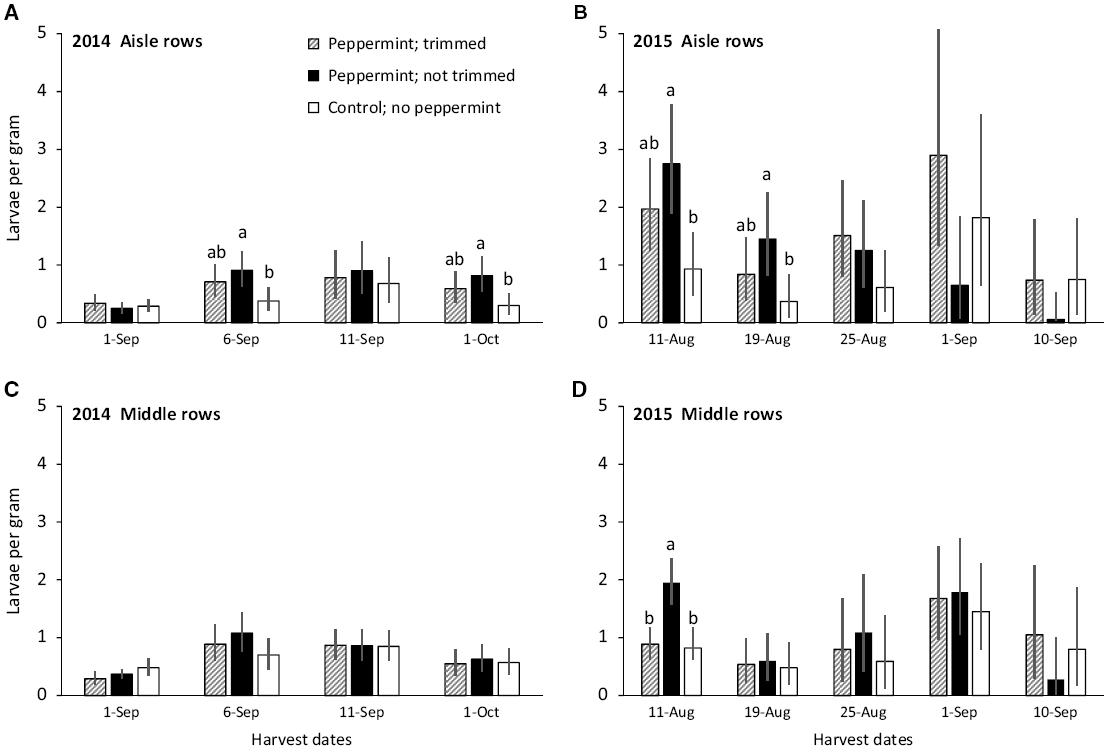
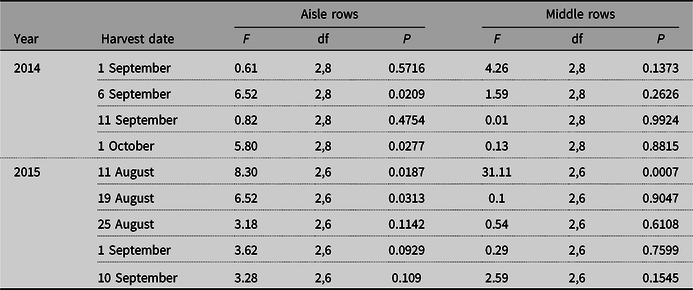
Growing peppermint next to strawberry plants affected numbers of D. suzukii larvae in ripe strawberries from aisle rows picked on 6 September and 1 October 2014, and on 11 and 19 August 2015 (Table 3). On these dates, more larvae were found in strawberries from plots with untrimmed peppermint compared to control plots without peppermint (Fig. 1). Growing peppermint next to strawberry plants also affected numbers of D. suzukii larvae in ripe strawberries from middle rows picked on 11 August (Table 3), with more larvae found in strawberries from plots with untrimmed peppermint compared to plots with trimmed peppermint or control plots (Fig. 1).
Results of analysis of variance for effects of plot type (peppermint, trimmed; peppermint not trimmed; control, no peppermint) on infestation levels of Drosophila suzukii larvae in ripe strawberries. Strawberries were harvested from aisle or middle rows of a four-row raised, plastic bed, with peppermint planted adjacent to the bed.
Mean (± 95% confidence intervals) numbers of Drosophila suzukii larvae per gram of ripe strawberry from two rows adjacent to aisles (A, B) or from two middle rows (C, D) in a four-row raised, plastic bed on four harvest dates in 2014 and five in 2015 in research plots near Simcoe, Ontario. Plots had either no peppermint (control) or a row of peppermint (Mentha × piperita) in the aisles along both sides of raised beds that was either periodically trimmed to minimise shading of the strawberries or not trimmed. For each date in each panel, means with the same letter are not significantly different (Tukey’s honestly significant difference test, α = 0.05). Aug, August; Sep, September; Oct, October.

Plant vacuuming for Hemipteran pests
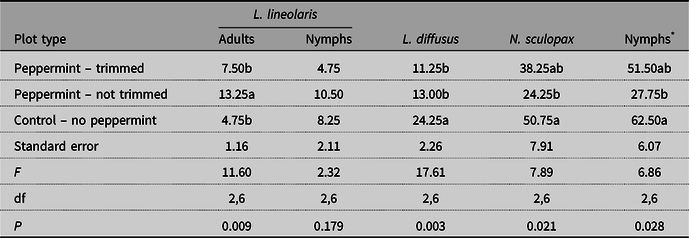
Lygus lineolaris was relatively uncommon in vacuum samples, but plot type significantly affected captures of adults (Table 4). More adults were found in plots with peppermint that was not trimmed than in plots with trimmed peppermint or control plots (Table 4). Plot type also significantly affected numbers of adult L. diffusus, N. scolopax, and hemipteran nymphs (Table 4). There were fewer adults of both species and nymphs in plots with untrimmed peppermint compared to control plots without peppermint (Table 4).
Results of analysis of variance on numbers of Lygus lineolaris, Ligyrocoris diffusus, and Neortholomus sculopax collected in vacuum samples from strawberry plants (cultivar Albion) in the mornings and afternoons of 21, 28 August and 3, 23 September 2015 in research plots near Simcoe, Ontario. Plots had a row of peppermint (Mentha × piperita) in the aisles along both sides of two adjacent raised beds that was either trimmed every two weeks to minimise shading of the strawberries or not trimmed. For each column, means with the same letter are not significantly different (Tukey’s honestly significant difference test, α = 0.05).
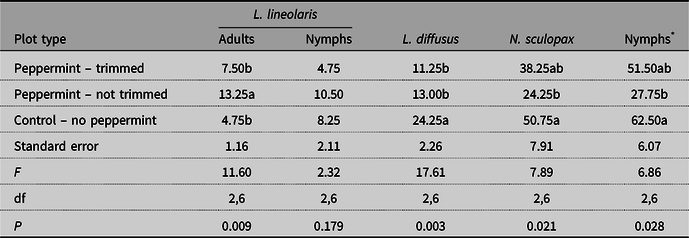
* Nymphs (Hemiptera) were not identified to species.
Discussion
Our results showed that interplanting peppermint in day-neutral strawberries did not reduce D. suzukii infestation levels in ripe fruit during the latter part of the growing season, when high populations of D. suzukii are typical. Peppermint plants grew rapidly, and by placing transplants close to strawberry plants, the yield of strawberry was reduced in the second year. Trimming peppermint plants to limit their size and potentially increase volatile concentration did not help reduce D. suzukii infestation, although D. suzukii infestation was less than in plots with untrimmed peppermint. The lack of a repellent or deterrent effect of peppermint plants may be due to interacting structural, chemical, and biological factors.
We propose that the lack of an effect of peppermint plants on D. suzukii in strawberries was due to the creation of favourable habitat, relatively low emissions of peppermint volatiles, and/or habituation of D. suzukii flies to peppermint volatiles. Drosophila suzukii has a strong diel periodicity with flight activity and other behaviours peaking at dawn and dusk when summer conditions are typically ideal (24–26 °C and high relative humidity) (Hamby et al. Reference Hamby, Kwok, Zalom and Chiu2013; Lin et al. Reference Lin, Zhai, Zhou, Li, Zhuang and Zhang2014; Evans et al. Reference Evans, Toews and Sial2017). During the day at peak temperatures, D. suzukii flies may seek shade and areas with lower temperatures. Strawberry fields are relatively unshaded, so the incorporation of peppermint likely created a more favourable environment for adult D. suzukii during hot days, which may have increased survival and reproduction, as suggested by the increased levels of fruit infestation observed.
Others have noted that repellent odours in the laboratory were not biologically relevant for D. suzukii in the field, as high levels were not maintained over a long period of time (Wallingford et al. Reference Wallingford, Connelly, Dore Brind’Amour, Boucher, Mafra-Neto and Loeb2016). Although the peppermint plants likely provided relatively constant volatile emissions, these levels were likely below biologically relevant levels. Future research on any repellent or deterrent will need to focus on determining biologically relevant concentrations in the laboratory and then quantifying volatile emissions in the field to determine whether a particular plant or extracted compound is likely to be effective. However, exposure to repellent volatiles over long periods of time, even amounts that are biologically relevant initially, may result in habituation of D. suzukii, as has been observed with other insect pests (e.g., Wang et al. Reference Wang, Guo, Zhang, Wu and Liu2008).
Interplanted peppermint also appeared to have a positive effect on L. lineolaris numbers. This effect is potentially detrimental to strawberry production, as L. lineolaris is an important pest of strawberries that often requires chemical management (Dumont and Provost Reference Dumont and Provost2019). The presence of well-established peppermint plants early in the spring (as was the case in 2015) has the potential to support the growth and development of both the first and second generations of L. lineolaris (Bostanian et al. Reference Bostanian, Mailloux, Binns and Thibodeau1990), resulting in a longer window for feeding damage and/or higher density of individuals across the season. Similar results have been found in other studies: the addition of wildflower borders or buckwheat planted as a trap crop increased L. lineolaris populations in adjacent strawberries compared to strawberries alone (McCabe et al. Reference McCabe, Loeb and Grab2017; Dumont and Provost Reference Dumont and Provost2019).
In contrast with L. lineolaris, Ligyrocoris diffusus and N. scolopax were most abundant in control plots without peppermint. Both L. diffusus and N. scolopax are common and widespread in North America (Larson and Scudder Reference Larson and Scudder2018), and the preferred habitat for L. diffusus has been described as open and unshaded, containing herbaceous vegetation (Sweet Reference Sweet1964). Therefore, the added shade provided by the peppermint plants may explain why L. diffusus was less common in these plots. Ligyrocoris diffusus is an oligophagous seed feeder (Sweet Reference Sweet1964) and may have been feeding on strawberry achenes. Host plants of N. scolopax belong to at least 13 plant families (Hamilton Reference Hamilton1983) and include both narrow-leaved mountain mint (Pycnanthemum tenuifolium Schrader (Lamiaceae)), a relative of peppermint, and several species in the family Rosaceae, to which strawberry also belongs. These associations likely explain the presence of large numbers of N. scolopax in our plots, but not necessarily the lower numbers in peppermint plots. Although we directly observed L. diffusus and N. scolopax on strawberry fruits, it was unclear if their presence affected strawberry yields.
By placing peppermint plants directly adjacent to strawberry beds, strawberry plant growth was increased in the first year of our study, but yield was reduced in the following year. In other agricultural systems, intercropping herbs also resulted in a positive effect on growth of the main crop, most notably in new fields (Bustos et al. Reference Bustos, Pohlan and Schulz2008; Booker et al. Reference Booker, Bennett, Cong, Daniell, George and Hallett2014). Strawberry yields as much as 36% lower in untrimmed peppermint plots than in control plots in the second year were likely due to a combination of shading and/or competitive effects of peppermint on strawberry plants. Trimming peppermint every two weeks had little effect on plant height compared to untrimmed peppermint. Therefore, trimming could have been more aggressive or frequent to reduce shading of strawberries and increase amounts of repellent volatiles released. Lygus lineolaris feed directly on the exposed achenes of strawberry caused “cat-facing” and deformed fruit (Handley and Pollard Reference Handley and Pollard1993; Dale et al. Reference Dale, Hughes, Hallett, Galic and Rougoor2007). Although we did not quantify unmarketable fruit by damage type, it is likely marketable yield was also reduced in peppermint plots due to L. lygus since it was not explained by the presence of D. suzukii.
In conclusion, planting peppermint adjacent to day-neutral strawberries did not suppress D. suzukii or L. lineolaris abundance and reduced crop productivity. It is therefore not an advisable strategy for improving management of these pests in this cropping system. We chose peppermint because its essential oil was a promising repellent and deterrent in the laboratory, and we expected that having a constant supply of repellent volatiles from the plants would overcome the need to frequently reapply highly volatile essential oils in a field setting. However, research on the use of aromatic plants or crops to manipulate D. suzukii behaviour for pest management should not be abandoned. Plants and flower volatiles of sweet alyssum (Lobularia maritima Linnaeus (Desvaux) (Brassicaceae)) are repellent to D. suzukii in our preliminary laboratory assays, and, in contrast to peppermint, sweet alyssum has a low, compact growth form that is unlikely to provide additional shade in a strawberry field. Drosophila suzukii continues to be the most significant pest of temperate berry crops in many regions worldwide, and effective alternative management practices that reduce reliance on insecticides are needed.
Acknowledgements
The authors are grateful to numerous summer students for assistance in the field; to Adam Dale, Toktam Taghavi (University of Guelph), and Pam Fisher (Ontario Ministry of Agriculture, Food, and Rural Affairs) for advice on growing strawberries; and to John Cooper (Strawberry Tyme) for preparing the strawberry beds. This project was supported through The Ontario Ministry of Agriculture, Food and Rural Affairs-University of Guelph Sustainable Production (Plants) Programme funding to R.H.H.