Assigning a grammatical structure to an input string presupposes knowledge of the combinatorial rules and grammatical constraints that apply in the language being processed. At the same time, however, successful grammar building presupposes the availability of appropriate mechanisms for processing the linguistic input (compare Chaudron, 1985; Fodor, 1998a, 1998b, 1999; Valian, 1990). This apparent acquisition paradox poses a challenge for theories of first (L1) and second language (L2) acquisition that requires our existing knowledge of language learners' grammatical development to be supplemented by a detailed and systematic investigation of their grammatical processing routines. Although several decades' worth of psycholinguistic research has greatly increased our understanding of how mature readers and listeners process their native language in real time, psycholinguistically informed research into language learners' processing mechanisms and strategies is comparatively scarce. Many researchers have put forward theoretical models or ideas about grammatical processing in language learners (see, e.g., Crain & Wexler, 1999; Fodor, 1998a, 1999, for children; Andersen, 1993; Carroll, 2001; Clahsen, 1984; Gregg, 2003; Hulstijn, 2002; Pienemann, 1998; VanPatten, 1996, for L2 learners), while at the same time providing little experimental psycholinguistic evidence on the way learners process the target language in real time. Instead, most previous studies investigating language learners have focused on the acquisition of linguistic knowledge in children or adult learners.
During the past few years, however, a number of research teams in Europe and North America have begun to study the mechanisms language learners employ to process sentence-level and word-level information in real time, by applying experimental techniques familiar from the adult processing literature to the study of child and adult language learners. The preliminary picture that has emerged thus far suggests that there are characteristic differences between the way mature monolingual speakers, child L1 learners, and adult L2 learners process the target language.
First, language learners may have difficulty with the on-line integration of different information sources, in contrast to adult native speakers, who have been shown to rapidly integrate lexical, discourse-level, prosodic, and structural information during on-line processing. Several studies have found that in parsing temporarily ambiguous sentences children rely primarily on structural information while ignoring lexical–semantic and contextual cues, unlike adult native speakers (Felser, Marinis, & Clahsen, 2003; Traxler, 2002; Trueswell, Sekerina, Hill, & Logrip, 1999). The opposite pattern has been found for adult L2 learners, who seem to rely more on nonstructural information in parsing ambiguous sentences (Felser, Roberts, Gross, & Marinis, 2003; Papadopoulou & Clahsen, 2003). Late L2 learners also appear to be less efficient in using prosodic cues to interpretation than adult native speakers (Akker & Cutler, 2003). It is not clear how such apparent difficulties to integrate different types of information during parsing are to be interpreted. They may be indicative of qualitative differences between language learners' and mature native speakers' processing systems, or result from more general cognitive limitations in language learners such as a shortage of working memory resources in children and nonnative comprehenders.
Second, language learners may process the target language less rapidly than adult native speakers, possibly reflecting a lack of automaticity (Segalowitz, 2003). Several studies using time-course sensitive measures such as event-related brain potentials (ERPs) have indicated delays in L2 processing. ERP studies investigating lexical–semantic processing in L2 learners obtained N400 effects for semantic anomalies (Ardal, Donald, Meuter, Muldrew, & Luce, 1990; Hahne, 2001; Hahne & Friederici, 2001; Weber-Fox & Neville, 1996) and pronounceable nonwords (McLaughlin, 1999) that had a delayed peak latency compared to native speakers (see Hahne, 2001; Hahne & Friederici, 2001; Weber-Fox & Neville, 1996). Similarly, morphosyntactic violations elicited a later onset and/or longer duration of language-specific ERP components in adult L2 learners than in native speakers (Hahne, 2001; Sabourin, 2003; Weber-Fox & Neville, 1996).
Third, properties of L2 learners' native language might influence the way they process the L2 input. If learners transfer L1 processing strategies that are inappropriate for processing their L2, then this could well be a barrier to acquiring full nativelike competence and/or fluency in the L2. The experimental results currently available on this question are, however, far from conclusive. Although some studies investigating on-line sentence processing in the L2 have found evidence for L1 influence on parsing (see, e.g., Frenck-Mestre & Pynte, 1997; Juffs, 1998a, 2005), other studies failed to find any effect of learners' L1 background on their L2 processing performance (Felser, Roberts, Gross, & Marinis, 2003; Papadopoulou & Clahsen, 2003; Roberts, Marinis, Felser, & Clahsen, 2004; Williams, Möbius, & Kim, 2001).
Fourth, language processing mechanisms available to mature native speakers may only be partially accessible to language learners. One specific hypothesis as to how L2 language processing might differ from L1 processing has been put forward by Ullman (2001). He argues that, although the linguistic representation and processing of one's native language involves two different brain memory systems, a lexical store of memorized words that is rooted in temporal lobe structures, and a procedural memory system that is involved in processing combinatorial rules and is rooted in frontal brain structures, L2 processing and representation is largely dependent upon the lexical (or “declarative”) memory system (compare also Paradis, 1994, 1997, 2004).
Clearly, all four of these hypotheses are in need of further testing. Although the findings from child L1 and adult L2 processing studies have potentially far-reaching implications for theories and models of language acquisition, language processing, and the neuroscience of language, there exists at present no empirically based model of how grammatical processing in language learners differs from that of mature native speakers. The purpose of this article is to take some steps in this direction. By providing a detailed comparison of on-line grammatical processing in children and L2 learners we will explore the idea that there might be fundamental differences between child L1 and adult L2 processing, akin to what has previously been argued for the acquisition of grammatical knowledge (Bley-Vroman, 1990; Clahsen & Muysken, 1986, 1989, 1996).
MORPHOLOGICAL PROCESSING IN LANGUAGE LEARNERS
Much work in linguistic theory assumes that the language faculty has a dual structure and consists of two basic components, a lexicon of (structured) entries and a computational system of combinatorial operations for forming larger linguistic expressions from lexical entries. In the domain of morphology, psycholinguistic studies investigating the dual structure of language have focused on the contrast between regular and irregular inflection. This research has employed different psycholinguistic methods and techniques and has led to a number of consistent and replicable experimental results suggesting that adult native speakers employ two distinct mechanisms for processing and mentally representing morphologically complex words: an associative system of full-form representations stored in lexical memory, and a set of rulelike operations for decomposing inflected and derived words into their morphological constituents (see Clahsen, 1999; Marslen-Wilson & Tyler, 1998; Pinker, 1999, for review).
Consider, for example, experiments using ERPs. Active neurons in the brain produce electrical activity that can be measured by electrodes placed on the scalp. Psycholinguists are concerned with isolating the electrical activity associated with a specific task (ERPs) from background activity with the aim of identifying the electrical components associated with a given linguistic stimulus (for reviews, see Kutas & Schmitt, 2003; Osterhout & Holcomb, 1995). With respect to morphological processing, three ERP studies examining adult native speakers of German compared brain responses to correctly formed inflected words to brain responses for words that were formed using an incorrect ending. Two types of violation were tested: regularizations, formed by adding a regular suffix to a verb or noun that requires an irregular one, and incorrect regulars, in which a verb or noun that takes the regular default suffix appeared with a different incorrect ending. Penke, Weyerts, Gross, Zander, Münte, and Clahsen (1997) examined participle formation in three experiments, Weyerts, Penke, Dohrn, Clahsen, and Münte (1997) and Lück, Hahne, Friederici, and Clahsen (2001) noun plurals. Penke et al. (1997) and Weyerts et al. (1997) presented their stimuli visually, Lück et al. (2001) auditorily. In all these experiments, an anterior negativity between 300 and 800 ms was found for regularizations (which was larger over the left than over the right hemisphere). Moreover, Lück et al. (2001) found a centroparietally distributed positivity (P600) in the 800- to 1200-ms time window for regularizations. For incorrect regulars, both the visual and the auditory studies on plurals elicited a central N400-like negativity compared to their correct counterparts. These results were interpreted as supporting a dual-mechanism account of morphological processing. From this perspective, regularizations are combinatory violations, that is, misapplications of the participle -t or the plural -s to (irregular) verbs or nouns that would normally block these rules, to produce illegal stem plus affix combinations. By contrast, irregular inflection is based on full-form storage, and misapplications of irregular inflection produce unexpected or anomalous words as indicated by the central N400 effect for (plural) irregularizations.
These findings raise the question of whether the two mechanisms for morphological processing (full-form storage and decomposition) are also employed by language learners. Unfortunately, however, very little is known about on-line morphological processing in language learners. There are a few studies on adult L2 processing of past-tense forms, but the results are largely inconclusive (see Hahne, Müller, & Clahsen, 2006, for discussion), and for children we are not aware of any published study investigating on-line morphological processing. Against this background, we examined two systems of German inflection, participle formation and noun plurals, in groups of child L1 and adult L2 learners using behavioral and ERP experiments (Clahsen, Hadler, & Weyerts, 2004, Hahne et al., 2006, Lück et al., 2001). The following presents a brief summary of the findings from these studies.
Children's processing of inflected words
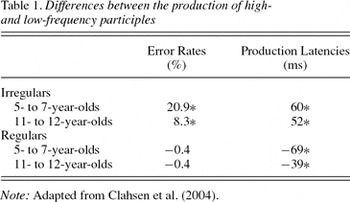
Clahsen et al. (2004) examined the production of regular and irregular participle forms of German with high and low frequencies using a speeded production task. Forty children in two age groups (5- to 7-year-olds, 11- to 12-year-olds) and 35 adult native speakers of German listened to stem forms of verbs presented in a sentential context and were asked to produce corresponding participle forms as quickly and accurately as possible. Dependent variables were the participants' participle-production latencies and error rates. Table 1 presents a summary of the main findings on the two groups of children. The scores in Table 1 display the percentages of error and the production latencies for high-frequency participle forms subtracted from those of low-frequency ones; cases in which these differences were significant are indicated by an asterisk. A positive value reflects an advantage, a negative one a disadvantage for high-frequency forms.

Children's production of participle forms revealed clear regular/irregular contrasts. Regular inflectional forms (i.e., the unmarked stem and the regular -t participle suffix) were overapplied to verbs that require irregular forms in the adult language (8.3 and 20.9%, respectively), whereas overapplications of irregular patterns to verbs that are regularly inflected in the adult language were extremely rare (less than 1%). Regulars and irregulars were also affected by frequency, but in different ways. The error rates shown in Table 1 reveal a significant frequency advantage for irregulars, with more errors on low-frequency irregular verbs than on high-frequency ones, but not for regulars. Contrasts between regulars and irregulars are also evident from the production latencies: high-frequency irregular participles were produced significantly faster than low-frequency ones, whereas regular participles yielded a reverse frequency effect, that is, significantly longer production latencies for high-frequency forms than for low-frequency ones.
The finding that high-frequency irregulars are produced more quickly than low-frequency ones and elicit fewer overregularization errors indicates that irregular participles have full-form memory representations in the children's lexicon. If an inflected word form is stored in the mental lexicon, then retrieval should be faster for high-frequency forms than for low-frequency ones, and this contrast should be reflected in different production latencies. Moreover, memory storage and retrieval are dependent on frequency of exposure, and hence, low-frequency forms should yield more errors than high-frequency ones. The results reported above are compatible with these expectations. By contrast, the suffixation errors (i.e., -t overregularizations) are the result of the child's applying a regular (-t) suffixation rule in cases in which the lexical entry for an irregular participle form is not available. Likewise, overapplications of the unmarked stem form to participles that require irregular stems arise when specific stem information is not available or not accessible to children. In such cases, they fall back on the base entry, producing errors such as *gefinden instead of the correct gefunden (found). In this way, the unmarked base stem serves as a default form in circumstances in which the required irregular forms are not retrieved. An explanation for the reverse frequency effect for regulars that was also seen in some previous studies with adults (Beck, 1997; Prasada, Pinker & Snyder, 1990) is offered by Pinker (1999). He argues that the production of an inflected word invokes both lexical lookup and the rule route, and that the lexical memory system is connected to the computational (“rule”) system by an inhibitory link. Thus, the activation of a stored whole-word representation turns off the rule, a mechanism that is independently required to account for the so-called blocking effect, that is, the fact that an irregular form blocks the application of the rule, for example, sang blocks *singed. Pinker claims that high-frequency regulars (but not low-frequency ones) have whole-word representations stored in memory. Thus, the production of high-frequency regulars involves memory access, which interferes with the rule route. This produces extra processing costs and slows down the production of high-frequency regulars relative to low-frequency ones for which the rule route is not impeded by any stored forms.
The study of children's speeded production of participles revealed regular/irregular contrasts parallel to those reported for adults, suggesting that the two mechanisms for morphological processing (lexical storage and morphological decomposition) are also employed by children. Children's production of participle forms was found to be different from adults' in three respects: higher overregularization rates, longer production latencies, and stronger and more consistent reverse frequency effects for regulars. These differences can be attributed to slower and less accurate lexical access and retrieval in children than in adults. Overregularization errors arise when access to the lexical entry of an irregular form fails (see Marcus et al., 1992). Consequently, we expect children to produce more such errors than adults. That children take longer to produce participles is also consistent with slower lexical access in children than in adults. Finally, reverse-frequency effects arise from the retrieval of stored high-frequency regulars that inhibit the rule route (Pinker, 1999). If lexical retrieval is relatively slow, then it will take longer to block the rule route, and thus the consistent reverse frequency effects in both groups of children.
In a second study we investigated children's on-line comprehension of German noun plurals using the ERP violation paradigm (Lück et al., 2001). Three age groups of children (6- to 7-year-olds, 8- to 9-year-olds, 11- to 12-year-olds) and an adult control group listened to sentences containing plural forms in two conditions: correct irregular or incorrect (overregularized) plurals (…Tuben/*Tubes…[tubes]), and correct/incorrect regular plural forms (e.g.,…Waggons/*Waggonen…[wagons]). ERPs were timelocked to the onset of the critical noun plurals and were averaged for a time window of 200–1500 ms. Recall that previous studies with adults yielded a left anterior negativity (LAN) for overregularized plural forms (relative to the correct ones) followed by a centroparietal positivity (P600), and an N400 for incorrect regulars. The question Lück et al. (2001) addressed was whether these components are also present in children.
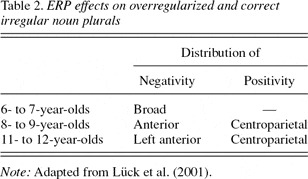
Although plural overregularizations (condition 1) yielded consistent ERP effects in the children (see below), there was no N400 or any other significant difference between incorrect and correct regulars (condition 2) in either group of children, indicating that they were sensitive to overregularized plurals (*Tubes), but not to violations such as *Waggonen. The contrast observed in the ERP results was confirmed by an additional elicited production task in which the children were found to reliably produce the correct plural forms of the condition 1 items (e.g., Tube), with a mean accuracy score of 98%, whereas for the condition 2 items they performed at chance level (mean accuracy=51.8%). The children were not confident of the correct plural forms of the condition 2 items (perhaps because most of the items used in this condition were loan words), and as a result violations such as *Waggonen did not yield any measurable ERP effect. By contrast, the ERP results for condition 1 show that the children were sensitive to plural overregularizations. Table 2 indicates the distribution of the two ERP waveforms for correct plural forms subtracted from the corresponding overregularized ones.

Two groups of children (8- to 9-year-olds, 11- to 12-year-olds) showed a biphasic ERP waveform to incorrect noun plurals, that is, a frontal negativity followed by a centroparietal positivity, parallel to the pattern seen in adults. The timing of these two ERP components with the negativity having an earlier onset than the positivity was also parallel to the one for adults. In previous studies on adults, the anterior negativity was interpreted as signaling rule-based morphological processing. An -s overregularization such as *Tubes is word-internally decomposed into stem plus affix, and the item Tube is identified as a noun that takes an irregular plural form and therefore blocks the -s rule. The later positivity suggests that regularization errors cause additional processing at a sentence-level stage, perhaps because participants try to repair or reanalyze the regularized plural form before integrating it with the rest of the sentence. According to Lück et al.'s (2001) findings, effects of these processes are also seen in children above the age of 8. By contrast, the younger group of children displayed an unspecific broad negativity and no positivity. It is not quite clear what this ERP response might mean. One possibility would be that the younger children failed to identify the overregularized plurals as inflected forms of existing German words, perhaps because the -s plural rule was not yet completely stable and automatized. Independent evidence for that comes from the fact that in the elicited production task, the 6- to 7-year-olds achieved low accuracy scores for nouns requiring -s plurals (mean 29.4%). As a result, they may have perceived items such as *Tubes as unanalyzed wholes, in which case the negativity could be taken as an ERP response to a pronounceable nonword.
Adult L2 learners' processing of inflected words
There are four L2 studies employing speeded production or grammaticality judgment tasks to investigate the processing of inflected words (Beck, 1997; Birdsong & Flege, 2000; Brovetto & Ullman, 2001; Lalleman, van Santen, & van Heuven, 1997). The findings from these studies are inconsistent and partly surprising. Whereas the native speaker controls showed a consistent response-time advantage for high-frequency irregulars (but not for high-frequency regulars) in all experiments, most studies failed to replicate this contrast for the L2 learners. The L2 learners' results on regulars were even less conclusive (see Hahne et al., 2006, for discussion).
As the available behavioral studies have not been able to provide a clear picture of morphological processing in an L2, Hahne et al. (2006) used ERPs to investigate how L2 learners process inflected words on-line. Two inflectional systems of German, participle formation and noun plurals, were examined in a group of advanced L2 learners with Russian as L1 who had learned German after childhood. Hahne et al. (2006) adopted the designs and materials of previous ERP violation experiments with native speakers of German, from Penke et al. (1997) for participles and from Lück et al. (2001) for noun plurals. In both cases, participants were presented with sentences containing two types of violation: overregularizations and incorrect regulars. In addition to the ERP experiments, Hahne et al. (2006) performed two elicited production tasks with the L2 learners after the EEG sessions, in which participants were given uninflected verb and noun forms of the test items used in the ERP experiments and were asked to produce the corresponding participle and noun plural forms. Performance in these two tasks was good (>95% correct for participles, >86% for plurals) indicating that the participants were familiar with the critical items and their correct inflected forms.
Table 3 presents an overview of the ERP effects that Hahne et al. (2006) obtained for L2 learners and, for convenience, the corresponding results from adult native speakers of German. Table 3 illustrates that the group of advanced L2 learners studied by Hahne et al. (2006) responded differently to violations of regular and irregular inflection during on-line morphological processing. For misapplications of regular rules of inflection, they showed ERP effects that have independently been argued to tap morphosyntactic processing, namely an anterior negativity and/or a P600, whereas misapplications of irregular inflection revealed an ERP effect (the N400) that has been claimed to be characteristic of lexical processing and interpretation. The brain responses seen in L2 learners for these two kinds of morphological violation suggest that the two processing routes posited by dual-mechanism models of inflection (lexical storage and morphological decomposition) are also accessible and employed by L2 learners. Note, however, that although N400 and P600 effects were seen in both the native speakers and the L2 learners, early anterior negativities in the L1 speakers were more focal and consistent across experiments than in the L2 learners. Moreover, whereas the anterior negativity had its maximum at left frontal sites in the L1 speakers, it was observed bilaterally in Hahne et al.'s L2 group. Topographic variations of anterior negativities in this time range have also been observed in a number of ERP studies with adult native speakers, though; see, for example, Rodriguez-Fornells, Clahsen, Lleo, Zaake, and Münte (2001) for Catalan, Gross, Say, Kleingers, Münte, and Clahsen (1998) for Italian, and Weyerts, Penke, Münte, Heinze, and Clahsen (2002) for German, who found either bilateral negativities or even effects at right anterior sites. Both in terms of its timing and its distribution, the anterior negativity Hahne et al. (2006) found for the L2 learners falls within the range of variation that has been observed in studies with native speakers and can be taken to be an instance of a “morphosyntactic negativity,” an ERP waveform that is clearly different from the centroparietal N400, which has been found to be associated with lexical–semantic processing (see, e.g., Osterhout, 1997).

In native speakers of German, a LAN was found in three different experiments on participles (Penke et al., 1997) and in both the visual and the auditory ERP studies on noun plurals (Lück et al., 2001; Weyerts et al., 1997). In the L2 learners, an anterior negativity was found for participles but not for noun plurals. Given that the anterior negativity reflects early automatic processes of word-internal morphological decomposition, these results suggest that L2 learners employ these processes for participles but not for plurals. Proficiency differences are likely to be responsible for this contrast. An independent elicited production task with the L2 participants on the critical items used in the two ERP experiments yielded considerably worse correctness scores for plurals than for participles. For plurals, 14% of the elicited forms given by the L2 participants were incorrect, whereas there were hardly any errors for participles, indicating that the L2 learners were less confident in plural than in participle formation. Thus, it seems that the L2 learners are not only more confident in forming participles than noun plurals, their processing of participles is also more nativelike than that of plurals.
Preliminary summary
Clearly, more research on morphological processing in language learners is needed before any strong conclusions can be drawn. However, what the results from the above studies suggest is that child L1 learners (at least in the age range under study) do not fundamentally differ from adult native speakers in how they represent and process morphologically complex words. The two mechanisms that mature speakers have been shown to employ for morphological processing (lexical storage and morphological decomposition) are also used by children. Lexical storage effects were seen in the on-line production of irregular participles, and evidence for morphological decomposition comes from the speeded production and ERP studies. Differences between children's and mature speakers' processing of inflected words were argued to be due to slower lexical access and retrieval or to incomplete acquisition. The dual processing system, however, appears to be the same for children and adults.
In regard to L2 learners, the N400 effects seen for irregularizations are indicative of lexical storage of irregulars, parallel to what has been claimed for native speakers. This is compatible with previous studies investigating lexical–semantic processing in L2 learners and bilinguals in which N400 effects were obtained for semantic anomalies (Ardal et al., 1990; Hahne, 2001; Hahne & Friederici, 2001; Weber-Fox & Neville, 1996) in nonnative speakers that were similar to those found in monolingual studies. Likewise, the finding that P600 effects were seen in the L2 learners in the same conditions as for native speakers is compatible with previous ERP studies of syntactic processing in nonnative speakers, which demonstrated P600 effects for phrase-structure violations (Hahne, 2001; Weber-Fox & Neville, 1996) and violations of subject–verb agreement and gender concord (Sabourin, 2003). Finally, the fact that the learners' proficiency in the L2 seems to affect the ERP findings is also familiar from previous studies. For example, Friederici, Steinhauer, and Pfeifer (2002) report findings from an artificial grammar experiment in which adult subjects were trained on an artificial language system (BROCANTO) to a level at which they were highly proficient and produced hardly any errors. A subsequent ERP experiment examining syntactic violations in BROCANTO revealed the biphasic ERP pattern familiar from comparable studies of natural language processing in native speakers, that is, an early negativity followed by a P600. Taken together, these results suggest that at least in domains in which they are highly proficient, L2 learners can employ the same mechanisms for morphological processing as L1 speakers.
LANGUAGE LEARNERS' PROCESSING OF AMBIGUOUS SENTENCES
Adult monolingual sentence processing is fast, efficient, and highly automatized. Grammatical structures are built incrementally during comprehension, with each new incoming word or phrase being integrated into the current partial representation as soon as possible (see, e.g., Pickering, 1999). How does the parser deal with input that is compatible with more than one grammatical analysis though? Investigating how readers or listeners resolve structural ambiguities in real time can tell us something about the parsing heuristics and types of information used during sentence processing.
Previous research has shown that adult native speakers are able to access different knowledge sources and integrate both bottom-up and top-down information rapidly and without difficulty when processing their native language (see Gibson & Pearlmutter, 1998, for a review). Proponents of modular or multistage models of sentence processing have argued that grammatical information is privileged in that it is utilized earlier during processing than other types of information, with initial parsing decisions being determined by a narrow set of universal, phrase structure based “least effort” principles (Frazier, 1978). The parser's preference for the structurally simplest analysis, for example, is assumed to give rise to the well-known garden-path effect elicited by temporarily ambiguous sentences such as The log floated down the river sank. Here, the verb floated is initially analyzed as a main verb rather than as a participle introducing a reduced relative clause, an error that does not become apparent until much later, requiring substantial reanalysis. In contrast, probabilistic or experience-based models such as the tuning hypothesis (Cuetos, Mitchell, & Corley, 1996; Mitchell & Cuetos, 1991) claim that ambiguity resolution preferences are determined primarily by an individual's history of past exposure to a particular linguistic pattern.
Although studies using time-course sensitive methods such as ERPs (see Friederici, 2002, for a review) or the speed–accuracy trade-off procedure (McElree & Griffiths, 1995, 1998) have provided support for syntax-first models of L1 sentence processing, native speakers' ambiguity resolution preferences have also been found to be affected by a variety of other factors including individual working memory constraints, lexical–semantic information such as verb argument structure and thematic requirements, as well as prosody, discourse-level, and probabilistic information (Gibson & Pearlmutter, 1998).
Only a small number of studies have examined how children or L2 learners resolve structural ambiguities in real time. Although children's grammatical development is generally assumed to be complete by around age 6, their processing system may be more constrained by their relatively limited cognitive capacities, such as a reduced working memory span, than the adult processing system. If this is correct, then we might expect that children have more difficulty than adults accessing different knowledge sources and evaluating different types of information in parallel, and children's slower speed of lexical access and retrieval may cause ambiguity resolution to be temporally delayed relative to adults'.
The cognitive development of postpuberty L2 learners, by contrast, is usually complete by the time they start acquiring a L2, and they already possess a fully developed processing system for their native language. However, considering the increased processing demand caused by having to identify words and phrases in a nonnative language (compare, e.g., Harrington, 1992; Segalowitz & Segalowitz, 1993), L2 ambiguity resolution may be delayed relative to ambiguity resolution in the L1. This additional drain on working memory resources may also result in less efficient integration of different types of information (Kilborn, 1992). It is further conceivable that properties of the L1 lexicon or grammar affect the processing of the L2, or that language-specific L1 processing strategies are transferred to the L2, resulting in nonnativelike parsing decisions. Incomplete grammatical acquisition is another potential source of L1/L2 processing differences. As successful parsing relies on the availability of the relevant grammatical knowledge, nontargetlike properties of a learner's interlanguage grammar may give rise to nonnativelike processing behavior. Experience-based models of language acquisition and processing (MacWhinney, 1997; Mitchell & Cuetos, 1991; among others) also predict transfer of L1 ambiguity resolution preferences, but would attribute these to insufficient past exposure to the relevant linguistic patterns in the L2.
In the following, we compare existing findings on child L1 and adult L2 ambiguity resolution, with the aim of highlighting some rather fundamental differences in the way these two types of learners process structurally ambiguous input.
Children's processing of ambiguous sentences
Results from several studies of children's ambiguity resolution preferences suggest that children are more restricted than adults in their ability to make use of lexical–semantic and pragmatic information during parsing. Evidence for children's reduced ability to use lexical–semantic cues to disambiguation comes from a self-paced listening study by Felser et al. (2003). Felser et al. investigated how 6- to 7- and 10- to 11-year-old English-speaking children and adults processed relative clause attachment preferences in sentences such as The doctor recognized the nurse of (with) the pupil who was feeling very tired. Previous research on adult native speakers has shown that disambiguation preferences are affected by the type of preposition joining the two potential antecedent noun phrases (NPs). NP2 disambiguation (i.e., associating the relative clause with the pupil) is preferred cross-linguistically if the two possible antecedent NPs are joined by a thematic preposition such as with (Carreiras & Clifton, 1999; Gilboy, Sopena, Clifton, & Frazier, 1995; among others). For antecedent NPs joined by the case-assigning preposition of or its translation equivalents, on the other hand, attachment preferences have been found to vary across languages (Cuetos et al., 1996; Gilboy et al., 1995). One explanation for the robust NP2 preference for NPs linked by semantically contentful prepositions is that prepositions such as with create a local thematic domain of their own, and that the parser prefers to associate ambiguous modifiers with material inside local thematic domains (Frazier & Clifton, 1996). In the absence of such lexical biases, attachment preferences are determined by other factors including phrase structure based locality principles (Gibson, Pearlmutter, Canseco-Gonzales, & Hickock, 1996).
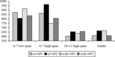
Figure 1 provides an overview of the different participant groups' mean reaction times to the disambiguating auxiliary in Felser et al.'s (2003) study. Only the adult group in Felser et al.'s (2003) study showed a significant interaction between preposition and attachment, indicating that their attachment preferences were influenced by the type of preposition involved. The children differed from the adult controls in that their disambiguation preferences were not affected by the type of preposition (of vs. with) at all. Instead, the younger children's on-line attachment preferences were found to interact with their working memory span as measured by Gaulin and Campbell's (1994) listening span test for children. Although both groups of high-span children showed a preference for NP1 attachment irrespective of the preposition involved, the low-span 6- to 7-year-olds showed an overall preference for NP2 disambiguation. These results suggest that depending on their listening span, the children applied one of two different phrase structure based locality principles during parsing. Whereas high-span children seemed to follow a “predicate proximity” strategy according to which ambiguous modifiers are attached as close as possible to the main predicate (compare Gibson et al., 1996), low-span children tended to associate the relative clause with the most recently processed NP, in accordance with the “recency” principle. Note that although the older children's reaction times were as fast as the adults' overall, the 10- to 11-year-olds showed the same nonadultlike pattern of preferences as did the younger high-span children, a preference for NP1 attachment irrespective of the type of preposition.1
We only report the results from the high-span 10- to 11-year-olds (n=26) here because the number of low-span children in this age group was too small to allow for a statistical comparison.

Overview of children's and adults' mean listening times (ms) on the disambiguating segment (Felser et al., 2003).
Results from a reading-time study by Traxler (2002) provide further evidence for children's tendency to choose the structurally simplest analysis, and show that they will do so even if this analysis is semantically inappropriate. Traxler examined 8- to 12-year-old children's processing of sentences containing temporary subject–object ambiguities such as When Sue tripped the girl (the table) fell over and the vase was broken, manipulating the plausibility of the ambiguous NP as a direct object of the preceding verb. The children tended to analyze the postverbal NP as a direct object regardless of whether or not this analysis was in fact plausible. A similar (albeit weaker) preference for the structurally simpler direct object analysis was observed even for intransitive verbs.
Results from a number of other studies have shown that children are less able than adults to take referential information into account during on-line ambiguity resolution, and provide further evidence for children's “least effort” approach to parsing. Trueswell et al. (1999) investigated 4- to 5-year-old children's processing of sentences containing temporary prepositional phase (PP)-attachment ambiguities such as Put the frog on the napkin in the box. Children's eye movements and actions were recorded as they responded to an experimenter's instructions to move objects around on a table. The visual context was manipulated (“one frog” vs. “two frog” contexts) so as to support either a verb phrase (VP) modifier or NP modifier reading of on the napkin. Whereas adults' attachment decisions were influenced by the type of context, in accordance with the referential principle (Altmann & Steedman, 1988; Crain & Steedman, 1985), the children interpreted the postverbal PP as the destination argument of the verb put in both one-referent and two-referent contexts. The fact that the children opted for the syntactically simpler VP-modifier analysis even in NP-modifier contexts suggests that children, unlike adults, are unable to integrate referential information provided by the visual context during on-line ambiguity resolution. The authors' observation that the children frequently performed inappropriate actions even after receiving disambiguating linguistic information moreover indicates that they are less able than adults to revise their initial analysis.
Results from a similar eye-movement study by Snedeker, Thorpe, and Trueswell (2001) confirmed children's inability to make use of referential information during sentence comprehension but indicated that 4- to 5-year-old children, like adults, were sensitive to verb bias when resolving PP-attachment ambiguities. That is, both children's eye movements and their actions in response to sentences like Examples 1a and 1b below revealed that they preferred the VP-modifier interpretation only for “instrument bias” verbs such as tickle in Example 1b but not if the stimulus sentences contained a “modifier bias” verb such as choose in Example 1a.
1. a. Choose the cow with the stick. (modifier bias)
b. Tickle the pig with the fan. (instrument bias)
There is evidence, however, that children are not generally impervious to pragmatic information during language processing. Hurewitz, Brown-Schmidt, Thorpe, Gleitman, and Trueswell (2000) found that 4- to 5-year-old children were able to make use of the referential context in a production task, suggesting that their apparent inability to use contextual information may be task specific. The results from an act-out experiment reported in Meroni and Crain (2003), who used materials similar to Trueswell et al.'s (1999) but that involved two equally salient potential referents, also demonstrate that children are able to take referential information into account in off-line tasks. It is thus conceivable that only in situations of increased processing demand, such as during on-line comprehension tasks, do children prioritize on bottom-up information and disregard the referential context.
An eye-tracking study by Sekerina, Stromswold, and Hestvik (2004) on 4- to 7-year-olds' interpretation of ambiguous pronouns revealed a discrepancy between children's eye movements and their choices in a picture-selection task. Despite their eye movements indicating that the children were aware of a referential ambiguity, although they were slower to notice it than were the adults, they almost always selected a sentence-internal referent for ambiguous pronouns. Adults, on the other hand, chose a sentence-external referent in 20% of cases. As linking a pronoun to an external referent requires additional discourse-level processing, the authors suggest that the children's strong preference for a local antecedent might be due to their relatively limited processing capacity.
Taken together, the results from the above studies support the view that children apply the same kind of phrase structure based parsing heuristics as adults but are more limited in their ability to use lexical–semantic, plausibility, and referential information during on-line ambiguity resolution.
Ambiguity resolution in L2 processing
Results from several studies suggest that unlike children, L2 learners do not have any difficulty making use of lexical–semantic and pragmatic information when processing ambiguous input. How do L2 learners resolve syntactic ambiguities in the absence of any lexical or contextual cues for disambiguation though? The results from our studies in this domain indicate that L2 learners differ from both child and adult native speakers in that they do not rely on structure-based parsing strategies when resolving ambiguities in the L2.
Much of the work on L2 ambiguity resolution has focused on relative clause attachment ambiguities involving complex “genitive” (NP-of-NP) antecedents as in Someone saw the servant of the actress who was on the balcony. Given that relative clause attachment preferences are subject to cross-linguistic variation, investigating how L2 learners resolve RC attachment ambiguities may also help to shed some light on the “processing transfer” issue. Although mature monolingual English-speaking readers tend to prefer NP2 disambiguation (see, e.g., Carreiras & Clifton, 1999; Fernández, 2003; Roberts, 2003), NP1 attachment is preferred in many other languages including Spanish (Carreiras & Clifton, 1993; Cuetos & Mitchell, 1988; Gilboy et al., 1995), German (Hemforth, Konieczny, & Scheepers, 2000), French (Frenck-Mestre & Pynte, 1997; Zagar, Pynte, & Rativeau, 1997), and Greek (Papadopoulou & Clahsen, 2003). Several reading-time studies on a variety of L1/L2 combinations indicate that even highly proficient learners fail to acquire nativelike attachment preferences for relative clauses with complex genitive antecedents, consistently showing no preference for either NP1 or NP2 attachment instead (Dussias, 2003; Felser, Roberts et al., 2003; Papadopoulou & Clahsen, 2003; but see Frenck-Mestre, 2002).2
The results from a questionnaire study by Fernández (1999) on L2 English and from eye-tracking experiments on L2 French reported in Frenck-Mestre (1999), however, indicate that less proficient learners may initially transfer their L1 attachment preference to the L2.
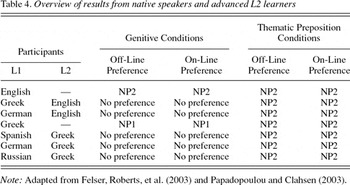
Papadopoulou and Clahsen's (2003) study examining advanced Spanish-, German-, and Russian-speaking learners of Greek moreover provides strong evidence against the transfer of L1 processing strategies. Despite the fact that the learners' L1s all pattern with Greek in that speakers of these languages typically exhibit an NP1 preference, none of the learner groups showed any attachment preference at all for relative clauses preceded by complex genitive antecedents in their L2. Parallel results were obtained in Felser, Roberts, et al.'s (2003) reading-time study on L2 English. Table 4 provides an overview of the results from Felser, Roberts, et al.'s and Papadopoulou and Clahsen's studies.

Together, these findings suggest that L2 learners are sensitive to the NP2 attachment cue provided by a thematic preposition but fail to show any clear attachment preferences for ambiguous relative clause modifiers when such lexical cues are absent, even if the preferred L2 ambiguity resolution strategy is the same as in their L1.3
Dussias (2001) and Fernández (2003) found that “early” Spanish/English bilinguals also behaved differently from monolinguals in that they exhibited no on-line attachment preferences for complex genitive antecedents, either.
Conceivably, the lack of any attachment preferences that has been observed in the above reading-time studies might be due to the learners' delaying their decision until the end of the sentence, or could even indicate that this method is inappropriate for measuring L2 parsing. The former possibility is unlikely given that the learners in Felser, Roberts, et al.'s (2003) and Papadopoulou and Clahsen's (2003) studies did not show any preferences for complex genitive antecedents in a complementary off-line task, either (but see Dussias, 2003). The latter possibility is ruled out by the authors' finding that all L2 groups tested exhibited a clear on-line preference for NP2 disambiguation if the two potential antecedent NPs were linked by a thematic preposition. Felser, Roberts, et al. (2003) and Papadopoulou and Clahsen (2003) suggested that the absence of any reliable preferences in the complex genitive conditions may be due to the learners' failing to apply phrase structure-based parsing principles (such as recency or predicate proximity; cf. Gibson et al., 1996) when processing ambiguous sentences in the L2, which they compensate for by overrelying on nonstructural cues to sentence interpretation instead. If such cues are absent, as in the genitive conditions, L2 learners' attachment decisions are made randomly.
Although the above studies have failed to find any evidence for L2 learners' use of phrase structure-based ambiguity resolution strategies, several other studies have demonstrated learners' sensitivity to lexical–semantic cues to disambiguation. Juffs (1998a), for example, found that L2 learners of English from various language backgrounds processed main verb/reduced relative clause ambiguities as in The bad boys criticized almost every day were playing in the park in a similar way as native speakers. The learners showed evidence of being “garden-pathed” if the initial participle looked like a transitive main verb (and if the following adverbial adjunct provided no cue as to the correct analysis), suggesting that the learners were sensitive to verb argument structure information during parsing. Learners from typologically different language backgrounds (Chinese, Japanese, and Korean speakers) had more difficulty processing ambiguous sentences of this kind than did learners whose L1 was typologically similar to English (i.e., Romance speakers) and were less accurate in judging the grammaticality of the test items.
In an eye-tracking study, Frenck-Mestre and Pynte (1997) examined how advanced English-speaking learners of French and French-speaking learners of English resolved PP-attachment ambiguities in sentences such as They accused the ambassador of espionage (of Indonesia) but nothing came of it. Both the learners and the native speakers associated plausible argument PPs such as of espionage with the VP and interpreted PPs such as of Indonesia as NP modifiers. Frenck-Mestre and Pynte also investigated learners' processing of sentences containing temporary subject/object ambiguities such as Every time the dog obeyed (barked) the pretty little girl showed her approval. Again, the learners behaved similarly to the native speakers in that sentences containing a potentially transitive verb elicited a garden-path effect compared to sentences containing intransitives. Both learner groups showed evidence of L1 lexical interference, however, in that they found sentences containing verbs like obey (which are intransitive in French but optionally transitive in English) more difficult to process than sentences containing verbs that are intransitive in both languages.
L2 learners' processing of subject/object ambiguities has also been investigated in self-paced reading experiments. Juffs and Harrington (1996), Juffs (1998b, 2004), and Felser and Roberts (2004) examined how L2 learners of English from various language backgrounds resolved temporary ambiguities in sentences such as After Bill drank the water proved to be poisoned. Again, the learners tested by Juffs and Harrington (1996) and Juffs (1998b, 2004) were garden-pathed in a similar way as the native speakers. Juffs (2004) furthermore observed that the size of the garden-path effect caused by sentences like the above was not correlated with the learners' working memory span as measured by the standard Daneman and Carpenter (1980) reading-span test (although there was some indication that word span might be a factor). Manipulating the plausibility of the postverbal NP as a direct object, Felser and Roberts (2004) found that advanced Greek-speaking learners of English were much more strongly influenced by plausibility information than native speakers when processing subject/object ambiguities in their L2, and that they had difficulty recovering from an initial misanalysis of sentences like the above.
Preliminary summary
The above findings reveal some interesting differences in the way children and adult L2 learners resolve structural ambiguities in real time. Results from a number of studies suggest that child L1 learners apply the same structure-based, least-effort processing principles as mature native speakers but are more constrained than adults in their ability to make use of nonstructural cues to interpretation.4
The findings from the above L2 processing studies show that contrary to children, late L2 learners have no difficulty accessing and making use of lexical–semantic or pragmatic information when resolving structural ambiguities in their L2. There is no independent evidence, on the other hand, that nonnative comprehenders are guided by phrase structure based parsing principles of the kind that have been attested in L1 processing. Although there is some indication that L2 ambiguity resolution may be influenced by properties of the learners' L1, the extent to which L2 processing is subject to L1 transfer remains yet to be determined.LANGUAGE LEARNERS' PROCESSING OF SYNTACTIC DEPENDENCIES
Like ambiguity resolution, the processing of sentences containing syntactic dependencies has been the subject of a considerable body of research on monolingual sentence comprehension in adults. Encountering anaphoric expressions such as reflexives or pronouns, for example, triggers the immediate reactivation of possible antecedents, in accordance with grammatical constraints such as the principles of binding theory (Nicol, 1988; Sturt, 2003). A large number of studies have investigated how adult native speakers process sentences containing syntactically displaced elements, or “filler-gap dependencies.” Filler-gap dependencies present a particular challenge for the parser, for several reasons. First, a syntactically displaced constituent (or “filler”) must be temporarily stored in working memory until it can be linked to its subcategorizer or other licenser. This is assumed to incur a processing cost that increases with distance (Gibson, 1998). Second, given that a syntactic “gap” is, by definition, not present in the input signal, its existence and structural position can only be inferred indirectly. Once a gap has been identified, the filler must be retrieved from working memory and (ultimately) integrated with its subcategorizer to ensure that the sentence can be assigned a coherent interpretation.
There is strong evidence from the adult L1 processing literature that having encountered a filler such as who in sentences like Who did Fred tell Mary left the country? the parser attempts to integrate it at the earliest grammatically possible point during the parse. That is, who will preferentially be analyzed as the indirect object of tell in the example above, rather than the subject of leave. The parser's preference for keeping filler-gap dependencies as short as possible is known as the Active Filler Strategy (Clifton & Frazier, 1989), or Minimal Chain Principle (De Vincenzi, 1991). Processing models differ, however, as to whether filler integration is assumed to be purely lexically driven (i.e., triggered by an incoming potential subcategorizer; compare Pickering & Barry, 1991) or mediated by syntactic dependencies involving empty categories (Bever & McElree, 1988; Fodor, 1989; Love & Swinney, 1996; Nicol & Swinney, 1989). Findings from studies on filler-gap dependencies in head-final languages (Aoshima, Phillips, & Weinberg, 2004; Clahsen & Featherston, 1999; Fiebach, Schlesewsky, & Friederici, 2002; Nakano, Felser, & Clahsen, 2002) and long-distance wh- dependencies in English (Gibson & Warren, 2004) provide evidence that adult native speakers do indeed postulate syntactically defined gaps during parsing.
Comparatively little is known about the way language learners process syntactic dependencies. Assuming that establishing nonlocal filler-gap dependencies in real time incurs additional working memory costs (Gibson, 1998), it may be that language learners do not have enough working memory capacity to spare to link a displaced element to its associated gap in real time. In this case, filler integration may be delayed, or possibly postponed until the sentence-final “wrap-up” stage. Given the above hypothesis that L2 learners underuse syntactic information when processing their L2, it is conceivable that they might try to semantically integrate a displaced constituent directly with its subcategorizer when the latter is encountered, rather than projecting full-fledged grammatical representations that include syntactic gaps. Incomplete grammatical acquisition may also prevent learners from successfully establishing syntactic dependencies on-line, and it is possible that properties of a learner's L1 influence parsing. Learners from wh- in situ backgrounds, for example, may not process sentences containing a fronted wh- constituent in a nativelike fashion, even if they appear to be sensitive to (e.g.) subjacency violations in off-line tasks. Below we provide a brief overview of studies investigating language learners' processing of syntactic dependencies that may help shed some light on the questions and issues raised above.
Children's processing of syntactic dependencies
Children have been shown to be sensitive to binding constraints in off-line tasks before the age of 5 (Chien & Wexler, 1990; Crain & McKee, 1986; Wexler & Chien, 1985). McKee, Nicol, and McDaniel (1993) used the cross-modal picture priming paradigm to examine whether 4- to 6-year-old children were capable of establishing syntactic binding relationships during the processing of sentences such as The alligator knows that the leopard with green eyes is patting himself on the head with a soft pillow. Like the adult controls, the children showed antecedent priming effects in the reflexive condition but not in the corresponding pronoun condition, demonstrating that they were able to apply their knowledge of binding constraints in real time.
Love and Swinney (1997) adopted McKee et al.'s (1993) cross-modal picture priming technique to investigate 4- to 6-year-old children's processing of filler-gap dependencies in sentences such as The zebra that the hippo had kissed________on the nose ran far away. Like adults (compare Love & Swinney, 1996), the children in Love and Swinney's (1997) study showed an antecedent reactivation effect at the gap position following the subcategorizing verb (i.e., kissed, in the example above). Note, however, that because the gap in Love and Swinney's experiment was located immediately after the verb, it is impossible to determine whether the observed priming effect reflected verb-driven (i.e., lexical–semantic) integration processes or structure-based gap filling.
Also using a cross-modal picture priming task, Roberts, Marinis, Felser, and Clahsen (2006) investigated how 5- to 7-year-old English-speaking children and adults processed sentences such as Example 2 below that involved three-place predicates.
2. John saw the peacock to which the small penguin gave the nice birthday present________in the garden last weekend.
Indirect object fillers were used in order to ensure that the putative gap was not directly adjacent to the subcategorizing verb. Participants were instructed to listen carefully to the stimulus sentences over headphones, and to make a lexical (“alive”/“not alive”) decision to pictures that appeared on a computer screen before them at different points during the sentence. Visual targets included pictures of the filler (e.g., a peacock) and pictures of unrelated objects such as a carrot. The picture targets were presented at two different test positions, at the gap position (e.g., after birthday present), or at a nongap control position 500 ms earlier. All participants additionally underwent a working memory test (Daneman & Carpenter, 1980, for adults, and Gaulin & Campbell, 1994, for children).
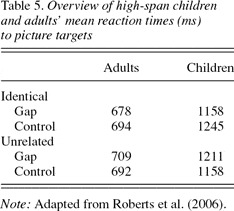
If the indirect object filler is mentally reactivated at the gap position, then lexical decision times should be faster for “identical” than for “unrelated” pictures presented at the gap position, and reaction times to “identical” pictures should be faster at the gap position than at the control position. Although the children's reaction times were slower overall than the adults', the results suggest that children's and adults' processing of filler-gap dependencies was affected by working memory differences rather than differences in lexical decision speed (compare also Nakano et al., 2002, for monolingual adults). For children and adults with a relatively high working memory span, a Position × Target Type interaction was found indicating that the filler (e.g., peacock in Example 2 above) was mentally reactivated at the gap position following the direct object NP. That is, high-span participants responded more quickly to “identical” than to “unrelated” picture targets at the gap position, and lexical decision times for pictures showing the filler were shorter at the gap position than at the earlier control position. Table 5 presents an overview of the high-span children and adults' mean reaction times to identical and related targets. Low-span children and adults, on the other hand, did not show any filler reactivation effects at the gap position. The results from the high-span participants tie in with Love and Swinney's (1997) earlier findings, and provide further evidence for phrase structure based gap-filling in L1 processing.

Short-term memory effects were also observed in Booth, MacWhinney, and Harasaki's (2000) study investigating 8- to 12-year-old children's processing of subject and object relative clauses. The children were found to slow down more at the relative clause/main clause boundary when reading or listening to sentences containing object relatives such as The prince that the king taught rode the car to the palace than those containing subject relatives, a finding that is familiar from the monolingual adult processing literature (e.g., King & Just, 1991). Subject–object relatives are more difficult to process than subject–subject relatives because an object gap is further away from its filler than a subject gap (Gibson, 1998), and because they involve perspective shifts (MacWhinney, 1982). Children with a high digit span processed the critical region more slowly than low digit-span children, which Booth et al. (2000) suggest may be due to the former group's processing complex sentences more effectively by making use of their short-term memory store during the processing of difficult regions. On the assumption that the extra slow down observed at and immediately after the embedded verb in sentences containing object relatives reflects the mental reactivation of the direct object filler at this point, Booth et al.'s results, like Roberts et al.'s (2006), suggest that differences in short-term memory may affect children's ability to link a filler to its associated gap in real time.
In sum, the above findings demonstrate that children do not differ from adults in their ability to establish syntactic dependencies during on-line sentence comprehension, but that both children's and adults' processing of such dependencies may be influenced by their working memory capacity.
L2 processing of filler-gap dependencies
Previous studies on L2 learners' knowledge of wh- movement and subjacency have not produced consistent results (see Chapter 7 of Hawkins, 2001, for an overview), giving rise to the hypothesis that processing problems may be responsible for L2 learners' difficulties with certain types of extraction (compare Juffs & Harrington, 1995, 1996). Results from earlier studies investigating the processing of filler-gap dependencies in the L2 provide evidence for on-line filler integration but are ambiguous with respect to the question of whether L2 learners apply a verb-driven or structure-based gap-filling strategy (Juffs, 2005; Juffs & Harrington, 1995; Williams et al., 2001).
To dissociate verb-based integration effects from syntactic gap filling, Marinis, Roberts, Felser, and Clahsen (2005) carried out a self-paced reading study investigating how L2 learners of English from different language backgrounds process sentences involving long-distance wh- dependencies of the kind shown in Examples 3a and 3b. Two corresponding nonextraction sentences served as control conditions.
3. a. The nurse who the doctor argued________that the rude patient had angered________is refusing to work late. (intermediate gap)
b. The nurse who the doctor's argument about the rude patient had angered________is refusing to work late. (no intermediate gap)
For sentences such as Example 3a that involve wh- extraction from a complement clause, an intermediate gap is assumed to be present at the intervening clause boundary breaking the long dependency up into two shorter ones (Chomsky, 1977). No such intermediate gap is present, on the other hand, in sentences such as Example 3b that involve extraction across a complex NP. Although the linear distance between filler and subcategorizer is the same in both Examples 3a and 3b, integrating the filler with its subcategorizing verb should be facilitated by the availability of an intermediate gap at the clause boundary, if the processor consults a mental representation of the filler at this point during processing. Results from an earlier study by Gibson and Warren (2004) using similar materials indicate that adult native speakers of English do indeed make use of such intermediate gaps during sentence comprehension.
Marinis et al.'s (2005) experimental sentences were presented visually in a segment by segment fashion, and were followed by a comprehension question. Participants who postulate intermediate gaps should find it easier to integrate the filler with its subcategorizer in sentences like Example 3a than in sentences like Example 3b, which should be reflected in shorter reading times on the segment containing the subcategorizing verb (=segment 5) in Example 3a than in Example 3b. An overview of Marinis et al.'s results is given in Table 6.

All participant groups took longer to read segment 5 in the two extraction conditions than in the nonextraction conditions, which reflects the extra processing cost associated with integrating a filler with its subcategorizer at this point. Only the native speakers showed a significant interaction between extraction and phrase type on this segment, however, indicating that the presence of an intermediate gap facilitated filler integration for this group. That is, the native speakers' reading times at the segment containing the subcategorizing verb were shorter for sentences that contained an intermediate gap than for those that did not, whereas no such difference was observed between the two nonextraction conditions. The native speakers also took longer to read the segment containing the complementizer that in Example 3a than in the corresponding nonextraction condition, which is consistent with the hypothesis that the filler is mentally reactivated at this point during parsing.
Although Marinis et al.'s (2005) results from the native speakers replicate Gibson and Warren's (2004) findings, neither the learners from wh- in situ backgrounds (L1 Chinese and L1 Japanese) nor those from wh- movement backgrounds (L1 German and L1 Greek) showed any intermediate gap effect. In other words, there is no evidence that the learners mentally reactivated the filler prior to the processing of the subcategorizing verb in either of the two extraction conditions. This suggests that contrary to the native speakers, the learners did not observe subjacency during processing but tried to establish a direct link between the filler and its subcategorizer in both extraction conditions instead, even if the subjacency principle is operative in their L1. Note that the learners' verb-driven processing strategy did not seem to affect their ability to comprehend the experimental sentences, though, as witnessed by the fact that they were as accurate as the native speakers in answering the end of trial comprehension questions.
Results from previous studies are consistent with the assumption that nonnative comprehenders employ a lexically driven strategy when processing syntactic dependencies. In two on-line grammaticality judgement experiments, Juffs and Harrington (1995) examined how Chinese-speaking learners of English processed subject and object extractions. The learners showed difficulty with grammatical sentences involving subject extraction such as Who did Anne say________likes her friend? but not with object extractions (see also White & Juffs, 1998). The authors suggest that the learners' selective difficulty with subject extractions may be due to reanalysis problems. In sentences involving subject extraction, the filler is likely to be mistaken initially for the object of the matrix verb, an analysis that must subsequently be revised. Whereas this kind of reanalysis does not seem to cause much processing difficulty for native speakers, it may well do so for nonnative comprehenders (compare Juffs & Harrington, 1996). An explanation in terms of reanalysis difficulty has been called into question, however, by Juffs (2005), who carried out a reading-time study using similar materials to those of Juffs and Harrington (1995) with Chinese-, Japanese-, and Spanish-speaking learners of English. Here the learners showed more difficulty with grammatical subject extractions from finite than from nonfinite clauses, with the Japanese group showing greater processing difficulty than the Chinese- or Spanish-speaking learners. Differences in the learners' working memory span, however, did not appear to influence the learners' processing behavior. According to Juffs (2005), a possible alternative explanation for the learners' problems with wh- extraction from finite clauses might be that they were confused by the co-occurrence of two finite verbs.
In another reading-time study, Williams et al. (2001) examined Chinese-, Korean-, and German-speaking learners' of English processing of sentences that involved adjunct extractions such as Which friend did the gangster hide the car for________late last night? Plausibility was manipulated such that the fronted wh- phrase was either a plausible or an implausible object of the verb hide. All participant groups showed elevated reading times at the postverbal noun in the plausible condition compared to the postverbal noun in the implausible condition. These results indicate that the learners, like the native speaker controls, initially analyzed the wh- filler as the direct object of the verb, and that the subsequent reanalysis was more difficult if the wh- filler was a plausible direct object. The observed “filled-gap” effect suggests that both native speakers and L2 learners attempt to integrate a filler with a potential subcategorizer at the earliest opportunity.
Taken together, the above studies provide evidence that L2 learners are like native speakers in that they attempt to integrate a displaced constituent with its (potential) subcategorizer when this is encountered, and in that they show sensitivity to plausibility information when processing sentences containing filler-gap dependencies. Although the results from Juffs and Harrington (1995), Juffs (2005), and Williams et al. (2001) do not allow us to distinguish between verb-driven and structure-based gap-filling strategies, the absence of any intermediate gap effect in the learners in Marinis et al.'s (2005) study indicates that L2 learners establish long filler-gap dependencies using direct lexical association rather than structure-based gap-filling, regardless of their L1 background.
Preliminary summary
Comparing how children and adult L2 learners process syntactic dependencies has revealed differences between the two types of language learners. Child L1 learners have been found to apply essentially the same parsing routines as mature native speakers when processing syntactic dependencies, and to reactivate displaced constituents at gap positions that are nonadjacent to their lexical subcategorizer. Moreover, there is evidence that children's ability to establish filler-gap dependencies in real time is affected by their short-term memory capacity. Although L2 learners seem to be able to link a fronted constituent to its subcategorizer during processing, there is no evidence that the dependencies thus established are mediated by syntactically defined gaps. Instead, the results from the small number of published studies on processing filler-gap dependencies in the L2 are consistent with the hypothesis that L2 learners establish such dependencies primarily on the basis of lexical–semantic and pragmatic information.
GENERAL DISCUSSION
The results from the child L1 and adult L2 processing studies available to date are indicative of some characteristic differences between child L1 learners and mature native speakers on the one hand, and between adult L2 learners and native speakers on the other hand. In the following, we discuss the findings from child L1 and adult L2 learners separately.
Children versus mature native speakers
Are the observed child–adult differences due to qualitative differences in the architecture of their processing system, or to other factors such as children's relatively lower short-term memory span and/or their more limited lexicon? The evidence available thus far strongly supports the latter hypothesis. The dual architecture for processing morphologically complex words appears to be the same in children and adults, and the child/adult differences reported by Clahsen et al. (2004), for example, overregularization errors, slower response times, and reverse frequency effects, can all be attributed to slower and less accurate lexical access in children than in adults. Likewise, the results on children's sentence processing indicate that the child parser is essentially the same as the adult one. Although children's sentence processing tends to be slower overall than adults', there is no reason to believe that their processing system is fundamentally different from adult native speakers' processing system, or that children's initial parsing decisions are delayed. Rather, there is evidence that even preschool children process sentences incrementally and in accordance with the L1 grammar (Love & Swinney, 1997; Trueswell et al., 1999). Although children seem to rely predominantly on structure-dependent least-effort principles during parsing of the kind that are familiar from the adult L1 processing literature, results from various off-line studies have shown that children, like adults, are able to take additional pragmatic or contextual information into account in tasks that put less demand on their processing resources (compare, e.g., Hurewitz et al., 2000; Meroni & Crain, 2003). Children's apparent difficulty to abandon their initial syntactic analysis if this is proven wrong by subsequent input (Trueswell et al., 1999) fits with findings from Friederici and Hahne's (2001) ERP study according to which young children's first-pass parsing routines (as indexed by an early LAN) are the same as adults', whereas processes of reanalysis and repair (indexed by the P600 component) operate more slowly in children than in adults.
In short, children's processing performance supports the continuity assumption according to which the child's parser is the same as the adult one and does not undergo any developmental changes (Crain & Wexler, 1999; Fodor, 1998a, 1999). Both children's tendency to prioritize on bottom-up information during parsing and their preference for “local” processing decisions can plausibly be attributed to their relatively limited short-term memory capacity, a factor that has been shown to affect child language development more generally (Adams & Gathercole, 2000). Assuming that basic processing routines do not need to be acquired in addition to the L1 grammar, and that any language-specific processing strategies are determined by properties of this grammar, provides a rather attractive solution to the acquisition paradox noted at the outset. The results from children's processing studies are incompatible with the so-called “semantics first” view of early language processing (Bever, 1970), and with functionalist models of language acquisition and processing according to which children are able to access and integrate semantic information immediately during parsing (Bates & MacWhinney, 1982). Instead, the present data support the view that the language processing system is modular, and are consistent with multistage models of language processing, which claim that early, automatic parsing decisions are based primarily on morphosyntactic information (cf. Friederici, 2002).
L2 versus L1 processing: The role of confounding factors
The question arises as to whether the results on adult L2 processing can be explained in the same way as those on children, namely, by assuming that the L2 processing system is the same as that of L1 speakers, and that any L1/L2 differences obtained in processing experiments can be explained in terms of other factors such as L2 learners' limited knowledge of the target language, cognitive limitations such as a shortage of working memory resources, or effects of transfer. Let us consider these possibilities in turn.
Consider first the possibility that L1/L2 processing differences might be due to the L2 learners' incomplete acquisition of the target grammar. Note that a fully functioning parser, even if available and suitable for processing the L2 input, will be of limited use if the grammatical knowledge required to build nativelike representations is missing or incomplete. As assigning a grammatical structure to an input string presupposes knowledge of the relevant combinatorial rules and grammatical contraints, learners' nontargetlike interlanguage grammar may prevent them from processing the L2 input in a nativelike fashion. Effects of incomplete acquisition on processing were seen in Hahne et al.'s (2006) ERP study on German inflection in which the L2 learners achieved lower accuracy scores for noun plurals than the native speakers and did not show the same ERP effects as native speakers. Although there is some evidence that L2 processing performance is affected by factors such as proficiency or age of acquisition (Frenck-Mestre, 2002; Hahne & Friederici, 2001; Weber-Fox & Neville, 1996), most of the L2 sentence processing studies reviewed above have examined learners at or near the top end of the L2 proficiency scale, and several studies have found a discrepancy between the learners' (nativelike or nearly native) knowledge of the structures under investigation and their processing performance. Papadopoulou and Clahsen (2003), for example, tested the L2 learners' knowledge of Greek using a language proficiency test as well as grammaticality judgement tasks probing the particular constructions that were subsequently examined in the on-line task. The L2 learners performed at native-speaker levels in the judgement tasks, and also achieved high proficiency scores. The differences between native speakers and L2 learners in the on-line task cannot therefore be attributed to incomplete acquisition of the Greek grammar; see also Felser, Roberts, et al. (2003) and Marinis et al. (2005) for similar findings on L2 sentence processing in English.
Next, consider the possibility that cognitive limitations may impede L2 processing. Although L2 processing is usually slower than L1 processing, we do not think that the observed L1/L2 differences can be accounted for by differences in processing speed. Although learners whose L1 uses a different script tend to read sentences from the L2 more slowly than learners whose L1 script is the same as the one used in the L2, such differences do not seem to give rise to any qualitative differences in their processing behavior (compare, e.g., Felser et al., 2003; Marinis et al., 2005; Papadopoulou & Clahsen, 2003; Williams et al., 2001). In Felser et al.'s (2003) study, the German-speaking learners actually read the experimental sentences faster than both the native speakers and the much slower Greek-speaking learners, but nevertheless showed the same nonnativelike pattern of ambiguity resolution preferences as did the Greeks. Examining the processing of causative structures by “slow” and “fast” L1 English readers of L2 French, Hoover and Dwivedi (1998) found that slower readers spent more time processing the end of sentence marker after reading sentences that contained a clitic versus sentences that did not. Their on-line reading-time pattern, however, did not significantly differ from that of the faster readers. Similarly (although few studies have tested this), there is as yet no clear evidence that the potentially greater working memory resources required for processing a nonnative language affect learners' parsing behavior (Juffs, 2004, 2005). Note also that if child L1 learners' overreliance on structural information is due to their relatively limited working memory resources, as has been argued above, then we would expect L2 learners to prioritize on grammatical information in the same way as children do in situations that put a high demand on their processing resources, contrary to what has been observed.
Finally, the fact that adult L2 learners already possess a full-fledged competence grammar and processing system for their L1 raises the possibility of L1 interference or processing transfer. Results from studies within the framework of the competition model using the (off-line) agent-identification task suggest that incipient learners initially apply L1-specific sentence interpretation strategies to the L2 (see MacWhinney, 1997, 2002, for review). Although the extent to which properties of a learner's L1 influence their real-time processing of the L2 input remains to be determined, studies by Felser et al. (2003) and Papadopoulou and Clahsen (2003) provide evidence against the transfer of L1 ambiguity resolution preferences. Instead, learner groups from typologically different L1 backgrounds have been found to show remarkably similar patterns of L2 processing, which argues against a strong L1 influence on L2 parsing (compare also Marinis et al., 2005; Williams et al., 2001).
Summarizing the discussion thus far, we conclude that the observed differences between adult L1 and adult L2 sentence processing cannot be explained in terms of a shortage of working memory resources (as we have argued for children), differences in processing speed, transfer of L1 processing routines, or incomplete acquisition of the target grammar.
L2 versus L1 processing: Reduced availability of the procedural memory system?
According to Ullman (2001) and Paradis (1994, 1997, 2004), L2 learners differ from native speakers in the way grammar is mentally represented and processed. Grammatical processing in native speakers is assumed to depend on “implicit” knowledge stored in procedural memory, as a result of which L1 parsing is fast, unconscious, and automatic. Regarding adult L2 learners, they suggest that the procedural memory system for language is less available for processing a nonnative language (perhaps due to a critical period effect), so that late L2 learners have to rely mainly on declarative memory sources for storing knowledge about their L2. Knowledge about an L2, then, will largely be “explicit” (i.e., conscious) knowledge, rather than an internalized set of computational procedures that apply automatically (Paradis, 2004). Depending on the degree to which they are able to speed up what are in fact controlled processes, late learners may still exhibit a high degree of proficiency or fluency in their L2. The mental processes involved in processing the L2 input, however, would be qualitatively different from those used in L1 processing, and subserved by different brain regions.
Some of the findings reported above are indeed compatible with this account. Recall that L2 readers or listeners appear to have no difficulty accessing and evaluating lexical–semantic or plausibility information during sentence processing, whereas they underuse syntactic information when resolving temporary ambiguities or interpreting sentences containing long-distance dependencies. In terms of the Ullman/Paradis account, the former finding is indicative of an intact declarative memory system, whereas the latter observation may be taken to result from the reduced availability of the procedural memory system.
The results on L2 morphological processing, however, specifically those on participle inflection, do not seem to fit in with the Ullman/Paradis account. Recall that Hahne et al. (2006) obtained brain responses from adult L2 learners for morphological violations of participle formation that were similar to those seen in native speakers, in particular, an anterior negativity in response to morphological regularizations (geschlaft instead of geschlafen [slept]). For inflectional morphology, anterior negativities for regularizations have been interpreted as reflecting violations of rule-based morphological processing (Penke et al., 1997; Rodriguez-Fornells et al., 2001; Weyerts et al., 1997). Given this interpretation, Hahne et al.'s results indicate that L2 learners do indeed employ regular rules of inflection in on-line morphological processing. For Ullman's (2001) model in particular, processing regular inflection such as the English past-tense -ed crucially involves the procedural memory system. Indeed, Ullman's model is an extension of Pinker's (1999) words and rules theory, which specifically aims to explain contrasts between regular and irregular inflection in language processing and language acquisition. Ullman (2001) argued that the distinction between words and rules follows from a more fundamental distinction according to which the associative system (“words”) depends upon declarative memory and is rooted in temporal lobe structures of the brain, whereas the combinatorial system (“rules”) depends upon the procedural memory system and is rooted in frontal brain structures. Given this distinction, Hahne et al.'s (2006) results indicate that adult L2 learners do, in fact, employ both systems; specifically, the anterior negativity seen for regularizations suggests that the procedural system is active in L2 morphological processing. Thus, the claim that L2 processing is “largely dependent upon declarative/lexical memory” (Ullman, 2001, p. 105) appears to be too simplistic, and untenable as it stands.
A more general problem of the Ullman/Paradis account is the vagueness of notions such as “less available” and “more dependent.” What does it actually mean to say that the procedural memory is less available to L2 learners, and that they are more dependent upon declarative memory? Ullman and Paradis do not provide much insight into how these gradient notions are to be understood. One interpretation might be that procedural memory is partitioned into different subcomponents, and that some of them are unavailable to L2 learners while others are still operative. This leaves us with the question of which components are and which are not available to L2 learners. Another interpretation would be that the procedural system as a whole becomes less available over time, possibly making age of acquisition a crucial factor in L2 development. The extent to which procedural memory sources can be recruited for L2 processing (i.e., the extent to which controlled processes can become automatized) may then be affected by factors such as length of exposure, degree of immersion, or the amount of practice in the L2. Although there is some evidence for a shift towards automatization from the study of L2 word recognition (Segalowitz & Segalowitz, 1993; Segalowitz, Segalowitz, & Wood, 1998), results from sentence processing studies show that even highly proficient L2 learners behave differently from native speakers when resolving structural ambiguities or processing syntactic dependencies. Contrary to Hahne et al.'s (2006) study on L2 morphological processing, most ERP studies on L2 sentence processing have failed to find any LAN effects of the kind that are thought to reflect early automatic structure-building processes (Hahne, 2001; Hahne & Friederici, 2001; Sabourin, 2003; Weber-Fox & Neville, 1996; but see Friederici et al., 2002). In contrast, the P600 effect associated with later syntactic processes of reanalysis and repair was observed in some L2 subgroups. In a recent priming study, Scherag, Demuth, Rösler, Neville, and Röder (2004) found that English native speakers who were long-term immigrants to Germany and highly fluent in German did not gain from morphosyntactically congruent primes as did native speakers of German, suggesting that late L2 learners' processing of (gender) agreement does not become nativelike even after long periods of immersion.
Summarizing, although the idea that the role of the procedural memory system is reduced in nonnative language processing accounts for a range of differences between L2 and L1 grammatical processing, some findings are challenging for this model. Specifically, the model is unable to account for the observed differences between L2 morphological and syntactic processing. Moreover, the Ullman/Paradis account is in need of further theoretical elaboration of what is actually meant by the reduced availability of the procedural system.
L2 versus L1 processing: The shallow structure hypothesis
As previous accounts provide only partial explanations for the differences between native and nonnative grammatical processing, we finally outline an alternative idea, the shallow structure hypothesis.
Recall that the studies on sentence processing reported above yielded responses for adult L2 learners that were clearly different from those of native speakers, whereas in the domain of morphology, the L1/L2 processing differences were less dramatic and could be attributed to other factors such as the L2 learners' insufficient mastery of noun plurals in Hahne et al.'s (2006) study. In sentence processing, adult L2 learners have been found to rely on lexical, semantic, and pragmatic information in the same way as native speakers, whereas effects of syntactic structure that were seen in native speakers appear to be absent in L2 processing. Studies of relative-clause attachment, for example, reveal that native speakers rely on both lexical cues and phrase structure-based parsing strategies, employing the latter in cases in which there are no lexical cues for ambiguity resolution. L2 learners, by contrast, make use of lexical but not of syntactic information in parsing these sentences (Felser et al., 2003; Papadopoulou & Clahsen, 2003). Likewise, in processing syntactic dependencies, native speakers demonstrate lexical (verb driven) as well as structure-based effects. Of these, only the former were seen in L2 learners (e.g., Marinis et al., 2005).
Note that sentence interpretation minimally requires readers or listeners to be able to segment an input sentence into meaningful chunks, and to work out the semantic relationships between these chunks. In many cases, successful comprehension can, in principle, be achieved on the basis of lexical–semantic, pragmatic, and other relevant nonlinguistic information. To apply structure-based parsing strategies such as recency or predicate proximity, however, or to reactivate a filler at syntactic gap sites in language comprehension, the reader or listener needs to compute a fairly detailed syntactic representation of an incoming sentence that includes hierarchical phrase structure as well as abstract elements such as empty categories. Evidence for native speakers' ability to construct such detailed representations when processing their L1 can be gathered from the syntactic effects reported above, and from previous research on L1 sentence processing (compare, e.g., Fodor, 1989, 1995). For nonnative language processing, we suggest that the syntactic representations adult L2 learners compute for comprehension are shallower and less detailed than those of native speakers.
For the sake of concreteness, suppose that for sentence comprehension, L2 learners essentially compute predicate–argument structure representations of the input that capture thematic roles and other aspects of lexical–semantic structure, but which lack hierarchical detail and more abstract elements of syntactic structure. Consider, for example, the kind of representations that native speakers may construct when processing filler-gap dependencies of the sort tested in Marinis et al.'s (2005) study. Example 4 shows a simplified syntactic representation of Marinis et al.'s Example 3a, with the symbol e indicating the hypothesized positions of syntactic gaps.
4. [DP The nurse [CP [whoi] the doctor argued [CP [e2] that the rude patient had angered [e1]]]] …is refusing to work late.
Our results suggest that native speakers consult a mental representation of the filler who (referring to the nurse) when they encounter the complementizer that, which signals the beginning of a new subordinate clause, in accordance with the subjacency principle (see also Gibson & Warren, 2004). Cyclically reactivating the filler at intermediate gap sites (=e2) ultimately facilitates the filler's semantic integration with its subcategorizer, relative to extraction sentences that lack such intermediate gaps.
Now assume that the syntactic structure assigned to the same sentence during L2 processing is much more rudimentary than Example 4, but that L2 learners are able to draw on their lexical, pragmatic, and world knowledge to build up a semantic or conceptual representation of the sentence. Consider how the above sentence might be segmented and analyzed semantically during L2 comprehension (cf. Examples 5a–c).

L2 sentence comprehension may well be incremental in that learners try to integrate each new incoming chunk into the emerging semantic representation as soon as possible, assigning thematic roles to argument expressions and associating modifiers with their semantic hosts. Unlike Example 4, the representation computed by native speakers, the representation thus assembled does not contain any intermediate gaps. The absence of any intermediate gap effects in L2 processing then follows from the learners' failure to project the syntactic structure necessary for accommodating intermediate gaps, rather than from lack of knowledge of subjacency. The observed filler-integration effect, on the other hand, which indicates that the learners were able to associate a displaced element with its subcategorizer or thematic role assigner, is expected even under a shallow structure account. On the assumption that L2 processing is generally shallow in the sense described above, the fact that the learners' language background (wh- movement vs. wh- in situ) did not affect the way they processed long-distance wh- dependencies in Marinis et al.'s (2005) study is not surprising. Given that in Juffs and Harrington's (1995), Juffs (2005), and Williams et al.'s (2001) studies the observed effects also occurred at, or immediately after, a main verb that could initially be mistaken for the filler's subcategorizer, their results are also consistent with the shallow structure hypothesis.
The shallow structure hypothesis also accounts for the absence of L1 transfer effects in studies investigating L2 learners' relative clause attachment preferences (Dussias, 2003; Felser et al., 2003; Papadopoulou & Clahsen, 2003). For structure-based ambiguity resolution strategies to be transferred, a sufficient amount of structure must be present in the first place, and this must be of a form that allows the syntactic processor to operate on it. If learners segment sentences from the L2 according to their thematic structure, then complex NPs such as the servant of the actress are likely to be treated as a single chunk, whereas a preposition signalling a new thematic domain such as with and its complement will form a separate chunk. Although L2 learners have demonstrated a clear NP2 attachment preference for complex NPs linked by with, in accordance with Frazier and Clifton's (1996) Relative Clause Construal strategy, their apparent inability to apply any structure-based ambiguity resolution strategies in cases where the construal strategy fails is expected if their representations of NP of NP complexes lack the relevant structural detail. Results from other L2 ambiguity resolution studies also fit into the picture. The garden-path effects observed by Felser and Roberts (2004), Frenck-Mestre and Pynte (1997), Juffs (1998b, 2004), and Juffs and Harrington (1996) all provide evidence for learners' ability to use lexical–semantic or pragmatic information during L2 processing, and their ability to associate ambiguous argument phrases with a potential subcategorizer, but no independent evidence for phrase structure driven parsing.
The shallow structure hypothesis not only accounts for L1/L2 differences in ambiguity resolution and the processing of filler-gap dependencies, but it is also consistent with the absence of early anterior negativities in ERP studies of L2 sentence processing as opposed to L2 morphological processing. Note that the kind of inflected words that have been tested by Hahne et al. (2006) involve simple concatenation of two adjacent elements (stems and affixes) and thus have a much shallower internal structure than sentences. Rather than being unable to apply linguistic “rules” as such, as Ullman's (2001) model would predict, learners whose ability to compute complex grammatical representations at the sentence level is reduced might still be able to strip a regular affix off its stem when processing inflected words.
Finally, note that shallow processing does not seem to be unique to L2 learners. There are several proposals in the psycholinguistic literature that have explored the idea of shallow processing for language comprehension in native speakers, including Fodor's (1995) depth of processing hypothesis; Ferreira, Bailey, and Ferraro's (2002) notion of “good enough” representations for language comprehension; and Sanford and Sturt's (2002) underspecification account. For example, Ferreira et al. (2002) observed that when native readers or listeners interpreted implausible passive sentences such The dog was bitten by the man, they were less accurate than for plausible passives, indicating that even though the compositionally derived meaning of both implausible and plausible passives is clear and unambiguous, participants were tricked by the content words and the predicate–argument structure of the implausible sentence. Another example comes from the interpretation of garden-path sentences. Ferreira et al. (2002) found that when native speakers are asked questions such as Did the baby play in the crib? and Did Anna dress the baby? after listening to a garden-path sentence such as While Anna dressed the baby played in the crib, they would often answer both questions with “yes,” indicating that they misinterpreted the baby as both the agent of played and the patient of dressed. In this case, the content words and the predicate–argument structure of the first part of the sentence (While Anna dressed the baby…) sent the language comprehension system in the wrong direction, and native speakers find it difficult to figure out the exact contents of such sentences. To account for these findings, it has been argued that the language processing system sometimes computes representations for comprehension that are shallower and less detailed than might be required, allowing, for example, an argument such as the baby in the garden-path sentence above to be (incorrectly) interpreted as the agent of one predicate and as the patient argument of another. Although the exact circumstances under which native speakers rely on such “good enough” representations are not entirely clear, it looks as if shallow processing is an option available to the human language comprehension system in principle. What we suggest here is that contrary to native speakers, adult learners are largely restricted to this option in L2 processing, computing representations for language comprehension that lack syntactic detail, and attempting more direct form-function mappings instead.
SUMMARY AND CONCLUSION
The aim of this article has been to compare grammatical processing in adult native speakers, child L1, and adult L2 learners. Although children, like mature native speakers, have been found to adhere to syntax-based parsing principles when processing sentences in their L1, they differ from adults in that they make little or no use of lexical–semantic or referential information during processing. In the domain of morphological processing, we found evidence that children, like adult native speakers, show effects of lexical storage and morphological decomposition indicating that the (dual) system for processing morphologically complex words is the same for children and adults.
In the domain of morphology, adult L2 learners also showed regular/irregular contrasts in processing inflected words. In processing combinatory violations, the L2 learners evidenced ERP components (an anterior negativity and/or a P600) that have been linked to morphosyntactic processing, and for misapplications of irregular inflection, they showed an ERP effect (the N400) that has been claimed to be characteristic of lexical processing. These results are consistent with the two processing routes posited by dual-mechanism models of inflection (lexical storage and morphological decomposition), and suggest that they are also accessible in L2 processing of inflected words, at least by advanced learners and in inflectional domains in which they are highly proficient. In L2 sentence processing, on the other hand, nonnative comprehenders were found to underuse syntactic information during parsing, while being guided by lexical–semantic and pragmatic information to at least the same extent as adult native speakers.
The empirical findings on child L1 processing are consistent with the continuity hypothesis according to which the child's parsing mechanism is basically the same as that of mature speakers. Differences between child and mature speaker's processing can be attributed to other factors such as the child's limited working memory capacity and less efficient lexical retrieval. In nonnative (adult L2) language processing, however, some striking differences were observed between adult L2 learners and native speakers in the domain of sentence processing. By way of accounting for these differences, we proposed the shallow structure hypothesis according to which the sentential representations adult L2 learners compute for comprehension contain less syntactic detail than those of native speakers.
Finally, we emphasize that further investigation of grammatical processing in language learners is necessary before any firm conclusions can be drawn. The number of empirical studies using on-line techniques with language learners is still rather small, and it remains to be seen whether the results reported above can be replicated. Note also that the existing empirical studies have only looked at a restricted set of grammatical phenomena, and it is not clear whether the findings reported above generalize to other kinds of syntactic and morphological phenomena, or to languages or L1/L2 combinations other than those that have been examined thus far.
The present data are also limited with respect to the kinds of language learners that have thus far been tested in on-line grammatical processing experiments. For child L1 learners, for example, existing studies suggest that children from about age 4 employ the same parsing mechanisms as mature adults. However, whether this is also true for children at a younger age (e.g., for 2- to 3-year-olds) is currently unknown. Similarly, previous L2 processing studies have largely been restricted to learners at the high end of the proficiency scale, and little is known about how L2 grammatical processing changes over time. Despite these empirical gaps and limitations of the currently existing studies, we think that the comparative study of child L1 and adult L2 learners has led to some (albeit preliminary) understanding of how grammatical processing in language learners differs from that of mature native speakers.
ACKNOWLEDGMENTS
Our research on grammatical processing in language learners was supported by the Leverhulme Trust (Grant F/213B to Harald Clahsen, Claudia Felser, and Roger Hawkins) and by the German Research Council (Grants SFB 282/B7 and C7 to Harald Clahsen). We are indebted to many people who have collaborated with us over the past years on these studies, most particularly, Meike Hadler, Anja Hahne, Theo Marinis, Jutta Müller, Leah Roberts, and Helga Weyerts.