INTRODUCTION
The Inner Mongolia Province comprises one of the largest grassland regions of the world that covers an area of 791 000 km2, equivalent to 0.68 of the province area (Kawamura et al. Reference Kawamura, Akiyama, Yokota, Tsutsumi, Yasuda, Watanabe and Wang2005). The Xilingol steppe is a major livestock husbandry region in Inner Mongolia and traditionally used for sheep grazing (Kawamura et al. Reference Kawamura, Akiyama, Yokota, Tsutsumi, Watanabe and Wang2003). Stocking density has increased from 6·8 ha per sheep in the 1950s to 1·05 ha per sheep in 1990 (Li et al. Reference Li, Ali and Zhang2007). The increasing grazing pressure reduced vegetation cover (Li et al. Reference Li, Harazono, Oikawa, Zhao, He and Chang2000), thereby increasing soil erosion in the dry and windy seasons of the winter and spring months (Zhao et al. Reference Zhao, Zhao, Zhou, Zhang and Drake2005), and diminishing the fertile top soil layer. Hence, in the Xilin River catchment 0.72 of the steppe area had been degraded by overgrazing by 1999 (Tong et al. Reference Tong, Wu, Yong, Yang and Yong2004). Since forage supply for livestock is mainly provided by the grassland, rangeland degradation reduces important resources not only for animal production but also for the livelihoods of the local people. However, according to current land tenure arrangements, farmers rent land from the government for only limited time periods. These arrangements may favour further steppe degradation, because farmers will aim to maximize their short-term economic benefits regardless of possible long-term steppe degradation.
Grazing intensity (GI) is still the most important management decision in pastoral systems and further studies are needed to comprehensively evaluate the effects of GI on herbage and animal production. Therefore, a 3-year-grazing experiment was conducted in the Inner Mongolian steppe that aimed to determine the effect of different GI on the grassland vegetation, feed intake and quality as well as the performance of grazing sheep.
MATERIALS AND METHODS
All procedures involving animals followed the guidelines for the care and use of experimental animals established by the Ministry of Agriculture of the People's Republic of China (1995).
Study site
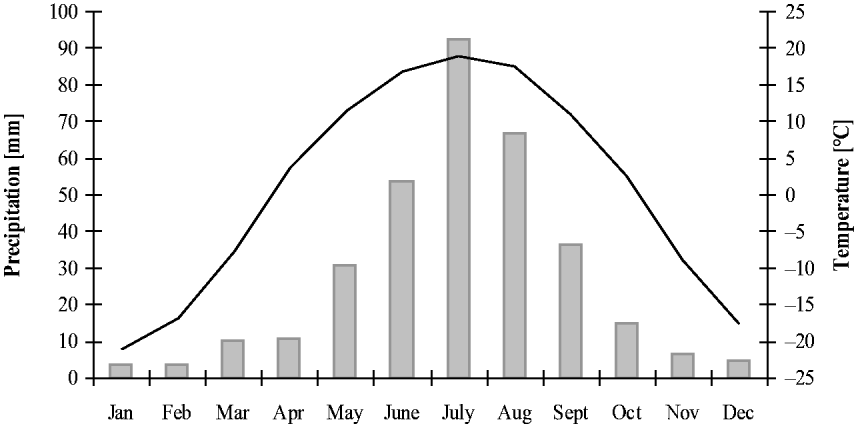
In 2005, the grazing experiment was established in the Xilin River catchment (E116°42′; N43°38′) of the Inner Mongolian steppe, approximately 600 km north of Beijing, China. The study area is located on the Mongolian Plateau about 1200 m above sea level and belongs to the Inner Mongolia Grassland Ecosystem Research Station which is administered by the Institute of Botany of the Chinese Academy of Sciences, Beijing. Climatically, the area belongs to the continental middle temperate semi-arid zone (Yu et al. Reference Yu, Ellis and Epstein2004). The long-term (1982–2007) mean annual precipitation is 335 mm, 0.85 of which occurs from May to September. Mean annual temperature is 0·8 °C. The coldest and warmest monthly temperatures are −20·9 °C in January and 19·0 °C in July, respectively (Fig. 1). The first experimental year 2005 was very dry with only 158 mm of precipitation, whereas average amounts of rain and snowfall were recorded in 2006 and 2007. The vegetation period lasts from May to September for about 150 days with a non-frost period of only 100 days. The dominant soil type is Calcic Chernozem (Li et al. Reference Li, Chen, Wang, Liu and Li1997). The natural grassland vegetation is characterized by the perennial bunchgrass Stipa grandis P. Smirn. and the perennial rhizome grass Leymus chinensis (Trin.) Tsvelev (Bai et al. Reference Bai, Han, Wu, Chen and Li2004).
Long-term mean annual precipitation (in mm, primary y-axis, columns) and mean monthly air temperatures (in °C, secondary y-axis, line) measured at the Inner Mongolia Ecosystem Research Station in 1982–2007.

Experimental design
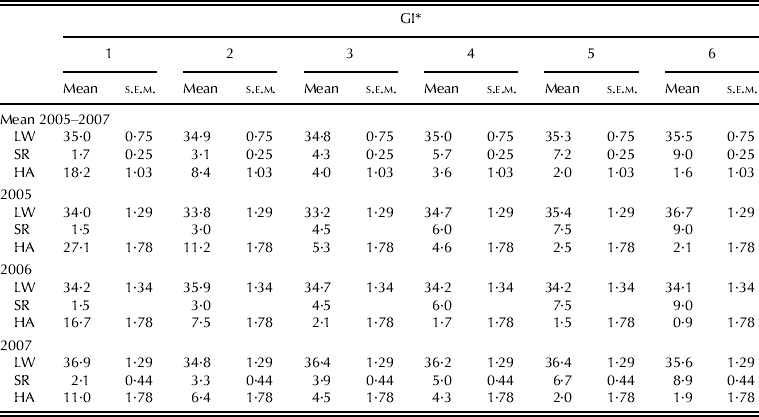
The grazing experiment was conducted in the vegetation periods of 2005, 2006 and 2007. Grazing seasons start around 10 June and end around 12 September each year. They lasted for 98, 90 and 93 days in 2005, 2006 and 2007, respectively. The experiment consisted of six different GI treatments from very light (GI 1), light (GI 2), light-moderate (GI 3) and moderate (GI 4) to heavy (GI 5) and very heavy (GI 6) grazing. GI treatments 1–6 were defined by the following herbage allowance (HA) classes: >12·0, >6·0–12·0, >4·5–6·0, >3·0–4·5, >1·5–3·0 and ⩽1·5 kg herbage dry matter (DM)/kg live weight (LW), respectively (Table 1). Subsequent to animal weighing and biomass measurements, the number of sheep was adjusted monthly to standing biomass in the respective plots to keep HA within defined target ranges. All GI treatments were tested on two plots each: a flat and a moderately sloped plot. Plots had a size of 2 ha each, except for the GI 1 plots which comprised 4 ha to achieve a minimum of six sheep per plot. The effect of GI on herbage and animal variables was tested within an alternating grazing management system, i.e. grazing and hay-making annually alternated between two adjacent plots. The year before the experiment started, none of the plots had been grazed.
Live weight (LW, in kg), stocking rate (SR†, in sheep/ha) and HA (kg DM/kg LW) at different GIs in 2005, 2006 and 2007 (least squares means and standard error of the means (s.e.m.))
* Defined by the following HA classes with GI 1: >12; GI 2: >6–12; GI 3: >4·5–6; GI 4: >3–4·5; GI 5: >1·5–3; and GI 6: ⩽1·5 kg DM/kg LW.
† Least squares means across the grazing season from June to September.
In 2005 and 2006, no s.e.m. was calculated for SR, because it was kept constant across the whole grazing season. DM, dry matter.
Animal management and determination of live weight gain (LWG)
At the beginning of each grazing season in June, approximately 132 female sheep of the ‘Mongolian fat-tailed’ breed were purchased from local farmers. The animals were about 15 months old, neither pregnant nor lactating. Immediately after purchase, all sheep were ear-tagged for identification, orally administered an anthelmintic against internal and external parasites (this treatment was repeated at the beginning of the study), weighed (31·2, s.d. 0·3 kg LW), and allocated to the grazing plots so as to equalize mean LW per plot. Sheep were continuously kept on the plots throughout the entire grazing season. Anthelmintic treatments were repeated in the beginning of July. Water and mineral licks were freely available to all animals at any time. The animals were weighed again after an adaptation period of 10 days to determine their initial LW and on two consecutive days in the middle of July, August and September, respectively. Mean LW of the 2 days was used to calculate LWG of individual sheep (LWG/sheep; g/d) during each month. Total LWG per hectare (LWG/ha; g/d) was estimated from LWG/sheep and the stocking rate (SR; sheep/ha) in respective plots. In September 2006, LW could not be determined for any of the GI treatments because of an early winter onset which required an abrupt and untimely ending of the experiment at the beginning of September (see also next section).
Determination of digestibility of the ingested herbage and organic matter intake (OMI)
At the beginning of the grazing seasons, six sheep per plot were randomly chosen to determine digestibility of ingested organic matter (dOM) and OMI. Faecal excretion was determined using the external marker titanium dioxide (TiO2) assuming a faecal recovery rate of 100% (Glindemann et al. Reference Glindemann, Tas, Wang, Alvers and Susenbeth2009a). On 10 consecutive days at the beginning of July, August and September, respectively, one gelatine capsule containing 2·5 g TiO2 was orally administered to each of the six sheep per plot at the same time each day. From day 6–10 (sampling period), faecal grab samples were obtained from the rectum once daily and frozen immediately. After each sampling period, aliquots of faeces samples of 20 g each were pooled to one sample per sheep a 100 g fresh matter. One subsample was analysed for nitrogen (N), DM and organic matter (OM) content. A second subsample was oven-dried at 60 °C for 48 h, ground to pass a 1 mm sieve and analysed for TiO2 concentration using the procedure described by Brandt & Allam (Reference Brandt and Allam1987) modified by Glindemann et al. (Reference Glindemann, Tas, Wang, Alvers and Susenbeth2009a) to estimate faecal OM excretion. In 2005 and 2006, samples of each sheep and period were analysed separately for TiO2 concentration with repeated determination. In 2007, samples of all six sheep per plot were pooled and analysed with three replicates to reduce the number of analyses. Digestibility of ingested organic matter was estimated from faecal crude protein (CP=N×6·25) concentration according to the regression equation developed by Wang et al. (Reference Wang, Tas, Glindemann, Rave, Schmidt, Weissbach and Susenbeth2009). Subsequently, OMI was calculated from faecal OM excretion and dOM. The dOM was multiplied by OMI to determine digestible organic matter intake (DOMI). Dietary metabolizable energy (ME) concentrations were estimated according to the equation derived by K. Aiple (personal communication) on the basis of the data published by Aiple et al. (Reference Aiple, Steingass and Menke1992): ME (MJ/kg OM)=−0·9+17.0 × dOM. Metabolizable energy intake (MEI) was calculated by multiplying dietary ME concentrations by respective OMI values. Total OMI, DOMI and MEI per hectare were estimated from intake values of individual sheep (g and MJ/d) and the SR (sheep/ha) in respective plots. Although sheep at GI 1–GI 4 remained on the plots until the experiment was ended in the middle of September due to heavy snowfall shortly after the sampling period, animals at GI 5 and GI 6 had already been removed from their grazing plots on the 16 and 30 August due to a shortage of forage. Hence, dOM and feed intake could not be measured for these GI treatments in September of that year.
Determination of herbage mass (HM) and herbage quality
Herbage mass (HM) was determined by cutting the sward to 10 mm above ground level in three 0·25 × 2·0 m-frames per plot. Each year, herbage measurements took place on grazed plots in the middle of June and concomitant to faeces sampling in July, August and September, respectively. The collected herbage material was pooled by plot, dried at 60 °C for 24 h, and ground to pass a 1 mm sieve. Contents of DM, OM, CP, neutral detergent fibre (NDF), acid detergent fibre (ADF), acid detergent lignin (ADL) and in vitro-digestible organic matter (IVdOM) were determined by near-infrared-spectroscopy after calibration. For calibration (2005: n=138, 2006: n=44, 2007: n=31) and validation (2005: n=25, 2006: n=10, 2007: n=15) subsets of herbage samples were chosen (for details see Schönbach et al. Reference Schönbach, Wan, Gierus, Loges, Müller, Lin, Susenbeth and Taube2012). Herbage DM contents were determined by drying at 105 °C until constant weight, whereas OM contents were calculated as the difference between the dry weight of the sample material and the ash after incineration at 550 °C overnight. The CP concentrations were calculated from N contents (N×6·25) determined by Dumas combustion method (Vario Max CN, Elementar Analysesysteme, Hanau, Germany). Contents of NDF, ADF and ADL were analysed sequentially by a semi-automated Ankom 200 Fiber Analyzer (Ankom Technology, Macedon, New York, USA) according to the procedures described by Van Soest & Robertson (Reference Van Soest and Robertson1985). The IVdOM and ME contents were calculated from crude ash (CA), CP and enzyme insoluble organic matter (EIOM) concentrations (all in g/kg DM) determined according to the cellulase technique described by De Boever et al. (Reference De Boever, Cottyn, Buysse, Wainman and Vanacker1986) using the equation of Weissbach et al. (Reference Weissbach, Kuhla, Schmidt and Henkels1999):
 $$\scale90%\eqalign{ {\rm IVdOM}\,({\rm g}/{\rm kg}\,{\rm OM}) = & \,(940 - {\rm CA}-0 {\cdot} 62 \times {\rm EIOM} \cr &-0 {\cdot} 000221 \times {\rm EIOM}^2) / (1000 - {\rm CA}).} $$
Statistical analyses
Mean values for dOM, OMI, DOMI, MEI, LWG/sheep and LWG/ha of the six selected sheep per plot were used for data analyses. Hence, a total of 144 observations (6 GI treatments × 2 plots × 3 years × 4 months) were obtained for herbage variables, whereas only 104 observations for all intake and 96 observations for all performance variables were available (6 GI treatments×2 plots×3 years×3 months) due to the lack of data in September 2006 (see previous sections). Data were analysed using the Mixed Model of SAS version 9.1 (SAS Institute Inc., Cary, NC, USA). The model included the fixed effects GI (1–6), year (2005, 2006 and 2007), and plot (flat, sloped), month (July, August and September) as repeated effect, and their interactions. Probabilities were determined for all effects and their interactions GI×month and GI×year. Heterogeneous auto-regression covariance structure was chosen. The Tukey test (Steel & Torrie Reference Steel and Torrie1980) was used for multiple comparisons of least squares means. Statistical significance was tested at P < 0·05. A linear regression analysis was carried out between IVdOM (independent variable) and dOM (dependent variable) to identify differences in the quality of forage on offer and the herbage actually ingested by the animals. Moreover, linear and quadratic regression analyses were performed by SAS to determine the effects of SR (sheep/ha, independent variable) on daily OMI (g/kg0·75 LW), LWG/sheep (g) and LWG/ha (g/ha) of sheep (dependent variables) in 2005, 2006 and 2007. For this, mean values across the grazing seasons were used, resulting in a total of 12 observations per year (6 GI×2 plots).
RESULTS
Effect of GI
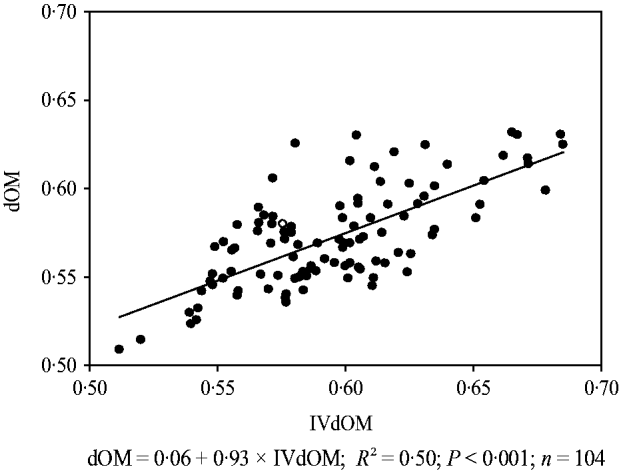
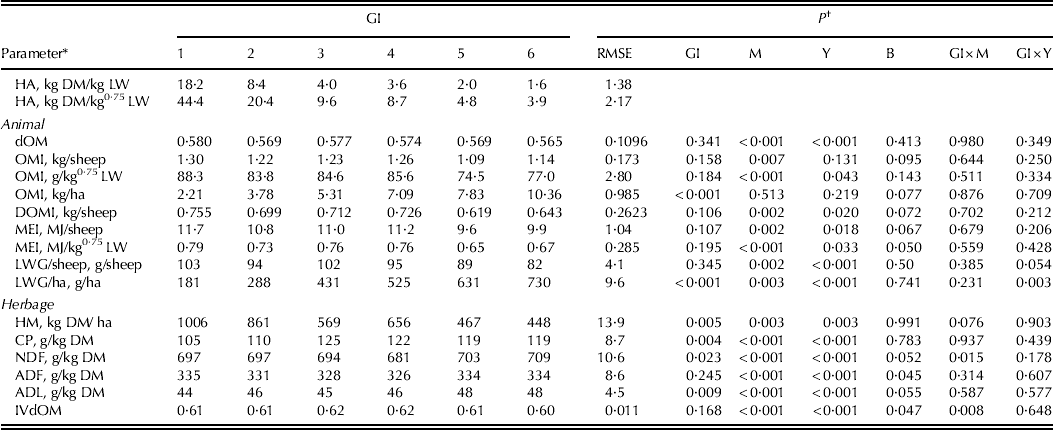
The HM on offer decreased with increasing GI from 1006 (GI 1) to 448 kg DM/ha (GI 6; P=0·005; Table 2). Moreover, significant effects of GI on CP (P=0·004), NDF (P=0·023) and ADL contents (P=0·009) were observed. Although CP contents were numerically highest and NDF contents numerically lowest at GI 3 and GI 4 plots, ADL contents were lower at GI 1 than at GI 5 and GI 6. The dOM did not differ between GI (P=0·34). It linearly increased with increasing IVdOM, but was in most cases lower than IVdOM (dOM=0·25+0·54 × IVdOM; R 2=0·50; P<0·001; n=104; Fig. 2). Daily OMI and MEI of sheep (in g and MJ/kg0·75 LW) did not differ between GI treatments (P>0·05). Nevertheless, results of the regression analyses showed a linear decrease in the animals' OMI (in g/kg0·75 LW) with increasing SR (sheep/ha) in 2005 (OMI=90·7 (s.e. 5·74) – 2·26 (s.e. 0·983) × SR; R 2=0·28; P=0·044; n=12). In contrast, there was no influence of SR on OMI of animals in 2006 and 2007 (2006: R 2=−0·06; P=0·58; n=12; 2007: R 2=0·01; P=0·33; n=12).
Linear relationship between the in vitro-digestibility of herbage organic matter on offer (IVdOM) and the dOM determined in sheep during 2005–2007.
Effect of GI on dOM, daily intake of OMI, daily intake of DOMI, daily intake of metabolizable energy (MEI), daily LWG per sheep (LWG/sheep) and per hectare (LWG/ha), and HM and composition in 2005–2007 (least squares means and root mean square error (RMSE)).
* HA, herbage allowance; DM, dry matter; LW, live weight; CP, crude protein; NDF, neutral detergent fibre; ADF, acid detergent fibre; ADL, acid detergent lignin; IVdOM, in vitro-digestibility of herbage organic matter on offer.
† M, month; Y, year; B, block.
Number of observations for digestibility and intake parameters: 18 (except GI 5 and 6 : 16); for LWG: 16; for herbage related parameters: 24.
For definitions of GI treatments see Table 1.
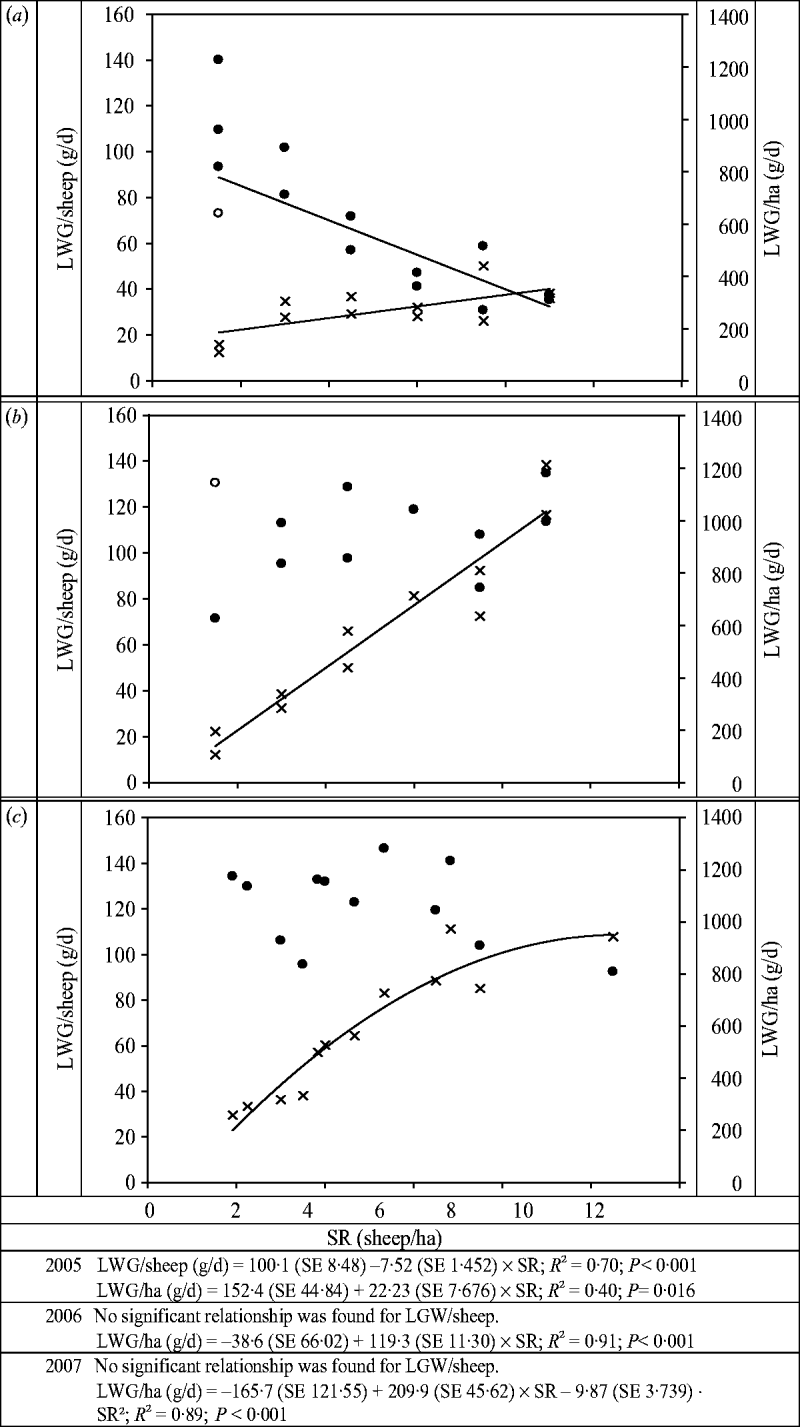
Although LWG/sheep did not differ between GI treatments (P=0·345), it was numerically higher at GI 1 (103 g/d) than at GI 6 (82 g/d). Moreover, LWG/sheep (g/d) decreased with increasing SR (sheep/ha) according to the regression analyses (LWG/sheep=117·4 (s.e. 9·83) – 4·22 (s.e. 1·710) × SR; P=0·015; n=96). Across the three study years, adjusted R 2-value was very low at only 0·05. Nevertheless, LWG/sheep tended to respond differently to GI in individual study years (P=0·054). While LWG/sheep was unaffected by SR in 2006 and 2007 (Figs 3(b) and (c)), it decreased linearly with increasing SR in 2005 (Fig. 3(a)). Correspondingly, there was a linear increase in LWG/ha by 22 g/d per sheep in this year, whereas in 2006 and 2007, quadratic regressions described the change in LWG/ha with increasing SR well. Across the study years, daily LWG/ha was 181 g/ha at GI 1 and reached 739 g/ha at GI 6 (P<0·001).
Linear and quadratic relationships between stocking rate (SR, x-axis) and LWG per sheep (LWG/sheep, primary y-axis, ●, n=12) and per ha (LWG/ha, secondary y-axis, x, n=12) in (a) 2005, (b) 2006 and (c) 2007.
Effect of year
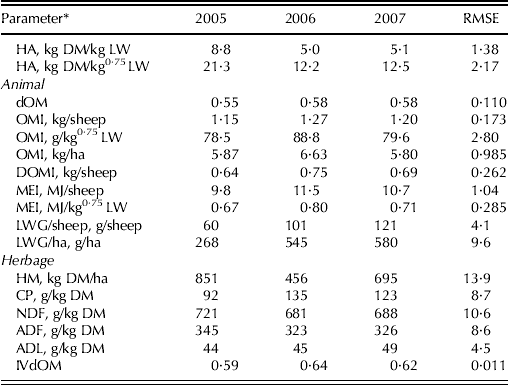
Herbage quality (P<0·001 for all variables) and HM (P=0·003) differed between experimental years (Table 3). While HM was highest in 2005, CP and IVdOM contents were lowest and NDF and ADF concentrations were highest in this year, most likely due to lower rainfall compared with the following 2 years. Although dOM was lower in 2005 (0·55) than in 2006 (0·58) and 2007 (0·58; P<0·001), OMI of sheep did not differ between years (P=0·13) with 78·5, 88·8 and 79·6 g/kg0·75 LW, respectively. No differences were found in the animals' DOMI (P=0·24) and MEI (P=0·22) between 2005 and 2007. However, both variables were lower in 2005 than in 2006 (P=0·014; P=0·015). Correspondingly, LWG/sheep and LWG/ha were lower in 2005 than in 2006 (P<0·001; P<0·001) and 2007 (P<0·001; P<0·001).
Effect of year on dOM, daily intake of organic matter (OMI), daily intake of DOM (DOMI), daily intake of metabolizable energy (MEI), daily LWG per sheep (LWG/sheep) and per hectare (LWG/ha), and HM and composition in 2005–2007 (Least squares means and root mean square error (RMSE)) with two different means of expressing herbage allowance (HA)
* HA, herbage allowance; DM, dry matter; LW, live weight; CP, crude protein; NDF, neutral detergent fibre; ADF, acid detergent fibre; ADL, acid detergent lignin; IVdOM, in vitro-digestibility of herbage organic matter on offer.
Number of observations for animal related parameters in 2005 and 2007: 36, in 2006: 32 (except for LWG: 24); for herbage related parameters: 48.
Effect of month
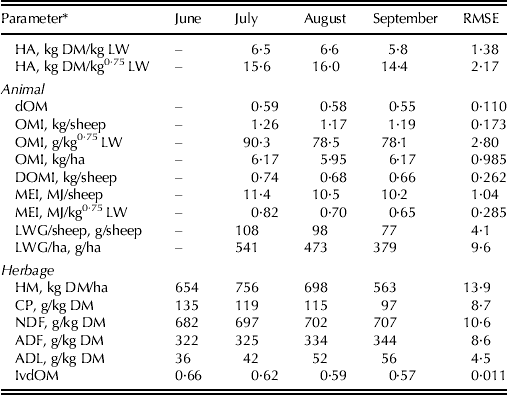
The HM and herbage quality differed between months (Table 4). In September, HM, CP and IVdOM contents were lower than in July (P<0·01), whereas herbage ADF and ADL contents increased with advancing vegetation period (P<0·001). Accordingly, dOM decreased from 0·59 and 0·58 in July and August, respectively, to 0·55 in September (P<0·001). Daily OMI and MEI of sheep expressed in g/kg0·75 LW were higher in July than in August (P<0·001; P<0·001) and in September (P<0·001; P<0·001). Consequently, LWG/sheep (P=0·002) and LWG/ha (P=0·003) across the three study years decreased with advancing vegetation period.
Effect of month on dOM, daily intake of organic matter (OMI), daily intake of DOM (DOMI), daily intake of metabolizable energy (MEI), daily LWG per sheep (LWG/sheep) and per hectare (LWG/ha), and HM and composition in 2005–2007 (Least squares means and root mean square error (RMSE))
Within a row means without a common superscript difference (P⩽0·05).
* HA, herbage allowance; DM, dry matter; LW, live weight; CP, crude protein; NDF, neutral detergent fibre; ADF, acid detergent fibre; ADL, acid detergent lignin; IVdOM, in vitro-digestibility of herbage organic matter on offer.
Number of observations for animal related parameters in July and August: 36, in September: 32 (except for LWG: 24); for herbage related parameters: 36.
DISCUSSION
Effect of GI
Effect of GI on HM and chemical composition
Increasing GI reduced HM on offer in the current study, an effect which is often described in the literature (Ackerman et al. Reference Ackerman, Purvis, Horn, Paisley, Reuter and Bodine2001; Animut et al. Reference Animut, Goetsch, Aiken, Puchala, Detweiler, Krehbiel, Merkel, Sahlu, Dawson, Johnson and Gipson2005; Schönbach et al. Reference Schönbach, Wan, Gierus, Bai, Müller, Lin, Susenbeth and Taube2011). The lack of covering vegetation at the end of the grazing season, in particular, renders the soils more vulnerable to wind and water erosion (Schönbach et al. Reference Schönbach, Wan, Gierus, Bai, Müller, Lin, Susenbeth and Taube2011). Hence, intensive grazing may increase desertification and the frequency of dust storms and might therefore reduce long-term grassland productivity (Li et al. Reference Li, Harazono, Oikawa, Zhao, He and Chang2000). Sharrow et al. (Reference Sharrow, Krueger and Thetford1981) measured the effect of three different SR on the productivity of pasture vegetation and consequently, LW of ewes and their lambs; in their study, the highest herbage production was observed on moderately stocked pastures. Sharrow et al. (Reference Sharrow, Krueger and Thetford1981) found a short-term decline in HM at highest and a long-term decline in herbage production at lowest GI and therefore, recommended a moderate SR for long-term pasture utilization. In contrast, herbage CP and IVdOM concentrations determined in a study by Schlegel et al. (Reference Schlegel, Wachenheim, Benson, Ames and Rust2000) increased with increasing GI. Hence, increasing GI may improve forage quality, because plant re-growth is enhanced and forage is thus maintained at a more immature state (Roth et al. Reference Roth, Rouquette and Ellis1990; Schlegel et al. Reference Schlegel, Wachenheim, Benson, Ames and Rust2000; Schönbach et al. Reference Schönbach, Wan, Schiborra, Gierus, Bai, Müller, Glindemann, Wang, Susenbeth and Taube2009).
In the current study, HM on heavily grazed plots (GI 5 and 6) represented only about half, or even less, of the HM on offer at GI 2 and GI 1 plots, respectively. In September 2006, it even decreased to a level where survival of sheep could no longer be ensured and the animals had to be removed from pastures. This indicates that, depending on the amount and distribution of annual rainfall, intensive sheep grazing strongly reduces HM on Inner Mongolian grasslands. Furthermore, Schönbach et al. (Reference Schönbach, Wan, Gierus, Bai, Müller, Lin, Susenbeth and Taube2011) revealed a marked decline in above-ground net primary production of the grassland in the study area of the current paper at higher GI. This was partly compensated for by the alternating use of plots for hay-making or grazing each year. Hence, Schönbach et al. (Reference Schönbach, Wan, Gierus, Bai, Müller, Lin, Susenbeth and Taube2011) showed that higher litter accumulation and soil coverage in the alternating system compared with a grazing system where the same plot was used for grazing every year reduced the risk of soil erosion and steppe degradation, especially on very heavily grazed plots (Schönbach et al. Reference Schönbach, Wan, Gierus, Bai, Müller, Lin, Susenbeth and Taube2011).
The GI only had a minor effect on herbage quality. However, at GI⩾5, where on average 7·2 sheep/ha of about 35 kg LW were kept during the 3-month-grazing seasons, NDF concentrations were numerically and ADL contents significantly higher than at the lowest GI. This indicates that plant re-growth on the heavily grazed plots could either not occur at all or was completely consumed by sheep, resulting in a lower nutritional quality of standing herbage.
Effect of GI on digestibility of ingested herbage and OMI
Across the years, dOM was almost identical for all GI treatments which contradicts the hypothesis that dOM may be influenced by GI either due to differences in the chemical composition of standing herbage or the greater ability of sheep at low GI to select higher quality plants or plant parts (Garcia et al. Reference Garcia, Carrere, Soussana and Baumont2003). Schiborra (Reference Schiborra2007) determined only small differences in the digestibility of herbage at different heights above ground level, suggesting that the animals' ability to select plant parts of higher quality might have been limited. Moreover, dOM should have been higher than IVdOM, if selective feeding behaviour had occurred in the current study. However, dOM was even lower than IVdOM which might partly be due to methodological differences, since IVdOM reflects potential digestibility. Nevertheless, it can be expected that the difference between IVdOM and dOM would be smaller or disappear, if selective grazing occurs. Furthermore, this difference did not vary between GI treatments and dOM increased linearly with increasing IVdOM. Hence, it appears unlikely that selective grazing occurred to a considerable degree. Together with the minor differences in the chemical composition and IVdOM of standing herbage (see the previous section), this explains why GI did not influence dOM in the current study.
The OMI of sheep in the current study of 75–88 g/kg0·75 LW is within the range of values given by Cordova et al. (Reference Cordova, Wallace and Pieper1978) for grazing cattle and sheep (40–90 g/kg0·75 LW) and is similar to the intake for sheep of 74 g/kg0·75 LW determined by Moore & Mott (Reference Moore, Mott and Matches1973). Langlands & Bennett (Reference Langlands and Bennett1973), who estimated feed intake of ewes at three different SR from 2·5 to 37·1 sheep/ha, found a linear decline in their OMI with increasing GI. The observed increase in feed intake with increasing HM on offer in their study was asymptotic and reached a plateau where HM did not further limit the animals' OMI (Langlands & Bennett Reference Langlands and Bennett1973). In the current study HM on offer decreased markedly with increasing GI, but no significant effect of GI on OMI of animals was determined across the three study years. This agrees with the results of Ackerman et al. (Reference Ackerman, Purvis, Horn, Paisley, Reuter and Bodine2001) and could be due to the fact that animals grazing steppe pastures of low productivity select areas with higher biomass rather than patches with higher nutritional quality to maintain their nutrient and energy intake (Wang et al. Reference Wang, Han, Bai and McGilloway2005). Furthermore, dOM largely determines voluntary feed intake of ruminant livestock (Van Soest Reference Van Soest1994). As mentioned above, dOM was nearly identical between GI treatments which further explains why, irrespective of GI, no or only minor differences in OMI were found. Moreover, very low dietary CP contents may limit ruminal fibre digestion, because N requirements of rumen microbes are not met. As a consequence, CP deficiencies may limit herbage intake (Minson Reference Minson1990) as shown by many authors who have revealed a positive relationship between herbage CP contents and OMI (Coleman & Moore Reference Coleman and Moore2003; Boval et al. Reference Boval, Fanchone, Archimede and Gibb2007). However, dietary CP contents of 105–125 g/kg DM varied only slightly between the GI in the current study and were consistently above the minimum dietary CP content of 80 g/kg DM recommended by Coleman & Moore (Reference Coleman and Moore2003) for ruminant diets to avoid any depression in the animals' feed intake. Hence, it can be stated that CP concentrations did not limit OMI of sheep at any GI. Nevertheless, concentrations of NDF were numerically higher at GI 5 and 6. The higher contents of ADL at these GI suggest a lower rumen degradability of the fibrous fraction. This did not reduce dOM, but may have reduced passage rate of the digesta (Ketelaars & Tolkamp Reference Ketelaars and Tolkamp1992) and could thus be responsible for the slightly lower OMI observed at the two highest GI. Correspondingly, the current study found a significant decrease in OMI of sheep with increasing SR in 2005, when herbage NDF concentrations were highest. Instead, there were no significant relationships between SR and the animals' feed intake in the following 2 years.
Effect of GI on LWG of individual sheep
A decrease in LWG/sheep with increasing SR has often been reported in the literature (Sharrow et al. Reference Sharrow, Krueger and Thetford1981; Zoby & Holmes Reference Zoby and Holmes1983; Han et al. Reference Han, Li, Wei and Li2000; Ackerman et al. Reference Ackerman, Purvis, Horn, Paisley, Reuter and Bodine2001; Glindemann et al. Reference Glindemann, Wang, Tas, Schiborra, Gierus, Taube and Susenbeth2009b) which could be due to lower HM on offer, higher proportions of mature plant parts, and hence, lower digestibility and nutrient contents in the herbage on heavy grazed pastures (Allison Reference Allison1985). Furthermore, reduced herbage availability may increase walking distances and grazing time of animals and thus, their energy expenditures for activity which in turn reduces the energy available for growth (Lin et al. Reference Lin, Dickhoefer, Müller, Wurina and Susenbeth2011). In the current study LWG/sheep was similar between GI in 2006 and 2007 which is in line with the small and insignificant differences in OMI (78·5–88·8 g/kg0·75 LW) and the almost identical values for dOM between GI treatments (0·57–0·58) in these years. In contrast to the current findings, HM (Schönbach et al. Reference Schönbach, Wan, Schiborra, Gierus, Bai, Müller, Glindemann, Wang, Susenbeth and Taube2009) and LWG/sheep (Schönbach et al. Reference Schönbach, Wan, Gierus, Loges, Müller, Lin, Susenbeth and Taube2012) of sheep on plots in the same experimental area as used in the current study that were used for grazing every year were much lower at high than at low GI. Hence, the alternating use of pastures for grazing or hay-making might have mitigated the negative effects of heavy grazing on herbage and animal performance. Nevertheless, OMI and LWG/sheep decreased markedly with increasing SR in 2005, indicating that, irrespective of grazing management system, the effect of SR on feed intake and performance of grazing animals differs between years according to the amount and distribution of annual rainfall.
Effect of GI on LWG per area
Animut et al. (Reference Animut, Goetsch, Aiken, Puchala, Detweiler, Krehbiel, Merkel, Sahlu, Dawson, Johnson and Gipson2005) stated that LWG per area increases with increasing GI up to a certain point when forage mass becomes the limiting factor for LWG of individual animals. Hence, a trade-off exists between LWG per animal and LWG per area (Han et al. Reference Han, Li, Wei and Li2000; Ackerman et al. Reference Ackerman, Purvis, Horn, Paisley, Reuter and Bodine2001; Animut et al. Reference Animut, Goetsch, Aiken, Puchala, Detweiler, Krehbiel, Merkel, Sahlu, Dawson, Johnson and Gipson2005), and maximum gain per hectare is never achieved when maximum gain per animal is reached (Jones & Sandland Reference Jones and Sandland1974). In contrast, Ackerman et al. (Reference Ackerman, Purvis, Horn, Paisley, Reuter and Bodine2001) observed a linear increase in the LWG/ha of steers with increasing GI. Similarly, LWG/ha strongly increased with increasing GI in the current study in 2006, while it reached a plateau at SR⩾7 sheep/ha in 2007 due to slightly lower LWG/sheep. Hence, heavy grazing appears to be most profitable for farmers in most years. Since the land still belongs to the government and farmers only have short-term contracts for pasture use, they will not be affected directly by the negative consequences of high GI on productivity and nutritional quality of herbage of the grassland in the long term. The current land tenure system therefore supports the common practice of heavy grazing. Nevertheless, LWG/sheep decreased markedly with increasing SR in 2005, when annual rainfall was very low, leading to a similar LWG/ha across the range of SR tested. Hence, the effect of GI on LWG/sheep and LWG/ha differs greatly between years, indicating that short-term experiments are not sufficient to give any recommendations for optimal pasture utilization. Similarly, Fynn & O'Connor (Reference Fynn and O'Connor2000) emphasized that data from long-term experiments should be used to account for the intra- and inter-annual variability in temperature and precipitation which may result in differences in HM and herbage composition as well as the animals' OMI and LWG. Moreover, data suggest that, from an economic point of view, no constant SR for a maximum LWG/ha can be recommended in this and similar environments.
Effect of year
Annual precipitation varied much between study years, resulting in differences in HM on offer, herbage quality, dOM and OMI of sheep. Similarly, Ackerman et al. (Reference Ackerman, Purvis, Horn, Paisley, Reuter and Bodine2001) and Langlands & Bennett (Reference Langlands and Bennett1973) found that dOM and the effects of GI differed according to the amount and distribution of annual rainfall. Annual precipitation was lowest in 2005. Correspondingly, IVdOM, dOM and LWG/sheep were lower in this than in the following 2 years. However, despite a lower rainfall than in 2007, herbage CP concentrations and IVdOM were higher in 2006 most likely due to a carry-over effect from the very low rainfall in the previous year. Hence, a lower HM towards the end of the grazing season in 2005 might have enhanced herbage re-growth in spring 2006 and/or favoured plant species of higher nutritional quality. The fact that LWG/sheep was greater in 2007 than in 2006 despite a similar or even numerically lower OMI and MEI of sheep in this year suggests that energy expenditures for purposes other than maintenance and LWG (i.e. grazing activity) were higher in 2006 than in 2007 (Lin et al. Reference Lin, Dickhoefer, Müller, Wurina and Susenbeth2011).
Effect of month
The HM and herbage quality decrease as the vegetative period progresses (Bailey Reference Bailey2004), which was confirmed by the results of the current study. Herbage ADL and NDF contents increased as the growing period progressed due to limited herbage re-growth and advanced forage maturation (Vavra et al. Reference Vavra, Rice and Bement1973). Correspondingly, CP, IVdOM and dOM decreased from July to September which is similar to the findings of Jung & Sahlu (Reference Jung and Sahlu1989) and Garcia et al. (Reference Garcia, Carrere, Soussana and Baumont2003). As a result of the lower nutritional quality, OMI of sheep in the current study declined from July to August. The fact that it did not further decrease in September was a reflection of the missing intake data in 2006 for this month. Nevertheless, LWG/sheep was nearly 30% lower during this month compared with July. Hence, the decrease in HM and the nutritive value of the herbage on offer appears to be largely responsible for the lower feed intake (Langlands & Bennett Reference Langlands and Bennett1973; Cordova et al. Reference Cordova, Wallace and Pieper1978; Garcia et al. Reference Garcia, Carrere, Soussana and Baumont2003) and performance (Animut et al. Reference Animut, Goetsch, Aiken, Puchala, Detweiler, Krehbiel, Merkel, Sahlu, Dawson, Johnson and Gipson2005; Glindemann et al. Reference Glindemann, Wang, Tas, Schiborra, Gierus, Taube and Susenbeth2009b) of grazing livestock towards the end of the vegetation period.
In conclusion, the results show that intensity of grazing generally does not affect dOM, OMI and hence, LWG of individual sheep grazing on a semi-arid grassland steppe, but greatly increases LWG per unit of land area. High GI thus appear to be most profitable, allowing for maximum short-term benefits to local farmers. This practice is further supported by the current land tenure system in Inner Mongolia. The alternating use of pastures for grazing or hay-making may mitigate the negative effects of heavy grazing on herbage and animal performance commonly reported in the literature. However, in dry years or in years with an uneven distribution of rainfall, a lack of HM on offer at high GI requires the purchase of additional forage for animals at the end of the growing period and/or the untimely sale of animals. Moreover, grassland use with the objective of maximizing short-term profit does not take into account negative effects of high GI on grassland productivity in the long term, in particular due to sparse vegetation cover towards the end of the grazing season which renders the soil more vulnerable to wind and water erosion during winter and spring. Finally, it is evident that experiments from only a few years do not enable the deduction of recommendations for ecologically and economically sustainable SR in this and similar environments.
ACKNOWLEDGEMENTS
The authors gratefully acknowledge the financial support by the Deutsche Forschungsgemeinschaft (DFG, German Research Foundation) within the framework of the DFG research group 536 ‘Matter fluxes in grassland of Inner Mongolia as influenced by stocking rate’ – a Sino-German cooperation project. We highly appreciate the initiative and the coordination of this research unit by Prof. B. Sattelmacher. We gratefully acknowledge the efforts of Prof. X. Han, Institute of Botany, Beijing, to provide experimental areas of the Inner Mongolia Grassland Research Station.