


Introduction
*Tiger or beast that has passed; tiger or beast of the past
A full translation of the article in Filipino and a translation of the abstract in Pala’wan are provided in the Supplementary materials, SI-1.
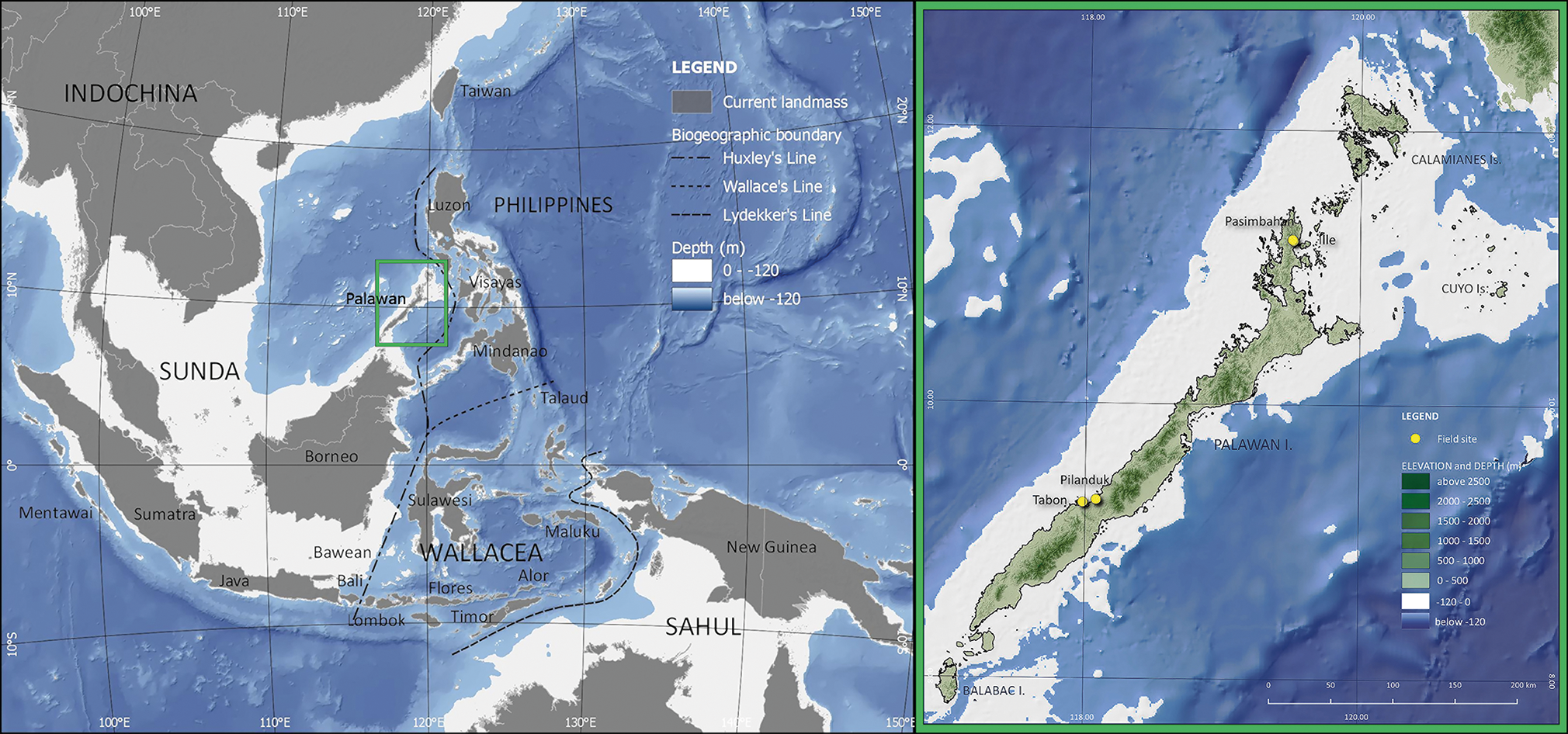
The past geographic distribution of the tiger (harimau; Panthera tigris) covered a vast expanse of the Asian continent and the islands of Southeast Asia. Tigers live across a variety of terrestrial ecosystems, such as the mangrove coasts of the Sundarbans, taiga of Siberia, and a host of sub-tropical and tropical environments (Goodrich et al. Reference Goodrich, Wibisono and Miquelle2022; Sunquist Reference Sunquist, Tilson and Nyhus2010). The Sunda biogeographic region is known as part of the tiger’s domain and their present and past distribution included the islands of Sumatra, Borneo, Java and Bali (Fig. 1).
Map of Southeast Asia (left) and Palawan Island (right) showing the location of Pilandok Cave, other Palawan sites, biogeographic regions, biogeographic boundaries and present-day landmasses. Last Glacial Maximum land distribution (white areas) is approximated using the –120 m isobath.

Figure 1 Long description
The map on the left displays Southeast Asia, including regions such as Indochina, Sunda, and Wallacea, with biogeographic boundaries marked by Huxley’s Line, Wallace’s Line, and Lydekker’s Line. Key locations include Luzon, Palawan, Borneo, and New Guinea. The map on the right focuses on Palawan Island, highlighting specific sites like Pilandok Cave, Pasimoro, and Tabon. The current landmasses are shown in green, while the approximated land distribution during the Last Glacial Maximum is indicated by white areas using the -120 meter isobath. Depths are color-coded, with shades of blue representing different depth ranges.
Six extant tiger subspecies are conventionally recognized based on molecular genetic and genomic evidence (Liu et al. Reference Liu, Sun and Driscoll2018; Luo et al. Reference Luo, Kim and Johnson2004): the Bengal, Siberian, South China, Malayan, Sumatran and Indochinese tigers. In addition, three extinct subspecies are known: the Java, Bali and Caspian tigers. Other studies have questioned the taxonomic grouping of these nine subspecies (e.g. Kitchener & Yamaguchi Reference Kitchener, Yamaguchi, Tilson and Nyhus2010) and instead suggest the recognition of only two subspecies: continental and Sunda tigers (Kitchener et al. Reference Kitchener, Breitenmoser-Würsten and Eizirik2017; Wilting et al. Reference Wilting, Courtiol and Christiansen2015). Continental tigers continue to persist in Southeast Asia, with the Indochinese and Malayan populations, while Sunda tigers are critically endangered in Sumatra. Historical records indicate the recent extinction of Sunda tigers on Java and Bali. Tiger fossils are recorded on Java as far back as the Early Pleistocene (van den Bergh et al. Reference van den Bergh, de Vos and Sondaar2001; Volmer et al. Reference Volmer, Hertler and van der Geer2016). On Borneo, the tiger’s past presence has been confirmed based on fossil and subfossil material from three localities. Four tiger bone specimens have been reported from Borneo: a metacarpal fragment found in a Terminal Pleistocene layer at Niah Cave (Piper et al. Reference Piper, Cranbrook and Rabett2007), an upper canine specimen also from Niah that is of late Holocene age, a navicular bone from Madai Cave in Sabah of Holocene age, and a mandible fragment found in peat deposits on the banks of the Kahaya River that is inferred to date from Marine Isotope Stage 2 (Sherani Reference Sherani2021).
Wherever tigers live, they are held in majestic awe, respect, fear, or reverence and they feature prominently in local cosmologies and belief systems of human societies that overlap with the tiger’s current and recent historical distribution. Among indigenous groups of Borneo, Malay Peninsula, Java and Sumatra, for instance, tigers are considered as both benevolent and malevolent beings with important spiritual qualities and social roles (Sellato Reference Sellato1993; Reference Sellato2019; Wessing 1986; Reference Wessing1995). Tigers and humans are believed to share common ancestors and can shape-shift into each other’s forms. Tigers also perform the role of mediators between humans and other forest spirits. Tiger spirits, tiger ‘familiars’ and ‘were-tigers’ can be healers for those who fall ill, but they are also known to accord punishment to humans for certain transgressions. Healers and ritual specialists called belian (in Malay) who are possessed by spirits of tiger familiars are called bomoh belian (Endicott Reference Endicott1970). The b’lian among Semang and Senoi are themselves able to turn into a tiger (Skeat & Blagden Reference Skeat and Blagden1906). The cognate set belian/balian is widely used in Austronesian languages to refer to the anthropological category ‘shaman’; this is translated as babaylan in Filipino and bəlyan in Pala’wan. The use of tiger body parts, especially in the form of skins and fangs, is widespread in the region, and tiger iconography is also extensive. Various parts of the tiger’s body serve as amulets, medicines, or aphrodisiacs (Sellato Reference Sellato2019; Wessing Reference Wessing1986).
The tiger is known by various names in Southeast Asia, with several cognate sets identified (Sellato Reference Sellato2019). One cognate set refers to the tiger names kuleh, kuli, kulo, kuyir and kuri (from the languages of Kayan, Punan, Iban and Kelabit of Borneo and Gayo of Sumatra). Another set of names—lejo, lejau, linjo and its other variations—are used in Kayanic languages in the interiors of Borneo and in Kerinci in Sumatra. A third set comes in the form of harimau, rimau, limau, rimaung and its variations found in several Malayo-Polynesian languages. The Proto-Western-Malayo-Polynesian (PWMP) reconstruction is *qari-maquŋ, related to the proto-form *harimaw (ACD 2016). The term halimaw, which is a possible borrowing from Malay, is used in Tagalog (and other Philippine languages) to refer to a ferocious beast. Among the Eastern Penan, the tiger is referred to as tepun, which means grandparent or ancestor. Sellato (Reference Sellato2019) describes that tepun belongs to the cognate set deriving from the Austronesian *ampu, which refers to grandparent and ancestor (ACD 2016). In Philippine languages, apo and apu are common cognates of *ampu.
In the Philippine archipelago, the past presence of the tiger has not been documented in written records or known from ethnographic accounts. However, on Palawan Island, we previously reported three tiger fossil foot bones found in Ille Cave in the town of El Nido (Ochoa & Piper Reference Ochoa, Piper and Monks2017; Piper et al. Reference Piper, Ochoa, Lewis, Paz and Ronquillo2008; Fig. 1). Two phalanx specimens came from Terminal Pleistocene deposits of the East Mouth trench dated to c. 14,000 bp. A third phalanx specimen was later identified in the West Mouth trench in a layer that is contemporaneous with Early Holocene levels (c. 9,000 bp) in the East Mouth trench. The Ille Cave record presents a very limited inventory of tiger remains in Palawan. In this paper, we present Late Pleistocene evidence from a second locality on the island called Pilandok Cave where rare tiger remains have been found. We then expound on the importance of this discovery in terms of the natural presence of the tiger, the use of tiger body parts, and the social significance of tigers in ancient Palawan societies.
Pilandok Cave archaeology
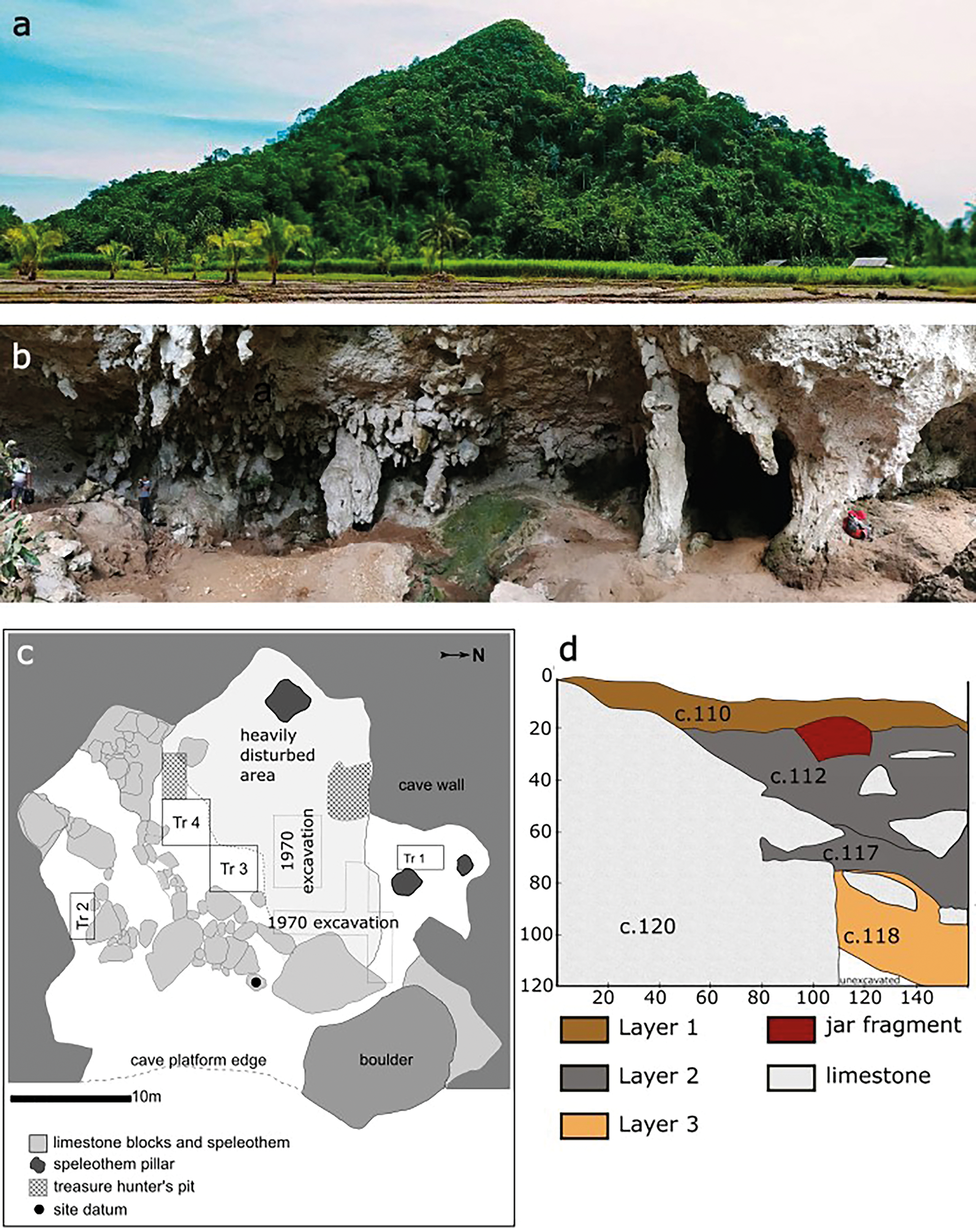
Pilandok Cave is located in a karst formation called Negmisi Peak in Barangay Maasin, Quezon municipality of southern Palawan (Figs 1 & 2). The site and its vicinities are situated within the ancestral domain of the indigenous Pala’wan of Maasin (Certificate of Ancestral Domain Title no. RO4-QUE-O110-143). Negmisi Peak is a limestone karst and the cave lies just below the peak of the karst, at approximately 165 masl. The name of the cave is also spelled as pilanduk (see Kress Reference Kress1978), but in this paper we are using the contemporary Pala’wan spelling of pilandok. In local languages in the region, the word pilandok typically refers to the mousedeer.
The Pilandok Cave site. (a) Negmisi Peak where (b) Pilandok Cave is located; (c) site plan showing the four excavation trenches (Tr 1–4); (d) stratigraphic profile for Pilandok Cave showing main archaeological layers and archaeological contexts (c.) based on the south wall of Trench 3.

Figure 2 Long description
The image consists of three elements: a photo, a site plan, and a stratigraphic profile. The photo shows Negmisi Peak, a lush green hill, with Pilandok Cave located at its base. The site plan illustrates the layout of Pilandok Cave, highlighting four excavation trenches labeled Tr 1 to Tr 4, a heavily disturbed area, a 1970 excavation site, a cave wall, a cave platform edge, limestone blocks and speleothem, a speleothem pillar, a treasure hunter’s pit, and a boulder. The stratigraphic profile depicts the main archaeological layers and contexts within the cave, based on the south wall of Trench 3. The profile includes Layer 1, Layer 2, Layer 3, limestone, and a jar fragment.
Pilandok Cave was first excavated in 1969–70 by a team led by Jonathan Kress (Reference Kress1978). Radiocarbon dating was conducted using mollusc samples and produced uncalibrated ages ranging from 18,000 to 25,000 bp (Kress Reference Kress2000). In 2016, we conducted a re-excavation of the site to validate the possible Last Glacial Maximum (LGM) age of the site. Three major cultural layers were unearthed during the excavation (Fig. 2d). Radiocarbon dates from charcoal produced LGM dates for two of these layers, namely Layers 2 and 3 (Ochoa et al. Reference Ochoa, Carlos and Lara2022). Layer 2 is composed of a very dense midden layer found across the site containing remains of various mammals, molluscs, macrobotanical remains and lithic artifacts. Calibrated radiocarbon ages for this layer are: 20,468–20,034 cal. bp (OxA-37182) and 22,004–21,540 cal. bp (OxA-36553). Underlying this layer is another midden deposit (Layer 3) in a different sediment matrix. Radiocarbon ages from Layer 3 are: 23,785–23,140 cal. bp (OxA-37180); 24,440–23,933 cal. bp (OxA-36331); and 24,995–24,301 cal. bp (OxA-36332).
Seven pantherine specimens were found in situ within Layer 2 of two excavation units (Trenches 3 and 4 in Figure 2c; SI Fig. 1). These are adjacent trenches located in the southern portion of the cave (or the left side of the main cave platform when facing the cave entrance). Two specimens were found on the surface, with one found near Trench 4 and another specimen recovered from treasure-hunters’ backfill near Trench 1 (north end of cave).
The taxonomic composition of the vertebrate bone assemblage of Layer 2 consists primarily of deer (92% of identified remains, N=819). This is based on zooarchaeological analysis of vertebrate remains from Trench 3. Methods in zooarchaeological identification and vertebrate taphonomy are described in the Supplementary Information (SI-2). Aside from deer, seven other mammal and reptile taxa were identified, but all of them occur in very small quantities. Endemic bearded pigs comprise 6% of the assemblage, and the rest of the taxa represent less than 1% of identified remains. These are the Palawan porcupine, tree squirrel, long-tailed macaque, diadem leaf-nosed bat, monitor lizard and Asian leaf turtle. Overall taphonomic data indicate that the large mammal assemblage is primarily human-derived and accumulated (Ochoa et al. Reference Ochoa, Carlos and Lara2022). The mollusc assemblage primarily consists of freshwater taxa from the genus Melanoides (92%, N=2132). Locally, these molluscs are known as kedkad and sulibid. It is within this animal bone and shell midden context that the pantherine fossil specimens were found.
Pantherine fossil material
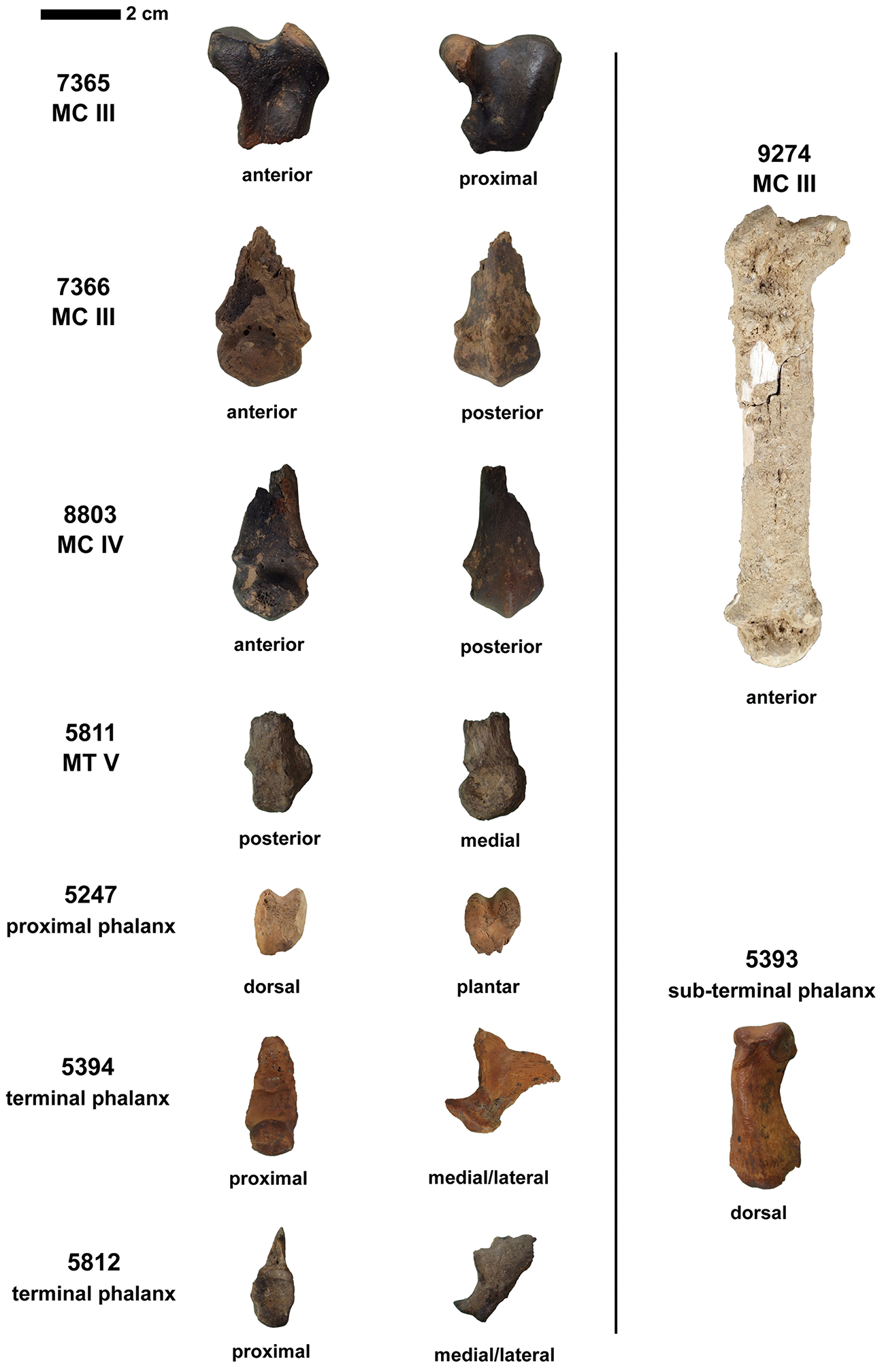
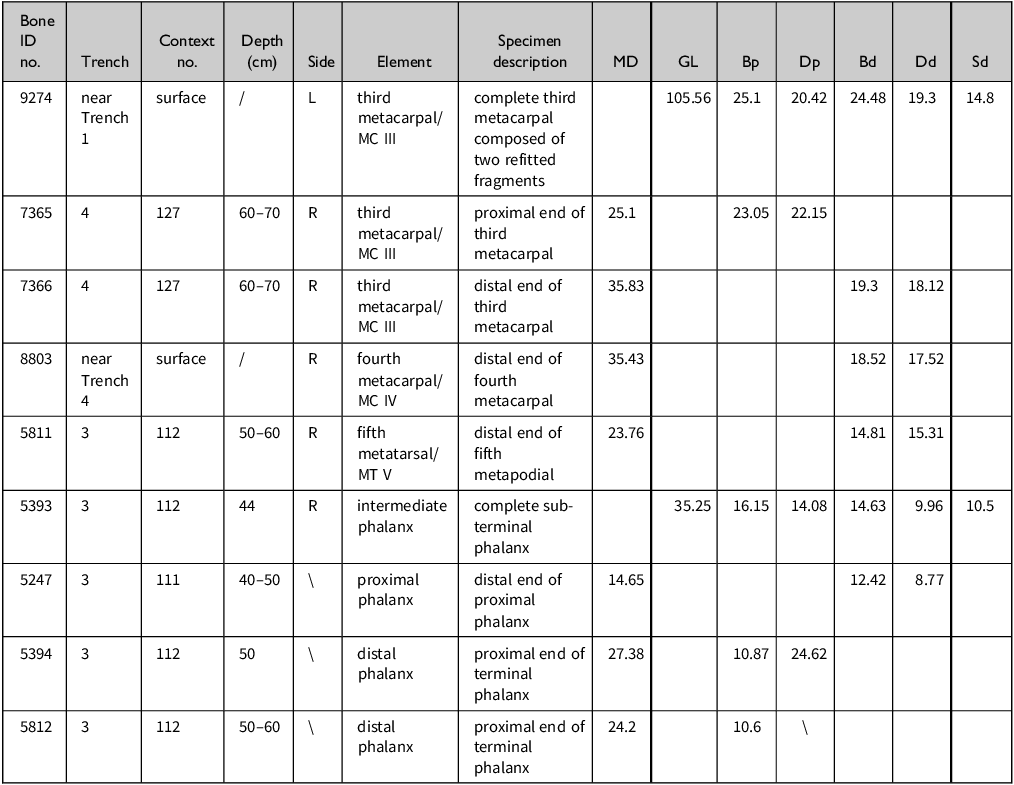
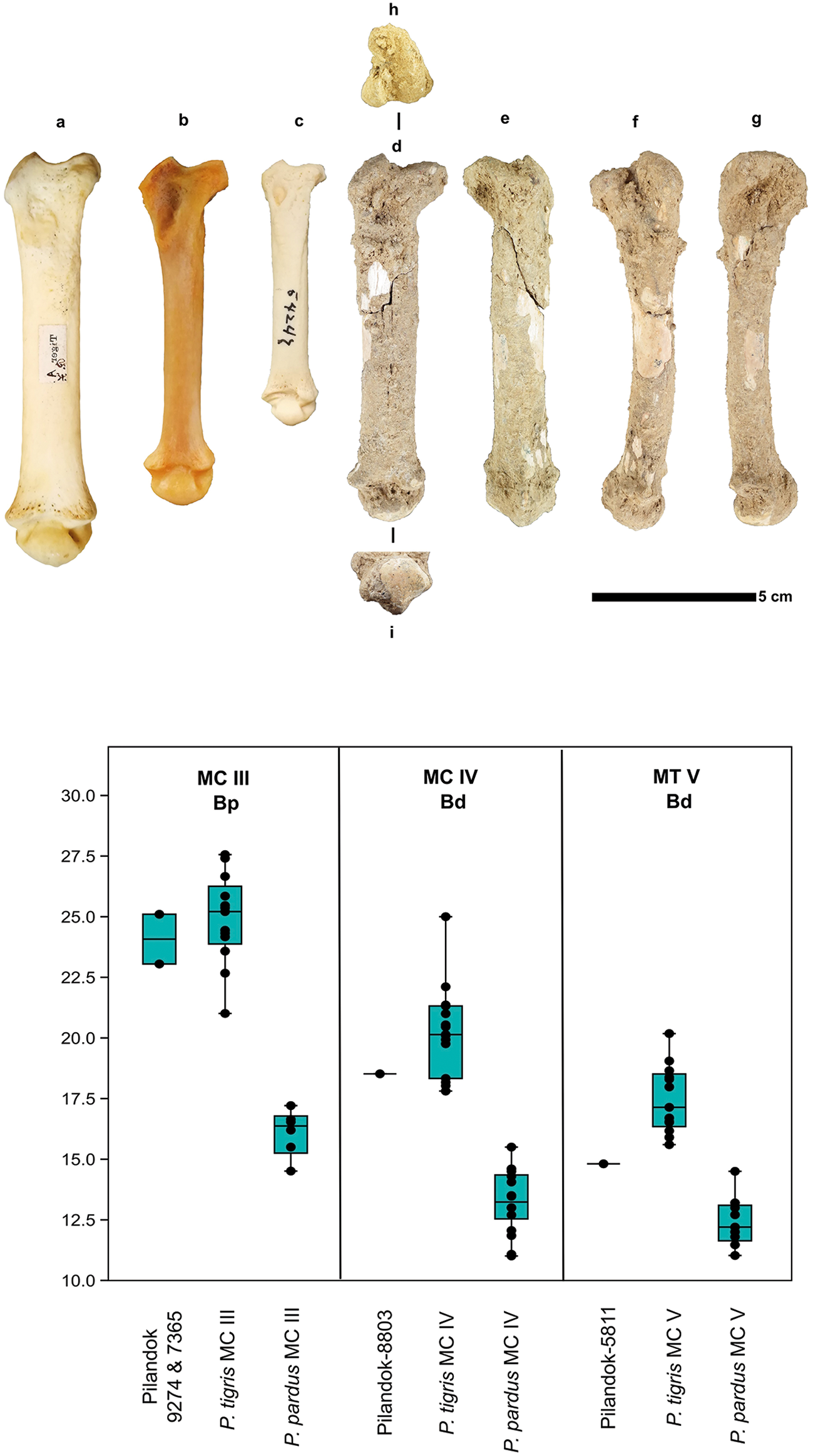
Nine specimens belonging to a large pantherine were recovered from Pilandok Cave (Fig. 3). Measurements of all specimens are presented in Table 1. The size of the fossils points to the largest pantherines—Panthera tigris and Panthera leo (Table 2; Fig. 4). From the Late Pleistocene to the present day, the only recorded pantherines in Southeast Asia are the tiger (P. tigris) and the leopard (P. pardus) (Kitchener & Yamaguchi Reference Kitchener, Yamaguchi, Tilson and Nyhus2010; Piper et al. Reference Piper, Cranbrook and Rabett2007). There are no reported modern or fossil records of the lion (P. leo) in the Southeast Asian region.
Nine pantherine specimens found in Pilandok Cave. MC=metacarpal, MT=metatarsal.

Figure 3 Long description
Nine tiger bone specimens from Pilandok Cave are displayed, each labeled with identifiers and orientations. The specimens include various bones such as metacarpals and metatarsals, with specific labels like 7365 MC III, 7366 MC III, 8803 MC IV, 5811 MT V, 5247 proximal phalanx, 5394 terminal phalanx, 5812 terminal phalanx, 9274 MC III, and 5393 sub-terminal phalanx. Each bone is shown from different angles such as anterior, posterior, proximal, medial, lateral, dorsal, and plantar views. The scale bar indicates a length of 2 centimeters.
Inventory and measurements (in mm) of pantherine specimens from Pilandok Cave. GL=greatest length (for complete specimens only), MD=maximum diameter, Bp=proximal breadth (medio-lateral), Dp=proximal depth (antero-posterior), Bd=distal breadth, Dd=distal depth, Sd=smallest transverse diameter of diaphysis. Bd for metapodials was taken at the epicondyles.

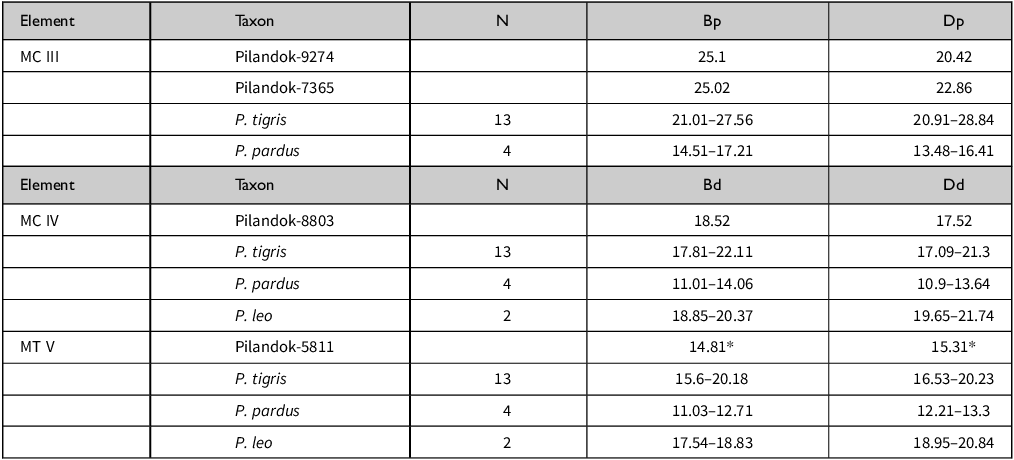
Summary of metapodial measurements (in mm) of Pilandok Cave fossil and modern pantherines. N=number of samples of modern individuals, MC=metacarpal, MT=metatarsal, Bp=proximal breadth, Dp=proximal depth, Bd=distal breadth, Dd=distal depth. Breadth measurement is medio-lateral and depth is antero-posterior. Measurements for modern pantherines are given as ranges. *Underestimated value due to slight damage on specimen 5811.

Top row: Comparison of tiger third metacarpals showing modern Bengal tiger (a: OUMNH-3756, mirror view of R side), captive Sumatran tiger (b: FMNH-165401) and captive leopard (c: FMNH-54247, P. pardus) with the Pilandok fossil left third metacarpal (Pilandok-9274) referred to Panthera tigris in anterior (d), posterior (e), medial (f), lateral (g), proximal (h) and antero-distal (i) views. Bottom row: Box-and-jitter plot of pantherine (Panthera) metapodial measurements (in mm). MC=metacarpal; MT=metatarsal; Bp=proximal breadth; Bd=distal breadth. For Pilandok-5811 MT V, the measurement is underestimated due to slight damage on the specimen.

Figure 4 Long description
The image consists of two main parts: a top row with a comparison of tiger third metacarpals and a bottom row with a box-and-jitter plot of pantherine metapodial measurements. The top row features seven bones arranged from left to right. The first three bones are modern specimens: a Bengal tiger, a captive Sumatran tiger, and a captive leopard. The next four bones are views of a fossil left third metacarpal from Pilandok, referred to Panthera tigris, shown in anterior, posterior, medial, lateral, proximal, and antero-distal views. The bottom row displays a box-and-jitter plot comparing measurements of pantherine metapodials, including metacarpals and metatarsals, with specific focus on proximal breadth and distal breadth. The plot includes data from various specimens, highlighting measurements in millimeters.
Out of nine specimens, two complete elements were found: a refitted third metacarpal (Fig. 4) and a sub-terminal phalanx (SI-Fig. 1). The other seven specimens are fragments of metapodia and phalanges. The metapodia are more clearly distinguishable based on the proximal articulation, and in this case, two specimens with proximal ends (specimens 9274 and 7365) are easily identifiable. Nonetheless, upon careful examination and measurement, distal heads of metapodia can also be differentiated to digit and side, based on the outline and shape of condyles and epicondyles. An individual description of each pantherine specimen is provided in SI-3. Based on the identified elements, the minimum number of individuals (MNI) for the tiger in the assemblage is one (refer specifically to SI-3 description for pantherine metapodia).
Linear morphometric comparisons of the Pilandok Cave fossils with modern referential Asian pantherines clearly distinguish that the fossils belong to P. tigris (tiger) instead of P. pardus (leopard), which is a much smaller pantherine (Table 2; Fig. 4; SI-Tables 1 & 2). Based on morphological and morphometric traits (see SI-2), six specimens are clearly ascribable to the largest known extant pantherine in Southeast Asia, the tiger. Although highly fragmented and/or lacking measurable landmarks, three additional phalanx specimens (5247, 5812 and 5394) are also ascribed to the tiger, since they conform to pantherine morphology and are comparable in size to tiger reference material.
Morphometric data indicate the Pilandok tiger is smaller than modern continental tigers, but larger than two modern comparatives from Sumatra and the Malayan Peninsula. This agrees with present-day observations that Sunda and island tigers in the tropics are smaller in body size than Bengal and Siberian tigers (Kitchener & Yamaguchi Reference Kitchener, Yamaguchi, Tilson and Nyhus2010).
Pantherine taphonomy and the Pilandok Cave large mammal assemblage
The animal bones from Layer 2 of Pilandok Cave are generally mineralized and highly fragmented. This assemblage also shows high incidence of heat alteration or burning. The high degree of fragmentation is partly attributed to bone-marrow extraction from deer bones and to burning (Ochoa Reference Ochoa2019). Common bone surface modifications produced by humans include heat alteration, smooth helical fractures from fresh bone breakage, and cutmarks (Fernández-Jalvo & Andrews Reference Fernández-Jalvo and Andrews2016; Outram Reference Outram2001). Skeletal element representation for cervids in the assemblage indicates that entire deer carcasses were brought into, processed and discarded in the cave. This pattern contrasts markedly with the taphonomy of tiger remains found on-site. Only tiger foot bones are represented in the assemblage, which reflects selective transport of tiger body parts into the cave. The entire assemblage excavated in 1970 and 2016 was sorted for tiger remains, yet only these nine specimens were identified. The tiger remains also exhibit mineralization and the fragmented elements show dry bone breakage. Six specimens show evidence of heat alteration or charring. In addition, three specimens display linear marks attributable to butchery actions by humans. In the following, butchery marks observed on tiger bones are described, as well as taphonomic marks produced by pantherines that come in the form of carnivore gnawing.
The butchery marks observed are in the form of cutmarks. Using criteria summarized by Fernández-Jalvo and Andrews (Reference Fernández-Jalvo and Andrews2016, 26–7), cutmarks were diagnosed as linear incisions that typically have a V-shaped cross-section, internal microstriations (Potts & Shipman Reference Potts and Shipman1981) and thinner linear marks parallel to the main incision (or ‘shoulder effect’ after Shipman & Rose Reference Shipman and Rose1983) and Hertzian fracture cones (Bromage & Boyde Reference Bromage and Boyde1984). Placement, distribution, and orientation (relative to long axis of the bone) of the butchery marks were also noted (Costamagno et al. Reference Costamagno, Soulier, Val and Chong2019).
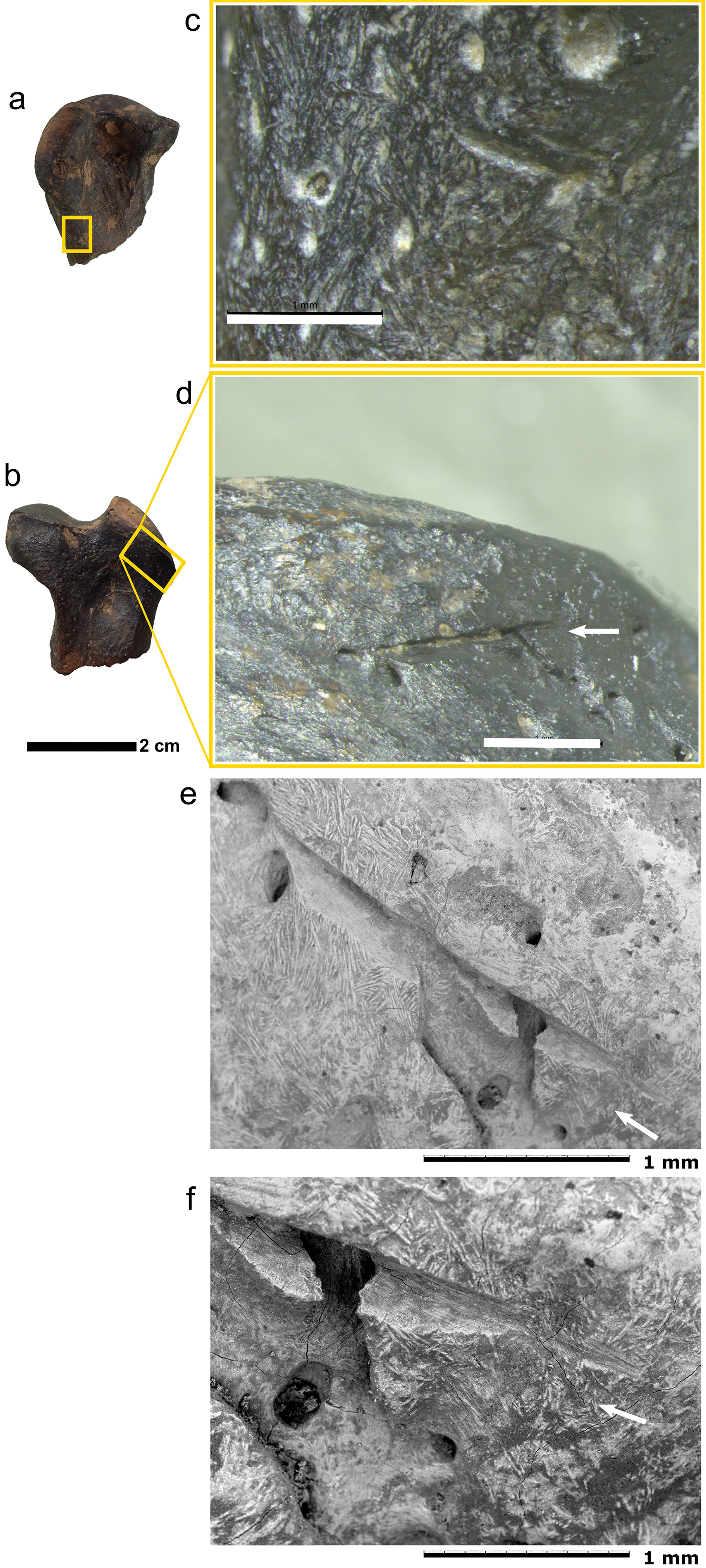
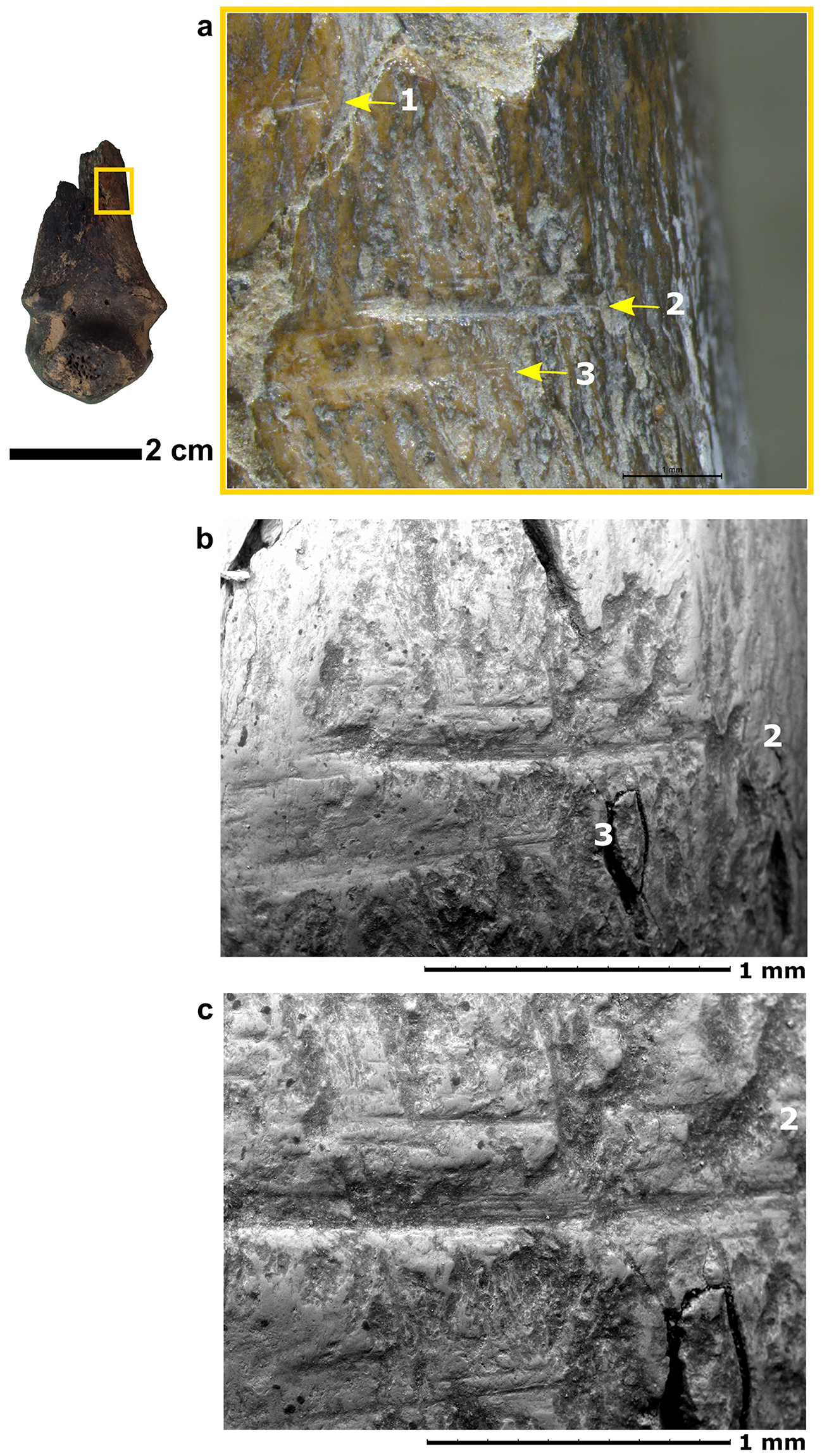
The proximal third metacarpal fragment (Pilandok-7365) presents cutmarks on the lateral (Fig. 5a) and anterior (Fig. 5b, c and d) sides of the proximal articular end. On the lateral side, there is one main V-shaped linear incision with a thinner and shorter parallel mark adjacent to it. On the anterior side, there is one sharp V-shaped linear incision. The two cutmarks surround the bulbous proximo-lateral articulation of the metacarpal. The right fourth metacarpal fragment (Pilandok-8803) has several sets of cutmarks on both the dorsal and plantar aspects of the distal shaft (Fig. 6). On the dorsal side of the diaphysis (Fig. 6a), three groups of linear incisions can be seen, with each having one main linear mark and thinner linear incisions running parallel to the main cutmark. These diagnosed cutmarks differ in gross and microscopic morphology from other linear marks such as root marks (which are often U-shaped, are rarely straight, and are instead commonly branched), gnawing marks (which are U-shaped and typically wider than the V-shaped incisions of cutmarks), and trampling marks (which usually are randomly occurring on exposed on bone surfaces and have irregular orientations relative to the long axis of bone diaphysis) (see Fernández-Jalvo & Andrews Reference Fernández-Jalvo and Andrews2016, 26–34; Marín-Monfort et al. Reference Marín-Monfort, Pesquero and Fernández-Jalvo2014). A third specimen, the sub-terminal phalanx (Pilandok-5393) has multiple linear marks that may potentially be attributed as anthropic marks made along the dorsal surface of the diaphysis and on the plantar side of the distal articulation (SI-Fig. 2). The marks have a U-shaped profile and internal microstriations. They are oriented in the same direction (transverse relative to long bone axis) and located on the dorsal and plantar ligament attachment sites.
Butchery marks on proximal right third metacarpal fragment (Pilandok-7365) on the lateral (a) and anterior (b) sides: (c) two parallel cutmarks on the neck of the proximo-lateral articulation seen in lateral view; (d) cutmark on the edge of the proximal articulation seen in anterior (dorsal) view. SEM micrographs (e, f) of (d), with white arrows denoting orientation of cut mark. Scale bars on micrographs are 1 mm.

Figure 5 Long description
The image displays a proximal right third metacarpal fragment identified as Pilandok-7365. Panel (a) shows the lateral side of the fragment with a highlighted area indicating two parallel cut marks on the neck of the proximo-lateral articulation. Panel (b) presents the anterior (dorsal) view of the fragment, highlighting a cut mark on the edge of the proximal articulation. Panels (c) and (d) provide magnified views of these cut marks, with panel (c) focusing on the two parallel cut marks seen in lateral view and panel (d) showing a single cut mark in anterior view. Panels (e) and (f) are scanning electron microscope (SEM) micrographs of the cut mark shown in panel (d), with white arrows indicating the orientation of the cut mark. Scale bars in the micrographs measure 1 millimeter.
Three sets (1, 2, 3) of cut marks on the anterior (dorsal) aspect (a) of the distal shaft of right fourth metacarpal fragment (Pilandok-8803): (b) SEM micrograph of cutmark sets 2 and 3: (c) SEM micrograph of cutmark set 2. Scale bars on micrographs are 1 mm.

Figure 6 Long description
The image shows a right fourth metacarpal fragment with three sets of cut marks labeled 1, 2, and 3 on the anterior (dorsal) aspect. The main image highlights the fragment with a scale bar of 2 centimeters. The inset images (b) and (c) provide detailed SEM micrographs of the cut marks. Image (b) shows cut mark sets 2 and 3 with a scale bar of 1 millimeter. Image (c) focuses on cut mark set 2 with the same scale bar of 1 millimeter.
The placement of the butchery marks at the ends of the metapodia and on the dorsal and distal sections of the phalanx where ligaments and muscle attach suggests that these marks were made in the process of detaching these tissues from the bone. These actions possibly derive from skinning or detachment of the forefoot of a tiger for obtaining pelt, paws and/or claws.
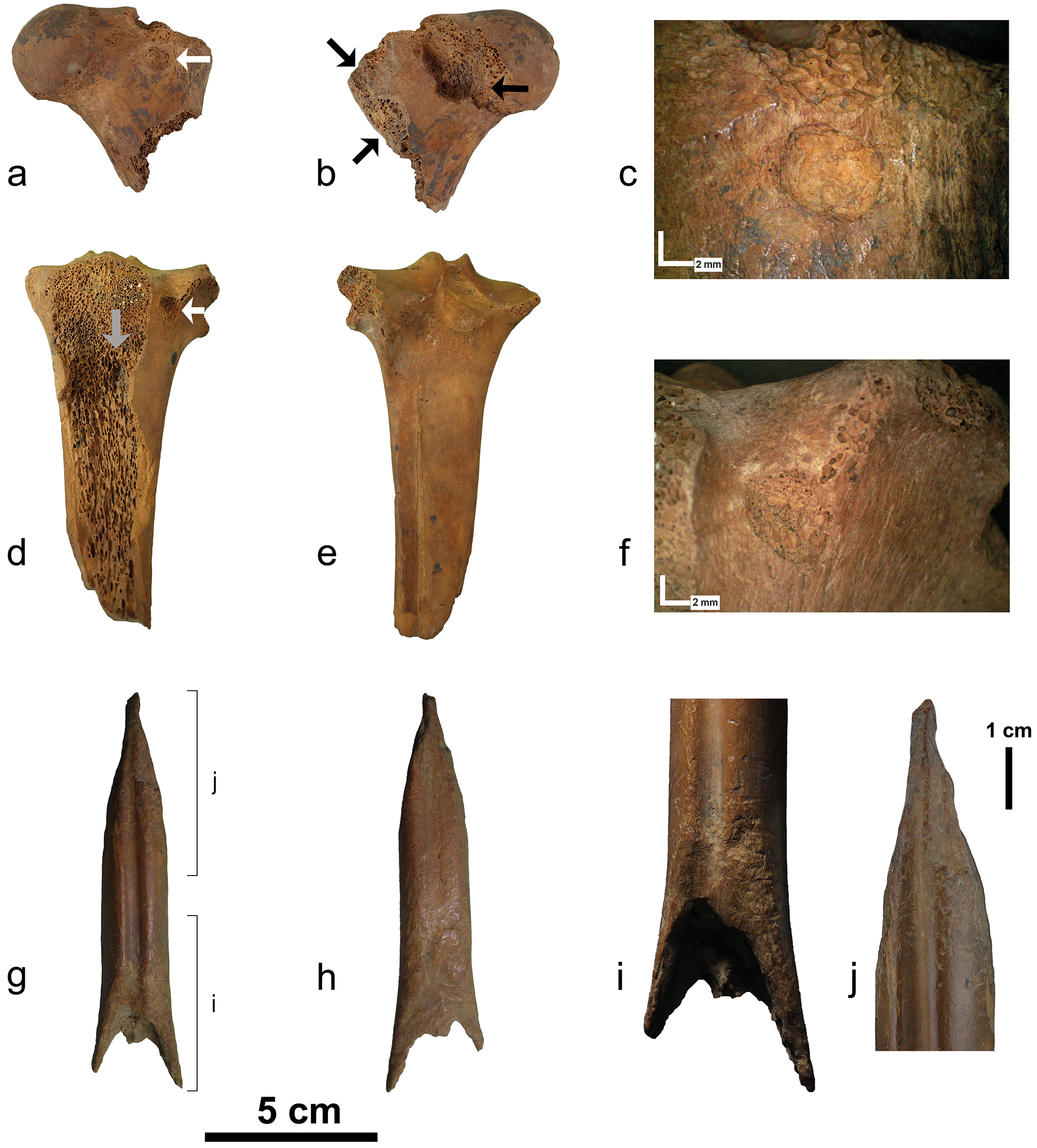
In addition to butchery marks on tiger remains, of interest here for pantherine taphonomy are three deer bone fragments that show evidence for carnivore gnawing. These three specimens are not charred or calcined. Across the Trench 3 assemblage, only 13 bone fragments were observed to show signs of carnivore or rodent gnawing, accounting for only 0.16% of the analysed remains. This implies that humans were the main accumulators and modifiers of the vertebrate assemblage. Of these 13 bones, three specimens show clear evidence for large carnivore gnawing in the form of tooth pits, punctures, furrowing, scoring or scratch marks and chewed-like or scalloped cortical margins of bones (Fig. 7 and SI-Figs 4, 5 & 6). Definitions for these tooth marks follow Binford (Reference Binford1981), Colard et al. (Reference Colard, Delannoy, Naji, Rottier and Blondiaux2014), Delaney-Rivera et al. (Reference Delaney-Rivera, Plummer, Hodgson, Forrest, Hertel and Oliver2009), Domínguez-Rodrigo and Piqueras (Reference Domı́nguez-Rodrigo and Piqueras2003), Haynes (Reference Haynes1983) and Sala and Arsuaga (Reference Sala and Arsuaga2018). Pits are tooth marks described as circular to oval depressions resembling the shape of a tooth crown or cusp. When a tooth mark penetrates the cortical bone, this is categorized as a puncture. Furrows are broad gouges that result from gnawing action and involves the extraction or absence of portions of the cancellous bone tissue.
Deer bones from Pilandok Cave showing evidence for large carnivore gnawing. Pilandok-5371 proximal femur in anterior (a) and posterior (b) views, with a tooth pit (white arrow) on the anterior side and punctures (black arrows) on the posterior side; (c) micrograph of tooth pit on the femur; Pilandok-5823 proximal tibia in anterior (d) and posterior (e) views, with a tooth pit (white arrow) and large fissure (grey arrow) on anterior side; (f) micrograph of tooth pit on the tibia; Pilandok-5392 metatarsal shaft in anterior (g) and posterior (h) views, with heavy gnawing marks on the proximal (j) and distal (i) ends.

Figure 7 Long description
The composite image consists of one photo and six illustrations. The photo shows a close-up view of a tooth pit on a femur and a tibia, each with a scale of 2 millimeters. The illustrations depict various deer bone specimens from Pilandok Cave with evidence of large carnivore gnawing. The first illustration shows the proximal femur in anterior and posterior views, highlighting a tooth pit on the anterior side and punctures on the posterior side. The second illustration displays the proximal tibia in anterior and posterior views, featuring a tooth pit and a large fissure on the anterior side. The third illustration presents the metatarsal shaft in anterior and posterior views, showing heavy gnawing marks on the proximal and distal ends. The bones are shown with a scale of 5 centimeters and 1 centimeter respectively.
A left proximal femur fragment (Pilandok-5371; Fig. 7; SI-Fig. 4) bears the following marks: a) a tooth pit on the anterior portion below the greater trochanter; b) furrowing on the proximal border resulting in the removal of the greater trochanter; c) puncture on the posterior side below the neck; d) furrowing and gnawing damage on the distal-most end of the fragment that possibly contributed to the breakage and eventual detachment of the proximal end from the rest of the femoral shaft. Additional taphonomic details for this specimen are shown in SI-Figure 4. A left proximal tibia fragment (Pilandok-5823; Fig. 7; SI-Fig. 5) bears gnawing damage and furrowing across the anterior portion of the epiphysis that led to the removal of the anterior crest, as well as a tooth pit on the proximo-lateral border of the epiphysis. A right metatarsal fragment (Pilandok-5392; Fig. 7; SI-Fig. 6) bears very heavy gnawing damage that resulted in the removal of the proximal portion and distal epiphysis and leaving only the diaphysis or long bone shaft.
In Haynes’s (Reference Haynes1983, 169–70) neo-taphonomic description of large felid (lion, tiger and jaguar) gnawing, the main damage produced by large cats on the femur consists of the biting-off of the greater trochanter and undercut biting of the femoral head. On the tibia, the proximal end or tibial crest is occasionally furrowed perpendicular to the element’s long axis and the crest may also be bitten off. These descriptions are corroborated by the study of Parkinson et al. (Reference Parkinson, Plummer and Hartstone-Rose2015) on tiger feeding and gnawing, where the greater trochanter of the femur is prone to destruction and the proximal end of the tibia is typically not well preserved. These descriptions are consistent with the gnawing damage found on the deer femur and tibia fragments from Pilandok described above (Fig. 7). In certain cases, tooth mark dimensions in certain bone regions can also differentiate the taxon size of the carnivore, particularly for marks on long bone epiphyses (Delaney-Rivera et al. Reference Delaney-Rivera, Plummer, Hodgson, Forrest, Hertel and Oliver2009; Domínguez-Rodrigo & Piqueras Reference Domı́nguez-Rodrigo and Piqueras2003). Dominguez-Rodrigo and Piqueras (2003, 1389–90) conclude that pit lengths on epiphyseal sections of bone can be used to establish three tooth-marking groups reliably: 1) marks under 4 mm are observed in all carnivores but lions; 2) marks between 4 and 6 mm are made by middle-sized and large-sized carnivores; and 3) marks above 6 mm are made by large carnivores.
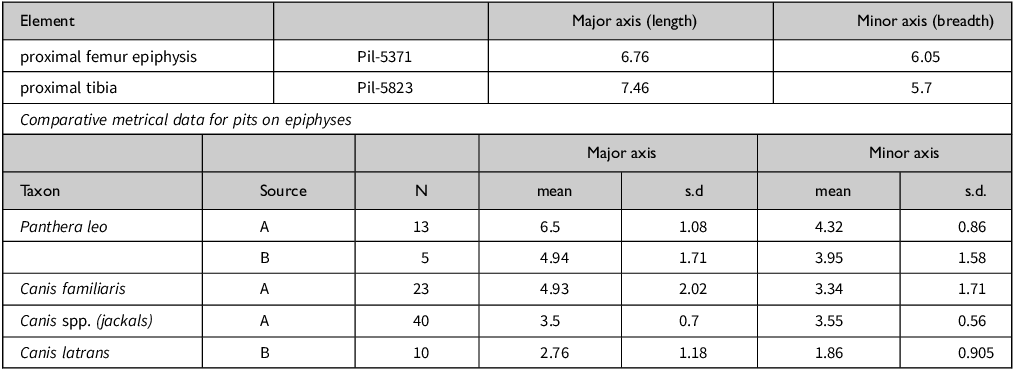
For pantherines, comparative measurements for epiphyseal tooth pits are available only for lions, which is in the same taxon size range as the tiger (Table 3; Delaney-Rivera et al. Reference Delaney-Rivera, Plummer, Hodgson, Forrest, Hertel and Oliver2009, table 3; Domínguez-Rodrigo & Piqueras Reference Domı́nguez-Rodrigo and Piqueras2003, table 1). The tooth pit length measurements on the Pilandok deer femur and tibia both exceed 6 mm (Table 3), suggesting that they were made by a large carnivore. On Palawan, the tiger is the sole candidate for a large carnivore, as well as being the only carnivore identified in the LGM levels of Pilandok site. Collectively, the gnawing modifications and tooth pit dimensions on the femur and tibia specimens described above suggest that the gnawing damage was made by a large carnivore in the size range of the tiger.
Measurements (in mm) for epiphyseal tooth pit dimensions for two deer specimens (Pilandok-5371 and Pilandok-5823) taken using a Dinolite microscope and comparative pantherine and canid data from Dominguez-Rodrigo & Piqueras Reference Domı́nguez-Rodrigo and Piqueras2003 (Source A) and Delaney Rivera et al. Reference Delaney-Rivera, Plummer, Hodgson, Forrest, Hertel and Oliver2009 (Source B). N=number of specimens measured, s.d.=standard deviation.

Although rare in the Pilandok vertebrate assemblage, these fragments show clear evidence for carnivore-induced bone modification. The low frequency of this type of gnawing indicates that tigers were not significant bone accumulators in the cave. Instead, the tiger(s) likely scavenged over human refuse left in the cave, as evidenced from these three fragments.
Natural distribution of tigers on Palawan
On Palawan Island, the fossil evidence for the tiger appears in the form of human-accumulated tiger parts. All tiger remains identified so far are foot bones. These occurrences point to two main possible scenarios that explain their presence on Palawan. Firstly, the most parsimonious explanation for the fossil presence of tiger bones in two cave sites on Palawan is that there was a natural population of tigers on the island during the Late Pleistocene up to the early Holocene. The current fossil record covers a geographic range from the northern end of the island at Ille Site (Fig. 1) to the southern portion of the island at Pilandok Cave, and encompassing a time span from c. 10,000 to 22,000 years. The question of a land connection between Borneo and Palawan during the LGM remains unresolved; at the very least, a narrow channel may have separated the two islands, based on palaeogeographic reconstructions of Palawan land area and sea-level lowstand estimates during the LGM ranging from –120 to –134 m below present sea level (Lambeck et al. Reference Lambeck, Rouby, Purcell, Sun and Sambridge2014; Robles et al. Reference Robles, Piper, Ochoa, Lewis, Paz and Ronquillo2015). Tigers are highly intelligent creatures and are known to be adept swimmers, and so it is highly likely that they can colonize Palawan from Borneo, even with a short sea-crossing when a small channel may have separated the two islands. The tiger’s fossil presence on Borneo (Piper et al. Reference Piper, Cranbrook and Rabett2007; Sherani Reference Sherani2021) also lends some support to their natural presence on Palawan, since Borneo is the closest Sundaic land mass to Palawan and a possible source and pathway for tigers to reach Palawan. Similar to the case of Palawan, tigers are not present on Borneo at present. Ethnohistorical evidence on Borneo shows multiple examples of tiger parts (skins, teeth, and bones) found in indigenous material culture (Sellato Reference Sellato2019). As mentioned above, a total of four subfossil/fossil specimens are known from Borneo. Three of these are of Holocene to terminal Pleistocene age, while a fourth specimen is reported by Sherani (Reference Sherani2021) to be of possible LGM age. The latter is possibly of the same age range as that of tiger remains from Pilandok Cave. The Palawan pantherine record presents a curious contrast to that of Borneo: a total of 12 tiger osteological specimens is now known from Palawan, but to our knowledge, there are no recent historical or ethnographic records of tigers on the island.
An alternative explanation is that the Palawan tiger remains represent animal parts transported or exchanged across vast distances, originating from Borneo or further west in the Southeast Asian mainland, or south from islands such as Java or Sumatra. Tiger parts are recognized as important materials imbued with potency, power, or efficacy, as recorded among contemporary societies in Asia. Consequently, there is the possibility that such remains represent long-distance exchange networks rather than actual physical presence of the tiger on Palawan. As noted above, only remains from tiger feet have been recovered in the two Palawan sites (Pilandok and Ille sites). This differential representation may indicate a long-lived practice of transporting or exchanging tiger pelts or paws, which also appear to be important in deeper antiquity.
Nonetheless, the natural distribution of the tiger on Palawan is bolstered by taphonomic data on large carnivore gnawing. Clear evidence for carnivore gnawing has been identified on three deer bones found in the same temporal horizon as the tiger remains. On Pilandok, there is no other mammalian carnivore identified in the assemblage. Remains of a canid were found in the Terminal Pleistocene record of Ille Cave, but there is no evidence for their LGM presence on Pilandok Cave. Furthermore, the size of the tooth pits is indicative of a large carnivore in the size range of the tiger (or large pantherine), which is considerably bigger than tooth pits recorded for canids (Table 3). The tiger is the only large carnivore in Island Southeast Asia of this size range that could have produced the recorded tooth pits.
Examining the LGM and terminal Pleistocene mammal fauna of Palawan, the tiger is not out of place within this ecological community, particularly with the presence of deer. There is terminal Pleistocene and early Holocene evidence for seven small carnivore taxa based on the Ille cave record: wild cat (Prionailurus bengalensis), otter (Aonyx cinereus), stink badger (Mydaus marchei), short-tailed mongoose (Herpestes bracyhurus), binturong (Arctictis binturong), palm civet (Paradoxurus philippinensis), Malay civet (Viverra tangalunga) and a possible wild canid (cf. Cuon alpinus). With the exception of the canid and the tiger, all these other carnivore taxa are found on Palawan today (Esselstyn et al. Reference Esselstyn, Widmann and Heaney2004). The smaller carnivores are not known to make ocean crossings, but tigers are known as strong swimmers (Kitchener & Yamaguchi Reference Kitchener, Yamaguchi, Tilson and Nyhus2010). The Late Quaternary mammal fauna displays many Sundaic affinities, and most of the medium-sized Palawan mammals are not found in the oceanic Philippines. The palaeoenvironments on Palawan during the LGM also differed from the late Holocene, consisting of a mosaic of environments that included more open or grassland habitats, along with different forest types (Hamilton et al. Reference Hamilton, Amano and Bradshaw2024; Wurster et al. Reference Wurster, Bird and Bull2010). Such habitats appear to have supported large mammal communities on Palawan that included tiger and deer.
The disappearance of the tiger on Palawan may represent a local extirpation of an island population, or a possible retreat of the tiger population into more favourable hunting environments in the early Holocene. A factor at play here is the extirpation of the local deer population on the main island of Palawan, since tigers rely significantly on large prey biomass and density to maintain viable populations (O’Brien et al. Reference O’Brien, Kinnaird and Wibisono2003; Seidensticker Reference Seidensticker, Miller and Everett1986; Sunquist Reference Sunquist, Tilson and Nyhus2010; Wilting et al. Reference Wilting, Courtiol and Christiansen2015). Tigers and humans would have been the two main predators of deer. Two deer taxa—a large deer (Rusa sp.) and the Calamian hog deer (Axis calamianensis)—were previously present on the island, but both disappeared during the Holocene (Ochoa & Piper Reference Ochoa, Piper and Monks2017). The Calamian hog deer retains a relictual distribution in the small islands immediately north of Palawan, but not on Palawan itself. The extirpation of local deer populations would have resulted in a significant depletion of large prey biomass for the tiger, and only the wild pig would have remained as ungulate prey. Other small prey species would have been present on Palawan, but modern studies on the population ecology of tigers indicate that they cannot survive and reproduce solely on small prey even if these were abundant (Sunquist Reference Sunquist, Tilson and Nyhus2010).
Insights on human use of tiger parts
Based on the vertebrate taphonomy evidence from Pilandok Cave, there is a marked difference in the treatment of and perception towards deer and tiger by ancient human inhabitants of Palawan. Tiger remains were processed differently from deer, the latter being the main human prey. Deer remains dominate the mammalian assemblage in the cave and osteological elements from all body parts of the deer are represented (Ochoa et al. Reference Ochoa, Carlos and Lara2022). This indicates that entire deer individuals were being brought into the cave for processing and consumption. On the other hand, tigers are very rare in the assemblage and only bones from the feet have been found. The pattern seen in Pilandok is likely not just due to density-mediated attrition and differential preservation of foot bones, since in the case of deer, which are less robust in size than tigers, all anatomical regions are represented from head to toe even as deer bones were intensively processed for marrow extraction (Ochoa Reference Ochoa2019). Treatment of deer foot bones is markedly different from tiger foot bones, as deer phalanges and metapodia were deliberately fractured to obtain marrow. Given the taphonomic evidence, it appears that there is deliberate human selection and transport of tiger parts into the cave. The same pattern of element representation is seen in the 14,000-year-old layer and early Holocene levels of Ille Site in northern Palawan. The archaeological layers in Pilandok and Ille Caves where tiger remains are found are separated in time by at least 6000 years.
Tigers are not commonly viewed as meat or subsistence food (see Sellato Reference Sellato2019; Wessing Reference Wessing1986). As described above, the evidence for cut marks on tiger foot bones indicates skinning to obtain the tiger’s pelt or processing to obtain paws or feet. The use of tiger skins and body parts is known across Asia in recent history and up to the present. To our knowledge, this practice of collecting tiger foot parts for skins or paws evident from Pilandok Cave is the oldest record of its kind for the Southeast Asian region. Such a practice may be related to perceived powers and potency (bisa in Tagalog) attributed to the tiger, such that certain tiger body parts are used for specific purposes based on perceived important qualities. Their placement in caves may also be connected to a perceived value of Pilandok Cave as a sacred or mysterious place (marikit or mari-it in Philippine languages; liyanen in Pala’wan). The use or processing of tiger parts may also have occurred within the context of food-sharing in the cave related to the consumption of deer meat and marrow.
A social world with tigers
Tigers have long resided in the islands of Southeast Asia, stretching back in time to when Homo erectus inhabited Java c. one million years ago (van den Bergh et al. Reference van den Bergh, de Vos and Sondaar2001). Palaeontological and zooarchaeological records also show their fossil presence in Late Pleistocene contexts in the region (Amano et al. Reference Amano, Moigne, Ingicco, Sémah, Awe and Simanjuntak2015; Piper et al. Reference Piper, Cranbrook and Rabett2007; Volmer et al. Reference Volmer, Hertler and van der Geer2016), with such accounts focusing on palaeoenvironmental inquiries, ecological competition and subsistence strategies. A different set of views on tigers and their environs are presented in Southeast Asian ethnographic contexts. While such recent accounts are separated by many millennia from the LGM archaeological context of Pilandok Cave, they still offer a broader set of ontological perspectives that goes beyond a normative behavioural ecology standpoint in palaeozoological analysis. In such accounts often written in and translated into English by Western scholars, we glean social worlds based on vernacular concepts described in such texts—social worlds that are populated by tigers and various persons, spirits and beings. In Southeast Asian societies where tigers are present, the tiger is not just seen as a carnivorous predatory animal with certain biological traits; nor are they simply perceived as ‘maneaters’ and ferocious beasts that produce landscapes of fear. Instead, tigers enact various roles and relations in specific contexts that includes ancestor, kin, ‘totem’, shape-shifting mediator, ‘shaman’ or balian/babaylan, and guardian (Boomgaard Reference Boomgaard2001; Sellato Reference Sellato2019; Wessing Reference Wessing1986).
Palawan during 20,000–22,000 years ago at the Last Glacial Maximum can be reimagined as a social landscape that drastically differed from Holocene-age and present-day Palawan. Across the LGM, Palawan was a much larger island, which was connected to neighbouring small island groups called Cuyo, Calamianes and Busanga Islands (Fig. 1), forming an extensive landmass that biogeographers call Greater Palawan. The site of Pilandok and the Negmisi karst would have been in the interior part of the island, around 40 km inland. It was a landscape inhabited by classes of beings that are no longer present today on the island, such as the tiger and deer.
A re-imagining of Palawan during this period in the past must consider a plurispecies social world that includes harimau/halimaw. Here, we refer to the idea of the social as including non-human persons and beings that humans negotiated and interacted with. This perspective partly derives from a definition of animism ‘as an ontology which postulates the character between humans and non-humans’ (Viveiros de Castro Reference Viveiros de Castro2012). This social world would have been the landscape of harimau/halimaw as much as a human landscape, wherein the largest feline would have served not only as an environmental variable but also a powerful shaper of the lands and forests that humans and other beings acted upon. Modern-day morphological, ecological and historical descriptions of tigers as perceived and described by humans picture them as embodiments of power, beauty, flexibility, agility and mysterious camouflage (Boomgard Reference Boomgaard2001; Sunquist Reference Sunquist, Tilson and Nyhus2010). Certain perceptible tiger attributes, i.e. characteristics that mark the class of being of ‘tiger’, would also have been observed and experienced by humans in the past, such that past peoples would have recognized and selectively appreciated affective attributes of tigers in various meaningful ways. The rhythms, movements and ecological knowledge of human inhabitants would also have been scaled and attuned to a plurispecies (see Bird-David Reference Bird-David2018) community that included the tiger. As such, past humans would have perceived general and particular qualities of tigers that include aspects of their physicality, presence and powerfulness. This formidability and the distinctions ascribable to tigers render them valuable for examining concepts of power and personhood.
The archaeological evidence from Palawan indicating a selective practice to obtain tiger parts suggests the human recognition of particular attributes of the tiger. The making and usage of tiger-derived objects may have an affective and transformative basis that enacted certain forms of power-efficacy, or bisa in Tagalog. Bisa is a concept of widespread use across the Philippines, Indonesia and Malaysia. Derived from Sanskrit and originally referring to ‘venom of a snake, poison, or substance’, the term bisa now connotes ‘power and being powerful’ among Philippine languages, as well as ‘ability and capacity’ in Indonesian. The partialization of tiger bodies can be interpreted as an act of re-embodying the tiger or qualities of the tiger for human(s) who made and used such bodily items. This form of partialization can signify the idea of ‘affectability’ and affective power (see Robb Reference Robb2017; Robinson Reference Robinson, Alberti, Jones and Pollard2013). Among the indigenous Pala’wan, whose ancestral domain covers important archaeological sites on Palawan Island such as Pilandok Cave, power translates as kapendayan and kepengdedyan/kepengyedyan. The root word for kapendayan is panday, a borrowing from Sanskrit and which in various Austronesian languages refers to a blacksmith and forging, but has also taken on broader meanings related to skill, power, knowledge and expertise. In relation to bisa, the Pala’wan concept of power as kapendayan subsumes affective power that resides in objects, as well as experiential power that resides among persons who can ‘activate’ and have knowledge of how to use such objects. Classes of objects that are commonly known to have affective power include charms, amulets and talismans, which translate as mutya, anting-anting and agimat in various Philippine languages. Among the Pala’wan, these objects—many of which derive from various plants and animals—possess kapendayan. Kepengdedyan/kepengyedyan translates to the Tagalog word kapangyarihan, which is defined as a capacity to make or perform something and to make something happen, and which is also fitting to use as a concept that, more than a translation, portrays instantiations of power. The word derives from the root word yari which translates as create, make, or have the power to make. Yari is also the root word for the term pangyayari, which is the Tagalog translation for occurrence or event and which can be further elaborated as a happening or coming into being. The specific choice of utilizing tiger body parts in the form of pelts or paws potentially relates to an attribution of a transmorphic form of power residing in such bodily items that can be translated and expressed as kapangyarihan, denoting in this case a specific affective capacity to enact something based on the partible attributes of the tiger. The body parts of a powerful being such as that of the harimau/halimaw may have been imbued with powerful animated or animic attributes.
Although the term widely used in the Philippines to refer to ‘tiger’ is tigre—a Spanish loanword—the Indonesian equivalent, harimau, is seen to have entered the lexicon of ethnolinguistic groups in the Philippines, albeit carrying a different meaning, ‘monster or wild, as in ferocious beast’. Aside from harimau, another term that is shared by speakers of Indonesian and speakers of Pala’wan (in Brooke’s Point) is simaya. Among the latter two ethnolinguistic groups, the term simaya has the following meanings: ‘offering to gods, and altar, place of sacrificing or offering place’ (SIL Philippines 2025). Interestingly, the same term in Indonesian means ‘saviour.’ In Pala’wan, simaya is synonymous with begey, which, aside from ‘gift,’ also means, ‘reward or prize’. Using concepts surrounding the term simaya can further explicate how objects such as animal parts may acquire and manifest affectability in relation to other beings, as well as give insight on the significance of the place or cave context in which it was found. Paz (Reference Paz, Rountree, Morris and Peatfield2012) examined the idea of ‘appropriateness’ in relation to the recurrent use of caves in the Palawan context as evidenced in archaeological and ethnographic records. He also discussed the notion of ‘attention-focusing’ activities that are conducted by people in these locales across time. The archaeological layer in which the Pilandok Cave tiger remains were found shows evidence of notable practices: processing and possible food-sharing of high-value food like deer meat and marrow, using the site as a stone tool workshop, fire-making, and possible social exchanges surrounding the hearths that were made in the cave.
In Island Southeast Asia, human–animal relations in the Late Pleistocene are also remarkably encoded in rock art. Some of the earliest known figurative representations are those of animals and therianthropes recorded on Sulawesi and Borneo. In Sulawesi, narrative scenes depicting humans interacting with a wild pig in Leang Karampuang has been dated to at least 51,200 years ago, while anoas, therianthropes, humans and pigs are depicted in a cave-art panel at Leang Bulu’ Sipong 4 dated to at least 48,000 years ago (Oktaviana et al. Reference Oktaviana, Joannes-Boyau and Hakim2024). Depictions of wild pig in Leang Tedongnge in Sulawesi date to at least 45,500 years ago (Brumm et al. Reference Brumm, Oktaviana and Burhan2021), while depictions of a large ungulate (possibly banteng) in Lubang Jeriji Saleh in Borneo have been dated to at least 40,000 years ago (Aubert et al. Reference Aubert, Setiawan and Oktaviana2018). The parietal art provides a glimpse of the symbolic and social significance of animal beings in regional belief systems of ancient foraging groups, although this is in a time range at least 20,000 years older than the Pilandok record. In the case of the LGM tigers of Palawan, the specific procurement of tiger parts implies a particular perception of tigers as possessing special qualities and potency that make them valuable for humans. The Pilandok Cave pantherine record currently presents the only dated Late Pleistocene evidence in the Southeast Asian region for this kind of modification of tiger body parts and this form of interaction between tigers and humans in deep antiquity.
Intrinsic to the idea of other-than-human animacy and agency is the recognition that many other animals and plants possess a spirit, life force or vital breath—kurudwa/kaluluwa/kiaruwa and ginhawa/giinawa in Philippine languages—similar to humans (Abrera Reference Abrera2005; Covar Reference Covar1993; Salazar Reference Salazar and Pe-Pua1982). Underlying this specific form of interaction between tigers and humans evident in the Pilandok record is the possible recognition of the tiger’s personhood. The notion of person includes humans and other entities that have certain aspects such as mind, spirit or soul, life force, physical body, and/or having some form of agency (Bird-David Reference Bird-David2018; Fowler Reference Fowler2004; Reference Fowler2016). Using concepts among Southeast Asian societies, we use an ‘animistic’ view of relational personhood among tigers and humans. This comes from a definition of animism derived from Southeast Asian contexts that fundamentally views life, agency and personhood as distributed among humans and non-humans (Sprenger et al. Reference Sprenger, Haug, Duile, Duile, Großmann, Haug and Sprenger2023). This further relates to the view that other-than-human persons are not just beings or objects imputed with agency or spirit, but instead are considered as social beings and actors inhabiting a pluriversal lifeworld that reciprocally bring one another into existence, emergence and immanence (see Ingold Reference Ingold2006; Reference Ingold2022). An alternative to this, of course, is the perspective of what is labelled as ‘naturalism’, following Descola’s (Reference Descola2013) comparative schema, which are said to characterize modern western ontologies, wherein beings like tigers are perceived as occupying a separate domain of animality and conceived as devoid of interiority but possessing some similarity in physicality with humans. However, Western naturalist and modernist perspectives derive from ontologies that have developed imaginaries of the tiger from a distance rather than living in proximity with them. Instead of taking the human–animal dichotomy in Western taxonomy as a default, we utilize a pluralized notion of personhood from Southeast Asian Indigenous groups. Concerns may be raised regarding the projection of ethnographic views onto deep-time contexts, and rightly so, since Indigenous groups, including those that practise foraging lifeways, are themselves shaped by modernity and change rather than persisting in ethnological fixities. The attempt made here is not simply of ethnographic analogizing, but of a modest application of vernacular theorizing (see Parreñas Reference Parreñas2020) in order to expand our perceptions on ways of being with the tiger across time, as well as with other living beings and the ‘environment’. This paper makes an initial attempt to centre fundamental understandings of humanity and personhood in Southeast Asia, which can be compared and contrasted with universalized notions of Homo sapiens and modern human in Western archaeological science and epistemologies. The latter can also be considered as ‘ethnographic viewpoints’ rooted in European and Western epistemic contexts and histories, which include encounters with non-Western and non-human/non-person others. It is necessary to provincialize (see Chakrabarty Reference Chakrabarty2000) and recontextualize western notions of being, as well as to centre other views, particularly forms of place-based knowledge rooted in the lands and environs that, in this case, tigers have lived in for millenia alongside humans.
We can put forward the usage of the concept of tao (also tau, taw, tawo, tawu), translated as ‘person’, and which in various Philippine and Austronesian languages refers to humans and other-than-human persons. The vernacular concept of tao encompasses both English concepts of human and person, and this non-separation has profound ontological implications. The PWMP reconstruction for this cognate set is *tau (ACD 2016). We note that the time-scale of c. 10,000 to 20,000 years ago likely means that humans on Palawan were not speaking Austronesian languages, and the label for such concepts in a past vernacular would have been different. Nonetheless, these contemporary vernacular labels are described here to impart and demonstrate local concepts derived from living in these island- and forest-scapes and are constitutive of social–ecological relations with beings that animate such places, which in turn animate indigenous ontological paradigms. Tao, when used with certain qualifiers, can refer to specific beings, such as ‘masters,’ or ‘spirits’ in forests and waters. For example, taw magepet in the Batak (of Palawan Island) language translates as ‘persons in charge’ and refers to persons in charge of plants, animals and stones (Novellino Reference Novellino, Barker and Janowski2011). The Hanunoo Mangyan (of Mindoro Island) refer to important beings that include tawu dagat (‘sea supernaturals in human form’), tawu danum (water ‘spirit’) and tawu sa talun (forest ‘spirit’), tawo namatay (dead people) and tawo sa kaybi (people of the past or ancestors) (ACD 2016; Conklin Reference Conklin1953; Luquin Reference Luquin2021). Among the indigenous Pala’wan of Quezon, it is known that certain taw (here referring to powerful persons or beings) are resident in the various karst complexes, including Negmisi Peak where Pilandok Cave is found and Lipuun Point where the Tabon Cave Complex is located. The Pala’wan term taw banar (‘true’ human/person) is a close translation of the notion of ‘human’, and there are other taw who have different qualities and powers. Perspectives on the tiger’s extraordinary and unique being, setting them apart from other animals, are common across indigenous groups in Southeast Asia such as the Eastern Penan of Borneo, Aceh and Gayo of Indonesia, and Khmu of Vietnam, who perceive that humans and tigers have a shared ancestry and thus tigers are treated as kin and ancestors (Boomgard Reference Boomgaard2001; Sellato Reference Sellato2019; Wessing Reference Wessing1986). Such a view of certain animals or animal individuals as persons is pervasive among many Indigenous groups around the world. This is elaborated in Amerindian perspectivism, wherein certain animals are viewed as humans and persons, and the original condition of animals and humans is perceived as a state of undifferentiated and shared humanity rather than animality (Viveiros de Castro Reference Viveiros de Castro2012). This recognition of a shared humanity and shared human ancestry between tigers and people is reflected in Southeast Asian cosmologies (Sellato Reference Sellato2019; Wessing Reference Wessing1986).
Furthermore, big cats such as tigers, lions, leopards and jaguars are known to play important social roles and relations with humans in the past and the present wherever they co-inhabit (e.g. Hussain & Floss Reference Hussain and Floss2015; Kohn Reference Kohn2013; Motta & Porr Reference Motta, Porr and De Vos2023). Examples of early archaeological evidence showing symbolic interactions between humans and big cats derive from European Upper Palaeolithic representations of cave lions, as depicted in Aurignacian art such as the famous ‘Lion Man’ statuette of Stadel Cave in Germany and the Panneau des Lions drawings in Chauvet Cave in France (Kind et al. Reference Kind, Ebinger-Rist, Wolf, Beutelspacher and Wehrberger2014; Leroi-Gourhan Reference Leroi-Gourhan1965). Much earlier evidence for obtaining lion pelt is demonstrated by Neanderthals in the site of Einhornhöhle in Germany, where lion phalanges were analysed to have skinning marks and dated to at least 190,000 years old (Russo et al. Reference Russo, Milks and Leder2023). Across South America, jaguars are known to be part of the past and present symbolic repertoire of various indigenous groups, and they are said to be the most venerated feline in the continent (Motta & Porr Reference Motta, Porr and De Vos2023).
Although the particular nature of these relationships with the tiger on Palawan c. 20,000 to 10,000 years ago—whether as ancestor, kin, totem, protector, healer, enemy, or other person and relation—cannot be ascertained, we are able to gather insight that the tiger is perceived distinctly by humans from other animals and valued particularly because of their attributes based on a conspicuous practice of treatment of the tiger’s body. Interactions between humans and powerful beings such as tigers would have shaped the relational experience of personhood within this social world of Palawan and the broader island region of Southeast Asia where tigers previously roamed for thousands of years.
Conclusion
The Pilandok Cave fossil evidence expands the temporal and geographic record for the past presence of the tiger on Palawan Island. These represent the oldest known tiger fossils on Palawan and the Philippine archipelago. The tiger specimens found in situ come from the 20,000–22,000-year-old layer of the site. Skeletal element representation may cast uncertainty regarding the tiger’s actual presence, since there is the possibility that these parts may have been widely transported across the region. However, direct evidence for large carnivore ravaging indicates that this pantherine was present in the landscape and that they gnawed on deer remains that were hunted by humans and brought to the cave. Collectively, the archaeological evidence confirms that Palawan Island was part of the natural range of tigers and that they inhabited all the large Southeast Asian islands west of the biogeographic boundary labelled as Huxley’s line. The taphonomic evidence also demonstrates the selective transport and particular treatment of tiger parts to obtain tiger pelt or paws. Although now peripheral to the tiger’s range, the Palawan pantherine record currently presents the oldest evidence in the region for this kind of human modification of tiger body parts. This practice of procurement of tiger parts implies a distinctive perception of harimau as possessing qualities that make them valuable for humans. These percepts are potentially connected to animistic notions of power and relational personhood, since the harimau would have been a powerful shaper of the social landscape that humans cohabited in. The use of tiger body parts may have been related to forms of affective power, as elaborated by the concepts of bisa, kapendayan and kapangyarihan, which were potentially embodied in pantherine artifacts. Although the tiger has passed (halimaw nang nakalipas/halimaw na lumipas na) and no longer roams Palawan and much of the Sundaic islands, their remains from Pilandok Cave tells of a radically different place in the LGM from what Palawan is today and alludes to past social ecologies and web of relations that humans and other-than-human persons participated in.
Supplementary material
The supplementary file may be found at https://doi.org/10.1017/S0959774326100638
Acknowledgements
We wish to thank the Pala’wan community and Indigenous Political Structure of Maasin (Quezon, Palawan), especially Penglima Eddie Seniaga Sr and IPMR Narciso Seniaga. A huge thanks to the 2016 Pilandok Cave excavation team. We thank the local government of Barangay Maasin and Quezon Municipality, including former Mayor Joselito Ayala and former Barangay Captain Danilo Carmen. We also thank Ronadette Eriman, Robina Arban and Penglima Jorni Arban. At the National Museum of the Philippines, we thank Jeremy Barns, Mary Jane Louise Bolunia, Maricar Belarmino, Hazel Ramirez, Jonathan Jacar, Timothy James Vitales and the Archaeology Division. At the University of the Philippines, we thank Victor Paz, Michael Herrera, Juan Rofes and Felipe Jocano, Jr. We thank Andrew Whyte and Fairuz Bangahan for their kind assistance with the illustrations. At the University of Cambridge, we thank Graeme Barker, Preston Miracle, Jessica Rippengal, Mathew Lowe, Marjolein Bosch and Emily Tilby. We also extend our gratitude to Lawrence Heaney of the Field Museum. We gratefully acknowledge research funding from the University of Cambridge Department of Archaeology, Evans Fund, Newnham College and the Wenner-Gren Foundation Dissertation Fieldwork Grant and Engaged Research Grant. We are also very grateful to the two reviewers who provided important insights that improved this paper. We dedicate this paper to Victor J. Paz, an exceptional person and magnanimous spirit—bukod-tangi ka, Victor.


 Open access

