Introduction
Otolaryngology and head and neck surgery are highly specialised fields which are often not taught well at undergraduate level.Reference Newbegin, Rhodes, Flood and Richardson1 A national survey showed that the average length of time spent within ENT departments during undergraduate medical training was only one and a half weeks, and 42 per cent of the undergraduates surveyed did not undergo any formal assessment of their clinical skills or knowledge at the end of such attachments.Reference Mace and Narula2 A previously published telephone survey disclosed the fact that 75 per cent of senior house officers (SHOs) had not received enough undergraduate ENT teaching to deal with ENT emergencies.Reference Sharma, Machen, Clarke and Howard3 The ‘Modernising Medical Careers’ initiative has led to doctors specialising earlier in their career, and therefore gaining less experience in a variety of specialities.Reference Powell and Doshi4 These recent changes within the National Health Service (NHS) may mean that acute ENT services are being provided, particularly at night, by doctors with little experience of the speciality.
The implementation of the European Working Time Directive has led to an increase in cross-speciality out-of-hours cover.Reference Fisher, Moffat, Quinn, Wareing, Von Blumenthal and Morris5 A 2006 national survey found that non-ENT SHOs were on call out of hours in 60 per cent of the hospitals contacted; this survey also found that a significant number of SHOs had no ENT experience and no access to training, and hence were not confident in managing simple ENT emergencies.Reference Davis and McDonald6 The introduction of the European Working Time Directive in 2004 reduced working time to 56 hours per week; in August 2009, this will reduce again from 56 to 48 hours per week.Reference Morris-Stiff, Sarasin, Edwards, Lewis and Lewis7 Compliance with the European Working Time Directive means hospitals must increase efficiency at night, employing methods such as ‘Hospital at Night’ or cross-covering of specialities. Requiring a small number of inexperienced junior doctors to cover many specialties during night hours could potentially affect patient care, particularly in smaller specialities such as otolaryngology. This concern prompted us to undertake a national survey of junior doctors supplying night-time ENT cover.
Method
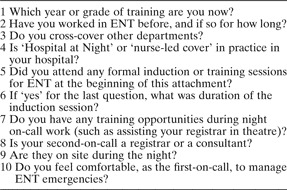
A national survey of first-on-call doctors for ENT was conducted using a telephone questionnaire. We formulated a set of interview questions which were then discussed, amended and approved at our local research meeting (the final version of these questions is shown in Table I). Hospital names and telephone contact details were sourced from the NHS website (www.nhs.uk). We restricted our survey to NHS hospitals within England. The inclusion criterion was hospitals providing acute ENT facilities overnight. Telephone calls were made between 8 p.m. and midnight by the first and second authors in March 2008. The starting dates of the ENT posting of the specialty and foundation year trainees included in this survey were February 2008 and December 2007, respectively. Respondents’ personal details were not requested, and other information related to the interview (e.g. name of hospital, day and time of call) was not saved in our database. At the beginning of each interview, the nature of the call was clarified and permission was sought before proceeding further. Data were saved on the hospital computer, access to which was trust password controlled.
Survey questions

Results and analysis
One hundred and nineteen NHS hospitals were contacted. Of these, 91 were eligible for inclusion in the survey as they provided out-of-hours night emergency services for ENT. Eighty-three interviews were conducted (a response rate of 91 per cent). Eight interviews were not conducted as the doctor did not have the time to complete the interview.
Question one
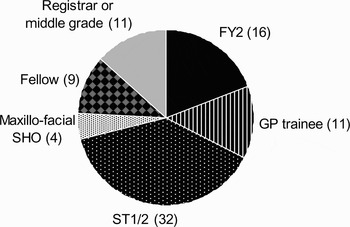
Respondents’ grades are shown in Figure 1. Eleven of the first-on-call doctors (13 per cent) were at the grade of registrar or above, and therefore were not considered further for data analysis. Sixteen respondents (22 per cent) were in foundation year two, having only had one year of ward work experience. Five respondents (6 per cent) were from the maxillo-facial surgery department and had only dental qualifications.
Grades of first-on-call doctors for night-time ENT cover (n = 83) in English National Health Service hospitals. Numbers represent number of respondents. FY2 = foundation year two; GP = general practitioner; SHO = senior house officer; ST = specialty trainee

Question two
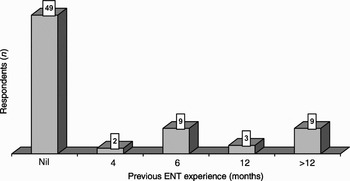
Respondents’ levels of previous ENT experience are shown in Figure 2. Forty-nine respondents (68 per cent) had no previous ENT experience. Twelve respondents had previously worked in ENT for one year or more, and represented a mixture of Calman trainees.
Previous otolaryngology experience of night-time first-on-call ENT doctors below registrar level (n = 72).

Question three
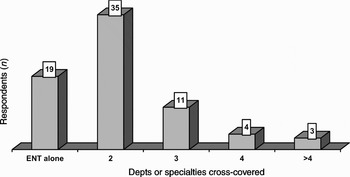
The number of departments or specialities cross-covered by the respondents is shown in Figure 3. Fifty-three doctors (74 per cent) cross-covered other specialties in addition to ENT, with seven (10 per cent) covering four or more specialities. The additional specialties covered (in various combinations) were as follows: general surgery, maxillo-facial surgery, neurosurgery, plastic surgery, orthopaedics, urology, ophthalmology, cardiothoracic surgery, vascular surgery, general medicine, nephrology and gynaecology.
Number of departments (depts) or specialities cross-covered by night-time first-on-call ENT junior doctors (n = 72).

Question four
In 31 hospitals (43 per cent), out-of-hours ENT services were provided by a member of the ‘Hospital at Night’ team or by a senior nurse practice.
Question five
Formal teaching or ENT induction courses were provided by 37 hospitals (51 per cent).
Question six
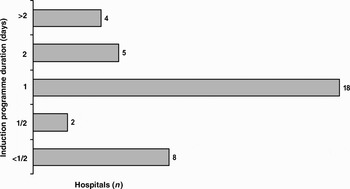
Figure 4 shows the duration of otolaryngology induction programmes in the 37 hospitals which provided them. The duration of the teaching or induction sessions varied widely, ranging from half a day to a week.
Duration of otolaryngology induction programmes in respondents’ hospitals providing such programmes (n = 37). (The remaining respondents’ hospitals (n = 35; 49 per cent) provided no structured induction for junior ENT doctors.)

Question seven
Forty-six doctors (64 per cent) felt there was a lack of training opportunities during night shifts. Although not specifically questioned, many doctors volunteered the information that they were unable to attend theatre due to time constraints as a result of cross-covering other specialities.
Questions eight and nine
The second-on-call doctor was a registrar in 85 per cent of respondents’ hospitals and a consultant in 15 per cent.
Question ten
Thirty respondents (42 per cent) stated that, as the first-on-call doctor for ENT, they did not feel comfortable managing common ENT emergencies.
Discussion
Out-of-hours service represents both continuation of patient care and round-the-clock service commitment for an acute speciality. In view of this, we assessed the efficacy of night-time on-call systems for ENT cover, within English hospitals. In order to make junior doctors’ rotas compliant with the European Working Time Directive, cross-covering specialties during night shifts has become unavoidable (being reported by 74 per cent of our respondents). When prioritising emergency patient care, a junior trainee in a shift system will often spend more time in a specialty or unit with more acute care, such as neurosurgery. This may result in ENT patients waiting longer to be assessed. This problem is exacerbated when a doctor cross-covers multiple specialities. In the present survey, 25 per cent of respondents reported covering more than two specialities during the night. We understand that the ‘Hospital at Night’ project or a senior nurse led practice can partially fill this gap (43 per cent of our respondents reported that such approaches were used in their hospitals). However, over-reliance on alternative systems may remove training opportunities for future ENT speciality trainees.
In the Calman era, the average time spent at SHO grade by an ENT specialist registrar was 42 months, with 19 months spent in the otolaryngology department.Reference Powell and Doshi4 Thus, one could presume that ENT wards and emergency care were provided by a group of experienced SHOs many of whom intended to pursue a career in otolaryngology.Reference Powell and Doshi4 In contrast, we found 68 per cent of our respondents had no previous ENT experience, and 19 per cent had only one year's experience of working on wards. This problem was compounded by the fact that 88 per cent of second-on-call doctors were reportedly not on site. Probably as a consequence of these findings, we found that 42 per cent of respondents did not feel confident managing routine ENT emergencies. Similar changes in patient management have been observed in a study on emergency medicine department doctors.Reference Whiticar, Webb and Smith8 Foundation year two doctors, despite seeing fewer patients per head than middle-grade doctors, had a higher level of patient reattendance; the authors of this study hypothesised that this may be due to the impact on doctor training of the ‘Modernising Medical Careers’ initiative.Reference Whiticar, Webb and Smith8
Implementation of the European Working Time Directive and the ‘Modernising Medical Careers’ initiative will mean that junior surgeons must be trained in fewer hours over a shorter period; for this reason, surgical training opportunities must be optimised.Reference Wasson, Jacobsen, Bowdler and Hopkins9 The continued reduction in UK junior doctors’ hours has made it no longer appropriate to assume that all activities represent either training or service individually in relation to a trainee's learning curves.Reference Derrick, Badger, Chandler, Nokes and Winch10 In a pilot project in Ireland, it was observed that a tightly defined shift system caused a deterioration in training; 81 per cent of the trainee in this project also felt that patient care had suffered as a result.Reference Garvin, McLaughlin and Kerin11
• With the introduction of the ‘Modernising Medical Careers’ initiative and the implementation of the European Working Time Directive in England, acute ENT services are being provided by junior doctors with little experience in otolaryngology, and patient care may be detrimentally affected
• Patient safety is paramount; hence, training programmes for junior doctors must be strengthened in order to safeguard patient care
• Structured ENT induction programmes should be mandatory for all junior doctors covering ENT, and should be nationally recognised, with standard guidelines
Good clinical governance means that we must strive to continually improve the quality of the service we provide. Therefore, the ENT specialty as a whole needs to proactively instigate a streamlined, mandatory ENT training programme for all doctors new to ENT and for those cross-covering ENT out of hours. Unfortunately, half of the NHS hospitals in England do not provide such induction programmes for junior doctors, according to our survey. Moreover, those induction courses which were provided were of diverse duration and quality. As a result of our findings, we recommend a national audit of ENT induction programmes, in order to facilitate the development of a national standard.