


During the second half of the nineteenth century several waves of foreign banks surged into Latin America, reflecting the complexity and diverse nature of capital flows in that epoch. The arrival of these banks of different origins was a harbinger of the rise of global finance and a new stage in the spread of capitalism on an international scale. But it is also important to recognize that the foreign banks in Latin America had to compete with more numerous and, often, larger domestic rivals. This chapter provides a panoramic view of the trajectories of banks of different nationalities, including British, French, German, Spanish, Canadian and United States financial firms that entered Latin America and the Caribbean between 1863 and 1914.
The history of the role of European banks in nineteenth-century Latin America is frequently misinterpreted as a result of the prevalence of some largely unexplored suppositions. The most common of these views is that British banks were the pioneers, and faced little competition.Footnote 1 However, previous chapters of this book have underlined the earlier role and preponderance of domestic banks, although it is evident that in times of crises, British overseas banks could prove especially adept in confronting monetary and financial difficulties. On the other hand, it must also be noted that banks and bankers of other nationalities were also active in the hemisphere from the last third of the nineteenth century –particularly French, German and Spanish banks – a subject largely neglected in the historiography until quite recently. Similarly, it is surprising that there are still few publications to have analyzed the entry into this vast region by financial firms from the United States and Canada after the turn of the century, mainly in the Caribbean zone.Footnote 2 In summary, the activities of foreign banks and bankers were quite diverse from country to country, a fact that calls for a revision of some of the traditional stereotypes of foreign banking in Latin America during this era of the ascent of globalization.
Our point of departure in this chapter consists in arguing that a comparative study of the early trajectories of foreign commercial and investment banking firms in Latin America in the period requires close attention to financial and political chronologies in each nation, as well as to leading actors and firms, the insertion of the foreign banks into local capital markets and their links to international trade and credit circuits. In addition, it is important to distinguish between differences in the specialization of the foreign banking firms. For instance, it should be noted that although a majority were engaged in trade finance, other firms promoted the sale of gold bonds of different Latin American governments and/or investments in a variety of business enterprises and public works, while quite a number also came to play active roles in the financing of local mortgage business.
British Overseas Banks in Latin America from the 1860s to 1914
Numerous London merchant banks played a preeminent role in the international trade and finance of the newly independent states of Latin America, but major changes took place from the early and mid 1860s. It was then that a select number of British financial firms became the pioneers among commercial foreign banks to establish offices in different countries of the region. On the whole, most of them were sufficiently successful to experience fairly long business cycles, surviving for more than a century, as has been illustrated by a classic work by David Joslin, as well as in studies by Geoffrey Jones, among others.Footnote 3
Initially, the earliest British overseas banks were regulated by the Colonial Banking Regulations (CBR), as ratified by the British Treasury in the 1830s to supervise the international operations of such firms, and these norms were incorporated into their charters. Such was the case of one of the earliest commercial banks in the West Indies, known as the Colonial Bank, established in 1837, which had offices in Jamaica, St. Thomas and even in Puerto Rico between 1830 and 1842.Footnote 4 But the real burgeoning of the overseas banks was the result of legislative reforms regarding joint-stock companies that were approved by the British Parliament at midcentury. According to historian Philip Cottrell, the liberalization of British company law from 1857 onwards facilitated the establishment of banking companies abroad. Between 1862 and 1866, twenty-five overseas banks as well as thirteen colonial banks were registered in England.Footnote 5
Although the history of the emergence of banking in other regions of the world at this time – in Asia, the Middle East and Africa – goes beyond the limits of this book, it may also be useful to keep in mind parallel experiences for comparative purposes. In this regard, it is worthwhile noting that a limited number of British commercial banks began to be established from the mid-nineteenth century. They appeared in the Ottoman Empire, in Turkey and Egypt, across a range of cities in India, particularly in Bombay and Calcutta, in the major port cities of China, notably in Shanghai and Hong Kong, as well as in Dutch Indonesia.Footnote 6 At the same time, a series of commercial banks also began to spring up in British dominions, in Canada from the 1830s, in the Cape Colony and Natal Colony during the 1850s and 1860s, and in Australia, where a dozen small banks were set up between the 1840s and 1860s as a result of the speeding up of local economic development.Footnote 7 In the regions mentioned, a high proportion of British capital was engaged in these new economic ventures and a good number were definitely called colonial banks.
In contrast, in the independent Latin American nations the majority of the early foreign banks could operate only after negotiating concessions from local governments and thus were not protected by the imperial norms, in contrast to most British banks in Australia, India or South Africa. Between 1860 and 1914, several British overseas banks operated in Argentina, Brazil, Chile, Mexico, Peru and Uruguay, each of which had various branches that were distributed in geographical regions that could be considered as their principal “zones of influence.” The oldest and most prosperous institution was the Bank of London and the River Plate (1862), which concentrated on the financial markets of Argentina and Uruguay. In Brazil, the London and Brazilian Bank (1862) and the British Bank of South America (1863) were important actors in domestic credit markets. In Chile, the Anglo-South American Bank (successor to the Bank of Tarapacá and London, established in 1888) established its fiefdom, although gradually this company also opened branches in Argentina and acquired stakes in banks in several Latin American countries. From 1865, there also came to the fore a multinational entity called the Bank of London, Mexico and South America, with its head office in London, and commercial branches in both Lima and Mexico City, as well as offices, for a while, in Bogotá.
The organization of the overseas banks conformed in many ways to the theories on free-standing enterprises developed by historian Mira Wilkins, since they were not, properly speaking, direct subsidiaries of a major bank in Great Britain.Footnote 8 The bulk of their ordinary banking operations, buildings, branches and local agencies were located overseas, although they all had a head office in London and were able to open accounts with the Bank of England, giving them a considerable advantage in the discount of bills of exchange, at the lowest existing interest rates internationally. Furthermore, according to virtually all historical studies of the British banking concerns in Latin America, it is clear that these entities were more risk-averse than their local counterparts. For the most part, they tended to specialize in short-term, fully funded, self-liquidating commercial transactions, especially in the foreign exchange market, in order to minimize their risks. And this allowed them to survive numerous bank panics in different Latin American countries in the last third of the nineteenth century.
The solvency and prestige of the British overseas banks helped them to occupy prominent positions in the finance of foreign trade and foreign exchange operations in the Latin American countries in which they came to operate but, even so, they rarely became the dominant players in the respective national banking systems. This was so because, as has been argued previously in this book, during the second half of the nineteenth century and the beginning of the twentieth century, the largest Latin American commercial banks tended to be domestic, some public, but most private. In any case, it is important to identify the specific niches in which the diverse set of foreign banks came to operate in an era that has been described as a golden age of globalization.
The first British overseas commercial bank that began business in South America was the Bank of London and the River Plate (BLRP).Footnote 9 This firm was created in 1862 by a coalition of London bankers and River Plate merchants who raised half-a-million pounds sterling in capital for its initial operations. At London, the City Bank was its chief correspondent banker, an alliance that allowed the new South American entity to have access to a discount and drawing account opened at the Bank of England. The first office in Buenos Aires began business in January 1863 and the expectation by its founders was that it could participate profitably in the export–import trades of Argentina with Europe. In order to do so the London home office quickly sought to establish a broad range of correspondents in various European cities, beginning with the collaboration of the Bischoffsheim and Goldschmidt firms of London, Paris and Brussels, but also opening connections with banking firms at Hamburg, Amsterdam, Berlin and even New York. By 1871, additional correspondents were also arranged with firms in various ports of Spain, Portugal and Italy. As Joslin noted: “Credits were granted to European exporters against bills sent for collection. Acceptance credits were opened for importers in the River Plate; all these dealings had one great feature in common, namely that the rate of interest charged was directly linked to the Bank of England’s discount rate.”Footnote 10
The chairman of the home office of the BLRP in London, the experienced banker Henry Bruce, who had twenty years’ previous experience running the Colonial Bank in the West Indies, imposed conservative practices, and prohibited the Buenos Aires manager, J. H. Green, from extending loans for mortgage business, but allowed the concession of loans to trustworthy sheep farmers and cattle ranchers on a seasonal basis, with advances on produce if reasonable risks were secured. The business of the bank soon flourished as a result of the dramatic expansion of wool production at this time – similar to that of Australia – as well as the more traditional business in shipments of hides, tallow and salt beef that were produced by ranching establishments throughout the pampas. Equally important was the finance of imports carried on by merchant houses in Buenos Aires, and to a lesser extent in Rosario, Santa Fe and Córdoba, where agencies were opened. The bank accepted and discounted promissory notes and bills from solid commercial firms, generally providing them with credit terms that rivaled those offered by the few domestic banks then in existence.
Alliances with the local community of British origin merchants and landowners were critical to the success of the BLRP. Most important was the role of George Drabble, a merchant active in the wool and leather trade, who had bought large sheep farms and was a sometime director in the powerful state-run Banco de la Provincia de Buenos Aires, the first Argentine commercial bank, which had been set up in 1854. Drabble was named director and chairman of the BLRP in 1869, moving to London in order to be able to promote the increasing flows of British direct investments to Argentina and Uruguay. He participated actively in the launching of the Buenos Aires Great Southern Railway Company at this time, as well as helping to set up the first tramway company of Buenos Aires, and two water works firms in the Argentine capital and in Montevideo.Footnote 11 The BLRP prospered and, in later decades, particularly from the 1880s, played an important role in financing the international meat trade and in serving its most valued clients, the great British railway companies that dominated land transport throughout the River Plate until the 1940s. In short, in countries like Argentina, the operational specialization of banking firms tended to be linked to the origin of the capitalists that exercised control over the respective financial institution. This relationship was, in effect, a more or less common pattern for South America as a whole during the period, although there were, of course, exceptions.
While the BLRP dominated foreign banking in Argentina almost without foreign competition during its first two decades, some new British enterprises eventually entered the local market, including the smaller English Bank of the River Plate in the early 1880s. However, the greatest challenge to all banks in Buenos Aires and Montevideo came as a direct result of the Argentine financial collapse of 1890/1891, also known as the Baring Panic in the literature on international crises.Footnote 12 During the debacle, the BLRP suffered sharp losses, as clients pulled their money out of the bank, but it was able to weather the storm, in part as a result of absorption of the local and solid Carabassa Bank, just across the street in Buenos Aires. The latter firm had much prestige among small depositors in Argentina, especially Italian and Spanish immigrants, and actually increased its holdings, despite the panic. As a result of this acquisition, the directors of the London Bank were able to move extra cash from across the street each night to replenish their own till and avoid bankruptcy!
After the end of the crisis and the reestablishment of normal activities in the Buenos Aires money markets, other British banks moved into Argentina, including a branch of the London and Brazilian Bank, the British Bank of South America and the Anglo-Argentine Bank, but none of them had such success as the older BLRP, which continued to dominate the greater part of the credit and deposit business provided by the British railway, tramway and insurance companies active in the River Plate zone.Footnote 13 On the other hand, a number of more heterodox financial firms run by British entrepreneurs proved successful in the mortgage business as well as in promoting business groups that became early conglomerates. Particularly notable was the River Plate Trust, Loan and Agency Company founded in Buenos Aires 1882 by the dynamic British entrepreneur John Morris, who promoted personal links and cross-share holdings in other firms such as the Mortgage Company of the River Plate, the Argentine Southern Land Company, the Santa Fe Land Company, the Tucumán Sugar Company, the Rosario Waterworks Company, the River Plate Electricity Company, as well as five relatively small British-run railway firms.Footnote 14
In neighboring Uruguay the arrival of foreign banks also came early as a result of a small burst of British investments. The Bank of London and the River Plate opened a branch in Uruguay in the early 1860s, and remained one of the principal banks in the country throughout the period. By the 1880s, three other British banks were operating in the country, including the English Bank of the River Plate, the London and Brazilian Bank, which opened its Uruguayan branch in 1878, and the British Bank of Rio de Janeiro, which set up an office in Montevideo in 1885. After the Baring Panic, the latter entity changed its name to the British Bank of South America in 1891.Footnote 15
The establishment of British overseas banks in Brazil followed a similar path to that of Argentina and Uruguay, being largely the result of the initiatives of important, local merchant firms that maintained close ties to British commercial and financial circles. During the 1840s a set of consular surveys of Brazil listed over forty-five mercantile firms of British origin operating at Rio de Janeiro, as well as eighteen French and six American houses, while some twenty-five British merchants resided in Salvador de Bahia, dealing in imports of textiles and in the sugar trade. At midcentury the London merchant banking firm of Schroders had seventeen mercantile clients in Rio de Janeiro and eight in Bahia, while Fredrick Huth & Co. had twenty-two correspondents in Brazil.Footnote 16 At that time, almost half of all Brazilian exports of coffee, sugar and cotton were handled by English commercial houses and their bankers in London.
Among the most dynamic British firms, and one that was to play an important role in the establishment of the first overseas banks in Brazil, was that of Edward Johnston. An English immigrant who had worked as an employee of a plantation in Brazil from the late 1820s, he was soon able to set up his own merchant house in Rio de Janeiro in 1842.Footnote 17 In 1844, Johnston left his partners in Rio in charge of the local commercial business and moved to Liverpool, where he set up an office subsequently run by his son, later opening an even larger house in London, known as the firm of Edward Johnston, Son & Co.Footnote 18 This merchant house obtained discounting facilities at the Bank of England, and carried on a rapidly growing business in the coffee trade. The markets for coffee were varied, the foremost being those of the United States, and as a result Johnston opened agencies in New Orleans and New York, Baltimore, Charleston and Mobile, run by two sons and several associated partners. A recent study argues that this type of decentralized structure by mercantile firms was effective because they “used clusters to widen their pool of resources and lower transaction costs. Merchants, with profitable opportunities but without the means to exploit them, could use a network to mobilize funds, spread their risks and improve their decision making.”Footnote 19 In addition, such flexibility allowed local managers to take critical decisions without having to wait for instructions from the home office, at a time when information still traveled very slowly. It should be noted that before 1874, when the submarine telegraph linked Brazil to Portugal and Britain, the mail sent by sailing ships to South America often took two months or more to arrive.Footnote 20
As a result of legislation that facilitated the formation of overseas banks, various British financial entities set up shop in Rio de Janeiro, Bahía and other Brazilian ports. The London and Brazilian Bank (LBB) opened in 1862, being joined shortly thereafter by the smaller firm known then as the Brazilian and Portuguese Bank (1863), which later changed its name to English Bank of Rio de Janeiro. Both banks were able to confront the violent Brazilian bank panic of 1864 in Rio de Janeiro much better than domestic banks. The LBB grew fastest and quite soon built up a wide network of branches, ranging from Santos and São Paulo to Manaus on the Amazon, Pará and Maranhão on the northern coast, as well as maintaining offices further south, in Porto Alegre, Pelotas and Rio Grande do Sul, bordering Uruguay. The success of the English firms was largely due to their conservative practices, since they maintained significant gold reserves and limited their loans to the most solvent and liquid clients.Footnote 21 These practices were linked to the fact that the British banks had the support of the strong Anglo-Brazilian mercantile houses dedicated to the financing of coffee exports. Such was the case of Edward Johnston, head of the previously mentioned coffee firm at London that had branches in Liverpool, Santos and Rio. This English merchant banker accumulated sufficient capital and commercial prestige to participate as a leading shareholder in the LBB and helped open an account for the foreign bank at the main office of the Banco do Brasil, as well as opening a drawing credit for the Imperial Treasury of Brazil through the home office of the LBB. Not surprisingly, Johnston was soon named deputy chairman of the banking enterprise in 1867.
Another banking firm in Brazil that maintained close relations to the London money markets at the time was that of Baron Mauá, the intrepid Brazilian entrepreneur whom we have met previously in this book. He had begun his training as a merchant from 1829 as a young clerk, but soon enough became manager of the house of the prosperous merchant Richard Carruthers at Rio de Janeiro, who left him in charge of the local firm when he decided to retire to a country estate in England. However, for a time, Carruthers continued to supervise correspondence from London and his country estate. He also maintained a branch in Manchester, run by Joseph Reydell de Castro, a close friend of Mauá, as well as an agency in New York, apart from the Rio firm. These connections and experience allowed Mauá, his Brazilian protégé, to establish a wide-ranging set of financial connections in England, which helped him become a prominent merchant banker in Rio de Janeiro, running the import business of Carruthers.Footnote 22 Subsequently Mauá established his own private investment bank and played a leading role in the modernization of the Brazilian capital, promoting the first iron foundry, a tramway firm, a steamship company, waterworks and an urban lighting system. As noted in a previous chapter, Mauá also became active in establishing banking firms in Montevideo and Buenos Aires. Eventually he proposed a merger in 1865 of his banking enterprise with the LBB, evidently aiming to establish a veritable multinational financial enterprise in South America. Nonetheless, in 1866 the Overend Gurney financial crisis in London weakened the LBB, and the project had to be cancelled.Footnote 23
The British overseas banks in Argentina and Brazil built up their business gradually in the 1860, although they faced severe problems not only during the London financial panic of 1866, but also during the more extensive crises of the mid 1870s, when almost all the domestic banking markets in Latin America suffered acute problems, accompanied by numerous suspensions of the service of public external debts, currency crises and a dramatic drop of the inflow of foreign capital. Nonetheless, the British bank managers generally proved to be conservative and confided only in their most solvent clients, with the result that they were able to confront and survive the major difficulties that led to numerous failures among many domestic Latin American banks. During the 1880s the overseas banks once again grew rapidly on the back of a series of export booms and a remarkable surge in British investments in railroads and many other companies in the Southern Cone. Nonetheless, in 1890/1891, this expansion was cut short by the explosion of the Baring Panic and a series of deep banking panics in Buenos Aires, Montevideo and Rio de Janeiro threatening the English banks in the region. Yet once again, most of their managers proved adept at navigating extremely troubled financial waters, and by the end of the century they were expanding, in part because of their abilities in attracting wealthy clients who abandoned the domestic banks that were much harder hit by the recent panics.
As can be seen from the financial data in Table 7.1, the years 1900 to 1913 proved to be a golden age for the British overseas banks in South America as capital, deposits and profits rose substantially.

Table 7.1 Long description
The values are stated in current U.S. dollars. The table is organised into four financial indicators: Paid-in Capital and Reserves, Deposits and Credits in Current Accounts, Gross Profits, and Dividends (percent). The data is grouped by bank, with each bank’s fiscal year-end noted. All banks generally expanded their capital, deposits, and profits between 1890 and the early 1910s, though showing fluctuations near 1914. Dividends remained high for major banks, often around 15 to 20 percent, indicating strong profitability.
Overseas banking in Mexico faced great obstacles as a result of the military, political, fiscal and financial instability during the first two-thirds of the century, making it virtually impossible for joint-stock banks to operate in this context. The greatest external shock was the invasion and occupation of Mexico by the United States Army between 1846 and 1848. A second disaster was the occupation of Mexico in 1862 by a large army of French and Austrian troops that led to the establishment of the short-lived empire under the Archduke Maximilian (1863–1867). However, certain branches of trade with Europe flourished during these years and stimulated interest in the establishment of early joint-stock companies. British merchant houses that had long been active in Mexican ports and mining towns, dealing in the export of silver and the import of textiles, were not averse to promote new entrepreneurial initiatives such as a bank, even under a French-run administration, and were encouraged to do so when they found allies in the London capital market.
The result was the establishment of the Bank of London, Mexico and South America, launched in 1864 with an official concession by Archduke Maximilian, head of state. The promoters of the bank took advantage of the favorable situation for the investment of foreign capital in the country, using preestablished mercantile networks. They focused heavily on the silver trade, which was the principal export engine of Mexico and, as a result, the new bank fostered close relations with entrepreneurs in numerous mining centers, complemented by strong ties to the leading merchants in the principal ports.Footnote 24 The Bank of London and Mexico – as heir to previous networks of both British and Mexican merchants – was therefore well placed to control several of the country’s main channels of merchandise and exchange. The history of this early commercial bank in Mexico is illustrative of the importance of foreign trade in driving financial innovation, despite difficult and unstable military conditions.
The structure of operations of the Bank of London and Mexico was determined by a variety of factors. In the first place, it was not subject to significant regulation since there was as yet no banking law in the country. The only prerequisite for business was inscription of the new enterprise in the mercantile registry (Registro del Tribunal Mercantil).Footnote 25 The bank had a minimal administrative staff at the start: general manager, accountant, cashier and collector, while its regional agencies also had very limited personnel as they relied on the collaboration of networks of British merchants in a number of Mexican cities, ports and mining centers. As historian Paolo Riguzzi has argued, the main thrust of the banking enterprise’s strategy was to take advantage of sector-specific competitive advantages. These included the use of banking techniques that it introduced into Mexico: banknotes, checks, insurance policies, and the discount of international bills of exchange.Footnote 26 Initially, the financing of credit operations was covered by the issue of banknotes, until deposits began to increase.
The early business of the Bank of London and Mexico was concentrated in four fields, the first being financing of the export–import trade between Great Britain and Mexico, which doubled between 1860–1862 and 1863–1866.Footnote 27 A significant portion of the silver exports was made up of capital flight by several of the wealthiest Mexican entrepreneurs, who invested heavily in this period in the stock markets of London and Paris.Footnote 28 Another important activity was the extension credits by the bank to producers and exporters of cotton in northeastern Mexico, a trade that expanded enormously as a result of the Civil War in the United States, leading to the blockade of southern ports of the Confederacy and the rerouting of the cotton trade through northern Mexican ports. Finally, a considerable number of the bank’s loans went to the imperial government of Maximilian in Mexico City and to rural proprietors and manufacturers in central Mexico and Veracruz.Footnote 29
After the fall of the Empire of Maximilian in 1867 and the economic recession that engulfed the Mexican Republic, now headed by President Benito Juárez, things changed for the worse for the Bank of London and Mexico. The rupture of diplomatic relations between Mexico and Great Britain (which lasted until 1884) made the country less attractive for British investors, as did the bankruptcy of many of British merchant houses in the country, and all this caused a substantial drop in business. Furthermore, the end of the trade boom of 1863–1866 was followed by the suspension of payments on the foreign debt decreed by the government of Juárez, as well as increased hostility toward foreign firms, as confirmed by the imposition of fines and new taxes on the Bank of London and Mexico, measures creating much friction with the republican government.
Such a depressed state of affairs led the bank to concentrate most of its efforts in the silver trade, which constituted the leading branch of the export trade and provided the wherewithal to maintain the import trade. The bank also facilitated capital flight for wealthy Mexicans. This led to the building up of considerable money stocks abroad by the bank, but its principal activities tended to be restricted to a relatively small set of wealthy clients, mainly located in Mexico City. Curiously, the principal British enterprises then operating in Mexico did not carry on much business with the bank.Footnote 30 Even the completion in 1873 of the first railway, the British-owned Mexican Railway Company that connected the port of Veracruz to the City of Mexico, did not bring a marked increase in the volume of business to the Bank of London and Mexico, which remained pretty stable until the early 1880s, when it began to expand. The brief but intense phase of prosperity, however, was interrupted between 1884 and 1886 due to serious fiscal and financial crises in Mexico and as a result of the efforts by the new Banco Nacional de México (largely French-owned and with excellent connections to the Mexican government) to marginalize the British bank.
Between 1886 and 1896, diverse circumstances led to the legal separation of the British home office and the Bank of London and Mexico. The former, which was initially owner and administrator, later became simply a majority stockholder (with a considerable degree of control) and finally a minority shareholder (with virtually no control). These changes took place during a substantial period of growth in the Mexican economy in the 1880s, leading to a notable expansion of the activities of the bank, which stimulated alliances with domestic entrepreneurs. As the volume of business and profits rose, the bank became an attractive investment opportunity for local investors with whom it was associated. The latter had excellent political connections and were interested in the profits now being generated by the Bank of London and Mexico, but they also looked to the possibility of gaining control over a key financial institution that could become a privileged source of future credit. This group of capitalists was able to take advantage of government pressure to “mexicanize” the Bank of London and Mexico by offering to take one third of capital (at 100 percent premium on nominal price of the share) and obtaining Mexican domicile for the bank, while allowing the holding company of the Bank of London, Mexico and South America (LBM-SA) to retain two-thirds of the stock.
Among the new and leading Mexican investors was Thomas Braniff, owner of a textile factory and manager of the Mexican Railway. Also important was the participation of Juan Llamedo, supplier of the federal army, and of Ignacio de la Torre y Mier, President Díaz’s son-in-law.Footnote 31 Another major change came in 1896 with a new increase of capital by the Bank of London and Mexico, which climbed from 3 to 10 million pesos, accompanied by a change in statutes and a new federal charter. The increase in capital of the Bank of London and Mexico had as its purpose a move to further separate the British holding company and the Mexican bank. The operation was the result of an ultimatum presented by a new set of Mexican stockholders, led by a group of wealthy French immigrants (known as the Barcelonette group) to the London board. They forcefully pushed for an increase in capital, threatening that otherwise the Mexican bank would lose the support of the government and much future business.Footnote 32 In this way, there took place a nonconventional process in which a group of domestic investors in a Third World country displaced foreign investors. The LBM-SA lost its control of the Bank of London and Mexico and began to sell portions of the stock, while maintaining only occasional correspondence with the local manager of the bank.Footnote 33 By 1900, Mexico was one of the few Latin American countries where no British banks were operating.
At this point, it should be clarified that the holding company of the LBM-SA had also retained interests in Peru, including a broad-ranging set of banking offices on the western coast of South America. In this regard, it may be suggested that the entity was organized much in the way of a business model described by Geoffrey Jones as “a set of single-unit banks joined in a federation to a centre (the head office) that provided the general guide-lines and acted as a lender of last resort.”Footnote 34 Initially, Mexico, Peru and Colombia were the countries where the LBM-SA had set up operations, all being connected to the head office in London, which operated as coordinating agency, but each country branch enjoyed a considerable degree of autonomy, which meant that the local general manager would play a key role in determining the scale, scope and direction of local business, relying on the head office for acquiescence on major deals as well as for assistance with the discount of export–import bills, which were expected to make up a large percentage of the bank’s business.Footnote 35
From the late 1860s and early 1870s, the directors in London of the LBM-SA tended to divert business from Mexico and Colombia and directed most of their resources to Peru, concentrating on the booming business in Lima and on the Pacific ports as a result of the great guano export boom, which made the Peruvian state the richest of Latin America in fiscal terms during three decades. At the same time, a remarkable phase of investments in railroad construction and port modernization took place in Peru between 1868 and 1875. In the early 1870s, the LBM-SA (now named the Banco de Londres y Perú) had three branches operating in Peru, although it also opened an office in Valparaíso, Chile.Footnote 36 Nonetheless, expansion was cut short from the mid 1870s as a result of traumatic external shocks. To begin with, the international crisis of 1873 had a severe impact upon public finance while at the same time the guano trade began to decline. By 1876, the Peruvian state – the largest Latin American debtor – declared a suspension of payments, leading to a suspension of the public works under construction and a chain of bankruptcies, including the collapse of the majority of local banks.
By 1878 the Banco de Londres y Perú and the Banco del Callao remained as the only surviving banks in Lima, although the scale of business had already diminished substantially. Between 1873 and 1876 the issue of banknotes by the Banco de Londres y Perú decreased by 48 percent and at the same time the bank suffered a drop in the market value of its stock, which led to a reduction of capital in 1877 from £500,000 to £250,000.Footnote 37 To make things worse, the military conflict between Chile and Peru in the years 1879–1881 contributed to aggravate the business perspectives of the bank. On the other hand, after the war, the Banco de Londres y Perú played a major part in the financing of domestic entrepreneurs engaged in the contemporary sugar and cotton export booms in Peru that took off from the mid 1880s. Later in the 1890s, many domestic investors came to participate more actively in the bank and in 1895 it merged with the Bank of Callao, becoming the largest financial institution in Peru during more than twenty years.Footnote 38
One of the latest British overseas banks to be set up in Latin America was the Bank of Tarapacá and London in 1888, which came to be known as the “nitrate bank” because of its participation in the finance of Chilean and Bolivian mining as well as trade. The Bank of Tarapacá was organized in London by the mining entrepreneur John Thomas North and a group of fellow British capitalists who were engaged in Chile’s expanding nitrate industry.Footnote 39 After a decade and a half, the enterprise changed its name to the Anglo-South American Bank in 1906, when the nitrate plutocrats allied with a series of South American millionaire entrepreneurs, including the Patiño family in Bolivia, who had made their fortune in tin mining, as well as the Bunge family in the River Plate, who owned what was already one of the largest cereal trading firms in the world. This bank company soon opened additional branches in Argentina and acquired additional stakes in financial firms in several Latin American countries. In 1917 it took over the Commercial Bank of Spanish America, which had been active for two decades in several cities in Colombia, but also had agencies in the principal cities of Nicaragua, Salvador, Venezuela and Ecuador, with correspondent networks in Paris, Manchester and Now York, specializing quite heavily in the export of coffee, hides and cocoa. In 1920 the Anglo-South American Bank moved again and absorbed the British Bank of Spanish America and in the same year obtained control of 60 percent of the venerable Chilean private banking firm of Agustín Edwards y Cia.Footnote 40
In the 1920s the mergers of the principal British overseas banks in Latin America proceeded rapidly. The London and Brazilian Bank and the Bank of London and the River Plate merged into the holding company known as the Bank of London and South America (BOLSA) in 1923. This enterprise subsequently acquired most of the subsidiaries of the Anglo-South American Bank during the Great Depression of the 1930s. It continued in business for several decades but in the 1960s, Lloyds Bank acquired this conglomerate and converted it into a segment of what is today a huge global bank.
Overall, it may be argued that in Latin America the British overseas banks opened a fair number of branches in South America in the late nineteenth century, but which stood in contrast to several of the larger multinational banks within the British Empire that developed hundreds of branches. In his pioneering studies on the birth and development of British multinational banks, business historian Geoffrey Jones has described the impressive multiplication of the branches of the overseas banks that operated mainly within the spheres of the British Empire, most notably in Australasia, South Africa and Asia, although lesser numbers also were busy in Canada, the West Indies and Southeast Asia. By 1890 those multinational financial enterprises already had 710 branches and by 1913 an incredible total of 1,286 branches.Footnote 41 In summary, in the light of the great number of branches established by British banks within the Dominions and Empire, an open question remains whether the British overseas banks in Latin America before 1914 can be really considered multinational banks. Certainly from the 1920s onwards, the trend toward consolidation accelerated, although it may be posited that this was, paradoxically, the result of the underlying weakness of many of the oldest British banking firms in the region.
German Banks in Latin America, 1870–1914
British overseas banks only began to experience serious competition from other European banks in the late 1880s, when the great German banks (Grossbanken) began to take a marked interest in the trade with Latin America and became their most serious rivals until the outbreak of the First World War.Footnote 42 The new strategies adopted by these large banks were, in good measure, the result of the trade that had been built up for decades by the previously existing networks of German merchant houses in Latin America. In the case of Mexico, the earliest German merchants came mainly from the cities of northern Germany, Hamburg, Bremen and Lübeck, arriving from the 1830s, as has been shown in various historical works, but it was also from these same cities that most German merchants came to Argentina, Brazil and Chile at that time.Footnote 43 Beginning in the early 1870s, various German bankers took stock of the growing importance of commerce with Latin America and began to offer a series of new credit facilities to exporters and importers, particularly in Buenos Aires and Montevideo.Footnote 44 The Deutsche Belgische La Plata Bank, established in 1872, was organized by the Disconto Gessellschaft Bank, with the support of the private bank of S. Oppenheim & Co. and of various Belgian financial firms, as well as of the Austrian Kreditanstalt bank. Its initial capital was 10 million thalers, but it had a very brief existence. Initially engaged in financing the trade of the River Plate with Germany and Belgium, the small bank failed after extending a loan to the Uruguayan government in 1873, which was never repaid.
During the last quarter of the nineteenth century, important changes in the transatlantic trade began to be observed as a result of the establishment of regular lines of German steamships as well as telegraphic communications between Hamburg and Latin American ports. Both elements contributed powerfully to stimulate direct trade between Germany and countries such as Argentina, Uruguay, Chile and Brazil. The first German banks in the region can perhaps be described as latecomers, but between the late 1880s and the beginning of the new century they managed to consolidate their positions rapidly, as demonstrated by the establishment of the Banco Alemán Transatlantico (BAT), a branch of the Deutsche Bank, at Buenos Aires in 1887.Footnote 45 The BAT soon proceeded to set up a network of branches through Latin America, including four offices and branches in Brazil, one in Uruguay, six in Argentina, nine in Chile, two in Bolivia and four in Peru, and one in Mexico, all still operating in 1914, before the outbreak of the First World War. In contrast, other German banks tended to choose somewhat more limited geographical strongholds: the Brasilianische Bank für Deutschland (1887), founded by the Disconto Gesellschaft, set up five branches in Brazil. Meanwhile, in Chile, a first German bank was established in October 1895 by the Disconto Gesellschaft, jointly with the Norddeusche Bank, and was named the Bank für Chile und Deutschland, setting up several offices in Chile but with a head office in Hamburg. Shortly thereafter, however, a major competitor also moved into Chile: the Deutsche Überseeische Bank (BAT) opened a branch in Santiago in January 1896, eventually going on to become the largest German bank in the country. Finally in 1910, the Dresdner Bank and the National Bank für Deutschland set up a third German bank in Latin America, the Deutsche-Südamerikanische Bank, which established a branch in Argentina and two branches in Chile, as well as one in Mexico.Footnote 46
The English and German banks competed not only in the financing of exports and imports, but also in the management of freight and maritime insurance as well as in foreign currency exchange. According to a detailed case study by Briones and Villela, British and German banks accounted for at least 80 percent of deposits held by foreign banks in Brazil between 1880 and 1914, although it should be noted that the English banks remained dominant in this sphere.Footnote 47 However, according to the recent studies of Wilfrid Kisling, the German overseas companies had a different organizational structure as they were subsidiaries of large banks from the mother country and did not operate as free-standing firms but rather were early examples of globalized banks.Footnote 48 Since they quickly set up multiple branches and agencies, these firms would seem to conform to the analytical models advanced by researchers Geoffrey Jones and Stefano Batillossi on the internationalization of banks in this era. Nonetheless, it can also be argued that the German banks were in fact pioneers of the first models of highly centralized multinational banks.Footnote 49
A key question is why German banks began to go international in the late 1880s. To begin with, it should be noted that the years 1886–1890 were an early period of financial globalization in German money markets. According to a classic study, during those five years, 35 percent of all stocks and bonds sold on the Berlin Börse were foreign securities.Footnote 50 In the second place, there were strategic reasons that led Germany to diversify its political and military alliances, and also to broaden its financial spheres of influence. Of considerable importance was the decision taken in 1887 by Bismarck to terminate the previous political-military alliance with the Russian Empire and, therefore, to reduce the acquisition of the gold bonds issued by the government of the Tsar. The Berlin Börse had absorbed large quantities of Russian securities before that date, but subsequently it was the French bankers and investors who would become the main financial allies of the Russian Empire, as demonstrated in the classic study on Russian finance.Footnote 51 These decisive changes in great power alliances probably influenced trends after 1887, when the largest foreign bond issues on the Berlin Börse now were those issued for the governments of Hungary, Greece, Italy, Portugal, Norway, Sweden, Turkey, Argentina and Mexico. In the case of Latin American bond issues, it should be noted that the German banks occasionally took the lead in the major financial syndicates that placed the securities abroad, particularly of Mexico, but more frequently acted as junior partners to the British merchant banks and French banques d’affaires.
The participation of German bankers and investors in the international finance of Argentina became especially significant in the five short years of the Juárez Celman administration (1886–1890), both in national government loans and in several provincial transactions. A first initiative by the Argentine national authorities to attract the great banks of Berlin came as a result of the trip to Europe in 1885 by Minister of Finance Carlos Pellegrini, but negotiations failed. On the other hand, the agents of the Banco de la Provincia de Buenos Aires were more successful in their overtures to the firms of the Deutsche Bank and the private banking firm of Mendelsohn of Berlin. The directors of the provincial bank needed money to assure the extraordinary growth in credit demand in the richest province of Argentina. The German bankers accepted the offer quite rapidly as the bond issue assured a high profit margin.Footnote 52 The following year the Buenos Aires banking firm of Ernesto Tornquist y Cia. negotiated a national loan with the Disconto Bank of Berlin and during several years Argentine bonds became quite popular on German money markets.Footnote 53 In order to successfully place the South American securities, German banks were obliged to participate in broad financial syndicates that permitted an alliance of financial firms that promoted the sale of the Argentine bonds on various European financial markets simultaneously. In the two bond issues mentioned, the Disconto and Deutsche Banks respectively organized financial groups that included such important firms as the Darmstädter Bank and the wealthy and influential private banking firms of S. Oppenheim and Sons of Cologne, M. A. Rothschild and Sons of Frankfurt and various banking firms in Hamburg, including the Norddeutsche Bank. The same syndicate was also active in the issue of other Argentine national government loans that followed: the national bank loan of 1887, the 4.5 percent gold loan of 1888, and the 5 percent railway loan of 1890.Footnote 54
But apart from increasing involvement in the issue of Latin American government securities by the Grossbanken, their offspring – the overseas banks – were dedicated primarily to promoting German exports. In the case of Brazil, which was already a major trading partner of Germany due to the growing coffee trade, two powerful banks, the Diskonto Gesellschaft of Berlin and the Norddeutsche Bank of Hamburg, set up a bank in Rio de Janeiro in 1889, known as the Brasilianische Bank für Deutschland. It prospered and remained the only German bank in Brazil until 1911. It combined interests in the promotion of railways and public works as well as trade finance and by 1913 had as large a volume of deposits as the London and Brazilian Bank and actually began discounting a greater volume of bills of exchange than its rival from 1895 onwards.Footnote 55
The success of this firm, which belonged to the category of Auslandsbanken (overseas banks), was directly linked to its credit policies, which were substantially more liberal than those of the British entities. As historian Wilfried Kisling has demonstrated, it provided longer maturities for bills of exchange, extending the period for repayment to 270 days in contrast to the more traditional 90 days. And, as was the case with the other German banks, it generally facilitated letters of credit to the German export firms to cover 70 percent of their expenses involved in shipping and insurance, providing finance long before the final sale of goods. But, in addition, these financial companies offered numerous credits in German marks to local export–import firms, thus contributing to making German currency a competitor of the pound sterling and the French franc in international money markets.Footnote 56
The Brasilianische Bank contributed to a strong expansion of Brazilian coffee exports to Germany, the second-largest market in the world for this beverage after the United States. This was big business, as can be surmised from the fact that Brazilian exports represented 71 percent of the world coffee trade between 1889 and 1919. The dynamism of this trade as well as that of the Brazilian exports of sugar, cotton, rubber and cacao eventually attracted other German banks, including the Deutsche and the Dresdner Banks that opened overseas branches in Rio in 1913.Footnote 57 In the case of Argentina, as already noted, the Deutsche Bank had taken the lead with the establishment of the offices of the Banco Alemán Transatlántico (BAT) in Buenos Aires in 1887, which continued to be the only German bank in the country until 1906, when the Deutsche Südamerikanische Bank (SÜD) was established. By 1912 the BAT had built up a network of twenty-eight branches throughout South America, rivaling the Bank of London and the River Plate, which had thirty branches (Table 7.2).Footnote 58

Table 7.2 Long description
For each bank, the table reports: Total number of branches, Paid-in capital and reserves, Deposits and credits in current accounts, Gross profits, Dividend rate (percent). All monetary values are expressed in U.S. current dollars. British banks, especially the London and River Plate Bank and London and Brazilian Bank, dominate in deposits, capital, and profitability. German banks hold a substantial presence, with Deutsche Überseeische Bank coming closest to British counterparts in scale.
German commercial banks were late to enter Mexico. Actually the first business of German bankers there came as a result of the complex negotiations in 1887 and 1888 to place a large international Mexican loan on European markets (with a nominal value of 10 million pounds sterling), which was aimed at converting outstanding external debts of the government. Historian Fritz Stern summarized this great financial operation as a strategic move by the German chancellor, Bismarck, and his personal banker, Gerson von Bleichröder, in order to increase the influence of the Reich in Mexico:
In 1888 Bleichröder opened up yet another country to German influence: it was he who organized a major international loan to Mexico at a time when that country’s government was desperately looking for European help. Mexico’s need was great and European interest minimal: the German minister in Mexico thought that the only guarantee for the healthy development of Mexican politics was the person of President Porfirio Díaz; all other signs were unfavorable. Given everybody’s skepticism, Bleichröder could extract singularly advantageous terms for his consortium.Footnote 59
The successful sale of the 1888 bonds changed the financial landscape of Mexico and, from that date, the Díaz government was able to place more securities in the European markets and to encourage important inflows of direct foreign investment. The banker Bleichröder assumed that his collaboration in this first great financial operation gave him rights to manage future business with Mexico, but this was not necessarily the case. For example, in 1889 the Tehuantepec Railway (a government entity) placed 2.7 million pounds sterling-worth of bonds in Europe through the offices of two of the largest German commercial banks, the Dresdner and the Darmstädter Banks. Bleichröder was furious at what he considered unfair competition by rival firms. Instead, when it came to obtaining control of a new foreign loan for the federal government in 1890, Bleichröder regained control of the issue, an operation that he carried out, in alliance with Banamex. The Mexican government wanted to convert and consolidate the large debt it had with the private railway companies, having agreed to cover an annual subsidy to these firms as they progressed with the construction of lines. However, around 1890, the Ministry of Finance was seriously behind in payments, and this generated concern that it could lead to a suspension of foreign investment in the railway sector. The solution consisted in issuing a large volume of bonds payable in gold by the federal government, the proceeds of the sale being delivered to private companies to settle outstanding debts. For this purpose, a loan of 6 million pounds sterling (or 122.4 million German reichsmarks, or 150 million francs) was negotiated in Mexico with the house of Bleichröder (responsible for the placement of bonds in Europe). The Banco Nacional de México was commissioned to provide future service payments on the loan. In any case, Bleichröder had to fight hard with other financial syndicates, including German and American bankers, but also with French banks, to obtain the business.
In the following decade, after the death of Bleichröder in 1893 and that of Bismarck in 1898, the great German commercial banks took over most financial initiatives in Mexico. In the case of the Deutsche Bank, it participated in 1899 in the creation of a large national clearing house and investment bank entity known as the Banco Central Mexicano. Shortly thereafter, it opened a local bank branch in Mexico City that was merged with the Banco Mexicano de Comercio e Industria, which specialized in investments in railways, local banks, a major beer company and the first steel plant in the country.
Almost simultaneously, the powerful Dresdner Bank also moved in, participating in the debt conversion loans of the Mexican government in 1899, as well as in several international issues of bonds for the Tehuantepec Railway Company and in the establishment of a branch of the Deutsch-Südamerikanische Bank in the Mexican capital. According to historian Paolo Riguzzi, the decision to open the subsidiary in Mexico was closely linked to the stability effect that resulted from the “favorable impact of the 1905 Mexican monetary reform on international financial markets. The adoption of a standard form of gold-exchange eliminated the severe problems caused by the depreciation of silver and exerted a powerful attraction on foreign investment that had a large surge between 1905 and 1907.” On the other hand, Riguzzi states that “in the eyes of German diplomacy the Dresdner Bank represented a model of foreign operations more oriented toward the promotion of (German) national interests, in contrast to the ‘cosmopolitanism’ of the Deutsche Bank and its alliances with Anglo-American companies and capital.”Footnote 60
A subsequent commercial bank experiment in Mexico came with the establishment of the Deutsch-Südamerikanische Bank in 1906, but in contrast to its English and French competitors, the late timing meant that it entered a market where the banking system had already been consolidated. It discovered that it was subject to a regulatory framework that excluded foreign banks from the sphere of banknote issuance and removed them from federal supervision. Nonetheless, in contrast to most other banks, the Deutsch-Südamerikanische Bank was able to weather the civil wars and expropriations of the Mexican Revolution (1910–1920) rather successfully and continued operations during the 1920s and even after the crash of 1929. For some years it served as a channel for the financial diplomacy of the National Socialist regime, although finally its assets and deposits were seized in 1942 by the Mexican authorities as a result of pressures by the United States to expropriate German assets.Footnote 61
French Banks and Finance in Latin America
While the role of the German banks and bankers has begun to be incorporated into Latin American economic histories, much less attention has been paid to the role of French financers, who began to operate in the region during the last third of the nineteenth century. For almost fifty years – from the 1870s until 1914 – French banks and private bankers took positions in many loans of different Latin American governments, participated as promoters in public works projects and became strategic partners in a number of local banks, closely linked to the public sector, as well as in numerous mortgage/finance companies. In short, a good number of the major Parisian banques d’affaires as well as other leading French financial firms joined the trend toward internationalization, although it should be underlined that they did not follow the model of the overseas commercial banks of the British, nor – with one exception – did the French banks establish local subsidiaries in the German style.Footnote 62
According to the recent comparative study by Stefano Battilosi on multinational banking in this first age of financial globalization, French commercial banks were less effective than their rivals in establishing branches abroad and in promoting trade finance than their rivals. But in the field of international investments, numerous Parisian investment banks were quite successful, being aggressive and moving all around the globe. For example, a profitable type of international activity consisted in taking positions in a number of foreign banks closely linked to national governments in Latin America, in similar fashion to their strategies in the Middle East and in Asia. The private banks of the Parisian haute banque, the Paribas investment bank, and the large deposit bank of the Société Génerale became major stockholders in the Banque Imperiale Ottomane (1865), the Banque Russo-Asiatique (1895), the Banque d’Indochine (1875), the Banco Nacional de México (1884), the Banque Nationale d’Haiti (1880), and the Banque International Bresliénne (1887), among others.
Banking historians such as Jean Bouvier, Hubert Bonin, René Girault and Albert Broder have argued that initially, contemporary French bankers tended to focus fundamentally on channeling capital abroad into what were presumed to be profitable investments in large government loans and public works projects, although a good number of these in Latin America turned out to be huge disappointments, especially the earliest Mexican imperial bond issues of the 1860s, the Peruvian loans of the 1870s and the titanic but failed efforts to build the Panama Canal in the 1880s.Footnote 63
French bankers first took interest in Latin America as a result of the invasion of the port of Veracruz in Mexico by British, French and Spanish naval forces in 1862, followed by the invasion and occupation of the entire country by an army of over 30,000 troops sent by Napoleon III. The establishment of a colonial administration headed by Austrian Archduke Maximilian (1863–1867) appeared to offer a singular opportunity to exploit a country that had extraordinary mineral riches but had been ravaged by political instability and war since independence. Mexico was the greatest silver exporter in the world and might therefore become a rich French colony, or so thought Napoleon III, the French emperor, who was bent on establishing an empire in the Americas. Moreover, in the year 1862 he anticipated little external military resistance to his grandiose plans because the United States was submerged in civil war (1861–1865).
During the brief regime of Maximilian a variety of competing French financial groups broached schemes for the establishment of an early national bank in Mexico. The first bank proposal was made by a syndicate composed of the Parisian banks of Salomon Heine, Crédit Mobilier, Oppenheim et Cie., Fould et Cie., as well as several British financiers. The second was advanced by another Anglo-French consortium headed by the Société Internationale Financière and the Glyn, Mills & Co. merchant bank of London. The third was promoted by members of the haute banque of Paris, notably the firms of Heine, Mallet, Hottinguer, Fould, as well as that of Finlay, Hodgson of London. Finally, a fourth proposal was advanced by the French branch of the Rothschilds.Footnote 64 None of these, however, came to fruition. Meanwhile, as previously noted, a less prominent and more modest proposal by a group of British investors led to the establishment of the first commercial bank in Mexico, the Bank of London and Mexico (1864), which remained the sole commercial bank in the country for many years.
During the military occupation of Mexico, the French government pressed several syndicates of bankers to place huge sums of so-called Imperial Mexican bonds on the Parisian Bourse, which were also to be sold on the London Stock Exchange. Their purpose was to cover the costs of the military occupation of Mexico, which Napoleon III had resolved would be paid by the Mexican people, who were to provide the tax revenues to cover the service of the bonds, a truly extraordinary example of financial imperialism. However, after the defeat of the French Army and the execution of Maximilian, the new Mexican government led by President Benito Juárez declared an indefinite moratorium on the service of the imperial loans of 1864/1865, which he rightly considered spurious as being of an explicitly colonial and exploitative character. As a result of the default on foreign debts, European investors remained extremely wary during the 1870s of any proposals broached by the Mexican government to invest more money in private enterprises or in prospective loans. Nonetheless, by the early 1880s this situation began to change, largely as a result of the reestablishment of diplomatic relations between Mexico and France, although the Paris Bourse remained nominally closed to new issues of Mexican government bonds.Footnote 65
The participation of French capital in the creation of a new private bank in Mexico in 1882, called the Banco Nacional Mexicano, has been described previously in Chapter 6 of this book. The establishment of this new financial entity was, in good measure, the result of the extraordinary activities of the French Swiss banker Edouard Noetzlin, based in Paris. In the early 1880s he was director of the Banque Franco-Egyptienne (a firm controlled by a cosmopolitan cluster of Parisian private bankers), a position that also allowed him to develop close ties with many leading financiers and investors throughout Europe.Footnote 66 The proposal of a novel and large bank was of great interest to the Mexican government since it appeared to offer favorable perspectives for the restructuring of the old external debts, held by investors in London, Amsterdam and Paris.
In relatively short order, between 1881 and 1882 Noetzlin mobilized a singular alliance of European and Mexican investors and financiers to promote what would become the largest commercial bank in Mexico, with the desire that it be granted a major role in the administration of the finances of the federal government. However, the European banker found that final approval by the Mexican government was more difficult than anticipated and could only be overcome by recourse to expensive bribes that were paid to the Mexican generals in power, and most prominently to President Porfirio Díaz.Footnote 67 In November 1881, the legislature approved the contract, and in early December the new firm was registered in Paris and in Mexico.Footnote 68
In 1884, after a fiscal crisis, Noetzlin and his colleagues decided to merge the Banco Nacional Mexicano with a local Mexican bank, the Banco Mercantil Mexicano.Footnote 69 The new entity was named the Banco Nacional de México (Banamex) and received a government charter. The association of domestic entrepreneurs and foreign investors in this enterprise suggests that it is worthwhile reconsidering the overly rigid view of much of the literature on foreign investments in Latin America, which projects an image of strict separation between foreign and domestic capital in terms of ownership and management. In the case of the Banamex it is clear that local merchants and merchant bankers were perfectly willing to establish firm alliances with international bankers and investors and, in fact, they were able to work together efficiently for decades. Each benefited from such an association: the local entrepreneurs could organize business domestically in accord with their own interests but at the same counted upon the superior financial support and information of their European colleagues for international business and to help with inflows of foreign capital. For their part, the international investors relied upon their local allies for inside information on domestic business and politics, allowing for profitable business opportunities of many kinds. It may be noted that this was also true in a good number of the British overseas banks set up in Latin America from the 1860, since several included local British merchants as shareholders but also a fair number who were of diverse origins.
Another Latin American country in which French financiers took great interest was Peru, notably between 1870 and 1876, during the last stages of the great guano boom, previously reviewed in Chapter 5. It was in late 1869 that Peruvian Minister of Finance Nicolás Pierola signed an amazing contract for the commercialization of guano with the French merchant banker Auguste Dreyfus. The latter had a commercial house in Lima that took charge of selling 1.5 million tons of the fertilizer between 1870 and 1871 in European markets, shipped in several hundred ships. There followed a new contract in 1872 to place another 2 million tons of guano in the agricultural markets of Britain, France, Germany and Spain. In anticipation of revenues from these huge contracts, the Peruvian government decided to issue a huge external loan, valued at 12 million pounds sterling in 1870, to finance the conversion of old debts, as well as an enormously ambitious program of railway construction connecting the Peruvian coasts and ports with mining centers in the Andean mountains. To activate both the guano contract and the loan, Dreyfus sought the support of a broad alliance of bankers in London and Paris. The French bank Société Générale participated vigorously in these enormous transactions, although it should be noted that most of the bonds were placed in London through a financial syndicate organized by the influential merchant bank of J. H. Schröder, which explains why French participation in this case was secondary. Nonetheless, in 1872, the Peruvian government authorized a new, and even more gigantic, loan for 22 million pounds sterling, the largest of all Latin American external loans of the entire nineteenth century. The Société Générale participated actively, but placing the bonds turned out to be extremely difficult, especially after the outbreak of the international financial crisis of 1873. There followed years of travail, extended renegotiations and complicated court cases for the bank and its allies, especially after the default of Peru on its debts in 1876.Footnote 70
Notwithstanding the Peruvian debacle, French bankers and investors continued to be attracted to what promised to be profitable Latin American transactions, perhaps because interest rates were so low in France at the time. During the years 1879–1881 the Paris and Lyons financial markets were expanding and there were many bankers looking for new possibilities of profitable business opportunities overseas. The financial upswing reflected the surprising resiliency of the French economy despite the great losses suffered in the war of 1870 as a result of the huge indemnity payments to Germany, as well as losses in Egyptian and Turkish bonds, a large amount of which had gone into default after 1875. Historian Rondo Cameron pointed out in a classic study that it was from this date that French investors began to abandon their positions in Southern Europe and the Near East in favor of other regions of the world.Footnote 71
One of the most attractive projects, and that which required the largest volume of investments, was the momentous plan to build a canal in Panama (1881–1889), under the direction of the legendary Ferdinand de Lesseps, who had already and successfully built the Suez Canal. Small investors from all over France immediately placed their confidence in this project, which promised to connect the Atlantic and Pacific and contribute to an expansion of the world economy. Subscriptions rolled in as the first stages of work on the canal in Panama were initiated. A nominal sum of almost 1 billion francs was invested in the company stock and in bonds that were issued on the Paris Bourse and placed through French regional bank offices. The money was used to finance the great engineering project, which hired thousands of workers and engineers. But gradually, obstacles in the tropical isthmus began to multiply, making further advances in the canal untenable, and in the end leading to the spectacular failure of this grandiose financial and engineering project in 1889.Footnote 72
In the late nineteenth century another region that began to attract French financiers, bankers, investors and firms was the River Plate because of the acceleration of economic growth rates in the region. A detailed study by historian Andrés Regalsky has described French bank strategies in detail and demonstrated their notable capacity to compete with British financiers and enterprises. French participation began quite soon with the issue on international markets of a series of Argentine gold bonds. For example, in the year 1880, when the new Argentine government, headed by General Roca, began to look abroad for a new loan for railway construction, three British banking firms and two Anglo-Spanish firms competed for the contract, but so did two groups of French banks.Footnote 73 In the event, the decision of president Roca favored a syndicate composed of the Paribas investment bank, the Anglo-Spanish firm of Cristobal Murrieta and the well-connected merchant banking firm of Otto Bemberg, at Buenos Aires. This group was able to place most of the bonds on European markets at a price of close to 91 percent, and therefore was able to make a profit of some 4–5 million francs. The Argentine minister at Paris wrote to the minister of finance in Buenos Aires on June 4, 1881, confirming the success of the bond issue: “The loan has been covered more than 18 times in France … This is, in effect, a great triumph, since the unfavorable impression left on this market by the discredited loans of Mexico, Peru and Honduras made the present issue a dubious business.”Footnote 74 French bankers were also successful in the placement of additional Argentine international loans in 1881, 1882, 1884 and 1886, through syndicates headed by Paribas and the Comptoir d’Escompte, which were assisted and represented by the Buenos Aires merchant banking firm of Otto Bemberg. As European financial markets continued to expand in the late 1880s, scores of large and small banks and many private bankers from London, Paris, Antwerp, Brussels, Berlin and Frankfurt began sending signals that they were anxious to participate in additional loans. The Argentine government pounced on this opportunity to offer new bond issues but even more active were provincial governments, which became engaged in promoting local railways, state provincial banks and vast quantities of mortgage bonds. An illustration of the newfound confidence in Argentine bonds can be found in the comments published by the Money Market Review (November 26, 1887):
Holders of Argentine securities may be invited to consider how vast and widespread are the interests now concerned in upholding Argentine credit. Four or five of the greatest private financial firms in London as well as some of the best accredited Banks and other Joint-Stock companies are identified with her loan issues; and so likewise are leading establishments at Paris, Berlin and many other continental centres of finance. It is not as in the old days when the relations of the Argentine Government with Europe were conducted only through one or two channels.Footnote 75
Apart from the interest of French investment banks in Argentine bonds, railway stock and port works, it is also clear that they did not pay as much attention to the promotion of trade as the German overseas banks. But some of the Argentine railroad enterprises did stimulate the import of equipment by French industrial firms like Schneider et Cie., as well as materials for the construction of ports like that of Rosario, which would become among the most dynamic grain trading centers in the world by the early twentieth century.Footnote 76
While Parisian banks were mainly focused on long-term investments, most French trade in the River Plate was actually financed by local Argentine banks, in particular the Banco Francés del Rio de la Plata, established in Buenos Aires in 1887 by a group of French-Argentine capitalists that included the influential local firm of the Portalis brothers. These entrepreneurs aimed not only to consolidate their influence in the trade with France, but also to extend their participation in financing the local production of sugar, quebracho and tobacco in northern and northwestern Argentina, all sectors in which they had major interests.Footnote 77 The Banco Francés grew and with it the commercial and financial emporium of the Portalis group prospered, becoming one of the strongest in the Argentine economy at the turn of the century. Other merchant groups that actively promoted Franco-Argentine trade included that of the Bunge & Born conglomerate, which was the greatest wheat exporter and owner of huge flour mills by 1900, and the firm of Otto Bemberg, who owned the largest beer company in the country. Both enterprises had been operating as mercantile/financial firms in Argentina since the 1880s, but preferred to restrict their operations primarily to the specific businesses that interested their owners, without necessarily acting as bankers for a broader clientele. Nonetheless, as the Argentine economy expanded, from the years 1900 to 1914 they began to take certain initiatives in the local financial sphere. Bemberg promoted the formation of the Bank of the Union of France and Argentina while the Bunge & Born group took a strong stake in foreign banks that established branches in Buenos Aires, including the Banco Italo-Belga and the aforementioned Anglo-South American Bank.
While French bankers were extremely active in Argentina between 1880 and 1914, the Paribas investment bank as well as the powerful deposit bank of the Société Générale were also engaged in Brazil from the 1880s down to the First World War, as can be garnered from a review of the abundant documentation in various Paris bank archives. Similarly, commercial banks like Crédit Lyonnais sent agents to Latin America and set up small offices in many countries of the region. After 1900, various groups of French financiers also began to specialize in promotion of the mortgage and real estate business in Argentina, Brazil, Mexico and Peru, although these initiatives have been scarcely studied by historians except for the pioneering research of Alejandro Tortolero on French investments in Mexican haciendas.Footnote 78
Starting in 1900, investors from other European countries, including Belgian, Italian, Swiss and Dutch capitalists, placed funds in financial enterprises in various countries of the Latin American region, not infrequently in collaboration with local entrepreneurs. These firms did not have a well-defined national stamp and should be considered as a “mixed” type of financial company with regards to the origins of their capital. A prominent example was the Banque Française et Italienne pour l’Amérique du Sud, established in 1910 jointly by the Banque de Paris et Pays Bas and the Banca Commerciale Italiana. By the 1930s, this bank had established thirty-six branches and agencies in Argentina, Chile, Panama, Uruguay, Peru and the United States, at the same time as it worked through affiliates in Brazil, Colombia and Paraguay.
Finally, a word should be said about the activities of French banks in the Caribbean that illustrate their interest in international business opportunities in this age of globalization. Among the Parisian banks that participated in loans and in local banking initiatives in this zone, the following firms may be mentioned. To begin with, the private Banque Marcuard-André assumed responsibility for a Haitian external loan in 1874, although it was not entirely successful. As a result, the powerful Société Générale bank was led to participate in several loans issued by the Haitian government between 1875 and 1880, and eventually to invest in the establishment of the Banque Nationale d’Haiti in 1880. Some years later, other French banks participated in a set of Caribbean loans, notably the Comptoir d’Escompte in the issue of a Cuban gold loan in 1886, the Crédit Mobilier Français in finance for Santo Domingo in 1889, as well as the Banque Paris et Pays Bas in financial operations in Cuba between 1890 and 1902, even in the midst of the war of 1898 between Spain and the United States.Footnote 79
Spanish Banks in the Caribbean
The histories of Spanish banks in Latin America during the second half of the nineteenth century followed substantially different trajectories from those of other European overseas banks. This may be attributed in part to the slow development of commercial banking and difficulties in consolidating truly large enterprises in this sector within Spain. The expansion of Spanish banks only took off after the approval of legislation by the parliament in 1856, which authorized the creation of joint-stock companies in the finance and service sectors, as well as in railways, tramways, industries and mining enterprises.Footnote 80 According to Nicolás Sánchez Albornoz, the first banking boom lasted a decade, with the result that by 1866 there were nineteen regional banks of issue and twenty joint-stock credit companies operating in Spain. Nonetheless, the domestic and international crisis of 1866 led to the failures of half of the Spanish banks in the following four years.Footnote 81 By 1875, the majority of the regional note-issuing banks had been absorbed by the large national and official bank, the Banco de España.Footnote 82
The relatively underdeveloped and small size of Spanish commercial banks reflected the fact that they were not prepared to set up overseas branches to promote international trade as in the British or German cases. A still unexplored subject is how much of the Spanish American commerce at this time was financed by Spanish regional banks, since it is known that merchant bankers in the ports of Santander, Bilbao and Barcelona were actively engaged in transactions with Argentina, Uruguay, Chile, Mexico and Peru with advances of credit to local traders and shippers. It should be noted, however, that during most of the nineteenth century the trade between Spain and Latin America was not especially voluminous, and much inferior to that of Great Britain, France, Germany or the United States, except in the case of Cuba.
A singular aspect of the international context of banks and bankers of Spanish origin was the capacity of emigrant entrepreneurs in creating their own banks overseas, particularly in Cuba, and later in Argentina. Especially relevant is the history of the so-called colonial banks in Cuba and Puerto Rico, which were governed by Spanish banking norms, since both islands remained colonies and therefore subject to regulations issued by the Madrid government.Footnote 83 In the midst of the sugar export boom of the 1850s the first joint-stock bank began to operate in Cuba, the Banco Español de la Habana (1856), which was set up by rich merchants and plantation owners (most of them of Spanish origin) who were living in that city.Footnote 84 The basic business of the Banco Español was the discount of commercial paper, but like other local banks it also occasionally got involved in the financing of the first local railways and public works companies in Cuba. But quite soon the Spanish colonial administration asked for support from this local bank to help finance the naval expedition sent to Mexico to occupy the port of Veracruz in 1862 as well as to assist with the Spanish military intervention in Santo Domingo in 1866. Shortly thereafter, the demands of the Cuban administration skyrocketed as a result of a long civil war inside Cuba (1868–1878), which pitted a vast alliance of small white planters and slaves against the Spanish authorities and army. The Banco Español de La Habana was forced to issue a growing quantity of banknotes for the war effort, guaranteed as official currency by the government authorities. As a result of the management of double accounts, public and private, by the Banco Español, the administration of the enterprise became increasingly complicated. Subsequently, the Madrid government decided to reorganize key aspects of colonial administration both in the Caribbean and in the Philippines. A key example was the law of August 16, 1878 that regulated operations of the establishments of three banks of issue that had been authorized to continue to operate, namely the Banco Español de la Isla de Cuba, the Banco Español de Puerto Rico and the Banco Español de Filipinas.Footnote 85
Another and different kind of colonial bank was the Banco Hispano Colonial. In 1875 the prime minister of the Spanish government, Antonio Canovas del Castillo, requested a large loan of 75 million pesetas in order to stabilize Spanish public finance, seriously weakened by huge expenses in the Cuban civil war. He found support among leading Catalan capitalists and bankers who cooperated in the issue of the bonds, led by the wealthy shipowner Antonio López y López, whose company – the Compañía Trasatlántica de Vapores – was very active in Cuban trade and who took more than 5 million pesetas of the bonds, as did his banking firm, Crédito Mercantil, which bought a bundle of these securities for 2.5 million pesetas, while additional placements of bonds were acquired by the Banco de Barcelona and by the Banco de Castilla of Madrid.
Shortly thereafter these banking groups agreed to launch the Banco Hispano Colonial, which soon became the main vehicle of the Spanish government to cover deficits and debts in Cuba in the 1880s, as the sugar business gradually revived. In practice, the Hispano Colonial devoted itself principally to administering the finances of the Cuban customs system, a business that allowed it to pay the service on government debts and to obtain substantial profits from management of the fiscal offices. After the Spanish defeats in the Cuban War of 1895–1898, on the other hand, this same private bank shifted its capital into a conglomerate of companies inside Spain that were controlled by Antonio López, who became owner of one of the main holding companies of Spanish capitalism in the early twentieth century.Footnote 86
An additional arena of international activities of banks of Spanish origin in Latin America was the business of remittances by emigrants from Argentina, Uruguay, Chile, Cuba, Puerto Rico and Mexico. In all these countries there were local Spanish merchant houses that provided such services: sixteen such firms have been identified in various Cuban cities, another nineteen in Mexico and four in Buenos Aires.Footnote 87 They worked closely with several Spanish regional banks, such as the Banco Santander and the Banco de Gijón, among others.Footnote 88 In Mexico the leading Spanish merchant banker, Antonio Basagoiti, became a specialist in remittances but also invested in the largest Mexican bank, Banamex, of which he was a prominent director, and in several industrial companies. But in 1900 he decided to transfer his capital and his energies to Madrid, where he founded the Banco Hispano Americano jointly with a dozen wealthy Spanish merchants from both Mexico and Cuba. This bank soon became the largest commercial deposit bank in Spain, a fact that reflected an inverse process of internationalization whereby émigré capital from abroad contributed to the transformation of banks in the metropolis.
Another example of the accumulation of capital by a prolific émigré community was that of the Banco Español del Río de la Plata, founded in 1887 by wealthy Spanish merchants in Buenos Aires. This bank financed trade between the River Plate and Spain as well as handling most of the local remittance business, opening offices in various Spanish cities, including a prominent building in the center of Madrid in 1918, which became its European headquarters for another quarter of a century.
United States and Canadian Banks in Latin America, 1890–1914
Among the last international banks to enter Latin America were the Canadian and United States banks in an age which is sometimes described as the belle époque of globalization, although it was also the era of classic imperialism. In the case of the major Canadian banks, their expansion into the Caribbean came as the result of a successful financial campaign to introduce local branches in the British West Indies, beginning in 1889 in Jamaica and Trinidad, but then extending into Barbados and other sugar islands of the late Victorian empire. From there it was but a short step to move into Cuba and Santo Domingo, during the first decade of the twentieth century. This little-known story merits future research by historians as there are still few detailed studies extant.Footnote 89 As in so many cases, banks followed trade: from the early nineteenth century Canadian merchant firms had shipped timber, cod and flour to the Caribbean, and in return imported sugar, molasses, rum, cocoa and coffee from the islands. The Bank of Nova Scotia opened its first branch in the Caribbean with an office in Kingston in 1889 and soon became banker to the British colonial administration of Jamaica. In years following, the firm continued to expand and by 1914 had twelve branches in the Caribbean.Footnote 90 In the meantime, the Royal Bank of Canada focused on expansion in Cuba from the 1890s, largely to finance the sugar trade. It acquired a branch of the Union Bank of Halifax that had begun to operate in Trinidad in 1902 and subsequently jumped into Cuba, acquiring local financial institutions such as the Banco de Oriente of Santiago de Cuba in 1903, allowing it to handle a portion of the business being built up by North American railroad and sugar companies that were expanding in the eastern part of the island. The profits garnered from trade finance and the exchange business stimulated the Canadian bank to multiply branches in many other Caribbean islands, and by 1914 it already had thirty-seven branch offices in the region.Footnote 91
The establishment of the first branches of United States commercial banks in Latin America came somewhat later, due to the restrictions of bank legislation. As business historian Mira Wilkins pointed out long ago, it was only after the Federal Reserve Act was ratified by Congress in December 1913 that national banks of the United States were allowed to open foreign branches. The first major bank to do so was the National City Bank, almost immediately establishing a branch in a new and large office building in Buenos Aires that opened for business in 1914. This innovation was the result of the strategy of expansion promoted by the forceful president of this enterprise during the First World War, Frank Vanderlip, who declared in 1915: “Financially we have been a provincial people.”Footnote 92 He was determined to change this, and by the 1920s the National City Bank had created an extensive international branch network in the Caribbean as well as in several other countries in Latin America.
While United States banks had not been allowed to establish branches abroad before 1914, quite a number of New York investment and commercial banks had already become engaged in the finance of Latin American trade, from the late nineteenth century, promoting investments in railways, mines, plantations and shipping companies in various countries of the region. The greatest volume of these flows went into railways and mines in Mexico, beginning in the early 1880s. The most prominent were the large railway companies, the Ferrocarril Central of Mexico and the Ferrocarril Nacional, which connected with great trunk lines that extended from the United States after crossing the Rio Bravo.Footnote 93 Also fundamental were investments by powerful mining conglomerates such as those of the Guggenheims, who owned the American Smelting and Refining Corporation, a powerful enterprise that developed copper, silver, lead and zinc mines and refineries in Mexico from the 1890s.Footnote 94 After 1900, both the Guggenheims and the Anaconda Copper Company opened mines in Chile and Peru, ventures that involved participation by banks and bankers in the United States. At the same time, there were other kinds of investments by United States investors, often in small companies. As economic historian Aurora Gómez points out, between the late 1890s and 1910 a great number of relatively small private banking companies and savings banks, without official state concessions, were set up by Mexican investors but also by US entrepreneurs in different Mexican cities. They have been little studied because of the scarcity of official reports and balance sheets, but if found such documents could attract considerable interest among researchers.Footnote 95
In the case of Cuba, which had long exported the bulk of its cane sugar to North American markets, much of this trade was financed by a number of merchant houses from different cities, the most prominent being that of Moses Taylor from New York, who became the long-time president of the National City Bank and was its largest stockholder at the time of his death in 1882. This early Cuban connection goes a long way to explaining why this particular bank would become the most globalized commercial bank of the United States from the early twentieth century. The trend was accelerated under the subsequent direction of the chairman of National City Bank, James Stillman, in alliance with the bank president, Frank Vanderlip, as they supervised a remarkable increase in their worldwide network of offices and banking correspondents after 1902.Footnote 96
Banks followed investments in the Caribbean, since many United States companies increased their interests in the region following the Spanish American War of 1898, particularly in sugar plantations and railways, but also in electrical companies, tramways, insurance firms and other enterprises. At the same time, New York investment firms also began to participate in several international financial syndicates that provided loans to Argentina, Mexico and Cuba from 1905 onwards. The most powerful of the New York firms, such as J. P. Morgan & Co. and the National City Bank, recognized the possibilities for expanding business in Latin America but, in most instances, they did not yet dare to strike out alone. At that time, the New York financiers relinquished the front seat to the European bankers in joint loan issues not only because they felt that their colleagues from London had superior experience in this field, but also because the North American investing public was much more reticent than that of Europe to invest money in foreign government bonds.Footnote 97
After the outbreak of the First World War, on the other hand, the New York banks began to promote the formation of large trade and finance associations to take advantage of business in the Caribbean and South America, including the American International Corporation, established by the National City Bank in 1915, and the Mercantile Bank of the Americas, promoted most particularly by the Morgan Bank and associates, which bought or established several local banks in Central America and in the Caribbean.Footnote 98 The National City Bank’s president, Vanderlip, forcefully advocated the need for closer collaboration between United States banks and industries to conquer foreign markets. He repeatedly cited the example set by the German banks, noting that “the connection between industries pushing their goods in foreign markets and the German banks has had much to do with the institution of long credit in South America.”Footnote 99 Vanderlip advocated the extension of more bank credit for Latin America because he believed that it was the essential instrument that could allow United States firms to capture regional markets from rivals. This trend was confirmed with the establishment of the first branches of National City Bank that opened between 1914 and 1916 in Argentina, Brazil, Chile, Uruguay and Venezuela, while the Bank of Boston and the Guaranty Trust Company also opened offices in Buenos Aires.
In sharp contrast to South America, a more bellicose financial strategy was directed against the smallest and weakest republics in Central America and the Caribbean. The imposition of United States political and military control over Cuba and Puerto Rico was followed by expansion into Panama and by military occupation of Santo Domingo (1916–1924), Haiti (1915–1933) and Nicaragua (1912–1925) by the United States Marines. In each of these cases the New York bankers imposed stiff financial conditions on local governments, supported by the State Department. A group of powerful bankers engaged in the renegotiation of the Santo Domingo loan that was headed by the New York firm of Kuhn, Loeb & Co., relying on the Marines to assure hegemony over the island’s public finances. In the case of Haiti, the dominant financial force was the aggressive firm of the National City Bank, which took control of the Banque National d’Haiti, forcing the French owners to sell out in 1914.Footnote 100 Meanwhile, in Nicaragua a different set of buccaneering bankers were active, led by the firms of Brown Brothers and J. and W. Seligman & Co., which forced the local authorities to give them control of the Banco Nacional, the most important local banking institution. As a result, during the First World War, the United States consolidated its financial and military grip over various small but strategically located nations in the Caribbean and in Central America with the support of New York banks that favored imperial projects. Their principal rivals in the Caribbean were Canadian banks, who benefitted from the advantage of participation in the British colonies in the West Indies and in the neocolonial territories under United States control in the Caribbean. During the great sugar boom during the First World War, the Royal Bank of Canada expanded its networks most vigorously in Cuba. As Peter Hudson indicates, “By the middle of the 1920s, the Royal Bank had sixty branches in Cuba (part of a Caribbean network of more than one hundred agencies) and held close to half of the country’s deposits.”Footnote 101
In summary, during the early twentieth century, foreign banks from Europe, the United States and Canada occupied important positions in the financial markets of many Latin American countries, although it should be noted that the North American bank branches in the region generally were of much smaller size than the great domestic banks such as the Banco de la Nación in Argentina, the Banco de la República Oriental of Uruguay, the Banco do Brasil or the Banco de Chile. The latter handled most government business, controlled most domestic credit and collected a great volume of deposits as a result of well consolidated and extensive branches in each nation. The foreign banks were clearly important actors but, as was logical in an early age of modern globalization, they remained generally focused on trade finance. They would continue to do so until the Great Depression of the early 1930s when, gradually, the majority of foreign banks began to reduce their activities in Latin America or even closed shop. An important chapter of early globalization had come to a close.
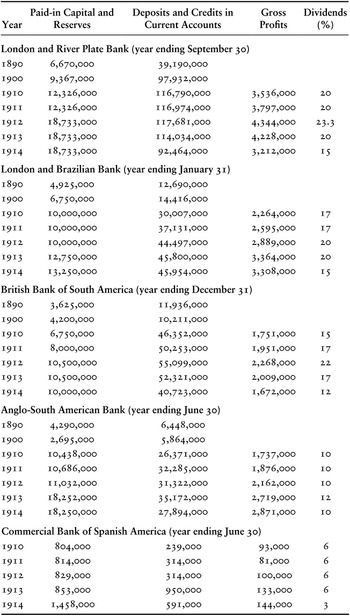
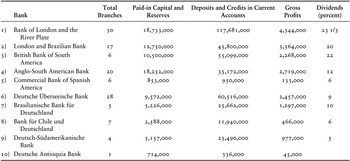

 Open access