1. Introduction
The study of language acquisition has long occupied a privileged place in formal linguistics, especially with regard to the search for explanatory adequacy, which, in the words of Chomsky (Reference Chomsky2002: 129), ‘[is] achieved when a descriptively adequate analysis is completed by a plausible hypothesis about its acquisition’. The standard assumption in formal work on language is that ‘plausible hypotheses’ about language acquisition include reference to an inborn Universal Grammar (UG) that presents learners with a set of language-defining parameters that have to be fixed in response to input of a particular sort. Fodor (Reference Fodor, Palmarini, Uriagereka and Salaburu2009) summarizes the history of work in this area and offers a detailed proposal concerning parameter setting.
I adopt a very different view: not only is there no UG, there is no specialized acquisition device, and no developmental process whose goal is to produce a grammar. Rather, what we think of as language acquisition is an accidental side-effect of attempts to improve the ability of a grammatically naive processor to deal with input.Footnote 1 Let us call this the amelioration hypothesis.
The Amelioration Hypothesis:
Language acquisition consists of processing amelioration.
Before proceeding, it is necessary to say a word about exactly what ‘language acquisition’ is supposed to bring about. I adopt the following assumption, which I take to be a matter of consensus:
The Mapping Assumption:
Language acquisition yields a way to create ‘mappings’ between form and meaning.
On this view, language acquisition corresponds to the emergence of an ability to pair sentences with meaning in the course of comprehension and to carry out the reverse mapping in the case of production, as illustrated in Figure 1 (for the purposes of illustration, I represent meaning via a primitive predicate-argument notation that disregards number, definiteness, tense, and the like.)
A form-meaning mapping

This brings us to the classic problem of syntactic development: how do children come to distinguish between possible and impossible mappings between form and meaning in their language? How, for instance, do they learn that Robin sliced the apple can be used to describe a cutting event in English, but that Sliced Robin the apple cannot? Or that Robin didn't slice all the apples is far more likely to mean that Robin sliced just some of the apples than that Robin sliced none of them? I begin with the problem of word order.
2. A first case study: basic word order
Work on typology distinguishes between two grand language types: those (like English) with verb–direct object order and those (like Korean and Japanese) with direct object–verb order.
a. Verb–object order (English)
bought the book
b. Object–verb order (Korean)
chayk(-ul) sassta
book(-Obj) bought
(Obj = direct object marker)
Let us briefly consider the familiar UG account for this contrast and its relevance for language acquisition.
2.1. The UG story
A longstanding proposal within work on UG is that a simple parameter makes two options available to language learners (e.g. Baker Reference Baker2001: 58ff; Yang Reference Yang2006: 135ff):
The Head-Direction Parameter:
A head (e.g. a verb) precedes/follows other elements in the phrase.
A striking advantage of the parametric approach is that, at least in principle, exposure to a small number of simple utterances (e.g. Eat it, Don't touch that) should suffice to set the head-direction parameter. This scenario fits well with the common observation that children make few errors involving the basic word order of their language. It also brings us to our first challenge: can a processor, trying only to improve its own functioning, discover a language's basic word order?
2.2. The processing story
The starting point for a processing-based account of the development of word order lies in the widely held assumption that learners are able to infer at least some form-meaning mappings without prior knowledge of a language's syntax:
The Bootstrapping Assumption:
Some mappings are inferable without syntactic knowledge.
Consider, for the sake of illustration, an extreme case. Imagine that a hypothetical learner knows nothing about English syntax, but is familiar with a couple of noun-type words (say, Charlie and ball) and a verb-type word (kick). Imagine, further, that on some occasion he or she hears the sentence Charlie kicked the ball, perhaps in a context where someone named Charlie has just kicked a particular ball. Under such circumstances, the learner should be able to map the input onto a meaning by proceeding one word at a time in the following manner. For the sake of illustration, I assume a compressed version of the mapping procedures adopted in O'Grady (Reference O'Grady and Kidd2011).
Charlie kicked the ball.
1. Interpret the first nominal (Charlie).
Charlie
2. Access the meaning of the transitive verb kick; find its agent argument (Charlie) to the left.
kick <agent: Charlie>
3. Interpret the nominal to the right (the ball); treat it as the verb's patient argument.
kick <agent: Charlie; patient: ball>
As illustrated here, the end result of these operations is the creation of a link, or mapping, between a particular word order (Charlie kicked the ball) and a particular meaning involving a kicking event.
In their first implementation, these operations are no doubt applied slowly and laboriously. With time, however, they will be called up with increasing frequency, as the learner creates other mappings of a similar type. For example:
Daddy drives a car. Mary rode a horse. A friend broke the glass.
As the processor creates the appropriate form-to-meaning mappings in these and other cases, the same sequence of three operations is repeatedly activated, ultimately forming a routine. It is widely assumed that routines play a crucial role in the functioning of the processor, improving its speed and efficiency as they are gradually strengthened and automatized (Anderson Reference Anderson1993: 18; Lieberman Reference Lieberman2000: 35; Townsend & Bever Reference Townsend and Bever2001: 175; Paradis Reference Paradis2004: 28; Bybee & McClelland Reference Bybee and McClelland2005: 382; Beckner, Blythe, Bybee et al. Reference Beckner, Blythe, Bybee, Christiansen, Croft, Ellis, Holland, Ke, Larsen-Freeman and Schoenemann2009: 7; Herschensohn Reference Herschensohn2009). As Sagarra & Herschensohn (Reference Sagarra and Herschensohn2010: 2022) put it, ‘During acquisition of the native language, the child must develop computational procedures . . . to facilitate split-second processing in adult speech and comprehension.’
The creation and strengthening of routines is motivated entirely by processing considerations. The processor, it is widely agreed, is resource-limited. It has access to only a modest working memory store, and given the speed with which speech decays (Sachs Reference Sachs1967; Ferreira, Bailey & Ferraro Reference Ferreira, Bailey and Ferraro2002), it must act quickly in creating form-meaning mappings during comprehension and production. The emergence of processing routines is a response to that need.
Independent evidence for the establishment of routines comes from developmental phenomena of various sorts:
• Processing speeds up in response to increased experience with relevant input (Song & Fisher Reference Song and Fisher2007: 1980; Lieven & Tomasello Reference Lieven, Tomasello, Robinson and Ellis2008: 169; Clahsen Reference Clahsen, Sekerina, Fernández and Clahsen2008: 13; Fernald, Thorpe & Marchman Reference Fernald, Thorpe and Marchman2010: 208 and 211), presumably reflecting the gradual automatization of processing routines.
• The commitment to subject–verb–object (SVO) order becomes stronger with age, as comprehension and production routines are strengthened in response to repeated activation. Akhtar (Reference Akhtar1999) exposed children aged from two to four to novel verbs in a variety of word order patterns, including SOV (e.g. Elmo the car gopped). Whereas the younger children were willing to use the new verbs in SOV patterns, the four-year-olds produced only SVO order. In an extension of Akhtar's work, Matthews et al. (Reference Matthews, Lieven, Theakston and Tomasello2005) introduced 96 children aged 2 years 3 months – 4 years 3 months to actual English verbs in SOV patterns. The younger children (mean age 2 years 9 months) used low-frequency verbs such as tug in non-canonical SOV patterns almost half the time, but never did so with high-frequency verbs such as push. The older children resisted SOV order for all verbs. Both studies point toward an initial phase in which word order is determined on a verb-by-verb basis, followed by the emergence and strengthening of a general routine for SVO order that precludes alternative linearizations by age four or so.
• Success at processing transitive sentences emerges earlier in languages that consistently use the same word order to mediate the relationship between form and meaning than in languages that employ a variety of word order patterns. In an act-out task involving more than 200 monolingual children aged 2 years 6 months to 4 years 6 months, Chan, Lieven & Tomasello (Reference Chan, Lieven and Tomasello2009) report that monolingual learners of English attain 100% accuracy on the comprehension of transitive sentences containing a novel verb at an earlier age than learners of German and Cantonese, which have more flexible word order. This points toward the importance of frequency and consistency for the emergence and strengthening of processing routines.
2.3. Summary
In sum, the processing story offers an explanation for two key facts about the acquisition of basic word order, namely:
• the gradual improvement of the accuracy and speed with which language learners use word order in sentence production and comprehension, reflecting the emergence and strengthening of the corresponding processing routine.
• the emergence of an aversion to unattested word order patterns, reflecting the gradual entrenchment of the routine formed in response to the repeated processing of attested patterns.
The key question that arises at this point has to do with whether there is more to language acquisition than the emergence of routines designed to facilitate processing. I propose that there isn't. What we think of as ‘development’ and ‘acquisition’ is simply processing amelioration: improvements to the speed and efficiency of the processor, via the creation and strengthening of processing routines, as exemplified by the emergence of a basic word order in English. Development occurs as routines are formed and strengthened; acquisition takes place when they become entrenched.
Despite its illustrative value, basic word order is not a typical syntactic phenomenon. Not only does it involve an unusually simple contrast (it's either verb–object, or it's object–verb), it has an extravagantly high rate of instantiation in the input. Given that children are exposed to as many as 2.5 million utterances a year (Hart & Risely Reference Hart and Risley1995), examples of basic word order are presumably encountered hundreds of times every day. Most of the phenomena whose study drives acquisition theory do not enjoy these two advantages. Scope, to which we turn next, is a case in point.
3. Scope
The term ‘scope’ refers to the effect of logical operators such as quantifiers and negation on semantic interpretation. A well-known example involves the interaction between negation and the universal quantifier all in sentences such as the following, from English and Korean.
a. Mary didn't read all the books.
b.


(Subj = subject marker, Obj = direct object marker)
The two languages differ in the preferred interpretation of these patterns. Whereas native speakers of English strongly favor the not > all reading (‘Not all of the books were read’), native speakers of Korean show an equally strong preference for the all > not interpretation (‘All the books were unread’). We are thus confronted with two challenges:
i. What is responsible for the difference between the two languages with respect to scopal preferences?
ii. How do learners of each language come to have the appropriate preference?
As in the case of word order, there is a well-established UG account, with which we will begin.
3.1. The UG story
Han, Musolino & Lidz (Reference Han, Lidz and Musolino2007: 18ff) offer a UG-based account for scope, relying on the classic principle paraphrased below.
The Scope Principle:
An operator that is in a higher position in syntactic structure influences the interpretation of an operator in a lower position.
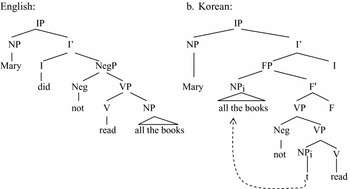
Han et al. propose the structures in Figure 2 for English and Korean. (Do not be alarmed by the abstractness of these structures; the only thing of relevance here is whether the negative is higher than the universal quantifier.)
Syntactic structure for English and Korean

Matters in English are straightforward: the negative is higher in syntactic structure than all and is therefore able to influence its interpretation, giving the not-all reading. The situation in Korean, as Han et al. describe it, is the reverse: setting aside details that do not concern us, the all phrase is higher than the negative, which in turn accounts for the strong preference for the all > not interpretation in Korean.
At this point, we can see that scope differs from word order in two striking ways. First, whatever principle governs the interpretation of scope, it is (at least on the UG account) an order of magnitude more abstract than what is involved in verb–object order. Second, and paradoxically, far less input is available to learners. An illustrative case involves Adam, for whom the CHILDES database provides bi-weekly hour-long speech samples over a two-year period, beginning when he was 2 years 3 months old. In those samples, not-Verb-all sentences appeared in maternal speech just seven times; in contrast, examples of basic word order occurred thousands of times.
Phenomena like scope endow the study of language acquisition with much of its intellectual interest, and progress in this area is vital to our understanding of development. This notwithstanding, the basic research questions are identical to those addressed in our consideration of word order.
• Is there a processing account for the structural difference between English and Korean, and for its acquisition?
• If so, is there anything left for a UG-based account to do?
3.2. The processing story
The key idea underlying the processing account of scope involves one simple factor: whether the intended interpretation of the sentence can be uncovered in an efficient manner, without having to backtrack and revise an earlier interpretation.
In the case of English, the answer is ‘yes’: since the negative occurs early in the sentence, the processor can immediately compute either interpretation when it subsequently comes upon the quantifier. That is, it can either allow the negative to influence the interpretation of the quantifier, or it can bypass that option.
1.
2.
The strong preference for the not > all interpretation in English reflects a simple frequency effect: the routine that gives the not > all interpretation is activated far more often and is therefore far stronger than the routine for the all > not interpretation.
This leaves children with no initial grounds for choosing between the two interpretations: each is easily accommodated by the processor, and the relevant input is too sparse to reveal the adult preference right away. This is reflected in the developmental facts: English-speaking children are initially willing to accept both the not > all and the all > not interpretation (Musolino, Crain & Thornton Reference Musolino, Crain and Thornton2000: 13–14; Musolino & Lidz Reference Musolino and Lidz2006). In contrast, of course, adult speakers of English show a strong preference for the not > all interpretation.
Now consider how the processor goes about interpreting scopal patterns in Korean. The key difference between Korean and English is that in Korean the negative and the verb come after the subject and the direct object.
This means that the processor will already have encountered and interpreted the all-phrase before it comes upon the negative.
If nothing else happens, the all phrase simply retains its ‘full set’ interpretation, ultimately yielding the all > not meaning for the sentence (all the books were unread).
If the all phrase is to have the ‘partitioned set’ interpretation (just some books), the processor has to retrace its steps upon encountering the negative and undo the earlier interpretation that the all-phrase received.
This suggests that the not > all interpretation should be more difficult in Korean, as it places an extra burden on the processor, forcing it to backtrack and revise an earlier interpretation. Experimental work by Lee (Reference Lee2009) has confirmed this prediction: the not > all interpretation takes longer to compute in Korean even for adult native speakers.
Because the all > not interpretation is easier to process in Korean, we would expect it to be preferred by children. This is in fact the case, as has been shown in experimental work with four-year-olds by Han et al. (Reference Han, Lidz and Musolino2007) and with five- and six-year-olds by O'Grady, Kwak, Lee & Lee (Reference O'Grady, Kwak, Lee and Lee2011). Similar preferences for adults are also reported in these studies.
3.3. Summary
In sum, the processing theory offers promising insights into both the typological and developmental issues we have been considering for English and Korean.
On the typological side, there is a straightforward account for why Korean resists the not > all interpretation that is favored in English: that interpretation in Korean requires the processor to backtrack and recalculate a previously assigned meaning, as illustrated above. No such problem arises in English.
On the developmental side, there is a straightforward account for why children learning Korean manifest the same preference for the all > not interpretation that adults do – they are subject to the same processing forces. And there is an equally straightforward explanation for why children learning English initially exhibit no strong scopal preference, even though their adult counterparts strongly prefer the not > all interpretation: processing considerations do not favor either interpretation, and the input is too sparse to establish an immediate bias. As we have seen, a preference emerges over a period of years in English as the processing routine associated with the not > all interpretation is gradually strengthened in response to the fact that more opportunities for activation are available than for the all > not interpretation.
In sum, the scope-related contrast between Korean and English, as well as the developmental profile of scope in each language, falls out from processing considerations. Consistent with the idea that I have been outlining, the emergence of routines, motivated by the need to facilitate processing, has side-effects that correspond to what is usually called ‘language acquisition’.
• The aversion to the not > all interpretation in Korean compared to English follows from the extra processing cost associated with that interpretation in Korean. The aversion is felt even by young children, since processing cost is an issue at all ages.
• Children learning English initially exhibit no strong scopal preference. This is because processing considerations do not favor either interpretation in English, and the input is too sparse to establish an immediate preference. Instead, a preference emerges gradually as the routine associated with the not > all interpretation is strengthened through experience.
There is nothing to suggest that a specialized acquisition device has produced a grammatical rule or set a grammatical parameter. As in the case of basic word order, what we think of as language acquisition is in fact just processing amelioration: attempts by the processor to improve its speed and efficiency by forming routines.
4. Second language acquisition
Could second language acquisition (SLA) also be an instance of processing amelioration? That is, could the developmental profile associated with L2 learning, including the appearance of an interlanguage with particular properties, reflect the processor's attempt to improve its functioning in response to new types of input, despite the existence of entrenched routines from the first language? Or is it necessary to posit the existence of grammatical parameters and a specialized acquisition device? The key to addressing this question lies in an examination of phenomena for which grammar-based approaches and processing-based approaches make different predictions for second language acquisition.
The study of basic word order is unlikely to be revealing here, because both the parameter-based UG approach and the processing approach predict transfer in the early stages of L2 learning, and both appear to be right in this regard. Although basic word order is one of the least problematic phenomena in SLA, there are signs of L1 influence. For example, drawing on speech samples from nine Korean-speaking children in the early stages of learning English (three pre-schoolers, three primary schoolers, and three middle schoolers), Hahn (Reference Hahn2000) reports that some systematically employed Korean word order in English during at least the first part of the twenty-month period of observation. Two of the children in Hahn's study exhibited an especially interesting tendency: they used the correct order for verb–object patterns that had previously been modeled, but reverted to OV (object–verb) order for novel combinations (Hahn Reference Hahn2000: 141 and 190); see also Park (Reference Park1997).
The effects of word order transfer are graded: they are not found in every utterance produced by early L2 learners, and they do not disappear all at once. This suggests that the object–verb routine of Korean is gradually pushed to the side by the verb–object routine of English, thereby improving the processor's performance on the newly encountered input: an instance of processing amelioration.
However, these facts can also be accommodated by UG theories that allow parameter settings to vary in strength. Truscott & Sharwood Smith (Reference Truscott and Sharwood-Smith2004) offer just such a theory, suggesting (for example) that the object–verb setting of the word order parameter in Korean-speaking L2 learners gradually weakens as the verb–object setting of English is strengthened, until at some point a complete change in its value takes place. Yang (Reference Yang2006: 156ff) proposes a similar idea with respect to first language acquisition.
In order to tease apart the processing-based and parameter-based approaches, we need a phenomenon for which they make different predictions. A promising possibility in this regard involves scope. Of particular relevance is the interpretive preference that native Korean speakers might be expected to manifest for English sentences such as Mary didn't read all the books.
4.1. The UG story
To begin, let us recall the Scope Principle that is the key to much work on scopal interpretation in the UG framework.
The Scope Principle:
An operator that is in a higher position in syntactic structure influences the interpretation of an operator in a lower position.
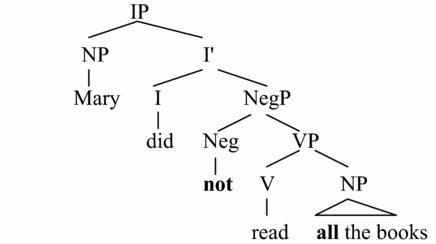
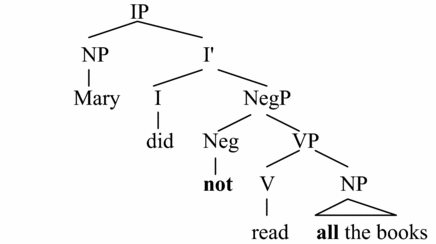
As already noted, this principle straightforwardly predicts the preference for the not > all interpretation in English sentences such as Mary didn't read all the books, since the negative is higher than the quantifier in syntactic structure, as illustrated in Figure 3.
Syntactic structure of an English not–all sentence
Given that the Scope Principle is taken to be universal, and given the assumption that L2 learners have access to UG (e.g. White (Reference White2003) and the many references cited there), it seems safe to conclude that the UG account predicts that Korean-speaking learners of English should strongly favor the not > all interpretation of sentences such as Mary didn't read all the books, just as native speakers of English do.
As we will see next, the processing-based approach to SLA makes a very different prediction.
4.2. The processing story
A key component of the processing account of SLA is the proposal about transfer put forward by O'Grady, Lee & Kwak (Reference O'Grady, Lee, Kwak, Ritchie and Bhatia2009: 83):
Processing-Based Transfer
L2 learners transfer the dominant processing routine of their first language, unless a competing routine is less costly in the second language.
This is an entirely processor-centered strategy – the dominant routines are transferred simply because they are, by definition, the ones that are easiest to implement.
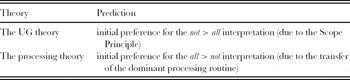
As we have already seen, the dominant processing routine in Korean is the one that gives the all > not interpretation. It is easily adaptable to English, in which it can be executed at no greater cost than the routine underlying the not > all interpretation (see the discussion in section 3.2). We therefore predict that Korean-speaking L2 learners will favor the all > not reading in English, just as they do in Korean: the precise reverse of the prediction made by the parameter setting approach. The predictions of the two theories are summarized in Table 1.
Predictions of the two theories

O'Grady et al. (Reference O'Grady, Lee, Kwak, Ritchie and Bhatia2009) tested 42 native speakers of Korean (all undergraduates at Hanyang University in Seoul) on their scopal preferences in both Korean and English, in which they had attained an intermediate or high-intermediate level of proficiency. Crucially, these learners exhibited an overwhelming preference for the all > not interpretation in English, just as they did in Korean. This is exactly what the processing account predicts, contra the UG account.
Can Korean-speaking L2 learners of English adjust the strength of routines in response to new input? Work by Lee (Reference Lee2009:68) on every suggests that they can: she found that high-proficiency learners chose the not > every paraphrase for test sentences (presented in writing, without a context) 70% of the time, reversing the preference manifested in lower proficiency groups. Presumably, L2 learners can also strengthen the not > all routine in English at the expense of the all > not routine transferred from Korean, thereby approaching the interpretive preference manifested by native speakers of English.
4.3. Summary
As the signature phenomenon in SLA, transfer has the potential to shed light on the fundamental question that we have been considering: is there a specialized grammar-oriented acquisition device, or is language acquisition (including SLA) simply the result of processing amelioration? Whereas the processing approach and the UG-based approach make essentially the same prediction in the case of basic word order, they diverge sharply in their predictions about the scopal preferences that should be manifested by Korean-speaking learners of English.
Crucially, the experimental findings – a strong preference for the all > not interpretation – are just what one would expect if the dominant processing routine in the L1 is transferred to the L2 as an initial attempt at processing amelioration in the second language. Furthermore, Lee's (Reference Lee2009) results suggest that progress in L2 learning is marked by the emergence and strengthening of new routines to facilitate the processing of form–meaning mappings encountered in the L2. In these two crucial respects at least, what we think of as SLA appears to consist of processing amelioration, just as first language acquisition does.
In sum, the transfer and emergence of routines, motivated by the need to facilitate processing, have side-effects that correspond to what is usually called ‘second language acquisition’.
• The dominant all > not routine in Korean is transferred to English in order to facilitate processing of scope patterns in the L2.
• Exposure to new (but sparse) input provides an eventual opportunity for the emergence and strengthening of the not > all routine, thereby facilitating the processing of the more common scope pattern in English.
There is no reason to think that a grammatical rule or parameter setting has been transferred, or that a specialized acquisition device has brought about an improvement in L2 proficiency. What we think of as development or progress in SLA, such as the gradual shift in scope preferences observed by Lee, is in fact just processing amelioration: the emergence of a processing routine for scope that allows faster form–meaning mappings than does the routine carried over from the L1.
5. Concluding remarks
It is beyond dispute that qualitative changes in proficiency take place in response to ongoing exposure to language. These changes are so striking and come about so mysteriously that it is tempting to attribute them, as we always have, to the work of a specialized acquisition device, with access to inborn grammatical options. Nonetheless, another possibility is worthy of consideration.
According to the processing hypothesis that I have been outlining, there is no acquisition device and there are no inborn grammatical constraints and options. Rather, what we think of as language acquisition – with its particular initial states, developmental changes, and end state – is just a side-effect of processing amelioration, which is directed toward improving the speed and efficiency with which the processor creates mappings between form and meaning in the course of production and comprehension.
The theme for this year's Second Language Research Forum is ‘Reconsidering SLA Research: Directions and Dimensions’. I have taken this theme seriously. Even if there is resistance to my suggestion that there is really no such thing as language acquisition in the traditional sense (i.e. the creation of a grammar by a specialized acquisition device), I hope that the general approach to SLA that I have outlined will merit consideration as one way to do SLA research.
As I have tried to illustrate, the key to this approach involves starting with a typologically informed characterization of the relevant features of the L1 and L2. Next comes an attempt to understand those properties in terms of processing considerations that might shed light on the developmental course of first language acquisition. Only at this point is it possible to consider the properties and problems of SLA in an insightful way. This is a demanding and unusual course of inquiry to pursue, I admit, but it may prove to be worthwhile in the long run.
Acknowledgements
I thank Miho Choo, Kevin R. Gregg, and Graeme Porte for their helpful comments.
William O'Grady is Professor of Linguistics at the University of Hawaii at Manoa in the United States, where he teaches course on syntax and language acquisition. He is the author of many articles and books, including Syntactic carpentry (Routledge, 2005) and How children learn language (Cambridge University Press, 2005).