Implication
The observation that alpine forages affect in vitro ruminal fermentation differently when employed as substrate for incubation and when fed over a longer period to the rumen fluid donor cow is noteworthy. This has implications not only for the evaluation of feeding value and the effect of feeding alpine forage but also for the adaptation of rumen fluid donor animals, as there were several interactions between both dietary interventions. These complex interactions emphasize that alpine forages have specific properties, possibly mediated partly by elevated concentrations of plant secondary compounds, which, however, could still not be proven.
Introduction
Summer grazing at high altitude during the vegetative period is a traditional agricultural practice across the European alps (cf. Leiber et al., Reference Leiber, Kreuzer, Leuenberger and Wettstein2006). Compared with lowland herbages, alpine pastures have a higher diversity in plant species, especially herbs, and are supposed to be richer in plant secondary compounds (PSC) than intensively managed lowland pastures (Jeangros et al., Reference Jeangros, Scehovic, Troxler, Bachmann and Bosset1999; Jayanegara et al., Reference Jayanegara, Marquardt, Kreuzer and Leiber2011a). In addition to that, alpine pasture grass and hay are limited in their energy density and therefore may cause a shortage of energy for the rumen microbes (Leiber et al., Reference Leiber, Kreuzer, Leuenberger and Wettstein2006 and Reference Leiber, Wettstein and Kreuzer2009; van Dorland et al., Reference van Dorland, Wettstein and Kreuzer2006). These two properties were hypothesized to affect those rumen microbes that are involved in ruminal lipid metabolism and might explain the characteristic fatty acid profile of alpine milk (Leiber et al., Reference Leiber, Kreuzer, Nigg, Wettstein and Scheeder2005). Some plant species found in alpine habitats are additionally known for their anti-microbial properties (García-González et al., Reference García-González, López, Fernández, Bodas and González2008). Therefore, alpine pasture grass can be expected to modify ruminal fermentation in general, which could also affect methanogenesis. On the level of individual alpine plant species, a limited variation of methanogenesis has been demonstrated in vitro (Jayanegara et al., Reference Jayanegara, Marquardt, Kreuzer and Leiber2011a). However, it may well be that composed swards, which are a mixture of many, possibly interacting, plant species, have other effects than single species. Further, a direct comparison of alpine forages with lowland diets in terms of ruminal fermentation is lacking.
This study tested the hypothesis that forages from high altitude pastures influence ruminal fermentation differently from lowland forages. A second hypothesis was that adaptation to this specific type of forage plays a noticeable role for the expression and the magnitude of this effect. For this purpose, forages from alpine pastures were (i) fed to the rumen fluid donor animal (long-term effect) and (ii) directly incubated in rumen fluid originating either from high altitude or from the lowlands (short-term effect). Comparisons were made with various lowland forages. This approach considers the possibility that adapting donor animals to certain feeds may affect the results of in vitro ruminal fermentation (Nagadi et al., Reference Nagadi, Herrero and Jessop2000; Tejido et al., Reference Tejido, Ranilla and Carro2002; Martínez et al., Reference Martínez, Ranilla, Tejido, Saro and Carro2010).
Material and methods
Donor cow treatment and rumen fluid collection
The experiment lasted for 16 weeks in summer 2008. During this period, a rumen-cannulated non-lactating Brown Swiss cow was translocated between two different study sites. The rumen fluid collection periods started at the ETH research station Chamau in central Switzerland at 400 m above sea level (a.s.l.) where the cow had received a mixed diet consisting of maize silage, grass silage and grass hay (6 : 3 : 1) at ad libitum access and 1 kg/day of a commercial concentrate for the entire winter and spring. The cow was then moved to the pastures around the buildings of the ETH research station Alp Weissenstein situated at an altitude of 2000 m a.s.l. in the southeast of the Swiss alps. Rumen fluid was collected on the day before transport (reflecting the status after 6 months of adaptation to the lowland diet) and after 2, 6 and 10 weeks of alpine grazing, in order to examine the development of the rumen environment during the entire alpine period (10 to 12 weeks long at this altitude). Subsequently, the cow returned to the lowlands and was fed with the same mixed diet as before. Rumen fluid was collected again 2 and 6 weeks after return. Rumen fluid was always collected at 0900. Other than recommended in the Hohenheim Gas Test protocol (Menke and Steingass, Reference Menke and Steingass1988), the cow was not fasted in advance of sampling, because the effect of the feeding on the actual rumen environment was one of the targets of the experiments. During the transport of the rumen fluid to the laboratory, which always lasted for 3.5 h, its temperature was maintained at 38°C. Before use, rumen fluid was filtered through four layers of medicinal gauze (1000 μm pore size, type 17; MedPro Novamed AG, Flawil, Switzerland).
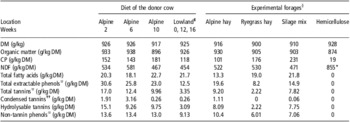
The pastures offered at the alpine site were characterized by two main vegetation types, namely Crepido aureae–Festucetum rubrae and Deschampsio cespitosae–Poetum alpinae. Always one day before rumen fluid collection, a forage sample representative of the donor cow's diet was collected by mimicking its grazing behavior following the protocol of Berry et al. (Reference Berry, Scheeder, Sutter, Kröber and Kreuzer2000). The assumption was made that the grazing behavior on that respective sampling day was similar to that of the days before. Representative samples from the mixed lowland diet were taken before rumen fluid sampling as well. The nutrient composition of the donor cow's alpine and lowland diets is shown in Table 1. The experiment was approved by the cantonal veterinary office of Zug (permission no. ZG 50/08).
Composition of nutrients and phenolic compounds of the diets of the donor cow and of the four experimental foragesFootnote †

DM = dry matter; CP = crude protein; NDF = neutral detergent fiber.
† Linseed oil addition not included in nutrient composition of the experimental forages.
‡ Diet consisted of mixed grass–maize silage, grass hay and concentrate.
§ Given for forages not supplemented with linseed oil; for the supplemented forages this meant additionally 27 and 55 g total fatty acids/kg DM on average.
* NDF content of the hemicellulose treatment was calculated from organic matter minus crude protein.
π Given as gallic acid equivalent.
†† Given as leucocyanidin equivalent.
In vitro incubation experiment
For in vitro incubation, amounts of 200 mg air-dry matter (DM) of four experimental forages were used. In order to be able to establish effects on biohydrogenation as well (results not described here), each forage had been incubated together with 0, 5 and 10 mg of linseed oil as an extra source of unsaturated fatty acids. Although such an oil could possess anti-bacterial effects (Maia et al., Reference Maia, Chaudhary, Figueres and Wallace2007), and thus could alter ruminal fermentation, there was actually no oil effect in this study and no significant interaction with the other factors occurred in the variables analyzed. Every treatment combination (forage × oil) was incubated in triplicate. The forages tested were (i) alpine hay produced from a cut of another Crepido aureae–Festucetum rubrae pasture; (ii) pure lowland ryegrass hay; (iii) a grass–maize silage mixture (2 : 1) resembling the donor cow's lowland forage; and (iv) purified hemicellulose (xylan; produced by hydrolysis of oat spelt and containing mainly xylose and some arabinose and glucose (⩽0.1 and ⩽0.15 of total, respectively); Sigma-Aldrich GmbH, Buchs, Switzerland). This set of experimental forages was accompanied by a considerable variation in contents of total and individual phenols (Table 1). Both forages of alpine origin were richer in total extractable phenols (TEP) and tannins compared with the respective lowland feeds, whereas TEP contents in hemicellulose were zero. The alpine forages had a higher fiber content than the lowland feeds as well. In terms of crude protein (CP), the characterization was not as clear because the alpine pasture grass was richer in CP than the lowland feed, whereas the alpine hay was poorer in CP than the other experimental forages. The particularly high CP level of the grass after 10 weeks of grazing at the alpine site probably resulted from regrowth fertilized by the dung of the cow itself.
The in vitro method applied was a batch culture technique based on the Hohenheim Gas Test and was operated as described by Soliva and Hess (Reference Soliva and Hess2007). Briefly, filtered rumen fluid was mixed with pre-warmed Menke buffer solution (1 : 2). Then, 30 ml of this mixture was added to 200 mg of the air-dry experimental forages which had been weighed into special incubation glass pistons with two outlets. Linseed oil was prepared as an emulsion (50 mg/ml) with 1% (v/v) Tween 80® in aqueous solution following Khiaosa-ard et al. (Reference Khiaosa-ard, Leiber and Soliva2010) before being added in amounts of either 0.1 or 0.2 ml. In the zero oil treatments, 0.2 ml of the aqueous Tween 80® solution was added. Further, triplicates of incubation units of either blank (rumen fluid buffer mixtures only) and of standard hay and concentrate with known gas production (GP) potential, obtained from the University of Hohenheim, were included in each run to establish baseline values for later correction as outlined in López et al. (Reference López, Makkar and Soliva2010). The pistons were incubated at 39°C for 24 h. Total fermentation gas volume formed in these 24 h was quantified with the help of the calibrated scale printed onto the piston. Subsequently, the residue consisting of rumen fluid, buffer and feed residues (called incubation fluid further on) was removed from the pistons for subsequent analysis. Samples of the fermentation gas remaining in the piston were obtained by a Hamilton syringe through the rubber covering the second outlet.
Laboratory analysis
The incubation fluid samples were analyzed for pH and ammonia concentration immediately upon collection by using a potentiometer (model 173, Metrom, Herisau, Switzerland) equipped with the respective electrodes. Total counts of bacteria and ciliate protozoa (differentiated into holotrichs and entodiniomorphs) present in the incubation fluid samples were determined using 0.02 and 0.1 mm depth Bürker counting chambers (Blau Brand, Wertheim, Germany), respectively. Before counting, the microbial samples were fixed with Hayem solution (mg/ml; HgCl2, 2.5; Na2SO4, 25; NaCl, 5.0). Concentrations of volatile fatty acid (VFA) were analyzed by HPLC (System Hitachi Lachrom, Merck, Tokyo, Japan) following the protocol of Ehrlich et al. (Reference Ehrlich, Goerlitz, Bourell, Eisen and Godsy1981). Methane in fermentation gas was determined using a gas chromatograph (model 5890 Series II, Hewlett Packard, Avondale, PA, USA) equipped with thermal conductivity and flame ionization detectors and a Carboxen-1000 column (15′ × 1/8″ SS, mesh size 60/80; Fluka Chemie AG, Buchs, Switzerland).
Feeds were analyzed following standard protocols (Association of Official Analytical Chemists (AOAC), 1997). DM and total ash contents were determined with an automatic analyzer (TGA-500 Leco Corporation, St. Joseph, MI, USA), ether extract (EE) after petrol ether extraction (required for the calculation of metabolizable energy (ME)), and nitrogen with a C/N analyzer (Type FP-2000, Leco Corporation, St. Joseph, MI, USA). CP content was calculated as 6.25 × N. The ash-corrected content of neutral detergent fiber (NDF) was analyzed as outlined in Van Soest et al. (Reference Van Soest, Robertson and Lewis1991) with a Fibertec 1020 system (Tecator, Höganäs, Sweden) using α-amylase (Termamyl 120L, type S; Novo Nodirsk A/S, Bagsværd, Denmark). The total fatty acid content of the feeds was assessed as described in Palmquist and Jenkins (Reference Palmquist and Jenkins2003). In addition, non-fatty acid compounds were removed using thin layer chromatography (Khiaosa-ard et al., Reference Khiaosa-ard, Bryner, Scheeder, Wettstein, Leiber, Kreuzer and Soliva2009). The determination of TEP (not containing lignin) and tannins was performed as described in detail in Jayanegara et al. (Reference Jayanegara, Togtokhbayar, Makkar and Becker2009). For that, the oven-dried (60°C, 24 h) samples were extracted with aqueous acetone water (7 : 3 v/v). Other findings (Muetzel and Becker, Reference Muetzel and Becker2006; own unpublished tests) suggest that the drying method chosen was probably not systematically affecting extractability and biological activity of tannins in comparison with freeze-dried and freshly frozen samples. Different from the Folin–Ciocalteu method, polyvinylpolypyrrolidone was used to separate tannin phenols from non-tannin phenols. Butanol-HCl-iron was applied to determine condensed tannins. Hydrolysable tannins were estimated by the difference of total tannins and condensed tannins. This is a simplification and may be slightly biased by applying different standards (leucocyanidin for condensed tannins, gallic acid for the other traits).
In vitro organic matter digestibility (IVOMD) and ME contents were calculated using the adjusted fermentation GP volume and the standard equations given in Menke and Steingass (Reference Menke and Steingass1988) reading:
 $${ {\rm{IVOMD}}\,({\rm{mg}}/{\rm{g}}) & = \,148.8\, + \,8.893\,\times \,{\rm{GP}}\,({\rm{ml}})\, + \,0.448\,\times \,{\rm{CP}}\,({\rm{g}}/{\rm{kg}}\,{\rm{DM}}) \cr
& + \,0.651\,\times \,{\rm{total}}\,{\rm{ash}}\,({\rm{g}}\,/\,{\rm{kg}}\,{\rm{DM}}); \cr}$$
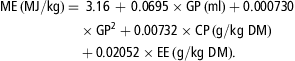 $${{\rm{ME}}\,({\rm{MJ}}/{\rm{kg}}) & = \,3.16\, + \,0.0695\,\times \,{\rm{GP}}\,({\rm{ml}})\, + \,0.000730\,\times \,{\rm{GP}}2 \cr
& + \,0.00732\,\times \,{\rm{CP}}\,({\rm{g}}/{\rm{kg}}\,{\rm{DM}})\, + \,0.02{\rm{052}}\,\times \,{\rm{EE}}\,({\rm{g}}/{\rm{kg}}\,{\rm{DM}}){\rm{.}} \cr}$$
Statistical analysis
Data were analyzed using the GLM procedure of SAS (version 9.1, SAS Institute, Cary, NC, USA) considering the factorial experimental arrangement based on rumen fluid origin (lowland v. alpine), experimental forage type and their interactions. The linseed oil treatment and its interactions with the other test factors initially included were not further considered in the final statistical model as this resulted in very few significances. Multiple comparisons among main factor means and interaction means were performed using Tukey's method. For the comparisons of the means of the individual measurement periods, as displayed in the figures, a second model (MIXED procedure of SAS; Littell et al., Reference Littell, Henry and Ammerman1998) was used where the repeated measurements character of the data was considered. The Least square means of these periods were compared with Tukey's adjustment for significance within experimental forage type.
Results
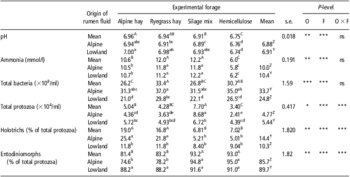
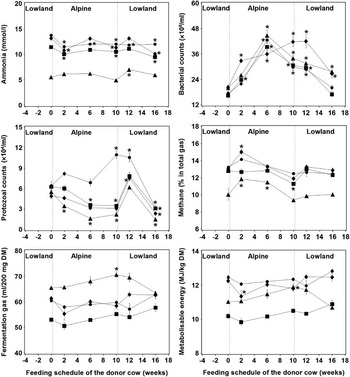
The pH of the fluid after 24 h of incubation ranged between 6.7 (hemicellulose) and ∼7 (other forages) (P < 0.05, Table 2). Although ruminal pH was lower (P < 0.05) in the alpine period, the difference was small in magnitude. Ammonia concentration in incubation fluid was lowest after fermenting pure hemicellulose. With alpine hay, ammonia was lower compared with the two other forages as well (P < 0.05). During alpine grazing, ammonia concentration was lower (P < 0.01) than during the lowland period, but again the difference was small. Despite the presence of a time effect (P < 0.001, as determined by repeated measurement analysis; Figure 1), there was also no pronounced development with time in this trait. Total bacterial count was higher (P < 0.001) with alpine grazing than with lowland feeding (∼+36% on average across all groups; Table 2). Total bacterial count were low with alpine hay and the grass–maize silage mix and highest with ryegrass hay (P < 0.05). Bacterial counts clearly increased after 2 and 6 weeks of alpine grazing with all forages incubated decreased slightly after 10 weeks and very clearly 6 weeks after the end of the alpine sojourn (Figure 1). The total protozoal count was found to be lower in rumen fluid collected at high altitude when alpine hay, ryegrass hay and hemicellulose were incubated (−31% on average), whereas the opposite was observed with the grass–maize silage mix (+29%, P < 0.05; interaction, P < 0.001; Table 2). In more detail, protozoal count was immediately increased with hemicellulose when switching to the alpine period (2 weeks), whereas with alpine hay and the grass–maize silage effects only occurred after 6 and 10 weeks of grazing had passed (Figure 1). Two weeks after returning to the lowlands, protozoal counts increased across all forages incubated before declining again to levels lower than initially (P < 0.05). Incubation with rumen fluid of alpine origin and incubation of alpine hay and ryegrass hay increased (P < 0.05) the holotrich protozoa proportion of total protozoa (Table 2).
Effects of experimental forages on fermentation traits when incubated with rumen fluid collected in the lowlands and at the high altitude site (sub-cells, n = 9)

O = origin; F = forage.
Means of periods and of incubated forages, respectively, sharing no common capital letters are significantly different at P < 0.05.
Period × forage interaction means sharing no common small letters are significantly different at P < 0.05. *P < 0.05; **P < 0.01; ***P < 0.001; ns, not significant.
Changes in the effect of forage type (▪, alpine hay; ?, ryegrass hay; •, grass-maize silage; ▴, hemicellulose) on selected ruminal fermentation traits when incubated for 24 h in vitro with rumen fluid collected from the lowlands and at high altitude (n = 9 per data point). Overall, effects of experimental forage and period as well as their interactions were significant at P < 0.001 for all traits. Asterisks denote means within experimental forage type, which differed (P < 0.05) from the first assessment made in the lowlands.

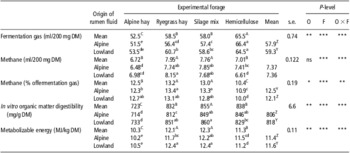
Total fermentation GP across all forages incubated was lower (P < 0.05) when using rumen fluid from the alpine site compared with that from the lowlands, but the difference was minor in extent. When considering the time-dependent development, no clear shifts of gas formation occurred during the entire experiment (Figure 1). Among the forages, hemicellulose resulted in the highest GP, the alpine hay in the lowest value and the other two forages were found to be intermediate (P < 0.05; Table 3). There was an interaction (P < 0.001) of rumen fluid origin and forage type because the use of rumen fluid of alpine origin caused a lower GP with all incubated forages except with hemicellulose, where the GP increased. There was a minor increase (P < 0.05) in methane proportion of total gas (+1%) when using rumen fluid of alpine origin, but absolute methane production was similar to that found with rumen fluid from the lowlands (Table 3). Methane formation was lower (P < 0.05) in amount and proportion with hemicellulose and alpine hay than with the other two forages. There was a sharp increase in methane proportion of total gas after moving the donor cow to the alpine site with three of the forages incubated (P < 0.05 relative to initial), but not with the alpine hay (Figure 1). Afterwards the methane proportion gradually declined to the level found initially, and this development persisted until the end of the experiment. With the exception that IVOMD of hemicellulose was lower than that of the silage mix, IVOMD and ME contents varied basically as did total fermentation gas (Table 3, Figure 1).
Effects of experimental forages on gas and methane production and calculated energy content when incubated with rumen fluid collected in the lowlands and at the high altitude site (sub-cells, n = 9)

DM = dry matter; O = origin; F = forage.
Means of periods and of incubated forages, respectively, sharing no common capital letters are significantly different at P < 0.05.
Period × forage interaction means sharing no common small letters are significantly different at P < 0.05. *P < 0.05; **P < 0.01; ***P < 0.001; ns, not significant.
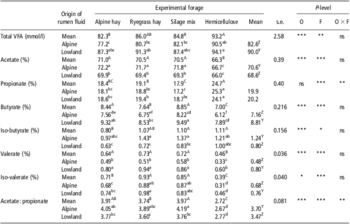
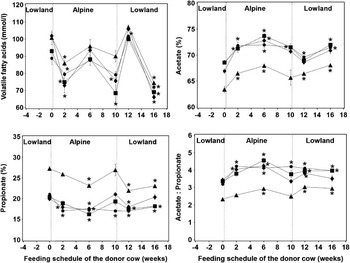
Alpine grazing of the donor cow led to clearly reduced (P < 0.001) total VFA concentrations in the incubation fluid (−8%) compared with lowland feeding (Table 4). Because in the incubations equal amounts of rumen fluid and forages had been used, this is equivalent to a corresponding reduction in actual VFA production. Incubating the hemicellulose enhanced VFA concentration compared with the other forages, especially when using rumen fluid originating from the high altitude site. There were large fluctuations in VFA concentration during the experimental periods across all forages incubated (Figure 2). Lower values were found at the first and the last alpine measurement and at the last lowland measurement date in comparison with the initial value (P < 0.05; especially pronounced with the two hay types). Alpine grazing increased (P < 0.05) proportions of acetate and iso-butyrate at cost of butyrate, valerate and iso-valerate (Table 4). The increase in acetate was accompanied by a higher (P < 0.05) acetate:propionate ratio. Incubating different forages altered (P < 0.05) VFA profile as well. Especially the hemicellulose treatment resulted in a different profile with largely elevated propionate proportions and lower proportions of all other VFA (P < 0.05). Compared with that, the other three forages appeared to have similar effects, except that the incubation of the alpine hay resulted in lower (P < 0.05) proportions of the iso-acids. A more detailed view on the fluctuations between the individual measurement periods (Figure 2) did not reveal additional systematic changes in acetate, propionate and the acetate : propionate ratio. Interactions (P < 0.01) between origin of rumen fluid and forage type were only found with propionate proportion and, consequently, in the acetate : propionate ratio, but these interactions were of minor quantitative importance.
Effects of experimental forages on VFA concentration and profile when incubated with rumen fluid collected in the lowlands and at the high altitude site (sub-cells, n = 9)

VFA = volatile fatty acid; O = origin; F = forage.
Means of periods and of incubated forages, respectively, sharing no common capital letters are significantly different at P < 0.05.
Period × forage interaction means sharing no common small letters are significantly different at P < 0.05. *P < 0.05; **P < 0.01; ***P < 0.001; ns, not significant.
Changes in the effect of forage type (▪, alpine hay; ?, ryegrass hay; •, grass-maize silage; ▴, hemicellulose) on traits concerning volatile fatty acids when incubated for 24 h in vitro with rumen fluid collected from the lowlands and at high altitude (n = 9 per data point). Overall, effects of experimental forage and period as well as their interactions were significant at P < 0.001 for all traits. Asterisks denote means within experimental forage type, which differed (P < 0.05) from the first assessment made in the lowlands.

Discussion
In this study, alpine forages were tested in their effect either as a feed for the donor cow or as a substrate for in vitro incubations. Both alpine forage sources were characterized by an elevated content of PSC, as indicated here by TEP, as had been expected from the literature (Jeangros et al., Reference Jeangros, Scehovic, Troxler, Bachmann and Bosset1999; Fraisse et al., Reference Fraisse, Carnat, Viala, Pradel, Besle, Coulon, Felgines and Lamaison2007). Purified PSC or plant extracts and plants rich in PSC have been occasionally demonstrated to alter ruminal fermentation processes in vitro in the short term (Makkar et al., Reference Makkar, Blümmel and Becker1995; Patra et al., Reference Patra, Kamra and Agarwal2006; Soliva et al., Reference Soliva, Zekele, Clément, Hess, Fievez and Kreuzer2008; Jayanegara et al., Reference Jayanegara, Wina, Soliva, Marquardt, Kreuzer and Leiber2011b). Therefore, in this study clear TEP-related effects of the alpine forages on ruminal fermentation were expected.
The experimental set-up allowed testing the effects of forage of alpine origin from two different perspectives including short-term and longer-term responses. When comparing these alpine forage effects, it has to be kept in mind that the respective controls had been different. The lowland diet resembled best the silage mix among the forages incubated, whereas the monoculture lowland hay was an ideal control for the identification of a direct hay origin effect. Hemicellulose was employed as a feed free of PSC. One clear limitation of this study was that only one donor animal could be employed. Since variation between animals exists (Franzolin and Dehority, Reference Franzolin and Dehority1996), which could not be ruled out in the current experimental setting, the results have a preliminary character. However, especially the apparent contrast found between the long-term and the short-term effects is an important information to be further investigated in more detail.
Effects of alpine forage on rumen microbes
A lower bacterial count was expected from the possible anti-microbial effect of phenolic compounds and other PSC (Kamra et al., Reference Kamra, Agarwal and Chaudhary2006). Indeed, the incubation of the alpine hay reduced bacterial counts, but the rumen fluid collected from the alpine site had higher bacterial counts, indicating that the adaptation of the donor animal to a certain feed has a different influence on the result than the short-term incubation of a similar forage. Furthermore, bacterial counts peaked after 6 weeks of alpine grazing, which was when the forage had the highest content of condensed tannins. The increase in bacterial count was, however, found earlier with condensed tannin supplementation in vitro (Khiaosa-ard et al., Reference Khiaosa-ard, Bryner, Scheeder, Wettstein, Leiber, Kreuzer and Soliva2009) and with herbal preparations studied in vivo (Bhatt et al., Reference Bhatt, Singh and Ali2009). Therefore, no general anti-bacterial effect of the alpine pasture plants can be assumed, which is also in agreement with the results of Jayanegara et al. (Reference Jayanegara, Marquardt, Kreuzer and Leiber2011a).
Also in the short-term perspective, based on the differences between the incubated forage types, no general influence of the TEP present in the alpine hay can be deducted. In fact, there are various factors influencing bacterial counts, and some of them could even have been counteractive in this study. For instance, a lower bacterial count is likely to have resulted from the lower content of fermentable organic matter of the alpine hay compared with the other forages (Grubb and Dehority, Reference Grubb and Dehority1975). Besides, the alpine hay had a lower CP content than the lowland forages incubated. By contrast, a higher average CP concentration of the alpine meadows compared with the lowland diet ingested by the cow may have contributed to an improved microbial growth during the alpine grazing periods of the donor cow. In addition, bacterial counts might have been higher in the rumen fluid of alpine origin as a compensation for the concomitantly decreased protozoa, which are predators of bacteria (Hess et al., Reference Hess, Kreuzer, Díaz, Lascano, Carulla, Soliva and Machmüller2003). It is obvious that rumen bacteria got adapted to the TEP within the 70-day period of alpine grazing. Resistant rumen bacteria can overcome the inhibitory effects of PSC (see reviews by Smith et al., Reference Smith, Zoetendal and Mackie2005; Makkar et al., Reference Makkar, Francis and Becker2007). This was shown for instance in continuous culture where rumen microbes got adapted to PSC from plant extracts already after 6 days (Cardozo et al., Reference Cardozo, Calsamiglia, Ferret and Kamel2004). Finally, a clearly reduced water intake with alpine forage, as observed by Leiber et al. (Reference Leiber, Wettstein and Kreuzer2009) when comparing lowland and alpine hay, might explain why bacterial concentrations in rumen fluid were higher in the animal (little dilution) compared with alpine forage incubated in vitro.
Alpine forage, tested in either way, resulted in lower protozoal counts compared with the corresponding silage-based lowland diets (although not when compared with the lowland hay). Although the effects of PSC on protozoal populations reported are quite variable (Benchaar et al., Reference Benchaar, McAllister and Chouinard2008; Vasta et al., Reference Vasta, Yáňez-Ruiz, Mele, Serra, Luciano, Lanza, Biondi and Priolo2010), and type and dose of PSC are important, several PSC are known to act specifically against protozoa. This includes tannins among the phenolic compounds and especially saponins (Śliwiński et al., Reference Śliwiński, Soliva, Machmüller and Kreuzer2002; Hess et al., Reference Hess, Kreuzer, Díaz, Lascano, Carulla, Soliva and Machmüller2003; Carulla et al., Reference Carulla, Kreuzer, Machmüller and Hess2005). Another explanation for low protozoal counts is the low content of the alpine forages of easily digestible non-fiber carbohydrates, the nutrients preferred by the protozoa (Dijkstra, Reference Dijkstra1994). This is particularly obvious from the strong anti-protozoal effect of the PSC-free hemicellulose. The holotrich protozoa seemed to be less susceptible to alpine forage than the entodiniomorphs. The same was reported by Patra et al. (Reference Patra, Kamra and Agarwal2006) when investigating the responses of protozoa populations to extracts of PSC-containing plants.
Effects of alpine forage on the production of ammonia and methane
The ammonia concentration in the incubation fluid was clearly lower with the alpine hay than with the lowland hay and the silage mix, whereas the corresponding decline with alpine forage found in the rumen fluid of the donor cow was only small. This coincides with the differences in CP contents in relation to the respective controls and is further illustrated by the exceptionally low ammonia concentration found with the low-CP feed hemicellulose. Tannins strongly bind to protein at pH 6.0 to 7.0 (Cortés et al., Reference Cortés, Moreno, Pabón, Avila, Kreuzer, Hess and Carulla J2009) and thus inhibit ruminal microbial protein degradation and ammonia formation (Śliwiński et al., Reference Śliwiński, Soliva, Machmüller and Kreuzer2002). Since dietary tannin concentrations clearly varied among forages in this study, an effect could have been possible. However, the large variation in CP content between the forages has such a high relevance for the ruminal ammonia production that distinguishing of tannin effects from those of CP seems to be impossible, the more because the concentration of tannins in the alpine forages was rather low compared with the dietary levels investigated in other studies (Carulla et al., Reference Carulla, Kreuzer, Machmüller and Hess2005; Khiaosa-ard et al., Reference Khiaosa-ard, Bryner, Scheeder, Wettstein, Leiber, Kreuzer and Soliva2009).
The short-term incubation of alpine hay led to a lower methane production than that from lowland hay and the mixed silages. On the basis of the studies of Jayanegara et al. (Reference Jayanegara, Marquardt, Kreuzer and Leiber2011a and Reference Jayanegara, Wina, Soliva, Marquardt, Kreuzer and Leiber2011b), it can be assumed that total phenolic compounds at a concentration of ∼20 g/kg in the alpine hay contributed at least partly to the decrease in methane production. Different from that, in the long-term perspective, there was no systematic effect of alpine grazing on methane formation and its proportion of total gas in vitro. The fluctuation (increase and then gradual decline) in methane formation among the alpine sub-periods indicates that changes in microbial population or their activity in the native rumen fluid or both took place. The fluctuations did not coincide with those found in numbers of protozoa, microbes where a substantial proportion of methanogens are closely associated with (Hess et al., Reference Hess, Kreuzer, Díaz, Lascano, Carulla, Soliva and Machmüller2003). As discussed earlier, short-term anti-methanogenic effects may have been overcome by gradual microbial adaptation. The lowest methane proportion found when incubating hemicellulose is likely to be explained by the concomitant increase in total GP, which was more than proportionate compared with methane.
Effects of alpine forage on VFA and its energy content
The fluctuations found on the alpine site in acetate proportion coincided with those found for methane production, which was expected as both are related to fiber degradation. This also suggests that the hydrogen supply for the methanogens (Martínez et al., Reference Martínez, Ranilla, Tejido, Saro and Carro2010) was initially elevated with alpine grazing. The most peculiar VFA profile (acetate and propionate proportion) was found with the pure fiber coming from the hemicellulose treatment while the alpine and the lowland forages, containing quite similar NDF contents, showed no major differences. Similar to the low ammonia concentration, the clear decrease in the iso-fatty acids found with the alpine hay compared with the lowland hay incubated can be attributed to the low-CP concentrations of the alpine hay. The significant shift in the acetate : propionate ratio between the lowland and the alpine periods, that is, the long-term effect, has to be attributed to the lower fiber and higher soluble carbohydrate contents (data for soluble carbohydrates not shown) of the lowland compared with the alpine diet.
Total VFA concentration (and therefore production) as well as total fermentation GP were lower with the alpine forage compared with the respective lowland controls. This means that forage quality, in terms of digestibility (here estimated by the IVOMD) and ME concentration, was lower although not very much. Similar observations on alpine forage quality have been made in other studies (e.g. Leiber et al., Reference Leiber, Kreuzer, Leuenberger and Wettstein2006). In the present investigation, there was a minor increase with time on the alpine pasture, and also some interactions with forage type occurred. The differences in IVOMD and ME between alpine forage and the corresponding lowland feeds were again rather small when compared with the difference to the well digestible pure hemicellulose.
Conclusion
This in vitro study showed that employing alpine forages influences ruminal fermentation compared with lowland feeding systems. This adds to earlier findings on the specific properties and effects of such forages on intake, digestion, performance and milk quality, some of which are favorable, others unfavorable. Overall, although the TEP concentrations were high in both alpine forages compared with the other feeds, it was not possible to clearly distinguish the effects of these compounds from other dietary properties on ruminal fermentation parameters. However, in comparison with the different controls used, it appears most likely that the effects were the result of a combination of a rather limited digestibility and energy content but also of constituents of the alpine forage, which are present in minor proportions. The frequent occurrence of significant interactions between test forage and rumen fluid origin, although not being of large magnitude, may be a result of the different degree of microbial adaptation to alpine forage. Being aware about the fact, that only one donor cow could be used, the results, however, underline the importance of adapting the cow donating rumen fluid for short-term in vitro experiments to forage with specific properties (Nagadi et al., Reference Nagadi, Herrero and Jessop2000; Tejido et al., Reference Tejido, Ranilla and Carro2002; Martínez et al., Reference Martínez, Ranilla, Tejido, Saro and Carro2010).
Acknowledgments
We thank Anuraga Jayanegara, Carmen Kunz, Muna Mergani and Irene Zbinden for their help in this experiment.