Introduction
Today, knowledge and information has become a factor in determining the success and competitiveness of organizations, and knowledge management (KM) has been proposed as one of the last issues of organizations in management science. Knowledge, defined as information combined with experience, context, interpretation, and reflection (Davenport et al., Reference Davenport, Delong and Beers1998), can be divided into explicit knowledge and tacit knowledge (Nonaka and Takeuchi, Reference Nonaka and Takeuchi1995). KM is the explicit and systematic management of vital knowledge and its associated processes of creation, organization, diffusion, use, and exploitation. Although KM is usually explored separately from creativity and innovation, these concepts are closely related and in practice reinforce each other. Linking KM to innovation and creativity management in a holistic style has facilitated the examination of the KM's impact on innovation performance of organizations. In addition, this practice makes it possible to examine how creativity and invention can be used to increase the efficiency of KM (Cabrilo and Grubic-Nesic, Reference Cabrilo and Grubic-Nesic2013).
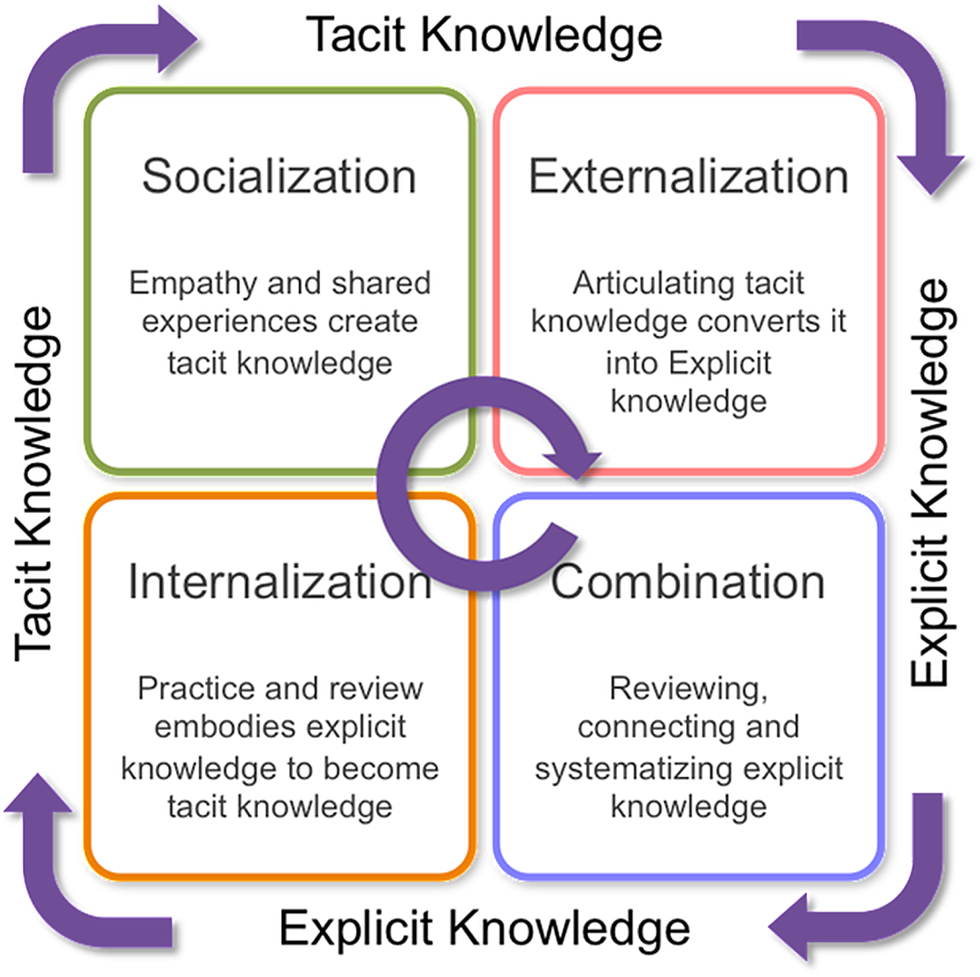
The innovation processes on KM in education through knowledge transfer activities will facilitate the shift from teaching as the transmission of knowledge to teaching as the facilitation of learning. In this respect, Dima (Reference Dima2013) has explored the innovation side of KM in education, based on knowledge transfer partners and activities. As academics continuously evolve collaborative forms of research activity and re-imagine the nature of academic-practitioner exchange and knowledge transfer. Similarly, we find work that makes the link between KM as a field of education to innovative learning. There are opportunities to apply personal KM and knowledge sharing logic in several related subject fields that enable innovative learning (Elenurm, Reference Elenurm2013). However, Nonaka and Takeuchi (Reference Nonaka and Takeuchi1995) argued that knowledge can be created, shared, improved, and justified via collaborative, social processes and individual's cognitive processes such as reflection. They have supported that the conversion between tacit and explicit knowledge results in knowledge. Accordingly, they have developed the four mode SECI model (socialization, externalization, combination, and internalization) of knowledge creation and transfer (Fig. 1).
SECI model of knowledge creation (Nonaka and Takeuchi, Reference Nonaka and Takeuchi1995).

In this context, knowledge mapping, which is considered as a method of knowledge explicitation, aims to showcase the trade's critical knowledge of the company (Fındıklı et al., Reference Fındıklı, Yozgatb and Rofcaninc2015). Knowledge mapping is primarily a managerial approach whose finality is to identify the patrimonies of know-how that are strategic in the actions of the trades in the organization. The identification of the latter in an organization is to sustain and develop knowledge that is related to the company's business as its work strategy. Its main purpose consists in quickly showing the collaborators of an organization, a network or pathway, where expertise can be sought. Similarly, it allows the indication of the importance of knowledge that is at risk of being lost and that must be preserved (Brahami, Reference Brahami2016). The research questions have been formulated as follows:
Q1: Is it truly possible to innovate starting from knowledge (tacit and explicit) using knowledge engineering methods?
Q2: What are the effects of the knowledge capitalization on the innovation process?
Q3: What is the role of knowledge mapping to support the innovation process?
Q4: Is there a significant relationship between knowledge mapping, innovation process, and organization performance?
The remainder of this paper is structured as follows. In the next section, we present the related works of different approaches, concepts, and models that are found in the literature and will be considered as part of the theoretical framework of this research. The “Proposed approach” presents our approach and the method to design the questionnaire. Two sub sections present the results of our paper and, finally, conclusions are given followed by the references.
Literature review/background and related work
In the following section, different approaches, concepts, and models found in the literature review will be considered as part of the theoretical framework of this research, enabling the construction of the conceptual framework of the study.
Knowledge management and innovation process
Several researches have recognized the effect of an effective KM in innovation. Hind (Reference Hind2008) evaluated the relationship between KM and creativity and innovation of managers of high education centers. The results of the study showed that the KM variable had positive, direct, and significant effects on creativity and innovation. Also, the creativity variable had a positive and significant effect on the innovation variable. Nonaka et al. (Reference Nonaka, Toyama and Konno2000) thought that irrespective of knowledge creation or innovation, the knowledge sharing activity between peoples and groups is the starting point for the next “Spiral of Knowledge” wave. Liu and Tsai (Reference Lo Liu and Tsai2009) have conducted a study for analyzing and exploring the relationship between knowledge management (KM), knowledge absorption capability, and innovation management capability in Taiwan high-tech industries. This study found: (1) a significant positive correlation between KM capability and innovation management capability; (2) a significant positive correlation between KM capability and knowledge absorption capability; and (3) a significant positive correlation between knowledge absorption capability and innovation management capability. Zheng et al. (Reference Zheng, Yang and McLean2010) found that knowledge acquiring and its sharing were effective in innovation and development of product and improvement of organizational performance. In other words, the integration of organizational knowledge can lead to the development of product, reduction of disadvantages, and increase in organizational efficiency. Moreover, Xu (Reference Xu2011) proposed a conceptual framework to analyze the roles of service organization, customer-contact employees, and the customers in customer KM, and indicates that it is a critical process for achieving effective service innovation. This work contributes to the literature on knowledge management and customer relationship management and provides service companies with a basic framework to shape their customer KM strategies. López-Nicolás and Meroño-Cerdán (Reference López-Nicolás and Meroño-Cerdán2011) have on the basis of an empirical study on 310 Spanish organizations and structural equations modeling showed that both KM strategies (codification and personalization) impact innovation and organizational performance directly and indirectly (through an increase on innovation capability). Also, findings demonstrate a different effect of KM strategies on diverse dimensions of organizational performance. The conclusions may help academics and managers in designing KM strategic programs in order to achieve higher innovation, effectiveness, efficiency, and profitability.
Rahimnia and Sadeghian (Reference Rahimnia and Sadeghian2011) in the Industrial State of Rasht introduced proper approaches by intermediate variables of organizational innovation and KM in order to improve the performance in production factories. As well, the results show in this study that the research model is meaningful and all the relations except the relation of human resource functions with the KM have been confirmed. Abid and Senin (Reference Abid and Senin2014) conducted a study aimed at examining the effect of KM on innovation directly and through organizational learning. The research results indicate that organizational learning has a full mediation effect on KM and organizational innovation. However, there are still some confusing relations between KM and organizational learning which is important for this topic. Xu and Wang (Reference Xu and Wang2014) have focused on the role of KM in enhancing employee innovation in organizations. In particular, they had attempted to review the innovation and KM literature in a systematic way.
In such a context, Ojeda-López et al. (Reference Ojeda-López, Mul-Encalada and Barrera-Canto2015) have analyzed KM in companies involved in innovation activities in the state of Yucatán, México, through a quantitative, descriptive, non-experimental study, which was conducted by means of a survey given to a sample of 73 managers of these companies. The results show that, in these companies, KM is at a highly developed stage. Fındıklı et al. (Reference Fındıklı, Yozgatb and Rofcaninc2015) have conducted a study to investigate the key effects of strategic human resource practices over organizational innovations (exploration and exploitation) and over KM capacity of firms. To realize their objectives, they have collected data across industries in Turkey and the aftermath of financial crises. Results from this regression analyses emphasized that only certain practices in strategic human resources had predictive the power of organizational innovation. Generally and for Rezaei et al. (Reference Rezaei, Rezaei and Lati2015), KM is a handy tool for organizations to expand their investment, encourage innovation, and provide optimal performance to the maximum. KM is a new engine which can reduce the gap. With much higher employee creativity, KM performance is also better. In fact, in relation to knowledge and creativity of human resources in organizations, there are two basic strategies; first, the optimal use of existing technology in organizations for applying this knowledge within the organization. Second, sometimes called knowledge innovation, when the employees have sufficient knowledge of the organizational values and criteria and are capable to apply their own creative ideas to produce new and valuable products and services. We now live in an era that truly can be called the era of knowledge. Su et al. (Reference Su, Yang, Yang, Zhang and Liu2015) have presented customer collaborative product innovation (CCPI) as a novel pattern of new product development to integrate customers and their knowledge as the main innovative agents and resources. Because conflict is an intrinsic and inevitable phenomenon in this process, they have simulated the process of CCPI conflict contagion and verified the influence of different factors on the conflict-spreading trend. In the study done by Sarabestany and Amiran (Reference Sarabestany and Amiran2016) they evaluated the effect of strategies, technologies, and organizational learning on organizational innovation in IT organizations of case study of IT organizations by the structural equations model. In this study, besides the direct effect of using the KM system and organizational learning on organizational innovation, the indirect effect of entrepreneurial orientation and technological orientation via the KM system and organizational learning on organizational innovation can be investigated.
Knowledge mapping processes
In order to effectively manage knowledge in organizations, knowledge workers and managers need to know the organizational knowledge resources and flows well. A knowledge map is a useful technique to reach this goal. Knowledge mapping, considered an instrument which indicates the places where knowledge is located (among some citizens, organizational units, or sources of information) and how to conduct acquisition, access to and transfer of this knowledge (Brahami et al., Reference Brahami, Atmani and Matta2015). In the other words, knowledge mapping is a process by which organizations can identify and categorize knowledge assets within their organization – people, processes, content, and technology. It allows an organization to fully leverage the existing expertise resident in the organization, as well as identify barriers and constraints to fulfill strategic goals and objectives (Ermine, Reference Ermine2010; Grundstein, Reference Grundstein2012; Brahami, Reference Brahami2016). Several approaches to knowledge mapping have been proposed to organize the cognitive resources of a company. For example, Bentaleb and Zouhdi (Reference Bentaleb and Zouhdi2017) have conducted a project for the implementation of knowledge mapping. The studies were performed at the laboratory of Medical Analysis and Research of the Fraternal of the Royal Gendarmerie in Marocco (LARAM). Knowledge mapping has been performed using a domain approach. El Amrani et al. (Reference El Amrani, Saka, Matta and Chahdi2017) have done a case study of critical knowledge mapping conducted on the Moroccan craft of zellige in order to draw a methodological framework for building a critical knowledge map. The study results made it possible to elaborate an action plan for Moroccan zellige handicraft KM in which the modeling of certain highly critical knowledge, mainly related to the design phase is a must and the subject of ongoing work. Bentaleb and Zouhdi (Reference Bentaleb and Zouhdi2017) have discussed a KM strategy map based on Kaplan and Norton's strategy maps. The authors have determined these four issues such as balanced dimensions in the KM strategies. These balanced dimensions are intellectual capital, KM processes, value creating dimension, and KM performance dimension. Nenonen et al. (Reference Nenonen, Jensen and Lindahl2014) have drafted a knowledge map of the fragmented and multidisciplinary research relevant to FM. The facilities management knowledge map is a tool for presenting relevant data and knowledge that reside in different disciplines. Knowledge mapping is a step in creating an inventory of knowledge (i.e., the knowledge base) and developing/improving the processes of knowledge sharing in research, education, and practice. Nenonen et al. (Reference Nenonen, Jensen and Lindahl2014) have studied the KM performance in the collaborative network and then by drawing the knowledge map of the Sustainable Smart Force Research Company. Also, this study has investigated the indicators of supply chain performance, quality, supplier selection indicators, and KM indicators include transfer, sharing production of knowledge for use in the knowledge mapping algorithm. Matta et al. (Reference Matta, Ducellier, Charlot, Beldjoudi, Tribouillas and Hibon2011) have conducted a project for mapping the knowledge and the technical competence critical within the direction of innovation and research of the INRS. Ermine (Reference Ermine2010) has completed a project in Chronopost International (observatory of trades) which relies on two objectives, firstly, identify the know-how of trades affected by the strategy and, secondly, consider the evolution of critical skills in the future. For this, Ermine has elaborated the project in several phases: the first phase is the realization of a mapping strategy of business actions formalized by the graphical model approach “a map of knowledge domains.” The second phase consists of an analysis of the know-how of trades critical through the use of criticality criteria taking into account the specifics of Chronopost International. Chabot (Reference Chabot2006) has proposed a complete mapping of the different areas of expertise to the company HYDRO-Quebec. However, the primary objective was to identify, on the one hand, the areas of knowledge, the other hand, to do a study of criticality to bring out the critical knowledge domains with the help of the French Society Kadrant. Barroso et al. (Reference Barroso, Ricciardi and Emine2005) have conducted a project in the Center of radio pharmacy in Sao Paulo (IPEN). Since the nuclear domain suffers from problems related to considerable accumulation of knowledge: the risk of non-preservation, the difficulty of transfer, etc. They have developed the project in several steps by using a process approach. The process was described in a conventional manner in the form of flow diagrams linking activities in process.
Nevertheless, numerous variants of models graphs and maps wearing on knowledge have been proposed in the literature. The models of conceptual graph, mind maps, concept maps, and cognitive maps are noteworthy. According to Gavrilova et al. (Reference Gavrilova, Alsufyev and Gladkova2015), knowledge maps are the most common knowledge visualization techniques and include mind maps, concept maps, Ishikawa diagrams, and others. Managers frequently use these instruments in their work for business analytics purposes, but the preparation of such knowledge maps must follow several laws in order to make them effective. According to Teimourpour et al. (Reference Teimourpour, Eslami, Mohammadi and Padidarfard2016), knowledge maps have significantly contributed to the success of KM in the company by identifying, measuring, and visualizing the knowledge resources of the company, which is considered as part of the main KM process. Lin and Hsueh (Reference Lin and Hsueh2006) have proposed a knowledge map management system to facilitate KM in virtual communities of practice. To realize the proposed knowledge map management, we have developed knowledge map creation by utilizing information retrieval and data mining techniques. Knowledge maps generated by the system are accepted by domain experts from the evaluation since the degree of their modification of the automatically created knowledge maps is proportionally small. Okada and Shum (Reference Okada and Shum2006) have focused on the application of knowledge mapping in open learning. They demonstrated how knowledge maps can help organize knowledge in several contexts, such as learning design, learning path planning and problem solving, online learning, and distance education. Besides, Eppler (Reference Eppler2008) has offered a basic map for the knowledge classification pedestal for the tasks management of knowledge. These tasks consist of four steps: knowledge identification maps, knowledge creation and development, application, and assessment maps. This categorization is not wide ranging, multipurpose, and accurate enough to be used in KM. Xiaolin et al. (Reference Xiaolin, Liu and Dang2010) have presented a knowledge map for the intelligentized content website using association rules and the pruning algorithm to achieve the core module of system in order to generate the knowledge map. This map representation compensates for the lack of various meanings in a single knowledge map. Finally, Watthananon and Mingkhwan (Reference Watthananon and Mingkhwan2012) have presented a method using the knowledge map to explain knowledge associations that enable users in an organization to see associations of knowledge and provide them the path to access the knowledge stored within a knowledge base. In addition, they presented ways of increasing efficiency of KM with the use of knowledge maps.
Proposed approach
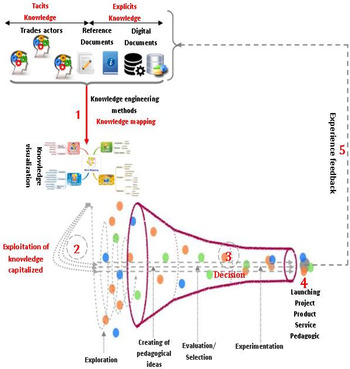
The objective of our approach, illustrated by Figure 2, is twofold: firstly, the construction of the education direction knowledge map in Algeria, particularly the training and evaluation direction of different domains of the trade's knowledge based on a extraction work of expert knowledge (managers, teachers, education consultants, inspectors training, association of students parents, and association of social partners). For this construction, we have used one of the knowledge capitalization methods, the knowledge mapping method, named BKMDM (Boolean Knowledge Mapping guided by Data Mining) (Brahami, Reference Brahami2016). On the other hand, the design description of a conceptual framework which exploits and integrates knowledge capitalized “critical and crucial” and external knowledge by the open innovation process. A contribution in this domain consists of conceiving and experimenting a new exploitation approach of the knowledge mapped and integration of external knowledge, customers, and suppliers by an innovation process. This result is intended to be used as an aid to put in place a creativity stimulation process in the research and innovation cell and mount its operational feasibility for eventual deployment.
General architecture of the proposed approach.

Research methodology
According to Durrheim (Reference Durrheim, Blanche, Durrheim and Painter2004), the design helps the researcher with the collection and analysis of data, and it reflects decisions about the priority being given to a range of dimensions of the research process. In this study, the design has indeed been flexible and changes have been made continually, both in the field and after the fieldwork.
The data collection was conducted in a period of six running months from January to June 2016 to investigate the mediating role of knowledge mapping to support the innovation process and organization performance of education direction situated in Oran City. The choice is because Oran is the second capital of the country and an educational and training center town where most of the educational activities take place. As the study population was big and distributed in many different disciplines, the quantitative method was considered the most relevant for this research. The study used a quantitative cross-sectional design with a face-to-face administered survey questionnaire for data collection. Furthermore, we mentioned that we might conduct some semi-structured interviews, informal surveys, and participant observation.
Population and sample size
Experience has demonstrated that the implementation of an effective KM for firms goes by identifying critical knowledge and the use of various KM tools aimed at retaining and sharing this knowledge. This study uses the collection of data in order to perform an empirical analysis that allows classifying the educational and training centers regarding the practice of KM and its implications in relation to the innovation process from knowledge exploitation and exploration. The questionnaire was made up of two parts. The first deals with issues that characterize the training centers and experts’ knowledge, and the second refers to the two constructs addressed in this research (knowledge mapping for the innovation process). Initially, a pilot study was conducted with (50) managers and professionals, also, (220) teachers and graduate in the field of Administration and Engineering, working in the Oran training centers. A total of 250 questionnaires were sent via email to management-level staff and teachers in the areas of mathematical technique, computer science, and engineering registered in the training centers of Oran city, from January 2016 to June 2016.
Realization and visualization of knowledge mapping
Knowledge mapping by the BKMDM method
Experience has demonstrated that the implementation of an effective KM goes through the establishment of knowledge mapping. Thus, the knowledge mapping is a navigation means (cognitive) in order to access the resources of a knowledge patrimony in an organization, and to be implied or explicit. More so, the knowledge mapping allows to have a fine understanding by criticality analysis, the knowledge domains on where efforts should be made in terms of capitalization, sharing, or innovation (Aubertin, Reference Aubertin2006). Moreover, the field of knowledge mapping presents itself as an emerging research domain where there has been little work done that can be identified in the literature and the work that has been done is not thorough (Ermine et al., Reference Ermine, Boughzala and Tounkara2006).
There are various approaches to organize the cognitive resources of an enterprise or agency. In the literature, we can distinguish two types of cartographic approaches. The first focuses on classification by process and on the classification by domains that organize the knowledge around the subjects, objects, or purposes of common interest that have been identified in the organization. The critical knowledge mapping method, BKMDM, is classified in the latest approach (Brahami et al., Reference Brahami, Atmani and Matta2015; Brahami, Reference Brahami2016). The latter (BKMDM) proposes in parallel to formalize the strategy and to identify strategic competencies and other items by achieving a criticality analysis of knowledge domains with the trades.
In this context, we have chosen to represent the process model using the BKMDM method (Method of Boolean Knowledge Mapping guided by Data Mining) which has been applied in health domains (epidemiology).
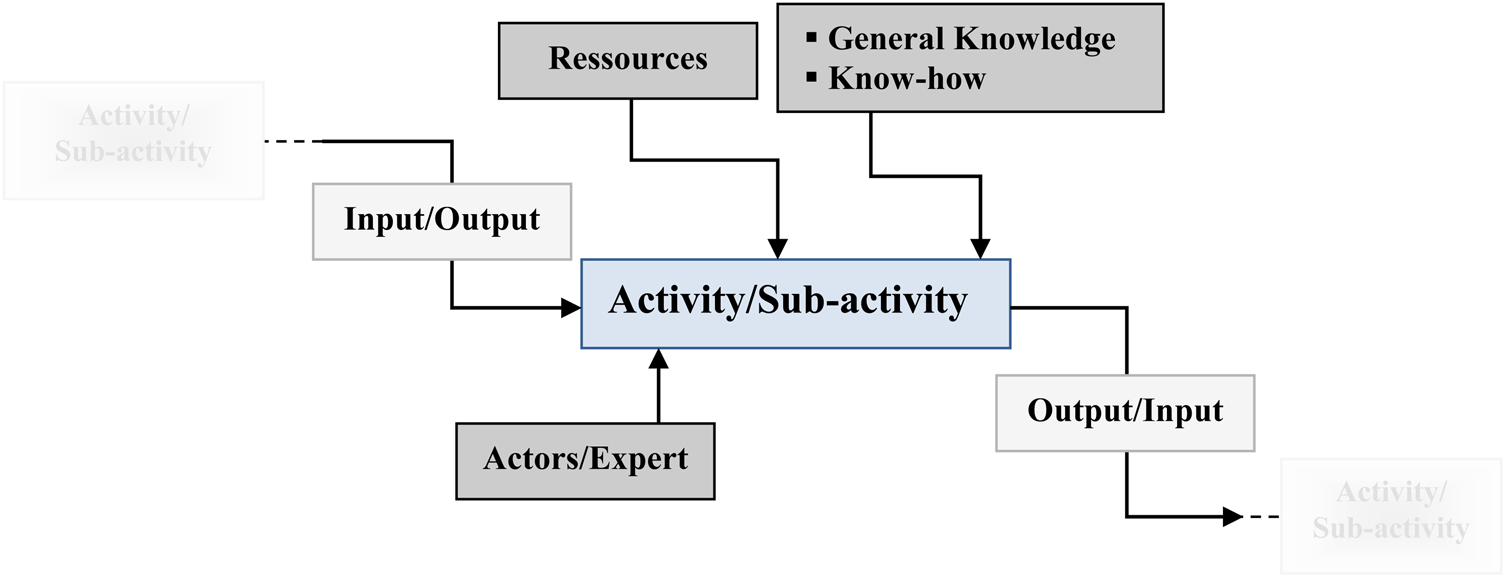
This model as shown in Figure 3 makes it possible to associate with each step of the process important elements for the accomplishment of the current activity, such as the knowledge, the resources, and the actors contributing to these activities. Each step of the process will be broken down into activities and sub-activities whether the activity can be further decomposed. Then we will collect the necessary data to complete the model. For this purpose, we have proceeded with interviews and videotaping.
The knowledge map process model of the BKMDM method.

The evaluation of the latter is elaborated on the basis of a library of the criteria or a grid CFK (Critical Knowledge Factor) that has been elaborated on by the Knowledge Management Club and tested in various contexts (Aubertin, Reference Aubertin2006; Ermine et al., Reference Ermine, Boughzala and Tounkara2006). The strategic alignment allows crossing the two points of view and for identifying strategic actions to improve the performance of the organization. To begin the innovation generation, the map was created to visually represent the domains critical knowledge (or different know-how critical trades) of the education in a synthetic and intelligible way. In this step, the realization of the map was based on an analysis of reference documents (organizational chart, description of the distributions of activity services, directory of staff activities, plan medium term of the production, balance sheet of the training activity, studies or projects, etc.) and interviews with about 40 persons involved in the different services (managers or trades’ actors) and others who are responsible for training.
The adopted principle of knowledge mapping is to group the different activities’ knowledge domains. These activities get in shape via a representation vulnerable then the complete and validate the mapping produced with experts (teachers, trainers, inspectors training, association of students parents and association of social partners … ), in an iterative manner. These iterative validations allow to have co-construction work. They also guarantee the maximum involvement and appropriation of the interviewees. The result is a map of knowledge domains or know-how map trades. This mapping is a description of a level of the meta-knowledge (Brahami, Reference Brahami2016; Brahami and Matta, Reference Brahami and Matta2018) of the education know-how. It provides a system for being able to address know-how in order to facilitate access to knowledge domains.
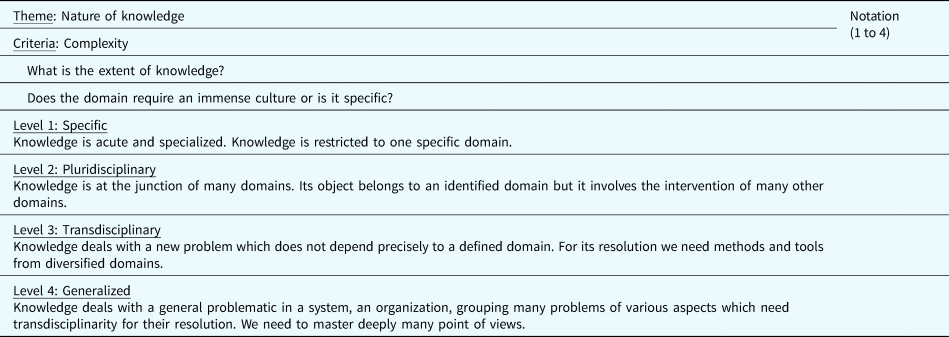
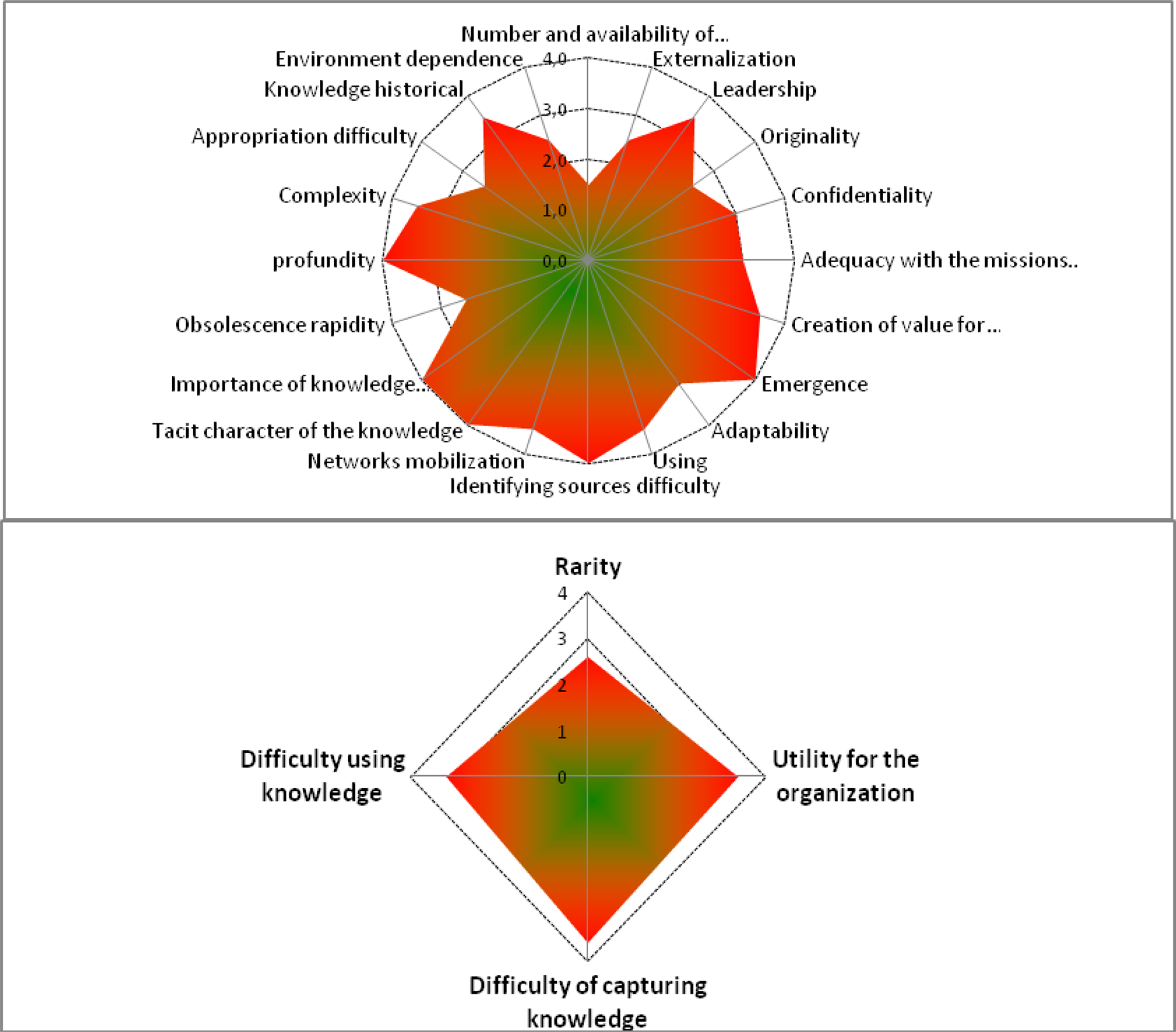
From this map, a study, thought, and criticality were realized, which took into account the specificities of the education service and expected project mapping. The criteria presented in the map are organized into four families (difficulty to capture knowledge, difficulty of usage of the knowledge, rarity of the knowledge, and utility of the knowledge). Each criterion is designed to be valued. For this, we have established an evaluation scale for each criterion (Table 1) based on the evaluation method that was developed by the Knowledge Management Club or on the CKF (Aubertin, Reference Aubertin2006; Ermine et al., Reference Ermine, Boughzala and Tounkara2006). We recall that critical knowledge is knowledge that has value but is difficult to exploit. In our case, it is for each knowledge domain (from interviews) to assess the risks and opportunities related to the availability, nature, utility for direction of education, and accessibility of know-how it covers.
Evaluation grid of a factor

From Aubertin (Reference Aubertin2006) and Ermine et al. (Reference Ermine, Boughzala and Tounkara2006), the criticality of a knowledge domain is to assign a score from 0 to 4 in order to represent the degree of realization of the criterion of grid analysis for each domain. The purpose of criticality analysis, which is viewed through the grid of criticality criteria, is to objectively determine which knowledge domains are the most critical of the direction and to recommend actions to prevent risks in these domains. More the domain is critical within the meaning the criterion evaluated, higher the note. Each evaluation of a criterion depends on a synthesized question. When the respondent does not know the answer, a score of “0” is assigned. This note will not be taken into account during the analysis. A complementary analysis was conducted on the basis of combinations from the criterion and/or groups of criteria that were chosen in relation to the objectives of the criticality of the study. An interesting aspect of this analysis is that it allows bringing out some specifics (i.e., the battlements of expert current/future domains to enhance the highly sensitive domains, etc.). A tool (i.e., Excel) was used for the restitution of these results in a graphical form, especially for the radar chart (Kiviat diagram) format. The radar charts compare the values of criticalities of knowledge domains that have been aggregated into multiple data series that have been collected from different interviewees (Fig. 4a and b).
Diagrams for automatic analysis by Excel tool “(a) thematic axes and (b) criteria of criticality.”

Finally, we can conclude that the criticality calculation revealed the most critical and vulnerable know-how on a three-level scale: a high level of vulnerability/criticality, an average level of vulnerability/criticality, and a low level of vulnerability/criticality.
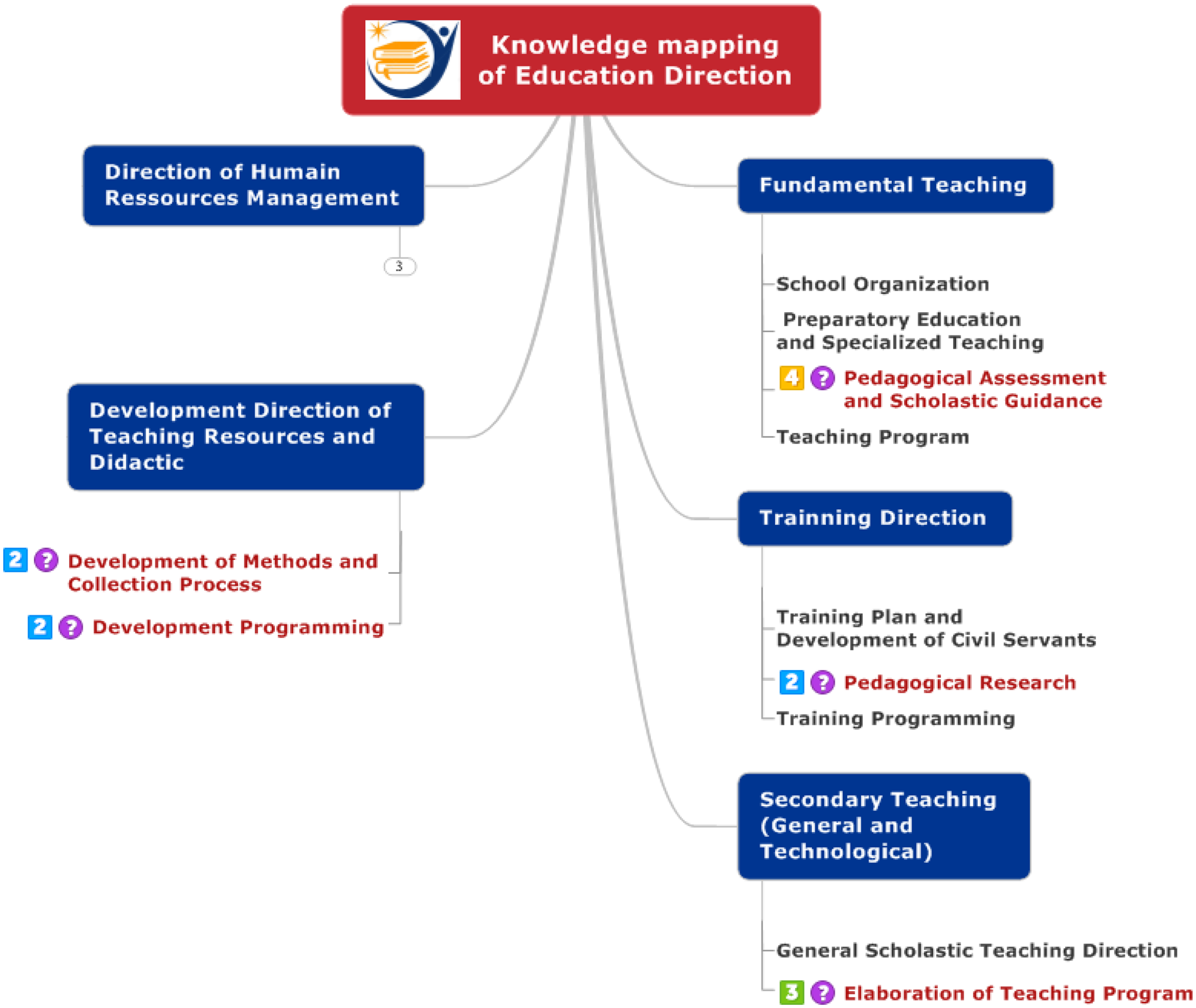
The result is a map of critical knowledge domains or a map of know-how/strategically critical trades (Fig. 5). This mapping is a description of the level of the meta-knowledge (Grundstein, Reference Grundstein2012) of know-how of the direction. This mapping provides a system for addressing of the know-how critical in order to facilitate sharing.
Critical knowledge mapping of the education direction by the MindManager tool.

The critical know-how requiring a retention program constitutes a priority action. Thus, the next step will be devoted to the knowledge discovery from data using the data mining techniques in order to improve the process of acquiring knowledge explicit that will constitute a documented knowledge base currently missing.
Discussion and results
Retaining the critical knowledge mapping of the education direction is one of the strategic vision priority axes for the reforms carried out on the educational programs, and the study we carried out in this paper constitutes a first step of this vision. It is indeed a critical knowledge mapping of the education direction. For this purpose, we have used our own approach named BKMDM specifically adapted to the nature of the informal environment and the knowledge holder's profile. From BKMDM, the domain-based approach and from MASK II the criticality calculation technique. For the knowledge map graphic representation, we have opted for a tree representation in a process logic diagram realized by the MindManager tool. The education experts' interviewing process for the criticality assessment has been well thought out to adapt to their specific profile. However, having some knowledge of the trade (teaching techniques and processes) is necessary to apprehend such a project in order to overcome the lack of inspector's professionalization that need to be asked as precise and profound questions to stir up their interest. Thus, this project raises several challenges and needs a real reflection on how to interview the knowledge holders and involve them more in this process.
Finally, our aims are to capitalize knowledge and experiences in order to allow several actors in education to design, pilot, manage, and train innovative cropping systems, which are preferment scientifically, pedagogically, and socially but also to promote exchanges (sharing) around these techniques.
The creation of the open innovation process
Creativity and innovation can play an important role in knowledge. They contribute to economic prosperity as well as to social and individual well-being and are essential factors for a more competitive and dynamic organization of Algeria. Education is seen as central in fostering creative and innovative skills. Both creativity and innovation involve the generation of novel ideas, yet the two concepts are not identical. According to Amabile (Reference Amabile2000), creativity is usually associated with the generation of new ideas as an end to itself, by against; innovation emphasizes the applicability of new ideas to address particular problems (Nayak and Agarwal, Reference Nayak and Agarwal2011). For Chakrabarti (Reference Chakrabarti2003), creativity is a process by which novel and interesting ideas are created and plays a central role in innovation. Here, the central influences on creativity from various definitions are: knowledge, flexible processing of knowledge, and motivation (Sarkar and Chakrabarti, Reference Sarkar and Chakrabarti2007, Reference Sarkar, Chakrabarti and Gero2008; Chulvi et al., Reference Chulvi, Mulet, Chakrabarti, López-Mesa and González-Cruz2012).
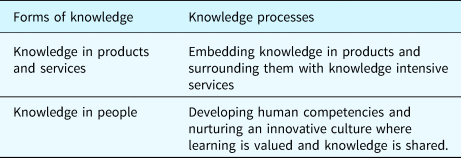
In other words, Plessis (Reference Plessis2007) said innovation is the application of new ideas from cited creativity and believes that innovation can be a new product, new service, or a new way of doing something, but creativity is the ability of creating new ideas and innovative thought. From this point, the creative person can be non-innovative and have new ideas but cannot supply or sell them. So often a creative person is an innovator, but all creative people are not necessarily innovative (Fadaee and Abd Alzahrh, Reference Fadaee and Abd Alzahrh2014). Note that the creativity techniques can be applied either individually or either in group. According to Sutanto (Reference Sutanto2015), innovation is the process of finding or implementing something new into a new situation. To achieve this innovation, it is necessary that tacit and explicit KM through integration are done and is called the SECI model (Sutanto, Reference Sutanto2015). Each of these sources of knowledge presents different challenges and often requires different knowledge processes. These forms of knowledge and the processes to implement them are summarized in Table 2.
Forms of knowledge and processes

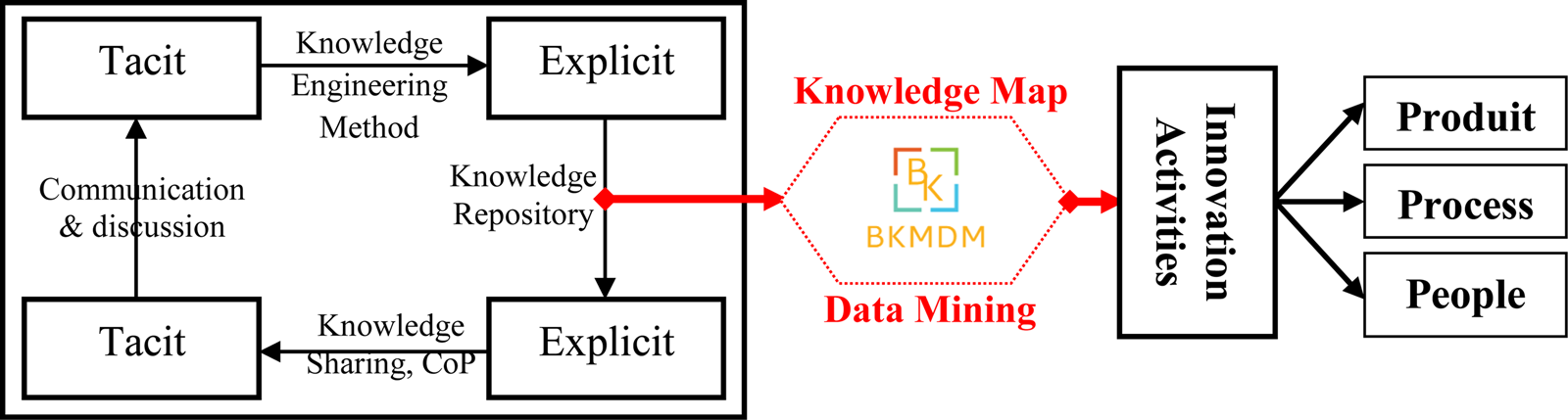
Thus, knowledge once in explicit form can be more easily distributed, but then it does need converting and assimilating into another person's tacit knowledge for application in a different context (creativity and innovation). Furthermore, the one tool to increase knowledge and enhance the innovation process is open communication within the education directions because open communication and flexible structures urge people to create new ideas and share their tacit knowledge. Very broadly speaking, the education directions must foster a knowledge sharing culture that ensures that these investments are fully utilized (Fig. 6).
Relationship between innovation activities, knowledge spiral model, and our approach.

Nowadays, organizations’ innovation processes are increasingly dependent on external sources. But in order to be able to efficiently integrate the potential of external knowledge, companies first need to structure their internal ties and processes. According to Chesbrough (Reference Chesbrough2003), open innovation is the use of “purposeful inflows and outflows of knowledge to accelerate innovation internally while also expanding the markets for the external use of innovation”. In the open innovation model, by contrast, projects may enter or exit at various points and in various ways (Chesbrough, Reference Chesbrough2003; Chesbrough and Bogers, Reference Chesbrough and Bogers2014). In this context, constructing successful relations with external actors turns out to be both a promising opportunity and a big challenge for companies. In these workshops, the research and innovation cell whose advantages they saw in adopting the open innovation process compared with the traditional closed innovation model namely access to additional competence, flexibility of skills, find new ideas, and increase in quality. Those interviewed were R&D managers and creativity engineers, in particular, those responsible for implementing the innovation cell or actively involved at the level of the Education Ministry in order to support the core activity or “core knowledge”. This model involves strategic, managed exchanges of information with actors outside of the boundaries of an education direction, aimed at integrating their resources and knowledge into the direction's own innovative process.
Implementation of the open innovation framework
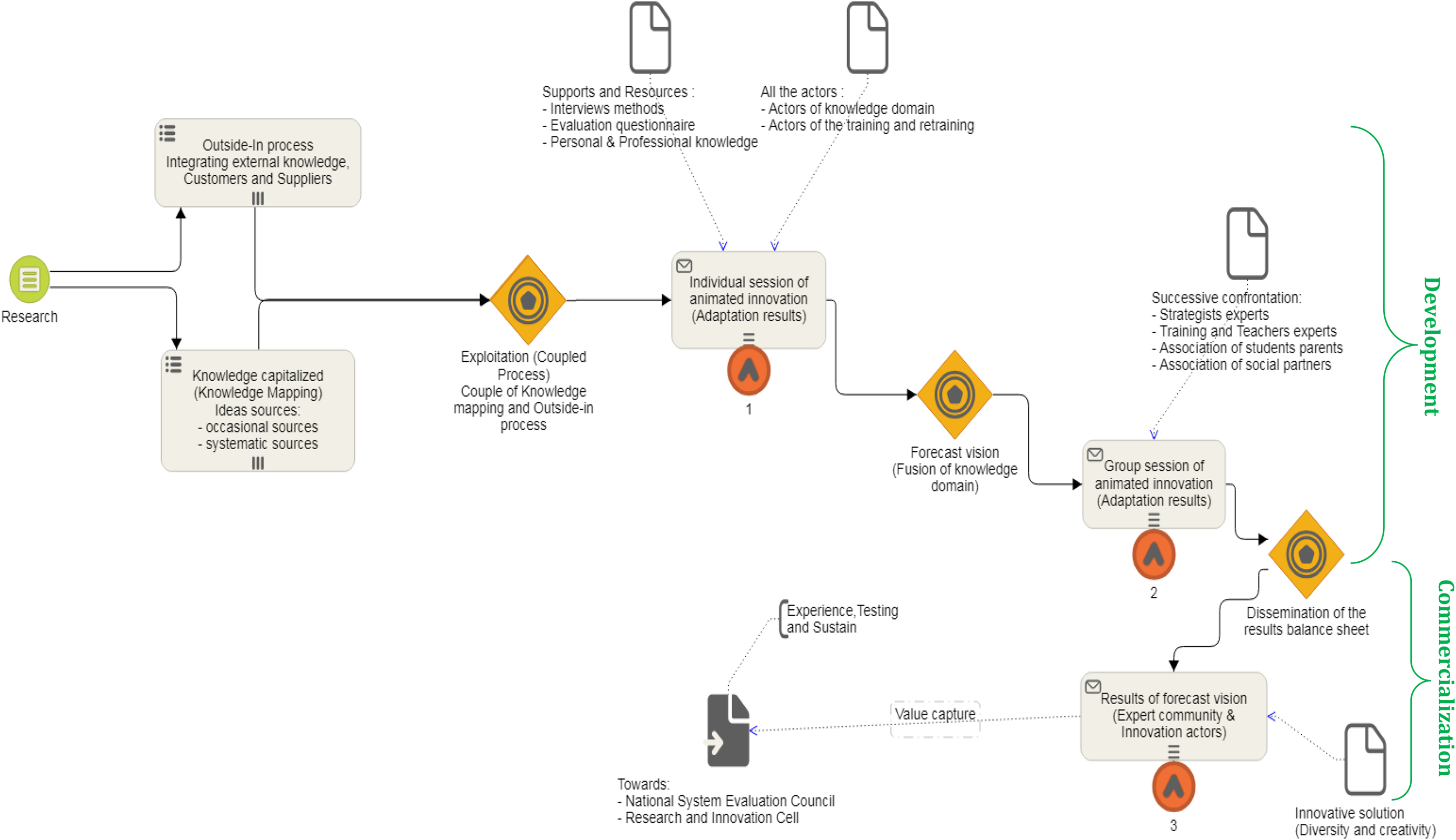
In this paper and after having the global knowledge mapping of the education direction, the pedagogical creativity approach is proposed in three steps (Fig. 7). The first step is dedicated to the individual stimulation of trades’ actors (managers, terrain experts, teachers, association of students’ parents, and association of social partners) through individual sittings of creativity. The second is dedicated to organize comparisons of individual results by sessions of actors' group (work group). Finally, the third considers the educational balance sheet diffusion the first two steps to the actors concerned in the form of the forecast vision obtained (experts in the training domain, actors concerned by innovation in the training domain, national systems evaluation council, research and innovation cell, and education programs preparation cell).
The implementation of the open innovation process to the education direction.

The proposed approach has been implemented as part of the reforms of educational syllabus conducted in 2014. Otherwise, we have used through this study our own expert skills to capture, structure, understand, and interpret the intellectual capital that is responsible for creativity and innovation of the education ministry and the education direction of Oran city. Furthermore, the expertise combination of the members who participate in each axis will develop models of analysis and intervention adapted to this new reality.
The preliminary phase is dedicated to the collection and analysis of traces of past inventive activities, namely past first-generation education program and the application of the objective approach. For it, we solicited the experts recognized by the Education Ministry as representing knowledge domains of experimentation so that these experts provide the initial list of major contributors to his knowledge domains. This list has been enriched by other persons, namely the training experts, teachers, association of student's parents, and association of social partners. Thereafter, we have postponed the constituent census of the intellectual corpus on the domains of knowledge mapping of the corresponding which will serve to stimulate the experts during individual and group sessions of creativity. Currently, a visual representation of expert knowledge such as a knowledge map can help manage both our studies and work more effectively. Both these techniques afford the user a view of the entire knowledge space in the organization. In summary, the method was used because it facilitated interaction between experts and trades’ actors and enabled us to obtain qualitative and quantitative information from participants easily.
Individual and group session of animated innovation
Note that individual sessions of creativity include the traces presentation collected, the analysis of trace by the expert, and the utterance of the expert forecast vision while taking into account the critical knowledge mapping of the education direction of Oran city, in particular, the training direction. Thus, each knowledge domain has been the subject of a provisional document containing (the presentation of the domain as seen by the trades’ actors, the syntheses taken by knowledge worker, and terrain expert comments on this analysis).
Furthermore, a survey by questionnaire will be conducted to provide sufficient evidence for the basic relationship of the study and potential moderating factors. This study can be classified as a cross-sectional study, since it measures the relationship between KM and organizational innovation within a specific period of time. Moreover, the forecast elements are faced successively, in the second step, by different experts groups (representatives of the training strategy and of the education direction, the trainers, and the inspectors). This forecast traces the passage of individual creativity to collective creativity.
In this experimentation, we can note that the experts who had participated in individual sessions have been engines in the discussions and have been able to defend, on the one hand, the point of view of their domain of knowledge and, on the other hand, show and discuss the links which exist between different knowledge domain.
Finally, the final document contains for each knowledge domain, very particularly the training domain, on the one hand, the majors problematic which determines the challenges of the future training in the education and others, the action plan for the implementation of those results.
Discussion and results
The results obtained in this research show that KM encourages innovation activities in three different ways (product, process, and people). First, it helps education directions to locate innovative knowledge in the external environment of the education organization, own that knowledge and transfer it to all with experts (teachers, inspectors training, student's parents association, social partners association, etc.) of the education direction and incorporate it efficiently to the creative activities, which generate changes or improvements to the products educative created. Thus, the knowledge generated in universities, research centers, government institutions, and other organizations that produce similar or identical products allows educations directions to acquire and develop knowledge that turns into superior skills of the human resources, which derives in an improvement of the competitive advantage of education organization by means of the generation of new products educative in the target market.
Similarly, it is necessary to have innovative initiatives in the delivery methods, higher levels of cooperation with the educative suppliers to diminish risks and a more efficient and effective educative production schedule. Hence, education directions require external innovative knowledge that is spread in the education so KM enables this process into the education organization in order to generate new knowledge. This will facilitate its fast internal dissemination of the operational processes of the education organization which will cause changes or improvements in the educative production processes. Furthermore, in order to take external knowledge and incorporate it with the existing knowledge in the education directions, it is necessary to improve and upgrade the process of KM and provide the necessary skills so that the education organization become learning organizations.
The main objective of this research was aimed to identify the relationship between KM and the innovation process by using a sample of the schools. The empirical evidence in this paper allows us to conclude that KM, namely knowledge mapping, has a positive and direct effect on the innovation process of the educational books, as well as the processes and management systems of schools. Otherwise, we can conclude that a good combination of internal and external knowledge can make educations directions more innovative. Thus, KM provides a knowledge-driven culture within innovations that can be incubated. Knowledge sharing is enhanced by a culture where the role of knowledge, KM, innovation, and creative thinking is encouraged. Most KM programs have a strong knowledge culture element through which an organizational culture of knowledge generation and sharing are emphasized. This benefits innovation programs as it not only provides knowledge as a resource, but it also provides a culture within which innovation, creativity, and learning through mistakes are encouraged and valued.
Conclusions
A key part of KM is performing knowledge map to determine knowledge flows within an organization and to provide insights for improving creativity and innovation processes. A review was presented on different aspects regarding the link between different forms of KM and the structure and functioning of the innovation process. In order to choose among the existing definitions or to propose new one, the paper attempts to show the importance of the knowledge mapping as a knowledge capitalization method of the education system, in particular, of Oran city and their impacts on creativity and the innovation process. The objective of this paper is to propose a new approach based, on the one hand, on the realization of a knowledge mapping, and the evaluation of different critical know-how domains and, on the other hand, the exploitation of these critical knowledge mapped by the research and innovation cell. This result puts into play individually and collectively a set of experts involved in the anterior construction of this patrimony and in its strategic evolution compared to the education organization.
Finally, it is important for creativity, open innovation, and KM experts to understand the systemic relationship between these concepts and the value that it can generate in respect of creating and maintaining sustainable competitive advantage for organizations.
The prospects now bear on:
1. The experience sharing with the managers’ community of the innovation especially at the Education Ministry, educations directions, and schools directors.
2. The elaboration of a trace database of inventive intellectual activity especially at the education ministry, educations directions, and schools directors.
In sum, the educational sector is always concerned and focused on innovation and informal knowledge flows. It is open to new ideas and always applies the latest concepts. Moreover, the effective KM and knowledge mapping systems are a crucial component of successful open innovation. For the support of innovation projects implemented in an educational sector, a database and the correlation between different kinds of knowledge should be established. The knowledge mapping system should support decisions about innovative project selection and implementation. In contrast, especially important is to define the level of the projected costs and assumed profits of the innovation process. Each innovative project implementation results in a new knowledge (experiences, the implementation of new methods and tools, etc.) which is important for the KM system, in particular, the knowledge mapping system. Therefore, the systems should include tools which facilitate the securing of knowledge about project implementation.
Acknowledgements
This project is registered in the context of collaboration between research teams of the education direction in Algeria, the research team of ICD/TechCICO laboratory, University of Technology of Troyes (UTT), and our research team. The authors thank the Algerian Directorate for Education for its assistance to finalize the project.
Menaouer Brahami is a research professor of computer science in the National Polytechnic School of Oran (Algeria). He received an HDR degree in computer science from the University of Science and Technology of Oran Mohamed Boudiaf (Algeria). He received a PhD in computer science from the University of Oran (Algeria). His research interests include Knowledge Management, Knowledge Mapping, Knowledge Representation, Data Mining, Deep Learning, Business Intelligence, Big Data, Boolean Modeling, Project Management, and Creativity and Innovation. His work has appeared in Extraction and Knowledge management, Journal of Information Processing Systems (JIPS), International Journal of Computer Science Issues (IJCSI), Journal of Computer Applications, International Journal of Information Systems in the Service Sector, Procedia – Social and Behavioral Sciences (Elsevier), and European Journal of Social Law.
Nada Matta received an HDR degree in computer science from the University of Technology of Troyes (France), in 2004. She is a professor at University of Technology of Troyes (UTT) in the Computer Science Department. Her research interests include Information Systems, Knowledge Engineering, Knowledge Management, Knowledge capitalization, Memory Project, and Knowledge Tracing. Her work has appeared in the Journal of Information Processing Systems (JIPS), International Journal of Computer Science Issues (IJCSI), and Journal of Computer Applications, International Journal of Knowledge Management Research and Practices, International Journal on Advances in Information Sciences and Service Sciences, Journal of Communication and Information Sciences, Journal of Universal Computer Science, International Journal of e-Collaboration on “Creativity, Innovation and e-Collaboration”, Computer science journal, Journal of Universal Computer Science (J.UCS), International Journal of Information Systems in the Service Sector, and International Journal of Human-Computer Studies.