Introduction
Typical, conversational speech is a continuous, rapidly unfolding signal that contains variability and ambiguity throughout the duration of the utterance (McClelland & Elman, Reference McClelland and Elman1986). Perception of this complex signal is a multi-step process that includes accurate sensory processing of the signal and matching utterances contained within it to their correct phonological, lexical, and semantic representations (Lecumberri, Cooke & Cutler, Reference Lecumberri, Cooke and Cutler2011; McClelland & Elman, Reference McClelland and Elman1986; Norris & McQueen, Reference Norris and McQueen2008). Selecting the correct representations from the wealth of potential targets requires that lateral and top-down feedback mediate competition between the eventual linguistic targets and their phonological, lexical, and semantic competitors (Anderson & Kraus, Reference Anderson and Kraus2010; Norris & McQueen, Reference Norris and McQueen2008; Shook & Marian, Reference Shook and Marian2013). Though this speech recognition process occurs with relative ease in quiet listening conditions, it becomes more challenging when the utterance occurs in acoustically-complex environments, such as when speech is presented in noise (e.g., see Shi, Reference Shi2010). Noise can degrade or mask the rapidly presented, ambiguous cues (Bronkhorst, Reference Bronkhorst2000; Lecumberri & Cooke, Reference Lecumberri and Cooke2006). As a result of this degradation, the cues may now match a larger number of potential phonemic or semantic targets than when speech is spoken in quiet. This lack of signal clarity and the need to resolve heightened ambiguity of the rapidly-unfolding utterance makes speech-in-noise perception a complex, challenging process.
Noise makes speech perception challenging for everyone; however, it may result in greater adversity for bilinguals than monolinguals. Much of the evidence for a bilingual disadvantage comes from studies assessing sequential language learners (i.e., late bilinguals) on speech-in-noise perception abilities in their second, non-native language (L2) (e.g., Bradlow & Alexander, Reference Bradlow and Alexander2007; Mayo, Florentine & Buus, Reference Mayo, Florentine and Buus1997; Rogers, Lister, Febo, Besing & Abrams, Reference Rogers, Lister, Febo, Besing and Abrams2006). In these studies, bilinguals require greater signal resolution, for example through a larger signal-to-noise ratio (Shi, Reference Shi2010, Mayo et al., Reference Mayo, Florentine and Buus1997) or an increase in both the clarity and predictability of the speech signal (Bradlow & Alexander, Reference Bradlow and Alexander2007) than monolinguals. The level of clarity necessary for perception tracks with age of acquisition and proficiency in the target language such that later age of acquisition or lower proficiency require greater levels of signal clarity (Brouwer, Van Engen, Calandruccio & Bradlow, Reference Brouwer, Van Engen, Calandruccio and Bradlow2012; Shi, Reference Shi2010, Reference Shi2012; Van Engen & Bradlow, Reference Van Engen and Bradlow2007). However, these factors alone cannot fully account for the bilingual speech-in-noise disadvantage. The influence of proficiency and acquisition age on L2 speech perception often manifests as deficits in both quiet and noise (Shi, Reference Shi2010); and yet, even early, near-native proficiency bilinguals who perform equivalently to monolinguals on perceiving speech in quiet show a larger performance drop than their monolingual peers when perceiving speech in noise (Rogers et al., Reference Rogers, Lister, Febo, Besing and Abrams2006; Shi, Reference Shi2010). Thus, it is likely that differences in how bilinguals and monolinguals process speech in noise also contribute to the observed performance differences.
The speech-in-noise disadvantage ultimately manifests as poorer utilization of the contextual cues present in the degraded utterance (e.g., using other words in the sentence to identify an unknown word; Cooke, Lecumberri & Barker, Reference Cooke, Lecumberri and Barker2008; Lecumberri et al., Reference Lecumberri, Cooke and Cutler2011). However, because speech-in-noise perception is a complex, multi-step process, it has been difficult to pinpoint why bilinguals are poorer in utilizing contextual cues. This disadvantage could stem from a number of different processing sources that can be broadly divided into two categories: language-independent processes and language-dependent processes. Language-independent processes are necessary for speech-in-noise perception but are independent of language knowledge, including sensory processing of the signal, separation of the target stream from competing streams, executive control of attention, and working memory. Though the sensory and cognitive processes involved in speech-in-noise perception are tuned by language experience (Krishnan, Xu, Gandour & Cariani, Reference Krishnan, Xu, Gandour and Cariani2005; Kroll & Bialystok, Reference Kroll and Bialystok2013) or may be called upon during linguistic processing, ultimately they are precursors to language comprehension. On the other hand, language-dependent processes rely on language knowledge, including activation of potential linguistic targets, selection of correct phonological, lexical, or semantic targets from their competitors, and facility in choosing the correct lexical/semantic targets. (Bradlow & Alexander, Reference Bradlow and Alexander2007; Bradlow & Bent, Reference Bradlow and Bent2002; Lecumberri et al., Reference Lecumberri, Cooke and Cutler2011). Identifying the unique contributions of language-independent and language-dependent processes can provide mechanistic insights into why monolinguals and bilinguals perform differently on tests of speech-in-noise perception.
A bilingual is not the sum of two monolinguals (Grosjean, Reference Grosjean1989) and, so, knowing and communicating across two languages necessitates different speech-processing strategies (Shook & Marian, Reference Shook and Marian2013). These differences in speech processing result in certain bilingual advantages for language-independent sensory processes, such as enhanced neural encoding of auditory stimuli (Krizman, Marian, Shook, Skoe & Kraus, Reference Krizman, Marian, Shook, Skoe and Kraus2012; Krizman, Skoe, Marian & Kraus, Reference Krizman, Skoe, Marian and Kraus2014; Krizman, Slater, Skoe, Marian & Kraus, Reference Krizman, Slater, Skoe, Marian and Kraus2015) and language-independent cognitive processes, including filtering out irrelevant sensory information (i.e., inhibitory control; Bialystok, Reference Bialystok2009; Bialystok, Reference Bialystok2011; Krizman et al., Reference Krizman, Marian, Shook, Skoe and Kraus2012). Though bilingual experience seems to enhance some language-independent processes, we hypothesize that juggling two languages in one mind creates greater language-dependent processing demands for bilinguals, especially those processes important for lexical access of words in a sentence. If so, then bilinguals should not perform as well as monolinguals when extracting linguistic meaning from a degraded utterance. Conversely, if this degraded stimulus is non-linguistic, bilinguals may outperform monolinguals, given the bilingual advantages in cognitive and sensory processing (Bialystok, Reference Bialystok2011; Carlson & Meltzoff, Reference Carlson and Meltzoff2008; Krizman et al., Reference Krizman, Marian, Shook, Skoe and Kraus2012; Krizman et al., Reference Krizman, Skoe, Marian and Kraus2014; Kroll & Bialystok, Reference Kroll and Bialystok2013). Alternatively, if the speech-in-noise disadvantage arises from language-independent processes, monolinguals should outperform bilinguals on all tests that measure perception of a degraded auditory stimulus, even if the target is non-linguistic.
To test whether language-independent or language-dependent processing differences underlie speech-in-noise differences, we compared early (i.e., both languages acquired by the age of 5), high-proficiency Spanish–English bilingual and English monolingual adolescents on English-language tests of sentence-in-noise, word-in-noise, and tone-in-noise perception. By testing early bilinguals that were matched to monolinguals on English proficiency, the effects of proficiency and acquisition age on speech-in-noise performance could be minimized Moreover, because only early bilinguals, who learned both languages before the close of the presumed sensitive period (Werker & Tees, Reference Werker and Tees2005), were tested any differences in performance could not be attributed to bilinguals learning a second language outside the sensitive period (Florentine, Reference Florentine1985) and this reduced the likelihood of differences in performance being attributable to native language biasing non-native phoneme perception (reviewed in Lecumberri et al., Reference Lecumberri, Cooke and Cutler2011). Adolescents were chosen because the sensory, cognitive, and linguistic systems that support speech in noise perception (Krizman, Tierney, Fitzroy, Skoe, Amar & Kraus, Reference Krizman, Tierney, Fitzroy, Skoe, Amar and Kraus2015a; Paus, Reference Paus2005; Skoe, Krizman, Anderson & Kraus, Reference Skoe, Krizman, Anderson and Kraus2015), and consequently speech-in-noise perception, (e.g., Talarico, Abdilla, Aliferis, Balazic, Giaprakis, Stefanakis, Foenander, Grayden & Paolini, Reference Talarico, Abdilla, Aliferis, Balazic, Giaprakis, Stefanakis, Foenander, Grayden and Paolini2006) continue to mature during this age. Capturing a diverse range of performance may maximize differences between bilinguals and monolinguals on these perception-in-noise tasks that may not be apparent in young adults. A variety of perception-in-noise measures were chosen because they have a different balance of language-dependent and language-independent processing demands as a consequence of the different amount of contextual cues present in each task's target stimulus. While all tests require language-independent processing, tone perception tests require no language-dependent processing, the word perception test requires some language-dependent processing, and sentence perception tests require the greatest amount of language-dependent processing.
Methods
Participants
Participants were fifty-six freshmen (14.6 + 0.42 years of age) recruited from three public high schools in Chicago. The Northwestern University Institutional Review Board approved all procedures, and informed written assent and consent was given by the children and their parent/guardian, respectively.
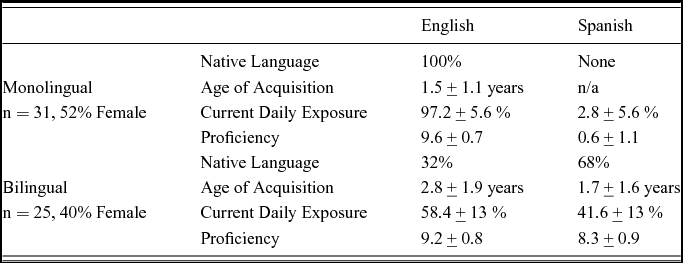
Participants were divided into two groups based on their language experience as measured by the Language Experience and Proficiency Questionnaire (LEAP-Q, Marian, Blumenfeld & Kaushanskaya, Reference Marian, Blumenfeld and Kaushanskaya2007): English monolinguals (n = 31; 52% female, 52% low maternal education (i.e., < high-school graduate, used as a proxy for socioeconomic status, D'Angiulli, Herdman, Stapells & Hertzman, Reference D'Angiulli, Herdman, Stapells and Hertzman2008) and Spanish–English bilinguals (n=25; 40% female; 56% low maternal education). Inclusionary criteria were: high English proficiency (≥ 7 out of 10 on English speaking and understanding proficiency, LEAP-Q), low Spanish proficiency for English monolinguals (< 3 out of 10 on Spanish speaking and understanding proficiency, LEAP-Q), high Spanish proficiency for bilinguals (> 7 out of 10 on Spanish speaking and understanding proficiency, LEAP-Q); early acquisition of Spanish and English (< 5 years old) for bilinguals, air conduction thresholds of < 20 dB hearing level (HL) per octave for octaves from 125–8000 Hz (ANSI, 2009), and no diagnosis of a reading or language disorder.
The two groups did not differ in age (monolinguals: 14.5 + 0.37 years, bilinguals: 14.6 + 0.39 years; F(1,54) = 0.681, p =.413), sex (Kruskal-Wallis Χ2 = 0.737, p =.391), maternal education level (Kruskal-Wallis Χ2 = 1.067, p =.302), IQ (monolinguals: 98.84 + 10.9; bilinguals: 99.2 + 7.6; F(1,54) = 0.125, p =.901, Wechsler Abbreviated Scale of Intelligence, WASI, Wechsler, 1999), or English proficiency (F(1,54) = 2.944, p =.092), as determined from the LEAP-Q. The groups were also matched on their English comprehension abilities (F(1, 54) = 0.320, p =.574; LEAP-Q) but they did differ on daily English/Spanish exposure (F(1,54) = 222.556, p < .0005) and Spanish proficiency (F(1,54) = 765.001 p <.0005). Eight of the bilinguals learned English and Spanish simultaneously, 3 were exposed to English first, and the remaining 14 were exposed to Spanish first. For these 14, they learned English on average 2.7 years after learning Spanish. All bilingual participants reported acquiring Spanish at a younger age than they acquired English (t(24) = 2.477, p =.021), greater proficiency in English than Spanish (t(24) = 4.299, p <.0005), and greater daily exposure to English than Spanish (t(24) = 3.239, p =.003). Means and standard deviations of these LEAP-Q measures for each group are summarized in Table 1.
Language Experience Descriptive Statistics

Table 1. Summary of adolescent monolingual and bilingual language experience as reported on the LEAP-Q.
Psychophysical Testing
Participants’ listening-in-noise abilities were assessed with two tests of sentence-in-noise perception, one test of word-in-noise perception and two tests of tone-in-noise perception. Two measures of sentence-in-noise and tone-in-noise perception were used to provide converging evidence of any observed differences in performance between monolinguals and bilinguals.
Quick Speech in Noise
The Quick Speech-In-Noise test (QuickSIN, Etymotic Research, Elk Grove, IL; Killion, Niquette, Revit & Skinner, Reference Killion, Niquette, Revit and Skinner2001) measured perception of target sentences (female talker) spoken amid four-talker babble (three female and one male). English sentences and babble were presented diotically through insert earphones (ER-2, Etymotic Research, Elk Grove Village, IL). Of the 20-list corpus, three lists were presented to the participant at a fixed level of 70 dB HL. Each list contained six sentences that were syntactically and semantically correct (e.g., ‘A white silk jacket goes with any shoes’, Wilson, McArdle & Smith, Reference Wilson, McArdle and Smith2007). The signal-to-noise ratio (SNR) decreased in 5 dB SNR steps for each sentence in the list with the first sentence presented at 25 dB SNR and the sixth sentence presented at 0 dB SNR. Participants were instructed to repeat back each sentence, and each sentence was scored based on the participant's ability to correctly recall five target words (e.g., “white”, “silk”, “jacket”, “any”, “shoes”). The total number of key words correctly recalled in the list (30 in total) was subtracted from 25.5 to give an SNR loss score for each list. The SNR loss score for each list was averaged together to obtain a final score. A lower score indicates better performance on this task.
Hearing in Noise Test
The Hearing In Noise Test (HINT; Biologic Systems Corp., Mundelein, IL; Nilsson, Soli & Sullivan, Reference Nilsson, Soli and Sullivan1994) was an adaptive test of speech recognition in which the participant repeated short semantically and syntactically simple English sentences (e.g., “A boy fell from the window”) presented in speech-shaped background noise that matched the spectra of the test sentences. The Bamford–Kowal–Bench (Bench, Kowal & Bamford, Reference Bench, Kowal and Bamford1979) sentences (12 lists of 20 sentences), spoken by a male, were presented in free field via a loud speaker positioned at 0° azimuth relative to the participant (i.e., directly in front of the participant). Participants were again asked to repeat out loud the target sentence. In this test, the noise presentation level was fixed at 65 dB SPL and the intensity level of the target sentence was increased or decreased to adjust the difficulty level until the threshold SNR was reached. Threshold SNR was defined as the dB SNR difference between the speech dB level and noise dB level that resulted in 50% correct sentence repetition. Again, a lower score indicated better performance on this task. This sentence-in-noise task differed from the QuickSIN in sentence type (simple versus complex), the type of noise (speech-shaped versus babble), type of presentation (speakers versus earphones), signal-to-noise levels (adaptive to threshold versus fixed), and sex of talker (male versus female). By using these different sentence-in-noise tests we could demonstrate whether any group differences observed were specific to the method of administration or generalizable across tests.
Words in Noise
The Words-in-Noise test (WIN) was a non-adaptive measure of single-word perception, in which participants were asked to repeat a word (e.g., “dog”) that was embedded in a carrier phrase (i.e., “Say the word. . .”). This measure was used to assess perception of single English words in English background babble. The target utterance were spoken by a female voice and masked by four-talker babble (three female and one male) presented at 55 dB HL in soundfield. Thirty-five words were presented starting at a 24 dB SNR and decreasing by 4 dB every five words until 0 dB SNR was reached. The final SNR score was based on the number of correctly-repeated words, corresponding to a threshold performance. As such, lower threshold scores indicated better performance.
Tones in noise
Backward masking and simultaneous masking were used to assess how well participants could perceive auditory stimuli in a task that has no linguistic processing demands. These tests were chosen because they have been shown to activate sensory regions important for speech perception (van Dijk & Backes, Reference van Dijk and Backes2003). Moreover, the ability to perceive a tone embedded in noise, especially when assessed via backward masking, is known to engage cognitive mechanisms important for segregating rapidly-presented sounds (Hartley, Hill & Moore, Reference Hartley, Hill and Moore2003; Hartley & Moore, Reference Hartley and Moore2002; Hartley, Wright, Hogan & Moore, Reference Hartley, Wright, Hogan and Moore2000; Strait, Kraus, Parbery-Clark & Ashley, Reference Strait, Kraus, Parbery-Clark and Ashley2010; Tallal, Miller & Fitch, Reference Tallal, Miller and Fitch1993; Wright, Lombardino, King, Puranik, Leonard & Merzenich, Reference Wright, Lombardino, King, Puranik, Leonard and Merzenich1997) and corresponds to activation of the prefrontal cortex and anterior cingulate cortex during the task (van Dijk & Backes, Reference van Dijk and Backes2003), two regions that underlie inhibitory control enhancements found in bilinguals (Abutalebi, Della Rosa, Green, Hernandez, Scifo, Keim, Cappa & Costa., Reference Abutalebi, Della Rosa, Green, Hernandez, Scifo, Keim, Cappa and Costa2011; Kroll & Bialystok, Reference Kroll and Bialystok2013).
These masking tests were assessed by the IHR Multicentre Battery for Auditory Processing (IMAP, developed by the Medical Research Council Institute of Hearing Research, Nottingham, UK; Barry, Ferguson & Moore, Reference Barry, Ferguson and Moore2010) program using a laptop computer placed 60 cm from the participant. Auditory stimuli were presented diotically through Sennheiser HD 25–1 headphones and were accompanied by animated visual stimuli displayed on the laptop screen. A three-button response box was placed in front of the participant and was used to indicate the participant's response on each trial.
For the backward masking test, the participant watched the computer screen while listening to three sequentially-played ‘noise sounds’, which were composed of a 600 to 1400 Hz bandpass noise (1000 Hz center frequency) that was 300 ms in duration and had a fixed spectrum level of 30 dB. Immediately preceding one of these ‘noise sounds’, a 20 ms 1000 Hz target tone occurred (i.e., the target's offset and the noise's onset occurred concurrently). On the first trial, the 1000-Hz targets were presented at 90 dB SPL and on subsequent trials, the targets decreased or increased in intensity level via a 3 down, 1 up adaptive staircase model to determine the participants’ minimum detection threshold (in dB, see Amitay, Irwin, Hawkey, Cowan & Moore, Reference Amitay, Irwin, Hawkey, Cowan and Moore2006 for more information on the staircase model). On each trial, participants pressed the button on a 3-button response box that corresponded to the ‘noise sound’ that contained the target tone (as opposed to noise only).
For the simultaneous masking task, the target tone was a 20 ms, 1000 Hz tone that occurred 200 ms following the onset of a 300 ms noise (the same masking noise used for the backward masking task). The initial target was presented at 95 dB SPL and descended using the same 3-alternative forced-choice paradigm and staircase threshold detection procedure that was applied for the backward masking task. Two blocks of 20 trials each were run for both the backward masking and simultaneous masking tasks, and on both, lower scores indicate better performance. Administration order of backward and simultaneous masking was randomized by the IMAP system. The speech-in-noise tests were always administered in the following order: QuickSIN, HINT, WIN. Practice stimuli were administered at the start of each test to make sure the participant understood the task directions. Administration order of tone-in-noise vs. speech-in-noise tasks was randomized across participants.
Statistical analyses
Each of the perceptual tasks yields a non-standardized threshold score. Since we were interested in comparing performance among these different tests and determining how language experience influenced the relative performance on these measure, the raw threshold performance values across all subjects in both groups for each test were transformed to z-scores normalized around 0. Comparisons were made between monolinguals and bilinguals on perception-in-noise performance with a 2 (group, monolingual v. bilingual) x 5 (test, QuickSIN, HINT, WIN, backward masking, simultaneous masking) repeated-measures analysis of variance (RMANOVA). Following the RMANOVA analyses, post-hoc t-tests were run comparing monolingual and bilingual performance on the individual perceptual tasks.
For the RMANOVA analyses, corrected p-values are reported in cases where sphericity could not be assumed, as determined by Mauchly's Test of Sphericity, and t-tests report corrected p-values when Levene's Test for Equality of Variances determined unequal variance between the two groups. Cohen's d effect sizes are reported for group comparisons where, consistent with accepted standards, a small effect size is < 0.2, a medium effect size is between 0.2 and 0.5, and a large effect size is > 0.5.
Results
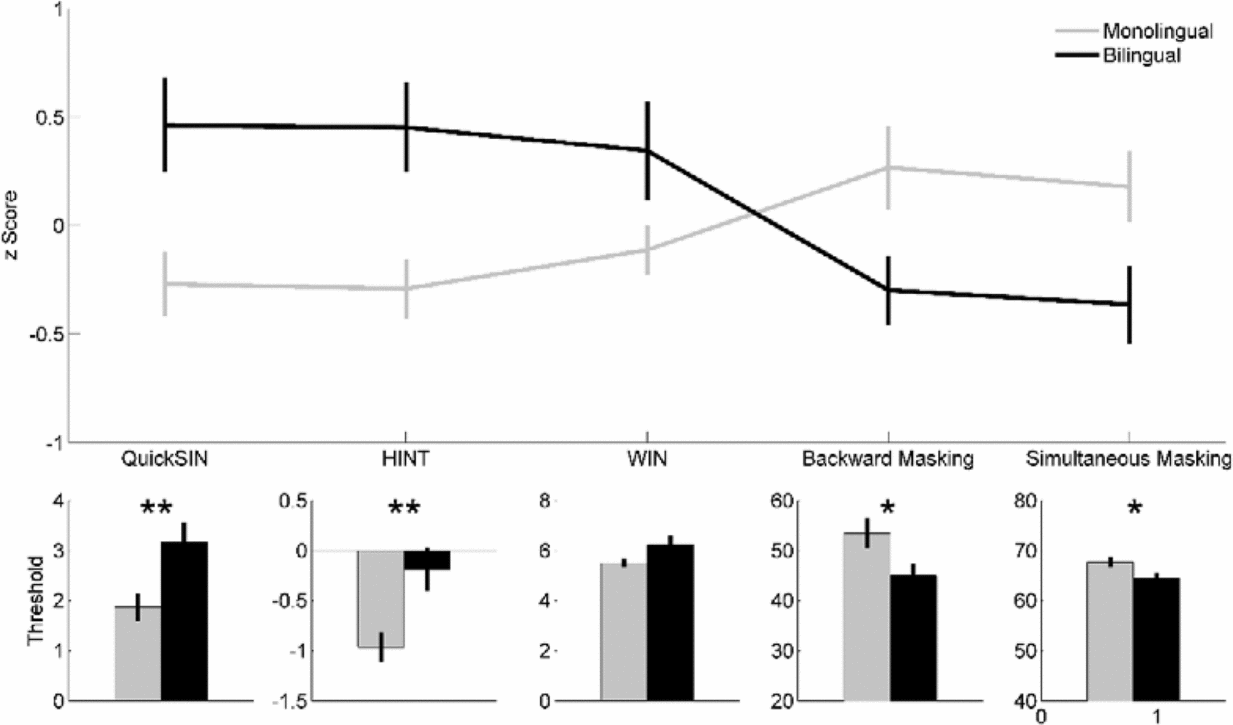
Overall, monolingual participants outperformed bilinguals on tests of speech perception in noise but bilinguals’ tone detection in noise abilities were enhanced relative to monolinguals (Figure 1), as evidenced by a language group by test interaction (F(4, 51) = 5.845, p =.001). There was no main effect of language group (F(1, 54) = 1.335, p =.253) or test (F(4, 216) = 0.092, p =.985). However, because we normalized the performance across the five tests through a z-transformation, a null effect of test was expected.
Comparisons of monolinguals (gray) and bilinguals (black) on perception-in-noise tasks. The top plot shows the z-normalized threshold performance for the two groups and the bottom graphs illustrate the raw threshold means (+ 1 standard error). Lower numbers indicate better performance for all measures. Monolinguals performed better on the two sentence-in-noise tasks, the two groups performed equivalently on the perception of words, and bilinguals performed better on the two tone-in-noise detection tests.

Post-hoc t-tests showed poorer performance for the bilinguals than monolinguals when perceiving sentences, as measured by both QuickSIN (t(54) = 2.806, p =.007, d = 0.74, monolinguals: 1.87 + 1.5 dB SNR loss, bilinguals: 3.17 + 1.99 dB SNR loss) and HINT (t(54) = 3.004, p =.004, d = 0.79, monolinguals: -0.97 + 0.82 dB SNR, bilinguals: -0.19 + 1.12 dB SNR) tests. The groups did not differ on perception of words in noise, WIN (t(54) = 1.866, p =.087, d = 0.48), though bilinguals tended to perform more poorly on this measure (monolinguals: 5.51 + 1.01 dB SNR, bilinguals: 6.22 + 1.83 dB SNR).
Contrary to poorer performance for bilinguals on the speech-perception-in-noise tasks, bilinguals outperformed monolinguals when perceiving tones in noise. This was evident for both the backward masking task (t(54) = 2.149, p =.036, d = 0.59, monolinguals: 53.51 + 16.67 dB SNR, bilinguals: 44.89 + 12.4 dB SNR) and the simultaneous masking task (t(54) = 2.183, p =.033, d = 0.59, monolinguals: 67.69 + 5.85 dB SNR, bilinguals: 64.3 + 5.67 dB SNR). In Figure 1, z-scores are plotted for bilinguals and monolinguals to compare performance across tests. Below the interaction plot, average raw threshold performance for each group is plotted for the different tests.
Discussion
We tested monolingual and early high proficiency bilingual adolescents on sentence-in-noise, word-in-noise, and tone-in-noise perception. We found that differences in performance between bilinguals and monolinguals varied with the amount of linguistic information available in the stimulus. Specifically, we found a monolingual advantage for perceiving sentences in noise and a bilingual advantage when the degraded auditory target is non-linguistic. Our findings of a bilingual speech-in-noise disadvantage in adolescents are consistent with previous studies in young adults (Bidelman & Dexter, Reference Bidelman and Dexter2015; Lecumberri et al., Reference Lecumberri, Cooke and Cutler2011; Mayo et al., Reference Mayo, Florentine and Buus1997; Rogers et al., Reference Rogers, Lister, Febo, Besing and Abrams2006; Shi, Reference Shi2010; Shi, Reference Shi2009). By using non-speech stimuli, the current study also demonstrates that the bilingual perception in noise disadvantage is specific to linguistic stimuli, suggesting that language-dependent processes, but not language-independent processes underlie differences between bilinguals and monolinguals for perceiving speech in noise.
Bilinguals and monolinguals both experience the same signal-driven sources of difficulty when perceiving speech in noise, including degradation of acoustic cues, activation of a greater number of linguistic competitors, and rapidly unfolding speech imposing time constraints on speech-in-noise processing. However, having two languages in one mind requires unique, additional processing for bilinguals relative to monolinguals. While monolinguals only need to resolve competition that arises from within-language competitors (e.g., hearing /k/-/æ/-/n/ can activate both ‘candy’ and ‘candle’), bilinguals experience both within-language and between-language competition. For example, a Spanish–English bilingual hearing /k/-/æ/-/n/ would not only activate ‘candy’, but Spanish phonological competitors such as ‘cántaro’ or candy's translation equivalent ‘dulce’ (Marian & Spivey, Reference Marian and Spivey2003a, Reference Marian and Spivey2003b; Marian, Spivey & Hirsch, Reference Marian, Spivey and Hirsch2003; Shook & Marian, Reference Shook and Marian2013). Moreover, because a phoneme in one language may map with more than one phoneme in the bilingual's other language (e.g., for native Japanese speakers of English, the English phonemes /r/ and /l/; Miyawaki, Jenkins, Strange, Liberman, Verbrugge & Fujimura, Reference Miyawaki, Jenkins, Strange, Liberman, Verbrugge and Fujimura1975), the acoustic signal activates the matching phoneme, as well as words that contain similar-sounding phonemes within either language. Although these overlaps may work asymmetrically across a bilingual's two languages (Cutler, Weber & Otake, Reference Cutler, Weber and Otake2006; Pallier, Colomé & Sebastián-Gallés, Reference Pallier, Colomé and Sebastián-Gallés2001), they have the potential to cause a cascade of activation for a bilingual that a monolingual would never experience (Lecumberri et al., Reference Lecumberri, Cooke and Cutler2011; Shook & Marian, Reference Shook and Marian2013). Because the presence of two languages in one mind leads to greater language activation, which may be exacerbated when the speech is spoken in noise, bilinguals experience greater linguistic competition and so must devote greater neural resources than monolinguals to competition resolution (Bidelman & Dexter, Reference Bidelman and Dexter2015; Lecumberri et al., Reference Lecumberri, Cooke and Cutler2011; Mattys, Carroll, Li & Chan, Reference Mattys, Carroll, Li and Chan2010).
In addition to contending with a greater amount of competition, bilinguals have not had the same amount of experience with the target language as monolinguals. Therefore, bilinguals do not have the same exposure to the probabilities of co-occurrence that exist for given words, phrases, or syntax within that language (Gollan, Montoya, Cera & Sandoval, Reference Gollan, Montoya, Cera and Sandoval2008; Mack, Reference Mack1986; Merriman & Kutlesic, Reference Merriman and Kutlesic1993; Sorace, Reference Sorace1993). This is important because language-dependent processing is tuned in an experience-dependent manner, such that, when perceiving words in an utterance, knowledge of their prior frequency of occurrence or probability of co-occurrence can be used to identify the correct linguistic targets (Elliott, Reference Elliott1979; Lecumberri et al., Reference Lecumberri, Cooke and Cutler2011; Norris & McQueen, Reference Norris and McQueen2008; Talarico et al., Reference Talarico, Abdilla, Aliferis, Balazic, Giaprakis, Stefanakis, Foenander, Grayden and Paolini2006). Less experience with the target language appears to result in poorer lexical access and subsequently poorer use of lexical/semantic information during speech perception for bilinguals relative to monolinguals (Mattys et al., Reference Mattys, Carroll, Li and Chan2010; Shook, Goldrick, Engstler & Marian, Reference Shook, Goldrick, Engstler and Marian2014) and our observation of poorer performance on sentence-in-noise perception is consistent with this difference. Studies investigating relations between speech-in-noise perception and age of acquisition may suggest that this influence is greater in those who have acquired the target language later in life (e.g., Mayo et al., Reference Mayo, Florentine and Buus1997), but these influences were likely at play even in the early age of acquisition participants in the present study.
While many prior studies have found a speech-in-noise disadvantage for sequential, late-learning bilinguals in their second language (e.g., Shi, Reference Shi2010, Brouwer et al., Reference Brouwer, Van Engen, Calandruccio and Bradlow2012; Mayo et al., Reference Mayo, Florentine and Buus1997), we add to a growing literature showing (e.g., Rogers et al., Reference Rogers, Lister, Febo, Besing and Abrams2006) that this difference in speech-in-noise perception is evident in bilinguals who are highly proficient, early learners of the target language. In addition to being early high-proficiency bilinguals, the bilingual group was a mix of Spanish-native, English-native and simultaneous learners. Therefore, we suggest that these effects are the result of bilingualism and not specific to being tested in a non-native (i.e., second) language. Alternatively, since only Spanish–English bilinguals were tested, it is possible that exposure to Spanish may have driven these differences, though we suggest that this is unlikely given that speech-in-noise differences have been found in bilingual speakers of other languages (e.g., Shi, Reference Shi2010) and there are no obvious Spanish features that would lead to a tone-in-noise advantage. While these findings suggest that early high-proficiency adolescent bilinguals perform more poorly on tests of speech-in-noise perception and better on tests of tone-in-noise perception relative to their English monolingual peers, future research comparing bilinguals to monolinguals of both languages and studying bilinguals who speak languages different from those spoken by the bilinguals studied here can confirm that the observed differences are an effect of bilingualism and that the speech-in-noise disadvantage is apparent in both of a bilingual's languages rather than a consequence of being tested in a non-native language.
Linguistic-processing bottlenecks may impede bilinguals’ perception of speech in noise. However, our finding that bilinguals outperform monolinguals on perception of tones in noise provides evidence for a bilingual advantage in processing degraded non-linguistic stimuli. These results suggest that the bilingual speech-in-noise disadvantage does not result from deficits in language-independent processing. This pattern of a bilingual speech-in-noise disadvantage and non-speech-in-noise advantage suggests that, relative to monolinguals, language-dependent processes are reduced, while language-independent processes are enhanced. In light of previous demonstrations of bilingual cognitive and sensory processing enhancements (Bialystok, Reference Bialystok2011; Carlson & Meltzoff, Reference Carlson and Meltzoff2008; Krizman et al., Reference Krizman, Marian, Shook, Skoe and Kraus2012; Krizman et al., Reference Krizman, Skoe, Marian and Kraus2014; Krizman et al., Reference Krizman, Tierney, Fitzroy, Skoe, Amar and Kraus2015b; Kroll & Bialystok, Reference Kroll and Bialystok2013; Mattys et al., Reference Mattys, Carroll, Li and Chan2010), our pattern of results, together with previous literature (Bidelman & Dexter, Reference Bidelman and Dexter2015), suggest that bilinguals may attempt to compensate, at least partly, for the linguistic processing bottlenecks by enhancing language-independent processes important for perceiving speech in noise. Alternatively, the greater linguistic activation in bilinguals makes perceiving speech in noise more challenging and so it leads to strengthened non-linguistic processing. While differences in linguistic processing demands were the key manipulation in the current study, this manipulation may have also impacted the cognitive processing load required to perform these tasks (Mattys & Wiget, Reference Mattys and Wiget2011). By obtaining threshold performance measures on the HINT and tone-in-noise tests, task difficulty effects were minimized. Nevertheless, future research should systematically manipulate cognitive load and linguistic load to assess the separate influence of each on bilingual and monolingual speech-in-noise perception.
Adolescents
We have expanded previous findings of a bilingual disadvantage for speech-in-noise perception in adults to adolescents (e.g., see Mayo et al., Reference Mayo, Florentine and Buus1997; Shi, Reference Shi2010; Shi, Reference Shi2009). Follow-up studies should examine whether the bilingual tone-in-noise advantage extends into adulthood. Exploring how bilinguals and monolinguals perform on these tasks in a stable adult system could elucidate whether these language-independent processes are enhanced in bilinguals or if bilingual adolescents reach maturity faster. Furthermore, observing speech-in-noise differences in a younger population in which speech-in-noise perception skills are still developing suggests that the accrual of different language experiences throughout childhood for monolinguals and bilinguals is sufficient to result in differences between these language groups on speech-in-noise tasks. Continuing this investigation into even younger children could help to identify how much single-language or dual-language experience is necessary for the monolingual speech-in-noise advantage and bilingual tone-in-noise advantage.
Clinical Implications
These study outcomes are clinically relevant, as speech-in-noise perception is a chief complaint for patients seeking clinical services (Carhart & Tillman, Reference Carhart and Tillman1970). Despite the early high-proficiency Spanish–English bilingual adolescents performing significantly worse than the English monolingual adolescents on tests of speech-in-noise perception, both groups still performed within the clinically-normal range on these tests (Killion et al., Reference Killion, Niquette, Revit and Skinner2001; Wilson et al., Reference Wilson, McArdle and Smith2007b). Therefore, though they differ in their performance, it is not the case that knowing and using two languages results in impairments in speech processing for bilinguals. Rather, the monolingual/bilingual performance differences observed on the various perception-in-noise tasks suggest that through differences in lifelong language experience, the language-independent and language-dependent processes are differentially shaped, leading to differences in the strategies that bilinguals and monolinguals employ when understanding speech in noise (see Cutler, Lecumberri & Cooke, Reference Cutler, Lecumberri and Cooke2008 for a related discussion of differences in L1 and L2 listening strategies; Cutler, Weber, Smits & Cooper, Reference Cutler, Weber, Smits and Cooper2004).
Conclusions
Differences between monolingual and bilingual adolescents in perceiving degraded auditory stimuli vary with the amount of linguistic information available in the stimulus. From this, we confirm previous findings of a bilingual speech-in-noise disadvantage. However, we also find an advantage for bilinguals when detecting non-linguistic sounds in the presence of noise. While future studies should assess the generalizability of the listening strategies observed in the current study by extending this work to speakers of other languages and other age groups, as well as test participants in both languages they speak, these results suggest that the source of bilingual speech-in-noise perception disadvantage results from bottlenecks in linguistic processing. Our results further suggest that bilinguals may compensate for the language-processing bottlenecks by enhanced cognitive and sensory processes important for perceiving speech in noise. Together, these results highlight how shaping sensory, cognitive, and linguistic processes through experience can lead to advantages and disadvantages in performing real-world tasks.