1 Introduction
The dynamical study of automorphisms and endomorphisms of groups has been a topic of interest for many in the past 30 years. In this paper, we consider two different questions about the dynamics of endomorphisms of
 $F_n\times F_m$
, with
 $n,m\geq 2$
, the direct product of two nonabelian free groups. We remark that the study of endomorphisms of free-abelian times free groups and their dynamics is developed in [Reference Carvalho8, Reference Carvalho and Delgado15, Reference Delgado and Ventura19].
The direct product of two free groups is known to be a good source of undecidability results, mostly due to Mihailova’s construction [Reference Mihailova27]. However, endomorphisms of these groups have been classified in [Reference Carvalho10], and positive decidability results were obtained: the Whitehead problem was proven to be decidable and fixed, and periodic subgroups were proven to be computable (in case they are finitely generated). In [Reference Carvalho12], it is proved that the triviality of the intersection of the subgroup fixed by a monomorphism with the subgroup fixed by an endomorphism of
 $F_n\times F_m$
can be decided, showing that, in some sense, subgroups fixed by endomorphisms of
 $F_n\times F_m$
are quite special among arbitrary subgroups. Some dynamical results about the behaviour around infinite fixed points are obtained in [Reference Carvalho10].
In the first part, we solve Brinkmann’s problems for endomorphisms of
 $F_n\times F_m$
. Brinkmann’s (equality) problem on G, BrP(G), consists of deciding, on input two elements
 $x,y\in G$
and an endomorphism
 $\phi \in \mathrm {End}(G)$
, whether y belongs to the
 $\phi $
-orbit of x, that is, whether there is some
 $k\in \mathbb {N}$
such that
 $x\phi ^k=y$
. Similarly, Brinkmann’s conjugacy problem on G, BrCP(G), consists of deciding whether there is some
 ${k\in \mathbb {N}}$
such that
 $x\phi ^k\sim y$
. Brinkmann proved in [Reference Brinkmann7] that these problems were decidable for automorphisms of the free group. This turned out to be particularly important in proving decidability of the conjugacy problem for free-by-cyclic groups in [Reference Bogopolski, Martino, Maslakova and Ventura3]. In [Reference Logan26], Logan solved several variations of this problem for general endomorphisms and used them to solve the conjugacy problem in ascending HNN-extensions of the free group, generalizing the work in [Reference Bogopolski, Martino, Maslakova and Ventura3]. In fact, it is proved in [Reference Carvalho and Delgado14] that Logan’s results imply decidability of Brinkmann’s problems for endomorphisms (not necessarily injective) of the free group. Kannan and Lipton had already solved in [Reference Kannan and Lipton23] (Theorem 2.1) the problem of deciding whether, given an
 $n\times n$
matrix Q of rational numbers and two vectors of rational numbers
 $x,y\in \mathbb {Q}^n$
, there is a natural number
 $i\in \mathbb {N}$
such that
 $xQ^i=y$
, which is more general than Brinkmann’s problem for free-abelian groups. In [Reference Carvalho11], the link between Brinkmann’s conjugacy problem and the conjugacy problem in cyclic extensions of the group was extended to generalized versions of the problems and in [Reference Carvalho13], the author studied a quantification of Brinkmann’s problem in the context of virtually free groups.
We prove that both problems are decidable for endomorphisms of
 $F_n\times F_m$
.
Theorem 3.1. There exists an algorithm taking as input integers
 $n,m>1$
,
 $\Phi \in \mathrm {End}(F_n\times F_m)$
and two elements
 $(x,y),(z,w)\in F_n\times F_m$
that outputs
 $k\in \mathbb {N}$
such that
 $(x,y)\Phi ^k=(z,w)$
if such a k exists and outputs NO otherwise.
Theorem 3.2. There exists an algorithm taking as input integers
 $n,m>1$
,
 $\Phi \in \mathrm {End}(F_n\times F_m)$
and two elements
 $(x,y),(z,w)\in F_n\times F_m$
that outputs
 $k\in \mathbb {N}$
such that
 $(x,y)\Phi ^k\sim (z,w)$
if such a k exists and outputs NO otherwise.
Logan proved the decidability of the conjugacy problem for ascending HNN-extensions of free groups by reducing this problem to a two-sided version of Brinkmann’s problem and the twisted conjugacy problem for injective endomorphisms of
 $F_n$
. It is shown in [Reference Sapir and Spakulová31] that almost all one relator groups with
 $3$
or more generators are subgroups of ascending HNN-extensions of free groups and that the conjugacy problem is open for general one-relator groups. We solve this two-sided version of Brinkmann’s conjugacy problem as well as the twisted conjugacy problem for injective endomorphisms of
 $F_n\times F_m$
and, using Logan’s method, this yields decidability of the conjugacy problem for ascending HNN-extensions of
 $F_n\times F_m$
.
Corollary 4.4. The conjugacy problem is solvable for ascending HNN-extensions of
 $F_n\times F_m$
, for
 $n,m>1$
.
Ascending HNN-extensions of free-abelian groups (which are direct products of free groups of rank 1) have been considered before (see, for example, [Reference Valiunas35]) and include interesting classes of groups such as higher Baumslag–Solitar groups [Reference Sánchez and Shapiro30, Reference Stoll34].
In the last part, we study the dynamics at the infinity of automorphisms of
 $F_n\times F_m$
.
For automorphisms of free groups, infinite fixed points were discussed by Bestvina and Handel in [Reference Bestvina and Handel2], and by Gaboriau, Jaeger, Levitt and Lustig in [Reference Levitt, Gaboriau, Jaeger and Lustig24]. The dynamics of free-group automorphisms is proved to be asymptotically periodic in [Reference Levitt and Lustig25] and the same was obtained for free-abelian times free groups in [Reference Carvalho8]. In [Reference Cassaigne and Silva16], Cassaigne and Silva study the dynamics of infinite fixed points for monoids defined by special confluent rewriting systems (which contain free groups as a particular case). This was also achieved by Silva in [Reference Silva33] for virtually injective endomorphisms of virtually free groups and in [Reference Carvalho8, Reference Carvalho10], this was done for free-abelian times free groups and the direct product of two free groups, respectively.
We denote by
 $F_n$
the free group of rank n and its alphabet by
 $X=\{x_1,\ldots ,x_n\}$
. Given two words u and v on a free group, we write
 $u\wedge v$
to denote the longest common prefix of u and v. The prefix metric on a free group is defined by
 $$ \begin{align*}d(u,v)=\begin{cases} 2^{-|u\wedge v|}& \text{ if } u\neq v,\\ 0& \text{ otherwise}. \end{cases}\kern-1pc\end{align*} $$
The prefix metric on a free group is in fact an ultrametric and its completion
 $(\widehat {F}_n,\widehat {d})$
is a compact space that can be described as the set of all finite and infinite reduced words on the alphabet
 $X \cup X^{-1}$
. We denote by
 $\partial F_n$
the set consisting of only the infinite words and call it the boundary of
 $F_n$
.
We consider
 $F_n\times F_m$
endowed with the product metric given by taking the prefix metric in each factor. This is also an ultrametric and
 $\widehat {F_n \times F_m}$
is homeomorphic to
 $\widehat {F_n}\times \widehat {F_m}$
by uniqueness of the completion [Reference Willard37, Theorem 24.4].
When seen as a CAT(0) cube complex, or alternatively, as a median algebra, this coincides with the Roller compactification (see [Reference Bowditch6, Reference Chatterji, Fernós and Iozzi18, Reference Fioravanti21, Reference Fioravanti22, Reference Roller29]). Indeed, the Roller boundary and the Gromov boundary coincide in the free group and the behaviour of the Roller compactification when taking direct products is the same as that of the completion of metric spaces, that is, denoting by
 $\bar X$
the Roller compactification of X, we have that
 $$ \begin{align*}\bar X=\bigcup_{i=1}^m \bar X_1\times\cdots\times \bar X_m.\end{align*} $$
It is well known by a general topology result [Reference Dugundji20, Section XIV.6] that every uniformly continuous mapping
 $\varphi $
between metric spaces admits a unique continuous extension
 $\widehat \varphi $
to the completion. The converse is obviously true in this case: if a mapping between metric spaces admits a continuous extension to the completion, since the completion is compact, then the extension must be uniformly continuous and so must the restriction to the original mapping. Uniformly continuous endomorphisms with respect to this metric are described in [Reference Carvalho10] and it turns out that every automorphism of
 $F_n\times F_m$
is indeed uniformly continuous. Characterizing and studying some properties of uniformly continuous endomorphisms has been done before for other classes of groups (see, for example, [Reference Araújo and Silva1, Reference Carvalho8, Reference Cassaigne and Silva17, Reference Silva32, Reference Silva33]).
An interesting property of this metric (and so, of this boundary) is that the uniformly continuous endomorphisms of
 $F_n\times F_m$
for this metric d are precisely the coarse-median preserving endomorphisms for the product coarse median obtained by taking the median operator induced by the coarse-median operators given by hyperbolicity of
 $F_n$
and
 $F_m$
.
Theorem 5.2. Coarse-median preserving endomorphisms of
 $F_n\times F_m$
are precisely the uniformly continuous ones.
Coarse-median preservation turns out to be a useful tool for obtaining interesting properties of automorphisms (see [Reference Fioravanti22]), including finiteness results on the fixed subgroup of an automorphism. We remark that uniformly continuous preserving endomorphisms also coincide with the uniformly continuous ones for free-abelian times free groups.
In the study of dynamical systems, the notion of an
 $\omega $
-limit set plays a crucial role. Given a metric space X, a continuous function
 $f:X\to X$
and a point
 $x\in X$
, the
 $\omega $
-limit set
 $\omega (x,f)$
of x consists of the accumulation points of the sequence of points in the orbit of x. Understanding the
 $\omega $
-limits gives us a grasp on the behaviour of the system in the long term. If the space X is compact, then
 $\omega $
-limit sets are nonempty, compact and f-invariant.
In [Reference Levitt and Lustig25], the authors proved that in the case where f is the extension of a free group automorphism to the completion, then, for every point
 $x\in \widehat F_n$
,
 $\omega (x,f)$
is a periodic orbit.
In this paper, we prove the same result for automorphisms of
 $F_n\times F_m$
.
Theorem 5.3. The continuous extension of every automorphism of
 $F_n\times F_m$
to the completion obtained by taking the prefix metric in each factor has asymptotically periodic dynamics.
2 Preliminaries
The purpose of this section is to introduce the classification of endomorphisms of
 $F_n\times F_m$
obtained in [Reference Carvalho10], notation, and some known results on the dynamics of endomorphisms of free and free-abelian groups that are used later.
2.1 Endomorphisms of
 $F_n\times F_m$

For
 $(i,j)\in [n]\times [m]$
, we define
 $\lambda _i:F_n\to \mathbb Z$
as the homomorphism given by
 $a_k\mapsto \delta _{ik}$
and
 $\tau _j:F_m\to \mathbb Z$
given by
 $b_k\mapsto \delta _{jk}$
, where
 $\delta _{ij}$
is the Kronecker symbol.
For
 $x\in F_n, y\in F_m$
and integers
 $p_i,q_i,r_j,s_j\in \mathbb {Z}$
, we denote
 $\sum \nolimits _{i\in [n]} \lambda _i(x)p_i$
by
 $x^{P}$
;
 $\sum \nolimits _{j\in [m]} \tau _j(y)r_j$
by
 $y^{R}$
;
 $\sum \nolimits _{i\in [n]} \lambda _i(x)q_i$
by
 $x^{Q}$
and
 $\sum \nolimits _{j\in [n]} \tau _j(y)s_i$
by
 $y^{S}$
. We also define the sets
 ${P=\{p_i\in \mathbb {Z}\mid i\in [n]\}}$
,
 $Q=\{q_i\in \mathbb {Z}\mid i\in [n]\}$
,
 $R=\{r_j\in \mathbb {Z}\mid j\in [m]\}$
and
 $S=\{s_j\in \mathbb {Z}\mid {j\in [m]}\}$
. We keep this notation throughout the paper.
In [Reference Carvalho10], the author classified endomorphisms of the direct product of two finitely generated free groups
 $F_n\times F_m$
, with
 $m,n>1$
into seven different types:
-
(I)
$(x,y)\mapsto (u^{x^P+y^R},v^{x^Q+y^S})$
for some
$1\neq u \in F_n$
,
$1\neq v \in F_m$
and integers
$p_i,q_i, r_j, s_j\in \mathbb Z$
for
$(i,j)\in [n]\times [m]$
, such that
$P,Q,R,S\neq \{0\}$
; -
(II)
$(x,y)\mapsto (y\phi ,v^{x^Q+y^S})$
for some nontrivial homomorphism
$\phi :F_m\to F_n$
,
${1\neq v \in F_m}$
and integers
$q_i, s_j\in \mathbb Z$
for
$(i,j)\in [n]\times [m]$
, such that
$Q,S\neq \{0\}$
; -
(III)
$(x,y)\mapsto (u^{x^P+y^R},y\phi )$
for some nontrivial endomorphism
$\phi \in \mathrm {End}(F_m)$
,
${1\neq u \in F_n}$
and integers
$p_i, r_j\in \mathbb Z$
for
$(i,j)\in [n]\times [m]$
, such that
$P,R\neq \{0\}$
; -
(IV)
$(x,y)\mapsto (y\phi ,y\psi )$
for some nontrivial homomorphism
$\phi : F_m\to F_n$
and nontrivial endomorphism
$\psi \in \mathrm {End}(F_m)$
; -
(V)
$(x,y)\mapsto (1,v^{x^Q+y^S})$
for some
$1\neq v \in F_m$
and integers
$q_i, s_j\in \mathbb Z$
for
${(i,j)\in [n]\times [m]}$
, such that
$Q,S\neq \{0\}$
; -
(VI)
$(x,y)\mapsto (x\phi ,y\psi )$
for some endomorphisms
$\phi \in \mathrm {End}(F_n)$
,
$\psi \in \mathrm {End}(F_m)$
; -
(VII)
$(x,y)\mapsto (y\psi ,x\phi )$
for homomorphisms
$\phi :F_n\to F_m$
and
$\psi :F_m\to F_n$
.


From [Reference Carvalho10, Proposition 3.2], injective endomorphisms correspond to endomorphisms of type VI or VII such that the component mappings
 $\phi $
and
 $\psi $
are injective. We denote by
 $\mathrm {Mon}(G)$
the monoid of monomorphisms of a group G. In [Reference Carvalho10, Corollary 3.3], it is shown that automorphisms of
 $F_n\times F_m$
are the type-VI endomorphisms with bijective component endomorphisms
 $\phi $
and
 $\psi $
, and if
 $n=m$
, there are also automorphisms of type VII, given by the type-VII endomorphisms with bijective component homomorphisms
 $\phi $
and
 $\psi $
. Hence, groups of the form
 $F_n\times F_n$
have more automorphisms than groups of the form
 $F_n\times F_m$
with
 $n\neq m$
. We usually denote endomorphisms (and homomorphisms) of free groups by
 $\phi ,\psi $
and endomorphisms of
 $F_n\times F_m$
by
 $\Phi ,\Psi $
.
Given an endomorphism by the image of the generators of
 $F_n\times F_m$
, its type is decidable. Indeed, consider an endomorphism
 $\varphi : F_n\times F_m\to F_n\times F_m$
defined by
 $(a_i,1)\mapsto (x_i,y_i)$
and
 $(1,b_j)\mapsto (z_j,w_j)$
for
 $i\in [n]$
and
 $j\in [m].$
We define
 ${X=\{x_i\mid i\in [n]\}}$
,
 $Y=\{y_i\mid i\in [n]\}$
,
 $Z=\{z_j\mid j\in [m]\}$
and
 $W=\{w_j\mid j\in [m]\}$
. We say that these sets are trivial if they are singletons containing only the empty word and nontrivial otherwise. As seen in [Reference Carvalho10], matching the numbering above the endomorphisms are classified as follows:
-
(I) all sets
$X,Y,Z$
and W are nontrivial; -
(II) X is the only trivial set;
-
(III) Y is the only trivial set;
-
(IV) X and Y are the only trivial sets;
-
(V) X and Z are the only trivial sets;
-
(VI) Y and Z are trivial sets;
-
(VII) X and W are trivial sets.

Therefore, when we take an endomorphism as input (meaning that we are given images of the generators), we often assume that its type is known.
2.2 Dynamics of endomorphisms
2.2.1 Orbits
We now review some concepts that are used when studying the dynamics of endomorphisms.
Brinkmann’s problems were proven to be decidable for automorphisms of the free group by Brinkmann in [Reference Brinkmann7]. In [Reference Logan26], Logan extended these results to injective endomorphisms, and using a result from [Reference Logan26], it is shown in [Reference Carvalho and Delgado14] that these problems are decidable for arbitrary endomorphisms of the free group. Kannan and Lipton proved (something more general than) the decidability of Brinkmann’s problem for free-abelian groups.
Theorem 2.1 (Kannan–Lipton [Reference Kannan and Lipton23]).
Given a matrix
 $M\in \mathcal M_{n\times n}(\mathbb {Q})$
and two vectors
 $x,y\in \mathbb {Q}^n$
, it is decidable whether there exists some
 $k\in \mathbb {N}$
such that
 $xM^k=y$
.
Remark 2.2. We often use the above theorem for affine transformations. It is seen in [Reference Carvalho and Delgado15] that this is not a problem, as an affine transformation can be seen as a restriction of a linear one.
Let G be a group,
 $x,y \in G$
and
 $\phi \in \mathrm {End} (G)$
. Then, the set of
 $\phi $
-logarithms (respectively
 $\widetilde {\phi }$
-logarithms) of y in base x is
 $\phi \text {-}\log _x(y)=\{k\geq 0\mid x\phi ^k=y\}$
(respectively
 $\tilde \phi \text {-}\log _x(y)=\{k\geq 0\mid x\phi ^k\sim y\}$
). An element
 $x\in G$
for which there is some
 $k>0$
such that
 $x\phi ^k=x$
(respectively
 $x\phi ^k\sim x$
) is said to be
 $\phi $
-periodic (respectively
 $\tilde \phi $
-periodic). The smallest k satisfying the condition is called the
 $\phi $
-period (respectively
 $\tilde \phi $
-period).
Given a finite orbit
 $\text {Orb}_\phi (x)$
, we say that
 $\text {Orb}_\phi (x) \cap \text {Per}(\phi )$
is the periodic part of the orbit and
 $\text {Orb}_\phi (x)\setminus \text {Per}(\phi )$
is the straight part of the orbit.
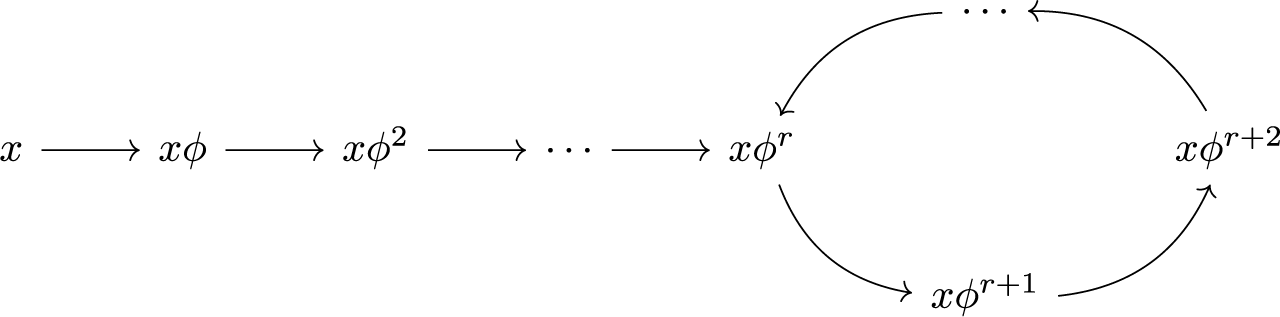
In Figure 1, the straight part of the orbit corresponds to
 $\{x,x\phi ,\ldots ,x\phi ^{r-1}\}$
and the periodic part of the orbit to
 $\{x\phi ^k\mid k\geq r\}=\{x\phi ^r,\ldots , x\phi ^{r+p-1}\}$
, where p is the period of
 $x\phi ^r$
. We consider the same notions up to conjugacy and the notation should be clear from context: for example, a finite
 $\tilde \phi $
-orbit is one containing only finitely many conjugacy classes. Naturally,
 $\phi $
-logarithms and
 $\tilde \phi $
-logarithms have the form
 $p+q\mathbb {N}$
for natural numbers p and q, and are computable, as long as Brinkmann’s problems are decidable.
A finite orbit.

2.2.2 Dynamics at the infinity
When we consider a hyperbolic group G endowed with a visual metric d and take its completion, we obtain the Gromov completion of G. As mentioned above, the endomorphisms of G admitting a continuous extension to the completion are precisely the uniformly continuous ones (with respect to d).
Now, let f be a homeomorphism of a compact space K. Given
 $y\in K$
, the
 $\omega $
-limit set
 $\omega (y,f)$
, or simply
 $\omega (y)$
, is the set of limit points of the sequence
 $f^n(y)$
as
 $n\to + \infty $
. We say that the dynamics is asymptotically periodic if every
 $\omega $
-limit set is a periodic orbit (see [Reference Levitt and Lustig25]).
We study these concepts for
 $\widehat \Phi $
, the continuous extension of an endomorphism to the completion
 $\widehat {F_n\times F_m}$
when the group is endowed with the product metric given by taking the prefix metric in each direct factor. As noted above, this is the Roller completion of the group.
Theorem 2.3 (Levitt and Lustig, [Reference Levitt and Lustig25, Theorem I]).
Every automorphism of a free group has asymptotically periodic dynamics.
3 Brinkmann’s problems
The goal of this section is to prove the following theorems.
Theorem 3.1. There exists an algorithm taking as input integers
 $n,m>1$
,
 $\Phi \in \mathrm {End}(F_n\times F_m)$
and two elements
 $(x,y),(z,w)\in F_n\times F_m$
that outputs
 $k\in \mathbb {N}$
such that
 $(x,y)\Phi ^k=(z,w)$
if such a k exists and outputs NO otherwise.
Theorem 3.2. There exists an algorithm taking as input integers
 $n,m>1$
,
 $\Phi \in \mathrm {End}(F_n\times F_m)$
and two elements
 $(x,y),(z,w)\in F_n\times F_m$
that outputs
 $k\in \mathbb {N}$
such that
 $(x,y)\Phi ^k\sim (z,w)$
if such a k exists and outputs NO otherwise.
We now present two technical lemmas that are useful later.
Lemma 3.3. There exists an algorithm that, on the input of two reduced words
 ${u,v\in F_n}$
, decides whether u is conjugate to some power of v and, in case it is, outputs the unique value of
 $k\in \mathbb {N}$
such that
 $u\sim v^k$
.
Proof. Two words u and v are conjugate if and only if the cyclically reduced core of u,
 $\tilde u$
is a cyclic permutation of the cyclically reduced core of v,
 $\tilde v$
. In particular, their cyclically reduced cores must have the same length. So, we compute
 $\tilde u$
,
 $\tilde v$
and check if
 $k={|\tilde u|}/{|\tilde v|}$
is an integer. If it is not, then there is no power k such that
 $u\sim v^k$
and if it is, then it is our only candidate. Hence, it only remains to check whether
 $u\kern1.4pt{\sim}\kern1.4pt v^k$
or not.
The equality version of this lemma can be seen to hold in the same way.
Lemma 3.4. There exists an algorithm that, on the input of two reduced words
 ${u,v\in F_n}$
, decides whether u is equal to some power of v in
 $F_n$
and, in case it is, outputs the unique value of
 $k\in \mathbb {N}$
such that
 $u= v^k$
.
Since the word problem and the conjugacy problem are decidable in
 $F_n\times F_m$
(as they reduce to the same problem in each factor), we prove that we can decide the existence of a positive k, and that is equivalent to deciding if there is a nonnegative value of k such that
 $(x,y)\Phi ^k=(z,w)$
(or
 $(x,y)\Phi ^k\sim (z,w)$
, in the conjugacy case).
3.1 Type I
In this case, we have that
 $(x,y)\Phi =(u^{x^P+y^R},v^{x^Q+y^S})$
for some words
 ${u,v\neq 1}$
. It is shown in [Reference Carvalho10, Section 5.1] that, defining sequences in
 $\mathbb {Z}$
by
 $$ \begin{align*} \begin{cases} a_1(x,y)=x^P+y^R,\\ b_1(x,y)=x^Q+y^S,\\ a_{n+1}(x,y)=a_n(x,y)u^P+b_n(x,y)v^R,\\ b_{n+1}(x,y)=a_n(x,y) u^Q+b_n(x,y) v^S, \end{cases}\kern-11pt \end{align*} $$
we have that, for every
 $k>0$
,
 $(x,y)\Phi ^k=(u^{a_k(x,y)},v^{b_k(x,y)})$
. We want to decide, given
 $(x,y),(z,w)\in F_n\times F_m$
, whether there is some
 $k\in \mathbb {N}$
such that
 $(x,y)\Phi ^k=(z,w)$
. Using Lemma 3.4 to decide if z is a power of u and w is a power of v, if, in any of the cases, the answer is no, then we do not have a positive solution to our problem; if both answers are yes, we compute exponents
 $(a,b)\in \mathbb {N}^2$
such that
 $(z,w)=(u^a, v^b)$
.
So, for all
 $n\in \mathbb {N}$
,
 $$ \begin{align*}\begin{bmatrix} a_{n} \\ b_n\end{bmatrix}=\begin{bmatrix}u^P & v^R\\u^Q & v^S\end{bmatrix}^{n-1} \begin{bmatrix} x^P+y^R\\ x^Q+y^S\end{bmatrix},\end{align*} $$
and hence, putting
 $M_\Phi =[\begin {smallmatrix}u^P & v^R\\u^Q & v^S\end {smallmatrix}]$
, the problem can now be translated as the problem of deciding whether there is some
 $k\in \mathbb {N}$
such that
 $$ \begin{align*}M_\Phi^k \begin{bmatrix} x^P+y^R \\ x^Q+y^S\end{bmatrix}= \begin{bmatrix}a \\ b\end{bmatrix},\end{align*} $$
which can be done by Theorem 2.1.
In the conjugacy case, we start by checking if
 $k=0$
is a solution to our problem by solving the conjugacy problem. If not, using Lemma 3.3, we check if z is conjugate to a power of u and w is conjugate to a power of v. If, in any of the cases, the answer is no, then we do not have a positive solution to our problem; if both answers are yes, we compute the unique exponents
 $(a,b)\in \mathbb {N}^2$
such that
 $(z,w)\sim (u^a, v^b)$
. Then, we simply check if there is some k such that
 $(x,y)\Phi ^k=(u^a,v^b)$
using the equality algorithm above.
3.2 Type II
In this case, we have that
 $(x,y)\Phi =(y\phi ,v^{x^Q+y^S})$
for some word
 $v\neq 1$
and homomorphism
 $\phi :F_m\to F_n$
. It is shown in [Reference Carvalho10, Section 5.2] that, defining a sequence in
 $\mathbb {Z}$
by
 $$ \begin{align*} \begin{cases} a_1(x,y)=x^Q+ y^S,\\ a_2(x,y)=a_1(x,y) v^S +y\phi^Q,\\ a_n(x,y)=a_{n-1}(x,y)v^S +a_{n-2}(x,y)(v\phi)^Q,\\ \end{cases} \end{align*} $$
we have that, for every
 $k>1$
,
 $(x,y)\Phi ^k=(v^{a_{k-1}(x,y)}\phi ,v^{a_k(x,y)})$
. We start by checking if
 $k=1$
is a solution. Then, by Lemma 3.4, we test if z is a power of
 $v\phi $
and if w is a power of v. If one of them is not, then there is no solution k. If both are, we compute
 $a,b\in \mathbb {N}$
such that
 $(z,w)=(v^a\phi , v^b)$
. Our problem now becomes finding
 $k>0$
such that
 $[\begin {smallmatrix} b & a\end {smallmatrix}]=[\begin {smallmatrix} a_{k+1}(x,y) & a_{k}(x,y)\end {smallmatrix}]$
. Similarly to the type-I case, we use Kannan–Lipton’s algorithm to decide on the existence of such a k. Consider the matrix
 $M_\Phi =[\begin {smallmatrix}v^S & (v\phi )^Q\\1 & 0\end {smallmatrix}]$
. Clearly, for
 $k>0$
,
 $$ \begin{align*}M_\Phi\begin{bmatrix} a_{k+1}(x,y) \\ a_{k}(x,y)\end{bmatrix}=\begin{bmatrix} a_{k+2}(x,y) \\ a_{k+1}(x,y)\end{bmatrix},\end{align*} $$
and so
 $$ \begin{align*}M_\Phi^k\begin{bmatrix} a_{2}(x,y) \\ a_{1}(x,y)\end{bmatrix}=\begin{bmatrix} a_{k+2}(x,y) \\ a_{k+1}(x,y)\end{bmatrix}.\end{align*} $$
By Theorem 2.1, we can decide if there is some k such that
 $$ \begin{align*}\begin{bmatrix} a_{k+2}(x,y) \\ a_{k+1}(x,y)\end{bmatrix}=M_\Phi^k \begin{bmatrix} a_{2}(x,y) \\ a_{1}(x,y)\end{bmatrix}=\begin{bmatrix} b \\ a\end{bmatrix},\end{align*} $$
and we are done.
The variation up to conjugacy is similar to the previous case: we first decide if z is conjugate to some power of
 $v\phi $
and w is conjugate to some power of v, and then apply the algorithm for equality.
3.3 Type III
We have that
 $(x,y)\mapsto (u^{x^P+y^R},y\phi )$
for some word
 $u\neq 1$
and endomorphism
 $\phi \in \mathrm {End}(F_m)$
. It is seen in [Reference Carvalho10, Section 5.3] that
 $$ \begin{align*}(u^a,y)\Phi^k=(u^{a(u^P)^{k}+\sum_{t=0}^{k-1} (y\phi^t)^R(u^P)^{k-t-1}},y\phi^k).\end{align*} $$
We start by solving BrP(
 $F_n$
) to compute
 $p_0, p_1\in \mathbb {N}$
such that
 $\phi \text {-}\log _y(w)=p_0+p_1\mathbb {N}$
. If
 $p_1=0$
, then
 $p_0$
is our only candidate, so the only thing to check is if
 $(x,y)\Phi ^{p_0}=(z,w)$
. If
 $p_1\neq 0$
, w is a
 $\phi $
-periodic point with period
 $p_1$
. We check if z is a power of u. If it is not, then we are done, since there is no possible k; if it is, we compute
 $a\in \mathbb {N}$
such that
 $z=u^a$
.
Now, consider the following affine transformation of
 $\mathbb {Z}$
:
 $$ \begin{align*} \Theta\colon \mathbb{Z}&\longrightarrow\mathbb{Z}\\ c&\longmapsto c(u^P)^{p_1}+\sum_{t=0}^{p_1-1} (w\phi^{t})^R(u^P)^{p_1-t-1}, \end{align*} $$
and denote by
 $(a_n)_n$
the sequence such that
 $(x,y)\Phi ^n=(u^{a_n},y\phi ^n)$
. Clearly, given
 $k\in \mathbb {N}$
, we can compute
 $a_k$
. We claim that, for
 $k\in p_0+p_1\mathbb {N}$
, writing
 $k=p_0+p_1r$
, we have that
 $$ \begin{align} (x,y)\Phi^k=(u^{a_{p_0}\Theta^r}, y\phi^k). \end{align} $$
We prove our claim by induction over r. Clearly, if
 $r=0$
, then
 $(x,y)\Phi ^k=(x,y)\Phi ^{p_0}=(u^{a_{p_0}}, y\phi ^k).$
Now, assume that the claim holds for r up to some
 $n\geq 0$
. Notice that
 $w=y\phi ^{p_0}$
is periodic with period
 $p_1$
, and so, for all
 $n, t\in \mathbb {N}$
,
 $y\phi ^{p_0+np_1+t}=w\phi ^t.$
Hence,
 $$ \begin{align*} (x,y)\Phi^{p_0+(n+1)p_1}&=(x,y)\Phi^{p_0+np_1}\Phi^{p_1}\\ &=(u^{a_{p_0}\Theta^n}, y\phi^{p_0+np_1})\Phi^{p_1}\\ &=(u^{(a_{p_0}\Theta^n)(u^P)^{p_1}+\sum_{t=0}^{p_1-1} (y\phi^{p_0+np_1+t})^R(u^P)^{p_1-t-1}},y\phi^{p_0+(n+1)p_1})\\ &=(u^{(a_{p_0}\Theta^n)(u^P)^{p_1}+\sum_{t=0}^{p_1-1} (w\phi^{t})^R(u^P)^{p_1-t-1}},y\phi^{p_0+(n+1)p_1})\\ &=(u^{a_{p_0}\Theta^{n+1}}, y\phi^k). \end{align*} $$
Since our only candidate solutions are of the form
 $p_0+p_1\mathbb {N}$
, we can proceed as follows: we check manually the existence of a solution for k up to
 $p_0$
, using the word problem; then, if we obtain no positive answer, we verify the existence of some
 $r\in \mathbb {N}$
such that
 $a_{p_0}\Theta ^r=a$
, which can be done by Remark 2.2.
When considering the conjugation variant, we proceed analogously. Using BrCP(
 $F_n$
), we compute
 $p_0, p_1\in \mathbb {N}$
such that
 $\tilde \phi \text {-}\log _y(w)=p_0+p_1\mathbb {N}$
. We then check if z is conjugate to some power of u and if so, compute a such that
 $u^a\sim z$
. Using the same argument as above, we check if there is some r such that the first component
 $(x,y)\Phi ^{p_0+rp_1}$
is
 $u^a$
. In fact, even though w is no longer a periodic point, it is enough that w is
 $\tilde \phi $
-periodic since, for words
 $u,v\in F_m$
such that
 $u\sim v$
, that is, for which there is some
 $z\in F_m$
such that
 $u=z^{-1}vz$
, we have that
 $$ \begin{align*}u^R=\sum\limits_{j\in[m]} \tau_j(u)r_j=\sum\limits_{j\in[m]} \tau_j(z^{-1}vz)r_j=\sum\limits_{j\in[m]} \tau_j(v)r_j=v^R.\end{align*} $$
This means that for all
 $n, t\in \mathbb {N}$
,
 $(y\phi ^{p_0+np_1+t})^R=(w\phi ^t)^R$
and the same reduction done above can be done here and the claim (3-1) holds in this case too. Hence, we reduce our problem to finding some
 $r\in \mathbb {N}$
such that
 $a_{p_0}\Theta ^r=a$
, which can be done by Remark 2.2.
3.4 Type IV
We have that
 $(x,y)\mapsto (y\phi ,y\psi )$
for some homomorphism
 $\phi : F_m\to F_n$
and endomorphism
 $\psi \in \mathrm {End}(F_m)$
, and so, as seen in [Reference Carvalho10, Section 5.4],
 $(x,y)\Phi ^k=(y\psi ^{k-1}\phi , y\psi ^k)$
for
 $k>0$
. Using BrP(
 $F_n$
), we start by computing
 $\psi \text {-}\log _y(w)$
. If it is empty, then there are no solutions k. If not,
 $\psi \text {-}\log _y(w)=p_0+p_1\mathbb {N}$
for some computable
 $p_0,p_1\in \mathbb {N}$
. We check if
 $k=p_0$
is a solution or not. We have that
 $w=y\psi ^{p_0}$
is a
 $\psi $
-periodic point with period
 $p_1$
. For
 $k=p_0+p_1r$
, with
 $r\geq 1$
, we have that
 $(x,y)\Phi ^k=(y\psi ^{p_0+p_1r-1}\phi , w)$
. However, for all
 $r\geq 1$
,
 $y\psi ^{p_0+p_1r-1}=y\psi ^{p_0+p_1-1}$
. So we simply check if
 $z=y\psi ^{p_0+p_1-1}\phi $
. If it is, then
 $p_0+p_1\mathbb {N}_{>0}$
is the set of solutions; if not, then there are no solutions to our problem.
We can handle the conjugacy version of the problem in the same way, computing
 $\tilde \psi \text {-}\log _y(w)$
instead of
 $\psi \text {-}\log _y(w)$
. In this case, we have that, for all
 $r\geq 1$
,
 $y\psi ^{p_0+p_1r-1}\sim y\psi ^{p_0+p_1-1}$
and so
 $y\psi ^{p_0+p_1r-1}\phi \sim y\psi ^{p_0+p_1-1}\phi $
, and the set of solutions is
 $p_0+p_1\mathbb {N}_{>0}$
if
 $z\sim y\psi ^{p_0+p_1-1}\phi $
and empty otherwise.
3.5 Type V
We have that
 $(x,y)\mapsto (1,v^{x^Q+y^S})$
for some
 $1\neq v \in F_m$
, and so, as seen in [Reference Carvalho10, Section 5.5],
 $(x,y)\varphi ^k=(1,v^{(x^Q+y^S)(v^S)^{k-1}})$
for
 $k>0$
. So we start by checking if
 $z=1$
and if w is a power of v. If any of these does not hold, then there is no positive solution k. If both hold, we compute
 $a\in \mathbb {Z}$
such that
 $w=v^a$
. Clearly, k is a solution if and only if
 $(v^S)^{k-1}={a}/({x^Q+y^S})$
, and its existence is decidable. The conjugacy problem is analogous: we compute the unique
 $a'\in \mathbb {Z}$
such that
 $w\sim v^{a'}$
and check if there is some k such that
 $(v^S)^{k-1}={a'}/({x^Q+y^S})$
.
3.6 Type VI
We have that
 $(x,y)\mapsto (x\phi ,y\psi )$
for some endomorphisms
 $\phi \in \mathrm {End}(F_n)$
,
 $\psi \in \mathrm {End}(F_m)$
, and so
 $(x,y)\varphi ^k=(x\phi ^{k},y\psi ^k)$
for
 $k>0$
. So this case is also simple: we compute
 $p_0,p_1, q_0,q_1\in \mathbb {N}$
such that
 $\phi \text {-}\log _x(z)=p_0+p_1\mathbb {N}$
and
 $\psi \text {-}\log _y(w)=q_0+q_1\mathbb {N}$
(if there are no
 $p_0$
or
 $q_0$
, then there are no solutions to our problem). Our set of solutions is the intersection
 $\phi \text {-}\log _x(z)\cap \psi \text {-}\log _y(w)$
, which we can check if it is empty or not. For the conjugacy version of the problem, we proceed in the same way, computing
 $\tilde \phi \text {-}\log _x(z)$
and
 $\tilde \psi \text {-}\log _y(w)$
instead.
3.7 Type VII
We have that
 $(x,y)\mapsto (y\psi ,x\phi )$
for homomorphisms
 $\phi :F_n\to F_m$
and
 $\psi :F_m\to F_n$
, and so, as seen in [Reference Carvalho10, Section 5.7], for
 $k\geq 0$
,
 $(x,y)\varphi ^{2k}= (x(\phi \psi )^k,y(\psi \phi )^k)$
and
 $(x,y)\varphi ^{2k+1}= (y(\psi \phi )^k\psi ,x(\phi \psi )^k\phi )$
. So we describe two algorithms: one to decide the existence of an even k and another one to decide the existence of an odd k. The first one is simple, since it can be seen as an application of the previous case, defining
 $\Phi $
to be the type-VI endomorphism mapping
 $(x,y)$
to
 $(x\phi \psi , y\psi \phi )$
. Now, we describe the second one. We start by checking if there is some even
 $r\in \mathbb {N}$
such that
 $(x,y)\Phi ^r=(z,w)\Phi $
. If there is none, then there is no solution k; otherwise, compute such a minimal r. It is proved in [Reference Carvalho10, Section 5.7] that the subgroup of periodic points of
 $\Phi $
is given by
 $\text {Per}(\Phi )=\text {Per}(\phi \psi )\times \text {Per}(\psi \phi )$
. In particular, it is computable and we can check if a given element of
 $F_n\times F_m$
is periodic or not. We verify if
 $(w\psi ,z\phi )=(z,w)\Phi $
is periodic or not. If it is not, then our only candidate is
 $k=r-1$
. Indeed, if there was some other
 $k>r$
, then we would have that
 $$ \begin{align*}((z,w)\Phi)\Phi^{k-r+1}=(x,y)\Phi^r\Phi^{k-r+1}=(x,y)\Phi^{k+1}=(z,w)\Phi\end{align*} $$
and if there was some other
 $k<r$
, we would have that
 $$ \begin{align*}(z,w)\Phi\Phi^{r-k}=(x,y)\Phi^{k}\Phi^{r-k+1}=(x,y)\Phi^{r+1}=(z,w)\Phi.\end{align*} $$
So, assume that
 $(z,w)\Phi $
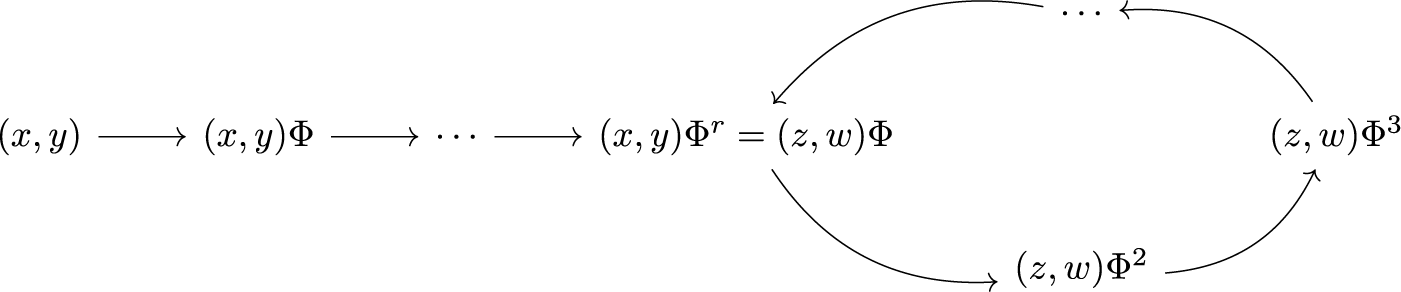
is periodic with period s. In this case, there are only finitely many checks to do since the orbit of
 $(x,y)$
is finite, as illustrated in Figure 2.
The orbit of
 $(x,y)$
.

The conjugacy case is similar. Checking the existence of an even k can be translated as an instance of the algorithm for Type-VI endomorphisms in the same way as above. Then, we verify if there is some even r such that
 $(x,y)\Phi ^r\sim (z,w)\Phi $
. If not, then there is no solution k, and if there is one, we compute it. We can check if
 $(z,w)\Phi $
is
 $\tilde \Phi $
-periodic, because that happens if and only if there is some
 $s\in 2\mathbb {N}$
such that
 $(z,w)\Phi \Phi ^2\Phi ^s\sim (z,w)\Phi $
. Indeed, if there is such an s, then
 $(z,w)\Phi \Phi ^{s+2}\sim (z,w)\Phi $
and
 $(z,w)\Phi $
is
 $\tilde \Phi $
-periodic and conversely, if
 $(z,w)\Phi $
is
 $\tilde \Phi $
-periodic, then there is some
 $p\in \mathbb {N}_{>0}$
such that
 $(z,w)\Phi \Phi ^p\sim (z,w)\Phi $
and so
 $$ \begin{align*}(z,w)\Phi\Phi^2\Phi^{2p-2}=(z,w)\Phi\Phi^{2p}\sim (z,w)\Phi\Phi^p\sim (z,w)\Phi.\end{align*} $$
As done in the equality case, if
 $(z,w)\Phi $
is not
 $\tilde \Phi $
-periodic, there is only one possible solution and if it is, our problem amounts to finitely many checks as the orbit of
 $(x,y)$
has only finitely many conjugacy classes.
4 The conjugacy problem for ascending HNN-extensions of
$F_n\times F_m$

Let G be a group and
 $\Phi $
be an injective endomorphism of G. The ascending HNN-extension of G induced by
 $\Phi $
is the group with relative presentation
 $$ \begin{align} G \ast_\Phi \,=\, \langle G, x \mid x^{-1}gx=\Phi(g), g\in G \rangle \end{align} $$
and with normal forms given by
 $x^i g x^{-j}$
, with
 $i,j\in \mathbb {N}_0$
and
 $g\in G.$
In [Reference Bogopolski, Martino, Maslakova and Ventura3], it was proved that the conjugacy problem was solvable in free-by-cyclic groups, by reducing this problem to the solution of BrCP(
 $F_n$
) and TCP(
 $F_n$
) for automorphisms. In [Reference Logan26], Logan proved that the conjugacy problem was decidable for ascending HNN-extensions of a free group, extending the work in [Reference Bogopolski, Martino, Maslakova and Ventura3]. To do so, Logan solved a variation of BrCP, which we call the two-sided Brinkmann’s conjugacy problem and TCP(
 $F_n$
) for injective endomorphisms of the free group. The two-sided Brinkmann conjugacy problem in G with respect to
 $\mathcal {T}\subseteq \mathrm {End}(G)$
, denoted by
 $\text {2BrCP}(G)$
, is the problem of deciding, on input of an endomorphism
 $\Phi \in \mathcal T$
and elements
 $x,y\in G$
, whether there is some pair
 $(r,s)\in \mathbb {N}^2$
such that
 $x\Phi ^r \sim y\Phi ^s$
.
We show that TCP(
 $F_n\times F_m$
) and
 $\text {2BrCP}(F_n\times F_m)$
are decidable with respect to monomorphisms, which, using Logan’s techniques, implies that the conjugacy problem is decidable for ascending HNN-extensions of the direct product of two free groups. Notice that the free-abelian times free case was already dealt with in [Reference Carvalho and Delgado15]. We recall that it is proved in [Reference Carvalho10, Proposition 3.2] that injective endomorphisms of
 $F_n\times F_m$
are precisely the types-VI and -VII endomorphisms having injective component homomorphisms
 $\phi $
and
 $\psi $
. We start by proving a lemma that is useful in proving decidability of
 $\text {2BrCP}(F_n\times F_m)$
in the injective case.
Lemma 4.1. There exists an algorithm taking as input an integer
 $n>1$
, an injective endomorphism
 $\phi \in \mathrm {Mon}(F_n)$
and an element
 $x\in F_n$
that decides if the number of conjugacy classes in the orbit of x is finite or not. Equivalently, it is decidable whether there is a pair
 $(p,q)\in \mathbb {N}^2$
such that
 $x\phi ^p\sim x\phi ^q$
with
 $p>q$
.
Proof. First, we verify if x is
 $\tilde \phi $
-periodic using [Reference Logan26, Lemma 4.1] to decide if there is some
 $k\in \mathbb {N}$
such that
 $x\phi \phi ^k\sim x$
. If x is
 $\tilde \phi $
-periodic, then the orbit of x contains only finitely many conjugacy classes and we are done. So, we may assume that x is not
 $\tilde \phi $
-periodic.
Suppose that there are
 $(p,q)\in \mathbb {N}^2$
such that
 $x\phi ^p\sim x\phi ^q$
with
 $p>q$
and let p be the minimal positive integer for which there is some
 $q < p$
such that
 $x\phi ^p\sim x\phi ^q$
. Then, there is some
 $u\in \mathbb {F}_n$
such that
 $x\phi ^p=u^{-1}x\phi ^qu$
. Notice that
 $q>0$
, since otherwise, we would have that x is
 $\tilde \phi $
-periodic. If
 $u\in \text {Im}(\phi )$
, that is,
 $u=u'\phi $
for some
 $u'\in F_n$
, then
 $x\phi ^p=(u^{\prime -1}\phi )(x\phi ^q)(u'\phi )$
, which, by injectivity, implies that
 $x\phi ^{p-1}=u^{\prime -1}x\phi ^{q-1}u'$
and this contradicts the minimality of p. Thus, for the minimal p, we know that
 ${x\phi ^p=u^{-1} x\phi ^q u}$
for some
 $u\in F_n\setminus \text {Im}(\phi )$
.
Therefore, the number of conjugacy classes in the orbit of x is finite if and only if there is some pair
 $(p,q)\in \mathbb {N}^2$
such that
 $p>q>0$
and some
 $u\in F_n\setminus \text {Im}(\phi )$
such that
 $x\phi ^p=u^{-1}x\phi ^qu$
. Verifying this condition can be done by applying [Reference Logan26, Lemma 4.3] to verify if there is some pair
 $(p,q)\in \mathbb {N}^2$
with
 $p\geq q \geq 0$
such that there is some element
 $u\in F_n\setminus \text {Im}(\phi )$
satisfying
 $(x\phi )\phi ^p=u^{-1}(x\phi ^q)u$
.
Theorem 4.2. There exists an algorithm taking as input two integers
 $n, m>1$
, two elements
 $(x,y),(z,w)\in F_n\times F_m$
and an injective endomorphism
 $\Phi \in \mathrm {Mon}(F_n\times F_m)$
that outputs a pair
 $(r,s)\in \mathbb {N}^2$
such that
 $(x,y)\Phi ^r\sim (z,w)\Phi ^s$
if such a pair exists and outputs NO otherwise.
Proof. Suppose that
 $\Phi $
is an injective endomorphism of type VI. Then,
 $(x,y)\Phi =(x\phi ,y\psi )$
for some
 $\phi \in \mathrm { Mon}(F_n)$
and
 $\psi \in \mathrm {Mon}(F_m)$
. Naturally,
 $$ \begin{align*}(x,y)\Phi^r\sim(z,w)\Phi^s\iff (x\phi^r,y\psi^r)\sim(z\phi^s,w\psi^s)\iff \begin{cases} x\phi^r\sim z\phi^s,\\ y\psi^r\sim w\psi^s. \end{cases}\kern-12pt\end{align*} $$
We start by using [Reference Logan26, Proposition 4.4] to check whether there is a pair
 $(r_1,s_1)$
such that
 $x\phi ^{r_1}\sim z\phi ^{s_1}$
. If there is none, then we answer NO. If there is such a pair, we compute the minimal
 $r_1$
for which there is some
 $k\in \mathbb {N}$
such that
 $x\phi ^{r_1}\sim z\phi ^{k}$
. This is possible by [Reference Logan26, Lemma 4.1]: we keep increasing the candidate values
 $r_1$
until the algorithm in [Reference Logan26, Lemma 4.1] answers YES. When it does, we compute the minimal
 $s_1$
such that
 $x\phi ^{r_1}\sim z\phi ^{s_1}$
, which can be done by iteratively solving the conjugacy problem. Then, we verify if the orbit of z has finitely many conjugacy classes or not, using Lemma 4.1. If there are only finitely many conjugacy classes, we compute the minimal
 $q_z\in \mathbb {N}$
such that
 $z\phi ^{q_z}$
is
 $\tilde \phi $
-periodic and
 $p_z\in \mathbb {N}$
, the
 $\tilde \phi $
-period of
 $z\phi ^{q_z}$
. If there are infinitely many conjugacy classes, we say that
 $q_z=\infty $
. We claim that the set
 $\mathcal S$
of all pairs
 $(p,q)\in \mathbb {N}^2$
such that
 $x\phi ^{p}\sim z\phi ^{q}$
is precisely
 $$ \begin{align*}{{\begin{cases} (r_1,s_1)+(1,1)\mathbb{N} &\text{ if } q_z=\infty,\\ (r_1,s_1)+(1,1)\mathbb{N}+(0,p_z)\mathbb{N} + (p_z,0)\mathbb{N} &\text{ if } q_z\leq s_1,\\ \{(r_1+i,s_1+i)\mid 0\leq i< q_z-s_1\}\cup ((r_1+q_z-s_1,q_z)+(1,1)\mathbb{N}+(0,p_z)\mathbb{N} + (p_z,0)\mathbb{N})&\text{ if } q_z> s_1. \end{cases}}}\end{align*} $$
Suppose that
 $q_z=\infty $
. Then, clearly
 $(r_1,s_1)+(1,1)\mathbb {N}\subseteq \mathcal S$
. So, suppose that
 $x\phi ^{p}\sim z\phi ^{q}$
. Then, by minimality of
 $r_1$
, we have that
 $p\geq r_1$
. Clearly,
 $$ \begin{align} z\phi^q\sim x\phi^p=x\phi^{r_1}\phi^{p-r_1}\sim z \phi^{s_1}\phi^{p-r_1}=z\phi^{s_1+p-r_1}. \end{align} $$
Since the orbit of z has infinitely many conjugacy classes, then it must be the case that
 $q=s_1+p-r_1$
, that is,
 $q-s_1=p-r_1$
, and so,
 $(p,q)=(r_1,s_1)+ (p-r_1)(1,1)\in (r_1,s_1)+ (1,1)\mathbb {N}$
.
Now, assume that
 $q_z\leq s_1$
. Then,
 $z\phi ^{s_1}$
has
 $\tilde \phi $
-period
 $p_z$
, and so
 $x\phi ^{r_1}$
must also have
 $\tilde \phi $
-period
 $p_z$
. Indeed,
 $x\phi ^{r_1}\phi ^k\sim x\phi ^{r_1}$
if and only if
 $z\phi ^{s_1}\phi ^k\sim x\phi ^{r_1}\sim z\phi ^{s_1}$
. Thus, it is clear that
 $(r_1,s_1)+(1,1)\mathbb {N}+(0,p_z)\mathbb {N}+ (p_z,0)\mathbb {N}\subseteq \mathcal S$
. Now, suppose that
 $x\phi ^{p}\sim z\phi ^{q}$
. Again, by minimality of
 $r_1$
, we have that
 $p\geq r_1$
, which implies that
 $x\phi ^{p}$
(and so,
 $z\phi ^q$
) is in the
 $\tilde \phi $
-periodic part of the orbit and has period
 $p_z$
. Proceeding as above, we get that
 $z\phi ^q\sim z\phi ^{s_1+p-r_1}$
. If
 $q>s_1+p-r_1$
, there is some
 $r\in \mathbb {N}$
such that
 $q-p-s_1+r_1=rp_z$
, which means that
 $q=s_1+(p-r_1)+rp_z$
, and thus,
 $$ \begin{align*}(p,q)=(r_1,s_1)+(p-r_1)(1,1)+ r(0,p_z)\in (r_1,s_1)+(1,1)\mathbb{N}+(0,p_z)\mathbb{N}+ (p_z,0)\mathbb{N}.\end{align*} $$
If, however,
 $q\leq s_1+p-r_1$
, there is some
 $r\in \mathbb {N}$
such that
 $s_1+p-r_1-q=rp_z$
and so
 $p=r_1+(q-s_1)+rp_z$
, and thus,
 $$ \begin{align*}(p,q)=(r_1,s_1)+(q-s_1)(1,1)+ r(p_z,0)\in (r_1,s_1)+(1,1)\mathbb{N}+(0,p_z)\mathbb{N}+ (p_z,0)\mathbb{N}.\end{align*} $$
Now, suppose that
 $q_z>s_1$
. Obviously,
 $\{(r_1+i,s_1+i)\mid 0\leq i< q_z-s_1\}\subseteq \mathcal S$
. Again, since
 $x\phi ^{r_1+q_z-s_1}\sim z\phi ^{q_z}$
, then
 $x\phi ^{r_1+q_z-s_1}$
has
 $\tilde \phi $
-period
 $p_z$
and so it is clear that
 $(r_1+q_z-s_1,q_z)+(1,1)\mathbb {N}+(0,p_z)\mathbb {N} + (p_z,0)\mathbb {N}\subseteq \mathcal S$
. Now, suppose that
 $x\phi ^{p}\sim z\phi ^{q}$
. By minimality of
 $r_1$
, we must have that
 $p\geq r_1$
. Suppose that
 $p< r_1+q_z-s_1$
. Then,
 ${s_1+p-r_1<q_z}$
, which means that
 $ z\phi ^{s_1+p-r_1}$
is not
 $\tilde \phi $
-periodic. As in (4-2),
 $z\phi ^q\sim z\phi ^{s_1+p-r_1}$
and so, it must be that
 $q= s_1+p-r_1$
and
 $(p,q)=(r_1,s_1)+(p-r_1,q-s_1)=(r_1,s_1)+(p-r_1,p-r_1)$
. Since we are assuming that
 $p-r_1<q_z-s_1$
, it follows that
 $(p,q)\in \{(r_1+i,s_1+i)\mid 0\leq i< q_z-s_1\}.$
If, however,
 $p \geq r_1+q_z-s_1$
,
 $$ \begin{align*}x\phi^p\sim x\phi^{r_1}\phi^{p-r_1}\sim z\phi^{s_1}\phi^{p-r_1},\end{align*} $$
with
 $p-r_1\geq q_z-s_1$
, and so
 $x\phi ^p$
(and so,
 $z\phi ^q$
) lies in the
 $\tilde \phi $
-periodic part of the orbit and has period
 $p_z$
. So we proceed as in the previous case. As in (4-2),
 $z\phi ^q\sim z\phi ^{s_1+p-r_1}$
. If
 $q>s_1+p-r_1$
, there is some
 $r\in \mathbb {N}$
such that
 $q-p-s_1+r_1=rp_z$
, which means that
 $q=s_1+(p-r_1)+rp_z$
, and thus,
 $$ \begin{align*}(p,q)&=(r_1+q_z-s_1,q_z)+(p-r_1+s_1-q_z)(1,1)+ r(0,p_z)\\ &\quad\in (r_1,s_1)+(1,1)\mathbb{N}+(0,p_z)\mathbb{N}+ (p_z,0)\mathbb{N}.\end{align*} $$
If, however,
 $q\leq s_1+p-r_1$
, there is some
 $r\in \mathbb {N}$
such that
 $s_1+p-r_1-q=rp_z$
and so
 $p=r_1+(q-s_1)+rp_z$
, and thus,
 $$ \begin{align*}(p,q)&=(r_1+q_z-s_1,q_z)+(q-q_z)(1,1)+ r(p_z,0)\\ &\quad\in (r_1,s_1)+(1,1)\mathbb{N}+(0,p_z)\mathbb{N}+ (p_z,0)\mathbb{N}.\end{align*} $$
Proceeding analogously, we compute the set
 $\mathcal S'\subseteq \mathbb {N}^2$
of pairs
 $(p,q)\in \mathbb {N}^2$
such that
 $y\phi ^{p}\sim w\phi ^{q}$
. These are semilinear sets, so their intersection can be computed (in particular, its emptyness can be decided) and the solution set for our problem is precisely
 $\mathcal S\cap \mathcal S'$
.
Now, suppose that
 $\Phi $
is a type-VII injective endomorphism. Then,
 $(x,y)\Phi =(y\psi ,x\phi )$
for some injective homomorphisms
 $\phi :F_n\to F_m$
and
 $\psi :F_m\to F_n$
and, for
 $k\geq 0$
,
 $(x,y)\varphi ^{2k}= (x(\phi \psi )^k,y(\psi \phi )^k)$
and
 $(x,y)\varphi ^{2k+1}= (y(\psi \phi )^k\psi ,x(\phi \psi )^k\phi )$
. We prove that we can decide if there is a pair
 $(r,s)\in \mathbb {N}^2$
by showing that it is decidable whether there is such a pair
 $(r,s)$
in
 $2\mathbb {N}\times 2\mathbb {N}$
, in
 $2\mathbb {N}\times (2\mathbb {N}+1)$
, in
 $(2\mathbb {N}+1)\times 2\mathbb {N}$
and in
 $(2\mathbb {N}+1)\times (2\mathbb {N}+1)$
.
The first case is immediate, since we are deciding if there are some
 $r',s'\in \mathbb {N}^2$
such that
 $(x(\phi \psi )^{r'},y(\psi \phi )^{r'})\sim (z(\phi \psi )^{s'},w(\psi \phi )^{s'})$
, which can be reduced to the type-VI case, by defining the type-VI monomorphism given by
 $\Psi : (x,y)\mapsto (x\phi \psi ,y\psi \phi )$
. The second and third cases are the same since one can be obtained from the other by swapping the roles of
 $(x,y)$
and
 $(z,w)$
. We now see that we can decide whether there are some
 $r',s'\in \mathbb {N}$
such that
 $(x,y)\Phi ^{2r'+1}\sim (z,w)\Phi ^{2s'}$
. However,
 $$ \begin{align*} &(x,y)\Phi^{2r'+1}\sim (z,w)\Phi^{2s'}\\ &\quad\iff (y(\psi\phi)^{r'}\psi,x(\phi\psi)^{r'}\phi)\sim (z(\phi\psi)^{s'},w(\psi\phi)^{s'})\\ &\quad\iff ((y\psi)(\phi\psi)^{r'},(x\phi)(\psi\phi)^{r'})\sim (z(\phi\psi)^{s'},w(\psi\phi)^{s'}), \end{align*} $$
which is again an instance of the case for the type-VI injective endomorphism
 $\Psi $
defined above with input
 $(y\psi ,x\phi )$
and
 $(z,w)$
. We can use the same trick to solve the remaining case of deciding if there is a solution
 $(r,s)\in (2\mathbb {N}+1)\times (2\mathbb {N}+1)$
. We want to decide whether there are some
 $r',s'\in \mathbb {N}$
such that
 $(x,y)\Phi ^{2r'+1}\sim (z,w)\Phi ^{2s'+1}$
. However,
 $$ \begin{align*} &(x,y)\Phi^{2r'+1}\sim (z,w)\Phi^{2s'+1}\\ &\quad\iff (y(\psi\phi)^{r'}\psi,x(\phi\psi)^{r'}\phi)\sim (w(\psi\phi)^{s'}\psi,z(\phi\psi)^{s'}\phi)\\ &\quad\iff ((y\psi)(\phi\psi)^{r'},(x\phi)(\psi\phi)^{r'})\sim ((w\psi)(\phi\psi)^{s'},(z\phi)(\psi\phi)^{s'}), \end{align*} $$
which is again an instance of the case for the type-VI injective endomorphism
 $\Psi $
defined above with input
 $(y\psi ,x\phi )$
and
 $(w\psi ,z\phi )$
.
Now, we can prove decidability of TCP(
 $F_n\times F_m$
) for monomorphisms of
 $F_n\times F_m$
.
Proposition 4.3. There exists an algorithm taking as input two integers
 $n, m>1$
, two elements
 $(x,y),(z,w)\in F_n\times F_m$
and an injective endomorphism
 $\Phi \in \mathrm {Mon}(F_n\times F_m)$
that outputs an element
 $(u,v)\in F_n\times F_m$
such that
 $(x,y)=(u^{-1},v^{-1})\Phi (z,w)(u,v)$
if such an element exists and outputs NO otherwise.
Proof. Suppose that
 $\Phi $
is a type-VI monomorphism. Then,
 $(x,y)\Phi =(x\phi ,y\psi )$
for some
 $\phi \in \mathrm {Mon}(F_n)$
and
 $\psi \in \mathrm {Mon}(F_m)$
. We have that
 $$ \begin{align*}(x,y)=(u^{-1},v^{-1})\Phi(z,w)(u,v) \iff \begin{cases} x=(u^{-1}\phi)zu,\\ y=(v^{-1}\psi)wv. \end{cases}\kern-11pt\end{align*} $$
So, there exists an element
 $(u,v)\in F_n\times F_m$
as desired if and only if TCP(
 $F_n$
) answers YES on input
 $(x,z,\phi )$
and TCP(
 $F_m$
) answers YES on input
 $(y,w,\psi )$
. That is decidable by [Reference Logan26, Lemma 2.2] or [Reference Ventura36, Theorem 2.4].
Now, assume that
 $\Phi $
is a monomorphism of type VII. Then,
 $(x,y)\Phi =(y\psi ,x\phi )$
for injective homomorphisms
 $\phi :F_n\to F_m$
and
 $\psi :F_m\to F_n$
. Applying this description of
 $\Phi $
, we obtain that
 $$ \begin{align*}&(x,y)=(u^{-1},v^{-1})\Phi(z,w)(u,v)\iff\begin{cases} x=(v^{-1}\psi) zu,\\ y=(u^{-1}\phi) wv, \end{cases}\kern-11pt\iff \begin{cases} u^{-1}=x^{-1}(v^{-1}\psi)z,\\ y=(u^{-1}\phi) wv, \end{cases}\\ &\quad\iff \begin{cases} u^{-1}=x^{-1}(v^{-1}\psi)z,\\ y=(x^{-1}\phi)(v^{-1}\psi\phi)(z\phi) wv, \end{cases} \kern-11pt\iff \begin{cases} u=z^{-1}(v\psi)x,\\ (x\phi)y=(v^{-1}\psi\phi)(z\phi) wv. \end{cases}\kern-11pt \end{align*} $$
So, if
 $(x,y)$
and
 $(z,w)$
are
 $\Phi $
-twisted conjugate with conjugator
 $(u,v)$
, then
 $(x\phi )y$
and
 $(z\phi ) w$
are
 $\psi \phi $
-twisted conjugate with conjugator v. Conversely, if
 $(z\phi ) w$
and
 $(x\phi )y$
are
 $\psi \phi $
-twisted conjugate with some conjugator v, then
 $(x,y)$
and
 $(z,w)$
are
 $\Phi $
-twisted conjugate with conjugator
 $(z^{-1}(v\psi )x,v)$
. Since it can be decided whether
 $(z\phi ) w$
and
 $(x\phi )y$
are
 $\psi \phi $
-twisted conjugate, by solving TCP(
 $F_m$
), we are done.
By the results in [Reference Logan26], the two results above yield the following corollary.
Corollary 4.4. The conjugacy problem is solvable for ascending HNN-extensions of
 $F_n\times F_m$
for
 $n,m>1$
.
5 Dynamics at the infinity
A metric space
 $(X,d)$
is said to be a median space if, for all
 $x,y,z\in X$
, there is some unique point
 $\mu (x,y,z)\in X$
, known as the median of
 $x,y,z$
, such that
 $d(x,y)=d(x,\mu (x,y,z))+d(\mu (x,y,z),y); d(y,z)=d(y,\mu (x,y,z))+d(\mu (x,y,z),z)$
and
 $d(z,x)=d(z,\mu (x,y,z))+d(\mu (x,y,z),x)$
. We call
 $\mu :X^3\to X$
the median operator of the median space X.
Coarse median spaces were introduced by Bowditch in [Reference Bowditch5]. Following the equivalent definition given in [Reference Niblo, Wright and Zhang28], we say that, given a metric space X, a coarse median on X is a ternary operation
 $\mu :X^3\to X$
satisfying the following.
There exists a constant
 $C\geq 0$
such that, for all
 $a,b,c,x\in X$
, we have that:
-
(1)
$\mu (a,a,b)=a \text { and } \mu (a,b,c)=\mu (b,c,a)=\mu (b,a,c);$
-
(2)
$d(\mu (\mu (a,x,b),x,c),\mu (a,x,\mu (b,x,c)))\leq C;$
-
(3)
$d(\mu (a,b,c),\mu (x,b,c))\leq Cd(a,x)+C.$


Given a group G, a word metric on G measures the distance of the shortest path in the Cayley graph of G with respect to some set of generators, that is, for two elements
 $g,h\in G$
, we have that
 $d(g,h)$
is the length of the shortest word whose letters come from the generating set representing
 $g^{-1}h$
. Following the definitions in [Reference Fioravanti22], two coarse medians
 $\mu _1,\mu _2:X^3\to X$
are said to be at bounded distance if there exists some constant C such that
 $d(\mu _1(x,y,z),\mu _2(x,y,z))\leq C$
for all
 $x,y,z\in X$
, and a coarse median structure on X is an equivalence class
 $[\mu ]$
of coarse medians pairwise at bounded distance. When X is a metric space and
 $[\mu ]$
is a coarse median structure on X, we say that
 $(X,[\mu ])$
is a coarse median space. Following Fioravanti’s definition in [Reference Fioravanti22], a coarse median group is a pair
 $(G,[\mu ])$
, where G is a finitely generated group with a word metric d and
 $[\mu ]$
is a G-invariant coarse median structure on G, meaning that for each
 $g\in G$
, there is a constant
 $C(g)$
such that
 for all
 $g_1,g_2,g_3\in G$
. The author in [Reference Fioravanti22] also remarks that this definition is stronger than the original definition from [Reference Bowditch5] that did not require G-invariance. Despite being better suited for this work, it is not quasi-isometry-invariant nor commensurability-invariant, unlike Bowditch’s version.
Now, a K-hyperbolic group is such that there is some
 $K\geq 0$
for which every geodesic triangle has a K-centre, that is, a point that, up to a bounded distance, depends only on the vertices, and is K-close to every edge of the triangle. Given three points, the operator that associates the three points to the K-centre of a geodesic triangle they define is coarse median. In fact, by [Reference Niblo, Wright and Zhang28, Theorem 4.2], it is the only coarse-median structure with which we can endow X. Given two groups
 $G_1$
and
 $G_2$
endowed with coarse median operators
 $\mu _1$
and
 $\mu _2$
, it is easy to check that
 $\mu :(G_1\times G_2)^3\to G_1\times G_2$
defined by
 $\mu ((x_1,x_2),(y_1,y_2),(z_1,z_2))=(\mu _1(x_1,y_1,z_1),\mu _2(x_2,y_2,z_2))$
is coarse median. We refer to
 $\mu $
as the product coarse median operator and this is the coarse median with which we endow
 $F_n\times F_m$
.
Given a coarse median group
 $(G,[\mu ])$
, an automorphism
 $\varphi \in \text {Aut}(G)$
is said to be coarse-median preserving if it fixes
 $[\mu ]$
, that is, when there is some constant
 $C\geq 0$
such that for all
 $g_i$
, we have that
 $$ \begin{align*}d(\mu(g_1,g_2,g_3)\varphi,\mu(g_1\varphi,g_2\varphi,g_3\varphi))\leq C,\end{align*} $$
with respect to some word metric d. This can naturally be defined for general endomorphisms, not necessarily bijective, as done in [Reference Carvalho8, Reference Carvalho9], and even for homomorphisms between different groups: we say that a homomorphism
 $\varphi :(G_1,\mu _1)\to (G_2,\mu _2)$
is coarse-median preserving if there is some
 $C\geq 0$
such that for all
 $x,y,z\in G_1$
,
 $$ \begin{align*}d(\mu_2(x\varphi,y\varphi,z\varphi),\mu_1(x,y,z)\varphi)\leq C\end{align*} $$
for some word metric d of
 $G_2$
.
Let
 $G=\langle A\rangle $
be a hyperbolic group. Given
 $g,h,p\in G$
, we define the Gromov product of g and h taking p as basepoint by
 $$ \begin{align*}(g|h)_p^A=\tfrac 12 (d_A(p,g)+d_A(p,h)-d_A(g,h)).\end{align*} $$
We write
 $(g|h)$
to denote
 $(g|h)_1^A$
, when the generating set is clear. Notice that, in the free group case, we have that
 $(g|h)=|g\wedge h|,$
where
 $u\wedge v$
denotes the longest common prefix between u and v.
Recall the notation from Section 2, namely the definition of sets
 $X, \, Y,\,Z$
and W.
It is shown in [Reference Carvalho9, Theorem 4.11] that an endomorphism
 $\phi $
of a hyperbolic group G is coarse-median preserving if and only if the bounded reduction property holds for
 $\phi $
. In particular, if G is free,
 $\phi $
is coarse-median preserving if and only if it is either trivial or injective. Following the same strategy as in [Reference Carvalho9, Theorem 4.11], we can see that the result holds for homomorphisms between free groups of different ranks.
Proposition 5.1. Let
 $\varphi :F_n\to F_m$
be a homomorphism. Then,
 $\varphi $
is coarse-median preserving if and only if it is either trivial or injective.
Proof. Suppose that
 $\varphi $
is not trivial nor injective. Then, there are some nontrivial
 $x,y\in F_n$
such that
 $x\varphi =1$
and
 $y\varphi \neq 1$
. Eventually, conjugating x by a suitable element, we can assume that
 $y^Cxy^{-C}$
is reduced for all
 $C\in \mathbb {N}$
. Indeed, conjugating a kernel element by any element yields a kernel element, and if c is the last letter of y, then
 $c^{|x|}xc^{-|x|}$
is an example of an element with the desired property (notice that we may assume that x is not itself a power of c, as that would imply that
 $c\varphi $
is
 $1$
, in which case, we can simply remove all occurrences of c and
 $c^{-1}$
from y). So, for all
 $C\in \mathbb {N}$
, we have that
 $$ \begin{align*} &d(\mu_1(x,y^Cxy^{-C},y^C)\varphi,\mu_2(x\varphi,(y^Cxy^{-C})\varphi,y^C\varphi))\\ &\quad=d(y^C\varphi,\mu_2(1,1,y^C\varphi))\\ &\quad= d(1,y^C\varphi)\\ &\quad\geq C. \end{align*} $$
Since C can be arbitrarily large,
 $\varphi $
is not coarse-median preserving.
Clearly, if
 $\varphi $
is trivial, it is coarse-median preserving, so the only thing left to prove is that injectivity implies coarse-median preservation. Suppose that
 $\varphi $
is injective. By [Reference Carvalho9, Proposition 5.3], for all
 $M\geq 0$
, there is some
 $N\geq 0$
such that
 $$ \begin{align*}(u|v)\leq M \implies (u\varphi |v\varphi)\leq N\end{align*} $$
for all
 $u,v\in F_n$
. Following the proofs of [Reference Carvalho9, Proposition 4.2 and Theorem 4.6] step by step, we get that there is some
 $N\in \mathbb {N}$
such that, for all
 $x,y\in F_n$
, the image of the geodesic
 $[x,y]$
is at a Hausdorff distance at most N from the geodesic
 $[x\varphi ,y\varphi ]$
. Let
 $x,y,z\in F_n$
. Then,
 $\mu _1(x,y,z)$
belongs to
 $[x,y]$
,
 $[y,z]$
and
 $[x,z]$
, and so
 $\mu _1(x,y,z)\varphi $
is at a distance at most N from
 $[x\varphi ,y\varphi ]$
,
 $[y\varphi ,z\varphi ]$
and
 $[x\varphi ,z\varphi ]$
, and thus,
 $\mu _1(x,y,z)\varphi $
is an N-centre of the triangle
 $[[x\varphi ,y\varphi ,z\varphi ]]$
. Since
 $\mu _2(x\varphi ,y\varphi ,z\varphi )$
is also an N-centre of
 $[[x\varphi ,y\varphi ,z\varphi ]]$
, by [Reference Bowditch, Verjovsky, Ghys and Haefliger4, Lemma 3.1.5], it is at a bounded distance from
 $\mu _1(x,y,z)\varphi $
and this bound depends only on N.
Therefore,
 $\varphi $
is coarse-median preserving.
Now, we establish an equivalence between preservation of a coarse median and uniform continuity in
 $F_n\times F_m$
, similar to what happens in free and free-abelian times free groups.
Theorem 5.2. Coarse-median preserving endomorphisms of
 $F_n\times F_m$
are precisely the uniformly continuous ones.
Proof. Let
 $\Phi \in \mathrm {End}(F_n\times F_m)$
be a coarse-median preserving endomorphism with constant C and recall the notation from Section 2, namely the definition of the sets
 $X, \, Y,\,Z$
and W.
We start by proving that
 $1\in X\implies X=\{1\}$
. Suppose there are some
 $i,j\in [n]$
such that
 $(a_i,1)\Phi =(1,y_i)$
and
 $(a_j,1)\Phi = (x_j,y_j)$
with
 $x_j\neq 1$
. Then, letting D be a number greater than C,
 $$ \begin{align*} &d(\mu((a_j^{-D}a_i,1)\Phi,(a_j^{-D}a_ia_j^D,1)\Phi,(a_i,1)\Phi),\mu((a_j^{-D}a_i,1),(a_j^{-D}a_ia_j^D,1),(a_i,1))\Phi)\\ &\quad=d(\mu((x_j^{-D},y_j^{-D}y_i),(1,y_j^{-D}y_iy_j^D),(1,y_i)),(\mu_1(a_j^{-D}a_i,a_j^{-D}a_ia_j^D,a_i),\mu_2(1,1,1))\Phi)\\ &\quad=d((\mu_1(x_j^{-D},1,1),\mu_2(y_j^{-D}y_i,y_j^{-D}y_iy_j^D,y_i)),(a_j^{-D}a_i,1)\Phi)\\ &\quad\geq d(\mu_1(x_j^{-D},1,1),x_j^{-D})\\ &\quad=d(1,x_j^{-D})\\ &\quad>C, \end{align*} $$
which contradicts the fact that
 $\Phi $
is coarse-median preserving with constant C. So,
 $1\in X\implies X=\{1\}$
. The same holds for
 $Y, \,Z$
and W, and that can be seen analogously. Notice that in the second equality above, we have that
 $\mu _1(a_j^{-D}a_i,a_j^{-D}a_ia_j^D,a_i)=a_j^{-D}a_i$
since the elements
 $a_i$
are distinct basis elements; hence, all words appearing in the expression are freely reduced.
We now prove that we cannot have Y and W to be nontrivial simultaneously, which shows that
 $\Phi $
cannot be of type I, II or V. Suppose that
 $Y\neq \{1\}$
and
 $W\neq \{1\}$
. In view of the above,
 $1\not \in Y\cup W$
. We know that there is some word
 $v\in F_m$
, and nonzero exponents
 $q_i$
and
 $s_j$
such that
 $y_i=v^{q_i}$
and
 $w_j=v^{s_j}$
. For
 $D\in \mathbb {N}$
, we have that
 $$ \begin{align*} &\mu((a_i^{Ds_j},b_j^{-Dq_i})\Phi,(a_i^{\text{sgn}(s_j)+2Ds_j},b_j^{-Dq_i})\Phi,(a_i^{2Ds_j},b_j^{-2Dq_i})\Phi)\\ &\quad=\mu((x_i^{Ds_j}z_j^{-Dq_i},1),(x_i^{2Ds_j+\text{sgn}(s_j)}z_j^{-Dq_i},v^{q_i(\text{sgn}(s_j)+Ds_j)}),(x_i^{2Ds_j}z_j^{-2Dq_i},1))\\ &\quad= (\mu_1(x_i^{Ds_j}z_j^{-Dq_i},x_i^{2Ds_j\text{sgn}(s_j)}z_j^{-Dq_i},x_i^{2Ds_j}z_j^{-2Dq_i}),\mu_2(1,v^{q_i(\text{sgn}(s_j)+Ds_j)},1)) \end{align*} $$
and
 $$ \begin{align*} &\mu((a_i^{Ds_j},b_j^{-Dq_i}),(a_i^{\text{sgn}(s_j)+2Ds_j},b_j^{-Dq_i}),(a_i^{2Ds_j},b_j^{-2Dq_i}))\Phi\\ &\quad=(\mu_1(a_i^{Ds_j},a_i^{\text{sgn}(s_j)+2Ds_j},a_i^{2Ds_j}),\mu_2(b_j^{-Dq_i},b_j^{-Dq_i},b_j^{-2Dq_i}))\Phi\\ &\quad=(a_i^{2Ds_j},b_j^{-Dq_i})\Phi. \end{align*} $$
Then, for
 $D>C$
, the distance between
 $$ \begin{align*}\mu((a_i^{Ds_j},b_j^{-Dq_i})\Phi,(a_i^{\text{sgn}(s_j)+2Ds_j},b_j^{-Dq_i})\Phi,(a_i^{2Ds_j},b_j^{-2Dq_i})\Phi)\end{align*} $$
and

is greater than or equal to
 $$ \begin{align*}d(\mu_2(1,v^{q_i(\text{sgn}(s_j)+Ds_j)},1),v^{Ds_jq_i})=d(1,v^{Ds_jq_i})\geq C,\end{align*} $$
which contradicts the fact that
 $\Phi $
is coarse-median preserving with constant C. The same argument yields that we cannot have both X and Z nontrivial, so type III is also dealt with.
Since coarse-median and uniform continuity coincide for free groups, it follows from [Reference Carvalho8, Lemma 3.2] that an endomorphism of type VI is coarse-median preserving if and only if it is uniformly continuous.
If
 $\Phi $
is a type-IV endomorphism defined as
 $(x,y)\Phi =(y\phi ,y\psi )$
, then, for all
 $(x_1,x_2),(y_1,y_2),(z_1,z_2)\in F_n\times F_m$
and
 $C>0$
, we have that

Hence,
 $\Phi $
is coarse-median preserving if and only if both
 $\phi $
and
 $\psi $
are. Since, in view of Proposition 5.1, this is equivalent to having injective or trivial
 $\phi $
and
 $\psi $
, these are precisely the uniformly continuous type-IV endomorphisms of
 $F_n\times F_m$
(see [Reference Carvalho10, Proposition 6.2]).
Finally, if
 $\Phi $
is a type-VII endomorphism defined as
 $(x,y)\Phi =(y\psi ,x\phi )$
, then, proceeding as in the type-IV case, we obtain that
 $\Phi $
is coarse-median preserving if and only if both
 $\phi $
and
 $\psi $
are. Since, in view of Proposition 5.1, this is equivalent to having injective or trivial
 $\phi $
and
 $\psi $
, these are precisely the uniformly continuous type-VII endomorphisms of
 $F_n\times F_m$
(see [Reference Carvalho10, Proposition 6.2]).
We now denote by
 $d_1$
the prefix metric on
 $F_n$
, by
 $d_2$
the prefix metric on
 $F_m$
, and by d the product metric obtained by taking
 $d_1$
and
 $d_2$
in the factors. We can now prove the main result of the section.
Theorem 5.3. The continuous extension of every automorphism of
 $F_n\times F_m$
to the completion obtained by taking the prefix metric in each factor has asymptotically periodic dynamics.
Proof. We prove that a point
 $(z,w)\in \widehat {F_n\times F_m}$
that belongs to the
 $\omega $
-limit of some point
 $(x,y)$
must be periodic, which implies that the
 $\omega $
-limit is itself the (periodic) orbit of
 $(z,w)$
and so that the dynamics is asymptotically periodic.
Let
 $\Phi \in \text {Aut}(F_n\times F_m)$
be a type-VI automorphism of
 $F_n\times F_m$
. Then,
 $\Phi $
is of the form
 $(x,y)\mapsto (x\phi ,y\psi )$
for some
 $\phi \in \text {Aut}(F_n)$
and
 $\psi \in \text {Aut}(F_m)$
. By [Reference Carvalho10, Proposition 6.2],
 $\Phi $
is uniformly continuous with respect to the metric d and, by uniqueness of the extension
 $\widehat \Phi $
is given by
 $(x,y)\mapsto (x\widehat \phi , y\widehat \psi )$
. Let
 $(z,w)\in \omega ((x,y),\widehat \Phi )$
. There is a sequence
 $(n_i)_{i\in \mathbb {N}}$
such that
 $(x,y)\widehat \Phi ^{n_i}\to (z,w)$
. This means that
 $$ \begin{align*}( x\widehat\phi^{n_i},y\widehat\psi^{n_i})\to (z,w),\end{align*} $$
and so
 $ x\widehat \phi ^{n_i}\to z$
and
 $y\widehat \psi ^{n_i}\to w$
, which implies that
 $z\in \omega (x,\widehat \phi )$
and
 $w\in \omega (y,\widehat \psi )$
. Since the dynamics of free group automorphisms is asymptotically periodic by Theorem 2.3, then x must be
 $\widehat \phi $
-periodic and y must be
 $\widehat \psi $
-periodic, and so
 $(x,y)$
is
 $\widehat \Phi $
-periodic.
Now, suppose that
 $n=m$
and let
 $\Phi \in \text {Aut}(F_n\times F_m)$
be a type-VII automorphism of
 $F_n\times F_n$
. Then,
 $\Phi $
is of the form
 $(x,y)\mapsto (y\psi ,x\phi )$
for some
 $\phi ,\psi \in \text {Aut}(F_n)$
. Again, by [Reference Carvalho10, Proposition 6.2],
 $\Phi $
is uniformly continuous with respect to the metric d and, by uniqueness of the extension
 $\widehat \Phi $
, is given by
 $(x,y)\mapsto (y\widehat \psi , x\widehat \phi )$
. Moreover,
 $\widehat \phi $
and
 $\widehat \psi $
are continuous maps between compact spaces, and hence uniformly continuous. Additionally, since both
 $\phi $
and
 $\psi $
are automorphisms,
 $\phi ^{-1}$
and
 $\psi ^{-1}$
are also uniformly continuous and extend to continuous mappings
 $\widehat {\phi ^{-1}}$
and
 $\widehat {\psi ^{-1}}$
. By uniqueness of extensions, we have that
 $\widehat \phi $
and
 $\widehat {\phi ^{-1}}$
(respectively
 $\widehat \psi $
and
 $\widehat {\psi ^{-1}}$
) are mutually inverse uniformly continuous mappings.
Let
 $(z,w)\in \omega ((x,y),\widehat \Phi )$
. Then, there is a sequence
 $(n_i)_{i\in \mathbb {N}}$
such that
 $(x,y)\widehat \Phi ^{n_i}\to (z,w)$
. If
 $(n_i)$
has infinitely many even numbers, then consider the subsequence
 $(n_{k_i})_{i\in \mathbb {N}}$
of even numbers such that
 $(x,y)\widehat \Phi ^{n_{k_i}}\to (z,w)$
. This means that
 $$ \begin{align*}( x(\widehat\phi\widehat\psi)^{{n_{k_i}}/{2}},y(\widehat\psi\widehat\phi)^{{n_{k_i}}/{2}})\to (z,w),\end{align*} $$
and so
 $x(\widehat \phi \widehat \psi )^{{n_{k_i}}/{2}}\to z$
and
 $y(\widehat \psi \widehat \phi )^{{n_{k_i}}/{2}}\to w$
, which implies that
 $z\in \omega (x,\widehat \phi \widehat \psi )$
and that
 $w\in \omega (y,\widehat \psi \widehat \phi )$
. By Theorem 2.3, we deduce that z is
 $(\widehat \phi \widehat \psi )$
-periodic and w is
 $(\widehat \psi \widehat \phi )$
-periodic, that is, that there are
 $p_1,p_2\in \mathbb {N}$
such that
 $z(\widehat \phi \widehat \psi )^{p_1}=z$
and
 $w(\widehat \psi \widehat \phi )^{p_2}=w$
. Hence,
 $$ \begin{align*}(z,w)\widehat\Phi^{2p_1p_2}=(z(\widehat\phi\widehat\psi)^{p_1p_2},w(\widehat\psi\widehat\phi)^{p_1p_2})=(z,w),\end{align*} $$
that is,
 $(z,w)$
is
 $\widehat \Phi $
-periodic.
If
 $(n_i)$
has only finitely many even numbers, then it must have infinitely many odd numbers and we consider the subsequence
 $(n_{k_i})_{i\in \mathbb {N}}$
of odd numbers such that
 $(x,y)\widehat \Phi ^{n_{k_i}}\to (z,w)$
. This means that
 $$ \begin{align*}( y(\widehat\psi\widehat\phi)^{({n_{k_i}-1})/{2}}\widehat\psi,x(\widehat\phi\widehat\psi)^{({n_{k_i}-1})/{2}}\widehat\phi)\to (z,w),\end{align*} $$
and so
 $y(\widehat \psi \widehat \phi )^{({n_{k_i}-1})/{2}}\widehat \psi \to z$
and
 $x(\widehat \phi \widehat \psi )^{({n_{k_i}-1})/{2}}\widehat \phi \to w$
. By uniform continuity of
 $\widehat \phi $
and
 $\widehat \psi $
, it follows that
 $y(\widehat \psi \widehat \phi )^{({n_{k_i}-1})/{2}}\widehat \psi \widehat \phi \to z\widehat \phi $
and
 $x(\widehat \phi \widehat \psi )^{({n_{k_i}-1})/{2}}\widehat \phi \widehat \psi \to w\widehat \psi $
. Hence,
 $z\widehat \phi \in \omega (y,\widehat \psi \widehat \phi )$
and
 $w\widehat \psi \in \omega (x,\widehat \phi \widehat \psi )$
, which, by Theorem 2.3, implies that
 $z\widehat \phi $
is
 $(\widehat \psi \widehat \phi )$
-periodic and
 $w\widehat \psi $
is
 $(\widehat \phi \widehat \psi )$
-periodic, that is, that there are
 $p_1,p_2\in \mathbb {N}$
such that
 $z\widehat \phi (\widehat \psi \widehat \phi )^{p_1}=z\widehat \phi $
and
 $w\widehat \psi (\widehat \phi \widehat \psi )^{p_2}=w\widehat \psi $
. Therefore,
 $$ \begin{align*}z(\widehat\phi\widehat\psi)^{p_1}=z\widehat\phi(\widehat\psi\widehat\phi)^{p_1}\widehat{\phi^{-1}}=z\widehat\phi\widehat{\phi^{-1}}=z\end{align*} $$
and
 $$ \begin{align*}w(\widehat\psi\widehat\phi)^{p_2}=w\widehat\psi(\widehat\phi\widehat\psi)^{p_2}\widehat{\psi^{-1}}=w\widehat\psi\widehat{\psi^{-1}}=w.\end{align*} $$
Hence,
 $$ \begin{align*}(z,w)\widehat{\Phi}^{2p_1p_2}=(z(\widehat\phi\widehat\psi)^{p_1p_2},w(\widehat\psi\widehat\phi)^{p_1p_2})=(z,w),\end{align*} $$
and
 $(z,w)$
is
 $\widehat \Phi $
-periodic.
Acknowledgements
The author thanks Rémi Coulon, Damien Gaboriau and Yassine Guerch for pointing out a flaw in a previous version of the paper. The author is also indebted to the anonymous referee for their report, which confirmed this issue, and offered further comments and suggestions that helped improve the overall quality of the paper.