Introduction
Major depressive disorder (MDD) is a public health problem, and the World Health Organization (WHO) projects that it will be the leading cause of morbidity worldwide by 2030 (WHO, 2004; Whiteford et al. Reference Whiteford, Degenhardt, Rehm, Baxter, Ferrari, Erskine, Charlson, Norman, Flaxman, Johns, Burstein, Murray and Vos2013). Despite the enormous personal and societal impact of depression its pathophysiology remains incompletely understood. Dysregulations in biological stress systems (Dowlati et al. Reference Dowlati, Herrmann, Swardfager, Liu, Sham, Reim and Lanctot2010), such as inflammatory pathways and the hypothalamic-pituitary-adrenal axis (Vreeburg et al. Reference Vreeburg, Hoogendijk, van Pelt, Derijk, Verhagen, van Dyck, Smit, Zitman and Penninx2009) are increasingly recognized as potential underlying mechanisms. There is growing evidence that increased oxidative stress might also be involved in the pathophysiology of depression (Palta et al. Reference Palta, Samuel, Miller and Szanton2014; Black et al. Reference Black, Bot, Scheffer, Cuijpers and Penninx2015; Jiménez-Fernández et al. Reference Jiménez-Fernández, Gurpegui, Díaz-Atienza, Pérez-Costillas, Gerstenberg and Correll2015; Liu et al. Reference Liu, Zhong, Liao, Chen, He, Lai and Jia2015).
Oxidative stress occurs when there is either an increase in exposure or production of reactive oxygen species (ROS), or lowered antioxidant defences, which cause oxidative damage to lipids, proteins and DNA (Valko et al. Reference Valko, Leibfritz, Moncol, Cronin, Mazur and Telser2007). This process is a well-established mechanism in physiological ageing and in the pathophysiology of most major somatic diseases (Valko et al. Reference Valko, Leibfritz, Moncol, Cronin, Mazur and Telser2007) including cancer (Valavanidis et al. Reference Valavanidis, Vlachogianni and Fiotakis2009) and cardiovascular disease (Kroese & Scheffer, Reference Kroese and Scheffer2014). Measures of oxidative damage represent the outcome of exposure to ROS and the activity of the antioxidant defences. F2-isoprostanes are currently considered to be the best representatives of oxidative lipid damage (Kadiiska et al. Reference Kadiiska, Gladen, Baird, Germolec, Graham, Parker, Nyska, Wachsman, Ames, Basu, Brot, Fitzgerald, Floyd, George, Heinecke, Hatch, Hensley, Lawson, Marnett, Morrow, Murray, Plastaras, Roberts, Rokach, Shigenaga, Sohal, Sun, Tice, Van Thiel, Wellner, Walter, Tomer, Mason and Barrett2005; Milne et al. Reference Milne, Yin, Brooks, Sanchez, Jackson Roberts and Morrow2007; Niki, Reference Niki2014) and have been demonstrated to be independent predictors of cardiovascular health (Davies & Roberts, Reference Davies and Roberts2011). 8-Hydroxy-2′-deoxyguanosine (8-OHdG), an oxidized derivative of the guanosine base, is a well-established marker of DNA damage. 8-OHdG is a lesion with mutagenic potential and has been widely researched in somatic disease and found to be associated with the development and presence of cancer in particular (Valavanidis et al. Reference Valavanidis, Vlachogianni and Fiotakis2009).
Both these markers have been demonstrated to be increased in depression in a meta-analysis (Black et al. Reference Black, Bot, Scheffer, Cuijpers and Penninx2015). This study, however, also demonstrated that the number of studies and their sample sizes were limited, and that heterogeneity was high. Some of this variation may be explained by the differences between studies in accounting for important potential confounders. Sociodemographic and lifestyle factors, such as smoking and alcohol use, have been associated with depression (Glassman et al. Reference Glassman, Helzer, Covey, Cottler, Stetner, Tipp and Johnson1990; Sullivan et al. Reference Sullivan, Fiellin and O'Connor2005), but are also known to affect oxidative stress levels (Loft et al. Reference Loft, Vistisen, Ewertz, Tjønneland, Overvad and Poulsen1992; Meagher et al. Reference Meagher, Barry, Burke, Lucey, Lawson, Rokach and FitzGerald1999; Janicki-Deverts et al. Reference Janicki-Deverts, Cohen, Matthews, Gross and Jacobs2009). Inadequate adjustment for these factors could considerably influence the estimate of the association. The use of antidepressant medication is a factor of particular importance as intervention studies have shown antidepressant use may affect levels of oxidative stress markers (Jiménez-Fernández et al. Reference Jiménez-Fernández, Gurpegui, Díaz-Atienza, Pérez-Costillas, Gerstenberg and Correll2015; Liu et al. Reference Liu, Zhong, Liao, Chen, He, Lai and Jia2015).
Oxidative stress has also been demonstrated to be associated with anxiety disorders (Hovatta et al. Reference Hovatta, Juhila and Donner2010; Guney et al. Reference Guney, Fatih Ceylan, Tektas, Alisik, Ergin, Goker, Senses Dinc, Ozturk, Korkmaz, Eker, Kizilgun and Erel2014; Smaga et al. Reference Smaga, Niedzielska, Gawlik, Moniczewski, Krzek, Przegaliński, Pera and Filip2015), but has not been as widely studied as in depression. Given the high co-morbidity rates between MDD and anxiety disorders [in our study ~65% (Lamers et al. Reference Lamers, van Oppen, Comijs, Smit, Spinhoven, van Balkom, Nolen, Zitman, Beekman and Penninx2011)] investigating them in one study is representative of real-world clinical practice, but oxidative stress levels may differ across types of disorders and between those with current and remitted disorders.
This study aims to establish the cross-sectional association between F2-isoprostanes, 8-OHdG and (current or remitted) MDD, anxiety disorders and co-morbid MDD and anxiety, taking into account most major potential confounding sociodemographic and lifestyle factors, with particular attention to the use of antidepressants. To our knowledge this study comprises the largest sample of cases with well-defined psychiatric diagnoses of both MDD and anxiety disorders in which oxidative stress markers have been examined.
Materials and method
Population
Data were derived from the baseline measurement of the Netherlands Study of Depression and Anxiety (NESDA), an ongoing longitudinal cohort study conducted among 2981 adults aged 18–65 years. Between September 2004 and February 2007 participants were recruited from the general population, primary-care and mental healthcare organizations, at three research sites in The Netherlands. The study includes participants with current or remitted major depressive disorder (MDD), dysthymia, and/or anxiety disorders [social phobia (SP), generalized anxiety disorder (GAD), panic disorder (PD), agoraphobia (AP)] as well as healthy control subjects. Persons with insufficient command of the Dutch language or another primary psychiatric diagnosis of e.g. bipolar disorder, a severe substance use disorder or a psychotic disorder, either self-reported or reported by their mental health provider, were excluded. Depressive and anxiety disorders were ascertained using the lifetime version of the Composite International Diagnostic Interview (CIDI, version 2.1; Kessler et al. Reference Kessler, Wittchen, Abelson, Mcgonagle, Schwarz, Kendler, Knäuper and Zhao1998). At baseline, participants in NESDA underwent a 4-h assessment conducted by trained research staff according to a predesigned protocol, including blood sampling, written questionnaires, an interview and a physical examination. A full, detailed description of the NESDA rationale, methods and recruitment has been previously published (Penninx et al. Reference Penninx, Beekman, Smit, Zitman, Nolen, Spinhoven, Cuijpers, De Jong, Van Marwijk, Assendelft, Van Der Meer, Verhaak, Wensing, De Graaf, Hoogendijk, Ormel and Van Dyck2008). NESDA was approved by the Medical Ethics Committees of the participating institutes and all participants provided written informed consent.
This study included of 2841 subjects (2830 with 8-OHdG measurements, 2555 with F2-isoprostane measurements), who were divided into three groups: remitted MDD and/or anxiety disorder(s), current MDD and/or anxiety disorder(s) and healthy controls. Subjects with remitted disorders (N = 610) had a lifetime history of MDD and/or any of the abovementioned anxiety disorders, but no diagnosis in the past 6 months. Subjects with a current disorder (N = 1619) had a diagnosis of MDD and/or any of the above-mentioned anxiety disorders in the past 6 months. Control subjects (N = 612) were defined as having no lifetime history of depressive or anxiety disorders and no current antidepressant use. Subjects were excluded from the analyses for the following reasons; no data available for either marker of oxidative stress (N = 97), current pregnancy or breastfeeding (N = 26), and subjects who did not meet the criteria for any of the abovementioned three categories (N = 17; these were subjects with a diagnosis of minor depression or dysthymia but without a lifetime diagnosis of MDD or an anxiety disorder, or subjects who had no diagnosis but did report antidepressant use).
Clinical characteristics and antidepressant use
The severity of depressive symptoms in the past week was assessed with the 30-item Inventory of Depressive Symptoms – Self Report (IDS-SR; Rush et al. Reference Rush, Gullion, Basco, Jarrett and Trivedi1996). Scores range from 0 to 84 and can be categorized as 0–13 = normal, 14–25 = mild, 26–38 = moderate, 39–48 = severe and 49–84 = very severe depression (Rush et al. Reference Rush, Trivedi, Ibrahim, Carmody, Arnow, Klein, Markowitz, Ninan, Kornstein, Manber, Thase, Kocsis and Keller2003). The severity of anxiety symptoms in the past week was assessed using the Beck Anxiety Inventory (BAI; Beck et al. Reference Beck, Epstein, Brown and Steer1988; Beck & Steer, Reference Beck and Steer1993). Scores range from 0 to 63 and can be categorized as 0–9 = normal, 10–18 = mild, 19–29 = moderate and >29 = severe. The severity of phobic symptoms in the past week was assessed with the Fear Questionnaire (FQ) which consists of 15 items on the most common phobias for which subjects rate their avoidance (range for each item 0–8, total score range 0–120) (Van Zuuren, Reference Van Zuuren1988; Lee & Oei, Reference Lee and Oei1994). The IDS, BAI and FQ all have well-established validity and reliability (Beck & Steer, Reference Beck and Steer1993; Lee & Oei, Reference Lee and Oei1994; Rush et al. Reference Rush, Trivedi, Ibrahim, Carmody, Arnow, Klein, Markowitz, Ninan, Kornstein, Manber, Thase, Kocsis and Keller2003).
The Life Chart interview (Lyketsos et al. Reference Lyketsos, Nestadt, Cwi, Heithoff and Eaton1994), which uses a calendar method, was used to assess the number of months in which depressive and/or anxiety symptoms were present during the past 4 years and was expressed as the percentage of time with depressive or anxiety symptoms.
Current use of antidepressants was assessed by examination of pill containers at the face-to-face interview and was classified according to the WHO's Anatomical Therapeutic Chemical (ATC) classification (WHO Centre for Drug Statistics Methodology, 2010) and divided into three groups: selective serotonin reuptake inhibitors (SSRIs; ATC code N06AB; N = 480), tricyclic antidepressants (TCAs; ATC code N06AA; N = 78) and other antidepressants (ATC codes N06AF, N06AG, N06AX; N = 146). Subjects using more than one antidepressant (N = 18) were categorized as TCA users if TCA use was present, SSRI users (if using SSRI but no TCA) and as other antidepressant users if using multiple antidepressants other than TCAs or SSRIs.
To further examine the effects of antidepressant doses and compare these effects across antidepressants groups, the derived daily dose (DDD) was calculated for the above-mentioned antidepressant groups. The DDD was calculated using the defined daily dose, the assumed average maintenance dose per day for a drug used for its main indications in adults as defined by the WHO for all drugs in the ATC classification system (Wertheimer, Reference Wertheimer1986; Pahor et al. Reference Pahor, Chrischilles, Guralnik, Brown, Wallace and Carbonin1994). The defined daily dose divided by the dose a subject is using equals the DDD.
Measurement of plasma F2-isoprostanes and 8-OHdG
Blood was collected in the morning after an overnight fast using a vacutainer blood collection tube and transported to local laboratory sites for processing within 1 h of withdrawal. Plasma samples were stored at −80 °C and transported to the Metabolic Laboratory of the VU University Medical Center where F2-isoprostanes and 8-OHdG were determined between 2012 and 2014. The measurement of both markers in this sample has previously been described in more detail elsewhere (Black et al. Reference Black, Bot, Scheffer and Penninx2016a ). F2-isoprostanes [the total, i.e. free and esterified, concentration of 8-iso prostaglandin F2α (iPF2α-III)] was determined by liquid chromatography tandem mass spectrometry (LC-MS/MS); intra- and inter-assay coefficients of variation (CVs) were 4.6% and 8.2%, respectively. Plasma levels of 8-OHdG were determined by LC-MS/MS with intra- and inter-assay CVs of 3.1% and 6.3%, respectively.
Covariates
Covariates were selected based on a previous study that examined the determinants of the oxidative stress markers in a healthy subsample of this population (Black et al. Reference Black, Bot, Scheffer and Penninx2016a ).
Sociodemographic factors included sex (male/female), age (years) and number of years of education.
Plasma cotinine (the major metabolite of nicotine) was included as measure of cigarette smoke exposure. Cotinine concentrations were assessed in plasma by solid-phase competitive ELISA (Cotinine Direct ELISA kit, cat. no. CO096D, Calbiotech, USA). The detection limit was 1 ng/ml. Intra- and inter-assay CVs for values >2 ng/ml were <20% and <15%, respectively. Participants with cotinine values below the detection limit of 1 ng/ml had their level set at the value of 0.9 ng/ml.
Alcohol use was categorized based on units/week into mild/abstainer (<1 unit/week for men and women), moderate users (1–21 units/week for men, 1–14 units/week for women) and heavy users (>21 units/week for men, >14 units/week for women).
Body mass index (BMI, kg/m2) and physical activity (assessed using the 7-item International Physical activity Questionnaire, IPAQ; www.ipaq.ski.se) were not associated with either oxidative stress marker in this sample (Black et al. Reference Black, Bot, Scheffer and Penninx2016a ) and therefore not included as covariates.
The use of supplements with potential antioxidant properties was assessed at the face-to-face interview and was defined as frequent use (more than half the days in the last month) of any or more of the following supplements: vitamin A (ATC A11CA01), vitamin E (ATC code A11HA03), vitamin C (ATC A11GA01) or a multivitamin supplement (ATC A11BA).
Sampling factors included research site, adherence to the instructions for overnight fasting prior to the examination (yes/no), and the season of sample collection [spring (March–May), summer (June–August), autumn (September–November), winter (December–February)].
Statistical analyses
Statistical analyses were performed using SPSS v. 20.0 (IBM Corp., USA). ANOVA was used to compare means of continuous variables with a normal distribution, Kruskal–Wallis tests for those with a non-parametric distribution and χ² tests to compare categorical variables between control subjects and subjects with remitted or current MDD and/or anxiety disorder(s). Because of their non-normal distribution, F2-isoprostanes and 8-OHdG were log-transformed for analysis. Analyses were conducted for F2-isoprostanes and 8-OHdG separately.
To study the associations between oxidative stress and MDD/anxiety disorders and antidepressant use ANCOVAs were used to calculate the mean levels of F2-isoprostanes and 8-OHdG for different groups, i.e. (1) controls, subjects with remitted disorders [MDD, anxiety disorder(s) or both], subjects with current disorders [MDD, anxiety disorder(s) or both]; (2) controls, subjects with remitted MDD (only), remitted anxiety disorder(s) (only), remitted co-morbid MDD and anxiety disorder(s), current MDD (only), current anxiety (only), current co-morbid MDD and anxiety disorder(s); (3) non-antidepressant users and antidepressant users; (4) controls, subjects with remitted disorders not using antidepressants, subjects with current disorders not using antidepressants, SSRI users, TCA users, other antidepressant users (with remitted or current disorders). Reported levels were back-transformed to geometric means with 95% confidence intervals (CIs).
In order to check for dose-response associations, linear regression analyses were conducted with F2-isoprostanes or 8-OHdG as the dependent variables and each of the clinical severity scores (IDS, BAI, FQ) as main predictors. To check for dose response-associations with antidepressant use the same analyses were conducted with the DDD of each antidepressant group as main predictors.
The above-mentioned ANCOVA and linear regression analyses were adjusted for sampling factors including research site, season of sample collection, fasting status; sociodemographics including age, sex, education; and for lifestyle factors including plasma cotinine levels, alcohol use, and supplement use (model 1). Analyses that did not already include antidepressant use in the grouping of subjects were additionally adjusted for antidepressant use (model 2).
Effect's sizes (Cohen's d; Cohen, Reference Cohen1988) were calculated based on the means, standard deviations and number of subjects. For all analyses a p value <0.05 was defined as statistically significant.
Ethical standards
The authors assert that all procedures contributing to this work comply with the ethical standards of the relevant national and institutional committees on human experimentation and with the Helsinki Declaration of 1975, as revised in 2008.
Results
Sample description
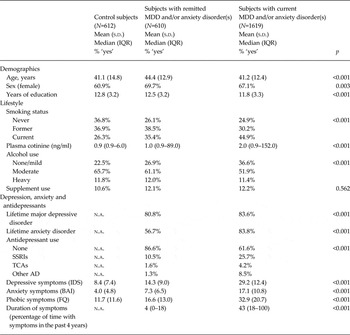
The sample included 2841 subjects (2830 with 8-OHdG measurements, 2555 subjects with F2-isoprostane measurements) of which 66.3% was female, with a mean (s.d.) age of 41.9 (13.1) years and 12.2 (3.3) years of education. Of these 2841 subjects, 612 were control subjects, 610 were subjects with remitted MDD and/or anxiety disorder(s) and 1619 were subjects with current MDD and/or anxiety disorder(s). Antidepressant use was reported by 13.4% of subjects with remitted disorders and 38.4% of subjects with current disorders. Subjects with remitted or current MDD and/or anxiety disorder(s) were older, more likely to be female, smoked more often, and were more likely to have less education and drink less alcohol than controls (Table 1).
Sample characteristics of controls, subjects with remitted MDD and/or anxiety disorder(s) and subjects with current MDD and/or anxiety disorder(s)

AD, Antidepressants; BAI, Beck Anxiety Inventory; FQ, Fear Questionnaire; IDS, Inventory of Depressive Symptomatology; IQR, interquartile range; N, number; MDD, major depressive disorder; s.d., standard deviation; SSRIs, selective serotonin reuptake inhibitors; TCAs, tricyclic antidepressants.
Oxidative damage in MDD and/or anxiety disorder(s) and antidepressant use
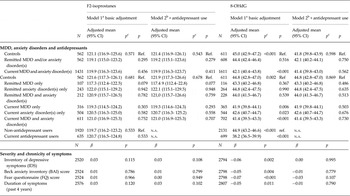
F2-isoprostane levels did not differ between controls and subjects with remitted disorders (p = 0.295), or between controls and subjects with current MDD and/or anxiety disorder(s) (p = 0.456). Nor were there any differences between antidepressant users and non-users (p = 0.533).
8-OHdG levels in subjects with current MDD and/or anxiety disorder(s) were lower [42.1 pmol/l (95% CI 40.4–43.8)] than in controls [45.0 pmol/l (95% CI 42.9–47.2), p < 0.001)], after adjustment for sampling, sociodemographics and lifestyle factors. Subjects with remitted disorders [44.4 pmol/l (95% CI 42.4–46.4)] did not differ from controls [45.0 pmol/l (95% CI 42.9–47.2), p = 0.516). The pattern of results for both markers was comparable over all disorders: MDD only, anxiety disorder(s) only (Table 2) and all anxiety disorders individually (data not shown).
Associations of F2-isoprostanes and 8-OHdG with remitted/current major depressive disorder and/or anxiety disorder(s), antidepressant use and clinical characterictics

CI, Confidence interval; n.a., not applicable.
ANCOVA with F2-isoprostanes or 8-OHdG as dependent variables, log-transformed for analysis. Reported values are back-transformed (adjusted) geometric means.
Linear regression analyses with F2-isoprostanes or 8-OHdG as dependent variables, log-transformed for analysis. Reported values are standardized regression coefficients.
a Model 1 includes sampling variables: research site, season of sample collection, fasting prior to sample collection; sociodemographic variables: age, sex, education; health and lifestyle variables: plasma cotinine, alcohol, supplement use.
b Model 2 all factors in model 1 + antidepressant use yes/no.
c p value omnibus ANOVA.
Antidepressant users had significantly lower 8-OHdG levels [38.2 pmol/l (95% CI 36.5–39.9)] compared to non-users [44.9 pmol/l (95% CI 43.2–46.6), p < 0.001].
There were no significant differences in 8-OHdG levels between patients and controls (p = 0.562) after further adjustment for antidepressant use, suggesting that the lower levels are associated with antidepressant use, but not with the presence of MDD and/or anxiety disorder(s) (Table 2).
F2-isoprostane levels were not associated with any of the clinical characteristics. 8-OHdG levels were inversely associated with all symptom severity measures (all p < 0.005) and the duration of symptoms (p = 0.011); however, none of these associations remained present after additional adjustment for antidepressant use.
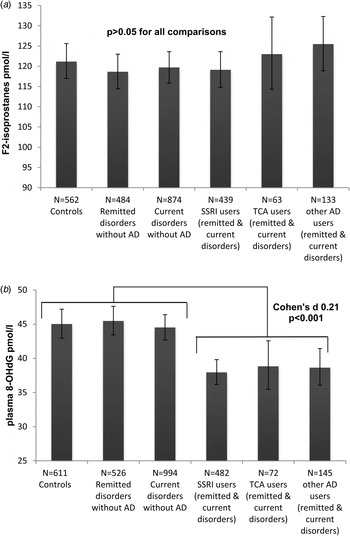
To investigate the associations of different antidepressants types with both markers of oxidative damage, subjects were divided further by type of antidepressant. Fig. 1 shows the adjusted mean levels of F2-isoprostanes and 8-OHdG for controls, subjects with remitted disorders not using antidepressants, subjects with current disorders not using antidepressants, and SSRI, TCA or other antidepressant users (with remitted or current disorders). 8-OHdG levels were lower in users of all antidepressant types (37.9 pmol/l in SSRI users, 38.8 pmol/l in TCA users, 38.6 pmol/l and other antidepressant users), compared to non-users and controls [45.5 and 44.5 pmol/l in non-antidepressant users with remitted or current disorders, respectively, and 45.0 pmol/l in controls (p < 0.001)]. Effect size (Cohen's d) for the comparison between antidepressant users and non-users was d = 0.21, p < 0.001 (Fig. 1b ).
(a) Mean F2-isoprostane levels (pmol/l) in controls, subjects with remitted or current major depressive disorder (MDD) and/or anxiety disorder(s) without antidepressants, selective serotonin reuptake inhibitor (SSRI) users, tricyclic antidepressant (TCA) users and other antidepressant users (with remitted or current MDD and/or anxiety). F2-isoprostane values were log-transformed for analysis. Reported levels are back-transformed geometric means. Error bars indicate 95% confidence intervals. The ANCOVA model was adjusted for sampling, sociodemographic, health and lifestyle factors. (b) Mean 8-OHdG levels (pmol/l) in controls, subjects with remitted or current MDD and/or anxiety disorder(s) without antidepressants, SSRI users, TCA users and other antidepressant users (with remitted or current MDD and/or anxiety). 8-OHdG values were log-transformed for analysis. Reported levels are back-transformed geometric means. Error bars indicate 95% confidence intervals. The ANCOVA model was adjusted for sampling, sociodemographic, health and lifestyle factors.

There were no associations between F2-isoprostanes and the DDD of any of the antidepressant types. 8-OHdG levels were inversely associated with the DDDs of TCAs (β = −0.30, p = 0.041). The associations of 8-OHdG with the DDD of SSRIs (β= −0.06, p = 0.191) and the DDD of other antidepressants (β = −0.08, p = 0.358) were in the same direction, however not significant.
The unexpected finding that 8-OHdG was lower in antidepressant users than in controls, raised the question whether 8-OHdG is an indicator of prognosis, either favourable or unfavourable. Therefore, post-hoc analyses within persons with current MDD and/or anxiety disorder(s) at baseline were conducted to determine whether oxidative damage markers predicted remission or chronicity of symptoms during 2 years of follow-up. Remission was defined as the absence of MDD and anxiety disorders for a consecutive period of 3 months, whereas chronicity of symptoms was defined as being symptomatic ⩾75% of the follow-up time, both based on the CIDI and Life Chart interview conducted at the 2-year follow-up examination. Logistic regression analyses were performed in subjects with a current disorder at baseline and 2-year follow-up data (N = 992 with F2-isoprostane data, N = 1130 with 8-OHdG data), and were also stratified for baseline antidepressant use. These analyses found no associations between either marker and remission rates or symptom chronicity (Supplementary Table S1), suggesting that 8-OHdG and F2-isoprostane levels may not be predictive of the course of affective disorders, in subjects with or in those without antidepressants (Supplementary Table S1).
Discussion
Oxidative stress has been hypothesized to play a role in the pathophysiology of MDD and anxiety disorders and has previously been demonstrated to be increased in subjects with these disorders (Palta et al. Reference Palta, Samuel, Miller and Szanton2014; Black et al. Reference Black, Bot, Scheffer, Cuijpers and Penninx2015; Jiménez-Fernández et al. Reference Jiménez-Fernández, Gurpegui, Díaz-Atienza, Pérez-Costillas, Gerstenberg and Correll2015; Liu et al. Reference Liu, Zhong, Liao, Chen, He, Lai and Jia2015). However, this large-scale study did not find increased oxidative stress in MDD or anxiety disorders. Plasma F2-isoprostanes, reflecting oxidative lipid damage, were not associated with the presence of MDD and/or anxiety disorder(s) or with antidepressant use. Plasma 8-OHdG, reflecting oxidative DNA damage, was found to be lower in subjects with MDD and/or anxiety disorders. When including antidepressant use in the model these associations were no longer present. Antidepressant users with either remitted or current disorders had lower levels of 8-OHdG than non-users, suggesting the levels of 8-OHdG are not dependent on the presence of MDD or anxiety disorders but are affected by antidepressant use.
These findings are in contrast with the conclusion of our meta-analysis on these markers that demonstrated both F2-isoprostane and 8-OHdG levels were higher in persons with MDD and/or depressive symptoms (Black et al. Reference Black, Bot, Scheffer, Cuijpers and Penninx2015) compared to controls. The effect sizes reported in this meta-analysis were modest (Hedges’ g = 0.31 and 0.48 for 8-OHdG and F2-isoprostanes, respectively), and there was considerable heterogeneity (8-OHdG I 2 = 75%, F2-isoprostanes I 2 = 73%). It should also be noted that this study's sample size (N = 2871) is larger than that of all previous studies combined in the meta-analysis (8-OHdG N = 1308, F2-isoprostanes N = 2481).
Only four of the studies on F2-isoprostanes included in the meta-analysis (Dimopoulos et al. Reference Dimopoulos, Piperi, Psarra, Lea and Kalofoutis2008; Yager et al. Reference Yager, Forlenza and Miller2010; Wolkowitz et al. Reference Wolkowitz, Mellon, Epel, Lin, Dhabhar, Su, Reus, Rosser, Burke, Kupferman, Compagnone, Nelson and Blackburn2011; Chung et al. Reference Chung, Schmidt, Stein, Morrow and Salomon2013) had well-defined MDD diagnoses (as opposed to depressive symptom scales) as well as antidepressant use information. Three of these reported higher F2-isoprostanes in MDD, but all had relatively small numbers of subjects (N = 13–57 MDD patients). The study most directly comparable to this sample, using plasma samples and the gold-standard method chromatography-mass spectrometry for F2-isoprostanes measurement, found no association with MDD (Wolkowitz et al. Reference Wolkowitz, Mellon, Epel, Lin, Dhabhar, Su, Reus, Rosser, Burke, Kupferman, Compagnone, Nelson and Blackburn2011). Only two studies (Forlenza & Miller, Reference Forlenza and Miller2006; Jorgensen et al. Reference Jorgensen, Krogh, Miskowiak, Bolwig, Kessing, Fink-Jensen, Nordentoft, Henriksen, Weimann, Poulsen and Jorgensen2013) on 8-OHdG (with a total of 111 patients) included in the meta-analysis had subjects that are directly comparable to those in this study. These studies included subjects form the general population or from psychiatric settings, and compared MDD cases with controls, and also included information on antidepressant use. Only one of these found higher 8-OHdG levels in MDD (Forlenza & Miller, Reference Forlenza and Miller2006).
The heterogeneity in the meta-analysis, and its conflicting findings as compared to our study results, might be explained by the lack of adjustment for possible confounding factors in many of the studies in the meta-analysis. More than half the studies either did not report on antidepressant medication use or did not account for its use in the analyses and approximately half did not adjust for any potential health and lifestyle confounders (Black et al. Reference Black, Bot, Scheffer, Cuijpers and Penninx2015).
Many of these potential confounding factors, smoking in particular, but also alcohol use and overweight or obesity, are known to increase exposure to ROS (Meagher et al. Reference Meagher, Barry, Burke, Lucey, Lawson, Rokach and FitzGerald1999; Basu, Reference Basu2008; Sakano et al. Reference Sakano, Wang, Takahashi, Wang, Sauriasari, Kanbara, Sato, Takigawa, Takaki and Ogino2009; Aseervatham et al. Reference Aseervatham, Sivasudha, Jeyadevi and Arul Ananth2013), thereby potentially increasing oxidative damage. These poor lifestyle behaviors are known to be associated with depression (Glassman et al. Reference Glassman, Helzer, Covey, Cottler, Stetner, Tipp and Johnson1990; Sullivan et al. Reference Sullivan, Fiellin and O'Connor2005; Luppino et al. Reference Luppino, de Wit, Bouvy, Stijnen, Cuijpers, Penninx and Zitman2010). An important part of the association between oxidative stress and depression is therefore likely due to many of these lifestyle factors. A recent large-scale study (N = 3009; not yet covered in the above-mentioned meta-analysis) found that F2-isoprostane levels were increased in subjects with depressive symptoms compared to healthy controls; however, this association was no longer present after adjusting for lifestyle factors (specifically smoking, diet and BMI) confirming the importance of adequate adjustment for these factors (Black et al. Reference Black, Penninx, Bot, Odegaard, Gross, Matthews and Jacobs2016b ). In the current study, however, there was no association between F2-isoprostanes and MDD and/or anxiety disorders even before adjustment for lifestyle factors.
The finding that 8-OHdG levels are lower in antidepressant users compared to non-users suggests antidepressants may exhibit antioxidant properties. However, as this is an observational study, inferences about causality should be made with caution. It cannot be ruled out that the lower levels found in antidepressant users are attributable to confounding by indication. Those subjects who are prescribed and use antidepressants may differ from subjects who are not in other (unmeasured) ways that account for the lower 8-OHdG levels.
Nevertheless, two meta-analyses of experimental studies have demonstrated that antidepressants affect a number of oxidative stress and antioxidant parameters: after antidepressant treatment malondialdehyde (marker of oxidative lipid damage) levels decreased significantly, whereas non-enzymatic antioxidants zinc (Jiménez-Fernández et al. Reference Jiménez-Fernández, Gurpegui, Díaz-Atienza, Pérez-Costillas, Gerstenberg and Correll2015), vitamin C (Liu et al. Reference Liu, Zhong, Liao, Chen, He, Lai and Jia2015) and uric acid (Jiménez-Fernández et al. Reference Jiménez-Fernández, Gurpegui, Díaz-Atienza, Pérez-Costillas, Gerstenberg and Correll2015; Liu et al. Reference Liu, Zhong, Liao, Chen, He, Lai and Jia2015) increased. The effect of antidepressant treatment on F2-isoprostanes specifically has been investigated in only two intervention studies, one did not find an effect on F2-isoprostane levels (Rawdin et al. Reference Rawdin, Mellon, Dhabhar, Epel, Puterman, Su, Burke, Reus, Rosser, Hamilton, Nelson and Wolkowitz2013) and the other reported an increase (Chung et al. Reference Chung, Schmidt, Stein, Morrow and Salomon2013), despite treatment decreasing depressive symptoms in the subjects of both studies. To our knowledge there are no intervention studies on the effects of antidepressants on 8-OHdG in humans. One animal study demonstrated venlafaxine treatment reduced stress-induced 8-OHdG levels in the serum and hippocampus of mice (Abdel-Wahab & Salama, Reference Abdel-Wahab and Salama2011).
As oxidative stress is closely linked to the immuno-inflammatory system, the finding that oxidative stress markers are influenced by antidepressant use is in line with reports of the anti-inflammatory effects of antidepressant treatment, which have been described in meta-analyses of intervention studies: SSRIs in particular were found to reduce levels of the inflammatory markers C-reactive protein, interleukin-6 (IL-6) and interleukin-1β (Hannestad et al. Reference Hannestad, DellaGioia and Bloch2011; Hiles et al. Reference Hiles, Baker, de Malmanche and Attia2012). A previous study in our sample (Vogelzangs et al. Reference Vogelzangs, Duivis, Beekman, Kluft, Neuteboom, Hoogendijk, Smit, de Jonge and Penninx2012) also demonstrated a cross-sectional association between SSRI use and lower IL-6 levels, findings in line with the lower levels of 8-OHdG found in this study. SNRIs and TCAs were however associated with higher inflammatory markers, whereas this study found lower 8-OHdG levels in users of all antidepressant classes.
The precise mechanisms through which antidepressants could exert anti-inflammatory and antioxidant action are not fully understood. There are a number of possible pathways through which antidepressants might reduce oxidative damage. Antidepressants may replenish and/or reactivate antioxidants levels; increased mRNA levels of antioxidant enzymes, such as superoxide dismutase, have been demonstrated after antidepressant treatment (Schmidt et al. Reference Schmidt, Heiser, Hemmeter, Krieg and Vedder2008). However, a recent meta-analysis did not find significant effects of antidepressant treatment on the majority of enzymatic antioxidants (Liu et al. Reference Liu, Zhong, Liao, Chen, He, Lai and Jia2015). Secondly antidepressants may decrease free radical levels (Herken et al. Reference Herken, Akyol, Yilmaz, Tutkun, Savas, Ozen, Kalenderoglu and Gulec2006, Reference Herken, Gurel, Selek, Armutcu, Ozen, Bulut, Kap, Yumru, Savas and Akyol2007). In vitro (Hashioka et al. Reference Hashioka, Klegeris, Monji, Kato, Sawada, McGeer and Kanba2007; Lee et al. Reference Lee, Park, Yoo, Choi, Hwang, Ryu, Kim, Kwon, Kim and Won2011) and in vivo (Horikawa et al. Reference Horikawa, Kato, Mizoguchi, Monji, Seki, Ohkuri, Gotoh, Yonaha, Ueda, Hashioka and Kanba2010) studies have demonstrated that SSRIs inhibit microglial activation, preventing the release of among others IL-6,TNF-α and nitric oxide from activated microglia. Finally, serotonin (5-HT) exhibits antioxidant properties in vitro, where it acts as a free radical scavenger (Reiter et al. Reference Reiter, Tan, Cabrera and D'Arpa1999). Inhibition of serotonin re-uptake therefore may prevent oxidative damage by raising antioxidant capacity through increased 5-HT availability.
This study's finding that 8-OHdG levels are lower in antidepressant users is open to multiple interpretations. On the face of it, a decrease in 8-OHdG might be interpreted as a sign of decreased DNA damage and therefore reflective of a health benefit. However, when interpreting measurements of oxidative damage it must be considered that the levels not only reflect the rate of damage but also the rate of repair (Poulsen et al. Reference Poulsen, Nadal, Broedbaek, Nielsen and Weimann2014). 8-OHdG levels measured in urine, serum, or plasma (as used in this study) are effectively a measurement of the excretion rate of 8-OHdG, originating from any or all sites or tissues in the body. This study's finding of lower levels of 8-OHdG in antidepressant users, even lower than those of healthy controls, might reflect a lower clearance rate of 8-OHdG from the intracellular environment, leading to lower levels in plasma. This may be detrimental to cellular functioning and health. In fact, the base excision repair pathway which clears DNA lesions such as 8-OHdG is inhibited by ROS. This may mean oxidative stress not only causes DNA damage but also prevents its repair, further increasing the potential for mutagenic effects (Feng et al. Reference Feng, Hu, Marnett and Tang2006).
From our findings that 8-OHdG levels did not predict remission rates or chronicity of symptoms during 2 year follow-up, we might tentatively conclude that the lower 8-OHdG levels found in antidepressant users are not associated with a more favorable (or adverse) course of MDD and/or anxiety disorders over time.
8-OHdG and F2-isoprostanes do not have clinically established reference values to allow interpretation based on the absolute plasma levels. Therefore they are interpreted based on the effects sizes of group differences, which in this study are statistically significant, but small in size (Cohen, Reference Cohen1988). This should be kept in mind when considering the possible clinical impact of these findings. These effect sizes are however comparable to those in previous research on markers of oxidative stress (Black et al. Reference Black, Penninx, Bot, Odegaard, Gross, Matthews and Jacobs2016b ), inflammation (Howren et al. Reference Howren, Lamkin and Suls2009) and the hypothalamic pituitary adrenal axis (Vreeburg et al. Reference Vreeburg, Hoogendijk, van Pelt, Derijk, Verhagen, van Dyck, Smit, Zitman and Penninx2009) in depression.
The main strengths of this study are the large sample size, well-established psychiatric diagnoses through a semi-structured interview, measurements of markers of preference for oxidative lipid and DNA damage with highly specific laboratory techniques and the inclusion of the majority of potential important confounding factors, antidepressant use in particular.
There are however some limitations that should be considered when interpreting the results. Both plasma F2-isoprostanes and 8-OHdG are considered ‘whole body’ measurements, as opposed to levels from specific cells or tissue types. These measurements do not allow any interpretation as to where in the body, i.e. from which tissues, the markers measured have arisen. F2-isoprostanes are just one of many products of lipid peroxidation (of which this study measured the best characterized isomer, iPF2α-III). Similarly, 8-OHdG is only one product of oxidative DNA damage. Oxidative damage to proteins and measurements of antioxidant status were not included in this study. Oxidative stress is a complex and dynamic biological process that cannot be completely captured by the measurement of levels of individual peripheral markers of oxidative damage. This limitation naturally applies to all studies with similar methodology in this field. Negative or conflicting findings for a particular marker therefore cannot necessarily lead to the conclusion that oxidative stress is not involved in the pathophysiology of MDD or anxiety disorders, as each measurement reflects only one aspect of redox homeostasis.
As mentioned above it cannot be concluded from the cross-sectional analyses in this study that the relationship between antidepressant use and lower 8-OHdG levels is a causal one. We can, however, conclude that antidepressant use appears to be an important determinant of 8-OHdG levels that should be included in future studies on MDD and/or anxiety disorders and oxidative stress.
In conclusion, this large scale study found no evidence of increased oxidative damage in MDD and anxiety disorders, but found that oxidative DNA damage was lower in subjects using antidepressants. Intervention studies that investigate several oxidative stress and antioxidant markers pre- and post-treatment are necessary to gain insight into the true effects of antidepressants on oxidative stress, and should explore whether these effects are dependent or independent of treatment response.
Supplementary material
The supplementary material for this article can be found at https://doi.org/10.1017/S0033291716002828
Acknowledgements
The infrastructure for the NESDA study (www.nesda.nl) has been funded through the Geestkracht programme of the Netherlands Organisation for Health Research and Development (Zon-Mw, grant no. 10-000-1002) and participating universities (VU University Medical Center, Leiden University Medical Center, University Medical Center Groningen). Catherine N. Black and Brenda W. J. H. Penninx are supported through a NWO-VICI grant (no. 91811602). The grant provider had no involvement in the study design, the data collection, the analysis or interpretation of the results, the writing of the report, or in the decision to submit the article for publication. The authors thank Jan Nouta and acknowledge his contribution to the determination of plasma 8-OHdG levels in this study.
Declaration of Interest
None.