


1. INTRODUCTION
The experimental realization of very intense laser pulses, corresponding to intensities higher than 1017 W/cm−2, has opened up a new field in physics, namely the relativistic interactions between laser and particle beams. A new version of the relativistic Thomson scattering has recently been developed, in which hard X-rays are generated through the collision between very intense laser beams and relativistic electron beams (Pogorelsky et al., Reference Pogorelsky, Ben-Zvi, Hirose, Kashiwagi, Yakimenko, Kusche, Siddons, Skaritka, Kumita, Tsunemi, Omori, Urakawa, Washio, Yokoya, Okugi, Liu, He and Cline2000; Anderson et al., Reference Anderson, Barty, Betts, Brown, Crane, Cross, Fittinghoff, Gibson, Hartemann, Kuba, Lesage, Rosenzweig, Slaughter, Springer and Tremaine2004; Tomassini et al., Reference Tomassini, Giulietti, Giulietti and Gizzi2005; Kotaki et al., Reference Kotaki, Kando, Dewa, Kondo, Watanabe, Ueda, Kinoshita, Yoshii, Uesaka and Nakajima2000; Sakai et al., Reference Sakai, Aoki, Dobashi, Fukuda, Higurashi, Hirose, Iimura, Kurihara, Okugi, Omori, Urakawa, Washio and Yokoya2003; Schwoerer et al., Reference Schwoerer, Liesfeld, Schlenvoigt, Amthor and Sauerbrey2006; Babzien et al., Reference Babzien, Ben-Zvi, Kusche, Pavlishin, Pogorelski, Siddons and Yakimenko2006). Studies related to properties of the σ and π type configurations of the incident field polarization with respect to the directions of the electron and laser beams, and to the properties of the σ and π polarizations of the scattered beam are encountered in literature (Kim et al., 1994; Krafft et al., Reference Krafft, Doyuran and Rosenzweig2005). This is the problem we investigate here. In the same time, we recall that other effects related to the interactions between laser and electron beams, are intensively studied, such as those in a high-density electron beam in the field of a super-intense laser pulse (Kulagin et al., Reference Kulagin, Cherepenin, Hur, Lee and Suk2008), effects in strongly correlated plasmas (Fortmann et al., Reference Fortmann, Bornath, Redmer, Reinholtz, Roepke, Schwarz and Thiele2009), Thomson scattering on electron trapped in plasma vacuum boundary (Liu et al., Reference Liu, Xia, Liu, Li and Xu2009), the radiative reaction effect on electron dynamics (Mao et al., Reference Mao, Kong, Ho, Che, Ban, Gu and Kawata2010), and generation of attosecond X-ray pulses (Liu et al., Reference Liu, Xia, Liu, Wang, Cai, Wang, Li and Xu2010).
Our analysis is made in the inertial system, denoted by S′, in which the velocity of the electron beam is zero. This analysis is based on a periodicity property of the Liènard-Wiechert equation, which we presented in a previous paper (Popa, Reference Popa2011). In that paper, we proved that the intensity of the scattered electrical field is a periodic function of only one variable, which is the phase of the incident field. We proved that this property is also valid in the case of the scattered electric field, which results from the collision between very intense laser beams and relativistic electron beams, when the analysis is made in the S′ system. This property leads to a strong simplification of the mathematical solution, because we show that the properties of the Thomson scattered beam are evaluated by composite functions depending on only one parameter, which is the phase of the incident laser field. These functions are easily computable by computer programs, even in the most general case, when the only approximation made is neglecting the radiative corrections. We show that these corrections are indeed overwhelmingly negligible for the domain where our calculations are made. The main result of our approach is determining the explicit dependence of the polarization of the Thomson scattered beam on the angle between the directions of the laser and electron beams.
We consider the cases in which the laser electric field is perpendicular on or parallel to the plane defined by the propagation directions of the laser beam and electron beam. We allow the angle between these directions, θL, to be arbitrary. It follows that the 180° and 90° configurations, in which the laser and electron beams collide, respectively, head on and perpendicularly, are particular cases. We prove that the polarization properties of the scattered electromagnetic field depend on the θL angle, and the σ and π polarized scattered beams can be accurately obtained for certain values of θL.
Our approach is valid for a < 100 and for E i < 100 MeV, where a and E i are, respectively, the relativistic parameter and the initial energy of the electron. For completeness, we will show that, for these ranges of values, the quantum term from the Compton relation, written in the S′ system, is negligible compared to unity. In turn, this means that our analysis is at the classical limit in the frame of the Compton model, and, thus, using the Thomson model is justified. On the other hand, it is worth recalling that polarized photon beams can be obtained by Compton scattering on electrons having initial energies of the order of GeV (Hoblit et al., Reference Hoblit2009).
We show that our theory is in good agreement with the experimental data from literature regarding the properties of the spectrum of the scattered radiations in interactions between laser beams and electron beams. For the above domain, our theory predicts that it is possible to obtain hard radiations having energies on the order of 100 MeV using current technologies. This result suggests the possibility of realizing adjustable photon sources in which both the energy and polarization of the emitted radiation are variable parameters.
The equations are written in the International System.
2. INITIAL HYPOTHESES
We analyze the collision between the electromagnetic wave of a laser beam and a relativistic electron. The intensity of the electric field, the magnetic induction vector, and the wave vector of the electromagnetic field are denoted, respectively, by  $\bar{E}_L$,
 $\bar{B}_L$, and
 $\bar{k}_L$. The initial energy of the electron is denoted by E i, resulting that the relativistic parameters γ0 and β0 are given by the relations E i = γ0mc2, and
 $\bar{\rm \beta}_0=\bar{V}_0 /c$, where m, c and
 $\bar{V}_0$ are, respectively, electron mass, light velocity in vacuum and the initial velocity of the electron. We consider the following initial hypotheses:
(h1) The electromagnetic field is produced by a very intense laser beam, and the value of the intensity of its electric field is on the order of one atomic unit, namely 5.1423 × 10¹¹ V/m, or greater.
(h2) The electromagnetic field is linearly polarized. For completeness, we consider both cases, when the electric field is perpendicular or parallel to the plane defined by the propagation directions of the laser beam and electron beam. In order to make a distinction between the σ and π polarizations of the incident electric field with respect to the plane defined by the directions of the laser and electron beams, and the σ and π polarizations of the scattered beam, with respect to the scattering plane, defined by the directions of the incident and scattered beams, we use the indexes L for the former. These cases are described by the following relations: (a) The electric field is perpendicular on the plane defined by the vectors
 $\bar{k}_L$ and $\bar{V}_0$, corresponding to the σL polarization (see Fig. 1a). The following relations are valid:
(1)and$$\eqalign {\bar{E}_L& =E_M \cos{\rm \eta} \bar{i}\comma \; \bar{B}_L=B_M \cos{\rm \theta} _L \cos{\rm \eta}\, \bar{j} - \cr & \quad B_M \sin{\rm \theta} _L \cos{\rm \eta} \bar{k}\comma \; \bar{k}_L=\vert \bar{k}_L\vert \lpar \sin {\rm \theta} _L {\bar{j}}+\cos {\rm \theta} _L \bar{k}\rpar\comma }$$(2)with$$\bar{V}_0=- \vert {\bar{V}_0 } \vert \bar{k}\comma \;$$(3)$${\rm \eta}={\rm \omega} _L t - \bar{k}_L \bar{r}+{\rm \eta} _i\comma \; \vert {\bar{k}_L } \vert c={\rm \omega} _L\comma \;$$(4)where$$E_M=cB_M\comma \; \, {\rm and}\ c\bar{B}_L=\lpar {\bar{k}_L /\vert {\bar{k}_L } \vert }\rpar \times \bar{E}_L\comma \;$$$\bar{i} $, $\bar{j}$, and $\bar{k}$ are versors of the ox, oy, and oz axes, $\bar{r}$ is the position vector of the point where the electron is situated, ωL is the angular frequency of the laser field, and ηi is the initial phase of the field. (b) The electric field is parallel to the plane defined by the vectors $\bar{k}_L$ and $\bar{V}_0 $, corresponding to the πL polarization (see Fig. 2a). The components of the electromagnetic field are written:
(5)while Eqs. (2)–(4) remain valid in this case.$$\eqalign {\bar{E}_L& =E_M \cos{\rm \theta} _L \cos{\rm \eta} \bar{i} - E_M \sin{\rm \theta} _L \cos{\rm \eta} \bar{k}\comma \; \bar{B}_L\cr & \quad =B_M \cos{\rm \eta} \bar{j}\comma \; \bar{k}_L=\vert \bar{k}_L\vert \left( \sin {\rm \theta} _L {\bar{i}}+\cos {\rm \theta} _L \bar{k}\right) \comma}$$Fig. 1.
Components of the laser field in the S and S′ systems. The incident field has the σL polarization. The intensities of electric fields, the magnetic induction vectors and the wave vectors, for incident and scattered fields, are shown on figures.
Fig. 2.Components of the laser field in the S and S′ systems. The incident field has the πL polarization. The intensities of electric fields, the magnetic induction vectors and the wave vectors, for incident and scattered fields, are shown on figures.
Two situations are considered. In the first one, θL = 0°, and the σL or πL polarizations correspond to the 180° geometry in which the laser beam and electron collide head on. The second situation is described by θL = ±90°, which corresponds to the 90° geometry in which the laser beam and electron are perpendicular.
(h3) The radiative corrections are neglected. The values of the relativistic parameter
(6)for which the radiative corrections must be taken into account, as results from the theory presented at page 340 from (Mourou et al., Reference Mourou, Tajima and Bulanov2006), are given by the relation a ≥ ɛrad−1/3, where ɛrad = 4πr e/(3λL) and r e is the classical electron radius. For λL = 1.06 × 10⁻⁶ m, in the case of a YAG:Nd laser, we obtainɛrad−1/3 = 96.5, which means that the radiative corrections must be taken into account when a ≥ 100.$$a=\displaystyle{{eE_M } \over {mc{\rm \omega} _L }}\comma \;$$(h4) The above relations are written in the laboratory reference system, denoted by S(t,x,y,z). Our analysis will be made in the inertial system, denoted by S′ (t′,x′,y′,z′), in which the initial electron velocity is zero, resulting that the initial conditions, for both polarizations, are as follows:
(7)where v′x′, v′y′, and v′z′ are the components of the electron velocity in the S′ system.$$t^{\prime }=0\comma \; \, x^{\prime }=y^{\prime }=z^{\prime }=0\comma \; \, v^{\prime }_{x^{\prime }}=v^{\prime }_{y^{\prime }}=v^{\prime }_{z^{\prime}}=0\, {\rm and}\, {\rm \eta}^{\prime }={\rm \eta} _i\comma \;$$







3. RELATIVISTIC MOTION OF THE ELECTRON IN THE S′ SYSTEM, WHEN THE ELECTROMAGNETIC FIELD IS σL OR πL POLARIZED
3.1. The σL Polarization
The Cartesian axes in the S(t, x, y, z) and S′(t′, x′, y′, z′) systems are parallel. In virtue of Eq. (2), the S′ system moves with the velocity –  $\vert {\bar{V}_0 } \vert$ along the oz axis (see Fig. 1).
From Eqs. (1) and (3) it follows that the four-dimensional wave vector in the S system is  $\lpar {\rm \omega} _L /c\comma \; 0\comma\; \vert {\bar{k}_L } \vert \sin{\rm \theta} _L\comma $
 $\vert {\bar{k}_L } \vert \cos{\rm \theta} _L \rpar $. In virtue of the Lorentz transformation, given by Eq. (11.22) in Jackson (Reference Jackson1999), it follows that the components of the four-dimensional vector in the S′ system are as follows:
 $${\rm \omega}^{\prime }_L={\rm \gamma} _0 {\rm \omega} _L \lpar {1+\vert {\bar{\rm \beta}_0 } \vert \cos{\rm \theta} _L } \rpar \ {\rm and}\ \vert {\bar{k}^{\prime }_L } \vert ={\rm \omega}^{\prime }_L /c\comma \;$$
 $$k^{\prime }_{Lx^{\prime }}=0\comma \; k^{\prime }_{Ly^{\prime }}=\vert \bar{k}_L\vert \sin {\rm \theta} _L\ {\rm and} \ k^{\prime }_{Lz^{\prime }}={\rm \gamma}_0 \vert \bar{k}_L \vert \lpar\! \cos {\rm \theta} _L+\vert {\bar{\rm \beta}_0} \vert \rpar \comma \;$$
where
 $$\bar{\rm \beta}_0=- \displaystyle{{\vert \bar{V}_0 \vert } \over c}\bar{k}\quad {\rm and} \quad {\rm \gamma} _0=\lpar 1 - {\rm \beta} _0^2 \rpar ^{ - {1 \over 2}}.$$
Since the phase of the electromagnetic wave is a relativistic invariant (Jackson, Reference Jackson1999), we have
 $${\rm \eta}={\rm \omega} _L t - \bar{k}_L \cdot \bar{r}+{\rm \eta} _i={\rm \omega}^{\prime }_L t^{\prime} - \bar{k}^{\prime }_L \cdot \bar{r}^{\prime }+{\rm \eta} _i={\rm \eta}^{\prime }\comma \;$$
where  $\bar{r}$ and
 $\bar{r}^{\prime }$ are the position vectors of the electron in the two systems. Since the relations between the spacetime four-dimensional vectors in the systems S′ and S are
 $ct^{\prime}={\rm \gamma} _0 \lpar ct\,+ $
 $\vert {\bar{\rm \beta}_0} \vert z \rpar $,
 $z^{\prime}={\rm \gamma} _0 \lpar {z+\vert {\bar{\rm \beta}_0 } \vert ct} \rpar $, x′ = x and y′ = y, it is easy to see that these relations and Eqs. (8) and (9) verify (11).
We write equations (11.149) from Jackson (Reference Jackson1999), which give the Lorentz transformation of the fields, in the International System, and using Eq. (1), we obtain the the following expressions for the components of the electromagnetic field in the S′ system:
 $$\eqalign {\bar{E}^{\prime}_L&={\rm \gamma} _0 \left( 1+\vert {\bar{\rm \beta}_0 } \vert \cos{\rm \theta} _L\right) E_M \cos {\rm \eta}^{\prime} \bar{i} \; \cr \quad \bar{B}^{\prime}_L&=\left[ {\rm \gamma} _0 \left(\! \cos {\rm \theta} _L+\vert {\bar{\rm \beta}_0 } \vert\right) \bar{j} - \sin {\rm \theta} _L \bar{k}\,\right] \displaystyle{{E_M } \over c}\cos {\rm \eta}^{\prime }\; \cr \quad &=\lpar {k^{\prime}_{Lz^{\prime}} \bar{j} - k^{\prime}_{Ly^{\prime}} \bar{k}}\rpar \displaystyle{{E_M } \over {c\vert {\bar{k}_L } \vert }}\cos {\rm \eta}^{\prime }.}$$
The equations of motion written for the electron are
 $$\eqalign {m {d \over dt^{\prime}} \lpar {\rm \gamma} ^{\prime} v^{\prime}_{x^{\prime}}\rpar &=-{\rm \gamma} _0 \lpar 1+\vert \bar{\rm \beta}_0\vert \cos {\rm \theta} _L\rpar eE_M \cos {\rm \eta}^{\prime}\cr & \quad +\lpar k^{\prime}_{Ly^{\prime}}v^{\prime}_{y^{\prime }}+ k^{\prime}_{Lz^{\prime}}v^{\prime}_{z^{\prime }}\rpar \displaystyle {{eE_M}\over {c \vert \bar{k}_L\vert}}\cos {\rm \eta}^{\prime}\comma \; }$$
 $$m\displaystyle{d \over {dt^{\prime}}}\lpar {{\rm \gamma} ^{\prime}v^{\prime}_{y^{\prime}} }\rpar =- k^{\prime}_{Ly^{\prime}} v^{\prime}_{x^{\prime}} \displaystyle{{eE_M } \over {c\vert {\bar{k}_L } \vert }}\cos{\rm \eta}^{\prime }\comma \;$$
 $$m\displaystyle{d \over {dt^{\prime}}}\lpar {{\rm \gamma} ^{\prime}v^{\prime}_{z^{\prime}} }\rpar =- k^{\prime}_{Lz^{\prime}} v^{\prime}_{x^{\prime}} \displaystyle{{eE_M } \over {c\vert {\bar{k}_L } \vert }}\cos{\rm \eta}^{\prime}.$$
Using (3), (6), and (8), the equations of motion can be written
 $$\displaystyle {d \over dt^{\prime}}\lpar {\rm \gamma} ^{\prime}{\rm \beta}^{\prime}_{x^{\prime}}\rpar =-a{\rm \omega}^{\prime}_L \cos {\rm \eta} ^{\prime}+a{\rm \omega}^{\prime}_L \left(\displaystyle {k^{\prime}_{Ly^{\prime}}\over \vert \bar{k}^{\prime}_L\vert}{\rm \beta} ^{\prime }_{y^{\prime}}+\displaystyle {k^{\prime}_{Lz^{\prime}}\over \vert \bar{k}^{\prime}_L\vert}{\rm \beta} ^{\prime }_{z^{\prime}}\right)\cos {\rm \eta}^{\prime}\comma \;$$
 $$\displaystyle{d \over {dt^{\prime}}}\lpar {{\rm \gamma}^{\prime}{\rm \beta}^{\prime}_{y^{\prime}} }\rpar =- a{\rm \omega}^{\prime}_L \displaystyle{{k^{\prime}_{Ly^{\prime}} } \over {\vert {\bar{k}^{\prime}_L } \vert }}{\rm \beta}^{\prime}_{x^{\prime}} \cos{\rm \eta}^{\prime}\comma \;$$
 $$\displaystyle{d \over {dt^{\prime}}}\lpar {{\rm \gamma}^{\prime}{\rm \beta}^{\prime}_{z^{\prime}} }\rpar =- a{\rm \omega}^{\prime}_L \displaystyle{{k^{\prime}_{Lz^{\prime}} } \over {\vert {\bar{k}^{\prime}_L } \vert }}{\rm \beta}^{\prime}_{x^{\prime}} \cos{\rm \eta}^{\prime}.$$
We multiply (16), (17), and (18), respectively, by β′x′, by β′y′, and by β′z′. Taking into account that β′x′2 + β′y′2 + β′z′2 = 1 − 1/γ′2, their sum leads to
 $$\displaystyle{{d{\rm \gamma}^{\prime}} \over {dt^{\prime}}}=- a{\rm \omega}^{\prime}_L {\rm \beta}^{\prime}_{x^{\prime}} \cos{\rm \eta}^{\prime}.$$
 $$\displaystyle{d \over {dt^{\prime}}}\lpar {{\rm \gamma}^{\prime}{\rm \beta}^{\prime}_{y^{\prime}} }\rpar =\displaystyle{{k^{\prime}_{Ly^{\prime}} } \over {\vert {\bar{k}^{\prime}_L } \vert }}\displaystyle{{d{\rm \gamma}^{\prime}} \over {dt^{\prime}}}.$$
Integrating this relation with respect to time between 0 and t′, and taking into account the initial conditions (7), we have:
 $${\rm \beta}^{\prime}_{y^{\prime}}=\displaystyle{{k^{\prime}_{Ly^{\prime}} } \over {\vert {\bar{k}^{\prime}_L } \vert }}\left( {1 - \displaystyle{1 \over {{\rm \gamma}^{\prime}}}}\right) .$$
Similarly, from (18) and (19) we obtain
 $${\rm \beta}^{\prime}_{z^{\prime}}=\displaystyle{{k^{\prime}_{Lz^{\prime}} } \over {\vert {\bar{k}^{\prime}_L } \vert }}\left({1 - \displaystyle{1 \over {{\rm \gamma}^{\prime}}}}\right).$$
On the other hand, the differentiation of the phase η′, given by (11), leads to
 $$\eqalign{\displaystyle {d{\rm \eta}^{\prime}\over dt^{\prime}} &= {\rm \omega}^{\prime}_L-k^{\prime}_{Ly^{\prime}}c{\rm \beta}^{\prime}_{y^{\prime}}-k^{\prime}_{Lz^{\prime}}c{\rm \beta}^{\prime}_{z^{\prime}} \cr &= {\rm \omega}^{\prime}_L\left(1-\displaystyle{{k^{\prime}_{Ly^{\prime}}}\over {\vert \bar{k}^{\prime}_L\vert}}{\rm \beta}_{y^{\prime}}-\displaystyle{{k^{\prime}_{Lz^{\prime}}}\over {\vert \bar{k}^{\prime}_L\vert}}{\rm \beta}_{z^{\prime}}\right)\comma\;}$$
and from (16) and (23) we obtain
 $$\displaystyle{d \over {dt^{\prime}}}\lpar {{\rm \gamma}^{\prime}{\rm \beta}^{\prime}_{x^{\prime}} }\rpar =- a \cos{\rm \eta}^{\prime}\displaystyle{{d{\rm \eta}^{\prime}} \over {dt^{\prime}}}.$$
We integrate (24) with respect to time between 0 and t′, and taking into the account the initial conditions (7), we obtain
 $${\rm \beta}^{\prime}_{x^{\prime}}=\displaystyle{{\,f^{\prime}_1 } \over {{\rm \gamma}^{\prime}}}\ {\rm where}\ f^{\prime}_1=- a\lpar {\sin{\rm \eta}^{\prime}-\sin{\rm \eta} _i }\rpar .$$
We substitute the expressions of β′x′, β′y′, and β′z′, respectively, from Eqs. (25), (21), and (22) in β′x′2 + β′y′2 + β′z′2 = 1 − 1/γ′2 and obtain the expression of γ′:
 $${\rm \gamma} ^{\prime }=1+\displaystyle{{\,f^{\prime 2}_1 } \over 2}.$$
From (21) and (26) respectively, from (22) and (26), we obtain the expressions of β′y′ and β′z′. With the aid of the Eqs. (8) and (9), we have:
 $${\rm \beta}^{\prime}_{y^{\prime}}=\displaystyle{{\,f^{\prime}_2 } \over {{\rm \gamma}^{\prime}}}\ {\rm where}\ f^{\prime}_2=\displaystyle{{\sin{\rm \theta} _L } \over {{\rm \gamma} _0 \lpar {1+\vert {\bar{\rm \beta}_0 } \vert \cos{\rm \theta} _L }\rpar }} \cdot \displaystyle{{\,f^{\prime 2}_1 } \over 2}\comma \;$$
and
 $${\rm \beta}^{\prime}_{z^{\prime}}=\displaystyle{{\,f^{\prime}_3 } \over {{\rm \gamma}^{\prime}}}\ {\rm where}\ f^{\prime}_3=\displaystyle{{\cos{\rm \theta} _L+\vert {\bar{\rm \beta}_0 } \vert } \over {1+\vert {\bar{\rm \beta}_0 } \vert \cos{\rm \theta} _L }} \cdot \displaystyle{{\,f^{\prime 2}_1} \over 2}.$$
From Eq. (16), we obtain  ${\dot {\rm \beta}}^{\prime}_{x^{\prime}}$, where the dot signifies the derivation with respect to time:
 $$\eqalign {{\dot {\rm \beta}}_{x^{\prime}}&=\displaystyle {1\over {\rm \gamma} ^{\prime}}\left[-{\rm \beta}^{\prime}_{x^{\prime}}\displaystyle {d{\rm \gamma}^{\prime}\over dt^{\prime}}-a{\rm \omega}^{\prime}_L \cos{\rm \eta}^{\prime} +a{\rm \omega}^{\prime}_L \left(\displaystyle {k^{\prime}_{Ly^{\prime}}\over \vert \bar{k}^{\prime}_L\vert}{\rm \beta} ^{\prime }_{y^{\prime}}+\displaystyle {k^{\prime}_{Lz^{\prime}}\over \vert \bar{k}^{\prime}_L\vert}{\rm \beta} ^{\prime }_{z^{\prime}}\right)\cos {\rm \eta}^{\prime}\right].}$$
From (21) and (22) we obtain  $k^{\prime}_{Ly^{\prime}} {\rm \beta}^{\prime}_{y^{\prime}}+k^{\prime}_{Lz^{\prime}} {\rm \beta}^{\prime}_{z^{\prime}}= $
 $\vert {\bar{k}^{\prime}_L } \vert \lpar {1 - 1/{\rm \gamma}^{\prime}}\rpar $. Introducing this expression in (29), together with the expressions of dγ′/dt′ and β′x′, given respectively, by (19) and (25), we obtain
 $${\dot {\rm \beta}}^{\prime}_{x^{\prime}}={\rm \omega}^{\prime}_L g^{\prime}_1\, {\rm where}\, g^{\prime}_1=\displaystyle{a\over {\rm \gamma} ^{\prime 3}}\left(\displaystyle {\,f^{\prime 2}_1\over 2}-1\right)\cos {\rm \eta}^{\prime}.$$
Similarly, from (17) and (18) we obtain  ${\dot {\rm \beta}}^{\prime}_{y^{\prime}}$ and
 ${\dot {\rm \beta}}^{\prime}_{z^{\prime}}$:
 $${\dot {\rm \beta}}^{\prime}_{y^{\prime}}={\rm \omega}^{\prime}_L g^{\prime}_2 \, {\rm where} \, g^{\prime}_2=-\displaystyle{\sin {\rm \theta} _L\over {\rm \gamma}_0 \lpar 1+\vert \bar{\rm \beta}_0\vert \cos {\rm \theta}_L\rpar } \cdot \displaystyle{\,f^{\prime}_1\over {\rm \gamma}^{\prime 3}}a \cos{\rm \eta}^{\prime}\comma \;$$
and
 $$\dot {\rm \beta}^{\prime}_{z^{\prime}}={\rm \omega}^{\prime}_Lg^{\prime}_3 \, {\rm where}\, g^{\prime}_3=-\displaystyle{\cos {\rm \theta}_L+\vert \bar{\rm \beta}_0\vert \over 1+\vert {\rm \beta}_0\vert \cos {\rm \theta} _L} \cdot \displaystyle {\,f^{\prime}_1\over {\rm \gamma} ^{\prime 3}}a \cos {\rm \eta}^{\prime}.$$
The analysis of the expressions of f′1, γ′, f′2, f′3, g′1, g′2, and g′3, given, respectively, by Eqs. (25)–(28) and (30)–(32), reveals that the quantities β′x′, β′y′, β′z′,  $\dot {\rm \beta}^{\prime}_{x^{\prime}}$,
 $\dot {\rm \beta}^{\prime}_{y^{\prime}}$, and
 $\dot {\rm \beta}^{\prime}_{z^{\prime}}$ are periodical functions of only one variable, that is the phase η′.
3.2. The πL Polarization
From Eqs. (3) and (5) it follows that the four-dimensional wave vector in the S system is  $\lpar {\rm \omega} _L /c\comma \; \vert {\bar{k}_L } \vert \sin{\rm \theta} _L\comma \; 0\comma $
 $ \vert {\bar{k}_L } \vert \cos{\rm \theta} _L \rpar $. With the aid of the Lorentz transformations, we obtain the components of the four-dimensional vector in the S′ system, denoted by ω′L/c, k′Lx′, k′Ly′, k′Lz′), as follows (see Fig. 2):
 $${\rm \omega}^{\prime}_L={\rm \gamma} _0 {\rm \omega} _L \lpar {1+\vert {\bar{\rm \beta}_0 } \vert \cos{\rm \theta} _L }\rpar \ {\rm and}\ \vert {\bar{k}^{\prime}_L } \vert ={\rm \omega}^{\prime}_L/c\comma \;$$
 $$k^{\prime}_{Lx^{\prime}}=\vert\bar{k}_L\vert \sin {\rm \theta}_L\comma \; k^{\prime}_{Ly^{\prime}}=0 \ {\rm and}\ k^{\prime}_{Lz^{\prime}}={\rm \gamma}_0 \vert\bar{k}_L\vert \lpar \!\cos {\rm \theta} _L+\vert\bar{\rm \beta}_0\vert\rpar \comma \;$$
where  $\bar{\rm \beta}_0$ and γ0 are given by (10).
The phase of the electromagnetic wave is a relativistic invariant (Jackson, Reference Jackson1999), and Eq. (11) remains valid. Since the relations between the spacetime four-dimensional vectors in the systems S’ and S are the same as in the previous subsection, it is easy to see that these relations and Eqs. (33) and (34) verify (11).
With the aid of the Lorentz transformation of the fields, and using Eq. (5), we obtain the the following expressions for the components of the electromagnetic field in the S′ system:
 $$\eqalign {\bar{E}^{\prime}_L&=\left[ {\rm \gamma} \left( \!\cos {\rm \theta}_L+\vert \bar{\rm \beta}_0\vert\right) \bar{i}-\sin {\rm \theta}_L\bar{k}\right] \cr \quad E_M \cos {\rm \eta}^{\prime}&=\lpar k^{\prime}_{Lz^{\prime}}\bar{i}-k^{\prime}_{Lx^{\prime}}\bar{k}\rpar \displaystyle {E_M\over \vert \bar{k}_L\vert} \cos {\rm \eta}^{\prime}\comma \; \cr \quad \bar{B}^{\prime}_L&={\rm \gamma}_0\displaystyle{E_M\over c}\left( 1+\vert \bar{\rm \beta}_0\vert\! \cos {\rm \theta}_L\right) \cos {\rm \eta}^{\prime}\bar{j}.}$$
With the aid of (3), (33), and (35), the equations of the motion of the electron can be written:
 $$m\displaystyle{d \over {dt^{\prime}}}\left( {{\rm \gamma}^{\prime}v^{\prime}_{x^{\prime}} }\right) =- eE_M \displaystyle{{{\rm \omega}^{\prime}_L } \over {{\rm \omega} _L }} \cdot \displaystyle{{k^{\prime}_{Lz^{\prime}} } \over {\vert {\bar{k}^{\prime}_L } \vert }}\cos{\rm \eta}^{\prime}+\displaystyle{{eE_M } \over c} \cdot \displaystyle{{{\rm \omega}^{\prime}_L } \over {{\rm \omega} _L }}v^{\prime}_{z^{\prime}} \cos{\rm \eta}^{\prime}\comma \;$$
 $$m\displaystyle{d \over {dt^{\prime}}}\left( {{\rm \gamma}^{\prime}v^{\prime}_{z^{\prime}} }\right) =eE_M \displaystyle{{{\rm \omega}^{\prime}_L } \over {{\rm \omega} _L }} \cdot \displaystyle{{k^{\prime}_{Lx^{\prime}} } \over {\vert {\bar{k}^{\prime}_L } \vert }}\cos{\rm \eta}^{\prime} - \displaystyle{{eE_M } \over c} \cdot \displaystyle{{{\rm \omega}^{\prime}_L } \over {{\rm \omega} _L }}v^{\prime}_{z^{\prime}} \cos{\rm \eta}^{\prime}\comma \;$$
where v′y′ = 0 and
 $${\rm \gamma}^{\prime}=\left( 1 - {\rm \beta}^{\prime 2}_{x^{\prime}} - {\rm \beta}^{\prime 2}_{z^{\prime}}\right) ^{ - {1 \over 2}}\comma \;$$
with β′x′ = v′x′/c and β′z′ = v′z′/c.
With the aid of (6), the equations of motion become
 $$\displaystyle{d \over {dt^{\prime}}}\lpar {{\rm \gamma}^{\prime}{\rm \beta}^{\prime}_{x^{\prime}} }\rpar =- a{\rm \omega}^{\prime}_L \displaystyle{{k^{\prime}_{Lz^{\prime}} } \over {\vert {\bar{k}^{\prime}_L } \vert }}\cos{\rm \eta}^{\prime}+a{\rm \omega}^{\prime}_L {\rm \beta}^{\prime}_{z^{\prime}} \cos{\rm \eta}^{\prime}\comma \;$$
 $$\displaystyle{d \over {dt^{\prime}}}\lpar {{\rm \gamma}^{\prime}{\rm \beta}^{\prime}_{z^{\prime}} }\rpar =a{\rm \omega}^{\prime}_L \displaystyle{{k^{\prime}_{Lx^{\prime}} } \over {\vert {\bar{k}^{\prime}_L } \vert }}\cos{\rm \eta}^{\prime} - a{\rm \omega}^{\prime}_L {\rm \beta}^{\prime}_{x^{\prime}} \cos{\rm \eta}^{\prime}.$$
We solve this system with the aid of the substitution
 $${\rm \beta}^{\prime}_{x^{\prime}}={\rm \beta} _v \sin{\rm \xi}+{\rm \beta} _u \cos{\rm \xi} \, {\rm and}\, {\rm \beta}^{\prime}_{z^{\prime}}={\rm \beta} _v \cos{\rm \xi} - {\rm \beta} _u \sin{\rm \xi}\comma \;$$
where
 $$\eqalign {\sin {\rm \xi}&=\displaystyle {k^{\prime}_{Lx^{\prime}}\over \vert \bar{k}^{\prime}_L\vert }=\displaystyle {\sin {\rm \theta} _L\over {\rm \gamma}_0 \left( 1+\vert \bar{\rm \beta}_0\vert \cos {\rm \theta} _L\right) } \, {\rm and}\, \cr \quad \cos {\rm \xi}&=\displaystyle {k^{\prime}_{Lz^{\prime}}\over \vert \bar{k}^{\prime}_L\vert }=\displaystyle {\cos {\rm \theta} _L+\vert \bar{\rm \beta}_0\vert \over \left( 1+\vert\bar{\rm \beta}_0\vert \cos {\rm \theta} _L\right) }.}$$
After substitution of (41) in (39) and (40), we multiply (39) and (40), respectively, by cos ξ and − sin ξ. The sum of these equations leads to (43) shown below. Similarly, by multiplication of the same equations by sin ξ and cos ξ, we obtain (44) shown below.
 $$\displaystyle{d \over {dt^{\prime}}}\left( {{\rm \gamma}^{\prime}{\rm \beta} _u }\right) =- a{\rm \omega}^{\prime}_L \cos{\rm \eta}^{\prime}+a{\rm \omega}^{\prime}_L {\rm \beta} _v \cos{\rm \eta}^{\prime}\comma \;$$
 $$\displaystyle{d \over {dt^{\prime}}}\left( {{\rm \gamma}^{\prime}{\rm \beta} _v }\right) =- a{\rm \omega}^{\prime}_L {\rm \beta} _u \cos{\rm \eta}^{\prime}.$$
We multiply (43) and (44), respectively, by βu and βv. Taking into account that βu2 + βv2 = β′x′2 + β′z′2 = 1 − 1/γ′2, their sum leads to
 $$\displaystyle{{d{\rm \gamma}^{\prime}} \over {dt^{\prime}}}=- a{\rm \omega}^{\prime}_L {\rm \beta} _u \cos{\rm \eta}^{\prime}.$$
On the other hand, the differentiation of the phase η′, given by (11), taking into account (34), (41), and (42), leads to
 $$\displaystyle{{d{\rm \eta}^{\prime}} \over {dt^{\prime}}}={\rm \omega}^{\prime}_L - k^{\prime}_{Lx^{\prime}} c{\rm \beta}^{\prime}_{x^{\prime}} - k^{\prime}_{Lz^{\prime}} c{\rm \beta}^{\prime}_{z^{\prime}}={\rm \omega}^{\prime}_L \lpar {1 - {\rm \beta} _v }\rpar .$$
From (44) and (45) we have d(γ′βv)/dt′ = dγ′/dt′. Integrating this equation, and taking into account the initial conditions (7) and Eq. (46), we have
 $$\displaystyle{1 \over {{\rm \gamma}^{\prime}}}=1 - {\rm \beta} _v=\displaystyle{1 \over {{\rm \omega}^{\prime}_L }}\displaystyle{{d{\rm \eta}^{\prime}} \over {dt^{\prime}}}.$$
Introducing 1 − βv from (47) in (43), we obtain d(γ′βu) /dt′ = −a cos η′ dη′/dt′. We integrate this equation, taking into the account the initial conditions (7), and obtain
 $${\rm \beta} _u=\displaystyle{\,f \over {{\rm \gamma}^{\prime}}}\comma \;$$
where
 $$\,f=- a\lpar {\sin{\rm \eta}^{\prime} - \sin{\rm \eta} _i }\rpar \comma \;$$
 $$\displaystyle{{d{\rm \gamma}^{\prime}} \over {dt^{\prime}}}=- a{\rm \omega}^{\prime}_L \displaystyle{\,f \over {{\rm \gamma}^{\prime}}}\cos{\rm \eta}^{\prime}.$$
From (47) and (48), taking into account that βu2 + βv2 = β′x′2 + β′z′2 = 1 − 1/γ′2, we have
 $${\rm \gamma}^{\prime}=1+\displaystyle{{\,f^2 } \over 2}\comma \;$$
and from (47) and (51) we obtain
 $${\rm \beta} _v=\displaystyle{{\,f^2 } \over {2{\rm \gamma}^{\prime}}}.$$
Introducing (48) and (52) in (41), we obtain the expressions of the normalized velocities, as follows:
 $$\eqalign{{\rm \beta}^{\prime}_{x^{\prime}}&=\displaystyle{\,f^{\prime}_1 \over {\rm \gamma}^{\prime}}\ {\rm where}\ f^{\prime}_1=- \displaystyle{\cos{\rm \theta} _L+\vert\bar{\rm \beta}_0\vert \over 1+\vert \bar{\rm \beta}_0 \vert \cos{\rm \theta} _L} \cr & \quad f+\displaystyle{\sin{\rm \theta} _L \over {\rm \gamma} _0 \lpar 1+\vert \bar{\rm \beta}_0 \vert \cos {\rm \theta} _L\rpar } \displaystyle{\,f^2 \over 2}\comma \; }$$
 $$\eqalign{{\rm \beta}^{\prime}_{z^{\prime}}&=\displaystyle{\,f^{\prime}_3 \over {\rm \gamma}^{\prime}}\ {\rm where}\ f^{\prime}_3=- \displaystyle{\sin {\rm \theta} _L \over {\rm \gamma} _0 \lpar 1+\vert \bar{\rm \beta}_0\vert \cos{\rm \theta} _L \rpar }\cr & \quad f+\displaystyle{\cos {\rm \theta} _L+\vert \bar{\rm \beta}_0 \vert \over 1+\vert \bar{\rm \beta}_0 \vert \cos {\rm \theta} _L} \displaystyle{\,f^2 \over 2}.}$$
From Eq. (39), we obtain  ${\dot {\rm \beta}}^{\prime}_{x^{\prime}}$:
 $${\dot {\rm \beta}}^{\prime}_{x^{\prime}}=\displaystyle{1\over {\rm \gamma}^{\prime}}\left(\!\!{-}{\rm \beta}^{\prime}_{x^{\prime}}\displaystyle {d{\rm \gamma}^{\prime}\over dt^{\prime}}-a{\rm \omega}^{\prime}_L\displaystyle {k^{\prime}_{Lz^{\prime}}\over \vert \bar{k}_L\vert}\cos {\rm \eta}^{\prime}+a{\rm \omega}^{\prime}_L{\rm \beta}^{\prime}_{z^{\prime}}\cos {\rm \eta}^{\prime}\right).$$
Introducing the expressions of dγ′/dt′, β′x′ and β′z′, given respectively by (50), (53), and (54), in (55), we obtain
 $$\dot{\rm \beta}^{\prime}_{x^{\prime}}={\rm \omega}^{\prime}_L g^{\prime}_1\, {\rm where}\, g^{\prime}_1=\displaystyle{a\over {\rm \gamma}^{\prime}}\left(\displaystyle{\,f f^{\prime}_1\over {\rm \gamma}^{\prime}}+\displaystyle{\,f^{\prime}_3\over {\rm \gamma}^{\prime}}-\displaystyle{\cos {\rm \theta}_L+\vert \bar{\rm \beta}_0\vert \over 1+\vert \bar{\rm \beta}_0\vert \cos {\rm \theta} _L}\right)\cos {\rm \eta}^{\prime}.$$
Similarly, from (40) we obtain  $\dot {\rm \beta}^{\prime}_{z^{\prime}}$:
 $$\eqalign{\dot {\rm \beta}^{\prime}_{z^{\prime}}&={\rm \omega}^{\prime}_L g^{\prime}_3 \ {\rm where}\ g^{\prime}_3=\displaystyle{a\over {\rm \gamma}^{\prime}}\left[\displaystyle{\,f f^{\prime}_3\over {\rm \gamma}^{\prime 2}}-\displaystyle{\,f^{\prime}_1\over {\rm \gamma}^{\prime}}\right. \cr & \quad \left. +\displaystyle{\sin {\rm \theta}_L\over {\rm \gamma}_0\left( 1+\vert \bar{\rm \beta}_0\vert \cos {\rm \theta}_L\right) }\right]\cos {\rm \eta}^{\prime}.}$$
We see that, in virtue of the expressions of f, γ′, f′1, f′3, g′1, and g′3, given, respectively, by Eqs. (49), (51), (53), (54), (56), and (57), the quantities β′x′, β′z′,  ${\dot {\rm \beta}}^{\prime}_{x^{\prime}}$, and
 ${\dot {\rm \beta}}^{\prime}_{z^{\prime}}$ are periodical functions of only one variable, that is the phase η′.
The term appearing in the Compton relation written in the S′ system that reflects the quantum behavior is  ${\rm \omega}^{\prime}_L \hbar\! /\lpar mc^2\rpar ={\rm \gamma} _0 \lpar {1+\vert \bar{\rm \beta}_0 \vert \cos{\rm \theta} _L }\rpar \lsqb {\rm \omega} _L \hbar\! /\lpar mc^2\rpar \rsqb $ for both the σL and πL polarizations of the electromagnetic field. We recall that this paper considers initial energies of the electron smaller than 100 MeV, which correspond to γ0 < 200. In this case, the above quantum term is negligible compared to unity. Consequently, the Compton model is at the classical limit and, therefore, using the Thomson model, on which our analysis is based, is justified.
4. CALCULATIONS OF THE SPECTRAL COMPONENTS OF THE ELECTROMAGNETIC FIELD IN THE S′ AND S SYSTEMS
4.1. Spectral Components of the Electromagnetic Field in the S′ System
In order to obtain the intensity of the electrical field generated by the motion of the electron, we introduce the expressions of  $\bar{\rm \beta}^{\prime}$ and
 $\dot {\bar{\rm \beta}}^{\prime}$, calculated in the previous section, in the Liènard-Wiechert relation:
 $$\bar{E}^{\prime}=\displaystyle{-e\over 4{\rm \pi} {\rm \varepsilon}_0cR^{\prime}}\cdot \displaystyle {\bar{n}^{\prime}\times \left[\left(\bar{n}^{\prime}-\bar{\rm \beta}^{\prime}\right)\times \dot {\bar{\rm \beta}}^{\prime}\right]\over \left(1-\bar{n}^{\prime} \cdot \bar{\rm \beta}^{\prime}\right)^3}\comma \;$$
where R′ is the distance from the electron to the observation point (the detector) and  $\bar{n}^{\prime}$ is the versor of the direction electron-detector. We calculate the right-hand side of Eq. (58) at time t′. In virtue of the significance of the quantities entering in the Liènard-Wiechert equation, it results that the field
 $\bar{E}^{\prime}$ corresponds to the time t′ + R′/c and we have
 $\bar{E}^{\prime}=\bar{E}^{\prime}\lpar \bar{r}^{\prime}+\bar{r}^{\prime}\comma \; t^{\prime}+R^{\prime}/c\rpar $, where
 $\bar{r}^{\prime}=R^{\prime}\bar{n}^{\prime}$. The inequality R′ > >r′ is strongly fulfilled (Jackson, Reference Jackson1999). We write the vector
 $\bar{n}^{\prime}$ in a spherical coordinate system, so its components are written as follows:
 $$n^{\prime}_{x^{\prime}}=\sin{\rm \theta}^{\prime} \cos{\rm \phi}^{\prime}\comma \; n^{\prime}_{y^{\prime}}=\sin{\rm \theta}^{\prime}\sin{\rm \phi}^{\prime} \; \quad {\rm and}\quad n^{\prime}_{z^{\prime}}=\cos{\rm \theta}^{\prime}\comma \;$$
where θ′ is the azimuthal angle between the  $\bar{n}^{\prime}$ and
 $\bar{k}$ versors and ϕ′ is the polar angle in the plane x′y′.
Introducing the components of  $\bar{\rm \beta}^{\prime}$ and
 $\dot {\bar{\rm \beta}}^{\prime}$, given, respectively, by f′1/γ′, f′2/γ′, f′3/γ′ and ω′Lg′1, ω′Lg′2, ω′Lg′3, in (58), and taking into account that f′2 = 0 and g′2 = 0 for πL polarization, we obtain the following expression of the intensity of the scattered electric field in the system S′ (Popa, Reference Popa2011):
 $$\bar{E}^{\prime}=\displaystyle{K^{\prime} \over F^{\prime 3}_1}\left( {h^{\prime}_1 \bar{i}+h^{\prime}_2 \bar{j}+h^{\prime}_3 \bar{k}}\right) \quad {\rm with}\quad K^{\prime}=\displaystyle{{ - e{\rm \omega}^{\prime}_L } \over {4{\rm \pi} {\rm \varepsilon} _0 cR^{\prime}}}\comma \;$$
where
 $$h^{\prime}_1=F^{\prime}_2 \left( {n^{\prime}_{x^{\prime}} - \displaystyle{{\,f^{\prime}_1 } \over {{\rm \gamma}^{\prime}}}}\right) - F^{\prime}_1\, g^{\prime}_1\comma \;$$
 $$h^{\prime}_2=F^{\prime}_2 \left( {n^{\prime}_{y^{\prime}} - \displaystyle{{\,f^{\prime}_2 } \over {{\rm \gamma}^{\prime}}}}\right) - F^{\prime}_1\, g^{\prime}_2\comma \;$$
 $$h^{\prime}_3=F^{\prime}_2 \left( {n^{\prime}_{z^{\prime}} - \displaystyle{{\,f^{\prime}_3 } \over {{\rm \gamma}^{\prime}}}}\right) - F^{\prime}_1\, g^{\prime}_3\comma \;$$
with
 $$F^{\prime}_1=1 - n^{\prime}_{x^{\prime}} \displaystyle{{\,f^{\prime}_1 } \over {{\rm \gamma}^{\prime}}} - n^{\prime}_{y^{\prime}} \displaystyle{{\,f^{\prime}_2 } \over {{\rm \gamma}^{\prime}}} - n^{\prime}_{z^{\prime}} \displaystyle{{\,f^{\prime}_3 } \over {{\rm \gamma}^{\prime}}}\comma \;$$
 $$F^{\prime}_2=n^{\prime}_{x^{\prime}} g^{\prime}_1+n^{\prime}_{y^{\prime}} g^{\prime}_2+n^{\prime}_{z^{\prime}} g^{\prime}_3.$$
From Eqs. (60)–(65) we see that the components of the field given by Eq. (58) are periodic composite functions of only one variable, which is η′, and they can be developed in Fourier series.
We expand the components of the electric field  $\bar{E}^{\prime}$ in Fourier series and find the expression of the intensity of harmonics j of the electric field, which is denoted by
 $\bar{E}^{\prime}_j$:
 $$\bar{E}^{\prime}_j=\bar{E}^{\prime}_{\,js}+\bar{E}^{\prime}_{\,jc}\comma \;$$
where
 $$\eqalign {\bar{E}^{\prime}_{\,js}& =K^{\prime}\left( f^{\prime}_{1sj}\bar{i}+f^{\prime}_{2sj}\bar{j}+f^{\prime}_{3sj}\bar{k}\right)\! \sin j{\rm \eta}^{\prime}\comma \; \cr & \quad \bar{E}^{\prime}_{\,jc}=K^{\prime}\left( f^{\prime}_{1cj}\bar{i}+f^{\prime}_{2cj}\bar{j}+f^{\prime}_{3cj}\bar{k}\right)\! \cos j{\rm \eta}^{\prime}\comma \; }$$
 $$\,f^{\prime}_{{\rm \alpha} sj}=\displaystyle{1 \over {\rm \pi} }\int_0^{2{\rm \pi} } \displaystyle{{h^{\prime}_{\rm \alpha} } \over {F^{\prime 3}_1}}\sin j{\rm \eta}^{\prime}d{\rm \eta}^{\prime} \ {\rm and}\ f^{\prime}_{{\rm \alpha} cj}=\displaystyle{1 \over {\rm \pi} }\int _0^{2{\rm \pi} } \displaystyle{{h^{\prime}_{\rm \alpha} } \over {F^{\prime 3}_1 }}\cos j{\rm \eta}^{\prime}d{\rm \eta}^{\prime}\comma \;$$
with α = 1,2,3 and j = 1,2,3,….
It is easy to verify that, in virtue of Eqs. (58)–(65), we have  $\bar{E}^{\prime}\bar{n}^{\prime}=0$. We multiply both equations (67) by
 $\bar{n}^{\prime}$, taking into account the previous equation and (68), and obtain:
 $$\bar{E}^{\prime}_{\,js} \bar{n}^{\prime}=0\ {\rm and}\ \bar{E}^{\prime}_{\,jc} \bar{n}^{\prime}=0.$$
Eqs. (66)–(68) can be simplified, due to the following symmetry properties. It is easy to see that, in virtue of the relations from the previous section, taking into account (61)–(65), for σL and πL polarizations, the functions h′α/F′13 are of the form F(η′) = f(sin η′ − sin ηi) cos η′. Since the function F has the symmetry F(η′) = −F(π − η′), it is easy to see that
 $$f^{\prime}_{{\rm \alpha} sj} = 0 \ {\rm when}\ j = 1\comma \; 3\comma \; 5\comma \; \ldots \ {\rm and}\ f^{\prime}_{{\rm \alpha} cj} = 0\ {\rm when}\ j = 2\comma \; 4\comma \; 6\comma \; \ldots$$
Since the phase of the j harmonics of the electromagnetic field is jη′, it follows that, in virtue of Eq. (11), the angular frequency and the wave vector of the radiation scattered in the  $\bar{n}^{\prime}$ direction, corresponding to the j harmonics, are
 $${\rm \omega}^{\prime}_j=j{\rm \omega}^{\prime}_L\comma \; \bar{k}^{\prime}_j=j\vert {\bar{k}^{\prime}_L } \vert \bar{n}^{\prime}\ {\rm and}\ {\rm \omega}^{\prime}_j=c\vert {\bar{k}^{\prime}_j } \vert.$$
The corresponding magnetic field is
 $$\bar{B}^{\prime}_j=\bar{n}^{\prime} \times \displaystyle{{\bar{E}^{\prime}_j } \over c}\comma \; \bar{B}^{\prime}_{\,js}=\bar{n}^{\prime} \times \displaystyle{{\bar{E}^{\prime}_{\,js} } \over c}\ {\rm and}\ \bar{B}^{\prime}_{\,jc}=\bar{n}^{\prime} \times \displaystyle{{\bar{E}^{\prime}_{\,jc} } \over c}.$$
4.2. Spectral Components of the Electromagnetic Field in the S System
We calculate the components of the electromagnetic field corresponding to an arbitrary value of j following a procedure similar to that presented in (Popa, Reference Popa2011) and used there to calculate the fundamental component of the electromagnetic field in the laboratory system when j = 1. We use again the Lorentz transformations of the fields given by Eq. (11.149) from (Jackson, Reference Jackson1999) to calculate the component  $\bar{E}_{\,js}$ in the laboratory system S. From (72), we obtain for an arbitrary value of j:
 $$\eqalign{\bar{E}_{\,js}& ={\rm \gamma} _0 \left( {\bar{E}^{\prime}_{\,js} - \bar{\rm \beta}_0 \times c\bar{B}^{\prime}_{\,js} }\right) - \displaystyle{{{\rm \gamma} _0^2 } \over {{\rm \gamma} _0+1}}\bar{\rm \beta}_0 \left( {\bar{\rm \beta}_0 \cdot \bar{E}^{\prime}_{\,js}}\right) =\cr &\quad {\rm \gamma}_0 \left( 1-\vert {\rm \beta}_0\vert \cos {\rm \theta}^{\prime}\right) \bar{E}^{\prime}_{\,js}+K^{\prime}_{{\rm \gamma}_0}\vert {\rm \beta} _0\vert f^{\prime}_{3sj}\cr & \quad \sin j{\rm \eta}^{\prime}\left(\bar{n}^{\prime}-\displaystyle{{\rm \gamma}_0\vert {\rm \beta} _0\vert \over {\rm \gamma} _0+1}\bar{k}\right).}$$
Similarly, we have:
 $$\eqalign {\bar{E}_{\,jc}&={\rm \gamma}_0 \left( 1-\vert {\rm \beta}_0\vert \cos {\rm \theta}^{\prime}\right) \bar{E}^{\prime}_{\,jc} +K^{\prime}{{\rm \gamma}_0}\vert {\rm \beta} _0\vert f^{\prime}_{3cj}\cos j{\rm \eta}^{\prime}\left(\bar{n}^{\prime}-\displaystyle{{\rm \gamma}_0\vert {\rm \beta} _0\vert \over {\rm \gamma} _0+1}\bar{k}\right).}$$
From (59), (66)–(68), (73), and (74) and taking into account that the phase of the electromagnetic field is a relativistic invariant, namely η = η′, we obtain the expression for the intensity of the fundamental electrical field in the system S:
 $$\bar{E}_j=\bar{E}_{\,js}+\bar{E}_{\,jc}\comma \;$$
where
 $$\eqalign {\bar{E}_{\,js}& =K^{\prime}\left( {I_{1sj} \bar{i}+I_{2sj} \bar{j}+I_{3sj} \bar{k}}\right) \sin j{\rm \eta} \ {\rm and}\, \cr & \quad \bar{E}_{\,jc}=K^{\prime}\left({I_{1cj} \bar{i}+I_{2cj} \bar{j}+I_{3cj} }\right) \bar{k}\cos j{\rm \eta} \comma \; }$$
with
 $$I_{1sj}={\rm \gamma} _0 \left( {1 - \vert {{\rm \beta} _0 } \vert \cos{\rm \theta}^{\prime}}\right) f^{\prime}_{1sj}+{\rm \gamma} _0 \vert {{\rm \beta} _0 } \vert \sin{\rm \theta}^{\prime}\cos {\rm \phi}^{\prime}f^{\prime}_{3sj}\comma \;$$
 $$I_{1cj}={\rm \gamma} _0 \left( {1 - \vert {{\rm \beta} _0 } \vert \cos{\rm \theta}^{\prime}}\right) f^{\prime}_{1cj}+{\rm \gamma} _0 \vert {{\rm \beta} _0 } \vert \sin{\rm \theta}^{\prime}\cos {\rm \phi}^{\prime}f^{\prime}_{3cj}\comma \;$$
 $$I_{2sj}={\rm \gamma} _0 \left( {1 - \vert {{\rm \beta} _0 } \vert \cos {\rm \theta}^{\prime}}\right) f^{\prime}_{2sj}+{\rm \gamma} _0 \vert {{\rm \beta} _0 } \vert \sin {\rm \theta}^{\prime}\sin {\rm \phi}^{\prime}f^{\prime}_{3sj}\comma \;$$
 $$I_{2cj}={\rm \gamma} _0 \left( {1 - \vert {{\rm \beta} _0 } \vert \cos {\rm \theta}^{\prime}}\right) f^{\prime}_{2cj}+{\rm \gamma} _0 \vert {{\rm \beta} _0 } \vert \sin {\rm \theta}^{\prime}\sin {\rm \phi}^{\prime}f^{\prime}_{3cj}\comma \;$$
 $$I_{3sj}=f^{\prime}_{3sj}\comma \;$$
 $$I_{3cj}=f^{\prime}_{3cj}.$$
From (70) and (75)–(82), we obtain
 $$I_{1sj}=I_{2sj}=I_{3sj}=0\ {\rm and}\ \bar{E}_j=\bar{E}_{\,jc} \ {\rm when}\ j=1\comma \; 3\comma \; 5\comma \; \ldots\comma \;$$
and
 $$I_{1cj}=I_{2cj}=I_{3cj}=0\ {\rm and}\ \bar{E}_j=\bar{E}_{\,js} \ {\rm when}\ j=2\comma \; 4\comma \; 6\comma \; \ldots$$
5. ENERGIES OF THE SCATTERED RADIATIONS, POLARIZATION OF THE SCATTERED ELECTROMAGNETIC FIELD AND INTENSITY BEAM RELATIONS
5.1. Energetic and Angular Relations
With the aid of Eqs. (59) and (71), we find that the four-dimensional wave vector of the j-th harmonics, in the S′ system, is  $\lpar {{\rm \omega}^{\prime}_j /c\comma \; \vert {\bar{k}^{\prime}_j } \vert \sin {\rm \theta}^{\prime}\cos {\rm \phi}^{\prime}\comma \; \vert {\bar{k}^{\prime}_j } \vert \sin {\rm \theta}^{\prime}\sin {\rm \phi}^{\prime}\comma \; \vert {\bar{k}^{\prime}_j } \vert \cos {\rm \theta}^{\prime}}\rpar $. With the aid of the Lorentz equations, we calculate the components of this vector in the S system, denoted by (ωj/c, k jx, k jy, k jz). We obtain
 $$\displaystyle{{{\rm \omega} _j } \over c}={\rm \gamma} _0 \left({\displaystyle{{{\rm \omega}^{\prime}_j } \over c}+\bar{\rm \beta}_0 \cdot \bar{k}^{\prime}_j }\right)={\rm \gamma} _0 \displaystyle{{{\rm \omega}^{\prime}_j } \over c}\left( {1 - \vert {\bar{\rm \beta}_0 } \vert \cos{\rm \theta}^{\prime}}\right) \comma \;$$
 $$k_{\,jz}={\rm \gamma} _0 \left({k^{\prime}_{\,jz^{\prime}} - \vert {{\rm \beta} _0 } \vert \displaystyle{{{\rm \omega}^{\prime}_j } \over c}}\right)={\rm \gamma} _0 \vert {\bar{k}^{\prime}_j } \vert \left( {\cos {\rm \theta}^{\prime} - \vert {\bar{\rm \beta}_0 } \vert }\right) \comma \;$$
 $$k_{\,jx}=k^{\prime}_{\,jx^{\prime}}=\vert {\bar{k}^{\prime}_j } \vert \sin{\rm \theta}^{\prime}\cos{\rm \phi}^{\prime}\, {\rm and}\, k_{\,jy}=k^{\prime}_{\,jy^{\prime}}=\vert {\bar{k}^{\prime}_j } \vert \sin{\rm \theta}^{\prime}\sin{\rm \phi}^{\prime}.$$
 $$\displaystyle{{{\rm \omega} _j } \over c}=\vert {\bar{k}_j } \vert.$$
We denote by  $\bar{n}$ the versor of the direction in which the radiation is emitted in the S system. Its components are:
 $$n_x=\cos{\rm \theta} \sin{\rm \phi}\comma \; \quad n_y=\sin{\rm \theta}\sin{\rm \phi}\; \quad {\rm and}\quad n_z=\cos{\rm \theta}.$$
From (86) and (89) we have  $k_{\,jz}=\vert {\bar{k}_j } \vert \cos{\rm \theta}={\rm \gamma} _0 \vert {\bar{k}^{\prime}_j } \vert (\cos{\rm \theta}^{\prime} -$
 $ \vert {\bar{\rm \beta}_0} \vert ) $. From (71), (85), and (88) we obtain
 $\vert {\bar{k}_j } \vert /\vert {\bar{k}^{\prime}_j } \vert = $
 ${\rm \gamma} _0 \left( {1 - \vert {\bar{\rm \beta}_0 } \vert \cos{\rm \theta}^{\prime}}\right) $. From these relations, we deduce the relation between the angles θ and θ′, as follows:
 $$\cos {\rm \theta}=\displaystyle{\cos{\rm \theta}^{\prime} - \vert \bar{\rm \beta}_0 \vert \over 1 - \vert \bar{\rm \beta}_0 \vert \cos {\rm \theta}^{\prime}}\, {\rm and}\, \sin {\rm \theta}=\displaystyle{\sin {\rm \theta}^{\prime} \over {\rm \gamma} _0 \left( 1 - \vert \bar{\rm \beta}_0 \vert \cos {\rm \theta}^{\prime}\right) }.$$
We note that these equations are identical to (5.6) from Landau and Lifschit (Reference Landau and Lifschits1959), in spite of the fact that they are deduced in a completely different way.
In order to find the relation between ϕ and ϕ′, we observe that, in virtue of Eqs. and (8), we have  $k_{\,jx}=\vert {\bar{k}_j } \vert \sin{\rm \theta} \cos{\rm \phi}=\vert {\bar{k}^{\prime}_j } \vert \sin{\rm \theta}^{\prime}\cos{\rm \phi}^{\prime}$ and
 $k_{\,jy}={\bar{k}_j } \vert \sin{\rm \theta} \sin{\rm \phi}=$
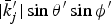 $\vert {\bar{k}^{\prime}_j } \vert \sin{\rm \theta}^{\prime}\sin{\rm \phi}^{\prime}$. The ratio of these relations leads to
 $${\rm \phi} = {\rm \phi}^{\prime}.$$
It is easy to prove, that in virtue of equations (73), (74), (89), (90), and (91), the following relations are valid:
 $$\bar{E}_{\,js} \bar{n}=0\hbox{ and }\bar{E}_{\,jc} \bar{n}=0 .$$
With the aid of Eqs. (8) (which is the same for both the σL and πL polarizations), (71), and (85) we obtain the following expressions of the angular frequency and of the wavelength of the j-th component of the scattered radiation, in an arbitrary direction:
 $$\eqalign {{\rm \omega} _j & =j{\rm \omega} _L {\rm \gamma} _0^2 \left( {1+\vert {\bar{\rm \beta}_0 } \vert \cos{\rm \theta} _L }\right) \left( {1 - \vert {{\rm \beta} _0 } \vert \cos{\rm \theta}^{\prime}}\right)\ {\rm and}\cr & \quad {\rm \lambda} _j = \displaystyle{{{\rm \lambda} _L } \over {\,j{\rm \gamma} _0^2 \left({1 +\vert \bar{\rm \beta}_0\vert \cos {\rm \theta} _L } \right)\left({1 - \vert \bar{\rm \beta}_0\vert \cos {\rm \theta} ^\prime } \right)}}}.$$
The energy of the quanta of the scattered radiation, in an arbitrary direction, is:
 $$W_j={\rm \omega} _j \hbar=j{\rm \omega} _L {\rm \gamma} _0^2 \left( {1+\vert {\bar{\rm \beta}_0 } \vert \cos{\rm \theta} _L }\right)\left( {1 - \vert {{\rm \beta} _0 } \vert \cos{\rm \theta}^{\prime}}\right) \hbar.$$
5.2. Polarization of the Electromagnetic Field of the Scattered Beam
The scattering plane is defined by the directions of the incident and scattered beams. The versors corresponding to these directions are  $\bar{n} _L=\bar{k}_L /\vert {\bar{k}_L } \vert $ and
 $\bar{n} $. The versor normal to the scattering plane, which is the same as the versor of the electric field intensity, in the case of the σ polarization, denoted by
 $\bar{n} _{\rm \sigma} $, is
 $\bar{n} \times \bar{n} _L$. Its expression is different for the σL and πL polarizations of the incident beam, so we will analyze separately these cases.
5.2.1. The Case of the σL Polarization of the Incident Field
In virtue of relations Eqs. (1) and (89), it follows that the versor normal to the scattering plane is
 $$\bar{n} _{\rm \sigma}=\left( {\cos{\rm \theta} _L n_y - \sin{\rm \theta} _L n_z }\right) \bar{i} - \cos{\rm \theta} _L n_x \bar{j}+\sin{\rm \theta} _L n_x \bar{k}.$$
In virtue of (76), (83), and (95), it follows that the angle ξo between the vector  $\bar{E}_j$ and the direction of the σ polarization in the case of odd harmonics (when
 $\bar{E}_j=\bar{E}_{\,jc}$) is given by the following relation
 $$\eqalign {& \cos {\rm \xi} _e = \displaystyle{{\bar{E}}_{\,jc} \over {\bar{E}_{\,jc} }} \cdot \bar{n}_{\rm \sigma}\cr & \quad = \displaystyle{{\left({\cos {\rm \theta} _L n_y - \sin {\rm \theta} _L n_z } \right)I_{1cj} - \cos {\rm \theta} _L n_x I_{2cj} + \sin {\rm \theta} _L n_x I_{3cj} } \over {\sqrt {I_{1cj}^2 + I_{2cj}^2 + I_{3cj}^2 } }}.}$$
Similarly, the angle ξe between the vector  $\bar{E}_j$ and the direction of the σ polarization, in the case of even harmonics (when
 $\bar{E}_j=\bar{E}_{\,js}$) is given by the relation
 $$\eqalign {& \cos {\rm \xi} _e = \displaystyle{{\bar{E}}_{\,js} \over \vert {\bar{E}_{\,js} }\vert} \cdot \bar{n}_{\rm \sigma} \cr & \quad = \displaystyle{\left(\! \cos {\rm \theta} _L n_y - \sin {\rm \theta} _L n_z\right) I_{1sj} - \cos {\rm \theta} _L n_x I_{2sj} + \sin {\rm \theta} _L n_x I_{3sj} \over \sqrt {I_{1sj}^2 + I_{2sj}^2 + I_{3sj}^2 }}.}$$
5.2.2. The Case of the πL Polarization of the Incident Beam
From Eqs. (5) and (89), we obtain the following expression of the versor normal to the scattering plane
 $$\bar{n} _{\rm \sigma}=\cos{\rm \theta} _L n_y \bar{i}+\left( {\sin{\rm \theta} _L n_z - \cos{\rm \theta} _L n_x }\right) \bar{j} - \sin{\rm \theta} _L n_y \bar{k}.$$
From (76), (83), and (98), it follows that the angle between the vector  $\bar{E}_j$ and the direction of the σ polarization, in the case of odd harmonics, is given by the relation
 $$\eqalign {& \cos {\rm \xi} _0 = \displaystyle{{\bar{E}}_{\,jc} \over \vert {\bar{E}_{\,jc} }\vert} \cdot \bar{n}_{\rm \sigma} \cr & \quad = \displaystyle{\cos {\rm \theta} _L n_y I_{1cj} + \left( \sin {\rm \theta} _L n_z - \cos {\rm \theta} _L n_x\right) I_{2cj} - \sin {\rm \theta} _L n_y I_{3cj} \over \sqrt {I_{1cj}^2 + I_{2cj}^2 + I_{3cj}^2 }}.}$$
Similarly, the angle between the vector  $\bar{E}_j$ and the direction of the σ polarization, in the case of even harmonics, is given by the relation
 $$\eqalign {& \cos {\rm \xi} _e = \displaystyle{{\bar{E}}_{\,js} \over \vert {\bar{E}_{\,js} }\vert} \cdot \bar{n}_{\rm \sigma} \cr & \quad = \displaystyle{\cos {\rm \theta} _L n_y I_{1sj} + \left( \sin {\rm \theta} _L n_z - \cos {\rm \theta} _L n_x\right) I_{2sj} - \sin {\rm \theta} _L n_y I_{3sj} \over \sqrt {I_{1sj}^2 + I_{2sj}^2 + I_{3sj}^2 }}.}$$
We observe that Eqs. (92) and (95)–(100) define completely the polarization of the scattered electromagnetic field  $\bar{E}_j$. This happens because the vector
 $\bar{E}_j$ is situated in the plane perpendicular on
 $\bar{n}$, and makes an angle ξo or ξe, respectively, for odd and even harmonics, with the direction of the σ polarization. If ξo = 0 or ξe = 0 the scattered electromagnetic field is σ polarized, while when ξo = π/2 or ξe = π/2 the scattered field is π polarized.
5.3. Intensities of the Harmonic Radiation Beams in the S′and S Systems
The average value of the intensity of the j-th component of the scattered radiation, normalized to ɛ0cK′2, in the system S′, is given by
 $$\underline I^{\prime}_j=\displaystyle{I_j \over {\rm \varepsilon} _0 cK^{\prime 2}}=\displaystyle{1 \over 2{\rm \pi} }\int _0^{2{\rm \pi} } \displaystyle{\bar{E}^{\prime 2}_j \over K^{\prime 2 }} d\lpar j{\rm \eta}^{\prime}\rpar .$$
Taking into account (66), we obtain the following relation:
 $$\underline I^{\prime}_j=\displaystyle{1 \over 2}\left(\,f^{\prime 2}_{1sj}+f^{\prime 2}_{1cj}+f^{\prime 2}_{2sj}+f^{\prime 2}_{2cj}+f^{\prime 2}_{3sj}+f^{\prime 2}_{3cj}\right).$$
In order to calculate the average value of the intensity of the j-th harmonics of the scattered radiation in the laboratory system, we calculate first the expression of  $\bar{E}_j^2$, where
 $\bar{E}_j$ is the intensity of the electric field in the S system. The Lorentz transformation of the electric field intensity from the S′ to the S system is given by Eq. (11.149) of Jackson (Reference Jackson1999), and, written in the International System, leads to the following relation:
 $$\bar{E}_j^2=\left[{{\rm \gamma} _0 \left(\bar{E}^{\prime}_j - \bar{\rm \beta}_0 \times c\bar{B}^{\prime}_j\right)- \displaystyle{{\rm \gamma} _0^2 \over {\rm \gamma} _0+1}\bar{\rm \beta}_0 \left({\bar{\rm \beta}_0 \cdot \bar{E}^{\prime}_j}\right)} \right]^2.$$
Since  $c\bar{B}_j^{\prime} = \bar{n}^{\prime} \times \bar{E}_j^{\prime} \comma \; \bar{n}^{\prime} \cdot \bar{E}_j^{\prime} = 0$ and
 $\bar{E}^{\prime} _j \cdot \left[{\bar{\rm \beta}_0 \times \left({\bar{n}^{\prime} \times \bar{E}_j^{\prime} } \right)} \right]= $
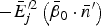 $- \bar{E}_j^{\prime 2} \left({\bar{\rm \beta}_0 \cdot \bar{n}{^\prime} } \right)$, Eq. (103) becomes
 $$\eqalign {\bar{E}_j^2 &= {\rm \gamma}_0 ^2 \bar{E}_j^{\prime 2} \left[1+\bar{{\rm \beta}}_0^2 \sin^2 {\rm \alpha}_3 + {\displaystyle{{\rm \gamma}_0^2}\bar{{\rm \beta}}_0^4 \over \left( {\rm \gamma}_0+1\right) ^2} \cos^2 {\rm \alpha}_2\right. \cr & \quad \left. +2 \vert \bar{{\rm \beta}}_0\vert \cos {\rm \alpha}_1 - {\displaystyle {2{\rm \gamma} _{0}\bar{{\rm \beta}}_0^2 \over {\rm \gamma}_0+1}} \cos^2 {\rm \alpha}_2\right]\comma \; }$$
where α1 is the angle between  $\bar{{\rm \beta}}_0$ and
 $\bar{n}^{\prime}$, α2 is the angle between
 $\bar{\rm \beta}_0 $ and
 $\bar{E}^{\prime}_j $, and α3 is the angle between
 $\bar{\rm \beta}_0 $ and
 $\bar{n}^{\prime} \times \bar{E}^{\prime}_j $. It is easy to see that γ02β02/(γ0 + 1)2 − 2γ0/(γ0 + 1) = −1, and Eq. (104) can be written:
 $$\bar{E}_j^2={\rm \gamma} _0^2 \bar{E}^{\prime 2}_j \left(1+\bar{\rm \beta}_0^2 \sin^2 {\rm \alpha} _3 - \bar{\rm \beta}_0^2 \cos^2 {\rm \alpha} _2+2\vert \bar{\rm \beta}_0 \vert \cos {\rm \alpha} _1 \right).$$
The three vectors,  $\bar{n}^{\prime}$,
 $\bar{E}^{\prime}_j $, and
 $\bar{n}^{\prime} \times \bar{E}^{\prime}_j $ form a right trihedral angle, therefore, cos2 α1 + cos2 α2 + cos2 α3 = 1 and we obtain:
 $$\bar{E}_j^2={\rm \gamma} _0^2 \bar{E}^{\prime 2}_j \left( {1+\vert {\bar{\rm \beta}_0 } \vert \cos{\rm \alpha} _1 }\right) ^2.$$
Since α1 = π− θ′, from (106) we obtain
 $$\bar{E} _j^2=\bar{E}^{\prime 2}_j {\rm \gamma} _0^2 \left( 1 - \vert \bar{\rm \beta}_0 \vert \cos{\rm \theta}^{\prime}\right) ^2.$$
The intensity of the j-th harmonics of the scattered radiation is  ${\rm \varepsilon} _0 c\bar{E}_j ^2 $ in the S system. Its averaged value, normalized to ɛ0cK′2, results from Eqs. (101), (102), and (107), as follows
 $$\eqalign {\underline I_j&=\displaystyle{I_j \over {\rm \varepsilon} _0 cK^{\prime 2 }}={\rm \gamma} _0^2 \lpar 1 - \vert {{\rm \beta} _0 } \vert \cos{\rm \theta}^{\prime}\rpar ^2 \displaystyle{1 \over {2{\rm \pi} }}\int_0^{2{\rm \pi} } \displaystyle{\bar{E}^{\prime 2}_j \over K^{\prime 2}}d\lpar j{\rm \eta}^{\prime}\rpar \cr & \quad =\displaystyle{1\over 2}{\rm \gamma}_0^2 \left( 1-\vert{\rm \beta}_0\vert \cos {\rm \theta}^{\prime}\right) ^2\cr & \quad \times \left(\,f^{\prime 2}_{1sj}+f^{\prime 2}_{1cj}+f^{\prime 2}_{2sj}+f^{\prime 2}_{2cj}+f^{\prime 2}_{3sj}+f^{\prime 2}_{3cj}\right)\comma \; }$$
or
 $$\underline I_j={\rm \gamma} _0^2 \lpar {1 - \vert {{\rm \beta} _0 } \vert \cos{\rm \theta}^{\prime}}\rpar ^2 \underline I^{\prime}_j.$$
The analysis Eqs. (60)–(65) shows that the intensity components of the electric field in the S′ system, namely h′1/F′13, h′2/F′13, and h′3/F′13, are composite functions of f′1, f′2, f′3, g′1, g′2, g′3, and γ′, which, in turn, are periodic functions of η′. Our method is based on this property, because the calculation of the composite functions and their integrals can be easily performed by simple computer programs.
When the incident electromagnetic field is σL polarized, our calculations are made using Mathematica 7 with the aid of the following algorithm. In the first step, we introduce the initial data of the system, which are a, γ0, θL, ηi, ωL θ′, ϕ′ and j. In the second step, we calculate the functions f′1, γ′, f′2, f′3, g′1, g′2, g′3, F′1, F′2, h′1, h′2, and h′3. In the third step, we calculate the integrals (68), from which we obtain the f′1sj, f′1cj, f′2sj, f′2cj, f′3sj, and f′3cj. Eqs. (102) and (109) lead, finally, to the values of  $\underline I^{\prime}_j $ and
 $\underline I_j$. The relative errors of our calculations are of the order 10−12.
When the incident electromagnetic field is πL polarized, the calculations are very similar to those performed for the σL polarization. There is one difference: in the second step of the algorithm, the order of the calculation of the composite functions is f, γ′, f′1, f′3, g′1, and g′3 (in this case f′2 = g′2 = 0).
6. APPLICATION: SCATTERED BEAM CHARACTERISTICS IN THE DIRECTION IN WHICH THE SCATTERED BEAM HAS MAXIMUM INTENSITY
We consider in this section the applications in which the scattered radiations are emitted in the direction in which the electron beam moves, which corresponds to θ′ = θ= π. We will show below that the intensity of the radiation emitted in this direction is maximum.
6.1. The 180° and 90° Configurations, as Particular Cases of σL and πL Polarizations
As the angle θL increases, the system will pass periodically through the two configurations of interaction having 180° or 90° geometries. We recall that these two geometries correspond to the cases in which the laser and electron beams collide, respectively, head on and perpendicularly. This holds for both the σL and πL polarizations.
The value θL = 0 corresponds to the 180° geometry. In this case, the σL and πL polarizations are identical, because they correspond to the same incident electromagnetic field, when  $\bar{E}_L=E_M \cos{\rm \eta} \bar{i}\comma \; \bar{B}_L=B_M \cos{\rm \eta} \bar{j}$, and
 $\bar{k}_L=\vert {\bar{k}_L } \vert \bar{k}$.
The values θL = ±90° correspond to the 90° geometry. For these values of θL the σL and πL polarizations behave differently. For the σL polarization, we have  $\bar{E}_L=$
 $E_M \cos{\rm \eta} \bar{i}\comma \; \bar{B}_L=\mp B_M \cos{\rm \eta} \bar{k}$, and
 $\bar{k}_L=\pm \vert {\bar{k}_L } \vert \sin{\rm \theta} _L \bar{j}$, while for the πL polarization,
 $\bar{E}_L=\mp E_M \sin{\rm \theta} _L \cos{\rm \eta} \bar{k}$,
 $\bar{B}_L=$
 $B_M \cos{\rm \eta} \bar{j}$, and
 $\bar{k}_L=\pm \vert {\bar{k}_L } \vert \sin{\rm \theta} _L \bar{i}$. Figure 3, obtained with the aid of Eq. (94), shows the variation of the quanta energy of the radiation scattered in the direction in which the electron beam moves (which corresponds to θ′ = θ= π) as function of θL. The energy is normalized to
 $j{\rm \omega} _L {\rm \gamma} _0^2 \lpar {1+\vert {\bar{\rm \beta}_0 } \vert }\rpar ^2 \hbar$. The 180° geometry corresponds to θL = 0°; 180°, while the 90° geometry corresponds to θL = 90°; 270°; these points have been marked accordingly on the curve illustrated in Figure 3. This figure shows that the energy corresponding to the 90° geometry is half the energy corresponding to the 180° geometry, for same values of ωL and γ0.
Variation of the quanta energy of the scattered radiation normalized to  $j{\rm \omega}_L {\rm \gamma}_0^2 \lpar 1 + \vert \bar{{\rm \beta}}_0 \vert\rpar ^2 \hbar$ as function of θL, for θ′ = θ= 180° and γ0 = 100. The point θL = 0° corresponds to the 180° geometry, while the points θL = 90° and θL = 270° correspond to the 90° geometry.

From the properties of the the Liènard-Wiechert equation, it results that the components of the scattered electromagnetic field emitted in a certain direction are rigorously determined. It follows that for a point on the curve shown in Figure 3, which corresponds a certain value of θL and to a certain geometry of the collision between the laser and electron beams, we can evaluate exactly the polarization of the scattered beam. The polarization, which corresponds to a given interaction geometry, results from Figure 4, in which we represent the variations of the angle ξ with θL, in the cases of the two σL and πL polarizations, for odd and even harmonics. The angle ξ corresponds to the polarization of the electric field of the scattered radiation.
Variations of the angle ξ, which corresponds to the polarization of the electric field of the scattered radiation, as function of θL, for a = 4, γ0 = 100, θ′ = θ= 180°, ηi = 20° and ωL = 2.355 × 10¹⁵ rad/s. Curve 1 correspons to the σL polarization of odd harmonics, curve 2 correspons to the σL polarization of even harmonics, while curve 3 corresponds for the π polarization, for both the even and odd harmonics. The σ polarization of the scattered field corresponds to ξ = 0°, while the π polarization corresponds to ξ = ±90°.

We can find the polarization of the scattered field in a given geometry from Figures 3 and 4. We consider, for example, the 180° geometry, which corresponds to θL = 0 in Figure 3. We can see from Figure 4 that the scattered field is π polarized, because it corresponds to ξ = 90° for all cases, when the incident field is either σL or πL polarized, for odd and even harmonics. For the 90° geometry, which corresponds to θL = 90° in Figure 3, we find from Figure 4 that the scattered field is σ polarized for even harmonics, because it corresponds to ξ = 0 on curve 2.
6.2. Comparison between Theory and Experiment
The initial data entering our model, which correspond to certain experiments reported in the literature, consists of the initial energy of the electron, the energy of the laser pulse, the radius of the laser beam, the duration of the laser pulse, and the wavelength of the laser pulse. These quantities are denoted, respectively, by E i, W L, r L, τL, and λL. We use the relations  ${\rm \gamma} _0=E_i /mc^2\comma \; \vert {\bar{\rm \beta}_0 } \vert =\sqrt {1 - 1/{\rm \gamma} _0^2 }\comma \; I_L=W_L /\lpar {\rm \pi} r_L^2 {\rm \tau} _L \rpar \comma $
 $ E_M=\sqrt {2I_L /\lpar {\rm \epsilon} _0 c\rpar }\comma \; {\rm \omega} _L=\lpar 2{\rm \pi} c\rpar /{\rm \lambda} _L$, and a = eE M/(mcω) to calculate, respectively,
 ${\rm \gamma} _0\comma \; \vert {{\rm \beta} _0 } \vert $, I L, E M, ωL, and a, where I L is the intensity of the laser beam.
Figure 5 presents the angular distributions of the scattered radiations, which correspond to four experiments. The curves 1, 2, 3, and 4 from Figure 5 correspond, respectively, to the experiments (Babzien et al., Reference Babzien, Ben-Zvi, Kusche, Pavlishin, Pogorelski, Siddons and Yakimenko2006; Pogorelsky et al., Reference Pogorelsky, Ben-Zvi, Hirose, Kashiwagi, Yakimenko, Kusche, Siddons, Skaritka, Kumita, Tsunemi, Omori, Urakawa, Washio, Yokoya, Okugi, Liu, He and Cline2000; Anderson et al., Reference Anderson, Barty, Betts, Brown, Crane, Cross, Fittinghoff, Gibson, Hartemann, Kuba, Lesage, Rosenzweig, Slaughter, Springer and Tremaine2004; Kim et al., Reference Kim, Chattopadhay and Shank1994). The calculations are made for θ′ = π and for the values of θL, a, γ0, λL, and ωL, listen in caption of the figure. These calculations are made as follows. With the aid of Mathematica 7 and the procedure described in previous section, we calculate first the variation of the scattered beam intensity  $\underline I_1$ as function of θ′, when θ′ takes values between 90° and 180°. With the aid of Eq. (90) we calculate the values of θ as function of θ′ and the values of the angle α given by the relation
 $${\rm \alpha}={\rm \pi}-{\rm \theta} .$$
Knowing the variations  $\underline I_1 \lpar {\rm \theta}^{\prime}\rpar $ and
 ${\rm \alpha} \lpar {\rm \theta}^{\prime}\rpar $ we obtain the variation of
 $\underline I_1$ as function of α.
Variations of I 1, normalized to their maximum values, with α. Curve 1 is for the 180° geometry, θL = 0°, γ0 = 117.4, j = 1, a = 0.35, ηi = 0°, θ′ = 180°, ϕ′ = 0° and ωL = 1.777 × 10¹⁴ rad/s; curve 2 is for the 180° geometry, θL = 0°, γ0 = 117.4, j = 1, a = 0.053, ηi = 0°, θ′ = 180°, ϕ′ = 0° and ωL = 1.777 × 10¹⁴ rad/s; curve 3 is for the 180° geometry, θL = 0°, γ0 = 111.5, j = 1, a = 0.2012, ηi = 0°, θ′ = 180°, ϕ′ = 0° and ωL = 2.355 × 10¹⁵ rad/s; curve 4 is for the 90° geometry, σL polarization, θL = 90°, γ0 = 62.62, j = 1, a = 0.08369, ηi = 0°, θ′ = 180°, ϕ′ = 0° and ωL = 2.355 × 10¹⁵ rad/s; curve 5 is for the same parameters as for curve 4, but the πL polarization is used instead.

The values of the divergence angles of the scattered beams, which result from Figure 5, are almost identical to the experimental values. For example, in the case of curve 1, the divergence angle is 8 mrad. This value is in agreement with the experimental value which results from Figure 3a in Babzien (2006). Similarly, curves 2 and 3 show divergences of 8 mrad, which are in good agreement with the experimental data presented, respectively, at page 090702-4 in Pogorelsky et al. (Reference Pogorelsky, Ben-Zvi, Hirose, Kashiwagi, Yakimenko, Kusche, Siddons, Skaritka, Kumita, Tsunemi, Omori, Urakawa, Washio, Yokoya, Okugi, Liu, He and Cline2000) and in Figure 3 in Anderson et al. (Reference Anderson, Barty, Betts, Brown, Crane, Cross, Fittinghoff, Gibson, Hartemann, Kuba, Lesage, Rosenzweig, Slaughter, Springer and Tremaine2004).
In the same time, there is a good agreement between theoretical and experimental values of energies or wavelengths of the scattered radiations, which correspond to the data shown in Figure 5. For example, using the data for cases 1 and 3, we obtain, with the aid of Eq. (94), respectively, the values W 1 = 6.45 keV and W 1 = 77.1 keV. These values have to be compared, respectively, to the experimental values 6.5 keV (Babzien et al., Reference Babzien, Ben-Zvi, Kusche, Pavlishin, Pogorelski, Siddons and Yakimenko2006) and 78.5 keV (Anderson et al., Reference Anderson, Barty, Betts, Brown, Crane, Cross, Fittinghoff, Gibson, Hartemann, Kuba, Lesage, Rosenzweig, Slaughter, Springer and Tremaine2004). In the same mode, using the data for cases 2 and 4, we obtain, with the aid of Eq. (93), respectively, the values λ1 = 1.9A and W 1 = 1.02A. These values have to be compared, respectively, to the experimental values 1.8 A (Pogorelsky et al., Reference Pogorelsky, Ben-Zvi, Hirose, Kashiwagi, Yakimenko, Kusche, Siddons, Skaritka, Kumita, Tsunemi, Omori, Urakawa, Washio, Yokoya, Okugi, Liu, He and Cline2000) and 1 A (Kim et al., Reference Kim, Chattopadhay and Shank1994).
We evaluate now the properties of the second harmonic, resulted from the experiment corresponding to curve 1 from Figure 5. Using Eq. (94), in which we set j = 2, θL = 0, and θ′ = π, we obtain W 2 = 12.9 keV. This value is in good agreement with the corresponding experimental value of W 2exp = 13 keV (Babzien et al., Reference Babzien, Ben-Zvi, Kusche, Pavlishin, Pogorelski, Siddons and Yakimenko2006).
For the aforementioned experiment, we calculate the angular distribution of the second harmonic,  $\underline I_2$. We record in Figure 6 the angular variation of
 $\underline I_2$ as function of α. A comparison between our theoretical results shown in Figure 6 and the experimental results shown in Figure 3 in Babzien et al., (Reference Babzien, Ben-Zvi, Kusche, Pavlishin, Pogorelski, Siddons and Yakimenko2006) reveals that the angular distributions of
 $\underline I_2$ are the same in both cases. The distance between the two-peak pattern of the second harmonics radiation, shown in Figure 3b in Babzien et al., (Reference Babzien, Ben-Zvi, Kusche, Pavlishin, Pogorelski, Siddons and Yakimenko2006), corresponds to 6 mrad. This value is in good agreement with our calculated value, which results from Figure 6.
Variations with α of I 2, normalized to its maximum value, for the 180° geometry, θL = 0°, γ0 = 117.4, j = 2, a = 0.35, ηi = 0°, θ′ = 180°, ϕ′ = 0° and ωL = 1.777 × 10¹⁴ rad/s.

For the same initial data, corresponding to the first case presented in Figure 5, we have calculated the polar distribution of the X-ray intensity, namely the variation of  $\underline I_2$ with ϕ, for constant θ′. This variation, when the electromagnetic field is linearly polarized in the directions ox and oy, is shown in Figure 7. If we compare Figure 7 of our paper and Figure 4 in (Babzien et al., Reference Babzien, Ben-Zvi, Kusche, Pavlishin, Pogorelski, Siddons and Yakimenko2006), we will see a good agreement between the theoretical and experimental polar distributions of I 2. We notice in both figures that these distributions are represented by two lobes, whose axes are parallel to the two directions of the field polarization.
The intensities of the second harmonics, I 2, normalized to their maximum values, as functions of ϕ in the case of the head-on interaction between the electromagnetic field and relativistic electrons. The calculations are made for θL = 0, γ0 = 117.4, ωL = 1.777 × 10¹⁴ rad/s, θ′ = 130° and ηi = 0°. The field is characterized by a = 0.35 and is linearly polarized in the ox direction for curve 1, and in oy direction for curve 2.

We use Eqs. (102) and (109) to calculate the spectra of the beam scattered in the direction of the moving of the electron, in the inertial systems S′ and S, when  $\underline I^{\prime}_j$ and
 $\underline I_j$ are normalized to their maximum values. This direction corresponds to the maximum intensity in the narrow emission cone of the scattered radiation. The spectra, which are calculated for three values of the a parameter, are represented in Figure 8. As it results from this figure, and from Eqs. (102) and (109), the spectra corresponding to
 $\underline I^{\prime}_j$ and
 $\underline I_j$ are identical.
Typical spectral distributions ot the scattered Thomson radiation, namely variations of I j′ and I j in the inertial systems S′ and S, normalized for their maximum values, for odd harmonics, E i = 100 MeV, γ0 = 195.8, θL = 0°, θ′ = 180°, ϕ′ = 0°, ηi = 0° and ωL = 2.355 × 10¹⁵ rad/s. The spectra from curves 1, 2 and 3 correspond, respectively, to a = 3, a = 5 and a = 7. The spectra of I j′ and I j are identical. The continuous curves interpolate the discrete values of I j′ and I j, which are denoted by points.

This analysis reveals two properties. First, the spectrum has a specific shape that comprises a slowly increasing region for low order harmonics, followed by a maximum and a fast decreasing region for higher harmonics. Second, the maximum of the spectrum is shifting to shorter wavelengths, when a increases.
We recall that the spectrum given by  $\underline I^{\prime}_j=\underline I^{\prime}_j \lpar j\rpar $ is calculated in the system S′ when a very intense laser field, characterized by relativistic parameters having values bigger than unity, interacts with an electron whose initial velocity is zero. We compare our theoretical prediction with the spectral curve obtained in an experiment presented in (Ta Phuok et al., Reference Ta Phuok, Rousse, Pittman, Rousseau, Malka, Fritzler, Umstadter and Hulin2003) that involved the interaction of a very intense laser beam and an electron having negligible initial velocity. The comparison of the curves illustrated in Figure 8 and Figure 2a in Ta Phuok et al., (Reference Ta Phuok, Rousse, Pittman, Rousseau, Malka, Fritzler, Umstadter and Hulin2003) shows that these curves have similar shapes. The second property stated above, namely that the maximum of the spectrum is shifting to shorter wavelengths when a increases, is in good agreement with the experimental data presented in Ta Phuok et al. (Reference Ta Phuok, Rousse, Pittman, Rousseau, Malka, Fritzler, Umstadter and Hulin2003).
We note that the energies of the radiations calculated in this example for low orders of harmonics with the aid of Eq. (94) are on the order of 1 MeV. For example, for j = 5, we obtain W 5 = 1.189 MeV (see Fig. 8).
7. CONCLUSIONS
We presented an accurate model used to calculate the angular and spectral distributions of the scattered radiations in collisions between very intense laser beams and relativistic electrons. Its accuracy stems from the fact that it uses only one approximation, namely it neglects the radiative corrections. The model is in in good agreement with numerous experimental data presented in literature, and it predicts the possibility of obtaining photonic sources for energies greater than 1 MeV with the existing technology. We proved that the energy and the polarization of the electromagnetic radiations emitted by such a source can be accurately adjusted by the variation of the angle between the directions of the laser and electron beams.
ACKNOWLEDGMENTS
This work was supported by a grant of Romanian National Authority for scientific Research, CNCS-UEFISCDI, project number PN-II-ID-PCE-2011-3-024.



