Introduction
Forests, and tropical rainforests in particular, are an important regulator of the planet’s climate through their capacity to store carbon, i.e. carbon sinks. They are involved in global processes such as soil protection against erosion (Vogt et al. Reference Vogt, Grier and Vogt1986), hydrological (Band et al. Reference Band, Patterson, Nemani and Running1993), and climatic regulation (Nabuurs et al. Reference Nabuurs, Päivinen, Sikkema and Mohren1997) and, above all, play a major role in the conservation of both animal and plant biodiversity. However, both forests and their biodiversity are threatened by human activities, and their surface area is decreasing at an alarming rate (FAO 2020). The rate of net forest loss decreased significantly over the period 1990–2020 due to a reduction in deforestation in some countries and an increase in forest area in others due to afforestation and natural forest expansion. The rate of net forest loss decreased from 7.8 million hectares per year over the period 1990–2000 to 5.2 million hectares per year over the period 2000–2010 and to 4.7 million hectares per year over the period 2010–2020 (FAO 2020). In Côte d’Ivoire, dense rainforest was estimated to occupy an area of 16 million hectares at the end of the 19th century (Aké Assi & Dian Reference Aké Assi and Dian1990), but the end of the 20th century this decreased to 2.7 million hectares (Païvinen et al. Reference Païvinen, Pitkanen and Witt1992). Deforestation and land degradation are the main drivers of biodiversity loss, as they result in the destruction of habitats and ultimately the extinction of species.
Protected areas are places that have more or less escaped human development. Globally, about 726 million hectares of forest lie within protected areas (FAO 2020). However, they do not necessarily guarantee the survival of species, including great apes (Campbell et al. Reference Campbell, Kuehl, Kouame, N’Goran and Boesch2008; Kormos et al. Reference Kormos, Boesch, Bakarr and Butynski2004), and other fauna (Laurance et al. Reference Laurance, Useche, Rendeiro, Kalka, Bradshaw, Sloan, Campbell, Abernethy, Alvarez, Ashton, Benítez-Malvido, Blom, Bobo, Cannon, Cao, Coates, Cords, De Dijn, Dinerstein, Donnelly, Edwards, Foster, Gale, Harris, Harrison, Hart, Karpanty, Kress, Krishnaswamy, Logsdon, Lovett, Maisels, Marshall, McClearn, Mudappa, Nielsen, van der Ploeg, Plumptre, Poulsen, Quesada, Rainey, Robinson, Scatena, Schulze, Sheil, Struhsaker, Terborgh, Thomas, Timm, Urbina-Cardona, Vasudevan, Arroyo, Ashton, Auzel, Babaasa, Babweteera, Baker, Banki, Blake, Brockelman, Brokaw, Brüh, Bunyavejchewin, Chave, Chellam, Clark, Clavijo, Congdon, Dave, Beisiege, Paes da Silva, Dirzo, Doran-Sheehy, Eaton, Emmons, Estrada, Ewango, Feer, Fruth, Willis, Goodale, Goodman, Guix, Guthiga, Haber, Hamer, Herbinger, Hill, Huang, Sun, Ickes, Itoh, Ivanauskas, Janzen, Jiangming, Jin, Jones, Justiniano, Kalko, Kasangaki, King, Klop, Knott, Koné, Ribeiro, Lattke, Laval, Lawton, Leal, Leighton, Lentino, Leonel, Lindsell, Lwanga, Mack, Martins, McGraw, McNab, Montag, Thompson, Nepal, Norconk, Novotny, O’Donnell, Opiang, Ouboter, Parker, Pisciotta, Prawiradilaga, Pringle, Rajathurai, Reinartz, Renton, Reynolds, Reynolds, Riley, Sakai, Sanaiotti, Siaka, Silman, Smith, Sodhi, Stewart, Stokes, Stoner, Surbeck, Tobler, Umapathy, Rivera, Venn, Verea, Waltert, Wang, Watts, Weber, West, Whitacre, Whitney, Wilkie, Wright, Xiankai, Yonzon and Zamzani2012), as over hunting of animal species due to poaching often leads to the disappearance of forest biome fauna (Nasi et al. Reference Nasi, Taber and van Vliet2011). Wilkie & Carpenter (Reference Wilkie and Carpenter1999) have shown that poaching-related removal rates of most large mammals in Central Africa are unsustainable. Conservation actions, specifically the presence of guards/rangers, researchers, and long-term non-governmental conservation organisations, are the most reliable guarantors of the survival for great apes (Tranquilli et al. Reference Tranquilli, Abedi-Lartey, Amsini, Arranz, Asamoah, Babafemi, Barakabuye, Campbell, Davenport, Dunn, Dupain, Ellis, Etoga, Furuichi, Gatti, Ghiurghi, Hart, Hicks, Holbech, Huijbregts, Imong, Kumpel, Maisels, Marshall, Nixon, Nziguyimpa, Nzooh-Dogmo, Okon, Plumptre, Rundus, Sunderland-Groves, Todd, Warren, Mundry, Boesch and Kuehl2012; Tagg et al. Reference Tagg, Willie, Duarte, Petre and Fa2015).
The Taï National Park is home to one of the largest chimpanzee populations in Côte d’Ivoire (Granier et al. Reference Granier, Hambuckers, Matsuzawa and Huynen2014; GSP CSE UICN 2020). Due to a long history of research conducted by the Taï Chimpanzee Project (TCP), three chimpanzee communities have been fully habituated to human presence and regularly monitored: the Northern, Southern, and Eastern communities. The home range size of the Northern community varies between 19 and 30 km2, that of the Southern community between 38 and 49 km², and that of the Eastern community between 32 and 43 km² (Samuni et al. Reference Samuni, Crockford and Wittig2021). Chimpanzees are omnivorous but consume a large amount of fruit and play an important role in seed dispersal (Ban et al. Reference Ban, Boesch, N’Goran, N’Guessan, Tako and Janmaat2016; N’guessan et al. Reference N’guessan, Boussou and Koffi2021).
Seed dispersal is an essential ecological process that contributes to the maintenance of plant diversity (Wandrag et al. Reference Wandrag, Dunham, Duncan and Rogers2017). In fact, the removal of primary and secondary seed dispersers could result in the loss of approximately 60% of local tree species (Vulinec Reference Vulinec2000) across the tropical region. To ensure forest dynamics are maintained, the transport and dispersal mechanisms involved must be able to safeguard the germination capacity of the seeds involved. According to Lazure & Almeida-Cortez (Reference Lazure and Almeida-Cortez2008), frugivores can affect seed germination in three ways: (i) by mechanically or chemically modifying the pericarp; (ii) by separating the seeds from the pulp; and (iii) by the fertilising effect of faeces surrounding the seeds. Also, passage through the gut can kill the larvae of infesting insects such as Bruchid beetles (Fragoso Reference Fragoso1997).
Additionally, the burial of faeces by dung beetles contributes towards many essential ecological functions such as nutrient recycling soil fertilisation and aeration, parasite regulation, and secondary seed dispersal (Nichols et al. Reference Nichols, Spector, Louzada, Larsen, Amezquita and Favila2008).
The contribution of dung beetles to the dispersal of seeds from frugivore faeces has been widely reported (Andresen & Levey Reference Andresen and Levey2004; Andresen Reference Andresen2005; Culot et al. Reference Culot, Mann, Munoz Lazo, Huynen and Heymann2011; deCastro-Arrazola et al. Reference deCastro-Arrazola, Hortal, Ari Noriega and Sanchez-Pinero2020; Vulinec Reference Vulinec2000; Petre et al. Reference Petre, Zinque, Tagg, Beudels-Jamar, Haurez, Josso, Moretto and Doucet2015). Accordingly, dung beetles play a key role in mitigating density-dependent mortality in dispersed seeds by scattering those deposited as an aggregate in faeces (Andresen Reference Andresen2001; Andresen & Feer Reference Andresen, Feer, Forget, Lambert, Hulme and VanderWall2005), thus contributing towards natural forest regeneration.
The impact of dung beetles on seed fate can be affected by a variety of factors, including the type of seeds dispersed, their attractiveness and detectability to rodents, and their ability to germinate at a given depth.
The objective of the current study was to assess the germination probability and seedling establishment of four plant species at different burial depths within the Taï rainforest. Our research hypotheses were as follows: (H1) predation is a key factor governing the rate of seedling establishment; (H2) the presence of faeces around the buried seeds could promote germination by providing additional chemical elements to the soil, i.e. fertilisation; (H3) burial depth would influence the rate of seed germination and seedling establishment; (H4) chimpanzee intestinal transit will improve the rate of seed germination and seedling establishment.
Methods
Study site
The Taï National Park (TNP) covers an area of some 508,186 hectares in South-western Côte d’Ivoire and extends between 5°08′192″ and 6°23′790″ N and between 6°46′579″ and 7°26′006″ W (Décret n° 2018-496 du 23 mai 2018). It is the largest intact block of primary rainforest in West Africa and represents more than half of the total West African forest area with strongly protected status. TNP is characterised by a subequatorial climate with four seasons (Chatelain et al. Reference Châtelain, Kadjo, Koné and Refisch2001). Two wet seasons, a long one from March to June and a short one from September to November, are separated by a long dry season from December to February and a short dry season from July to August. Rainfall varies from 1,700 mm in the North-east to 2,200 mm in the South-west of the Park. The annual variation in temperature is around 4°C, ranging from 24 to 28°C. Relative humidity is always very high, varying from 70 to 90% (Chatelain et al. Reference Châtelain, Kadjo, Koné and Refisch2001). During the 2020 study year, the average temperature and rainfall were 25.2°C and 1,877 mm, respectively. The soil of TNP is of two main types: highly desaturated and fragile ferralitic soils and more fertile hydromorphic gley and pseudogley soils drained by numerous permanent watercourses which are shared between two large catchment areas and two basins of small coastal rivers. Some 1,300 species of vascular plants have been recorded in the TNP, 12% of which are endemic (Adou et al. Reference Adou, Blom, Dengueadhé, Van Rompaey, N’guessan, Wittebolle and Bongers2005). Vegetation is fairly homogenous overall with two main forest types, namely the hyper humid forest dominated by Diospyros spp. and Mapania spp. or pelohygrophilous forest and the evergreen forest dominated by Eremospatha macrocarpa and Diospyros mannii.
Plant species studied
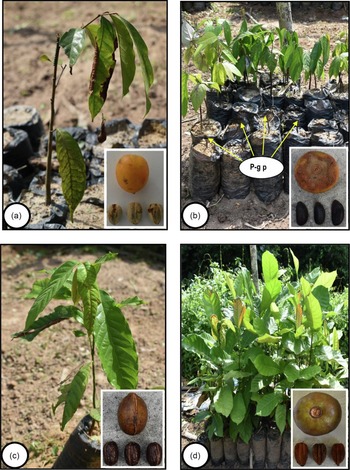
The seeds of four plant species (Figure 1) were selected for the study of dispersal by dung beetles. These were Uapaca guineensis Muell. Arg. (Phyllantacaea), Diospyros mannii Hiern (Ebenaceae), Dacryodes klaineana (Pierre) H.J. Lam (Burseraceae), and Pycnanthus angolensis (Welw.) Warb. (Myristicaceae). These species were selected as their fruits are regularly consumed by chimpanzees during the November – February period (Kasparek Reference Kasparek2000). Study of chimpanzee faeces during the study period showed that 66% of the total seeds found in their faeces belonged to the four plant species chosen above. The average seed dimensions for the four study species are given in Table 1.
Fruits, seeds, and seedlings of the four plant species studied. ((a) Dacryodes klaineana; (b) Diospyros mannii; (c) Pycnanthus angolensis; (d) Uapaca guineensis; P-g p: Post-germination predation).

Seed dimensions (in cm) of the four plant species studied (Mean ± SD, N = 75)

Dacryodes klaineana (Pierre) H.J. Lam (Burseraceae): A medium-sized, dioecious, evergreen, hypogeous germinating tree reaching 25–30 m high, often branched a few metres above the ground. The shaft is branchless over 10 m, up to 60–120 cm in diameter. The leaves are composed of imparipinnate, opposite leaflets with flowers in a raceme fascicle in the axils of the terminal leaves. The fruits are ovoid edible drupes of about 2 cm × 1 cm and have a lemony taste (Kasparek Reference Kasparek2000).
Diospyros mannii Hiern (Ebenaceae): A small tree with simple, alternate leaves. The flowers are unisexual, fasciculate, and axillary. The calyx is covered in short brown hairs. The fruits are hard-husked berries completely covered with brown hairs. The genus Diospyros is a Pantropical genus of some 700 species, 6 of which are known from TNP (Kasparek Reference Kasparek2000). The species Diospyros mannii is the most common in TNP and is often consumed by chimpanzees.
Pycnanthus angolensis (Welw.) Warb. (Myristicaceae): An evergreen tree, monoecious or dioecious, medium to large in size and up to 25–35 (-40) m high. The straight, cylindrical shaft is branchless up to 15 (-25) m, reaching 120 (-150) cm in diameter. This species usually bears buttresses. The outer bark is greyish-brown with orange-brown exudate. The cyme is small, the alternate leaves are disticticulate, simple and whole, without stipules. The fruit is an ellipsoid to oblong or globular, yellowish-orange drupe with a fairly hard and solid husk. Thick, succulent, and aromatic pink to red arils cover most of the seed surface, strongly fringed almost to the base (Kasparek Reference Kasparek2000).
Uapaca guineensis Muell. Arg. (Euphorbiaceae): This genus has a distribution that extends from Sierra Leone to Congo. Species prefer riversides and wet, swampy ground. It has large, arched aerial roots (the stilt roots) which support the tree. The leaves are more or less large in terminal rosettes of simple leaves with small white to fairly large yellow flowers. This is a dioecious species. The fruit is a drupe of different sizes, ovoid. The genus Uapaca is particularly well represented within TNP, including the species Uapaca esculenta A. Chev. Ex Aubrév. & Leandri, Uapaca guineensis Muell. Arg. and Uapaca paludosa Aubrév. & Leandri (Kasparek Reference Kasparek2000).
Chemical composition of chimpanzee faeces
A sample of faeces from six adult individuals belonging to each of the three chimpanzees groups was collected during daily monitoring. These faeces were collected using bags on which was mentioned the name of the individual, the group to which the individual belongs as well as the harvest day. These samples were dried at 30°C and were then sent to the Laboratoire d’Analyse de Végétaux et de Sol (LAVESO) of the Institut National Polytechnique Felix Houphouët-Boigny (INPHB) for analyses. The C/N ratio is an indicator that expresses the ability of an organic product to decompose more or less quickly in the soil. The lower the ratio, the faster the elements become available to plants. An organic product with a high C/N (>15–20, incomplete composting) can lead to a risk of “nitrogen starvation” for the plants (Huber & Schaub Reference Huber and Schaub2011).
Faecal samples were analysed for Nitrogen (N), Carbon (C), Phosphorus (P), Potassium (K), Calcium (Ca), and Magnesium (Mg). Determination of the chemical elements was made by the calcination method or by the dry method and by distillation according to the Kjeldahl method N (CEAEQ 2014). The determination of C used the Walkley and Black method (FAO 2019). The amounts of P, K, Ca, and Mg were measured by atomic absorption spectrophotometry (Pinta Reference Pinta1973).
Germination experiments
The germination experiments aimed to quantify the germination success of seeds buried at different depths, thus mimicking the dung burial behaviour of dung beetles. A preliminary study showed that dung beetles dispersed the majority of seeds on the surface (45.6%) with 6.3% of seeds buried below the surface. We counted the number of seeds on the surface. When it was lower than the number of seeds exposed initially (28 seeds), the soil was excavated following the orientation of the pedotrophic nests or over a maximum depth of approximately 50 cm and within a maximum radius of 1 m around a flag initially placed in the centre faecal matter. The various burial depths at three chimpanzee nesting (North, South, and East) locations are summarised in Table 2.
Mean, minimum (min) and maximum (max) depth (cm) that seeds were buried by dung beetles at three chimpanzee nesting sites in Tai National Park, Côte d’Ivoire

On 4th February 2020, 600 seeds of each of the four focal plant species were sown in a nursery, at depths of 0, 2, 5, 10, and 15 cm. These seeds had various origins. We had chosen a mother plant for each of the four species of seeds within the forest under which seeds were collected for the germination study. Seeds of chimpanzee faeces were directly removed from the faeces samples collected during the follow-up of the groups studied. The soil used for the nursery came from the forest, from the different nesting sites (North, South, and East) of the chimpanzees used for the study of seed dispersal. Composite samples were taken from the northern, southern, and eastern origins of the soil collected. These samples were used to fill the nursery bags (12 cm in diameter and 20 cm high). The nursery was installed in the forest under shade to be as close as possible to forest conditions (see Supplementary Material Figure S1). The germinated seeds were inspected one by one for possible infection. Only seeds with complete morphological maturation were selected. To assess the impact of intestinal transit on seed germination, 120 seeds per plant species were buried at each depth, 60 from chimpanzee faeces and 60 collected directly from the forest floor under the mother trees. All germinated seeds were buried with 5 g of chimpanzee faeces. The nursery bags containing the buried seeds were kept in TNP so as to ensure that seeds would experience natural environmental conditions. We planted two seeds of the same plant species per nursery bag. The seeds and seedlings were watered every 3 days using river water until the onset of rains in mid-March.
Germination parameters
The following germination parameters were monitored:
- Germination time: The period between the planting of the seed and the first appearance of seedling emergence above the soil surface (Bamba et al. Reference Bamba, Ouattara, Konan, Bakayoko and Tra Bi2018).
- Germination rate: The number of seeds germinated after 18 weeks (the mean germination time of the four plant species being 4 weeks according to Kasparek (Reference Kasparek2000)) divided by the total number of seeds sown expressed as a percentage (Bamba et al. Reference Bamba, Ouattara, Konan, Bakayoko and Tra Bi2018):
 $$TG = \left( {n/N} \right) \times 100$$
n: number of germinated seeds; N: total number of seeds sown.
- Seedling growth and development: A follow-up of the seedlings was carried out and the following parameters were measured 8 months after germination: stem height, diameter at the collar, and the number of leaves.
Assessment of seed predation
Different species of rodents inhabit the TNP including are Dephomys defua, Hybomys planifrons, and Graphiurus murinus (Konaté & Kampmann Reference Konaté and Kampmann2010). Rodents are often responsible for significant damage to seedlings, at last 50% on seeds of Apodemus sp. and Clethrionomys glareolus in France (Vincent Reference Vincent1977), 60% according to Medeton et al. (Reference Medeton, Biaou, Ewedje and Natta2017) on seeds of Haematostaphis barteri in Benin, and up to 100% according to the work of Dansou (Reference Dansou2019) on Afzelia Africana seeds in Benin. Our evaluation of rodent damage included observed footprints and the observed teeth marks on the tigellum. For seeds sown on the surface, predation was assessed on a daily basis by counting the number of seeds remaining. For deep and post-germination predation, a search was made each time when obvious activity of granivores was observed in the nursery bags and/or on the stalks of the seedlings.
Statistical analysis
All statistical analyses were conducted in R version 4.0.3, at 5% significance level (R Core Team 2020). The germination rates between seeds from the mother plant and seeds from chimpanzee faeces were compared using Student’s t-test, after checking for normality and equality of variances. If these assumptions were not met, then the Mann–Whitney’s non-parametric U test was used. For the comparaison of more than two means, the Kruskal–Wallis ANOVA was used to compare independent samples of similar or different sizes. This test was used to compare the number of germinated seeds per burial depth to establish if significant variation was presented. Kruskal–Wallis post hoc test allowed a one-step multiple comparison to determine whether significant differences were present between group means in an analysis of variance.
Results
Chemical composition of chimpanzee faeces
Only the Mg concentrations showed a significant variation, with the Eastern population having the highest levels. The concentrations of the other minerals were not significantly different. The faeces of the Southern chimpanzee groups contained the highest levels of K, P, Ca, and C/N. Whereas, C and Mg had their highest levels in the faeces of the Eastern chimpanzee population. For N, the highest levels occurred in the faeces of Northern chimpanzee population. However, none of differences between groups were statistically significant. In addition, although the C/N ratio was higher in the faeces of individuals from the South, no significant difference was observed (Table 3).
Chemical composition of chimpanzee faeces from three chimpanzee groups within Tai National Park, Côte d’Ivoire. Significance based on the Kruskal–Wallis test at the 5% level

C: Carbon, N: Nitrogen, C/N: C/N ratio, P: Phosphorus, K: Potassium, Ca: Calcium, Mg: Magnesium.
Mean values with the same letters are not statistically different at the 5% threshold.
Germination experiments
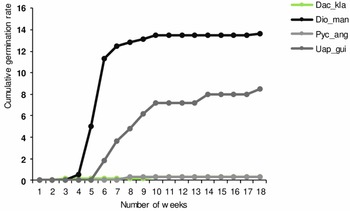
The germination times of Dacryodes klaineana, Diospyros mannii, and Uapaca guineensis seeds were 20, 24, and 37 days, respectively. Pycnanthus angolensis seedlings were the last to emerge, appearing on the 44th day.
The germination rate was almost zero in Dacryodes klaineana (0.3%) and Pycnanthus angolensis (0.3%). However, a higher germination rate was observed in Uapaca guineensis guineensis (9%) and Diospyros mannii (14%). The cumulative germination of seedlings over time is shown in Figure 2.
Cumulative germination rate curves of four plant species as a function of time. (Dac_kla: Dacryodes klaineana; Dio_man: Diospyros mannii; Pyc_ang: Pycnanthus angolensis; Uap_gui: Uapaca guineensis).

Influence of burial depth
Seed germination rate in relation to burial depth
Overall, low germination rates were observed at burial depths 0, 10, and 15 cm with 0.2%, 3%, and 0.8%, respectively. However, higher germination rates were observed at depths 2 and 5 cm with (13% and 11%, respectively). The observations showed not only a variation in germination rate according to burial depth, but also according to plant species.
The germination rate of Dacryodes klaineana seeds did not differ significantly by burial depth (χ² = 8.61, df = 9, p = 0.07). Similarly, there was no significant variation in germination rate of Pycnanthus angolensis (χ² = 3.23, df = 4, p = 0.52) with burial depth.
Less than 2% of Dacryodes klaineana seeds sown at 2 cm depth achieved seedling emergence and establishment, while seeds of this species that germinated at a depth of 5 cm did not reach the emergence stage. Similarly, extremely low seedling emergence and establishment rates, 0.8% each, were observed in P. angolensis at burial depths of 10 and 15 cm.
In contrast, there was a significant difference in the germination rates of Diospyros mannii seeds (χ² = 10.93, df = 4, p = 0.03) and Uapaca guineensis (χ² = 12.3, df = 4, p = 0.02) for seeds from different burial depths. For the seeds of these two plant species, the germination rate was influenced by burial depth (Figure 3), and only the seeds sown at 2 and 5 cm achieved high seedling establishment rates. No germination was observed for Uapaca guineensis seeds planted at a depth of 15 cm. The germination rate for Diospyros mannii seeds planted at 15 cm was 2.5%.
Boxplots showing the mean number of germinated seeds sown at different burial depths ((a): Uapaca guineensis; (b): Diospyros mannii). The thick horizontal (black) bars indicate medians, the lower and upper limits of the rectangles correspond to quartiles, and the bars above (or below) the rectangles correspond to minimum and maximum observations (values). Different letters above each boxplot indicate significant differences between treatments at 0.05 level.

Seed germination rate in relation to seed origin (seeds from mother plant (smp) versus seeds from chimpanzee faeces (scf))
There was no significant variation in germination rates between smp and scf seeds for Diospyros mannii (U-test, p = 0.35) or for Uapaca guineensis (U-test, p = 0.65). Seeds of Dacryodes klaineana and Pycnanthus angolensis were not analysed due to low number of germinated seeds, which did not allow the application of statistical tests.
Growth parameters in relation to seed origin
The growth parameters of seedlings originating from smp vs scf, measured 8 months after germination, for Diospyros mannii were mean number of leaves (8.4 ± 3.1 vs 8.7 ± 3.4), mean stem height (14.4 ± 4.7 vs 16.4 ± 3.9 cm), or mean diameter at the collar (4.4 ± 0.8 vs 4.4 ± 0.9 mm). There was no significant difference between growth parameters of seedlings from the two seed origin types in regards to the mean number of leaves (t-test, df = 66.12, p = 0.71), the mean stem height (t-test, df = 53.12, p = 0.06), or the mean diameter at the collar (t-test, df = 69.23, p = 0.9).
The growth parameters of seedlings originating from smp vs scf, for Uapaca guineensis are mean number of leaves (13.4 ± 4.2 vs 13.5 ± 4.3), mean stem height (38 ± 13.8 vs 40.6 ± 12.1 cm), or mean diameter at the collar (7.3 ± 2.3 vs 6.5 ± 1.9 mm). There was no significant difference between growth parameters of seedlings from the two seed origin types in regards to the mean number of leaves (t-test, df = 27.4, p = 0.96), mean stem height (t-test, df = 23.9, p = 0.44), or the mean diameter at the collar (t-test, df = 23.6, p = 0.27).
Assessment of seed predation
The first incidence of predation was observed 18 days after sowing. A total of 517 seeds (22% of total seeds sown) were removed from their original location by predators. Observations revealed that predation could be categorised into three main types: surface predation, deep predation, and post-germination predation (involving epigeous germination before cotyledons withered).
Surface predation was more prevalent than the other two types, involving 439 seeds (85% of the total seeds lost to predation). On the first day of predation (i.e. the 18th day), 117 of the 120 Diospyros mannii seeds sown at depth 0 cm (98%) were removed by surface predation.
Post-germination predation (see Figure 1) and subsurface predation were both observed 30 days after sowing and only affected seeds of Diospyros mannii. A total of 44 out of 480 seeds (9%) sown at depth were affected by subsurface predation. Considering only the depth of 2 cm (only depth affected by this type of predation), 44 out of 120 seeds (36.67%) suffered subsurface predation. Conversely, 34 out of 480 seeds (7%) sown at depth were lost to post-germination predation. The predation rate of the different seeds based on predation type is given in Table 4.
Predation rate categorised by predation type on the four species of seeds sown at different depths in Tai National Park, Côte d’Ivoire

Ungerminated seeds
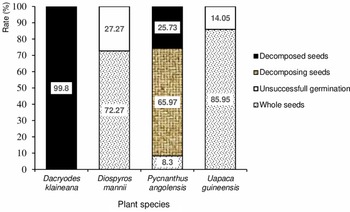
Seeds that did not germinate after 18 weeks were removed and categorised (Figure 4).
Condition of ungerminated seeds after 18 weeks follow-up for the four plant species studied.

Decomposed seeds represented 98.2% and 25.7% of the ungerminated seeds of Dacryodes klaineana and Pycnanthus angolensis, respectively. Seeds in the process of decomposition were found in 66% of the ungerminated Pycnanthus angolensis seeds. Seeds that underwent unsuccessful germination comprised 27% of Diospyros mannii and 14% of Uapaca guineensis seeds. Finally, ungerminated seeds that were found whole represented 86%, 72%, and 8% of Uapaca guineensis, Diospyros mannii, and Pycnanthus angolensis seeds, respectively.
Discussion
This study investigated the effect of seed burial on germination as a proxy for dung beetle burial behaviour and the inadvertent burial of seeds (non-voluntary burial of seeds during voluntary burial of faeces) contained in chimpanzee dung. Our results show that almost all seedlings originated from buried seeds. In contrast, seeds remaining on the surface were unable to germinate due to predation or abiotic constraints. The experiments show that the dung burial behaviour of dung beetles positively influences the fate of seeds contained within chimpanzee dung. Our results agree with Andresen & Feer (Reference Andresen, Feer, Forget, Lambert, Hulme and VanderWall2005) who state that seed dispersal is considered favourable only if the probability of seedling establishment and survival is higher than for seeds that were not dispersed by dung beetles.
Interestingly, our results show that seedling growth was not related to the passage of seeds through the chimpanzee digestive tract, although larger, albeit non-significant, averages of seedling growth parameters were found for seeds collected from chimpanzee dung. That is, there was no significant variation in the number of leaves, stem height, and stem diameter of seedlings originating from chimpanzee dung compared to those collected from the mother plant. For the four tree species studied, it seems that intestinal transit is neither an advantage nor a hindrance to seedling development. Thus, the role of chimpanzees is limited to the simple transport of seeds, at least for the plant species studied.
Furthermore, the contribution of chimpanzee faeces to soil fertilisation showed no advantage for the seeds. The C/N ratio of the faeces of the three groups of chimpanzees was higher than 15 and between 16 and 20, which would indicate a slow mineralisation due to a nitrogen deficit (Snoeck et al. Reference Snoeck, Koko, Joffre, Bastide and Jagoret2015). An organic product with a high C/N (>15–20, incomplete composting) can lead to a risk of “nitrogen starvation” for the plants, because the soil microorganisms will use the available soil nitrogen for the mineralisation of the product in question (Huber & Schaub Reference Huber and Schaub2011).
The results obtained during germination tests with U. guineensis and D. mannii suggest that an increase in the depth of seed burial negatively affected the probability of seedling emergence and establishment. Such results have also been obtained by Maraghni et al. (Reference Maraghni, Gorai and Neffati2010) for the seeds of Ziziphus lotus (L.) Lam. (Rhamnaceae) in Tunisia, Petre et al. (Reference Petre, Zinque, Tagg, Beudels-Jamar, Haurez, Josso, Moretto and Doucet2015) with Uapaca spp (Euphorbiaceae) seeds in Cameroon and Silue et al. (Reference Silue, Kouassi, Koffi and Soro2017) with Isoberlinia spp (Caesalpiniaceae) in Côte d’Ivoire. For all four plant species, less than 20% of the seeds sown at depths of 0, 2, 5, 10, and 15 cm germinated. However, only seeds sown at 2 and 5 cm depth produced viable seedlings. Nevertheless, a significant success rate was observed at a depth of 10 cm for Diospyros mannii seeds indicating that these seeds have the necessary nutrient resources to allow germination at this depth.
In addition, the probability of a seedling emerging at a given depth depends, among other things, on the size of the seed from which it emerged. Unlike larger seeds, smaller seeds which are often buried deeper, are more likely to suffer as they do not have sufficient energy reserves to emerge from a greater soil depth (Vulinec et al. Reference Vulinec, Lambert and Mellow2006). Furthermore, seeds buried at greater depths are likely to suffer from decreased amounts of light, oxygen, and also water in the dry season when rainfall is less abundant. Together, these factors trigger the metabolic reactions that lead to seed germination (Guyot Reference Guyot1978). Other characteristics can determine the ability of a buried seed to germinate from a given depth and survive. One of these is the functional morphology of the seedlings, determined by three parameters: the exposure of the cotyledons (phanerocotyl or cryptocotyl), the position of the cotyledons (epigeous or hypogeous), and their texture (foliaceous or tough) (Guyot Reference Guyot1978). Cryptocotyl seedlings with hypogeal germination and fleshy cotyledons would be more likely to emerge from more than 10 cm deep compared to phanerocotyl seedlings with epigeated germination and foliaceous cotyledons, as in the case of Diospyros and Uapaca species. According to De La Mensbruge (Reference De La Mensbruge1966), species with fleshy cotyledons are swollen with reserve material. Moreover, the cotyledons of hypogeous species keep their attachment with the lower part of the tigellum. They feed the seedling for some time (often several weeks). This explains the low germination rates obtained above 5 cm depth in both Diospyros mannii and Uapaca guineensis. Concerning the seeds of Pycnanthus angolensis, they would be very sensitive to prolonged exposure to solar radiation in the dry season. These seeds would deteriorate quite rapidly, surviving a maximum of 10 days under the mother plant (Koffi, Pers Obs).
The results obtained with U. guineensis seeds sown at the soil surface differed from those of Petre et al. (Reference Petre, Zinque, Tagg, Beudels-Jamar, Haurez, Josso, Moretto and Doucet2015), who found high germination rates from the soil surface by Uapaca spp. Unlike the present study, that of Petre et al. (Reference Petre, Zinque, Tagg, Beudels-Jamar, Haurez, Josso, Moretto and Doucet2015) was carried out in March, a rainy period at the research site ‘La Belgique’ at the Northern periphery of the Dja Biosphere Reserve, South-east Cameroon. Also, no predation of the sown seeds was reported from them. The apparent lack of germination in this study is mainly due to the very high predation of seeds at the soil surface compared to other depths. In addition to predation, the severe climatic conditions reflecting the dry season to which the seeds were exposed would contribute to seed desiccation, further negatively influencing germination rate. A study conducted on the seeds of Uapaca bojeri showed that drying in the shade for 5 days would result in a reduction in moisture content of almost 27% (Randrianavosoa et al. Reference Randrianavosoa, Andrianoelina and Ramamonjisoa2011).
Additionally, seed dormancy (physiological or morphological) can be considered as a “blockage” to germination of a viable seed under favourable conditions (Li & Foley Reference Li and Foley1997). While morphological dormancy is linked to an immature embryo described as rudimentary or linear, physiological dormancy is not linked to any morphological criteria and can occur in any type of seed (Nivot Reference Nivot2005).
A study related to the effects of pre-treatments on the germination of Dacryodes klaineana in nurseries showed a high germination rate for seeds roasted in a fire for 5 minutes (86%), followed by those impregnated with H2SO4 (60%), and those subjected to scarification (50%). Conversely, no germination was observed in seeds that were not pre-treated (control seeds), or those soaked in water for 2 hours (Akhideno et al. Reference Akhideno, Ogboru and Clement2019). This indicates that fire is an important factor in the dormancy breaking of Dacryodes klaineana, which could explain the low germination rate (0.3%) observed in the absence of pre-treatment during this experiment.
Seeds are a quality food source, being composed of tissues rich in energy and nutrients (Lazure & Almeida-Cortez Reference Lazure and Almeida-Cortez2008). Accordingly, seeds that are either exposed or lightly buried may be subject to high levels of predation (Hingrat & Feer Reference Hingrat and Feer2002). This is what happened in the current study where almost all surface-sown seeds of all species included in this study and many of the Diospyros mannii seeds sown at 2 cm were detected by rodents, thus undergoing predation. In the early stages, this mainly involved the seeds of Diospyros mannii, which were the largest of the four species of seeds, and thus are likely to have greater nutritional reserves than the others seeds available. We cannot know the fate of the removed seeds, since tracking them was not part of the experimental design. However, while some seeds may have been eaten (predated) immediately, others may have been further dispersed. Indeed, two main storage techniques are known in rodents. Unlike “larder-hoarding”, which consists for the rodent of storing all the diaspores in the same burrow (Evrard et al. Reference Evrard, Haurez and Doucet2017), “scatter-hoarding” is a technique that consists of storing seeds in small quantities in numerous caches. This system of storage in different burrows prevents the scatter-hoarding animal from losing all its reserves at the same time. Of course, as the recovery rate is rarely 100%, seeds that are not found can then germinate (Janzen Reference Janzen1982; Brewer & Rejmánek Reference Brewer and Rejmánek1999; Gorchov et al. Reference Gorchov, Palmeirim, Jaramillo and Ascorra2004; Russo Reference Russo2005; Brodin Reference Brodin2010). The act of predation in this case is similar to seed dispersal and may actually contribute to seed germination. Furthermore, the experiments showed the detectability of Diospyros mannii seeds at 2 cm. Conversely, no seeds were detected at 5 cm. From the results of the experiment, it seems that the most favourable depth would be between 2 and 5 cm. More work is needed to determine the various depth of seed burial by different species of dung beetles. The nature of the dung beetle burrows and their depth, depends on both the dung species and the soil characteristics. Various depths have been mentioned according to some works. Maximum depths were 26.5 cm for Petre et al. (Reference Petre, Zinque, Tagg, Beudels-Jamar, Haurez, Josso, Moretto and Doucet2015) with gorilla faeces, 14 cm for Andresen (Reference Andresen2001) with howler monkey faeces in Brazil, and 27 cm for the work of Shepherd & Chapman (Reference Shepherd and Chapman1998) with baboon faeces in Uganda.
Nevertheless, our germination results cannot be generalised to all seeds buried by dung beetles. Factors such as the season, the time of detection by rodents and the germination time of the seeds could potentially have great influence on the germination and establishment rates of seedlings.
In conclusion, the experimental data suggest that dung beetles positively affect the likelihood of seedling emergence and establishment by burying seeds at depths that allows them to escape predation (Midgley et al. Reference Midgley, White, Johnson and Bronner2015) and dessication (Randrianavosoa et al. Reference Randrianavosoa, Andrianoelina and Ramamonjisoa2011). The current study has also highlighted the incidence rate of predation on seed germination both at the surface and at depth, as well as on epigeous germination. Although germination success was inversely proportional to the burial depth, large seeds (Diospyros mannii or Uapaca guineensis) with greater nutrient reserves have shown their inability to germinate at great depths (beyond 10 cm for example). Also, the study showed that chimpanzee faeces are not the small plot of fertiliser that we thought because, in its current composition, it can in fact lead to loss of nutrients through microbial action in the soil. In contrast to the many previous studies (Traveset Reference Traveset1998; Kouamé et al. Reference Kouame, Koulibaly, Gone bi, Kouassi, Koffi and Adou Yao2017), passage through the chimpanzee intestine appeared not to enhance germination rates of any of the four species studied. It is therefore considered that the role of chimpanzees is limited to the simple transport of seeds. However, it should be kept in mind that this study investigated the seeds of only four tree species utilised by the subspecies Pan troglodytes verus in a specific location and during a specific season. Further investigations on different tree species and during different seasons will be welcome additions to the results of this study.
Supplementary material
To view supplementary material for this article, please visit https://doi.org/10.1017/S0266467422000402
Acknowledgements
We thank the Ivorian Office for Parks and Reserves for permitting the study in Taï national park. We express our gratitude to Christophe BOESCH, founder of the Taï Chimpanzee Project (TCP) for his collaboration. Many thanks to Dr Kafana SORO and Professor Inza KONE, Director respectively of Taï Ecology Research Station and of the Swiss Center for Scientific Research (CSRS).
Financial support
Co-financial support for this study was provided by the International Foundation for Science (IFS) and the Organisation of Islamic Cooperation’s Standing Committee on Scientific and Technological Cooperation (COMSTECH) under the number Ref: D-6231-1. The Max Planck Society had provided core funding for the Taï Chimpanzee Project since 1997.
Conflicts of interest
None.
Ethical statement
None.