

Asperger syndrome (AS) is a neurodevelopmental disorder that until recently was recognised as a distinct form of autism in the international diagnostic manuals. Currently, this disorder is subsumed into the diagnostic category of Autism Spectrum Disorders (Bostock-Ling, Cumming, & Bundy, Reference Bostock-Ling, Cumming and Bundy2012). According to Attwood (Reference Attwood2007), the criteria for a diagnosis of AS are: (1) social impairment, (2) narrow interest, (3) compulsive need for introducing routines and interests, (4) speech and language peculiarities, (5) non-verbal communication problems, and (6) motor clumsiness. Hence, people with AS routinely display communication difficulties that impact on abilities to function effectively in all social contexts: home, school, workplace, and community (Lovett, Reference Lovett2005; Tantam, Reference Tantam2012). These difficulties affect the capability to understand and respond to the thoughts and feelings of others, and as a consequence, influence the capacity to relate to others (Attwood, Reference Attwood2007).
Misconceptions are generally held that adults on the autism spectrum, including AS, do not want romantically involved relationships (Moreno, Wheeler, & Parkinson, Reference Moreno, Wheeler and Parkinson2012). While many adults with classic autism appear to be more comfortable with a solitary lifestyle, adults with AS are usually as equally interested in relationships as are neurotypical (NT) adults (Moreno et al., Reference Moreno, Wheeler and Parkinson2012). Neurotypical is a term used initially by the autistic community (i.e., individuals on the autism spectrum) as a label for people who are not on the spectrum (i.e., non-autistic individuals). According to Rudy (Reference Rudy2013), the term has no medical or psychological meaning although ‘neurotypicals’ are generally assumed to have effective social and communication skills, together with the capacity to navigate new or socially complex situations.
In the main, adults with AS are highly intellectual and analytical, and can become quite resourceful at masking inherent differences (Barnhill, Reference Barnhill2007; Boyd, Reference Boyd2009; Jennings, Reference Jennings2005). When combined with various attractive qualities, such as kindness and attentiveness (Attwood, Reference Attwood2007), these features can make adults with AS appealing partners. Accordingly, adults with this disorder readily establish romantic relationships with NT partners (Aston, Reference Aston2003; Grigg, Reference Grigg2012; Moreno et al., Reference Moreno, Wheeler and Parkinson2012). However, it is only after a relationship has advanced to a deeper level, and with it, the subsequent demand to connect intimately in reciprocal interaction, that the inadequacies of adults with AS become evident (Attwood, Reference Attwood2007).
Reciprocity in Relationships
Reciprocity is an integral part of communicating, connecting, and expressing love (Aston, Reference Aston2001; Rearn, Reference Rearn2010). It involves the back-and-forth flow of social interaction. The term reciprocity refers to how the behaviour of one person influences, and is influenced by, the behaviour of another person and vice versa. Social reciprocity is the ‘sharing of conversation, direction of an activity and resources’ (Dodd, Reference Dodd2005, p. 138), which involves communicative partners working together on a common goal to create successful interaction. Communicative adjustments are made by both partners until success is achieved.
Everyday reciprocal communication between couples is central to building and sustaining emotionally connected and committed intimate relationships (Weigel & Ballard-Reisch, Reference Weigel and Ballard-Reisch2012). The lack of reciprocal communication is recognised as a key barrier to building an intimate relationship since genuine intimacy in human relationships requires dialogue, reciprocity, transparency, and vulnerability (Timmerman, Reference Timmerman1991). Given that AS affects communication, social reciprocity and empathy, adults with this disorder are vulnerable to experiencing difficulties in relating to their partner, particularly in regard to capacities to respond to the thoughts and feelings of others and the give-and-take that typically occurs within the ongoing reciprocal interactions required for close relating (Lovett, Reference Lovett2005; Meyer, Root, & Newland, Reference Meyer, Root and Newland2003). Within a romantic relationship, developing intimacy is a process that takes place over time in order to develop a deep connection with a significant person and to become emotionally close to that person.
Intimacy takes many forms and can be divided into four main categories: (1) intellectual intimacy, where a couple exchanges thoughts; (2) experiential intimacy, where a couple share in mutual activities; (3) emotional intimacy, where a couple comfortably discloses their feelings and empathises with the feelings of the other; and (4) sexual intimacy, where a couple share a broad range of sensuous activities, including sexual intercourse (Aston, Reference Aston2012; McGraw, Reference McGraw2000; McKay, Fanning, & Paleg, Reference McKay, Fanning and Paleg1994). It follows that the lack of reciprocal interactions within romantic relationships undermines the development of intimacy in all its forms, and as a consequence, restricts closeness, while creating havoc in loved ones’ lives and distancing those who are close (Grigg, Reference Grigg2012; Rodman, Reference Rodman2003).
High intellect on the part of the AS partner cannot compensate for ineffective social and communicative behaviours that affect the capacity for sustaining the level of reciprocal interactions needed to develop intimacy. Berney (Reference Berney2004) reports that adults with AS have a tendency to talk ‘at’ rather than ‘to’ others, and appear to have little concern for their communicative partners’ response. In doing so, they create not only one-sided exchanges with their partner, but also circumstances that undermine the back-and-forth flow of interactions with that partner. On the one hand, adults with AS may not realise that they have been misunderstood, may not view their interactional style as a problem, and as a consequence, may not see any need to change their behaviour (Barnhill, Reference Barnhill2007; Clements, Reference Clements2005). On the other hand, failure to confront interactional and emotional difficulties may be related to low self-motivation (Berney, Reference Berney2004) or may be a constant source of distress and anxiety (Dubin, Reference Dubin2009; Tantam, Reference Tantam2000). At this point in time, research is not available to support a particular standpoint as ‘what we know about autism in adulthood is minimal’ (Bresnahan, Li, & Susser, Reference Bresnahan, Li and Susser2009, p. 1172).
Prompting and Prompt Dependency
Prompting is a well-established procedure to facilitate learning (Cooper, Heron, & Heward, Reference Cooper, Heron and Heward2007) and is commonly used with children on the spectrum to compensate for the challenges related to independent functioning (Hume, Loftin, & Lantz, Reference Hume, Loftin and Lantz2009; Wilson, Perry, Anderson, & Grosshandler, Reference Wilson, Perry, Anderson and Grosshandler2012) and low intrinsic motivation (Chevallier, Kohls, Troiani, Brodkin, & Schultz, Reference Chevallier, Kohls, Troiani, Brodkin and Schultz2012). Prompting is defined as antecedent stimuli (e.g., instructions, explanations, gestures and illustrations) that are effective in producing a target behaviour that otherwise would not occur (MacDuff, Krantz, & McClannahan, Reference MacDuff, Krantz, McClannahan, Morris, Green and Fox2001; Shabani, Katz, Wilder, Beauchamp, Taylor, & Fischer, Reference Shabani, Katz, Wilder, Beauchamp, Taylor and Fischer2002). Simply put, a prompt is a temporary aid designed to help children respond correctly during the acquisition phase of learning. Once consistent achievement of the target behaviour occurs, the prompt should be faded gradually (Cooper et al., Reference Cooper, Heron and Heward2007).
However, children on the spectrum have a tendency to become dependent on the prompts of others, especially if prompt-fading procedures are not specifically implemented (Boutot & Smith Myles, Reference Boutot and Smith Myles2011; Bryan & Gast, Reference Bryan and Gast2000); ‘Prompt dependence means that a person responds to the prompts instead of responding to the cues that are expected to evoke the target behaviour’ (MacDuff et al., Reference MacDuff, Krantz, McClannahan, Morris, Green and Fox2001, p. 43). Over time, this dependency not only inhibits the learning of new skills but also influences the ability to function without adult facilitation (Mesibov, Shea, & Schopler, Reference Mesibov, Shea and Schopler2004). Moreover, resistance to change or insistence on sameness (a particular issue for those on the spectrum) may strengthen the prompt-dependent child's reliance on, and need for adult facilitation, and accordingly, increase the child's reliance on prompting (Hume et al., Reference Hume, Loftin and Lantz2009). Under these circumstances, prompt dependency contributes to learned helplessness and the belief that one's own behaviour does not control outcomes or results (Sternberg & Williams, Reference Sternberg and Williams2010).
To date, little attention has been paid to what occurs when prompt-dependent children on the spectrum reach adulthood. Does prompt dependency acquired in childhood continue into adult life, and if so, does it interfere with the ongoing reciprocal interactions needed to sustain relationships with significant others? In adulthood, relationships play a central role in the overall human experience and satisfy the universal need to belong, to care, and to be cared for (Ruppel & Curran, Reference Ruppel and Curran2012; Simpson, Collins, Tran, & Haydon, Reference Simpson, Collins, Tran and Haydon2007). Hence, there is a need to acquire a better understanding of prompt dependency within this specific adult population.
Current Study
The current study explored prompt dependency as a phenomenon within AS-NT relationships. To this end, the study had a twofold, yet interconnected purpose. First, the study aimed to ascertain whether prompt dependency carried into adulthood. Second, if prompt dependency was confirmed, it aimed to explore how this phenomenon mediated communications within the relationship between an adult with AS and his/her NT partner. Two research questions, therefore, framed the inquiry:
1. Do adults with AS become dependent on prompts in interaction with their NT partners?
2. If so, how does prompt dependency impact on communication and interpersonal interactions within the AS-NT relationship?
Given that no empirical evidence could be located in the literature concerning prompt dependency behaviours of this adult population, and given the lack of research in regard to the intimate interactions of AS-NT couples, this study adopted a qualitative research design, guided by a grounded theory research strategy. The qualitative approach was selected because it was seen to furnish ‘an extensive collection of thick description as the basis for inductive generation of an understanding of what is going on and how things work’ (Locke, Silverman, & Spirduso, Reference Locke, Silverman and Spirduso2010, p. 184). As such, this methodology had a goodness of fit with the need to delve into the ‘how’ of prompt dependent behaviour, explore the meanings behind this behaviour and make sense of what was going on in terms of the everyday experiences specific to AS-NT couples (Denzin & Lincoln, Reference Denzin and Lincoln2005; Locke et al., Reference Locke, Silverman and Spirduso2010). Moreover, grounded theory's data analysis processes suited the study's requirement to iteratively test, modify, and refine the evolving prompt dependency hypothesis and allow a theory to emerge around how prompt dependency manifested in the interaction of AS-NT couples, and how the phenomenon impacted on the couple's ability to communicate to each other and consequently relate to each other (Strauss & Corbin, Reference Strauss, Corbin, Denzin and Lincoln1994).
As a result of applying grounded theory methods, the theory generated in this study not only established that adults with AS in this study were dependent on prompts in their interactions with their NT partners, but also found that a cycle of prompt dependency formed within the interactions of these couples. These two aspects — dependency on prompts and the resulting cycle — were seen to be inextricably interwoven. This article attempts to restrict reporting to prompt dependency within the context of AS-NT partner interactions. A future paper will report on the theoretical model of a prompt dependency cycle.
Method
Participants
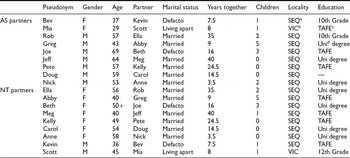
Participants in this study were aged between 29 and 69 years, with the vast majority living in south-east Queensland. Of the AS participants, seven were males and two females. All participants were in a heterosexual long-term relationship, ranging from 3.5–35 years’ duration. Of the nine couples interviewed, seven had children from their current relationship, a previous relationship or both, and two did not have children. Six couples were married and living in the same household. Two couples were in a defacto relationship, with one of the two planning to marry a few months subsequent to the data collection stage of the study. One couple was living apart in separate households. Educational levels ranged from Year 10 to postgraduate degrees. To reduce the risk of identification, pseudonyms will be used for participants. Table 1 presents demographic information on AS and NT partners.
Participant Demographic Information

Note: aSEQ denotes south-east Queensland; bVIC denotes Victoria; cTAFE denotes Training and Further Education; dUni denotes University.
Materials and Procedures
In-depth, one-on-one interviews with AS-NT couples were the primary form of data collection for this study. This interview approach was selected in order to gain detailed and descriptive information from participants (Creswell, Reference Creswell2008; Silverman, Reference Silverman2004) and to discover the story behind participants’ experiences (Turner, Reference Turner2010). For Queensland couples, face-to-face interviews were conducted at a venue of the participant's choice. For the Victorian couple, interviews were conducted via Skype. All participants were interviewed separately to their partner, with interviews lasting between 1 to 2 hours. Interviews were conducted in a relaxed and informal manner in order to draw out perspectives on interactions, communication and any perceived dependency patterns. This personalised approach was very effective in obtaining fine-grained data from each partner about his/her personal feelings, opinions, and experiences pertaining to the intimate relationship (Mack, Woodsong, Macqueen, Guest, & Namey, Reference Mack, Woodsong, Macqueen, Guest and Namey2005).
This study used theoretical sampling for recruitment because participating individuals needed to have specific experience of being involved within an AS-NT relationship (Creswell, Reference Creswell2008). Hence, to be eligible to participate in the study, couples needed to meet four predetermined criteria: (a) one partner in the relationship had a formal diagnosis of AS and the other partner was regarded as NT, (b) the relationship was not newly formed (existing for at least 1 year) so that the couple had adequate knowledge of each other to allow for a descriptive account, (c) both partners had to consent to a recorded interview for the study, and (d) both partners had to be available to be interviewed within a 6-month time frame. AS-NT couples were recruited through the Queensland Asperger Partner Support group (QAPS) based in Brisbane; Asperger Services Australia (ASA), a national AS support organisation based in Northern Brisbane; and psychological counselling services based in south-east Queensland. Recruitment involved talks to support groups, flyers and electronic outreach. The application of the predetermined criteria to interested couples resulted in a small sample of nine AS-NT partners. Ethical approval for undertaking this research using this overarching methodology and associated research procedures was granted by Griffith University, Australia.
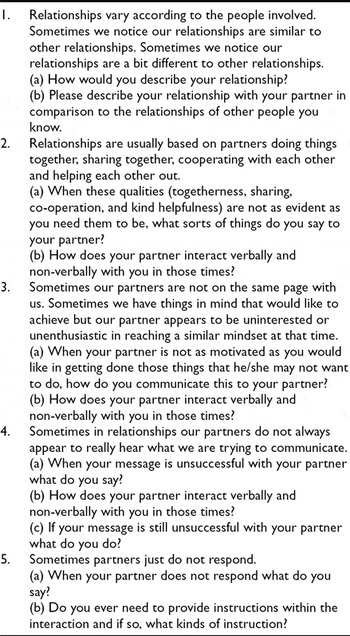
While the interview questions were not formally piloted, they were developed through consultation in a number of forums to seek feedback regarding question suitability, clarity and meaning (Creswell, Reference Creswell2008). These forums included numerous colleagues of the first author, support group members and a number of AS-NT couples. Through this process, 32 open-ended questions and probes were generated and used to explore the individual perspectives on couple interactions, communications, closeness, any perceived dependency patterns, self-motivation and coping strategies within AS-NT relationships. Prior to interview commencement, a Sony IC recorder was placed on a table in full view of the participants. All participants (both AS and NT) were asked questions drawn from the same set of 32 questions. However, not all questions were asked within each interview, as they were used only to guide, generate, and probe conversation. Five questions were used as ice breakers, five were probes for prompt dependency, seventeen were focused on the impact of prompt dependency on communication and interpersonal interactions, and four were related to services and desired options. The interview ended with a positive impact question. Table 2 presents the five core questions specifically related to probing for prompt dependency.
Core Questions Related to Research Question 1

Audiotapes of the interviews were transcribed in their entirety. To increase the credibility and validity of the research, member checking (Cho & Trent, Reference Cho and Trent2006) was used to enable participants to determine what aspects divulged during the interview they chose to make known, and to validate collected data (Cho & Trent, Reference Cho and Trent2006). To this end, each participant was sent a copy of her/his transcribed interview for comment and/or revision. Several participants provided feedback about the transcribed interview being an accurate account of the conversation, with only one participant suggesting minor additions. All participants approved the use of all aspects shared within the interview.
Results
Data Analysis
Once transcriptions were revised, they were imported into NVivo data management software (Bazeley, Reference Bazeley2013). This computer-based analysis tool allowed for a systematic and complete analysis of transcripts (Bazeley, Reference Bazeley2013), facilitated many aspects of the iterative data analysis procedures associated with grounded theory (Creswell, Reference Creswell2008), and helped to provide a transparent account of these procedures (Hutchison, Johnston, & Breckon, Reference Hutchison, Johnston and Breckon2009; Richards, Reference Richards2009). In order to manage ideas, concepts and theoretical knowledge generated from the data, nodes (storage depositories) were formed. Each interview transcript was examined in depth and coded into nodes for the presence of references to prompt dependency within partner interactions. A hierarchical tree structure of nodes was developed and structured according to themes and subthemes. The method of constant comparison of incident to incident, incident to codes, codes to codes, codes to categories, and categories to categories was used in order to reduce and condense the themes into the most important categories (Corbin & Strauss, Reference Corbin and Strauss1990; Heath & Cowley, Reference Heath and Cowley2004; Kendall, Reference Kendall1999). Through this repetitive, cyclical process, the most salient categories were identified.
The emphasis of this article is on analysis derived from the five core interview questions that probed into whether adults with AS in the sample displayed prompt dependency in their interactions with their NT partners. Evidence of prompt dependency for adults with AS in the sample emerged during the axial coding stage of grounded theory. Axial coding in grounded theory is the second step of a four-step sequence within the coding process (Creswell, Reference Creswell2008; Kendall, Reference Kendall1999). It is an element of the constant comparative process of connecting codes (categories and concepts) to each other through a combination of inductive and deductive reasoning. Additional measures aimed at reducing coder bias were implemented, including discussions among members of the research team throughout the process of data coding and analysis, and through systematic recording of how data were collected, analysed, and interpreted.
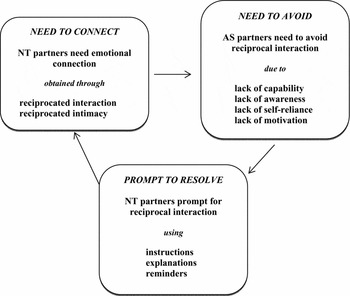
During the axial coding stage of grounded theory, three related themes confirming the existence of prompt dependency emerged from the analysis: NT partners’ need to connect; AS partners’ need to avoid; and NT partners’ prompt to resolve. Figure 1 shows the connections between these initial themes, with themes being described in detail using participants’ voices in the sections that follow.
The development of prompt dependency within AS-NT interactions.

NT Partners’ Need to Connect
In this study, NT partners indicated that they sought deep reciprocal emotional connection, sharing, and intimacy in their relationships. However, they reported frequent unmet needs due to limited or inadequate interactions with their AS partner. All NT partners considered their relationship, their interactions, and their experiences to be not representative of what they considered ‘normal’ for an intimate relationship. Kelly (NT) highlighted how the differences caused communication breakdown and misunderstandings:
I know that in an NT-NT relationship, they get each other and . . . they actually understand each other and don't have to go the long route of explaining actions or explaining why they want to do something like they want to do it. Whereas with us, there is a lot of explanation needed and when communication is not good, which . . . it is not good, always, then you just have to guess why they are doing that particular thing that way. Whereas in a neurotypical/neurotypical relationship . . . communication is better . . . maybe even with . . . an AS/AS relationship . . . they understand each other . . . I suppose when you’ve got the opposites, then you have a breakdown in communication, you have a breakdown in understanding.
Most NT partners also believed that the frequent communication problems contributed to a lack of connectedness typically found in intimate relationships. This lack of connectedness contributed to their perception that their relationship was not conventional. Ella's frustration was evident as she expressed her longing for the qualities she felt were missing in her relationship:
I just tell him he sucks actually. I have done that before . . . I have always told him that he has never had to guess about how I feel. ‘Look this is what I need from you.’ And I can think back . . . before he was even diagnosed, in our relationship, having those conversations with him. ‘I need more of you.’ ‘You don't give me enough of yourself.’ ‘You don't talk to me about you.’ And being very honest and I say this is not fair . . . Those things need to happen, and because they don’t, this is why we don't have this relationship . . . I actually sit on the train and look at couples that sit together on the train and converse with one another, and think ‘gee I wish my relationship was like that’. So nothing is kind of natural if you like . . . not even normal conversation, like Rob will tell me three days later something that's happened, and yet we will sit at the dinner table just about every night with nothing to say. So it's not normal in the way that we just interact on everyday interaction.. . . There is nothing normal about that kind of stuff and it's probably that's what I miss the most.
Overall, NT partners expressed that a major challenge to their relationship health was due to missing out on the typical interactions expected within an intimate relationship.
AS Partners’ Need to Avoid
In the main, AS partners in this study demonstrated an unawareness of the needs of their partners, and this lack of awareness resulted in them repeatedly remaining unresponsive and consistently not engaging reciprocally with their partners. Consequently, when involved in unsuccessful interactions, AS partners tended to evade the situation rather than make an attempt to rectify it. Joe (AS) confirmed that he preferred to shut down rather than continue responding:
Usually by the time that I realise that there is a misunderstanding in communication it's too late, the point has passed and it can't be redeemed at all. So it causes quite a bit of resentment . . . Beth wants to . . . talk about it, work it out and I just really don't really cope with that too well at all. I just want to shut down again.
Nick (AS) recognised that he understood how his partner wanted him to respond to her. Moreover, he indicated the interactional context surrounding this ‘shutting-down’ behaviour:
She will quite often try and get me to respond in the way that she wants me to respond, so she will keep at me . . . to try and get a response out of me, because when that sort of thing happens, I start shutting down. So there's going to be no visible response from me, no emotional response, which apparently frustrates the crap out of her.
Many AS partners described how difficult it was for them to communicate with their partners. They also indicated that they had little knowledge of how to do things differently. For example, Rob (AS) stated:
Just shut up and walk away, and . . . that makes it worse because Ella wants a good working relationship in regards to communication . . . I would have a situation where I tried to express how I feel and before I can . . . I’ve got to stop and think about it and . . . go a long way around to get to my point. Well sorry, Ella has got to get to the point straight away.. . . Well I’m not capable of doing it . . . whereas Ella is just ‘if you’ve got something to say, say it’ . . . well ‘I’m not as blunt as you are sometimes’ but it makes it extremely difficult . . . I think of what advantage is get upset and having an argument about it.. . . She might see something that she is real fired up about, and I’m thinking ‘Oh shit. Can't do anything about it, so forget about it.’ Let's get over it and walk away. Build a bridge. She said ‘well you should try’ and I’m thinking, but try at what . . . and this is where the crux is. She said ‘well you should be doing something better’. Yeah but at what . . . for me when someone says you should try more. Yeah well try at what? It's a big question mark.
Rob continued his discussion, including the claim that some of his struggles were more an issue of the listener rather than the speaker since he thought that Ella was responsible for the communication troubles within their relationship. He pointed out that Ella was not as responsive toward him as he thought she should be:
Okay, if you haven't got someone who wants to listen to you how can you be more communicative, and also express your feelings? Huh, feelings okay . . . I feel sad, I feel alone now, I feel angry, I feel upset. Like I’m sorry but I’m no good at interacting with people outside my work environment. Is that a crime? Is that something that I should be ashamed of? I don't think so . . . to turn around and say, well you’ve got to be a bit more considerate, a bit more passionate, oh yeah, right, okay.
Frequently, the communication difficulties that AS partners experienced appeared to be intensified by an apparent fear of failure of getting entangled within the complexities of intimate interactions. Although understanding that communication was a concern that needed work, fear appeared to drive a reluctance to communicate with their partners, which commonly undermined interactions between them. Doug (AS) described how difficult communication was for him:
Probably just don't do anything, unless it is absolutely necessary . . . probably not say anything . . . I don't know how to explain . . . sometimes I do get angry, but most of the time I don't communicate properly with her . . . because I find forming sentences and words very hard . . . Just try to form the right words, like it just takes time, because if I just try and say something straight out it always comes out wrong and the communication breaks down.
Additionally, for AS partners, the frequent lack of self-motivation to engage and become involved in interacting with their partners may have also hindered their ability to change any problem behaviours that emerged from their lack of understanding. Beth (NT) described her partner's resistance:
And I think sometimes they do mean it. They have still got personality that dictates the way they do things or their commitment. He has absolutely no commitment to try and change. He's very resistive. He's been very resistive to all forms of counselling. He virtually rubbishes their capacity to do anything for him and has said quite categorically ‘he is not going to change’, he doesn't see why he has to change.
Nearly all NT partners were of the same view as Beth. Not only did their partner's resistance to working through difficulties with them create a sense of emotional loneliness for them, but also, for many NT partners, the anticipation of the companionship that would have formed through completing activities together was also left wanting. Beth shared how this was the case for her on both accounts:
If he doesn't want to do something he just doesn't do it. You cannot force him to do anything he doesn't want to do. And, I mean this is, this is one of the lonely spots in our relationship is that he will be motivated to do something that he wants to do but for me to ask him to do something, it's like I have asked him to pin himself to a cross. It is just so resistive and he might do it eventually, after months and months of me asking, but he will do it with such foul temper that it is almost a waste of me getting anything done. And it never gets finished. He never finishes anything that he doesn't want to do.
Mia, a female partner with AS, concurred: ‘I do not dwell a great deal on the things I don't want to do. Sometimes I avoid them by procrastinating.’
Many NT partners felt that their partner's unresponsiveness and avoidance to interact with them, their resistance to change and their lack of self-motivation to confront difficulties, all resulted in an absolute disconnectedness within their relationship. This disconnectedness not only created considerable loneliness, but was also one of the most difficult things to deal with in their relationship. Ella described the gulf that had developed in her relationship and her dismay that the progression of time had not resolved the situation:
But now he withdraws, because I just nowadays have the total wrong tactic. I probably did years ago, would sit and ‘well tell me and talk to me’ and I would get a blank sort of inane sort of stare and I have often had things like, ‘well I don't really know’ and I actually believe that he doesn’t. I think that's part of the frustration. I don't know but I figure at 57 there has got to be somewhere along the line you’ve got to know something. Over 35 years if you still don't know something is just not working.
Similarly, Beth also drew attention to her partner's unresponsiveness and how it impacted on her:
I mean, it's a weird feeling to sit and be absolutely distraught and crying and have him change the subject and say ‘I saw the most amazing engine the other day’. You are in the middle of this terrible crisis and breaking your heart, and he is telling you about nuts and bolts. I mean, that defies all reasoning. So you don't talk to people about that . . . it is rare that he will engage. He really does a retreat and he will even get up and walk away from me while I’m talking . . . I just can't believe that it is anything but — this is going to cause a lot of emotional upheaval, I am going to remove myself from it . . . So I think, as an adult, an Aspie adult may be, is deliberately shutting down that episode in order to comfort themselves.
NT partners discussed a variety of ways in which they commonly attempted to work around their partners’ resistance and poor self-motivation so that they could bring an end to their partners’ avoidance tactics and gain connectedness with them. Their main approach was to prompt, which ranged from extensive explaining, initiating, modelling, pushing, urging and sometimes complaining.
NT Partners’ Prompt to Resolve
NT partners frequently reported using prompts as a means to resolve their partner's unresponsive behaviour and low self-motivation to change this behaviour. Although not successful on every occasion, NT partners reported that frequent prompting appeared to improve their partner's responsiveness and encouraged some responses to occur. Because this strategy was partially successful, the level of prompting tended to intensify over time. For all participating NT partners, prompting their partner became the means to achieve involvement and attachment within their relationship. Beth shared how she set the scene with instructional prompts before discussing important matters with her partner:
I do. But they’re generally not heard and the kind of instructions would be: ‘I really would like to talk to you about this. I want you to not talk over me so that I can say what I want to say and I really would like you not to get angry and start raising your voice.’ But it usually falls on deaf ears.
Meg described her attempts to prompt through explanation, but admitted this strategy was frequently unsuccessful:
I try to explain to him, then it comes down to ‘I’m not explaining it in the words that he wants’, and then it usually escalates into an argument. So, once again, another day, another argument. So it's not working at the moment . . . Jeff demands that I explain things to the nth degree every time there's a debate and a discussion, on everything and it goes on infinitum. I am exhausted with all of the discussion to get the small thing done that I am determined I am not going to let him get away with it so that I am doing all the work.
Anne gave examples of her course of action that involved prompting through a pattern of positive reminders:
‘Did you understand what I was feeling or what I meant before? Or how that went?’ So it is constantly going back and reminding and reminding, this is what happened, this is how I felt, this is what I need. Again, and can we move forward and have an agreed way forward and consistently going back to that.
As explained previously, prompting is meant to be used as a temporary aid to facilitate learning during childhood, and there is an expectation that the prompt will be faded as learning occurs. Likewise, NT partners delivered prompts to their adult partners with an expectation that the partner would ‘get the message’ and that the prompts would be only temporary measures. However, adults with AS in this study responded in a similar way to children on the spectrum in that they continued to respond to ‘the prompts instead of responding to the cues that are expected to evoke the target behaviour’ (MacDuff et al., Reference MacDuff, Krantz, McClannahan, Morris, Green and Fox2001, p. 43). As a consequence, they either evaded their interactional difficulties by withdrawing either passively or aggressively, or if not able to escape, relying on the prompts of their partners to persuade them to interact. As a consequence, NT partners continued to put effort into prompting for emotional connection and intimacy, and this pattern of interaction appeared to be connected to them taking on a parental/caretaker role. The vast majority of NT partners indicated that a parent/carer/teacher appropriately described their role within their relationships. Carol had earlier written her thoughts about the issue during a course she had previously undertaken. She read it aloud within the interview:
And I wrote: ‘he feels like a child and I am the parent. He can't cope without me. I have to praise him. I have to prompt him. I had to guide him. I have to teach him. I feel heavy and overburdened. No wonder so many AS-NT couples stop having sex. I just want him to be self-motivated.’
Carol went on to describe how her relationship suffered in the times when she withheld the extra effort to prompt, guide or give positive feedback:
Oh we don't want to be near each other or with each other. If we are both in that state, because an AS person needs a lot of positive feedback, which is a parenting role and doesn't seem to have any inner resources to build themselves up. They need to have someone outside telling them how wonderful they are, which is probably why they make good employees. If they do their job well, and they get good feedback they probably prefer to be at work than at home . . . but when I am too busy to give positive feedback, our relationship tends to fall over and disintegrate into shouting matches.
Scott confirmed that he had given up trying to prompt Mia, his AS partner, for the same reasons. He expressed the general NT point of view:
In many ways I suppose I’ve given up on trying to have any more of an instructive role because to me it feels that I’m just being like a teacher and a carer and not being a partner and just, yeah, just wearing after a while. And so I find that, at times can get frustrating, asking for a level of detail that is really onerous.
All participants repeatedly mentioned how difficult it was to live with the consequences of prompt dependency on the part of the AS partner. Most recognised that a considerable portion of their issues resulted from the communication difficulties and differences in which constant prompting was a central theme.
Discussion
The current study was developed in response to the issue of prompt dependency in order to explore its continuation past childhood. In childhood, prompt dependency has been clearly identified as a contributor to the difficulties involved in teaching and learning for students on the spectrum (Bryan & Gast Reference Bryan and Gast2000; Milley & Machalicek, Reference Milley and Machalicek2012). Similarly, this study found that prompt dependency was identified as a contributor to the difficulties involved in communicating within intimate relationships where one partner has AS. From the voices of the participants, it would appear that prompt dependency, with its resultant relational challenges, is triggered by the reciprocal interplay between conflicting needs. Frequently, partners with AS in this study discussed the need to escape from intimate conversations in which they did not want to participate or felt incompetent to handle. Equally, however, NT partners in this study described how they needed to have those conversations in order to feel connected with their partner. The two competing objectives (the need to avoid and the need to have) exist at cross-purposes.
Using prompts is a successful teaching method employed in schools to promote skill acquisition (Cooper et al., Reference Cooper, Heron and Heward2007). Using prompts also becomes the main way for NT partners to attempt to work around the tensions in their relationships in order to make attempts to gain connected relationships. Subsequently, the twofold impact of imparting prompts on the one hand and dependency on prompts on the other comes to partly define roles within the relationship. Prompting was found to be embedded within most of the couples’ interactions and communications, and permeated the relationship in general. As a result, NT partners mostly described their relationship in terms of being positioned in the role of a mother/teacher/carer. This role involved being required to oversee many aspects of their relationship that would typically be shared between both partners.
Moreover, prompting is also commonly used in schools to circumvent the low intrinsic motivation of children on the spectrum (Berney, Reference Berney2004; Chevallier et al., Reference Chevallier, Kohls, Troiani, Brodkin and Schultz2012). Similarly, a frequent lack of motivation to confront difficulties often accompanied AS partners’ avoidance tactics. This lack of motivation extended to a failure to acknowledge NT partners’ attempts to improve the relationship, and an acknowledgment that AS partners themselves also needed to participate (even partially) in the resolution of these difficulties. The repeated lack of motivation shown by AS partners appeared to contribute to the requirement for NT partners to provide further prompts. As such, NT partners reported that they needed to prompt for connectedness and also prompt in an attempt to counteract their partners’ lack of motivation. Thus, NT partners’ perceptions of being situated as a mother/teacher/carer instead of a partner was further cemented by their partners’ lack of motivation.
This study's interview data confirmed that in order to be compelled to interact, a circumstance that is frequently avoided by AS partners, they become dependent on the prompts of their NT partners to compensate for their avoidance of communications and interactions. Additionally, the lack of motivation AS partners displayed to improve their particular interactional difficulties commonly preceded a frequent redelegation of relational responsibilities, which also appeared to contribute to dependency on prompts.
As such, findings point to the need for greater awareness among service providers and other professionals working with AS-NT couples regarding issues confronting adults with AS and their partners in order to reduce the distress felt by both partners. While these data provide only preliminary results, the indications are that NT partners are also at risk for psychological distress. Support may be needed to ameliorate the impact of coping with AS specific characteristics and associated challenges such as unresponsiveness, evasion tactics and lack of motivation, which counteract the connectedness required for sound intimate relationship health.
Limitations and Implications for Future Research
Findings from this study provide an initial benchmarking of prompt dependency within the adult population with AS. While these data provide only preliminary results, the indications are that AS-NT couples are under pressure to cope with interactional difficulties within their relationships and prompt dependency is one feature of coping. However, these findings about prompt dependency in adults with AS should be considered with a number of limitations in mind. First, findings from this small-scale study cannot be generalised to a larger population. The views expressed by the 18 participants who contributed data to the study may not necessarily represent the views of the majority of AS-NT couples. Nevertheless, findings of prompt dependency in adults with AS in this small sample provide a valuable starting point to future research to explore long-term impacts of prompt dependency on the ability to develop, sustain, and maintain intimate relationships.
Second, although this study highlighted selected areas of difficulty that prompt dependency produces between AS-NT couples, factors underlying prompt dependency within adult relationships remain poorly understood. Adult relationships are a complex issue and these findings should be regarded as preliminary regarding prompt dependency in adults with AS. There is thus a need for studies specifically investigating the extent of prompt dependency in adults with AS and to further explore resulting impacts on an individual level and on a relational level, using larger samples and longitudinal designs.
Conclusions
Generally, the giving and receiving of prompts is a natural circumstance in life and is used in many teaching procedures to facilitate learning. However, dependency on prompts is not a natural circumstance. For many years, prompt dependency has been a concern for children on the spectrum and their teachers (Bryan & Gast, Reference Bryan and Gast2000; Milley & Machalicek, Reference Milley and Machalicek2012) and this dependency taxes the emotional and physical resources of teachers who work with this student population (Abbott, Reference Abbott2006; Batten, Reference Batten2005; Pearce, Gray, & Campbell-Evans, Reference Pearce, Gray and Campbell-Evans2009). Accordingly, being intimately involved with an adult with an AS with similar dependency issues presents its own unique set of difficulties and challenges.
The current study produced the first set of data on prompt dependency in adults with AS within the context of their intimate relationships with their NT partners. The findings of this qualitative study highlight participants’ perspectives concerning the communicational difficulties that AS-NT couples experience arising from prompt dependency. Although these data provide only preliminary results, the indications are that both partners experience negative impacts from issues related to prompt dependency. Listening to the voices of AS-NT couples is a key element in the advancement of understanding prompt dependency beyond childhood.