INTRODUCTION
Communities of benthic animals associated with methane seeps (also known as cold seeps) have been reported at several locations on active and passive continental margins of the world oceans (e.g. Olu et al., Reference Olu, Duperret, Sibuet, Foucher and Fiala-Medioni1996; Sibuet & Olu-LeRoy, Reference Sibuet, Olu-LeRoy, Wefer, Billett, Hebbeln, Joergensen, Schlüter and Van Weering2002). Chemosymbiotic megafauna at cold seep communities are often dominated by siboglinid polychaetes, largely non-overlapping populations of vesicomyid clams and/or bathymodiolid mussels, and many other taxa (e.g. Olu et al., Reference Olu, Duperret, Sibuet, Foucher and Fiala-Medioni1996; Van Dover et al., Reference Van Dover, Aharon, Berhard, Caylor, Doerries, Flickinger, Gilhooly, Goffredi, Knick, Macko, Rapoport, Raulfs, Ruppel, Salerno, Seitz, Sen Gupta, Shank, Turnipseed and Vrijenhoek2003; Levin, Reference Levin2005). A rich assemblage of non-chemosymbiotic species, including grazers, suspension feeders, deposit feeders, predators, and decomposers, is often present at seep sites. Although some of these species are seep endemics, the majority is just attracted by local organic enrichment and/or increased habitat heterogeneity (Carney, Reference Carney1994). This accompanying fauna is often dominated by suspension and deposit feeders (see Olu et al., Reference Olu, Duperret, Sibuet, Foucher and Fiala-Medioni1996; Van Dover et al., Reference Van Dover, Aharon, Berhard, Caylor, Doerries, Flickinger, Gilhooly, Goffredi, Knick, Macko, Rapoport, Raulfs, Ruppel, Salerno, Seitz, Sen Gupta, Shank, Turnipseed and Vrijenhoek2003). Among the deposit-feeding species, ophiuroids are one of the most important animal groups observed (Van Dover et al., Reference Van Dover, Aharon, Berhard, Caylor, Doerries, Flickinger, Gilhooly, Goffredi, Knick, Macko, Rapoport, Raulfs, Ruppel, Salerno, Seitz, Sen Gupta, Shank, Turnipseed and Vrijenhoek2003; Stöhr & Segonzac, Reference Stöhr and Segonzac2005).
The occurrence of cold seepage and gas hydrates in central Chile has been investigated since 2003 (Morales, Reference Morales2003; Sellanes et al., Reference Sellanes, Quiroga and Gallardo2004). Among the chemosymbiotic fauna identified at the Concepción Methane Seep Area (CMSA) are several families of bivalves (e.g. vesicomyids, thyasirids, lucinids and solemyids) and a siboglinid tubeworm (Lamellibrachia sp.; Sellanes & Krylova, Reference Sellanes and Krylova2005). Non-chemosymbiotic species in this zone comprise more than one hundred taxa (Sellanes et al., Reference Sellanes, Quiroga and Neira2008).
Bathyal megabenthic communities of the Chilean margin have been also recently investigated by Quiroga et al. (Reference Quiroga, Sellanes, Gerdes, Arntz, Gallardo and Hebbelnin press). Many species are currently being described; nonetheless, the taxonomy of some important groups still remains problematic. In this region, sixteen species of bathyal benthic ophiuroids belonging to the families Gorgonocephalidae, Asteronychidae, Ophiomyxidae, Ophiocanthidae, Ophiuridae, Amphiuridae and Ophiolepididae have been identified. The bathyal ophiuroid Stegophiura sp. is one the most conspicuous species observed on the continental slope off central Chile (Quiroga et al., Reference Quiroga, Sellanes, Gerdes, Arntz, Gallardo and Hebbelnin press); this species is abundant at the CMSA as well (Sellanes et al., Reference Sellanes, Quiroga and Neira2008). However, in spite of its potentially important role in the functioning of the benthic system along the Chilean margin, information about its basic biological parameters, such as individual growth rates, reproduction, and population dynamics, is still lacking.
One of the approaches used to determine growth and age in ophiuroids is the study of natural growth bands at the vertebral ossicles (Dahm, Reference Dahm1996, Reference Dahm1999; Dahm & Brey, Reference Dahm and Brey1998; Gage et al., Reference Gage, Anderson, Tyler, Chapman and Dolan2004). These growth bands are produced by the deposition of calcareous skeletal material with different densities and structures (Gage, Reference Gage2003). Environmental conditions and internal factors such as temperature, reproduction, and food supply can produce changes in skeletal growth (see Dahm & Brey, Reference Dahm and Brey1998). Individual growth rates and age are key parameters for establishing population dynamics and are required to determine the significance of each animal population in the energy flow through an ecosystem.
Hence, this paper aims: (1) to describe the growth parameters and size-structure of the ophiuroid Stegophiura sp. at both seep and non-seep sites; and (2) to assess if there are any differences in these parameters between seep and non-seep populations of this species on the continental slope off central Chile.
MATERIALS AND METHODS
Study area and field sampling
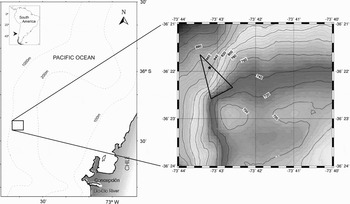
The cold seep site is located 72 km north-west off Concepción Bay, Chile (36°22′S 73°73′W), in the upper slope zone (750 to 900 m water depth; Figure 1). The presence of abundant carbonate-cemented mud, carbonate blocks, and shell fragments of several clams known to harbour chemosynthetic endo-symbiotic bacteria (vesicomyids, lucinids, thyasirids and solemyids) has been reported for this site (Sellanes et al., Reference Sellanes, Quiroga and Gallardo2004; Sellanes & Krylova, Reference Sellanes and Krylova2005). In addition, high concentrations of pore water methane and sulphide and a widespread occurrence of authigenic carbonates and sub-surface gas hydrates were also documented in core material from the study area (Coffin et al., Reference Coffin, Gardner, Diaz and Sellanes2006).
Study site, located on the slope zone off central Chile (36°S). The triangle indicates trawls that successfully collected evidence of active methane seepage (carbonate blocks, live chemosymbiotic clams and shell fragments).

Samples were obtained during the SeepOx cruise (31 August–4 September 2006) onboard the AGOR R/V ‘Vidal Gormáz’. Megafaunal specimens were collected by means of a modified Agassiz trawl (AGT) with a beam width of 1.5 m and a codend mesh size of 10 mm. Four successful hauls were used for this study: two performed under active seep conditions (indicated by the presence of living chemosymbiotic clams) and two at control sites (without evidence of seep activity, i.e. no living chemosymbiotic clams or authigenic carbonates; Table 1). Sampling depths varied from 732 to 893 m and, from each haul, Stegophiura sp. specimens were picked out and preserved onboard in buffered 4% seawater–formaldehyde. Disc diameter (DD) was measured from the disc edge above the base of an arm across the opposite interradius.
Station information and number of Stegophiura sp. individuals collected at each location. Samples were taken between 1 and 4 September 2006.

Note: Seep sites are indicated by the presence of live clams Calyptogena gallardoi.
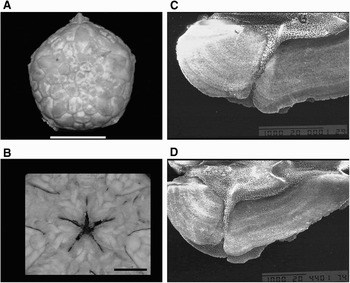
Specimens of Stegophiura sp. were identified according to Lara de Castro et al. (in preparation), who is describing the species as new. However, it is also described herein to avoid any problems with its future taxonomic identification. The species is easily distinguished by its orange colour and large disc with rounded borders, slightly pentagonal, covered with large, irregular, slightly granulated and inflated scales (Figure 2A, B). Central plate semi-pentagonal, slightly convex with the same size or larger than the primaries and separated from those by five small irregular scales. Primaries followed on the radial area by large subpentagonal scales, with distal border rounded, positioned on the proximal zone between the radial shield scales. Radial shields longer than they are wide, inflated, and united on the distal medium area. Dorsal arm plates strongly convex wider than they are long until approximately mid-arm, where they become as long as they are wide. Lateral arm plates as wide as the dorsal ones, each plate bearing from zero to two spines. Ventral interradial surface covered with five to six large irregular scales. Bursal slits narrow and long, with borders covered by plane, rectangular, and continuous genital scales that extend to the dorsal surface of the disc, where they become narrower and pointed forming the brachial comb. Jaws longer than they are wide, formed by strong and inflated plates. Two pointed infradental papillae present on the apex of the jaw. First oral tentacle pore communicating with the oral slit, and also with four to five papillae connected to the jaws and adoral shields. Also four papillae connected with the first ventral arm plate. Adoral shields inflated, narrow, and continuous near each other, surrounding the anterior third of the oral shield and touching the first ventral arm plate and the first lateral arm plate. Ventral plates of the arms wider than they are long, hexagonal on the first segments. Tentacle pores present all along the arm.
(A) Photograph of an adult of Stegophiura sp., dorsal view; (B) ventral view (scale bars: A = 30 mm, B = 10 mm); (C) SEM microphotographs of the growth banding from a specimen of 31.8 mm disc diameter (DD) from a non-seep site; (D) specimen of 32.1 mm DD from a seep site.

Ossicle growth bands
The age of the ophiuroids was determined according to Dahm (Reference Dahm1993, Reference Dahm1996), Dahm & Brey (Reference Dahm and Brey1998), and Gage (Reference Gage1990), by analysing the microstructure of annually formed growth bands on the vertebral ossicles of the arms. We used the proximal-most part of the arm in order to reduce error in aging of specimens whose arm(s) might have regenerated. The arm segment was prepared for examination of the vertebral ossicles according to the procedure of Dahm & Brey (Reference Dahm and Brey1998). The vertebral ossicles were mounted on brass stubs, sputter coated with gold under vacuum and examined using SEM micrographs (Figure 2C, D). Growth bands were measured as radii as described by Dahm (Reference Dahm1993). We used the von Bertalanffy (1) and Gompertz (2) functions to model individual growth:


where L∞ is the asymptotic size (ossicle radius, OR in mm), K (y−1) is the growth constant, t0 (y) is the age at which disc diameter would be zero and t* is the time of growth inflexion. Growth parameters were fitted using the Microsoft Excel computation worksheet of Brey (Reference Brey2001), by means of iterative non-linear regressions using Excel's Solver routine. In addition, the growth performance index was computed according to (3) Brey (Reference Brey1998) and (4) Moreau et al. (Reference Moreau, Bambino, Pauly, Maclean, Dizon and Hosillos1986):


where Mmax is maximum body mass (Kj), Amax is maximum age (y), K is the growth constant (y−1) and L∞ is the maximum asymptotic size (OR in mm).
RESULTS
Size-structure
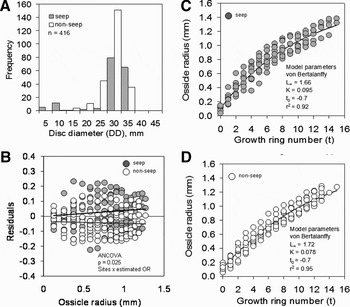
Size–frequencies of disc diameter from the aggregated samples at both non-seep (Stations: VG06-06-4 and VG06-06-7) and seep (Stations: VG06-06-8 and VG06-06-11) sites are given in Figure 3A. Whereas the Stegophiura sp. specimens from the non-seep sites varied in size between 10.6 and 38.1 mm disc diameter (DD; 31.59±4.05 mm; mean±1 SD), the specimens from the seep sites ranged from 8.8 to 39.6 mm DD (31.97±7.28 mm). The size–frequency of this species at the non-seep sites peaked between 25 and 35 mm DD; specimens collected from the seep sites presented two peaks: major frequencies between 30 and 35 mm DD and a secondary peak between 5 and 10 mm DD. We found that small-bodied individuals (DD < 10 mm) were more frequent at the seep sites, but no significant difference in DD was detected between the non-seep and seep sites (ANOVAF=0.464, N = 339, P = 0.495).
(A) Disc size–frequencies of Stegophiura sp. individuals from the seep and control non-seep sites; (B) plot of residual versus ossicle radius (OR) estimated from the von Bertalanffy model; (C, D) von Bertalanffy functions fitted to size-at-age data for individuals from the seep and control non-seep sites, respectively.

Growth and age
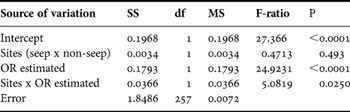
Growth banding is generally interpreted as reflecting zones of rapid skeletal growth during spring/summer (coarse-pore stereom), followed by a band of slower or nil growth, probably occurring in autumn/winter (fine-pore stereom). In fact, the break between fine-pore stereom and coarse-pore stereom is marked by the crest of a shallow ridge in the surface relief and provides the clearest mark of the limits of successive growth bands (Gage, Reference Gage2003). Size-at-age data, expressed as the ossicle radius, was obtained from measurements of natural growth lines on the vertebral ossicles of 10 individuals (N = 120) from the non-seep sites and 9 individuals (N = 141) from the seep sites. The resulting common growth curves are shown in Figure 3. The von Bertalanffy and the Gompertz growth functions provided a good fit to size-at-age data. In general, growth in Stegophiura sp. is expressed as a relatively low value of the growth constant. The von Bertalanffy growth constant for the seep sites was estimated to be KVB = 0.095 (r2 = 0.92). This value was higher than that obtained for individuals from the non-seep sites (KVB = 0.078; r2 = 0.95). In fact, based on the von Bertalanffy growth function, there was a significant difference in the elevation of the regressions of residuals versus ossicle radius (Y-intercepts) among specimens from the two sites (Table 2; Figure 3). In addition, we found a significant effect for the interaction between sites and estimated OR (ANCOVAF=27.36, N = 257, P = 0.025). These results confirm the significant differences among the growth rates for specimens from seep and non-seep. On the other hand, the Gompertz function provides an estimate of the asymptotic size for the non-seep sites (L∞ = 1.4 mm of OR) that is closer to that estimated for the seep sites (L∞ = 1.5 mm of OR). The von Bertalanffy model provides an estimate of the theoretical growth asymptote (L∞ = 1.72 mm of OR) higher than that derived from the Gompertz model. The oldest specimen of Stegophiura sp. was estimated to be 15 years old; its disc diameter was about 38.8 mm.
Analysis of covariance testing for homogeneity of regression coefficients for residuals from Stegophiura sp. individuals collected at seep and control non-seep sites.

OR, ossicle radius.
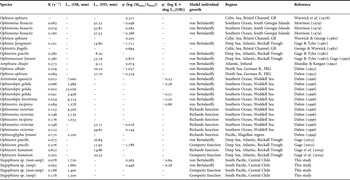
Table 3 summarizes growth rates and growth performance values estimated from our data set and the available literature regarding ophiuroids from various regions. In general, information on ophiuroid growth parameters is scarce in the literature; the population dynamic data collection contains the growth performance for only fourteen of the 16 species whose growth parameters are reported herein (Brey, Reference Brey2001). In general, our values are higher than those reported for Antarctic species, but within the range of growth performance values reported for sub-Antarctic and boreal species.
Growth parameters of ophiuroids from various regions (modified from Brey, Reference Brey2001).

K, growth constant (y−1); L∞, asymptotic size; ϕ, growth performance; OR; ossicle radius (mm); DD, disc diameter (mm); Mmax, maximum body size (Kj); Amax, maximum age (y).
DISCUSSION
It is known that, occasionally, non-chemosymbiotic species exhibit enhanced densities in the vicinity of deep-water seeps. In fact, dense aggregations of urchins, buccinid gastropods, cnidarians and asteroids have been described near seeps on the Oregon margin (Levin, Reference Levin2005). Stegophiura sp. is a common ophiuroid inhabiting the continental slope off central Chile (Quiroga et al., Reference Quiroga, Sellanes, Gerdes, Arntz, Gallardo and Hebbelnin press). Our results indicate that this species occurs in even higher densities nearby the CMSA (Sellanes et al., Reference Sellanes, Quiroga and Neira2008). Although the diet of this species has not been investigated, Stegophiura sp. specimens collected at the seep site display fairly heavy isotopic signatures for C and N (δ13C = −15.7‰ and δ15N = 20.1‰), suggesting a non-chemosynthetic origin of their food sources (Sellanes et al., Reference Sellanes, Quiroga and Neira2008). Indeed, these isotopic signatures are close to those recorded at the same site for other ophiuroid species (i.e. secondary consumers) such as Astrodia tenuispina (δ13C = −15.5‰ and δ15N = 18.9‰), Asteronyx loveni (δ13C = −13.5‰ and δ15N = 18.8‰) and the asteroid Ctenodiscus australis (δ13C = −11.0‰ and δ15N = 18.7‰). Individual echinoderm growth is known to be affected by a variety of factors (temperature, food, age, competition and predation). In an ecological context, food quantity and quality have been considered to be important parameters in most studies (Bluhm et al., Reference Bluhm, Piepenburg and von Juerzenka1998; Dahm & Brey Reference Dahm and Brey1998; Gage, Reference Gage2003). It is clear that the relationship between primary production and benthic food availability is not direct, but is affected by a complex of coupled factors (Bluhm et al., Reference Bluhm, Piepenburg and von Juerzenka1998). However, the relationship between low primary production and low echinoderm growth rates could indicate that the latter is limited by food availability. Therefore, the high abundance of Stegophiura sp. at the CMSA has to be considered as its ability to exploit this particular environment. In fact, the results obtained here suggest a size-segregated Stegophiura sp. distribution pattern. Indeed, juvenile forms (<10 mm of disc diameter) were found mainly at the seep sites, probably attracted to these areas by the presence of hard substrates (generating an enhanced diversity of suitable habitats) rather than the availability of food produced in situ.
The individual growth of benthic invertebrate species can be extremely variable, mainly due to environmental factors such as temperature and/or food supply (see Brey, Reference Brey1998 and references therein). In the present study, Stegophiura sp. growth was investigated by analysing the microstructure of growth rings. However, the hypothesis that these rings represent annual growth marks has not been validated, although the results provide strong evidence for seasonal growth. This pattern is similar to those described for Antarctic and sub-Antarctic ophiuroid species (Dahm, Reference Dahm1996, Reference Dahm1999). In the study area, the oldest Stegophiura sp. specimens were estimated to be 15 years, with a disc diameter of about 38.8 mm. These values are close to those reported for Antarctic species by Dahm (Reference Dahm1996), who determined a maximum age of 19 years for Ophioceres incipiens, 22 years for Ophionotus victoriae and 25 years for Ophiurolepis brevirima. However, the ages estimated for Stegophiura sp. are much lower than those estimated for Ophiurolepis gelida (33 years) and Astrotoma agassizi (91 years). Considering that the largest individual recorded in the study area is close to 40 mm, it is likely that the real longevity is higher than 15 years. This is reflected in the shape of the von Bertalanffy growth curve, which is not asymptotic in the analysed age-range. As proposed for Antarctic and sub-Antarctic ophiuroid species (Dahm, Reference Dahm1996, Reference Dahm1999), Stegophiura sp. is likely to reach asymptotic growth only after two decades. In addition, our results are similar to those estimated for sea urchins from boreal regions, which range from a maximum of 10 to 20 years (see Bluhm et al., Reference Bluhm, Piepenburg and von Juerzenka1998 and references therein). We suggest that the growth parameters estimated in this study could be also influenced by the presence of the Antarctic Intermediate Water (AAIW) in the region. This water mass is distributed along the continental slope (400–1200 m), and is characterized by low temperatures (4–6°C) and low salinity (Palma et al., Reference Palma, Quiroga, Gallardo, Arntz, Gerdes, Schneider and Hebbeln2005; Quiroga et al., Reference Quiroga, Sellanes, Gerdes, Arntz, Gallardo and Hebbelnin press). In fact, growth performance of Stegophiura sp. was relatively higher than values reported for Antarctic species, but falls within the range of those estimated for sub-Antarctic species, which are also influenced by the AAIW (see Table 3 and references cited therein).
Age-structures of hydrothermal vent and cold seep populations are still poorly understood (e.g. Schöne & Giere, Reference Schöne and Giere2005). The growth rates determined for Stegophiura sp. in the study area (von Bertalanffy KVB = 0.078–0.095; Gompertz KG = 0.178–0.188) are closer to those reported for other deep-sea ophiuroid species such as Ophiura ljungmani (KVB = 0.06, KG = 0.27; Gage et al., Reference Gage, Anderson, Tyler, Chapman and Dolan2004) and Ophiocten hastatum (KVB = 0.20, KG = 0.02; Gage et al., Reference Gage, Anderson, Tyler, Chapman and Dolan2004) but lower than that of Ophiocten gracilis (KVB = 0.02, KG = 0.27–0.28; Gage et al., Reference Gage, Anderson, Tyler, Chapman and Dolan2004). The von Bertalanffy growth function was suggested as the most promising for ophiuroids (Dahm, Reference Dahm1993; Gage, Reference Gage2003; Gage et al., Reference Gage, Anderson, Tyler, Chapman and Dolan2004). According to this growth function, size-at-age data from ossicle growth band measurements indicate a relatively rapid growth of Stegophiura sp. populations at methane seep sites. Therefore, we suggest that this result could be attributable to the presence of methane-derived authigenic carbonates, which provide a suitable habitat for ophiuroids, offering this heavily calcified epifaunal species some protection from predation (Gage, Reference Gage1990; Gage et al., Reference Gage, Anderson, Tyler, Chapman and Dolan2004). On the other hand, these rates were fairly low when compared with published studies of other bathyal species. In fact, both longevity and growth patterns characterize Stegophiura sp. as a long-lived, slow-growing invertebrate similar to those species living in the Antarctic and sub-Antarctic regions (Dahm, Reference Dahm1996, Reference Dahm1999).
In summary, according to information published on stable isotopes for the studied sites, Stegophiura sp. does not benefit from extra inputs of energy derived from chemosynthetic sources at the seep sites, and this species is probably just ingesting phytodetritus and sediments, as was found for other bathyal ophiuroids (Gage & Tyler, Reference Gage and Tyler1982; Gage, Reference Gage2003). However, although no significant differences were observed in the size-structure at both types of habitats, the higher occurrence of juveniles observed near the seep sites suggests that these areas constitute preferred breeding grounds for this species and/or represent recruitment sites as well. This preference is also reflected in the higher growth rates estimated at the seep site.
We still know little about the biochemical adaptations, trophic ecology, reproductive biology and population dynamics (e.g. secondary production and mortality) of the benthic megafauna associated with cold seep communities on the margin off Chile. In order to verify our findings, future studies should use other approaches to validate the growth models (such as stable isotope ratios 18O/16O and 13C/12C; Brey, Reference Brey2001).
ACKNOWLEDGEMENTS
Our thanks go to the officers and crew of the AGOR ‘Vidal Gormáz’ for their skilful operations at sea. We also thank Guillermo Guzmán and Mauricio Silva (Museo del Mar, Universidad Arturo Prat-UNAP, Chile) for help with sorting samples onboard as well as excellent support. We are also very grateful to Maria Soledad Romero (Universidad Católica del Norte, Coquimbo) for SEM work. The comments of two anonymous referees greatly helped to improve this manuscript. This research was funded by FONDECYT projects No. 1061217 and No. 1061214, and FONDAP-COPAS project No. 15010007; SCRIPPS Institution of Oceanography provided extra funding for ship time through NOAA Ocean Exploration programme grant No. NOAA NA17RJ1231. The CIEP centre (Gobierno Regional de Aysén, Chile, BIP, No. 3004258-0) is thanked for their support given to E.Q. during the writing phase of this work.