1. Introduction
In this paper, we address the ways in which nouns can give rise to new adjectives in Dutch and German. More specifically, the focus is on words with an evaluative meaning that can be used in a wide range of morphological and syntactic constructions. For instance, the Dutch noun reus ‘giant’ can be used as an intensifying prefixoid (namely, a compound member characterized by semantic specialization, see Booij Reference Booij2010:57) in nominals, as in 1a and in adjectival compounds, as in 1b. It can also be found as a free adjective, as in 1c, and even as an adverb, as in 1d (see Van Goethem & Hiligsmann Reference Van Goethem and De Smet2014).
(1)

In German, similar cases can be found in informal language. An example is the use of Hammer lit. ‘hammer’ as an intensifying prefixoid meaning ‘fantastic, extremely’ in nominals and adjectival compounds, as in 2a and 2b, respectively. The word can also be used as an adjective—attributively, as in 2c, as well as predicatively, as in 2d.
(2)
Hence, synchronic language use reflects a widespread distribution of such evaluative elements. It is obvious that the adjectival (and/or adverbial) uses are in most cases very recent and often still restricted to (very) informal language, as attested on the web. This is the case for the preceding examples, which are all drawn from the COW2012 web corpora (Schäfer & Bildhauer Reference Schäfer, Bildhauer, Calzolari, Choukri, Maegaard, Mariani, Odijk, Piperidis, Rosner and Tapias2012).Footnote 1
The question is how to account for these new adjectives and/or adverbs. Are they diachronically related to the corresponding prefixoids, or did they derive directly from the corresponding nouns? Both hypotheses can be found in the literature. On the one hand, the former hypothesis states that the intensifying bound morpheme has developed into a free morpheme, by means of a process called debonding (Norde Reference Norde2009). Van Goethem & De Smet (Reference Van Goethem and De Smet2014), for instance, demonstrate how nouns may turn into adjectives via debonding in Dutch, English, and French. The latter hypothesis, on the other hand, suggests that the new adjectival uses are the result of an n-to-a conversion, subsequent to a syntactic reanalysis that would take place in the predicative position and later extend to other contexts and uses, such as a prefixoid, an attributive adjective, and possibly an adverb. This view is supported by Pittner & Berman (Reference Pittner and Berman2006) and Berman (Reference Berman, Dufter, Fleischer and Seiler2009) for examples from German.
Whereas the debonding hypothesis suggests that prefixoids are the source of the new adjectives, the conversion hypothesis supports the idea that predicatively used nouns are at the heart of the new categories. On the one hand, according to the debonding hypothesis, context expansion proceeds from the bound morpheme to the free morpheme in the attributive position and later on to the predicative position. The conversion hypothesis, on the other hand, postulates the reverse path of context expansion. The contrast between the hypotheses has never been studied in the literature: Studies dealing with this topic explain the rise of these new evaluative adjectives either by debonding or conversion. The tension between the hypotheses is the central topic of this paper.
In the next sections, we adduce arguments for both points of view. We start with the conversion hypothesis (section 2.1) and contrast it with the debonding hypothesis (section 2.2). In sections 3 and 4, then, we present and analyze corpus material from the COW webcorpora (Schäfer & Bildhauer Reference Schäfer, Bildhauer, Calzolari, Choukri, Maegaard, Mariani, Odijk, Piperidis, Rosner and Tapias2012) to test the validity of each analysis. We present a detailed synchronic case study on Dutch top ‘top’ (section 3) and compare the results with data for German top and spitze (which is semantically equivalent in the evaluative use to Dutch top, section 4).
The comparison of Dutch and German in this domain allows us to measure the impact of particular language-specific factors on the observed category changes. It is a well-known fact that German has a more complex inflectional system than Dutch, which could be an obstacle to the N-to-A category change, since the newly formed adjectives would have to conform to the inflectional rules of German. Still, we need to find an appropriate account for the cases in which the category changes do occur.
Our case studies demonstrate that the debonding and conversion hypotheses are not mutually exclusive. On the contrary, if the language-specific constraints allow for it, the processes may interact closely with each other. In other words, it is shown that the new evaluative adjectival uses may result from different source constructions, namely, the compound pattern and the predicatively used noun. Thus, we provide additional evidence to support the more general claim that language change, more often than commonly presumed, involves a multiplicity of sources and pathways (see De Smet et al. Reference De Smet2013).
2. Category Change from Noun to Adjective
In general, it can be stated that the category change from noun to adjective is quite marginal in Dutch and German. In comparison, this type of category change seems to be more regular in English, which might be due to the fact that English adjectives are not subject to inflection. De Smet (Reference De Smet2012), for instance, describes the pathways taken by the English nouns fun and key in their recent development into adjectives. Being a mass noun, fun does not need a determiner in predicative position. This licenses, according to De Smet (Reference De Smet2012), its reanalysis as an adjective, as shown in 3a; it then gradually acquires a number of typically adjectival uses such as degree modification, as shown in 3b, and attributive use, as shown in 3c.
(3)
Conversely, De Smet (Reference De Smet2012:623–625) points out that the locus of reanalysis of English key is probably not the predicative position, but the attributive one. Support for this claim can be found in the unambiguously adjectival uses in which key is modified by the degree adverb very: The sequence very key occurs more frequently than expected in attributive position, as in 4a, than in predicative position, as in 4b.
(4)
The question whether English sequences such as key point in 4a should be analyzed as compounds or phrases has long been an object of much debate (see, for instance, Plag et al. Reference Plag, Kunter, Lappe and Braun2008, Giegerich Reference Giegerich2009 and, more generally, Schlücker & Hüning Reference Schlücker and Hüning2009 on the distinction between compounds and phrases).Footnote 2 It can at least be stated that their cohesion is much weaker than that of Dutch and German compounds. From this point of view, the pathway taken by English key from nominal premodifier to attributive adjective, and later to predicative adjective, is very reminiscent of the process of debonding explored in section 2.2. Conversely, the category change in the predicative context described for English fun is shown to be completely in line with the claims made by, for instance, Pittner & Berman (Reference Pittner and Berman2006) and Berman (Reference Berman, Dufter, Fleischer and Seiler2009) about the N-to-A conversion of German intensifying nouns. These claims are presented in the following section.
2.1 Conversion
Conversion is usually defined as “the derivation of a word without any phonological change of its base word” (Booij Reference Booij2002:134).Footnote 3 With regard to the formation of adjectives, morphological conversion is usually treated as a marginal process at best. Erben (Reference Erben2000:101), for instance, claims that conversion is not relevant for the formation of adjectives in German, and Olsen (Reference Olsen1990) even calls it ungrammatical.
For Dutch, it has been claimed that “there is no conversion of nouns or verbs into adjectives” and “that there is only conversion into verbs and nouns” (Booij Reference Booij2002:137). N-A pairs do exist in the non-native lexicon of Dutch (for example, het/de periodiek N ‘the periodical’–periodiek ADJ ‘periodical’), but according to Booij (Reference Booij2002:137), in most cases “the meaning of the noun can be defined more easily as a compositional function of that of the adjective, than vice versa.” A periodiek ‘periodical’ is a journal with a periodiek appearance.
German words such as ernst ‘serious’, schmuck ‘pretty’, schade ‘too bad’, angst ‘anxious’, feind ‘hostile’, and schuld ‘guilty’ are often mentioned as exceptional cases of N-to-A conversion resulting in defective adjectives that can in most cases only be used predicatively. Attributive use is not possible.
(5)
Moreover, adjectival use of angst or feind is becoming more and more outdated and restricted to certain idiomatic constructions, such as angst und bange ‘worried to death’ and jemandem spinnefeind sein ‘to hate someone’.
Because of this defectivity, there has been a lot of discussion about the status of these words: Are they really to be analyzed as adjectives (Donalies Reference Donalies2002:133)? Usually, a derivational (or compositional) alter-native is found next to the converted adjective: angst–ängstlich ‘anxious’, ernst–ernsthaft ‘serious’, feind–feindlich ‘hostile’, schuld–schuldig ‘guilty’. Eichinger (Reference Eichinger2000:169), therefore, suggests that German does not really need this type of conversion. Derivation and compounding yield “better” adjectives, which can be inflected and (therefore) used in attributive position, too, as in das ängstliche Kind ‘the anxious child’.Footnote 4
While this seems to confirm the marginal status of N-to-A conversion, there is a group of nouns that does allow for this type of category change. As pointed out by Pittner & Berman (Reference Pittner and Berman2006) for German, this N-to-A conversion occurs (with limited productivity) in substandard varieties. In particular, in youth language new adjectives are derived from nouns in evaluative expressions. This includes adjectives with a negative value (such as mist, scheiße, kacke, all meaning ‘shit’), adjectives that can be used as evaluative intensifier with any specific connotative value (such as hammer ‘fantastic’ lit. ‘hammer’), and adjectives such as klasse ‘great, awesome, neat’ or spitze ‘top’ that indicate a positive value.
According to Pittner & Berman (Reference Pittner and Berman2006) and Berman (Reference Berman, Dufter, Fleischer and Seiler2009), such adjectives have to be seen as the product of a conversion process in predicative use. This is, however, not to be seen as a case of morphological conversion in the strict sense, which would imply a productive morphological pattern of category change. Instead, one is dealing here with a syntactic reanalysis triggered by an ambiguous use in a particular syntactic context, namely, the predicative one. In constructional terms, this syntactic reanalysis is the result of constructional override and coercion (Michaelis Reference Michaelis2004): The noun used predicatively begins to show adjectival properties because the predicative position is typically filled by adjectives.Footnote 5 The relevant steps can be illustrated as follows, with Bombe ‘bomb’ used metaphorically as an equivalent for fantastic:
(6)
While 6a is a clear example of Bombe being a noun, accompanied by its article, 6b, c are ambiguous. Bombe could be a bare noun or adjective. The only clue is the spelling of the first letter (capital or not). This is of course a highly problematic criterion, but since all nouns in German are spelled with a capital letter, one might assume that the lowercase letter <b>, as in 6c, can be seen as an indication that the writer might interpret bombe as an adjective.
There are, however, more criteria. While 7a is an example of an NP with an inflected adjective (total-e), 7b, despite the capital, and 7c seem to be examples of an adjective accompanied by an intensifying adverbial (total).
(7)
Moreover, like all adjectives, bombe has to be negated with nicht. Negation with kein/e(r) leads almost automatically to the literal interpretation of the noun Bombe ‘bomb’.
(8)
Replacing nicht by keine in these examples would lead to semantically odd sentences.
Although bombe behaves like an adjective in predicative position, there are arguments against its adjectival status. Words such as bombe or klasse cannot be inflected, which becomes problematic in attributive position, where German adjectives need to be inflected for gender, number, and case. Therefore, the status of these words is controversial in the literature (Elsen Reference Elsen2011:163). Example 9 demonstrates that the absence of inflection cannot be the consequence of the stem ending in schwa, since the ordinary adjective böse ‘evil’ is inflected, while evaluative klasse ‘neat, great’ is not.
(9)
Adjectives such as klasse ‘great, neat’, bombe ‘terrific’, and schrott ‘bad, absurd’ are used more frequently in predicative than in attributive position. When used attributively, they do not adopt all the characteristics of normal adjectives. Therefore, Pittner & Berman (Reference Pittner and Berman2006) and Berman (Reference Berman, Dufter, Fleischer and Seiler2009) suggest that it is the predicative position that has to be seen as the source context of the reanalysis:
It is argued that N→A conversion is linked to the predicative position, which, due to its syntactic and semantic characteristics, is well suited to conversion. Once the adjectival use is established in the predicative position, it can spread to other syntactic environments.
(Pittner & Berman Reference Pittner and Berman2006:233)
The predicative position seems to be the ideal locus for this type of category change, not only because nouns can be used without a determiner in this specific context, but also because adjectives are not inflected in the predicative position, both in German and Dutch. Hence, the distinction between nouns and adjectives is probably most blurred in this specific syntactic context and may therefore license N-to-A reanalysis.
Not only in German, but also in Dutch, certain nouns may be used predicatively with an evaluative value, especially in informal language; the use of a determiner may then be obligatory, as in 10, optional, as in 11, or ungrammatical, as in 12.
(10)
(11)
(12)
Just as in German, the predicative use of bare Dutch evaluative nouns may be reinterpreted as adjectival, and language users may therefore extend the use of these intensifiers to new unambiguously adjectival contexts. This can be illustrated, for instance, by Dutch klasse that can be modified by degree adverbs, as in 13a, and used attributively, as in 13b.
(13)
As claimed before, this kind of adjectival use should, in our view, be distinguished from true morphological conversions, which would explain why Booij (Reference Booij2002) does not mention N-to-A conversion. Nouns and verbs obtained by conversion—such as de gek ‘the madman’ or fiets-en ‘to cycle’—immediately adopt the syntactic and morphological behavior typical of nouns and verbs. In contrast, the adjectival uses of nouns such as klasse are subject to rigid syntactic and morphological constraints— they are highly context-sensitive—and may expand in a gradual way. For example, klasse does not have the typical adjectival morphological comparative and superlative forms (⋆is klasser dan, ⋆is het klassest), and their analytic comparative and superlative forms are very rare and sound odd (?is meer klasse dan lit. ‘is more class than’, ?is het meest klasse lit. ‘is the most class’). These observations also hold for English: De Smet & Van de Velde (Reference Hendrik and Van de Velde2014) claim that new English denominal adjectives, such as sneak, are often defective (for example, a sneak atomic attack versus ⋆very sneak).
In sum, the hypothesis formulated for German by Pittner & Berman (Reference Pittner and Berman2006)—we still refer to it as the conversion hypothesis for the sake of convenience—is not implausible for Dutch, but it may, like in German, not result in full-fledged adjectives. In the next section, we examine the extent to which the debonding hypothesis could provide an alternative explanation for adjectives derived from (bound) nouns in Dutch and German.
2.2. Debonding
Debonding is one of the subtypes of degrammaticalization distinguished by Norde (Reference Norde2009). The process is defined as “a composite change whereby a bound morpheme in a specific linguistic context becomes a free morpheme” (Norde Reference Norde2009:186) and is typically marked by the following parameters: severance (the emergence of free morphemes out of bound morphemes), recategorialization (category change), scope expansion (for example, scope over a phrase), and flexibilization (syntactic context expansion; Norde Reference Norde2009:186–227). Norde (Reference Norde2009) focuses on the debonding of clitics, and inflectional and derivational affixes. Norde & Van Goethem (Reference Norde and Van Goethem2015) demonstrate that (Dutch) affixoids may undergo debonding as well.
Just like the context-sensitive N-to-A category change described in the preceding section, debonding and subsequent recategorialization also differ from morphological derivation through conversion. As stated in Van Goethem & De Smet Reference Van Goethem and De Smet2014:253,
[debonding] depends on the occurrence of the noun in the specific morphosyntactic constellation of compound(-like) sequences, and typically occurs when the noun has already obtained some qualifying adjective-like function […]. This is also reflected in its gradualness.
Logically, when an affixoid undergoes debonding and is reanalyzed as an adjective, attributive uses tend to appear before predicative uses (see the case study on French clé in Amiot & Van Goethem Reference Amiot and Van Goethem2012 and Van Goethem Reference Van Goethem2015, and the study on Dutch reuze in Van Goethem & Hiligsmann Reference Van Goethem and De Smet2014).
Van Goethem & De Smet (Reference Van Goethem and De Smet2014) investigate how the debonding process in Dutch, English, and French is impacted by three different factors: (a) the semantics of the bound noun or affixoid subject to debonding, (b) the degree of prosodic and morphological cohesion of the sequence, and (c) the impact of adjective inflection in the language. With regard to the semantics, debonding in all three languages is typical of nouns with a qualifying (often evaluative/intensifying) function, for example, un secteur économique clé ‘a key economic sector’.
Besides this semantic constraint, there are further language-specific, essentially morphological, constraints on debonding, namely, compound cohesion and inflection. These constraints account for the fact that the English sequences with key and their French counterparts with clé, for instance, act differently from the Dutch compounds beginning with sleutel, for example, ⋆sleutel economische sector (Amiot & Van Goethem Reference Amiot and Van Goethem2012). Van Goethem & De Smet (Reference Van Goethem and De Smet2014) therefore argue that the likelihood of debonding largely depends on the degree of cohesion of the compounds or compound-like sequences, manifested, among others, through spelling and word stress. Since Dutch compounds show stronger cohesion than their French and English counterparts, debonding is less likely to occur in Dutch.
Finally, as already observed in the previous sections, reanalysis of a noun as an adjective may be favored in languages with little or no adjectival inflection, as in French and English, respectively. For the same reason, debonding is disfavored in Dutch.Footnote 8 Van Goethem & Hiligsmann (Reference Van Goethem and De Smet2014) investigated the debonding of the Dutch prefixoid reuze, derived from the noun reus ‘giant’, and confirmed that its autonomous uses may display all of the typical parameters of the process. Some relevant examples are given in 1 above: In 1c, reuze acts as a predicative adjective, which is suggestive of its flexibilization. Example 1d demonstrates that the prefixoid can be recategorized not only as an adjective, but also as an adverb. Example 14 illustrates the possibility of scope expansion, reuze being used as an attributive adjective with scope over an entire noun phrase: megalithische steenblokken ‘megalithic blocks of stone’.
(14)
The fact that as an adjective and adverb reuze preserves the form of the prefixoid reuze (as in reuzespannend ‘very exciting’) and not that of the corresponding noun (reus ‘giant’), as well as its intensifying value, provides strong support for the debonding account: Reuze is just not a plausible outcome of N-to-A conversion.Footnote 9
Van Goethem & De Smet (Reference Hendrik and Van de Velde2014) do not include German in their analysis of debonding processes. However, drawing on their data, they assume “that a language such as German, characterized by very cohesive compounds and a more complex inflectional system than Dutch will even allow less debonding or may exploit yet other pathways” (Van Goethem & De Smet Reference Van Goethem and De Smet2014:272). This might be a plausible explanation for the absence of the debonding analysis in the literature on German, where the emergence of intensifying adjectives is seen exclusively as a case of syntactic reanalysis (conversion; see section 2.1).
There are, however, indications that debonding might play a role in German, too. Norde & Van Goethem (Reference Van Goethem and De Smet2014), for instance, present some evidence for debonding in the case of the adjectival use of German riesen ‘giant’. Because of its form, this case cannot be analyzed as conversion from the noun Riese ‘giant’. It has to be seen as a reinterpretation of the first element of the nominal compound, including the linking element -n- (for example, Riesenaufwand > riesen Aufwand ‘giant effort’), which competes against the derivational adjective riesig ‘giant’.
In the previous section, we discussed Dutch klasse in the context of the conversion approach. The use of its German cognate klasse ‘great, neat’ shows some variation that might be seen as support for the debonding analysis: ein Klassewagen / Klasse Wagen / klasse Wagen ‘a great car’, ein Klassespieler / Klasse Spieler / klasse Spieler ‘an excellent player’, etc. The spelling klasse indicates an adjectival interpretation of the word, despite the omission of the inflectional ending -r. Inflected uses are attested, but only very rarely, and they are judged very odd by native speakers of German. For klasser Spieler we only found one example:
(15)
At first sight, the existence of such variants might be seen as an illustration of an ongoing debonding process: Klassespieler > Klasse Spieler > klasse Spieler > klasser Spieler. On closer inspection, however, frequency data do not, or at least not convincingly, support this analysis. They rather point in the opposite direction. The combination klasse Spieler is attested 124 times in DECOW2012-00, while Klassespieler occurs only 55 times. Therefore, Klassespieler could also be an A+N compound with the evaluative adjective klasse as its first element. The adjective itself, then, is probably the result of a syntactic reanalysis in predicative position, and its use in attributive position is to be seen as context expansion. The “in-between spelling” Klasse Spieler (with capital K) is not conclusive: It might be seen as an indication of ongoing debonding, but it could also be a mere spelling variant, not unusual in informal language.
In German, therefore, the conversion analysis seems to be the most straightforward explanation for the emergence of evaluative adjectives. Debonding effects might strengthen the adjectival interpretation, and in some cases (such as riesen), they offer an adequate explanation for the adjectival use. In what follows, we investigate if both strategies—conversion and debonding—can also account for the adjectival uses of Dutch top (section 3) and its German counterparts top and spitze (section 4).
3. Dutch Top
In this section, we investigate how the adjectival uses of the Dutch noun top should be accounted for. Top is frequently used as a compound member (as in topsport ‘top-level sport’), and more specifically, as an intensifying prefixoid (as in topvakantie ‘excellent holiday’). The noun top can act as an evaluative predicate, too, with or without a determiner:
(16)
The data for this case study are drawn from the COW corpus, a gigatoken database of tagged and lemmatized texts from the web, compiled at Freie Universität Berlin (Schäfer & Bildhauer Reference Schäfer, Bildhauer, Calzolari, Choukri, Maegaard, Mariani, Odijk, Piperidis, Rosner and Tapias2012).Footnote 10 Since this corpus provides large data sets from different languages, including Dutch and German, often from informal sources such as forums and blogs, it is perfectly suited for a comparative study of innovative constructions.
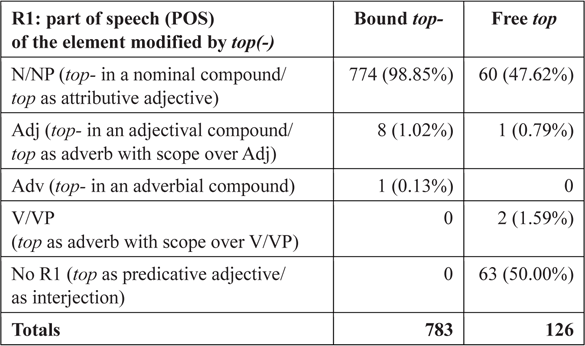
For the corpus study of Dutch top(-), a random sample of 1000 occurrences of both bound and free forms was extracted from the NLCOW2012-00X subcorpus. Our aim was to compare bound top- within compounds with free top with a potentially adjectival (or possibly adverbial) function. Therefore, we had to discard some incomplete and repeated examples, as well as a range of irrelevant hits. The latter included non-compounds beginning with top, as in topper ‘topper, hit’, toppen ‘tops; to top’; top unambiguously used as a noun, as in de top van de berg ‘the top of the mountain’, een zomerse top ‘a summery top (t-shirt)’, de top 10 ‘the top 10’; top used in (English) collocations, as in op en top ‘all over, out and out’, tip top ‘first-class, in perfect shape’, van top tot teen ‘ from top to toe, from head to foot’, top down, over the top).Footnote 11 After this clean-up of both types of sample, we ended up with 783 occurrences of bound top- and 126 potentially adjectival/adverbial free forms of top (that is, followed by a phrase or used predicatively or as an interjection).Footnote 12
Following the previous accounts, under the debonding hypothesis attributive uses should be more frequent than predicative ones (because of the diachronic priority), and the free usages of top should be semantically related to its bound forms. Alternatively, under the conversion hypothesis, predicative uses should be more frequent than attributive ones (because of the predicative source context), and the free adjective top should preserve the semantics of the corresponding noun. In what follows, we first compare the semantics of bound and free top(-) (section 3.1) before examining the constructions both types of morphemes occur in (section 3.2). On the basis of these data, we determine whether free top should be considered the result of either N-to-A conversion or debonding of compounds beginning with top- (section 3.3).
3.1. Semantic Types
With regard to the semantics of top, the following types can be distinguished. First, top(-) can have a concrete, spatial meaning: ‘upper’. This meaning is restricted to the bound forms:
(17)
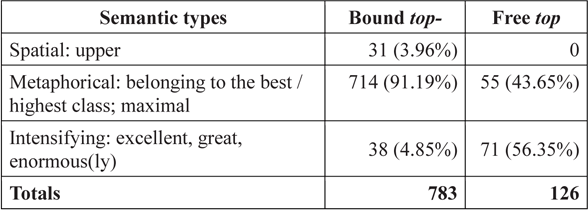
Second, top(-) can have an abstract metaphorical meaning, expressing that someone or something belongs to the highest or best class. This meaning is by far the most frequent one when top- forms part of a compound: It applies to more than 91% of the 783 compounds in our sample, as in 18a, b. However, this value is also widespread in the free forms (about 44% of the data), as shown in 18c. In combination with measurable entities, top(-) may also mean ‘maximal’, as in 18d.
(18)
Finally, top(-) can be used with an intensifier meaning ‘excellent, great, enormous(ly)’. Because of its specialized meaning within the compound, top- can then be considered a prefixoid (see, among others, Leuschner Reference Leuschner, Nübling, Dammel and Kürschner2010, Hüning & Booij Reference Hüning and Booij2014, Norde & Van Goethem Reference Norde and Van Goethem2015). However, the use as a true intensifying prefixoid is quite exceptional: It only applies to 4.85% of the bound forms, as, for example, in 19a. As a free morpheme, on the contrary, the intensifying function is the most common one, covering more than 56% of the sample. Top can then be used as an attributive or predicative intensifier, as in 19b and 19c, respectively.
(19)
This semantic classification is not as straightforward as it may look at first sight. The same compound can, for instance, belong to different semantic classes according to the context in which it is used; therefore, every occurrence had to be interpreted in a very careful way. This is especially the case for the metaphorical and intensifying semantic types, which are closely related to each other by Lakoff & Johnson (Reference Lakoff and Johnson1980)'s metaphor “Good is up.” For instance, toptijd is clearly evaluative in 19a, but when it is used to describe the achievements of an athlete, it belongs to the second semantic class and should be interpreted as “record time”. Furthermore, whereas toplaag in 17a can be placed in the spatial category (with top meaning ‘upper’), this is not the case in 20, where top means ‘belonging to the best class in a hierarchy’.
(20)
Table 1 summarizes the frequencies of the different semantic types for both the bound and free forms of top(-).
Semantic types of bound and free top(-).

The data show important semantic differences between bound and free top(-): Bound top- can have a spatial meaning, albeit marginal, which is not observed in the free uses. The metaphorical meaning appears far more frequently with the bound forms, while the intensifying meaning is typically associated with free top. These semantic differences already indicate that bound and free top(-) are not merely spelling variants of each other. However, they do not yet allow one to determine which process—debonding or conversion—accounts for the adjectival uses of top. Therefore, we have to take a closer look at the different construction types in which the bound and free forms may appear (see section 3.2). For the time being, we can nevertheless advance the following hypothesis. The fact that free top is used significantly more often with the intensifying meaning, whereas bound top- is used significantly more often with the metaphorical meaning, may indicate one of the following: Either bound top- is not a result of debonding (but of conversion), or the debonding process involved is subject to considerable semantic constraints. The latter would be in line with Van Goethem & De Smet (Reference Hendrik and Van de Velde2014), who demonstrate that debonding mainly applies to compound members with an evaluative meaning (see section 2.2).
As shown by the examples above, top(-) mostly combines with a nominal R1 (that is, the right-hand compound member in bound constructions, or the first word to the right in free constructions), even though it can also occur with words belonging to other classes (see section 3.2). When comparing the most frequent R1s, we also observed some interesting differences between bound and free top(-). The most frequent R1s for bound top- are sport, club(s), and ambtena(a)r(en) ‘official(s)’, whereas the most frequent R1s for free top are leverancier ‘supplier’, manager, and secret.Footnote 13 What also attracted our attention is that in the latter case, two out of the three nouns are English loanwords: manager and secret. The spelling of the words top manager and top secret is most probably influenced by the English spelling of compounds, even though topmanager also occurs—and is even highly ranked—among the most frequent compounds (in seventh position).
If one includes the less frequent nominal R1s for free top, a general tendency emerges: 10 out of 58 free occurrences (17.24%) involve English loanwords (top cast, top entertainment, top service, etc.). In contrast, this only applies to 45 out of the 774 (5.81%) compounds beginning with top- (topteam, topcoating, topcoach, etc.). Even if spelling alone is not sufficient to explain the emergence of the free forms and the semantic differences observed above, one needs to take into account the English origin of certain top+N sequences as a crucial factor that has triggered some of the free forms.
Another formal factor that may influence the spelling of compounds was pointed out in Van Goethem & Hiligsmann's (Reference Van Goethem and De Smet2014) study of the debonding of Dutch reuze-, namely, the length and complexity of the compounds. In six out of the 58 cases (10.34%), top has scope over another nominal compound, as in top handballanden ‘top handball countries’. It is very probable that this separation is motivated by a concern for the readability of compounds that would be too long and too complex if written as one word. Moreover, spelling such compounds as two words may disambiguate the scope of top, as shown in 21.
(21)
In 21, top has scope over the head of the following compound, zangeres ‘(female) singer’ and not over its modifier, zeur ‘(to) nag’.
3.2. Construction Types
Table 2 compares the construction types, in which bound and free top(-) are found.
Construction types for bound and free top(-).

As the results in table 2 indicate, bound and free top(-) occur in highly divergent construction types. Bound top- is almost exclusively found in nominal compounds (for example, topvorm ‘top form’, topinkomens ‘top incomes’, topattractie ‘top attraction’). In contrast, cases in which free top has scope over a noun are significantly less common (about 48% of the data). As already observed, such cases include many nominal compounds borrowed from English (top manager, top secret) and constructions in which top has scope over another compound. However, there are also a few cases in which top has scope over a phrase, as illustrated in 22. This is a clear sign of scope expansion, one of the typical parameters of debonding (see section 2.2).
(22)
Moreover, the fact that top technisch accountmanager is coordinated with gewone technisch accountmanager indicates that top has the status of an attributive adjective, in the same way as gewone ‘ordinary’. This status should also be assigned to top in 23, in which it is coordinated with the adjective lagere ‘lower’.
(23)
In precisely half of the data, free top is found in predicative position or as an interjection, as shown in 24b. This implies that no immediate R1 can be identified. In all 63 cases with top used predicatively or as an interjection, it conveys the intensifying meaning excellent, which may also explain why it is so often accompanied by a degree adverb in this context. In 24a, b, the forms absoluut ‘absolutely’ and echt ‘really’ are unambiguously adverbial degree modifiers. If they were prenominal adjectives, they would have the inflected forms absolut e ‘absolute’ and echt e ‘real’. This signals that top should be assigned adjectival status in these examples. Helemaal ‘completely’ in 24c is a degree adverb, without adjectival counterpart.
(24)
These predicative cases are at the heart of our study since they may be accounted for in two ways. First, they may result from flexibilization, typically involved in debonding. This would imply that top has undergone context expansion from the attributive to the predicative position. Second, they may be accounted for by N-to-A reanalysis in the predicative position (conversion). However, both accounts still raise some important questions. On the one hand, as shown earlier, predicative top, attributive top, and bound top- are semantically very different: Predicative top is always intensifying; attributive (free) top has an intensifying meaning in five instances out of the 60 (8.33%); for bound top- this intensifying value is even more marginal, that is, only 4.85% of the occurrences in the corpus sample. On the other hand, if the predicative use of top were the result of the reanalysis of the noun top, one would expect the noun phrase de top to be used productively in this position too, but this seems not to be the case. In the original sample of 1000 random examples of free top (including the clearly nominal ones), only two instances of this construction occurred:
(25)
Finally, scope over adjectives, adverbs and verbs is marginal or inexistent for both the free and the bound morpheme. Bound top- is almost exclusively used in nominal compounds, but adjectival/adverbial compounds do occur. In these cases, top functions as an intensifying prefixoid:
(26)
In the few cases in which free top does have scope over an adjective or verb phrase, it acts as an intensifying degree adverb:
(27)
From this data analysis, it can be concluded that bound and free top(-) display a very different semantic and constructional behavior. In the next section, we interpret these results in the light of the two theoretical hypotheses presented above.
3.3. Debonding or Conversion?
The key question of this study is to examine if the free uses of Dutch and German intensifying prefixoids should be considered the result of a debonding process, or of an N-to-A category change in predicative position. With respect to Dutch top, we can now draw the following conclusions. It is true that certain free uses should probably be seen as just a matter of spelling (for example, the English borrowings and the separated spelling of long compounds, or a more general tendency to write compounds as separate words). Yet the spelling factor cannot account for the significant divergences between the bound and the free forms with respect to the semantics and construction types they appear in.
The conversion hypothesis seems to be the most logical account for the predicative uses and the use of top as an interjection. Although de top (with a determiner) does not frequently occur in predicative position (for instance, het was de top! ‘it was great’ lit. ‘it was the top!’), it clearly has an intensifying value and is most probably related to the predicative use without determiner, as in het was top ‘it was top’, where top preserves this intensifying function. However, attributive top and bound top- are unlikely to be merely extended uses of predicative top since they only rarely express intensification. At the same time, these forms typically carry the metaphorical semantics of top ‘belonging to the highest/best class’, lacked by predicative top.
As a consequence, the debonding hypothesis is needed too, not only to account for the attributive uses with the metaphorical meaning, as in top leverancier ‘top supplier’ or top sport ‘top sport’ (even if misspelling could be at play here too), but also to capture the instances of scope expansion, such as top technisch accountmanager in 22. In order to explain that these kinds of attributive uses are quite marginal, we need to refer to the properties of Dutch morphology. When Dutch adjectives are used predicatively, they are uninflected, as in het boek is mooi/de boeken zijn mooi ‘the book(s) is(are) beautiful’. In contrast, attributive adjectives mostly end in an inflectional -e, as in het mooi eboek/mooi eboeken ‘(the) beautiful book(s)’, except when the noun is neuter indefinite singular, as in een mooi boek ‘a beautiful book’. Accordingly, the free form of Dutch top is not well suited for reanalysis as an attributive adjective, unlike the Dutch prefixoid reuze ‘giant’ (Van Goethem & Hiligsmann Reference Van Goethem and De Smet2014), which acts more frequently as an attributive adjective. Inflected forms of Dutch top did not occur in our corpus sample, but they do exist. The following two examples are drawn from the more recent NLCOW2014 corpus:
(28)
To summarize, we state that the predicative (intensifying) uses of top can be accurately explained as cases of conversion through reanalysis, whereas debonding is very likely to be involved in the rise of the attributive (mostly metaphorical) uses. It is more difficult, however, to account for the attributive intensifying uses—the ones with inflection illustrated in 28, but also the ones without inflection, as in 29.
(29)
Different processes could be involved in these kinds of examples. They could simply illustrate the tendency to write compounds as separate words; they could be the result of debonding of compounds beginning with an intensifying prefixoid (for example, topvakantie ‘top holiday’), or they could be seen as the result of context expansion of predicative top to include the attributive position (without, however, adopting the regular inflectional pattern of Dutch adjectives; see De Smet & Van de Velde Reference Hendrik and Van de Velde2014 on defective denominal adjectives).
To conclude, the case study of Dutch top indicates that a complex interplay of debonding, conversion, and spelling is most likely at work. The free uses of Dutch top derive not from a single source construction but from an intricate interaction between different sources, with the different compound types and (de) top used as intensifying predicates. These results are entirely in line with the findings reported in De Smet et al. Reference De Smet2013. In the next section, we demonstrate that different conclusions can be drawn from the German data.
4. German Counterparts of Dutch Top
Dutch top has two direct equivalents in German. In section 4.1, we briefly outline the results of a study on top in German (Battefeld & Rawoens Reference Battefeld and Rawoens2014). In section 4.2, we have a closer look at the semantics and construction types of German spitze, which is closely related to top semantically. The central aim is to explore if the free uses of German top and spitze should be accounted for by conversion alone, as suggested in the literature, or if debonding may play a role as well.
4.1. German Top
English loan words such as top manager are found in many languages, and the evaluative/intensifying top is on its way to becoming an internationalism under the influence of English. Battefeld & Rawoens (Reference Battefeld and Rawoens2014) conducted a comparative study on German top- and Swedish topp(en)-, with their data also drawn from the COW corpora. Their research question is parallel to ours, too: They investigate whether the free use of top is to be seen as a result of conversion or debonding, and their results seem to be in line with our findings for Dutch top.
As in Dutch, adjectival top is used frequently in predicative position in German. Some examples from the German DECOW2012 corpus may serve as an illustration. In 30a, bare top is used predicatively, while in 30b, c, top is modified by an adverb. Furthermore, 30c shows that the spelling is far from consistent. Because of the preceding adverbial, Top has to be analyzed as an adjective here, despite being spelled with a capital.
(30)
Adverbial use of top is also attested in German:
(31)
Attributive use of top, however, is problematic, since top usually cannot be inflected:
(32)
Inflected forms and comparative/superlative forms are only attested in very informal language or when used on purpose (as a pun). Battefeld & Rawoens (Reference Battefeld and Rawoens2014) mention toppes Wetter ‘top weather’, and in DECOW2012 we found an example of the comparative:
(33)
In 34, the first Top has to be interpreted as the first element of a compound (Topmarken), while the second one is an adjective because it is preceded by an adverbial (otherwise one would expect an inflected form absoluten).
(34)
There is also a telling difference in pronunciation in this example: most likely, initial compound-stress in Tóp Marken versus final phrase stress in top Préisen.
According to Battefeld & Rawoens Reference Battefeld and Rawoens2014, more than 30% of all top+N combinations in German have to be classified as loans from English (nominal compounds such as Topseller, Topmodel, etc.). When used in German nominal compounds, top has an abstract metaphorical meaning in the vast majority of cases, indicating the top of a hierarchy, a high or the highest level or class (Topspieler ‘top player’, Topqualität ‘top quality’). Related to this use, one finds evaluative top ‘excellent, great’ in compounds such as Topfilm ‘great movie’ or Topwochenende ‘great weekend’. In these words, top is becoming an intensifying prefixoid. The intensifying meaning can also be observed in adjectival compounds (topaktuell ‘very much up-to-date’, topmodern ‘very/highly modern’).
In the DECOW-2012 corpus, we found much variation with respect to spelling. For Topzustand ‘top condition’, the DECOW-2012-00 corpus has 138 instances of the compound written as one word, as in 35a, which would be the “correct” spelling in standard German. However, it is also spelled with a hyphen (35b, 115 instances) or as two words, with the capital letter (35c, 126 instances) or without (35d, 63 instances).
(35)
Such variation in spelling can be seen as an indication of ongoing debonding and the emergence of an adjective top in German, whose context of use can be expanded to include both attributive and predicative positions. The use of top as an adjective might, of course, also be influenced by English directly, where the form is ambiguous in prenominal position as well as in the predicative position.
In contrast, the conversion path seems to be less convincing for German. As Battefeld & Rawoens (Reference Battefeld and Rawoens2014) have shown, the noun Top is hardly ever used in German. Unambiguous cases of nominal use of Top in predicative position are very rare. In DECOW2012-00 we only found one example of Top preceded by an inflected adjective:
(36)
We do, however, find many examples of the predicative types illustrated in 30, many of which are ambiguous between bare nouns and adjectives. The spelling of the first character (capital or not) does not provide conclusive evidence; it seems to be arbitrary to a certain extent. In sum, we share the conclusion of Battefeld & Rawoens (Reference Battefeld and Rawoens2014). The debonding hypothesis seems to provide the most plausible explanation for the adjectival use of top in German. Compared to our case study on Dutch, we found fewer arguments in favor of the conversion path in German.
4.2. German Spitze
The data for our analysis of spitze are again drawn from the COW corpus. Like the Dutch case study, our study of spitze is mainly based on a selection of 1000 random examples of both its bound and free forms from the German DECOW2012-00 subcorpus. However, we also looked at other slices of the corpus for the verification and illustration of relevant cases. The main goal of this section is to compare the interplay of factors described above for the adjectival use of Dutch top with a semantically equivalent case.
The German noun Spitze is a highly polysemous word. It can be used to denote the peak (of a mountain), the top (of a tree), the tip (of a finger), the front (of a train), or the leading position (in sports). Top leaders or heads (of a concern) are referred to as die Spitze. Furthermore, Spitze can refer to a dig (at someone).Footnote 14 German has a corresponding adjective spitz, usually meaning ‘pointed; sharp’ (also metaphorically: eine spitze Bemerkung ‘a sharp remark’). Other usages are found in spitze Klammern ‘angle brackets’, ein spitzer Schrei ‘a shrill cry’, or jemanden spitz machen ‘to turn somebody on’ where spitz means ‘horny’.
While these examples only partially illustrate the semantic potential of Spitze and spitz, in this article, we want to focus on another (related) adjective: spitze. It is used in colloquial speech as an evaluative adjective, roughly equivalent to super, fantastic, or excellent. It is used predicatively in most cases, as in 37a, b, but attributive usage is attested incidentally too, as in 37c, d.
(37)
The adjective spitze is very similar to top in many respects. It is related to the use of evaluative nominal compounds such as Spitzenleistung ‘top performance’ or Spitzenpreis ‘top price’. The first element in these compounds is, however, the noun Spitze (not the adjective), since all of the relevant compounds contain the linking element -n- which in German is only used in NN-compounds, not in AN-compounds. Since the use of -n- is obligatory in compounds with Spitze as their first element, the form Spitzen- can also be analyzed as an allomorphic variant of the noun, used in compounds. With respect to the semantics of the productive pattern [Spitzen- + XN]N, one finds two meanings that are also frequently observed in Dutch nominal compounds with top as their first element (see section 3.1).
In most compounds, Spitzen- is used with an abstract metaphorical meaning, expressing that someone or something belongs to the highest or best group or class. A Spitzenleistung is a performance that can be ranked very high. A soccer game between the two leading teams (Spitzenteams) is a Spitzenspiel, and a Spitzenwein belongs to the best wines:
(38)
Spitzen- is also used in compounds denoting the leading position (in a race, etc.), as in Spitzenposition ‘top/pole position’ or Spitzenreiter ‘front-runner’:
(39)
Like top-, Spitzen- can also mean ‘maximal’ in combination with measurable entities:
(40)
Other examples of this type are Spitzenwert ‘top/maximum value’ or Spitzensteuersatz ‘top/highest tax rate’.
The meaning ‘top/highest’ gave rise to the intensifying evaluative meaning ‘excellent, great, super’. The distinctions between different meanings are, however, not always obvious nor clear-cut: There is an overlap between highest, best and the evaluative meaning, and many compounds can be used for both (such as Spitzenteam ‘top team’ or Spitzenspieler ‘top player’). Here are some examples of the evaluative/intensifying use of Spitzen-:
(41)
It is this meaning of Spitzen- that can also be found in the adjective spitze, and the obvious question is how these usages are related.
The adjective might be the result of a reanalysis of the noun Spitze, which has been suggested in the literature. As shown in section 2.1, Pittner & Berman (Reference Pittner and Berman2006) and Berman (Reference Berman, Dufter, Fleischer and Seiler2009) see the predicative use of this noun as the source context for the conversion into an adjective. The bare noun can be used to express the evaluative meaning:
(42)
The noun can also be modified by an adjective, typically absolut or einsam, in order to emphasize the positive evaluation:
(43)
However, the categorical status of Spitze seems to be uncertain. This can be illustrated by examples, in which the noun loses its capital letter, as in 44a. In some contexts, the noun is even accompanied by an inflected adjective, as in 44b.
(44)
Clear-cut adjectival uses can be found in contexts where the adjective is modified by an adverb and used in coordination with another adjective:
(45)
Attributive use of the adjective, however, is hardly observed. This usage is attested (see above in 37c, d), but it is very rare. In our sample, we found the example in 46.
(46)
The overwhelming majority of the instances of adjectival spitze, thus, are found in the predicative position. This is a strong argument in favor of the conversion analysis: The adjectival use has emerged in the predicative position out of the noun Spitze.
This does not, however, mean that debonding does not play a role at all. We do find examples of compounds with Spitzen-, written as two words, which might be seen as an indication that the status of Spitzen- is not always obvious to the writers. The word is also found without the capital letter, which might be seen as a further indication that it is sometimes interpreted as an adjective:
(47)
Unless one is willing to explain such examples as spelling variants or errors, this use of spitzen can only be explained by debonding: The first element of the compound is reinterpreted as an adjective. It is, however, defective in that it does not show inflection. In addition, it never occurs in predicative position; it is bound to the attributive position next to the noun it modifies. Moreover, it has the same evaluative meaning as Spitzen- in the compound. The reanalysis might be prompted by the existence of the adjective spitze, with which it shares the evaluative semantics. One might even see it as an attributively used variant of this adjective.
We conclude that German has developed an evaluative adjective spitze through conversion, as suggested in the literature. This adjective is perfectly usable in the predicative position, but its usage as an attributive adjective is problematic. This leaves room for the debonding of spitzen, an alternative pathway that is not taken into account in the literature on these kinds of evaluative morphemes. Both variants are, however, restricted to highly informal use in German. The further development of spitze into an ordinary adjective with inflection is blocked by the inflected forms of the adjective spitz ‘sharp’: ein spitze(n) Bleistift would mean ‘a fantastic pencil’, but the inflected form ein spitzer Bleistift can only mean ‘a sharpened pencil’. This might be one of the factors responsible for the variation and complicated development of attributive spitze.
5. Conclusion
The central aim of this study was to account for the emergence of new Dutch and German evaluative adjectives with a nominal origin. Category change from noun to adjective is a marginal phenomenon in both Germanic languages. The fact that it is observed more frequently in English indicates that the complexity of the language-specific inflectional system has a crucial impact on this type of category change. Yet the data in this study show that certain Dutch and German nouns may be reanalyzed as evaluative adjectives, in spite of the morphological constraints, and that these forms are commonly used in informal language to express a high degree of intensification, as attested in web-blogs and forums.
In order to account for these data, we have investigated two hypotheses found in the literature. According to the debonding hypothesis, compound members may be reinterpreted as attributive adjectives and may undergo a further process of flexibilization or context expansion. In contrast, the conversion hypothesis suggests the inverse pathway: The noun is reanalyzed as an adjective in the predicative position, and the adjectival usage may then spread to new syntactic and morphological contexts. In our case study, we have analyzed the bound and free usages of Dutch top and compared them with German top and spitze. The three forms synchronically occur as evaluative nouns, adjectives, and compound members, and therefore serve as an ideal case study for testing the validity of both hypotheses.
As for Dutch top, we have observed that different processes closely interact with each other. Conversion is the most likely account of the predicative (always intensifying) usages, but it does not explain the large proportion of attributive cases with top meaning ‘belonging to the best class’. These are clearly related to the compounds in which top- almost exclusively expresses this metaphorical meaning and hence suggest that debonding plays a role too. We have also observed that some free usages may be accounted for as spelling variants of the compounds written as one word (for instance, in the case of English loan compounds). However, attributive cases of top with scope over a phrase should definitely be accounted for by debonding. The comparison of the semantics of the bound and free morphemes and of the constructions in which they occur allow us to state that adjectival top has at least two source constructions: the noun used with an evaluative meaning in the predicative position and the left-hand compound member.
The data for German top point in the direction of the following debonding cline: Topzustand (‘top condition’) > Topzustand > Top-Zustand > top Zustand > Zustand ist top. In German, compounds with Top- are a more plausible source of adjectival top than the corresponding noun because evaluative top entered German mainly through compounds borrowed from English, and also because the noun Top is not entrenched in German. Therefore the conversion pathway seems to be less likely, as also concluded by Battefeld & Rawoens (Reference Battefeld and Rawoens2014).
In the case of German spitze, however, both paths of development should be taken into account, especially when explaining the wide range of formal variants (S/spitze versus S/spitzen). While evaluative spitze can be explained by conversion (reanalysis of the established noun Spitze), the use of free spitzen is inevitably the result of debonding (from the allomorphic variant in compounds with Spitzen-). Nevertheless, it seems reasonable to assume that the two forms have influenced each other. The use in attributive position, in particular, is most probably the result of mutual influence. The use of evaluative/intensifying spitze as an attributive adjective can be related to the corresponding predicative adjective, via context expansion, but it may also be linked to the nominal compounds with the semantically equivalent noun Spitze(n) as their first element.
At the same time, one observes—most probably under the influence of predicative spitze—a debonding tendency for these compound members: Spitzen is used as if it were an adjective, while surprisingly preserving its linking element. Expansion of debonded spitzen to the predicative position is, however, not observed. The adjectival status of spitzen, therefore, remains somewhat dubious. The formal variation found in the attributive position (as in Spitzenspiel /Spitzen Spiel /spitzen Spiel ‘top game’) is symptomatic of the uncertainty of language users with respect to the status of the first element.
To conclude, our findings support the idea that language change does not always follow linear pathways from the source construction to the target construction. In the present case study, it has been shown that multiple source constructions should be taken into account (see De Smet et al. Reference De Smet2013). Alternatively, pursuing the constructional perspective, newly created constructions may inherit properties from multiple parent constructions, via so-called multiple inheritance (Trousdale Reference Trousdale2013, Trousdale & Norde Reference Trousdale2013).
However, it has also been demonstrated that the impact of the different source constructions may be language-specific, and even construction-specific to a high degree. In general terms, it has been shown that the evaluative adjectives Dutch top and German spitze clearly inherit properties from two source constructions, the corresponding compound member (via debonding) and the predicatively used nouns (via conversion). However, conversion seems to be less likely in the case of German top. Although the complex inflectional system of German strongly counteracts the debonding process, the latter is the most plausible account for the emergence of the adjectival usages of German top.