1. Introduction
A reader of the Dutch quality newspaper NRC Handelsblad, who deeply regretted the retirement of its columnist J. L. Heldring, published the following comment on the newspaper’s website (bold is ours; throughout the article, we put the finite verb with singular or plural agreement in this construction in boldface):Footnote 1
(1)


This compliment prompted the response of Frits Abrahams, another columnist in the same newspaper, that the reader’s comment was an example of an “incorrect” construction Heldring had been fighting against in vain for all these years: a restrictive relative clause in which the finite verb agrees with the numeral one instead of with the subject of the relative clause, that is, the plural head noun NRC-columnists.Footnote 2 According to prescriptive grammar rules in Dutch, the singular verb form had ‘have.PST.SG’ in 1 should have been the plural form hadden ‘have.PST.PL’. This particular “agreement error” occurs extremely often in Dutch, as also noted by Heldring, quoted by Abrahams as follows: “Deze fout komt zo vaak voor dat ik niet alle passages waarin ik haar aantrof, ga citeren” [This error is made so often that I am not going to quote all phrases in which I encountered it.]
The same “error” can be found in English. While prescriptive grammar rules of English dictate that the finite verb in the relative clause agrees with the plural head noun and not with the numeral one, this often goes against native speakers’ intuitions, as illustrated by the following post by a native speaker on the internet forum WordReference (January 2005, boldface is in the original example):Footnote 3
(2)

The author of 2 apparently is not aware of the prescriptive rule that requires have in the relative clause of the sentence to agree with the head noun writers, and is confused because it sounds wrong; in their opinion, the verb in the relative clause should have been the singular verb has, agreeing with the determiner one of the partitive construction.
As for Dutch, the online version of the Algemene Nederlandse Spraakkunst (General Dutch Grammar) 1997 notes that the use of singular agreement in a sentence such as 3 below is indeed quite frequent. Still, the authors of the grammar call such sentences twijfelachtig ‘dubious’ (which is their terminology for prescriptively incorrect yet frequently occurring types of sentences).Footnote 4
(3)

The reason the authors of the grammar claim that 3 is dubious is that the relative subject pronoun die ‘that’ refers back to the plural head noun weinigen ‘few (people)’ and therefore should trigger plural agreement on the finite verb. We found 4 in another Dutch quality newspaper, de Volkskrant. This sentence is similar to 3 and even violates the prescriptive rule twice:
(4)

The subject Hoogewerf in 4 belongs to a set of few people who care about a boy, Farlan, and also to a set of few people who are not impressed by the boy’s temper tantrums. The determiner weinigen ‘few’ is nominalized, meaning ‘few people’, just as in 3. Note that the relative clauses in examples 3 and 4 are truly restrictive. A nonrestrictive meaning would be highly unlikely, as it would mean that Hoogewerf is one of a group of few people (it remains unclear who this group of people is), and in addition, that he is somebody who cares about Farlan. Because the restrictive reading is the only plausible one in sentences such as these, we should find plural agreement. Instead, 4 shows singular agreement, which is also reproduced in the English translation. One may wonder how such a violation of the prescriptive rule can enter a quality newspaper such as de Volkskrant. In the usage guide published by de Volksrant in 1992, the construction with singular agreement is explicitly claimed to be an error (van Gessel et al. Reference Gessel, Hulsbosch, Huurdeman, Kleef, Los and Vuijsje1992:62):
Vaak fout gaan constructies met een van de weinigen die … Goed is: Piet is een van de weinige gedetineerden die niet aan de actie meedoen. Het moet zijn meedoen, want het bijbehorende onderwerp is die en dat slaat op de gedetineerden. Fout is in dit geval te schrijven: meedoet.
A language error often made is found in constructions such as one of the few people who … Correct usage: Piet is one of the few prisoners who do not take action. It must be do, because the concomitant subject is who, which refers to the prisoners. Incorrect usage in this case: does.
As van Gessel et al. (Reference Gessel, Hulsbosch, Huurdeman, Kleef, Los and Vuijsje1992) mention, the construction with incorrect singular agreement often occurs in Dutch, apparently even in the newspaper that published the usage guide (as illustrated in 4 above). This may be due to the rather flexible and perhaps incomplete standardization of Dutch in general (see Grondelaers & van Hout Reference Grondelaers and Roeland2011), or to certain characteristics of the construction itself. Also, we have noticed that speakers of Dutch, including linguists, are often not aware of the existence of this prescriptive rule in Dutch.
Apparently, both plural and singular agreement are possible in this construction in present-day Dutch. Also, the difference between the two does not give rise to differences in interpretation per se. These observations then raise the question of what determines the choice between the two. In section 2, we first consider the possibility that the attested alternation between singular and plural agreement is an agreement error (and we briefly go back to this issue at the end of section 5.2). In section 3, we discuss the results of our corpus study, which shows that singular agreement is actually more frequent than plural agreement in the construction under consideration. The aim of this paper is therefore not only to explain why singular agreement is possible at all in the one of the (few) X who Y-construction, but also why it turns out to be the preferred option by native speakers of Dutch.
The corpus study furthermore reveals that this type of construction is mostly used as a nominal predicate, and that it remarkably often contains the modifier weinige ‘few’. We argue that this is not a coincidence. In its prototypical predicative use, the construction one of the (few) X who Y can be understood to mean that the subject is special because its referent has property Y. We argue in section 4 that the implicature of the subject’s specialness has become part of the conventional meaning of the construction one of the (few) X who Y, which explains the use of singular agreement within the relative clause, as we show in section 5. Section 6 addresses specialness as a context-dependent notion. In section 7, we compare the Dutch partitive construction to its German counterpart. Section 8 concludes.
2. An Agreement Error?
Since plural agreement in the relative clause seems to be in accordance with mainstream syntactic and semantic analyses of the construction, the occurrence of singular agreement might be taken to be an “agreement error”. Experimental studies that used a sentence completion task, as first introduced by Bock & Miller (Reference Bock and Miller1991), have investigated the relevance of several semantic and structural factors in the elicitation of agreement errors. In Bock & Miller’s (Reference Bock and Miller1991) first experiment, participants listened to English preambles such as The key to the cabinets, which they had to repeat along with a predicate that turned them into complete sentences, for example, The key to the cabinets was/were rusty. These preambles contained a feature known to be found in spontaneous agreement errors, namely, the combination of a head noun and a modifying phrase that do not agree in number, that is, the key is singular, whereas the cabinets is plural. Bock & Miller (Reference Bock and Miller1991) found an interesting asymmetry in the pattern of agreement errors, which has been replicated over and over again in later studies, both in English and Dutch (see Veenstra Reference Veenstra2014 for an overview). The asymmetry is that agreement errors are more frequent for subjects with a singular head and a plural modifier (The key to the cabinets…) than for subjects with a plural head and a singular modifier (The keys to the cabinet…). The agreement errors elicited by Bock & Miller (Reference Bock and Miller1991) and in later work (see Pearlmutter et al. Reference Pearlmutter, Garnsey and Bock1999) thus differ in three crucial respects from the alleged agreement error that we focus upon:
(i) Bock and Miller only found replacement of correct singular agreement by “erroneous” plural agreement. By contrast, in our construction the correct plural agreement is replaced by erroneous singular agreement;
(ii) In the experiments conducted by Bock & Miller, the agreement error involved agreement with the more local (intervening) modifying plural noun phrase instead of the more distant head noun phrase. By contrast, in our construction, the “agreement error” involves agreement with the more distant singular head of the partitive construction, een ‘one’, rather than with the more local plural head of the relative clause. Hence, there is no literally intervening noun phrase to trigger the erroneous singular agreement;
(iii) Bock & Miller emphasize that even in the experiments specifically designed to elicit these agreement errors, the errors remained highly exceptional, as 95% of the responses in their experiments showed correct agreement. By contrast, the outcome of a corpus study to be presented in section 3 is that the “erroneous” singular agreement forms the overwhelming majority in the one of the (few) X who Y-construction in spontaneous Dutch, namely, 80%.
Although singular agreement in the relative clause is unexpected from both a syntactic and a semantic point of view, and disapproved of by prescriptive grammar rules of Dutch, it does not appear to have any of the characteristics of agreement errors studied in psycholinguistic research (see Veenstra Reference Veenstra2014). Therefore, we believe that singular agreement cannot be considered an error at all and that we should try to find an explanation for the fact that singular agreement in sentences such as 4 above is a truly grammatical option for native speakers of Dutch, and also that it is the preferred option. The remainder of this article presents such an explanation. Before we turn to our analysis in section 4, we present our corpus study in section 3.
3. Singular Versus Plural Agreement in a Corpus
3.1. Methodology
In order to find out whether and when speakers of Dutch use singular or plural agreement in a subject relative clause embedded in partitive constructions headed by one, we built a corpus of spontaneous written language—an internet chat corpus. In general, written language might contain more instances of plural agreement than spoken language, due to the prescriptive norm that rejects singular agreement in these constructions. A corpus of spoken language is less suitable for our purposes, however, because the pronunciation cannot always distinguish between singular and plural agreement, as is shown by the following example, taken from the Corpus Gesproken Nederlands (CGN; Corpus of Spoken Dutch):
(5)

The past tense plural form of the verb woedden ‘rage.PST.PL’ is pronounced in the same way as the past tense singular form woedde ‘rage.PST.SG’ by many speakers of Dutch, and therefore it could have been the decision of the person who transcribed the sentence to write the word with plural rather than singular agreement. In order to avoid apparent disadvantages of both formal written and spoken language corpora, we have chosen an alternative for the present study, namely, a corpus of chat language. With the rise of new media, linguistic principles can be re-evaluated in what might be called “spontaneous written language”. The interactive text-based computer-mediated conversations, such as chat, indeed share many characteristics with informal spoken conversations (Herring Reference Herring2010).
In the Summer of 2011, we collected data from a Dutch internet forum called Fok!, which can be found at forum.fok.nl. This chat forum is the biggest of its kind in the Netherlands, and was announced to be 12th in the world in July 2011 when it contained over 100 million posts; in March 2017 it had more than 466,000 registered users, and over 169 million posts.Footnote 5 The users of the forum supposedly had a mean age of 28 in the year 2011.Footnote 6 The language used on the site is standard Dutch, and we have no indication whatsoever that it deviates from ordinary spoken or informal written Dutch language by native speakers of Dutch. Hence, there is no question of a specific language variant, or what Hinrichs (Reference Hinrichs and Lauren2016) refers to as “digital language contrasting”. We used an advanced Google search (see Kilgarriff Reference Kilgarriff2007 for a critical review of Google as a resource for linguistic research), and collected 270 constructions of the type one of the (few) X who Y in which the relative pronoun die ‘that’ refers to the subject of the relative clause. We subsequently checked whether all of these constructions were indeed of the type we were looking for. Care was taken to exclude constructions where the relative clause was presumably nonrestrictive (appositive), such as the one in 6 (note that we copy all spelling errors of the original examples).
(6)

The partitive in 6 likely does not refer to one of the theories that seem plausible (restrictive), but to one of the theories, which happens to be one that seems plausible (nonrestrictive). In this case, singular agreement is expected. Two items were thus removed from the data set. This resulted in a remainder of 268 items, which were scored for singular versus plural agreement of the finite verb in the relative clause. Two items unexpectedly showed 1st person singular agreement, apparently due to the 1st person subject of the main clause. These two items are presented in 7. We have annotated them as singular agreement.
(7)

In order to exclude the possibility that individual subjects influenced the data (for example, an exceptional author who only uses plural agreement, while all others only use singular agreement), we included the authors’ aliases in our data set. Although we cannot be completely sure, we assume that each alias stands for a different author (the use of more than one alias by one and the same author is not allowed on this internet forum). Of 243 utterances out of 268, we could retrace the author. It turned out that only 4 aliases occurred more than once, namely, twice, in the data set. As a consequence, we are not concerned about particular subject effects. Other information about the individual authors of the items, such as gender or age, was not available and therefore not taken into account.
The following factors that we thought might influence the preference for either singular or plural agreement were annotated: the grammatical function of the partitive construction (for example, subject or nominal predicate), presence of a quantifier (positive or negative), presence versus absence of a lexical head noun, and the gender of the head of the relative clause, to be explained below. Initially, we also annotated other factors, but they showed the same tendency toward singular agreement as the data overall, that is, 80%. Therefore, these factors were not taken into consideration in the final analysis.Footnote 8
3.2. Results
The 268 items were annotated for singular or plural agreement in the relative clause. Of the 268 examples, 214 had singular agreement (79.9%), and 54 had plural agreement (20.1%). Sentence 8a gives an example with singular agreement, and 8b is one with plural agreement.
(8)

This first analysis shows that the vast majority of the partitive constructions contain singular agreement. As mentioned above, we found four factors that significantly influenced the overall proportion between singular and plural agreement (79.9% versus 20.1%).
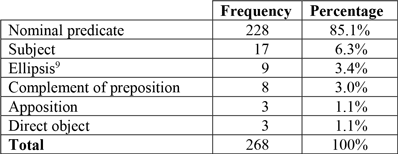
In both 8a and 8b above, the partitive construction is a nominal predicate. In 85.1% of the utterances, the construction under investigation fulfilled the grammatical function of nominal predicate. The second most frequent grammatical function was that of subject, as exemplified in 9b,c below. Table 1 demonstrates the different grammatical functions the construction fulfilled and their percentages.
Grammatical functions of one of the (few) X who Y.

To test the influence of grammatical role on the choice of singular or plural agreement, we compared utterances where the phrase was used predicatively (which included nominal predicates and appositives) with utterances in which it performed one of the other functions. We found that the percentage of singular agreement was higher when the phrase was used predicatively than when it was not, as can be seen in table 2. This difference was significant: χ2 (1)=7.117, p=.008 (two-sided).
Grammatical function and agreement.

The second factor considered in our analysis is the presence of a (positive or negative) quantifier. One of the observations that struck us when looking at the data was that many of the examples contained an adjectivized (or nominalized) quantifier, such as the negative quantifier weinige ‘few.AGR’, or a positive quantifier, such as vele ‘many.AGR’ or drie ‘three’. Examples with a negative, a positive, and no quantifier are given in 9a, 9b, and 9c, respectively:
(9)
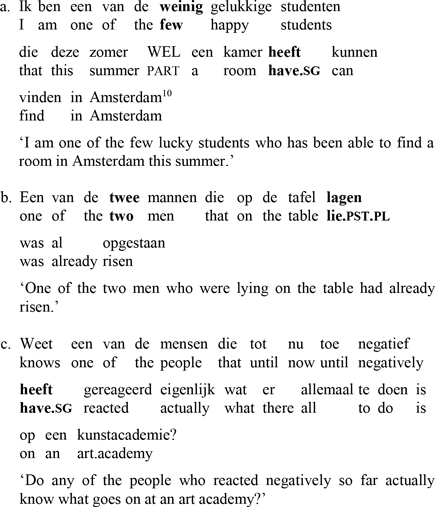
In total, 103 constructions did not contain a quantifier, 66 contained a positive quantifier, and 99 a negative quantifier. The only negative quantifier used was weinige ‘few’. Thus, 99 of the 268 partitive constructions contained weinige. We compared the utterances with weinige to utterances with either no quantifier or a positive quantifier. We found that there was a higher proportion of singular agreement in utterances with the negative quantifier weinige (89.9%) than in utterances with a positive or no quantifier (74%), as can be seen in table 3. This difference was significant: χ2 (1)=9.852, p=.002 (two-sided).
Quantifiers and agreement.

The third relevant factor is the presence versus absence of a lexical head noun. Quite a few utterances contained a nominalized quantifier, as in 10a, or a nominalized adjective, as in 10b, but no lexical head noun.
(10)

In total, 31% of the utterances had no lexical head noun but a nominalized quantifier or adjective, such as de weinigen ‘the few ones’, de drie ‘the three (ones)’, de enigen ‘the only ones’, de eersten ‘the first ones’, de gelukkigen ‘the lucky ones’, etc. We found that from the utterances with no lexical head noun, 91.6% had singular agreement, against 74.6% of the utterances with a lexical head noun (see table 4). This difference was significant: χ2 (1)=10.257, p=.001 (two-sided).
Presence/absence of lexical head noun and agreement.

The last factor we annotated is the gender of the head noun (lexical or not). In Dutch, two genders are distinguished: common gender, which is a collective term for both masculine and feminine gender, the so-called de-words (that take de ‘the’ as a definite article), and neuter gender, which is the gender of the so-called het-words (the words that take het ‘the’ as a definite article). Plural nouns combine with the relative pronoun die ‘that’ in Dutch independently of whether they have common or neuter gender. Singular common nouns combine with the relative pronoun die ‘that’, the same as the relative pronoun used for plural nouns, whereas singular neuter nouns (used to) only combine with the relative pronoun dat ‘that’ (nowadays there is a tendency toward using the relative pronoun die ‘that’ also with neuter nouns in Dutch). The reason for annotating for gender was that we expected that the use of the relative pronoun die with a neuter head noun could be an extra indication of plurality, thus triggering plural agreement in the relative clause. Consider again sentences 8 above, repeated below as 11.
(11)

Whereas the plural head noun mongolen ‘idiots’ in 11a has common gender (de mongool ‘the idiot’), the plural head noun boeken ‘books’ in 11b has neuter gender (het boek ‘the book’). Note that in both cases, the relative pronoun die ‘that’ is used, which is used for both, singular common gender nouns and plural nouns, but not for singular neuter nouns. Hence, we assumed that in 11a, die ‘that’ could relate to the plural head noun, but also to the empty singular noun that could be the complement of een ‘one’, that is, een (mongool) van de grootste mongolen ‘one (idiot) of the biggest idiots’. By contrast, the relative pronoun die ‘that’ cannot relate to the empty singular noun boek ‘book’ (because dat ‘that’ would be used as a relative pronoun), but only to the plural head noun boeken ‘books’. Thus, when the plural head noun had neuter gender, we expected more plural agreement in the relative clause.
We found that the proportion of plural agreement for het-words (33.3%) exceeded the proportion of plural agreement for de-words (17.7%), as can be seen in table 5. This difference was significant: χ2 (1)=5.381, p=.01 (one-sided).
Gender and agreement.

In this section, we presented our corpus study; we also discussed the four factors shown to be associated with singular agreement in the relative clause of the one of the (few) X who Y-construction: the grammatical function of the construction, the presence of a quantifier, the presence of a lexical head noun, and the gender of the head noun. In section 4, we argue that this construction comes with the implicature of specialness, which determines its prototypical use. In section 5, we show that this prototypical use of the construction explains why (each of) these four factors is associated with singular agreement (relatively more often).
4. The Target Construction
A construction is a conventionalized form-meaning pair in language (Goldberg Reference Goldberg2003, Reference Goldberg2006). We argue that the construction of the type one of the (few) X who Y comes with a particular implicature. Example 12 illustrates the prototypical use of the construction.
(12)

In this example, it is clear that there is no predefined set of men X who cannot fall asleep right after the act. Instead, the sentence is about the subject ik ‘I’ who has property Y (unable to fall asleep right after the act). The men are mentioned to emphasize the fact that there are only few people who possess this property, which gives rise to the implicature (pragmatic inference; Grice Reference Grice, Cole and Morgan1975) that the subject ik ‘I’ is special for having this property Y. Sentence 12 is thus primarily about the subject having property Y, and not so much about the subject being a member of group X. This means that the relative clause provides the primary predication (property Y) of the subject, whereas being a member of group X can be considered a secondary predication. We argue that this accounts for the fact that the relative clause that expresses Y tends to agree with the singular one rather than with the plural X.
Because it is the relative clause that provides the primary predi-cation, it is interpreted with respect to the cardinal one, hence singular agreement is expected. If the relative clause were attached to the numeral one directly, as in one who Y, singular agreement would be the only option. The partitive phrase of the (few) X in fact functions as a modifier providing secondary predication. Clearly, if Y were the only thing the speaker intended to say about themselves in 12, a verbal predicate such as I can’t fall asleep right after the act or a nominal predicate as in I’m a man who can’t fall asleep right after the act would be more efficient. However, then the addressee would miss the information that this property is shared by only few people, which makes the subject special. Embedding Y in the relative clause of a partitive construction headed by one is an economic way of expressing both pieces of information in one utterance. This implicature of specialness has become an essential ingredient of the one of the (few) X who Y-construction. Therefore, we consider it a “construction” in the sense of Goldberg Reference Goldberg2003, Reference Goldberg2006.
Example 12 above exemplifies the prototypical use of the construction. In section 5, we discuss how the four factors are related to the implicature of specialness; however, we note at this point that an utterance does not have to display all four characteristics to qualify as an example of the construction. Traugott (Reference Traugott2007:525) distinguishes between macro-construction and meso-constructions, the latter being sets of similarly-behaving constructions. We assume that the one of the (few) X who Y-construction is a meso-construction that includes not only one of the few X who Y, but also distinct but similarly-behaving constructions such as one of the lucky X who Y, one of the biggest X who Y, one of the rare X who Y, one of the only X who Y, etc. In fact, one of the X who Y, without an additional element such as few, can also be an instantiation of our target construction, as illustrated in 13.
(13)

The statement in 13 does not provide any information about the number of teachers who can admit they are wrong, that is, whether few or many teachers can do so. Still, even in the absence of such information, the sentence is readily understood as follows: The subject can admit they are wrong (property Y), and there are not many teachers who can (X), hence the subject is special for having this property, that is, being able to admit they were wrong. This interpretation is in accordance with the conventionalized meaning we propose for the one of the (few) X who Y-construction. While there is no quantifier few, the reading that emerges is nevertheless that there are few people like the subject. The fact that this reading emerges without the explicit mentioning of the smallness of the group the subject belongs to constitutes evidence for the claim that one is dealing with a construction here. If the implicature of specialness still holds in the absence of a specific trigger, it has become part of the conventional meaning of the construction (Verhagen Reference Verhagen2002). In other words, if the implicature could only be derived on the basis of an element such as few, this element would have to be present for the implicature to hold. The fact that the implicature can also arise in the absence of an element such as few indicates that it has become part of the meaning of the construction (see Verhagen Reference Verhagen2002 for another example of this process). Moreover, 14 shows that the implicature of specialness is not dependent on singular verb agreement either.
(14)

The statement in 14 is understood as follows: The subject cannot hold their pee for two hours (property Y), and there are not many people who cannot (X), hence the subject is special for having this property, that is, not being able to hold their pee for two hours. However, the construction in 14 has this conventional meaning without a quantifier such as few and also without singular agreement in the relative clause.Footnote 11 Again, this observation indicates that the meaning of the construction is truly conventionalized and even emerges in the absence of prototypical features such as the presence of few or singular agreement.
The interpretation of the one of the (few) X who Y-construction as a nominal predicate is given in 15.
(15)

Because the primary predication is that the subject is someone who has property Y, while the predication that the subject belongs to a group X who has this property is secondary, the use of singular agreement in the relative clause is explained. The factors that were found in our corpus study to increase the preference for singular agreement in the relative clause can each be related to the implicature of specialness, which is an essential part of the one of the (few) X who Y-construction. We review these factors below.
5. Specialness and Singular Agreement
5.1. The Presence of a Negative Quantifier: One of the Few
We start the discussion with the factor that seems most indicative of the implicature of specialness, namely, the presence of a negative quantifier. Recall that in our corpus, the only negative quantifier used was weinige ‘few’. This quantifier leads to a percentage singular agreement of 89.9%. Compare 16a, which has the nominalized negative quantifier weinige ‘few’, with 16b, which contains the nominalized positive quantifier vele ‘many’.
(16)

According to our analysis, the relative clause in 16a contains the main predication (in this case, the subject is someone who seriously responds to the addressee’s bullshit). The partitive phrase van de weinigen ‘of the few ones’ provides the secondary predication of the subject, namely, the subject belongs to a set of people X who have this property, but the cardinality of this set is low. The idea that it is the relative clause that contains the main predication explains the occurrence of singular agreement. The same argumentation, however, can be given for utterances containing a positive quantifier, such as 16b. In example 16b, the secondary predicate of the subject is that he belongs to a set of people who did not make it at Ajax, which contains many members. Here, too, the use of singular agreement does not come as a surprise, since the main predication is that the subject is a person who did not make it at Ajax.
Of the constructions in our corpus, 62% contained a quantifier, suggesting that indicating the quantity of the group X is one of its frequent functions. Moreover, although the presence of a negative quantifier increases the likelihood of singular agreement, in constructions containing a positive (or no) quantifier, singular agreement is also the most frequent option. The latter constructions, of which 16b is an example, do not give rise to the implicature that the subject is special for having the property denoted by the relative clause, because this property is shared by many others. This means that the relation between specialness and singular agreement is not a direct relation, but only an indirect one. The fact that a particular property is shared by many or a particular number of people is less noteworthy than the fact that a particular property is rare. Therefore, compared to negative quantifiers, a positive quantifier is less likely to yield a reading in which the relative clause contains the primary predication, and the partitive phrase a secondary predication. Compared to a one of the (few) X who Y-construction with a negative quantifier, a partitive construction that contains a positive quantifier is more likely to refer to a contextually determined set, as in 9b above, repeated below for convenience.
(17)

Recall that 99 of the 268 sentences (37%) contain the quantifier weinige(n) ‘few (ones)’. A partitive construction containing the quantifier weinige(n) ‘few (ones)’ offers an efficient way of expressing that the subject has the property denoted by the relative clause and that this makes the subject special since there are only few people who share this property. The construction is therefore highly suitable for expressing this particular meaning. Given the assumption that it is the relative clause in this construction that expresses the primary predication, we can explain why one finds singular agreement much more frequently than plural agreement.
We assume that examples containing the negative quantifier weinige(n) ‘few’ always give rise to the implicature of specialness, because the subject has a property shared by only few members of the relevant set of individuals. By contrast, sentences containing een van (de) vele(n) ‘one of (the) many’, such as 16b above, give rise to the implicature that the subject is not special for holding the property expressed by the relative clause, precisely because many more individuals share this property.
The negative quantifier weinige(n) ‘few (ones)’ is not the only lexical element in a one of the (few) X who Y-construction that can elicit an implicature of the subject’s specialness, however. Although constructions with the positive quantifier vele ‘many’ never give rise to an implicature of specialness, other positive quantifiers may still give rise to it, for example, the positive quantifier drie ‘three’ in 18.
(18)

The subject in 18 is special for being able to move their ears separately, a property that only three people appear to have. In general, when a set contains only a few members, membership in this set makes you special.
The nominalized adjective gelukkigen ‘lucky ones’ also gives rise to an implicature of the subject’s specialness. An example is provided in 19.
(19)

Low cardinality is not a necessary condition for the implicature of specialness to arise. It can arise with a high cardinality predicate as well, as illustrated in 20.Footnote 12
(20)

The subject in 20 is special (lucky) for having been at the opening of the Arena, even though there were 49,999 other people equally lucky. The implicature of the subject’s specialness arises in 19 and 20 due to the presence of the nominalized adjective gelukkigen ‘lucky ones’ indicating that the members of the set denoted by the relative clause are lucky, irrespective of the cardinality of the set.
Other lexical items that may give rise to an implicature of specialness are adjectives such as zeldzame ‘rare’ and superlatives. We briefly discuss these below. One example with zeldzame ‘rare’ is given in 21.
(21)

In 21, it is the adjective zeldzame ‘rare’ that gives rise to a similar implicature of specialness. That is, the modifier van de zeldzame mannen ‘of the rare men’ takes as its argument the set of individuals that just accept the situation as it is and adds the property that this set contains only few men. This is what makes the subject special.
Superlatives, as in 22 below, usually implicate the subject’s specialness as well.
(22)

The property of belonging to the prettiest women makes one special, because by definition (that is, due to the superlative) there are not many of them. Note that in these cases, it is the superlative form itself and not the property denoted by the relative clause that makes the subject special. The woman referred to in 22 is not special because she exists, nor is the writer in 2 above famous because she lived. Rather, the subject has a scalar property (pretty in 22 and famous in 2) and belongs to one of the few individuals that have this property to a maximal degree, that is, who are on the extreme end of the scale.
Similarly, consider the modifier van de eersten ‘of the first ones’ in 23.
(23)

In 23, the relative clause denotes the property of having a mobile phone, and the implicature that arises is that the subject can be considered special for being one of the first who had this property in their circle.
5.2. Grammatical Function of the Construction; Head Noun and Its Gender
Recall that the construction is used as a nominal predicate in the majority of the cases, namely, 85%. The occurrence of singular agreement increases when the construction is used predicatively. At first sight, this seems surprising given that here we are dealing with a partitive construction. Partitive constructions are typically used to refer to groups of individuals that are already present in the discourse or play a role in the subsequent discourse (see Ladusaw Reference Ladusaw, Flickinger, Macken and Wiegand1982 and Reed Reference Reed and Hoeksema1996, among others). Partitive constructions are therefore not expected to function as a nominal predicate so frequently. However, the main function of the one of the (few) X who Y-construction is not to refer to a group of individuals already present in the discourse, but to assert a property of the subject and at the same time indicate that the subject is special for having this property. Therefore, it can be expected that the construction functions as a nominal predicate most of the time. As a nominal predicate, the construction offers a way to ascribe a property to someone (the property Y denoted by the relative clause) and at the same time modify this property by indicating that it is rare. Since the partitive phrase of the (few) X thereby functions as a secondary predication of the subject, the verb in the relative clause agrees with the numeral one and consequently shows singular agreement.
The next factor relevant for singular agreement is the absence of a lexical head noun. We found that 31% of the constructions in our corpus contained no lexical head noun. When the construction in question does not contain a lexical head noun, as, for example, in 16, 19, 20, and 23 above, it is significantly more likely to have singular agreement: The absence of a lexical head noun co-occurred with singular agreement in 91.6% of all cases. The explanation is that without the presence of a lexical expression of X, it is even more obvious that the relative clause, rather than the partitive phrase, functions as the primary predicate. The partitive phrase provides a secondary predication, indicating (typically) that the group of entities that possess the property denoted by the relative clause is small. This then gives rise to the implicature that the subject of the main clause is special for having this property.
The fourth and last factor that has been shown to contribute to an increased probability of singular agreement, and that we still have to relate to the implicature of specialness, is gender of the head noun. Initially, we hypothesized that neuter nouns triggered plural agreement more often than common nouns because singular neuter nouns require a different relative pronoun, namely, dat ‘that’. Consider the difference between 24a and 24b. Sentence 24a unexpectedly makes use of the relative pronoun dat ‘that’ used for singular neuter nouns, such as land ‘country’, whereas the plural neuter noun landen ‘countries’ should take die ‘that’ as a relative pronoun, as in 24b.
(24)

The use of dat ‘that’ in 24a might suggest that singular agreement is used, and that the verb in the relative clause agrees with an empty singular noun land ‘country’. On the one hand, if the relative pronoun in 24a agrees with the plural head noun landen ‘countries’, it should be die ‘that’; but in that case, one would not expect singular agreement. On the other hand, if one assumes an empty singular noun land ‘country’ that triggers the use of dat ‘that’ as well as the singular agreement in the relative clause, then the combination of singular agreement with the relative pronoun die ‘that’ in 24b is unexpected.
However, what is truly exceptional is the use of the relative pronoun dat ‘that’ in 24a, not the combination of die ‘that’ and singular agreement in 24b. Therefore, the reason that we find relatively more plural agreement with neuter head nouns may have nothing to do with the gender of either the head noun or the relative pronoun.
An alternative explanation for less singular agreement in the case of neuter head nouns might lie with their semantic properties. Neuter nouns denote inanimate entities more often than common nouns. Inanimates are, in general, less prominent in discourse (see van Bergen Reference Bergen2011) and therefore inherently less likely to give rise to an implicature of specialness. In 25, the neuter noun with an inanimate referent nieuwsitems ‘news items’ can be considered “not special” despite its use as a nominal predicate and the presence of the superlative form eerste ‘first’ (as in 23 above).
(25)

The property of being one of the first publications on the news site is mentioned in 25, but it does not seem to render the subject special. This may become clearer when we provide the context in which this sentence was uttered:
(26)

The author mentions a well-known fact about certain contracts and adds that this was the topic of one of the first news items published on the site. That the news item about these contracts was one of the first items published is just mentioned as a fact, not as a property that makes this news item special.
To conclude the discussion in this section, we have argued that in our alternative construction grammatical analysis, the partitive phrase functions as a secondary predicate, and is, in fact, a modifier. Note that this analysis of the construction predicts singular agreement rather than plural agreement. Still, in 20% of the 268 constructions we examined we found plural agreement. This could have several reasons. First, there is the prescriptive rule that dictates plural agreement. Second, probably not all of these constructions give rise to an implicature of specialness. For example, we have argued that partitive constructions containing vele ‘many’ do not give rise to such an implicature. In those cases, it is more likely that the relative clause modifies the set denoted by the plural head noun. A third possible explanation is that the plural agreement in 20% of the cases is the result of a processing error. Recall the characteristics of agreement errors provided by Bock & Miller (Reference Bock and Miller1991). They found that agreement errors are most likely to occur when a modifying plural noun phrase appears between the verb and the singular subject. In those cases, there is a tendency for the verb to agree with the more local plural noun phrase rather than with the singular head noun phrase. The one of the (few) X who Y-construction follows a similar pattern: There is a singular quantifier one and an intervening modifying plural phrase such as of the few students between the quantifier and the relative clause. Hence, this plural modifier can erroneously trigger plural agreement on the verb in the relative clause.
6. Specialness
Whether a subject can be considered special for having the property denoted by the relative clause is of course a subjective and context-dependent matter. Whether or not the constructions under investigation give rise to an implicature of the subject’s specialness depends on the presence or absence of certain lexical elements as well as on the linguistic context of the utterance and world knowledge. There is no clear-cut syntactic or semantic test in order to determine specialness, since it is a pragmatic notion. To verify our intuitions on the implicature of specialness, two annotators annotated the corpus for this feature independently, after which they compared the outcomes.Footnote 13 The two annotators agreed about whether the utterance gave rise to specialness of the subject in 93.7% (Cohen’s Kappa=.84). Differences between the scores were resolved through discussion.
This interannotator agreement is sufficiently high to support the existence of a property of specialness attributed to the subject. We found that 197 occurrences of the construction (73.5%) expressed specialness, against 71 (26.5%) that did not. When we compared the percentage of plural and singular agreement in both groups we found that the utterances that express specialness occurred more frequently with singular agreement than the utterances that did not express specialness (see table 6). This difference was highly significant: χ2 (1)=29,332, p=.000 (one-sided).
Specialness and agreement.

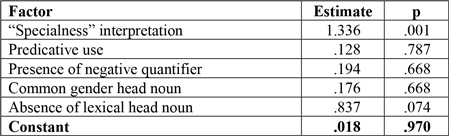
So far we discussed a number of factors that significantly contributed to the choice of singular or plural agreement. However, some of those factors are not independent. For example, the presence of a negative quantifier weinige ‘few’ is related to specialness, because if only few people share a certain property, the person who possesses this property may be considered special. To investigate the combined effect of all the factors, we carried out a logistic regression analysis taking into account the factors mentioned above. Using the enter-method, a significant model emerged (χ2 =31.950, df=5, p=.000), Nagelkerke’s R2=.177. The model showed that with all the factors entered simultaneously, specialness was the only significant factor. The p-values and estimates of the individual factors can be found in table 7.
Factors relating to singular agreement.

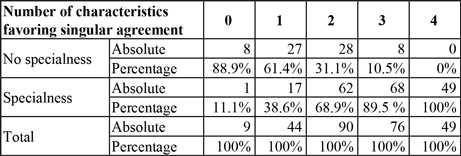
The result of the regression model raises the following question: Could the factors that were identified as correlating significantly with singular agreement be seen as the ingredients of specialness? In other words, could these factors determine whether the sentence receives an interpretation of specialness or not? To answer this question, we tested whether an utterance was more likely to be annotated as “special” if the number of individual factors favoring singular agreement increased. Table 8 shows the percentages of utterances we labeled as expressing specialness when they had 0, 1, 2, 3, or 4 of the individual characteristics favoring singular agreement. An occurrence of the one of the (few) X who Y-construction has value 0 if it is not used predicatively, if it contains a noun in addition to the quantifier, if its head noun is a neuter word, and if it contains a positive or no quantifier. An utterance has value 4 if it has all of the opposite characteristics.
Relation between specialness and other factors.

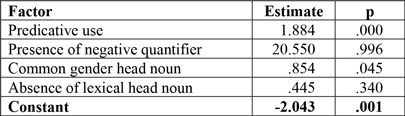
Table 8 shows that an increase in the number of factors goes hand in hand with an increase in the percentage of specialness readings. In fact, all utterances containing all four characteristics were coded as expressing specialness. Pearson chi-squared tests showed that the factors favoring singular agreement were also significantly more frequent in utterances that were coded as special when tested individually (used predicatively: χ2 (1)=37.778, p=.000, contains negative quantifier: χ2 (1)=56.582, p=.000, head is de-word: χ2 (1)=17.141, p=.000, absence of noun: χ2 (1)=17.538, p=.000 (all one-sided). When tested simultaneously in a regression model, this model was significant (χ2= 105.677, df=4, p=.000), but predicative use and common gender head noun were the only remaining significant factors, as can be seen in table 9.
Factors relating to specialness.

To explore in more detail the issue of whether specialness can be completely characterized by other factors, we performed a regression analysis in which we tested the influence of specialness and the cumulative effect of the factors favoring singular agreement (as a single variable with the possible values 0 to 4). We found that this variable was significant even when tested together with specialness (B=.365, p=.042). The model with the cumulative factors added as a variable was slightly better than the model with specialness as the only factor (respectively, χ2 (1)=30.597, df=2, p=.000, Nagelkerke’s R2=.170 and χ2 (1)=26.608, df=1, p=.000, Nagelkerke’s R2=.149). These results indicate that specialness is highly related to individual factors; at the same time, the cumulative individual factors have a (small) independent effect on the choice of singular or plural agreement as well. Thus, our first logistic regression model showed that with all the factors entered simultaneously, specialness was the only significant one; however, our last model, which tested the influence of specialness and the cumulative effect of the factors favoring singular agreement, was slightly better. This difference indicates that the other factors cannot merely be considered “ingredients” of specialness.
Because specialness shows up as an implicature (pragmatic inference), and not as a syntactic or semantic property of the construction, there is no causal relation between specialness and singular agreement, nor is specialness a necessary condition for singular agreement. Rather, the implicature of specialness and the concomitant pattern of singular agreement have become prototypical ingredients of the construction, in the sense of Goldberg Reference Goldberg2006.
7. The Target Construction in German
In this subsection, we briefly compare the Dutch construction to its counterpart in a closely related language, German.Footnote 14 The Dutch one of the (few) X who Y-construction was shown to be associated with a specialness implicature, which, as we proposed, goes hand in hand with singular agreement in the relative clause. In German, this type of analysis is less plausible because the gender of the determiner one is dependent on the subject. Only in case of a feminine subject does it give rise to the same relative pronoun die ‘that’ as the one that agrees with the plural head noun.
(27)

In 27, both the relative pronoun die ‘that’ and the finite verb are plural because the head noun of the relative clause, the nominalized quantifier Wenigen ‘few’, is plural. When singular agreement with the determiner einer ‘one’ occurs, as in the following example taken from a discussion about smoking and drinking on a bodybuilding discussion forum, not only the finite verb but also the relative pronoun changes to singular agreement.Footnote 15
(28)

Thus, in German the choice between singular or plural agreement has to be made earlier in the sentence, namely, as soon as the relative pronoun is encountered (unless its antecedent is feminine, in which case the singular and plural relative pronoun are the same, namely, die ‘that’). If the construction is analyzed according to our construction grammatical analysis of Dutch, both the verb and the relative pronoun would have to adapt to singular agreement. We assume therefore that the (re)analysis proposed for Dutch is less likely to apply in German. In order to establish whether singular agreement occurs at all in German, we built a small corpus with the prototypical constructions that give rise to an implicature of specialness, that is, one of the few X who Y. The data were collected from three different online resources.Footnote 16 On the basis of existing prescriptive norms, we expected to find only plural agreement in these constructions in German. An analysis of 211 sentences revealed that 115 sentences (55%) indeed had plural agreement. Yet, 96 sentences (45%) had singular agreement.
These results mean that even in German, an implicature of the subject’s specialness goes together with a construction grammatical (re)analysis in a substantial percentage of the cases, albeit not in the majority of the cases. In German, reanalysis involves adaptation of both the finite verb and the relative pronoun to the number and gender features of the determiner one. Again, we propose that in the prototypical one of the (few) X who Y-construction, the relative clause denotes the primary predication of the subject, and the intervening partitive phrase functions as secondary predication of the subject. The quantifier few expresses low cardinality of the set of individuals that have property Y, thereby giving rise to the implicature of the subject’s specialness. More elaborate research on the use of plural and singular agreement in the target construction in German and other languages is desirable.
8. Conclusion
Singular agreement turned out to be the dominant pattern in our internet corpus study of the one of the (few) X who Y-construction in Dutch. The corpus study identified four factors that significantly increase the proportion of singular agreement in the relative clause within the construction. We have argued that all of those factors contribute to the implicature of specialness. We have also argued that this is not a coincidence and that singular agreement goes hand in hand with the interpretive characteristics of the one of the (few) X who Y-construction. In particular, the construction in its prototypical use gives rise to the implicature of the subject’s specialness. We have further argued that this implicature of specialness and the concomitant pattern of singular agreement have become prototypical ingredients of the one of the (few) X who Y-construction, a construction in the sense of Goldberg Reference Goldberg2006.