Introduction
Midlife is considered to be a ‘pivotal period in the life course’ (Lachman et al., Reference Lachman, Teshale and Agrigoroaei2015; Infurna et al., Reference Infurna, Gerstorf and Lachman2020). Although there is little consensus on the precise chronological ages at which midlife begins or ends, the two decades of ages 40–49 and 50–59 are included in most scholarly and surveyed respondents’ conceptualisations of the midlife (Staudinger and Bluck, Reference Staudinger, Bluck and Lachman2001; Lachman, Reference Lachman2004). We term the decade of 50–59 years as ‘older mid-life’, with a focus not on the chronological ages that this represents, but instead on its importance as a period of various life transitions at the cusp of older ages. Midlife is distinguishable from other stages of life because individuals at midlife are simultaneously performing multiple central roles related to their family, community, and workplace. Given their multiple responsibilities, the stressors and challenges that individuals at midlife face are often concurrent and greater in number and magnitude (Infurna et al., Reference Infurna, Gerstorf and Lachman2020). At midlife, individuals are likely to face a number of life events as well as transitions in their roles, such as voluntary or involuntary exit from the workforce, children moving away for education or employment, or transitioning to the role of a care-giver for their own parents. All of these may be compounded by the onset and realisation of a decline in physical health and/or in cognitive functioning. At the same time, midlife can present opportunities, in the form of promotion at work to peak career positions, becoming a grandparent, and possibilities for generativity and positive experiences from care-giving.
There is considerable debate in the literature over whether this period of life is characterised by increased wellbeing or whether across the lifecourse there is a “mid-life nadir” (Cheng et al., Reference Cheng, Powdthavee and Oswald2017) in terms of happiness and life satisfaction (Blanchflower and Graham, Reference Blanchflower and Graham2020; Infurna et al., Reference Infurna, Gerstorf and Lachman2020). Some authors argue against the presence of a ‘U-shaped curve’ in life satisfaction and happiness across the lifecourse, with a recent review of 29 studies highlighting mixed evidence from both cross-sectional and longitudinal studies (Galambos et al. Reference Galambos, Krahn, Johnson and Lachman2020), as well as studies that show that individuals at older ages do not term midlife as the period when their happiness and life satisfaction were the lowest (Lachman et al., Reference Lachman, Lewkowicz, Marcus and Peng1994). Other authors emphasise that their longitudinal studies and within-person analyses present conclusive, multi-country evidence for happiness and life satisfaction being at their lowest points in midlife (Cheng, et al., Reference Cheng, Powdthavee and Oswald2017; Blanchflower and Graham, Reference Blanchflower and Graham2020; Blanchflower, Reference Blanchflower2021). Less equivocally, studies on mental wellbeing at midlife point to findings that stress, depression and suicide are at their peak at this stage (Graham and Ruiz Pozuelo, Reference Graham and Ruiz Pozuelo2017; Brody et al., Reference Brody, Pratt and Hughes2018; Blanchflower and Graham, Reference Blanchflower and Graham2020; Infurna et al., Reference Infurna, Gerstorf and Lachman2020). Stress at older midlife is often amplified because individuals typically have to balance competing demands from, and manage the mismatch and interference between, work roles and expected familial roles and responsibilities (Aldwin and Levenson, Reference Aldwin, Levenson and Lachman2001; Darling et al., Reference Darling, Coccia and Senatore2012; Minnotte et al., Reference Minnotte, Minnotte and Bonstrom2015; Longacre et al., Reference Longacre, Valdmanis, Handorf and Fang2016).
Research indicates that social networks shrink during the transition from midlife to older ages, as a consequence primarily of retirement and decline in physical health (Shaw et al., Reference Shaw, Krause, Liang and Bennett2007; Lu, Reference Lu2011; Sabbath et al., Reference Sabbath, Lubben, Goldberg, Zins and Berkman2015; Burn et al., Reference Burn, Dennerstein, Browning and Szoeke2016). The socio-emotional selectivity theory also postulates that ageing is accompanied by the narrowing of the perceived time remaining in life, and that social networks are increasingly limited to those fulfilling socio-emotional needs (Carstensen et al., Reference Carstensen, Isaacowitz and Charles1999; Heckhausen, Reference Heckhausen and Lachman2001). Given the unique challenges that midlife presents, it becomes important to study whether the ability to cope with the challenges and life transitions at these ages can be enhanced.
There is considerable focus in terms of social policy and civil society interventions on the social and psychological wellbeing of older adults in Singapore, a rapidly ageing society. An age threshold of 60 years is often used to determine eligibility for initiatives such as community-based ‘active ageing’ or ‘befriending’ programmes that seek to address the risk of social isolation, promote greater social engagement, provide opportunities for volunteering and generativity, and enable wider social networks. There is less of an emphasis in these programmes on outreach to older midlife individuals. In 2020, older midlife individuals aged 50–59 constituted about 14.9 per cent of the resident population of Singapore, an increase of nearly 50 per cent since 2010 (Singapore Department of Statistics, 2011, 2021). Our study aims to draw attention to this relatively under-studied older midlife group, and their psychological resilience in particular.
Resilience is a concept that has gathered considerable attention over the years in developmental psychology and gerontology research. Some definitions conceptualise resilience as a “dynamic process encompassing positive adaptation within the context of significant adversity” (Luthar et al., Reference Luthar, Cicchetti and Becker2000: 543). Others conceptualise resilience or resiliency as a set of qualities, abilities, characteristics and psychological traits that reduce the adverse impact of stressors, and enable individuals to respond to adversity through a variety of actions: adaptation, coping, accepting help and support, being open about vulnerability, recovering and remaining well (Connor and Davidson, Reference Connor and Davidson2003; Wagnild, Reference Wagnild2003; Janssen et al., Reference Janssen, Van Regenmortel and Abma2011). In the context of ageing, resilience is conceptualised as a factor positively influencing ‘successful’ ageing operationalised in terms of health and wellbeing across the physical, social, cognitive and psychological domains (Montross et al., Reference Montross, Depp, Daly, Reichstadt, Golshan, Moore, Sitzer and Jeste2006; Lamond et al., Reference Lamond, Depp, Allison, Langer, Reichstadt, Moore, Golshan, Ganiats and Jeste2008; Depp et al., Reference Depp, Vahia and Jeste2010).
Among the factors associated with psychological resilience at older midlife, we seek to understand the role of social networks in particular. Some studies have found that various aspects of social networks such as time spent with family and friends, quality of social relationships, and perceived social support are positively associated with enabling older adults to cope with stressful life events and adversity (Lamond et al., Reference Lamond, Depp, Allison, Langer, Reichstadt, Moore, Golshan, Ganiats and Jeste2008; Janssen et al., Reference Janssen, Van Regenmortel and Abma2011; Stein and Smith, Reference Stein and Smith2015). Lamond et al. (Reference Lamond, Depp, Allison, Langer, Reichstadt, Moore, Golshan, Ganiats and Jeste2008) found a positive association between social engagement, specifically the number of days spent with family and friends, and psychological resilience among community-dwelling older women. Stein and Smith (Reference Stein and Smith2015) showed that perceived social support moderated the effects of perceived stress on same-day and next-day physical symptoms such as pain, shortness of breath, nausea and low energy among community-dwelling adult women. They did not, however, find significant or substantial relationships when they studied the independent effect of different sub-components of social support, such as emotional-informational support, affectionate support, tangible support or positive social interactions (Stein and Smith, Reference Stein and Smith2015).
A number of qualitative studies have attempted to establish the underlying mechanisms in the relationship between social networks and psychological resilience. In their interviews with older adults receiving long-term community care, Janssen et al. (Reference Janssen, Van Regenmortel and Abma2011) found that positive relationships with family members enabled the receipt of instrumental and emotional help as well as reduced stress related to doing things by oneself. Netuveli et al. (Reference Netuveli, Wiggins, Montgomery, Hildon and Blane2008) conducted a longitudinal study of individuals aged 50 and older who had experienced one or more adverse events (defined as becoming single after being married, transitioning to having a functional limitation due to an illness and transitioning into poverty). They found that high social support (defined as a greater-than-median score of having someone who would listen, help in a crisis, with whom one could relax and be appreciated by, and on whom one could count for support) was associated with ‘bouncing back’ in terms of General Health Questionnaire (GHQ-12) scores. In a study of widowers aged 55–98, Bennett (Reference Bennett2010) found that social support was an important factor for a number of widowers ‘achieving’ psychological resilience, measured in terms of either no significant difference in depression from the time prior to bereavement to a year after (as conceptualised by Bonanno, Reference Bonanno2004), or in terms of coping, viewing current life positively, currently being active, and having returned to a life with meaning and satisfaction (Moore and Stratton, Reference Moore and Stratton2003). In another qualitative study of adults aged 56–92, Wiles et al. (Reference Wiles, Wild, Kerse and Allen2012) studied how older adults understood the concept of resilience in different contexts related to the response to or recovery from adversity, such as living relatively healthily despite disability, illness or trauma, and ageing well. They found that factors such as a positive attitude and having a purpose in life were important aspects of psychological resilience and, importantly, that these were linked to having supportive family and friends. Overall, in the development of their ‘framework for understanding resilience in later life’, Manning and Bouchard (Reference Manning and Bouchard2020) describe that being able to activate and access social support networks is a key element of resilience and response to adversity.
Although these studies clearly suggest a positive association between social support and resilience, they are lacking in two key aspects. First, they do not directly analyse multiple characteristics of the social networks from which social support is derived, which we do in this paper. Thoits (Reference Thoits1982) indicated that a social support ‘system’ consisted of those persons within an individual's social network upon whom the individual relied for social, emotional and instrumental support. Previous research suggests that stronger social ties – measured in terms of a higher frequency of contact with family and friends (Lamond et al., Reference Lamond, Depp, Allison, Langer, Reichstadt, Moore, Golshan, Ganiats and Jeste2008), and a higher frequency of receipt of emotional and instrumental support (Karademas, Reference Karademas2006) – are associated with stress-buffering attitudes such as optimism, greater acceptance and life satisfaction. At the same time, the size of social networks is also important since larger networks can yield multiple sources of support and information at a time of adversity or major life transition, potentially reducing the adverse effect of stress on wellbeing (Cohen, Reference Cohen2004). In this analysis, we simultaneously study the strength and the size of social networks, seeking to identify to what extent these two aspects of social networks are related to psychological resilience. A second limitation of the extant literature is that it does not establish the relationship between social support and resilience in causal terms. In studying whether social network characteristics influence psychological resilience, we attempt in this paper to formally address the issue of a possible selection bias: that individuals who are more resilient to begin with are more likely to maintain frequent contact with individuals in their social network, or have larger or stronger social networks. We establish the relationship between social networks and psychological resilience after accounting for the probability of being in different network types, based on measurable differences between individuals. Our research question therefore is:
• To what extent is the relationship between social networks and resilience influenced by the type of social network in terms of its strength and size?
A secondary aim of this analysis is to determine the demographic, socio-economic, health, personality traits and volunteering status correlates of psychological resilience at older midlife.
Methods
Data
We use cross-sectional data from the Panel on Ageing and Transitions in Health Survey (PATHS) 2016–2017, a national survey of 1,654 community-dwelling Singapore citizens and permanent residents (henceforth, Singaporeans) aged 50–59. A random sample of 1,940 Singaporeans stratified by gender, ethnicity (Chinese, Malay, Indian, Other) and two five-year age groups (50–54, 55–59) based on the estimated 2015 population distribution was approached to participate in PATHS. Malays and Indians were oversampled by a factor of two to ensure a sufficient number in these sub-groups for analysis. If an individual in the random sample refused participation or was uncontactable after four visits to his or her residence, a nearest neighbour, matched on gender, ethnicity and age group, who agreed to participate in the survey, was interviewed. Nearest neighbour replacement was not conducted for individuals residing in private housing (condominiums) and gated public housing due to practical issues in accessing such housing estates. A total of 1,654 respondents, including eight proxy individuals (if the index individual was not able to respond directly due to health reasons), gave informed consent and were interviewed face-to-face at their residence by trained interviewers. The study was approved by the Institutional Review Board of the National University of Singapore.
Dependent variable: psychological resilience
We measure psychological resilience using the ten-item Connor–Davidson Resilience Scale (CD-RISC-10), which asks respondents to self-rate their ability to cope with adversity (Campbell-Sills and Stein, Reference Campbell-Sills and Stein2007). Respondents were asked how much they agree, on a five-point scale (not true at all = 0, rarely true = 1, sometimes true = 2, often true = 3, true nearly all the time = 4), to statements related to their ability to adapt to changes, coping with stress, staying focused under pressure, not being discouraged by failure, dealing with life's challenges, ability to handle unpleasant or painful feelings, etc., as applicable over the pastmonth. Total scores for the CD-RISC-10 thus range from 0 to 40, with a higher score indicating greater psychological resilience. The measure of psychological resilience from the CD-RISC-10 is used as a continuous variable in our analysis.
CD-RISC-10 has been used to measure resilience among older populations and has been found to have acceptable levels of internal consistency and construct validity (Windle et al., Reference Windle, Bennett and Noyes2011; Cosco et al., Reference Cosco, Kaushal, Richards, Kuh and Stafford2016; Tourunen et al., Reference Tourunen, Siltanen, Saajanaho, Koivunen, Kokko and Rantanen2021). In our sample as well, the internal consistency of the CD-RISC-10 was acceptable (Cronbach's alpha = 0.88). For administration in PATHS, we obtained the CD-RISC-10 from the authors of the original 25-item CD-RISC scale, in English as well as translations in Malay, Tamil and Chinese (Taiwan) (Connor and Davidson, Reference Connor and Davidson2003). The written characters in the Chinese (Taiwan) version of the scale were first edited from the more complex traditional Chinese to simplified Chinese, with no change in the meaning of the individual scale items. It was then used with permission from the scale's authors.
Out of the total of 1,654 respondents in PATHS, the eight proxy respondents were not administered the CD-RISC-10, and omitted from the analysis at the outset. The authors of the CD-RISC have indicated that the average score of the non-missing CD-RISC-10 items can be applied to missing responses on specific items of the scale when respondents have answered at least seven of the ten items (http://www.cd-risc.com/faq.php). We followed this procedure for 42 of the 1,646 non-proxy respondents, and omitted one respondent who had answered fewer than seven items. We further allowed for listwise deletion of 36 cases with missing data on the explanatory variables in the regression analysis. This resulted in a final analytical sample of 1,609 respondents, about 97.8 per cent of the sample that was administered the CD-RISC-10.
Explanatory variable: social networks
Our main explanatory variable is social networks, which are measured using a modified version of the Lubben Social Network Scale (Revised) (LSNS-R) (Lubben et al., Reference Lubben, Gironda and Lee2002). LSNS-R questions in PATHS assessed social ties and engagement with relatives and friends who are not residing within the respondent's household. Respondents were asked six questions about the size of the network in terms of how many relatives and how many friends they had in different contexts: (a) how many did the respondent see or hear from at least once a month; (b) how many they felt at ease with talking about private matters; and (c) how many they felt close to such that they could call on them for help. Each item was scored on a six-point scale from 0 to 5, corresponding to the responses of 0, 1, 2, 3–4, 5–8, and 9 or more.
The scale also assesses the strength of the social network in terms of how often did respondents communicate with close members of the social network as well as specifically at the time of an important decision: (a) how often did the respondent see or hear from relatives/friends with whom they had the most contact; (b) how often would one of their relatives/friends talk to the respondent when the relative/friend had an important decision to make; and (c) how often was one of the respondent's relatives/friends available when the respondent had an important decision to make. Each question was assigned a score between 0 and 5, corresponding to the response options of never, seldom, sometimes, often, very often or always. These questions offer an additional dimension to the characteristics of social networks beyond measuring ‘how many’ relatives/friends are available: they measure the intensity of contact with close members of the social network. We therefore use these six items as a measure of the strength of social networks.
Overall, we operationalise social networks as a categorical variable based on a combination of strength and size. For each respondent, we first summate scores of the strength and size of social networks separately. We then dichotomise the two summed scores at the respective median score of all respondents, a categorisation approach that has been used in other studies on social support (Netuveli et al., Reference Netuveli, Wiggins, Montgomery, Hildon and Blane2008). Strength is dichotomized into weak and strong, and size is dichotomized into small and large. We classify each respondent into one of four mutually exclusive types of social networks based on strength and size: weak and small, weak and large, strong and small, and strong and large.
Covariates
We include a number of covariates in the analysis, related to demographic characteristics, socio-economic status, health status, personality traits and volunteering. We also control for the possibility of a social desirability bias in the responses.
Demographic characteristics
We include age (in years), sex, educational attainment (no formal or primary education, secondary-level education, and college and higher) and living arrangements (living alone, living with a spouse and child, living with a spouse and no child, living with a child and no spouse, and living with others) as demographic characteristics in the analysis. The inclusion of respondents’ living arrangement is particularly of relevance since our measure of social networks is based on members living outside the household. We therefore account for the possibility of an association between intra-household living arrangements and ties with family members and friends outside the household.
Socio-economic status
We use housing type as a proxy for socio-economic status based on previous research that shows that housing size is proportional to income and a valid proxy for income in Singapore (Chan et al., Reference Chan, Malhotra, Malhotra and Ostbye2011). We also include income adequacy as a measure of respondents’ financial status through a question that asks individuals if they feel that they have adequate income to meet their monthly expenses. The variable is coded into three categories: ‘enough money, with some left over’, which we use as the reference category, ‘just enough money, no difficulty’, and a combination of the remaining two response options, ‘some difficulty to meet expenses’ and ‘much difficulty to meet expenses’ which we code as ‘any difficulty’. We also include current employment status (currently working full-time, working part-time, retired and/or currently not working, and never worked) in our analysis.
Physical health
We include physical health status in our analysis through three variables. The first is the number of limitations in activities of daily living (ADLs), based on respondents reporting difficulty in performing the following without the assistance of a person or assistive device: bathing or showering, dressing, eating, standing up from a bed/chair or sitting down on a chair, walking around the house, or using a sitting toilet. Similarly, limitations in instrumental ADLs (IADLs) is based on seven activities: preparing own meals, leaving the home to purchase necessary items or medication, taking care of financial matters such as paying bills, using the phone, dusting, cleaning and other light housework, taking public transport to leave home, and taking medication as prescribed. Both ADL and IADL limitations were asked in the context of difficulty performing these due to the respondents’ health or physical state. We include a measure for the number of physical ailments based on respondents reporting that they have been diagnosed by a medical professional in the past year with any of the following ailments: heart ailment, cancer, cerebrovascular disease, hypertension, high blood sugar or diabetes, chronic respiratory illness, digestive ailments, ailments of the kidney, urinary tract, liver or gallbladder, joint pain, arthritis, rheumatism or nerve pain, chronic back pain, osteoporosis, fractures, cataract or glaucoma.
Depressive symptoms
Some studies suggest an inverse relationship between resilience and depressive symptoms among older adults (reviewed in Ávila et al., Reference Ávila, Lucchetti and Lucchetti2017). To account for any effect of depressive symptoms on psychological resilience, we include the 11-item Center for Epidemiologic Studies Depression Scale (CES-D) (Kohout et al., Reference Kohout, Berkman, Evans and Cornoni-Huntley1993) in the analysis, where the scores range from 0 to 22, with higher scores indicating a greater extent of depressive symptoms.
Personality traits
A number of previous studies have documented the role of personality traits in psychological resilience, in particular, a negative association between resilience and neuroticism (Friborg et al., Reference Friborg, Barlaug, Martinussen, Rosenvinge and Hjemdal2005; Campbell-Sills et al., Reference Campbell-Sills, Cohan and Stein2006), and a positive association with conscientiousness and extraversion (Campbell-Sills et al., Reference Campbell-Sills, Cohan and Stein2006) and agreeableness and openness (summarised in Ercan, Reference Ercan2017; Oshio et al., Reference Oshio, Taku, Hirano and Saeed2018). To study the effects of personality traits on the likelihood of being in different social network types, as well as directly on psychological resilience, we use the ten-item Big Five Inventory (Rammstedt and John, Reference Rammstedt and John2007) to include scores on measures of neuroticism, extroversion, openness, agreeableness and conscientiousness in the analytical models.
Volunteering
Volunteering by older persons has been found in previous research to be associated with greater life satisfaction, lower depression (Musick and Wilson, Reference Musick and Wilson2003), higher self-esteem and higher self-rated health (Morrow-Howell et al., Reference Morrow-Howell, O'Neill, Greenfield, Resnick, Gwyther and Roberto2011). These studies also suggest that volunteering enhances individuals’ social resources, making them more likely to be able to recover successfully from adverse events (Musick and Wilson, Reference Musick and Wilson2003; Morrow-Howell et al., Reference Morrow-Howell, O'Neill, Greenfield, Resnick, Gwyther and Roberto2011). Volunteering was measured in PATHS using questions adapted from the English Longitudinal Survey of Ageing. We include two dichotomous measures of volunteering based on responses pertaining to unpaid non-monetary help in the past 12 months to groups, clubs or organisations (formal volunteering), and to friends, neighbours and others excluding relatives (informal volunteering).
Social desirability bias
Finally, since our dependent variable of psychological resilience is measured using self-reported answers on dealing with adversity, we control for the possibility of a social desirability response bias (Soubelet and Salthouse, Reference Soubelet and Salthouse2011). We use scores obtained from the Brief Social Desirability Scale (Haghighat, Reference Haghighat2007) that was administered to all respondents. Scores range from 0 to 4 with higher scores representing a greater likelihood of socially desirable responses.
Analysis
Ordinary least squares
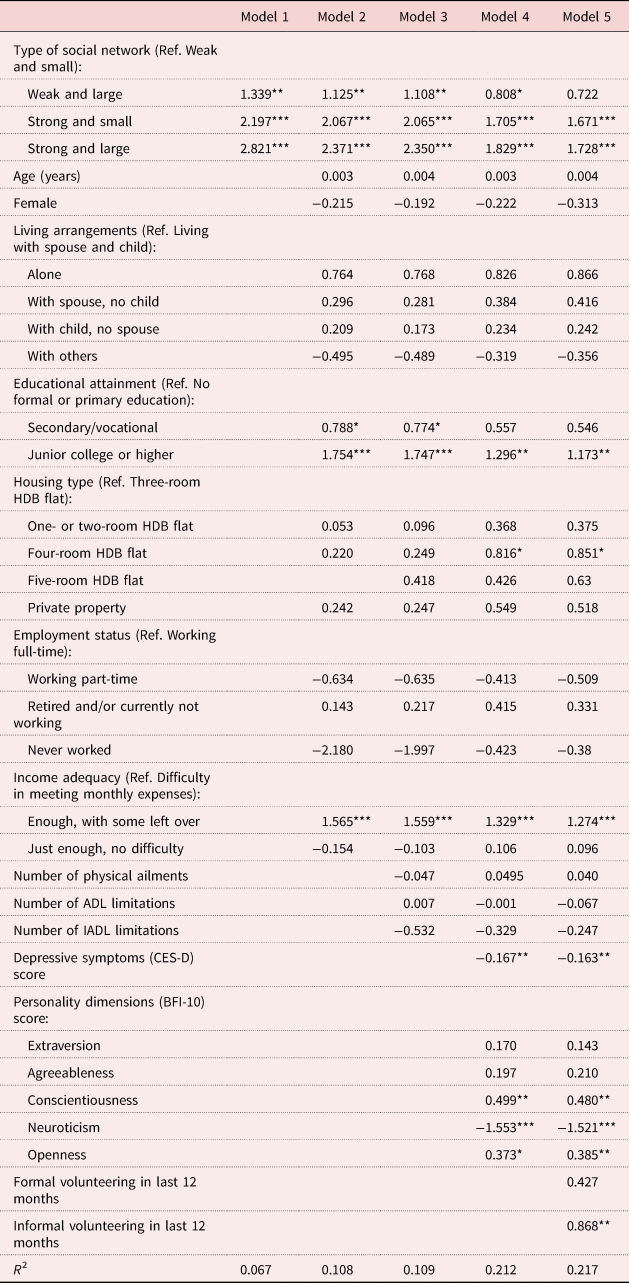
First, we employ multiple ordinary least squares (OLS) regression models to estimate the correlates of resilience. We introduce covariates in the models in sequence: starting with background characteristics, followed by their physical and mental wellbeing status and personality traits, and then followed by their engagement in volunteering. In Model 1, we assess the bivariate relationship between social networks and psychological resilience. We then introduce demographic and socio-economic status variables in Model 2, followed by the three measures of physical health in Model 3. We add depressive symptoms and personality traits in Model 4, and finally include volunteering in Model 5. All models control for social desirability bias. This analysis helps to ascertain the correlates of psychological resilience, and specifically whether the explanatory variable of interest, social networks, is associated with psychological resilience after accounting for other factors. We assessed variance inflation factors to ascertain the presence of multicollinearity in our multivariable models but did not find any problems.
IPWRA estimation
Additionally, we seek to overcome potential endogeneity biases in our results. Individuals are not randomly assigned to social networks, and individuals with greater psychological resilience may have self-selected into networks of greater strength or larger size. Thus, it may not be social network characteristics that affect psychological resilience, but psychological resilience to begin with that determines the characteristics of one's social network. In the absence of formally accounting for this possibility, we cannot interpret an association between either or both of the social network characteristics and psychological resilience as the effect of social networks on resilience. Therefore, we employ inverse probability weighted regression adjustment (IPWRA), a statistical technique by which we explicitly model the probability of being in different social network types, based on observed indicators, and then regress psychological resilience on the estimated probabilities of the different social network types.
The IPWRA estimator combines elements of two different estimators, inverse probability weighting and regression adjustment, and is considered to be a ‘doubly robust estimator’, which indicates that the estimates of the average treatment effect are consistent even if either the treatment model or the outcome model are mis-specified (Wooldridge, Reference Wooldridge2007; Cattaneo, Reference Cattaneo2010; Cattaneo et al., Reference Cattaneo, Drukker and Holland2013). There are four steps in our analysis:
(1) We first estimate a treatment model, wherein being in the four social network types is the ‘treatment’ of interest. We employ a multinomial logistic regression model, using our four-category variable for social networks as the dependent variable, with ‘weak and small’ social networks as the reference category. We regress the dependent variable on age, sex, living arrangements, socio-economic status measured in terms of educational attainment, housing type and income adequacy, employment status, volunteering, physical health status measured in terms of ADL and IADL limitations, physical health ailments, depressive symptoms and personality traits. The model yields the probabilities or propensity scores of being in each of the four social network types for each individual.
(2) In the second step, we use regression adjustment, i.e. we estimate a regression model for the outcome variable – the CD-RISC-10 resilience score – separately at each level of the four social network types. In this model, we specify that in addition to social networks, the outcome, resilience, is itself associated with age, sex, educational attainment, living arrangements, housing type, employment status, income adequacy, formal and informal volunteering in the community, physical health, depressive symptoms and personality traits. The inverse of the propensity score for each social network type obtained in the first step is used as weights for the outcome variable, and social network type-specific predicted CD-RISC-10 scores are estimated for each individual.
(3) The average treatment effect (ATE) of a specific social network type on the CD-RISC-10 resilience score is the difference between the average predicted CD-RISC-10 score of that social network type and the reference category (‘weak and small’ social networks).
(4) We also estimate the average treatment effect on the treated (ATT), which is the average effect on resilience of being in a social network type, only among those who were in that specific social network type, compared to the reference category.
All analyses were performed in Stata version 16 (StataCorp, College Station, TX).
Results
In Table 1, we show the distribution of the outcome variable and independent variables used in this analysis. The average resilience score on the CD-RISC-10 scale was 26.5 with a standard deviation of 5.9. We see that about one-third of the sample was in the ‘strong and large’ social network type, about 13 per cent were in the ‘strong and small’ type, 17 per cent were in the ‘weak and large’ type and 37.5%, the highest proportion, were in the ‘weak and small’ type.
Descriptive summary of variables

Notes: N = 1,609. Psychological resilience score is based on the ten-item Connor–Davidson Resilience Scale (CD-RISC-10). Depressive symptoms are based on the 11-item Center for Epidemiologic Studies Depression Scale (CES-D). Personality dimension scores are based on the ten-item Big Five Inventory (BFI-10). SD: standard deviation. HDB: Housing Development Board, Singapore. ADL: activities of daily living. IADL: instrumental activities of daily living.
The average age of respondents in our sample was 55 years, and just over half of them were female. A majority of 70 per cent lived with a spouse and a child. Between 7 and 9 per cent lived with others, with a spouse and no children, and with a child and no spouse. About 6 per cent lived alone. About half of the respondents had been educated up to the secondary or vocational level, and about 26 per cent had attended junior college (the equivalent of grades 11–12) or higher. About 22 per cent had either no formal education or only primary education (up to six years of schooling). About 80 per cent of the respondents were currently working full-time or part-time. The sample was generally healthy, with fewer than one ADL or IADL limitations on average, and an average of one physical ailment. The average score on the 11-item CES-D scale was 3.5.
We present the OLS regression results for the correlates of psychological resilience in Table 2. In Model 1 which includes only social networks, we see that compared to ‘weak and small’ social networks, all other types of social networks are associated with greater resilience. When we add socio-demographic variables in Model 2, we see that the magnitude of the association is attenuated, and further attenuated in Model 3 when we control for physical health status variables, and in Model 4 when we add additional controls for depressive symptoms and personality traits. In the final model, after we control for volunteering among respondents, we find that only ‘strong and small’ and ‘strong and large’ social networks are positively associated with resilience. At this stage, we have evidence for a positive association of strong social networks – when coupled with either small or large size – with psychological resilience.
Correlates of psychological resilience among older midlife Singaporeans aged 50–59: results from ordinary least squares regression analysis

Notes: N = 1,609. All models control for the total score on the four-item Brief Social Desirability Scale. Psychological resilience score is based on the ten-item Connor–Davidson Resilience Scale (CD-RISC-10). Depressive symptoms are based on the 11-item Center for Epidemiologic Studies Depression Scale (CES-D). Personality dimension scores are based on the ten-item Big Five Inventory (BFI-10). Ref.: reference category. HDB: Housing Development Board, Singapore. ADL: activities of daily living. IADL: instrumental activities of daily living.
Significance levels: * p < 0.05, ** p < 0.01, *** p < 0.001.
Among the correlates, higher education compared to no formal or primary education, four-room public housing compared to three-room flats, perceived income abundance, conscientiousness, openness and any informal volunteering were positively associated with psychological resilience. Depressive symptom scores and neuroticism were negatively associated with psychological resilience.
The IPWRA results are presented in Table 3. We present the ATE and ATT only for social networks, although as noted above, a range of covariates are included for both the treatment model of social network types and the outcome model. Compared to ‘weak and small’ social networks, there is no statistically significant difference in psychological resilience among those with ‘weak and large’ networks. On the other hand, those with ‘strong and small’ and ‘strong and large’ networks both have greater psychological resilience compared to those with ‘weak and small’ social networks.
Results of IPWRA estimation of relationship between psychological resilience and social network types among older midlife Singaporeans aged 50–59

Notes: N = 1,609. CD-RISC-10: ten-item Connor–Davidson Resilience Scale. Ref.: reference category. ATE: average treatment effect. ATT: average treatment effect on the treated. Models include covariates as described in the text.
We ran the ‘tebalance’ post-estimation command in Stata to estimate to what extent the treatment model had balanced the covariates among the different social network types (StataCorp, 2020). This allows us to compare standardised differences and variance ratios between the pre-weighted and weighted covariates of each social network type. With a standardised difference close to 0 and variance ratio of 1 for nearly all covariates, the results indicate that the treatment model employed in the analysis here was well-specified. A formal test of over-identification can only be run if the treatment is dichotomous and thus cannot be used in our case where social network type is classified into four categories.
Discussion
Our results show that strong social networks – defined as networks with a higher frequency of contact with close family members or friends and a higher frequency of contact at the time of important decisions – are associated with greater psychological resilience among older midlife individuals, regardless of the size of the network. On the other hand, weak networks, even when combined with a larger size of networks, have no influence on resilience. In other words, having a large social network outside the household is associated with greater psychological resilience only when these are also stronger networks.
These findings complement earlier research that indicates that supportive and positive relationships are an important external or environmental factor associated with greater psychological resilience (Janssen et al., Reference Janssen, Van Regenmortel and Abma2011; Southwick et al., Reference Southwick, Sippel, Krystal, Charney, Mayes and Pietrzak2016). Strong social networks, as defined above, are suggestive of greater potential social support at a time of need. In particular, supportive relationships are more likely to enhance self-esteem and promote an optimistic view of life (Symister and Friend, Reference Symister and Friend2003; van Kessel, Reference van Kessel2013). Strong social networks are also likely to be more efficient and effective at providing instrumental support, e.g. after the onset of a chronic ailment (Ducharme et al., Reference Ducharme, Lévesque, Lachance, Kergoat and Coulombe2011), and increase one's confidence that practical assistance will be at hand during adversity (Trivedi et al., Reference Trivedi, Bosworth, Jackson, Resnick, Gwyther and Roberto2011).
Among the correlates of psychological resilience, we found a significant relationship between resilience and depressive symptoms in the expected direction: individuals who report more depressive symptoms are less psychologically resilient compared to individuals with fewer symptoms. In addition, we found that both conscientiousness and openness were positively associated with greater psychological resilience, whereas neuroticism was associated with lower levels of psychological resilience. Informal volunteering was associated with greater psychological resilience, as found in previous research; however, we did not find any significant association between formal volunteering and psychological resilience. This supports the idea that programmes that encourage volunteerism, albeit informally within the individual's own community, can be a strategy to garner and boost resources that help individuals prepare better for adverse events (Morrow-Howell et al., Reference Morrow-Howell, O'Neill, Greenfield, Resnick, Gwyther and Roberto2011). Perceived income adequacy was also associated with psychological resilience. Individuals who reported that they had more than enough money to meet monthly expenses were more likely to be psychologically resilient compared to individuals who said that they had difficulty meeting monthly expenses, indicating that perceived financial adequacy is an important aspect of coping with adversity. Higher education, specifically at the college level and above, was also associated with greater psychological resilience.
We are mindful of the limitations of this study. First, we use an approach of classifying social network strength and size based on the median scores on the LSNS-R scale. We used other classifying criteria as well, such as categorising strength and size based on half a standard deviation above and below the mean scores (not shown here), and our results and the interpretation of the relationship between social networks and resilience did not change. Additionally, the sample size of the PATHS dataset precluded us from successfully analysing the data with more categories of strength and size, e.g. using tertiles (low, medium and high) for both characteristics instead of the median-based dichotomous classification that we have employed. We had model convergence errors in the IPWRA analysis when using tertiles that had resulted in nine combinations of strength and size, owing to the fact that some of these categories had relatively few observations. Future studies with larger datasets may allow for a more detailed exposition of the relative roles of social network strength and size in enhancing psychological resilience. Second, our measure of social networks is based on self-report by individuals at the time of the survey. The strength and size of social networks may decline or expand based on temporal factors and circumstances, which our data are unable to measure. Third, we acknowledge the limitations in our operationalisation of social networks. We do not distinguish in this analysis between friends- and family-focused social networks to which other studies on social networks among older populations have drawn attention (Wiles et al., Reference Wiles, Wild, Kerse and Allen2012; Donnellan et al., Reference Donnellan, Bennett and Soulsby2017; Fiori et al., Reference Fiori, Rauer, Birditt, Brown, Jager and Orbuch2017; Ayalon and Levkovich, Reference Ayalon and Levkovich2019). However, the objective of this study was to differentiate social network types in terms of their size and strength, and a further understanding of the role of friends compared to family in psychological resilience remains an area for future research. We also acknowledge that our conceptualisation of the strength of social networks is as an individual attribute, and it differs from social capital theory and the potentially multi-level and multi-faceted conceptualisation of social capital in terms of bonding social capital (strong ties with members of homophilial networks), bridging social capital (weaker ties with members of other social networks or groups that traverse social identities) and linking social capital (ties with formal agencies and those in positions of authority) (Kawachi et al., Reference Kawachi, Kim, Coutts and Subramanian2004; Szreter and Woolcock, Reference Szreter and Woolcock2004). In particular, studies on community resilience after natural disasters indicate that bridging social capital in the form of relatively weaker ties between communities and other individuals and organisations outside the affected area can aid receiving greater information, resource mobilisation and, ultimately, recovery (Aldrich and Meyer, Reference Aldrich and Meyer2015; Aldrich, Reference Aldrich, Yan and Galloway2017). Relatedly, the LSNS-R used in this analysis assessed social networks outside the household. Although we controlled for living arrangements of the respondent, we did not have data that measured the strength of intra-household ties which may be associated with psychological resilience or with social networks outside the household. Finally, the IPWRA estimator that we use in this analysis can only account for observable covariates in the treatment and outcome models. If there are unobserved characteristics that influence the selection of older midlife individuals into different social network types, the analytical method used here would not overcome the endogeneity bias fully. In the absence of being able to assign social network types randomly to different individuals, a possible strategy with observational studies would be to use an instrumental variable that can account for observable as well as unobservable differences by being correlated with social network types but with no direct relationship with psychological resilience. However, finding a valid instrument was difficult with the dataset used here; PATHS has a variety of data pertaining to the current status of older midlife individuals across different domains but limited demographic and background information to yield an instrumental variable. In light of this, we used a wide range of variables, pertaining to socio-economic status, physical health, psychological wellbeing, personality traits and volunteering status, that we expect to be associated with both social networks and psychological resilience. Nonetheless, further research on the role of social networks and psychological resilience could attempt to establish the causal relationship further.
Despite these limitations, this study has important implications. Overall, our findings indicate that at the cusp of older ages, the strength of social networks matters more for psychological resilience than their size. From a programmatic and policy point of view, a number of different ‘resilience training’ interventions have been proposed to increase the coping capacity and confidence of individuals in managing stressful situations (Vanhove et al., Reference Vanhove, Herian, Perez, Harms and Lester2016; Helmreich et al., Reference Helmreich, Kunzler, Chmitorz, König, Binder, Wessa and Lieb2017). Our findings also help detail an important aspect of the model of adaptive management of social networks as a process likely to influence resilience at midlife positively (Heckhausen, Reference Heckhausen and Lachman2001). Specifically, our findings suggest that while it is important to counterbalance the natural contraction and selective narrowing of social networks at older midlife with new or more diverse networks, it is the strength of these networks that matters for greater psychological resilience. At a time when there may be significant life transitions and stressors associated with managing multiple important roles in the family and at work, retaining or building strong social networks can provide older midlife individuals with the psychological resources to cope better, and potentially place them in a better position to meet the demands of growing older.
Financial support
The Panel on Ageing and Transitions in Health Survey (PATHS) was funded by the Singapore Ministry of Health's National Medical Research Council under its Singapore Translational Research Investigator Award ‘Establishing a Practical and Theoretical Foundation for Comprehensive and Integrated Community, Policy and Academic Efforts to Improve Dementia Care in Singapore’ (NMRC-STAR-0005-2009).
Author contributions
AV: conceptualisation and design, data analysis, writing, editing and revising the manuscript. RM: conceptualisation and design, acquisition of data, editing the manuscript. JML: preliminary analysis, editing the manuscript. AC: conceptualisation and design, acquisition of data, editing the manuscript.
Conflict of interest
The authors declare no potential conflicts of interest with respect to the research, authorship and publication of this article.
Ethical standards
The study was approved by the Institutional Review Board of the National University of Singapore (reference code B-15-104).