INTRODUCTION
In the Maya area, studies of material culture have often focused on objects that either were found in significant numbers or identified as temporally and culturally diagnostic. Studies of lithic and ceramic artifacts and, to a lesser extent, those of shell and bone have held a prominent place in Maya studies for decades. In contrast, metal objects have generally not been as well studied as their lithic and ceramic counterparts, largely because metal objects are found in far fewer quantities and at fewer sites than lithic or ceramic finds. The culturally specific reasons for this deserve further investigation. The production of metal objects eventually became part of a long and well-developed tradition in Mesoamerica. Its advent was as early as a.d. 650 in west Mexico (Hosler Reference Hosler, Roberts and Thornton2014), and the earliest evidence of its practice in the Maya region may have been around a.d. 1000 at El Coyote in western Honduras (Urban et al. Reference Urban, Shugar, Richardson, Schortman, Shugar and Simmons2013).
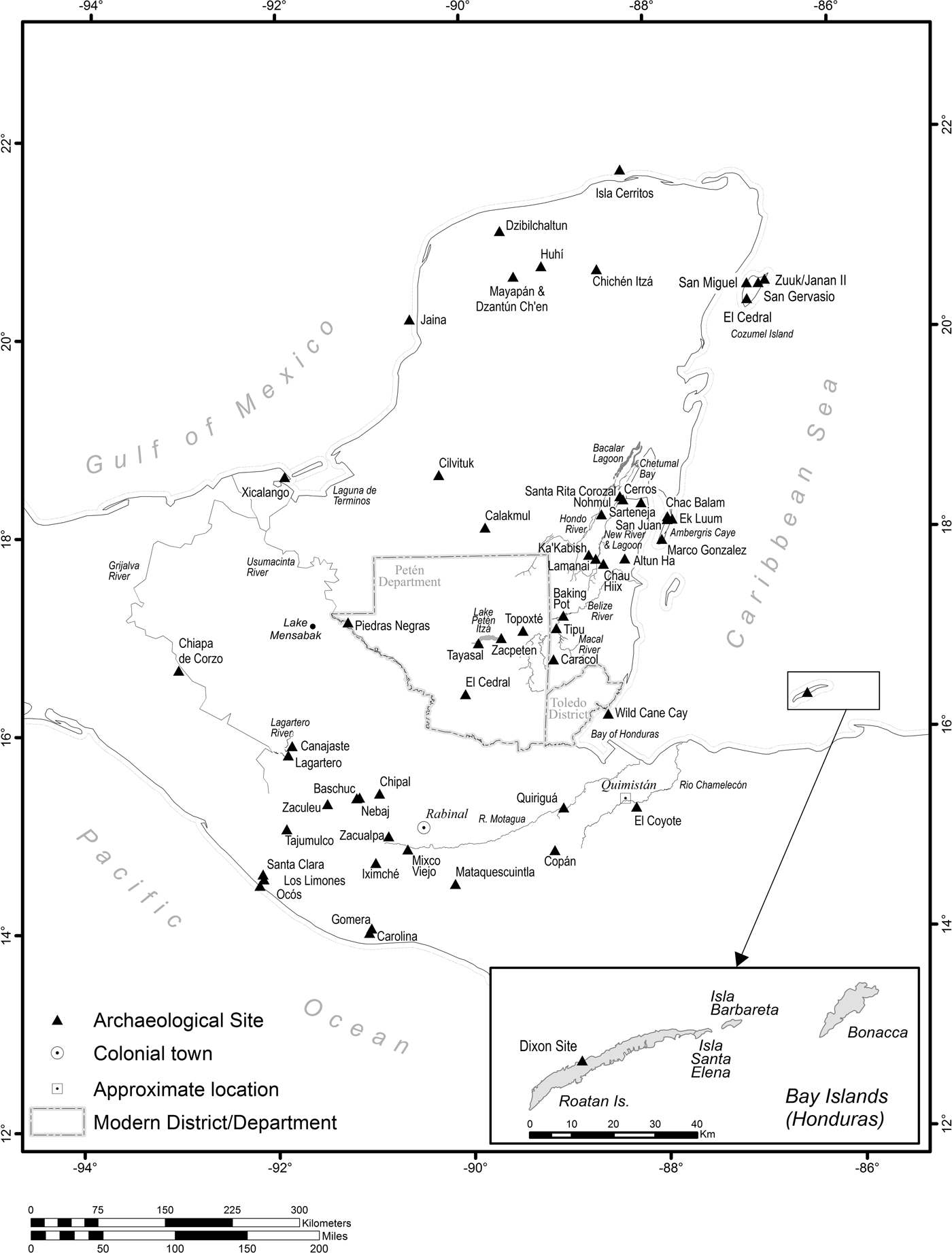
In other areas of the world, researchers have made great strides in addressing questions concerning the social, economic, and political contexts of metallurgy. This has not yet been possible in the Maya area up until very recently (Simmons and Shugar Reference Simmons, Shugar, Shugar and Simmons2013a). Here we present the results of recently conducted research on Maya metallurgy in the southern lowlands. The information comes from two sites in Belize: Lamanai and Tipu. Lamanai is located in northern Belize on the west bank of the New River Lagoon, which drains north into the New River and eventually empties into the Bay of Chetumal. Tipu is situated in western Belize on the west bank of the Macal River, a tributary of the Belize River (Figure 1).
Map of the Maya region, with sites and geographic features mentioned in the text. Data extracted from Brown and Witschey (Reference Brown and Witschey2016). Map by Walter Witschey.

Over the past several decades, both Belizean sites have been the focus of multi-disciplinary research that has helped to shape our understanding of Maya life in the southern lowlands at the time of Spanish contact and beyond (Graham Reference Graham and Thomas1991, Reference Graham2004; Graham et al. Reference Graham, Pendergast and Jones1989; Jones Reference Jones1989, Reference Jones1998; Pendergast Reference Pendergast1981, Reference Pendergast, Chase and Rice1985, Reference Pendergast, Sabloff and Andrews V1986, Reference Pendergast1993). More metal artifacts have been found during archaeological investigations at Lamanai and Tipu than at any other sites in the southern Maya lowlands and, with the exception of those from Mayapan and Chichen Itza, the metal assemblages at Lamanai and Tipu are the largest presently known in the entire Maya area. Most of the metal objects are made of copper or alloyed copper, although a small number of sheet gold (foil) pieces have been excavated at Lamanai and many silver-copper rings have been found at Tipu. Here we focus our discussion on the copper-based objects from these sites, using the term “copper” for brevity's sake, although most of the copper artifacts found at Lamanai and Tipu included concentrations of elements like arsenic and tin that suggest alloying to form bronze.
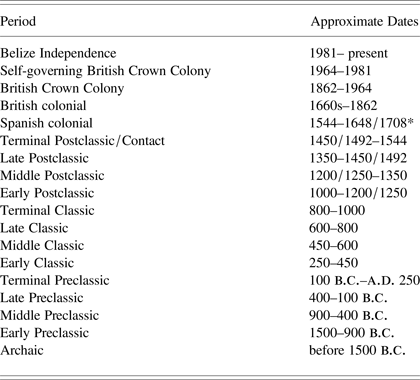
The opportunity to reconcile artifact assemblages from two distinct sites, united by their historical situation as centers of reducción in the Spanish Colonial period, is especially notable (Table 1). Intersite artifact comparisons can facilitate new interpretive threads and help to more critically evaluate the abundant documentary evidence associated with such Colonial-period sites (Graham Reference Graham2011:192–193) already fleshed out by Jones (Reference Jones1989). We follow the lead of Emery (Reference Emery and White1999), who compared faunal assemblages from Lamanai and Tipu to evaluate changes in consumption practices at the two sites from roughly a.d. 1150 into the Spanish Colonial period.
Approximate date ranges are given for relevant periods (after Graham et al. Reference Graham, Simmons and White2013).

*Spanish sovereignty was claimed until 1798.
Beyond its relevance to the understanding of historical changes in the southern Maya lowlands, the research presented in this paper represents the first comparative analytical study of ancient Maya metals using multiple methods to date. In this paper we describe and compare the types of metal objects recovered archaeologically from both sites, the contexts in which those objects were found, and the technological processes used in their production. Manufacturing technologies have been examined using data from on-going microstructural and chemical compositional analyses (Cockrell et al. Reference Cockrell, Martinón-Torres and Graham2013; Shugar Reference Shugar2005, Reference Shugar2008; Simmons and Shugar Reference Simmons and Shugar2013b). This archaeometric approach dovetails with studies of metal artifacts from the Sacred Cenote at Chichen Itza (Cockrell et al. Reference Cockrell, Sil and Díaz2015; Contreras et al. Reference Contreras, Sil and Alatorre2007; Franco Velásquez and de Grinberg Reference Franco Velázquez, Grinberg and Balderas2002; Ortiz et al. Reference Ortiz Díaz, Cockrell and Sil2016; Root in Lothrop Reference Root1952) and the metallurgical ceramics from Mayapan (Meanwell et al. Reference Meanwell, Paris, Alvarado and Lope2013). It is hoped that the research presented here may serve as a point of encouragement for future comparative, technological studies of metals in the world of the ancient Maya.
THE CURRENT STATE OF KNOWLEDGE OF MAYA METALS
As mentioned above, our understanding of Maya metals and the roles metal objects played in ancient Maya social, economic, and political life is still fairly limited at present. Metal objects only began to appear in some quantities in the Maya area very long after the Maya began producing stone tools, ceramic vessels, and shell and bone objects.
Small numbers of metal artifacts have been recovered from Classic period contexts at a handful of lowland sites (see below), but it was not until the eleventh to twelfth centuries that metal objects began to appear in the Maya world in appreciable quantities (Simmons and Shugar Reference Simmons, Shugar, Shugar and Simmons2013a). The Sacred Cenote at Chichen Itza represents a special case with the deposition of metals that are analogous to objects produced in the Central American Isthmus as early as a.d. 700 (Cockrell et al. Reference Cockrell, Sil and Díaz2015; Ortiz et al. Reference Ortiz Díaz, Cockrell and Sil2016). In addition, it has not been possible to fully understand how the Maya organized the production of metal objects since virtually no workshops have been identified, with the exception of the one recently reported at the site of El Coyote in western Honduras (Urban et al. Reference Urban, Shugar, Richardson, Schortman, Shugar and Simmons2013). Taken together, the limited number of sites that have yielded metal artifacts, the comparatively small overall sizes of the metal assemblages from those sites, and the lack of studies on these assemblages has greatly limited our understanding of the ways metal objects figured into the lives of early Maya peoples.
Fortunately, this situation now appears to be changing. Recent research conducted in both the northern lowland area (Paris Reference Paris2008; Paris and Peraza Lope Reference Paris, Lope, Shugar and Simmons2013) and southern Maya region (Cockrell et al. Reference Cockrell, Martinón-Torres and Graham2013; Simmons and Shugar Reference Simmons and Shugar2013b; Simmons et al. Reference Simmons, Pendergast and Graham2009; Urban et al. Reference Urban, Shugar, Richardson, Schortman, Shugar and Simmons2013) is beginning to provide us with a better understanding of the roles metal played in the lives of the ancient Maya. After offering a brief overview of Maya metallurgy, we will discuss the types of metal artifacts that have been recovered at Tipu and Lamanai, Belize. We also examine the objects' archaeological and chronological contexts, and offer some thoughts on the links between the southern Maya lowlands with other metal-producing areas of Mesoamerica, including west Mexico and Yucatan.
OVERVIEW OF MAYA METALWORK
Pendergast (Reference Pendergast1962) provided the first comprehensive overview of metal artifacts in Mesoamerica. This seminal work, based on his dissertation research (Pendergast Reference Pendergast1960), introduced a typological classification scheme for a wide range of metal artifacts from over 125 sites in Mesoamerica, including the Maya area. Fifteen years later, Bray (Reference Bray and Hammond1977) focused his discussion of “Maya metalwork and its external connections” on metal artifacts found in the Maya area proper, and the influences seen on Maya metalwork from Mexico (outside Yucatan) and the Central American isthmus. These two early studies provided useful comparanda for subsequent research on metals and metallurgy in ancient Mesoamerica. While our understanding of the metallurgical traditions of some parts of Mesoamerica, particularly west Mexico, has grown considerably over the last several decades, comparatively less is known about ancient Maya metals and metallurgy (Cockrell et al. Reference Cockrell, Martinón-Torres and Graham2013; Hosler Reference Hosler1994, Reference Hosler, Evans and Webster2001, Reference Hosler2009; Maldonado Reference Maldonado2008, Reference Maldonado, Shugar and Simmons2013; Pollard Reference Pollard1987; Roskamp and Rétiz Reference Roskamp, Rétiz, Shugar and Simmons2013; Simmons and Shugar Reference Simmons, Shugar, Shugar and Simmons2013a). The following is a brief summary of metal artifacts in the Maya area, with a particular emphasis on more recent discoveries in this part of Mesoamerica.
Throughout the Maya area both utilitarian and ornamental objects of copper, and to a much lesser extent gold and silver, have been found (Simmons and Shugar Reference Simmons, Shugar, Shugar and Simmons2013a). Most of the copper objects found at Maya sites are bells of various shapes and sizes that were used in ritual performances, as status ornaments, and as a kind of currency at the time of Spanish contact (Simmons et al. Reference Simmons, Pendergast and Graham2009). Other copper ornaments, including finger rings, earrings, tweezers, small masks, and button-like ornaments also have been found. Axes are the most common utilitarian objects found at Maya sites but, unlike the thin, T-shaped “axe monies” of west Mexico and Oaxaca (Hosler et al. Reference Hosler, Lechtman and Holm1990), these are designed to be used in various work activities. Fishhooks, needles, awls, and chisels are among the other copper tools that have been recovered.
The earliest metal object found thus far in the Maya region comes from Altun Ha, Belize (Pendergast Reference Pendergast1970). Deposited as part of a cache around a.d. 500, the tumbaga (gold-copper alloy) pendant was most likely a trade item that both Bray (Reference Bray1971:36) and Pendergast (Reference Pendergast1970:117–118) believe originated in the Cocle region of Panama. Metal artifacts do appear in Classic period contexts at some Maya sites but are likely imported from other regions since there is only tentative evidence of Maya metallurgy at this time (see below). Indeed, over time, a circum-peninsular coastal trade network had taken shape, extending from the Gulf Coast in the west to the Bay of Honduras in the east (McKillop and Healy Reference McKillop and Healy1989). Most metal artifacts found in the Maya area, however, are associated with later Postclassic occupation and at several Maya sites there is compelling evidence of on-site metallurgy during this time (Paris Reference Paris2008; Simmons et al. Reference Simmons, Pendergast and Graham2009; Urban et al. Reference Urban, Shugar, Richardson, Schortman, Shugar and Simmons2013). The earliest traces of metallurgy in the Maya region date to a.d. 1000 or perhaps slightly earlier and come from the site of El Coyote, Honduras (Urban et al. Reference Urban, Shugar, Richardson, Schortman, Shugar and Simmons2013).
Northern Lowlands
A variety of primarily ornamental metal objects have been found at sites in the northern Maya lowlands, including Dzibilchaltun, Dzantún Ch'en, and Huhí (Bray Reference Bray and Hammond1977; Pendergast Reference Pendergast1962; Taschek Reference Taschek1981). Recently four pyriform-shaped copper bells were recovered in southwestern Campeche at the site of Isla Cilvituk; they were associated with probable high-status residential structures dating to the Postclassic period (Alexander Reference Alexander, Kepecs and Alexander2005:173).
The greatest numbers of metal artifacts in this part of the Maya world have been found at Chichen Itza and Mayapan. Almost all of the metal objects at Chichen Itza were recovered from the Sacred Cenote (Coggins and Shane Reference Coggins and Shane1984).Footnote 1 Between 1904 and 1911, Edward Thompson directed dredging operations in the southern part of the cenote, resulting in the extraction of hundreds of metal objects along with jade, flaked stone, ceramics, textiles, and other materials (Lothrop Reference Lothrop1952). Excavations by INAH-CEDAM in 1961 and 1968 added to this diverse assemblage (Piña Chan Reference Piña Chan1970). Copper finds include a variety of bell types, rings, and axes, while gold or tumbaga items include other bell types, anthropomorphic and zoomorphic figurines, and embossed discs (Cockrell Reference Cockrell2014; Lothrop Reference Lothrop1952). These metals were likely fabricated in places as diverse as west Mexico (certain copper bells, “axe-monies,” and tweezers), Caribbean Costa Rica (figurines), the Cocle region of Panama (ear ornaments, cuffs), and were subjected to re-working (crumpling, embossing, indenting) before their deposition.
West of Chichen Itza, the site of Mayapan has produced more metal objects (n = 381) from controlled archaeological investigations than any other site in the Maya lowlands (Paris Reference Paris2008; Paris and Peraza Lope Reference Paris, Lope, Shugar and Simmons2013; Proskouriakoff Reference Proskouriakoff, Pollock, Roys, Proskouriakoff and Smith1962). Recent analyses have shown that almost all of these are copper and it appears that metallurgists were casting objects on-site, as crucibles, prills, sheet fragments and a large mass of casting sprues have been found (Paris Reference Paris2008:48). The presence of miscast bells found in presumed crucibles indicates that metals were melted down and recycled to fabricate new objects (Meanwell et al. Reference Meanwell, Paris, Alvarado and Lope2013). Most metal artifacts (91.6 percent) from Mayapan were found in burials and caches (Paris and Peraza Lope Reference Paris, Lope, Shugar and Simmons2013:179). In addition to copper objects, several pieces of sheet gold and tumbaga have been found there (Paris Reference Paris2008).
Southern Lowlands
As mentioned above, the oldest securely dated metal object found in the Maya area comes from Altun Ha, Belize, where a tumbaga felid claw-shaped pendant was found in a cache that, based on stratigraphy, was deposited no later than a.d. 550 (Pendergast Reference Pendergast1970). Elsewhere in northern Belize a variety of copper objects have been recovered at Cerros, Chau Hiix, Ka'Kabish, Nohmul, and Progresso Lagoon (Andres and Pyburn Reference Andres, Pyburn, Demarest, Rice and Rice2004; Gann Reference Gann1918; Garber Reference Garber1989; Haines Reference Haines2013; Oland Reference Oland2009). At Cerros, on Chetumal Bay, three tumbaga discs and 17 bells of eight different types were found in a Late Postclassic cache (Garber Reference Garber1989:92–93). One of these bells was a form not previously identified by Pendergast (Reference Pendergast1962) or Bray (Reference Bray and Hammond1977). Copper axes, fishhooks, bells, and bell fragments have been found in Late Postclassic domestic contexts at Progresso Lagoon (Oland Reference Oland2009). Recently Haines and her colleagues recovered 33 copper bells, seven finger rings, and a ring fragment associated with four individuals buried in a chultun at Ka'Kabish during Early Postclassic times (Gonzalez Reference Gonzalez and Haines2013).
In central Belize, small numbers of copper artifacts have been reported from several sites aside from Tipu. In the Belize river valley, the site of Baking Pot has yielded five copper bells from Early Postclassic period contexts (Hoggarth and Awe Reference Hoggarth and Awe2014). At Caracol, a sheet copper frog was recovered from a Terminal Classic period sub-stela cache (Chase and Chase Reference Chase and Chase2007:21). Northwest of the Belize river valley in southern Campeche, a single copper ring was recovered from Terminal Classic contexts at Calakmul (Braswell et al. Reference Braswell, Gunn, Carrasco, Folan, Fletcher, López, Glascock, Demarest, Rice and Rice2004:181).
In the southeastern part of the Maya area, a pair of legs from a small, hollow tumbaga figurine was found in a Terminal Classic period cache at Copan (Sharer and Traxler Reference Sharer and Traxler2006:576). There is some evidence that the Maya were casting bells at Quirigua, Guatemala, located just 31 miles north of Copan (Lothrop Reference Lothrop1952:25). In his discussion of the bells found there, including one that was clearly miscast, Sharer (Reference Sharer, Chase and Rice1985:247) notes the possibility that copper metallurgy at Quirigua dates to Terminal Classic or Early Postclassic times. Around 55 miles to the east of Quiriguá, compelling evidence for on-site casting of copper objects has been found recently in the Chamelecon-Cacaulapa region of western Honduras at El Coyote (Urban et al. Reference Urban, Shugar, Richardson, Schortman, Shugar and Simmons2013). Although dating is not conclusive as yet, it appears the Maya there were crushing metal slag, recovering copper prills washed along a stone feature, and then smelting them during the Terminal Classic or Early Postclassic (Urban et al. Reference Urban, Shugar, Richardson, Schortman, Shugar and Simmons2013:103).
The most famous “hoard” of copper objects was discovered in the very early twentieth century at the Quimistan “bell cave,” also located in the Chamelecon river valley of Honduras (Blackiston Reference Blackiston1910). Over 800 bells, many with elaborate anthropomorphic faces and false wirework designs, were found in the cave. Root (in Lothrop Reference Root1952:25) analyzed the chemical compositions of 15 of these bells and Hosler (Reference Hosler1994:220) believes “their chemistries indicate they were made from reused metal.” The bells range in size from “minute” to almost three inches in diameter (Blackiston Reference Blackiston1910:537).
Copper artifacts from pre- and post-Conquest contexts have been found in relatively small numbers at several sites located in the central Peten of Guatemala, including Topoxte, Tayasal, and Zacpeten (Pugh Reference Pugh2004, Reference Pugh2009; Pugh et al. Reference Pugh, Sánchez and Shiratori2012; Wurster Reference Wurster2000). The contexts in which these metal objects were recovered at Zacpeten provide valuable insights into the ways they were used and regarded by the Maya who lived there. A small number of copper bells along with copper and gold foil were recently found, most in cache deposits. These were typically associated with ceremonial structures, including a temple and what has been interpreted as an oratorio (Pugh Reference Pugh2009:379–380). Two bells were found buried just below floor level in a high-status residential structure in alignment with the short north-south axis of the building. In addition, a copper axe fragment was recovered just below the floor in the front room of the building (Pugh Reference Pugh2009:379).
Two sites in the upper Grijalva river valley of Chiapas, Mexico have produced a variety of copper and gold objects. At Canajaste, located on the Lagartero River just inside the Mexican border with Guatemala, 17 copper artifacts, including bells, bell fragments, rolled sheet pieces, a false filigree ornament, and a ring were found in Early and Late Postclassic period contexts (Blake Reference Blake2010:184, 229). Roughly 15 kilometers south of Canajaste, four gilded copper reptile (possibly crocodile) head ornaments were recovered at the site of Lagartero; these also date to the Postclassic period (Guerrero et al. Reference Guerrero Peñuelas, Cosme, López, Sil, Arenas, Lemoine, Vargas, Portilla and Torres2012). Northeast of these sites, copper bells have recently been recovered from Late Postclassic contexts at Lake Mensabak, located approximately 30 kilometers west of Piedras Negras (Palka Reference Palka2014:317).
Coastal Sites
It has long been acknowledged that coastal trade was an important part of ancient Maya economic life and that copper and other metal objects were highly valued trade items, at least by Postclassic times (Chapman Reference Chapman, Arensberg, Pearson and Polanyi1957; McKillop and Healy Reference McKillop and Healy1989; Sabloff Reference Sabloff and Benson1977; Sabloff and Rathje Reference Sabloff and Rathje1975; Smith Reference Smith, Smith and Berdan2003). Hosler (Reference Hosler1994) has proposed that, specifically in West and central Mexican contexts, sound was important in metals to promote fertility, protect people in warfare, realize a sacred paradise, and that the metals' color effected divine associations for their wearers; these properties of sound and color were especially developed in metal bells. The Spanish friar López de Cogolludo (Reference Lopez de Cogolludo1688) suggests that copper bells were used among Mayas as currency.
Objects made of metal have been recovered at a number of Maya coastal sites extending from the Gulf Coast to the Bay of Honduras. In the west, metal objects have been found at sites around Laguna de Terminos and the ancient trade port of Xicalanco (or Xicalango), as well as on Jaina Island (Bray Reference Bray and Hammond1977). On the north coast of Yucatan, a gold frog effigy pendant, a probable piece of rolled sheet copper, and an unidentified piece of metal have been found on Isla Cerritos, which acted as a port for Chichen Itza (Andrews Reference Andrews1995:22).
On the east coast of Yucatan, the recovery of copper artifacts at San Miguel, Zuuk, El Cedral, and San Gervasio on Cozumel Island is not surprising given the island's prominent role in maritime trade (Robles Castellanos Reference Robles Castellanos1986a, Reference Robles Castellanos1986b; Sabloff and Freidel Reference Sabloff, Freidel, Sabloff and Lamberg-Karlovsky1975; Sierra Sosa and Robles Castellanos Reference Sierra Sosa, Castellanos, Saavedra and Sobrino1988). South of Cozumel, excavations in the early twentieth century by the British physician Gann (Reference Gann1918) yielded different types of metal artifacts from several coastal Belizean sites. One of these was Santa Rita Corozal, located on the west shore of Chetumal Bay. More recent excavations at Santa Rita have yielded copper bells, rings, needles, and tweezers, many of which were associated with burials (Chase Reference Chase1982:521; Chase and Chase Reference Chase and Chase1988:55, 60). In addition, a pair of turquoise and gold earplugs with obsidian backing was found in Structure 216 (Chase and Chase Reference Chase and Chase1988:55–56). Sarteneja, another site investigated by Gann, is located along the south shore of Chetumal Bay. A single copper bell and 45 pieces of hammered gold foil were found there in an Early Postclassic period tomb (Boxt Reference Boxt1993).
Along the southern Belizean coast, Wild Cane Caye has produced a pair of sheet copper ear spools along with a pair of copper masks with cross straps. Gann (Reference Gann1918:136) also recovered two copper finger rings, a bell, and a copper tube during mound excavations and McKillop (Reference McKillop1987:81) found a copper bell in mound-fill associated with a burial at Wild Cane Cay. Curiously, no copper objects have been reported from any of the other Belizean cayes, including Ambergris Caye. This is somewhat puzzling, given that archaeological excavations have occurred at the most prominent sites engaged in coastal trade on the island, including: Marco Gonzalez, Chac Balam, San Juan, and Ek Luum. At least one of these sites, Marco Gonzalez, appears to have had close economic ties with Lamanai (Guderjan and Garber Reference Guderjan and Garber1995; Pendergast Reference Pendergast, Clancy and Harrison1990; Simmons and Graham Reference Simmons and Graham2017). The absence of metal artifacts at these sites, however, may be due to a focus on investigations of Terminal Classic and earlier deposits and metals do not begin to appear in quantities until somewhat later in the Postclassic period (Simmons and Shugar Reference Simmons, Shugar, Shugar and Simmons2013a).
Farther south in the Bay of Honduras, copper artifacts have been found on most of the Bay Islands, including Roatan, Santa Elena, Barburata, and Bonacca (Strong Reference Strong1935). Thirty copper bells, two small hoop-like objects, and a piece of worked copper that Lothrop (Reference Lothrop1952:25) suggests may be an ingot were found at the Dixon Site on Roatan (Strong Reference Strong1935). Four bells, one of which had been miscast during manufacture, and a small metal disc were found on Bonacca Island, and copper axes have been found on Santa Elena Island. Besides the copper ingot and miscast bell there is other evidence of copper metallurgy, specifically the smelting of copper ore, on the Bay Islands. Christopher Columbus's son, Ferdinand, who was 14 years old at the time he accompanied his father on his fourth voyage to the New World in 1502, noted the presence of numerous pieces of copper ore which the Spanish called calcide on Bonacca Island. In addition, it was in the vicinity of the Bay Islands that Columbus and his crew encountered a large trade canoe carrying “hatchets resembling the stone hatchets used by the other Indians, but made of good copper; and hawks bells of copper, and crucibles to melt it” (Columbus Reference Columbus and Keen1959:231–232).
Highlands and Pacific Coast
A number of highland Maya sites in Guatemala and Chiapas, Mexico have yielded copper and gold artifacts (Bray Reference Bray and Hammond1977; Lothrop Reference Lothrop1952; Pendergast Reference Pendergast1962). Gold discs, cast copper animal effigies, finger rings, and axes have been found at Zacualpa, in the K'iche area of Guatemala (Lothrop Reference Lothrop1936). Excavations at Zaculeu have produced one of the largest assemblages of copper artifacts in the highland area (Woodberry and Trik Reference Woodberry and Trik1953). Thirty metal objects from Early and Late Postclassic burials have been found, including copper bells, rings, and an unusual painted bird's head. In addition, two very large earplugs of thin gilded copper, along with a gold nose pendant, have been recovered at the site (Woodberry and Trik Reference Woodberry and Trik1953).
Another substantial assemblage of metal artifacts comes from Tajumulco, where over 20 copper bells, rings, sheet pieces, and gold discs were found (Dutton and Hobbs Reference Dutton and Hobbs1943). Copper axes of varying sizes also have been found at Tajumulco, as well as at Rabinal, Matequesquintla, and Mixco Viejo. Various forms of copper bells have been recovered at other highland sites in Guatemala, including Baschuc, Chipal, Nebaj, and Zaculeu, while copper tweezers (worn by at least one individual around his neck at Lamanai—see below) also have been reported from Mixco Viejo and Zaculeu (see Bray Reference Bray and Hammond1977). A spectacular necklace of 40 small gold beads and ten jaguar heads was recovered during excavations of Burial 27-A at Iximché, the ancient Kakchiquel capital (Guillemin Reference Guillemin1967:33).
Perhaps the most significant assemblage of highland metal artifacts comes from the site of Chiapa de Corzo, located on the western periphery of the Maya world in eastern Chiapas, Mexico (Lee Reference Lee1969). A variety of bell types, including 42 with false wirework designs, have been found at the site along with an axe, a chisel, and a gilded copper ring (Lee Reference Lee1969:185–187). Some of the wirework bells appear to have been miscast as they are missing elements such as suspension loops and portions of bell walls (Lee Reference Lee1969: Figure 147).
A small number of sites on the Pacific coastal plain have produced metal artifacts, and these include Carolina, Gomera, Los Limones, Ocos, and Santa Clara (Bray Reference Bray and Hammond1977; Mencos Reference Mencos2009; Mencos and Moraga Reference Mencos, Moraga, Pedro, Laporte and Mejía2005). Recent investigations in what are interpreted as high-status residential contexts in the central areas of Carolina and Gomera yielded 18 copper artifacts, including rings, needles, bells, fishhooks, and pieces of sheet metal (Mencos and Moraga Reference Mencos, Moraga, Pedro, Laporte and Mejía2005). The 15 metal artifacts from Carolina and the three from Gomera are believed to date to the Late Postclassic period.
ANALYTICAL METHODS
Approximately one quarter of the assemblage of Lamanai copper artifacts (45 pieces total) was first analyzed in the 1980s and 1990s (Hosler Reference Hosler1994:Table 7.5; Williams Reference Williams1990). Both emission spectroscopy as well as atomic absorption analyses revealed two distinct manufacturing regions for Lamanai metals—West Mexico and what Hosler (Reference Hosler1994:215) termed “a local southeastern copper-based casting tradition.” In addition, some metal objects recovered in Spanish Colonial (post a.d. 1544) deposits, including four copper ingots recovered by Pendergast (Reference Pendergast1981), had “highly anomalous” chemical compositions suggesting they were created using “stock metal derived from melted-down artifacts” (Hosler Reference Hosler1994:215). In the past decade, an additional 33 copper objects have been analyzed using optical microscopy, Scanning Electron Microscopy with Energy-Dispersive Spectroscopy (SEM-EDS), Laser Ablation Inductively Coupled Mass Spectrometry (LA-ICP-MS), and Energy Dispersive X-ray Fluorescence Spectrometry (ED-XRF) with a Bruker Tracer III V (Shugar Reference Shugar2005, Reference Shugar2008). SEM-EDS was performed for partially quantitative compositional analysis with a JEOL JXA-840 microscope, using internal reference materials at the Smithsonian Center for Materials Research and Education and in the Archaeometallurgy Laboratory at Lehigh University by Shugar (Reference Shugar2005, Reference Shugar2007, Reference Shugar2008).
Eighty-one of the 99 Tipu objects were analyzed by Cockrell (Cockrell et al. Reference Cockrell, Martinón-Torres and Graham2013; Cockrell and Salas Reference Cockrell and Salas2012) at University College London's Institute of Archaeology. The metals were studied macroscopically for thickness, length, diameter, and other attributes. For microanalysis, some objects (n = 47) were studied by polishing a small surface area and keeping the object whole; others (n = 14) were sectioned and mounted in polished epoxy blocks. A Leica DMLM optical microscope was employed for phase characterization. For qualitative bulk compositional analysis, an InnovX Systems portable XRF Alpha 8000 LZX (40 kV) Spectrometer was used on unprepared object surfaces. Compositional analysis of particular phases was accomplished through a JEOL JXA-8600 superprobe (20 kV, working distance = 11 mm, spot size = 5) with Oxford Instruments EDS and wavelength-dispersive spectroscopy (WDS) detectors. Data were processed using the Inca microanalysis suite. A naval brass and phosphoric bronze were analyzed as standard reference materials. For compositional analysis, the aim was to cover the entire typological spectrum of artifacts, with a particular focus on the most prevalent forms: bells, lacetags, needles, and rings. Less numerous forms usually were studied with ED-XRF. Whether an object was studied whole or in section depended on concerns for its structural integrity as well as time constraints.
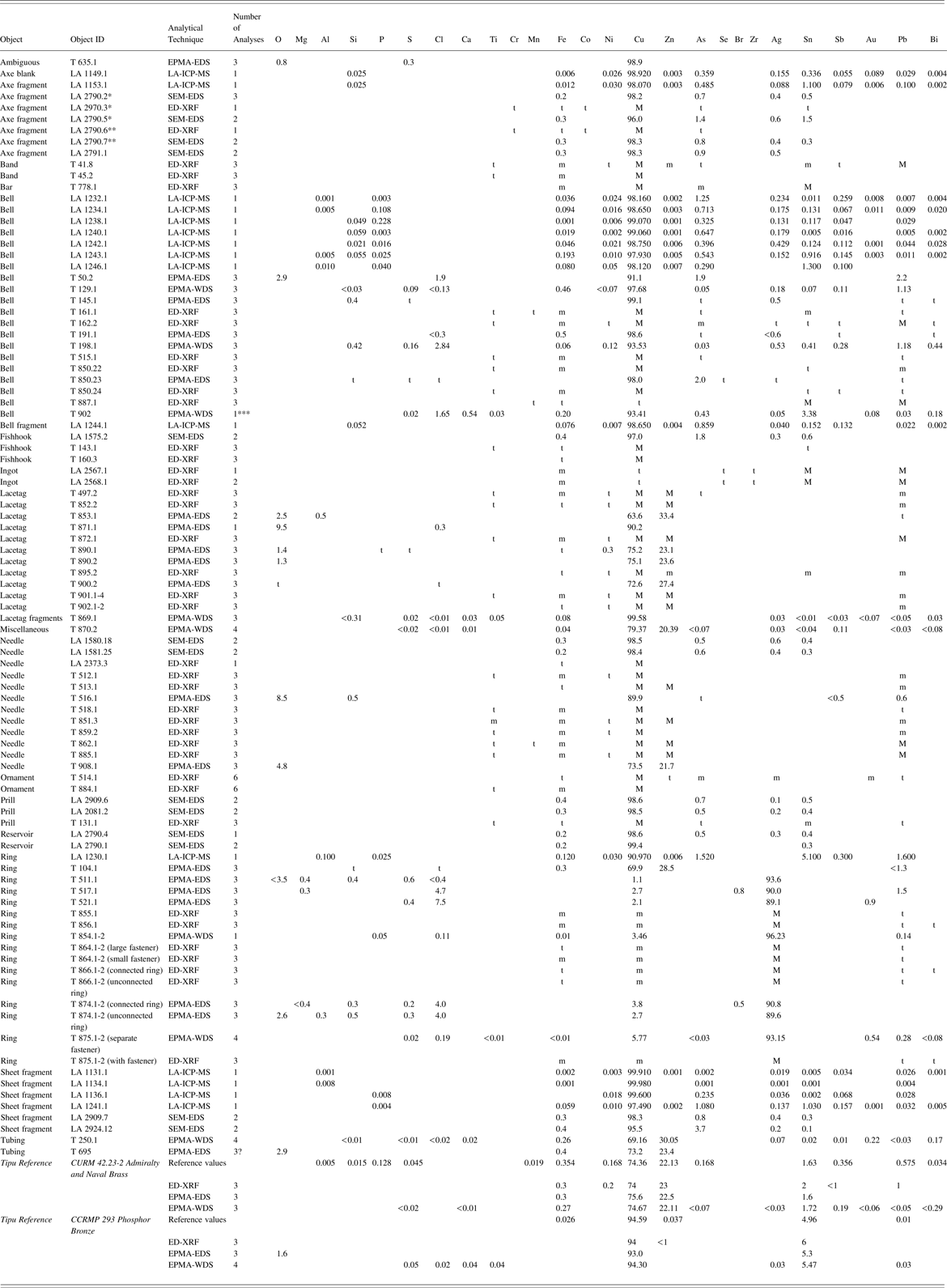
It is important to note that the compositional data for the Lamanai and Tipu assemblages were acquired through different methods, which, of course, is not ideal for comparison. For compositional analysis, the superprobe used for the Tipu metals offers the advantage of identification of quantitative phase composition, and WDS can be employed to resolve spectral ambiguities stemming from EDS. The SEM used for the Lamanai metals also offers phase-specific analysis but offers less spatial resolution and its results are less quantitative. The XRF applied to the Lamanai and Tipu metals cannot resolve distinct phases and, instead, only can be used to reveal generic compositional patterns. Thus, caution has been applied in the data presentation (Table 2) with compositions presented as major (≥10 wt%), minor (1 ≤ x < 10 wt%), and trace (<1 wt%) elements with the analytical method specified.
Quantitative (LA-ICP-MS, SEM-EDS, EPMA-EDS and WDS) and semi-quantitative (ED-XRF) compositions are provided for each Lamanai and Tipu metal analyzed, citing the results of the analysis offering the greatest spatial or spectral resolution for each object. For ED-XRF results, major elements (M) have a concentration ≥ 10 wt%, minor elements (m) have a concentration of 1 ≤ x < 10 wt%, and trace elements (t) have a concentration of < 1 wt%. “LA” before the object ID number indicates an object from Lamanai and “T” indicates an object from Tipu.

* Indicates fragments from one individual axe; ** indicates fragments from another individual axe; *** represents the results of one spot analysis from a line scan.
LAMANAI AND TIPU METALS
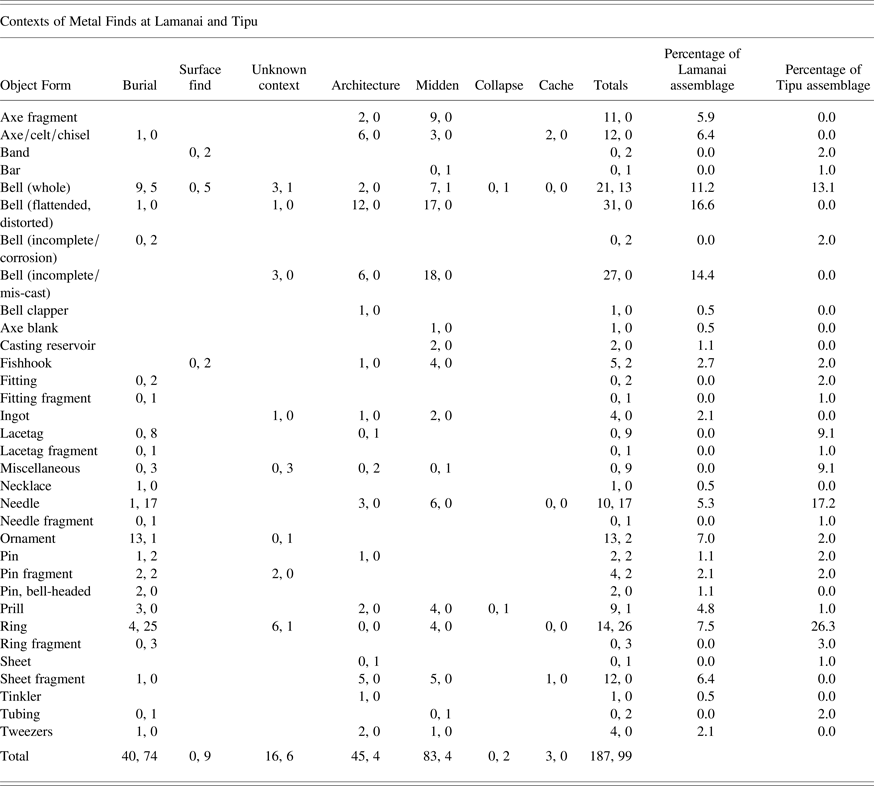
The assemblage from Lamanai is composed of 187 copper objects, making it the largest of its kind in the southern Maya lowlands (Simmons et al. Reference Simmons, Pendergast and Graham2009; Simmons and Shugar Reference Simmons, Shugar, Shugar and Simmons2013c). Slightly less than half that number of metal objects has been found at Tipu (n = 99) but, to our knowledge, the size of the Tipu metal assemblage is surpassed only by the assemblage from Lamanai. Both sites share particular metal forms, such as bells, rings, needles, and fishhooks (Table 3). There are also some pronounced differences, as discussed below. Rings make up the largest number of metal objects at Tipu, comprising just over one quarter (n = 26) of the entire assemblage (Cockrell et al. Reference Cockrell, Martinón-Torres and Graham2013). In contrast, bells are the most common metal artifact type at Lamanai, making up slightly more than 42 percent of the copper assemblage. At Tipu, bells account for only 15 percent of the total number of metal artifacts.
Contexts are provided for all Lamanai (first frequency listed in each cell) and Tipu (second frequency listed in each cell) metal finds by form. One “find” may include multiple fragments of metal presumed to originate from the same object. Frequencies of forms within each assemblage also are provided.

Our discussion of the forms of copper artifacts from Tipu and Lamanai follows Pendergast's (Reference Pendergast1962) typology of metal artifacts in Mesoamerica. This particular classification scheme is based on the division of objects into one of three major functional categories: utilitarian objects, objects of personal adornment, and ceremonial objects (Pendergast Reference Pendergast1962:521). Despite recognition that some objects, such as tweezers, could have been used either for utilitarian purposes or as objects of personal adornment, this typology is considered to be the most comprehensive, as well as the least restrictive, among those proposed for Mesoamerican metals. Hosler's (Reference Hosler1986:104–105) typology considers stylistic criteria as well as other attributes such as mechanical properties (for such objects as axes and tweezers) and volume and pitch (for bells). As these data could not be obtained for all of the metals in the Lamanai and Tipu assemblages, we use Pendergast's (Reference Pendergast1962) typological classification, unless otherwise noted. Specifically, we occasionally supplement Pendergast's typology by using Hosler's (Reference Hosler1986:104–105) classification for certain objects, such as needles, for which more detailed typological categories exist.
Bells
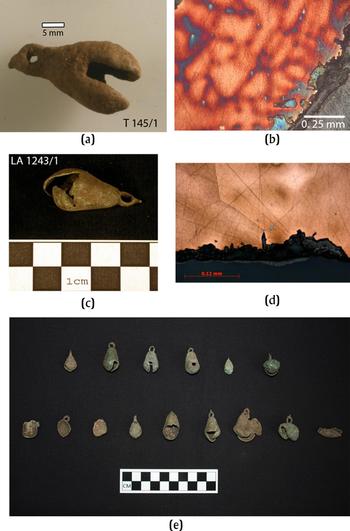
The majority of bells from both Belizean sites are either plain-walled globular or pear-shaped in form (Figure 2). These are Types IA1a-i and IC1a, respectively. All have single suspension loops and a number still contain their clappers, which are either stone pebbles or copper pellets. Other types at the sites include bells with human or animal face designs on their resonators (IC4a at both sites), bells with an elongated pyriform shape (ID1a at both sites), regular and flattened globular with a plain resonator (IA1c and 1B1a at Tipu), and zoomorphic forms (IE1a at Tipu). Two bells of unidentified type were found in the “Hunchback Tomb” (in Structure N12-26), dating to a.d. 1500–1540. Pendergast (Reference Pendergast1984) believes the individual interred there may have been the last Maya ruler of Lamanai. Only a small number of more ornately designed bells have been recovered from either site. A single bell from Lamanai has simulated wirework bands on the upper portion of its resonator body (Type IC2a); two bells from Tipu and one from Lamanai are Type IC4a, having human or animal faces, with their slits resembling mouths. These forms are similar to the effigy types reported by Lothrop (Reference Lothrop1952) and Blackiston (Reference Blackiston1910) for some of the bells found at Chichen Itza and Quimistan, respectively. Two of the bells from Tipu, including one of the head-effigy types, are associated with glass beads. The majority of bells (n = 13; 86.7 percent) from Tipu are complete (not to mention two bell fragments, to be discussed later), whereas nearly three-quarters (n = 58; 73.4 percent) of the bells from Lamanai are either incomplete or flattened and distorted (Table 3).
(a) Globular bell T 145/1 from Tipu and (b) an etched section of the bell, revealing the dendritic (as-cast) microstructure. Photographs by Cockrell, courtesy of UCL Wolfson Archaeological Science Laboratories. (c) Pyriform bell LA 1243/1 from Lamanai and (d) the large-grained microstructure, indicative of slow cooling. Photographs by Aaron Shugar. (e) A range of bells from Lamanai, with flattened resonators illustrated among two in the lower right, and six miscast bells or partial bells to their left. Photograph by Simmons.

The contexts in which many of Lamanai bells were recovered imply that this flattening was not the result of post-depositional processes. Instead, these bells appear to have been intentionally crushed, probably in preparation for casting (see below). Among their other possible functions, bells were used by the Maya as currency, in ritual dance performances, and as payment for fines imposed on the Maya by the Spanish for idolatry (Lopez de Cogolludo Reference Lopez de Cogolludo1688:18; Scholes and Adams Reference Scholes and Adams1938:214; Tozzer Reference Tozzer1941:186; Vásquez Reference Vásquez1980:87). In addition to the two bells found in the Hunchback Tomb, eight other Lamanai bells were recovered from Early and Middle Postclassic burial contexts.
While some Tipu bells come from burial contexts (seven bells, including complete and incomplete specimens from three burials, three of which are from a double interment), many are surface finds (five bells). The concentration of bells in a few burials suggests that this object type may have been reserved for particular residents of Tipu. Yet, of the four most common metal forms at Tipu (bells, lacetags, needles, and rings), bells demonstrate the strongest tendency to come from non-burial contexts (53.3 percent compared to 10 percent, 0 percent, and 6.7 percent for lacetags, needles, and rings, respectively, including fragments of each).Footnote 2 While the bells that are surface finds may have arrived in such contexts as a result of taphonomic processes, it is possible that, prior to their ultimate deposition, certain bells were reserved by the Tipu population for some activity outside of burial.
Given the presence of sprues on some bells—usually preserved on their loops—as well as dendritic microstructures, it is presumed that the bells were lost-wax cast. At Lamanai, bells are copper and copper-arsenic, with especially high trace concentrations of tin (approaching 1 wt%). They tend to show large grains, indicative of slow cooling, and porosity, owing to shrinkage. The bells from Tipu include copper, copper-lead, and copper-arsenic with trace amounts of tin (Table 2). There is greater variety in grain size and typically less porosity among the Tipu bells than among those from Lamanai. There is a range of trace elements (<1 wt%) in bells from both sites (e.g., tin, antimony, and silver at Tipu), which suggests that the bells may have been fabricated from recycled metal.
Rings
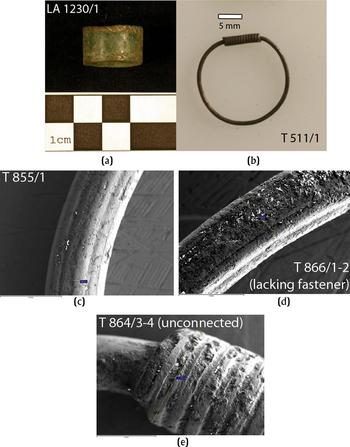
Rings are the most numerous metal artifact type (n = 26, plus three ring fragments) at Tipu (Figure 3). While four of the 14 rings at Lamanai are Type IVA3 with false filigree, most were plain, as were the majority of rings from Tipu. The plain rings from Tipu are variants of Type IVAI in that they are thin bands without any elaboration except for a coil of metal wrapped around individual rings as a fastener, half as thick as the metal used for the actual ring. No fastener coils have been recovered in association with any of the rings from Lamanai. In cross section the rings are rectangular or circular in shape. Analogs for this less ornate ring are evident in west Mexico and Ecuador (Hosler Reference Hosler1994:Figures. 3.7, 4.4), as well as at sites in the northern Maya lowlands, including Chichen Itza and Mayapan (Lothrop Reference Lothrop1952:83–84; Paris Reference Paris2008:52; Root Reference Root, Pollock, Roys, Proskouriakoff and Smith1962:398). While there is variety in whether the rings are “open” (west Mexico, Ecuador) or “closed” (Chichen Itza, Mayapan), none of these appears to include a fastener coil. Both false filigree or openwork decoration rings (Type IVA3) recovered with Buk phase (Early Postclassic) burials at Lamanai have intricate and ornamental strapwork with either linked or separated S-scroll motifs. The contexts in which most of the rings at both sites have been found imply adornment in hair and/or on ears—some were recovered near the cranium—and fingers, although several rings were recovered in midden deposits at Lamanai (Simmons et al. Reference Simmons, Pendergast and Graham2009). Of the ten Tipu burials with rings whose occupants' sex and/or age have been identified, three are juveniles (that is, under 18 years old) and six are female adults. The Tipu rings are silver-copper alloys with high (>90 wt%) silver content (Table 2). One of the rings, with a different morphology and fastened with a rivet, was brass. Ridges on the rings suggested they were formed using dies.
(a) Plain ring from Lamanai, LA 1230/1, with decorative chevron incisions at the top and bottom. Photograph by Aaron Shugar. (b) Ring T 511/1 from Tipu (with fastener coil). (c–d) Secondary electron images of two rings from Tipu, showing the variety in the cross-sections encountered. Both contain impressions of the dies used to draw their wire bodies (field of view is 2.5 mm across at left and 2.25 mm across at right). (e) A secondary electron image of another Tipu ring shows its fastener coil (field of view is 3 mm across). Photographs by Cockrell, courtesy of UCL Wolfson Archaeological Science Laboratories.

Ornaments
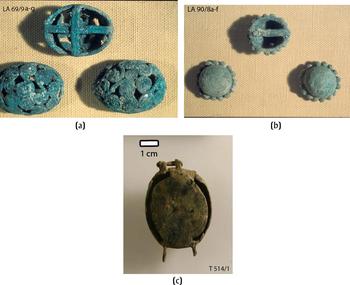
Several different types of copper ornaments have been identified at Tipu and Lamanai and, like the rings described above, all were likely used as items of personal adornment (Figure 4). Seven oval-shaped copper ornaments found in one burial (N10-4/3) were made of interconnected S-scroll wires attached to an elliptical frame. They measured between 2.6–2.9 cm in length and 2.0 cm in width and were likely attached to clothing by their wide, cruciform rear straps. It may be that they functioned as garment fasteners or as objects of personal adornment. This form has not been reported from any other sites in the Maya area (Bray Reference Bray and Hammond1977:385). Other copper ornaments found at Lamanai that may have been used as clothing fasteners are six dome-shaped bronze objects (LA 90/8a–f) with perimeter beading (Figure 4). They are identical in form to gold objects found in Tomb 7 at Monte Alban, Oaxaca (Pendergast Reference Pendergast1981:48–49). All 13 of these ornaments have cruciform rear straps, presumably for fastening purposes. All were associated with individuals Pendergast (Reference Pendergast1981) believes enjoyed high status among the Early Postclassic population of the site.
(a) Three of the oval-shaped, s-scroll filigree ornaments, LA 69/9a-g, from Lamanai, measuring between 2.6–2.9 cm in length and 1.95–2.0 cm in width. Note the cruciform straps, presumably for attachment to clothing, on the middle ornament. (b) Three dome-shaped ornaments, LA 90/8a-f, from Lamanai. These are identical to gold dome-shaped objects found in Tomb 7 at Monte Albán, Oaxaca. Photographs by David Pendergast. (c) A “turtle-shaped” ornament T 514/1 from Tipu, presumably suspended using the metal “bridge” at the top and another bridge, now missing its connecting piece, at the bottom. Photograph by Cockrell, courtesy of UCL Wolfson Archaeological Science Laboratories.

Finally, two bell-headed pins (LA 91/1&2), both with small remnants of textiles adhering to their shafts, make up the other clothing ornaments recovered from Lamanai. All of these ornaments are unique to Lamanai, as none has been reported from any other Maya lowland site. Thus, no typological categories presently exist for these objects.
Within the Tipu assemblage, there is a relatively flat object in the form of a face with two holes, positioned at approximately the same distances from the top corners, presumably for suspension. This object was recovered from a burial. A second potential ornament is described in prior records as a “turtle effigy,” adopting the reptilian form vis-à-vis its domed body and two projecting “feet” at each end. The feet are connected by a metallic bridge at one end, which is absent at the other, which may have permitted suspension of the object. Both ornaments were presumably cast; the turtle's hollow body likely housed the casting core that was removed subsequently. The former is nearly pure copper, while the latter is primarily copper with minor concentrations of arsenic, potentially exacerbated through superficial corrosion, and silver (<5 wt% in each case); gold (<10 wt%) also was detected (Table 2).
Tweezers
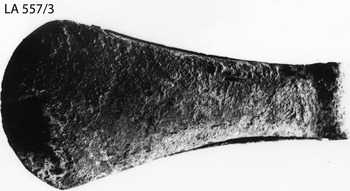
One of the major differences between the assemblages from these two southern lowland sites is the presence of some copper objects at one site and their absence at the other. For example, four tweezers have been found at Lamanai but none have been recovered from Tipu. The four from Lamanai are either disc-shaped in design or have elongated blades and, thus, are Types IIIC and IIIBI, respectively (also see Hosler Reference Hosler1994:Figures 5.6a–5.6b). One of these (LA 557/3) is shown in Figure 5. These objects were used both for hair removal and for status display purposes. For the latter they were often worn as objects of adornment around the neck (Hosler Reference Hosler1994:145) and, based on contextual evidence from Postclassic burials, this was also the case at Lamanai. A pair of tweezers was found in the lap of the male in the “Loving Couple’” burial at Lamanai, suggesting the tweezers had been worn around his neck at the time of his interment (Pendergast Reference Pendergast1989:2–3).
Tweezers LA 557-3 from Lamanai. Length is 4.65 cm and maximum width is 2.2 cm (at blade/bit). Photograph courtesy of Dorothy Hosler.

Axes and Chisels
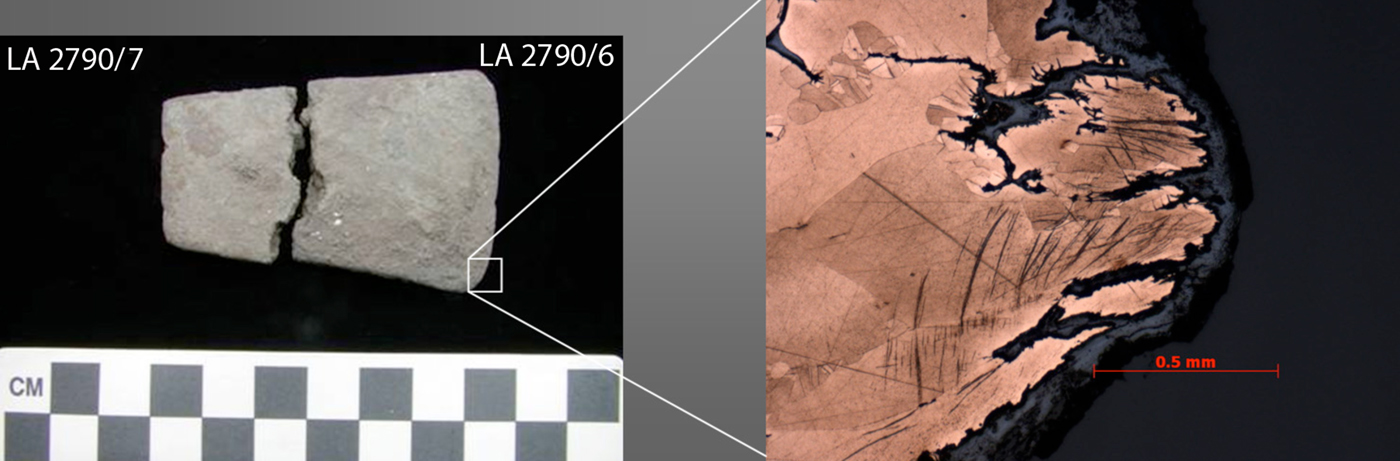
Woodworking tools also show a major discrepancy between the two sites. At Lamanai, 23 axes, axe fragments, and chisels have been found, while none of these forms has been recovered at Tipu (Figure 6). Nearly as many axe fragments (n = 11) have been found at Lamanai as whole axes and chisels (n = 12). Axes with both non-flaring bits (Type IVA) as well as those with flaring bits (Type IVB) have been recovered, while several Type VA chisels have also been found at Lamanai. Analyzed axes show minimal working and annealing; a probable sprue on one axe suggests that open mold casting may have been the primary manner in which axes were formed. Some axes were copper-tin-arsenic, while others were nearly pure copper (Table 2). The former group may have emerged through the re-melting of more strongly alloyed metals. The significant trace arsenic content among the latter group suggests that the metal was formed through the co-melting of copper and arsenic-bronze.
Axe LA 2790/6 (blade/bit) and LA 2790/7 (poll) from Lamanai. At right, the section reveals little annealing and dense working lines close to the blade tip. Photograph by Aaron Shugar.

Lacetags
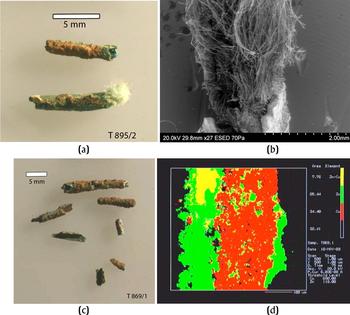
Lacetags (or “aglets”) are thin, hollow rods with a tapering thickness and an overall “stub” shape (Figure 7). Nine lacetags and one lacetag fragment have been found at Tipu but none has been identified at Lamanai. These objects are present at other Caribbean Colonial period archaeological sites, such as El Chorro de Maíta, Cuba (Martinón-Torres et al. Reference Martinón-Torres, Rojas, Cooper and Rehren2007), and they have been identified in Colonial New England (White Reference White2005:31) and, centuries earlier, in medieval London (a.d. 1270–1350) (Egan and Pritchard Reference Egan and Pritchard2002:288). The Tipu lacetags are on the shorter end of the range of lacetag lengths (1.5 to 3.5 cm) noted by Deagan (Reference Deagan1987:175) from Spanish Colonial archaeological sites and indeed appear to be fragments of longer tubes. All of the Tipu lacetags are from burial contexts, except one found in the west nave of the associated Spanish church. The presence of cotton fibers on several lacetags suggests that they were worn as clothing fasteners. This use is evident in the appearance of lacetags in illustrations of men and women from fifteenth century continental Europe (Egan and Pritchard Reference Egan and Pritchard2002:285); whether they served that role on clothing at Tipu is uncertain. Of the three burials with lacetags whose occupants' sex and/or age have been identified, all are male adults (that is, over 18 years old).
(a) Lacetag T 895/2 from Tipu and (b) a secondary electron image of it, revealing that cotton stuffed within the tube has been unpacked (the whitish area near the bottom of the image represents the metal lacetag). (c) Lacetag T 869/1, heavily fragmented, is paired with (d) a WDS map that illustrates its composition in section: the red represents copper, the green zinc, and the yellow indicates a region of copper-zinc, the last of which may be indicative of the original brass. Indeed, the dezincification indexed by this map suggests the need for caution when employing compositional analyses that do not distinguish different phases. Photographs by Cockrell, courtesy of UCL Wolfson Archaeological Science Laboratories.

Cross sections of the objects reveal that they were made of sheet metal rolled to shape, with some overlap evident; heat may have been applied to facilitate diffusion of the metal and seal the tube at these overlapping points. The closed end of each lacetag, often obscured by corrosion, is more difficult to interpret; various techniques, from crimping to filing to rotation “against a flat surface” have been proposed for analogous objects (Egan and Pritchard Reference Egan and Pritchard2002:282; White Reference White2005:31). The metal displays high porosity and evidence of working and annealing concentrated at the edges; whether the metal was left in the worked or annealed state is variable among objects. All of the lacetags analyzed were made of brass with zinc content significant enough to suggest intentional alloying rather than a “natural brass” (Table 2).
Needles and Pins
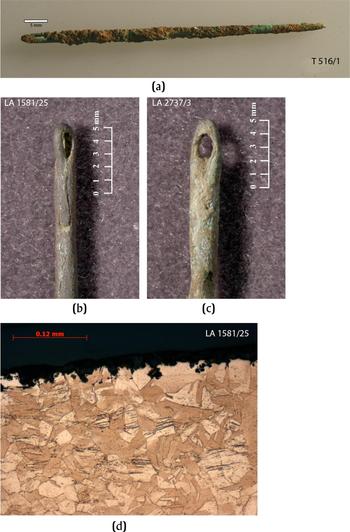
Unlike lacetags and woodworking tools, needles and pins are present at both sites (Figure 8). A total of 17 needles and one needle fragment have been recovered at Tipu, while excavations at Lamanai have produced ten needles. The needles are thin, solid rods terminating in a loop that forms an eye. Both the perforated-eye type and the loop-eye type have been found at Lamanai; both loop-eye subtypes—the tucked and the flap—have been detected. All nine needles with visible eyes from Tipu are of the loop eye type and all appear to be of the tucked subtype. Hosler (Reference Hosler1994:77, Reference Hosler2009) associates the perforated eye with period I of metallurgy in west Mexico (a.d. 600–1200/1300) and the loop eye with period II (a.d. 1200/1300–1521). The tapering thickness of the needles may have permitted more fluidity in their handling. The two bell-headed pins from Burial N10-4/29 at Lamanai are composed of small, plain globular bells of Type 1A1a-i attached to relatively short pins, with a small, cup-like element attaching the bell and the shaft of the pin. The small amount of cloth found adhering to these pins suggests that they were used as clothing fasteners (Pendergast Reference Pendergast1981:47). To our knowledge, no other examples of this particular form have been recovered in the Maya area (see also Bray Reference Bray and Hammond1977:385). The pin form at Tipu is similar to that of the needles, but more abruptly tapering and a wider, more spherical end; only one highly corroded complete example was studied but three others (one complete, two fragmented) are reported in excavation notes.
(a) Needle T 516/1 from Tipu of the loop eye, tucked type. Photograph by Cockrell, courtesy of UCL Wolfson Archaeological Science Laboratories. (b) Needle LA 1581/25 from Lamanai of the loop eye, flap type. (c) Needle LA 2737/3 from Lamanai of the perforated eye type. Photographs by Dan Kushel. (d) The microstructure of LA 1581/25, revealing small, equiaxed grains with working lines and distorted annealing twins. Photograph by Aaron Shugar.

The needles and pins from Tipu and Lamanai were made by hammering, and analysis of a tip of a Lamanai needle (LA 1581/25) shows, in fact, extensive working (Figure 8:13). A loop, on the other hand, was left in an annealed state. Each object appears to have been fabricated from one strip or rod of metal. One of the needles from Tipu shows cotton fibers attached to the eye, suggesting that the needle was actually used for threading. In some of the Tipu burials, legs were tightly packed, as if the body had been wrapped in a shroud that had been potentially threaded by a needle. All of the needles and pins from Tipu emerged from burial contexts. The needles consist of brass (n = 5) or copper with trace-minor concentrations of lead (n = 4) (Table 2). At Lamanai, six of the ten needles found came from Structure N11-18, the possible domicile of Lamanai's Spanish Colonial period Maya authority or cacique (Pendergast Reference Pendergast1981). Only one needle from Lamanai came from the first Spanish church, Structure N12-11, where it was may have been used to fasten a burial shroud.
Fishhooks
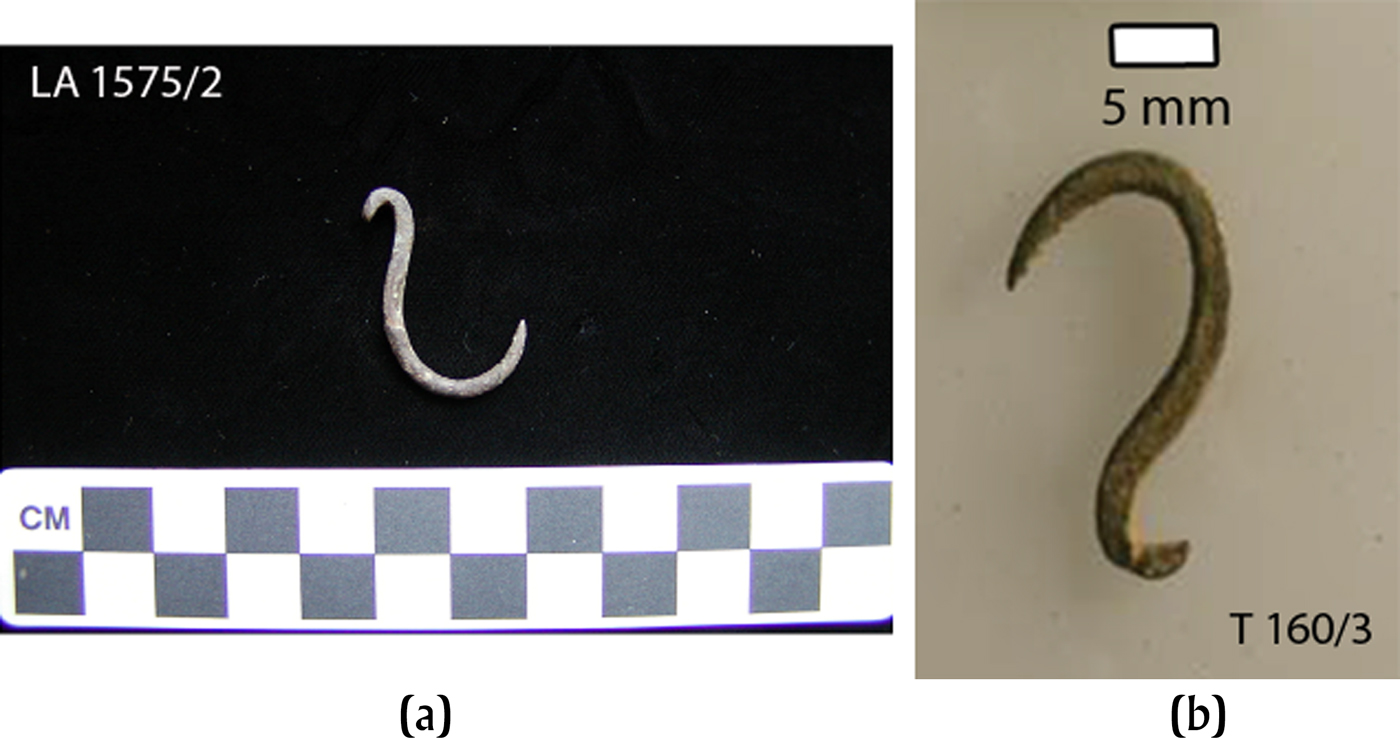
Given the locations of both southern lowland sites along prominent watercourses, it is not surprising that fishhooks have also been recovered, albeit thus far in modest numbers, at both Lamanai (n = 5) and Tipu (n = 2) (Figure 9). Like the needles, these objects have solid, round shanks that were bent into roughly a J-shape. Suspension loops were partially open, characteristic of Type IXA2. Fishhooks have been found at west Mexican archaeological sites, though usually only one at each site, and appear in the RMG collection studied by Hosler (Reference Hosler1994:82–3), who proposes that to achieve the hooks' curved shapes, smiths hammered and annealed cast metal blanks. All but one of the five fishhooks from Lamanai came from midden deposits, while the fifth was found in the core of a structure that likely represents re-deposited fill material. One of the fishhooks from midden deposits at Lamanai is a low-arsenic (approximately 2 wt%) copper-arsenic alloy with traces of tin, iron, and silver (Table 2; Shugar Reference Shugar2007:23). This composition raises the possibility that recycled metal was used for its fabrication, although its tin content is not as high as that of other copper-arsenic objects from Lamanai. This fishhook was extensively worked and annealed. Both fishhooks from Tipu are nearly pure copper, and both were surface finds, one from a primary midden. In terms of thickness, diameter, and mass, one fishhook is approximately twice the size of the other.
(a) Fishhook LA 1575/2 from Lamanai, photograph by Simmons. (b) Fishhook T 160/3 from Tipu, photograph by Cockrell, courtesy of UCL Wolfson Archaeological Science Laboratories.

PRODUCTION MATERIALS
While there is compelling evidence that Maya craft specialists were engaged in metallurgy in certain areas of both the highlands and northern lowlands (Paris Reference Paris2008, Reference Paris, Lope, Shugar and Simmons2013; Shugar and Simmons Reference Shugar and Simmons2013a; Urban et al. Reference Urban, Shugar, Richardson, Schortman, Shugar and Simmons2013; Weeks Reference Weeks, Wallace and Carmack1977, Reference Weeks, Shugar and Simmons2013), evidence for on-site metallurgy in the southern Maya lowland area thus far comes only from the site of Lamanai. Several types of production materials and debris have been recovered in the Spanish Church Zone (Simmons Reference Simmons1999, Reference Simmons2004, Reference Simmons2005, Reference Simmons2006; Simmons et al. Reference Simmons, Pendergast and Graham2009). Those objects clearly related to production activities include ingots/pigs, prills, a blank, and casting reservoirs. Taken together, these comprise over 8.5 percent of the assemblage of copper artifacts from Lamanai. Based on contextual evidence as well as the results of chemical compositional analyses (see below), however, it is reasonable to conclude that bell fragments (n = 27) along with flattened/distorted bells (n = 31), axe fragments (n = 11), and sheet pieces (n = 12) were also intended for use in casting activities by Lamanai's metalsmiths. If these objects are included as raw materials for casting, then production materials make up 52 percent of the assemblage of copper objects from Lamanai. Summary descriptions of these materials are presented below.
Ingots or Pigs
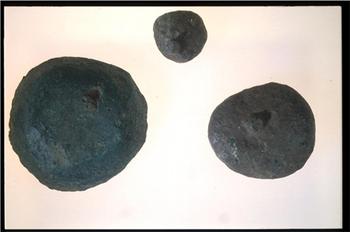
Four masses of copper have been recovered in the Spanish Church Zone at Lamanai. These cannot easily be classified as ingots, nor are they pigs in the strictest sense, referring to a product of iron smelting (Rostoker and Bronson Reference Rostoker and Bronson1990:102). These are solid masses of metal, shaped like shallow cups with a rounded “bottom” and a flat “top,” each with a remnant casting sprue (Figure 10). The smallest of the four weighs 5.8 g while largest weighs 275.5 g. In terms of their length and width measurements, the smallest measures 1.15 × 1.3 cm while the largest is 6.3 × 6.5 cm in size.
Three copper ingots, LA 858/1, LA 894/1, and LA 908/1, from Lamanai. Photograph by David Pendergast.

Casting Reservoirs
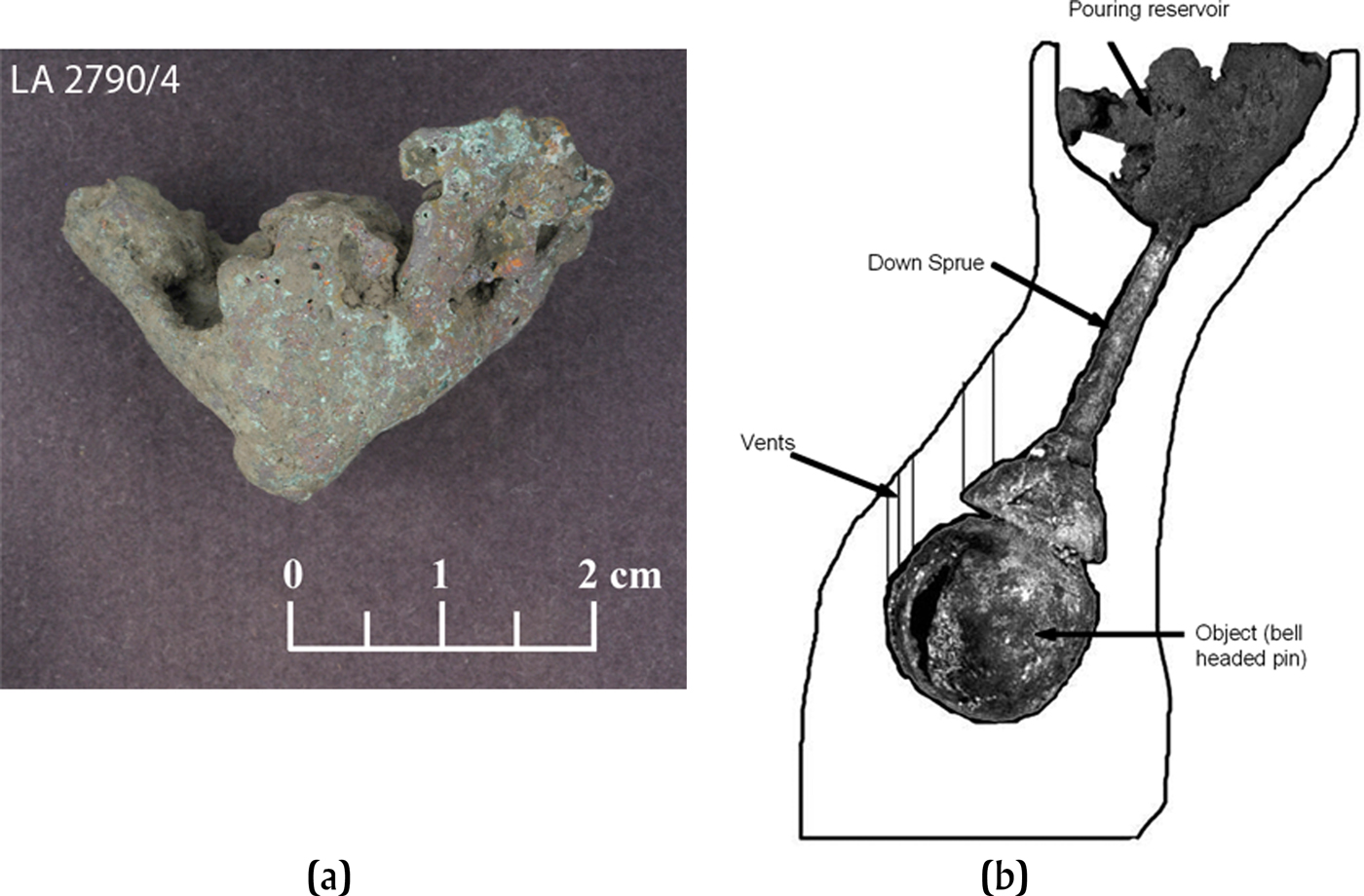
Two artifacts were initially interpreted as ingots based on the characteristics of previously recovered artifacts of similar size and shape found at Lamanai (Figure 11). It was assumed that these objects were produced as ingots to be re-melted and cast as new objects. Optical microscopy suggests that these objects are more likely “pouring or casting reservoirs” (Shugar Reference Shugar2008:13). They are parts of lost wax casting molds that served as funnels into which molten copper was poured. Once the mold of the cavity is filled, the reservoir acts as a receptacle for excess metal (Long Reference Long1964:Figure 1). After the metal has cooled sufficiently both the reservoir and the sprue (the tube leading from the cast object to the reservoir) are detached and may be remelted for later casting. While both casting reservoirs are roughly cone-shaped, the smaller of the two weighs 21.4 g, while the larger weighs 86.1 g. No other metal artifacts of this type have been reported in the Maya area, a situation that inhibits the possibility of making comparative assessments of these unique artifacts. The extensive presence of copper oxide inclusions in the reservoirs befits an open, oxygen-rich casting environment. Annealing twins detected near edges may have arisen from efforts to separate the reservoir from the sprue. One reservoir is nearly pure copper while the other has minor (1–3 wt%) concentrations of arsenic and tin (Table 2). These casting reservoirs were recovered in a lagoon-side midden east of the Spanish churches at Lamanai, in direct association with five axe fragments that fit together to form two complete copper axes (Simmons Reference Simmons2006:39). Given that Lamanai's metalsmiths were remelting metals at the site, it is possible that these casting reservoirs and axes fragments were destined for recycling.
(a) Casting reservoir, LA 2790/4, from Lamanai, photograph by Dan Kushel; and (b) a proposed illustration of its use to cast a bell-headed pin, drawing by Aaron Shugar.

Prills
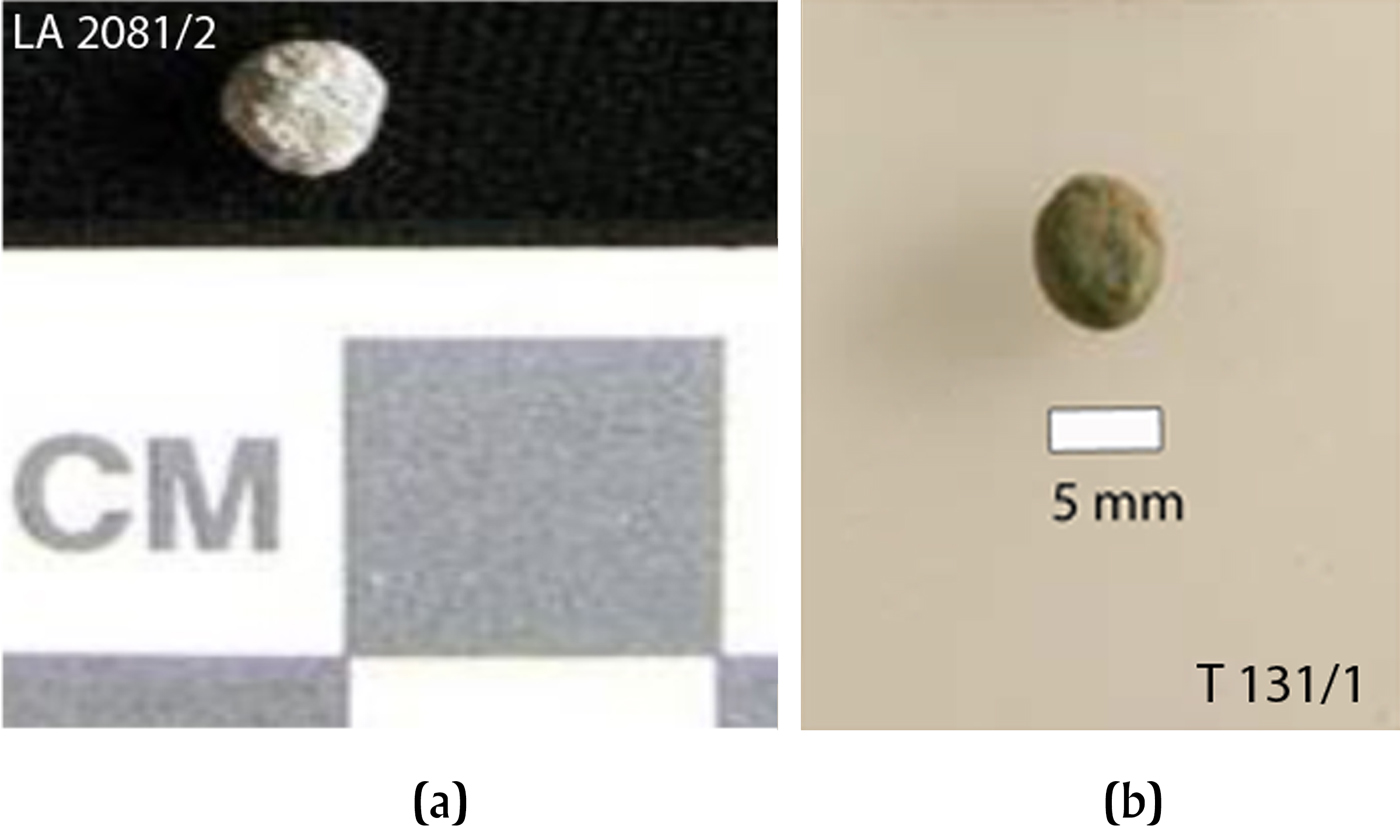
Prills are small, round pellets of copper that can form during either the smelting process or the casting process (Shugar Reference Shugar2005). During casting, molten metal pellets may bounce away from open molds and cool rapidly while traveling through the air. This action causes the metal to form into roughly spherical pellets called prills, which typically fall to the ground and are found surrounding the metal casting area. Alternatively, if there is any wax remaining in the mold a violent reaction can occur, causing the molten metal to spurt out of the mold's pouring reservoir. This can also result in the creation of prills, which, likewise, can be recovered archaeologically around the casting area. Nine prills have been found thus far in the Spanish Church Zone at Lamanai (Figure 12); nearly all of these were found in the core of a small Spanish Colonial period structure, N11-27, located immediately north of Structure N11-18, possibly the cacique's house (Simmons Reference Simmons2005). The prills range from approximately 2 to 5 millimeters in diameter. Those that are larger in size were ideal for use as bell clappers. Lamanai prills tend to show the microstructure associated with fast cooling of molten metal. One “prill,” however, displayed traces of extensive working, suggesting it was shaped to make a bell clapper. The prills consist of copper with traces of arsenic, tin, and silver, which raises the potential that metal was recycled (Table 2). One possible prill has been recovered from Tipu amidst collapse; its composition—copper with minor tin (1 wt%)—is less diverse than that of the analyzed prill from Lamanai.
Prills (a) LA 2081/2 from Lamanai, photograph by Simmons; and (b) T 131/1 from Tipu, photograph by Cockrell, courtesy of UCL Wolfson Archaeological Science Laboratories.

Blank
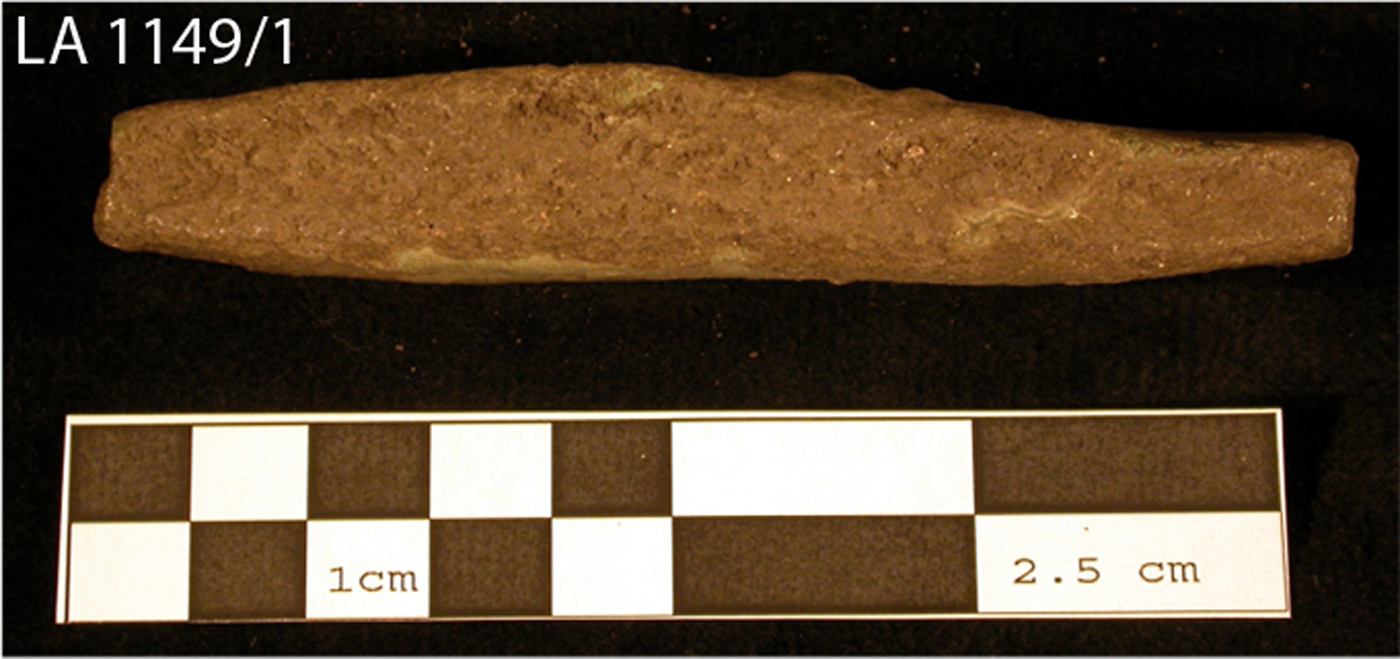
A blocky, rectangular copper object weighing just over 400 grams was recovered in the Spanish Church Zone at Lamanai during the first year of the Maya Archaeometallurgy Project (Figure 13; Simmons Reference Simmons1999). It has been interpreted as a blank from which a large object, such as an axe or chisel, could have been fashioned by cold working (Shugar Reference Shugar2005). It consists of copper with minor trace concentrations of arsenic, tin, and silver (Table 2). Nothing comparable to this type of copper object has been reported elsewhere in the Maya lowland area to date.
LA 1149/1 from Lamanai. This blocky, rectangular mass of copper may have served as a blank from which other objects could be fabricated. Photograph by Aaron Shugar.

Other Copper Objects
Twelve pieces of sheet copper have been recovered in pre-Hispanic contexts at Lamanai. Many more were found in nineteenth century British Colonial contexts (Simmons Reference Simmons1999). Only one piece of sheet copper has been found at Tipu. Those from Lamanai vary in size, but most are relatively small (less than 5 cm in both length and width). All were plain or undecorated. In addition, at Lamanai, two pin tips and two pin heads have been found, along with a metal fragment interpreted as a tinkler by Pendergast (Reference Pendergast1962) as well as very small fragments of copper Pendergast described as possible necklace fragments. Analyzed Lamanai sheet objects show traces of working and annealing. One is a copper-arsenic alloy; others are pure copper with traces of arsenic, tin, and/or silver, and one of these shows a particularly complex composition with concentrated areas of arsenic, tin, and lead (Table 2).
A variety of metal fragments (e.g., tubing, bands, and bars) whose form is uncertain have been recovered from Tipu. Many are relatively flat and could have been attached to materials that did not preserve. These objects were recovered from a variety of contexts: burials, middens, and surface finds. Their compositions are largely comparable to the other Tipu metals, some brass (e.g., object T870/2 and tubes T250/1 and T695), some nearly pure copper (band T45/2 and object T635/1), and some copper with additions such as tin (bar T778/1); one unusual case (band T41/8) contains copper with minor concentrations of zinc, tin, and a significant lead content, exacerbated in corrosion. Those that were analyzed show traces of working with variety in whether they were left in the worked or annealed state.
DISCUSSION
The people at Lamanai and Tipu clearly had access to metal objects from afar, but they appear at Lamanai somewhat earlier than they do at Tipu. In the case of Lamanai, metals appear as early as the Early Postclassic period, by roughly a.d. 1100, but at Tipu it is not until the middle of the sixteenth century that they begin arriving at the site. The most notable difference between the metal assemblages is the distinct evidence of metallurgical practice at Lamanai and the absence of such clear evidence at Tipu. At Lamanai, this evidence consists of casting reservoirs, ingots, prills, and a large blank, possibly for an axe. In addition, the artifact chemistries strongly suggest that imported metal objects were co-melted and recast (Hosler Reference Hosler1994; Shugar Reference Shugar2008; Simmons and Shugar Reference Simmons, Shugar, Shugar and Simmons2013c). At Tipu, any materials related to metallurgical practice are less conspicuous, but a possible prill was identified.
At both sites there are misshapen or fragmented forms—particularly bells—as well as ambiguous forms (e.g., sheet, tubing, and bands) that may represent an intermediate stage in metallurgical activities; the materials may have been prepared for re-melting and re-forming. Alternatively, they may stand on their own as examples of metallurgical experimentation and, again, some likely were destined for re-fabrication. Nevertheless, the role of natural processes of corrosion and deterioration and our inability to pinpoint the form of a material should not be underestimated.
The features with which metals are associated at both sites are relatively similar. More metals found at Lamanai were in association with high-status burials in Early Postclassic times and later in middens by the Late Postclassic period, with considerably fewer originating from caches or architectural contexts (Simmons et al. Reference Simmons, Pendergast and Graham2009). At Tipu, metal objects have been recovered mainly from the Spanish church cemetery in which Maya individuals were buried and, thus, come from Spanish Colonial period contexts (Cockrell et al. Reference Cockrell, Martinón-Torres and Graham2013). Five came from middens and eight from surface contexts.
The chronological contexts of the metals at the two sites display some important differences as well. At Lamanai, all metals come from contexts in which Buk, Cib, and Yglesias phase ceramics are found. Refinement of the ceramic chronology at Lamanai is ongoing; it appears now, however, that the Buk ceramic phase at Lamanai began ca. a.d. 950/1000 and lasted until roughly a.d. 1200/1250, when Cib ceramics began to dominate (Graham Reference Graham, Rice and Sharer1987, Reference Graham2004; Graham et al. 2103). Cib phase ceramics were produced at Lamanai until a.d. 1350, after which time Yglesias phase ceramics made their appearance (Graham Reference Graham2004).
On the other hand, while occupation of Tipu dates as early as 300 b.c., the majority of architectural evidence comes from the Postclassic and Colonial settlement of the site. A cemetery of over 600 Maya burials surrounds the Colonial church on its north, west, and south sides. Stylistic dating of pottery and glass beads recovered from the burials situates the cemetery between the mid-to-later half of the sixteenth century through the early seventeenth century (Graham and Bennett Reference Graham and Bennett1989; Smith et al. Reference Smith, Graham and Pendergast1994:30). The majority of metal objects from funerary contexts at Tipu were recovered from separate burials. Yet, on occasion, several metals are found in the same burial (e.g., a needle and two rings in the burial of a 30–40 year-old female; three bells and two rings in the burial of a four to seven year-old). The occupants of these particular burials may have enjoyed relatively greater access to metal during their lives than did their peers. The overall wide dispersion of metal among the burial population, however, suggests a substantial circulation of the material within the site.
In short, metals appear at Lamanai as many as four to perhaps nearly five centuries before they do at Tipu. Lead isotope analyses suggest that metals continued to be imported to Lamanai from west Mexican and other sources as late as the early part of the Cib ceramic phase (Hosler Reference Hosler1994). All of the most distinct evidence of metallurgical practice at Lamanai—casting reservoirs, ingots, prills, and the blank—comes from the Yglesias ceramic phase (except for one ingot from an unknown context). Thus, before a.d. 1350, metals at Lamanai were imports, while some time after a.d. 1350 metals began to be produced at the site. Indeed, considering all metal forms, fully three-quarters of the copper artifacts found at Lamanai—143 of the 187 or 76.5 percent of the assemblage—comes from Yglesias phase deposits. The production of these Yglesias ceramics may, in fact, cover a narrower temporal frame: they were made especially during the Spanish Colonial period but began to be produced earlier. Their introduction could have taken place around a.d. 1500–1510, when the European presence was first felt in the circum-Caribbean region, but it is also possible that their manufacture began as early as a.d. 1350 (Graham Reference Graham2004). Thus, if the association of the metals with Yglesias ceramics is prioritized, the metal objects produced at the site may date from some time before Spanish contact to the early seventeenth century.
At both sites, metals were found in association with European materials. The European materials, however, are not necessarily indicators of the exact time of manufacture of the metal objects. At Lamanai, metals were found with glass beads and Spanish majolica and olive jar sherds in several contexts (Pendergast Reference Pendergast, Chase and Rice1985; Simmons Reference Simmons2004, Reference Simmons2005). At Tipu, besides general associations with glass beads and majolica, metals were found in direct association with European materials: one ring was attached to a Spanish jet bead as part of a necklace of over 140 glass beads, found inside a juvenile's skull, and likely dating to after a.d. 1575 (Lambert et al. Reference Lambert, Graham, Smith and Frye1994:57–58). In a double juvenile burial, three bells were associated with glass beads, one of which was threaded through the suspension loop of a bell, dating the burials to before a.d. 1575.
Thus, there is a clear proliferation of metal and potentially metallurgical activity between Lamanai and Tipu beginning in the sixteenth century. The exact relationship of this surge in metal at the sites and the arrival of Spanish colonists demands special scrutiny. To what extent did these metal finds emerge from metallurgical practices already in place in Mesoamerica, including west Mexico, a source of metal for Lamanai in the Buk and Cib ceramic phases? Were the “itinerant metalsmiths” identified by Bray (Reference Bray and Hammond1977:397) part of the social exchange relationships that were established between Mesoamerican communities? To what degree did Spanish colonization influence these metal assemblages and metallurgical activities?
Metallurgical activities appear to have begun at Lamanai before the Spanish incursion and so our search for answers about the origins of this metallurgical knowledge must begin within Mesoamerica. The importation of metal objects from west Mexico to Lamanai as early as a.d. 1100 could have inspired later metallurgical practice and experimentation. Connections between Yucatan and the southern Peten are well-documented in the Colonial period (Jones Reference Jones1989), when peoples from Yucatan sought refuge to the south in order to distance themselves from Spanish strongholds. This could have inspired additional practitioners, armed with the knowledge of metallurgists working in Mayapan, whose occupation spans from ca. a.d. 1000 to 1450 (Paris Reference Paris2008; Meanwell et al. Reference Meanwell, Paris, Alvarado and Lope2013). Scholes and Thompson (Reference Scholes, Thompson and Jones1977) documented 77 surnames of residents of Tipu in a 1655 census among 92 surnames within Yucatan.
Other connections emerged between the two regions. Maya persons appointed to Spanish Colonial administrative positions in the area of Belize made annual visits to Yucatan to confirm the appointments (Graham Reference Graham2011:194). Spanish friars visited Belize to serve as a launchpad for their conquest of the Itza people around Lake Peten Itza (Jacobi Reference Jacobi2000:19–21). Friars Fuensalida and de Orbita carried an arsenal of items—including needles, glass beads, crosses, and rosaries—when they traveled to Tipu and Tayasal, the Itza capital (Graham Reference Graham and Thomas1991:327). In particular, Smith et al. (Reference Smith, Graham and Pendergast1994:43) argue that catechizing friars used glass beads as gifts to the Tipu community. Indeed, Tipu also maintained links to the Kowoj Maya, similarly involved in anti-Spanish resistance, and architecture and ceramics show some resemblances to those of Kowoj sites, like Topoxte and Zacpeten, where indigenous and European metals have been found; furthermore, Kowoj Maya lived at Tipu at certain points in the Spanish Colonial period (Pugh Reference Pugh2009:377).
Lacking substantial connections before the Colonial period, Lamanai and Tipu came to be linked as centers for the Spanish practice of reducción, concentrating populations of indigenous peoples in particular sites in order to make Spanish evangelization efforts more efficient (Graham Reference Graham2011:192, 198–199). Tipu was a special focus for the Spanish, as it occupied a position between already Christianized (eastern Belize) and non-Christianized (southern Peten) areas (Graham Reference Graham2011:202–203).
Even recognizing the links of the region of Lamanai and Tipu with metal-producing areas of Mesoamerica, including west Mexico and Yucatan, we must examine exactly how raw material was acquired for metallurgical activities at Lamanai. The fact that the casting reservoirs recovered from Lamanai display the same compositions (pure copper and copper with minor concentrations of arsenic and tin) as some finished objects excavated at the site suggests that the reservoirs represent metal that was in the process of being channeled into the space once occupied by a wax model. Perhaps too much molten metal was poured and it filled a receptacle (none was recovered with the reservoir), eventually solidifying. Only at Tipu is there a striking diversity in bulk metal composition with, in addition to copper, arsenic, and tin, high-silver alloys with copper and brass (copper-zinc). Does this enhanced compositional diversity correlate with a lack of undetected on-site production, indicating that Tipu served as a collection point for metal objects from various metal-producing communities? While available evidence suggests that Lamanai residents may have engaged in more metallurgical activity than residents of Tipu, the former did not fabricate bells, rings, and ornaments in a vacuum—the fact that ingots and an axe blank are present at Lamanai and that their compositions are traditional alloys suggests that Lamanai received intermediate materials from another place, where alloying occurred.
Furthermore, the sources of the starting materials are likely non-local. Copper anomalies have been identified in southern Belize, particularly in the Toledo District, but not in quantities sufficient for exploitation and with no indication of ancient operations (Graham Reference Graham, Rice and Sharer1987:758). The same caveats apply to the copper anomalies detected in Guatemala, where, in fact, there are significant quantities of silver and less of zinc (Anonymous 1919:632–3). Lamanai must have depended on other sites engaged in primary metallurgical activities to provide starting materials. While connections to Yucatan may have facilitated the transmission of metallurgical knowledge, metallurgists in Yucatan, faced with a lack of local metal-bearing minerals, would not have been able to send starting material (outside of intermediate or finished objects) to Lamanai. Another source of material for Lamanai may have been prior occupations of the site itself: the paucity of metals from earlier phases actually may owe to practices of recycling metal in the Yglesias phase to produce new materials (Simmons et al. Reference Simmons, Pendergast and Graham2009).
Metals and metallurgical knowledge circulated both before and after the arrival of Spanish colonists as part of a wider circum-Caribbean trade network. Some of this material movement constituted tribute payments, an indigenous practice that the Spanish advanced with priorities on different materials (Graham Reference Graham2011:197). In particular, cacao cultivation flourished around Tipu and this resource heightened Spanish interest in the southern Peten. Still, this area was far less penetrable for the colonists than the scrub forests of Yucatan. From the Maya rebellion in 1638 until 1695, the Spanish were not present from the area south of the Río Hondo, which Jacobi (Reference Jacobi2000:8, 24) describes as a “fringe area” and a “refuge for discontented Maya.” How did Maya peoples in this area negotiate between an experience of relative physical distance from the nexus of Spanish control in Yucatan and, farther south at Bacalar, one in which colonial influence was still endured vis-à-vis the visits of friars?
This negotiation most certainly happened at a material level and was not only writ large, such as through the incorporation of churches into the architectural landscapes of Lamanai and Tipu. In fact, negotiations took place at the level of individual objects. For instance, some of the loop eye needles, a form evident in the metallurgical practices of west Mexico, recovered from Tipu were fabricated with brass, a metal composition that was not produced in Mesoamerica until after Spanish colonization. Needles made of brass would appear different from needles made of nearly pure copper—the former would be more yellow, the latter more pink in color: the contexts in which the metals arrived at the sites were thus manifested and preserved in their surface colors. The negotiation was more direct in other cases: bells, likely of manufacture in Mesoamerica, were attached to glass beads of Spanish origin. This approach to materials—recycling and juxtaposition—is evident in the presence of metallurgical “equipment” and by-products of production at Lamanai. While not as direct as the evidence at Mayapan of clusters of bells fused together within crucibles, the flattened bells at Lamanai may index the preparation of metals to be packed into vessels and then melted. The ingots and the blank certainly suggest that Lamanai metallurgists were familiar with the “intermediate” products of their technology: the flattened bells may have been en route to ingot or blank form. In this way, another technological property outside of sound and color that Maya individuals may have esteemed among metals, and particularly bells, was their ability to be transformed and recycled. This aspect was vital to the casting process, as metal needed to flow in a molten state to fill up the space required to form the object before solidifying again. At the same time, much like the wax integral to this process that could be melted and re-shaped, the metal could be recycled to promote experimentation and creativity in object fabrication. The recovery of flattened bells from Lamanai and crucibles containing bells from Mayapan illustrate this creative process.
Recycling and juxtaposition also are indexed through compositional data. Unfortunately, there is no established baseline composition that indexes recycled metal (Ronald Gronsky, personal communication 2015). Nevertheless, we propose that the presence of multiple elements besides copper in significant trace or even minor concentrations indicates that metals of slightly different compositions were melted together and re-cast into new objects. Such signatures are evident in 14 objects (six cast, six hammered, two metallurgical by-products) from Lamanai and seven objects (five cast, one hammered, one by-product) from Tipu. It is possible the certain minor and trace elements may be impurities in the copper source. Others may spring from the vessel(s) used for melting and casting, which themselves are likely re-used and contain residues of prior metallurgical operations in their walls. The elements of interest in the Lamanai and Tipu objects tend to be As, Ag, Sn, Pb and, occasionally, Ni, Zn, Sb, Au, and/or Bi. It seems reasonable to conclude that the detection of at least three of the aforementioned eight elements in trace or minor concentrations was suggestive of recycling. Given the limitations of the analytical techniques employed, however, caution is required. Six of the seven Tipu “recyclings” were identified with ED-XRF, which does not discriminate between superficial and bulk compositions, thereby raising the potential for overestimation of “recyclings.” The other Tipu “recycling” was identified through EPMA-WDS but such a diverse composition was not detected when the object was studied with EPMA-EDS, thereby suggesting there may be other “recyclings” that went undetected.
The presence of these diverse compositions within the two assemblages suggests, ignoring the potential that these elements arrived with the copper source, that: 1) metallurgists were melting together different metal objects and casting blanks that themselves would be later hammered and/or cast into new forms; and, 2) they were re-using metallurgical vessels whose residues of prior operations contributed to the compositions of new objects. Two objects at Tipu reveal particularly large concentrations of elements whose co-occurrence in artifacts is relatively rare. Their presence suggests that products of metallurgical experimentation circulated outside of places with clear evidence of metallurgical activity. The striking co-occurrence of arsenic, silver, and gold in the aforementioned turtle-shaped ornament suggests that a copper-arsenic metal, whose actual arsenic content was likely lower than the 1.3 wt% detected by ED-XRF (an analysis influenced by surface patinas), may have been co-melted with a tumbaga (copper-silver-gold) metal. An aforementioned band contains significant concentrations of zinc, arsenic, tin, antimony, and lead, thereby implying the co-melting of brass with non-brass copper alloys. Indeed, metals from starkly different sources were brought into new relationships as bodily ornaments in a single cemetery. This grouping bears some similarity to the association of bronze, gold, and iron in the central cache of the Group A temple at Zacpeten (Pugh Reference Pugh2009:380). Though Pugh writes that, here, “European and indigenous metals were treated similarly even in ‘death,’” our identification of archaeological association—yielding this inference of similarity—should not erase a recognition of the fact that the people wearing and depositing these objects were acutely aware of different historical trajectories of both the objects and associated production technologies.
CONCLUSION
Sometime in the Early Postclassic period at Lamanai, metal ornaments of alloyed copper, as well as pieces of sheet gold, began arriving at the lagoon-side community. High-status individuals in two important structures were interred with a variety of objects that originated in west Mexico, the first center of metallurgy in ancient Mesoamerica. By Late Postclassic times, Lamanai's metallurgists were melting or co-melting pre-fabricated ingots and/or other forms of different compositions (whether imported or made locally) to create new objects. They also hammered and annealed pre-fabricated blanks into new forms, a number of which were utilitarian (e.g., axes) rather than ornamental, as in earlier times. Bells and axes, among other items, were clearly being recycled by Lamanai's metalsmiths. The large Spanish Colonial period midden located some 60 meters east of the site's second church on the shore of the lagoon yielded six axe fragments as well as the two casting reservoirs. Surely these had, at one time, been destined for re-casting but were discarded probably sometime after metalworking was no longer practiced in the community. The presence of copper prills roughly 300 meters north of the Spanish churches near Structure N11-18 supports the idea that metalworking may have taken place in these, and possibly other locales, at the site.
At Tipu, there is no evidence of metallurgical activity besides one possible prill, but the Maya community did receive finished metals from varied sources, both Mesoamerican and European. At Tipu, more so than at Lamanai, form did not always correlate one-to-one with composition: one band may have a wildly heterogeneous composition and another may be nearly pure copper; one needle may be brass and another copper with a small concentration of lead. Other forms did correlate one-to-one with compositions: lacetags were consistently brass and rings were all silver-copper alloys, except one, which was brass. This pattern indicates that Tipu may have been obtaining its finished metals from various sources while Lamanai exerted greater control over the compositions of finished objects fabricated on-site. The Maya community at Lamanai did experiment with compositions, at least among elements at trace concentrations, but their interest appears to have been mainly in high-copper objects. The presence of brass at Tipu reinforces the particularly important role that the mission town played as a staging point from which Spanish friars prepared to convert the more inland Maya population around Lake Peten Itza.
The reconciliation of Mesoamerican and Spanish materials and technologies at Tipu compels us to consider a more nuanced view of initial characterizations of the area south of the Río Hondo as “refuge” for indigenous peoples from colonial control. Yet, it is partially through metallurgy that Maya peoples in the southern lowlands responded to Spanish colonial aggression. They did not necessarily accept the brass in whatever shape it arrived to them but re-fashioned it into familiar forms (i.e., needles). Well into the Spanish Colonial period, Maya peoples at Lamanai continued to experiment with metallurgical technologies that had long been established in west Mexico and later had taken a foothold in Yucatan. The Maya populations did not completely reject pre-fabricated materials—whether from European or Mesoamerican sources—but incorporated them into new objects, occasionally leaving little to no visible superficial trace of the source materials. Though no distinct crucibles have been recovered from either site, the two places and the space between them was itself a crucible of sorts for the reconfiguration of different technologies and, moreover, of the relationships among southern lowland Maya communities who consciously and subconsciously formulated active material responses to the incursions of Spanish colonists. The recycling and re-contextualization of European metals, as well as glass and jet, was embedded in the practice of recycling and combining Mesoamerican-made metals to fabricate new objects.
RESUMEN
Esta investigación se centra en las dos colecciones más grandes de metales entre las Tierras Bajas Mayas del Sur, de los sitios de Lamanai (n = 187) y Tipu (n = 99). A través de una descripción y comparación de los tipos de piezas metálicas, sus contextos y sus métodos de fabricación, se determinó que la confluencia de tecnologías mesoamericanas y europeas puede ser descrita como un proceso de negociación. Este proceso se llevó al cabo por medio del reciclaje de materiales para producir unas formas nuevas y la yuxtaposición de materiales de procedencias diferentes para el adorno del cuerpo. La comunidad maya de Lamanai adquirió el metal a partir de 1100 d.C. y después empezó a practicar la metalurgia a partir de 1450 d.C. hasta el empiezo del siglo XVII. El sitio de Tipu sirvió como un punto de colección de metal entre el siglo XVI tarde y el siglo XVII temprano. En los dos sitios, la mayoría de los metales se recuperó en los entierros humanos. Se compararon los tipos de las piezas con las tipologías existentes, se estudiaron las piezas con la microscopía óptica y se determinaron sus composiciones a través de varios métodos (fluorescencia de rayos X por energía dispersiva, microscopía electrónica de barrido por energía dispersivo y microsonda electrónica por energía dispersiva y longitud de onda dispersiva). Con respecto a los tipos, la evidencia de metalurgia de derretir y vaciar está presente en Lamanai, por medio de cascabeles aplanados, embalses para vaciar, gotas de metal y lingotes, pero no en Tipu. Sin embargo, hay unas formas compartidas entre los dos sitios, por ejemplo, agujas, anillos, anzuelos y cascabeles. Los contextos arqueológicos indicaron que los metales se diseñaron para adornar—tienen unos huecos para suspensión o unas correas—y que ellos adornaron el cuerpo—fueron asociados directamente con los restos humanos y tienen vestigios de algodón de la ropa funeraria. Sobre la tecnología, había unas piezas que fueron vaciadas por el método de cera perdida y otras que fueron martilladas (y en unos casos, una combinación de vaciar y después martillar). La diversidad composicional es más obvia en Tipu (donde se encontraron unas piezas de casi puro cobre y también bronce, latón y plata-cobre); esta diferencia podría estar relacionada a los papeles diferentes de los dos sitios: Tipu, un punto de colección de metales, y Lamanai, un sitio donde se practicó la metalurgia. Aún con respecto a una forma, como agujas o anillos, hay unas diferencias pronunciadas composicionales en las piezas dentro de un sitio o entre los dos. Con menos frecuencia—pero también entre agujas y anillos—hay variedad de el método de fabricación entre una forma particular. En unos casos (14 de Lamanai y siete de Tipu), hay evidencia composicional—a través de la presencia de una gama de oligoelementos, como arsénico, plata, estaño y plomo—del reciclaje de metales para fabricar unas formas nuevas. Además, ocasionalmente se emplearon unos metales europeos, como latón, para producir unas formas—como agujas—mesoamericanas. También, unos metales se yuxtapusieron directamente a unos materiales europeos como cuentas de vidrio y azabache. Por eso, los estudios de los metales revelaron que no se aceptó o se rechazó fácilmente la colonización llevado por los españoles y que hay que revisar la caracterización de las Tierras Bajas Mayas del Sur como un lugar de ‘refugio’ para las comunidades mayas.
ACKNOWLEDGMENT
We offer our sincere thanks to Elizabeth Graham, David Pendergast, Marcos Martinón-Torres, Aaron Shugar, and Ronald Gronsky for their guidance throughout the research and in the preparation of this paper; Michael Wayman for providing access to the Tipu metals; Thilo Rehren and John Merkel for their help in the analysis of the Tipu metals; Simon Groom, Kevin Reeves, and Philip Connolly for their support in the UCL laboratories; and Juan Antonio Murro for reviewing the Spanish summary. Special thanks go to the people of both Indian Church and San Carlos for their kindness and support of research on Lamanai's ancient past.