

Introduction
Against the background of the Brazilian gold cycle, the House of Torres amassed the largest fortune in Portugal through its successful involvement in colonial and metropolitan tax farming. From 1730 to 1750, its founder, Estêvão Martins Torres, participated in as many as seventy-six tax farming contracts, of which forty-five comprised both fiscal and monopolistic rents provided by Brazil and Angola. By concentrating his business activities in tax farming, Estêvão Martins was able to accumulate a fortune estimated by the time of his death in the mid-eighteenth century to stand at a level similar to those of London's prince-merchants. Within just a few years, however, and despite his successors’ efforts to continue the line of business Estêvão Martins initiated, the House of Widow Torres & Sons shifted the core of the business activities to supplying credit. Losing momentum, while also under pressure both from creditors and co-heirs to divide the assets, the family business then slowly declined and was ultimately put under judicial administration in 1773, thus bringing to an end the once-wealthiest business house in Portugal.
Although unequivocally standing out among his peers, Estêvão Martins Torres embodied the key role that the elite of Lisbon businessmen played in exploiting and appropriating wealth generated by the Portuguese Atlantic empire at a juncture marked by the Brazilian mining cycle. Since Douglass North's work on institutions, scholars have highlighted the importance of institutional arrangements between the state and the economic elites in the exploitation of empires and the implications of these arrangements for how wealth was ultimately redistributed.Footnote 2 Within this framework, and under diverse mercantilist policies, early modern European states imposed barriers to guarantee the exclusivity of the exchanges with their colonial offshoots, whose exploitation could subsequently be granted either to chartered companies (as in the case of England, the Dutch Republic, and France), merchants’ guilds (in Spain's case), or the community of vassals (in the case of Portugal). An ample body of studies has highlighted how these institutional arrangements enabled metropolitan interest groups and businessmen across time and space to draw significant profits from the respective empires.Footnote 3 As would be expected, scholars’ attention has so far focused mainly on the extraction of rents from commercial flows under the political economy of empires. However, the Portuguese Atlantic empire, especially in the eighteenth century, presented another opportunity for partitioning colonial wealth with businessmen, of which Estêvão Martins Torres represents a case in point. This article therefore focuses on colonial tax farming and the key role played by business groups in collecting fiscal rents, and thus on their ability to share in this income.
Hence, this article brings together scholarly work from the New Fiscal History, especially studies focusing on tax farming as a means for rulers in Europe and beyond to overcome collection costs and smooth out irregular revenues.Footnote 4 Although the reasons for using tax farming in colonial Brazil have yet to be studied, it seems clear that, given the wide-ranging and rapid changes Brazil was undergoing in the early decades of the eighteenth century and the challenges these changes imposed on the fiscal administration, this method of fiscal collection represented an efficient solution for the Crown. Looking, however, at tax farming from the state's perspective, which remains the main goal of the New Fiscal History, goes beyond the scope of this article. The focus here lies instead on the perspective of the tax farmers. Both the rise and fall of the House of Torres are representative of the trajectories of the major Lisbon trading houses that dominated colonial tax farming during this period, as well as representative of the challenges and consequences of this activity, which ultimately led to their demise.Footnote 5
By adopting a micro-approach, this case study also integrates a recent stream of research within business history that deals with family firms as a specific (although highly diverse) form of enterprise and discusses their advantages (higher degree of stability, lower monitoring costs, etc.) and weaknesses (exposure to the external environment, limited capacity to pool capital outside the family, etc.).Footnote 6 Among the weaknesses, particular attention is paid to the disruption that the death of the business owner caused both for the family and the business, given that the two were so deeply entwined. While inheritance law varied considerably across Europe, it was not uncommon for a founder's death to result in dissolution of the business if the family members proved unable to find solutions to circumvent partible inheritance, while power disputes between the surviving parent and children, as well as sibling rivalry for leadership succession, could also jeopardize business continuity. A successful intergenerational transfer depended furthermore on how well the intangible assets of the business, such as reputation, knowledge, and social networks, were passed on to the next generation.Footnote 7
While these topics certainly have a bearing on this case study, the article also deals with the legal framework underlying public finances, given that this was at the heart of the Torres family business. In the agreements where the state temporarily delegated the collection of fiscal rents to private individuals or syndicates, the state not only set comprehensive rules on, for example, the periods and terms of leases and the applicable supervisory procedures, but also imposed a specific type of partnership for its exploitation.Footnote 8 Indeed, the standard practice in early modern Portugal was for the collection of state revenues to be managed by partnerships, whose legal features stem from the Roman societas publicanorum following its reception into Portuguese law.Footnote 9 Given that they were set up to handle public revenues, these partnerships, unlike general partnerships, fell under public rather than private law.Footnote 10 This legal framework consequently imposed “hard rules” on tax farmers, thus shaping an unequal relationship with the royal administration. Given these circumstances, participating in 101 tax farming contracts (seventy-six during Estêvão Martins’ lifetime and a further twenty-five subsequently), with a resultant total of 101 separate partnerships, over a period of nearly thirty years certainly created both legal and organizational challenges for the House of Torres. By examining some of those challenges, this article also contributes to a better understanding of how family firms, through these partnerships, organized the collection of taxes and monopolies.
By weaving the political economy of the Portuguese empire into business history and examining the Torres family business, this article highlights the role of metropolitan and colonial tax farming in the rise and fall of an elite that dominated the business scene in both mainland Portugal and colonial Brazil between roughly 1730 and 1760. It argues that while tax farming undoubtedly represented an opportunity to accumulate private wealth, it was also a risky business, not only because of the irregularity of fiscal income, but also because it imposed an unequal relationship, deriving from the legal framework for public finance, with the state. While being highly concentrated on tax farming in Portugal and the South Atlantic empire allowed the Torres family business to amass extraordinary wealth, it also proportionately increased the firm's exposure to those risks, which were then further compounded by a succession problem that eventually led to its demise.
This article draws heavily on primary sources. Given that the firm's archive is no longer extant and scholarly research on family businesses in Lisbon before 1755 is impaired owing to records from the Lisbon customhouses and public notaries being destroyed as a result of the earthquake, this reconstitution of the Torres family business relies both on judicial sources and on sources produced by the state administration.
The first section outlines the rise of a new mercantile elite, to which Estêvão Martins Torres belonged as a result of the Brazilian gold cycle, and how this bolstered colonial demand and translated into increased fiscal income. The second section relates the firm's success in tax farming to the founder's career trajectory and personal qualities, and assesses the illiquid fortune amassed. The final section discusses the reasons for the slow demise of the family and its loss of reputation over the years to 1773, when what was left of the estate was placed under judicial administration.
The Brazilian Gold Cycle and the Rise of a New Metropolitan Merchant Elite
Brazil witnessed considerable demographic and economic growth during the first half of the eighteenth century, a phenomenon directly linked to the gold mining cycle. The news of the existence of gold in Minas Gerais produced a massive influx of new settlers from the homeland, as well as African slaves. As a result, the colonial population rose from an estimated three hundred thousand inhabitants in the early- eighteenth century to over two million at the start of the next century.Footnote 11 Although agriculture was still Brazil's largest sector, gold exploitation became the main driver of the colony's economy. This sudden increase in demand from the mining areas translated into a redirection of the internal trade networks to Minas Gerais and an increase in the external traffic needed to supply them. Concurrently, a dense mercantile network, mostly composed of immigrants from northwest Portugal (Minho), formed in the Rio de Janeiro-Minas Gerais axis, as well as in Salvador da Bahia, and played a fundamental role in the intermediation of colonial trade.
The mining cycle also translated into a significant increase in fiscal income. In addition to the 20 percent tax (quinto) on the output of gold, the boost in economic activity inflated already existing revenues, while new taxes were levied on internal and external trade flows. Fiscal income from overland trade with Minas Gerais grew rapidly, and so, too, did the yields of the customhouses in the main captaincies. By the 1720s, the revenues collected at Rio de Janeiro's customhouse surpassed those of Bahia, signalling the rise of the former to the position of main port in Portuguese America due to its role as trading hub with the gold mining areas.Footnote 12 With the exception of taxes on the output of gold and diamonds, the colonial fiscal system was heavily based on indirect taxes, which yielded higher revenues than direct taxes (levied in the form of tithes).
In accordance with standard practices in the mother country, taxes in Brazil were collected either directly by the colonial administration or farmed out to private individuals, depending on the nature of the fiscal duty and the challenges of collecting it. The quinto tax on gold was always kept under direct administration, while tithes and monopolies (salt and whaling) were consistently farmed out to overcome collection costs. Customs duties, on the other hand, which comprised numerous fiscal rents, could either be raised directly or farmed out, with the choice between the two methods depending on a combination of opportunity and convenience. Against the backdrop of favourable macroeconomic trends, the state favoured competitive bidding for contracts as a means to maximize revenue to meet the rising costs of protecting Brazil. Unlike mainland Portugal, where tax farming was also open to foreigners, colonial tax farming was reserved for Portuguese vassals, regardless of their place of residence, a circumstance that the Crown exploited by accepting bids for the same rents both in Lisbon (in the Overseas Council) and in the Brazilian captaincies, and hence promoting competition between metropolitan and colonial businessmen. Significantly, the tax farming contracts awarded in the four major captaincies (Pernambuco, Bahia, Rio de Janeiro, and Minas Gerais) between 1720 and 1760 amounted to roughly thirty billion réis.Footnote 13
For Portuguese businessmen, Brazilian fiscal growth and the state's attitude to tax farming represented an opportunity. While businessmen settled in Brazilian outposts and ports also participated in colonial tax farming, Lisbon's mercantile elite undoubtedly dominated this activity, as demonstrated by the fact that they consecutively managed the fiscal revenue from the major customhouses, overland trade to Minas, and diamond extraction. The reasons for their dominance lie in the career trajectories of most of its members, which display a pattern marked by temporary migration to Brazil. In a typical career, young men, mostly from Minho, emigrated to Brazil at an early age to start or continue their training as traders. Once there, they worked as salesmen for established wholesale trading houses supplying commodities to the mining region, an activity they carried on for several years.Footnote 14 Once they had accumulated sufficient wealth, the most successful traders would subsequently establish themselves as wholesale traders in Rio de Janeiro or Salvador before moving on to the capital of the empire, where they used the amassed capital and the network of contacts acquired in Brazil to continue their business operations. Moving to Lisbon was the obvious next step in their wealth accumulation process as the capital city played a dominant role in re-exporting colonial goods and supplying domestic and European products to Brazil.Footnote 15 With Brazilian gold as a major driving force, Lisbon also became a leading port city for European trade, which certainly explains its capacity to attract merchants. Similar to what has been noted for London, the richest and largest merchant community in Portugal was undoubtedly the one established in Lisbon.Footnote 16
By 1720, therefore, a new mercantile elite was rising in Lisbon. With only a few exceptions, and owing to their previous sojourn in Rio de Janeiro and Bahia, the members of this elite possessed firsthand information on both the colonial market and the extraordinary growth potential of Brazilian fiscal rents, and this certainly afforded them a competitive edge. Their first pillar of wealth may have been the wholesale supply of domestic and European goods to Brazilian markets, but by the 1730s tax farming had become their major source of wealth accumulation as they proved able to dominate Brazilian rents. On the eve of the earthquake that destroyed Lisbon in 1755, thirty to forty trading houses occupied the top of the mercantile hierarchy.Footnote 17 The most prominent of these was undoubtedly the House of Torres, which stood out because of the size of its fortune and the number of years it remained active. Its founder, Estêvão Martins Torres, in many ways embodied this new elite, which was connected to the emergence of Brazil as the cornerstone of the Portuguese Empire.
The House of Torres: From Wholesale Trade to Tax Farming
Estêvão Martins was born into a humble family in Freiria, a rural parish in Torres Vedras (Estremadura province), on 26 December 1679. The grandson of farmers and the youngest son of a blacksmith, he was sent to Lisbon as a child to train as a goldbeater (bate-folha).Footnote 18 From there he emigrated to Rio de Janeiro at an unknown date, after his elder brother sent for him. Manuel Martins was already established as wholesale merchant in Rio de Janeiro, where he was joined in this thriving business by his younger brother. Estêvão thus did his apprenticeship in trade, during which he witnessed such remarkable events as the opening of the Caminho Novo, the formation of gold mining encampments (arraiais), the expansion of Rio de Janeiro, and, more generally, the boom in the colonial trade. When Manuel died without descent, Estêvão came into the possession of a fortune large enough to allow him to return to Portugal and establish a trading house in Lisbon.Footnote 19 By 1711, therefore, he was settled in the capital and had already added his birthplace, Torres, to his surname, as was customary among Portuguese businessmen.Footnote 20 In the following year, aged thirty-two, he married Maria Teresa de Abreu, the daughter of a bookshop owner from Braga, who had been born and raised in Lisbon. Fourteen children were born from this marriage, ten of whom reached adulthood.Footnote 21
Although little is known about Estêvão Martins Torres’ early years of activity in Lisbon, a few facts can nevertheless be surmised from the extant sources. As would be expected, considering his stint in Rio de Janeiro, colonial trade was at the heart of his economic activity. In Rio de Janeiro, Minas Gerais, and Bahia he operated through a network of agents that was certainly built on the relationships he formed while in the colony.Footnote 22 But he also operated through business partnerships set up to exploit temporary commercial endeavours with the Brazilian markets.Footnote 23 Some of the partners he associated with at that time later also set up tax farming partnerships with him, a sign of the reputation and creditworthiness that allowed him to maintain long-standing business associations.Footnote 24
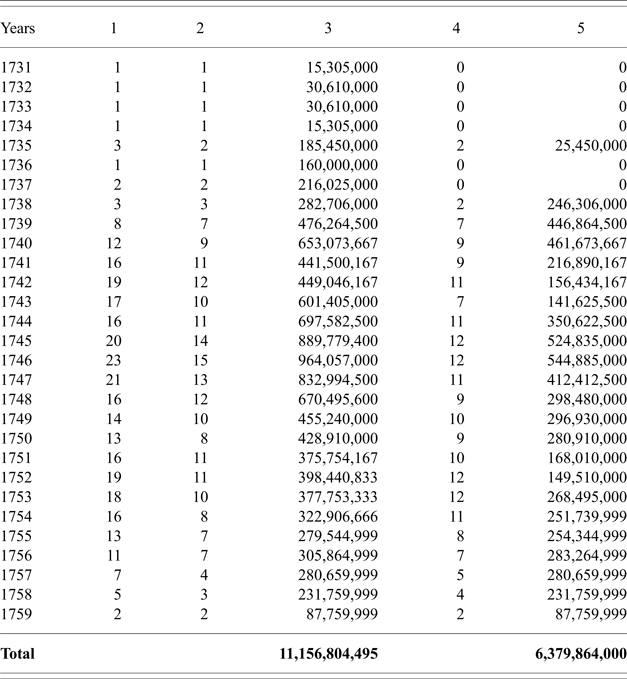
By the 1730s, Estêvão Martins’ activities had shifted to collecting domestic and colonial fiscal revenues, and within a few years this had become the backbone of his firm. Until his death in 1750, and alongside other businessmen from Lisbon, Bahia, and Rio de Janeiro, he farmed or participated as a partner in seventy-six tax farming contracts pertaining to the major rents of the Portuguese Crown in the metropole, Brazil, or Angola.Footnote 25 While the total value of these rents is difficult to gauge, the most significant in number (forty-five) and value clearly seem to have been the contracts in Portuguese America and Angola.Footnote 26 These comprised the revenues from the major customhouses in Brazil (Rio de Janeiro, Bahia, and Pernambuco), the overland trade to Minas Gerais, and the salt and diamond extraction monopolies, as well as the taxes levied on slaves and ivory in Angola. Between 1731 and 1750, these rents alone amounted to an overwhelming 9 billion réis.Footnote 27 Although lower in value, Estêvão Martins also farmed a wide range of rents in metropolitan Portugal, including the consulado tax collected in Lisbon's customhouse and the fiscal revenues of the inland ports (Casas de Lisboa). With such a concentration of fiscal rents in his activities, by the 1740s he was already the wealthiest businessmen on the Lisbon business scene (Table 1).
Contracts of the House of Torres, by year, 1731–1759

Key: 1. Number of metropolitan and colonial contracts; 2. Number of colonial contracts; 3. Fees payable to the royal treasury from colonial contracts (in réis); 4. Number of managed colonial contracts; 5. Fees payable to the royal treasury from managed colonial contracts (in réis).
Sources: ANTT, CS, FF, Inventários post-mortem, Letter E, bundle 28, doc. 13; ANTT, FF, AC, bundle 161, doc. 5.
The shift to tax farming and the extraordinary success Estêvão Martins attained in this activity can be explained by factors such as the growing expansion of the Brazilian market and the Crown's policy of farming out an increasing range of rents, but also by his business acumen and specific traits in his personality. When he first emerged as a main contractor in Brazilian rents, the market place was well aware of the high level of profits that had been earned by tax farmers in the early days of the gold cycle. It is difficult to ascertain whether he had been involved in tax farming contracts as a minor partner before the 1730s, but it is reasonable to assume that, during that period, he became aware that farming Brazilian rents was a thriving business. By the 1730s, he was in his fifties and the senior member of his generation, while also enjoying an undisputed reputation and possessing an extensive network of relationships and contacts that allowed him to attract business partners with whom he could share the risks associated with tax farming.Footnote 28 Furthermore, his fellow merchants also recognized in him leadership and management qualities, which is why, by the late 1740s, he had served as executive manager (caixa) on forty-two tax farming contracts and had been a partner in another thirty-four such contracts. It should be pointed out, however, that Estêvão Martins’ involvement in such an unusually high number of contracts was possible only because he made clever use of standard practices so as to circumvent the restrictions that the legal framework sought to impose on those who farmed public rents. The steps he took included resorting to members of his family, business partners, and strawmen in order to bypass the rules banning tax farmers from simultaneously exploiting more than one large fiscal rent or from engaging in new contracts before settling accounts with the royal treasury from previous contracts.Footnote 29 Managing such a high number of tax farming contracts certainly put pressure on the House of Torres; to better understand the management and organizational challenges it faced, we need to shift our attention to the legal framework within which tax farmers managed their concessions.
First and foremost, given that fiscal rents were considered public revenues, the rules governing the relationship between tax farmers and the Crown fell under public rather than private law.Footnote 30 This had an array of consequences: tax farmers operated under the supervision of the Crown's magistrates; any legal disputes that arose fell under the jurisdiction of a special division (Juízo dos Feitos da Fazenda) within the High Court of Appeal in Lisbon (Casa da Suplicação); and any unpaid contract payments constituted debts to the royal treasury (aerarium) and so were passed on to the tax farmers’ heirs until settled in full.Footnote 31 Moreover, the public nature of these rents also dictated a special type of partnership, the features of which stemmed from the Roman societas publicanorum.Footnote 32 In contrast to general partnerships, those formed for tax collection purposes were not dissolved upon a partner's death and instead continued until all accounts with the royal treasury and partners had been settled. Partners, or their heirs, were liable in solidum; in other words, they bound themselves fully for the debts to the aerarium.Footnote 33
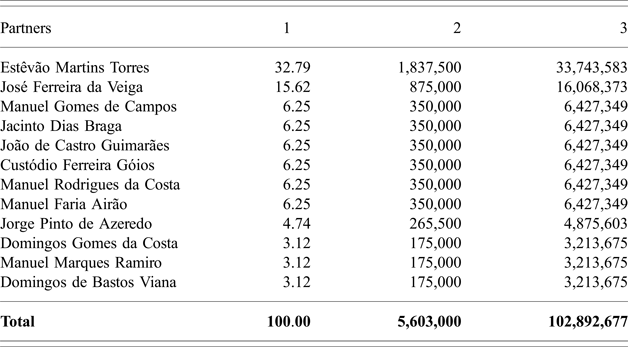
Information on partners’ socio-economic profiles, on how they pooled capital and shared risks, and on how they were structured and managed is scarce for early modern Portugal, not least because the Crown did not require these partnerships to be publicly disclosed before 1761.Footnote 34 Four of Estêvão Martins’ partnerships nevertheless provide some insight into these issues. These partnerships had between ten and eighteen partners, an unusually high number compared with the numbers of partners commonly seen in general partnerships, and this most likely reflected the high value of the rents contracted. Estêvão Martins’ partners included a core group of nine individuals, mostly other wealthy Lisbon merchants with whom he regularly did business, such as Jorge Pinto de Azeredo, José Ferreira da Veiga, and Domingos de Bastos Viana. Reflecting the Lisbon merchant elite's dominance in the tax farming of Brazilian rents, these nine businessmen held majority shares (ranging from 51.6 to 90.6 percent) in the contracts, with the remaining shares split between various medium- and small-sized merchants from Lisbon or Brazil.Footnote 35 Estêvão Martins, in turn, held shares ranging from 12.5 percent to 40.6 percent.Footnote 36 Tables 2 and 2A provide information on the partnership responsible for collecting duties (on metropolitan trade) at the Bahian customhouse from 1739 to 1741 and insight into the tax farmers’ gross profit margins, an aspect that has eluded scholarship owing to the loss of private business archives. This example is a case in point of a contract that was considered a success, insofar as it generated gross profit margins of 35.7 percent for its shareholders.
Bahian customhouse lease, 1739–1741 (in réis)

Key: 1. Annual fee for the lease; 2. Fees for three-year lease; 3. Actual revenue collected; 4. Gross proceeds; 5. Gross profit margin (%).
Source: AHU, bk. 1269, fol. 20v; AHU, Bahia, bx. 79, doc. 18; AHU, Bahia, bx. 82, doc. 18; AHU, Bahia, bx. 84, doc. 66.
Partnership for the Bahian customhouse lease, 1739–1741

Key: 1. Share in partnership (%); 2. Share in partnership (in réis); 3. Gross profit margin (in réis).
Source: ANTT, FF, Administração de Casas, bundle 161, doc. 5.
Despite the partners having managerial rights and being solidary liable, each of these partnerships set up a centralized management structure, whereby the partners voluntarily handed over management responsibility to an executive manager (caixa), who was either the businessman who had bid for the contract or a partner of unquestionable reputation. On the one hand, the executive manager was responsible for all the dealings with the state institutions that supervised the contract (either the Overseas Council or the Treasury Council), while, on the other hand, he was also entrusted with appointing, coordinating, and monitoring the administrators who ran the contract locally on a day-to-day basis. Exploiting royal rents of a very diverse nature and in places as distant from Lisbon as Brazil and Angola obviously also required short-term peripheral management structures to be put in place. Depending on the type of rent, these structures involved varying numbers of employees, who were geographically dispersed and performed a diverse range of tasks. Lastly, in view of the executive manager's responsibilities in the centralized treasury operations, he also had the task of settling accounts with the Crown and the partners after the contract had been completed. As these processes were highly demanding, both administratively and legally, they tended to drag on for years because as well as routinely filing petitions to obtain deductions from the total lease price (as compensation for losses incurred), executive managers also regularly went to court to contest additional payments imposed by the royal administration. Settling accounts with the partners was also a lengthy affair, not least because, by the end of the concession, fiscal revenues more often than not still had to be collected, and their recovery required judicial mediation.
Since Estêvão Martins assumed executive management responsibility for forty-two contracts during the course of his career, examining his firm's internal management and organization structures is key to understanding the extent to which the firm was able to manage this number of contracts effectively and overcome the many challenges. Although information on these aspects is scarce, some can nevertheless be gathered. As far as the comptoir was concerned, and as was customary among family firms, Estêvão Martins met part of his labour needs from within his family by training two sons in the business. By 1735, his eldest son, Manuel, was already helping his father to manage the contracts, while António, the younger of the two, was entrusted in 1748 with keeping the accounts. Estêvão Martins’ wife may also have assisted in overseeing some of the firm's businesses, as can be surmised from her later role in running the affairs after his death. In addition to family members, the House of Torres employed unknown numbers of clerks and salesmen. Perhaps the most striking feature of the firm's core organization, however, was its permanent need for lawyers and solicitors. Indeed, by 1758, the firm had a solicitor and eight lawyers handling sixty-one pending court cases, the majority of which involved conflicts pertaining to tax farming contracts, either with the royal treasury (twenty-four) or business associates (sixteen).Footnote 37 For locally managing the tax farming contracts in which it acted as executive manager, the House of Torres employed a short-term workforce of administrators and agents, whose numbers depended on the specific needs and challenges of the individual contracts. In the case of the Brazilian salt monopoly, for example, it employed an extensive network of agents in the acquisition, shipping, and local distribution of salt. Meanwhile the Angola contracts required the permanent presence of varying numbers of local agents in Luanda, Rio de Janeiro, Recife, and Bahia.Footnote 38 As mentioned earlier, settling the accounts could be an intrinsically challenging and lengthy process; given, however, the number of contracts—twenty-six—that still had to be settled in 1750, it is reasonable to assume that the firm was inadequately organized to deal with those challenges and already facing mounting difficulties to fulfil its obligations.
Estêvão Martins Torres died on 2 June 1750, leaving a widow, seven surviving children, and his late daughter's offspring as his heirs.Footnote 39 In his will, he designated his wife, his sons Manuel and António, and Manuel de Basto Viana, a Lisbon businessman, as executors and co-managers of the firm and set them a deadline of ten years to settle accounts and to divide the remaining estate equally between the heirs. Under Portuguese inheritance rules, a probate inventory had to be concluded within twelve months. Recognizing, however, the complexity and scale of the firm's businesses, the king granted a moratorium of six years, a concession granted only on a case-by-case basis and when major fortunes were at stake.Footnote 40 Pending the inventory and the subsequent partition of the estate, the family members were required to live “in common,” a temporary solution typically found in merchant houses that had the advantage of enabling them to keep the capital intact and carry on the business.Footnote 41
After several delays, a first inventory was produced in 1761. Despite being incomplete, this provides an assessment of the firm's illiquid wealth and estate, while also giving insight into the continuities and shifts in economic activities and investment patterns occurring after the founder's death (Table 3).
Fortune of Estêvão Martins Torres (assessment in December 1761) (in réis)

Key: 1. Net cash balance (1758–1761); 2. Gold and silver objects; 3. Household furnishings; 4. Slaves; 5. Carriages and animals; 6. Property of a clerkship; 7. Fixed capital (1/3 of the Santa Teresa ship); 8. Immovable property (urban and rural); 9. Advances to heirs; 10. Active debts; 11. Illiquid balance.
Source: ANTT, FF, Inventários post-mortem, Letter E, bundle 28, doc. 13 (corrected amounts).
By 1761, the illiquid wealth of the Torres family amounted to almost a billion réis (£272,906), an exorbitant amount by any standards and one reflecting the family's deep involvement in tax farming, and which made it the wealthiest merchant family in Portugal in the first half of the eighteenth century.Footnote 42 The fortune of Francisco Pinheiro, a successful Lisbon wholesaler, which has been assessed as amounting to 290 million réis at the time of his death in 1750, pales by comparison.Footnote 43 Even in the early nineteenth century, when fortunes were increasing, only a handful of Lisbon businessmen were as wealthy as the House of Widow Torres & Sons. These included João Pereira Caldas, João Teixeira Barros, and Policarpo José Machado, whose net fortunes ranged from one to one-and-a-half billion réis.Footnote 44 Even compared with the estates accrued by businessmen in other leading port cities, the House of Torres stood out in terms of its wealth. In London, for example, assets worth over £200,000 were unusual in the mid-eighteenth century, while, in the case of the French ports, merchant fortunes comparable in size to that of the House of Torres were not found until the late eighteenth century.Footnote 45
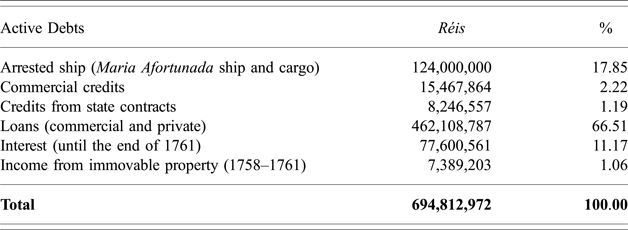
The composition of the House of Torres’ fortune displays both common and specific features compared with what is known for merchants of consequence in other major European ports. For one, the active debts had a significant weight in the firm's overall assets, which is not surprising and has also been noted, in view of their commercial and financial activities, as a usual pattern among trading houses operating in London, Bordeaux, and late-eighteenth-century Lisbon. In the case, however, of the House of Torres, not only did the active debts have an overwhelming weight of 70 percent, which is higher than in the other cases studied, but they also reflect specific investment patterns.Footnote 46 Indeed, rather than commercial credits, these active debts consisted mainly of private credit (66.5%), thus reflecting the shift in the allocation of capital that occurred after 1750 and the strategy of living off interest, given that the firm was losing momentum in tax farming and wholesale trade had long become only a subsidiary activity (Table 4). This also explains why, in contrast to other merchant houses, the inventory does not list commodities among the firm's assets.

Another specific feature of the Torres family's fortune was the rather small share of investments allocated to real estate (7.5%), compared with the successful merchants in other European ports who, from the eighteenth century onwards, aimed to advance socially by acquiring land.Footnote 47 In Portugal, however, the limited opportunities to rise socially meant investments in real estate among merchants were relatively low, and also economically unattractive compared to other investments.Footnote 48 Overall, the composition of the firm's fortune reveals a limited range of investments, unlike trading houses in Amsterdam and London, whose assets included government debt as well as company stocks and bonds.Footnote 49 The lack of interest in Portuguese government debt at the time has to be understood against the backdrop of the interest rates on government bonds, which had fallen from 5 to 4.5 percent and thus provided lower returns than those available from advancing credit, where rates stood between 5 and 6.25 percent.Footnote 50 The firm also chose not to invest in the recently established Brazilian chartered companies, the Company of Grão-Pará and Maranhão (1755) and the Company of Pernambuco and Paraíba (1759), for reasons that are not clear, but which may have been prompted by doubts about these companies’ profitability. This lack of diversity ultimately signals a strategy to allocate capital to higher-yielding activities such as tax farming, credit, and wholesale trade. The low value allocated to domestic items and transport also deserves a final note as it is evidence of a frugal lifestyle. While this stood in marked contrast to the firm's enormous wealth, this was far from exceptional, as it has also been noted for other successful Lisbon businessmen in the late eighteenth century.Footnote 51
The Demise
In many ways, the slow decline of the Torres family business is illustrative of the demise of the business elite that dominated in Lisbon between 1730 and 1760 and its replacement by a new group that went on to dominate the main metropolitan and colonial state contracts until the early nineteenth century.Footnote 52 While the demise of many trading houses constituting the former elite was certainly rooted in specific circumstances, it should also be understood in the framework of certain common variables relating both to the institutional setting and to conjunctural and contingent factors.
With regard to the institutional and legal setting, it should first be stressed that, like in the rest of Europe, the Portuguese trading houses were built on the family, or rather on the household.Footnote 53 This organizational structure was marked by a deep entanglement between family life and economic activity, which meant that business assets were part of the family's estate and, in turn, that all family members were liable for the debts. This lack of distinction also had consequences for how the estate was managed and transmitted. In the case of early modern Portugal, executive management was usually entrusted to the head of the household, while transmission of the estate followed the general inheritance rules, whereby assets and liabilities were divided equally among the heirs.Footnote 54 The equal distribution of wealth that these rules entailed hindered business continuity, and this has been seen as a key factor in explaining why most trading houses operating in Lisbon lasted for only one generation.Footnote 55 Unlike what has been noted for other European contexts, there are no indications of Portuguese family businesses circumventing the law of partible inheritance by favouring primogeniture.Footnote 56
A second common variable may be found in the balance of power established between the state and this economic elite, as seen in the case of tax farming, for the purposes of exploiting the South Atlantic empire. Although this aspect needs further research, against the backdrop of favourable economic circumstances and in a framework of competitive bidding, tax farmers were prompted to raise the value of the contracts in an effort to outbid the competition. This circumstance led them gradually to push the lease prices to economically dangerous levels. Over time, diminishing levels of profit increased their risks of defaulting on commitments entered into with the state. And the fact that the major tax farmers were inextricably bound together, both through the partnerships set up to collect fiscal revenues and through the warranties given under these contracts, precipitated the demise of numerous family businesses in the mid-eighteenth century.Footnote 57
Lastly, a contingent factor, the earthquake that struck Lisbon on 1 November 1755, adversely affected the business elite and compromised its continuity. Measuring 8.5 to 9 on the Richter scale, the earthquake caused an overwhelming loss of physical capital and affected the GDP by an estimated 75 percent.Footnote 58 Heavy losses of capital forced many merchants to close down operations, while many others declared bankruptcy.Footnote 59 The disruption to business was further worsened by the loss of commercial records.Footnote 60 While the impact that this contingent factor had on tax farmers, whether of metropolitan or colonial fiscal revenues, has yet to be assessed, tax farmers were certainly adversely affected both by the disruption of the mercantile flows and by the scrambling for funds that came in the wake of the earthquake.
While these common variables were certainly present in the demise of the House of Torres, certain specific factors, including a succession problem and internal disputes, as well as mismanagement, also played a central role.Footnote 61 The death of Estêvão Martins in 1750 triggered a process of erosion in the family business, not unlike what has been noted for other family firms. Like most of his fellow merchants, he had no business continuity plan, as evidenced by the management model laid down in his will, which was designed as a transitory solution for the purposes of settling the accounts and dividing the estate. However, these wishes were disregarded by the elder two sons, Manuel and António, who decided to stay in business, taking advantage not only of the capital amassed by their father, but also of his reputation and contacts. In doing so, they postponed the settling of tax farming accounts and, implicitly, the division of assets, and over time this irreparably damaged the firm's reputation, while also leading to rifts within the family.
Acting on their aspiration to continue the business, Manuel and António removed Manuel de Basto Viana as co-executor and co-manager and, together with their mother, the new head of the household, assumed a shared responsibility for managing the firm. In the years to 1756, and continuing the line of business inaugurated by the founder, the firm became involved in twenty-five new tax farming contracts, amounting to 2.2 billion réis.Footnote 62 In doing so, the brothers seemingly did not ponder the risks involved in committing themselves to such a high amount, even in partnership. Meanwhile the firm simultaneously also shifted its investment patterns by heavily advancing credit. From 1750 to 1759 it lent the staggering sum of 429.5 million réis.Footnote 63 While co-managing the old and new tax farming contracts, the brothers concurrently engaged in business activities on their own account. These led to a profound entanglement of businesses, which later impaired the distribution of losses and profits and caused the brothers to fall out.Footnote 64
Although for a few short years the firm may have been able to continue its business operations, the co-managers neglected to fulfil their obligations both to their business partners and to the royal treasury, using the moratorium as a pretext for postponing settlement of pending accounts. As later came to light, their co-management was also marked by administrative chaos. Whereas the bookkeeping and accounting appear to have been well organized during the founder's lifetime, under the management of the widow and the two elder sons negligence and disorder prevailed.Footnote 65 Whether these irregularities were evident in the marketplace is unclear; however, there were other indicators that worried the firm's creditors. Firstly, illegal advancements to the heirs were being made, which meant that the family's estate was becoming fragmented.Footnote 66 Secondly, the firm was heavily engaged in advancing credit, probably using profits from the contracts. In both cases, this was to the detriment of their business partners, who reacted in two ways when the moratorium expired in 1756. On the one hand, they petitioned the monarchy to take action to allow them to recover their stakes in the contracts, while, on the other hand, they sidelined the Torres family from any new partnership formed to exploit state contracts from 1756 onwards. Six years after the founder's death, therefore, it was clear to the business network in which they were embedded that neither Manuel nor António possessed the leadership qualities and business acumen of their father. The intergenerational transmission of an intangible asset of the business—its reputation—had thus failed and the firm's continuity had become severely compromised.
Meanwhile, the earthquake of 1755 compounded the firm's erosion. Although the exact extent of the damage cannot be assessed, the business was hit by direct losses in the form of damage to physical capital (buildings and commodities), as well as by indirect losses resulting from the general slowdown in economic activity. While the disruption of trade certainly adversely affected the profits available from the firm's ten ongoing tax farming contracts, defaults among fellow merchants also took their toll.Footnote 67 The case of Feliciano Velho Oldenberg, a merchant of German descent, deserves to be mentioned here, as his was the largest bankruptcy and the firm had lent him sixty million réis.Footnote 68 Furthermore, the fact that the Torres family had advanced both commercial and private credit amounting to a total of 319 million réis between 1750 and 1755 undoubtedly increased its exposure to defaults stemming from the earthquake. However, the firm was also weakened in yet another way in the aftermath of this natural disaster. This resulted from the state's need to scramble for funds to stave off the sharp fall in fiscal revenues and to meet its new expenditure commitments. As a result, the state increased the pressure on tax farmers to pay their outstanding fiscal debts. This, in turn, produced a domino effect that impacted on most members of the business elite, who, having monopolized metropolitan and colonial tax farming, were inextricably bound together, either as partners or warrantors. Hence, as the royal treasury increased the pressure on them, many business partners urged the House of Torres to distribute pending profits from their tax farming contracts.
Against this background, a turning point in the demise came in 1756. This was when, acting on petitions filed by the firm's business partners, the Crown intervened to protect the property rights of the firm's many creditors, including the royal treasury. As a result, Manuel and António were first removed as co-managers of the family's estate and also, by implication, of the businesses, which were entrusted solely to their mother as head of the household. The Crown then appointed two supervising judges (juízes comissários): one to supervise the widow in making the probate inventory, and the other to preside over a newly formed commission of businessmen whose mission was to oversee settlement of the firm's many pending accounts.Footnote 69 In doing so, the Crown did not strip the widow Torres of her rights to freely manage and dispose of the family's assets, but nevertheless paved the way for scrutiny of how the House of Torres managed its tax farming contracts, and this, in turn, further damaged the firm's reputation.
In the following years, the two supervising judges continued performing their respective tasks, albeit with limited results. The settlement of accounts, both with the royal treasury and the partners, proceeded slowly, especially those that depended on litigation. To secure the debts owed to the state, the firm placed a deposit of 187 million réis at the royal treasury, while 170 million réis of profits derived from contracts were distributed in the years until 1773, when one judge's commission was disbanded because of the firm being placed under judicial administration.Footnote 70 The other judge, in turn, concluded his commission in 1761 with a first probate inventory. This inventory remained provisional, however, as it could not be completed until all the accounts had been settled. As the partition of assets hinged on an assessment of the liquid wealth, the family members had to continue to “live in common,” a circumstance that eroded them as a family.
By the end of the 1760s, with no prospect of a near-term solution, the family was becoming torn apart by bitter internal disputes. As well as the younger siblings pressing for further advancements on their inheritance, the two elder brothers, who had continued using their mother's signing rights and so had never ceased to manage the business, fell out, with each accusing the other of embezzlement. In this dispute, the widow took the side of Manuel, and sought to favour him in her will. To that end, she settled with António and João Clímaco, handing them forty-eight million réis each in exchange for waiving the inheritance they would otherwise be entitled to. After her death in 1769, however, António and João Clímaco reneged on the agreement and claimed their inheritance rights in full, while António also contested his mother's will in court. More important, however, as far as the firm's future was concerned, were the charges that João Clímaco brought before the Board of Trade (Junta do Comércio), accusing Manuel, the new head of the household, of misappropriating the family's assets.Footnote 71
Faced with evidence that the interests of the other heirs and creditors were being jeopardized, the estate was confiscated and handed over to a judicial administration by royal decree of 14 April 1773. Appointed by the Board of Trade and comprising a judge and three businessmen, this administration was entrusted with the task of liquidating the firm. To that end, a new assessment of the family's illiquid wealth was produced, according to which it still amounted to an impressive 556.6 million réis (Table 5). This judicial administration continued until the 1810s, when the House of Torres was finally dissolved.
Fortune of the House of Torres (1774) (in réis)

Key: 1. Gold and silver objects; 2. Household furnishings; 3. Slaves; 4. Carriages and animals; 5. Immovable assets (urban and rural); 6. Government bond; 7. Cash deposited at the royal treasury (collateral); 8. Active debts; 9. Illiquid balance.
Source: ANTT, DP, RCEI, bundle 1440.
Although the demise of the Torres family business represents an exceptional case because of the size of its amassed wealth, it is far from unique, given that outstanding debts to the state from tax farming contracts also resulted in many other Lisbon firms becoming insolvent or being placed under judicial administration in the 1750s and 1760s, including Francisco Ferreira da Silva, Manuel Basto Viana, Custódio Ferreira Góios, and the Veiga brothers.Footnote 72 In line with the common variables referred to earlier, the main features of this group, as well as the institutional arrangements in which they operated, also have explanatory potential as to this widespread failure. Most of the fortunes forged under the Brazilian gold cycle were created, after two or three decades in business, by individuals from humble origins and who were not born in trade. These individuals formed an open group, where barriers to entry were low, and competed among themselves for the opportunities provided not only by metropolitan, but also by colonial tax farming. Aside from the exclusive system in which they operated, and despite their key role in the collection of fiscal revenues, these businessmen did not enjoy any political protection. And their lack of protection proved to be a significant disadvantage when, as the level of contractual profit-taking began to decrease and the default risks increased proportionately, the group proved to be unable to adjust to these adverse conditions.
The decline of this business elite furthermore coincided with changes in the political scenario linked to the emergence of Sebastião de Carvalho e Melo (the future Marquis of Pombal), which set in motion a number of institutional reforms in the wake of the Lisbon earthquake. Influenced by cameralism, he strove for greater intervention by the state in the economy, particularly in defence of the colonial exclusive, which represented an important source of fiscal revenue for the Crown.Footnote 73 To foster economic relations with the empire and reduce English dominance over Portugal's foreign trade, Pombal's initiatives sought to establish a strong group of merchants. His package of institutional reforms thus helped to form a new and wealthy elite, with few connections to the group that had dominated the Lisbon business scene between 1730 and 1760. Favoured by Pombal, this new elite gradually began to monopolize the main state contracts, both in the homeland and in the empire, with its hegemony lasting until the early nineteenth century.Footnote 74
Concluding Remarks
By examining the rise and demise of the Torres family business, this article highlights the role played by the metropolitan business elite in the exploitation of empire through tax farming rather than colonial trade, which is the focus more commonly found in scholarship. From the businessmen's perspective, contracting the collection of fiscal rents represented a relevant business opportunity, given that it was also an exclusive sphere of activity for Portuguese vassals in the framework of a mercantilist policy. The farming of royal revenues certainly played a crucial role in the wealth accumulated by many Portuguese trading houses at this time, as well as in defining their inner hierarchy, which would not have been possible were it not for the exceptional context linked to the Brazilian mining cycle.
Where, however, it concerned public revenues, tax farming imposed strict rules on businessmen, while the Crown's policy of seeking to maximize revenue through competitive bidding also increased the risks to which they were exposed. These risks were further compounded by the fact that the businessmen in question enjoyed no political protection. Enticed by expectations of high returns, given the generally favourable macroeconomic trends at the time, businesses like that of the Torres family chose to concentrate their activities on tax farming, while disregarding the risks associated with these activities. In all likelihood, such concentration was not going to be compatible with the intrinsic characteristics of family firms, their organizational skills, and their vulnerability to the external environment. Moreover, members of the Lisbon business elite were inextricably bound together through partnerships set up specifically for tax farming purposes and that ultimately exposed them all not only to the defaults of fellow partners, but also to the vagaries of family businesses. The succession problem experienced by the Torres family provides a case in point of this fragility. When the concurrent demise of many family businesses connected to tax farming became a problem in the late 1750s owing to their key role in the imperial economy, the state was compelled to intervene to prevent the adverse impact of defaulting tax farmers. Changes in the institutional arrangements between the state and businesses were then put in place, with measures being taken to strengthen and protect a small group of businessmen who could in turn support Pombal's economic programme that aimed to foster the imperial economy. This was accompanied by a shift in tax farming policy as the state became increasingly risk-averse in adjudicating its contracts, and this also helped to cement the position of the new elite. This shift, however, came too late for the business elite that had risen to prominence during the Brazilian mining cycle.
Abbreviations
- AC:
Administração de Casas
- ADL:
Arquivo Distrital de Lisboa
- AHU:
Arquivo Histórico Ultramarino
- ANTT:
Arquivo Nacional da Torre do Tombo
- CD:
Cartório do Distribuidor
- CG:
Conselho Geral
- CNL:
Cartórios Notariais de Lisboa
- DL:
Distrito de Lisboa
- DP:
Desembargo do Paço
- FF:
Feitos Findos
- JPRC:
Juízo da Provedoria dos Resíduos e Cativos
- MCO:
Mesa da Consciência e Ordens
- OC:
Ordem de Cristo
- RCEI:
Repartição da Corte, Estremadura e Ilhas
- RGT:
Registo Geral de Testamentos
- RP:
Registos Paroquiais
- tit.:
titulo
- TSO:
Tribunal do Santo Ofício