INTRODUCTION
A peculiarity of tropical rain forests is the colonization of surfaces of living leaves, the phyllosphere (Ruinen Reference RUINEN1961), by epiphyllous organisms. The epiphyllous community is composed of species belonging to various taxonomic groups like liverworts, mosses, lichens, algae, cyanobacteria, fungi and even microscopic animals (Ruinen Reference RUINEN1961), with lichens and liverworts making up by far the largest contribution (Gradstein Reference GRADSTEIN1994, Lücking Reference LÜCKING, Gottsberger and Liede2001). The present study focuses on epiphyllous bryophytes. The taxonomic diversity of epiphyllous bryophytes is remarkably restricted and contains members of only three families – the liverwort family Lejeuneaceae, which is the largest group containing more than 95% of all epiphyllous bryophytes (Gradstein Reference GRADSTEIN1994), the Radulaceae and the moss family Hookeraceae (Gradstein Reference GRADSTEIN1997).
A variety of factors influence colonization, occurrence, abundance and diversity of epiphyllous bryophytes. This research focuses mainly on two aspects: first, attributes of the host plants (phorophytes), and second the differences in microclimatic conditions.
Epiphyllous bryophyte communities occur on a great variety of phorophyte species belonging to different families and are usually considered host non-specific (Pócs Reference PÓCS and Smith1982a, Winkler Reference WINKLER1967). However, leaf texture is believed to play a role in epiphyll colonization. Generally leathery or papyraceous leaves with smooth surfaces are preferred, but epiphylls also grow on hairy surfaces and even on artificial leaves (Monge-Nájera & Blanco Reference MONGE-NÁJERA and BLANCO1995). Only waxy cuticles seem to be less suitable for epiphylls (Pócs Reference PÓCS1978, Richards Reference RICHARDS and Schuster1984). Leaf size was found to be weakly correlated with epiphyll cover, whereas shape, including drip tips, has no influence at all (Burd Reference BURD2007, Monge-Nájera Reference MONGE-NÁJERA1989). On the other hand, epiphyll cover exhibits a strong relationship with leaf age (Bentley Reference BENTLEY1987, Richards Reference RICHARDS1954).
Microclimate – i.e. temperature, relative humidity and light availability – is regarded as the prime driver of epiphyll distribution (Coley et al. Reference COLEY, KURSAR and MACHADO1993, Lücking Reference LÜCKING1995, Monge-Nájera Reference MONGE-NÁJERA1989, Olarinmoye Reference OLARINMOYE1974, Richards Reference RICHARDS and Schuster1984, Wu et al. Reference WU, LI and GAO1987). High temperature, a characteristic feature of tropical lowland forests, may impose physiological limitations on bryophytes due to high respiration rates unbalanced by photosynthesis (Frahm Reference FRAHM1990a, Reference FRAHMb; Richards Reference RICHARDS and Schuster1984). In fact, lowlands are relatively poor in bryophyte species diversity and biomass in comparison to submontane and montane tropical rain forests (Gradstein et al. Reference GRADSTEIN, CHURCHILL and SALAZAR-ALLEN2001). However, Lejeuneaceae seem to be an exception since they are relatively dominant and widespread in lowland forests (Gradstein et al. Reference GRADSTEIN, CHURCHILL and SALAZAR-ALLEN2001). Epiphyll growth is thought to be strongly correlated with atmospheric humidity (Coley et al. Reference COLEY, KURSAR and MACHADO1993, Olarinmoye Reference OLARINMOYE1974, Winkler Reference WINKLER1967), but quantitative analyses are rare. Two studies from Panama comparing the epiphyll cover of sites with different humidity regimes revealed inconsistent results (Coley et al. Reference COLEY, KURSAR and MACHADO1993, Marino & Salazar Allen Reference MARINO and SALAZAR ALLEN1993). Similarly, reports on the effect of light intensity are ambiguous (Coley & Kursar Reference COLEY, KURSAR, Mulkey, Chazdon and Smith1996, Freiberg Reference FREIBERG1999, Monge-Nájera Reference MONGE-NÁJERA1989, Winkler Reference WINKLER1967), but in general epiphylls seem to grow best under moderate light levels, e.g. in small gaps, whereas large gaps and non-forest locations are avoided (Marino & Salazar Allen Reference MARINO and SALAZAR ALLEN1993).
In this paper, we use data from three adjacent, but microclimatically varied sites to analyse correlations among microclimate, host plants and bryophyte distribution. In particular, we tested the following hypotheses: (1) Microclimatic variations, i.e. temperature, relative humidity and light availability, are correlated to cover, diversity and community composition of epiphyllous bryophytes. (2) There are no differences in cover, diversity and species composition of epiphylls among four locally widespread phorophyte species.
STUDY SITE
The study was conducted in the Esquinas forest (08°41.316´N, 83°12.305´W) which is part of the Parque Nacional Piedras Blancas on the south-western coast of Costa Rica. The area belongs to the tropical wet forest life zone (Holdridge et al. Reference HOLDRIDGE, GRENKE, HATHEWAY, LIANG and TOSI1971) with an average annual precipitation > 5000 mm and an average temperature > 27 °C (Weissenhofer Reference WEISSENHOFER2005). The climate is characterized by high rainfall from August to November (> 500 mm mo−1) and a somewhat drier period from January to March (< 250 mm mo−1) (Huber Reference HUBER2005). The topography of the study area is dominated by ravines, steep slopes and narrow ridges covered with primary forest, partly intermingled with well-developed secondary forest patches. Three study sites in close proximity (within an area of c. 0.5 km2) were selected along an elevational transect, comprising a total altitudinal difference of c. 160 m.
The first site is located in a valley bottom (ravine) at c. 120 m asl along a small creek which carries water throughout the year. The site has typical ravine vegetation including small patches of secondary vegetation due to selective logging more than 20 y ago (Weissenhofer Reference WEISSENHOFER2005). The dense understorey is dominated by large-leaved shrubs.
The second site was selected at a south-eastern exposed slope with inclinations of 30–45° and an elevation from 153 m to 180 m asl. The slope is covered with primary forest characterized by emergent trees, high abundance of lianas, relatively dense understorey vegetation and frequent gaps due to natural disturbance.
The third site was established on a ridge at an elevation between 227 m and 285 m asl. The ridge is well drained and probably the driest stand within the study area with leaf drop during the dry season being considerably higher than in the surrounding parts of the forest (Huber Reference HUBER2005). Local species composition has been affected by past extraction of timber trees (Weissenhofer Reference WEISSENHOFER2005).
METHODS
Collecting and processing of samples
Four host plant species, Carludovica drudei Mast. (Cyclanthaceae), Asplundia pittieri (Woodson) Harling (Cyclanthaceae), Costus laevis Ruiz & Pav. (Costaceae) and Dieffenbachia concinna Croat & Grayum (Araceae) were selected according to the following criteria: (1) typical understorey species, (2) individuals present at all study sites and (3) perennial life form. According to the sampling design two fully developed but not senescent leaves should be (randomly) collected from five individuals of each host-plant species at each site, regardless of visible epiphyll cover. However, as there were only three Carludovica individuals at the ridge, and only one Dieffenbachia at the slope, the total number of phorophyte individuals sampled was only 57.
Leaf area was estimated by computer scanning and pixel counting. To evaluate epiphyllous cover of leaves, they were overlain with a grid of 100 nodes (mesh widths of 5, 10 or 20 mm depending on leaf size) and the number of nodes with epiphylls underneath was counted. This process was repeated three times with random repositioning of the grid and the mean value was taken as measure of epiphyll cover. The phorophyte leaves were pressed and dried carefully at 40 °C. To determine the spectrum of colonizing bryophyte species 12 squares of 1 cm2 each were randomly selected from the leaf surface by means of a template and epiphyllous bryophyte species within the squares were recorded. Identification of species was based on identification keys and monographs (Bernecker-Lücking Reference BERNECKER-LÜCKING1998, Dauphin Reference DAUPHIN2000, Ilkiu-Borges Reference ILKIU-BORGES2005, Lücking Reference LÜCKING1995, Schäfer-Verwimp Reference SCHÄFER-VERWIMP2004, Teeuwen Reference TEEUWEN1989). Nomenclature follows the TROPICOS database (http://www.tropicos.org).
All sampling was done during the dry season, as we supposed microclimatic variation to be more pronounced then.
Microclimate measurements
Microclimatic measurements were performed between early February and mid-March 2005. At each site a data-logger (capacitive humidity sensor and electronic thermometer) recorded air temperature and relative humidity in 5-min intervals over 40 d. Data loggers were positioned 1.5 m above ground at a representative position within each site.
Light availability was assessed for each phorophyte by means of hemispherical photography based on Global Site Factor (GSF) analysis. GSF represents the proportion of global solar radiation in a given location relative to that in the open above-canopy environment, and is calculated as the sum of direct and diffuse solar radiation weighted by their relative contributions. Photographs were taken at dawn under diffuse light conditions to avoid reflections of direct sunlight (Whitmore et al. Reference WHITMORE, BROWN, SWAINE, KENNEDY, GOODWINBAILEY and GONG1993) using a digital camera (Nikon 8400 with FC-E9 fish-eye adapter). Light availability was calculated from the photographs by a two-step procedure. First, an automatic threshold algorithm with edge detection was executed using SideLook 1.1.01 software (Nobis & Hunziker Reference NOBIS and HUNZIKER2005) selecting the blue-channel mode, which is regarded to discriminate best between sky and vegetation (Jonckheere et al. Reference JONCKHEERE, NACKAERTS, MUYS and COPPIN2005). The resulting black-and-white images were submitted to the HemiView Canopy Analysis Software 2.1. (Delta-T Devices Ltd., http://www.delta-t.co.uk). The default simple solar model with external solar flux of 1370 W m−2, transmissivity of 0.40, diffuse proportion of 0.45 (Whitmore et al. Reference WHITMORE, BROWN, SWAINE, KENNEDY, GOODWINBAILEY and GONG1993) and standard overcast sky was used to calculate GSF.
Statistical analysis
Data were analysed first to assess if the small-scale topography of the study area induces significant microclimatic variation, and second to test if abundance, diversity and species composition of epiphyll species are affected by these microclimatic differences or by host plant species.
To test for microclimatic variability each site was characterized by mean daily values, daily minima and maxima as well as the differences between daily minima and maxima of temperature and relative humidity. Differences among the sites were evaluated by linear mixed-effects models (LMM) grouping the data by day, i.e. allowing for random effects of each day of the measurement series. LMM was performed using the ‘lme’ function of the R-package ‘nlme’ (http://cran.r-project.org/web/packages/nlme/index.html). Analysis of variance (ANOVA) was used to compare sites in terms of GSF with the photographs taken at the individual host plants as replicates.
Among-site and among-host plant differences in epiphyll cover and diversity were evaluated by Kruskal–Wallis tests (Sachs & Hedderich Reference SACHS and HEDDERICH2006).
For a multivariate analysis of the species abundance matrix we used non-metric multidimensional scaling (NMDS) of the species × site (= host individual) abundance matrix. NMDS is currently regarded as the most efficient general ordination method for ecological data (Brehm & Fiedler Reference BREHM and FIEDLER2004). Host plant leaves without any epiphylls were excluded from the analysis. However, we did not eliminate rare species from the analysis as they make up an important contribution to taxonomic diversity and are indispensable for conservation aspects. The iterative algorithm, with Bray–Curtis index as similarity metric, was performed with 500 random starts and 1000 iterations to find the best-fitting configuration. Environmental variables – temperature, relative humidity, and light – were fitted into the resulting three-dimensional ordination diagram with the function ‘envfit’ from the ‘vegan’ package (http://vegan.r-forge.r-project.org). Post hoc analysis of the correlation between ordination scores and environmental gradients was performed and the significance of Pearson correlation coefficients was determined by means of bootstrapping (1000 replicates). Multivariate analysis of variance (MANOVA) was used for assessing the effects of site and host plant identity, as well as their interaction on sample position in the three-dimensional ordination space.
Indicator species analysis, as documented by Dufrene & Legendre (Reference DUFRENE and LEGENDRE1997), was conducted to identify species representative for each of the sites using the function ‘duleg’ implemented in the ‘labdsv’ package (http://cran.r-project.org/web/packages/labdsv/index.html).
All statistical analyses were performed with R 2.6.2 (http://cran.r-project.org).
RESULTS
Microclimate
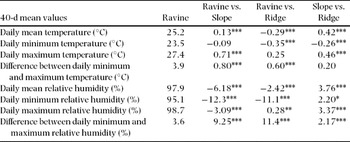
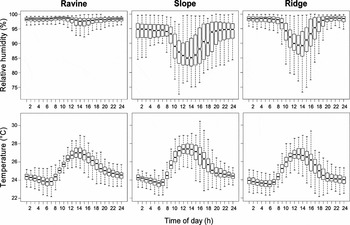
The microclimates of the three sites differed with respect to all parameters measured (Table 1). Variation was most pronounced for relative humidity. Although relative humidity levels were generally high across all sites, daily fluctuations were marked on the slope and at the ridge but were nearly nil in the ravine (Figure 1) and hence daily means differed accordingly. Inter-site differences in temperature and light regimes were more subtle. Highest temperature values were recorded for the slope, lowest for the ridge, while lowest fluctuations occurred in the ravine and highest on the slope.
Results of temperature and relative humidity measurements at the three study sites in the Esquinas forest, Costa Rica, over a period of 40 d (March–April 2005). Mean values are given for ravine, deviations form the situation in the ravine, for slope and ridge. Asterisks (*** P < 0.001, ** P < 0.01, * P < 0.05) indicate fixed-effect significance of the respective variable in an LMM (df = 80).

Mean daily course of relative humidity (top) and temperature (bottom) recorded at the three study sites (ravine, slope, ridge) located in the Esquinas forest, Costa Rica, over a period of 40 d during the dry season (February–March 2005). For each boxplot (boxes indicate 25th and 75th percentile, whiskers extend to the 1.5-fold of the interquartile range) 1-h mean values were calculated from measurements at 5-min intervals and averaged over the whole study period.

Analysis of hemispherical photographs gave mean GSF values of 0.12, 0.08 and 0.11 for ravine, slope and ridge, respectively, with ravine vs. slope and slope vs. ridge differing significantly (F = 8.07, df = 2, n = 57, P < 0.01).
Species diversity, abundance and area cover
A total of 60 epiphyllous bryophyte species were found on the investigated leaves (Appendix 1). Fifty-one of them could be identified to species level. Most of these species were rare, only 14 were found on 10 or more hosts. Odontolejeunea lunulata was the most abundant species. Crossomitrium patrisiae was the only moss occurring frequently on living leaves, whereas all other species were members of the leafy liverwort group, 90% belonging to the family of Lejeuneaceae with 20 genera and about 53 species. The highest number of species detected on a single host plant (alpha diversity) was 33 (on a C. laevis individual). On a single leaf, the maximum number of observed species was 24.
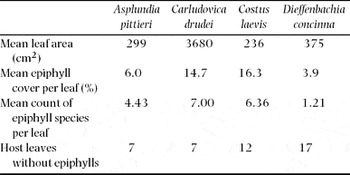
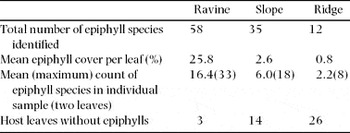
The estimated epiphyll cover per host plant varied from zero to 56%. Frequency and diversity of epiphyll species on the different phorophyte species and study sites are given in Table 2 and 3. Epiphyll cover and species richness did not differ significantly between host plant species (H = 2.6, df = 3, P > 0.05), although Dieffenbachia was colonized less by epiphylls than the others. With respect to sites, epiphyll cover and frequency were highest in the ravine (H = 23.5 and H = 13.4, df = 1, P < 0.001 for ravine vs. slope; H = 28.9 and H = 27.8, df = 1, P < 0.001 for ravine vs. ridge), while species diversity did not differ markedly between ravine and slope, but differed significantly for ravine vs. ridge (H = 14.5, df = 1, P < 0.001). The ridge exhibited by far the lowest epiphyll cover, frequency and species richness.
Estimated leaf area and epiphyll species data regarding cover and diversity for phorophyte species, Esquinas forest, Costa Rica.

Ordination, environmental correlation and indicator species analysis
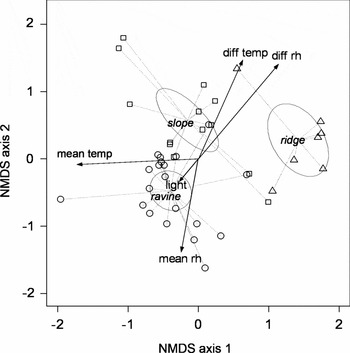
NMDS showed a clear separation of the three sites along the first two axes (Figure 2). Sample scores on the first axis are most strongly (negatively) correlated with daily mean air temperature (bootstrapped r = −0.71, 95% confidence interval: −0.84 to −0.54) and weaker but still significantly with fluctuations in air temperature (bootstrapped r = 0.31, 95% confidence interval: 0.11–0.52) and relative humidity (bootstrapped r = 0.55, 95% confidence interval: 0.37–0.72).
Ordination plot of the first two axes of a three-dimensional non-metric multidimensional scaling (NMDS) of 57 epiphyllous bryophyte samples from the leaves of four different phorophyte species in the Esquinas forest, Costa Rica. Stress = 12.3. Arrows indicate correlations of NMDS axis with mean daily air temperature (mean temp), daily fluctuations in temperature (diff temp), mean daily relative humidity (mean rh), daily fluctuations of relative humidity (diff rh) and the global site factor (light). Ellipsoids contain the 95% confidence interval of sample scores positioned on the centroid of the respective site. Circles = ravine, squares = slope, triangles = ridge.

Diversity and abundance of epiphyll species at a ravine, ridge and slope site in the Esquinas forest, Costa Rica.

Along the second NMDS axis the sample scores are negatively correlated with daily mean relative humidity (bootstrapped r = −0.62, 95% confidence interval: −0.75 to −0.46) and positively correlated with fluctuations in both relative humidity (bootstrapped r = 0.6, 95% confidence interval: 0.47–0.73) and temperature (bootstrapped r = 0.65, 95% confidence interval: 0.5–0.76).
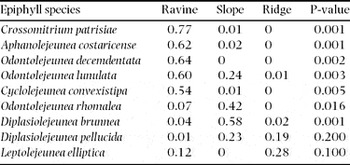
The influence of light was strongest on the third axis (bootstrapped r = −0.44, 95% confidence interval: −0.59 to −0.26) although none of the correlations with the third axis was particularly strong. In addition, MANOVA revealed a significant effect of host plant identity (F3,34 = 4.1, P = 0.01) on epiphyll composition and a marginally significant site-host plant interaction (F3,34 = 2.9, P = 0.047). Indicator species analysis identified a few reasonable indicator species for the three study sites (Table 4). Highly significant indicator species occurred in the ravine, while on the slope and particularly on the ridge the small numbers of individuals reduced the statistical power of the analysis.
Indicator values shown for epiphyll species with best representation of the three study sites in the Esquinas forest, Costa Rica. The higher the value the stronger the preference for a certain habitat.

DISCUSSION
Microclimatic factors
It has been hypothesized that the high air temperature prevailing in lowland rain forests may limit bryophyte growth due to exceedingly high losses of carbon during respiration (Frahm Reference FRAHM1990a). In the study area temperature in general was rather uniform – daily means ranging from 24.9–25.3 °C during the short dry season. Under such conditions, liverworts are not considered to suffer physiological limitation in terms of the carbon balance (Frahm Reference FRAHM1990a, Zotz et al. Reference ZOTZ, BÜDEL, MEYER, ZELLNER and LANGE1997). Moreover, along the studied gradient lowest temperatures were measured on the ridge, the site where epiphylls were least abundant. Therefore, temperature variation cannot explain the distribution of epiphyllous bryophytes in the Esquinas forest.
In contrast, both actual variation and the effect of relative humidity on bryophyte assemblages were much more pronounced. Accumulating evidence suggests that high atmospheric humidity strongly favours epiphyll growth in the forest understorey (Coley et al. Reference COLEY, KURSAR and MACHADO1993, Olarinmoye Reference OLARINMOYE1974, Winkler Reference WINKLER1967). The present study was conducted in the short dry season, where epiphyll cover is demonstrably not at its peak (Roskoski Reference ROSKOSKI1981) and discrepancies between study sites may have been increased, even though mean relative humidity was high across all sites. Among the most striking features of the microclimate was the high and almost constant relative humidity in the understorey of the ravine site which was linked to the highest density and diversity of epiphyllous bryophytes. Phorophyte leaves sampled on the slope and especially on the ridge exhibited low to very low epiphyll cover, and some of them were virtually free of bryophytes. The number of species, as well as the fraction of leaf area covered by epiphyllous bryophytes, was smallest on the ridge even though lowest daily mean air humidity values occurred on the slope. A more detailed analysis of relative humidity patterns, however, suggested that, apart from mean values, daily fluctuations of relative humidity have a major impact on epiphyll distribution. Fluctuations were marginal in the ravine, differences exceeding 20% were rare on the slope, but occurred repeatedly on the ridge which may be explained by increased air flow on slope and ridge. This pattern suggests that extreme drops of relative humidity in the afternoon, particularly during the dry season, may strongly impair germination and establishment of propagules and thus be the main limiting factor for epiphyll colonization of leaves.
Reports on the effect of light availability on epiphyllous liverworts are contradictory (Coley & Kursar Reference COLEY, KURSAR, Mulkey, Chazdon and Smith1996, Freiberg Reference FREIBERG1999, Monge-Nájera Reference MONGE-NÁJERA1989, Winkler Reference WINKLER1967). In the present study light availability was rather low with a somewhat inconsistent pattern. The relatively high light availability in the ravine understorey may have resulted from a denser but more heterogeneous tree canopy in comparison to the ridge. Light values on the slope were lowest, in apparent contradiction to its microclimate, since higher air temperature and low relative humidity suggested openness of the canopy. Hemispherical photographs draw a very local picture of the light situation in space and time, however, and the resulting stochasticity may partly explain these inconsistencies. Anyway, our data suggest that increased light availability may support epiphyll growth under high-humidity conditions such as in the ravine. Nevertheless, light cannot be the primary factor driving epiphyll distribution as GSF values did not differ significantly between ravine and ridge whereas epiphyll cover and diversity was much higher in the ravine.
Phorophyte specificity
Phorophyte properties such as leaf size, shape, texture, surface characteristics, leaf longevity and solute leaching are considered to influence colonization and establishment of epiphyllous communities (Coley et al. Reference COLEY, KURSAR and MACHADO1993, Lücking Reference LÜCKING1995, Pócs Reference PÓCS1982b, Wanek & Pörtl Reference WANEK and PÖRTL2005). In the present study, no distinct indicator species could be found for any of the host plants and epiphyll cover and diversity did not differ significantly between phorophyte species. Nevertheless, Dieffenbachia displayed a consistent lower epiphyll density and non-significance may result from rather small sample sizes and hence low statistical power. Moreover, species composition of bryophyte assemblages was significantly dependent on phorophyte identity, probably due to the low diversity on Dieffenbachia individuals. This avoidance of Dieffenbachia leaves suggest that the surface characteristics of host leaves might indeed have some effect on epiphyll growth (Lücking Reference LÜCKING1995) as this species has a particularly smooth and waxy cuticle with reduced wettability (Richards Reference RICHARDS and Schuster1984). However, taken together, our results do not allow clear conclusions with respect to host plant specificity of epiphyllous bryophytes. The fact that phorophyte identities obviously interact with microclimatic features in determining the species composition of epiphyll assemblages additionally complicates this issue. Studies with a more diverse phorophyte community and a larger sample size taken from a more varied array of habitats will be necessary to arrive at a less equivocal picture.
Diversity
The total of 60 species found in the Esquinas forest is comparably high and does not confirm Eggers' (Reference EGGERS2001) statement that pacific lowland is impoverished in epiphyllous hepatics or the results of some other studies (Marino & Salazar Allen Reference MARINO and SALAZAR ALLEN1993, but see Lücking Reference LÜCKING1997). However, in accordance with previous studies the epiphyll flora of the Esquinas forest is dominated by Lejeuneaceae, which generally play a major role within liverworts in tropical lowland forests, accounting for up to 70% of total hepatic diversity (Gradstein et al. Reference GRADSTEIN, CHURCHILL and SALAZAR-ALLEN2001). The proportion of rare to very rare species was high; about half of the species occurred on less than 10% of the investigated host plants. This phenomenon is well known in such communities (Lücking Reference LÜCKING1999, Marino & Salazar Allen Reference MARINO and SALAZAR ALLEN1993).
Species assemblages
The three investigated sites did not only differ in cover and diversity but also in species composition of the epiphyll flora. The ravine, as the site where epiphylls were most abundant, also had the highest number of indicator species. Among them was Crossomitrium patrisiae, the only moss species encountered, which, together with some of the bigger-leaved species (except Aphanolejeunea costaricense), clearly indicates the pronounced humidity of the site. Odontolejeunea lunulata, the most abundant species in the study area, showed a distinct preference for the more humid site but also occurred in the drier sites but with much lower abundance. In general, the drier sites, i.e. the slope and especially the ridge, had a less distinct epiphyll species composition. Nevertheless the two species of Diplasiolejeunea clearly prefer the drier locations, whereas D. brunnea is a distinct indicator species for the slope together with Odontolejeunea rhomalea; D. pellucida is more frequent on the ridge although not significantly so. This is in accordance with Winkler (Reference WINKLER1967) who reported resistance against temporary desiccation for Diplasiolejeunea. In the present study Leptolejeunea elliptica had the highest indicator value for the ridge which contradicts observations from Barro Colorado Island, Panama (Marino & Salazar Allen Reference MARINO and SALAZAR ALLEN1993) where L. elliptica occurred predominantly in humid locations. This discrepancy might be resolved by comparing precise microclimatic records.
In conclusion, the results of this study suggest that microclimatic factors, especially fluctuations in relative humidity, have a strong impact on distribution and community composition of epiphyllous bryophytes. Although the investigated sites were located in close proximity, we found measurable microclimatic differences in the understorey, especially with respect to fluctuations of atmospheric humidity, which were probably due to differences in canopy structure. The epiphyllous community obviously is very sensitive to such slight variations in terms of diversity as well as of abundance and community composition. The sensitivity of epiphyllous bryophytes to shifts in microclimate demonstrates that undisturbed forest structure is essential for the development of a diverse epiphyll flora.
ACKNOWLEDGEMENTS
Thanks to the Ministerio del Ambiente y Energía, Costa Rica, for granting a research and collecting permit; the staff of Fieldstation La Gamba, Costa Rica, for providing research facilities, accommodation and personal care; the University of Natural Resources and Applied Life Sciences (BOKU), Vienna, for providing data logging and microclimate sensing devices; and the University of Vienna for financial support (KWA grant). Furthermore, thanks to Andrea Bernecker, University of Costa Rica, Rob Gradstein and his team, University of Göttingen and Tamás Pócs, Eger for technical advice in species identification.
Appendix 1. Alphabetic list of epiphyllous bryophyte species occurring on 57 phorophyte individuals in three study sites located in the Esquinas forest, Costa Rica
Hookeriaceae
Crossomitrium patrisiae
Lejeuneaceae
Aphanolejeunea cingens
A. costaricensis
A. ephemeroides
A. gracilis
A. winkleri
Ceratolejeunea coarina
C. cornuta
C. cubensis
C. dussiana
C. sp.
Cheilolejeunea rigidula
Colura tortifolia
Cololejeunea cardiocarpa
C. linopteroides
C. obliqua
Cyclolejeunea accedens
C. convexistipa
C. peruviana
Diplasiolejeunea brunnea
D. pellucida
Drepanolejeunea inchoata
D. infundibulata
D. lichenicola
D. mosenii
Lejeunea anomala
L. caespitosa
L. controversa
L. filipes
L. intricata
L. laetevirens
L. subspathula
L. sp. 1
L. sp. 2
L. sp. 3
Leptolejeunea elliptica
L. radicosa
L. sp.
Lopholejeunea nigricans
Microlejeunea acutifolia
M. epiphylla
Neurolejeunea breutelii
Odontolejeunea decemdentata
O. lunulata
O. rhomalea
Oryzolejeunea saccatiloba
Prionolejeunea denticulata
P. muricato-serrulata
Rectolejeunea berteroana
Stictolejeunea squamata
Symbiezidium transversale
Taxilejeunea debilis
T. sp.
Plagiochilaceae
Plagiochila sp.
Radulaceae
Radula flaccida
R. mammosa
R. stenocalyx
R. yanoella