


Background
Attention deficit hyperactivity disorder (ADHD) is a common neurodevelopmental disorder affecting an estimated 5-7% of children and adolescents worldwide (Polanczyk et al. Reference Polanczyk, De Lima, Horta, Biederman and Rohde2007). In Ireland, approximately one in three children attending Child and Adolescent Mental Health Services (CAMHS) have a diagnosis of ADHD (HSE 2013). In recent years, there have been substantial increases in referrals and medication prescribing rates (McKechnie et al. Reference McKechnie, O’Nions, Dunsmuir and Petersen2023; Parkin et al. Reference Parkin, Bennett, Nicholas and Hayden2025; Raman et al. Reference Raman, Man, Bahmanyar, Berard, Bilder, Boukhris, Bushnell, Crystal, Furu and KaoYang2018).
ADHD is associated with significant long-term adverse academic, mental health, and social outcomes, as well as substantial societal and economic costs, estimated at €2–€2.5 billion annually in Ireland (Daley et al. Reference Daley, Jacobsen, Lange, Sørensen and Walldorf2019; Sciberras et al. Reference Sciberras, Streatfeild, Ceccato, Pezzullo, Scott, Middeldorp, Hutchins, Paterson, Bellgrove and Coghill2022). Despite well-established diagnostic criteria and effective treatments, ADHD service delivery remains variable. Inconsistencies in assessment, medication monitoring, clinical governance, and continuity of care have been reported in Irish CAMHS (Halpin Reference Halpin2025; Maskey Reference Maskey2022).
These challenges arise within a broader national policy context that emphasises accessible, integrated, and recovery-oriented care, with digital innovation identified as a key enabler (Sharing the Vision, Department of Health 2020). National reviews have highlighted variability in service quality, gaps in governance, and deficiencies in documentation, prescribing oversight, and physical health monitoring (Mental Health Commission 2023; Halpin Reference Halpin2025; Maskey Reference Maskey2022). Together, these findings underscore the risks associated with fragmented information systems and reliance on manual, paper-based workflows, and they point to the need for structured, integrated digital supports to ensure safe and consistent care. Broader reform programmes, including the Sláintecare Implementation Strategy and the HSE Digital Transformation Strategy (2020–2025), similarly prioritise integrated, digitally enabled models of care (Department of Health 2018, 2024). Internationally, the Independent ADHD Taskforce in England has emphasised the role of digital infrastructure in improving information flow, timely assessment, and monitoring across services (NHS England 2025).
In response to these challenges, the ADMiRE clinical pathway was developed as a structured, evidence-based framework for ADHD assessment and management (McGrath Reference McGrath2024), with demonstrated improvements in governance, efficiency, and service-user experience (McGrath et al. Reference McGrath, Cawley, McTiernan, Marques, Goncerz, Heron, Madden, Bond, Quinn and Mulholland2022). However, its paper-based format limits scalability and introduces administrative burden, requiring manual data collection, scoring, and longitudinal monitoring, with associated risks of error, duplication, and delay. These limitations are particularly relevant in the context of rising demand for ADHD services and increasing expectations for safe, consistent, and guideline-adherent care (Lang Reference Lang2024).
Digital platforms offer the potential to embed structured clinical workflows within integrated systems, supporting automated data capture, standardised documentation, and real-time outcome monitoring (Department of Health 2018, 2024; NHS England 2019; WHO 2025). However, translating these principles into routine clinical practice remains challenging, requiring careful integration with existing clinical workflows, stakeholder engagement, robust governance and sustained organisational support. Against this backdrop, this perspective paper presents a case study of digital transformation in ADHD services. A three-year, stakeholder-informed development process was undertaken to develop a secure digital platform that operationalises the ADMiRE pathway within routine clinical practice. This paper describes the platform’s development, key features, and potential contributions to ADHD service delivery in Ireland, including its capacity to generate structured data to support service evaluation and future research. A separate paper will report on the implementation and early evaluation of the platform within clinical services.
Development approach
Overview
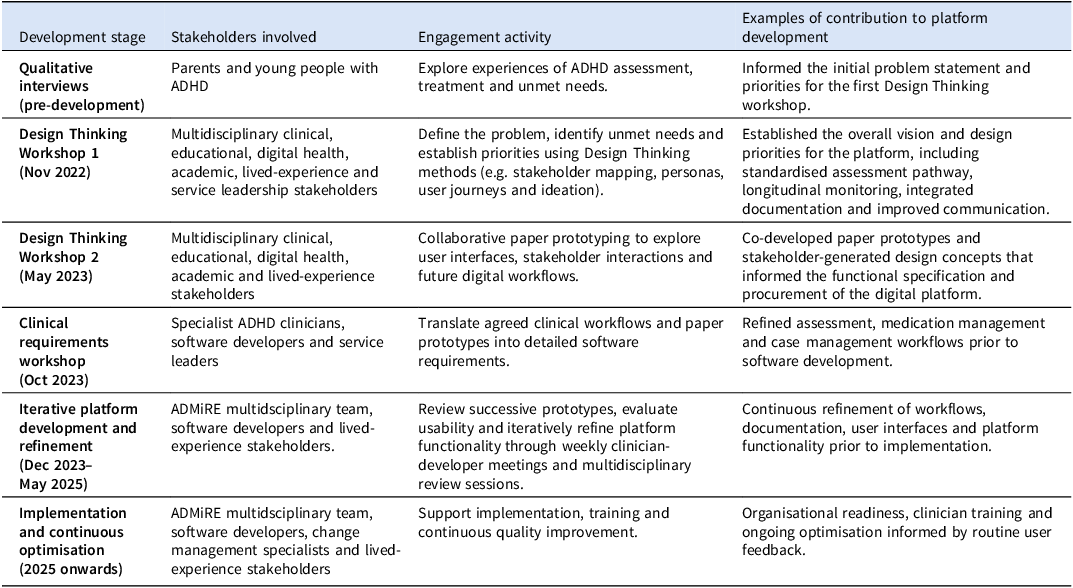
The ADMiRE digital platform was developed over three years (2022–2025) using an iterative approach that combined human-centred Design Thinking (Brown Reference Brown2008), agile software development and ongoing clinical service redesign. Development involved close collaboration between clinicians, software developers, digital health specialists, researchers, parents and service leaders. Stakeholder engagement continued throughout the project, from understanding user needs and designing the platform to prototype review, implementation and ongoing optimisation (Table 1).
Stakeholder engagement and contributions to the development of the ADMiRE digital platform (2022–2025)

Table 1. Long description
The table has five columns: Development stage, Stakeholders involved, Engagement activity, and Examples of contribution to platform development. It contains six rows detailing different stages and activities. Row 1: Development stage, Qualitative interviews (pre-development); Stakeholders involved, Parents and young people with ADHD; Engagement activity, Explore experiences of ADHD assessment, treatment and unmet needs; Examples of contribution to platform development, Informed the initial problem statement and priorities for the first Design Thinking workshop. Row 2: Development stage, Design Thinking Workshop 1 (Nov 2022); Stakeholders involved, Multidisciplinary clinical, educational, digital health, academic, lived-experience and service leadership stakeholders; Engagement activity, Define the problem, identify unmet needs and establish priorities using Design Thinking methods (e.g. stakeholder mapping, personas, user journeys and ideation); Examples of contribution to platform development, Established the overall vision and design priorities for the platform, including standardised assessment pathway, longitudinal monitoring, integrated documentation and improved communication. Row 3: Development stage, Design Thinking Workshop 2 (May 2023); Stakeholders involved, Multidisciplinary clinical, educational, digital health, academic and lived-experience stakeholders; Engagement activity, Collaborative paper prototyping to explore user interfaces, stakeholder interactions and future digital workflows; Examples of contribution to platform development, Co-developed paper prototypes and stakeholder-generated design concepts that informed the functional specification and procurement of the digital platform. Row 4: Development stage, Clinical requirements workshop (Oct 2023); Stakeholders involved, Specialist ADHD clinicians, software developers and service leaders; Engagement activity, Translate agreed clinical workflows and paper prototypes into detailed software requirements; Examples of contribution to platform development, Refined assessment, medication management and case management workflows prior to software development. Row 5: Development stage, Iterative platform development and refinement (Dec 2023–May 2025); Stakeholders involved, ADMiRE multidsciplinary team, software developers and lived-experience stakeholders; Engagement activity, Review successive prototypes, evaluate usability and iteratively refine platform functionality through weekly clinician-developer meetings and multidisciplinary review sessions; Examples of contribution to platform development, Continuous refinement of workflows, documentation, user interfaces and platform functionality prior to implementation. Row 6: Development stage, Implementation and continuous optimisation (2025 onwards); Stakeholders involved, ADMiRE multidsciplinary team, software developers, change management specialists and lived-experience stakeholders; Engagement activity, Support implementation, training and continuous quality improvement; Examples of contribution to platform development, Organisational readiness, clinician training and ongoing optimisation informed by routine user feedback.
For clarity, the development process is described in four phases: (1) understanding user needs, (2) translating stakeholder priorities into a digital platform, (3) iterative platform development and refinement, and (4) preparing the platform for implementation.
Phase 1. Understanding user needs and defining the problem
Development began in October 2022 with qualitative interviews conducted by the HSE Digital Transformation and Innovation Team with parents and children receiving ADHD care. The interviews explored experiences of ADHD assessment and treatment, barriers to accessing services and opportunities for improvement. Common themes included difficulties accessing assessment, fragmented care, challenges navigating school supports, medication concerns and the need for better information, communication and support for families. These findings informed the first Design Thinking workshop.
A multidisciplinary Design Thinking workshop was held in November 2022, and was facilitated by the HSE Digital Transformation and Innovation Team. Stakeholders representing clinical, educational, digital health, academic and parent perspectives participated (n = 29) (Table 1). Using stakeholder mapping, personas, user journeys and collaborative ideation, participants identified limitations of the existing paper-based pathway and developed priorities for a future digital platform.
Key priorities included standardised assessment pathways, automated questionnaire administration and scoring, longitudinal monitoring of symptoms and physical health, integrated clinical documentation, improved communication with families and schools, and access to digital psychoeducational resources. These priorities informed the subsequent funding application and the initial functional specification.
Phase 2. Translating stakeholder priorities into a digital platform
Following successful funding in early 2023, the priorities identified during the first workshop were translated into an initial functional specification document describing the proposed clinical workflows and core platform functionality. A second multidisciplinary Design Thinking workshop was held in May 2023. Using collaborative paper prototyping, participants who had attended the first workshop (n = 23) explored how the platform could support clinicians, parents and teachers, and developed concepts for user interfaces, information flow and digital workflows. The outputs from this workshop, together with feedback from the initial Design Thinking workshop, informed a revised functional specification, which was used to procure a software development partner.
Throughout this phase, development of the platform progressed alongside refinement of the ADMiRE clinical pathway. The aim was not simply to digitise existing paper processes, but to redesign workflows to support standardised assessment and monitoring, improve communication and deliver more efficient ADHD care.
Phase 3. Iterative platform development and clinical workflow refinement
Software development commenced in late 2023 using an agile, iterative approach. An initial clinical requirements workshop in October 2023 involving specialist ADHD clinicians, service leaders and software developers (n = 20) refined the assessment, medication management and case management workflows before development began.
The clinical project lead then met weekly with software developers to review prototypes, clarify requirements and prioritise changes. For example, feedback from clinicians and multidisciplinary prototype review informed refinement of the sequencing of assessment workflows, medication management processes, longitudinal data visualisation, user interfaces and automated clinical documentation to better align the platform with routine clinical practice. As working prototypes became available, they were reviewed by the full ADMiRE multidisciplinary team. An initial prototype review was held in October 2024, followed by four half-day multidisciplinary review sessions over the following months. New functionality was also demonstrated at weekly multidisciplinary team meetings, allowing feedback to be incorporated into subsequent software releases.
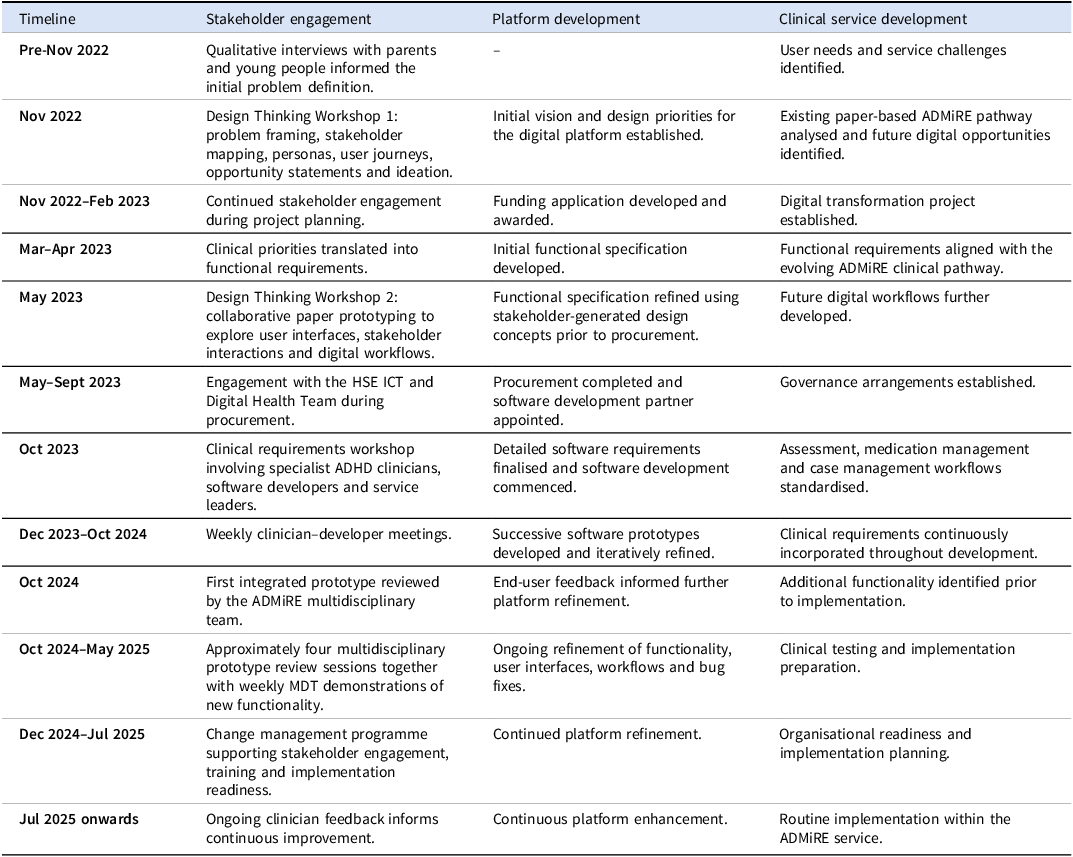
This iterative process resulted in progressive refinement of the platform, including clinical workflows, user interfaces, automated documentation, longitudinal monitoring, decision-support tools and communication processes before implementation (Table 2).
Development timeline for the ADMiRE ADHD digital platform (2022–2025)

Table 2. Long description
A table detailing the development timeline for the ADHD digital platform from 2022 to 2025. The table has four columns: Timeline, Stakeholder engagement, Platform development, and Clinical service development. It includes multiple rows with specific time periods and corresponding activities. Row 1: Pre-Nov 2022, Qualitative interviews with parents and young people informed the initial problem definition, -, User needs and service challenges identified. Row 2: Nov 2022, Design Thinking Workshop 1: problem framing, stakeholder mapping, personas, user journeys, opportunity statements and ideation, Initial vision and design priorities for the digital platform established, Existing paper-based ADMiRE pathway analysed and future digital opportunities identified. Row 3: Nov 2022-Feb 2023, Continued stakeholder engagement during project planning, Funding application developed and awarded, Digital transformation project established. Row 4: Mar-Apr 2023, Clinical priorities translated into functional requirements, Initial functional specification developed, Functional requirements aligned with the evolving ADMiRE clinical pathway. Row 5: May 2023, Design Thinking Workshop 2: collaborative paper prototyping to explore user interfaces, stakeholder interactions and digital workflows, Functional specification refined using stakeholder-generated design concepts prior to procurement, Future digital workflows further developed. Row 6: May-Sept 2023, Engagement with the HSE ICT and Digital Health Team during procurement, Procurement completed and software development partner appointed, Governance arrangements established. Row 7: Oct 2023, Clinical requirements workshop involving specialist ADHD clinicians, software developers and service leaders, Detailed software requirements finalised and software development commenced, Assessment, medication management and case management workflows standardised. Row 8: Dec 2023-Oct 2024, Weekly clinician-developer meetings, Successive software prototypes developed and iteratively refined, Clinical requirements continuously incorporated throughout development. Row 9: Oct 2024, First integrated prototype reviewed by the ADMiRE multidisciplinary team, End-user feedback informed further platform refinement, Additional functionality identified prior to implementation. Row 10: Oct 2024-May 2025, Approximately four multidisciplinary prototype review sessions together with weekly MDT demonstrations of new functionality, Ongoing refinement of functionality, user interfaces, workflows and bug fixes, Clinical testing and implementation preparation. Row 11: Dec 2024-Jul 2025, Change management programme supporting stakeholder engagement, training and implementation readiness, Continued platform refinement, Organisational readiness and implementation planning. Row 12: Jul 2025 onwards, Ongoing clinician feedback informs continuous improvement, Continuous platform enhancement, Routine implementation within the ADMiRE service.
Phase 4. Preparing for implementation within routine clinical care
As development progressed, attention shifted to implementation within routine clinical practice. A dedicated change management programme began in late 2024 to support organisational readiness, clinician engagement and implementation planning. Training materials, governance processes and implementation workflows were developed alongside continued software refinement. Feedback from clinician testing and prototype review informed final refinements before implementation in 2025. Since implementation, ongoing clinician feedback has continued to guide platform optimisation and further development.
Digital platform architecture and key features
The resulting platform supports the delivery of the ADMiRE clinical pathway by integrating structured assessment, longitudinal monitoring and clinical workflow management within a single digital system. It is a secure, cloud-hosted web application with role-based authentication and encrypted data storage.
It comprises two integrated components: a clinician-facing interface and a secure patient portal (Figure 1), supporting referral processing, diagnostic assessment, medication monitoring, and follow-up. The system can function standalone or integrate with existing electronic health records. By adopting an Application Programming Interface (API)-first approach, the system ensures that all functionality is accessible via APIs, which are standard mechanisms that allow different software systems to securely communicate and exchange data. This supports a high level of interoperability, enabling services to integrate the platform flexibly within their existing digital infrastructure.
Overview of the ADMiRE ADHD Digital Platform.

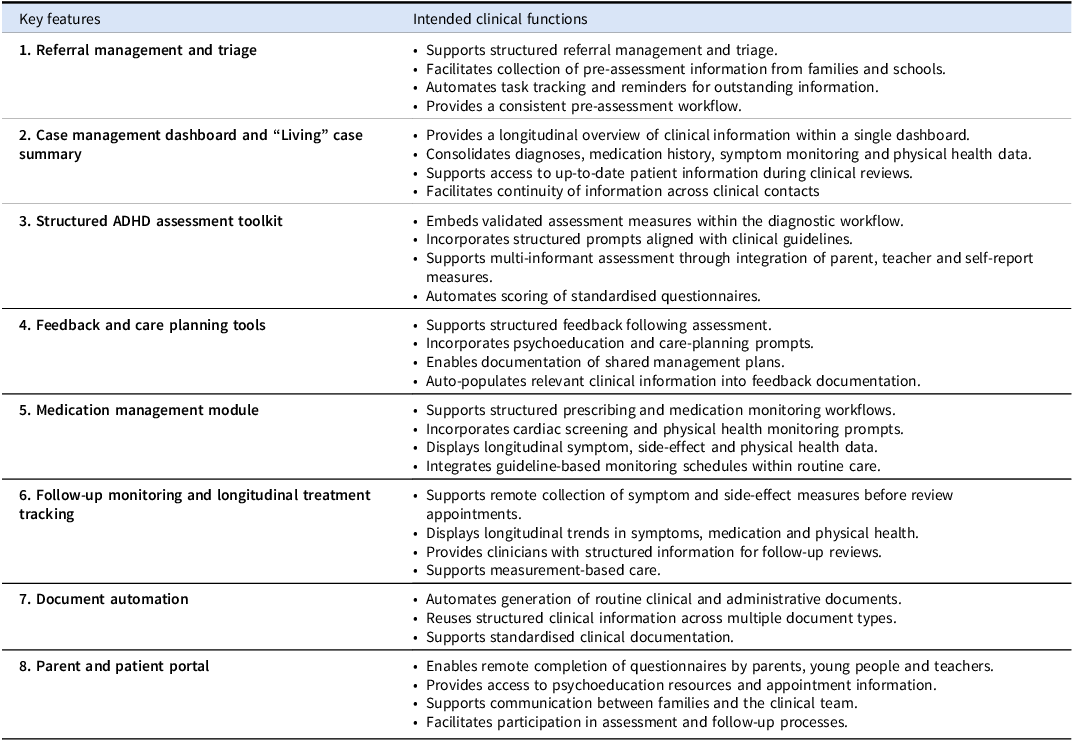
The platform comprises a series of modules designed to support key stages of the ADHD clinical pathway including referral management, assessment, medication monitoring, follow-up and communication. The intended functions of each component are described below, while Table 3 summarises their proposed clinical applications within the pathway.
Key features of the ADMiRE ADHD digital platform and their intended clinical functions

Table 3. Long description
A table with two columns and eight rows. The first column lists key features of the ADMiRE ADHD digital platform, and the second column describes their intended clinical functions. Row 1: Referral management and triage, Supports structured referral management and triage. Facilitates collection of pre-assessment information from families and schools. Automates task tracking and reminders for outstanding information. Provides a consistent pre-assessment workflow. Row 2: Case management dashboard and “Living” case summary, Provides a longitudinal overview of clinical information within a single dashboard. Consolidates diagnoses, medication history, symptom monitoring and physical health data. Supports access to up-to-date patient information during clinical reviews. Facilitates continuity of information across clinical contacts. Row 3: Structured ADHD assessment toolkit, Embeds validated assessment measures within the diagnostic workflow. Incorporates structured prompts aligned with clinical guidelines. Supports multi-informant assessment through integration of parent, teacher and self-report measures. Automates scoring of standardised questionnaires. Row 4: Feedback and care planning tools, Supports structured feedback following assessment. Incorporates psychoeducation and care-planning prompts. Enables documentation of shared management plans. Auto-populates relevant clinical information into feedback documentation. Row 5: Medication management module, Supports structured prescribing and medication monitoring workflows. Incorporates cardiac screening and physical health monitoring prompts. Displays longitudinal symptom, side-effect and physical health data. Integrates guideline-based monitoring schedules within routine care. Row 6: Follow-up monitoring and longitudinal treatment tracking, Supports remote collection of symptom and side-effect measures before review appointments. Displays longitudinal trends in symptoms, medication and physical health. Provides clinicians with structured information for follow-up reviews. Supports measurement-based care. Row 7: Document automation, Automates generation of routine clinical and administrative documents. Reuses structured clinical information across multiple document types. Supports standardised clinical documentation. Row 8: Parent and patient portal, Enables remote completion of questionnaires by parents, young people and teachers. Provides access to psychoeducation resources and appointment information. Supports communication between families and the clinical team. Facilitates participation in assessment and follow-up processes.
Referral management and triage
A referral and triage system standardises intake and supports assessment preparation. Clinicians specify required pre-assessment information (e.g., rating scales, school reports), which appear as structured tasks in the parent portal. Completion is tracked in the clinician dashboard, with automated reminders for outstanding items.
Case management dashboard and “Living” case summary
A central dashboard provides an integrated view of referral data, assessments, treatment history, and follow-up. Each record includes a dynamically updating “living” summary that consolidates diagnoses, medication history, symptom severity, side effects, physical health data, and involvement with other services.
Structured ADHD assessment toolkit
Validated assessment tools are embedded within the diagnostic workflow. Data from parent, teacher, and self-report questionnaires are automatically imported into a digital assessment form prior to the clinical evaluation. During assessment, clinicians are guided through structured prompts aligned to clinical guidelines.
Feedback and care planning tools
A feedback form supports delivery of diagnostic outcomes. Clinical information recorded during the assessment is automatically populated within the form, allowing clinicians to review and update key details during feedback. Structured prompts support psychoeducation, discussion of comorbidities, and signposting to appropriate services.
Medication management module
This module supports guideline-based prescribing and monitoring, including cardiac screening, initiation workflows, physical health monitoring, consent, and follow-up review. Screening prompts guide the need for cardiology input, while initiation workflows support baseline assessment, psychoeducation, care planning, and consent. Physical health data (height, weight, blood pressure, heart rate) are converted to age-adjusted centiles, displayed longitudinally, and flagged where abnormal (Figure 2).
Example of interactive longitudinal monitoring dashboards used to visualise clinical data over time. Panels display (A) ADHD symptom severity, (B) physical health parameters including weight, height, and blood pressure centiles, and (C) medication side effects. Individual data points include interactive pop-up details that indicate the associated rating scale scores, medication type, and dosage at each time point (shown in grey boxes).

Figure 2. Long description
Panel A: Four line graphs display ADHD symptom severity scores over time. The graphs are labeled ADHD Total Score, Hyperactivity/Impulsivity, Inattention, and ODD Score. The x-axis represents age, and the y-axis represents the score. Different colored lines represent self, parent/guardian, and teacher ratings. Panel B: Four graphs show physical health parameters. The first graph is a scatter plot of weight with age on the x-axis and weight in kilograms on the y-axis. The second graph is a line graph of height with age on the x-axis and height in centimeters on the y-axis. The third and fourth graphs are line graphs of systolic and diastolic blood pressure centiles with age on the x-axis and BP centile on the y-axis. Panel C: A timeline displays medication side effects with age on the x-axis and various side effects listed on the y-axis. Different colored dots indicate the presence of specific side effects at different ages.
Follow-up monitoring and longitudinal treatment tracking
Pre-review data collection is automated via the portal, with symptom and side-effect scales completed remotely. Results are auto-scored and displayed alongside longitudinal graphs of symptoms, physical health, and medication (Figure 2).
Document automation
Customisable templates enable automated generation of clinical and administrative documents (e.g., prescriptions, GP letters, reports, referrals, discharge summaries), populated directly from patient data.
Parent and patient portal
A secure portal enables parents, young people, and teachers to contribute information to the assessment and treatment process through remote questionnaire completion, psychoeducation resources, and appointment scheduling with reminders.
Discussion
This paper shows how a structured clinical pathway can be translated into a digital platform through an iterative, stakeholder-informed development process. The resulting platform brings together referral management, diagnostic assessment, medication management and longitudinal monitoring within a single system to support more consistent, coordinated ADHD care. The ADMiRE model of care, on which the platform is based, has previously demonstrated strong clinical outcomes, high levels of service-user satisfaction (McGrath et al. Reference McGrath, Cawley, McTiernan, Marques, Goncerz, Heron, Madden, Bond, Quinn and Mulholland2022), and adherence to international guidelines within a specialist ADHD service in Ireland (McGrath Reference McGrath2024). Embedding this pathway within a digital infrastructure extends its potential impact by enabling consistent implementation across diverse clinical settings.
The platform was developed in response to persistent challenges in ADHD services, including fragmented information systems, variability in clinical processes, administrative burden, and limited capacity for systematic monitoring of treatment response and physical health. Such challenges have been highlighted in national service reviews and are particularly relevant in the context of increasing ADHD referrals and rising prescribing rates. By integrating assessment and management into a single digital workflow, the platform has the potential to support more consistent, guideline-adherent care while reducing administrative workload.
A central feature is the structured collection and visualisation of clinically relevant data across the patient journey. Symptom measures, medication side effects, and physical health parameters are captured systematically and displayed longitudinally (Figure 2). The platform enables clinicians to review treatment response and safety indicators over time, supporting longitudinal monitoring. Automated scoring, calculation of physical health centiles, and generation of clinical documentation is designed to streamline routine clinical tasks and reduce administrative burden.
The inclusion of a parent portal represents a key design element intended to support family engagement in the assessment and treatment process. Through this interface, parents, teachers, and young people can complete questionnaires remotely, receive reminders, and access evidence-based psychoeducational resources. Remote completion of rating scales and other assessment measures enables relevant information to be made available to clinicians before appointments, supporting assessment and clinical review. The platform also provides educational materials and structured communication tools that are intended to support greater family engagement in the assessment and treatment process.
Beyond individual clinical care, the platform may also support service organisation and governance. Structured workflows and embedded prompts aim to promote consistent completion of key steps in assessment and medication monitoring. The platform also includes alerts for abnormal physical health parameters and generates structured clinical and operational data that may support audit, quality improvement, and service planning. In addition, the dynamic case summary provides a concise overview of clinical history that may support continuity of care when patients transition between clinicians or services.
These developments align with broader digital transformation within Irish CAMHS. Although a unified national infrastructure for ADHD care has historically been lacking, current reforms aim to address this gap. The ADMiRE platform complements these efforts by demonstrating how a structured clinical pathway can be implemented digitally to support monitoring, prescribing safety, and clinical governance. Its modular design allows it to function either as a standalone system or as a component that integrates with emerging national systems, offering flexibility for implementation across diverse service settings (Figure 1).
National reviews including the Mental Health Commission’s Independent Review of CAMHS (2023) and recent Look-Back Reviews (Halpin Reference Halpin2025; Maskey Reference Maskey2022) have highlighted the need for improved governance, more consistent diagnostic practices, and enhanced medication monitoring. Digital systems that embed structured clinical pathways may help address these challenges by standardising workflows while maintaining clinical flexibility. In this context, the ADMiRE platform illustrates how guideline-based ADHD care could be operationalised within routine services in a way that supports measurement-based practice, improved documentation, and greater transparency of clinical processes.
If evaluated successfully, digital platforms of this type could have wider implications for the organisation of ADHD services nationally. Standardised digital workflows may support more consistent assessment, safer medication monitoring, and improved continuity of care across teams and services, while generating data to inform audit and quality improvement. Importantly, such systems are intended to complement, not replace, clinical expertise, supporting delivery of consistent, evidence-based care within complex service environments. This direction is reflected internationally; the recent Independent ADHD Taskforce in England (NHS England 2025) recommends greater use of digital technology to improve assessment, information flow, and monitoring, reinforcing the relevance of this approach within UK and Irish reform agendas.
A key strength of this initiative lies in its grounding in an established clinical framework and its development through extensive stakeholder engagement. It operationalises a validated pathway rather than introducing a new model of care, and its design reflects the realities of routine clinical practice. Its modular structure, spanning referral, assessment, treatment, and review, means it can be adopted incrementally allowing services to tailor implementation to local need and capacity. Its ability to capture high-quality, structured clinical data may also support future health service research, service evaluation, and continuous quality improvement.
Alongside the potential benefits described above, successful implementation of digital platforms also requires careful consideration of the challenges associated with integrating digital technologies into routine clinical care. Structured digital workflows may increase documentation burden if systems are poorly designed or duplicate existing processes, while excessive standardisation may reduce flexibility for managing complex clinical presentations. The quality of clinical decision support also depends on the completeness and accuracy of the information entered into the system. Successful implementation requires appropriate digital infrastructure, training and engagement from clinicians and families. Care must also be taken to minimise digital exclusion, particularly among families with limited digital literacy, language barriers, socioeconomic disadvantage or restricted access to technology, to ensure that digital tools do not inadvertently widen inequalities in access to care. Robust information governance, cybersecurity and data protection are also essential to maintain patient trust and ensure the secure handling of sensitive health information.
The ADMiRE platform was implemented in accordance with organisational General Data Protection Regulation requirements and underwent a Data Protection Impact Assessment prior to implementation. Continued governance will remain essential as the platform evolves and additional functionality is introduced. Any future secondary use of routinely collected data for research purposes, including predictive modelling or artificial intelligence applications, will require appropriate governance arrangements, ethical oversight and regulatory approval where applicable. These challenges highlight the importance of careful implementation, appropriate governance, ongoing stakeholder engagement and continued evaluation to ensure that digital technologies improve care safely and equitably.
Limitations and future directions
Although the platform has now been implemented in routine clinical practice, this paper describes its design and implementation rather than a formal evaluation of its effectiveness. While preliminary service data are encouraging, the prospective evaluation currently underway will determine the platform’s impact on clinical outcomes, patient safety, workflow efficiency, implementation, generalisability and cost-effectiveness.
Development was informed by qualitative interviews with parents and children, multidisciplinary stakeholder workshops and iterative clinician feedback, using an iterative stakeholder-informed approach based on human-centred Design Thinking and agile software development. However, it did not follow a formal Patient and Public Involvement and Engagement or co-development framework, such as the UK INVOLVE guidance or the Person-Based approach. Future digital health initiatives could benefit from adopting more structured frameworks to guide and report stakeholder engagement, design decisions and iterative refinement throughout the development process. Nevertheless, the development described here reflects extensive real-world collaboration between clinicians, software developers, researchers, service leaders, parents and young people across the design, development and implementation of the platform.
This paper provides a descriptive account of the development of the ADMiRE platform from the perspective of the clinical lead responsible for its design and implementation. While every effort has been made to present a balanced account, independent evaluation by researchers not involved in the platform’s development will be important to evaluate its effectiveness, assess implementation across different clinical settings, and determine whether the anticipated benefits are realised in routine clinical practice.
Early observations from pilot use suggest improvements in medication monitoring, prescribing safety and administrative efficiency, but systematic evaluation is required to confirm these effects. Future work will therefore focus on pilot implementation and formal evaluation across diverse service settings. This will include assessment of clinical outcomes, safety metrics, workflow efficiency, and service user experience, as well as examination of interoperability with emerging national digital systems for CAMHS. Evaluation across multiple sites will also help determine the platform’s usability, acceptability, and feasibility in services with varying resources, staffing models, and levels of digital infrastructure.
The structured data generated by the platform may also support future research, including exploration of predictive modelling approaches and artificial intelligence applications. Any such work will require appropriate governance, ethical approval, transparent oversight and validation before clinical implementation. In addition, the modular design allows for further development, including extension to adult ADHD services, integration with prescribing systems, enhanced communication with schools and primary care, and expanded psychoeducation resources.
Conclusion
There is a clear need for more consistent, safe, and efficient ADHD services for children and adolescents in Ireland. The ADMiRE ADHD Digital Platform was developed to address this need by embedding a validated clinical pathway within a secure, modular digital system that supports structured assessment, medication monitoring, and longitudinal follow-up. Early experience suggests improvements in medication safety, efficiency, and consistency of care, while structured data outputs have the potential to support audit, quality improvement, and research.
Developed within a specialist ADHD service, the platform illustrates how digital tools can support structured clinical workflows, strengthen clinical governance and support measurement-based practice without replacing clinical judgement. Further evaluation across different service settings will be important to determine its effectiveness, feasibility and generalisability. If formally evaluated and scaled, it may provide one model for implementing evidence-based pathways digitally, contributing to a more coordinated and data-enabled mental health system.
Acknowledgements
Many thanks to the families, teachers, and clinicians who participated in the Design Thinking workshops and contributed invaluable insights to the development of the ADMiRE. Sincere thanks to the Zendra Health software development team, Thomas Coleman and David Coleman, whose technical expertise and close collaboration were central to translating the clinical pathway into a functional digital system. Deep appreciation is extended to the ADMiRE clinical team and Linn Dara CAMHS service managers for their sustained commitment and willingness to test and refine emerging prototypes. In alphabetical order, special acknowledgement is given to Jacqueline Behan, Ruth Buckmaster, Sarah Brennan, Kevin Brady, Barbara Cawley, Brendan Doody, Roisin Dunne, Noelle Farrelly, Margaret Grace, Catherine Hannon, Jennifer Keane, Olateju Mafe, Grainne McKenna, Louise O’Rourke, Sarah Jane Pitts, Sharon Ryan, Sarah Sexton, Matthew Shipsey, and Sarah Watters, along with many other colleagues whose contributions shaped this work. Gratitude is also owed to the HSE Digital Transformation team - particularly Des O’Toole and Aileen Killeen - and to CHO 7 ICT and Dublin Midlands Technology and Transformation colleagues, including Niamh Sneyd, Carol McCann, and Jason Reddin, for their support throughout the process. Thanks are extended to stakeholders who provided thoughtful feedback, including Sinead Frain, Aoife Ludlow, and Sheila Sanders, and to research collaborators Professor Rob Whelan (Trinity College Dublin) and Professor Tomas Ward (Dublin City University) for their guidance and encouragement. AI-assisted tools (including ChatGPT and Microsoft Copilot) were used to support language editing and improve readability. All intellectual content was developed by the author, who has reviewed all outputs and takes full responsibility for the final manuscript. Finally, the author wishes to acknowledge the many additional colleagues, service users, and stakeholders whose contributions supported this work.
Funding statement
This work was supported by the Department of Public Expenditure, NDP Delivery and Reform (Public Service Innovation Fund; grant number PSIF 2023–0053); and the HSE Consultant Innovation Fund (POCC CIF 2024).
Competing interests
The author currently holds no personal financial interest in the software and has not received any financial benefit related to its development or potential commercialisation. An intellectual property and licensing agreement is in development between Trinity College Dublin and the commercial partner Zendra Health. The author declares no other conflicts of interest.
Ethical standards
The author asserts that all procedures contributing to this work comply with the ethical standards of the relevant national and institutional committee on human experimentation with the Helsinki Declaration of 1975, as revised in 2008. This article describes a service development and design process and does not report research involving human participants. The Design Thinking workshops referenced were conducted as part of routine service development activities and did not constitute human subjects research; therefore, ethical approval was not required.



 Open access

