Introduction
Patients with cancer often experience psychological pain, such as mental shock, depression, and anxiety, during and after treatment, from the time of diagnosis, or even when they start suspecting they have cancer (Fortin et al. Reference Fortin, Leblanc and Elgbeili2021; Tosteson et al. Reference Tosteson, Fryback and Hammond2014). Studies have found that the psychological pain that patients with breast cancer experience is influenced by basic attributes (e.g., sex, age, education, financial status), psychobehavioral factors (e.g., personality traits, coping skills, emotional control), social factors (e.g., social support), and environmental factors (e.g., diagnosis notification) (Iwamitsu Reference Iwamitsu2015). Among these, the uncertainty surrounding the illness, which is a psychobehavioral factor, has been reported to be associated with the depression and anxiety experienced by patients with physical illnesses (Fischerauer et al. Reference Fischerauer, Talaei-Khoei and Vissers2018; Wallace et al. Reference Wallace, Cook and Finkelstein-Fox2022). Uncertainty has been defined as “a cognitive state in which, because the meaning of events related to an illness cannot be interpreted and adequate guidance cannot be obtained, one is unable to structure or categorize events related to their illness” (Mishel Reference Mishel1988). Furthermore, it is said that recognition of the uncertainty surrounding an illness has a notable impact on the manner in which one comes to terms with the illness (Mishel Reference Mishel1988). Understanding the way and extent to which a patient recognizes uncertainty is important for providing support to ameliorate the impact and mitigate the effects of uncertainty against the illness (Ghodraty Jabloo et al. Reference Ghodraty Jabloo, Alibhai and Fitch2017).
Patients with cancer struggle with the lack of a future outlook and uncertainty both during and after diagnosis and treatment (Dawson et al. Reference Dawson, Madsen and Dains2016; Langmuir et al. Reference Langmuir, Chu and Sehabi2023); moreover, psychological distress and uncertainty are particularly high during the period between diagnosis and breast cancer treatment (Meyer et al. Reference Meyer, Giardina and Khawaja2021). Therefore, support for patients with cancer could be improved by reducing their psychological pain and uncertainty during this period (Verduzco-Aguirre et al. Reference Verduzco-Aguirre, Babu and Mohile2021). Psychoeducational interventions that help relieve cancer patients’ psychological pain include cognitive behavioral therapy, problem-solving skills, and relaxation and stress management, such as autogenic and muscle relaxation training (Antoni et al. Reference Antoni, Moreno and Penedo2023; Guarino et al. Reference Guarino, Polini and Forte2020; Jassim et al. Reference Jassim, Doherty and Whitford2023). Furthermore, due to time and human resource constraints, the current cancer treatment support system is in need of methods that only require quick and relatively simple training. Recent years have seen an increased interest in psychoeducational interventions for patients with cancer that use telephone (Ream et al. Reference Ream, Hughes and Cox2020) or online services, including mobile health (Triberti et al. Reference Triberti, Savioni and Sebri2019; Willems et al. Reference Willems, Bolman and Lechner2020). Among these, interventions using videos have been found to minimize costs and reduce time constraints for both patients and medical staff (van Helmondt et al. Reference van Helmondt, van der Lee and de Vries2016). For example, a video-based educational intervention for cancer patients has been shown to reduce depression and anxiety in patients with preoperative gastric cancer (Liu et al. Reference Liu, Chen and Pan2021). In contrast, another study of video-based intervention for patients with breast cancer did not show significant improvements (Sulakvelidze et al. Reference Sulakvelidze, Burdick and Kaklamani2019). Both of these interventions were primarily based on medical information and did not include psychoeducation. In addition, some review articles of educational interventions on uncertainty have demonstrated the benefits for patients of uncertainty management (Zhang et al. Reference Zhang, Kwekkeboom and Kim2020) and its association with mental health (Strout et al. Reference Strout, Hillen and Gutheil2018). On the other hand, no study has verified the effectiveness of video-based psychoeducation for patients with cancer to date.
Receiving a cancer diagnosis has been found to have a great psychological impact (Leão et al. Reference Leão, Pereira and Silva2022) and the post-diagnosis psychological state has been associated with subsequent persistent psychological distress (Cook et al. Reference Cook, Salmon and Hayes2018). Therefore, it is suggested that psychoeducation be provided as early as possible. Thus, this present study examined the effectiveness of a psychoeducational intervention (including video-based stress management and relaxation) on depression, anxiety, and further uncertainty in patients with first-episode breast cancer before the start of treatment.
Methods
Trial design and participants
Among women with a first diagnosis of breast cancer between February 2020 and June 2021, participants had to meet the following criteria to be eligible for the study: (1) between breast cancer stages 0 and III; (2) aged 20–70 years; (3) not suffering from any psychiatric disorder or poorly controlled major physical disorder besides breast cancer; and (4) not currently undergoing any other psychotherapy. From the time of definitive diagnosis until before starting treatment, nurses at the Department of Breast and Thyroid Surgery verbally explained the study to the participants using the study’s explanatory documents and obtained their written consent.
Questionnaires
Hospital Anxiety and Depression scale
This study measured subjective psychological distress using the Japanese version of the Hospital Anxiety and Depression Scale (HADS), a self-assessment scale developed by Zigmond and Snaith (Reference Zigmond and Snaith1983, Reference Zigmond and Snaith1993) for patients with physical disorders. The Japanese version’s reliability and validity have already been confirmed (Cronbach’s α was 0.77 and 0.79 for the anxiety and depression subscale, respectively) (Kugaya et al. Reference Kugaya, Akechi and Okuyama1998). The HADS contains 14 questions, 7 on depression and anxiety each, answered on a 4-point scale (0–3 points). For both depression and anxiety, a score of 7 or below indicates the absence of the mood disorder, a score of 8 to 10 indicates that the disorder is possible, and a score of 11 or higher is indicative of the disorder.
Universal Uncertainty in Illness Scale
Meanwhile, this study used the Universal Uncertainty in Illness Scale (UUIS) (Nogawa Reference Nogawa2012), which is designed to be applicable to all settings, to measure the degree and type of uncertainty surrounding the disease as experienced by the participants. The reliability and validity of the Japanese version have also been verified (Cronbach’s α: 0.79–0.93). This self-assessment questionnaire contains 26 questions distributed into 6 subscales: unpredictability of daily life (8 questions), complexity of interpretation of information (4), lack of cues finding meaning in illness (4), ambiguity of characteristics of illness (4), unpredictability of recovery from illness (3), and instability of self-confidence in carrying on a struggle against illness (3). Participants responded using a 5-point scale: from “yes” (5 points) to “no” (1 point). The UUIS score is the total of each subscale, where a higher score indicates more uncertainty surrounding an illness (26–130 points).
Details of psychoeducational intervention
All psychoeducation was provided after a definitive diagnosis and before the start of treatment. The psychoeducational contents, developed by a certified psychologist with more than 10 years of clinical experience in psycho-oncology, were created as follows. The intervention consisted of 2 sessions, each with a 40-minute psychoeducational video on stress management and a 10-minute video on relaxation techniques. The stress management content was prepared considering emotional expressions and methods to change moods by referring to the cognitive behavioral therapy developed by Ono and Tajima (Reference Ono and Tajima2011) and short-term psychosocial intervention designed by Aoki et al. (Reference Aoki, Kosaka and Sengoku2018). For the relaxation techniques, we adopted muscle relaxation training and breathing methods (Igarashi Reference Igarashi2015). The first session focused on appropriately communicating one’s feelings (expressing emotions/assertion), sufficiently resolving problems (problem-solving skills), and relaxation techniques. Meanwhile, the second session focused on making sense of things (situational analysis), adopting a balanced thinking (cognitive reframing), changing one’s mood, and relaxation techniques. Participants were encouraged to practice the relaxation techniques shown in the video.
Procedure
To recruit candidate participants among patients initially diagnosed with breast cancer at Kitasato University School of Medicine’s Department of Breast and Thyroid Surgery, we distributed pamphlets to attending physicians and nurses or posted recruitment posters. The nurses explained the study in writing to patients who expressed interest and obtained their written informed consent. Next, the participants were alternately allocated to either the intervention group, which would receive psychoeducation, or the control group, which would not receive psychoeducation, and a nonrandomized trial stratified by age and cancer stage was conducted. Subsequently, the patients were allotted unique ID codes for management.
The intervention group filled out the HADS and the UUIS on the day of diagnosis or at their next visit, while the control group completed them on the day of diagnosis or after returning home (baseline [BL]). The first individual psychoeducational video intervention for the intervention group was then administered in a private room at the Department of Breast and Thyroid Surgery. The second individual intervention was conducted at the same location approximately 1 week after the first. The intervention participants were asked by mail to complete information in the HADS and UUIS, 1 and 3 months after the second session. They were asked to freely discuss their thoughts 3 months post-intervention by recalling their experience with the 2 psychoeducational intervention sessions. Similarly, the control participants completed information in the HADS and the UUIS at the same time points as for the intervention group (1 and 3 months after the psychoeducational intervention).
Overview of analysis
We calculated descriptive statistics for basic attributes and each scale score. We performed a t-test on participants’ age and days from diagnosis to BL, a Mann–Whitney test on the stage, and a chi-squared test on other frequencies.
We conducted a 2 group (intervention and control groups) × 3 time points (BL and 1 and 3 months post-intervention) mixed models repeated measures (MMRM) analysis with days from diagnosis to BL, stage, and HADS and UUIS before intervention as covariates. Furthermore, we considered “group” and “time point” as fixed effects and “participants” as random effects. We examined the effect of the intervention using observed values without missing values (Cohen Reference Cohen1988) and calculated the effect size d 3 months post-intervention. Power analysis results showed that the study’s required sample size was 27 participants per group for a total of 54 (an effect size of 0.25 at a 5% significance level). For the analysis, we used G*power3 (Faul et al. Reference Faul, Erdfelder and Lang2007) to calculate the sample size and IBM SPSS Statistics version 26 for other tasks, with a significance level of 5%. Data analysis excluded participants more than 3 weeks from diagnosis to reduce variability in days from diagnosis to BL.
Finally, using an analytical method for qualitative descriptive studies, we analyzed participants’ comments regarding the intervention (Flick Reference Flick2011). First, one of the researchers carefully read the post-intervention comments, emphasizing the content of the stress management experience; identified important expressions and themes or summarized them by paraphrasing similar passages (summarizing content analysis); and coded them (duplicate answers). Similar codes were then aggregated to develop categories. Afterward, a clinical psychology researcher with at least a decade of clinical and qualitative analysis experience reexamined the codes and categories to assess the validity of the content.
Results
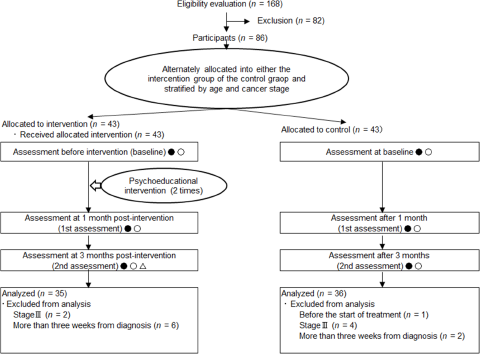
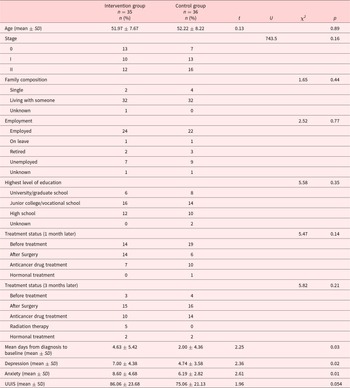
Figure 1 shows the procedure for managing the participants. Of the 43 participants each in the intervention and control groups, we excluded, first, 1 control group member who had already started treatment at BL and, second, 6 intervention group participants and 2 control group participants who were more than 3 weeks from diagnosis to reduce variability in days from diagnosis to BL. Furthermore, because of the large differences in survival by stage (Editorial board of the cancer statistics in Japan 2023), we excluded 2 intervention group participants and 4 control group participants who were finally diagnosed with stage III. Finally, analysis was performed on 35 participants in the intervention group and 36 in the control group. Table 1 lists the basic attributes of each participant in the intervention and control groups pre-intervention. Differences between the 2 groups were confirmed on days of diagnosis to BL and pre-intervention HADS. It was confirmed that there was no significant difference between the 2 groups in terms of the frequency of treatment content and the pre-intervention UUIS score.
Flow chart of research participation and procedures: closed circles, HADS; open circles, UUIS; open triangle, comments.

Basic attributes of participants

Hospital Anxiety and Depression Scale
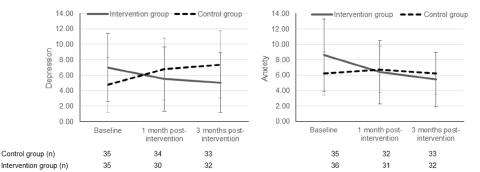
Figure 2 shows changes in psychological distress over the 3 time points. The 2 group × 3 time points MMRM analysis on depression and anxiety confirmed interactions for both (F (2, 128.63) = 12.49, p = 0.00 and F(2, 125.39) = 12.27, p = 0.00, respectively). The results of Bonferroni multiple comparison test showed that depression in the intervention group was significantly lower at 1 month (mean difference [MD] = 1.51, 95% confidence interval [CI] = 0.45 to 2.57, p = 0.00) and 3 months post-intervention (MD = 1.81, 95% CI = 0.73 to 2.88, p = 0.00) (effect size d = − 0.58 at 3 months) compared to the BL. Meanwhile, in the control group, depression was higher at 3 months post-intervention compared to the BL (MD = −2.67, 95% CI = −4.81 to −0.53, p = 0.00).
Mixed models repeated measures on depression and anxiety scores at 3 time points.

With regard to anxiety, the Bonferroni multiple comparison test results showed that it was significantly lower for the intervention group 1 month (MD = 2.03, 95% CI = 0.90 to 3.16, p = 0.00) and 3 months post-intervention (MD = 3.01, 95% CI = 1.90 to 4.13, p = 0.00) (effect size d = − 0.25 at 3 months) compared to the BL. However, for the control group, no significant difference was observed pre- and post-intervention (p = 0.50).
Universal Uncertainty in Illness Scale
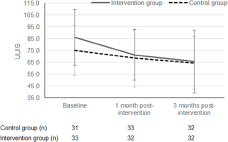
This study examined the effectiveness of the intervention on uncertainty surrounding the disease by performing an MMRM on the UUIS (Figure 3). The result confirmed an interaction for the UUIS (F(2, 120.35) = 5.66, p = 0.00). The multiple-comparison result showed that the scores of the intervention group were significantly lower at 1 month (MD = 17.19, 95% CI = 9.80 to 24.57, p = 0.00) and 3 months post-intervention (MD = 21.68, 95% CI = 14.14 to 29.23, p = 0.00) (effect size d = 0.05 at 3 months) compared to the BL; however, no significant difference was observed pre- or post-intervention at the same periods for the control group (p = 0.07).
Mixed models repeated measures on Universal Uncertainty in Illness Scale (UUIS) at 3 time points.

Subjective experience
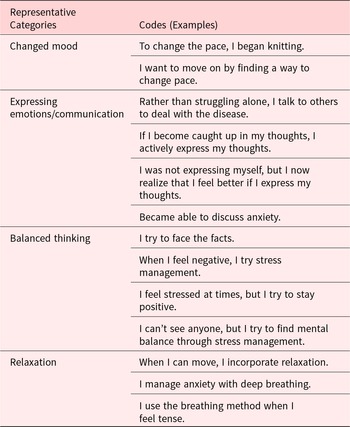
Of the 35 participants in the intervention group, qualitative analysis was conducted on 17 participants, excluding 2 who did not respond at 3 months post-intervention and 16 who did not describe their thoughts on psychoeducation. Table 2 shows the category names (%) and representative code names. Category names are denoted by < > and code names by []. Qualitative analysis of comments provided 3 months post-intervention generated 26 codes, which were then summarized into 6 categories: <Changed mood>, <Expressing emotions/communication>, <Balanced thinking>, <Relaxation>, <Stress management>, and <Others>.
Participants’ comments on their intervention experience

Discussion
We confirmed that video-based psychoeducation on covering stress management and relaxation techniques, at the early pretreatment stage, was effective for patients with breast cancer.
First, MMRM analysis demonstrated significant changes in depression and anxiety scores 1 and 3 months after the psychoeducational intervention; the intervention group showed a significant reduction in depression and anxiety scores compared to the control group. Based on Cohen’s criteria (Cohen Reference Cohen1988), the effect sizes were moderate for depression and small for anxiety. Previous studies have reported the effectiveness of psychoeducational interventions that include stress management and relaxation in alleviating depression and anxiety in patients with breast cancer (Antoni et al. Reference Antoni, Moreno and Penedo2023; Milanti et al. Reference Milanti, Metsälä and Hannula2016), and the present results also support these findings. Numerous studies of psychoeducational interventions to reduce psychological distress among patients with breast cancer have been conducted during hospitalization and posttreatment (Lyu and Siah et al. Reference Lyu, Siah and Lam2022; Skrabal Ross et al. Reference Skrabal Ross, Gunn and Olver2020; Ye et al. Reference Ye, Du and Zhou2018). In the present study, however, we demonstrated the effectiveness of implementing psychoeducational intervention to alleviate psychological pain in patients with breast cancer at an early stage, from definitive diagnosis before treatment. The literature has also reported that patients with breast cancer experience psychological distress, such as depression and anxiety, from their initial examination (Fortin et al. Reference Fortin, Leblanc and Elgbeili2021). This reinforces the importance of the timing of the intervention performed in this study. Implementing this study’s video-based psychoeducational intervention, instead of in-person sessions, could be useful for medical facilities facing human resource challenges. In addition, patients diagnosed with breast cancer are likely to experience psychological distress due to emotional suppression, which suggests the need for psychological support for suitable emotional expression (Karimzadeh et al. Reference Karimzadeh, Rahimi and Goodarzi2021). In this study, the importance of expressing their emotions and assertion was emphasized through video-based psychoeducation, and it is assumed that participants in the intervention group experienced decreased depression and anxiety by actively adopting emotional expression as a form of self-management. Furthermore, it has been shown that cognitive reframing (Serrat et al. Reference Serrat, Albajes and Navarrete2022) and relaxation (Felix et al. Reference Felix, Ferreira and Oliveira2018; Gould et al. Reference Gould, Kok and Ma2019) could alleviate depression and anxiety through video-based stress management for patients. We found that participants commented on 〈Expressing emotions/communication〉, 〈Balanced thinking〉, and 〈Relaxation〉. Thus, it is speculated that learning the stress-coping strategies, including expressing emotions/assertion, cognitive reframing, and relaxation, as self-management methods at the early stage and incorporating them into subsequent therapy alleviated depression and anxiety in the intervention group. This indicates the importance of stress management techniques focused on emotional expressions, cognitive reframing and relaxation when implementing early-stage psychoeducational interventions in patients with breast cancer.
Second, regarding the effectiveness of the intervention on uncertainty, notable uncertainty scores were observed 1 and 3 months after the psychoeducational intervention, compared with the control group; the intervention group showed considerable recovery from uncertainty. Uncertainty has been found to exist at every period from diagnosis to treatment and posttreatment (Zhang Reference Zhang2017). However, most interventions (Dawson et al. Reference Dawson, Madsen and Dains2016; Hong et al. Reference Hong, Lee and Lee2022; Schulman-Green and Jeon Reference Schulman-Green and Jeon2017) on uncertainty for patients with cancer have been performed after the start of treatment. In the current study, however, we conducted the intervention 3 weeks after diagnosis was confirmed and before the start of treatment to determine its effectiveness. In addition, reducing uncertainty in patients by cognitive reframing (Zhang et al. Reference Zhang, Kwekkeboom and Kim2020) and managing uncertainty in patients has proven to be beneficial (Etkind and Koffman Reference Etkind and Koffman2016). In our study, the cognitive behavioral strategies (such as cognitive reconstruction incorporated into psychoeducation) may have helped in correcting negative cognitive distortions about the stress of having the illness. A systematic review by Langmuir et al. (Reference Langmuir, Chu and Sehabi2023) showed that the feeling of uncertainty in patients with cancer increases the need for information and communication. Furthermore, Guan et al. (Reference Guan, Qan’ir and Song2021) confirmed the positive intervention effects of interventions that include information for patients with cancer about illness, treatment, etc., on illness uncertainty. While explanations and information in these studies mainly refer to medical knowledge, the present study placed emphasis on the psychological dimension, focusing on emotional expression and mood changes. This explains the reduced effectiveness of the stress management and relaxation-focused psychoeducational intervention implemented in the present study. This point requires further study in the future.
Recently, the use of videos for psychoeducational interventions has received increased attention as an approach to minimize disparities between medical service providers and geographic barriers (Serrat et al. Reference Serrat, Albajes and Navarrete2022). In addition to psychological issues and mental health status, the assessment of the physical health and financial status of patients with cancer is important. Adopting an interdisciplinary approach is therefore essential for providing comprehensive support (Hong et al. Reference Hong, Lee and Lee2022). The present study is expected to help deliver comprehensive and interdisciplinary support to patients and regions suffering from medical inequities.
Limitations of the study and prospects for future research
In this study, frequency of stages and treatment contents of the participants were not significantly different between the intervention and control groups. However, differences in psychological distress should be further examined in the future. In addition, this study was conducted at a single facility and had a limited number of participants; thus, in the future, it is desirable to increase the number of facilities and consider the effects of treatment content, stage, etc.
Acknowledgments
The authors thank all the participants who took part in this study.
Funding
This research received no specific grant from any funding agency, commercial, or not-for-profit sectors.
Competing interests
The authors declare none.
Ethical approval
The Kitasato University School of Medicine and Hospital Institutional Review Board provided approval for this study protocol (C19-157).