Introduction
With the rapid development of the direct-planting mode of rice, pond lovegrass [Eragrostis japonica (Thunb.) Trin.] has gradually become one of the most harmful weeds in addition to barnyardgrass [Echinochloa crus-galli (L.) P. Beauv.] and Chinese sprangletop [Leptochloa chinensis (L.) Nees] in rice fields in recent years, resulting in a significant loss of crop yield (Xu et al. Reference Xu, Lu, Wang, Li, Yao and Gao2020). Eragrostis japonica is distributed in Henan, Anhui, Jiangsu, Zhejiang, Jiangxi, Hubei, Fujian, Guangdong, Guangxi, Hainan, Taiwan, Sichuan, Guizhou, and Yunnan provinces in China, as well as in Africa, North America, and South America (Flora of China Editorial Committee 2016; USDA-NRCS 2016). Yet little research has been conducted on E. japonica, especially in terms of herbicide control.
Since acetolactate synthase (ALS)-inhibiting herbicides were popularized and used, they have been the leading agents for the control of annual weeds in rice fields. Penoxsulam, the ALS-inhibiting herbicide most commonly used in rice fields, has a wide herbicidal spectrum and good control effect on various weeds (Jabusch and Tjeerdema Reference Jabusch and Tjeerdema2005). However, in some areas, penoxsulam has a poor control effect on E. japonica in rice fields (Xu et al. Reference Xu, Lu, Wang, Li, Yao and Gao2020). It has not been clearly reported or determined whether E. japonica has developed resistance to penoxsulam or whether it is naturally resistant (or tolerant) to penoxsulam. Herbicide resistance refers to the heritable ability of a plant biotype to survive and reproduce under the wild-type lethal-dose treatment due to the selective pressure of long-term and widespread use of herbicides or artificial genetic manipulation, also known as acquired resistance (Qiang et al. Reference Qiang, Ni, Jin and Song2008). Herbicide tolerance refers to the heritable ability of a plant to naturally tolerate herbicide treatment and the ability to survive and reproduce after herbicide treatment without selection or genetic manipulation, also known as natural resistance (Price et al. Reference Price, Hill and Allard1983; Qiang et al. Reference Qiang, Ni, Jin and Song2008). Herbicide tolerance usually refers to the differences in herbicide susceptibility between species, while herbicide resistance usually refers to the development of a decreased response to a herbicide in a population within a species (Pantone et al. Reference Pantone, Larsen and Williams1988). Notably, when weeds are tolerant to a herbicide, no weed biotypes are sensitive to the herbicide (Wang et al. Reference Wang, Li, Lv, Lou and Dong2013). It has thus become an important task for researchers to screen and monitor weeds for herbicide tolerance (or natural resistance) over time and to study the mechanisms of herbicide tolerance to guide growers to use herbicides rationally and control weeds scientifically.
The herbicide tolerance of weeds, similar to their herbicide resistance, is mainly caused by differences in herbicide target enzymes, the enhancement of metabolic capacity, and the isolation and shielding of herbicides (Wang et al. Reference Wang, Li, Lv, Lou and Dong2013, Reference Wang, Li, Lv, Zhu, Lou and Dong2014). Previous studies have suggested that two main mechanisms are involved in resistance to ALS inhibitors: target-site resistance (TSR) and non–target site resistance (NTSR) (Yu and Powles Reference Yu and Powles2014). TSR is conferred by (1) the increasing intrinsic activity of the herbicide target protein that compensates for the herbicide inhibitory action, (2) the change in herbicide target protein genes in the nucleotide sequence, or (3) an increase in gene expression (Massa et al. Reference Massa, Krenz and Gerhards2011; Yu et al. Reference Yu, Han, Vila-Aiub and Powles2010). To date, researchers have identified 29 amino acid substitutions at nine conserved positions in the ALS gene (Fang et al. Reference Fang, Yang, Zhao, Chen and Dong2022). These positions are Ala-122, Pro-197, Ala-205, Phe-206, Asp-376, Arg-377, Trp-574, Ser-653, and Gly-654 (numbered on the basis of the corresponding sequence of Arabidopsis thaliana) (Fang et al. Reference Fang, Yang, Zhao, Chen and Dong2022; Yu and Powles Reference Yu and Powles2014). In contrast, NTSR is less understood due to its complexity and unpredictability (Yu and Powles Reference Yu and Powles2014). Reduced penetration, impaired translocation, and enhanced metabolism that reduce the dose of herbicide binding to the target protein are three mechanisms for NTSR, with metabolic resistance being the most important (Délye Reference Délye2013). Enzymes related to metabolic resistance to herbicides have been identified, including cytochrome P450 monooxygenases (CytP450s), glutathione S-transferases (GSTs), glycosyltransferases, ATP-binding cassette transporters, oxidases, esterases, hydrolases, and peroxidases (Délye Reference Délye2013). A variety of enzymes are involved in NTSR, of which CytP450s and GSTs play important roles in the metabolic detoxification of herbicides (Cai et al. Reference Cai, Chen, Wang, Gao, Xiang and Dong2022; Ma et al. Reference Ma, Evans and Riechers2016; Yuan et al. Reference Yuan, Tranel and Stewart2007). Piperonyl butoxide (PBO), malathion, 4-chloro-7-nitro-2,1,3-benzoxadiazole, and other metabolic enzyme inhibitors (Fang et al. Reference Fang, Zhang, Liu, Yan, Li and Dong2019b; Feng et al. Reference Feng, Gao, Zhang, Dong and Li2016; Ma et al. Reference Ma, Evans and Riechers2016; Wang et al. Reference Wang, Li, Lv, Lou and Dong2013; Zhang et al. Reference Zhang, Wu, Xu, Gao, Zhang and Dong2017), all of which inhibit the activity of metabolic enzymes toward herbicides, thereby overcoming resistance, have been used to detect resistance resulting from herbicide metabolism. Currently, NTSR is considered the predominant mechanism for resistance to acetyl CoA carboxylase (ACCase) and ALS inhibitors in many monocots (Délye et al. Reference Délye, Gardin, Boucansaud, Chauvel and Petit2011).
Both E. japonica and E. crus-galli are annual malignant Gramineae weeds in rice fields and are among the control objects registered on the label for penoxsulam (Fang et al. Reference Fang, Zhang, Liu, Yan, Li and Dong2019b; Xu et al. Reference Xu, Lu, Wang, Li, Yao and Gao2020). Penoxsulam could effectively control E. crus-galli in practical application, but why was it unable to effectively control E. japonica? To answer this question, this study aimed to (1) identify whether E. japonica is tolerant to penoxsulam, (2) explore the target-site basis of this penoxsulam tolerance, and (3) confirm the role of metabolism in E. japonica in response to penoxsulam.
It should be noted that this was a comparative study of the tolerance mechanisms of E. japonica and E. crus-galli. Because little research has been done on herbicide tolerance, the general practice is that if there is no sensitive population in the same weed species that is tolerant to an herbicide, another weed species that is sensitive to the same herbicide and has a high herbicide target protein gene homology can be selected as a control (Wang et al. Reference Wang, Li, Lv, Lou and Dong2013, Reference Wang, Li, Lv, Zhu, Lou and Dong2014; Yu et al. Reference Yu, Friesen, Zhang and Powles2004).
Materials and Methods
Plant Materials and Herbicide
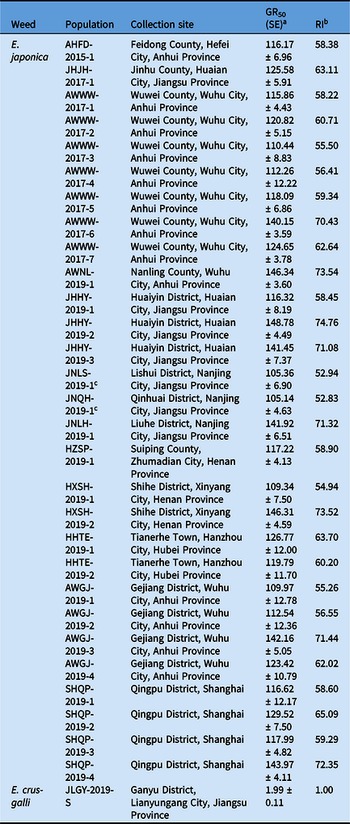
The weed species that were used are listed in Table 1. Partial E. japonica populations were collected from major rice-producing areas in China with regional representation, where the application of penoxsulam (Clipper 25 OD) at the recommended dose (15 to 30 g ai ha−1) has failed to control this weed since 2015. The rest of E. japonica populations were collected from fallow fields where penoxsulam had never been applied. According to the pretest (data not shown), none of the E. japonica populations were sensitive to penoxsulam. Therefore, a sensitive E. crus-galli population JLGY-2019-S, whose herbicide target protein gene homology was as high as 91% compared with E. japonica, was selected as a control in all biological and molecular studies (Wang et al. Reference Wang, Li, Lv, Lou and Dong2013, Reference Wang, Li, Lv, Zhu, Lou and Dong2014; Yu et al. Reference Yu, Friesen, Zhang and Powles2004). All seeds were collected by hand, air-dried in the shade, and stored in paper bags at 4 C until use. Penoxsulam oil dispersion (Dow AgroSciences, Nantong, Jiangsu, China, 226000) of 25 g L−1 was used.
Sensitivity of 29 Eragrostis japonica populations and one Echinochloa crus-galli population to penoxsulam.

a GR50 refers to the effective dose of herbicide causing 50% inhibition of fresh weight and is indicated as grams of active ingredient per hectare (g ai ha−1). Data are the means of two experiments.
b RI is the relative tolerance index: ratio of GR50 values relative to the susceptible E. crus-galli population (JLGY-2019-S). The recommended field dose of penoxsulam is 15–30 g ai ha−1.
c Populations with no prior herbicide exposure.
Whole-Plant Dose–Response Experiment with Penoxsulam
Greenhouse experiments were conducted to evaluate the penoxsulam sensitivity of E. japonica populations and an E. crus-galli population. Twenty seeds from each population were sown in plastic pots (9-cm diameter by 10-cm height) filled with a 2:1 (w/w) mixture of sand and pH 5.6 organic matter and grown in incubators at 30 /25 C (light/dark temperature) with a 12-h light/12-h dark cycle, a light intensity of 8,000 lux, and 85% relative humidity. The seedlings were thinned to 15 plants per pot before herbicide treatment. At the 3- to 4-leaf stage, penoxsulam was applied using a laboratory sprayer (machine model: 3WP-2000, Nanjing Research Institute for Agricultural Mechanization, National Ministry of Agriculture of China, Nanjing, China) equipped with a flat-fan nozzle delivering 280 L ha−1 at 230 kPa. Based on a preliminary experiment (data not shown), penoxsulam was applied at 0, 15, 30, 60, 120, and 240 g ha−1 to E. japonica and at 0, 0.94, 1.88, 3.75, 7.5, and 15 g ha−1 to E. crus-galli. The treated plants were returned to the incubators and cultured as described earlier. The fresh aboveground biomass was determined after 3 wk and expressed as a percentage of the untreated control (Feng et al. Reference Feng, Gao, Zhang, Dong and Li2016; Gao et al. Reference Gao, Yu, Pan, Wu and Dong2017). This experiment was conducted twice using a completely randomized design with four replicates.
ALS Activity Assay In Vitro
Plant materials for subsequent molecular experiments from a sensitive E. crus-galli population (JLGY-2019-S) and the most tolerant population of E. japonica (JHHY-2019-2) were prepared based on the results of the dose–response bioassay with penoxsulam (for convenience, the population name will be used hereafter). The response of ALS to penoxsulam was determined using crude enzyme extracts. The soil type and growth conditions were the same as those described earlier. Seedlings at the 3- to 4-leaf stage from JHHY-2019-2 and JLGY-2019-S were used for in vitro assays of ALS activity as described by Yu et al. (Reference Yu, Friesen, Zhang and Powles2004), with slight modifications as follow: 4 g of leaf blades without the petiole were harvested from each population, powdered in liquid nitrogen, and suspended in 4.5 ml of enzyme extraction buffer (10 mM sodium pyruvate, 1 mM MgCl2, 1 mM thiamine pyrophosphate, and 10 μM flavin adenine dinucleotide [FAD] in 100 mM potassium phosphate buffer [pH 7.5]) to prepare crude enzyme extracts. The protein concentration extracted from the leaf blades was measured according to Bradford (Reference Bradford1976) using bovine serum albumin (BSA) as a standard. Using enzyme assay buffer (100 mM potassium phosphate buffer [pH 7.5], 200 mM sodium pyruvate, 20 mM MgCl2, 2 mM thiamine pyrophosphate, 20 μM FAD, and 1 mM dithiothreitol [DTT]), the concentration of the protein extracts was normalized to 0.30 mg ml−1. Each dark reaction contained 100 μl of protein extract and 100 μl of ALS inhibitor, which was achieved using a series of concentrations of penoxsulam at 0.001, 0.01, 0.1, 1, 10, 100, 1,000, and 10,000 μM. A no-herbicide treatment was included for comparison (replacing penoxsulam with potassium phosphate buffer). Acetolactate was formed by incubating the mixtures at 37 C for 60 min. The reaction was stopped by the addition of 8 μl of 6 N H2SO4. The mixture was held at 60 C for 30 min to convert acetolactate to acetoin until the addition of 100 μl of 0.55% (w/w) creatine solution and 100 μl of 5.5% (v/v) α-naphthol in 5 N NaOH. Acetoin solution of a certain concentration was made with pure acetoin and H2O, then an equal gradient dilution was performed, and in order to exclude the influence of creatine and α-naphthol, 100 μl of 0.55% (w/w) creatine solution and 100 μl of 5.5% (v/v) α-naphthol in 5 N NaOH were also added. Under the same total volume conditions as the above reaction solution, an acetoin standard curve was made with the acetoin concentration as the abscissa and the optical density at 530 nm (OD530) value as the ordinate. ALS activity was monitored colorimetrically (530 nm) on a microplate photometer (Thermo Fisher, Shanghai, China, 200000) by measuring acetoin production. According to the concentration of acetoin generated (convert OD530 to acetoin concentration based on the acetoin standard curve), ALS activity at a series of concentrations of penoxsulam was expressed as a percentage of the no-herbicide control treatment. The assay was performed twice using independent enzyme extractions, with three replicates per herbicide concentration.
ALS Gene Cloning and Sequencing
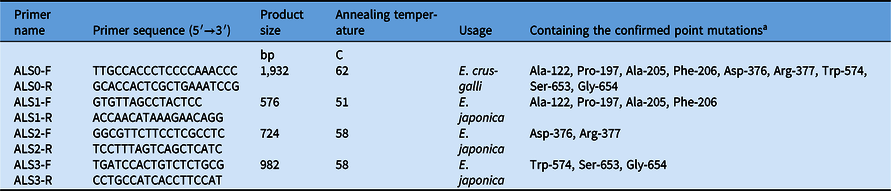
Young shoot tissues obtained from individual plants at the 3- to 4-leaf stage were used for DNA extraction using a Plant Genomic DNA kit (Tiangen Biotech, Beijing, China) according to the manufacturer’s instructions. Primers (Table 2) were designed using Primer Premier v. 5.0 to amplify DNA fragments encompassing all previously identified resistance mutation sites in the ALS gene. ALS gene fragments of the susceptible population JLGY-2019-S were amplified on the basis of previous study (Fang et al. Reference Fang, Liu, Zhang, Li and Dong2019a). As information regarding the ALS gene of E. japonica was not available, three pairs of primers intended to amplify regions of the ALS gene in JHHY-2019-2 were designed based on the nucleotide sequences of ALS enzymes from the following species (respective GenBank nucleotide accession numbers included in parentheses): blackgrass (Alopecurus myosuroides Huds.) (AJ437300.2), E. crus-galli (MH013497), E. crus-galli var. crus-galli (LC006061.1), E. crus-galli var. formosensis (LC006063.1), rice barnyardgrass [Echinochloa phyllopogon (Stapf) Koso-Pol.] (AB636580.1), cheatgrass (Bromus tectorum L.) (AF488771), and Italian ryegrass [Lolium perenne L. ssp. multiflorum (Lam.) Husnot] (AF310684) (National Center for Biotechnology Information, Bethesda, MD, http://www.ncbi.nlm.nih.gov).
Primers used to amplify the acetolactate synthase (ALS) gene fragments of Echinochloa crus-galli and Eragrostis japonica.

a Amino acid sequence positions in the ALS fragment refer to the full-length sequence of ALS from Arabidopsis thaliana (GenBank accession no. NM_114714).
A polymerase chain reaction (PCR) was performed as described by Xu et al. (Reference Xu, Zhu, Wang, Li and Dong2013). The PCR products were purified using a TaKaRa MiniBEST agarose gel DNA extraction kit (TaKaRa Biotechnology, Dalian, China) and then cloned into a pMD19-T vector (TaKaRa Biotechnology). Plasmids containing the fragment insertion were bidirectionally sequenced using GenScript Biotechnology (Nanjing, China). Ten plants each of JHHY-2019-2 and JLGY-2019-S were selected for gene cloning. At least 12 transformed clones from each plant were sequenced to obtain ALS gene sequences. The sequences were aligned and compared using the BioEdit Sequence Alignment Editor v. 7.2.5 (Tom Hall, Carlsbad, CA, USA). The Basic Local Alignment Search Tool (BLAST) procedure within the NCBI database was used to verify the accuracy of the obtained sequences.
Determination of ALS Expression by RT-qPCR
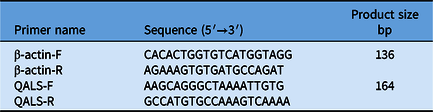
Real-time quantitative PCR (RT-qPCR) was used to measure the expression level of ALS gene relative to the housekeeping gene β-actin in JHHY-2019-2 and JLGY-2019-S. Plants were cultivated and treated with 7.5 g ha−1 penoxsulam, as previously described. Leaf tissue (0.1 g per population per time point) was harvested at 0, 1, 3, 5, and 7 d after treatment and flash-frozen in liquid nitrogen. RNA was extracted using an RNA Simple Total RNA Kit (Tiangen Biotech) according to the manufacturer’s instructions. After RNA extraction, cDNAs were synthesized using HiScript II Q RT SuperMix for qPCR (+ gDNA wiper; Vazyme Biotech, Nanjing, China). Based on the ALS nucleotide sequences of JHHY-2019-2 and JLGY-2019-S obtained earlier, RT-qPCR primers (Table 3) were designed at the highly conserved region. The β-actin gene was selected as the endogenous housekeeping gene for RT-qPCR (Fang et al. Reference Fang, Yang, Zhao, Chen and Dong2022; Li et al. Reference Li, Wu, Cai, Wang, Zhao and Wu2013), using its primers (Table 3). All primers were assessed for specific PCR amplification, and no PCR products were observed in the negative controls. RT-qPCR was performed according to a previously reported program (Fang et al. Reference Fang, Zhang, Liu, Yan, Li and Dong2019b). Fold changes in gene expression were calculated using the 2−ΔΔCt method (Livak and Schmittgen Reference Livak and Schmittgen2001). To exclude the influence of inherent differences between JHHY-2019-2 and JLGY-2019-S, ALS expression was displayed based on the Ct values relative to each population at 0 d (without penoxsulam treatment) (Fang et al. Reference Fang, He, Liu, Li and Dong2020, Reference Fang, Yang, Zhao, Chen and Dong2022). Three biological replicates were used, and the experiments were repeated at least twice.
Information for primers used in the real-time quantitative PCR (RT-qPCR) study.

Synergistic Effect of Penoxsulam and Metabolic Inhibitors on Weed Growth
Seeds from JHHY-2019-2 and JLGY-2019-S were cultured as described earlier. At the 3- to 4-leaf stage, weeds were treated with three CytP450 inhibitors (1-aminobenzotriazole [ABT], PBO, and malathion), one GST inhibitor (4-chloro-7-nitro-2,1,3-benzoxadiazole [NBD-Cl]), penoxsulam, ABT with penoxsulam, PBO with penoxsulam, malathion with penoxsulam, and NBD-Cl with penoxsulam. A pretest showed that these metabolic inhibitors had no adverse effects on seedling growth (data not shown). The applied doses and methods for ABT (1,000 g ai ha−1) (Zhang et al. Reference Zhang, Wu, Xu, Gao, Zhang and Dong2017), PBO (4,200 g ai ha−1) (Wang et al. Reference Wang, Li, Lv, Lou and Dong2013), malathion (1,000 g ai ha−1) (Wang et al. Reference Wang, Li, Lv, Lou and Dong2013), and NBD-Cl (270 g ai ha−1) (Ma et al. Reference Ma, Evans and Riechers2016) have been previously reported. Malathion, ABT, and PBO were first applied 1 h before herbicide application, and NBD-Cl was first applied 48 h before herbicide application. Subsequently, penoxsulam was administered to JHHY-2019-2 and JLGY-2019-S at the doses described in the whole-plant dose–response experiment with penoxsulam. Fresh aboveground biomass was determined after 3 wk and expressed as a percentage of the no-herbicide treatment. The experiments were conducted twice using a completely randomized design with four replicates.
Determination of Metabolic Enzymes Activity In Vivo
Based on the results of the dose–response bioassay with metabolic inhibitors, the activities of NADPH-dependent cytochrome P450 reductase toward penoxsulam in JHHY-2019-2 and JLGY-2019-S were determined in vivo according to previous studies (Wang et al. Reference Wang, Li, Lv, Lou and Dong2013; Zimmerlin and Durst Reference Zimmerlin and Durst1990). The seeds were planted in a plastic basin (5-cm radius, 10-cm height) filled with quartz sand, and the basin was wrapped with foil paper to ensure complete darkness, placed in a no-light incubator with a relative humidity of 85% at 25/30 C for 12 h/12 h, watered (no light exposure), and cultured for approximately 10 d. At the 2-leaf stage, a laboratory sprayer equipped with a flat-fan nozzle (machine model: 3WP-2000, Nanjing Research Institute for Agricultural Mechanization), delivering 280 L ha−1 at 230 kPa and 291 mm s−1 with a 30-ml carrier volume, was used to spray the stems and leaves; the dose of penoxsulam sprayed was one-fourth the recommended label rate in the field: 7.5 g ha−1. At 1 d after spraying, the aboveground parts of weeds were cut, 2 g was taken for each treatment, and untreated weeds were used as controls. After harvest, the aboveground tissue was soaked in 10 mM Na2S2O4, dried with absorbent paper, placed in liquid nitrogen, and stored at −80 C until use. The activity of CytP450 declines as the age of seedling tissues increases (Frear et al. Reference Frear, Swanson and Thalacker1991). Consequently, for comparative purposes, all excised shoot tissues needed to be of the same or similar physiological age.
Aboveground tissue was then ground with liquid nitrogen; 0.10 g polyvinylpolypyrrolidone (PVPP) was added before grinding. The finely ground powder was transferred to a new precooled mortar, and 6.0 ml enzyme extraction buffer was added (0.10 M pH 7.5 phosphoric acid buffer, containing 10% glycerol [v/v], 1 g L−1 BSA, 5 mM DTT, 1 mM Li2CO3). After being ground evenly, it was kept at 4 C for 5 min and then filtered through gauze. Then, the liquid was transferred into a 10-ml centrifuge tube. After centrifugation at 10,000 × g for 20 min at 4 C, the supernatant was taken and added to a new centrifuge tube. After centrifugation at 100,000 × g for 80 min at 4 C, the supernatant was discarded and the precipitate was retained. The precipitate was resuspended in 1ml buffer (0.1 M pH 8.0 phosphoric acid buffer, containing 10% glycerol and 1.5 mM β-mercaptoethanol) and then stored in a refrigerator at −70 C for later use. All the above operations were carried out under temperatures of 0 to 4 C (Mcfadden et al. Reference Mcfadden, Frear and Mansager1989; Yun et al. Reference Yun, Yogo, Miura, Yamasue and Fischer2005).
The activity of NADPH-dependent cytochrome P450 reductase was determined by a modification of the method used by Feng et al. (Reference Feng, Houseman and Downe1992) and Crankshaw et al. (Reference Crankshaw, Hetnarski and Wilkinson1979). The reaction mix contained 50 μl NADPH (1.5 mg ml−1), 1.5 ml of 0.1 M sodium phosphate buffer (pH 7.8, containing 50 μl cytochrome C [5 mg ml−1] and 50 µl microsomal crude enzyme solution) and was mixed immediately to start the reaction. The reaction without enzyme solution was used as a control. The change value of OD550 at 550 nm was recorded for 180 s at room temperature. The amount of cytochrome C reduced was calculated based on OD550; the millimolar extinction coefficient of 21.1 mmol L−1 cm−1 and the protein content of the enzyme solution were calculated according to Feng et al. (Reference Feng, Houseman and Downe1992). It can be used as a standard to measure the activity of NADPH-dependent cytochrome P450 reductase. The experiments were conducted twice with three replicates per treatment.
Data Analysis
After preliminary analysis, all data were subjected to a t-test analysis using SPSS v. 21.0 (SPSS, Chicago, IL, USA). The results showed no significant differences between assay repetitions (t-test, P > 0.05). The data from the whole-plant dose–response experiment with penoxsulam, ALS activity assay in vitro, and synergistic effect of penoxsulam and metabolic inhibitors on weed growth after preliminary analysis (percentage of the no-herbicide treatment) were then pooled and fitted to the four-parameter nonlinear log-logistic regression model (Equation 1) using SigmaPlot v. 14.0 (Systat Software, Chicago, IL, USA) (Cai et al. Reference Cai, Chen, Wang, Gao, Xiang and Dong2022; Fang et al. Reference Fang, Zhang, Liu, Yan, Li and Dong2019b; Liu et al. Reference Liu, Fang, He, Li and Dong2019; Seefeldt et al. Reference Seefeldt, Jensen and Fuerst1995):
 $$y = c + \left( {d - c} \right)/\left\{ {1 + {\rm{exp}}\left[ {b\left( {{\rm{log}}x - {\rm{log}}{x_0}} \right)} \right]} \right\}$$
where y denotes fresh weight of aboveground tissue, expressed as a percentage of the untreated control at herbicide dose x; b is the slope; c is the lower limit; d is the upper limit; and x 0 is the effective dose of herbicide causing 50% inhibition of fresh weight (GR50) with or without metabolic inhibitors or the herbicide dose causing 50% inhibition of ALS activity (IC50). Relative tolerance indices (RIs) were calculated by dividing the GR50 of the tolerant population by that of the susceptible population. Significant differences in the GR50 values and IC50 values, the expression levels, and the activities of NADPH-dependent cytochrome P450 reductase were also subjected to a t-test analysis using SPSS v. 21.0.
Results and Discussion
Sensitivity to Penoxsulam
The results of the whole-plant bioassay confirmed that E. japonica was tolerant to penoxsulam (Table 1). None of the E. japonica populations were sensitive to penoxsulam, even if there was no history of herbicide application. All 29 E. japonica populations displayed similar sensitivity levels to penoxsulam with significantly (t-test, P < 0.01) higher GR50 values (105.14 to 148.78 g ha−1) than the recommended label rate in the field (15 to 30 g ha−1). The GR50 values of E. japonica populations were approximately 52.83- to 74.76-fold significantly higher (t-test, P < 0.01) than those of the susceptible E. crus-galli population (1.99 g ha−1). Thus, the results indicated a high tolerance to penoxsulam in E. japonica.
Growers typically prefer to use a higher dose of a single herbicide to improve weed control; however, for herbicide-tolerant weeds, control cannot be achieved only by increasing a certain dosage because of the plant’s natural insensitivity (Wang et al. Reference Wang, Li, Lv, Lou and Dong2013). There is an urgent need to identify the tolerance of E. japonica to penoxsulam because of the increasing threat posed by this weed. Here, we determined the sensitivity levels of E. japonica populations to penoxsulam and confirmed that E. japonica was tolerant to penoxsulam (Table 1). To our best knowledge, this study is the first report of E. japonica being highly tolerant to penoxsulam.
Target-Site Basis of Penoxsulam Tolerance
Lower ALS Sensitivity to Penoxsulam In Vitro
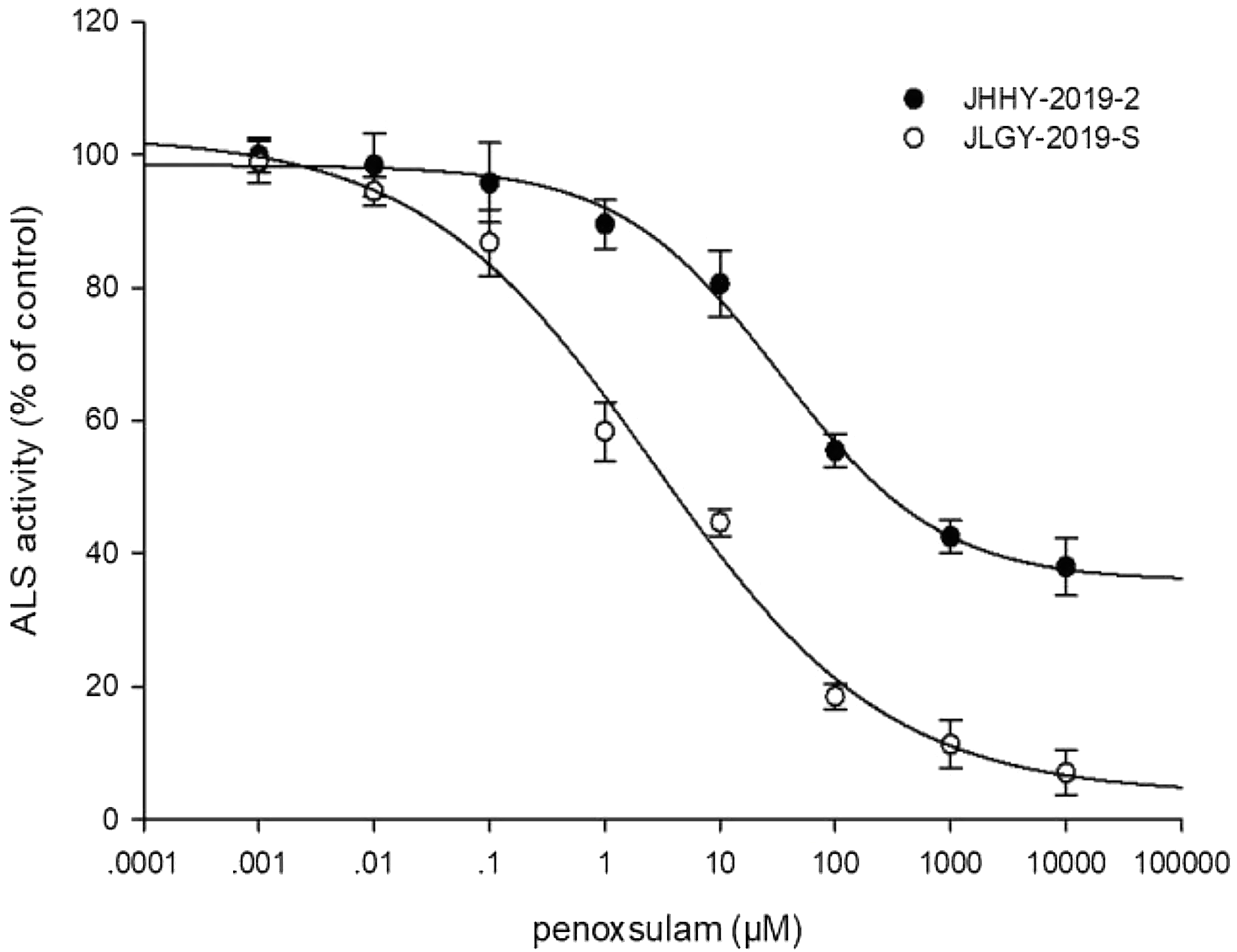
ALS activities in vitro were assayed and expressed as a percentage of the control (Figure 1). The ALS activities of JHHY-2019-2 and JLGY-2019-S were inhibited to different extents, and the inhibition was positively correlated with increasing concentrations of penoxsulam. The ALS of JLGY-2019-S was more sensitive to penoxsulam than that of JHHY-2019-2. At the same time, the penoxsulam concentrations causing 50% inhibition of the ALS activity (IC50) were calculated: the IC50 value of JHHY-2019-2 was 32.88 ± 8.23 μM, which was 12.27-fold significantly higher (t-test, P < 0.01) than that of JLGY-2019-S (2.68 ± 1.21 μM), suggesting that the reduced sensitivity of ALS may be responsible for E. japonica tolerance to penoxsulam.
In vitro acetolactate synthase (ALS) activity of Eragrostis japonica (JHHY-2019-2) and Echinochloa crus-galli (JLGY-2019-S) populations when treated with penoxsulam. ALS activity of the no-herbicide control was set as 100%. Vertical bars represent the mean ± SE.

Target enzymes with reduced sensitivity to herbicides are a common TSR mechanism in weeds, especially for herbicides with clear targets, such as ALS inhibitors, ACCase inhibitors, and the very-long-chain fatty-acid elongase synthesis inhibitors (Cai et al. Reference Cai, Chen, Wang, Gao, Xiang and Dong2022; Fang et al. Reference Fang, Zhang, Liu, Yan, Li and Dong2019b; Gao et al. Reference Gao, Yu, Pan, Wu and Dong2017; Liu et al. Reference Liu, Fang, He, Li and Dong2019; Xu et al. Reference Xu, Zhu, Wang, Li and Dong2013). In the current study, the sensitivity of ALS extracted from E. japonica was 12.27-fold lower than that of the susceptible weed E. crus-galli when treated with penoxsulam (Figure 1). The presence of a lower ALS sensitivity has also been documented in E. phyllopogon (Liu et al. Reference Liu, Fang, He, Li and Dong2019), Japanese foxtail (Alopecurus japonicus Steud.) (Feng et al. Reference Feng, Gao, Zhang, Dong and Li2016), rigid ryegrass (Lolium rigidum Gaudin) (Yu et al. Reference Yu, Han, Vila-Aiub and Powles2010), and flixweed [Descurainia sophia (L.) Webb ex Prantl] (Yang et al. Reference Yang, Deng, Wang, Liu, Li and Zheng2018).
ALS Sequencing and Natural Mutation Identification
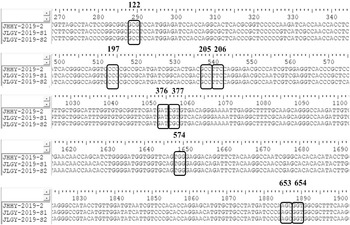
ALS gene fragments of JHHY-2019-2 that encompassed all previously identified resistance mutation sites were amplified, cloned, and sequenced. The assembled ALS gene fragment from JHHY-2019-2 was subjected to a BLAST search in GenBank for verification. The search result showed that it exhibited 91.62%, 91.32%, 86.39%, 85.98%, and 85.65% similarity to the ALS gene of E. crus-galli (MH013497), E. crus-galli var. crus-galli (LC006061.1), B. tectorum (AF488771), A. myosuroides (AJ437300.2), and L. perenne ssp. multiflorum (AF310684), respectively, indicating that we amplified the correct ALS sequence from E. japonica. The ALS gene sequence obtained in this study was the first DNA fragment of E. japonica in the GenBank database and was deposited in the GenBank database with accession no. ON652847 (see Supplementary Material). The ALS gene sequence also exhibited approximately 91% similarity between JHHY-2019-2 and JLGY-2019-S. However, mutations known to confer resistance to ALS inhibitors were not found (Figure 2). Thus, there were no natural mutations in JHHY-2019-2. It should be noted that we also sequenced the ALS gene of other E. japonica populations and obtained the same results (data not shown). Thus, tolerance to penoxsulam in E. japonica may not be related to target-site mutations in the ALS gene sequence.
Sequence alignment of partial acetolactate synthase gene (ALS) from Eragrostis japonica (JHHY-2019-2) and Echinochloa crus-galli (JLGY-2019-S) populations. The boxed codons indicate amino acid sequence positions in the ALS fragment referring to the full-length sequence of ALS from Arabidopsis thaliana (GenBank accession no. NM_114714).

Usually, amino acid mutations in the target protein reduce the binding affinity between the herbicide and target enzyme, resulting in reduced target enzyme sensitivity (Kukorelli et al. Reference Kukorelli, Reisinger and Pinke2013; Mengistu et al. Reference Mengistu, Christoffers and Lym2005; Thiel and Varrelmann Reference Thiel and Varrelmann2014; Yu and Powles Reference Yu and Powles2014). However, in our study, natural mutations in the ALS of E. japonica were not found (Figure 2). A similar situation has been reported for the target enzyme ALS in smallflower umbrella sedge (Cyperus difformis L.) (Merotto et al. Reference Merotto, Jasieniuk, Osuna, Vidotto, Ferrero and Fischer2009). It also has been reported in junglerice [Echinochloa colona (L.) Link] that lower basal 5-enolpyruvylshikimate-3-phosphate synthase (EPSPS) sensitivity can be considered an additional TSR mechanism, and in a lethal glyphosate treatment, this lower sensitivity enabled a population that had no EPSPS mutation to maintain normal growth (Alarcón-Reverte et al. Reference Alarcón-Reverte, García, Watson, Abdallah, Sabaté, Hernández, Dayan and Fischer2015). It was also reported that no difference was found in target enzyme sensitivity between resistant and sensitive populations when there was a gene mutation in the resistant population (Boutsalis et al. Reference Boutsalis, Karotam and Powles1999; Preston et al. Reference Preston, Stone, Rieger and Baker2006). Thus, the lower sensitivity of the herbicide target enzyme was not entirely consistent with the gene mutations.
Relatively Higher ALS Expression Level
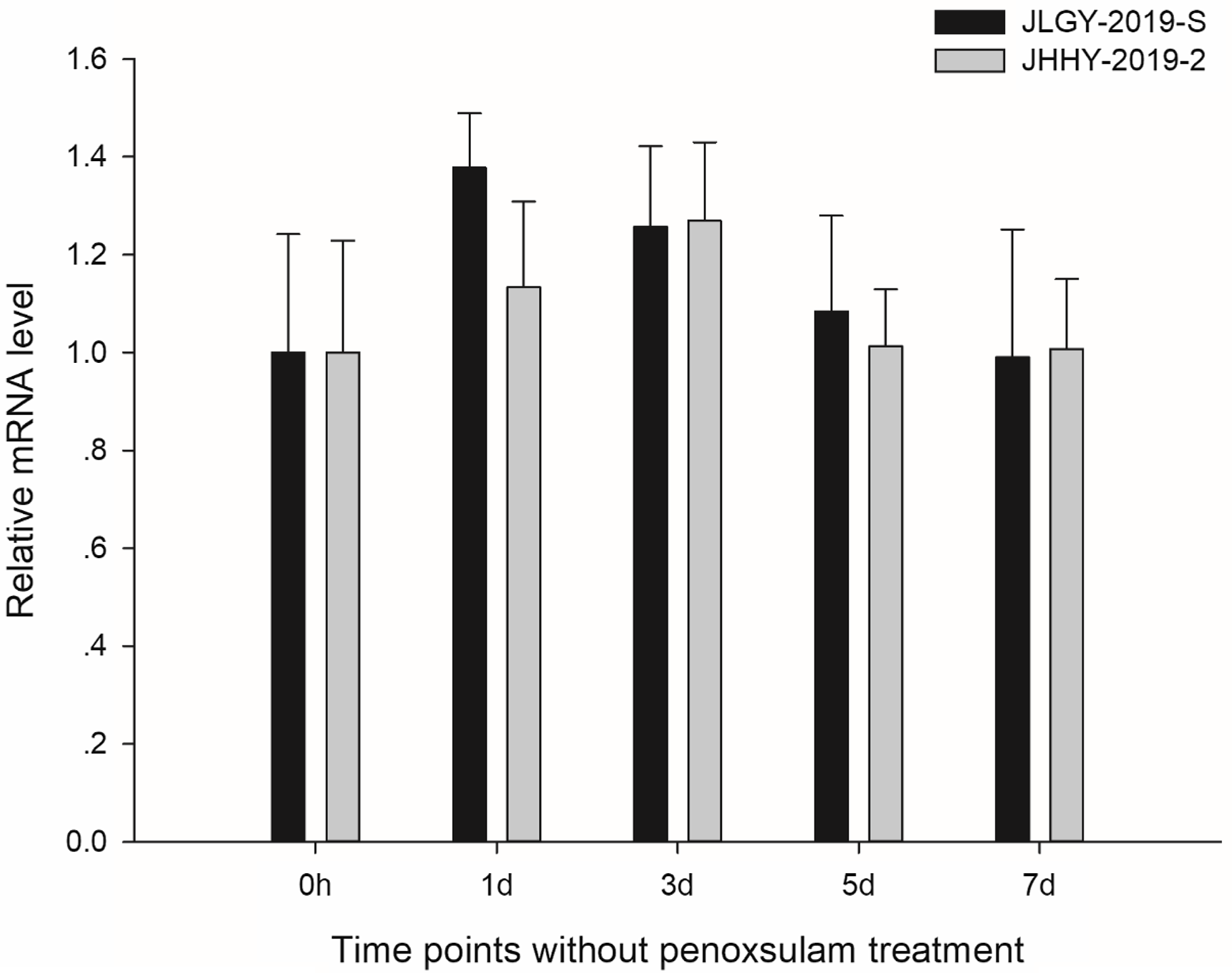
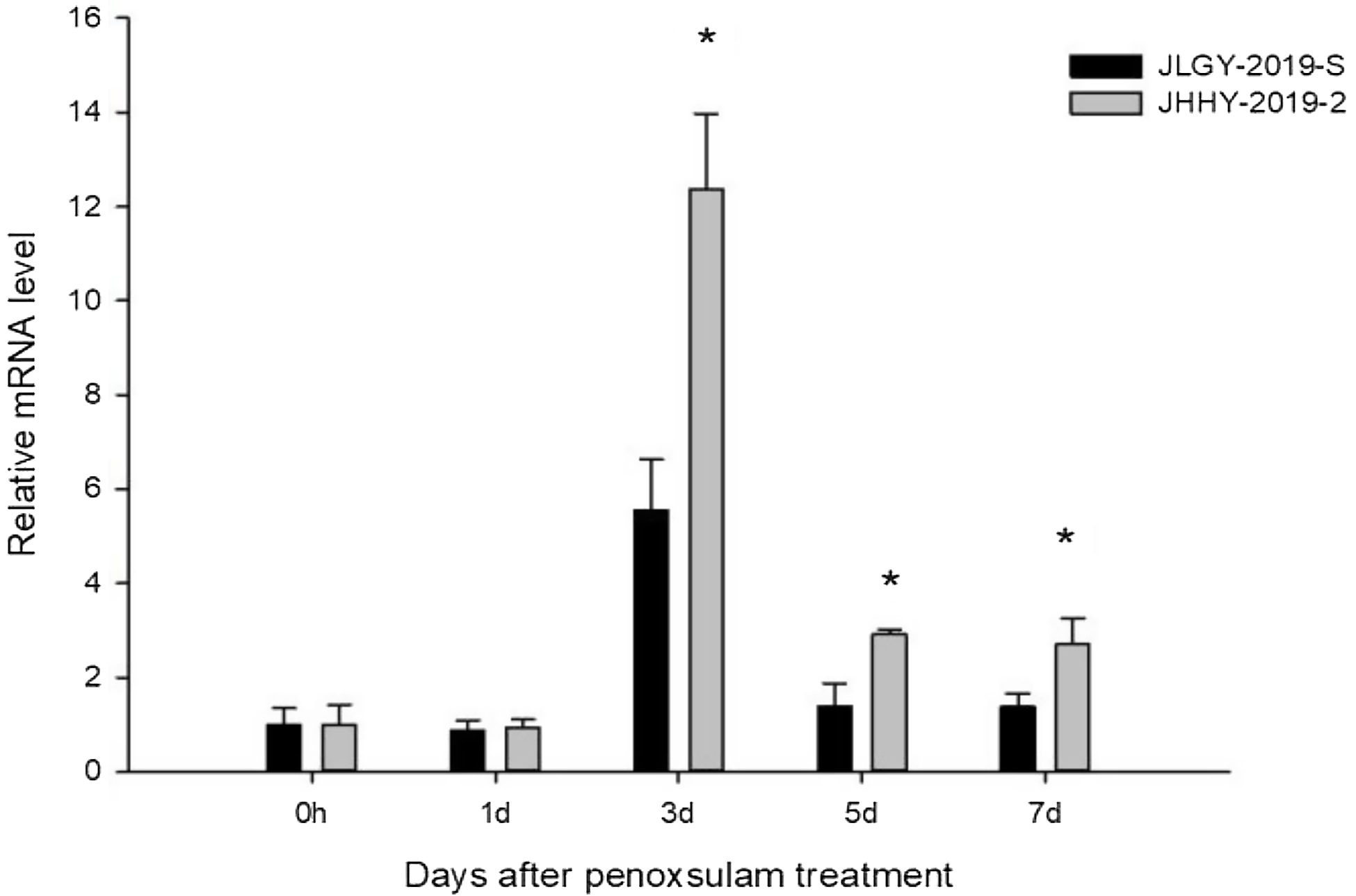
The relative mRNA levels showed the trends in total ALS transcription. Without penoxsulam treatment, the relative ALS expression levels in JHHY-2019-2 and JLGY-2019-S were similar over five sampling time points (t-test, P > 0.05; Figure 3). After penoxsulam treatment, the relative ALS expression levels in JHHY-2019-2 were significantly upregulated (t-test, P < 0.05) by 2.23-, 2.10-, and 1.95-fold at 3, 5, and 7 d after penoxsulam treatment compared with levels in JLGY-2019-S, respectively (Figure 4). Therefore, the relatively higher ALS expression level may be one of the target enzyme mechanisms of penoxsulam tolerance in E. japonica.
Relative mRNA level of ALS gene in Eragrostis japonica (JHHY-2019-2) and Echinochloa crus-galli (JLGY-2019-S) populations without penoxsulam treatment. Vertical bars represent the mean ± SE. No significant difference was found (t-test, P > 0.05).

Relative mRNA level of ALS gene in Eragrostis japonica (JHHY-2019-2) and Echinochloa crus-galli (JLGY-2019-S) populations treated with penoxsulam. An asterisk (*) indicates significant difference (t-test, P < 0.05); standard errors of the mean are shown by vertical bars. Plants were treated with 7.5 g ai ha−1 penoxsulam.

Higher expression levels of target-site genes have also been found to confer herbicide resistance or herbicide tolerance, with reports mainly focusing on ACCase inhibitors, ALS inhibitors, and glyphosate (Fang et al. Reference Fang, Yang, Zhao, Chen and Dong2022; Laforest et al. Reference Laforest, Soufiane, Simard, Obeid, Page and Nurse2017; Lorentz et al. Reference Lorentz, Gaines, Nissen, Westra, Strek, Dehne, Ruiz-Santaella and Beffa2014; Ngo et al. Reference Ngo, Malone, Boutsalis, Gill and Preston2018; Wang et al. Reference Wang, Li, Lv, Zhu, Lou and Dong2014; Zhang et al. Reference Zhang, Feng and Tian2018). In the present study, a higher level of ALS gene expression was found in E. japonica than in E. crus-galli after penoxsulam treatment (Figure 4). It was believed that this higher expression could lead to more protein production to normalize biochemical functions after herbicide treatment (Fang et al. Reference Fang, He, Liu, Li and Dong2020). This may partially explain why E. japonica has become tolerant to penoxsulam. Considering that the expression level of the ALS gene in E. japonica was not particularly high (up to 2.23-fold), the contribution of ALS gene overexpression to tolerance might be limited (Fang et al. Reference Fang, He, Liu, Li and Dong2020).
Metabolic Tolerance Mechanisms
Sensitivity Changes to Penoxsulam with CytP450 Inhibitors
As shown in Table 4, when penoxsulam was applied with NBD-Cl, no significant changes were found in the GR50 of JLGY-2019-S and JHHY-2019-2 compared with the penoxsulam-only treatment (t-test, P > 0.05), which suggests that GSTs are not involved in the penoxsulam tolerance of E. japonica; when penoxsulam was applied with ABT, PBO, or malathion, no significant changes were found in the GR50 of JLGY-2019-S (t-test, P > 0.05), whereas the sensitivity to penoxsulam of JHHY-2019-2 significantly increased by 54.23%, 59.73%, and 55.43%, respectively (t-test, P < 0.05). Therefore, NTSR mediated by CytP450s might be involved in the penoxsulam tolerance of E. japonica.
Sensitivities of Echinochloa crus-galli (JLGY-2019-S) and Eragrostis japonica (JHHY-2019-2) populations to penoxsulam with/without four metabolic inhibitors.

a GR50 refers to the effective dose of herbicide causing 50% inhibition of fresh weight and is indicated as grams of active ingredient per hectare (g ai ha−1).
b RI is the relative tolerance index: ratio of GR50 values relative to the susceptible E. crus-galli population (JLGY-2019-S) at the same treatment. An asterisk (*) indicates significant difference (t-test, P < 0.05).
c Penoxsulam: applied at 0, 15, 30, 60, 120, and 240 g ai ha−1 to JHHY-2019-2 and at 0, 0.94, 1.88, 3.75, 7.5, and 15 g ai ha−1 to JLGY-2019-S.
d NBD-Cl (4-chloro-7-nitro-2,1,3-benzoxadiazole): 270 g ai ha−1; applied 48 h before herbicide application.
e ABT (1-aminobenzotriazole): 1,000 g ai ha−1; applied 1 h before herbicide application.
f PBO (piperonyl butoxide): 4,200 g ai ha−1; applied 1 h before herbicide application.
g Malathion: 1,000 g ai ha−1; applied 1 h before herbicide application.
Higher Activity of NADPH-dependent Cytochrome P450 Reductase In Vivo
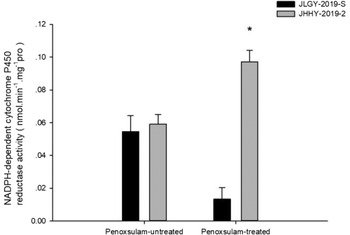
The results of studies on NADPH-dependent cytochrome P450 reductase activities of JLGY-2019-S and JHHY-2019-2 were analyzed (Figure 5). Before penoxsulam treatment, there was no significant difference in the NADPH-dependent cytochrome P450 reductase activity between JLGY-2019-S and JHHY-2019-2 (t-test, P > 0.05). After penoxsulam treatment, the NADPH-dependent cytochrome P450 reductase activity of JHHY-2019-2 was significantly higher (approximately 7-fold) than that of the sensitive population JLGY-2019-S (t-test, P < 0.01). This further indicated that CytP450s contributed to the metabolic tolerance to penoxsulam in E. japonica.
Comparison of the activities of NADPH-dependent cytochrome P450 reductase between Echinochloa crus-galli (JLGY-2019-S) and Eragrostis japonica (JHHY-2019-2) populations. An asterisk (*) indicates significant difference (t-test, P < 0.01); standard errors of the mean are shown by vertical bars. Plants were treated with 7.5 g ai ha−1 penoxsulam.

NTSR can endow unpredictable and complex resistance or tolerance to herbicides with different modes of action or chemical structures, such as ACCase inhibitors, ALS inhibitors, and photosystem II inhibitors (Cocker et al. Reference Cocker, Northcroft, Coleman and Moss2001; Fang et al. Reference Fang, Zhang, Liu, Yan, Li and Dong2019b; Feng et al. Reference Feng, Gao, Zhang, Dong and Li2016; Iwakami et al. Reference Iwakami, Uchino, Watanabe, Yamasue and Inamura2012; Wang et al. Reference Wang, Li, Lv, Lou and Dong2013; Zhang et al. Reference Zhang, Wu, Xu, Gao, Zhang and Dong2017). It was reported that CytP450s may play an important role in tolerance to the ACCase inhibitor fenoxaprop-P-ethyl in annual bluegrass (Poa annua L.) (Wang et al. Reference Wang, Li, Lv, Lou and Dong2013). And high activity of NADPH-dependent cytochrome P450 reductase can enhance the metabolic capacity of CytP450s in plants (Wang et al. Reference Wang, Li, Lv, Lou and Dong2013; Zimmerlin and Durst Reference Zimmerlin and Durst1990). In the present study, the tolerance to penoxsulam in E. japonica may also have been caused by the stronger metabolic effects of CytP450s, which were verified using both metabolic enzyme inhibitors (Table 4) and metabolic enzyme activities (Figure 5). However, the tolerance was not fully overcome by CytP450 inhibitors (Table 4), which suggested that NTSR played a partial role in penoxsulam tolerance.
In conclusion, the present study identified high tolerance to penoxsulam in E. japonica. This serves as a reminder that penoxsulam cannot be used to control E. japonica, even at high doses. Regarding tolerance mechanisms, lower ALS sensitivity, relatively higher ALS expression levels (target site–based tolerance), and CytP450-mediated metabolism may combine to confer penoxsulam tolerance in E. japonica. Additionally, other NTSR mechanisms not evaluated here (e.g., reduced absorption and translocation) may also contribute to the penoxsulam tolerance. More experiments are warranted to further clarify this point.
Supplementary material
To view supplementary material for this article, please visit https://doi.org/10.1017/wsc.2022.63
Acknowledgments
This work was supported by the National Natural Science Foundation of China (31871993). The authors declare no competing financial interests.