INTRODUCTION
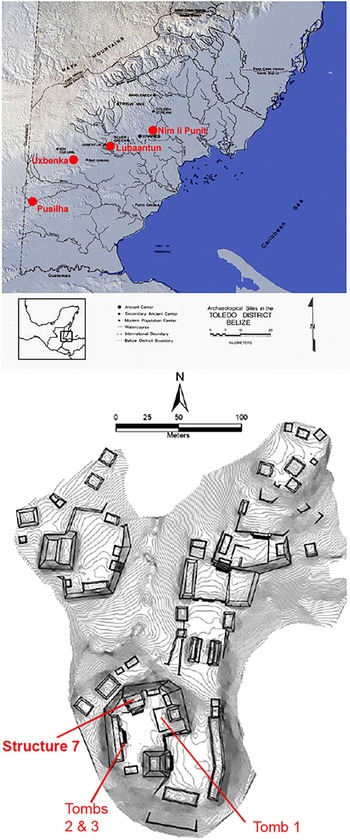
Nim li Punit is a small hilltop site located in the southern Belize region on the southeastern edge of the Maya zone (Figure 2; for definition, see Prager et al. Reference Prager, Volta, Braswell and Braswell2014:246–248), rediscovered in 1976 by Joseph O. Palacio, the former Archaeological Commissioner of Belize (Hammond et al. Reference Hammond, Howarth and Wilke1999:2). The modern site name means “The Big Hat” in Q'eqchi’ Mayan and was coined by Palacio because of the large headdress depicted on Stela 14. A total of eight carved monuments are known from the site. All date to the eighth and early ninth centuries, that is, the century before and during the Classic Maya collapse. Wanyerka (Reference Wanyerka2003:82) reads the emblem glyph of Nim li Punit as Kawam, which he takes to be a raptorial bird. Nonetheless, Beliaev (Reference Beliaev2006) points out that three distinct emblem glyphs appear on monuments at the site, and one should probably be read Wakaam (on Stela 2). Thus, it is not yet certain that all the lords shown on the monuments of Nim li Punit are from that place or which emblem glyph(s) actually pertains to the site.
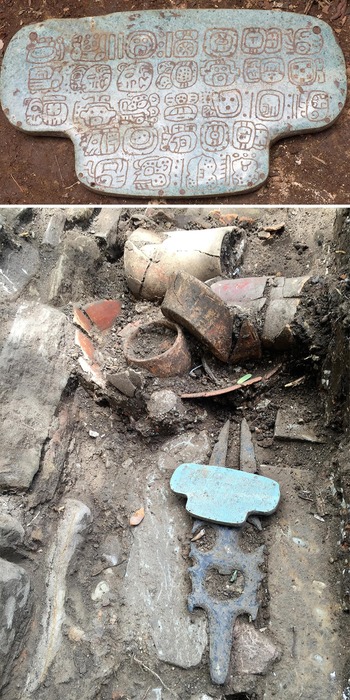
The Nim li Punit wind-jewel pectoral (upper) and its placement in Tomb 5 (lower). Photographs by Maya Azarova (upper) and Mario Borrero (lower).

Major sites of the southern Belize Region (upper) and map of Nim li Punit (lower). Site map by Daniels and Braswell. Refer to the Electronic Atlas of Ancient Maya Sites (http://mayagis.smv.org/maps_of_the_maya_area.htm) for detailed maps showing other sites discussed in the text.

Before the current project, excavations at Nim li Punit were quite limited. Hammond et al. (Reference Hammond, Howarth and Wilke1999) conducted some test excavations, and Leventhal conducted salvage excavations of Tomb 1, located in front of Structure 5, as well as a test-pitting program (Leventhal et al. Reference Leventhal, Dunham, van Eysden, Jamison, Herbert and Cowel1985). In the late 1990s, members of the Maya Archaeological Sites Development Programme encountered Tombs 2 and 3 in front of Structure 8 during consolidation operations. Information on these discoveries is found only in newspaper reports (e.g., Manning Reference Manning1986) and signs posted in the visitor center at the site. Tomb 1 is about 30 meters southeast and Tombs 2 and 3 are about 45 meters to the southwest of where the wind jewel was found (Figure 2).
Nim li Punit, founded no later than about a.d. 150, and Uxbenka (Prufer et al. Reference Prufer, Moyes, Culleton, Kindon and Kennett2011) are the two oldest known sites in the southern Belize region, settled at the dawn of the Classic period. In a.d. 572, at the end of the Early Classic period, the dynastic founder K'awil Chan K'inich established Pusilha, the largest site in the region (Braswell et al. Reference Braswell, Prager, Bill, Schwake and Braswell2004:228; Prager et al. Reference Prager, Volta, Braswell and Braswell2014:272–283). A fourth key site, Lubaantun, was first occupied sometime in the eighth century during the Late Classic period (Braswell et al. Reference Braswell, May, Pitcavage and Hagerman2011; Hammond Reference Hammond1975). All these sites were at their height during the eighth century but suffered significant depopulation and abandonment during the Classic Maya collapse of the ninth century.
Relations between Pusilha, Lubaantun, Nim li Punit, and other regions of the Maya area, as well as interaction among these three closely-spaced, yet seemingly independent, polities have been the focus of our two projects since 2001. The Pusilha Archaeological Project was co-directed by Braswell, Prager, and Cassandra Bill, and its successor, the Toledo Regional Interaction Project, is directed by Braswell. New bioarchaeological evidence shows ties between the ruling family of Pusilha and Copan (Somerville et al. Reference Somerville, Schoeninger and Braswell2016), but there is no evidence of extensive trade between those sites. Until about a.d. 800—the era of the Maya collapse—the southern Belize region as a whole seems to have engaged in very limited economic exchange with western Belize, including the large city of Caracol and the smaller sites of the Belize Valley. Finally, although three of the four major sites of the southern Belize region have extensive hieroglyphic texts, they do not explicitly mention their neighbors in other regions of the Maya world (with the probable exception of Altun Ha in northern Belize; Prager et al. Reference Prager, Volta, Braswell and Braswell2014:285–286, 299–300). Similarly, sites in the rest of the Maya world ignored the southern Belize region in their own inscriptions (Prager et al. Reference Prager, Volta, Braswell and Braswell2014:300). Thus, any new data that shed light on the external ties of Nim li Punit are of great interest.
CONTEXT: THE ROYAL RESIDENCE OF NIM LI PUNIT
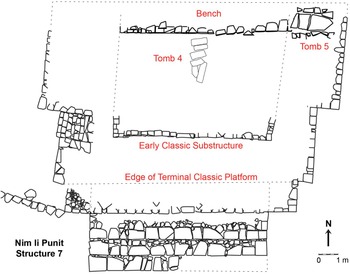
In 2012, Braswell began excavations of Structure 7 of Nim li Punit, which we interpret as the royal residence (Figure 3; Braswell et al. Reference Braswell, Fisher and Fauvelle2012:5–6). Our excavations there have revealed the earliest pottery yet known at the site, dating to the transition from the Preclassic to Early Classic period, including types and modes often called “Protoclassic” (Borrero et al. Reference Borrero, Azarova, Prager and Braswell2015). The platform was built in two phases. The first, Structure 7-sub, dates to a.d. 250–400. An elaborate crypt (Tomb 4) was cut into the rectangular platform along its centerline during a remodeling episode at about a.d. 400. This crypt contained three slab-footed tripod vases of Teotihuacan-like style, a plain plate, two large cowrie shells, a chert eccentric, and beads from a shell necklace painted green in imitation of jade (Braswell et al. Reference Braswell, Fisher and Fauvelle2012:32–34). The partial remains of an individual were found within the crypt.
Plan of Nim li Punit Structure 7, showing locations of Tombs 4 and 5. Note that the Early Classic substructure (which contains Tomb 4) is rectangular, while the Terminal Classic final platform (which contains Tomb 5) is T-shaped in plan and fronted by a stair and two small stair-side outsets. A small stair also leads up the west side of the final stage platform. The north arrow indicates grid north, perpendicular to the south-facing stair. Drawing by Braswell, Chelsea Fisher, Mario Borrero, and Maya Azarova.

A remodeling phase occurred sometime around a.d. 800–850, and the crypt was opened at that time. A polychrome (Dos Arroyos type) plate was removed from within the crypt and placed next to it, along with most of the painted shell beads and many skeletal elements. Some of these (as well as the painted beads) were re-interred in a series of Terminal Classic offerings placed in the expanded platform (Braswell et al. Reference Braswell, Fisher and Fauvelle2012:25–31). The final stage platform was roughly one meter taller than the Early Classic platform, shaped like a T with a broad crosspiece, and was fronted by a stair with two small stair-side outsets (Figure 3).
In 2015, Braswell and his students returned to finish excavations and consolidation of Structure 7. Expanding to the east, we discovered a small collapsed Terminal Classic tomb (Tomb 5) covered by two capstones visible on the surface of the platform. The tomb measures 2.0 m east-to-west by 1.1 m north-to-south and stands approximately one meter high. A step provided access from the east. Tomb 5 was placed only 6 m from the Early Classic crypt when the crypt was opened and the remodeling of the platform took place during the early ninth century.
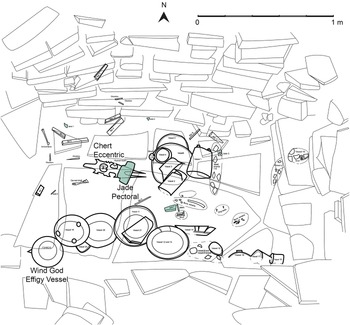
Tomb 5, despite its small size, was rich with many artifacts (Figure 4). These include: 25 ceramic vessels (mostly Terminal Classic polychromes and imported Belize Red vessels); several whole and fragmentary jade beads, ear ornaments, and small pendants; 19 painted limestone bars and three fragments; animal bones and teeth; a fragmentary carved Strombus shell; two small chert eccentrics (probably nose ornaments); a jade celt; and various pieces of obsidian including perforators. Human remains were quite scarce and hardly recognizable. Two dog teeth were found at the center of the largest collection of unidentified remains. We stress that the paucity of remains is most definitely not a result of poor preservation; the bones found within Tomb 4 and the Terminal Classic caches—just a few meters away—belie this possibility. Indeed, the context is called Tomb 5 because of its formal architectural structure rather than the presence of a complete body within it. Thus, the remains that were found most likely constitute a partial reburial and we speculate that they may have been re-interred from the opened Early Classic crypt (Tomb 4).
Plan of Tomb 5, Structure 7, Nim li Punit. Drawing by Maya Azarova.

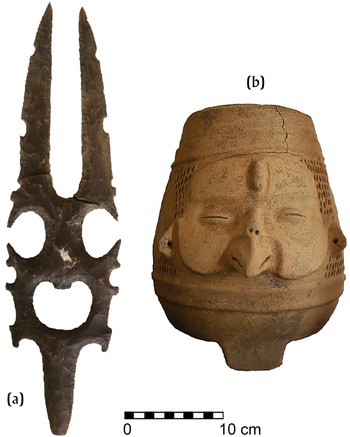
Three items from Terminal Classic Tomb 5 are particularly noteworthy. The first two are a large eccentric chert (Figure 5a) and a carved/modeled vase that depicts the bird-beaked wind god (Figure 5b). The eccentric is remarkably similar to one found outside Burial 8/4 at nearby Pusilha, a royal tomb dating to the eighth century (Prager et al. Reference Prager, Volta, Braswell and Braswell2014:Figure 10.11). The vessel possibly is a ceramic drum (Karl Taube, personal communication 2015). Images of this wind god wearing a duck-billed (or boat-billed heron) buccal mask—such as the Tuxtla Statuette—are known along the Gulf Coast from the Preclassic period onwards, but variants with a sharp beak appear in later periods in the Maya region (Taube Reference Taube2015). The third noteworthy item is the Nim li Punit wind jewel (Figures 1, 6, and 7a). In sum, the pectoral, the wind god vessel, and the T-shape of the final platform appear to link the context to veneration of the winds that bring the seasonal rains.
(a) Large chert eccentric and (b) the wind god vessel from Tomb 5. Photographs by Braswell.

The (a) front and (b) back of the Nim li Punit wind-jewel pectoral. Drawing by Prager.

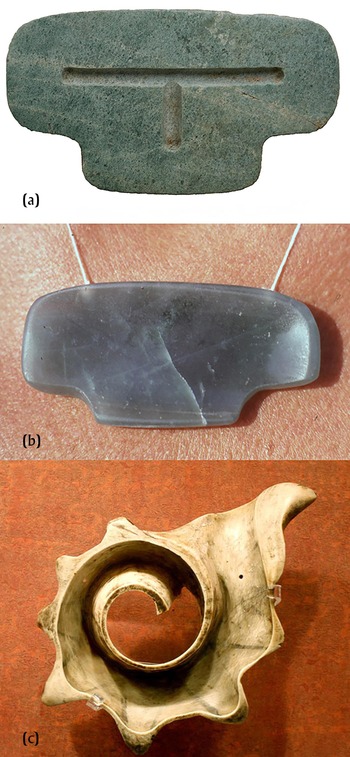
Different forms of wind jewels (not to scale): (a) Late Classic wind jewel from Nim li Punit, Belize. Photograph by Braswell. (b) Middle Preclassic example from Cuello, Belize, in the form of a bivalve shell. Photograph courtesy of Norman Hammond. (c) Postclassic cut Strombus shell in the Museo Nacional de Antropologia, Mexico City (Taube Reference Taube2006:Picture 4).

THE WIND-JEWEL PECTORAL
The wind jewel is a jade pectoral measuring 188 mm wide, 104 mm high, and 8 mm thick. It is the second largest piece of carved jade known from Belize and is one of the largest ever legally excavated in the entire Maya area. The shape of the pectoral is the hieroglyph T503 (nomenclature after Thompson Reference Thompson1962) IK' “wind, breath” and its front has a deeply inscribed ik’ glyph (Figures 6a and 7a). The form of the pectoral echoes the glyph and probably is derived from much earlier “Olmec spoons” and related shell-shaped jades dating to the Middle Preclassic (Figure 7b; see also Andrews Reference Andrews1987:Figure 1b; Healy and Awe Reference Healy and Awe2001; Źrałka et al. Reference Źrałka, Koszkul, Martin and Hermes2006:Figure 7). Although many of these early wind jewels represent bivalves (in some cases, an abstracted razor clam), others appear to be longitudinal sections of conch (Strombus spp.) shells. The well-known pectoral worn by priests of the deity Quetzalcoatl/Ehecatl during the Postclassic is a section of a Strombus shell (Figure 7c). Taube (Reference Taube2006) suggests “[i]t is likely that, just as we hear the ocean when we put a conch to our ear, the Aztecs heard the wind.” Thus, Preclassic jade representations of shells—which are concave—may have evolved into flat Classic T-shaped jade pendants in the Maya area (e.g., Proskouriakoff Reference Proskouriakoff1974:Plate 50a, 65b) and in the southern Gulf Coast, but were replaced by spiral sections of actual shells in Postclassic central Mexico.
The back of the Nim li Punit jade has a text consisting of 30 hieroglyphs (Figure 6b). Twelve holes perforate the back and emerge on the thin sides of the pectoral. Most holes appear in pairs and probably served to suspend jade beads or shell tinklers. Four holes clearly perforate the text and indicate that they were added at a later date. A single long hole measuring 4 mm in diameter runs straight through the long axis of the pectoral to its edges (not visible in Figure 6). This hole must have once contained the cord that allowed the pectoral to be suspended from the neck of the king. Norman Hammond (personal communication 2015) points out that this narrow-edge perforation technique was common during the Middle Preclassic period. Nonetheless, we stress that there is no clear reason to think that this is a repurposed Preclassic artifact like the jade bivalve-form pendant from Nakum (Źrałka et al. Reference Źrałka, Koszkul, Martin and Hermes2006). The Nim li Punit wind jewel does not have a concave front (and hence, is T-shaped rather than shell-shaped) and is not made of blue-green jade.
Line 1: Blocks 1–7
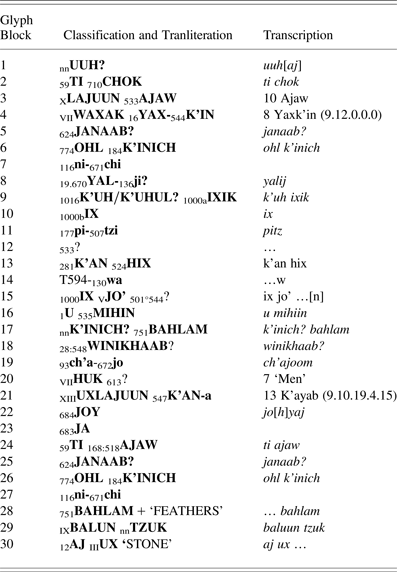
The incised text on the backside is arranged in four lines read horizontally left to right. We number the glyphs Blocks 1–30 in their reading order. Our translation is presented in Table 1. Our initial impression of Block 1 was that it is HUL-li-ya “to arrive here.” David Stuart (personal communication 2015) suggests that Block 1 may contain a complex sign that he and Simon Martin identify as the logograph for UUH? or YUY? (Źrałka et al. Reference Źrałka, Koszkul, Martin and Hermes2006:898). According to Stuart, the glyph shows a bead necklace with an attached plaque. The elongated element attached on the right could be a suffix such as ja or wa. Stuart proposes that the “necklace” logograph serves as a verb, like tupaj “he was earplugged” or uuhaj “he was necklaced,” as recorded on the main panels of the Temple of the Inscription at Palenque. As we shall see, the precise meaning of Block 1, “to arrive here” or “he was necklaced,” is critical to understanding the meaning of the text.
Summary of classification (after Thompson Reference Thompson1962), transliteration, and transcription of the text on the jade pectoral wind jewel from Tomb 5, Structure 7, Nim li Punit, Belize.

Block 2 is TI CHOK, ti chok, and reads “for the scattering” (Grube Reference Grube1990:59, 85). J. Eric S. Thompson (Reference Thompson1950:300–301; Reference Thompson1962:301–302) was the first to show that scattering is typically associated with records of period endings. Several rituals celebrated period endings, including “stone-tying” (k'altuun) and the erection and dedication of monuments, but the casting of copal incense (or sometimes other substances) into a fire is the most commonly recorded in texts and images (Schele Reference Schele1982; Stuart Reference Stuart, Justeson and Campbell1984, Reference Stuart and Scarborough2005a:370). It is thus very probable that the calendar round date 10 Ajaw 8 Yaxk'in expressed in Blocks 3–4 refers to the period ending of 9.12.0.0.0 (June 28, 672) and that the incense scattering event described in Block 2 occurred on that day. Nonetheless, it is odd that the calendar round follows the verbal construction and deviates from normal Classic Maya syntax. This may be a rhetorical device that gives special emphasis to Block 1 as a reference to the pectoral itself.
The subject of the phrase—the royal owner of the pendant and the scatterer—follows in Blocks 5–7. This name phrase is composed of the signs JANAAB? OHL K'INICH ni chi, JANAAB? OHL K'INICH-ni-chi, and most likely reads janaab? ohl k'inich. The sign T624v may read JANAAB or simply JAN (Martin and Reents-Budet Reference Martin and Reents-Budet2010:2). In Ch'ol of Tumbala, jan means “cornflower” (Aulie and Aulie Reference Aulie and de Aulie1978:40) and means “field flower” in Colonial Ch'olti' (Morán Reference Morán and Society1935[1625]). Thus, the Classic Maya lexeme janaab? is often translated as the former or simply “flower” (e.g., Taube Reference Taube2004; Boot Reference Boot2009). Alternatively, Stuart (Reference Stuart2005b) suggests that janaab? may refer to a raptorial bird. Block 6 has an Ik'-infix, but we believe that it is a variant of the sign OHL “heart, center” owing to diagnostic border elements. Moreover, the nominal segment ohl k'inich is particularly common in the eastern and southeastern Maya region, included in the names K'ahk' Ohl K'inich, Tum Ohl K'inich, and Jo' Janaab? Ohl K'inich Mo' (e.g., various monuments at Caracol, Pol Box, La Rejolla, and Mountain Cow; see also Kerr 4669). Thus, it is likely that the Ik’ infix is a rhetorical device that refers to the wind-jewel pectoral itself and the religious role of its owner rather than a phonetic complement. The syllables -ni-chi in Block 7 serve as phonetic complements to the K'INICH logograph in Block 6. This same name phrase is repeated in Blocks 25–26 but with additional name elements and titles. The verb in Block 1 must be expressed in either the passive voice or the intransitive mode, but such a suffix is missing. Following Stuart's suggestion, the first line of the text should be read as uuh(aj) ti chok 10 Ajaw 8 Yaxk'in and paraphrased as “he was necklaced /it is the necklace for the scattering on the day 10 Ajaw 8 Yaxk'in [by] Janaab? Ohl K'inich.”
Line 2: Blocks 8–14
The nominal phrase of Janaab? Ohl K'inich continues with two sub-phrases yielding a full parentage statement. Block 8 is the “child of mother” hieroglyph and reads YAL-ji, yalij “it is her child.” This expression often has the phonetic complement –la as a suffix. In contrast, -ji has not yet been attested to elsewhere. Alternatively, the three elements subfixed to the main sign may represent a variant of the -la suffix. The nominal phrase of the mother appears in Blocks 9–15 and reads K'UH/K'UHUL? IXIK IX pi-tzi T533 K'AN HIX BAL?-wa IX JO' T501°544, k'uhul? ixik ix pitz … k'an hix balaw? jo' … . This phrase begins with the epithet k'uh/k'uhul? ixik, “god-like woman,” a common and widespread title carried by wives of kings who gave birth to boys and dynastic heirs. Her proper name is only partially deciphered. The element ix pitz T533 contains the word pitz “to play ball” and is paired with the undeciphered logograph T533. Aj pitz is a common agentive name meaning “he of the ball[game]” (Stuart Reference Stuart1987). When agentive names are used by women, the female classifier ix is usually prefixed to the agentive morpheme aj yielding, for example, ix aj k'uhuun “she of worship” (Jackson and Stuart Reference Jackson and Stuart2001). In our case the agentive prefix aj is not given and women ball players are exceedingly rare in Maya inscriptions or art. These are good arguments against translating this portion of the name as “female ball player.” We therefore propose that ix pitz T533 forms an indivisible phrase whose meaning is not yet known. The last two elements of her nominal phrase are K'AN HIX BAL?-wa, k'an hix balaw? and include the hitherto undeciphered sign T594. This is the main element in the name of GIII, a patron god of Palenque. Prager proposes that T594 could be bal, meaning “hidden, guarded, or disappeared,” which—along with the element hix—fits perfectly with the identification of GIII as the Jaguar Sun God of the Night. This collocation also appears on an incised turtle shell and a bone ring discovered in Burials 2 and 7 of the Belizean site Cahal Pech, where k'an hix balaw? is included in a male nominal phrase that has been interpreted as a local noble title (Zender Reference Zender, Hoggarth and Awe2013). If Zender's suggestion proves to be correct, it could mean that the lady on the Nim li Punit pectoral was from Cahal Pech.
Line 3: Blocks 15–21
The assumption that ix pitz … k'an hix balaw? hailed from Cahal Pech is tentative and must be weighed against the meaning of Block 15, the last element in her nominal phrase. This last block is composed of three signs: IX JO' T501°544. It consists of the female classifier, the number five, and an undeciphered sign. Similar examples are usually written with a postfixed syllable -ni and often accompanied by the numerals four, five, seven, or nine. Some readings for the undeciphered sign have been proposed: p'u by Prager in an unpublished paper and so by Zender (Reference Zender, Hoggarth and Awe2013). Numbered T501°544-ni expressions are associated with material objects. For example, it appears as the proper name of a dancing object on the northeast jamb of Copan Temple 18. The meaning of this title is still enigmatic, but in his study on geopolitical references in Classic Maya texts, Tokovinine (Reference Tokovinine2013:110–112) suggests it may define a specific group or community and refers both to elite and non-royal individuals. He observes that examples with the number three are associated with the Calakmul area, those with the number seven come from sites in Belize and southeastern Peten, and instances with the numeral five refer to a group of lords in the eastern Peten, specifically Rio Azul. Zender's idea that the nominal string k'an hix balaw? could refer to the nobility of Cahal Pech therefore contrasts with this notion.
The parentage statement of Janab? Ohl K'inich continues in Block 16 with the “child of a father” glyph U.MIHIN?, umihiin, “he is the son of.” Block 17 contains the proper name composed of the jaguar head BALAM, bahlam, “jaguar” with an upward pointing serpent nose, the “square-nosed serpent” sign T1021. Martin (Reference Martin2014) explains that this element is associated with the central Mexican fire serpent Xiuhcoatl and the Classic Maya Sun God, K'inich. The serpent-nose element could be a possible clue for the decipherment of his proper name as K'INICH? BALAM, k'inich bahlam, or “Radiant Jaguar.” This collocation appears elsewhere as a royal name. At El Perú, for example, two kings named K'inich Bahlam are known (Guenter Reference Guenter, Navarro-Farr and Rich2014). The first ruled before a.d. 378 and the second came to the throne around 9.11.5.0.0 (a.d. 657) under the authority of Yuknoom Ch'een II of Calakmul (Martin and Grube, Reference Martin and Grube2008:109). Nonetheless, we stress that a shared partial name is likely just a coincidence. Indications that the K'inich? Bahlam on the Nim li Punit pectoral was indeed a king are found in Blocks 18–19. There he is called a WINIKHAB? ch'a-jo, winikhaab ch'ajo[om]. This epithet is extremely common in the Maya lowlands and is usually ascribed to kings. The ch'ajoom title refers to individuals who scatter incense at period-ending ceremonies. In this context the k'atun-hieroglyph T28.548 or WINIKHAB for “one k'atun,” or period of twenty years, is a classifier and records the age of K'inich Balam (Proskouriakoff Reference Proskouriakoff1963; Riese Reference Riese1980; Schele Reference Schele1989). Thus, according to this text, the father of Janaab? Ohl K'inich died under 20 years of age. His place of origin is not stated.
The second phrase of the Nim li Punit wind jewel begins with the Calendar Round date of 7 Men 13 K'ayab in Blocks 20–21. The original spelling for the day name “Men” is not known, but the month name is composed of the numeral 13 with the hieroglyphic K'AN-a, evidently an underspelling or variant of the Classic Maya month name K'anasiiy or K'ayab (cf. Boot Reference Boot2009:242).
Lines 4–5: Blocks 22–30
The Calendar Round in Blocks 20–21 introduces the accession expression JOY-ja TI AJAW, jo[h]yaj ti ajaw in Blocks 22–24, generally understood as “he acceded as lord.” Period-ending rituals were usually performed by kings, so we conclude that the date of the accession of Janaab? Ohl K'inich was before 9.12.0.0.0 (July 1, 672). We therefore propose that he acceded to the throne on the day 9.10.19.4.15 (January 23, 652).
The name and titles of the subject appear again in Blocks 25–30. Blocks 25–27 repeat the initial nominal phrase Janaab? Ohl K'inich. Blocks 28–30 continue his nominal phrase with three elements: BALAM BALUN TZUK AJ UX “FLINT.SIGN.” Block 28 contains the grapheme BALAM with plant-like elements or feathers issuing from the jaguar's forehead. It could be that the sign combines jaguar and bird heads, perhaps muwaan or “falcon.” This could be a reference to his lineage. As an aside, El Perú had a ruler named Muwaan Bahlam who must have reigned before the king K'inich Bahlam II of that site (Guenter Reference Guenter, Navarro-Farr and Rich2014).
The text concludes with Blocks 29–30. These contain two toponymic titles BALUUN? TZUK AJ UX “FLINT.SIGN,” baluun tzuk aj ux … , “9 division, he of Three …”. Numbered tzuk titles meaning “division, province” are prefixed by the numerals 1 to 13. These hint at the existence of units of identity—territorial, familial, or political—larger than that encompassed by a single emblem glyph. Such titles appear at the end of nominal phrases and refer to a cluster of sites within a defined geographic area, indicating the region from which an individual came (Beliaev Reference Beliaev, Colas, Delvendahl, Kuhnert and Schubart2000; Helmke et al. Reference Helmke, Awe, Morton and Iannone2011; Tokovinine Reference Tokovinine2013:98ff.; Wanyerka Reference Wanyerka2009:486). According to these scholars, the sites of Naranjo, Holmul, Buenavista, Cuychen, La Naya, Yaxha and Motul de San Jose were located in a province or territory called 7 tzuk. Tikal, Rio Azul, La Honradez, and Altun Ha, in contrast, were within 13 tzuk (Beliaev Reference Beliaev, Colas, Delvendahl, Kuhnert and Schubart2000; Helmke et al. Reference Helmke, Awe, Morton and Iannone2011; Tokovinine Reference Tokovinine2013:100). Stela 2 of Nim li Punit mentions 6 tzuk. Wanyerka (Reference Wanyerka2009:488) suggests that 6 tzuk refers to the Quirigua/Copan area and 8 tzuk could refer to the southern Maya Mountains region. In contrast, there are only two other known examples of 9 tzuk (Block 29). These appear at Cuychen and Dos Hombres, intimating that 9 tzuk referred to north-central Belize (Helmke et al. Reference Helmke, Awe, Morton and Iannone2011:85; Tokovinine Reference Tokovinine2013:109–110; Wanyerka Reference Wanyerka2009:488). This suggests that Janaab? Ohl K'inich may not have been native to Nim li Punit but perhaps came from a province to the north.
Block 30 is also key to understanding the origin of Janaab? Ohl K'inich. It is an agentive title reading AJ UX “FLINT.SIGN.” This “title of origin” (Stuart and Houston Reference Stuart and Houston1994:33) is a partially undeciphered collocation consisting of the agentive prefix aj with the numeral 3 and a problematic main sign, the “FLINT.SIGN”. Its diagnostic elements are two dotted semicircles or “stone” markings at the bottom of the pear-shaped, pointed sign similar to the TZUK sign in the previous block. Scholars explain that the “dotted semicircles may be curved versions of the flint sign's dotted band” and that “the flint markings were the generic designator of stone” (Stone and Zender Reference Stone and Zender2011:169–170). It is thus very likely that the sign in question represents a stone object with another diagnostic element at the top that is difficult to properly identify. It is most likely a simplified representation of the cluster of circles resembling a bunch of grapes as characterized by Stone and Zender (Reference Stone and Zender2011:169). These markings are diagnostic for tuun or “stone” objects, including mountains, blades, stelae, altars, platforms, metates, hearthstones, plazas, and holes.
Two known toponyms contain the agentive title pattern <aj + numeral 3 + “stone sign”>. The first is aj ux witz “he of three mountains,” which refers to Caracol (Grube Reference Grube and Robertson1994:99). The second is recorded on Cancuen Panel 3 dedicated on 9.18.5.0.0: AJ UX “PERSONIFIED.FLINT.SIGN”-na. The sign for “mountain” or witz “has irregular contours, … curled at the top and indented on the sides” (Stone and Zender Reference Stone and Zender2011:139). Block 30 lacks these, so it probably is not the sign for mountain. Moreover, if our interpretation of the second Calendar Round date as 9.10.19.4.15 is correct, then Caracol cannot be the place of origin of Janaab? Ohl K'inich because that site was then ruled by the king K'an II (Martin and Grube 2000:91–92). Moreover, although there are only two other examples of 9 tzuk, Caracol is not said to be within that division. Thus, we speculate that the undeciphered compound UX + “FLINT.SIGN” is either in north-central Belize or a local toponym, perhaps Nim li Punit. Nonetheless, this unique example does not appear on the monuments of the site.
INTERPRETATION AND DISCUSSION
We therefore tentatively read the text on the Nim li Punit pectoral as:
He was “necklaced” for the scattering on 10 Ajaw 8 Yaxk'in (9.12.0.0.0), Janaab Ohl K'inich
Son of the divine Lady Ix Pitz … K'an Hix Balaw
She of five …; son of K'inich Bahlam, incense scatterer (in his) first twenty years (of life). On 7 Men 13 K'ayab (9.10.19.4.15)
He acceded as lord, Janaab Ohl K'in- Nich Muwaan Bahlam, Nine-Province (person), he of Three Stony…
Who was Janaab Ohl K'inich, the owner of the Nim li Punit wind jewel? His name and those of his parents do not appear in monumental texts from Nim li Punit, probably because the jade was carved roughly 50 years before the first known stela was raised at the site. Janaab Ohl K'inich and perhaps his father were rulers of a site whose toponym is only partially readable, a place associated with 9 tzuk. The parents have nominal phrases containing elements and toponymic titles known at other sites in the central and eastern Maya lowlands. These include El Perú (in the case of his father) and Cahal Pech (in the case of his mother). Furthermore, Janaab Ohl K'inich used an additional nominal element, perhaps read as Muwaan Bahlam, which also appears at El Perú. Finally, the wind jewel does not contain any of the three emblem-glyph variants thought to refer to Nim li Punit (Beliaev Reference Beliaev2006; Stuart and Grube Reference Stuart and Grube2000; Wanyerka Reference Wanyerka2009:453). On balance, the epigraphic record seems to suggest that the ruler Janaab Ohl K'inich and his family came from somewhere other than Nim li Punit, probably to the north in Belize or from eastern Peten. Potential sites include those in the area where the 9 tzuk glyph appears, Caracol, Cahal Pech, or even El Perú, although all of these sites and regions have arguments against them. Alternatively, the agentive title in Block 30 may refer to Nim li Punit itself and connections between his parents’ nominal phrases and other sites might be coincidental.
How did the wind jewel get to Nim li Punit? There are several possibilities. The first is that it was created for Janaab Ohl K'inich and used by him at the site. Perhaps it was a gift from a powerful relative or the ruler of a subordinate site, although given the small size of Nim li Punit, the last seems rather unlikely.
A second possibility is that Janaab Ohl K'inich brought it to Nim li Punit and gave it to an unnamed local ruler as a gift and a sign of over-lordship. Two scenes of scattering events at the site show a ruler accompanied by a standing lord—perhaps a visiting dignitary—behind him and on the left side of the monument (Figures 8–9). Janaab Ohl K'inich could have been such a visitor. This second possibility rests on the somewhat unlikely possibility that Block 1 should be glossed as “he arrived.” A third possibility is that the pectoral was traded to Nim li Punit somewhat later in time or ended up at the site as a spoil of war. In that case, it could represent a battle between Nim li Punit and a site (mentioned in Glyph 30) whose location is still not known. It is therefore conceivable that Janaab Ohl K'inich had nothing to do with Nim li Punit and was never at the site.
Nim li Punit Stela 15, showing a scattering event performed on 9.14.10.0.0 (October 13, 721). The front of the wind jewel pectoral is visible in the close up. Photographs courtesy of Bruce Love.

Nim li Punit Stela 2, showing a scattering event performed on 9.15.0.0.0 (August 22, 731). The front of the wind jewel pectoral is visible in the close up. Photographs courtesy of Bruce Love.

What is important to stress is the significance of context and provenience. Had the pectoral been illegally excavated, we would have no reason at all to connect it to Nim li Punit. Instead, some internal clues point elsewhere beyond the southern Belize region. We would not be able to identify where it was used or even the modern country in which it was found.
The fact that the Nim li Punit wind jewel hints at interaction with regions to the north is intriguing. There are no clear ceramic connections between Nim li Punit and the Belize Valley (the location of Cahal Pech) or Caracol before the Terminal Classic period, at which time Belize Red pottery began to be traded to the southern Belize region. Connections with north-central Belize or El Perú are even harder to demonstrate from the material record. The only potential political connections previously posited are with Altun Ha or some other site that used the “water scroll” toponym and with the Quirigua/Copan region (e.g., Martin and Grube Reference Stuart and Grube2000:19; Prager et al. Reference Prager, Volta, Braswell and Braswell2014:299–300). Altun Ha is significantly to the east of most of the sites mentioned here (including those within the territory posited as 9 tzuk) and Quirigua/Copan are far to the south. The text of the wind jewel therefore implies political and familial ties with regions for which we had little to no evidence of economic interaction before its discovery. This mirrors relations between Pusilha and the powerful city of Copan. At Pusilha, we have documented the presence of elite migrants from Copan who married into the local royal family (Somerville et al. Reference Somerville, Schoeninger and Braswell2016), but evidence for economic interaction is extremely scant. Thus, political ties were maintained at least as much through marriage and the movement of Maya elites as through the exchange of goods.
We do know how the wind jewel was used. Blocks 1–2 say that it was put on for the scattering rituals that took place on important period endings. Perhaps the most spectacular aspect of the wind jewel is that we have two images that show it employed during such scattering rituals. The first scattering event, on Stela 15, took place on the date 9.14.10.0.0 (October 13, 721), 50 years after the first date on the pectoral (Figure 8). The second event appears on Stela 2 and dates to 9.15.0.0.0 (August 22, 731), ten years later (Figure 9). The central figure on both monuments can be seen wearing a T-shaped pectoral with the Ik’ glyph prominently displayed. Interestingly, the next image of a scattering event, on Stela 1 (9.15.10.0.0, June 30, 741), does not show an Ik’-shaped pendant. This stela may portray a ruler of a different polity (Beliaev Reference Beliaev2006). A final depiction of a scattering event on Stela 14 (9.18.0.0.0, October 11, 790) also omits the wind jewel. Stela 4 (unknown date but probably ca. a.d. 730) and Stela 21 (9.18.0.0.0, October 11, 790) mention scattering events but do not show them. Thus, we have iconographic evidence of the use of the wind jewel pendant at Nim li Punit only for the period a.d. 721–731. We do not know where the pectoral was between a.d. 731 and its final interment in Tomb 5 roughly a century later, but it is possible that it was temporarily interred with a ruler, otherwise stored, or in use but simply omitted from imagery.
CONCLUDING SPECULATION
Due to its depiction on two monuments, collective memory of important scattering events involving the Nim li Punit wind jewel persisted long after it was inscribed and first used. Indeed, we wonder if the final remodeling of Structure 7 and Tomb 5 might be dedicated to the wind jewel, the royal rituals surrounding it, and the memory of the kings who conducted scattering rituals at Nim li Punit. During the Terminal Classic period, the basic form of the platform (not including the stair and two stair-side outsets) was altered to resemble a giant Ik’ sign. A special tomb chamber was created and numerous offerings were placed within it, including an effigy pot dating to about a.d. 830 that displays the beaked god of music, trade, and the winds that bring the seasonal monsoon. The wind jewel itself—then approximately 150 years old—was entombed within the chamber along with fragmentary remains that may have come from an elaborate crypt burial encountered during the renovation, which itself was more than 400-years old.
The Ik’ sign, the wind jewel, and the wind deity, of course, are not all the same thing. Nonetheless, they are conceptually linked. It seems to us not to be a coincidence that they appear together in the curious form of Structure 7 and within Tomb 5 of Nim li Punit. Moreover, the final burial of the wind jewel took place during a time of great climatic instability (Kennett et al. Reference Kennett, Breitenbach, Aquino, Asmerom, Awe, Baldini, Bartlein, Culleton, Ebert, Jazwa, Macri, Marwan, Polyak, Prufer, Ridley, Sodemann, Winterhalder and Haug2012). We cannot help but wonder if such a precious relic of the past was given a dedicatory burial because the rains brought by the wind god—and by his representative on earth, the divine king of Nim li Punit—were scarce and unpredictable.
RESUMEN
Muchos jades mayas se han encontrado sin contexto o procedencia buena. Aquí describimos un artefacto notable descubierto durante nuestras excavaciones de 2015 en el sitio maya de Nim li Punit, Belice. Es un pectoral de jade en forma de “T” que se lleva en el pecho de los reyes mayas antiguos, cuando se dispersaron copal durante los rituales calendarios (Figura 1). Estos rituales se describen o representan en seis monumentos de piedra tallados (estelas) en el sitio. Además, dos estelas de Nim li Punit representan los gobernantes que llevan el pectoral mismo que descubrimos. El reverso de la pieza contiene un texto jeroglífico histórico importante. Si el artefacto había sido recuperado por medios ilegales y si se encuentra en una colección privada, el gran parte del texto tendría poco sentido y no podía ser atribuido a Nim li Punit. El valor inestimable del pectoral de Nim li Punit, por lo tanto, no sólo radica en su inscripción jeroglífica, sino también en su contexto arqueológico conocido y las imágenes contemporáneas del uso. Describimos brevemente ese contexto y presentamos una traducción del texto historico del pectoral de jade, que interpretamos como una “joya de viento.”
ACKNOWLEDGMENTS
Excavations at Nim li Punit in 2012 were supported by the University of California, San Diego, Faculty Senate and by the National Geographic Society (#9027-11). All research conducted in 2015 was funded by the University of California, San Diego, Faculty Senate. We thank the many men and one woman of Indian Creek, Belize, who have worked on our project, as well as the Institute of Archaeology of Belize. We give particular thanks to Bruce Love for allowing us to use his photographs of Stelae 2 and 15. These were taken with the assistance of Manuel Bolon and Estevan Choco, April 23–24, 2014, at the Nim li Punit Visitors Center, Toledo District, Belize, under a permit issued by the Institute of Archaeology of Belize. Similarly, we thank Norman Hammond for use of his photograph in Figure 7b. We also benefitted significantly from conversations with Karl Taube about the Mesoamerican wind god, and thank him for permission to use an image we ultimately omitted. We especially thank the three graduate students who participated in the excavations of Structure 7: Chelsea Fisher, Maya Azarova, and Mario Borrero. Finally, we thank the numerous epigraphers who have improved our understanding of the Nim li Punit wind-jewel inscription, as well as Joyce Marcus, Stephen Houston, and Norman Hammond, who all commented on an earlier draft of this paper.