Non-technical Summary
The Indo-West Pacific region is home to most hexapodid crabs alive today, but their family, Hexapodidae, has a fascinating history dating back to the Cretaceous. Despite their prominence in the Indo-West Pacific, their evolutionary history has been extensive, with a notable radiation throughout the Cenozoic. Interestingly, during the Paleocene to the Miocene, tropical America emerged as a crucial hub for the expansion of Hexapodidae, as evidenced by the discovery of various species in countries such as Peru, Barbados, Venezuela, Panama, and Trinidad. Recently, researchers examined the paleocarcinological collection at the Museu Paraense Emílio Goeldi and identified a new genus and species within Hexapodidae. This discovery, named Rodneyellus feldmanni, pays tribute to Dr. Rodney Feldmann's dedication to fossil crustacean research. Notably, this finding also marks the first documented presence of Hexapodidae in Brazil, encompassing both fossilized and living representatives. Furthermore, the Pirabas Formation in Brazil emerges as a significant site for understanding the distribution of decapod crustaceans in tropical America. This formation provides valuable insights into the contemporary habitats and evolutionary pathways of these crustaceans, further enriching our understanding of their ecology and biodiversity across the region.
Introduction
Hexapodid crabs, also commonly referred to as six-legged crabs, distinguish themselves from other brachyuran crabs by possessing only three pairs of ambulatory legs discernible instead of the typical four. The fifth pereopod is not completely suppressed, and a vestigial coxa articulates with the reduced sternite 8 to a significant extent (Guinot, Reference Guinot2006; Guinot et al., Reference Guinot, De Angeli, Garassino, Fransen, De Grave and Ng2010, Reference Guinot, Tavares and Castro2013).
The family is recognized for a relatively small number of extant and fossil species (De Angeli et al., Reference De Angeli, Guinot and Garassino2010; Guinot et al., Reference Guinot, De Angeli, Garassino, Fransen, De Grave and Ng2010), with the majority of species being distributed in the Indo-West Pacific region (Rahayu and Ng, Reference Rahayu and Ng2014). Although the contemporary distribution spans widely across the Indo-West Pacific, fossil representatives are notably reported from the Eocene and Miocene of Europe and the Americas (Collins and Morris, Reference Collins and Morris1976; Beschin et al., Reference Beschin, Busulini, De Angeli and Tessier1994; Feldmann et al., Reference Feldmann, Casadío, Chirino-Galvez and Aguirre-Urreta1995; Schweitzer et al., Reference Schweitzer, Feldmann, Tucker and Berglund2000; Schweitzer and Feldmann, Reference Schweitzer and Feldmann2001; De Angeli et al., Reference De Angeli, Guinot and Garassino2010; Guinot et al., Reference Guinot, De Angeli, Garassino, Fransen, De Grave and Ng2010; De Angeli and Caporiondo, Reference De Angeli and Caporiondo2022).
In the past five years, a wealth of information regarding paleocarcinology in the Brazilian marine Miocene has been gathered (Lima et al., Reference Lima, Tavares, Lopes, de Araújo and Aguilera2020a, Reference Lima, Anker, Hyžný, Kroh and Aguilerab, Reference Lima, Aguilera and Tavares2021, Reference Lima, da Silva, Aguilera, Pinheiro and Santana2023, Reference Lima, Pinheiro, da Silva and Aguilera2024). The remarkable abundance of decapod crustaceans from the Pirabas Formation in the Pará State, Brazil, can be linked to the heterogeneous environments deposited during the Oligocene–Miocene beds, characterized by marine shallow-water conditions (Rossetti et al., Reference Rossetti, Bezerra and Dominguez2013; Aguilera et al., Reference Aguilera, de Araújo, Hendy, Nogueira and Nogueira2020a, Reference Aguilera, Bencomo, de Araújo, Dias and Colettib, Reference Aguilera, Martins, Linhares, Kütter and Coletti2022). Upon reviewing Miocene crab material from the collections of the Emílio Goeldi Museum (Pará, Brazil), among the specimens collected at Praia do Atalaia (Salinópolis, Pará, north Brazil) was a new genus and species of a hexapodid crab, which is described and illustrated in the following. That new genus and species is named in honor of Dr. Rodney Feldmann, for his lifelong dedication to the study of fossil crustaceans.
Geological setting
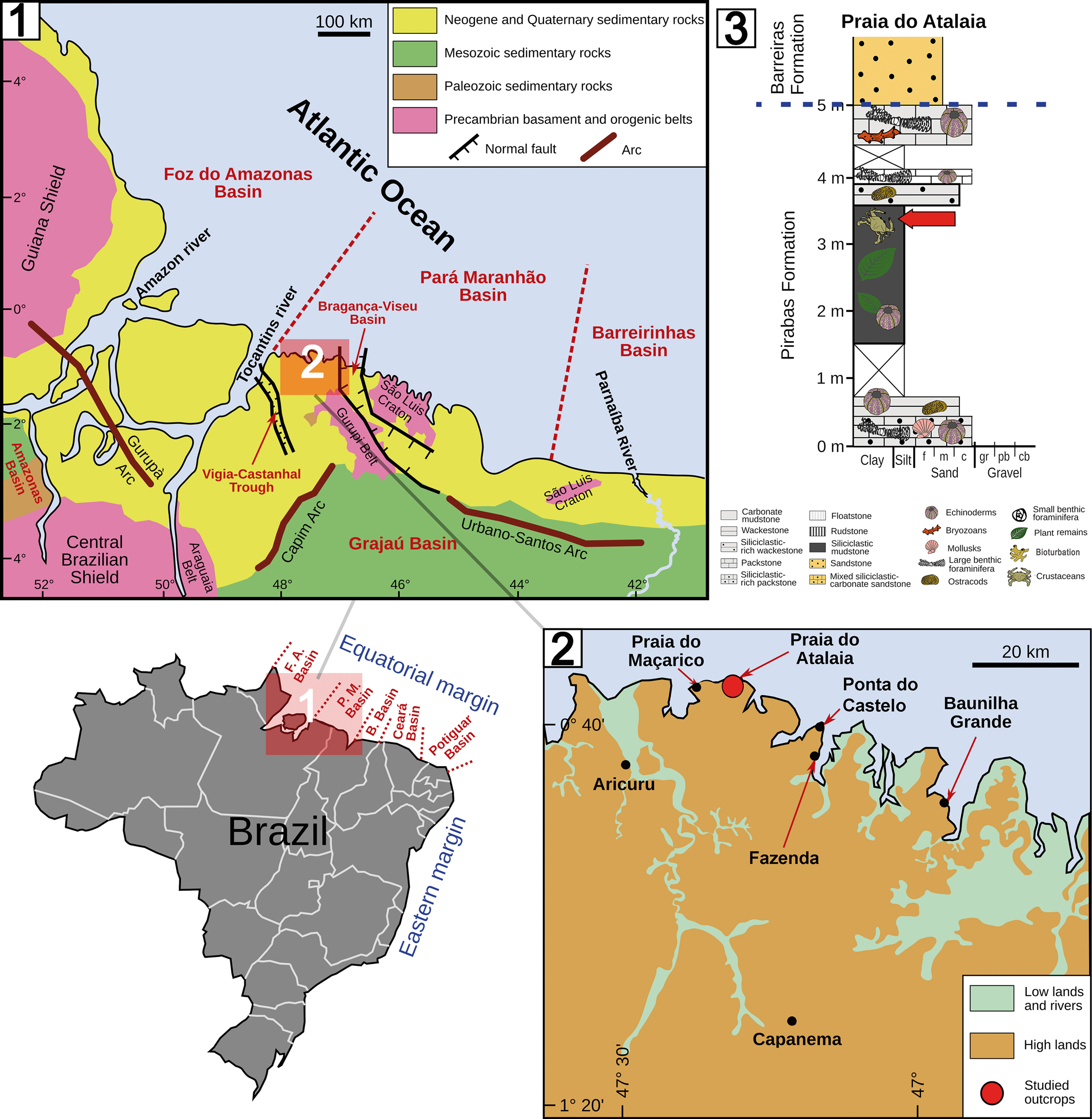
The Pirabas Formation (Maury, Reference Maury1925) is well recognized through equatorial coastal plain outcrops and quarries located in the Pará state, north Brazil (Fig. 1.1, 1.2). It is characterized by a mixture of carbonatic–siliciclastic deposits formed in a shallow-water context ranging from the inner to the middle platform (Rossetti et al., Reference Rossetti, Bezerra and Dominguez2013; Aguilera et al., Reference Aguilera, Bencomo, de Araújo, Dias and Coletti2020b).
(1) Location map of Pirabas Formation, Pará, Brazil. (2) Pirabas Formation at Praia do Atalaia outcrop. (3) Stratigraphic section of the Pirabas Formation at Praia do Atalaia outcrop. Location map modified from Aguilera et al. (Reference Aguilera, Martins, Linhares, Kütter and Coletti2022).

Aguilera et al. (Reference Aguilera, Martins, Linhares, Kütter and Coletti2022) distinguished four main facies within the Pirabas Formation: (1) facies α1, shallow-water offshore platform characterized by echinoderm–bryozoan packstone to rudstone; (2) facies α2, shallow-water inner platform, comprising siliciclastic-rich wackestone to packstone; (3) facies β, shallow coastal plain dominated by siliciclastic fine-grained sandstone to mudstone; and (4) facies γ, restricted tidal coastal plain of marginal mangroves dominated by sand-sized angular grains, iron-rich nodules, and pyritized fossils.
The stratigraphic location of the Praia do Atalaia outcrop seems to be at the very top of the entire carbonate succession of the Pirabas Formation (Fig. 1.3), and it is characterized by the facies γ (Aguilera et al., Reference Aguilera, Martins, Linhares, Kütter and Coletti2022), just below the contact with the overlying siliciclastic deposits of Barreiras Formation. The age of the Praia do Atalaia section spans from the middle to late Miocene (Gomes et al., Reference Gomes, Aguilera, da Silva-Caminha, D'Apolito, Cárdenas, Hocking and Lemes2023).
Materials and methods
Descriptions, drawings, and photographs were made using a stereomicroscope Nikon SMZ745T equipped with camera lucida and a Leica EZ4 W, both with digital camera attached. Photographs of the whole specimens were made using a Canon PowerShot SX50 HS camera. The morphological descriptions are based on both the holotype and paratypes of Rodneyellus feldmanni n. gen. n. sp., and the terminology used in the descriptions mostly follows Guinot et al. (Reference Guinot, De Angeli, Garassino, Fransen, De Grave and Ng2010) and Rahayu and Ng (Reference Rahayu and Ng2014). The extant species Hexaplax megalops Doflein, Reference Doflein and Chun1904 (MZUSP 25812) was used as comparative material.
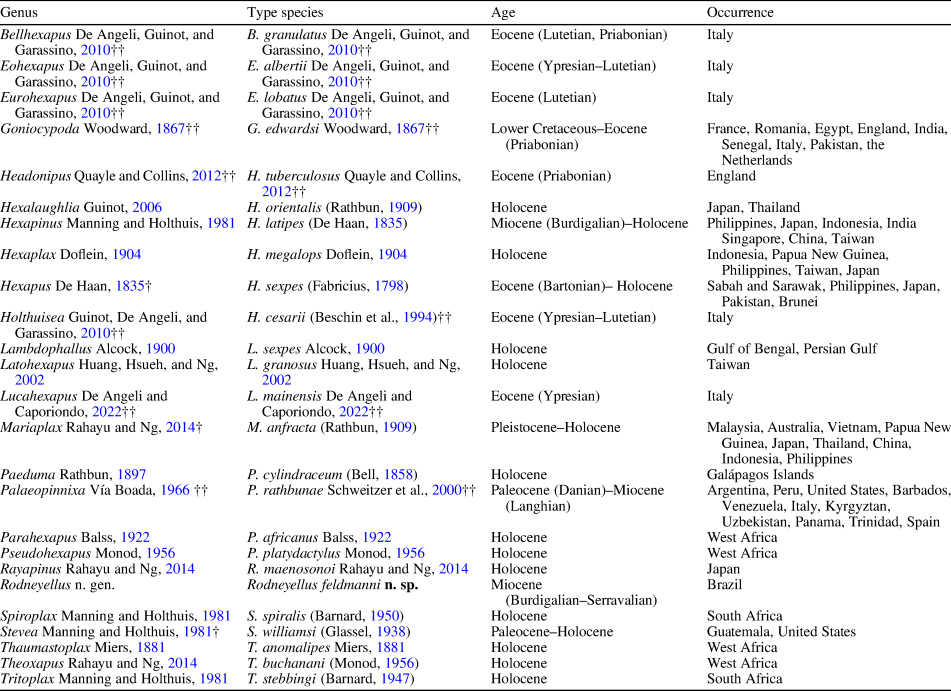
The Brachyura classification of Davie et al. (Reference Davie, Guinot, Ng, Castro, Davie, Guinot, Schram and Von Vaupel Klein2015) was used in suprafamilial rankings. Infrafamilial rankings mostly follow De Grave et al. (Reference De Grave, Pentcheff, Ahyong, Chan and Crandall2009). Genera were compared on the basis of their respective type species, as noted in the remarks and listed in the Table 1. The following abbreviations have been used: cl = carapace length; cw = carapace width (taken at the widest point); coll. = collector or collected by; † = taxa with recent and fossil representants; †† = taxa known exclusively from fossils; L/W = length/width ratio.
Hexapodidae Miers, Reference Miers1886 (Lower Cretaceous–Holocene) fossil and recent genera with information about type species, age, and geographic occurrence. † = taxa with recent and fossil representants; †† = taxa known exclusively from fossils.

Repositories and institutional abbreviations
Types, figured, and other specimens examined in this study are deposited in the following institutions: Museu Paraense Emílio Goeldi (MPEG), Pará, Brazil; Museu de Zoologia, Universidade de São Paulo (MZUSP), São Paulo, Brazil.
Systematic paleontology
Section Eubrachyura de Saint Laurent, Reference de Saint Laurent1980
Subsection Heterotremata Guinot, Reference Guinot1977
Superfamily Hexapodoidea Miers, Reference Miers1886
Family Hexapodidae Miers, Reference Miers1886
Type genus
Hexapus De Haan, Reference De Haan and von Siebold1835
Included fossil genera
Bellhexapus De Angeli, Guinot, and Garassino, Reference De Angeli, Guinot and Garassino2010††; Eohexapus De Angeli, Guinot, and Garassino, Reference De Angeli, Guinot and Garassino2010††; Eurohexapus De Angeli, Guinot, and Garassino, Reference De Angeli, Guinot and Garassino2010††; Goniocypoda Woodward, Reference Woodward1867††; Headonipus Quayle and Collins, Reference Quayle and Collins2012††; Hexapinus Manning and Holthuis, Reference Manning and Holthuis1981†; Hexapus De Haan, Reference De Haan and von Siebold1835†; Holthuisea Guinot, De Angeli and Garassino, Reference De Angeli, Guinot and Garassino2010††; Lucahexapus De Angeli and Caporiondo, Reference De Angeli and Caporiondo2022††; Mariaplax Rahayu and Ng, Reference Rahayu and Ng2014†; Palaeopinnixa Vía Boada, Reference Vía Boada1966††; Rodneyellus†† n. gen.; Stevea Manning and Holthuis, Reference Manning and Holthuis1981†.
Genus Rodneyellus†† new genus
Figures 2–4
Type species
Rodneyellus feldmanni n. sp. by monotypy and present designation. Gender masculine.
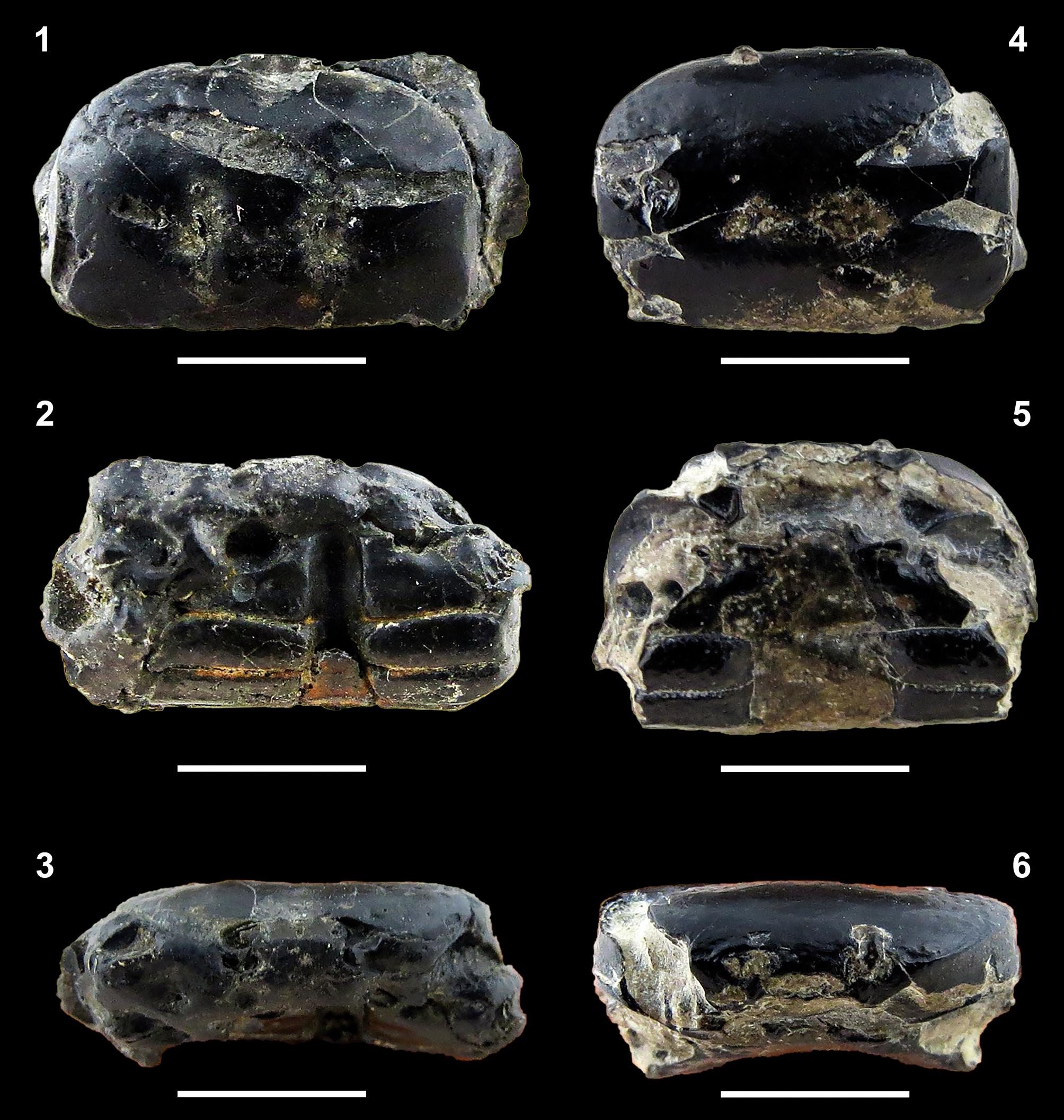
(1–3) Rodneyellus feldmanni n. gen n. sp., male holotype (MPEG 2616) in (1) dorsal, (2) ventral, (3) frontal views. (4–6) Rodneyellus feldmanni n. gen n. sp., female paratype (MPEG 2615) in (4) dorsal, (5) ventral, (6) frontal views. Scale bars = 5 mm.

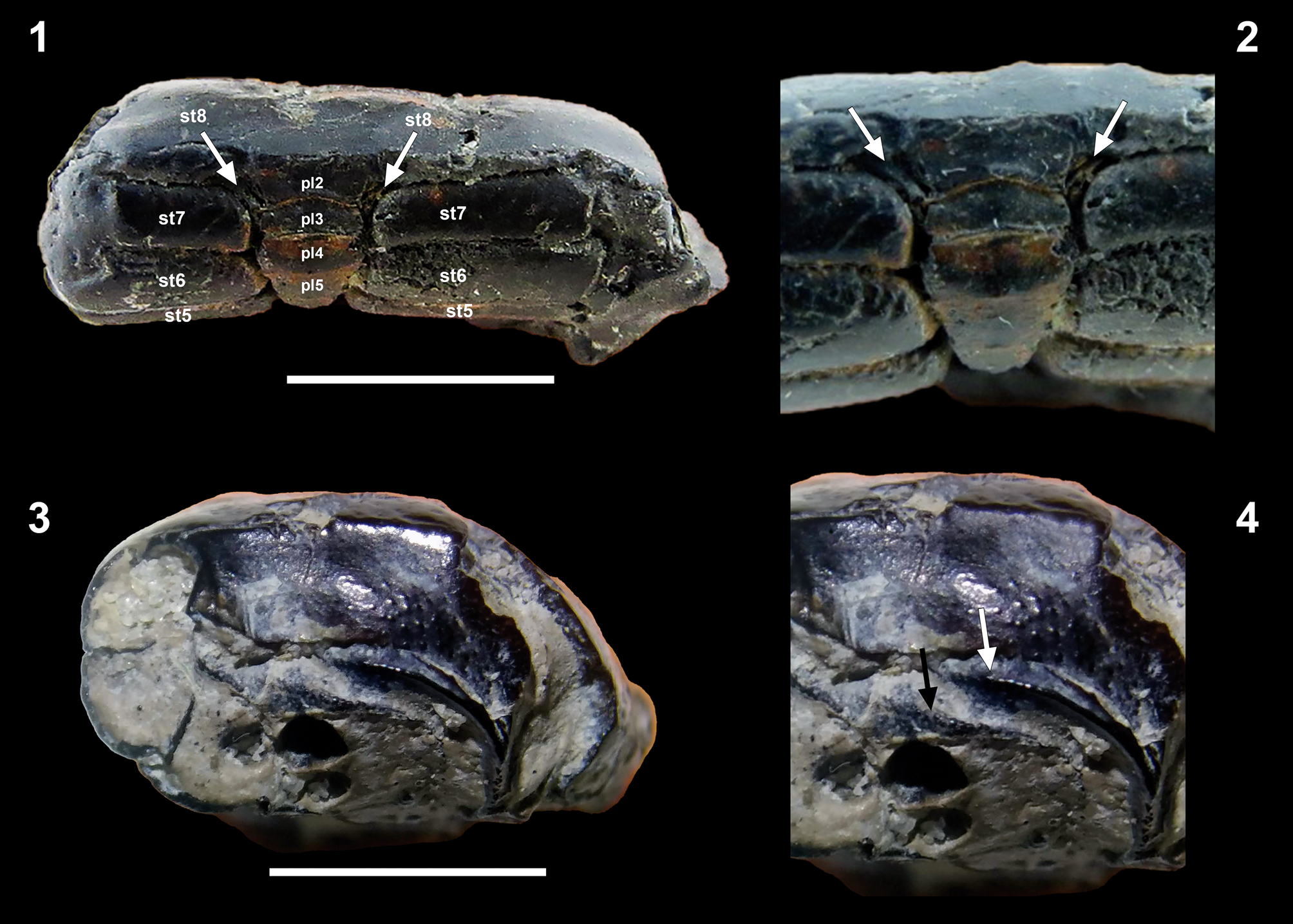
(1, 2) Rodneyellus feldmanni n. gen n. sp., male holotype (MPEG 2616): (1) posterior view; (2) detail from (1); white arrows indicate the position of the reduced sternite 8. (3, 4) Rodneyellus feldmanni n. gen n. sp., female paratype (MPEG 2615): (3) lateral view; (4) detail from (3); stridulatory mechanism: arrows indicate the position of the strong curved ridge punctate with granules near the subhepatic region (white arrow) and the ridge of granules along the upper margin of the arthrodial cavity of the cheliped (black arrow). pl2–pl5 = pleomeres 2–5; st5–st8 = sternites 5–8. Scale bars = 5 mm.

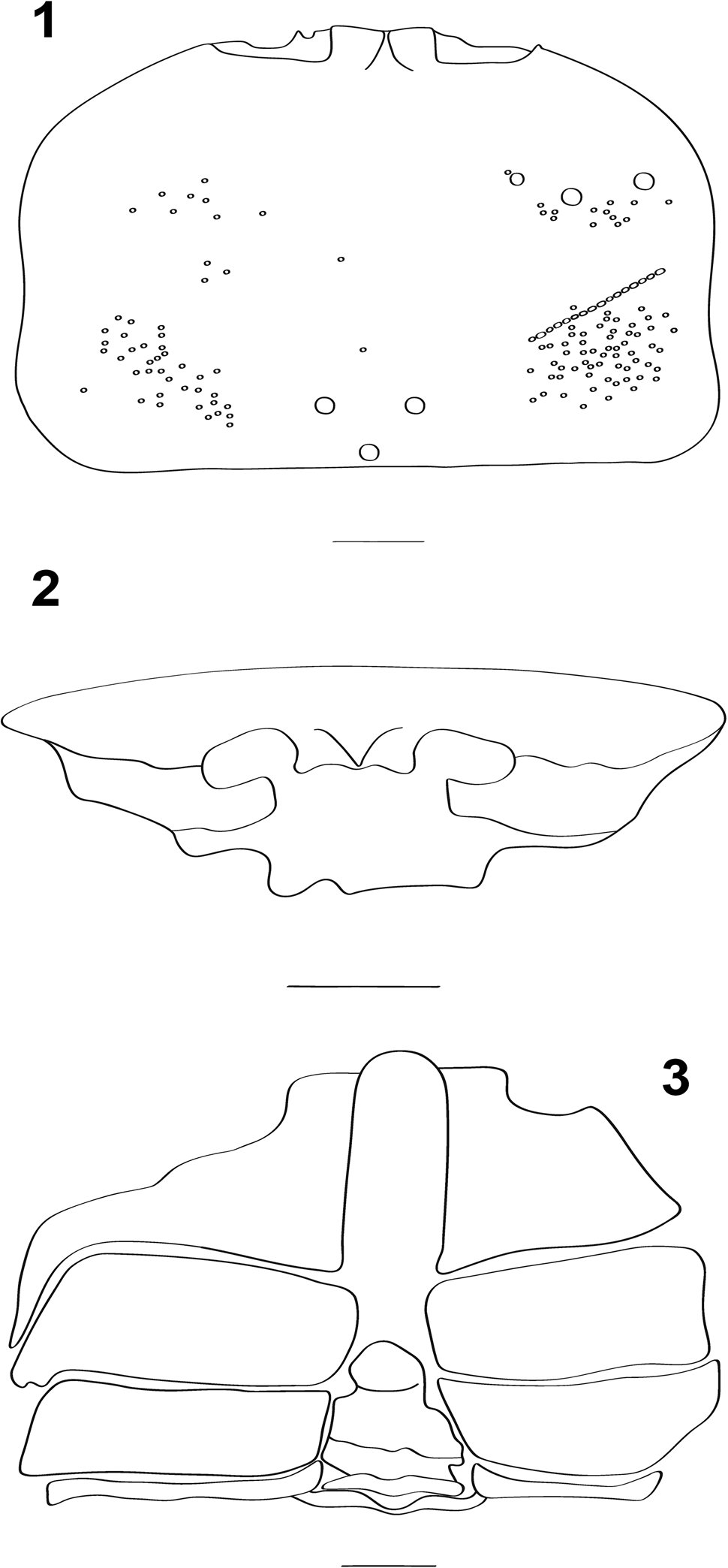
(1–3) Line drawing of Rodneyellus feldmanni n. gen n. sp. holotype (MPEG 2616) in (1) dorsal, (2) frontal, and (3) ventral views. Scale bars = 12 mm.

Diagnosis
As for the type species by monotypy.
Occurrence and age
Praia do Atalaia outcrop, Salinópolis, Pará, north Brazil, Pirabas Formation, late middle to late Miocene.
Etymology
The generic name is given in honor of Dr. Rodney Feldmann for his remarkable contribution to the knowledge of fossil crustaceans.
Remarks
The Hexapodidae currently comprises 25 genera, 12 of which contain exclusively modern species, nine of which are formed exclusively by fossil species, and four of which, Hexapinus, Hexapus, Mariaplax, and Stevea, encompass both modern and extinct species (Table 1).
Characters from the carapace separating Rodneyellus n. gen. from exclusively fossil genera, as well as from the genera containing both fossil and modern species, are as follows: carapace subrectangular, only slightly wider posteriorly (Fig. 2.1, 2.4) (very enlarged anteriorly in Eohexapus or enlarged posteriorly, narrowing considerably anteriorly, in Hexapus); carapace wider than long (about as long as wide in Eurohexapus); fronto-orbital margin less than half of the maximal width of the carapace (fronto-orbital margin more than half of the maximal width of the carapace in Eurohexapus, Goniocypoda, and Lucahexapus or fronto-orbital margin about half of the maximal width of the carapace in Headonipus, Holthuisea, and Mariaplax). Rodneyellus n. gen. also differs from Goniocypoda and Palaeopinnixa in having gently curved supraorbital margins, devoid of sinuous line (Fig. 2.3, 2.4) (supraorbital margin distinctly sinuous in Goniocypoda and Palaeopinnixa).
Rodneyellus can be separated from all fossil hexapodid genera (except Holthuisea) in having the thoracic sternite 8 partially exposed, scarcely visible between the sternite 7 and the first and second pleomeres (Fig. 3.1, 3.2).
Rodneyellus shares with Bellhexapus, Eohexapus, Hexapus, Holthuisea, Goniocypoda, and Mariaplax the possession of a stridulatory mechanism (Fig. 3.3, 3.4). Rodneyellus is superficially similar to Mariaplax in the possession of one strong curved ridge punctate with granules near the subhepatic region (Fig. 3.3, 3.4). However, Mariaplax is additionally provided with a row of oblique striae and scattered tubercles in the pterygostomial region (Rahayu and Ng, Reference Rahayu and Ng2014, p. 433, fig. 29D), absent in Rodneyellus n. gen. The present new genus and Mariaplax have in common a ridge of granules along the upper margin of the arthrodial cavity of the cheliped (Fig. 3.3, 3.4). Bellhexapus, Eohexapus, Goniocypoda, Hexapus, and Holthuisea stand apart from Rodneyellus in having a stridulatory apparatus consisting of a row of striae in the pterygostomial region and in Hexapus also a row of striae near the anterolateral angle of the buccal frame (Crane, Reference Crane1981, p. 13, fig. 8D; Guinot, Reference Guinot2006).
The thoracic sternum in males with grooves extending from the end of the sterno-abdominal cavity to receive the exposed apex of the first gonopod (Fig. 2.2) will separate the modern genera Hexapinus, Hexapus, Lambdophallus Alcock, Reference Alcock1900, Latohexapus Huang, Hsueh, and Ng, Reference Huang, Hsueh and Ng2002, Mariaplax, and Rayapinus Rahayu and Ng, Reference Rahayu and Ng2014 from Rodneyellus.
The stridulatory mechanism consisting of a row of oblique striae in the pterygostomial region in Hexaplax, Paeduma, and Stevea and the absence of such mechanism in Hexalaughlia Guinot, Reference Guinot2006, Parahexapus Balss, Reference Balss and Michaelsen1922, Pseudohexapus Monod, Reference Monod1956, Spiroplax Manning and Holthuis, Reference Manning and Holthuis1981, Thaumastoplax Miers, Reference Miers1881, Theoxapus Rahayu and Ng, Reference Rahayu and Ng2014, and Tritoplax Manning and Holthuis, Reference Manning and Holthuis1981 distinguishes the aforementioned genera from Rodneyellus.
Rodneyellus feldmanni new species
Figures 2–4
Type material
Holotype: adult male (MPEG 2616), pyritized carapace internal mold with thoracic sternum partially preserved, late middle to late Miocene, Pirabas Formation, north Brazil, Pará, Salinópolis, Praia do Atalaia outcrop, O. Aguilera coll. 2012. Paratypes: one female (MPEG 2615), pyritized carapace with thoracic sternum partially preserved, one indeterminate specimen (MPEG 2614), same information as the holotype.
Diagnosis
Carapace subrectangular, much wider than long (Fig. 4.1), slightly wider posteriorly, steeply arched anteriorly in lateral view; lateral margins subparallel in dorsal view; fronto-orbital margin less than half of maximal width of carapace. Supraorbital margin straight, directed perpendicularly toward carapace axis (Fig. 4.2). Stridulatory mechanism consisting of strong curved ridge punctate with granules near subhepatic region and ridge of granules along upper margin of arthrodial cavity of cheliped (not preserved in the male). Thoracic sternite 4 large (Fig. 2.2, 2.5) (with anterolateral projections in the female and probably in the male as well); sternites 5, 6 similar in length, seventh shorter; episternites 4–6 long, spur-shaped (not preserved in the female); sternite 8 minute, exposed between sternite 7 and first and second pleomeres (not preserved in the female). Male sterno-abdominal cavity narrow, deeply excavated (Figs. 2.2, 4.3) (broad and shallow in the female; Fig. 2.5). Sternum devoid of grooves extending from end of sterno-abdominal cavity, gonopods probably concealed under pleon (Fig. 4.3). Male pleomeres 1, 2 free; suture 2/3 well marked; pleomeres 3–5 probably fused, with sutures 3/4 and 4/5 indicated across pleomeres, more conspicuous in the axes (pleomeres not preserved in the female).
Occurrence
Same as for the genus.
Description (holotype MPEG 2616)
Partially preserved carapace internal mold with thoracic sternum of an adult male. Carapace subrectangular, wider than long (L/W = 7.8/12.8 mm = 0.61), with rounded corners, slightly convex longitudinally, strongly arched anteriorly, slightly widest posteriorly. Front slightly projected, bilobed, with deep axial depression. Orbits small, elliptical in frontal view, narrower than rostrum. Fronto-orbital margin narrow, 0.37 of maximum carapace width. Anterolateral margins broadly rounded. Lateral margins nearly parallel. Posterolateral margin rounded, narrow. Posterior margin straight, more than twice fronto-orbital margin. Carapace regions almost indistinct, median H-shaped depression distinct. Cardiac region subpentagonal, slightly swollen. Dorsal surface with several muscle scars; right protogastric region with antennae extensor muscle scar; H-shaped depression showing posterior gastric, attractor epimeralis, and internal mandible adductor muscle scars. Thoracic sternum large, wider than long. Sternites 1–4 fused; sternites 5–7 subrectangular, distinctly wider than long, subparallel to each other; sternites 5–6 subequal; sternite 7 narrow; sternite 8 visible as an oblique plate inserted between sternite 7 and pleomeres 1–2. Episternites 4–6 long, spur-shaped (not preserved in the female). Sternopleonal cavity well defined, deep, narrow, reaching anteriorly to sternite 2. Pleomeres 1–5 preserved.
Paratypes
Pyritized carapace of an adult female with partial thoracic sternum preserved; L/W = 9.3/13.4 mm (MPEG 2615). Pyritized carapace of an undetermined sex; L/W = 9.3/12.5 mm (MPEG 2614).
Etymology
Same as for the genus.
Remarks
Rodneyellus feldmanni n. sp. is the first undoubted hexapodid species recorded from Brazil, either extant or fossil. Assignment of the new species to the Hexapodidae is based on the vestigial sternite 8 visible as an oblique plate inserted between sternite 7 and pleomeres 1–2 and subrectangular carapace, wider than long (L/W = 7.8/12.8 mm = 0.61), with rounded corners.
Távora and Dias (Reference Távora and Dias2016, p. 2, 3, fig. 3a, b, erroneously spelled Palaeopinnixa porornata) reported the hexapodid Palaeopinnixa perornata from Aricuru locality, Maracanã, Pirabas Formation. Although not available to us, their specimen clearly corresponds to a ventral carapace of a portunid crab, a mistake already mentioned in Luque et al. (Reference Luque, Schweitzer, Santana, Portell, Vega and Klompmaker2017) and endorsed here.
The dark color, the high Fe content and Fe/Mn ratio of the mixture of carbonatic and black siliciclastic mudstone, and the record of pyritized fossil specimens are all suggestive of a restricted environment under low hydrodynamic conditions that fosters organic matter preservation as well as the precipitation of authigenic iron minerals (Otero et al., Reference Otero, Ferreira, Huerta-Díaz, Partiti, Souza, Vidal-Torrado and Macías2009; Moreira et al., Reference Moreira, Díaz, Santos, Mendoza, Böttcher, Capilla, Albuquerque and Machado2017). The pathways of biological or chemical pyritization processes involving fossils, such as of Rodneyellus feldmanni n. sp., were discussed at length by Jorgensen et al. (Reference Jorgensen, Findlay and Pellerin2019) and Renac et al. (Reference Renac, Barats, Mexias, Barrière, Rozmaric and Gerbe2020). Mangrove forests in the intertidal zone of the study section (facies γ) are supported by the extensive body of palynological research in the Praia do Atalaia section (Aguilera et al., Reference Aguilera, de Araújo, Hendy, Nogueira and Nogueira2020a; Gomes et al., Reference Gomes, Aguilera, da Silva-Caminha, D'Apolito, Cárdenas, Hocking and Lemes2023) favoring organic matter preservation, leading to reduced oxygen concentrations in sediments and influencing the behavior of redox-sensitive elements, such as Fe, Mn, and S (Ferreira et al., Reference Ferreira, Otero, Vidal-Torrado and Macías2007; Otero et al., Reference Otero, Ferreira, Huerta-Díaz, Partiti, Souza, Vidal-Torrado and Macías2009; Marchand et al., Reference Marchand, Fernandez, Moreton, Landi, Lallier-Vergès and Baltzer2012).
Discussion
Hexapodids, currently represented by 13 fossil genera, are more frequently documented worldwide from the Paleogene to Neogene, accounting for 92% of the total reported occurrences of the family. As much as 54% of all hexapodid fossil records originate from the Eocene in Europe. By contrast, Goniocypoda, Hexapus, and Mariaplax stand out as exceptions, with reported instances dating back to the Cretaceous, Pliocene, and Pleistocene, respectively, outside the typical Paleogene–Neogene temporal range. In terms of contemporary distribution, the majority of the extant hexapodid genera inhabit predominantly the Indo-West Pacific region, composing 50% of their current geographical range. Additional scattered records come from the east Pacific (12.5%), South Africa (12.5%), and west Africa (25%), as summarized in Table 1.
The Tethys Sea is a well-known dispersal pathway for many marine groups during the Mesozoic and Cenozoic (Schweitzer et al., Reference Schweitzer, Feldmann, González-Barba and Vega2002; Feldmann and Schweitzer, Reference Feldmann and Schweitzer2006; Lima et al., Reference Lima, Aguilera and Tavares2021, Reference Lima, da Silva, Aguilera, Pinheiro and Santana2023). Hexapodids, as many other decapod crustaceans, were widely distributed in the Eocene of Europe, mainly in the Tethys Sea of northeastern Italy (De Angeli et al., Reference De Angeli, Guinot and Garassino2010), ultimately extending into the Miocene in the Americas, including Argentina, Brazil, Peru, the United States, Barbados, Venezuela, Panama, and Trinidad.
During the Paleocene–Miocene, the hexapodid crabs were represented by nine species within the Americas, distributed in two genera: Palaeopinnixa (n = 8) and Rodneyellus (n = 1). However, only two extant species are reported—Paeduma cylindraceum from the Galápagos Islands and Stevea williamsi from Guatemala.
The Paleocene–Miocene interval is distinguished by significant global paleoceanographic and climate changes, marked by alternating cold and warm periods along with fluctuations in sea levels (You et al., Reference You, Huber, Müller, Poulsen and Ribbe2009; Goldner et al., Reference Goldner, Herold and Huber2014; Lear et al., Reference Lear, Coxall, Foster, Lunt, Mawbey, Rosenthal, Sosdian, Thomas and Wilson2015; Frigola et al., Reference Frigola, Prange and Schulz2018; Steinthorsdottir et al., Reference Steinthorsdottir, Coxall, de Boer, Huber and Bardolini2021). These fluctuations have exerted notable impacts on marine ecosystems, leading to faunal turnover episodes (Steinthorsdottir et al., Reference Steinthorsdottir, Coxall, de Boer, Huber and Bardolini2021; Alvarado et al., Reference Alvarado, Aguilera, de Araújo, Lopes, Geraldes, Martins, Coletti, Guimarães, Linares and Kütter2023; Guimarães et al., Reference Guimarães, Aguilera, Linhares, de Araújo and Mello2024). These paleoenvironmental changes during the Cenozoic can well have triggered the extinction of the Hexapodidae in the Miocene within the tropical Americas, limiting the family to a mere two relict species. Concurrently, along the Brazilian equatorial coast, notable events such as the formation of the Amazon River delta, the progradation of the Barreiras Formation, and the collapse of carbonate producers (Rossetti et al., Reference Rossetti, Bezerra and Dominguez2013; Hoorn et al., Reference Hoorn, Bogotá, Romero-Baez, Lammertsma, Flantua, Dantas, Dino, do Carmo and Chemale2017; Jaramillo et al., Reference Jaramillo, Romero, D'Apolito, Bayona and Duarte2017; Aguilera et al., Reference Aguilera, de Araújo, Hendy, Nogueira and Nogueira2020a, Reference Aguilera, Bencomo, de Araújo, Dias and Colettib; Nogueira et al., Reference Nogueira, Amorim, Góes, Truckenbrodt and Petri2021) were part of the broader environmental context in which Hexapodidae evolved. These changes certainly produced major environmental impacts on both the marine landscape and fauna, thus contributing to the extinction of a great number of species as also illustrated by the extinction of the spider crabs of the genus Eoinachoides in the Miocene (Lima et al., Reference Lima, Aguilera and Tavares2021).
Acknowledgments
We express our sincere gratitude to persons and institutions for all the help provided throughout this study: to M.I. Feijó for granting access to the fossil crustacean collections and for the loan of specimens from the MPEG; to H. Moraes-Santos (MPEG) for collaboration and support during the field trip to the Atalaia fossil site; to A.P. Pinheiro (URCA) for kindly giving access to the Laboratório de Crustáceos do Semiárido (LACRUSE), where the photos and drawings were made; and to reviewers H. Karasawa and À. Ossó for their constructive comments on the early version of this article. This work was supported by the Fundação Cearense de Apoio ao Desenvolvimento Cientifico e Tecnológico (FUNCAP) (grants #PV1-0187-00019.01.00/21 and #BP5-0197-00056.01.00/22 to D.L. and #BP5-0197-00141.01.01/23 to M.d.G.F.A). We thank Conselho Nacional de Desenvolvimento Científico e Tecnológico (CNPq, through fellowships #304693/2021-9 to O.A. and #309488/2020-6 to M.T.) and Fundação Carlos Chagas Filho de Amparo à Pesquisa do Estado do Rio de Janeiro (FAPERJ) (fellowship E-26/201.035/2021 to O.A.).
Declaration of competing interests
The authors declare none.