Introduction
Tonsillectomy remains one of the most common operative procedures performed in the NHS, with 26 634 tonsillectomies being recorded in the 0–14 year age group for Hospital Episode Statistics in 2012–2013 (Office of Population Censuses and Surveys codes f34.1, F34.2, F34.3, F34.7, F34.8 and F 34.9). Of these, 70–80 per cent is primarily performed to manage recurrent sore throats, with the remainder for treating obstructive symptoms, although there is often considerable overlap. However, in the last 2 decades there has been a substantial reduction in the tonsillectomy rate for the under-16 age group – falling from 555 per 100 000 population in 1991 to 284 per 100 000 in 2011. In parallel, there has been a significant rise in the admission rate for tonsillitis for the same age group, increasing from 98 per 100 000 to 390 per 100 000 population.Reference Lau, Upile, Wilkie, Leong and Swift1 While confounding factors such as reduced antibiotic prescription may contribute to the increase in emergency admissions, the reduced rate of surgical intervention is also likely to be an important factor.
Anecdotal evidence suggests that parental satisfaction with surgery is high; however, there is a relative paucity of published evidence and a wide geographical variation in intervention rates.2 These factors led, in 2006, the then Chief Medical Officer, Liam Donaldson, to include paediatric tonsillectomy in the list of procedures of limited clinical effectiveness which should be carried out only in exceptional circumstances. Following this, many primary care trusts sought to reduce the number of adenotonsillectomies performed in this age group by restricting referrals to children with sleep-disordered breathing or those meeting Scottish Intercollegiate Guideline Network (SIGN) criteria. We do not claim to know the appropriate surgical intervention rate. However, under such a management agenda the range of intervention rates may narrow towards a consensus but can be widened by arbitrarily large reductions in some districts. In the absence of comprehensive evidence on effectiveness, there are strong clinical suggestions that the current number of procedures may not fully meet the genuine healthcare needs of affected children. In 2012, the UK Department of Health's NHS Atlas of Variation in Healthcare also suggested that the intervention rate in some regions is lower than expected.3 A broad multidisciplinary review of evidence suggested that while the tonsillectomy rate for recurrent sore throats should be kept as at the present level, there should be a substantial increase in the number of tonsillectomies being offered to children for sleep apnoea.4
We set out to evaluate changes in the quality of life (QoL) of children who underwent tonsillectomy and of another group undergoing conservative management. The T14 for children is a disease-specific parent-reported outcome measure that was recently validated for use in children with tonsil-related disorders (both infective and obstructive) in the UK.Reference Hopkins, Fairley, Yung, Hore, Balasubramaniam and Haggard5 It is an adaptation of a pre-existing set of relevant questions that has been re-standardised, supplemented and psychometrically optimised for a low-respondent burden (14 items). Good construct validity has been shown by a known-group comparison (patients versus unaffected controls). The two scales of the instrument support the distinction between an infection aspect and an obstruction aspect. The disease-specific health-related QoL questionnaire is answered by the parents or other caregivers of children with infective or obstructive adenotonsillar disease. A pilot study of 36 children has suggested very large improvements in symptoms (1.5 SD) 6 months after surgical intervention. This figure is likely to include a degree of overestimation resulting from biased follow up, which the pilot study did not have the resources to remedy. Addressing this problem required a larger (preferably a multicentre) study to be performed, including sufficient patient numbers to more precisely estimate the benefit; the current study aimed to achieve this.
Materials and methods
Populations
A non-randomised observational cohort study of children (aged 0–15 years) undergoing tonsillectomy or adenotonsillectomy in 7 NHS hospitals was performed; observations were recorded at baseline and 1 year after surgery. Children were recruited over an eight-week period. The study also recruited children who attended the clinic during the same period after referral for throat problems but who were not managed by surgery based on clinical indication and parental preference. Indications for surgery were recorded according to SIGN criteria or to a history suggestive of disordered sleep. A diagnosis of sleep-disordered breathing was based on a very strong clinical history or supported by further sleep studies in selected patients (as indicated by the UK consensus statement on tonsillectomy for sleep-related breathing disorders6).
Intervention
Children underwent either tonsillectomy or adenotonsillectomy. Data was collected in the clinic for children planned to undergo non-surgical management with observation.
Outcome measures
As the primary outcome measure, parents were asked to fill out a T14 questionnaire at baseline and one year after recruitment. As secondary outcome measures, at one year parents were asked by letter whether their child's QoL related to throat problems was ‘much better, better, the same, worse, or much worse’ than a year earlier. At each time point, parents were asked to give an overall rating for their child's QoL as related to their throat problems. Parents were asked to report how many days their child had been absent from school over the previous six months because of throat problems. For children not initially recommended for surgery, parents were asked at one year whether they had actually undergone surgery and, if so, when.
Data collection
Initial data were collected at the clinic, with both the clinician and parents filling out baseline data sheets. Parents provided signed consent to be contacted for follow up. It was aimed to send follow up sheets by post one year after the original appointment. If no reply was received, then a repeat letter was sent at 14 months; up to 3 attempts to phone were made after another 2 months if there was no reply.
Ethical approval
The National Research Ethics Service confirmed that as an audit of normal practice, formal ethical approval was not needed. Each unit registered the audit in keeping with their own departmental process.
Results
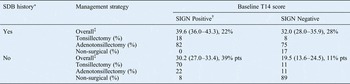
A total of 276 patients referred with symptoms relating to tonsil and adenoid disorders were recruited from 7 participating units over a 2-month period. Of these, 11 per cent had neither a history suggestive of sleep-disordered breathing nor met the SIGN criteria for tonsillectomy for recurrent acute tonsillitis; 22 per cent met both criteria, while the remainder met one or the other. Table I shows that the mean T14 score was significantly lower in patients who met neither criteria (p < 0.001) and highest in those who met both. It also shows the management strategy for each patient group, with the highest levels of surgical intervention (100 per cent) in patients meeting both criteria and the lowest levels in those meeting neither (11 per cent). The mean cohort age was 7.1 years; it was lowest in children who underwent adenotonsillectomy (5.5 years) and highest in those who underwent tonsillectomy (9.1 years). Children who underwent surgery for sleep-disordered breathing (5.5 years) were younger than those with recurrent acute tonsillitis (8.3 years). The mean age in the non-surgical group was 7.0 years. Overall, parents reported that their children had missed school for 2.7 days on average over the preceding 6 months. School absenteeism was higher in children who underwent tonsillectomy (3.3days) than in those who underwent adenotonsillectomy and non-surgical management (2.3 days and 2.0 days, respectively). Oximetry results were positive for obstructive sleep apnoea (OSA) in 15 children, but we do not know whether the remainder underwent oximetry or polysomnography and, if so, had a normal result.
Baseline t14 scores and management strategy by diagnostic category

*With (yes) or without (no) a clear parental history suggestive of SDB. †Meeting the SIGN criteria for recurrent acute tonsillitis. ‡Data represent the mean (95% confidence interval), % of patients. SDB = sleep-disordered breathing; SIGN = Scottish Intercollegiate Guideline Network
Table II shows the mean baseline T14 scores at recruitment and the distribution of diagnostic criteria according to management strategy. The mean T14 score in the non-surgical group (23.0) was significantly lower than in either the tonsillectomy or adenotonsillectomy group (p < 0.001, t = −3.51 and p < 0.001, t = −4.76, respectively; unpaired t-test); those in the non-surgical group were less likely to meet the diagnostic criteria for either disease. In the tonsillectomy group, 95 per cent of children met the SIGN criteria for recurrent acute tonsillitis, while in the adenotonsillectomy group sleep-disordered breathing was the most common indication for surgery. All children with OSA-positive oximetry findings were offered surgical management.
T14 scores and diagnostic groups by treatment group

*Data represent the mean (95% confidence interval). SIGN = Scottish Intercollegiate Guideline Network; +ve = positive; SDB = sleep-disordered breathing; Oxim = Oximetry
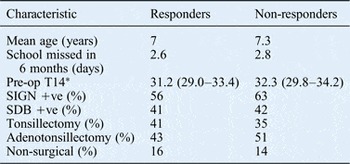
Responses were received for only 150 patients (54 per cent) despite 2 letters being sent and up to 3 attempts to make telephone contact. The parents of 10 patients included in the study did not consent to be contacted again, 11 letters were returned as addressee unknown and the remaining 38 per cent could not be contacted. The baseline characteristics of responders and non-responders were similar at recruitment (presented in Table III). The response rate was similar for each management strategy: 58 per cent for tonsillectomy; 52 per cent for adenotonsillectomy; and 59 per cent for non-surgical management. Follow-up forms were sent at 12 months, with a reminder 2 months later, and phone calls were made to non-responders after a further 2 months. Follow up therefore ranged from 12 to 16 months after recruitment.
Characteristics of responders versus non-responders

*Data represent the mean (95% confidence interval). Pre-op = pre-operative; SIGN = Scottish Intercollegiate Guideline Network; +ve = positive; SDB = sleep-disordered breathing
There was a significant improvement in T14 score for responders in all groups (Table IV). The mean change in T14 score was larger in the surgical groups, but the between-group difference did not reach statistical significance. The effect size, calculated by dividing the change in score by baseline SD was 1.3 SD for the non-surgical group, 2.1 SD for the tonsillectomy group and 1.9 SD for the adenotonsillectomy group. These effect sizes are considered to be very large.
Change in t14 scores by itt management strategy

*Data represent the mean (95% confidence interval). †Paired t-test. ITT = intention to treat
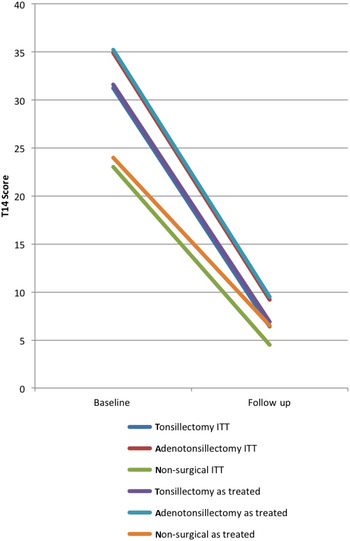
The parents of 8 out of 24 children (33 per cent) in the non-surgical group who responded at follow up reported that their child had undergone tonsillectomy in the intervening period. The parents of one child recommended for tonsillectomy reported that the procedure had not been performed (1 per cent). The change in T14 scores was recalculated based on ‘as treated’ management; comparison with the ‘intention to treat’ analysis is shown in Figure 1.
Graph comparing the mean T14 score change by ‘intention to treat’ (ITT) and ‘as treated’ in patients with follow-up responses.

A higher proportion of parents of children who underwent surgery reported that their child's QoL was ‘much better’ at follow up than at baseline. Although the mean T14 score changed across each group, the percentage of children who achieved the ‘minimally important difference’ in T14 score (i.e. the smallest change in T14 score that can be perceived as a significant change by the reporter, as defined in the previous validation study) was also higher in both surgical groups than in the non-surgical group (Table V).
Respondents reporting a ‘much better’ or ‘better’ qol after surgery, and achieving a mid t14 score

MID = minimally important difference
Comparison of the follow-up and baseline questionnaires revealed a significant reduction in the number of school days missed in the 6-month period prior to completing the T14 questionnaire for both surgical groups (3.1 days fewer in children who underwent tonsillectomy, 1.9 days fewer in children who underwent adenotonsillectomy), but no significant reduction in the non-surgical group (0.2 days fewer). There was no significant difference in the change in T14 score from baseline among the seven participating units.
Discussion
The results of this study suggest that most patients who undergo surgery for tonsil-related illness meet the current SIGN guidelines for tonsillectomy for recurrent acute tonsillitis or have a history of sleep-disordered breathing. However, over 10 per cent of children still undergo surgery when the indications are unclear. Children who underwent surgical management had a higher symptom burden than those electing non-surgical management; most of the latter did not meet criteria for surgery. There was also significant cross-over from the non-surgical management to the surgical management group.
Parents reported significant improvements in disease-specific QoL for children following both tonsillectomy and adenotonsillectomy. However, as in previous studies, we found a spontaneous improvement in T14 scores in the non-surgical group for both ‘intention to treat’ and ‘as treated’ analyses. It is interesting that when asked to compare the QoL at baseline and follow up, parents reported a much better QoL for 65 per cent of the surgical cohort compared with 39 per cent of the non-surgical cohort. A lower proportion of children had a change in T14 score greater than the minimally important difference – that is, although the score decreased, the amount of change may not be perceptible as a real difference by the parents. The change in score is likely to happen more quickly in the surgical group, and is therefore more readily apparent than the gradual, progressive improvement seen in the non-surgical group. Finally, an additional source of bias might be that parents who consent to their child undergoing surgery may have a strong desire to believe they have made the right choice, and may therefore report greater improvements in their child's QoL compared with those who denied consent.
Our results compare favourably with the published literature. A Cochrane review of tonsillectomy for recurrent acute tonsillitis failed to find any studies that met the inclusion criteria.Reference Burton and Glsziou7 A more recent meta-analysis by Blakley and Magit included four prospective randomised studies, with three in children.Reference Blakley and Magit8 They reported a 43 per cent reduction in acute pharyngitis, but also found significant rates of spontaneous resolution in the control groups. Compared with control groups, there were 1.2 fewer episodes of sore throat and 2.8 fewer days off school per year. No good randomised studies have evaluated the effectiveness of surgery in OSA, although a meta-analysis of adenotonsillectomy for sleep apnoea confirmed by sleep study in children found resolution of sleep apnoea in 82 per cent of children in repeated sleep studies after surgery.Reference Brietzke and Gallagher9 Two papers describe QoL changes following paediatric tonsillectomy, and both suffer from low response rates (43 per cent and 41 per cent). A study by Schwentner et al. documented a statistically significant improvement in children after adenotonsillectomy using the Glasgow Benefit Inventory.Reference Schwentner, Schmutzhard, Schwentner, Abraham, Hofer and Sprinzl10 Another by Goldstein et al. found improvements in all subscales of the Tonsil and Adenoid Health Status Instrument, including airway and breathing, infection, healthcare utilisation, cost of care, eating and swallowing, and behaviour.Reference Goldstein, Witsell, Hannley, Weaver, Yueh and Smith11 Neither study included a control group, although Goldstein and colleagues had intended to follow children assigned to watchful waiting or declined surgery for other reasons, but were unable to recruit sufficient numbers. The current study builds on our pilot study that validated the T14, and confirms the utility of the T14 for capturing changes in disease-specific QoL.
During the follow-up period, one in three patients initially allocated to conservative management crossed over to a surgical strategy. This is similar to the 26 per cent cross-over rates reported by the North of England and Scotland Study of Tonsillectomy and Adenotonsillectomy in Children (‘NESSTAC’) and is a significant challenge in randomised trials for surgery.Reference Lock, Wilson, Steen, Eccles, Mason and Carrie12, Reference Cook13 An intention to treat analysis is important to include in randomised controlled trials because it maintains the prognostic balance created by random allocation. Exclusion of non-compliant patients (who are likely to overly represent the extremes of disease severity) can introduce significant prognostic differences between treatment groups. However, when high rates of cross-over occur, an intention to treat analysis is likely to reduce the estimated treatment effect.
Limitations of the current study
This is a non-randomised observational study, in which patients were managed according to their clinical need. From the outset, there were significant differences among treatment groups, with the non-surgical group reporting significantly lower symptom scores, fewer school days missed and lower rates of both sleep-disordered breathing and recurrent acute infection. Therefore, the comparison of outcomes among groups is not a like with like comparison. It was not possible to capture the expectation bias of parents who consent to surgical treatment for their children, but we acknowledge that this may influence the reported outcomes and needs further study. Other operative variables, including experience of the surgeon, surgical technique, the occurrence of complications and same-day discharge may influence the surgical outcome but were not analysed in this study.
Despite multiple attempts at patient contact, the response rate was disappointing; this is the major limitation of the current study. Similar response rates have been reported in studies relying on parental completion of patient-reported outcome measures or diary cards. While there were no significant differences between responders and non-responders at baseline, there may be some respondent bias in that parents who were pleased with the results of surgery may have been more inclined to return the forms. In addition, there was a four-month range in the data collection period owing to delays in responding.
• Children referred to an ENT clinic with more severe tonsil-related symptoms are recommended for surgery
• Children undergoing surgery achieve significant improvements in disease-specific quality of life
• Less severely affected children managed conservatively also improve over 12 months
• One in three less severely affected children cross over to surgical intervention
Another limitation resulting from the study design is that symptom duration prior to tonsillectomy is unknown. Lock and colleagues found the greatest improvements in children who underwent tonsillectomy after a short history of recurrent sore throat compared with those with a longer history.Reference Lock, Wilson, Steen, Eccles, Mason and Carrie12 As with Lock and colleagues’ study, we also found significant rates of cross over from a non-surgical to a surgical management strategy. This is a common finding in surgical trials, and may partly result from recruiting patients in a secondary case setting. Parents referred from a general practitioner usually come with the expectation of being offered surgery (they have been referred because the general practitioner can only offer non-surgical options), so even if a period of watchful waiting is initiated, there is still often a strong parental drive towards surgery. The strong desire for surgery, and the parental perception that they might need to ‘push’ for surgery was highlighted in Lock and colleagues’ study.Reference Lock, Wilson, Steen, Eccles, Mason and Carrie12 Future randomised studies might recruit in a primary care setting to reduce the selection of families already primed for surgical management.
Conclusion
This study confirms that the T14 questionnaire is a useful tool to evaluate outcome in children with tonsil-related disease. Children who underwent surgery met either the SIGN criteria for recurrent acute tonsillitis or presented with a history of sleep-disordered breathing, and reported T14 scores representing more severe symptoms. Of those initially selected for watchful waiting (with lower symptom levels), a third eventually underwent surgical intervention. There was a significant improvement in symptoms for all groups over the 12-month follow up.
These results suggest that current guidelines are being followed when selecting children for surgery, which allows the less severely affected children who may improve with time to do so. In addition, the more severely affected children are being selected for surgical intervention and achieve a significant improvement in their disease-specific QoL. However, this study did not provide information on how much spontaneous resolution of symptoms would occur in this group if surgical intervention was withheld.
Acknowledgements
We would like to thank S Blaney, A Burgess, J Grainger, R Irving, N Jonas, A Kinshuck, M Kuo, A-L McDermott, E McNeil, J R M Moore, G Morrison, C Panagamuwa, A Reid, K Tzifa and J Williams for their particular help in recruiting children and for helping to coordinate the study at different centres.