

Incidental proceedings on provisional measures are an important component of the legal practice of the International Court of Justice (ICJ or Court). A state can file a written request asking the Court to indicate provisional measures in order to safeguard its interests in the case either at the same time as the application instituting proceedings or at a later time.Footnote 1 Under Article 41 of its Statute the Court has been given the power to indicate, if it considers that the circumstances so require, any provisional measures which ought to be taken to preserve the respective rights of either party.Footnote 2 Such power is largely comparable with that possessed by domestic courts to issue injunction orders pending the final settlement of a given dispute. Before the adoption of the 1978 Rules of the Court the term used by the Court was ‘interim measures of protection’.Footnote 3 As a matter of procedure, the Court arranges for a hearing so as to give both parties the possibility to express their views,Footnote 4 unless the circumstances require otherwise.Footnote 5 Only once so far has the Court not resorted to this procedure, stating that the circumstances required it to indicate provisional measures as a matter of the greatest urgency and without any other proceedings.Footnote 6 Requests for provisional measures are treated with the highest priority by the Court.
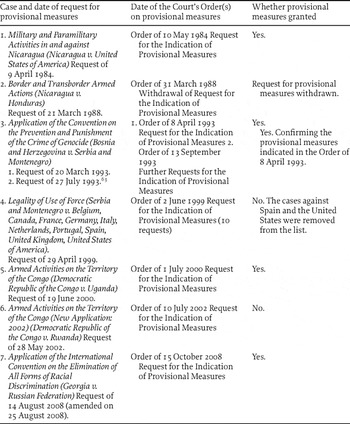
In the period between 1946 and 2010, of the 28 cases where requests for provisional measures were made, the ICJ granted provisional measures in 14 cases and rejected them in 13 others; one request was withdrawn.Footnote 7 In seven cases involving situations of armed conflict there were 17 requests for provisional measures filed with the Court (see appendix).Footnote 8 The Court indicated provisional measures in five of its orders, pertaining to four cases,Footnote 9 and rejected the rest. Arguably, provisional measures are needed most in disputes which constitute or come to constitute a threat to the maintenance of international peace and security. An armed conflict between two states by definition endangers international peace and security. Failure to address such a situation increases the risk of a potential escalation of the conflict, which in turn increases significantly the risk of prejudice to the rights of the affected parties.
The element of urgency in such cases is usually self-evident. As rightly pointed out by Rosenne, what is involved is not only the preservation of the object of the dispute or of the relevant evidence, but also the prevention of the use of force in violation of the Charter of the United Nations or of any aggravation or extension of the dispute and of risk to human life.Footnote 10 Regrettably, it is exactly in these same areas that provisional measures are the most difficult to apply and enforce. The most recent example of provisional measures issued in an armed conflict context to protect populations from irreparable harm is the Court's order of 15 October 2008 relating to the August 2008 armed conflict between Georgia and Russia.
This article examines a number of provisional measures issued by the Court in situations of armed conflict, including the most recent Georgia v. Russia case. Section 1 of the article deals with certain preliminary matters, namely the requirements for indicating provisional measures, their binding character, and the Court's procedures relevant to ensuring compliance with its orders. In section 2 close attention is devoted to the importance of provisional measures orders for protecting affected populations in an armed conflict situation. After dealing with the general importance of provisional measures orders in armed conflict situations (section 3), due attention is devoted to the legal consequences for states that violate these orders.
1. Necessary requirements for indicating provisional measures and their binding character
On the basis of Article 41 of the Statute of the Court, providing the legal basis for the Court's power to indicate provisional measures, ‘The Court shall have the power to indicate, if it considers that the circumstances so require, any provisional measures which ought to be taken to preserve the respective rights of either party.’ That article leaves open two important issues. First, what the necessary requirements for the Court to indicate provisional measures are and, second, what their nature is. Article 73(2) of the Rules of the Court stipulates that the request shall specify the reasons for indicating provisional measures, the possible consequences if they are not granted, and the measures requested. Clarity over the indispensable requirements for their indication and the legal status of provisional measures is necessary for states interested in making use of this possibility.
Over the years the ICJ has formulated a number of requirements whose fulfilment is necessary for indicating the requested provisional measures, also known as interim measures of protection. Thus before issuing an order the Court needs to be satisfied that the following requirements are met: Footnote 11
(1) it has prima facie jurisdiction;
(2) the order is necessary so as to preserve the rights of the parties concerned from irreparable prejudice; and
(3) there is urgency – that is, there is a real risk that action prejudicial to the rights of either party might take place before the Court gives its final decision.
Equally, as with requests made in other circumstances, also in armed conflict situations, the Court has assessed carefully whether the indication of provisional measures was justified under the specific circumstances of the case.
The Court will not indicate provisional measures unless the jurisdictional ground invoked by the applicant state seems to afford a prima facie basis for its jurisdiction. That means that the majority of the judges should believe that there will eventually be jurisdiction over the merits of the case. The preservation of the rights of the parties is central to provisional measures, since they are aimed at protecting rights that are the subject of the dispute and at the risk of irreparable damage or prejudice.Footnote 12 In dealing with the scope offered by interim measures for the protection of human rights, Judge Higgins has stated,
The requirements for the indication of provisional measures have evolved over the years. Although these are now well established, their scope and application in particular circumstances continues to evolve. At the same time, the evolving jurisprudence on provisional measures shows a growing tendency to recognize the human realities behind disputes of states.Footnote 13
However, the use of provisional measures as a tool for protecting the rights of named individuals has also drawn some concerns from inside the Court. Those concerns deal with the Court exceeding its function by determining the rights not of states but of individuals,Footnote 14 or doubts whether efforts to settle the dispute through negotiation had taken place, as a precondition to seizing the Court.Footnote 15 Evidently, in cases arising from an armed conflict situation, at stake is the protection of large parts of, or the entire population of, a party, and not specific individuals as is the case in consular relations cases.
The ICJ has responded expeditiously to requests made by states, while emphasizing on several occasions that provisional measures are only justified if they are a matter of urgency.Footnote 16 Such expeditiousness is institutionally embedded in the Court's Rules. Thus, according to Rule 74(1), a request for the indication of provisional measures shall have priority over all other cases. As best illustrated by the Georgia v. Russia case, in situations of armed conflict urgency is often a given, considering among others the increased risk of irreparable harm to the life and property of the civilian population during armed hostilities.
For a long time opinions were divided with regard to the legal nature of the provisional measures of the Court. Possibly the ambiguity of the binding power of orders on provisional measures was another reason behind the non-encouraging record of compliance with them by states.Footnote 17 The Court ended all speculation as to the binding nature of its provisional measures in its 2001 judgment in the LaGrand case.Footnote 18 After noting first that to date neither the Permanent Court of International Justice nor the present Court had been called on to determine the legal effects of orders made under Article 41 of the Statute,Footnote 19 the Court resorted to a close examination of the wording and the travaux préparatoires of Article 41. Being faced with two equally authentic texts in English and French, which were not, however, in total harmony, the Court decided to consider the object and purpose of the Statute together with the context of Article 41.Footnote 20 The Court stated,
It follows from the object and purpose of the Statute, as well as from the terms of Article 41 when read in their context, that the power to indicate provisional measures entails that such measures should be binding, inasmuch as the power in question is based on the necessity, when the circumstances call for it, to safeguard, and to avoid prejudice to, the rights of the parties as determined by the final judgment of the Court.Footnote 21
Having subsequently considered whether Article 94 of the UN Charter precludes attributing binding effect to orders indicating provisional measures, the Court concluded that this article does not prevent orders made under Article 41 from having a binding character.Footnote 22 The power vested in the Court to indicate provisional measures if the circumstances of the case so require, and the incumbent legal obligations upon the parties to which the Court refers in its order, underscore the binding character of such measures when issued.
2. Supervising compliance with provisional measures by the Court
Under Article 78 of its Rules the Court has the discretionary power to request information from the parties on any matter concerned with the implementation of any provisional measures it has indicated. The Court has decided to keep issues covered by its order under continuous review,Footnote 23 or has asked the parties explicitly to inform it as to their compliance with indicated provisional measures.Footnote 24 Both continuous review and receiving information are procedures which enable the Court to supervise compliance with its order by the party or the parties concerned. Continuous review appears to relate more to the Court's proprio motu powers to follow closely changing circumstances so as to adapt its interim protection measures accordingly.Footnote 25 Requesting the parties to provide information regarding the steps taken to comply with an order has a general nature. It is not entirely clear, however, what exactly the Court can do with such information. Moreover, the technicalities of this reporting procedure have not been spelled out in the Court's Rules or its Practice Directions.Footnote 26 A practice direction addressing this issue would add transparency and make it easier to establish whether a party has complied with the Court's request.
Some evidence of the Court's involvement after the indication of provisional measures in an armed conflict situation is provided in the Nicaragua case. The Court noted the following:
On 25 June 1984 the Government of Nicaragua addressed a communication to the Court referring to the Order indicating provisional measures, informing the Court of what Nicaragua regarded as ‘the failure of the United States to comply with that Order’, and requesting the indication of further measures. The action by the United States complained of consisted in the fact that the United States was continuing ‘to sponsor and carry out military and paramilitary activities in and against Nicaragua’. By a letter of 16 July 1984, the President of the Court informed the Agent of Nicaragua that the Court considered that that request should await the outcome of the proceedings on jurisdiction which were then pending before the Court. The Government of Nicaragua has not reverted to the question.Footnote 27
Eventually, either party can provide the Court with information whether its provisional measures are being complied with. The issue would be complicated in cases of non-participation or non-appearance in the proceedings. However, since the end of the Cold War there have been no instances when states have failed to appear or participate in the Court's proceedings, including incidental proceedings on provisional measures.
What is the role of the Court in ensuring compliance with its orders?Footnote 28 If one of the parties were manifestly to disregard the provisional measures ordered by the Court, the affected party could request of the Court the indication of additional provisional measures,Footnote 29 or eventually try to bring this issue before the Security Council under Article 94(2) of the UN Charter. It is doubtful, though, whether this second avenue is open,Footnote 30 and if so, how effective such a step might be in terms of ensuring compliance, if the Security Council were unable to address the situation from the beginning because of an internal deadlock. The Court has emphasized that it is incumbent on each party to take the Court's indication seriously into account, particularly in situations, such as in Bosnia and Herzegovina, where no reparation could efface the results of conduct which could be ruled as being contrary to international law.Footnote 31 In its order in the Georgia v. Russia case the Court pointed out that ‘its orders on provisional measures under Article 41 [of the Statute] have binding effect’ and thus create international legal obligations with which both parties are required to comply.Footnote 32 Since the obligatory nature of provisional measures is beyond doubt, states can no longer ignore such measures without the risk of being held accountable for a breach of their obligations under international law.Footnote 33
3. Protecting populations in armed conflict situations through the ICJ's orders on provisional measures
Provisional measures indicated by the ICJ represent a potentially useful tool in protecting the civilian population from the destructive effects of an armed conflict. What applicant states have generally requested in such cases is that the Court order an immediate stop to what is perceived as an act of aggression or illegal use of force gravely affecting that country's population. It has been argued that in cases of armed conflict the effect of provisional measures ordering an immediate halt to any armed action would be the same – at least for the parties to the case – as that of a Security Council resolution under Chapter VII of the Charter.Footnote 34 In any case, while stopping short of ordering an end to an armed conflict, the Court has called on the parties not to take any steps which would aggravate the dispute.
The circumstances surrounding most of the cases make a provisional measures order a last remedy. Requesting an order by the Court often represents the last-ditch attempt by a state to get some relief when everything else has had little or no effect. Undoubtedly, seizing the Court increases the visibility of the dispute, highlighting its seriousness and urgency. The two closely related issues discussed in this section are, first, the general importance of provisional measures in ensuring state compliance with commonly agreed standards of human rights and humanitarian law and, second, the legal consequences arising from violations of the Court's orders.
3.1. The general importance of provisional measures
Since the Anglo-Iranian Oil Co. case in 1951, there has been an increasing use of provisional measures proceedings as a way of involving the ICJ in crisis situations if the state taking the initiative can show prima facie jurisdiction and an element of urgency, even if it were on weak grounds.Footnote 35 The range of provisional measures the Court can indicate relates directly to the rights at risk of prejudice, which in turn are dependent on the grounds on which the Court's prima facie jurisdiction is based. When the jurisdiction of the Court is based on acceptance of its compulsory jurisdiction by both parties to the dispute, provisional measures can encompass a broad range of measures, including compliance with humanitarian law norms.Footnote 36 The Court's limitation in this regard is evident when its jurisdiction is based on a compromissory clause of a human rights treaty. Article IX of the 1948 Genocide Convention and Article 22 of the 1965 International Convention on the Elimination of All Forms of Racial Discrimination (CERD) have been used to found the Court's jurisdiction in cases arising from an armed conflict situation.Footnote 37 It bears mentioning that, although based on Article IX of the Genocide Convention or on Article 22 of CERD, the requests of the applicant states were worded to a significant extent in terms of violations of international humanitarian law.Footnote 38 Regrettably, the fact that neither the 1949 Geneva Conventions nor their 1977 Additional Protocols contain a compromissory clause represents an almost insurmountable jurisdictional barrier to the Court's involvement in disputes arising in an armed conflict situation.
In the Georgia v. Russia case the Court noted that the structure of Article 22 of CERD is not identical to that in certain other instruments which require that a period of time should have elapsed or that arbitration should have been attempted before initiation of any proceedings before it.Footnote 39 Seemingly, were the Court seized under a human rights treaty whose compromissory clause provides that if a dispute between two or more state parties concerning the interpretation or application of the convention which cannot be settled through negotiation shall be first submitted to arbitration and only after six months referred to the Court, its response would have been of an entirely different nature.Footnote 40 It is highly questionable, though, whether strict compliance with this requirement in situations of armed conflict should be a condition sine qua non for the Court to indicate provisional measures. It is submitted that depending on the magnitude and intensity of the conflict, the threat it poses to peace and security, and the imminent risk of irreparable prejudice to the life and property of a considerable part of the population, the Court should be entitled to issue provisional measures whether or not these requirements are met. The existence of an armed conflict should operate to the effect that the substantial obligations on the parties to a case to respect the human rights treaty remain,Footnote 41 while the triggering procedure of the Court is eased. A number of doctrines, such as rebus sic stantibus, impossibility, and that of effectiveness (ut res magis valeat quam pereat) could be invoked in support of this proposition.
Many requests for provisional measures motivated on humanitarian grounds have been brought before the Court. The violent break-up of the former Yugoslavia provides a telling example of a complex crisis situation that included also the involvement and indication by the ICJ of provisional measures on humanitarian grounds, albeit of limited practical significance. Similarly, the armed conflict in the Democratic Republic of the Congo has caused great loss of human life and much human suffering, despite the seizing of the Court.Footnote 42 As a distinguished author has noted, judicial treatment of appropriate elements of the crisis can, although not necessarily will, perform a significant, albeit not exclusive, role in the management of that crisis.Footnote 43 Even by simply calling on the parties to refrain from taking any action which aggravates the situation until a decision on the merits is reached, the Court could exert a potentially calming effect.
The potentially fortifying effect which the indication of provisional measures has on the ability of the Court to contribute to the maintenance of peace and security and the protection of human rights should be made use of, albeit within the bounds of the judicial function of the Court. By reminding states of their obligations in the fields of human rights and humanitarian law, or inviting them to continue negotiating in good faith, the Court renders a useful contribution to promoting the rule of law at an international level. More than once the Court has expressed its concern about the humanitarian aspects of a dispute arising in an armed conflict context, which, for lack of prima facie jurisdiction, it could not deal with.Footnote 44 Moreover, the Court has emphasized that whether or not states accept its jurisdiction, they remain in any event responsible for acts attributable to them that violate international law, including international humanitarian law.Footnote 45
Judges Lachs and Weeramantry have opined that even while not indicating interim measures, the Court can lay greater stress on, in particular, the need for restraint and the possible consequences of any deterioration or extension of the conflict.Footnote 46 By using in this manner the weight of its judicial office, the Court can potentially make a constructive contribution to the friendly resolution of a dispute arising in the context of an armed conflict. Such use would be entirely consonant with the Court's essential role within the international community – that is, providing assistance and guidance in the process of peaceful settlement of disputes. A more intrusive approach, however, besides essentially departing from the judicial nature of the activity of the Court and the consensual nature of the jurisdiction of the Court, would unnecessarily eclipse the primary responsibility for the maintenance of peace and security entrusted to the Security Council under Chapter VII of the UN Charter.
3.2. Legal consequences for violating provisional measures orders
There are two cases relating to an armed conflict situation where the Court found the respondent states in violation of its orders on provisional measures. In the Armed Activities case the Court, having found Uganda responsible for acts in violation of international human rights law and international humanitarian law carried out by its military forces, concluded that Uganda did not comply with the Court's Order on provisional measures of 1 July 2000.Footnote 47 Since the Democratic Republic of the Congo (DRC) had not requested more than a declaratory statement from the Court, the latter did not deal with the issue of what kind of reparation the DRC would be entitled to for that specific violation. One wonders what remedy the Court would have indicated, had a request for compensation been made as in the Application of the Genocide Convention case. Given that Uganda had violated legal obligations arising from the provisional measures order and a number of norms of human rights and humanitarian law, the Court could potentially have gone further than a declaratory statement.
In the Application of the Genocide Convention case Bosnia and Herzegovina claimed that, by failing to comply with the provisional measures indicated by the Court on 8 April 1993 and 13 September 1993, Serbia had breached its international obligations and for that violation had to provide symbolic compensation, the amount of which was to be determined by the Court.Footnote 48 On its part Serbia claimed that any question of legal responsibility for alleged breaches of such orders did not fall within the competence of the Court in terms of providing appropriate remedies to an applicant state in the context of contentious proceedings. The Court found Serbia in breach of the orders of April and September 1993 insofar as that measure required this state to ‘ensure that any . . . organizations and persons which may be subject to its . . . influence . . . do not commit any acts of genocide’.Footnote 49 The Court observed that the issue of symbolic compensation, in an amount to be determined by it, merged with the question of compensation for the injury suffered from the violation of the corresponding obligations under the Genocide Convention.Footnote 50 It found that, in respect of the massacres at Srebrenica in July 1995, Serbia failed to take measures which would have satisfied the requirements of the Court's Order of April 1993, reaffirmed in the Order of September 1993.Footnote 51 However, for purposes of reparation, the Court considered that the respondent's non-compliance with the provisional measures ordered was an aspect of, or merged with, its breaches of the substantive obligations of prevention and punishment laid upon it by the Convention.Footnote 52
Although Serbia's failure to prevent genocide could be considered a significant contributing factor to the injuries suffered, the Court required a direct causal link between the violation and the injury before awarding financial compensation for material and moral damages. The Court did not find it appropriate to give effect to Bosnia's request for an order for symbolic compensation in this respect. Nonetheless, the Court decided to include in the operative clause of the judgment, by way of satisfaction, a declaration that the respondent had failed to comply with the Court's Orders indicating provisional measures.Footnote 53 Satisfaction as a remedy can take many forms, which, besides a declarative statement by the Court, include also an expression of regret, a formal apology or another appropriate modality.Footnote 54 Although perhaps correct from the perspective of dealing with reparations for violations of international law, a declarative statement, be it even in the operative paragraph, does not seem to address properly the damage caused to the Court's own standing by a lack of compliance with its provisional measures orders. In view of the poor record of compliance by states with its provisional measures, the Court might have to consider other modalities of reparations falling under satisfaction, such as a formal apology to the affected party and to the Court and the establishment of a fund to contribute to the promotion of friendly relations between the two countries.
In this author's opinion, non-compliance with a Court's order on provisional measures is largely comparable with the concept of contempt of court in terms of the defiance expressed towards the authority and dignity of a judicial body,Footnote 55 in this case the principal judicial organ of the United Nations. The International Criminal Tribunal for the former Yugoslavia (ICTY), the International Criminal Tribunal for Rwanda (ICTR), and the Special Court for Sierra Leone (SCSL) have held several contempt of court proceedings against individuals obstructing their work, considering that to be part of their inherent powers.Footnote 56 The ICJ itself has emphasized that it possesses an inherent jurisdiction
enabling it to take such action as may be required, on the one hand to ensure that the exercise of its jurisdiction over the merits, if and when established, shall not be frustrated, and on the other, to provide for the orderly settlement of all matters in dispute, to ensure the observance of the ‘inherent limitations on the exercise of the judicial function’ of the Court, and to ‘maintain its judicial character’ (Northern Cameroons, Judgment, I.C.J. Reports 1963, at p. 29). Such inherent jurisdiction, on the basis of which the Court is fully empowered to make whatever findings may be necessary for the purposes just indicated, derives from the mere existence of the Court as a judicial organ established by the consent of States, and is conferred upon it in order that its basic judicial functions may be safeguarded.Footnote 57
Non-compliance with the Court's orders obstructs the proper administration of international justice, undermines the rule of law at an international level, and weakens the authority of the Court. Therefore, once the Court finds that its order on provisional measures has been violated, it should enjoy a certain degree of discretion in imposing an appropriate form of reparation for that violation.
4. Concluding remarks
So far the Court has used its powers under Rule 75(1) only once.Footnote 58 As expected, the Court has used its proprio motu powers under Rule 75(1) very sparingly, so as to afford both parties the opportunity of being heard.Footnote 59 As noted above, requests to the Court for the indication of provisional measures in situations of armed conflict appear to be a matter of last resort. Notably, in all cases the requesting state was at a clear military disadvantage. It is noteworthy that the Court has not shied away from indicating such measures, even when a permanent member of the Security Council was a party to the case. The Court has found the respondent states in violation of their obligations under international law for not complying with its provisional measures in two relevant cases.
The issue whether satisfaction, as provided by the Court by noting such violation in an operative paragraph of its judgment, is the appropriate and the only remedy in case of non-compliance is open to question. Probably the Court should try to explore other modalities of reparations for such a violation, which in turn would encourage compliance with its orders. Such modalities could include, inter alia, an official apology, the building of a memorial for the victims of the violations, the establishment of a fund for promoting friendly relations between the two parties, or other appropriate modalities. That could be done based on a request by the affected party or because it is deemed appropriate by the Court in view of the circumstances. Moreover, non-compliance with an order of the Court could and should be considered an aggravating circumstance in the stage of assessing reparations for violations of international law.
It has been contended before the Court that irreparable prejudice ‘is not necessarily removed by a suspension or cessation of the military hostilities that initially provided the context in which the risk was generated’.Footnote 60 Presumably that implies that provisional measures of the Court in situations of armed conflict must ensure more than a ceasefire accord. It must be recalled, however, that rights invoked and sought to be protected in a request for provisional measures must have a sufficient connection with the merits of the case, otherwise the Court cannot address them. Even if there were an arms embargo imposed by the Security Council which puts one of the parties to a conflict in a disadvantaged position, that party cannot contend before the Court that it must have the ability to obtain military weapons, equipment, and supplies from other states. Such a request would be outside the scope of Article 41 of the Court's Statute.Footnote 61 Ultimately, the usefulness of the Court's procedures hinges on the convergence of preservation of rights at risk with rights subject of the dispute.
The concept of prima facie jurisdiction is a legal construction which has enhanced the Court's ability to cope with unforeseen circumstances, including the protection of rights at risk due to an armed conflict situation between the parties to a case. In this manner the Court can render a significant contribution to the maintenance of international peace and security alongside other mechanisms of dispute settlement or collective security. Nonetheless, one should not overestimate the role which the Court can play in preventing, or putting a stop to, human and material losses arising from a situation of armed conflict, especially in view of the unsatisfactory record of state compliance with its orders on provisional measures. From their very nature such situations concern mainly the maintenance of peace and security, which is a primary responsibility and part of the political function of the Security Council. Concerted action, between the Court, the Security Council, and relevant international or regional organizations, could go a long way towards solving such conflicts and finding an acceptable political solution for the parties involved therein.
It has been noted that compliance or non-compliance with interim measures is an accurate barometer of a state's fidelity to the rule of law.Footnote 62 While compliance with provisional measures orders by the Court remains unsatisfactory, in the long run provisional measures might strengthen states’ compliance with their obligations under human rights and humanitarian law treaties. That would mean a heightened level of human rights protection for the populations affected by armed conflict. The Court's proprio motu power or that of indicating provisional measures different from those requested by the parties can be useful tools in dealing with complex circumstances where avoiding a humanitarian catastrophe resulting from an armed conflict situation is of paramount importance. Through its provisional measures orders the Court can render an important contribution to strengthening the rule of law and contributing to the maintenance of international peace and security in situations of armed conflict.
Appendix: Summary of relevant provisional measures