Tetralogy of Fallot is the most common cyanotic congenital cardiac lesion, with an incidence of about 5 to 8% of all congenitally malformed hearts.Reference Pradat, Francannet and Harris1 Since the first surgical repairs were reported in the 1950s, results have become excellent for the last decades, with current long-term rates of survival now over 95%. Since functional capacity, quality of life, and social interactions are basically normal in this large group of patients, pregnancy obviously becomes a relevant issue for the female subgroup.
The first reports on pregnancies after repair of tetralogy of Fallot were based on very small series of selected women with uncomplicated pregnancies.Reference Nissenkorn, Friedman and Schonfeld2–Reference Lo and Tan4 Recently, however, larger series have revealed higher risk of spontaneous abortion,Reference Veldtman, Connolly and Grogan5 premature birth,Reference Meijer, Pieper and Drenthen6 and low birth weight,Reference Veldtman, Connolly and Grogan5, Reference Meijer, Pieper and Drenthen6 as well as an increased incidence of congenital cardiac disease in the offspring.Reference Veldtman, Connolly and Grogan5–Reference Siu, Colman and Sorensen9 Pregnancy has generally been well tolerated with no mortality or long lasting sequels.Reference Veldtman, Connolly and Grogan5, Reference Meijer, Pieper and Drenthen6, Reference Singh, Bolton and Oakley10–12
In Denmark a personal register number was introduced in 1971. This unique identification number makes it possible to track patients with specific diagnoses with regards to vital statistics, hospital admissions, birth reports, fetal outcome, and so on, in all registries kept by The National Board of Health, such as the Birth Register, Hospital Discharge Register, and Register of Cause of Deaths. With this option available, we decided to investigate further the maternal and fetal outcomes in a fairly large experience from a single centre having a complete dataset available.
Materials and methods
The overall study group included all females who underwent surgery for tetralogy of Fallot at Aarhus University Hospital between April, 1972, and December, 1992, and who were at least 18 years of age at the time of acquiring the data, which was between June and September, 2006. We excluded patients with associated pulmonary atresia. Medical records of all patients were reviewed for details of the medical history, including cardiac anatomy, haemodynamics, and type and timing of surgical interventions. The pre- and postoperative state was assessed from hospital notes, as well from electrocardiograms, echocardiograms, and reports of catheterisation, when available. Hospitalisations, during or after pregnancy, were traced and confirmed from the national registries.
The survivors were asked to answer a questionnaire, which included questions on cardiac symptoms, functional state, number of pregnancies, number of life births, mode of delivery, gender of the offspring, gestational ages, birth weights, cardiac outcome for the fetus, cardiac complications, including hospitalisations for cardiac reasons, during pregnancy and the peripartal period, and number and reason for abortions and for not becoming pregnant. For those who were no longer alive, information was obtained from hospital notes, complemented by data from the Danish registries.
We searched all cardiovascular, obstetrical and pacemaker-related diagnosis and surgical codes on International Classification of Diseases 8 up to 1996, and International Classification of Diseases 10 from 1996. Cardiac state before and after each pregnancy, including clinical evaluation, classification in the system devised by the New York Heart Association, and reports of echocardiography, electrocardiography and catheterisation, were obtained when available.
Genetic analysis was neither performed routinely in the mothers nor in the offspring.
All survivors gave informed consent to participate in the study, which was authorized by The National Department of Data Supervision.
Statistical methods
Mean, standard deviation, median and range were determined for continuous variables. Student’s t-test was used to compare means. Frequencies were determined for nominal and ordinal variables. Confidence intervals were estimated for frequencies. Univariate analyses were used to study associations between presence of pregnancy, type of operation, and residual lesions.
Results
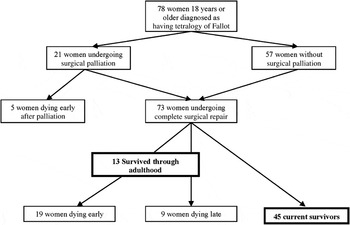
From April, 1972, to December, 1992, 78 women, who would be at least 18 years old today, underwent one or more surgical procedures for tetralogy of Fallot (Fig. 1). Of this group, 5 patients (6%) died after palliation. The remaining 73 women underwent complete repair, with 19 (24%) dying in the early postoperative period, and 9 (12%) later, leaving 45 current survivors (58%).
Chart showing the progress of our cohort of women undergoing surgical treatment of tetralogy of Fallot.

Despite the high mortality, 58 women were long-term survivors, as 13 patients first succumbed in adult age. All 45 current survivors, aged from 18 to 59 years, with a median of 35.6 years, replied to the questionnaire, although two mentally retarded responders required support. For the 13 who died late, information was compiled only from hospital archives and the data available within the national registries.
Of the 58 long-term survivors, 25 (43%) had been pregnant at the time of acquisition of our data. The 33 women who had not been pregnant were significantly younger, with a mean age of 28 as opposed to 38 years (p < 0.01), with 13 (39%) of these being under the age of 25 years.
The 13 women who died late all underwent late repair, at a median age of 30.8 years, the range being 15 to 68 years. Of the 9 who never became pregnant, 6 died in the early postoperative period, and 3 died later. Of the 4 who had pregnancies, three had 4 successful pregnancies prior to repair, 2 of these having been palliated, and one mother had 2 successful pregnancies and one miscarriage after the repair.
The median period of follow-up from complete repair to acquisition of data was 18 years in the group who had not become pregnant, and 28 years in those who had achieved pregnancies. Data on follow-up was available for 100% of the patients.
Anatomical and surgical aspects, other disabilities
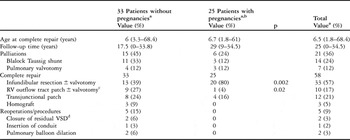
The surgical aspects are described in Table 1. The median age at the time of repair did not differ in those who had not or had become pregnant, at 6 and 6.7 years, respectively. Of those who had not become pregnant, 15 women (45%), along with 6 (24%) who had become pregnant, had undergone palliative procedures prior to the correction. Of those who had not become pregnant, 11 (33%), as opposed to only 3 patients who had become pregnant (12%), underwent a Blalock-Taussig shunt. Pulmonary valvotomy had been undertaken in 4 patients who had not become pregnant (12%), and in 3 patients achieving pregnancy (12%). All 21 palliative procedures were performed in childhood, except for 2 patients who did not become pregnant, one who received a Blalock-Taussig shunt at 16 years. and another who received two Blalock-Taussig shunts at 18 and 20 years.
Surgical history.

aContinuous variables are presented as median and range; nominal variables as total number and percentage of sample
bInclusive of 3 women, who became pregnant prior to surgical repair
cRV right ventricle
dVSD ventricular septal defect
All patients underwent closure of ventricular septal defect and infundibular resection. In the group who went on to become pregnant, the majority could be repaired without the need for a ventriculo-pulmonary transjunctional patch (84%), and no patient required primary placement of a conduit from the right ventricle to the pulmonary arteries. In the women who did not become pregnant, however, a patch across the ventriculo-pulmonary junction was required in one-quarter, and a conduit was placed in almost one-tenth. In addition, only patients who had not become pregnant required reoperation, in 2 instances for closure of residual ventricular septal defect, in 1 for insertion of a conduit, and in 2 for balloon dilation of the pulmonary valve.
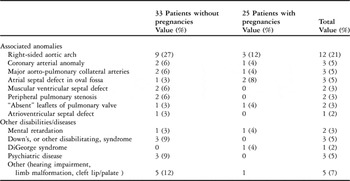
Associated cardiac and non-cardiac anomalies are shown in Table 2. There were generally more women who had not become pregnant with additional cardiac anomalies, predominantly relatively benign findings such as a right-sided aortic arch. Mental and genetic problems, including Down’s syndrome, were almost exclusively seen in the group who never became pregnant. A woman with DiGeorge syndrome had 2 children, both with tetralogy of Fallot with pulmonary atresia and 22q11 microdeletion.
Associated anomalies.

Cardiac state
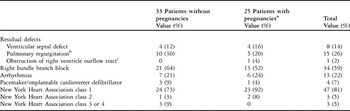
In Table 3, we summarize the cardiac state at the last follow-up in those who had not become pregnant, and at the last follow-up prior to the first pregnancy in those achieving pregnancy. There were no significant differences between the two groups in residual problems. All women who became pregnant were in the first or second classes of the system devised by the New York Heart Association, and there was no change in class during or after pregnancy. Of those who did not become pregnant, 3 were in the third or fourth classes of the system.
Residual lesions and arrhythmias.

ainclusive of 3 women, who became pregnant prior to surgical repair
bmoderate to severe pulmonary regurgitation
cmoderate to severe obstruction of right ventricle outflow tract, with antegrade pressure gradient above 40 mmHg
Fertility
There was nothing that suggested infertility among the 33 women who never became pregnant. The majority (73%) gave personal reasons for not becoming pregnant, such as “too early”, or “did not wish to”. A few reported other diseases, such as mental disability in 5, epilepsy in 1, and psychiatric dysfunction in 2, specifically depression, as being decisive. None of the 33 women had been discouraged from pregnancy.
Among those who became pregnant, one woman was diagnosed with infertility caused by ovarian dysfunction after a miscarriage, and she never became pregnant again. Another woman underwent in-vitro fertilization and had a successful pregnancy. The reasons for childlessness, confirmed from the Birth Registry, could not be assessed retrospectively in the 9 women who died late and who never became pregnant.
Pregnancy and neonatal outcome
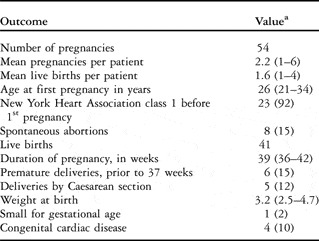
There have been 54 pregnancies in 25 women, in other words 2.2 pregnancies per woman (Table 4). The median age at first pregnancy was 26 years, with a range from 21 to 34 years. Of the women who died, 3 had successful pregnancies before repair, 2 of whom were palliated with pulmonary valvotomy in early childhood.
Obstetrical and neonatal outcomes among 25 women with tetralogy of Fallot, and characteristics of 41 live births.

aContinuous variables are presented as median and range; nominal variables as total number and percentage of sample.
There were 8 spontaneous abortions (15%). A woman without residual cardiac problems had 5 unexplained abortions before finally having a healthy child. Spontaneous abortions had been suffered by 3 women, 2 with severe arrhythmias, ventricular tachycardia and atrial flutter, but both had 2 healthy children prior to the abortion. The third woman had stenosis of the pulmonary arterial branches and raised right ventricle pressure. She never became pregnant again. There were 6 induced terminations, which are legal in Denmark, albeit none for maternal or fetal reasons.
The 39 pregnancies that came to delivery produced 41 live births, with 1 woman being pregnant at the time of our study. There have been 2 uncomplicated twin pregnancies, 1 electively delivered by caesarean section at the 36th week. The other went to full term and normal delivery. The median duration of all pregnancies was 39 weeks. Of the pregnancies, 6 (15%) ended in premature deliveries before 37 weeks, but no child was born before the 36th week. Only 5 caesarean sections were performed (12%), all for obstetrical reasons. Cardiac symptoms were reported by 6 mothers, specifically as ankle oedema, palpitations and dyspnoea, but neither treatment nor hospitalisation were ever required. Pre-eclampsia had occurred in only 1 mother.
The median weight of the neonates was 3.21 kg, with a range from 2.45 to 4.65 kg. Only one newborn was small for gestational age, although birth weight was less than 2.5 kg in 7 neonates, born to 6 mothers.
Congenital cardiac disease was present in 4 neonates (9.8%), with 3 having tetralogy of Fallot with pulmonary atresia, including a set of siblings with DiGeorge syndrome as their mother. The other child had a minimal muscular ventricular septal defect, which had closed spontaneously by 1 year of age. No other malformations were registered. The rate of congenital cardiac disease in the offspring was 4.8%, if we exclude the siblings with DiGeorge syndrome.
Discussion
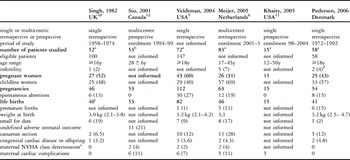
In an older cohort of adult women undergoing surgical treatment of tetralogy of Fallot, we have shown that pregnancy can be pursued with minimal risks to either mother or child, and very little risk of fetal loss, but a significant rate of recurrence of congenital cardiac disease. Although this is not the largest series on outcome of pregnancy in postoperative women with tetralogy of Fallot, our data is of particular interest for three reasons. Firstly, data was obtained in a single centre. Secondly, our data covered a complete surgical series. Thirdly, the study provides 100% follow-up information, even on those who subsequently have died. Our data corroborates recently published series that addressed pregnancy outcome in women with tetralogy of Fallot,Reference Veldtman, Connolly and Grogan5, Reference Meijer, Pieper and Drenthen6 and reports which describe issues of pregnancy in adults with congenital heart disease generally.Reference Khairy, Ouyang and Fernandes11 In Table 5, key findings from our study are compared to some of these reports. Veldtman et al.Reference Veldtman, Connolly and Grogan5 published the largest series of 43 pregnant women, and number of deliveries, with tetralogy of Fallot, but only half were followed-up. The study showed a high number of spontaneous abortions, but otherwise good outcome measures. In contrast, a Dutch multicentric studyReference Meijer, Pieper and Drenthen6 included many patients enrolled in a database from 2001 to 2003, but only few pregnancies.
Comparisons between different reported series of patients with tetralogy of Fallot.

aonly tetralogy of Fallot.
bboth tetralogy of Fallot and double outlet right ventricle were included.
cdetailed information was obtained only for 31 life births; percentage of prematurity, small for date, caesarean section, congenital cardiac disease in offspring, mean birth weight and maternal deterioration/complication refers only to the 31.
dout of 45 survivors, who answered the questionnaire.
eNYHA New York Heart Association.
UK – United Kingdom; USA – United States of America.
We observed no maternal complication or deterioration, neither in the women who had undergone repair, nor in the small subset that went through pregnancies prior to repair. This may reflect that the women who went on to become pregnant belonged to a group at low-risk, at least according to proposed risk scores.12 Thus, all women in the pregnant group were classified as being in either the first or second classes of the system devised by the New York Heart Association. The group dominantly comprised women with the least complex surgical history, having the fewest palliations, less need for transjunctional patches, and no reoperations, despite the longer period of follow-up compared to those who did not becomes pregnant, at 28 as opposed to 18 years.
These observations provide strong cardiac evidence for why non-pregnant women never went on to become pregnant, but many of them had, in addition, significant non-cardiac reasons, such as syndromes, mental retardation, and psychiatric problems, that may have influenced their subsequent non-pregnant state. Importantly, none of the non-syndromic women were discouraged from becoming pregnant.
Although difficult to define exactly from the available information, the assumed rate of infertility, at 3.4%, was not different from that normally observed in the Danish populationReference Schmidt, Munster and Helm13 and not different from that reported elsewhere in women following surgical treatment of tetralogy of Fallot.Reference Meijer, Pieper and Drenthen6, Reference Singh, Bolton and Oakley10
The spontaneous abortion rate was likewise similar to that seen in the normal Danish population,Reference Buss, Tolstrup and Munk14 and to that found in other studies.Reference Meijer, Pieper and Drenthen6, Reference Singh, Bolton and Oakley10, 12 Veldtman et al.Reference Veldtman, Connolly and Grogan5 found a surprisingly high rate of spontaneous abortions (27%), but most cases could be attributed to residual haemodynamic problems.
Vaginal delivery is the recommended mode of delivery for the majority of women with congenitally malformed hearts. Concerns regarding delivery undoubtedly are higher for women with cardiac lesions, but in this “historic” cohort, caesarean deliveries were performed only in one-eighth, and exclusively for obstetrical reasons. This was not different from what is currently seen in the normal population,15 but significantly lower than reported.Reference Meijer, Pieper and Drenthen6 This difference may have multiple explanations, including a gradually lowered threshold for offering Caesarean section, inter-institutional differences in levels of concerns, but also the possibility that our patients comprised an overall group of subjects at low risk. Similar considerations can be made for the absence of obstetrical complications.
Prematurity and small for gestational age remain valid markers for fetal well-being. Only 6 children were born prematurely, including a set of twins who were delivered at 36 weeks gestation for obstetrical reasons. Excluding the twins, the rate of prematurity was 10%, higher than that in uncomplicated pregnancies,16 but not higher than previously reported in mothers with tetralogy of Fallot.Reference Veldtman, Connolly and Grogan5 The median birth weight of 3.2 kg was similar to what has been seen earlier in women with tetralogy of Fallot,Reference Veldtman, Connolly and Grogan5, Reference Meijer, Pieper and Drenthen6, Reference Singh, Bolton and Oakley10 which is almost 10% lower than expected in uncomplicated pregnancies during the time period in Denmark.Reference Schack-Nielsen, Molgaard and Sorensen17 Adjusting for gestational age, however, only one newborn (2%) was small for gestational age, which was much lower than otherwise seen in women with tetralogyReference Veldtman, Connolly and Grogan5, Reference Meijer, Pieper and Drenthen6, Reference Singh, Bolton and Oakley10 and not different from what would have been expected in healthy controls during the same time period.16
The incidence of congenitally malformed hearts in the offspring was almost 10%, but only 4.8% if the siblings with heart defect and DiGeorge syndrome were excluded. This number was higher than recently reported in women with Fallot.Reference Veldtman, Connolly and Grogan5–Reference Burn, Brennan and Little8, Reference Singh, Bolton and Oakley10
There were no maternal cardiac complications during or after pregnancy. This was in contrast to available series in which arrhythmias and heart failure complicated pregnancies in women with dilated right ventricles and significant residual lesions.Reference Veldtman, Connolly and Grogan5, Reference Meijer, Pieper and Drenthen6, 12
Even though we have 100% follow-up on all patients, the main limitation of our series is its small size, which does not allow finding statistically significant differences between the two groups. Meticulous follow-up during pregnancy, and spontaneous selection of the least affected women, are both valid reasons for the excellent outcomes in our series. Moreover, studies in which the number of participating patients is much smaller than the number of eligible patients will probably reveal selection bias, as patients who remain in contact to the health system are those who have more complications and residual lesions.
We conclude that, in women with tetralogy of Fallot undergoing surgery in what might be considered historic time, with extensive use of palliative procedures and late repairs, pregnancy is extremely well tolerated, and fetal outcome is excellent. In addition, some of the women who have had no pregnancies still remain fertile, and could give birth later. Results can thus become even better. We have no doubts, therefore, that the excellent outcomes for women undergoing surgical treatment of tetralogy of Fallot, and their offspring, further documented in our report, will continue to improve.
Acknowledgements
We thank Dr Keld Sorensen, Consultant at the Cardiology Department, Skejby Hospital, for the kind revision of the manuscript. We thank Professor Michael Vaeth, Institute of Biostatistics, Aarhus University, for statistical assistance. We thank Jette Breiner, Annette Strandbo and Dorthe Hindby of the Department of Cardiothoracic Surgery for exceptional secretarial support. We thank Skejby Hospital Research Foundation for financial support.