INTRODUCTION
How do people respond to political appeals about controversial issues? This is our central research question, with a narrow focus on one issue in particular—abortion. Abortion attitudes to some degree have confounded researchers, because while opinions on abortion are rather consistent at the aggregate level (Converse and Markus Reference Converse and Markus1979; Wilcox and Riches Reference Wilcox and Riches2002), they can vary significantly at the individual level given different frames or question wordings (Zaller Reference Zaller1992; Alvarez and Brehm Reference Alvarez and Brehm1995; Bishop Reference Bishop2004). That is, while average opinions may appear stubbornly consistent over time, the specific thoughts of individuals are “situational” or fluid. This fluidity typically manifests itself when investigators begin to ask probing questions beyond the simple “pro or con” construct. Individuals' general notion of whether they support or oppose abortion in some broad sense appears consistent, but their opinions about what exactly “support” or “oppose” means can vary depending on the situation. This contextual variation in response manifests itself in a series of studies (Chong Reference Chong1993; Drukman Reference Drukman2001).
What seems evident is that the way abortion is often addressed in the public square does not match the way most people think about it privately. While pundits, politicians, and activists describe abortion as a polarizing issue with citizens leaning to one extreme or the other, the vast majority appears to be in the proverbial middle (Fiorina, Abrams, and Pope Reference Fiorina, Abrams and Pope2011; Jelen and Wilcox Reference Jelen and Wilcox2003). Following recent insight into how citizens respond to attempts to correct political and salient misperceptions (Nyhan and Reifler Reference Nyhan and Reifler2010), we also expect that certain characteristics will predispose respondents to react strongly to the context and/or question wording as well. Specifically, we expect that respondents will express an opinion that is even stronger in line with their predispositions when exposed to frames that challenge their position.
Using an experiment on abortion opinion embedded in the 2010 Cooperative Congressional Election Study (CCES), we find little indication that Pro-Abortion Access and Anti-Abortion Access frames move opinion on abortion in the aggregate, but there is evidence that specific characteristics correlate with a “backfire” effect identified by Nyhan and Reifler (Reference Nyhan and Reifler2010). In particular, gender, religiosity, and “Born-Again” Christian affiliation are all predictive of responding to either the Anti-Abortion Access or Pro-Abortion Access frame by moving the opposite direction as intended on the feeling thermometer. Other characteristics, however, are associated with the opposite or null effect.
ABORTION AND PUBLIC OPINION
Understanding opinions about abortion is important because abortion continues to be a prominent issue in the political arena. Recent controversies about Planned Parenthood's use of fetal tissue and the Supreme Courts overruling of individual states' attempts to limit abortion access reinforce this notion. More than most issues, abortion is able to mobilize people to political action (Maxwell Reference Maxwell2002) at the level of presidential elections, and in legislative, gubernatorial, and local elections as well (Gross Reference Gross1995; Jelen and Wilcox Reference Jelen and Wilcox2003; Miller and Krosnick Reference Miller and Krosnick2004). It is identified as an “easy” issue (Carmines and Stimson Reference Carmines and Stimson1980) in that nearly everyone forms an opinion on it. Furthermore, people not only have a viewpoint, but consider the topic to be of great significance.
Abortion is not only a significant issue for many citizens, but is commonly used by politicians as a source of polarization (Adams Reference Adams1997). In fact, 45% of voters polled by the Pew Research Center indicate that abortion would be “very important” to their vote in 2016. Furthermore, the issue of abortion is not isolated from other prominent issues, such as healthcare and the economy. Many of the news stories following the implementation of the Affordable Care Act addressed the requirement of certain employers (especially those identifying as religious) to fund or support insurance plans covering birth control methods decried by their critics as abortifacient. Hence, understanding the electorate requires an understanding of how we feel about abortion and why. It may also be more helpful to politicians to understand where the voters are in terms of abortion opinion if they hope to better tailor their message in political campaigns and their legislative efforts once elected. While there may be a benefit in “playing to the base” by exaggerating the divide among the electorate, there may also be rewards for meeting people where they are and recognizing the complex nature of the issue.
The issue of abortion is frequently discussed and studied as it appeals to our sense of right and wrong within both moralistic and legalistic contexts. This is intuitively recognizable in both the public debate, which is often framed in terms of the immorality of killing an innocent human being and the necessity of defending women's civil liberties. Attitudes toward abortion and related matters are strongly influenced by how characteristics like religiosity and ideology cause us to see these as primarily moral issues (Silber Mohamed Reference Silber Mohamed2018). Haider-Markel and Meier (Reference Haider-Markel and Meier1996) cite abortion politics as an important example of morality politics, which is characterized by strong salience combined with low information insofar as citizens do not require specialized knowledge to feel qualified to opine about morality. As such, beliefs about moral politics are most often influenced by religion and party identification and competition. More recent research complicates our understanding of how morality politics works at the state level, as moral and religious influences can reasonably predict anti-abortion policies but not more favorable ones (Kreitzer Reference Kreitzer2015). Similarly, Heidt-Forsythe (Reference Heidt-Forsythe2017) finds inconsistent effects of moral concern on a seemingly related issue, the use of assisted reproductive technologies. Nevertheless, the importance of the moral dimension regarding abortion opinion is clearly recognizable in survey research, as most studies include different questions—some designed to elicit a general opinion about the morality of the procedure and others about its legal standing. The results are frequently at odds, indicating that depending on which context people are considering, or which question wording they are exposed to, their opinions can vary. For example, the 2002 Pew Hispanic Center/Kaiser Family Foundation National Survey of Latino Voters asked the following two questions. “Do you think in general abortion is acceptable or unacceptable?” and “Do you think abortion should be legal in all cases, legal in most cases, or illegal in all cases?” Respondents were divided into three categories—Latinos, Whites, and African Americans—and in each case, the group was more likely to say that abortion in general was “acceptable” than they were to respond that abortion should be legal in “all cases” or “most cases.” This suggests that if citizens are thinking about abortion in different contexts, their responses may differ as well.
Research on gender and abortion similarly suggests that what drives opinion is more complicated than typically portrayed, as neither gender nor attitudes toward gender roles are strong predictors of abortion attitudes (Jelen and Wilcox Reference Jelen and Wilcox2003) though gender differences appear to matter in some cases as moderating or intervening variables. Among pro-choice advocates, the issue is more salient to women than men (Scott and Schuman Reference Scott and Schuman1988), and age differences interact with gender in predicting more pro-choice attitudes among older women than younger women (Scott Reference Scott1998). Hertel and Russell (Reference Hertel and Russell1999) find that men are slightly more in favor of reproductive rights but that this effect flips once models control for participation in the labor force. More recently, Barkan (Reference Barkan2014) and Lizotte (Reference Lizotte2015) argue that the null effect attributed to gender is the result of omitted variable bias and that when religiosity is included as a control, women do in fact favor abortion rights more than men.
FRAMING AND PUBLIC OPINION ON ABORTION
Framing is “the process by which people develop a particular conceptualization of an issue or reorient their thinking about an issue” (Chong and Druckman Reference Chong and Druckman2007). These frames are communicated in many forms such as political debate of elites, media broadcasting, and judicial rulings (Chong and Druckman Reference Chong and Druckman2007). Framing often functions at three levels. First, they lead to new beliefs by encouraging novel approaches to understanding among individuals. Second, frames assist individuals in accessing prior attitudes and giving them prominent consideration again. Finally, frames strengthen existing beliefs (Popkin Reference Popkin1994). Thus, a frame about abortion may not only encourage a person to think about the issue in a moralistic way, but may also strengthen one's moral condemnation (or approval).
Framing and abortion is the subject of a number of different studies. As a demonstration of the malleability of survey responses (Schaeffer and Presser Reference Schaeffer and Presser2003), one study finds that 55% of the respondents believe that abortion should be legal in the first trimester, but only 44% express approval of legal abortion when no gestational time is mentioned. Attitudes also vary based on whether a question is placed at the beginning of a survey or the end (Bumpass Reference Bumpass1997). A study looking at media frames and their effects on the public in terms of the late-term abortion debate finds that attitudes vary based on an exposure to the word “baby” versus “fetus” (Simon and Jerit Reference Simon and Jerit2007). A number of studies attempt to demonstrate that opinion about abortion is much less polarized than conventional wisdom seems to indicate. Cook, Jelen, and Wilcox (Reference Cook, Jelen and Wilcox1993) use a 1989 New York Times/CBS News survey to show that when questions indicate highly specific situations under which an abortion may be sought, the respondents move out of the extremes and into more moderate positions.
This is essentially the finding of Alvarez and Brehm (Reference Alvarez and Brehm1995) as well, who purport to show the “ambivalence” that characterizes actual abortion opinion versus the perception of certainty. They theorize that in the case of abortion, significant values are in conflict, specifically the notions about rights of choice and the right to life. These are “core beliefs” that are not easily reconciled with each other. When such a situation arises they expect that citizens will hold moderate or what they term “ambivalent” views. This is because the respondent is not sure of how to respond to many questions given the competing frames of value references. They consequently show a wide variance in their responses which may seem to contradict each other.
The concept of confirmation bias, described in the context of negative political campaigns by Ansolabehere et al. (Reference Ansolabehere, Iyengar, Crigler, Holbrook, Huckfeldt and Sprague1997) is also relevant here. They show that negative attack ads rarely cause people to change their opinion, but such ads do help reinforce opinions already held. People with a strong sense of opposition should respond to a moralistic frame more positively than others, and similarly, those who strongly approve of abortion rights should be more amenable to a legalistic frame. However, since previous research suggests that most people prioritize moralistic and legalistic considerations depending on the context, we expect that frames that induce people into these competing contexts can cause them to have considerations in either direction. Those with fixed opinions on a contentious moral issue like abortion, nevertheless, may have negative reactions to those frames which do not align with their preconceptions.
MISPERCEPTION AND THE ROLE OF CORRECTIONS
We suspect that for controversial and moralistic political issues like abortion, citizens are not only less likely to be moved by frames, but they may even hold their prior views more intensely upon exposure to a frame that contradicts their predisposition. We draw this belief from recent insights on misinformation and corrections. Attempts to rectify the misperceptions that citizens have about important public issues often fails, particularly among those who hold their views more strongly (Nyhan, Reifler, and Ubel Reference Nyhan, Reifler and Ubel2013; Nyhan and Reifler Reference Nyhan and Reifler2010, Reference Nyhan and Reifler2015). In a survey experiment providing misinformation followed by corrections to a randomly selected group, certain characteristics were predictive not only of failing to accept the correction, but also of becoming more confident in their misperceptions (Nyhan, Reifler, and Ubel Reference Nyhan, Reifler and Ubel2013; Nyhan and Reifler Reference Nyhan and Reifler2010, Reference Nyhan and Reifler2015). Often times, these characteristics were tied to ideology or party affiliation, but subsequent studies show that even more innocuous predispositions can be just as influential in causing citizens to double-down on their previously held beliefs (Nyhan and Reifler Reference Nyhan and Reifler2010, Reference Nyhan and Reifler2015). As Kuklinski et al. (Reference Kuklinski, Quirk, Jerit, Schwieder and Rich2000) observe, forcing respondents to utilize accurate information in the context of a survey requires an extremely strong manipulation.
Scholars understand that it is not just the information available that matters for the formation of opinion, but how respondents process the information in a biased manner, filtering and evaluating the data based on their predispositions. Individuals with confidently held views respond to correcting information with what is called a “backfire effect.” This effect manifests itself when frames on contentious subjects inspire an attitude of rebuttal among ideological individuals (Nyhan, Reifler, and Ubel Reference Nyhan, Reifler and Ubel2013; Nyhan and Reifler Reference Nyhan and Reifler2010, Reference Nyhan and Reifler2015). We expect to observe a similar phenomenon to the backfire effect when individuals are exposed to a contentious frame, rather than contentious information as observed in previous literature.
EXPECTATIONS
We expect that just as certain characteristics are associated with a backfire effect when correcting misinformation about controversial issues, similar attempts to frame contentious policy issues will motivate the intensification of predispositions regarding abortion. Thus we use two frames to assess this effect: an Anti-Abortion Access frame (“Some argue that banning abortion protects the rights of unborn children. The fear is that babies who are weeks from being born can be made to suffer and die”) and a Pro-Abortion Access frame (“Some argue that allowing abortion protects the rights of pregnant women. The fear is that we'll return to a time when women suffered and even died from unsafe procedures”).
More specifically, given the strong association between religiosity and abortion attitudes (Adamczyk Reference Adamczyk2008) we expect that controlling for all other factors, religiosity will cause a strengthening of Anti-Abortion Access attitudes when respondents are given a Pro-Abortion Access frame. We refer to this as the Religiosity hypothesis:
When respondents who are more religious are exposed to a Pro-Abortion Access frame, they will express less support for abortion rights, in comparison with similar respondents who receive no frame at all, ceteris paribus.
To put it simply, when respondents are more religious and are exposed to a Pro-Abortion Access frame, they will express less support for abortion rights compared to similar respondents who are not exposed to the frame. That is, instead of predicting a null effect, we expect a significant decrease in the respondents' approval of Pro-Abortion Access attitudes. Similarly, although gender has not often been a good predictor of Pro-Abortion Access attitudes when controlling for other factors, Barkan (Reference Barkan2014) shows that when controlling for Religiosity, this correlation is strong. Including Religiosity in our models, we expect women to be more Pro-Abortion Access than men, ceteris paribus, and to become even more supportive of Pro-Abortion Access attitudes when presented with an Anti-Abortion Access frame, all things being equal. We refer to this as the Gender hypothesis:
When female respondents are exposed to an Anti-Abortion Access frame, they will express more support for abortion rights relative to men than those female respondents receiving no frame at all, ceteris paribus.
Succinctly, our hypothesis expects that in comparison with respondents who receive no frame, women who receive an Anti-Abortion Access frame will express greater support for abortion rights. Following prior research (Barkan Reference Barkan2014), we also expect those respondents identifying as conservative Christians to have stronger Anti-Abortion Access attitudes and that these will strengthen in the face of a frame presenting a Pro-Abortion Access slant to the issue. This is the Christian hypothesis:
When respondents identifying as having a Born-Again and Evangelical Christian affiliation are exposed to a Pro-Abortion Access frame, they will express less support for abortion rights than those receiving no frame at all, ceteris paribus.
Finally, given that abortion rights is a contentious political issue, we expect political identification to also cause respondents to be resistant to frames that counter their beliefs. Political parties can serve the function of “aggregating interests” (Jelen and Wilcox Reference Jelen and Wilcox2003), and with abortion in particular this appears to be intensifying as fewer and fewer Democratic politicians identify as “Anti-Abortion” and the Republican party platform intensifies in its opposition to abortion rights. We therefore expect that self-identifying Democrats faced with an Anti-Abortion Access frame, and Republicans faced with a Pro-Abortion Access frame, will show stronger support for their party's traditional position compared to respondents in the control condition. We expect this phenomenon to be even more intense for those Democrats placing themselves in the most liberal categories of political ideology, and for Republicans describing themselves as particularly conservative.
When Democrats are exposed to an Anti-Abortion Access frame they express greater support for abortion rights relative to Independents than Democrats receiving no frame at all, ceteris paribus.
When Republicans are exposed to a Pro-Abortion Access frame they express less support for abortion rights relative to Independents than Republicans receiving no frame at all, ceteris paribus.
DATA AND MEASUREMENT
To test these relationships we utilize an experiment on abortion opinion embedded in a module of the 2010 Cooperative Congressional Election Study (N = 831).Footnote 1 Our dependent variable is a feeling thermometer from 0 to 100 measuring support for abortion rights, with 0 indicating a respondent feels that abortion should “never” be an option, while 100 denotes the belief that the option of abortion should “always” be available to women. Although feeling thermometers are not often used in research on abortion opinion, we wanted a wide range of potential responses to allow the potential effects of the frames to be captured, particularly since abortion is an issue in which it may be more difficult to alter respondents' views. Though there is still debate on the benefits and detriments of feeling thermometers in public opinion research, studies have found them to be at least as valid and reliable as other measures (Alwin Reference Alwin1997; Lupton and Jacoby Reference Lupton and Jacoby2016). The mean of the sample is 52.589, indicating an average opinion that leans slightly in favor of Pro-Abortion Access attitudes.
Our main independent variables are the different frame conditions. Survey respondents were randomly selected to receive one of four conditions—an Anti-Abortion Access frame, a Pro-Abortion Access frame, Both-Frames together, or no frame at all. The Both-Frames condition was further randomized so that approximately half of those in this condition received the Anti-Abortion Access frame first and the others were led by the Pro-Abortion Access frame. Table 1 reports the frequency of each frame condition and indicates close parity among them.
Distribution of respondents and experimental conditions

Both the Anti-Abortion Access and Pro-Abortion Access frames place respondents in the more extreme contexts in terms of the threats that exist for the unborn and for pregnant women. The Anti-Abortion Access frame reads as follows:
Some argue that banning abortion protects the rights of unborn children. The fear is that babies who are weeks from being born can be made to suffer and die.
The Pro-Abortion Access frame reads as follows:
Some argue that allowing abortion protects the rights of pregnant women. The fear is that we'll return to a time when women suffered and even died from unsafe procedures.
Both frames are equal in length and constructed to introduce as little extraneous information as possible. They are both explicitly worded in the context of rights to avoid unnecessary contamination of differing considerations along moral versus rights-based dimensions (Djupe et al. Reference Djupe, Lewis, Jelen and Dahan2014). The frames are nevertheless strong enough to induce movement by including a description of arguably the most fundamental concerns among Anti-Abortion Access and Pro-Abortion Access advocates. Both frames use similar vocabulary (“suffer” and “die”) to mitigate extraneous cues. The frames are strongly worded and meant to capture the most intense concerns of the two polarized factions in the debate. Though this perhaps biases toward a type one error, we also think it more accurately captures the essential perspectives that anti-abortion and pro-choice activists seek to communicate.
In addition to the frames, the main variables of interest are respondents' gender, religion, and political ideology. The first is Female (female = 1, male = 0), with 49.22% of the sample receiving frames being women. Following Barkan (Reference Barkan2014), Religiosity is a standardized scale that combines responses from questions about a respondent's religious attendance, frequency of prayer, and self-reported importance of religion. Born Again is a binary indicator of whether or not a respondent has experienced a “born again” conversion. Other binary indicators of religious identification are used for Evangelical Christians, Mainline Protestants, and Catholic Christians. We follow the protocol in Steensland et al. (Reference Steensland, Park, Regnerus, Robinson, Wilcox and Woodberry2000) in constructing these measures. For political party identification we use dummy variables for Democrat, Republican, and Independent. In all of the regressions, we use Independent as the base category. We also run models that substitute variables capturing both party identification and ideology. Ideology is a scale of political conservatism ranging from 1 to 7, with 1 indicating the respondent is “extremely liberal” and 7 “extremely conservative.” Liberal Democrats are those who both identify as being Democrat while also placing themselves in the two most liberal categories of Ideology. Conservative Republicans are those who claim Republican as their party and also place their Ideology among the top two conservative categories.
We also include a series of control variables to control for alternative explanations and spuriousness. For the multivariate regressions predicting abortion opinion in each of the frame conditions, we use correlates typically found in research on abortion attitudes. Education indicates the number of years of schooling, and Age is measured by year of birth. Two variables measuring race are included: White is a binary indicator of whether the respondent identifies of white (=1) or not (=0). Hispanic is also a dummy, so that the coefficient on race is effectively the difference between white respondents and non-Hispanic respondents. It is possible, however, that some Hispanic respondents are coded as White, as the dataset does not explicitly denote this category as being “Non-Hispanic.” South, Married, and Employed are binary variables indicating whether a respondent lives in one of the traditional southern states, is currently married, and has either a full-time or part-time job. Children denotes the number of children the respondent has, ranging from 0 to 6. Many prior studies indicate a positive association between additional education, being white, and being employed with support for abortion rights. Summary statistics of all variables are available in the Appendix.
RESULTS
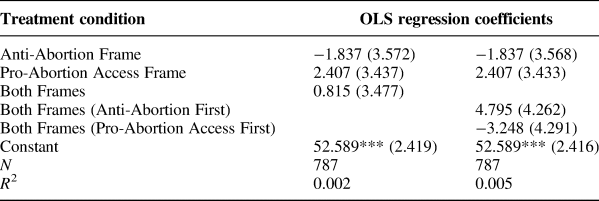
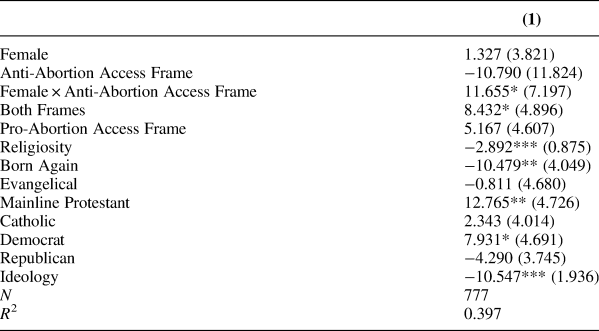
While our study focuses on the opinion formation and shifts of individual sub-populations, our results buttress previous studies regarding aggregate opinion on abortion. To begin, our results show that abortion frames have no statistically significant power to shift aggregate opinion. This is in line with expectations from past research (Converse and Markus Reference Converse and Markus1979; Luker Reference Luker1984; Wilcox and Riches Reference Wilcox and Riches2002; Detenber et al. Reference Detenber, Gotlieb, McLeod and Malinkina2007) and is reported in Table 2. Both the coefficients for the Anti-Abortion Access frame and the Pro-Abortion Access frame are consistent with expected directions, but given the large standard errors, we fail to reject the null hypothesis. These results seem to support theories positing a weakening effect of frames when applied to highly contentious issues. It is plausible that the respondents on average hold strong opinions on abortion that cannot be easily shifted by a simple framing device. It is also possible, however, that some respondents are moved by the frames in the direction intended, while others react negatively to the intentions of the frame and are moved in the opposite direction. This scenario would also result in null findings when just looking at the effects of the frames.
Abortion rights, DV = feeling thermometer (0–100)

Standard errors in parentheses.
*p <0.10, **p <0.05, ***p <0.01.
To test our hypotheses we further disaggregate the results to observe the potential backfire effect among particular sub-populations. We hypothesize that frames regarding controversial issues may provoke a backfire effect among respondents likely to hold strong predispositions. The responses among these populations may become more intense in the direction of their approval or disapproval of abortion rights. We examine this in several ordinary least squares (OLS) regressions with interactions. This allows us to observe the effect of the frame conditioned on characteristics expected to elicit a strong response.
The results of the analysis are reported in Tables 3–5 and presented graphically via marginal effects plots in Figures 1–4. Here we find suggestive evidence of a backfire effect among women, the more religious respondents, and those who experienced a “Born-Again” conversion, and to some extent, Evangelicals. Interestingly, the political variables are not associated with a backfire effect, but rather with movement in the intended directions of the frames. In the first model which tests the effect of an Anti-Abortion Access frame on women versus men, we see that the coefficient on the interaction term is positive and significant (p <0.05), indicating that upon receiving an Anti-Abortion Access message, women express stronger Pro-Abortion Access positions (relative to men) than they do when receiving no frame at all. Upon encountering an appeal to the rights of the unborn child, they become more strongly supportive of their reproductive rights as women. In addition to being statistically significant, this is also substantively significant, as the movement is of more than eleven units on a scale of 0–100. Put another way, there is nearly a 12% increase in support for abortion rights among women receiving the Anti-Abortion Access frame, controlling for other relevant factors. This finding provides evidence for the Gender hypothesis, indicating that women are likely to engage in resistance to frames, motivated skepticism and strong use of predispositions over question wording with regard to abortion. The coefficient on Female is not significant and therefore indicates that when the other frames or no frames are used (Anti-Abortion Access Frame = 0), gender is not a predictor of abortion attitudes. Similarly, the statistically insignificant coefficient on Anti-Abortion Access Frame suggests that the frame has a null effect on abortion attitudes among men (Female = 0).
Estimated treatment effect of Pro-Abortion Access Frame at different levels of Religiosity.
Source: CCES (2010).

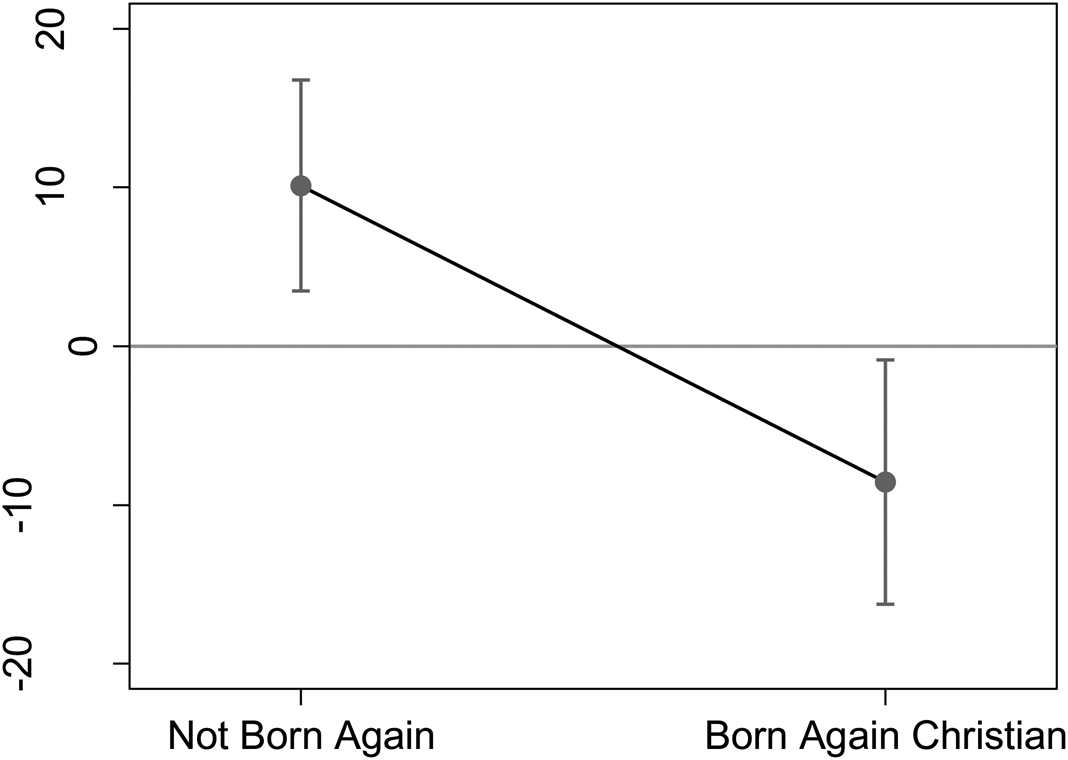
Estimated treatment effect of Pro-Abortion Access Frame for self-identified Born Again Christians.
Source: CCES (2010).

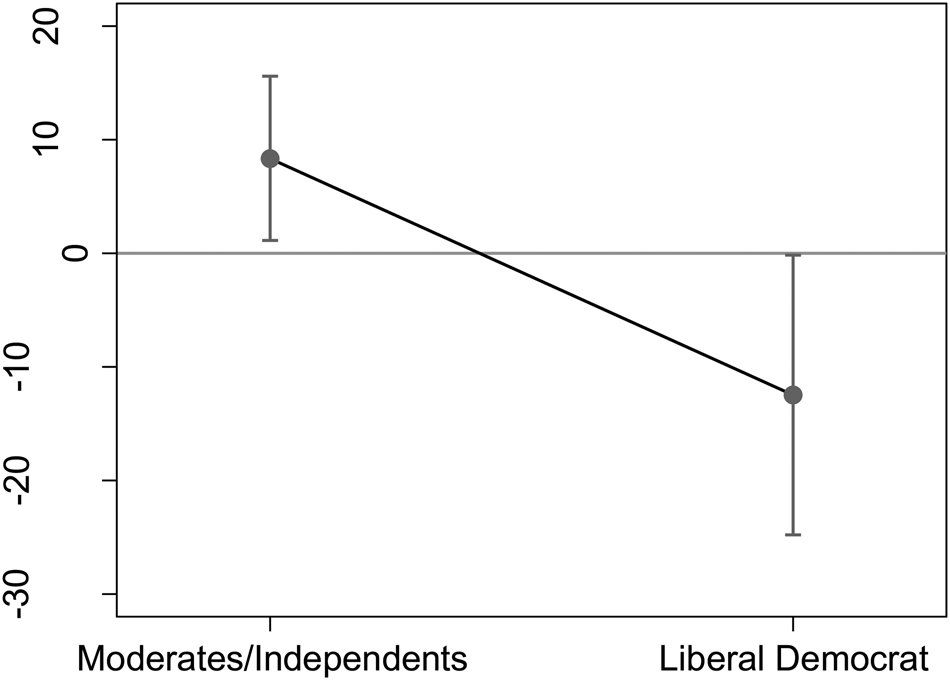
Estimated treatment effect of Anti-Abortion Access Frame on Liberal Democrats.
Source: CCES (2010).

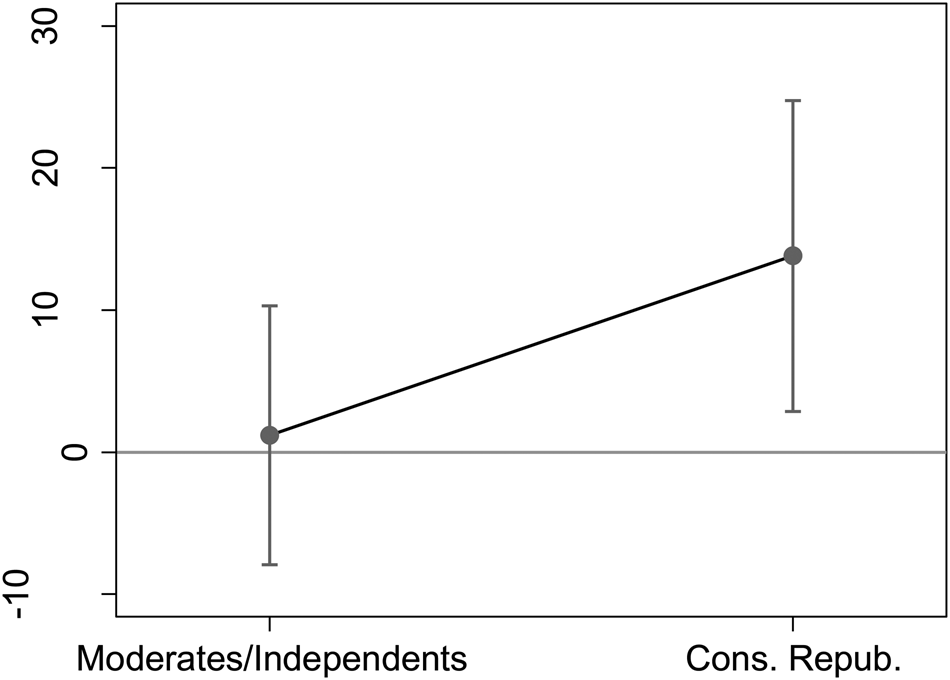
Estimated treatment effect of Pro-Abortion Access Frame among Conservative Republicans.
Source: CCES (2010).

Gender and abortion opinion

SE in parentheses; not shown: White, Hispanic, Education, Age, Married.
South, Married, Employed, Children, Constant.
^ p <0.10, *p <0.05, **p <0.01, ***p <0.001; one-tailed test.
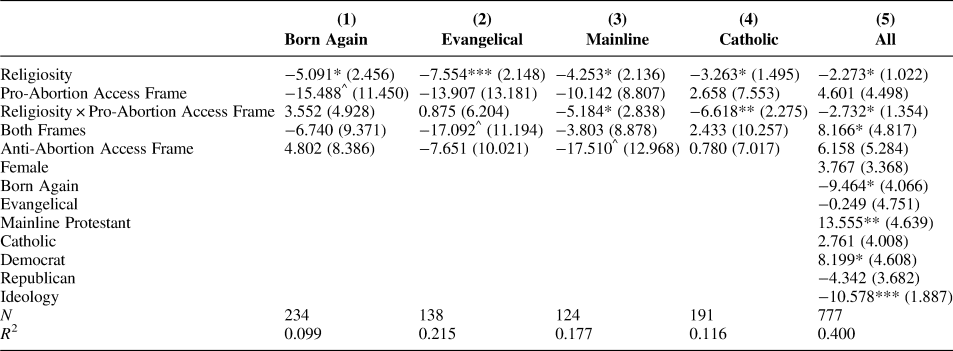
Religiosity and abortion opinion

SE in parentheses; not shown: White, Hispanic, Education, Age, Married, South, Married, Employed, Children.
^ p <0.10, *p <0.05, **p <0.01, ***p <0.001.
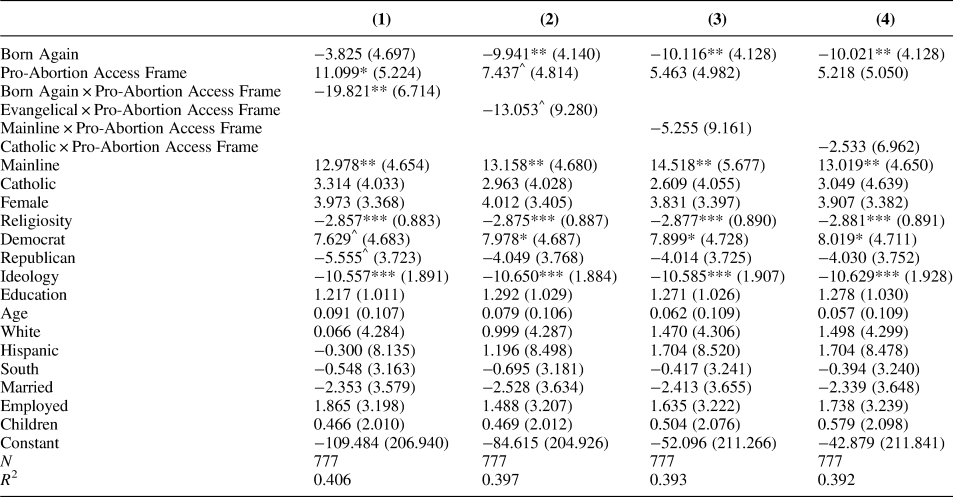
Religious identity and abortion opinion

Standard errors in parentheses.
^ p <0.10, *p <0.05, **p <0.01, ***p <0.001; one-tailed test.
We also observe evidence for a potential backfire effect in terms of Religiosity, supporting our second hypothesis. Citizens for whom religion is a significant part of their lives are often thought to be less likely to be support a woman's right to choose abortion. The Right to Life movement finds much of its energy and manpower from religious institutions and religious citizens. It is in the Pro-Abortion Access condition where we expect to see a backfire effect, and in fact there is evidence to support this (see Table 4, Model 5). All things being equal, those who are more religious are less likely to favor abortion rights when presented with a Pro-Abortion Access frame (β = −2.73; p <0.05). Moving from the bottom quartile of religiosity to the top quartile is therefore associated with a decrease of 12.38 units on the feeling thermometer. Models 1–4 indicate the interactive effects of Religiosity and the Pro-Abortion Access frame condition when limiting the samples based on religious identification. In these models, control variables are dropped due to the low number of observations. We can see that the Pro-Abortion Access frame has no differing effect across levels of Religiosity for Born-Again Christians and Evangelicals, but a negative and significant effect (p < 0.05) for Mainline Protestants and Catholics. For these groups, exposure to the Pro-Abortion Access frame makes them less likely to support abortion rights the more religious they are.
Table 5 reports the results modeling the interactive effects between religious affiliation and the framing conditions. For those who identify as “Born-Again” and Evangelical, we also find some evidence of a backfire effect. When respondents in these categories receive a Pro-Abortion Access frame it appears to generate a sizable backfire effect, as Born-Again identity correlates with a 19.82 point decrease (p <0.01) on the scale of abortion rights support. Though only marginally significant, Evangelicals also experience a 13 point decrease in support for abortion rights (p < 0.10) when receiving a Pro-Abortion Access frame. This is reasonable evidence that the Pro-Abortion Access frame is activating a defensive posture among conservative Christians regarding their opinion on abortion rights. Far from nudging them in the Pro-Abortion Access direction, this condition encourages these religious respondents to express a strong loyalty to the countervailing views held by their respective churches. No similar effect, however, appears to take place with Mainline Protestants and Catholics.
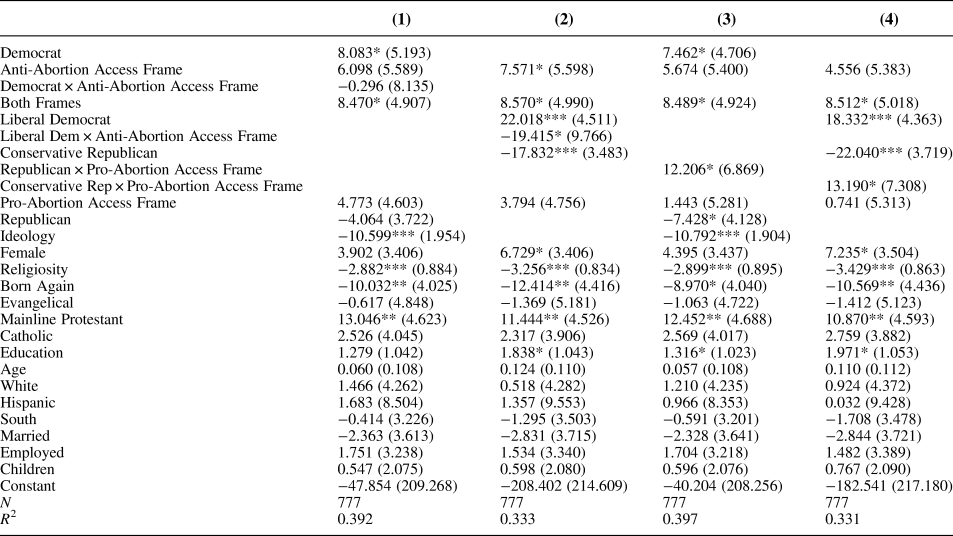
Finally, we analyze the effect of the interaction of political identification and the frames, but in this case the results are the opposite of our expectations and the predictions of the backfire theory. When Democrats are introduced to an Anti-Abortion Access Frame, there is no statistically significant difference compared to the No-Frame condition. This is reported in the first regression in Table 6. The rest of the models indicate, however, that instead of a null effect, there is a statistically significant effect of the frames conditional on party identification in the intended direction of the frames. In the second model in Table 6, we see that Liberal Democrat respondents who receive an Anti-Abortion Access Frame rank themselves on average over nineteen points lower (p < 0.05) than their liberal peers than their peers that do not receive this message. Being a Liberal Democrat that does not receive an Anti-Abortion Access Frame is otherwise associated with a 22 unit increase (p < 0.01) on the feeling thermometer. There is no similar effect, however, when we look at “Strong Democrats” (those self-placing at the extreme of the 7 point party scale).
Political party ID and abortion opinion

Standard errors in parentheses.
^ p <0.10, *p <0.05, **p <0.01, ***p <0.001; one-tailed test.
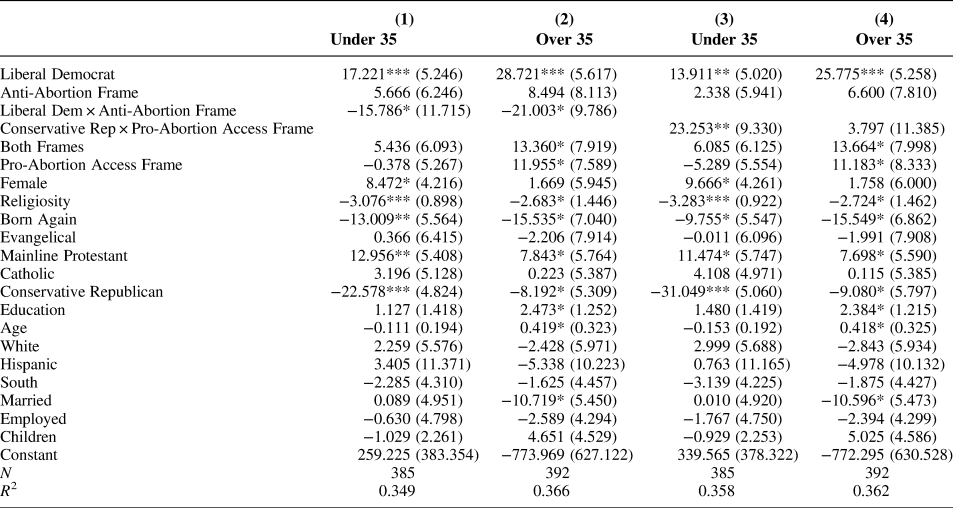
Among Republicans, the effect is more consistent. Both Republican and Conservative Republican correlate with higher values on the thermometer conditioned on being exposed to a Pro-Abortion Access Frame. That is, instead of demonstrating a backfire effect, Republicans indicate more abortion-friendly attitudes, as the frame intends. In the third model in Table 6, being a Republican receiving a Pro-Abortion Access Frame correlates with 12.21 (p < 0.05) more units of support for abortion rights. Conservative Republicans move even further in this direction; the coefficient on the interaction term with Pro-Abortion Access Frame is 13.19 (p < 0.05). Far from becoming more steadfast in a typically conservative position, they are nudged in the direction more favorable to abortion rights. We investigate these findings further by splitting the sample based on age, education, political knowledge, and political interest to test the hypotheses that these factors are modifying the effects of the political identification variables. We find no evidence that Republicans and Democrats responded to frames differently based on education and political knowledge. We do however find support for the idea that age and political interest are influencing the interaction effects between party identification and framing. These three-way interaction models are reported in Appendix Tables A2 and A3. In Table A2, we see that there is a dramatic difference between Conservative Republicans under the age of 35 and over the age of 35. For the former, a Pro-Abortion Access frame moves them 23% of the scale (p < 0.01) toward abortion rights approval, ceteris paribus. For the older respondents, however, the interaction effect is much smaller (3.80) and is not statistically significant. For Liberal Democrats, the difference between those below and above age 35 is not nearly as stark (−15.79 versus −21.0, respectively).
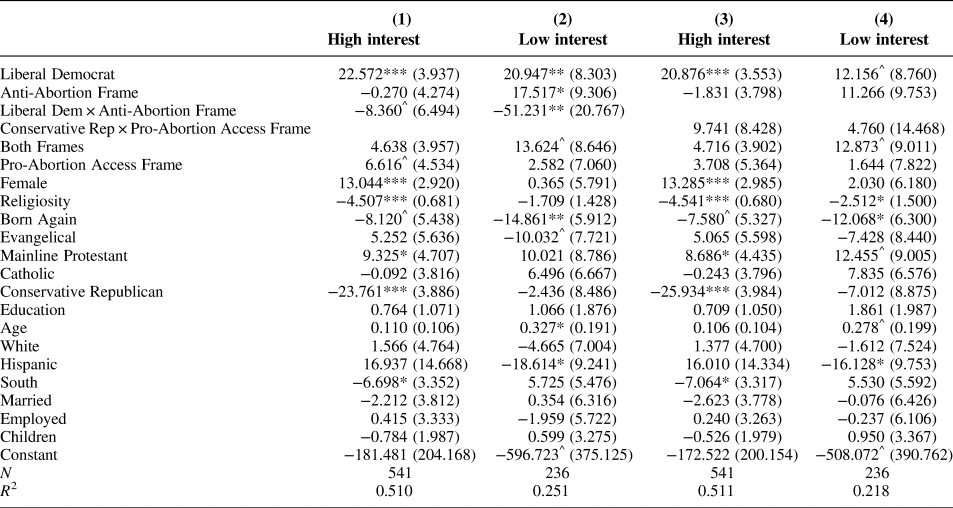
In Table A3 we report the results from three-way interaction models dividing the sample between those with “high” political interest and those with “low” political interest. Political Interest is based on the question asking respondents to identify their “interest in news and public affairs” with ordinal responses ranging from “Most of the time” to “Hardly at all.” Sixty-five percent of respondents chose the highest category of interest, so we dichotomize this measure in those who claim “Most of the time” and everyone else. We also use a binary indicator to make the three-way interaction more easily interpretable. Unlike with age, Political Interest seems to have a strong moderating effect among Liberal Democrats but not among Conservative Republicans. Among the former, the effect of the Anti-Abortion Access frame with those of high political interest is −8.36 and only marginally significant (p < 0.10). For those with low political interest, the effect is quite large—51.23 (p < 0.01). This seems to indicate that the negative effect of the Anti-Abortion Access frame among Liberal Democrats is mostly being driven by respondents with little interest in politics.
Among the control variables, only Education appears to have a consistent effect on abortion attitudes, and is positively correlated with the dependent variable in nearly each of the seven models. This suggests that perhaps the decline in the correlation between education and abortion attitudes witnessed most strongly in the 1970s and 1980s (Jelen and Wilcox Reference Jelen and Wilcox2003) is no longer as prevalent and that education is once again becoming an important predictor of support for abortion rights. Other control variables were statistically significant in the expected direction but appear to be dependent on the particular models. In two of the regressions incorporating party identification, the racial gap between Whites and African Americans, as the latter are significantly less supportive of reproductive rights.
CONCLUSION
This paper contributes to our knowledge of how framing of contentious moral issues affects public opinion and furthers our understanding of how backfire effects may operate within the framing literature. Here we observe that backfire effects are not only observable in attempts to correct political misperceptions but also occur when trying to influence political opinion more broadly by framing an issue within certain rights contexts. We find that Anti-Abortion Access and Pro-Abortion Access frames have little power to move abortion opinion in the aggregate, and in so doing reinforce a number of previous findings regarding this issue. We do, however, find that frames can trigger motivated reasoning based on certain characteristics, such as gender, religiosity, and certain religious affiliations. Interestingly, we also find that framing the issue seems to have the opposite effect conditioned on political and ideological identification. Republicans and strong Democrats are more likely to be influenced in the direction of the frames instead of exhibiting a backfire effect. In this regard, we also find that the interactions between partisanship and framing are themselves modified by age among Republicans and political interest among Democrats. This finding is important in that it suggests more research is necessary to better understand how morality politics may not always be affected by religious and party identification in a similar manner.
Some of the results are consistent with what is intended by the individual frames, and thereby contributes important knowledge to our understanding of what characteristics are most vulnerable to framing effects. More importantly, we observe a similar phenomenon to the backfire effect that previously had primarily been applied only to the correction of factual misperceptions. We therefore improve our understanding of the breadth of the backfire effect by showing its application to framing and public opinion. Notably, this addition contributes to the public opinion literature by showing that when processing information we must consider the sub-populations of interest, as they may be more likely to evoke their predispositions when forming opinions. Our work demonstrates that the backfire effect can be observed and quite strong when trying to convince citizens about a serious moral issue such as abortion. The results also, suggest, however, that this effect varies across different personal characteristics, and that the opposite can be true with regard to political identification.
In particular our research identifies several groups more vulnerable to a framing backfire effect when regarding abortion. The results show that women—who are no more likely than men to support abortion rights in the No-Frame condition—react strongly to Anti-Abortion Access frames by becoming even more Pro-Abortion Access. Similarly, there is a stronger association with movement toward Anti-Abortion Access attitudes among those Christians receiving a Pro-Abortion Access Frame than those who encounter no frame at all.
We believe that this study provides strong motivations for further research into the backfire effect with regard to political persuasion about polemical issues, moving beyond the arena of political, factual misperceptions. Other contentious subjects should be studied to help us understand the extent to which this phenomenon persists and to provide helpful information about political strategies to convince skeptical publics about opposing viewpoints. This research should be of interest to those scholars detecting increasing polarization in our society, and it may be the case that future research reveals that even issues not thought to be particularly contentious may also demonstrate similar effects.
We also want to acknowledge weaknesses in the present study. As indicated above, we limit our scope to one issue, and thus it is important to continue this line of research and conduct more studies to ensure that the backfire effect we observe is not simply an anomalous phenomenon unique to the issue of abortion and or those issues already investigated by other scholars. Because abortion deals with the crucial subject of life and death, and is highly polemic in the political arena dividing Democrats and Republicans, Liberals and Conservatives, it is possible that the effects we are witnessing are not typical. As with most experimental research, this study may also suffer weak external validity. The frames that respondents encounter in the survey do not match the myriad forms of framing average citizens may experience in day to day life. Nevertheless, the frames themselves are not egregiously strong in our view and so we are not particularly concerned that they represent something dramatically different from what may normally encounter consuming political news and information (Kuklinski et al. Reference Kuklinski, Quirk, Jerit, Schwieder and Rich2000). The sample may also lack representativeness. Respondents participating in the CCES surveys tend to report much higher rates of voting than the average citizen for example. More importantly for our topic, nearly half of all respondents believe that abortion should be legal in all circumstances. This is much higher than most polling in recent years indicates, and so some of the effects we are observing may be due to the fact that we have a particularly Pro-Abortion Access leaning sample.
In spite of these limitations, however, the findings here indicate that even among issues that tend to promote strong fixed opinions, frames can activate motivated reasoning based on certain characteristics. These effects are nevertheless often the opposite of what is communicated by the frame, indicating not so much an inclination by the public to change their opinions based on new information and perspectives, but a desire to defend them in the face of a challenge.
Appendix 1
Summary statistics

Political party ID, age, and abortion opinion

Political party ID, political interest, and abortion opinion