Introduction
One of the main biological necessities of organisms is food, taken as the way of acquiring matter and energy for functioning (Heithaus & Vaudo, Reference Heithaus, Vaudo, Carrier, Musick and Heithaus2012). Descriptions of diet in batoids have been based on four methods: (1) stomach contents analysis (SCA; Jacobsen & Bennet, Reference Jacobsen and Bennet2013; Kemper et al., Reference Kemper, Bizzarro and Ebert2017); (2) stable isotope analysis (SIA; Espinoza et al., Reference Espinoza, Munroe, Clarke, Fisk and Wehrtmann2015; Poulakis et al., Reference Poulakis, Urakawa, Stevens, DeAngelo, Timmers, Grubbs, Fisk and Olin2017); (3) the combination of the previous two methods (Yemışken et al., Reference Yemışken, Forero, Megalofonou, Eryilmaz and Navarro2018); and (4) molecular techniques (Bade et al., Reference Bade, Balakrishnan, Pilgrim, McRae and Luczkovich2014). Of these four techniques, SCA is the most frequently employed (Cortés, Reference Cortés1999; Brown et al., Reference Brown, Bizzarro, Cailliet and Ebert2012).
To date, SCA has been the most widely used technique to establish the food preferences of species (Cortés, Reference Cortés1999; Wetherbee et al., Reference Wetherbee, Cortés, Bizarro, Carrier, Musick and Heithaus2012), allowing identification of the most important prey, food strategies, as well as effects of biotic and abiotic variables in the diets of predators (Navia et al., Reference Navia, Torres, Mejía and Giraldo2011; López-García et al., Reference López-García, Navia-Lopez and Mejía-Falla2012). However, there exist many limitations to published diet studies (with an appropriate statistical confidence), such as a high index of vacuity, low sample sizes collected during the studies and a lack of identifiable prey in the stomach contents.
Traditionally, in almost all published studies the vacuity coefficients are less than 20% of the total stomachs analysed (Navia et al., Reference Navia, Mejía and Giraldo2007; Amariles et al., Reference Amariles, Navia and Giraldo2017; Viana et al., Reference Viana, Valentin and Vianna2017). In this regard, some species of elasmobranchs have particularly high values of emptiness, for example Zapteryx exasperata (76.6%) (Blanco-Parra et al., Reference Blanco-Parra, Galván-Magaña, Márquez-Farías and Niño-Torres2012), Mobula japanica (76%) (M. mobular sensu Last et al., Reference Last, White, Séret, de Carvalho, Stehmann and Naylor2016), M. thurstoni (58.3%) and M. munkiana (40%) (Notarbartolo di Sciara, Reference Notarbartolo di Sciara1988), where other methods such as SIA and molecular techniques were used to describe the diet.
Various factors can influence the vacuity coefficients, including bias in the size of specimens, timing of capture and eversion of stomach contents during the capture process (Wetherbee et al., Reference Wetherbee, Cortés, Bizarro, Carrier, Musick and Heithaus2012; Flores-Martínez et al., Reference Flores-Martínez, Torres-Rojas, Galván-Magaña and Ramos-Miranda2016). However, when monthly monitoring is carried out over a considerable period of time and specimens from a wide range of sizes are available, high vacuity values are not a result that is frequently found in the scientific literature (Pollerspöck & Straube, Reference Pollerspöck and Straube2018). Perhaps this is because traditionally the ‘zero’ has not been considered as an adequate or publishable result, but in itself, this value would be indicating a series of possible biological and ecological conditions for this result to be presented.
Golden cownose ray, Rhinoptera steindachneri Evermann & Jenkins, Reference Evermann and Jenkins1891, is a batoid that is widely distributed along the eastern Pacific coast from Mexico to Peru. It is usually associated with sandy substrates and occasionally with rocky reefs; it has migratory habits and tends to form large aggregations (Bizzarro et al., Reference Bizzarro, Robinson, Rinewalt and Ebert2007, Reference Bizzarro, Smith, Hueter and Villavicencio-Garayzar2009). The initial objective of this study was to characterize the trophic spectrum of R. steindachneri in La Paz Bay (LPB), Baja California Sur, Mexico, based on stomach contents analysis. However, this goal was not achieved fully, due to the excessive high vacuity coefficient found during the investigation. With this in mind, this article could be interpreted as a ‘post-hoc’ approach, trying to address the following question: Why, even if the species was present in all the months of the year during three years of sampling, with day and night captures, was the vacuity coefficient so high?
Materials and methods
La Paz Bay (LPB) is located between 24.1° and 24.8°N and between 110.2 and 110.8°W; it is the largest bay within the Gulf of California. There are two well-defined seasons, a warm season (June–November) and a cold season (December–May), which were taken into account during the present study (Guevara-Guillén et al., Reference Guevara-Guillén, Shirasago-Germán and Pérez-Lezama2015).
Specimens were collected monthly (using 15–20 sets of nets) from October 2013 to December 2015, and in March, June, July and August 2016, and March and April 2017. A bottom-set gill net (25 cm mesh size, 100–300 m long, 1 m high) was set, at depths of 7–25 m to capture the specimens. Nets were set at 19:00 h and retrieved the next morning at 07:00 h. A total of 20 net-sets were used to capture specimens during the day (between 11:00 and 17:00 h), and those individuals were also included to determine whether time of capture could affect the results. Each captured individual was identified to species (voucher specimen 8323 of the CICIMAR-IPN Ichthyological Collection).
Food remains from the stomach contents (not including the spiral valve) were separated, counted and weighed, and each prey item was identified to the lowest possible taxonomic level. In order to reflect the frequency of feeding, which has been used previously to estimate the fraction of the population presenting prey remains in the stomach, the vacuity index was calculated using the equation proposed by Euzen (Reference Euzen1987) in Valinassab et al. (Reference Valinassab, Jalali, Hafezieh and Zarshenas2011).
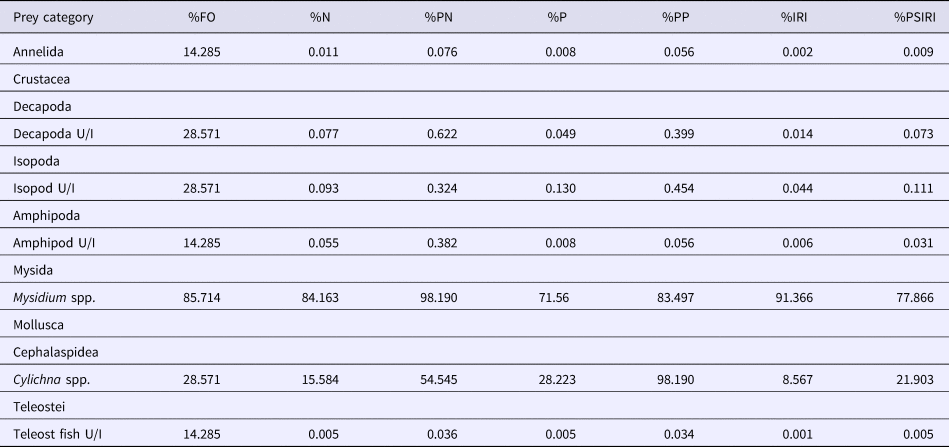
The quantification of the importance of each prey in the diet was performed based on the indices of frequency of occurrence (FO), abundance (%PN) and weight (%PP). %PN and %PP values were used to calculate the prey-specific index of relative importance (%PSIRI, Brown et al., Reference Brown, Bizzarro, Cailliet and Ebert2012). Following Brown et al. (Reference Brown, Bizzarro, Cailliet and Ebert2012), %IRI values of previous studies were transformed to %PSIRI to be able to compare our results with those of previous studies. We used the PSIRI because it is additive with respect to taxonomic levels, providing a more robust dietary index for comparisons between studies (Brown et al., Reference Brown, Bizzarro, Cailliet and Ebert2012; Espinoza et al., Reference Espinoza, Munroe, Clarke, Fisk and Wehrtmann2015). However, the simple and compound methods of %IRI (Cortés, Reference Cortés1997) were also estimated and included in this study (Table 1).
Per cent contribution of prey identified in R. steindachneri stomachs in La Paz Bay, BCS, estimated through two simple methods (numeric %N, %PN and weight %P, %PP respectively) using a common Frequency of Occurrence (%FO), and two compound methods: Index of Relative Importance (%IRI) and the Prey-Specific Index of Relative Importance (%PSIRI).

U/I, Unidentified.
To know if the number of stomachs analysed was sufficient to accurately describe the diet of the species, a prey accumulation curve was applied using the Shannon–Wiener diversity index to observe if an asymptote was reached (Hurtubia, Reference Hurtubia1973; Ferry & Cailliet, Reference Ferry, Cailliet, MacKinlay and Shearer1996). Cortés (Reference Cortés1997) suggested that the construction of this curve should be a randomized process, which is why the routine ‘sample-based rarefaction (species accumulation curves)’ of the EstimateS 7.5 program (Colwell, Reference Colwell2005) was used, applying 500 iterations to the values of species diversity of the stomachs analysed. To describe its accuracy, the slope generated by the last four points of the curve vs a zero slope line was compared (Bizzarro et al., Reference Bizzarro, Robinson, Rinewalt and Ebert2007).
Results
The stomach contents of 310 R. steindachneri specimens (146 females and 164 males) were collected and analysed. The sizes of the specimens ranged from 40.1–94.2 cm DW (for females) and 41.8–82.5 cm DW (for males) with an immature proportion of 69.9% and 71.3% respectively.
Of all examined and analysed stomachs, only nine (2.9%) contained stomach content remains, which resulted in a high vacuity coefficient (VI = 97.1%). Therefore, the species accumulation curve did not reach the asymptote (P < 0.05), and as a result the description of the R. steindachneri diet could not be characterized with precision.
All the 295 individuals captured during the effective hours of night fishing (19:00–7:00 h) had empty stomachs. Sixty per cent of specimens caught during the day (11:00–12:00 h) had stomach contents, and these specimens were 57–73 cm DW. However, specimens of both sexes caught at ~17:00 h had empty stomachs.
A total of 6813 prey were counted in nine cownose rays, with a total weight of 65.85 g. Six prey items belonging to four taxonomic classes (Annelida, Crustacea, Mollusca and Teleostei) were identified; crustaceans contributed the most by number (6808 individuals) and by weight (64.9 g) to diet.
The mysid shrimp Mysidium spp. stood out in terms of frequency of occurrence, specific abundance and specific weight (%FO = 86%, %PN = 98%, %PW = 83%), and in terms of prey-specific relative importance (%PSIRI = 77.9%). The second prey item in order of importance was the opisthobranch Cylichna spp. (%FO = 29%, %PN = 55%, %PW = 99%). These two prey items accumulated 99.8% of %PSIRI (Table 1).
Discussion
Based on the limited stomach contents identified, we can speculate that in our study area, the richness of prey species of the trophic spectrum of R. steindachneri is lower than that reported in previous studies. The bivalve Tellina subangulata was the most important prey in the Upper Gulf of California, with %PSIRI = 96.66% (Simental-Anguiano, Reference Simental-Anguiano2011), whereas the dominant prey in the southern Gulf of California was the mysid shrimp Mysidium spp. (%PSIRI = 77.9%; present study). Navarro-González et al. (Reference Navarro-González, Bohórquez-Herrera, Navia-Lopez and Cruz-Escalona2012) reported an ophiuroid, Ophionereis annulata (%PSIRI = 74.62%) as the most important prey off the Nayarit and Sinaloa coasts; however, Ramírez-Rodríguez (Reference Ramírez-Rodríguez2014) reported the bivalve Corbula spp. (%PSIRI = 38.26%) as the most important prey in the same area but in a different year. Díaz-Carballido (Reference Díaz-Carballido2011) reported that the main prey species of R. steindachneri was the bivalve Strigilla dichotoma (%PSIRI = 26.83%) in the Gulf of Tehuantepec (coasts of Guerrero and Oaxaca). Rhinoptera steindachneri (at least in La Paz Bay) seems to have a wider range of feeding habits, substituting the hard prey (principal food items) by soft prey, perhaps due the local abundance and availability of this type of prey. Spatial differences in the relative importance of prey in the diet have also been reported for other species of Rhinoptera in the North-east Atlantic Ocean (Smith & Merriner, Reference Smith and Merriner1985) and the Gulf of Mexico (Ajemian & Powers, Reference Ajemian and Powers2012, Reference Ajemian and Powers2013).
Although Rhinoptera species are considered specialist predators that consume molluscs (James, Reference James1962; Smith & Merriner, Reference Smith and Merriner1985; Sasko et al., Reference Sasko, Dean, Motta and Hueter2006; Myers et al., Reference Myers, Baum, Shepherd, Powers and Peterson2007), our study suggests that this pattern may not be preserved in LPB. With regard to this, Ajemian & Powers (Reference Ajemian and Powers2012, Reference Ajemian and Powers2013) also reported the preferred consumption of amphipods (Haustorius spp.) and isopods by adult R. bonasus specimens caught in open waters of the Gulf of Mexico. However, it has been suggested that prey such as mysids, isopods and amphipods can be captured incidentally during bivalve ingestion (Smith & Merriner, Reference Smith and Merriner1985). In our results, immature and mature specimens (57–73 cm DW) had mysid shrimps as the main prey in the stomach, decreasing the probability of an ontogenetic effect as previously mentioned for R. bonasus.
Previously recorded vacuity values for R. steindachneri and R. bonasus oscillated between 18.1% and 52.9% (Orth, Reference Orth1975; Díaz-Carballido, Reference Díaz-Carballido2011; Fisher et al., Reference Fisher, Call and Grubbs2011; Simental-Anguiano, Reference Simental-Anguiano2011; Ajemian & Powers, Reference Ajemian and Powers2012; Navarro-González et al., Reference Navarro-González, Bohórquez-Herrera, Navia-Lopez and Cruz-Escalona2012; Bornatowski et al., Reference Bornatowski, Wosnick, do Carmo, Corrêa and Abilhoa2014; Ramírez-Rodríguez, Reference Ramírez-Rodríguez2014) which are high values compared with those recorded in studies of the diet of other batoid species (Bornatowski et al., Reference Bornatowski, De Castro Robert and Costa2010, Reference Bornatowski, Wosnick, do Carmo, Corrêa and Abilhoa2014; Viana et al., Reference Viana, Valentin and Vianna2017). According to Euzen (Reference Euzen1987, in Valinassab et al., Reference Valinassab, Jalali, Hafezieh and Zarshenas2011), vacuity values <20% are considered characteristic of ‘edacious species’, whereas values >60% are characteristic of ‘moderate feeders’; and vacuity values between 81–100%, such as those found in this study, are characteristic of ‘abstemious’ predators. However, vacuity values from the latter category are reported only rarely.
Given that the results from the present study were based on a representative number of samples (N = 310) obtained regularly during the study period (32 months), we offer some possible explanations regarding the high vacuity values found during the entire study, to be taken into account for future research. Of all the possible explanations including biotic, abiotic, and the interaction of the two, the three following hypotheses are the more plausible. They should be considered with caution, however, as the digestion of consumed prey could depend on the secretion of enzymes produced by elasmobranchs; the fluctuation in the levels of these enzymes seems to be more sophisticated than those of other aquatic ectotherms (Bucking, Reference Bucking, Shadwick, Farrell and Brauner2015).
Hypothesis 1: Feeding habits
Of the previous R. steindachneri feeding habit descriptions, only the study by Díaz-Carballido (Reference Díaz-Carballido2011), pointed out the lower frequency of empty stomachs in the afternoon (VI > 85%). Sasko et al. (Reference Sasko, Dean, Motta and Hueter2006) reported greater feeding activity of R. bonasus at sunrise. In the present study nets were set at sunset and taken out at sunrise; assuming that the feeding of this species was mainly diurnal this could have led to most specimens being captured before their next feeding period. Taking into account the specimens with prey remains in their stomachs and greater stomach fullness, we propose that the feeding time of R. steindachneri in LPB is near noon (12:00 h) and not at sunrise, as has been reported for other locations. We do not rule out the possibility that R. steindachneri presents a more specific and narrow feeding period in LPB. However, we recommend capturing individuals over a circadian cycle with narrow temporal spacing to confirm the hypothesis that the time of capture was the cause of the high vacuity index reported for LPB.
The highest feeding activity of the species in the morning (noon) could be related to the response of visual stimuli predominately in the anterior lobe of the cerebellum, which is highly hypertrophied in filter-feeding species such as those from the Mobula genus (Csilla, Reference Csilla2011). Due to the morphological kinship and evolutionary closeness between Rhinoptera and Mobula (Last et al., Reference Last, White, Séret, de Carvalho, Stehmann and Naylor2016; Weigmann, Reference Weigmann2016), it could be hypothesized that ‘durophagous’ (including Aetobatus spp., see Schluessel et al., Reference Schluessel, Bennet and Collin2010) and ‘filter-feeding’ species (see Notarbartolo di Sciara, Reference Notarbartolo di Sciara1988) present similar cerebral shapes, for which eyesight is more relevant in the search for food, compared with other species of batoids (Navarro-González et al., Reference Navarro-González, Bohórquez-Herrera, Navia-Lopez and Cruz-Escalona2012; Viana et al., Reference Viana, Valentin and Vianna2017). This hypothesis that batoid fish could be day predators, has been previously reported (at least) for the southern stingray Dasyatis americana in the Bahamas (Gilliam & Sullivan, Reference Gilliam and Sullivan1993), and the banded guitarfish Zapteryx xyster in the Pacific coast of Costa Rica (Espinoza et al., Reference Espinoza, Clarke, Villalobos-Rojas and Wehrtmann2012).
Hypothesis 2: Physiology for a rapid digestion
According to Weiner (Reference Weiner1992), obtaining energy from prey is a continuous process that progresses from the search for food to food assimilation (digestion and absorption of nutrients). Studies that focus on physiology and digestion of prey in elasmobranchs are scarce compared with those carried out on teleosts (Windell, Reference Windell and Gerking1967; Cortés et al., Reference Cortés, Papastamatiou, Carlson, Ferry, Wetherbee, Cyrino, Bureau and Kapoor2008; Leigh et al., Reference Leigh, Papastamatiou and German2017). Digestion rates that have been estimated for elasmobranch species fluctuated between 30 and 92 h (Medved, Reference Medved1985; Wetherbee et al., Reference Wetherbee, Gruber and Ramsey1987; Nelson & Ross, Reference Nelson and Ross1995; Papastamatiou et al., Reference Papastamatiou, Purkis and Holland2007). Gastric emptying rates vary between species and are influenced by maturity stages, environmental temperature, and the rheological (biophysical) and chemical properties of ingested prey (Cortés et al., Reference Cortés, Papastamatiou, Carlson, Ferry, Wetherbee, Cyrino, Bureau and Kapoor2008; Leigh et al., Reference Leigh, Papastamatiou and German2017).
The rheological characteristics of the prey found in the present study (Mysidium spp. and Cylichna spp.) could be considered similar to those of krill and to the soft tissue of clams, as they present thin exoskeletons and low lipid content, which added to the biomechanical grinding process carried out by Rhinoptera species on their prey (Fisher, Reference Fisher2012; Bade et al., Reference Bade, Balakrishnan, Pilgrim, McRae and Luczkovich2014), could lead to the rapid action of proteolytic enzymes and of stomach acids, resulting in the rapid degradation and digestion of prey.
It has also been pointed out that the gastric evacuation of elasmobranchs is related to abiotic factors such as water temperature (Jones & Geen, Reference Jones and Geen1977; Macpherson et al., Reference Macpherson, Lleonart and Sanchez1989) as well as to stomach temperature (Papastamatiou et al., Reference Papastamatiou, Purkis and Holland2007), which could increase the metabolism of species (Windell, Reference Windell and Gerking1967; Medved, Reference Medved1985). R. steindachneri is a pelagic species (with benthic feeding habits) that keeps moving constantly (greater body temperature); the average sea surface temperature in LPB is 24 °C; these factors could lead to high metabolism and faster prey digestion, which in turn reduces the probability of finding prey remains in the analysed stomachs.
Based on this and considering that R. steindachneri is a pelagic species with relatively high energetic demands to sustain metabolism, we could assume that it is a species that feeds frequently and could maintain a continual secretion of stomach acids, leading to very low pH levels even when fasting (Cortés et al., Reference Cortés, Papastamatiou, Carlson, Ferry, Wetherbee, Cyrino, Bureau and Kapoor2008; Leigh et al., Reference Leigh, Papastamatiou and German2017). Additionally, J-shaped relatively simple stomach anatomies such as that presented by R. steindachneri are associated with lower food retention, compared with more complex U-shaped stomach anatomies (Kobelkowsky, Reference Kobelkowsky2010; Marinsek et al., Reference Marinsek, Viliod and Mari2017). The degree of grinding and crushing that prey tissues are submitted to accelerate digestion and facilitates the passage of stomach contents to the spiral valve to continue with the process of degradation and absorption.
Hypothesis 3: Geographic location of the captured specimens
Other areas of the Mexican Pacific (Upper Gulf of California, Nayarit-Sinaloa, and Gulf of Tehuantepec) for which the R. steindachneri diet has been described, share many similar hydrological and oceanographic characteristics such as: shallow waters, presence of deltas, river mouths, substrate types dominated by sand-silt and mud, among others (Reguero & García, Reference Reguero and García1989; Cervantes & Egremy, Reference Cervantes and Egremy2013). These environments present adequate habitats for several epibenthic invertebrate communities, among which molluscs stand out by their species diversity and abundance (Jiménez et al., Reference Jiménez, Narváez, Fernández, Allen and Villafranca2016). On the other hand, LPB is in a semi-desert area, with evaporation rates that are higher than precipitation or freshwater inputs (Martínez-Flores et al., Reference Martínez-Flores, Cervantes-Duarte and González-Rodríguez2006); sediments range from very coarse sand to very fine silt in the inner part of the bay (Urcádiz-Cázares et al., Reference Urcádiz-Cázares, Cruz-Escalona, Nava-Sánchez and Ortega-Rubio2017), which generates a lower availability of bivalves for this predator.
A relatively low mollusc richness (14 species) has been reported for Espíritu Santo Island (south-eastern LPB), with a greater number of species on the western shore of the island, which is characterized by being shallow with sandy substrates (Jiménez-Illescas et al., Reference Jiménez-Illescas, Obeso Nieblas, Salas de León, Urbán-Ramírez and Ramírez-Rodríguez1997; Guzmán-Méndez, Reference Guzmán-Méndez2009). Because ~95% of specimens collected in this study were obtained off the eastern coast of the island, where rocky substrates dominate (González-Medina et al., Reference González-Medina, Holguín-Quiñones and De la Cruz-Agüero2006), it is possible that this area is not a potential R. steindachneri feeding area, given the low richness and abundance of molluscs. Despite Rhinoptera spp. being mobile, pelagic swimmers capable of traversing large distances, they may remain within very small areas for extended periods (Collins et al., Reference Collins, Heupel and Motta2007), which may lead us to consider that R. steindachneri feed outside La Paz Bay.
Finally, and given that it is not very feasible to find studies which despite having a large number of stomachs cannot accurately describe the diet of the species, we consider that this situation is an opportunity to hypothesize and infer the most plausible causes to which to attribute this result. Many studies of diet based upon analysis of stomach contents have not included biological, ecological or physiological explanations but have limited themselves to contrasting their results with other studies, limiting the generation of basic knowledge.
Author ORCIDs
N. R. Ehemann, 0000-0003-1259-1779; L. A. Abitia-Cardenas, 0000-0002-2339-8918
Financial support
All of the authors are grateful for economic support provided by the projects SIP-IPN and SEP-CONACyT (project 180894). NRE thanks the Centro Interdisciplinario de Ciencias Marinas of the Instituto Politécnico Nacional for allowing his postgraduate studies and the scholarship CONACyT and BEIFI for the economic support. VHCE and LAAC were supported by programmes at the Instituto Politécnico Nacional: Estímulo al Desempeño de los Investigadores (EDI) and Comisión de Operación y Fomento de Actividades Académicas (COFAA). AFN and PAMF were funded by a postdoctoral fellowship from SEP-CONACyT project (SEP-CONACyT/CB-2012/180894).