Introduction
For aquaculture purposes, the use of sterile triploid fish improves carcass yield (do Nascimento et al., Reference do Nascimento, Pereira-Santos, Piva, Manzini, Fujimoto, Senhorini, Yasui and Nakaghi2017b; Kizak et al., Reference Kizak, Guner, Turel and Kayim2013), growth (Tabata et al., Reference Tabata, Rigolino and Tsukamoto1999), and meat quality (Turner et al., Reference Turner, Else and Hulbert2003). However, there are problems associated with early sex maturation, such as high disease susceptibility (Taranger et al., Reference Taranger, Carrillo, Schulz, Fontaine, Zanuy, Felip, Weltzien, Dufour, Karlsen, Norberg, Andersson and Hansen2010) and with ecological issues due to the escape of fertile fish that could lead to problems of how hybridization, for example, is avoided (Benfey, Reference Benfey2016).
While triploids can naturally occur at low percentages in several species, such as Astyanax scabripinnis (1.16–2.5%) (Luis Maistro et al., Reference Maistro, Lúcia Dias, Foresti, Oliveira and Filho1994), Trichomycterus davisi (2%) (Borin et al., Reference Borin, Martins-Santos and Oliveira2002), and loach (Misgurnus aguillicaudatus) (1.2–3.2%) (Zhang and Arai, Reference Zhang and Arai1999), artificially induced triploids are achieved at high percentages using thermal, chemical, or pressure shocks (Arai, Reference Arai2001). These treatments prevent the extrusion of second polar bodies (Benfey, Reference Benfey2016) and result in individuals containing three sets of chromosomes (Arai and Fujimoto, Reference Arai and Fujimoto2018).
However, the application of such shocks can negatively affect survival, increase the percentage of abnormal larvae, and do not totally guarantee triploidization rates (Adamov et al., Reference Adamov, Nascimento, Maciel, Pereira-Santos, Senhorini, Calado, Evangelista, Nakaghi, Guerrero, Fujimoto and Yasui2017). In this case, the use of tetraploid individuals by breeders becomes an interesting alternative for the mass production of triploids and also avoids the deleterious effects caused by the several shocks used for second polar body retention (Arai, Reference Arai2001; Dunham, Reference Dunham2004). Tetraploid fish, however, are difficult to achieve and limited to a few species (Yoshikawa et al., Reference Yoshikawa, Morishima, Fujimoto, Yamaha and Arai2007; Piferrer et al., Reference Piferrer, Beaumont, Falguière, Flajšhans, Haffray and Colombo2009).
In neotropical regions, for example, tetraploid fishes are described only in two species: the silver catfish Rhamdia quelen (Garcia et al., Reference Garcia, Amaral Júnior, Yasuy, Liebl, Souto and Zaniboni-Filho2018) and the yellowtail tetra Astyanax altiparanae (do Nascimento et al., Reference do Nascimento, Pereira-Santos, Levy-Pereira, Monzani, Niedzielski, Fujimoto, Senhorini, Nakaghi and Yasui2020). In the last decade, the yellowtail tetra (A. altiparanae) has become an important model organism for basic and applied studies, such as the induction of triploid, tetraploid, and gynogenetic fishes (Adamov et al., Reference Adamov, Nascimento, Maciel, Pereira-Santos, Senhorini, Calado, Evangelista, Nakaghi, Guerrero, Fujimoto and Yasui2017; do Nascimento et al., Reference do Nascimento, De Siqueira-Silva, Pereira-Santos, Fujimoto, Senhorini and Yasui2017a, Reference do Nascimento, Pereira-Santos, Levy-Pereira, Monzani, Niedzielski, Fujimoto, Senhorini, Nakaghi and Yasui2020, Reference do Nascimento, Bertolini, Lopez, Nakaghi, Monzani, Senhorini, Vianna and Yasui2021)
The results indicated that triploid females are sterile (do Nascimento et al., Reference do Nascimento, De Siqueira-Silva, Pereira-Santos, Fujimoto, Senhorini and Yasui2017a) and present increased performance (do Nascimento et al., Reference do Nascimento, Pereira-Santos, Piva, Manzini, Fujimoto, Senhorini, Yasui and Nakaghi2017b), suggesting that the mass production of such fish is desirable. Triploids (Adamov et al., Reference Adamov, Nascimento, Maciel, Pereira-Santos, Senhorini, Calado, Evangelista, Nakaghi, Guerrero, Fujimoto and Yasui2017) and triploid hybrids (Piva et al., Reference Piva, de Siqueira-Silva, Goes, Fujimoto, Saito, Dragone, Senhorini, Porto-Foresti, Ferraz and Yasui2018) were also produced artificially and checked for sterility and ploidy status (Xavier et al., Reference Xavier, Senhorini, Pereira-Santos, Fujimoto, Shimoda, Silva, Dos Santos and Yasui2017). The rise of spontaneously occurring triploids was also investigated in vivo (dos Santos et al., Reference dos Santos, Do Nascimento, Yasui, Pereira, Fujimoto, Senhorini and Nakaghi2018) and in vitro (do Nascimento et al., Reference do Nascimento, Lázaro, de Alcântara, Rocha, Dos Santos, Nakaghi and Yasui2018).
Despite the previous achievements mentioned previously, none of those procedures gave rise to a 100% triploid fish, and this may be achieved using diploid gametes from tetraploid individuals. In this scenario, some studies have been performed to achieve these results. The previous study of do Nascimento et al. (Reference do Nascimento, Pereira-Santos, Levy-Pereira, Monzani, Niedzielski, Fujimoto, Senhorini, Nakaghi and Yasui2020), for example, showed that high percentages of triploids were produced using tetraploid males. However, as far as we know, viable tetraploid females used for mass production of triploids have never been described in a neotropical species. Therefore, the aim of the present study was to investigate the ploidy of progeny obtained by crossing tetraploid females with diploid males in Astyanax altiparanae.
Materials and methods
The experimental procedures were conducted in accordance with the Ethics Committee on Animal Use of the Federal Rural University of Rio de Janeiro (CEUA 009-11-2019). The experiment was performed from January to March 2021 at the Centro Nacional de Pesquisa e Conservação da Biodiversidade Aquática Continental/Instituto Chico Mendes de Conservação da Biodiversidade (CEPTA/ICMBio) in Pirassununga, São Paulo State, Brazil.
Induced spawning, gamete collection, and incubation of Astyanax altiparanae
Females (three diploids and three tetraploids) and males (n = 3 diploids) of A. altiparanae with ploidy confirmed using flow cytometry were used. Breeders were subjected to hormonal induction (Yasui et al., Reference Yasui, Senhorini, Shimoda, Pereira-Santos, Nakaghi, Fujimoto, Arias-Rodriguez and Silva2015) with pituitary gland extract from common carp fish (Cyprinus carpio). Females received two doses (applied intraperitoneally) at concentrations of 0.3 and 3.0 mg/kg−1 body weight and at intervals of 6 h. The males were induced with a single dose of 3.0 mg/kg−1 applied simultaneously with the second dose in females.
After induction, the fish were kept in a 60-litre aquarium with the temperature set at 26ºC. When the spawning behaviour was observed, with the male chasing the female, males and females were anaesthetised with eugenol (Biodinâmica, Ibiporã, Brazil), which was diluted in ethyl alcohol in the proportion of 1 ml of eugenol/10 mL of alcohol (98º GL). Sperm were collected using a 1000-μl pipette (Eppendorf, Hamburg, Germany) and stored in 1.5-ml macrotubes containing 400 μl of modified Ringer’s solution (128.3 mM NaCl, 23.6 mM KCl, 3.6 mM CaCl2, 2.1 mM MgCl2). Subsequently, the oocytes were stripped on 90-mm Petri dishes covered with plastic film (Alpfilm, São Paulo, Brazil).
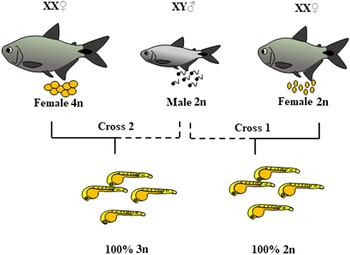
A small sample of oocytes from diploid (n = 15) and tetraploid (n = 15) females fixed in 2.5% glutaraldehyde was separated to measure the diameter (µm). Oocytes from each diploid and tetraploid female were fertilized with sperm from the same male, resulting in two crosses: cross 1 (diploid male and diploid female) and cross 2 (diploid male and tetraploid female). These procedures were performed with separate females (diploid and tetraploid and male diploid) for each replication (n = 3) (Figure 1). Two embryo aliquots (∼100) from each cross were selected (N = 600) for developmental analysis using a stereomicroscope (Nikon SMZ 18, Tokyo, Japan) and Nis-Ar Elements software (Nikon, Tokyo, Japan). Survival rates (%) were measured during the cleavage, blastula, gastrula, somite, and hatching stages with subsequent normal and abnormal larvae according to dos Santos et al. (Reference dos Santos, Yasui, Xavier, de Macedo Adamov, do Nascimento, Fujimoto, Senhorini and Nakaghi2016).
Experimental design evaluating progenies of cross 1 (female 2n × male 2n) and cross 2 (tetraploid females and diploid males) in Astyanax altiparanae.

Confirmation of ploidy status
For ploidy determination, 60 larvae from each treatment were analyzed using flow cytometry and cytogenetic methods. Flow cytometry was performed according to the protocol developed by Xavier et al. (Reference Xavier, Senhorini, Pereira-Santos, Fujimoto, Shimoda, Silva, Dos Santos and Yasui2017). The samples (each larva) were transferred to microtubes containing 120 µl of cell lysis solution (9.53 mM MgSO4.7H2O, 47.67 mM KCl, 15 mM Tris, pH 8.0, 74 mM of sucrose, and 0.8% of Triton X-100) for 10 min. Afterwards, nuclei staining was performed by adding 800 μl of 4′,6-diamidino-2-phenylindole (DAPI; Sigma #D5773, St. Louis, USA). The resultant solution was passed through a 30-μm filter and analyzed using a flow cytometer (CyFlow Ploidy Analyzer, Partec, GmbH, Germany).
Procedures for chromosome preparations (cytogenetics) were performed according to Foresti et al. (Reference Foresti, Oliveira and Foresti de Almeida-Toledo1993). Briefly, 20 embryos from each replicate (n = 60) were separated at the somite stage. Embryos were maintained in colchicine (0.007 %) for 4 h, and then the chorion was removed using a Pronase solution (0.03%). The larvae were anaesthetised in eugenol solution (1 ml of eugenol/10 ml of alcohol 98º GL) and individually dissociated (whole) in a Petri dish containing 7 ml of hypotonic KCl solution (0.075 M). Samples were maintained at 37°C for 21 min, fixed in methanol and acetic acid (3:1), and then stained with Giemsa solution (5%).
Results are presented as the mean ± standard error. The data were previously checked for normality and homogeneity using the Lilliefors and Levine’s tests, respectively. Afterwards, one-way analysis of variance (ANOVA) and Tukey’s post hoc tests were performed. The software STATISTICA v.10.0 (Statsoft, Tulsa, USA) was used and significance was set at P < 0.05.
Results
Early development
The oocytes presented a slightly ovoid shape at the time of extrusion, in which diploid oocytes had a size of 559 ± 20.62 μm and tetraploid of 1025.33 ± 30.91 μm. Statistical differences were observed between eggs from crosses 1 and 2 (P = 0.0130).
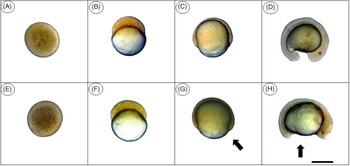
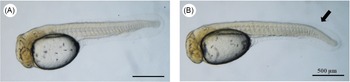
The embryos from cross 2 (triploids) showed some delay (45 min) from the epibolism movements when compared with the diploid embryos of cross 1 (Figure 2H). Most larvae from cross 2 presented irregular formations at the final portion of the tail (Figure 3B).
Embryonic development of Astyanax altiparanae was obtained through crosses between (female 2n × male 2n) and (female 4n × male 2n). (A, E) Animal pole differentiation; (B, F) blastula; (C, G) gastrula; (D, H) segmentation. Arrow indicates a small delay in yolk covering and embryonic shield formation. Arrowhead indicates delay in cephalic and caudal region formation.

External morphology of (A) larvae and (B) abnormal Astyanax altiparanae obtained through cross 1 (female 2n × male 2n) and cross 2 (female 4n × male 2n). Arrow indicates an anomaly in the final portion of the tail.

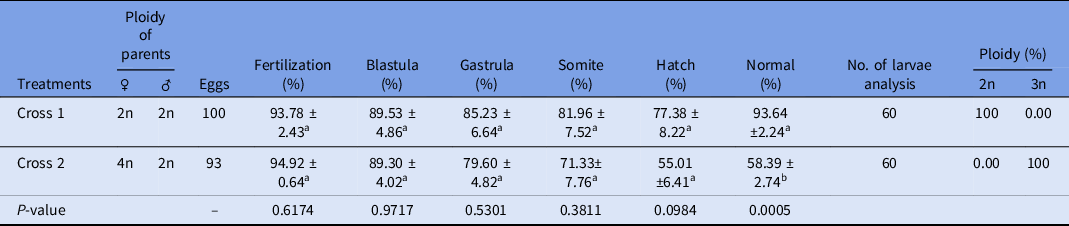
Data on early development into 2-cell stage, blastula, gastrula, somite, and hatching of abnormal and normal larvae, as well as the respective ploidy status, are detailed in Table 1. Despite morphological differences during critical stages of development, cross 2 embryos showed similar survival when compared with cross 1 embryos. No differences between treatments were observed for survival at the 2-cell (P = 0.6174), blastula (P = 0.9717), gastrula (P = 0.5301), somite (P = 0.3811), and hatching (P = 0.0984) stages.
Ploidy and survival (%) of yellowtail tetra A. altiparanae in percentage (±SE) resulting from cross 1 (female 2n × male 2n) and cross 2 (female 4n × male 2n)

a,b Data were obtained from different gamete sources resulting in three replications. Different superscript letters within a column indicate statistical differences using the Tukey multiple range test (ANOVA; P < 0.05). SE, standard error.
Confirmation of ploidy status
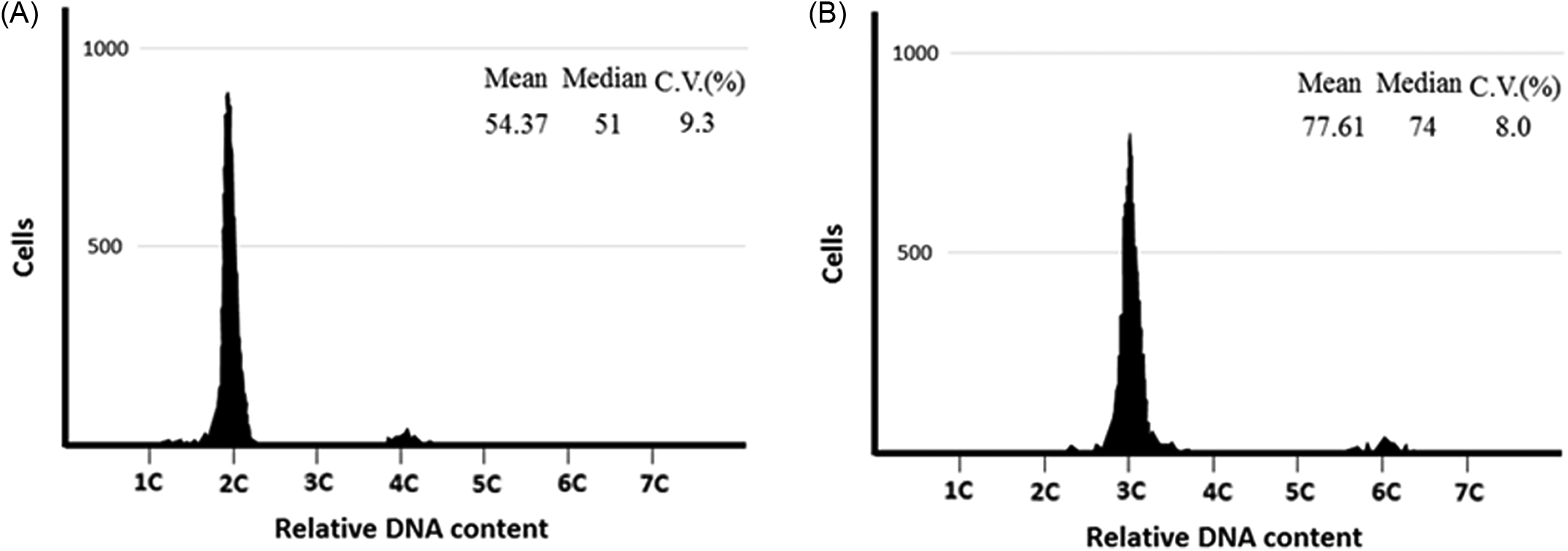
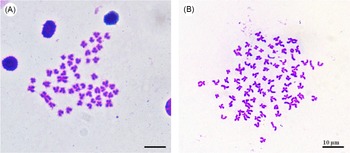
As expected, flow cytometry analysis showed that progenies from crosses 1 and 2 presented 100% diploid and triploid individuals, respectively (Table 1; Figures 3B, 4A). The same results were confirmed in the cytogenetic analysis. The larvae resulting from cross 1 had 50 metaphase chromosomes, and those from cross 2 had 75 chromosomes (Figure 5).
Flow cytometry histogram showing the relative DNA content of larvae from (A) cross 1 (female 2n × male 2n) diploid group and (B) cross 2 (female 4n × male 2n) triploid group Astyanax altiparanae.

Karyotypes of larvae from (A) cross 1 (female 2n × male 2n) diploid group and (B) cross 2 (female 4n × male 2n) triploid group of Astyanax altiparanae.

Discussion
In this study, for the first time in a neotropical species, triploid fish were obtained using tetraploid females and diploid males of A. altiparanae. These results are very interesting for fish aquaculture, as triploid females of yellowtail tetra present increased growth parameters when compared with diploids, such as carcass yield (do Nascimento et al., Reference do Nascimento, Pereira-Santos, Piva, Manzini, Fujimoto, Senhorini, Yasui and Nakaghi2017b) and sterility (do Nascimento et al., Reference do Nascimento, Pereira-Santos, Piva, Manzini, Fujimoto, Senhorini, Yasui and Nakaghi2017a). Therefore, the large-scale production of triploid (in special females) using tetraploids in this species could guarantee increased production and also reduce the risks of environmental impacts, as the possible escapes of sterile fish reduce the risks of introgression through hybridization (Benfey, Reference Benfey2016).
In aquaculture, tetraploid fish are an interesting alternative for the mass production of triploid fish, as observed in other studies (Nam and Kim, Reference Nam and Kim2004; Weber et al., Reference Weber, Hostuttler, Cleveland and Leeds2014; do Nascimento et al., Reference do Nascimento, Pereira-Santos, Levy-Pereira, Monzani, Niedzielski, Fujimoto, Senhorini, Nakaghi and Yasui2020). Additionally, the protocols for triploid induction established by Adamov et al. (Reference Adamov, Nascimento, Maciel, Pereira-Santos, Senhorini, Calado, Evangelista, Nakaghi, Guerrero, Fujimoto and Yasui2017) and those currently used for triploid induction in A. altiparanae do not guarantee 100% of triploids. Therefore, the current protocol overcomes the deleterious effects of heat shock, and 100% triploidy fish were obtained.
However, lower percentages of normal larvae were observed in the triploid group. This unexpected result, conversely, does not limit the large-scale production of triploids by these methods because high hatching rates were still achieved. In the previous work of Weber et al. (Reference Weber, Hostuttler, Cleveland and Leeds2014), for example, the deformity was much lower in triploids derived from the cross of a tetraploid with a diploid than in shock-induced conditions. Therefore, we can attribute the results to other variables such as differences in reproductive performance in tetraploid and diploid females. Additionally, some studies have also shown that the first generation of tetraploids has lower reproductive potential (Chourrout Reference Chourrout1984; Chourrout et al., Reference Chourrout, Chevassus, Krieg, Happe, Burger and Renard1986; Myers, Reference Myers1986; Blanc et al., Reference Blanc, Chourrout and Krieg1987, Reference Blanc, Poisson, Escaffre, Aguirre and Vallée1993; Hershberger and Hostuttler Reference Hershberger and Hostuttler2005, Reference Hershberger and Hostuttler2007) and, subsequently, higher normality and egg quality were observed in the second generation of tetraploids. Therefore, the same results may be observed in our study and these effects must be addressed in future studies.
Fish ploidy was determined using flow cytometry and chromosome preparations (Allen, Reference Allen1983; Xavier et al., Reference Xavier, Senhorini, Pereira-Santos, Fujimoto, Shimoda, Silva, Dos Santos and Yasui2017). As these methods present specific advantages (Piferrer et al., Reference Piferrer, Beaumont, Falguière, Flajšhans, Haffray and Colombo2009), the combination of both techniques ensures the accuracy of the current study. Therefore, the cytogenetic method could be an interesting alternative when a flow cytometer is not available, due to the low cost. In conclusion, our results showed that tetraploid females of the yellowtail tetra A. altiparanae are fertile, present viable gametes after stripping and fertilization using dry methods, and may be used for mass production of triploids. This is the first report of these procedures within neotropical characins. These results are innovative and can be applied to other related species of economic importance.
Data availability statement
The data that support the findings of this study are available from the corresponding author upon reasonable request.
Acknowledgements
The authors are grateful to CAPES #88882.426164/2019-01 and CTG (China Three Gorges Corporation) for the financial support of this research. We also acknowledge CEPTA/ICMBio for kindly providing the facilities and experimental fish.
Ethical standards
The authors assert that all procedures contributing to this work comply with the ethical standards of the relevant national and institutional guidelines ethical standards on the care and use of laboratory animals.