Financial historians have long been interested in explaining and analyzing the development of capital markets, and understanding the extent to which their development has a broader impact on growth rates for national economies. Recently, economists have been drawing on the insights of Joseph Schumpeter and earlier generations of scholars to reexamine the relationship between financial sector development and economic growth, and to test it using new long-run, cross-country data sets.Footnote 1 This newer literature argues that a causal relationship between finance and growth exists: well-functioning capital markets make it easier to channel savings to investment projects with high rates of return, which in turn enable modern economic growth to occur. Hence, understanding the factors that encourage capital market development is a key question.
The geographical mobility of capital is critical to allocative efficiency. Legal or regulatory barriers, underdeveloped banking systems or financial markets, and technological hurdles can impede the flow of capital from borrowers to lenders across regions, while institutional innovations can accelerate the development of national capital markets. To better understand how national capital markets are forged, this article examines the process of capital market integration in Japan during the late nineteenth and early twentieth centuries.
Japan's experience is particularly illuminating for several reasons. First, although previous studies have examined the slow emergence of a national capital market in the United States during the nineteenth century, comparatively little is known about the formation of national capital markets in other parts of the world.Footnote 2 Japan's status as the second largest economy in the world economy and its location in Asia (where many of the fastest growing developing nations are presently located) make it a particularly interesting historical case for assessing how capital market integration takes place. Second, because the institutional development of the Japanese banking system during the late nineteenth century differed considerably from the process taking place in the United States at that time, Japan's experience may shed light on factors that influence the formation of national capital markets but were non-existent or unimportant in the case of the United States. In particular, since Meiji-era policymakers were explicitly attempting to modernize the Japanese economy and break from Japan's feudal past, they experimented with new institutions, including the creation of a central bank in 1882 and its regional branches shortly thereafter and the development of commercial branch-banking networks.Footnote 3 Third, although existing (Japanese-language) studies by historians provide some suggestive evidence that a national capital market likely emerged in the late nineteenth and early twentieth centuries, our study is the first to analyze how convergence was influenced by competition, institutional developments, and a better flow of information (induced by both technological change and innovations in the banking industry such as branch banking).Footnote 4
One significant impediment to understanding capital market integration in countries other than the United States has been the lack of regional data on capital flows, interest rates, or other series that would permit the testing of this process. Hence, to analyze capital market integration in Japan, we collected a new data set on lending rates of commercial banks from 1884 to 1925 for 47 Japanese prefectures. We combined these data with other characteristics of Japanese prefectures, including the competitiveness of the banking environment, access to information networks, and the existence of branches of the Bank of Japan.Footnote 5 Unlike many previous studies on interest rate convergence, our data set permits us to use panel econometrics to test explicitly the relative importance of competing hypotheses and show how a national market became increasingly integrated over a 40-year period.
We first review the literature on capital market convergence and consider theories that may help explain the process of capital market integration in Japan. We then use fixed effects and random effects models to show that the establishment of branches of the Bank of Japan and the development of commercial branch-banking networks lowered the barriers to capital mobility in Japan during the Meiji and Taisho periods. These two findings suggest that institutional innovations can play a central role in forging national capital markets. Our findings also highlight the role played by information networks: the growing telegraphic transmissions of financial information appear to have accelerated capital market integration in Japan.
ACCOUNTING FOR CAPITAL MARKET INTEGRATION IN JAPAN
Studies of capital market integration have employed a wide range of data series (prices, capital flows, and differences in savings and investment) and statistical techniques to assess the pace and timing of national integration. Although there is no single agreed upon approach for studying integration, many researchers have used the movements in asset prices (for example, interest rates) to assess capital market integration, in part because these data are often available for longer periods of time and for a variety of locations. Economic theory suggests that asset prices ought to obey the law of one price because if capital markets are perfectly competitive and no market frictions exist, arbitrage opportunities should not persist across time and space. Otherwise, the arbitrage opportunities could be exploited by market participants. Much of the existing literature on capital market integration has thus analyzed the extent to which actual capital markets meet the idealized criteria of frictionless, perfectly competitive markets. For example, studies on the process of national capital market formation in the United States have emphasized a variety of regulatory and institutional characteristics that may have impeded the development of a national capital market in the nineteenth century.Footnote 6
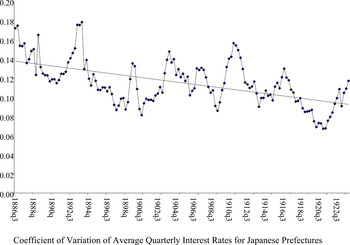
In this light, we begin our analysis of Japan's market for loanable funds by presenting evidence of the convergence in interest rates across Japanese prefectures. Figure 1 plots the coefficient of variation, on a quarterly basis, for the 47 Japanese prefectures from the mid-1880s to the early 1920s.Footnote 7 The graph suggests that interest rate differentials were narrowing over this period. By the middle of the 1890s, the Ministry of Finance's annual report on banking stopped commenting on regional gaps in interest rates, and suggested that capital market integration had taken place: “interest rate trends in different regions are virtually the same.” Footnote 8 In the rest of this section, we suggest several hypotheses that might help account for the apparent convergence in lending rates, which we then test in the next section of the article. The experience of the United States provides some guidance on what hypotheses we consider; however, the pattern and pace of convergence among Japanese prefectures is sufficiently different from what U.S. regions experienced at that time that we cast our net more broadly in order to consider additional factors. That is, although there are some surface level similarities between the development of the U.S. banking system and Japan's in the late nineteenth century, the Meiji period in Japanese history (1868–1913) ushered in a variety of institutional innovations in banking that may have figured prominently in the development of a national market for loanable funds.
NARROWING OF INTEREST RATE DIFFERENTIALS ACROSS JAPANESE PREFECTURES

Competition in the Loanable Funds Market and Financial Innovation
All else equal, more competitive banking systems ought to exhibit lower rates on borrowing and greater loan volume than monopolistic banking systems. One explanation, then, for the persistence of high lending rates in some regions is that banks were able to take advantage of market power, and charged local customers higher prices. They effectively exploited their locational advantage to derive monopoly rents.
In underdeveloped markets, banks are often able to retain significant pricing power. Distance from a central financial market therefore can often act as a barrier to entry by making it more costly for a larger, out-of-area bank to establish a branch or purchase an existing bank. For example, the Ministry of Finance reported in 1889 that “interest rates are always lower in the urban areas where there are highly developed financial institutions and higher in outlying areas that lack these institutions; this is a generally accepted economic principle.”Footnote 9 Hence, the threat of entry may have been weaker in markets located further from financial centers like Tokyo and Osaka, a hypothesis we consider in the next section of the article. Banks may have also been able to exploit informational advantages to obtain pricing power. For example, before the telegraph was widely used, it may have been difficult for customers to have complete information about competitive lending rates.
Another potential explanation for local market power is the role of regulation, which we will test by examining the competitive environment for banks in a given prefecture. Scholars examining the United States have noted that high initial capital requirements, restrictions on branch banking, and limitations on bank mergers or on the chartering of new banks may have impeded competition in regional banking markets. These regulations may have fostered local geographic monopolies and impeded the development of a national banking market in the United States.Footnote 10
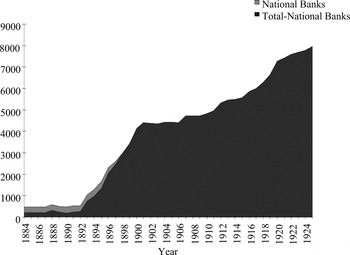
Circumstantial evidence might suggest a similar environment in Japan. After all, shortly after the Meiji restoration, the Japanese government passed a law in 1872 authorizing the creation of national banks that were closely modeled on the United States national banking system (which had been created in 1863). But, the Japanese experiment with national banks was much smaller in scale than in the United States. The Japanese national banking system grew more slowly than the U.S. system, it had fewer relationships with other banks in the economy, and it was abandoned soon after its creation (in 1885) in favor of other types of banking institutions.Footnote 11 Summary statistics on the Japanese banking system confirm the view that national banks were not an important source of banking growth during the Meiji-Taisho period. As Figure 2 shows, the growth in savings banks, ordinary banks, and other commercial banking institutions was quantitatively more important than national banks for our sample period.
The regulatory legacy of this Japanese national banking system also turned out to be quite limited. As in the United States in the nineteenth century, the original authorizing legislation in Japan established minimum capital requirements for national banks in Japan. These requirements specified the capital that banks were required to have on hand in order to receive a charter from the Ministry of Finance Shiheino-kami (Chief Officer of the Paper Currency Bureau). In particular, banks in large cities (greater than 100,000 in population) needed more than 500,000 yen (roughly $453,000 at 1880 exchange rates) to receive a charter.Footnote 12 Banks in medium-sized cities (between 10,000 and 100,000 people) needed a minimum of 200,000 yen. However, banks in small cities (between 3,000 and 10,000 people) could receive the approval of the Ministry of Finance to operate even if they had less than 50,000 yen in charter capital, so it is likely that capital requirements were not binding in smaller towns and cities. The original law was then amended in 1876, significantly lowering the capital requirements for national banks. The amended act basically required that national banks have capital of more than 100,000 yen; national banks in larger cities (with a population greater than 100,000) were required to have 200,000 yen in minimum charter capital. However, these requirements were still not restrictive, since banks with capital between 50,000 and 100,000 yen could operate given the approval of the Ministry of Finance.
GROWTH IN BANKS (HEAD OFFICES AND BRANCHES)

Since the Ministry of Finance wanted better control of banknote issuance, it stopped chartering national banks in 1878 and redirected its attention to establishing other types of commercial banks without note- issuing privileges. The Bank Act of 1890, which was created to regulate these nonnational, commercial banks, established minimum capital requirements similar to those in the National Bank Act.Footnote 13 It did require nonnational banks to get charter approval from the Ministry of Finance, but this restriction does not appear to have limited the growth of these banks. The number of the nonnational commercial banks and branches grew rapidly, with their numbers quickly exceeding those of the national banking system at its peak (Figure 2). By the 1880s, the capital requirements were quantitatively unimportant for commercial banks and did not serve as a meaningful barrier to entry.Footnote 14 In an attempt to stabilize the banking system after a financial crisis in 1901, the Ministry of Finance began to encourage mergers and consolidation in the banking industry and raised the minimum charter capital requirements for new banks to 500,000 yen.Footnote 15 Although the higher minimum capital requirement and the Ministry's policy slowed growth of the banking system (excluding branches), the number of banks had already expanded by more than 1500 percent in sixteen years (from 141 to 2289). Historians have concluded that entry regulations were fairly lax through the beginning of the twentieth century.Footnote 16
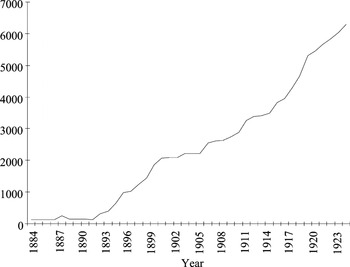
The Meiji-Taisho period was relatively unfettered in terms of entry regulations, with relatively free banking. Moreover, in contrast to the U.S. banking system of the late nineteenth and early twentieth centuries, branch banking flourished in Japan, since governments (either national or prefectural) imposed no restrictions on the formation of branching networks. Kazunobu Okada suggests that interbank transactions in the early Meiji period and the development of the branch bank system were important in the development of a national capital market in the middle and late Meiji periods.Footnote 17 From 1884 to 1925, the number of branches jumped from 122 to 6287 and the number of branches per head office increased from 0.87 to 3.77 in order to service an expanding customer base and the growing Japanese economy. According to Tetsuji Okazaki, the development of branching in Japan spurred competition in the banking sector, and that growth in branching was especially strong after 1905.Footnote 18 Yoshio Asai also suggests that branching led to competition in lending rates and deposits. Figure 3 shows the overall growth in branching, however, this growth was not uniform across Japan.Footnote 19 From 1884 to 1925, Tokyo and Hyogo saw the greatest increase in branch offices—from 16 to 487 and 5 to 398, respectively. On the other hand, Miyazaki and Okinawa saw branching expand the least over the same period—from 1 to 53 and 2 to 8, respectively. Some research also suggests that competition from branching may have been largely confined to major cities.Footnote 20 When we analyze the process of capital market integration in the next section of the article, we will therefore have to take into account differences in commercial branch banking across prefectures.
Commercial banks also extended their correspondent relationships during this period, and used their networks to transfer funds across regions.Footnote 21 Looking at the domestic funds transfer market in more detail, we find that, between 1877 and 1880, branch office networks and correspondent networks were built between the major urban banks and the large regional banks, and these networks were used to provide funds transfer services.Footnote 22 In Tokyo, Osaka, and other centers, transfer clearing houses arose spontaneously by 1880, and served as a venue for trading transfers between banks.Footnote 23 However, because Tokyo-Osaka transfers were the focus of the correspondent network and only a few of the largest regional banks were able to participate in the network at all, it may not have mattered much.
In short, the lack of restrictions on entry and the innovations in Japanese banking during the Meiji period suggest that the banking system may have been more competitive than the U.S. banking system, at least through the end of the nineteenth century. In the empirical tests, we examine how differences in competition in the loanable funds market at the prefectural level may have influenced interest rate differentials.
BRANCH OFFICES IN JAPAN

Information Networks
Another factor that we wish to test in our statistical analysis is the role of information networks. As Michael Bordo, Barry Eichengreen, and Douglas Irwin have noted, informational barriers can impede financial market integration as well, like a lack of competition.Footnote 24 Technological improvements that lower the cost of gathering information can increase the quantity of financial services and lower their prices. Improved information networks also let financial institutions gather better quality information on regional tastes and differences in risk. With lower-cost access to information, bank customers can also more easily gather information about market conditions that prevail elsewhere, allowing them to seek out competitive rates.
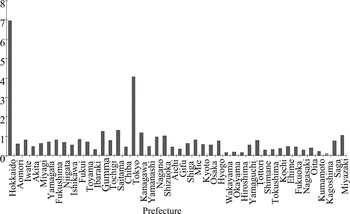
The Meiji period witnessed a dramatic improvement in transportation and communication networks beginning in the 1870s when the telegraph, railroads, and a modern postal system were established. Nobuyuki Fujii suggests that the growth in these networks was important for economic development; it seems plausible that the development of information networks in Japan may therefore have influenced the market for loanable funds, particularly because the expansion in communication networks was uneven.Footnote 25 Juro Teranishi suggests that better transportation and communications networks enhanced the development of private correspondent networks among banks.Footnote 26 Kazuo Sugiyama also suggests that these developments may have been important in driving the integration in commodity and goods markets within Japan.Footnote 27 For example, although use of the telegraph began in 1870 in Tokyo and Osaka, the process of developing the network to cover a broader geographical area took 10–15 years.Footnote 28 According to Fujii and Sugiyama, two-thirds of the private usage of the telegraph involved the transfer of information for business activities, such as commodity prices or interest rates; in 1885 the number of telegraph offices per capita varied considerably from prefecture to prefecture (Figure 4).Footnote 29 We include a measure of the use of telegraphs at the prefectural level in our analysis to assess whether the diffusion of this information network contributed to the reduction of interest rate differentials.
One final advantage of branch-banking networks is that they may have allowed banks to price loans more efficiently. Branch banking networks enable head offices to obtain more detailed information on local economic conditions and local borrowers; as a result, they may be willing to extend loans over a wider geographical area.Footnote 30 Although costly for banks to build, it may enable them to also obtain more customers as well as to diversify away from idiosyncratic risk associated with local lending markets. The comparative advantage that branching networks have in gathering specific information about borrowers and their investment projects may have also hastened the development of formalized lending markets in Japan by making it more difficult for informal money lenders to compete with banks, which had greater economies of scope and scale.
TELEGRAPH OFFICES PER 100,000 PEOPLE, 1885

Bank of Japan
One final institutional change may have fostered the development of a national capital market—the Japanese government's creation of a central bank (modeled after the Bank of Belgium). The early founding date of the Bank of Japan (1882), in comparison to the establishment of the U.S. Federal Reserve System in 1913, may have facilitated interregional payments and alleviated existing regional biases in the funding of loans during our sample period.
Promoting the nationwide integration of financial markets was one of the Bank of Japan's goals.Footnote 31 According to the “Proposal to Establish the Bank of Japan” and a supporting document entitled, “Explanation of the Establishment of the Bank of Japan,”Footnote 32 the Bank was founded with five objectives in mind: (1) facilitate finance; (2) enhance funding of the national banks; (3) reduce interest rates; (4) offer treasury receipt and disbursement services; and (5) discount foreign bills. Of these goals, the first three sought to improve domestic financial intermediation functions, and the first is particularly relevant to our discussion of the Bank of Japan's network. According to the “Explanation of the Establishment of the Bank of Japan,” the first goal, “facilitate finance,” was based on a judgment that networks of private-sector financial institutions were insufficient to adjust funding surpluses and shortfalls between regions.Footnote 33 It was therefore suggested that the central bank sign correspondent contracts with national banks throughout the country so that it could unify local financial markets into a single, nationwide market.Footnote 34 The use of correspondent transactions to build a network between the Bank of Japan and private sector financial institutions was considered to be a powerful tool for the achievement of the initial objectives behind the bank's establishment.
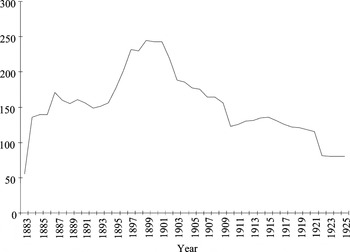
According to Masayoshi Tsurumi, “spontaneous private financial markets” had existed prior to the establishment of the Bank of Japan, but domestic Japanese financial markets were not sufficiently tied together: the Bank of Japan transformed these “spontaneous private financial markets” into a single market with the Bank of Japan at its core.Footnote 35 Private sector banks that signed correspondent transactions could use the Bank of Japan to transfer funds and collect bills from remote locations, and they could borrow short term from the Bank of Japan provided that they put up collateral.Footnote 36 The Bank of Japan began to sign correspondent transactions with private sector banks in June 1883, opening up a means of transferring funds through the Bank of Japan in addition to private payment systems. The number of correspondent contracts grew considerably after the Bank of Japan signed its first correspondent contracts in 1883, reaching around 150 in 1890, and peaking at over 200 in 1900 (Figure 5).Footnote 37 Makoto Kasuya comments that “going through the Bank of Japan helped to smooth out the movement of funds between remote locations.”Footnote 38 On the other hand, the rising volume of correspondent transactions handled by the Bank of Japan had the effect of reducing the volume handled by private sector transfer clearinghouses. According to Tsurumi, the Bank of Japan eventually completely took over this business by around 1890.Footnote 39
The branch offices of the Bank of Japan were supposed to “facilitate finance.” The Osaka Branch was established in December 1882, opening almost simultaneous to the head office in Tokyo, because of Osaka's position as a “center of commerce.” No other branches were established immediately thereafter, however.Footnote 40 At the time of the bank's establishment, the Ministry of Finance was concerned that “the establishment of local Bank of Japan offices may ‘impair the operations of local ordinary banks,’ and the Bank of Japan should therefore ‘initially’ sign correspondent contracts rather than establish branch offices.”Footnote 41 This was presumably why the Bank of Japan began by developing a nationwide correspondent network as a channel for circulating funds and delayed its expansion of a branching network.Footnote 42 The Ministry of Finance's policy appears to have changed its position, however, in the latter half of the 1880s. On July 30, 1889, seven years after the drafting of “Explanation of the Establishment of the Bank of Japan” by Masayoshi Matsukata, a Ministry of Finance memorandum acknowledged the need to expand the Bank of Japan's branching network. According to the memorandum, the primary duty of the Bank of Japan was “to provide a means of funds transfers throughout the country and to facilitate market finance.” Footnote 43 This emphasis on promoting funds transfersFootnote 44 was more or less the same as Masayoshi Matsukata had argued for in the “Proposal to Establish the Bank of Japan,” but the Ministry of Finance placed additional emphasis on the need to establish branch offices and agencies in order to achieve these objectives.Footnote 45
THE NUMBER OF CORRESPONDENT CONTRACTS BETWEEN BANK OF JAPAN AND PRIVATE BANKS

According to documents in the Bank of Japan, Institute for Monetary and Economic Studies Archives, Bank of Japan Governor Shigetoshi Yoshihara asked the Minister of Finance, Masayoshi Matsukata to establish new branches on June 16, 1886.Footnote 46 The application begins by noting the need to closely monitor conditions in local areas: “There has been a significant increase in the bank's operations with respect to its duties of handling treasury receipts and disbursements, issuing convertible banknotes, and providing ‘correspondence’ services, and these services now extend throughout the country. We therefore believe it is necessary and urgent to more closely monitor local conditions and circumstances.” Governor Yoshihara went on to note that the Bank of Japan, in its present configuration, had little scope for carrying out these aims. “The bank only has one branch office in Osaka and engages in correspondent financial transactions with national and private banks in other parts of the country and must rely on their communications through correspondent transactions to confirm the ebbs and flows of local commerce and finance to report to the Bank of Japan's head office.” Governor Yoshihara thus viewed the Bank of Japan's correspondent transactions with private-sector financial institutions as inadequate to respond to changes in local financial and economic circumstances, and he therefore argued for the establishment of “branch offices in local centers” that would “facilitate finance and balance interest rates.”Footnote 47 Seven days after the application was made, the minister of finance approved it.
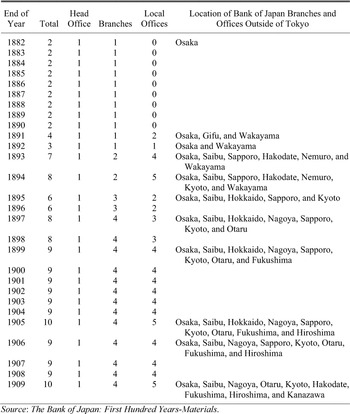
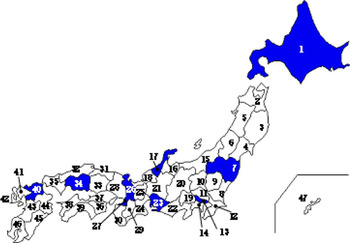
Table 1 traces the establishment of branch and liaison offices between 1882 and 1909. In contrast to the U.S. Federal Reserve System's branches, which were established simultaneously, the Bank of Japan's branches were rolled out over the extended period of our sample.Footnote 48 The regional variation in the establishment of Bank of Japan branches is particularly useful for testing whether they had any impact on reducing interest rate differentials. For the first decade after its establishment, the Bank of Japan had only two offices, in Tokyo and Osaka, but by 1910, it had ten offices in nine prefectures (Figure 6). The first two liaison offices were in Gifu and Wakayama in 1891; three more were established in Hokkaido in 1893.Footnote 49 The second branch office to be established after Osaka was the Saibu (Kyushu) Branch, in 1893. Branch and liaison offices were established at a steady pace thereafter.Footnote 50 In 1909 there were
OPENING OF THE BANK OF JAPAN'S BRANCHES AND OFFICES

Source:
The Bank of Japan: First Hundred Years-Materials.
branch and liaison offices in most of the major financial centers of Japan and in Hokkaido: Osaka (1882), Saibu, Sapporo, Hakodate, Nemuro (1893), Kyoto(1894), Nagoya, Otaru (1897), Fukushima (1899), Hiroshima (1905), and Kanazawa (1909).Footnote 51 For capital market integration, the key is whether branch and liaison offices provided funds transfer services. Documentary evidence collected from the “Manuals and Rules of the Bank of Japan's Operations,” (Collection 1, Volume 1), demonstrates that they did, from the moment they were established, along with the other services they provided, such as banknotes, treasury receipt and disbursement services, and government-bond handling.Footnote 52
BANK OF JAPAN'S BRANCHES IN 1909
(SHADED PREFECTURES INDICATE BANK OF JAPAN OFFICE)

EMPIRICAL ASSESSMENT OF MARKET INTEGRATION
Data and Estimation
Our aim is to characterize the process of long-run integration and understand the factors that are leading to or inhibiting capital market integration. We do so by assessing the relative importance for market integration of institutions, competition, geography, and prefecture-specific factors by estimating

To relate the process of financial market integration to the law of one price, we consider each prefecture's interest rate relative to a benchmark rate, so that the dependent variable RATEit is defined as the difference between the annual average lending rate in prefecture i and year t and the average across all prefectures in year t. In order to test whether our results are sensitive to this definition, we also consider two other ways of defining the depending variable—the prefecture's interest rate minus the rate in either Tokyo or Osaka—the two financial centers of Japan during our sample period.Footnote 53
The independent variables are defined as
BNKFAILit is the percentage of existing banks (at time t–1) that failed in prefecture i at time t;
RICELANDPit is the log price (measured in tan) of land dedicated to rice production in prefecture i at time t;
CROPFIELDPit is the log price (measured in tan) of agricultural crops other than rice in prefecture i at time t;
RESIDPit is the log price (measured in tan) of residential land (outside of city centers) in prefecture i at time t;
AVGLOANit is the (log) value of loans of all commercial banks divided by the number of commercial banks in prefecture i at time t;
TELEGRAPHit is the number of domestic telegraph transmissions per capita in prefecture i at time t;
DISTANCEi is the distance between the capital city in prefecture i and either Osaka or Tokyo (whichever is closest);
BRANCHit is commercial bank branches divided by total head offices in prefecture i at time t;
BOJOFFICEit denotes the number of branch offices established by Bank of Japan in prefecture i at time t;
BOJCORRit is the number of correspondent relationships with commercial banks that the Bank of Japan had in prefecture i at time t;
BNKMERGERit is the percentage of existing commercial banks at t–1 that merged at time t in prefecture i;
BNKLQDit is the percentage of existing commercial banks at t–1 that voluntarily liquidated at time t in prefecture i;
BNKENTRYit is the number of commercial banks that entered prefecture i at time t as a percentage of existing banks at t–1;
β are estimated coefficients;
and εit is a white noise error term capturing other influences on lending rates.
The dependent variable, RATEit, is constructed using annual lending rates, collected from the Ministry of Finance's Ginkokyoku N empo.Footnote 54 According to Kokichi Asakura, the type of loans reported in this publication were often taken out by farmers with business interests in sericulture, silk reeling, tea, and rice, and who used the loans to cover the cost of variable inputs into production (such as seeds and fertilizer), capital equipment (farm machinery), land, tax payments, and living expenses.Footnote 55 To create the variable RATEit, we first averaged monthly high and low values, and then averaged these monthly values over the 12 months of year t.Footnote 56
We gathered data from a variety of sources to construct information on regional banking markets (loan volume and loan size) as well as characteristics of bank market competition (bank branches, mergers, voluntary liquidations, and bank entry). Data on the numbers of commercial banks, number of branches of commercial banks, loans, capital, and deposits in each prefecture came from the Annual Report of the Banking Bureau of the Ministry of Finance (Ginkokyoku Ne mpo ), Imperial Statistics (Teikoku Tokei Nenkan), Japanese Monetary Statistics (Nihon no Kinyu Tokei), Shinichi Goto's History of Consolidation of Japanese Banks (Hompo Ginko Godoshi Zoho Kaiteiban), and Banker's Directory (Ginko Soran). Our sample of commercial banks included kokuritsu ginko (“national banks”), shiritsu ginko (“private banks”), and chochiku ginko (“savings banks”). All three types of banks made loans, although they differed somewhat in the size of loans they offered to customers. Kokuritsu ginko also had note-issuing privileges until 1883, at which point these were revoked by the government. Beginning in the 1890s, kokuritsu ginko and shiritsu ginko were converted to futsu ginko (“ordinary banks”). We computed data on bank entry, mergers, and voluntary liquidations for each prefecture using information contained in from History of the banks in Japan (Hompo Ginko Hensenshi ). Footnote 57
For our institutional variables, the source for the number of correspondent relationships between the Bank of Japan and commercial banks was the “Manuals and Rules of the Bank of Japan's Operations” (Enkaku-shi) Collection 1, Volume 2 and Collection 2, Volume 3. The number of Bank of Japan offices in each prefecture came from The Bank of Japan: The First Hundred Years.
Equation 1 also includes measures for the size of informational networks. Data on the number of telegraph transmissions are from Imperial Statistics and Post and Communication Statistics (Teishinsho Nempo ). We computed the distance between the capital city of a prefecture and either Osaka or Tokyo using information on road transportation networks that existed at that time.Footnote 58 In regressions where RATE is defined relative to the mean across prefectures, we use either Tokyo or Osaka, whichever is closest. When RATE is defined relative to Osaka or Tokyo, we use the distance measure with respect to Osaka or Tokyo, respectively.
We included two additional covariates to control for differences in default risk across prefectures. The first measure of risk that we compute is differences in land prices across prefectures. If land is a form of borrower's collateral, then all else equal, higher land prices ought to be associated with lower default risk. Given the historical importance of rice in the Japanese economy and the substantial amount of land dedicated to rice cultivation, we constructed a time series for the price of land dedicated to its production. However, because not all borrowers were rice farmers or owned fields dedicated to rice production, we also constructed two other land price series: one for other types of agricultural crops and one for residential land prices. Data for all three series are taken from Tax Bureau Statistics (Shuzeikyoku Tokei Nemposho ) and Imperial Statistics. Although land prices have been used to proxy risk by scholars like Eichengreen, the association between default risk (for borrowers) and land prices in Japan may be more tenuous in the Japanese case.Footnote 59 A borrower's personal credit history was the most important determinant of lending, and the most common form of collateral was government bonds. Some evidence from the case of Mitsui Bank (Mitsui Bunko, 1980) suggests that land was the last form of collateral that banks were willing to accept, so it is not clear, a priori, how important the land proxies are in the Japanese case.
Given the limitations of land prices, we constructed a second measure of risk based on commercial bank failures. The source of the data was Hompo Ginko Hensenshi, which included information about commercial bank entry and exit during our sample period.Footnote 60 We adjusted the bank failure series using population figures from Imperial Statistics. Other things being equal, prefectures with more bank failures per capita might have had greater underlying risks in lending.
Empirical Results from Panel Models
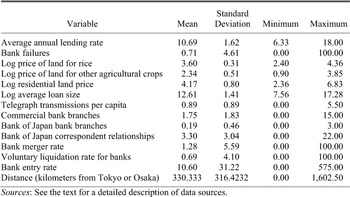
Table 2 provides summary statistics for the variables used in our empirical analysis. Our sample covers all 47 prefectures and the years 1884 to 1925. We chose to end our study at this date since there were substantial banking reforms that began in 1926 and gained momentum after the severe Showa Financial Crisis of 1927.Footnote 61 Most of our specifications use fixed effects panel models, since there are likely unobserved differences across prefectures that may influence interest rate
CHARACTERISTICS OF BANKING MARKETS IN JAPANESE PREFECTURES

Sources:
See the text for a detailed description of data sources.
behavior. In these, the distance measure (which remains constant over our sample period) is dropped from the reported regressions. Since Figure 1 suggests that there is a clear downward trend in rates over our sample period, we include year dummies in the regressions. Robust standard errors are reported to correct for heteroskedasticity.
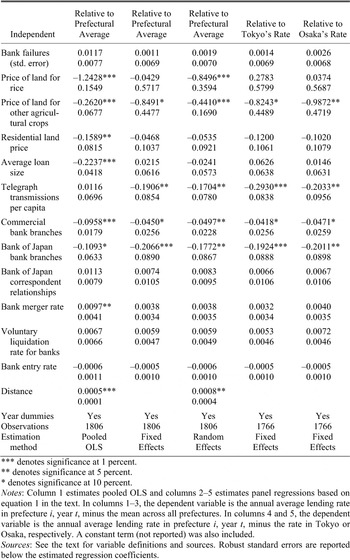
Column 1 of Table 3 reports results from an OLS specification, where we subtract the mean rate for all prefectures from each individual prefecture's rate. The R-squared suggests that our model accounts for roughly 31 percent of the prefectural variation in interest rate deviations from the mean rate across all prefectures. Moreover, the statistically and economically significant coefficients reported in Table 3 suggest that there are several factors that likely helped integrate the capital market during our sample period. When we include fixed effects at the prefectural level (column 2), the evidence for these factors is still there.
Specifically, prefectures with above average commercial branch banking and telegraph usage and those that had Bank of Japan branches converged more quickly. The buildout of information networks during our sample period appears to have helped a national capital market emerge. As shown in column 2, the diffusion of information helped to link regional lending markets. A one-standard-deviation increase in thevolume of telegraph transfers per person lowered a prefecture's lending rate by roughly 17 basis points (using the standard deviation shown in Table 2). In addition to facilitating the development of correspondent
REGRESSIONS EXPLAINING THE CONVERGENCE IN INTEREST RATES, 1884–1925

*** denotes significance at 1 percent.
** denotes significance at 5 percent.
* denotes significance at 10 percent.
Notes:
Column 1 estimates pooled OLS and columns 2–5 estimates panel regressions based on equation 1 in the text. In columns 1–3, the dependent variable is the annual average lending rate in prefecture i, year t, minus the mean across all prefectures. In columns 4 and 5, the dependent variable is the annual average lending rate in prefecture i, year t, minus the rate in Tokyo or Osaka, respectively. A constant term (not reported) was also included.
Sources:
See the text for variable definitions and sources. Robust standard errors are reported below the estimated regression coefficients.
networks, the telegraph, as we noted above, conveyed information to banks and borrowers about rates prevailing in other parts of the country thereby driving rates down in more distant markets.Footnote 62
Financial innovation also played a role in the convergence of interest rates; in particular, the dissemination of branch offices appears to have lowered rates for borrowers. The coefficient shown in column 2 suggests that a one-standard-deviation increase in the ratio of branch offices to head offices decreased lending rates by around 8 basis points. As we suggested earlier, there are several channels through which branch banking may have accelerated convergence: by introducing more competition, by facilitating the spread of information on local economic conditions, and by helping banks allocate capital more efficiently. To provide a more direct test of the first channel, we interacted our branching variable with merger rates, voluntary liquidations, and bank entry rates to examine whether branching reduced lending by introducing more competition into local markets. The interactions were not statistically significant and the magnitude and statistical significance of the branching variable itself does not change (results not reported). It thus appears that a more likely explanation for the impact of branching on lending rates was that it encouraged the spread of information and improved the efficiency of the lending market.
One of the more interesting empirical findings relates to the unique role the Bank of Japan played in forging a national capital market. According to our estimated model, adding a branch of the Bank of Japan lowered rates in a prefecture by roughly 21 basis points. This result is consistent with the stated goal of the Bank of Japan at that time—to provide a means of funds transfers throughout the country and to facilitate market finance. The Osaka branch nicely illustrates how Bank of Japan branch offices played a role in integrating financial markets. Both the head office and the Osaka Branch discounted and purchased bills between Tokyo and Osaka, which Tsurumi suggests “virtually alleviated the remaining separations between the Tokyo and Osaka financial markets.”Footnote 63 Toshimitsu Imuta examined a slightly later period of branch expansion, but he also emphasizes the merits to local banks when there was a Bank of Japan branch in the same prefecture.Footnote 64 He suggests that the opening of a Bank of Japan branch in the same prefecture enabled local banks to deal directly with the Bank of Japan and thus eased the movement of funds to and from other regions. A Bank of Japan branch also made it more convenient for local banks to accept Bank of Japan credits.Footnote 65
There is some evidence that local characteristics such as default risk affected lending rates, even when we condition on other variables. For example, a one-standard-deviation increase in the price of land for other agricultural crops prices lowered lending rates by roughly 43 basis points relative to the mean. However, we find little evidence that the variables we used to characterize the competitive environment—merger rates, voluntary liquidation rates, and bank entry rates—shaped lending rates. Although the coefficients have the correct predicted signs (negative for bank entry and positive for voluntary liquidations and mergers), they are not statistically significant at conventional levels (column 2), and bank mergers is the only one of them that is statistically significant in the OLS specification (column 1). Their lack of statistical significance may not be surprising since entry regulations were nonbinding in the Meiji-Taisho era. If we had found these variables to be statistically significant, it might have suggested that differences in regulation mattered; however, as Okazaki and Michiru Sawada and others have suggested, greater involvement in entry regulation did not occur until the time of the Showa financial crisis—after our sample period ends.Footnote 66 This evidence also suggests that the Japanese capital market at the start of our period is better characterized by underdevelopment rather than lack of competition. That is, once other factors such as financial market innovation (branch banking) and institutional development are accounted for, competition is not of primary importance in explaining movements of interest rates.
If we are willing to assume that the random error associated with each prefecture is uncorrelated with the independent variables, we can also estimate a random effects model (column 3). The results are robust to this specification test. The signs on the estimated coefficients for our measures of commercial bank branching, Bank of Japan branches, and telegraph transmissions do not change, and the results are still statistically significant at conventional levels. Furthermore, there are additional signs that differences in risk may have been important, since two of our proxies are now statistically significant and negative (rice field land prices and farm field land prices).
As an alternative way of specifying the movement of interest rates over time, the last two columns of Table 3 define a prefecture's interest rate relative to either Tokyo (column 4) or Osaka's rate (column 5). Since these were the two major financial centers in Japan in the nineteenth and early twentieth centuries, these regressions test which factors accelerated or hindered the movement towards the rate that prevailed in the largest and most liquid financial markets of the nation.Footnote 67 The results relative to either Tokyo or Osaka are quite similar to those shown for the regressions relative to the mean, and the explanatory variables explain a considerable amount of the variation in either of the dependent variables.Footnote 68 Growth in commercial bank branches, telegraphic transmissions, and the Bank of Japan branches all reduced a prefecture's lending rate relative to the rate prevailing in the financial center. Moreover, all these variables are statistically significant at conventional levels.Footnote 69
Corroborative Archival Evidence
Let us now take a closer look at the funds transfer services provided by a Bank of Japan branch.Footnote 70 Specifically, let us examine the Bank of Japan Saibu Branch, which opened in 1893. The Saibu Branch was the second branch office after Osaka. It was initially established in Akamagaseki (now Shimonoseki) in Yamaguchi Prefecture, but in 1898, it moved to Moji (now Kitakyushu) in Fukuoka Prefecture. The major industries in this region were coal mining and rice production, and it had active financial dealings with Osaka, which served as the trade center.Footnote 71
The Saibu Branch's first manager described the local financial situation before the branch opened as “about ¥10 million a year in rice, coal, and other industrial sales outside of Kyushu, with very few commodities other than these being sold. In other words, it was always a one-sided funds transfer. Even offsetting payments to the treasury in Kyushu, it was still necessary to send ¥4–5 million in cash every year from Osaka. Therefore, interest rates were ¥0.02–0.03 per day higher than Osaka.”Footnote 72 The movement of funds to the region was not necessarily sufficient to cover local demand, and higher interest rates may have reflected the risk of cash transfers or arbitrage opportunities. With the opening of the Saibu Branch, funds transfers could be made over the secure Bank of Japan network. This likely facilitated the movement of funds and drove down rates.
The details of funds transfers can be found in the “Bank of Japan Business Report.”Footnote 73 While there were changes over time in the direction of funds inflows and outflows, the volume of funds transferred over the Bank of Japan network increased each year after a branch was established.Footnote 74 Kasuya says that by 1902 the Moji Branch of the Mitsui Bank was “transferring enormous sums of funds over the Bank of Japan telegraphic transfers network from the head office and its Osaka branch.”Footnote 75 Yurio Mukai says that “during the Meiji period, even the zaibatsu-affiliated city banks…used the Bank of Japan branch office network for transfers of funds from the head office.”Footnote 76
There is also evidence that the Bank of Japan network helped to alleviate the regional funding bias through payments-side funds transfers between remote regions. The “Osaka Bank Report” of 1907 argued that the flow of funds was substantially smoother in regions with Bank of Japan offices.Footnote 77 As the report notes, “The benefits to be enjoyed by banks when transferring funds depend entirely upon whether they or the counterparty bank are located in areas where there are Bank of Japan offices.” In other words, having a Bank of Japan office facilitated the transfers of funds between local financial institutions.
CONCLUSION
After the Meiji restoration, Japanese policymakers began to experiment with western institutions and technologies in order to modernize their economy, but the process was one of trial and error. Shortly after Emperor Meiji assumed the thrown, the Japanese banking system was transformed by the creation of national banks, which were modeled after institutions that went by the same name in the United States. However, recognizing the weaknesses of a banking system centered on these banks, Japanese policymakers continued their process of institutional adoption and innovation, creating a banking system that by the end of the nineteenth century looked noticeably different from the U.S. system. In particular, policymakers had replaced national banks with alternative types of commercial banks. They had encouraged these commercial banks to form branching networks, as in Canada and England. In 1882 the government created a central bank whose network of branches spread over the country by 1900.
Along with a telegraph network, these institutional innovations had important implications for the creation of a national capital market in Japan. Using a new data set of annual lending rates for 47 Japanese prefectures, we show that differences in interest rates across Japanese prefectures declined between 1884 and 1925. The reduction in interest rate differentials between outlying prefectures and financial centers was influenced by both technology and institutions. The development of information networks used for lending, such as the telegraph, played an important role in capital market integration, while branch offices allowed commercial banks to gather better information about customers and market conditions and helped banks shift funds to where they could be most efficiently employed. Meanwhile, the establishment of satellite offices of the Bank of Japan reduced lending rates by facilitating funds transfers between regions. And in contrast to the United States, regulation played an insignificant role in impeding capital market integration.
The technological innovations and institutional developments that occurred during the Meiji and Taisho periods helped to transform Japan's underdeveloped capital market into a more efficient, national market for lending and borrowing. This more efficient, national capital market likely proved important for Japan's economic growth, since there was relatively little foreign borrowing. However, it is still unclear whether capital market integration and the development of Japan's banking system were necessary conditions for modern economic growth in Japan, and that remains as an important topic for future research.