Introduction
The media provide a cosmos that reflects general beliefs about older people in our culture (Roy and Harwood Reference Roy and Harwood1997). Television commercials are of particular importance in this respect, because they are designed to appeal to the general public and are driven by the imperative to sell products. Portrayals of older people in television commercials can therefore be considered as hyperbolic epitomes of cultural concepts of older people. A recent study has shown that the portrayal of older characters in Dutch television commercials has become more varied and more positive (Van Selm, Westerhof and de Vos Reference Van Selm, Westerhof and de Vos2007), which may be related to new cultures of ageing and old age in a consumer-oriented society (Gilleard and Higgs Reference Gilleard and Higgs2000) or, more mundanely, reflect the growing recognition that older people are an important consumer market (Robinson et al. Reference Robinson, Popovich, Gustafson and Fraser2003).
An unexamined question is how different portrayals of older characters in commercials affect the functioning of older people themselves. This question is all the more important because older adults spend more time watching television than any other age group (Robinson and Skill Reference Robinson, Skill, Nussbaum and Coupland1995; Van der Goot, Beentjes and Van Selm Reference Van der Goot, Beentjes, Van Selm and Beck2006). Furthermore, commercials are less easy to avoid than other media messages, given that they are brief and unscheduled (Roy and Harwood Reference Roy and Harwood1997). Interestingly, social-psychological experiments have shown that the cognitive activation of beliefs about older people influence older adults' functioning through a process called self-stereotyping: older individuals apply their beliefs about older people in general to their own person and behave accordingly (Levy Reference Levy2003). Using television commercials is a way to bring these laboratory results into the real world and increase their ecological validity. In seeking to connect cultural studies of the portrayal of older characters in the media together with psychological studies of self-stereotyping, we address a missing link between the cultural meanings of old age and our knowledge of individual functioning. This paper reviews first the evidence on the portrayal of older characters in the mass media and television commercials, and then psychological studies of self-stereotyping. Both strands of research are then combined in an experiment that examines the influence of portrayals of older characters in commercials on the memory performance of older individuals.
Media portrayals of older characters
Almost all studies of the portrayal of older characters in the mass media conclude that the representation of older people is well below their presence in the all-age population, whether as newscasters, as continuity announcers or in television series, popular films, fiction or comics; when older characters are represented in the media, the diverse portrayals range from those with poor health and functional limitations to more positive images such as grandparents or authority figures (Gerbner et al. Reference Gerbner, Gross, Signorielli and Morgan1980; Kessler, Rakoczy and Staudinger Reference Kessler, Rakoczy and Staudinger2004; Miller, Leyell and Mazachek Reference Miller, Leyell and Mazachek2003; Vasil and Wass Reference Vasil and Wass1993). Some older characters are shown as behaving in ways more often associated with youth than with old age, e.g. in the American series Golden Girls (Harwood and Giles Reference Harwood and Giles1992). Over time, media portrayals appear to have become more diverse and more positive (Featherstone and Hepworth Reference Featherstone, Hepworth, Featherstone and Wernick1995; Westerhof and Tulle Reference Westerhof, Tulle, Bond, Peace, Dittmann-Kohli and Westerhof2007).
Studies of television commercials have shown that older characters are under-represented, but mostly positively portrayed (Prieler et al. Reference Prieler, Kohlbacher, Hagiwara and Arima2009; Roy and Harwood Reference Roy and Harwood1997; Van Selm, Westerhof and Thissen Reference Van Selm, Westerhof and Thissen1996; Zhang et al. Reference Zhang, Harwood, Williams, Ylänne-McEwen, Wadleigh and Thimm2006; seeLee, Carpenter and Myers Reference Lee, Carpenter and Meyers2007 for an exception). A Dutch study that compared television advertisements during the early 1990s with those of the early 2000s found that older characters were under-represented, but that the portrayal of older characters in Dutch television commercials had become more diverse, positive and youth-like (Van Selm, Westerhof and de Vos Reference Van Selm, Westerhof and de Vos2007).
Complementing these content-analytic studies of media portrayals, it is important to know how media messages are perceived by older individuals and how they might influence their functioning (see also Mastro, Behm-Moarwitz and Kopacz Reference Mastro, Behm-Morawitz and Kopacz2008). Two recent studies have shown that younger and older people have similar perceptions of older characters in television advertisements (Robinson, Gufstafson and Popovich Reference Robinson, Gustafson and Popovich2008; Van Selm and Westerhof Reference Van Selm and Westerhof2009). Furthermore, a study has shown that older people who watch more television hold more negative beliefs about older people in general (Donlon, Ashman and Levy Reference Donlon, Ashman and Levy2005). Last, early studies showed that negative portrayals of older television characters had a negative impact on the self-concept of older individuals (Hess Reference Hess1974; Korzenny and Neuendorf Reference Korzenny and Neuendorf1980; Mares and Cantor Reference Mares and Cantor1992), but there have been no studies of the effects of different television portrayals of older characters on the functioning of older adults. In this article, we use the theoretical frame of self-stereotyping to study these effects (Levy Reference Levy2003).
Self-stereotyping
From a very young age, children acquire ideas about older people in society (Montepare and Zebrowitz Reference Montepare, Zebrowitz and Nelson2002). These ideas are often called stereotypes, or ‘cognitive structures that store our beliefs and expectations about the characteristics of members of social groups’ (Cuddy and Fiske Reference Cuddy, Fiske and Nelson2002: 4). An important question is what happens when individuals grow older and become a member of the age group about which they have held stereotypical beliefs for most of their lives. Interestingly, studies have shown that, in general, older people tend to maintain rather than change their stereotypes about older people (cf. Levy Reference Levy2003). A Dutch study also showed that younger and older adults held the same stereotypical beliefs about older people in society (Versteegh and Westerhof Reference Versteegh and Westerhof2007).
Self-stereotyping refers to the process where older people identify with their own age group and apply their stereotypical beliefs about older people in general to their own person. The effects of self-stereotyping have been demonstrated in several laboratory experiments. Levy (Reference Levy1996) primed older people with positive (or negative) stereotypical words about old age (e.g. wisdom or decrepitude) at speeds below conscious awareness. She found that the older people who were subliminally primed with negative stereotypes performed worse on different memory tasks than those primed with positive stereotypes. These effects on memory performance have been replicated several times (Chasteen et al. Reference Chasteen, Bhattacharyya, Horhota, Tam and Hasher2005; Hess and Hinson Reference Hess and Hinson2006; Hess, Hinson and Statham Reference Hess, Hinson and Statham2004; Hess et al. Reference Hess, Auman, Colcombe and Rahhal2003; O'Brien and Hummert Reference O'Brien and Hummert2006; Stein, Blanchard-Fields and Hertzog Reference Stein, Blanchard-Fields and Hertzog2002), and similar effects have been found on other aspects of functioning, such as walking and cardiovascular reactivity (Hausdorff, Levy and Wei Reference Hausdorff, Levy and Wei1999; Levy et al. Reference Levy, Hausdorff, Hencke and Wei2000).
Several longitudinal population studies have also produced evidence of the self-stereotyping process. Individuals who have more positive perceptions of their own ageing process have better functional health in late-life and are more likely to survive (Levy, Slade and Kasl Reference Levy, Slade and Kasl2002; Levy et al. Reference Levy, Slade and Kasl2002; Maier and Smith Reference Maier and Smith1999; Wurm, Tesch-Römer and Tomasik Reference Wurm, Tesch-Römer and Tomasik2007). These relationships remain after controlling for the effects of other factors related to health and survival, such as age, functional and subjective health, gender, race and socio-economic status. A similar conclusion was found for specific functional health problems: older people with more positive perceptions of their own ageing experience less hearing loss, better recovery after acute myocardial infarction, and lower mortality from respiratory diseases (Levy, Slade and Gill Reference Levy, Slade and Gill2006; Levy et al. Reference Levy, Slade and Gill2006; Levy and Myers Reference Levy and Myers2005).
An important assumption in the self-stereotyping process is that it occurs only when older individuals identify themselves with the older age group. Many studies have shown, however, that individuals tend to deny that they are older and to perceive themselves as younger than their actual age (Lund and Engelsrud Reference Lund and Engelsrud2008; Westerhof, Barrett and Steverink Reference Westerhof, Barrett and Steverink2003). It has been argued that this type of resistance is an assimilating strategy which is used by older people to prevent the impact of negative stereotypes (Sneed and Whitbourne Reference Sneed and Whitbourne2005). Following the experimental paradigm, O'Brien and Hummert (Reference O'Brien and Hummert2006) showed that implicit age identities moderated the effects of stereotype priming: only adults who had begun to make the identity transition into older adulthood were affected by priming with the category ‘older adults’. Population studies have also shown that age identities are related to mental and physical health and even mortality (Barak and Stern Reference Barak and Stern1986; Demakakos, Gjonca and Lazroo Reference Demakakos, Gjonca and Lazroo2007; Uotinen, Rantanen and Suutama Reference Uotinen, Rantanen and Suutama2005; Westerhof and Barrett Reference Westerhof and Barrett2005).
The present study
The present study used an experimental paradigm to study the self-stereotyping effects of television commercials featuring older characters on the memory performance of older individuals. In making a systematic choice of advertisements for the experiment, we drew on the ‘Stereotype Content Model’ (Fiske et al. Reference Fiske, Cuddy, Glick and Xu2002), which holds that ‘warmth’ and ‘competence’ are universal dimensions in the content of stereotypes about various social groups, including those differentiated by ethnicity, gender and age. Research asking respondents to rate older people in society on a number of character traits (e.g. to measure warmth, good-natured, friendly and to measure competence, skilful, efficient) shows that individuals tend to have a mixed stereotype about older people: ‘warm’ but ‘incompetent’ (Cuddy and Fiske Reference Cuddy, Fiske and Nelson2002; Cuddy, Norton and Fiske Reference Cuddy, Norton and Fiske2005; Versteegh and Westerhof Reference Versteegh and Westerhof2007).
Van Selm and Westerhof (Reference Van Selm and Westerhof2009) argued that warmth and competence are not only important dimensions of individual stereotypes about older people, but also play a role in the portrayal of older characters in television commercials. They asked older and younger individuals to evaluate older characters in commercials in terms of warmth and competence, using the same rating scales that were used in research on stereotypes. For example, an older man and woman in a commercial for renewable energy who were interacting in a friendly way but had obvious physical limitations were rated as ‘warm but incompetent’. In a commercial for a retirement fund that portrayed active retirees enjoying their life in sociable settings, the older characters were rated as ‘competent and warm’. A commercial for eye glasses featured some older women on holiday in Spain who were invited to a party by an attractive young man, passing over the young ladies who were also present. The older women reacted by smacking the man with a handbag, and they were rated as ‘cold and competent’. The ratings in terms of warmth and competence by younger and older people tend to converge with the researchers' content analysis. The older characters in television commercials can thus be reliably rated in terms of their warmth and competence. Furthermore, the portrayal of older characters in commercials is more varied than only presenting older characters matching the mixed stereotype of warm but incompetent (Van Selm and Westerhof Reference Van Selm and Westerhof2009).
The experimental design involved the random assignment of older people to three groups that watched different types of portrayals of older people in commercials: warm/incompetent, warm/competent and cold/competent. The participants' memory performance was assessed before and after watching the commercials. The basic idea was that portrayals of older characters in television advertisements will activate an older individual's stereotypical beliefs about older people, and these in turn will influence the person's memory performance, but that the self-stereotyping effect will result only with two conditions. First, the content of the portrayal should match the stereotypical belief of older people as ‘warm and incompetent’. Because the dominant stereotype is mixed (warm/incompetent), we chose two comparison groups: one differing on the dimension of competence (warm/competent), and the other on both dimensions (cold/competent). Second, the process of self-stereotyping depends on the fact that the older subject identifies as belonging to the older age group. The hypothesis was therefore that being primed with warm/incompetent portrayals would have a negative effect on memory performance only among the participants who identified with their own age group.
Methods
The participants
The 60 participants were recruited through community centres in a city (Nijmegen) and a village (Denekamp) in The Netherlands. To ensure variation in the identification with the older age group, we studied those aged between 65 and 75 years rather than the ‘oldest old’. The mean age was 69.8 years (standard deviation (SD) 3.1). Seventy-five per cent of the subjects were female, 53 per cent married, and 53 per cent had no health impairments. The educational level varied from primary school to university degree, with one-half of the subjects having less than 11 years' education. The participants in the three experimental groups did not differ significantly on any of these socio-demographic variables.
The measures
A simple question found valid in an earlier study (Versteegh and Westerhof Reference Versteegh and Westerhof2007) was used to measure identification with older people: ‘Do you feel you belong to the age group of older people?’ Among the participants, 43.3 per cent answered ‘yes’, with little variation among the three experimental groups (chi-squared (two degrees of freedom) 3.5; p=0.18). The mean age of those who identified with the older age group was no different to that of those who did not (t 58=1.1; p=0.29).
Memory performance was assessed using a number of instruments (following Levy Reference Levy1996). The 7/24 task was used to measure immediate, learned and delayed visual-spatial recall (Lezak Reference Lezak1983). The participants were shown a grid of 24 fields on which seven dots are placed. Immediate recall was measured directly after they saw the grid for the first time. Learned recall was measured after the same grid was shown four times to the subjects, and delayed recall ten minutes after the learned recall. The participants were asked to place nine dots on the right place in the grid. The number of correctly placed dots is the measure for memory performance. Auditory recall was measured with the Verbal Learn and Memory Task (Mulder, Dekker and Dekker Reference Mulder, Dekker and Dekker1996). A shopping list with 16 items was read to each participant, and the number of articles correctly recalled directly after having heard the list was another measure of memory performance. Photo recall was measured with the face recognition test of the Rivermead Behavioural Memory Test (Wilson, Cockburn and Baddely Reference Wilson, Cockburn and Baddeley1987). Five portraits were shown to the subjects, and after ten minutes they were shown ten faces and asked to identify which faces they saw before. The score is the number of correctly recalled faces minus the number of incorrectly identified faces. All measures of memory performance were linearly transformed to scales between 0 and 100.
As for the control variables, we asked the participants about their stereotypes of older people in general and about their attitude towards the advertisements. The Dutch version of the scale of Fiske et al. (Reference Fiske, Cuddy, Glick and Xu2002) was used to measure stereotypes about older people on the dimensions of warmth and competence (Versteegh and Westerhof Reference Versteegh and Westerhof2007). Each dimension was reliably measured with five items (Cronbach's alpha was 0.85 for warmth and 0.80 for competence). The attitude towards the advertisements was measured with 11 seven-point items including negative–positive, funny–not funny, informative–not informative (Appiah Reference Appiah2001; Van Selm and Westerhof Reference Van Selm and Westerhof2009). The reliability of this scale was high in the present study, with Cronbach's alpha 0.95.
The experimental design
We used a pre-test/post-test design for the measures of memory performance. In the pre- and post-test, the dots of the 7/24 task were placed on different places in the grid; on the auditory and photo recall tasks the two existing test versions were used. The participants answered the socio-demographic questions before viewing the advertisements, and the questions about their attitudes towards the advertisements and their stereotypes about older people after viewing the advertisements.
Individuals were randomly assigned to one of three experimental groups: warm/incompetent, warm/competent, and cold/competent. In each experimental group, subjects were shown three television advertisements portraying older adults in the designated way. These commercials were chosen by two researchers, based on a content analysis of the stock of commercials used in the study of Van Selm, Westerhof and de Vos (Reference Van Selm, Westerhof and de Vos2007). Both researchers agreed upon the three advertisements to be used in each experimental group. When older adults rated the warmth and competence of older characters in advertisements, they came to the same results as the researchers (Van Selm and Westerhof Reference Van Selm and Westerhof2009). To conceal the true purpose of the present study, the subjects were instructed to look closely at the advertisements, and were later asked a question about which products were advertised. The aim of the study was not revealed until after the experiment had finished. During the debriefing, it became clear that none of the subjects had guessed the actual aim.
Results
Preliminary analyses
Before testing the hypothesis, some preliminary analyses were conducted on the participants' stereotypes about older people in general and on their attitudes towards the advertisements. First, the hypothesis builds on the assumption that older subjects hold a mixed stereotype about older people in general: namely being warm and incompetent. The mean score on the stereotype measure was 3.5 (SD 0.6) for warmth, above the midpoint of 3.0, and it was 2.8 (SD 0.6) for competence, just below the midpoint. In line with previous research, the participants thus saw older people in general as warm but a little incompetent (Cuddy, Norton and Fiske Reference Cuddy, Norton and Fiske2005; Versteegh and Westerhof Reference Versteegh and Westerhof2007). We also performed two analyses of variance (ANOVA) to assess whether the stereotypical beliefs differed by experimental group and age-group identification. There were no significant main or interaction effects with these two variables on individual stereotypes about warmth and competence of older people in general (p>0.05). We concluded that the stereotypical beliefs were shared by the experimental groups and by those who did and did not identify with their age group.
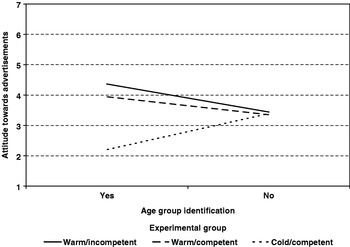
Turning to the findings about the degree to which the different commercials were liked, a two-way ANOVA of the attitudes towards the advertisements was conducted. A significant interaction was found between the experimental group and their identification with the older age group (F 2,54=3.5; p=0.036) (Figure 1). In general, the advertisements were not rated favourably, i.e. most scores were below the midpoint (4) of the scale from 1 to 7. Post hoc ANOVAs showed that the ratings were not significantly different by experimental group among those who did not identify with their own age group (F 2,31=0.0; p=0.99), but that there were significant differences by experimental group among those who did identify with their own age group (F 2,23=8.1; p=0.002). The latter group rated the commercials with cold/competent portrayals less favourably than those with warm/incompetent and warm/competent portrayals (Tukey's b was p<0.05). The attitudes towards the advertisements were not related to memory performance at either pre-test or post-test (Pearson correlation coefficients, p>0.05). It is therefore concluded that the differences in attitudes towards the advertisements cannot confound the experimental results.
Attitude towards the advertisements by experimental group and age-group identification.

Hypothesis testing
After confirming that the participants' stereotypes matched our assumption and that attitudes towards the advertisements would not confound the results, we proceeded to test the hypothesis that being primed with warm/incompetent portrayals has a negative effect on the memory performance of older adults who identified with their own age group. A two-way repeated measures multivariate ANOVA (MANOVA) was used to assess the effects of the advertisements and age-group identification on changes in memory performance. We specified two independent variables: the first comprised the experimental group (three groups: 19 warm/incompetent participants, 17 warm/competent, and 24 cold/competent); and the second referred to the identification with the older age group (two groups: 26 with age group identification, and 34 without). Furthermore, we used ten dependent variables: the results of each of the five memory tests before the presentation of the commercials and the results of these five tests after the presentation of the commercials. We were interested in two comparisons between these ten: that between the five different memory tests assessed whether the results differed among specific memory functions (immediate, learned and delayed visual spatial recall, auditory recall, and photo recall), whereas the comparison between the pre-test and the post-test measures assessed whether the memory performance changed over time.
We will first report whether the different tests of memory performance provided different results. When we compared the mean scores on the five different measures of memory functions, significant differences were found (F 4,51=119.4; p<0.001). This finding arose because the five tests differed in difficulty. More importantly, the differences between the tests were similar for the three experimental groups, age identification/non-identification and pre/post-measurement, because there were no interactions of the type of test with these variables (all F with p>0.05). We therefore decided not to report further on the different types of tests, but only for the mean across the five tests.
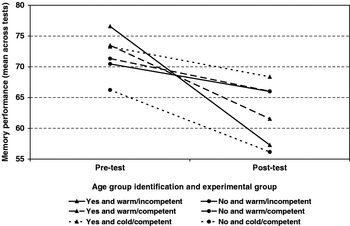
Statistically speaking, the hypothesis predicts an interaction between the two independent variables (experimental group and age-group identification) when analysing the change in memory performance between the pre-test and post-test. The analysis shows that this interaction is indeed significant (F 2,54=4.2; p=0.020). Figure 2 depicts the mean performance (across the five memory tests) at pre-test and post-test for the three experimental groups differing in age-group identification. The interaction effect is shown by the stronger decline in memory performance in some groups than others. We carried out six post hoc paired t-tests to assess whether the decline in memory performance was significant in each of the three experimental groups with and without age-group identification. For those who did not identify as belonging to the older group, the decline was not significant in any of the three experimental groups (warm/incompetent: t 13=0.2; p=0.82; warm/competent: t 8=0.1; p=0.93; cold/competent: t 10=1.9; p=0.09). It can be concluded that viewing different portrayals of older characters in commercials did not influence the memory performance of those who did not identify with their own age group, which is in line with the hypothesis that self-stereotyping depends on identification with the older age group.
Memory performance by experimental group and age-group identification.

The paired t-tests for those who did identify with the older age group showed a significant decline in memory performance for two of the three experimental groups: the warm/incompetent group (t 4=4.3; p=0.013) and the warm/competent group (t 7=3.8; p=0.007), but not for the cold/competent group (t 12=0.1; p=0.95). The finding that the warm/incompetent group had decreased memory performance was expected, because the portrayal of warm/incompetent older characters in commercials matches the mixed general stereotype of older people. The finding that the cold/competent group did not have reduced memory performance was also expected. The only unexpected finding was that the warm/competent group also experienced a significant decline in memory performance. It can be concluded that overall the hypothesis was supported, with the exception that the warm/competent portrayal also resulted in a significant decline in memory performance for those who identified with the older age group.
Conclusions and discussion
In the introduction we drew attention to the lack of connections between, on the one hand, cultural studies of the portrayal of older characters in the mass media and, on the other, psychological studies of self-stereotyping. The experiment reported in this paper is the first attempt to develop information and understandings that link the two. The hypothesis related the content of media portrayals of older characters in television commercials and individuals' age-group identification to their memory performance. In line with the hypothesis, it was found that the portrayal of older characters as ‘warm but incompetent’ resulted in poorer memory performance for those older adults who identified with their own age group. In line with self-stereotyping theory, the effect was not found among those who did not identify with their own age group, or among those who watched commercials that portrayed older characters as ‘cold and competent’. However, we did find an unexpected effect for those who watched commercials with warm/competent portrayals of older characters and identified with their age group.
The latter finding was initially surprising. Why should commercials that portray older characters as positive on both dimensions elicit a decline in memory performance, whereas commercials with a mixed portrayal as ‘cold and competent’ do not? Individuals who see themselves as older might very well identify with warm and competent older characters rather than cold and competent characters. The fact that the commercials with warm/competent and warm/incompetent portrayals were liked more than commercials with cold/competent portrayals might also indicate this identification process. Although we measured identification with the older age group in general, we did not measure identification with the older characters in the commercials. Identification with the older characters in media messages is therefore something to consider in further research on the topic.
There are two possible main weaknesses in the present study. First, the number of subjects was rather few, but despite the low statistical power we were able to find significant effects. Second, the advertisements differed both within and between the experimental groups in many ways beyond the portrayal of older characters, e.g. the product, the setting, and the music. The older characters also differed on other dimensions within and across the experimental groups, such as gender and role (e.g. being grandparent or retiree). Although we expect that more homogeneous priming images would have produced even stronger effects, it is certainly necessary to consider these differences in future research. Studies with more subjects should thus address more specific questions, for example with regard to gender differences or roles.
The results show that the interface between media portrayals and individual stereotypes is a vicious cycle of self-fulfilling stereotypes about older people. As in other studies, the older individuals in our study embraced the dominant stereotype of older people as warm but incompetent (Cuddy and Fiske Reference Cuddy, Fiske and Nelson2002; Cuddy, Norton and Fiske Reference Cuddy, Norton and Fiske2005; Versteegh and Westerhof Reference Versteegh and Westerhof2007). Those who identified as older preferred advertisements in which older characters are portrayed as ‘warm and incompetent’ or ‘warm and competent’, but these advertisements had a negative effect on their memory performance (independent of the memory test used). Most importantly, these effects seem to operate without awareness and are not therefore a demand effect. Furthermore, the effect occurred although most of the participants did not like the advertisements.
The findings begin to fill the gap between the understandings developed by cultural studies and psychological studies on the content and function of stereotypes of older adults. The main message is that there is a self-fulfilling prophecy in the portrayal of older adults as warm but incompetent. Older people themselves might resist this self-fulfilling prophecy by using the assimilative strategy of not identifying with older people as a stereotyped group (cf. Sneed and Whitbourne Reference Sneed and Whitbourne2005). In the long run, however, this strategy might reinforce the dominant stereotype of older people as warm but incompetent (Westerhof and Tulle Reference Westerhof, Tulle, Bond, Peace, Dittmann-Kohli and Westerhof2007).
The change towards more diverse, positive and youth-like portrayals of older characters that has been observed in Dutch television commercials also provides possibilities for resistance (Van Selm, Westerhof and de Vos Reference Van Selm, Westerhof and de Vos2007). In particular, cold and competent portrayals do not have the same negative effects as the other portrayals of older people, but these commercials were disliked, not least by those who identify with their own age group. The findings put media producers in a dilemma. Commercials targeted at older consumers might either use middle-aged characters to address older individuals who do not identify as older, but thereby contribute to the under-representation of older adults in the mass media. Alternatively, they may portray older characters as warm, but risk reproducing existing stereotypes and have a negative influence on the functioning of older adults.