Introduction
Identity construction is one of the identified functions of reminiscing (Lin et al., Reference Lin, Dai and Hwang2003; Webster et al., Reference Webster, Bohlmeijer and Westerhof2010; Westerhof and Bohlmeijer, Reference Westerhof and Bohlmeijer2014). However, we do not know what happens through reminiscing that is relevant for constructing identities in later adulthood, particularly in a Chinese rural context. There is an apparent theoretical dearth of literature regarding how rural Chinese older adults make sense of the self and reconstruct identity in the context of modern China. Carrying out this study, we aimed to understand what identities Chinese rural elders constructed while telling their life stories and how reminiscing about the past informed their identity construction.
Reminiscence
Reminiscence is about ‘personally experienced episodes from one's past’ (Webster et al., Reference Webster, Bohlmeijer and Westerhof2010: 528). As a normal process with multi-triggers, reminiscence is likely a universal experience emerging from young childhood appearing as ‘simple daydreaming, storytelling, or nostalgia by oneself or with others’ (Haber, Reference Haber2006: 154). In literature, reminiscence is also referred to by terms including life review, life story, life history, autobiographical memory and personal narrative (Haber, Reference Haber2006). Defining reminiscence is without consensus (Lin et al., Reference Lin, Dai and Hwang2003; Westerhof and Bohlmeijer, Reference Westerhof and Bohlmeijer2014). Although some view reminiscence as the recalling of one's past (Haber, Reference Haber2006; Wong and Watt, Reference Wong and Watt1991), we believe the recalling of one's past through reminiscing happens in the present with an imagined future in mind (Freeman, Reference Freeman2017), and the way one chooses to review the past depends on how relevant the past events are to the current life (Bluck and Habermas, Reference Bluck and Habermas2001). The reconstructed past affects the perceived present and anticipated future (McAdams, Reference McAdams1995; Freeman, Reference Freeman2009).
Reminiscence serves for individuals to enjoy, grow, cope or change (Haber, Reference Haber2006), and is used ‘to create bonds between people, to cope with important life events, and to attribute meaning to life’ (Westerhof and Bohlmeijer, Reference Westerhof and Bohlmeijer2014: 107). Reminiscence could, for instance, help older people reconstruct negative memories into more meaningful narratives, which would lead them to maintain a sense of meaning and purpose in life (Bohlmeijer et al., Reference Bohlmeijer, Westerhof and de Jong2008; Gaggioli et al., Reference Gaggioli, Scaratti, Morganti, Stramba-Badiale, Agostoni, Spatola and Riva2014; Lamers et al., Reference Lamers, Bohlmeijer, Korte and Westerhof2015) and ‘to consolidate a sense of self’ (Webster et al., Reference Webster, Bohlmeijer and Westerhof2010: 543).
Identity is ‘an individual's sense of self’ (Vandenbos, Reference Vandenbos2007: 463), ‘an emergent and evolving social construction’ but not ‘a permanent or an essential part of the personality’ (Hunter, Reference Hunter2010: 46). Scholars (e.g. McAdams, Reference McAdams1995; Habermas and Bluck, Reference Habermas and Bluck2000; Singer, Reference Singer2004; McAdams and McLean, Reference McAdams and McLean2013) view identity in adulthood as emerging in the telling of one's life story, as ‘an inner story of the self that integrates the reconstructed past, perceived present, and anticipated future to provide a life with unity, purpose, and meaning’ (McAdams, Reference McAdams1995: 365). Identity construction is a lifelong process that diachronically integrates a wide range of roles and relationships (McAdams, Reference McAdams1995, Reference McAdams2001; Syed and McLean, Reference Syed, McLean, McLean and Syed2015). Through integrating the past, present and future, reminiscing helps in identity continuation or adjustment (Westerhof and Bohlmeijer, Reference Westerhof and Bohlmeijer2014) and in constructing a sense of ego-integrity and coherence (Erikson, Reference Erikson1963).
Some theorists (Butler, Reference Butler1963; Erikson, Reference Erikson1963) claim there is a necessity to reminisce in later life to integrate one's selfhood and to have a meaningful coherent sense of self and others. Those who are more open to reminiscing are more inclined to search for identity and find it easier to integrate positive and negative experiences into a comprehensive life review and achieve higher levels of ego-integrity (Westerhof et al., Reference Westerhof, Bohlmeijer and McAdams2017). Individuals’ ‘search for coherence, worth, and meaning’ emerge through recalling the past (Webster et al., Reference Webster, Bohlmeijer and Westerhof2010: 543), and reminiscing in later life implies transitioning from associating the self with outer belongings to a process, from having to being (Sherman and Webb, Reference Sherman and Webb1994). A meta-analysis using 128 results on controlled trials of reminiscence interventions conducted by Pinquart and Forstmeier (Reference Pinquart and Forstmeier2012) shows there are moderate improvements at post-test in ego-integrity after reminiscence sessions.
Reminiscence activities can change along with different cultural, historical and situational contexts (Webster et al., Reference Webster, Bohlmeijer and Westerhof2010). A study on the negative functions of reminiscence among three different societies by Hofer et al. (Reference Hofer, Busch, Šolcová and Tavel2016) implies cultural uniqueness in reminiscing. However, few studies have explored how reminiscing contributes to Chinese rural elders’ identity construction (Liu, Reference Liu2018) and the what and the how of their identity development in this population (Syed and McLean, Reference Syed, McLean, McLean and Syed2015).
Existing reminiscence studies in Chinese contexts have explored the functions of reminiscence therapy, and included participants living in cities in the Mainland (e.g. Xiao et al., Reference Xiao, Kwong, Pang and Mok2012; Zhou et al., Reference Zhou, He, Gao, Yuan, Feng and Zhang2012), Hong Kong (e.g. Chong, Reference Chong2000; Choy and Lou, Reference Choy and Lou2016) and Taiwan (e.g. Wang, Reference Wang2007). The results of these studies are consistent with findings in reminiscence studies with the western population in terms of declining psychological impairment (e.g. depression) and enhancing positive functioning (e.g. self-esteem, psychological wellbeing) (see reviews by Pinquart and Forstmeier, Reference Pinquart and Forstmeier2012; Gaggioli et al., Reference Gaggioli, Scaratti, Morganti, Stramba-Badiale, Agostoni, Spatola and Riva2014). The study about a life-review intervention on patients with advanced cancer by Xiao et al. (Reference Xiao, Kwong, Pang and Mok2012) is one of the very few reminiscence studies in Chinese providing knowledge related to narrative identity (McAdams and McLean, Reference McAdams and McLean2013; Freeman, Reference Freeman2017). Their study shows five categories of what the participants do in a life-review therapy, including accepting one's life as unique, feelings of emotional relief, creating a sense of meaning in life, leaving a personal legacy and making future orientations. Although findings from existing research (e.g. Xiao et al., Reference Xiao, Kwong, Pang and Mok2012) are illuminating, what these studies imply might not represent the older population in rural China. Rural ageing in China is ‘accompanied by rapid social change and inequalities’ (Lowry, Reference Lowry2009: 2) and rural elders in China have scarcer public and health resources than their urban counterparts (Fang et al., Reference Fang, Scheibye-Knudsen, Jahn, Li, Ling, Guo, Zhu, Preedy, Lu, Bohr, Chan, Liu and Ng2015). Investigating how Chinese rural elders reminisce and integrate a sense of self, therefore, could provide knowledge on this fast-growing population so to help health care-givers prepare.
Study framework
We adopted a narrative identity perspective (Freeman, Reference Freeman2009, Reference Freeman2017; McAdams and McLean, Reference McAdams and McLean2013) to understand Chinese rural elders’ identity construction. Life stories contain both change and continuity, and provide information about the individual's understanding of her or his identity (McAdams, Reference McAdams1995; Webster et al., Reference Webster, Bohlmeijer and Westerhof2010). Freeman (Reference Freeman2017) claims that narrative identity should be understood through the interplay between spheres of temporality and otherness. Spheres of temporality, largely referring to time perspective, imply that narrative identity ‘emerges in and through the interplay of past, present, and future in the form of remembering, acting, and imaging’ Freeman (Reference Freeman2017: 206). The past, present and future are interwoven with the individuals’ relatedness ‘to other people, to the nonhuman world, and to those moral, ethical, and spiritual goods’ as artefacts of the cultural context in which narrative identity emerges (Freeman, Reference Freeman2017: 206). We assumed that rural elders in contemporary China might also tell stories about their relations to significant others, to institutions, to objects and spiritual goods in an attempt to make connections and unify their past, present and future into a coherent sense of self.
Culture plays an important role in psycho-social development (Erikson, Reference Erikson1963; McAdams, Reference McAdams2006; McAdams and McLean, Reference McAdams and McLean2013), and local contexts determine identity content (Syed, Reference Syed2017). As McAdams and McLean (Reference McAdams and McLean2013: 237) stated, different cultures provide different themes and autobiographical cues that people use to construct their narrative identities. In this study, while equipped with knowledge about western people's reminiscing, such as highly generative Americans narrating their lives following a redemptive sequence and constructed life scenes ‘from suffering to an enhanced status or state’ (McAdams, Reference McAdams2006: 117), we kept an open mind about Chinese rural elders’ storytelling, and aimed to know what relations Chinese rural elders would tell and how reminiscing could contribute to construction of what types of identity.
Methods
We adopted a hermeneutic phenomenological approach (van Manen, Reference van Manen2016) while designing the study. After collecting life stories of 20 Chinese rural elders living in ShiGo, a rural village in the deep south of the People's Republic of China (PRC), we thematically analysed the stories to understand the participants’ identity construction. The study received ethical approval from the university to which we are affiliated.
Phenomenology, developed from works of philosophers such as Husserl and Heidegger, is used to explore the commonalities people have when they share lived experiences (Martin and Sugarman, Reference Martin and Sugarman2001; Kafle, Reference Kafle2011). Hermeneutic, a term from the Greek language, means interpretation (Christopher, Reference Christopher2001). Emphasising subjectivity, hermeneutics allows human beings (and researchers) to interpret the social processes through which they constructed and reconstructed the world and themselves (Martin and Sugarman, Reference Martin and Sugarman2001; Burr, Reference Burr2015). Hermeneutic phenomenology rejects the idea of suspending researchers’ pre-existing knowledge regarding the topic of interest and of achieving a single and true description of the phenomenon emphasising the researchers’ interpretation of it (Laverty, Reference Laverty2003; Kafle, Reference Kafle2011). Research adopting a hermeneutic phenomenology approach is to focus on people's subjective lived experiences and to interpret them through the lens of language as a social process (van Manen, Reference van Manen2016). van Manen further proposed six activities conducting hermeneutic phenomenological research. Researchers had to focus on the phenomenon under investigation, reflect on themes that represent the lived experiences – that is, the phenomenon – then write descriptions of the phenomenon, and maintain a strong relation to it, balancing parts of the study report with its whole. Taking a phenomenological stance allows us to respect the complexities of ageing (Torres and Hammarström, Reference Torres and Hammarström2006; Pickard, Reference Pickard2018) and appreciate the older participants’ experiences with empathy (Ratcliffe, Reference Ratcliffe2012). For instance, we followed the local beliefs while defining ‘old’ rather than using chronological age and the elders that we interviewed not only decided whether to share their stories with us at what time and where, but also negotiated with us upon what and how to present their stories.
Participants
Twenty elders living in ShiGo voluntarily participated in the study and provided sufficient stories for analysis and interpretation. ShiGo is located in the north-east of Yunnan province, a southern province of the PRC, approximately 20 minutes’ walk from the County with which ShiGo is affiliated and another 40 minutes by bus to the city of Qujing, the closest major city in the County. According to the village head, ShiGo has 240 households and a population of about 945 people who hold local hukou registration (Chan and Buckingham, Reference Chan and Buckingham2008) as of 10 April 2018. Most residents are Han people, primarily engaged in agriculture and growing crops, and are connected through their daily living, working and leisure interactions. Having no retirement to mark the beginning of later life, residents in the study setting treat a person as an elder when she or he has a grandchild (Liu and van Schalkwyk, Reference Liu and Schalkwyk2019). This implies that any person irrespective of age could be considered an elder provided there is a grandchild indicating a change in status.
Following a hermeneutic phenomenological approach, for participant selection of this study we had to consider whether the participants had shared lived experiences that could be elicited through reminiscing and storytelling and whether they would be willing to share their experiences with us (Laverty, Reference Laverty2003). While sampling the participants we followed a purposive snowball sampling strategy (Merriam, Reference Merriam2009). After identifying several key informants, they were asked to recommend new participants and interviews were conducted until we considered the data saturated, with no new information emerging from engaging in further interviews. We made sure that all participants identified themselves as both rural residents who hold a ShiGo hukou registration and rural elders who had at least one grandchild at the time of interviewing. Furthermore, a person with certain observable constraints such as age-related hearing loss or dementia syndromes was excluded as these conditions were considered a barrier to interviewing. The aim of the study was to understand Chinese rural elders’ reminiscence and their identity construction, which precluded potential participants based on whether the interviewer could have a smooth and coherent conversation with him or her regardless of him or her claiming to be ‘healthy’ and without any problems (either diagnosed or not). During the actual interviewing process, the interviewer realised that two elders did not really respond to his questions even after he had repeated the question several times. Although the conversations were completed, we did not use these interviews as the data were compromised. Others reported that they had physical health problems such as a hurting back, but no one reported having been diagnosed (officially or unofficially) with any form of dementia. Perception of health condition, as implied in Torres and Hammarström's (Reference Torres and Hammarström2006) study on old adults talking about their limitations and competence, is not clear-cut for the elders. The 59-year-old Mr H, for instance, claimed he was healthy, then admitted that ‘I just have no serious illness. My back and feet hurt.’ He emphasised that everyone in the village must have some medical problems, it was only a matter of seriousness. He did not elaborate on his problems because he thought he was not that old and therefore was not qualified to complain. Given that the boundaries between health and illness are constantly changing in old age (Pickard, Reference Pickard2018), we respected the participants’ presentation of themselves in front us rather than classifying them as healthy or frail using clinical criteria of health conditions.
The 20 participants were between 47 and 86 years of age (mean = 70.02, standard deviation = 10.31), with four, three, ten and three participants, respectively, aged between 47 and 60 years, 61 and 70 years, 71 and 80 years, and 81 and 86 years. Nine of the 20 participants were women. All were Han people. Eleven participants had never gone to schools while the others had one to five years of school education. During the time of interviewing, 18 participants were married and two were widowed. Eleven participants lived with their spouses separate from other family members (e.g. their sons), and the other nine were living in intergenerational family settings. We assigned the participants aliases to protect their privacy and indicated their sex with Mr or Mrs and a letter of the alphabet, and in cases where both husband and wife participated, they were assigned the same letter to make the relationship clear.
Data collection and analysis
The first author conducted one-on-one semi-structured interviews in the local Chinese dialect with each of the 20 participants between January 2016 and January 2017. All interviews were audio-recorded with the verbal consent of participants. The interviews took on average 71 minutes, ranging from 37 to 108 minutes. Only one interview per participant was conducted and participants were free to choose where they wanted to be interviewed (e.g. their living room or a room in the house of a neighbour). Each interview progressed through first introducing the aim of the interview (i.e. to collect their life stories) and related issues such as confidentiality, then listening to the participant's autobiographical telling with the central question ‘could you briefly describe what you have experienced through your life?’, and probing unclear dimensions in his or her previous story-telling (Liu, Reference Liu2018).
Most participants were eager to tell their stories without interruption at the beginning of the interview, tended to reminisce spontaneously (Webster et al., Reference Webster, Bohlmeijer and Westerhof2010) and were keen to engage in the interview as an opportunity to tell their stories (Robertson and Hale, Reference Robertson and Hale2011). In cases where a participant did not know what to say or shared very little about his or her life, or when a participant's telling became repetitive or without new information, prompts from the revised Life Story Interview (LSI; McAdams, Reference McAdams2008) and further questioning were used to maintain the focus on life-story telling. The LSI is a technique created by McAdams (Reference McAdams2008) for collecting participants’ stories. We translated the LSI into Chinese, revising and adapting some terminology and expressions to make the interview agenda more feasible for the participants (Liu, Reference Liu2018). For instance, the metaphor of life as a book in the original LSI did not fit as the participants did not have much education and were not familiar with terms like ‘book’ and ‘chapters’. Thus, the metaphor was changed to ask them to briefly describe their life experiences and used marriage and childbearing as examples of life transitions if they did not know how to organise their thoughts. The interview was terminated when it became apparent that a participant had already replied on a similar topic or became repetitive. An interview was also ended when the interviewee asked to stop due to tiredness. For instance, Mr B commented that he had no new information to give and suggested stopping the conversation. Mr D, on the other hand, indicated that he was tired of talking and needed to go to his fields. In all interviews there was no coercion, and refreshments rather than monetary payment were provided to thank the participants for collaborating in this project.
Data analysis in this study was a loop of data collection, memo-writing, analysis, member checking, peer review and reflection that followed a hermeneutic cycle involving reading, reflective writing and interpreting (Laverty, Reference Laverty2003; Kafle, Reference Kafle2011). After conducting several interviews, we transcribed the audio-recordings into text-format using Mandarin, translated the contents into English word-by-word and edited these for readability, before evaluating whether further data collection was needed. We managed the data manually without using software such as NVivo, and retained the audio-recordings for verification during the analytic process. The latter was necessary given that translation, even transcribing into Mandarin, could limit interpretation of the finer nuances in the storytelling of participants.
Thematic analysis, a method to identify and analyse patterns within a data-set (Braun and Clarke, Reference Braun and Clarke2006), was used to reveal the structures of the participants’ reminiscing following a hermeneutic phenomenological approach (van Manen, Reference van Manen2016). Braun and Clarke (Reference Braun and Clarke2006) provided a six-phase guide in thematically analysing data, including researchers getting familiar with data through transcribing and reading the transcripts, creating codes, identifying themes within the codes, reviewing themes, refining and naming themes, and reporting. Thematic analysis coincided with both the hermeneutic cycle proposed by Kafle (Reference Kafle2011) and Laverty (Reference Laverty2003), and the six activities van Manen (Reference van Manen2016) described for investigating the relations Chinese rural elders would recall in constructing certain types of identities and the ways reminiscing contributed to the identity construction. The interpretive approach of hermeneutic phenomenology and thematic analysis was appropriate to analyse the social processes embedded in the elders’ storytelling (Kafle, Reference Kafle2011) and their identity reconstruction through reminiscing.
While analysing the participants’ stories, we adapted the six phases of thematic analysis proposed by Braun and Clarke (Reference Braun and Clarke2006) into the hermeneutic cycle. After checking the interview transcripts and translations with colleagues for accuracy, we conducted a single-case analysis for each transcript to search for the initial codes that structured the participants’ stories. To understand the narrative patterns and identity construction process, we then retold each elder's story. We then combined the single-case analyses with cross-case analysis to name themes, before refining the themes through further reading and collaborating with colleagues and writing the report to summarise themes.
After the initial analysis, we made a collage using magazine images that represented both the participants’ stories and our interpretation of their stories (van Schalkwyk, Reference van Schalkwyk2010), and conducted member checking (Merriam, Reference Merriam2009) through sharing what we found with the participants and having their feedback. The final report of this study, therefore, represents the themes describing identity construction that emerged directly from the participants’ narratives.
Findings and discussion
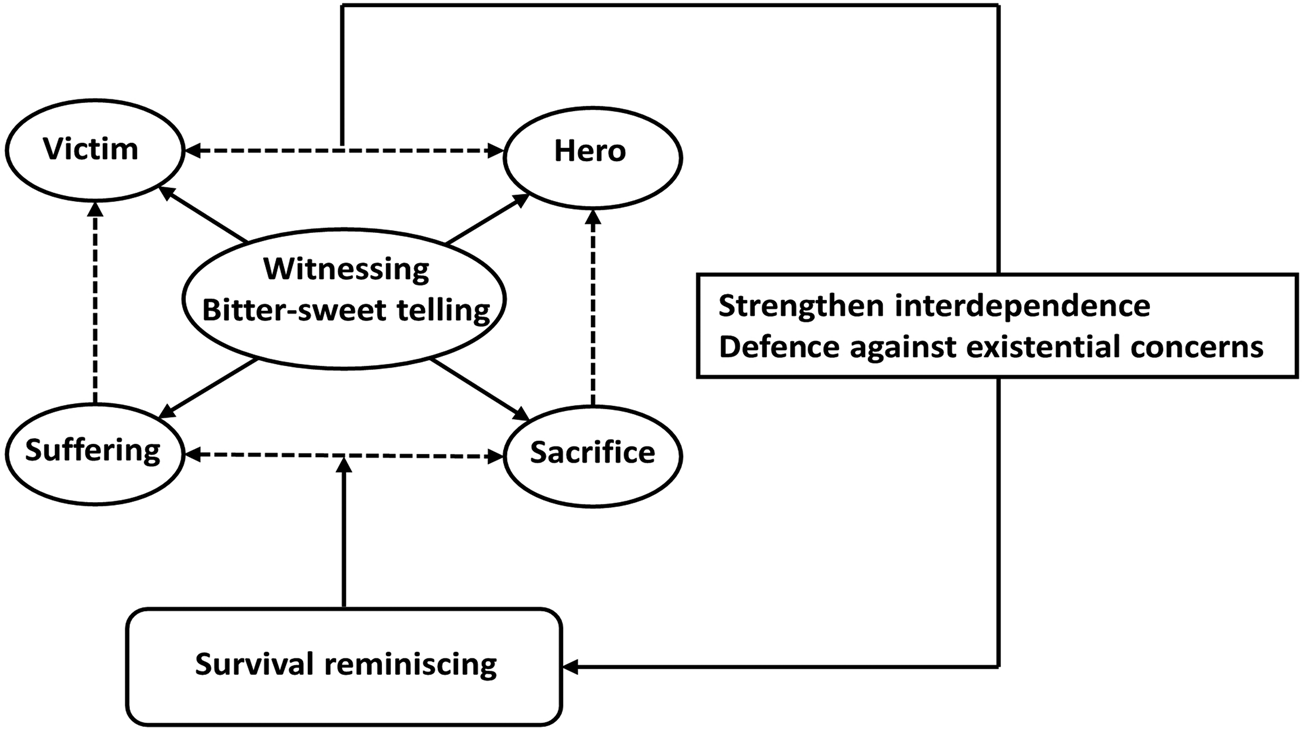
Three themes – suffering, making sacrifices, and being heroes and victims – were identified representing the identity (re)construction of rural elders in a village in south-west China. We have integrated the findings and discussion sections, maintaining a narrative approach (Liu and van Schalkwyk, Reference Liu and Schalkwyk2019). The discussion is ended with presenting a hero–victim dialectic model for rural Chinese elders (Figure 1).
The hero–victim dialectic model.

Suffering
All participants in this study recalled suffering from lacking basic needs before the policies of reform and opening up in the 1980s (Kanbur and Zhang, Reference Kanbur and Zhang2005; Chan and Buckingham, Reference Chan and Buckingham2008) and experienced vulnerability, homelessness, hunger and disease. Suffering is enduring something unpleasant (Allison and Setterberg, Reference Allison, Setterberg, Allison, Kocher and Goethals2016). The participants’ stories of suffering happened when they were directly or indirectly involved in wars (i.e. wars between China and Japan and between Communist Party and Kuomintang) and national upheavals such as the Land Reform in the 1950s (Ding, Reference Ding2003), the Great Leap Forward and famine from 1958 to 1961 (Li and Yang, Reference Li and Yang2005) and the Cultural Revolution from 1966 to 1976 (Lary, Reference Lary, Flath and Smith2011; Plänkers, Reference Plänkers2011).
Suffering from disharmony with significant others continued as a prominent theme in the participants’ stories throughout their reminiscing. When interpersonal bonds with significant others were troubled or distant, and when an elder had to disconnect him- or herself from others, they experienced a sense of loss (Aron et al., Reference Aron, McLaughlin-Volpe, Mashek, Lewandowski, Wright and Aron2004). Participants narrated how they suffered from troubled relationships with parents or parents-in-law (Mr H, Mrs A, Mrs B, Mrs J, Mrs I, Mrs M, Mrs N), siblings or siblings-in-law (Mr and Mrs A), children (Mr and Mrs B, Mr D, Mr G) and collective leaders in the village (Mr and Mrs I, Mrs J) or from losing family members due to death (Mr and Mrs B, Mr C, Mr L). For some elders in this study (e.g. Mr D, Mr G), being avoided or cut off by their children's families evoked intense bitterness. For instance, Mr D and his wife were not welcomed by their daughter-in-law but managed to help his son's family so maintained a connection with his son and grandchildren, saying ‘we do these for the two grandchildren. That is the only concern’. But not all cut-off relationships could be salvaged, in particular when the elders’ family members rejected any such overtures to continue the connection, as happened in Mr B's story below:
Last year, I brought the kid [his grandson's son] with me while I was working in the fields. That was nice. But recently they [his son's family] do not want me to get closer to the great-grandson anymore. I feel sad about it. (Mr B)
While encountering lacking basic needs in the past and to deal with challenges brought on by destructive interpersonal bonds with significant others, the elders in this study managed to survive. Situations that were especially challenging for them included being rejected by groups to which the elders wanted to affiliate (e.g. Mrs M trying to earn the acceptance of her husband's family members during her first years of marriage), being betrayed by people whom he or she cared for (e.g. Mr A being not able to let go the feeling of being used by one of his brothers), losing a family member because of death or disappearance (e.g. Mr L emotionally memorising how his younger sister caught measles and died when a local Sherman was trying to save her by burying her lower body in mud) or being social-politically suppressed (e.g. Mrs I being made to go on her knees in front of other villagers at collective meetings during the Cultural Revolution).
The elders that we interviewed, like participants in Wang and Conway's (Reference Wang and Conway2004: 911) study, told their past lives with more memories about ‘social and historical events and placed a great emphasis on social interactions and significant others’. Their narratives of interpersonal relatedness in suffering aligned with Freeman's (Reference Freeman2017) perspective on emphasising otherness in narrative identity construction and supported the claim that identity for Chinese people is relationship-oriented and defined primarily by social roles and obligations (Liu et al., Reference Liu, Li, Yue and Bond2010; Fung, Reference Fung2013).
Making sacrifices
During the interview, the elders repeatedly emphasised how they sacrificed themselves for the development of the country and their family members (e.g. parents, children and siblings). Sacrifice refers to giving up something pleasant or enduring something unpleasant for the benefit of others (Allison and Setterberg, Reference Allison, Setterberg, Allison, Kocher and Goethals2016). When involved in wars and national upheavals such as the Great Leap Forward period in the late 1950s (Lary, Reference Lary, Flath and Smith2011), they made (enforced) sacrifices for the country, worked hard with little payment and handed over large amounts of agricultural products to the government, or conceded their possessions (i.e. house, grain) to agricultural collectives when required.
Mr C was his parents’ only son after all five of his brothers either died or went missing. To console his parents, he gave up opportunities to join the army after the foundation of the PRC. He said:
I wanted to join the army. But I did not have that kind of fate. Only if I had at least one brother. I was worried about my mother. She was very sad about my brothers’ death and was crying in the middle nights. I could not leave them [his parents].
Making sacrifices, although it is related to suffering (Helin and Lindström, Reference Helin and Lindström2003) or has the risk of suffering (Franco et al., Reference Franco, Blau and Zimbardo2011), is sometimes a gain rather than a loss (Allison and Goethals, Reference Allison and Goethals2011). All the elders in this study claimed that it is their obligation in making sacrifices for their children that gave them a sense of meaning. Some (e.g. Mrs B, Mr H and Mr G) recalled how they saved food for their children while starving themselves and how they worked hard to build houses for their children to getting married. In cases where the elders felt their sacrifice was not recognised and appreciated by their children (e.g. Mrs N), or their willingness to contribute to their children's lives was blocked by forces outside their control (e.g. Mr B and Mr D), suffering emerged. On the other hand, when they believed their suffering and sacrifice were recognised by their children and others, the elders were satisfied and praised others as having a conscience (e.g. Mrs A). The elders also expressed appreciation towards the Chinese government when the government exempted agricultural taxes in 2006 (Yu and Jensen, Reference Yu and Jensen2010) and started old-age pensions from 2009 (Shen and Williamson, Reference Shen and Williamson2010) which might be identified by them as recognition of their earlier sacrifice and suffering for the development of the country.
The elders in this study, however, paid less attention to sacrifice than suffering. It seemed they chose to recall something because it was troublesome. A negative telling pattern is evident in their reminiscence (Liu, Reference Liu2018). For example, the elders used serious hardships that they went through as criteria in judging whether they were qualified to tell their stories to us, and emphasised the value they attributed to the hardships they went through as a way of constructing their narrative identity. Rather than presenting their sacrifice as a form of redemption and presenting an admirable identity (McAdams, Reference McAdams1995; Allison and Setterberg, Reference Allison, Setterberg, Allison, Kocher and Goethals2016), the elders we interviewed narrated difficulties and how they overcame the difficulties.
Being heroes and victims
While interpreting how the elders in this study recalled their suffering and sacrifice as well as how they adapted to the challenges brought on by them, we identified a hero–victim identity that the elders constructed. The hero–victim identity consists of two seemingly opposing but intertwined spheres: the victim identity and the hero identity. A victim ‘is an innocent person harmed, through no fault of his [or her] own, by an external force or the wrongful act of another’ (Govier, Reference Govier2015: 19). The participants recalled being harmed innocently by collective leaders, by people in power during the Land Reform in the 1950s or by parents-in-law. The victim identity emerged in the elders’ stories about suffering from hardships (i.e. struggling for survival, destructive interpersonal bonds and unappreciated sacrifice) and from adapting to the challenges brought on by the hardships. For the elders in this study, it is not them who started the wars and national upheavals but it is them who had to deal with the chaos brought on by them. Stories about themselves being self-sacrificing, kind and filial implied that the elders were morally right and innocent. Using coping strategies like external attribution helped them shift responsibility for their suffering to others (e.g. unfilial children) or uncontrollable external forces (e.g. fate).
Victims evoke paradoxical attitudes from others (Govier, Reference Govier2015; Niemi and Young, Reference Niemi and Young2016). People honour and respect those victims who suffered but survived, but also perceive victims as needy, helpless, vulnerable and passive and, to not alarm others, expected victims to keep silent about what they underwent. Victims are also blamed for what they went through because they ‘share responsibility for the responses to wrongdoing, ill fortune, and disease’ (Govier, Reference Govier2015: 1–18). The elders we interviewed seemed selectively focusing on the positive side of victimhood (i.e. nobility) when they were vulnerable and wanted to seek compassion. Participants like Mrs A and Mrs M had repeatedly told others about their hardships and had evoked negative reactions such as impatience, avoidance and even attack from listeners.
The hero identity evolved from the elders’ reminiscing of overcoming hardships for the benefit of the country (e.g. handing over a large portion of their grain as agricultural taxes in the past) and other people (e.g. starving themselves to save food for their children or not going to the hospital to lessen the children's burden paying medical bills). The elders’ sacrifice put their own lives at risk. When facing risks, the elders as heroes are competent, strong and self-sacrificing enough to make choices that are morally right, and to overcome obstacles for others’ benefit (Rankin and Eagly, Reference Rankin and Eagly2008; Allison and Goethals, Reference Allison and Goethals2011). Furthermore, they were strong enough to survive. While involved in wars and national movements, some participants’ siblings, newborn babies and parents died but the elders themselves did what they could do (e.g. endure, submit, escape) and stayed alive. Overcoming the harm requires heroic characteristics such as strength and competence. As argued by Govier (Reference Govier2015), the term ‘survivor’ implies strength and heroism. Additionally, being harmed innocently by collective leaders during the Land Reform in the 1950s or by parents-in-law created opportunities for some elders, as victims, to construct their ‘heroic victimhood’ (Govier, Reference Govier2015: 59).
The heroic victimhood suggests that both the hero identity and victim identity are ‘a personified and idealized image of the self’ (McAdams, Reference McAdams, Pervin and John1999: 486) and are inter-transformative for the elders in constructing a hero–victim identity. The elders chose to present themselves as heroes and/or victims based on their perception of how strong they were and how powerful others were with whom they interacted at the time. For instance, Mrs M was harmed by her parents-in-law during her initial years of marriage. Her victimhood motivated her to become a hero who was smart in bearing the harm while strengthening her competence and then becoming strong enough to generate her future successes.
We present a hero–victim dialectic model (Figure 1) to capture the process of how the rural Chinese older adults living in ShiGo constructed their hero–victim identity through telling stories of suffering and sacrifice. The term ‘survival reminiscing’ in the model is used to capture the elders’ sense of self-victimisation and heroic survival, as well as the negative telling pattern in their reminiscing. Survival reminiscing provides both the content and structure for the elders’ hero–victim identity construction. Stories told by the elders about how they adapted to challenges brought on by hardships contributed to their telling not only about the suffering but also about their heroic survival. The elders focused on memories of difficulties they encountered throughout their lives and on survival in an attempt to create meaning. According to Pasupathi et al. (Reference Pasupathi, McLean and Weeks2009: 114), troubles govern storytelling and a story with no emotional pain ‘lacks a point and ought, really, not to be told’. It seemed that the elders chose to tell something because it was problematic, avoiding presenting themselves as people who have lived an easy life. For instance, when recalling their past, not a single participant spontaneously mentioned any happy events like giving birth to a child. Being specifically asked about happy memories, Mrs M briefly described a happy moment during a bumper harvest event, and then quickly transferred again to converse about a host of unhappy memories. In a more recent study regarding the stories of clients in narrative therapy, Westerhof and Bohlmeijer (Reference Westerhof and Bohlmeijer2014: 111) noted that ‘problems and themes [of] being a victim’ featured prominently in older people's narration, suggesting that this pattern of telling negative memories for identity construction could be labelled as ‘obsessive reminiscing’ or ‘bitterness revival’. In our participants’ telling, we chose the label ‘survival reminiscing’ as this more accurately captured their telling of having survived hardship – that is, the hero–victim dialectic.
Furthermore, the term ‘dialectic’ was used to describe the finding that the elders we interviewed tolerated contradictions and found it natural to construct and balance the two apparently opposing identities of being a hero and a victim into a hero–victim identity. This dialecticism is supported by earlier research claiming that Chinese people are prone to have dialectical thinking as a way of making sense of their lives (Spencer-Rodgers et al., Reference Spencer-Rodgers, Peng, Wang and Hou2004). Dialectical thinking, as argued by Spencer-Rodgers et al. (Reference Spencer-Rodgers, Peng, Wang and Hou2004: 1417), is characterised by three primary principles: contradiction (two opposite statements may be true at the same time), change (things are constantly evolving and changing) and holism (‘all things in the universe are interrelated’). The hero–victim dialectic model connects the two pairs of interrelated oppositions – that is, suffering versus sacrifice and hero versus victim – into a harmonious and holistic system. The ever-changing nature is apparent in their storytelling of suffering and sacrifice and in their presenting their victimhood and heroism. The dialectical characteristic was also embedded in the way of presenting the model regarding the elders’ reminiscing and in turn can be used to make sense of their stories. Adopting a dialectical perspective also aligned with the study framework, namely the narrative identity perspective that emphasises identity as constantly reconstructed in the contexts in which the elders lived their daily lives (Freeman, Reference Freeman2017). The dialectical model also fits in with the harmonious ageing discourse (Liang and Luo, Reference Liang and Luo2012), recognising the dynamic balance between Yin and Yang, and explaining the identity construction processes in later life among the Chinese population.
Finally, the term ‘witnessing’ in the hero–victim model refers to the elders’ need to be seen, heard and acknowledged for the hardships they endured in their lives (Algoe and Haidt, Reference Algoe and Haidt2009). Heroic actions ‘must be witnessed or evaluated by spectators to receive acclaim’ (Franco et al., Reference Franco, Blau and Zimbardo2011: 103) and to create heroism. For the elders in this study, witnessing was expressed in their bitter-sweet telling, a group behaviour in which at least two local people get together and talk about their life challenges and happiness. In their storytelling (during the individual interviews), several participants mentioned getting together with other local adults, especially the aged ones, and talking about their past lives. They termed this behaviour as ‘bitter-sweet telling’, describing a phenomenon similar to the English term ‘reminiscence’. As described by Mrs P:
Neighbours that are close usually get together and talk about things. One tells something, the others comfort her. Bitter-sweet telling, you speak out, you feel better.
Given that the interviewer (the first author) was a local from the same town, other participants treated the interviewing as a form of bitter-sweet telling, only now the listener was a younger man with a motivation to listen to their telling instead of sharing much of his own stories. Several elders (e.g. Mrs B, Mrs P, Mr B and Mr C) were approached while they were doing bitter-sweet telling with other neighbours. By sharing what they went through, the elders released stresses that were evoked from enduring hardships, experienced empathy when recognising others’ bitterness and happiness, and co-constructed a sense of companionship, as well as formulated a system of moral judgement that praises heroic suffering and sacrifice and despises behaviours without conscience towards heroism and further protected them from the burden of existential concerns (Firestone and Catlett, Reference Firestone and Catlett2009; Maxfield et al., Reference Maxfield, John and Pyszczynski2014). Through regular bitter-sweet telling, the elders’ suffering and sacrifice was recognised, sympathised and praised, and their hero–victim identity justified and continuously reconstructed (Franco et al., Reference Franco, Blau and Zimbardo2011; Noor et al., Reference Noor, Vollhardt, Mari and Nadler2017).
Witnessing furthermore integrates suffering, sacrifice, hero and victim into a self-enforcing system putting the hero–victim dialectic model into motion. The elders in this study generated a sense of meaning when making sacrifices for their children and the country. They did not only feel noble for their suffering and sacrifice, but they also expected their nobility to be acknowledged. Their hero identity was justified when their sacrifice was appreciated or recognised (i.e. witnessed) by their children (younger generation) and other villagers. Recognition from others strengthened the elders’ sense of heroism. Whenever their sacrifice was underrated, the elders’ sacrifice turned into suffering and they experienced feelings such as disappointment, hurt and meaninglessness. To deal with these negative feelings, the elders blamed others (e.g. their children) for being ungrateful, victimising themselves while tolerating further hurt and suffering since they thought they could do nothing about the situation. Such external attribution or need for witnessing could therefore be an expression of their need for their stories to be heard (i.e. be witnessed) in order to receive sympathy. The longer they endured self-victimisation, the stronger their need for witnessing of their heroic victimhood. They presented themselves as having achieved a stronger sense of heroism because of the strength needed to bear the miseries brought on by victimisation. In cases where others (e.g. other villagers) heard their stories, praised the sacrifices that they made and shared their judgement of their children's ungrateful behaviour, the elders’ victimhood was justified. Witnessed suffering nurtured heroism and contributed to the construction of ‘heroic victimhood’ (Govier, Reference Govier2015: 59).
The hero–victim dialectic model was generated from the elders’ reminiscing and has the analytic power to make sense of their stories. The hero–victim dialectic model explained the elders’ emphasis on interpersonal interdependence. Victimhood and heroism originated from interpersonal interactions (Govier, Reference Govier2015; Allison and Setterberg, Reference Allison, Setterberg, Allison, Kocher and Goethals2016) and a form of social action through telling, witnessing and recognition (Burr, Reference Burr2015). The justification of the hero–victim identity required recognition of both individuals (e.g. family members, villagers) and institutions (e.g. agricultural collectives). The elders in this study repeatedly expressed their need for compassion and respect from these agents. Interdependence is apparent in the elders’ daily lives. For instance, they hold a belief that individuation should be avoided while group submission should be strengthened. They co-operated in farming, child-rearing and old-age pensions, and emphasised their obligation contributing to the lives of their children and grandchildren. Shared bitter-sweet telling was a form of gain and the offering of compassion.
The hero–victim dialectic model also offered an explanation for analysing prospectively irrational responses in the elders’ storytelling as their way of protecting their existing psychological defence system. Psychological defensiveness is useful in protecting from ‘experiencing primal pain’ (Firestone and Catlett, Reference Firestone and Catlett2009: 177), fighting against existential threats (e.g. uncertainty, meaninglessness) and maintaining a functional life (Sherman and Cohen, Reference Sherman, Cohen and Zanna2006; Hart, Reference Hart2014). When facing existential threats, people tend to hold the belief that the world is ‘stable, orderly, predictable, benevolent, and meaningful’ (Hart, Reference Hart2014: 21) in order to temporarily comfort themselves, and create cultural worldviews that define what behaviours are good and should be praised or bad and need to be punished, and offer a sense of immortality to deal with anxieties evoked (Maxfield et al., Reference Maxfield, John and Pyszczynski2014). When a threat to existential concerns is perceived (e.g. continuation of the species), a person's ‘psychological immune system’ triggers defensive reactions (Sherman and Cohen, Reference Sherman, Cohen and Zanna2006).
Having children, for example, provides the elders with a symbolic value of sustaining the immortality fantasy (Firestone and Catlett, Reference Firestone and Catlett2009). The participants adhered to a normative life trajectory, urging their children to live a life similar to how they did, particularly having sons and grandsons (Liu and van Schalkwyk, Reference Liu and Schalkwyk2019). Children who do not follow parents’ doctrine, as argued strongly by Mr J in this study, would be blamed for betraying their parents. Expressing strong will in punishing deviants implies heroism that functions in fulfilling human needs such as senses of belonging, certainty, immortality and self-esteem (Efthimiou and Allison, Reference Efthimiou and Allison2018). Participants such as Mr D, who had destructive relationships with his only son's family members, felt alone and helpless while envisioning death without children's support. Mr D victimised himself as a failed parent who was betrayed by his fate that he lived a life like his parents did, took care of his dying parents but was not going to be taken care of by his children. Mr D, however, still wanted to be connected with his offspring and managed to provide help in his son's family farming and housework, even if his provision was often unappreciated. The elders proclaimed family values like filial piety and ancestor worship in their storytelling. The illusion of group fusion, especially the anticipation of becoming ancestors who are worshipped by offspring, creates an imagination that they are a part of the endless generation chain. It gives them a sense of immortality in the face of their own death and therefore functions in coping with death anxiety and perceived aloneness (Liu and van Schalkwyk, Reference Liu and Schalkwyk2019).
Study limitations
There are some limitations in the study worth mentioning. The findings of this study should be understood in the local context of the village in which we collected the data – it is locally specific and not necessarily transferable to all rural Chinese elders. We made sense of the participants’ stories by explicating the contexts of agricultural collectives and family relations that emerged under the influence of historical events. The hero–victim dialectic model, for instance, is grounded in the reminiscing of hardship of the 20 elders who willingly participated in this study. Different from grand theories such as the Chinese ageing theory of Harmonious Ageing Discourse based on the Yin–Yang philosophy (Liang and Luo, Reference Liang and Luo2012), the hero–victim dialectic model has a narrow focus and application particular to the context in which it emerged. Nonetheless, it was not the aim of this qualitative study to generalise. Although the model could be used to interpret the identity construction of elders who share similar contexts, it cannot be considered as culturally universal for all Chinese elders at any place or time.
There could be some participant-recruitment bias as we could only collect data from the elders who were willing to share their stories with us. We did not officially screen the participants for any physical and psychological problems such as dementia and depression that might impact their storytelling. We primarily focused on whether having a conversation with a participant is possible and excluded those having issues such as hearing loss that could be obstacles for the interviewing. Additionally, the participants also performed a degree of self-selection. One of the reasons given for participating in the study was that they went through real hardships and therefore qualified to tell their stories, and they focused on negative memories during the interviews perhaps to impress upon the interviewer the extent of their suffering and sacrifice (selective telling) and to get the recognition that could come from participating in this research project. Those ‘unqualified’ elders might narrate different life stories and tell their past in other patterns.
Another limitation relates to the challenge of transcribing the local dialect and translating the field texts. The first author interviewed the participants using local dialect spoken in the deep south of China, transcribed the audio-taped interviews in Mandarin and translated the transcripts into English. Although the authors collaborated with each other, with other colleagues and with the participants to reduce errors of transcription and translation as well as the later interpretations, working with translated texts always involves the possibility of losing some of the nuanced meanings embedded in participants’ colloquial language used during the interview. Fortunately, the authors could revisit the audio recordings time and again to verify and validate the interpretations, and we collaborated with two colleagues in checking the accuracy of both the transcription and translation. The two colleagues were familiar with the dialects that the participants used to tell their stories but did not know any of the participants nor could they recognise who was speaking in the recordings (confidentiality), and they understood the written words in both Mandarin and English. One colleague independently judged the selected transcriptions as acceptable for more than 90 per cent and the other colleague checked the English translation of the selected transcript portions and consented that apart from a few minor grammatical errors, the translations were accurate renditions of the original stories.
Study implications
This study, although featured with the above limitations, contributes to the academic community and benefits therapeutic work. As the first attempt to understand Chinese rural elders’ identity (re)construction in contemporary Chinese society and based on the reminiscences of older adults living in a rural setting in the PRC, the hero–victim dialectic model provides a fresh interpretation of how a group of Chinese rural elders constructed a hero–victim identity through reminiscing about suffering and sacrifice. Chinese history and culture provide the elders’ scripts while telling their stories (McAdams and McLean, Reference McAdams and McLean2013). The elders in this study, although they constructed a sense of integrity through looking back over their lives and generativity by planning to leave a legacy of themselves for future generations and be connected to the offspring while envisioning their death (Erikson, Reference Erikson1963; Freeman, Reference Freeman2009), did not tell life stories from suffering to present a redemptive sequence in their story plots like highly generative American people did in McAdams's (Reference McAdams2006) study. Rather, they recalled life as a continuous balancing act of both high and low points. Some participants would even change the focus of a positive memory to a negative event when they felt that their sacrifices were not recognised and acknowledged by significant others. Future studies on identity construction in Chinese older adults from other settings such as rural villages in Northern China, urban cities and minority areas are needed to test the analytical power of this model. More research with different perspectives of identity construction (Hammack, Reference Hammack, McLean and Syed2015) may further confirm the hero–victim dialectic model and perhaps even generate a grand theory about the topic.
For reminiscence studies, in contrast to the heuristic model of reminiscence components of Webster et al. (Reference Webster, Bohlmeijer and Westerhof2010), the hero–victim model we present provided grounded knowledge and an analytic tool to map Chinese rural elders’ life stories regarding their identity construction. In this regard, we argue that witnessing should be considered when investigating how reminiscence functions in identity construction. For Chinese rural elders, their identities as heroes and victims emerged from their storytelling as they constructed witnessing through bitter-sweet telling. Bitter-sweet telling is a local group behaviour similar to reminiscence and includes recall of both positive and negative memories. The intensity to which each person focuses on the negative or the positive, however, is not predetermined. Considering that studies on reminiscence therapy for urban older adults from Mainland China (e.g. Xiao et al., Reference Xiao, Kwong, Pang and Mok2012; Zhou et al., Reference Zhou, He, Gao, Yuan, Feng and Zhang2012), Hong Kong (e.g. Choy and Lou, Reference Choy and Lou2016) and Taiwan (e.g. Wang, Reference Wang2007) showed that reminiscence works for those with psychological impairment and cognitive decline (e.g. depression) as well as for those who need positive function enhancement (e.g. self-esteem, psychological wellbeing), we argue future clinical studies are needed to provide evidence on whether and how bitter-sweet telling could be useful for Chinese rural elders and to develop more structured interventions using this approach in life-review therapy.
Our study, furthermore, contributes knowledge from Chinese culture to psychological studies on collective victimhood (Noor et al., Reference Noor, Vollhardt, Mari and Nadler2017) and heroism science (Efthimiou and Allison, Reference Efthimiou and Allison2018) and is one of the few studies to connect victimhood and heroism in a dialectic model (e.g. Gray and Wegner, Reference Gray and Wegner2011; McCartney, Reference McCartney2011; Juntrasook et al., Reference Juntrasook, Nairn, Bond and Spronken-Smith2013). McCartney (Reference McCartney2011), for instance, analysed how three paradoxical but co-existing stereotypes emerged in the public image of British soldiers, namely the hero, the victim and the villain, and were shaped in popular culture. For Chinese rural elders, the hero identity and victim identity are always interacting and inter-transforming, a dialectic emerging from their way of balancing seemingly opposing identities into a coherent whole. Findings connecting victimhood and heroism also evoke an interesting question regarding how these concepts are, in fact, different. The hero–victim dialectic model proposes a new way of co-constructing a sense of coherence among seemingly opposing concepts, and future studies might investigate more extensively who acts as judge defining whom as victim or hero and under what circumstances.
Professionals who work with rural elders are recommended to take note of how the hero–victim dialectic works before proposing interventions for rural elders and promoting changes. The hero–victim dialectic helps rural elders construct a sense of coherence and stability in who they are as persons of value. It provides a framework for therapists who work with rural elders suffering from interpersonal hurt. Through bitter-sweet telling, their own victimhood is justified, and they could release the burden of negative emotions, gain sympathy and construct their hero identity as someone who has strength in bearing miseries. As heroes, their bitter-sweet telling bears witness to their sacrifices and strength, and allows the elders to re-story their miseries (White, Reference White2007; Xiao et al., Reference Xiao, Kwong, Pang and Mok2012; Zhou et al., Reference Zhou, He, Gao, Yuan, Feng and Zhang2012). Adopting a narrative and collaborative approach to intervention with Chinese older adults in rural areas would give recognition to their way of being, their need for bitter-sweet telling and for witness. We also suggest that bitter-sweet telling could serve as a form of group therapy for Chinese rural elders who identify with this phenomenon. In practice, therapists could arrange a group of older adults and encourage them to share their lives with each other through bitter-sweet telling. For rural elders who might have difficulty participating in bitter-sweet telling, tools such as photos, videos and collage making could be used to trigger reminiscing of both the positive and the negative life experiences (van Schalkwyk, Reference van Schalkwyk2010).
Conclusion
In this study, we argue that reminiscing helped rural Chinese older adults make sense of themselves in the present and with an anticipated future in mind (McAdams, Reference McAdams1995; Freeman, Reference Freeman2009, Reference Freeman2017). We collected narratives from 20 Chinese elders in ShiGo, a rural village in southern China, and presented their reconstructed past, present and future reminiscing about their lives prior to and after the 1980s, their relationships, and their connections and relatedness to the grand forces of Chinese cultural beliefs and rituals. The thematic analysis of the data indicates that the rural Chinese elders in this study constructed a hero–victim identity through recalling memories of suffering and making sacrifice. A hero–victim dialectic model was generated to illustrate how witnessing connects reminiscing of suffering and making sacrifice with the victim identity and the hero identity into a self-enforcing system so as to explain the elders’ striving for strengthening of interdependence and defending against existential concerns. We further argue that, despite its limitations (e.g. participant-selection biases, language issues while transcribing and translation), the findings of this study contribute to both the knowledge base and psychological practices related to older people's wellbeing.
Acknowledgements
We thank the participants for their generosity in sharing their stories.
Author contributions
Both authors contributed significantly and equally, and are in agreement with the content of the paper.
Conflict of interest
The authors declare no conflicts of interest.
Ethical standards
The research reported was conducted in accordance with general ethical guidelines in psychology.