WARFARE AND RAIDING IN EARLY CIVILIZATIONS
In his seminal work Understanding Early Civilizations, the late Bruce G. Trigger (Reference Trigger2003) compared a series of early civilizations including those of Shang China, Southern Mesopotamia, Egypt, Yoruba-Benin, the Andes, as well as the Aztec and Maya. Based on this wide scope, he was able to identify some of the general parameters that define such civilizations as well as to segregate features that are clearly regional. In so doing, and touching on the subject of warfare, he was able to suggest that war was waged to maintain the borders of a given territory, to exploit peripheral areas, to control lucrative trade routes, and to impose tribute on conquered peoples (Trigger Reference Trigger2003:240). These are wholly universal features and I will not challenge the principal aims that warfare are said to serve and continue to serve. Instead, I hope to define the nature of Maya warfare on the basis of archaeological and epigraphic evidence, from a broad comparative perspective, taking into account commonalities with other Mesoamerica cultures, and casting the net a little wider to consider certain Native American cultures, both to the north and south.
In so doing, it can be recognized that Mesoamerican warfare was not primarily for expansion and the annexation of territory, but instead served to capture prisoners and to subdue neighboring city-states into networks of tributary indebtedness (see Berdan and Anawalt Reference Berdan and Anawalt1997; Scherer and Verano Reference Scherer, Verano, Scherer and Verano2014; Stuart Reference Stuart1995:352–393). Since the local infrastructure, social structure, and lords of a conquered area were left in place, this cannot be deemed expansionism in the same terms of warfare as waged in the Old World since Classic times. As a result, designating the form of governance of the Postclassic Aztec (ca. a.d. 1250–1521) as an “empire” is in many ways a misnomer, since it comprised a network of city-states subdued by the Triple Alliance and drawn into patterns of tributary obligations, not a centralized and territorially gregarious sociopolitical structure (Berdan and Anawalt Reference Berdan and Anawalt1997; Berdan and Smith Reference Berdan, Smith, Berdan, Blanton, Boone, Hodge, Smith and Umberger1996). Now that the system of vassalage championed by the dynasties of Tikal and Calakmul is better understood (Martin and Grube Reference Martin and Grube1995, Reference Martin and Grube2000), we can see that a very similar hegemonic process was in place in the Maya lowlands during the Late Classic period (ca. a.d. 550–950). In turn, the martial conflicts associated with this type of sociopolitical structure appear to have been practiced throughout Mesoamerica and may trace their origins to the vast and centralized urban states of the Early Classic, such as Teotihuacan (ca. a.d. 0–650), and possibly El Mirador in the Late Preclassic (ca. 200 b.c.–a.d. 100).
Apart from the purpose of wars, one must also consider the types of wars that were waged. Here we should consider the research history a little, since much literature has been dedicated to a variety of ritualistic wars, including the ostensibly astronomically motivated “Venus-Regulated Warfare” of the Mayas (especially Carlson Reference Carlson1991; Schele and Freidel Reference Schele and Freidel1990; Schele and Miller Reference Schele and Miller1986:209–222). This type of warfare is no longer considered as a tenable model, however, although the precedent of “Flower Wars” of central Mexican cultures should be remarked (Hassig Reference Hassig1988:7–10, 128–130, 254–256; Hicks Reference Hicks1979). Regardless, all of these types of ritualized warfare appear to have focused on the capture of live prisoners for eventual sacrifice, ballgames, and gladiatorial combats (Taube and Zender Reference Taube, Zender, Orr and Koontz2009), although some individuals appear to have been released (Stuart Reference Stuart2003; Martin and Grube Reference Martin and Grube2008:63, 121, 171).
In the case of the ancient Mayas, we are fortunate to have an extensive glyphic corpus and from this source we know of a variety of verbs relating to armed conflicts, including ch'ak, “to chop, axe,” jub, “to topple,” chuk, “to capture,” pul, “to set ablaze,” och’-ch'e'n, “to cave-enter” (see Brown and Stanton Reference Brown and Stanton2003; Helmke and Brady Reference Helmke, Brady, Helmke and Sachse2014; Kettunen Reference Kettunen, Martínez de Velasco and Vega2011; Martin Reference Martin, Grube, Eggebrecht and Seidel2001; Stuart Reference Stuart1995:291–351) and the enigmatic “star war” verb that may well refer to a type of conquest warfare that was introduced to the Maya area from Teotihuacan during the Early Classic (Schele and Freidel Reference Schele and Freidel1990:130–164; Helmke and Nielsen Reference Helmke and Nielsen2014:89–91). Despite such uncertainties, it seems clear enough that the “star wars” were highly destabilizing and debilitating martial actions for the affected dynasty, often resulting in protracted hiatuses that lasted for at least several decades and more. Based on our current understanding of ancient Maya texts, it would seem that the majority of the martial actions enumerated above involved types of open warfare that had as their aim the defeat of neighboring city-states in order to establish tributary relations. A subset of martial actions seem to have been devoted to the destruction and desacralization of ritual sites, particularly temples and caves (Helmke and Brady Reference Helmke, Brady, Helmke and Sachse2014; Sheseña Reference Sheseña2014). The seizure of captives, however, figures prominently in the written corpus and, based on current evidence, I would argue that these are first and foremost the product of one particular type of warfare, namely raids.
Despite the relatively common use of terms “raid” and “raiding” in discussions of conflict among the Classic Maya, the term itself remains ambiguous and has not been the subject of focused scholarly scrutiny. This lack is symptomatic of a wider pattern of poorly defined terminology in the anthropological literature on warfare and conflict. On the basis of this literature, “raiding” at its broadest may be described as a common mode of conflict in societies running the gamut of Service's (Reference Service1962) “band,” “tribe,” “chiefdom,” “state” typology. As with most classificatory schemes that present cultural features along a graduated spectrum, raids tend to be associated with societies considered to exhibit relatively simple socio-political structures, whereas open warfare tends to be considered a trait of state-level societies (Junker Reference Junker1999; Keeley Reference Keeley1996; Kelly Reference Kelly2000; Meggitt Reference Meggitt1977; Rosaldo Reference Rosaldo1980; Rousseau Reference Rousseau1990). Apparently, such predilections are influenced by considerations of the logistics, planning, and the number of combatants involved in such differing types of martial actions. Raids or raiding may be motivated and regulated by economic, religious, or socio-political considerations (Fagan Reference Fagan2005:163–164; Fleisher Reference Fleisher1999; Inomata Reference Inomata, Scherer and Verano2014; Roys Reference Roys1943:45, 69; Sahlins Reference Sahlins1968:37; Thompson Reference Thompson1930). While typically non-territorial in the sense that they are neither equipped nor designed to hold territory, the actions of raiding parties may have significant territorial consequences (Sahlins Reference Sahlins1968:32; Vayda Reference Vayda1976:22–23). Raids may set out to decrease the number of specific individuals in a rival group (Chagnon Reference Chagnon2009:193–204) and/or to acquire or adopt additional members for one's own group (Chagnon Reference Chagnon2009:207–208). Finally, while typically involving few participants in absolute terms, the number of combatants relative to the population as a whole can vary considerably. Among tribal societies in New Guinea, raids have been documented that have resulted in the complete loss of all male members of one community to the entire male population of a rival (Rousseau Reference Rousseau1990). In this case, the final act of the raid may be the abduction and incorporation of the surviving women and children from the losing side into that of the victors. A raid may therefore result in nothing less significant than the extinction of an entire community (Vayda Reference Vayda1976:23). As such, raiding is a multifaceted type of martial action that deserves greater scrutiny, clearer definition, and to assume its distinctive and rightful place in the repertoire of bellicose engagements practiced by the ancient Mayas.
RAIDING AND TACTICS
Within this broad conception of the term, one can find several overarching consistencies that have correlates among the ancient Maya. Primary among these, and in opposition to open warfare and attacks of conquest aimed at overtaking and/or holding terrain, raids are instead designed as specific, incisive maneuvers, with the aim of accomplishing a specific task (Gat Reference Gat2006; Kettunen Reference Kettunen, Martínez de Velasco and Vega2011, Reference Kettunen2012). Raiding parties can be composed of soldiers specifically trained in this tactic or of any group of organized combatants, down to agricultural conscripts providing their martial services to the state as corvée labor (Trigger Reference Trigger2003:242–249). One unifying characteristic of raids is their rapid deployment as well as the quick retreat of the raiding force to a previously defended position, or to the stronghold of origin. The rapidity of deployment and retreat provides raiding parties with a tactical advantage over open army warfare since they strike before the enemy forces are able to retaliate in a coordinated fashion. Furthermore, raids frequently function as small groups operating deep behind enemy lines, at times far removed from friendly territory (Chagnon Reference Chagnon2009:193–204, 207–208). Although the goals of raids have varied throughout history, in all cases these serve to demoralize the enemy by accomplishing one, or several, of the following objectives: (1) to pillage and/or destroy a location of economic, political, religious, or symbolic importance; (2) to capture or kill specific people or groups of people; and (3) to gather intelligence to better plan a future large-scale assault.
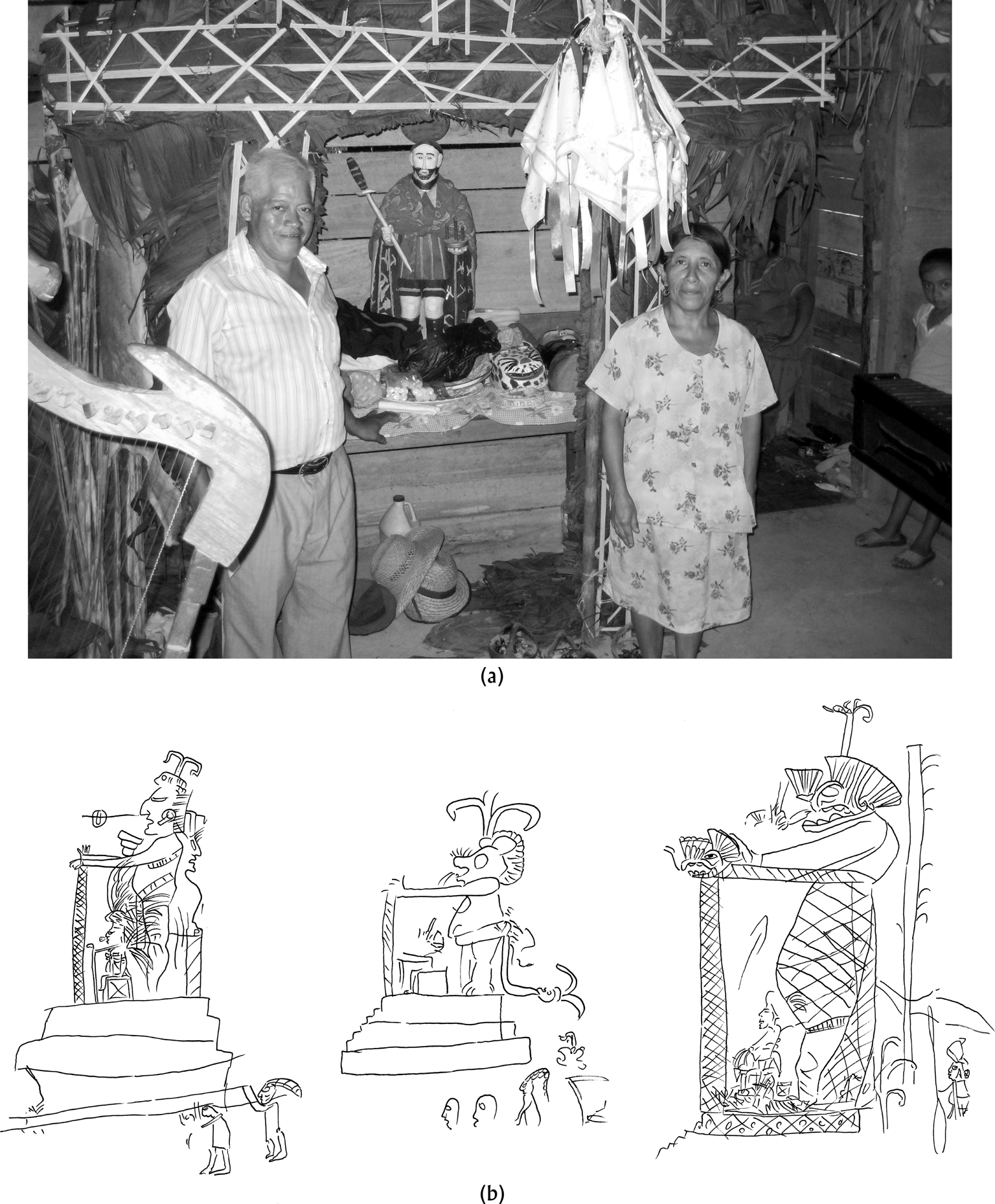
Bearing the aforementioned characteristics in mind, as we will see, there are many instances that accord with the data at our disposal for Maya culture throughout the ages. One incident, recounted by Thompson (Reference Thompson1930) in his Ethnology of the Mayas of Southern and Central Belize, is of particular interest. The account starts in 1883 at the settlement of San Luis in the eastern Petén, from whence a group of a hundred or so Mopan Maya migrated to southern Belize to found the settlement of San Antonio. The settlers were befallen by misfortune, failing crops, and fever, and during a council meeting it was unanimously agreed that “the troubles were due to the fact that their old saints no longer protected them,” a situation exacerbated by the fact that the patron saints remained at San Luis (Thompson Reference Thompson1930:38). In response, the council decided to mount a raid on San Luis to recover the coveted images of the santos and the church bells (Thompson Reference Thompson1930:38–39). The raiding party, “set forth armed with guns, axes, machetes, and [a] barrel of gunpowder” to blow up the church door if it were to prove necessary. The party covered the 72 km separating the two settlements, and halted on the outskirts of San Luis to await nightfall (Thompson Reference Thompson1930:39). Then, in cover of darkness, the raiding party promptly hacked open the church door, seized the bell and the santos, rejoined the reserve group stationed at the outskirts, and quickly retreated to San Antonio. “The return was rapid and by the following evening the saints had been installed in the little palm-thatched hut that served as church. The stolen bells chimed across the hills summoning the inhabitants to assemble to hear the story of the bloodless rape of the saints” (Thompson Reference Thompson1930:39). Thompson (Reference Thompson1930:39) concludes the story with a smirk: “It was obvious that the saints preferred their new abode. To this day San Antonio proudly displays to its infrequent visitors the famous saints. Needless to say disease abated, and the crops improved” (Figure 1a).
Religious effigies seized in raids in the Maya area. (a) The statue of San Luis Rey in San Antonio, Toledo, Belize. (b) Graffiti depicting some of the palanquins seized by Tikal rulers from adversaries in battle. Note the diminutive rulers seated before the great protective deities sustained by the palanquins. Drawing by the author, after Trik and Kampen (Reference Trik and Kampen1983:Figures 72 and 82b).

Although the San Luis raid is highly illustrative of this type of engagement, these were by no means isolated events, since raids frequently resulted in retaliations and a series of ensuing chain reactions (cf. Roys Reference Roys1943:45; see also Chagnon Reference Chagnon2009:194–208). In addition, we can extend this practice to the Classic period on the basis of the glyphic texts that provide tantalizing evidence for the profound continuity of such military practices (Brown and Stanton Reference Brown and Stanton2003). Undoubtedly, the most evocative case is the Late Classic conflict of a.d. 744, embroiling Tikal and Naranjo. A record of this battle is found in the text of Lintel 2 from Temple IV at Tikal, which has already been the subject of cogent analyses by Martin (Reference Martin1996) and Zender (Reference Zender2005:14–15; see also Helmke and Kettunen Reference Helmke and Kettunen2011:64–66). The remarkable text records a “star war” waged by Tikal's Yik'iin Chan K'awiil (a.d. 734–746+) against Naranjo. The narrative opens on the date 6 Eb 0 Pop, and states that Yik'iin Chan K'awiil descended from an unidentified place, possibly the escarpment that separates Tikal from the lake district (Zender Reference Zender2005:14). Later the same day, the Tikal forces arrived at a place named Tubal, quite possibly the archaeological site of Nakum, or at least a locality in the vicinity, where they established camp and rested. At dawn the following morning, 7 Ben 1 Pop, the Tikal forces attacked Naranjo, resulting not only in the capture of her ruler Yax Mayuy Chan Chaahk, but also of a palanquin and an effigy of “his god” (u-k'uh-uul), named in part “Hummingbird palanquin … seed …, sun ocelot, black headdress” (tz'unun piit … saak pilip, k'in hix, ihk’ hu'un; Helmke and Kettunen Reference Helmke and Kettunen2011:64–65). Thereafter, the Tikal king was triumphantly borne on the captured palanquin, the patron deity of Naranjo now protectively embracing the victorious Tikal ruler, thereby completing the total military and sacral defeat of Naranjo (Martin Reference Martin1996; Martin and Grube Reference Martin and Grube2008:49, 78–79).
Yet, one added dimension needs to be taken into consideration: the dates of the events. These transpired on the first two days of the month Pop, which is to say that these took place during the New Year's celebrations (Stuart Reference Stuart2004). Consequently, it is clear that the element of surprise played a crucial factor in this armed conflict (Zender Reference Zender2005:14–15). As such, the Tikal forces attacked in the midst of religious festivities, an unprecedented act, finding an apt analogy in the Fourth Arab-Israeli War of 1973 that was timed to take place on Yom Kippur, the holiest day of the Jewish calendar (Bregman Reference Bregman2002; Gawrych Reference Gawrych1996; O'Ballance Reference O'Ballance1978). Similarly, the so-called Tet Offensive of 1968 saw the combined North Vietnamese and Viet Cong forces attacking regional capitals and military strongholds in South Vietnam, in the midst of the most important religious observances, the lunar New Year's rituals known as Tẽt Nguyên Đán (Willbanks Reference Willbanks2007). Significantly, the palanquin seized from Naranjo is not the only such object captured by the armies of Tikal; others include a great litter from the site of El Perú, as well as one from its archenemy Calakmul (Martin Reference Martin and Trejo2000; Schele and Mathews Reference Schele and Mathews1998:90–91). So prominent were the triumphal pageants that ensued these victories that several graffiti were engraved at Tikal that depict the processions of these great palanquins (Figure 1b).
The raid of the San Luis santos and surprise attack of Tikal on Naranjo, both exhibit several key features worth emphasizing, including the complete integration of strategy and tactics, the halting of the raiding party at the outskirts of the target to await the cover of darkness, the seizing of significant religious effigies, the rapid deployment and retreat, and finally, the element of surprise. All these features align themselves perfectly not only with my definition of raiding, but also with Amerindian practices generally (Gat Reference Gat2006). An intriguing text at Palenque records the repercussions of an attack by the king known as “Sky Witness” of the Snake-Head dynasty (Martin and Grube Reference Martin and Grube2000:104), who conducted an axing event that resulted in the patron deities of Palenque suffering a yajel “throwing down” (Grube Reference Grube, Robertson, Macri and McHargue1996:3; Stuart and Stuart Reference Stuart and Stuart2008:141). This segment may well refer to the toppling of deity effigies within Palenque at the hands of enemy forces. Similarly, among the Aztec, the conquest of neighboring states was represented as the capture of local patron deities at the hands of Tezcatlipoca, patron deity of Aztec warfare, and “when the Mexica conquered a city, they took ‘captive’ some of the local idols and brought them back to be held in a special temple in Tenochtitlán” (Pasztory Reference Pasztory1983:150). This temple was known as the koowaateookalli (“snake-god-house”) and “had been constructed in the main ceremonial precinct to house the captured cult effigies and ritual paraphernalia brought home by triumphantly returning Mexica armies” (Townsend Reference Townsend1979:36).
Warfare among the Yanomamö of South America, or at the very least belligerent interactions (depending on which anthropologist is asked), traditionally consisted almost entirely of engagements conforming precisely to raids (Chagnon Reference Chagnon2009:193–204, 207–208). Thus, Yanomamö offensives entailed an assembly of warriors with the aim of killing warriors and/or abducting females of an enemy group. Usually the instigations or causal factors cited were fixed to the reprisals of earlier offenses, at the hands of the enemy group. The raiding parties marched to the vicinity of the enemy village, camped within a few hours march, and attacked at daybreak to ensure tactical efficiency and the element of surprise. At times, the skirmishes that ensued amounted to nothing more than shooting a few arrows into the opening of the xabono, the circular village-house, before rapidly retreating into the rainforest. Alternatively, warriors from both sides might exchange missiles and suffer great losses. Nevertheless, the pride of a Yanomamö warrior was to kill one or more enemies, preferably with an arrow, with minimal loss to the group one adheres to. Before being reintegrated into their community, warriors that had killed other men would undergo purification rites and thereby acquire the honorific title of unokai “killer” (Chagnon Reference Chagnon2009:205). Incidentally, it is this aspect, the behavior of warriors during and after battles that is another pivotal aspect of warfare, which warrants further discussion, especially as it relates to the acquisition of trophies during raids, and considering the implications of this behavior for our understanding of “state-level” societies in Mesoamerica.
HUMAN TROPHIES
In societies that cultivate the warrior ethos, the prowess and recognition of a warrior are elements of tantamount importance, since they altogether affect his social standing. Of interest here is how these aspects contribute to the definition and identification of particular types of conflicts and raiding, in particular. The aspirations of warriors are molded by the social norms of a given group, which dictate what it means to be a successful warrior. In several societies, the act of capturing or killing an opponent is a fundamental rite of passage into manhood and greater social integration (Chagnon Reference Chagnon2009). Thus, warriors had to keep a tally, not only as a means of heralding their achievements to society at large, but also to gauge their prowess and skill against one another. In this connection, we can think of the practice of “counting coup” celebrated by North American Indians to recall their achievements in battle (Grinnell Reference Grinnell1910; Linderman Reference Linderman2002; see also McNab Reference McNab2010). In recent history, World War II airplane pilots resorted to marking off the number of adversaries struck down in dogfights, in the “nose art” adorning their aircraft.
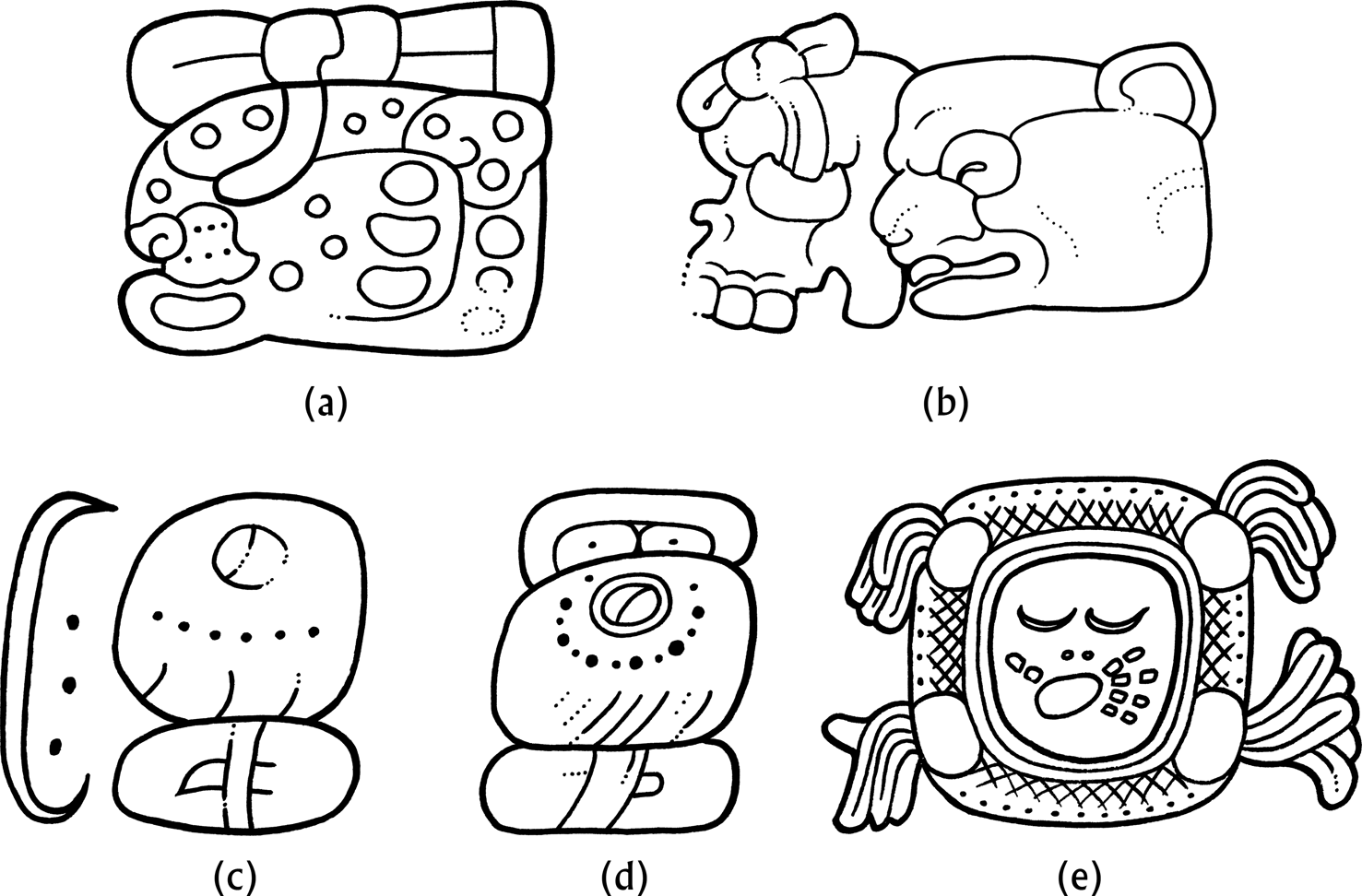
In preindustrial societies, symbolic equations were drawn (to varying degrees of abstraction) between the hunter of animals and the warrior who pursues human prey (Braakhuis Reference Braakhuis2001; Seeman Reference Seeman, Chacon and Pye2007). As a result, a successful hunter and/or warrior is inherently one who achieves a kill. Among the ancient Maya, this equivalence is made clear in the regal anthroponym, nicknamed “Knot-eye Jaguar,” which involves a jaguar trophy skull with a rope tied through its orbits (Figure 2a; Martin and Grube Reference Martin and Grube2008:120–121, 124, 141). In a revealing substitution set on a stela from the Bonampak area, now in the Musée du Cinquantenaire in Brussels, a human trophy skull is set beside the jaguar head to yield an alternate spelling (Figure 2b; see Martin Reference Martin2004:4, n.10; Stuart Reference Stuart2007). These spellings demonstrate that the anthroponym should be understood as “trophy-skull jaguar,” and make it clear that a human skull was an equally prized trophy by both warriors and jaguars. This clearly resonates with the Aj-jol, “he of the skull,” title that is found at several Maya sites, including Copan and in the famous murals of Bonampak (Miller and Brittenham Reference Miller and Brittenham2013). Unlike hunters, however, warriors could not have been expected to return home with all of their human quarries, unless they were seized and brought back alive, which was a solution practiced among several indigenous cultures, the Aztec and the Maya being no exception (Johansson K. Reference Johansson K.2007:65; Schele and Miller Reference Schele and Miller1986:212ff). Practical considerations notwithstanding, warriors have tended to resort to the acquisition of human trophies as a means of demonstrating a successful kill. This pars pro toto principle involves just about any human body part, including skulls, mandibles, scalps, ears, flayed skin, and long bones, down to fingers, and teeth— not to mention genitalia (Chacon and Dye Reference Chacon and Dye2007). As much stock has been placed in ancestor worship in Mesoamerica and the role that human remains play in these votive observances (see Tozzer Reference Tozzer1941:131), it is imperative to segregate the remains of ancestors from the trophies of foes, and below I discuss examples that are most likely to be the remains of captives seized in battle. That being said, among the Aztec a captor would present his captive for sacrifice by stating ca iuhqui nopiltzin, “he is as my beloved son,” and the captive would reply ca notatzin, “he is my beloved father” (Anawalt Reference Anawalt1982:44), revealing not only the miraculous substitution at play in human sacrifice, but also that captives were somehow deemed to form an integral part of the family and even the flesh and blood of a captor, thereby blurring the line somewhat between the remains of venerated family members and those of captives (see also Fausto Reference Fausto1999:945–946).
(a) The anthroponym “trophy-skull jaguar” naming a ruler of Ak'e (Lintel 35, Yaxchilan). (b) Analogous name with the constituent logograms separated and written sequentially (Brussels stela, Bonampak area). (c) The sequence u-baak as “his bone” (Miscellaneous Text 51A, Burial 116, Temple I, Tikal). (d) The sequence u-baak as “his captive” (Lintel 45, Yaxchilan). (e) Classic Maya shield showing the flayed skin of a captive with closed eyelids and a handprint over the buccal area (Palace Tablet, Palenque). Drawings by the author.

Although head-hunting is but one facet of human-trophy seizing, this practice has attracted a great deal of attention and been the subject of intense debate in the anthropological literature, focusing especially on the emic explanations of the practice and the etically construed implications for structuring and reinforcing social inequality and hierarchical relationships (Ogburn Reference Ogburn, Chacon and Pye2007). Head-hunting in the New World is best known for the tzantza, or shrunken heads, of the Jivaroan Shuar, of Ecuador and Peru and the trophy heads of the Tupian Munduruku of the greater Amazon. The owners of such trophies could harness the souls of their adversaries and compel them to serve their new masters (Chacon Reference Chacon, Chacon and Pye2007; Rubenstein Reference Rubenstein2006). Interestingly, the practice of shrunken heads may have extended to Costa Rica during the Classic and Postclassic periods (Hoopes Reference Hoopes, Chacon and Pye2007). Contemporaneously in the Andes, decapitated heads were presented as a sign of victory and military prowess (Ogburn Reference Ogburn, Chacon and Pye2007; Tung Reference Tung, Chacon and Pye2007). Although the practice of head-hunting in the Americas is not as well-documented as one might wish, it would seem that the harvest of heads was connected to agricultural fertility and rain-bringing, especially among the cultures of the Southwest (Shaafsma Reference Shaafsma, Chacon and Pye2007), whereas trophy heads were ritually used among Northwest Coast groups to attract whales and appease cannibalistic spirits (Lovisek Reference Lovisek, Chacon and Pye2007). Among the ancient Maya, the decapitation of an adversary finds its mythic origin in the decapitation of the Maize God, and was tied to rites of fertility and reincarnation (Taube Reference Taube and Fields1985), which in turn some scholars have connected to the Popol Wuj of the Kiche’ (Berryman Reference Berryman, Chacon and Pye2007; Coe Reference Coe and Kerr1987). Similarly, human trophy skulls were associated with rites of renewal among Mississippian cultures and mythic origins were invoked, much as in the Maya case, to justify these actions (Brown and Dye Reference Brown and David2007). Among the Aztec the weey tzompaantli, or “great skull banner” (the skull rack), of Tenochtitlan served not only to proclaim the achievements of the warriors of the Jaguar and Eagle orders, but may have served as a symbolic emulation of the fabled gourd tree, rooted solidly in Mesoamerican mythology (Matos Moctezuma Reference Matos Moctezuma1988; Mendoza Reference Mendoza, Chacon and Pye2007). This practice may find its antecedents in Epiclassic (a.d. 650–950) and Early Classic cultures of central Mexico, as series of skulls have been found within ritual deposits both at Xaltocan and within the Pyramid of the Moon at Teotihuacan (Morehart et al. Reference Morehart, Peñaloza, Sánchez, de Tapia McClung and Morales2012; Sugiyama and Cabrera Castro Reference Sugiyama and Castro2007).
As such, the acquisition of human trophies can be seen to have been a widespread and ancient practice in the Americas. From this, it stands that an abundance of archaeologically attested human trophies in a particular region imply the presence of societies cultivating the warrior ethos and positively valuating successful warriors, who kept count of their kills. Whereas it is difficult to ascertain with any certainty and to make broad generalizations, the anthropologically documented cases make it clear that the acquisition of human trophies and head-hunting, in particular, predominated among chiefdom and even “Big Men” societies, and were the result of raids specifically aimed at obtaining these items. This does not mean that the opposite is equally true, that trophies necessarily and inevitably stem from highly militarized societies, nor that these are exclusively the products of raids. Nevertheless, the patterns of predominance are such that it is evident that there is an intricate and ancient relationship between human trophies and raiding, wherein trophies heighten the prowess of the captor and contribute to his social identity. What is at odds here is the label of “state-level” applied to most Mesoamerican cultures; although, it is clear that the acquisition of human trophies was a primary outcome of martial encounters, and is an important point that has significant implications.
In fact, among the ancient Maya, captives were frequently referred to in the glyphic texts, and the term used to designate them is baak, which literally means “bone” and, by metonymy, “captive” (Figure 2c; Fox and Justeson Reference Fox, Justeson, Justeson and Campbell1984:42). As such, it is clear that captives were deemed to be the source of bone par excellence and that the seizing of captives and/or the acquisition of trophies were part and parcel of the same process: a bone trophy figuring in an inalienable “part-for-whole” relationship to its initial possessor, the captive (Zender Reference Zender and Wichmann2004). Hence, the seizing of captives was synonymous with the acquisition of bone. The bone trophies discovered throughout Mesoamerica attest to the widespread distribution of this underlying conception. Salient Early Classic examples include the elaborate necklaces of human mandibles and teeth discovered in deposits of the Pyramid of the Feathered Serpent at Teotihuacan (Sugiyama Reference Sugiyama2005; Taube Reference Taube1992), as well as a depiction of a human trophy head in the basal register of a carved-incised Teotihuacan tripod vase (Figure 3a; see Nielsen Reference Nielsen, Helmke and Sachse2014:184–185). With the collapse of Teotihuacan in the sixth century, the ensuing power vacuum resulted in a warring phase, known as the Epiclassic, wherein settlements moved from valley bottoms to more easily defendable hilltops. During this period of increasing warfare, human trophies became commonplace, as is illustrated by the carved human mandible discovered at Cacaxtla or the skull plates found at Xochicalco (Figures 3b and 3c; Hirth Reference Hirth, Diehl and Berlo1989:76, Figure 8; see also McCafferty and McCafferty Reference McCafferty, McCafferty, Zborover and Kroefges2015; Rivera Guzmán Reference Rivera Guzmán2014).
Human trophies in Central Mexican cultures. (a) Basal register of a carved-incised vase from Teotihuacan showing obsidian blades, spear throwers, and the head of a dead captive with lolling tongue. (b) Occipital cranial bone from Xochicalco modified into a pectoral in the form of a trophy head. (c) Incised mandible from Cacaxtla with perforated suspension holes, undoubtedly used as a buccal mask. Drawing and photographs by the author.

In the Maya area, virtually all of the types of human trophies known for one or another Amerindian society are attested in the rich archaeological record and/or iconographic corpus. The decapitation of captives and the taking of skulls is best demonstrated by the skull pits at Dos Pilas (Demarest et al. Reference Demarest, O'Mansky, Wolley, Van Tuerenhout, Inomata, Palka and Escobedo1997:234; Johnston et al. Reference Johnston, Inomata, Palka, Foias, Robles and Demarest1989) and Colha (Massey and Steele Reference Massey, Gentry Steele, Whittington and Reed1997), recalling the iconography of an incised Mississippian whelk from Spiro (Figure 4a). Skull caches in the Maya area are known from sites such as Uaxactun (Smith Reference Smith1932:6) and Calakmul (Nieves et al. Reference Nieves, Esparza, Nieto, Torrecilla, Villarejo and Fernández1995:105–106), as is the wearing of human skulls as part of martial attire (Graham Reference Graham1979:3.99; Kerr Reference Kerr2015:K2206; Mathews Reference Mathews and Robertson1980:66). Fascinatingly, scalping has also been documented in the Maya area at the site of Baking Pot, where it was determined that the scalps were removed post-mortem from previously decapitated skulls (Piehl and Awe Reference Piehl and Awe2009). Naturally, the practice of scalping is best known for North American groups, and formed such an integral part of society that these trophies were wielded during distinctive victory celebrations, known as scalp dances, still observed by Native American nations today (Figure 4b; Laubin and Laubin Reference Laubin and Laubin1977:152–170; see also Greene Reference Greene and Berlo1996:30–31). The identification of scalping in the Maya area ties North American and Mesoamerican cultural traditions together, and greatly extends the time-depth as well as the geographic extent of this practice, making it clear that it was a well-established practice in the Americas prior to the European invasion.
Human trophies in North America. (a) Incised whelk from Spiro, displaying the decapitated heads of captives and their shattered weapons. Drawing by the author, after Phillips and Brown (Reference Phillips and Brown1978:Plate 17). (b) Cheyenne scalp dance after the Custer battle. Note the scalps and hands mounted on dancing staffs. Drawing by the author, after Greene (Reference Greene and Berlo1996:Figure 5).

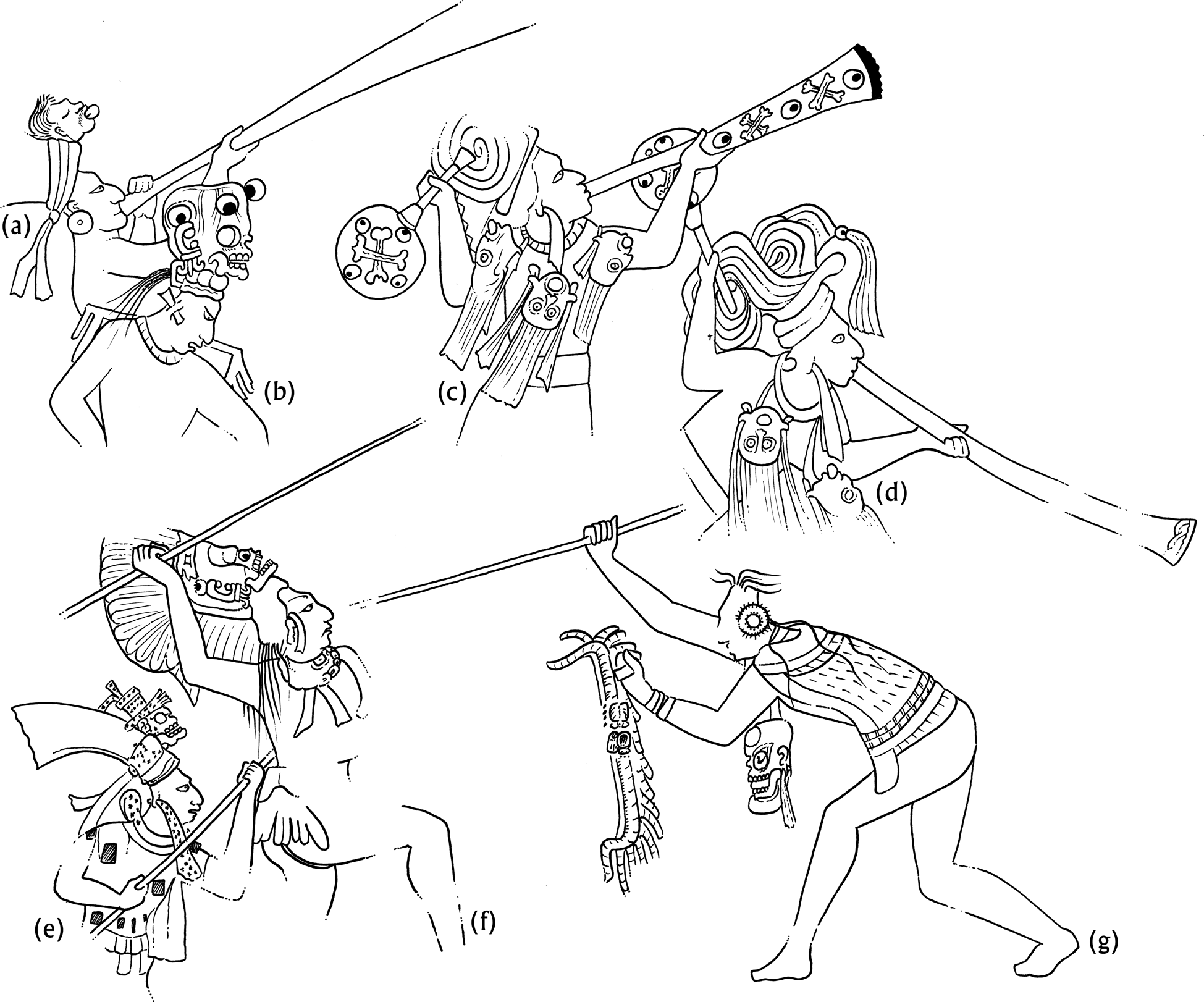
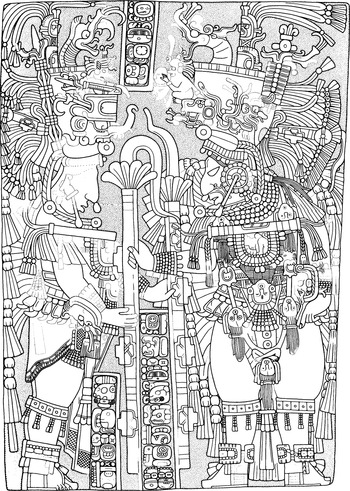
Similarly, the well-known South American practice of shrunken heads may also have been practiced in Mesoamerica, if the iconography found on the lintels of Yaxchilan (Graham Reference Graham1977:29), the polychrome vases of Nebaj (Kerr Reference Kerr2015:K2206, K2352), and the murals of Bonampak can be used as evidence. In this respect, the famed murals of Bonampak, and especially the vivid battle scene of Room 2, are particularly illustrative. Here, we see a melee of warriors engaging in bitter combat, each bearing their weapons and dressed for battle. The recently published watercolor renditions of the murals by Heather Hurst and Leonard Ashby (Miller and Brittenham Reference Miller and Brittenham2013) allow us to appreciate details that had so long remained obscured by calcite deposits and weathering. Among the warriors are musicians, who bear large rattles and blow on large wooden trumpets, some marked with crossed human long bones and disembodied eyes, calling to battle with tenebrous tones and solemn rhythms, as harbingers of death (Figures 5a, 5c, and 5d). Notably, each of these musicians are festooned with what appear to be shrunken heads, appropriately rendered in precisely the same flesh tone as the individuals themselves. Individual 7 wears a necklace of three heads, each head suspended upside down, whereas the adjoining Individual 35 has a similar necklace of two heads, and Individual 8 has a fine trophy head as the central feature on the front of his headdress, with eyes closed and mouth distended. Further within the battle are other warriors that either wear shrunken heads (e.g., Individual 51) or human skulls (Figure 5b, 5e–5g; e.g., Individuals 31, 33, and 64) both as necklaces and headdresses, whereas the lords leading the charge wear skeuomorphic heads made of greenstone (Individuals 54 and 55). The depictions at Bonampak closely duplicate examples known from the site of Yaxchilan, particularly the rich iconography of Lintel 9 (Graham Reference Graham1977:29). This lintel is truly remarkable, since the diminutive human figures worn by Yaxchilan's ruler Yaxuun Bahlam IV share the same blank expression and lengthy locks of hair, as are characteristic of actual Amazonian specimens (Figure 6). As a result, the practice of shrunken heads appears to have been much more widespread during the Classic period, over a continuous area spanning at least from eastern Mesoamerica, to the Chibchan cultures of the Intermediate Area and northwestern South America, and adjoining Amazonian cultures.
Shrunken heads and skulls worn by warriors in the battle scene of Room 2 at Bonampak: (a) Individual 8, (b) Individual 10, (c) Individual 7, (d) Individual 35, (e) Individual 31, (f) Individual 33, and (g) Individual 64. Drawings by the author, after watercolors by Heather Hurst and Leonard Ashby.

Lintel 9 of Yaxchilan, showing Yaxuun Bahlam IV and Chak Joloom conducting a flap-staff dance. Note the shrunken heads adorning the grisly necklace worn by Yaxuun Bahlam IV. Drawing by Ian Graham © President and Fellows of Harvard College, Peabody Museum of Archaeology and Ethnology, PM#2004.15.6.5.9.

Also derived from crania are skullcaps, mandibles, and teeth, all of which are represented in the archaeological record of the Maya area. Noteworthy examples include the inscribed skullcap from Aguateca (Inomata Reference Inomata1997:345, 347, Figure 13), the carved mandibles from Pakal Na in the Sibun Valley (McAnany et al. Reference McAnany, Murata, Thomas, López Varela, Finamore and Buck2004:302, Figure 5), and the plaquette from Pusilha made of the lateral masseter surface (Wanyerka Reference Wanyerka2004:193–196, Figure 85), decorated in much the same fashion with circular glyphic medallions. A cache of 379 human teeth associated with two isolated crania was found at Yakalche in northern Belize (Pendergast et al. Reference Pendergast, Bartley and Armelagos1968) and 36 mandibular incisors were recovered with more than 200 finger bowls, from a termination deposit at Cahal Pech in western Belize (Awe and Grube Reference Awe and Grube2001; Cheetham Reference Cheetham and Garber2004:136–137). Both of these instances make it clear that human teeth were valued trophies to be deposited in ritual contexts. The ritual importance of teeth may stem from their broad resemblance to maize kernels, especially incisors, and in several Mayan languages, including Yukatek, the word koj, “teeth” is homonymous with “seed, maize kernel” (Barrera Vásquez Reference Barrera Vásquez1980:323). It may be precisely on account of this equivalence that teeth were deposited in caches, and other ritual contexts, as human maize kernels, perhaps as part of rituals serving to promote human and agricultural fertility and the re-incarnation of human flesh/maize dough.
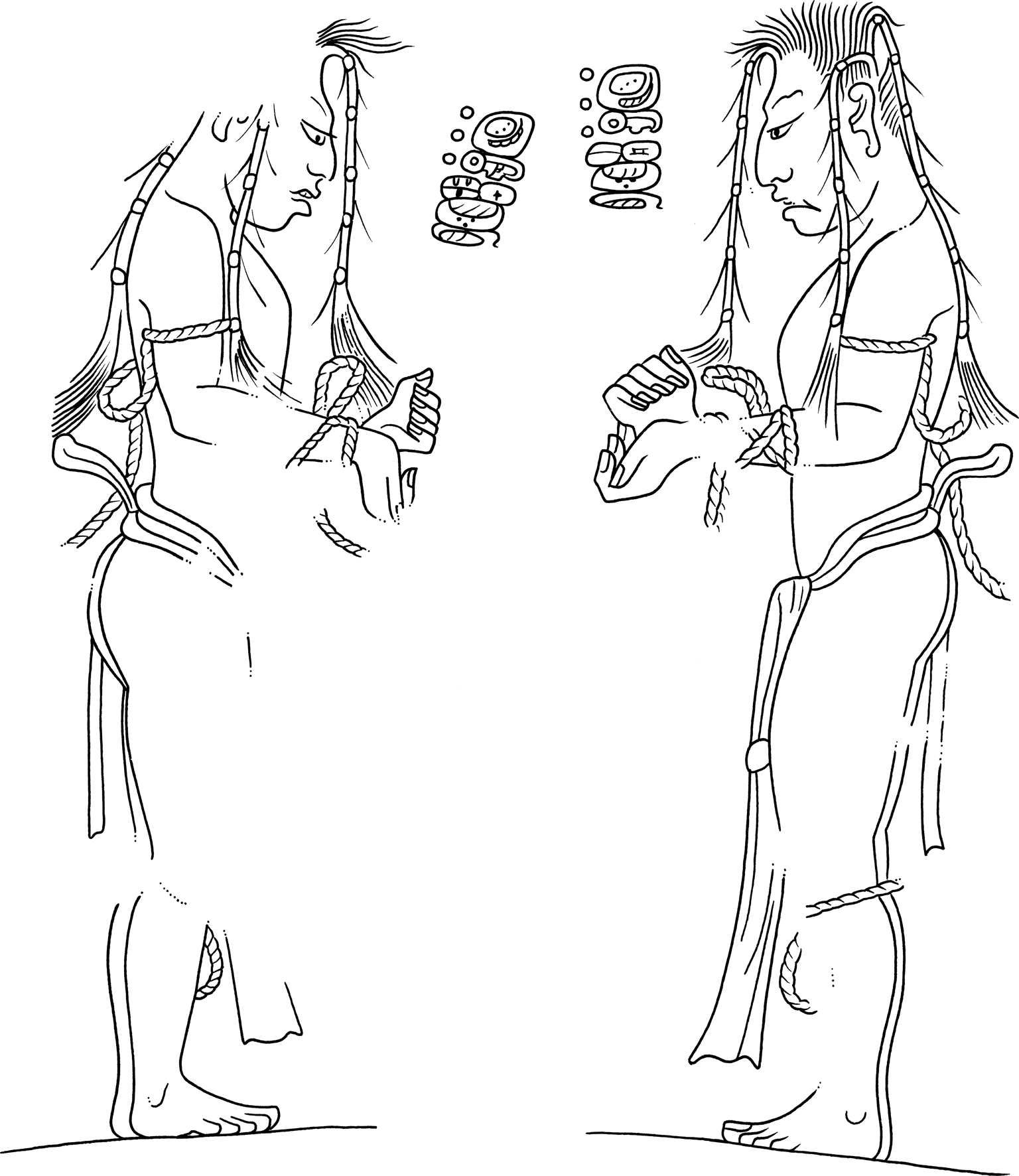
Aside from the all-important skull, other parts of the human body attracted the attention of warriors, including fingers. In the Maya area, severed fingers were placed in small, expediently, and intentionally made bowls, known as “finger bowls,” and interred in votive caches. Whereas finger bowls predominate at Caracol (Chase Reference Chase and Garber2004:328–330; Chase and Chase Reference Chase, Chase and Houston1998:319, Figure 5), hundreds of these have also been found in deposits at Cahal Pech and Baking Pot that correspond to periods of Caracol influence (Helmke and Awe Reference Helmke and Awe2008:84–86, Figure 17). The caching of severed fingers has also been identified farther afield at Tikal (Moholy-Nagy and Coe Reference Moholy-Nagy and Coe2008:64–65), El Zotz (Scherer Reference Scherer2015:153, Figure 3.55), Salinas de los Nueve Cerros (Dillon et al. Reference Dillon, Brunker and Pope1985), and most recently at Palenque (Martha Cuevas, personal communication 2011). To nuance this distribution, we should consider that the relative abundance of finger bowl caches at Caracol and related sites has very different implications regarding the frequency and scale of warfare in that region, depending on whether the fingers are those of captives or from relatives or dependents of the deceased (Scherer Reference Scherer2015:153–156). The preference for fingers as a trophy of adversaries is also found in cultures of the Plains and Great Basin of North America that produced elaborate necklaces of disarticulated phalanges and metacarpals, whereas other necklaces substituted beads with distal phalanges; skin and fingernails still attached (Owsley et al. Reference Owsley, Bruwelheide, Burgess, Billeck, Chacon and Pye2007). While fingers could have been severed from adversaries without causing loss of life, the same cannot be said of the long bones that were shaped into highly prized trophies. The most exceptional assemblage of long bones is that interred in Burial 116 at Tikal, the tomb of Jasaw Chan K'awiil I. Although these bones were extensively worked and polished, disabling secure identification as to taxon of origin beyond “large mammal,” the extant size and form of the most complete bones conform to human long bones. It is thereby conceivable that these are the remains of captives seized by Jasaw Chan K'awiil during his militarily active reign. We can look forward to chemical assays and provenance studies of these bones that constitute this fantastic assemblage. The set of 55 or so long bones were shaped into a wide array of ostensibly utilitarian objects, including weaving pins, tweezers, spatulate implements, effigy handles, and 42 of these were embellished with exquisitely incised texts and images (Moholy-Nagy and Coe Reference Moholy-Nagy and Coe2008:61–62). Particularly moving is the paired set of long bones depicting the lord of Hixil as a bound and dejected captive (Figure 7; Martin and Grube Reference Martin and Grube2008:111; Moholy-Nagy and Coe Reference Moholy-Nagy and Coe2008:Figure 200).
Two depictions of the lord of Hixil as a bound captive (MT39A and MT39B, Burial 116, Temple I, Tikal). Drawings by the author, after Moholy-Nagy and Coe (Reference Moholy-Nagy and Coe2008:Figure 200).

Finally, while we cannot hope to find any examples of flayed skin, the many iconographic depictions of shields provide us with exactly that. In fact, one of the main diagnostic features of circular shields of the Classic Maya is the skin of a flayed human face that is taut across the circular frame, eyes shut, and the mouth covered with distinctive face paint, often times a positive handprint (Figure 2e). The substitution of the human hand for the mandible is one of the defining traits of Maya deities of death and the underworld. As such, one can wonder whether such shields marked warriors as the heralds of death, or whether the death deities took their features from well-established martial symbolism. Regardless, such grisly shields are the very embodiment of a warrior trophy: one that would strike fear in any opponent. Corroborating the iconographic corpus are the osteological remains of the Colha skull pit, wherein 20 of the crania exhibit extensive composite cut marks along the orbits and muscle attachments, indicating that these, too, were flayed (Massey and Steele Reference Massey, Gentry Steele, Whittington and Reed1997:72–75). Thus, whereas the ancient Maya do not appear to have practiced flaying to the zealous extent that it reached among the Aztec in connection with the sacrifice and skinning of Xipe Totec impersonations (Dyckerhoff Reference Dyckerhoff, de Durand-Forest and Eisinger1993; Saville Reference Saville1929), they actively participated in these same Amerindian traditions.
CAPTIVE STATEMENTS AND COUNTS-OF-CAPTIVES TITLES
Aside from tangible human trophies, the Classic Maya elite, and royalty in particular, were ascribed a series of titles that celebrated their prowess as warriors. These titles served to recall fleeting historical events and achievements that were committed to social memory. In the absence of the glyphic texts, this orally reiterated social memory, which was otherwise so pervasive in Amerindian cultures, fades into oblivion. The titles in question are thus all the more remarkable since they breach the silence and provide a clear and definite record of otherwise intangible actions. The first of these titles is the captive statement as was originally identified by Tatiana Proskouriakoff (Reference Proskouriakoff1963:152, Reference Proskouriakoff1993:87–88) in the texts of Yaxchilan. Nowadays it is known that this title records a possessive construction that is read u-ka'an ~ u-cha'an (or u-kana'n ~ u-chana'n), depending on the period, wherein the root can be translated as “master” or “guardian” (Lacadena and Wichmann Reference Lacadena, Wichmann and Wichmann2004:110, 114, 117–118, 128, 140–141). This expression is then followed by the name of a captive, and the sequence is embedded into the lengthier titular sequence of the protagonist of the text (Figure 8a–8c).
Captive statements of Yaxchilan kings. (a) The “Guardian of Ajnik” title of Shield Jaguar III (Stela 12). (b) The “Guardian of Aju” title of Yaxuun Bahlam IV (Stela 11). (c) The “Guardian of Tajal Mo'” of Shield Jaguar IV (Stela 7). Count-of-captives statements in Mesoamerica: (d) Maya example reading ajcha’ baak or “he of two captives” (Stela 1, Aguateca); (e) Epiclassic example representing the numeral “two” below the bust of a “captive” (Structure A, North Pier, Cacaxtla); and (f) an Aztec example showing a warrior who has seized two captives in battle with his distinctive uniform. The dashed line connects to the corresponding cloak that this privilege earned him (Berdan and Anawalt Reference Berdan and Anawalt1992:f. 64r). Drawings by the author.

Yaxchilan is the city-state that most cherished these captive statements, and Late Classic rulers rarely failed to mention of which captives they were masters. Examples of such statements include Yaxuun Bahlam III who bore the captive epithet “Guardian of Chakjalte'”; succeeded by his son Shield Jaguar III who carried “Guardian of Ajnik”; whereas Yaxuun Bahlam IV was “Guardian of Ajuk”; Shield Jaguar IV was known as “Guardian of Tajal Mo'”; and, finally, K'inich Tatbu Jol IV carried the title of “Guardian of Ahku'l Mo'” (Martin and Grube Reference Martin and Grube2008:122, 124, 130, 137; Mathews Reference Mathews1988). Once these titles were appended to a person, they were typically always recorded and, at times, citing the captor's title was sufficient means of identification (all other regnal names being left aside). This makes for particularly interesting captive statements, when the captive himself is named by his captive epithet. Presumably such awkward constructions were designed to underline the fact that the individual captured was himself an accomplished warrior. An example of this can be seen at Tonina, where the text of Monument 159 records the capture of the ruler of Pomoy, one “Guardian of Ajchih.” Considering the onomastic importance of these titles and the privileged place they are afforded in the texts, it would seem that these were obtained at a relatively young age and served to commemorate the rite of passage to manhood. In this view, the captive epithets reflect the importance attributed to captive-taking in Classic Maya society. It is not as though men were not eligible for marriage until they had seized a captive in battle. Yet, it is reported that women would chide younger men at certain ceremonies, and call into question their bravery, for not having captured a prisoner in battle, as was made evident by their distinctive hair styles (Frances Berdan, personal communication 2018). It therefore stands to reason that these captive titles record the name of the first captive seized by a given person. Due to retrospective texts and anachronistic attributions of titles, however, the situation is not as clear as one might wish.
The second title is known as the “count-of-captives” and it, too, was first identified by Proskouriakoff (Reference Proskouriakoff1963:149–152). Since then, the title has been the subject of an insightful treatment by Stuart (Reference Stuart, Robertson and Fields1985), but to this day little has been done to build on such promising foundations. In all instances, the title is headed by an agentive prefix aj-, followed by a number, and closed by a “geometric” or “head-variant” spelling of the term baak, which, as previously discussed, means both “bone” and “captive” (Figure 8d). For example, Chak Joloom, a relative of the ruling family of Yaxchilan, bore a count-of-captive title that can be read as aj-huk-baak, or “he of seven captives,” marking him as an achieved military captain (Martin and Grube Reference Martin and Grube2008:132, 135). Rather than emphasizing a particular captive and providing a record of his name, what counts is the number of captives taken with increasing numbers presumably conveying heightened aptitude. The numbers involved in count-of-captive titles range between two and 21 (Stuart Reference Stuart, Robertson and Fields1985). This range is significant on several points. First, count-of-captive titles do not include the numeral one; instead, it would appear that the captive statements served that purpose. In essence, the captive statements are derivationally independent of the cardinal numbers employed in the formation of the higher-order count-of-captives. Second, although rare, numbers are known to increase as with Shield Jaguar IV, ruler of Yaxchilan, whose title increased from 15 to 16, in a text raised posthumously by his son and successor (Stuart Reference Stuart, Robertson and Fields1985:Figure 6). Similarly, the title of Shield Jaguar III is seen to increase, as recorded on Stela 18 (note the title at glyph block E2). Third, the qualifying numbers of the count-of-captive titles make it clear that even the most preeminent of kings, the longest ruling, or most accomplished martial rulers never claimed more than two dozen captives to their names. At first glance, this is surprising, especially when compared to Old World examples. Egyptian pharaohs, such as Merneptah of the Nineteenth Dynasty, claimed to have single-handedly defeated a Libyan invasion, resulting in the killing of more than 6,000 soldiers and the capture of 9,000 more. The original texts record the extent of the slaughter with bureaucratic precision: “Libyans, slain, whose uncircumcised phalli were carried off: 6359” (Clayton Reference Clayton1994:157).
Thus, in the Old World, the ruler could personally claim the successes of his entire army, deemphasizing the individual achievements of his warriors and atoning for the atrocities of war. In the case of the Maya, it does not seem warranted to assumed that the count-of-captive statements recorded are inflated and boastful. Nor can these titles be seen to represent literary expressions couched in self-aggrandizing and propagandistic rhetoric. Instead, it seems these are accurate records of prisoners seized. This is a point of nuance that responds to the comments put forth by Martin and Grube (Reference Martin and Grube2008) on the title of “he of twenty captives” borne by Yaxchilan's Yaxuun Bahlam IV. They state that “a modern understanding of these texts shows just how lowly most of these victims were. He made immense capital out of minor successes and Yaxchilan's former reputation as a ‘conquest state’ only reflects how beguiling his efforts have proved” (Martin and Grube Reference Martin and Grube2008:130). As such, one is left to conclude that the count-of-captive records are accurate. Why else would otherwise prominent noble figures cite themselves as “he of two captives,” not only in the Maya examples, but also in an exceptional example at Cacaxtla in central Mexico (Figure 8e; Helmke and Nielsen Reference Helmke and Nielsen2011:44)? A similar concern for the tallying of captives is known for the later Aztecs, since the number of captives taken in battle allowed increased rank and title (Figure 8f; Berdan and Anawalt Reference Berdan and Anawalt1992:ff. 63v–65r), in much the same way as the North American custom of counting coup (Grinnell Reference Grinnell1910; Linderman Reference Linderman2002).
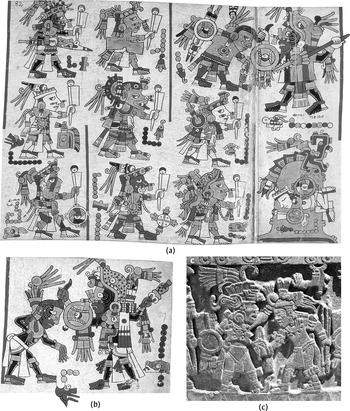
Some very interesting parallels can be drawn to other historical figures in Mesoamerica, particularly to the Mixtec ruler Eight Deer Jaguar Claw. The Codex Zouche-Nuttall that provides an account of his life and tallies his exploits is particularly telling, spanning from his birth in ca. a.d. 1063 to a cremation ritual in a.d. 1102, his dramatic death by sacrifice in ca. a.d. 1115 being recounted elsewhere, in the Codex Bodley (Jansen and Pérez Jiménez Reference Jansen and Jiménez2005; Pohl Reference Pohl1994, Reference Pohl2002; Troike Reference Troike1987; Williams Reference Williams2009). Whereas it is clear that the Codex Zouche-Nuttall is a retrospective account, it is also one of the very few pictorial manuscripts that is pre-Columbian in its manufacture. As such, one can doubt the historical accuracy of its content but, considering the rich and intricate details, one must conclude that the extant copy is precisely that, a later copy of an earlier historical document. Nevertheless, it is equally clear that temporal distance has introduced elements with mythic qualities such as battles in the heavens and combat involving stone men. The account of Eight Deer Jaguar Claw provides precise dates and names for all the characters involved and starts by giving his pedigree and rather candidly specifies that he was the first born, but of a second marriage, in the year 12 Reed (Troike Reference Troike1987:42–43). The narrative continues at a rapid pace with the conquest of four places in the year 7 Reed (ca. a.d. 1071), when Eight Deer was only eight years old (Troike Reference Troike1987:43–44). These battles were soon followed by more conquests, including three sites in the year 5 Reed (ca. a.d. 1095), events that culminated in a seating ceremony in a cave followed by a ritual ballgame, and observances at the Star Temple at Tututepec (Troike Reference Troike1987:45). These pivotal events mark the inauguration of Eight Deer as ruler of Tututepec, whose reign was initiated by a lengthy sequence of conquests that continued more or less unabated for the next six years, resulting in a staggering 94 conquests in all. Eventually, Eight Deer became an overlord by forming an alliance with the ruler of Cholula and received as a mark of his ascent a nose ornament in the year 7 House (ca. a.d. 1097; Troike Reference Troike1987:52). This ascent was followed by the congregation of 112 lords, who came and paid homage to him, each painstakingly named as to their places of origin (Troike Reference Troike1987:54–68). Despite the staggering number of conquests and military exploits that are listed, one sequence evidently held a special importance. This event is cited in connection with the year 9 Reed (ca. a.d. 1099), following the conquest of Fire Serpent Mountain (Xiucoatepec) and the death of his half-brother Nine Flower (Troike Reference Troike1987:76). At this juncture, the Codex Zouche-Nuttall records that Eight Deer had captured 14 individuals, each individually named, Eight Deer subduing the first, Two Flower, by grasping his hair (Figure 9a; Troike Reference Troike1987:76–77). Here, it is unclear if the capture is the result of a single action on this date, or a synthesis of the prominent captives that he had seized by this date. The latter is not unlikely, considering the numbers that have already been reviewed for the Maya and the Aztec and the fact that no other statements of capture are made in the narrative prior to this date. Significant in this respect is that another fifteenth capture statement is made at a later date in the year 11 House (ca. a.d. 1101) in conjunction with the conquest of Hua Chino (Troike Reference Troike1987:83). Here, the captive is named Four Wind, Eight Deer brandishing his atlatl and holding the boy by the hair (Figure 9b), thereby anticipating the conquest motifs that would appear so prominently on the later Aztec monuments known as the Stone of Tizoc and the Stone of Motecuhzoma Ilhuicamina (Figure 9c; Graulich Reference Graulich1992; Orzco y Berra Reference Orzco y Berra1877; Padilla y Yedra et al. Reference Padilla y Yedra, Sánchez-Nava and Olguín1989; Wicke Reference Wicke1976). What is interesting here is that the capture of a single individual was recorded so attentively, in order to express an increasing count-of-captives. The number of captives enumerated may thereby provide an accurate account and indicate that Eight Deer may once have been styled “he of fifteen captives,” thereby accentuating his incredible martial exploits.
The submission of captives in western Mesoamerica. (a) Lord Eight Deer Jaguar Claw with the first nine of the 14 captives seized (Codex Zouche-Nuttall; Troike Reference Troike1987:76–77). (b) Subduing Four Wind, the fifteenth captive (Troike Reference Troike1987:83). (c) The Aztec patron deity Tezcatlipoca grasping the deity of Acolman by the hair (Stone of Tizoc). Photographs by the author.

What is remarkable is that the Mesoamerican cases just cited above are highly reminiscent of the figures reported for the Yanomamö (Chagnon Reference Chagnon1988). For one, the number of warriors that have undergone the ritual purification rite for slaying an enemy ranges from one to 16; the vast majority (83.9 percent) of unokai have three or fewer kills to their name; and those that can boast a higher number are very few indeed. This distribution closely matches the pattern seen in the Maya area, where numbers do not seem to exceed 21, and, in the Mixtec case, a great warrior achieved 15, and the cap set among the Aztec to four captives suddenly makes great sense in light of the Yanomamö data, given that the largest proportion of the population occurs below that threshold. Leaving scalping practices of the colonial wars aside, Cheyenne and Omaha cases make it clear that only the first three or four coup were counted per battle (Grinnell Reference Grinnell1910:298) and one Algonquian warrior is reported as bearing a dance staff to which 15 scalps were fastened, whereas a raiding party returned with 21 scalps and nine prisoners (Bonin Reference Bonin and Gallup1993:107–108). It is intriguing that these numbers may reveal a fundamental aspect of indigenous warfare that to date has neither been properly identified nor accounted for. It is one of these traits, however, that seems to genuinely reflect features of indigenous warfare that greatly sets the New World apart from the Old in terms of the divergent evolution of behavioral codes and rules of engagement among the cultures of these hemispheres (McNab Reference McNab2010).
CONCLUDING THOUGHTS
We are only now beginning to tease apart some of the subtler aspects of Classic Maya warfare. It is worthwhile exploring some of the interesting questions that arise from this line of inquiry. Since it now seems clear that the Classic Maya indeed engaged in raiding, and not only in passing but as one of their primary forms of inter-polity conflict, then what does this mean for our understanding of the social organization of the Classic Maya?
As with many features of human societies, various types of warfare have been pigeonholed into different evolutionary stages, which, at least nominally, are meant to correspond to various stages of sociopolitical evolution, each correlated with increasing social complexity. Raiding and head-hunting as primary forms of organized violence tend to be relegated to quasi-egalitarian hunter-gatherer-horticultural societies (i.e., Service's “bands” and “tribes”; thinking especially of cases in Borneo, Papua New Guinea, and even the Amazon with the famed shrunken heads). Yet, from the available evidence, it is clear that at least one major aspect of Maya warfare concerned precisely this form of head-hunting and the collection of human trophies.
Echoing some of these larger trends, Webster (Reference Webster1975) has posited that with increasing complexity there is a decreasing importance of raiding as a mode of inter-group conflict. In state-level societies it is suggested that larger and more structured varieties of warfare (a broader category of conflict of which raiding forms a part) supplant the role of raiding. If we accept this premise, then the overt dominance of depictions and references to raiding within the Classic Maya corpus and the contemporaneous archaeological record forces us to reevaluate Webster's essentialization in light of the type and relative predominance of raiding that the evidence suggests. The resultant questions are many: are these survivals of a hunter-gatherer-to-horticultural stratum in a state-level society, or is Classic Maya society, on the whole, really that of a chiefdom-level society, exhibiting only few features of state-level societies? Alternatively, are the models of warfare and sociopolitical structure simply erroneous or wholly incompatible? How could head-hunting be complementary with a state-level society? These are all important questions that will have to be addressed in any further consideration of Maya conflict, particularly within diachronic and cross-cultural discussions.
RESUMEN
Los datos arqueológicos y epigráficos han aumentado enormemente nuestro entendimiento de la guerra practicada por los mayas en la antigüedad, especialmente en las últimas décadas. Sin embargo, uno de los aspectos que ha recibido relativamente poca atención es la desambiguación entre los diferentes tipos de guerras libradas. Este artículo se basa especialmente en las evidencias iconográficas y epigráficas que se puede presentar para mejorar nuestra comprensión de asaltos e incursiones marciales (“raiding”) en Mesoamérica como un tipo de conflicto marcial en particular, y continúa sugiriendo que estos tipos de asaltos representan una de las formas primarias de conflicto belicosos entre los antiguos mayas. La adquisición de trofeos humanos como se documenta en el registro arqueológico y iconográfico, así como los recuentos de cautivos y las declaraciones de cautivos registrados textualmente, proporcionan indicios tentadores de que este tipo de asaltos formaron parte integral de las tácticas militares de los mayas del periodo clásico. Esto suena particularmente cierto cuando consideramos que los términos en el idioma maya del clásico ‘cautivo’ y ‘hueso’ son uno y lo mismo, traicionando así las concepciones émicas en las que se consideraba los cautivos como la fuente ideal de hueso; trofeos humanos por excelencia. Las características identificadas para los mayas clásicos tienen que establecerse en una posición más amplia, ya que también se encuentran entre otras culturas mesoamericanas y también en las sociedades amerindias del continente americano. Al hacerlo, queda claro que el tipo de asaltos examinado en esta contribución y la adquisición de cautivos y trofeos humanos sirvieron para fomentar y aumentar el prestigio, especialmente entre las sociedades que cultivaron el espíritu guerrero. Como tal, estos asaltos emergen como un rasgo amerindio compartido, en lugar de ser el producto de la difusión o la innovación independiente.
ACKNOWLEDGMENTS
For the assistance provided in preparing this paper as well as for sharing insights and ideas, I would like to thank Jaime Awe, Dmitri Beliaev, Frances Berdan, Martha Cuevas, Stanley Guenter, Harri Kettunen, David Lee, Leonardo López Luján, Peter Mathews, Jesper Nielsen, Jerôme Rousseau, and Michael Smith. Many thanks to the President and Fellows of Harvard College and the Peabody Museum of Archaeology and Ethnology as well as the Akademishe Druck und Verlagsanstalt in Graz for permission to reproduce select illustrative materials. To Nancy Gonlin and the five anonymous reviewers, my thanks for their insightful and constructive comments that have greatly benefitted the gestation of the paper. I also owe a debt of gratitude to Shawn Morton and to Meaghan Peuramäki-Brown for their help, comments, and editorial input on an earlier version of this paper, initially presented at the 45th Chacmool Archaeology Conference.