Introduction
Botrytis grey mould (BGM), a disease caused by the necrotrophic fungus Botrytis cinerea Pers. ex Fr., has been reported from more than 15 countries (Nene et al., 1984). BGM is one of the most devastating diseases of chickpea (Cicer arietinum L.) and can result in complete yield loss (Davidson et al., 2004). It was first reported in the Jujuy Province of Argentina, causing 95% crop loss (Carranza, Reference Carranza1965). It is a serious constraint to chickpea production in many Asian countries including northern India, Nepal, Bangladesh and Pakistan. The disease is considered to be the major cause for the decline in the chickpea-growing areas of Nepal and Bangladesh (Pande, 1998). More than 80% yield loss has been observed in chickpea crops grown on the Indo-Gangetic plains of India (Pande, 1998). High levels of resistance have not been found in the cultivated germplasm (Singh and Bhan, Reference Singh and Bhan1986), which has encouraged the search for resistance sources in the related wild species.
Evaluation of germplasm accessions of wild species has revealed that they possess a wealth of genes for biotic and abiotic stresses (Haware et al., Reference Haware, Nene, Pundir and Narayana Rao1992, Mallikarjuna, 2003; Gaur et al., 2009). They have resistance to three or more stresses such as Ascochyta blight, BGM and Fusarium wilt (Robertson et al., Reference Robertson, Singh and Ocampo1995). Cicer reticulatum and C. echinospermum, two wild relatives from the secondary gene pool of chickpea (Mallikarjuna et al., 2011), have been reported to be resistant to BGM (Singh et al., Reference Singh, Kaur and Sharma1991; Singh et al., Reference Singh, Ocampo and Robertson1998; Ramgopal, 2006). In addition, accessions of Cicer bijugum, C. pinnatifidum and C. judaicum from the tertiary gene pool are resistant, but these species are currently inaccessible for chickpea improvement due to incompatibility between these species and cultivated chickpea (Mallikarjuna et al., 2011). Wild relatives in the secondary gene pool of chickpea are amenable to wide crossing and gene transfer (Collard et al., Reference Collard, Pang, Ades and Taylor2003; Mallikarjuna et al., 2011). Nevertheless, until now, none of the wild Cicer species have been used in the crossing programme to transfer BGM resistance to cultivated chickpea.
Currently, deployment of host plant resistance has limited potential in BGM management, as high levels of resistance have not been identified in cultivated germplasm and because of the variable nature of B. cinerea populations (Davidson et al., 2004). Fungicidal control of BGM is expensive and development of fungicide resistance has been reported frequently in B. cinerea populations (Leroux, 2004). This study describes the introgression of BGM resistance from C. reticulatum and C. echinospermum into chickpea and the pattern of inheritance of resistance.
Materials and methods
Plant material
The experiment was conducted at the International Crops Research Institute for Semi Arid Tropics (ICRISAT), Patancheru, Andhra Pradesh, India. The Genetic Resources Unit of ICRISAT provided C. reticulatum (collected from Turkey) and C. echinospermum (collected from Turkey) seeds, which were multiplied and used in the crossing programme. The crossing programme was carried out using the BGM-resistant accessions of C. echinospermum IG 73 074 (ICC 20 192) and C. reticulatum IG 72 937 (ICC 20 170) as male parents. Chickpea cultivars ICC 4954 and ICC 92 318, both susceptible to BGM, were used as female parents to develop interspecific populations. The F1s developed were selfed to develop F2 and backcrossed to the cultivated chickpea parent to develop BC1 populations in the glasshouse.
Screening for BGM
For the identification of BGM resistance, 8–10-d-old test seedlings along with the susceptible parent chickpea cultivars ICC 92 318 and ICC 4954 were inoculated with B. cinerea on a potato dextrose agar medium, which was isolated from naturally infected chickpea plants collected from the BGM hot-spot location Pantnagar, India. The isolate was from single spore following standard mycological procedures. Conidia of B. cinerea were cultured on autoclaved marigold (Tagetes erecta) flowers. The conidia were harvested into sterile distilled water, adjusted to 3 × 10⁵ conidia/ml using a haemocytometer and used as an inoculum. Chickpea seedlings were sprayed with the inoculum using a hand-operated atomizer. The inoculum was allowed to partially dry for about 30 min. Inoculated plants were maintained at 15 ± 2°C and above 60% relative humidity with a 12 h photoperiod. Disease scores for BGM on each accession were recorded using a 1–9 rating scale at 20 d after inoculation. The disease rating from scores 1 to 3 was treated as resistant, scores 4 to 5 as moderately resistant and scores 6 to 9 as susceptible (Pande et al., Reference Pande, Ramgopal, Kishore, Mallikarjuna, Sharma, Pathak and NarayanRao2006).
Data analysis
A χ2 goodness-of-fit test was calculated as given by Panse and Sukhatme (Reference Panse and Sukhatme1967) and the calculated χ2 values were compared with table values given by Fisher and Yates (Reference Fisher and Yates1963), against appropriate degrees of freedom (df).
Results
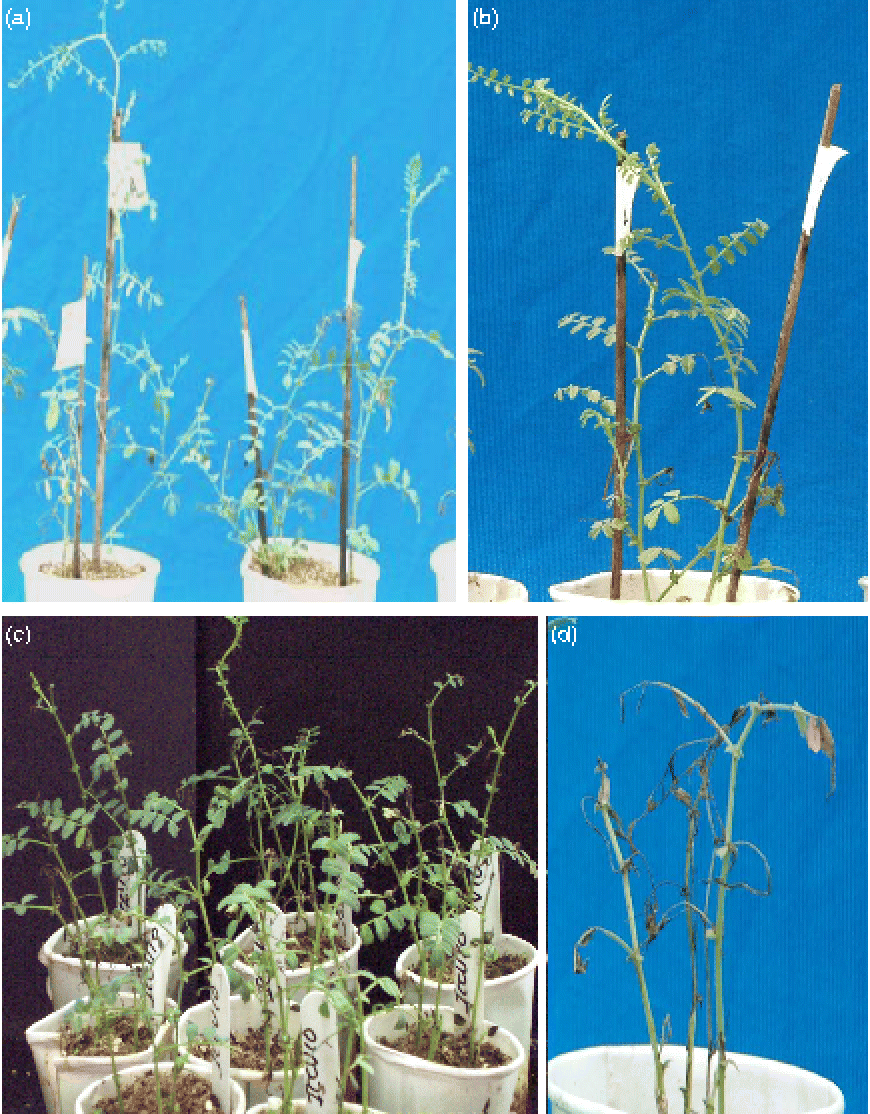
In this study, two crosses, one derived from C. reticulatum (ICC 92 318 × IG 72 937) and another derived from C. echinospermum (ICC 4954 × IG 73 074), were developed to screen for BGM resistance. The disease symptoms in the susceptible cultivar began with wilting and decaying of the leaves followed by decaying of the aerial parts of the plant by 18–20 d post-inoculation (Fig. 1(b)). In the resistant C. echinospermum (Fig. 1(a)) and the resistant interspecific derivatives (Fig. 1(c)), the aerial parts remained green and fresh without any signs of wilting and decaying. Wilting and decaying of the aerial parts of the seedlings was observed in disease-susceptible interspecific derivatives (Fig. 1(d)). Plants that did not show any disease symptoms upon transplantation to suitable pots grew further and set flowers and pods. Susceptible plants continued to decay under disease pressure.
(colour online) Botrytis grey mould screening of interspecific derivatives between C. arietinum and C. echinospermum. (a) Wild species, C. echinospermum, showing no BGM disease. (b) Cultivated chickpea cultivar showing susceptibility to the disease. (c) Interspecific derivative resistant to the disease. (d) Interspecific derivative showing susceptible reaction to the disease.

The F2 population derived from the C. reticulatum IG 72 937 cross (ICC 92 318 × IG 72 937) had a total of 16 plants. BGM disease screening tests showed three plants to be resistant while nine plants were found to be moderately resistant and four were susceptible to the disease. The BGM disease reaction fitted into a 1 (resistant):2:(moderately resistant):1 (susceptible) monogenic segregation ratio with additive gene action (χ2 test ratio 0.38ns, P= 0.83 at 2 df). Similarly, the BC1 population (derived by crossing the F1 of the same cross to ICC 92 318) had a total of 20 plants in which eight plants were moderately resistant to the disease and 12 plants were susceptible. The χ2 test (0.8ns) with a P value of 0.37 at 1 df followed the ratio 1:1, thereby confirming the monogenic additive F2 segregation ratio. The progeny derived from C. reticulatum were advanced further and screened for BGM, and the lines showed resistance to BGM.
The F2 population derived from the C. echinospermum IG 73 074 cross (ICC 4954 × IG 73 074) had a total of 63 plants, of which 12 plants were resistant, 37 moderately resistant and 14 susceptible to the disease. The χ2 test was carried out to test whether the ratio of 1:2:1 fitted. The χ2 test was 2.05ns with a P value of 0.36 at 2 df. The BC1 population (obtained by crossing the F1 of the same cross to ICC 4954) had a total of 17 plants with seven moderately resistant plants and 10 susceptible plants. The χ2 test (0.53, n.s.) with a P value of 0.47 at 1 df confirmed the ratio of 1:1 for the backcross. These results indicate that BGM resistance inherited from both C. reticulatum and C. echinospermum was a single gene showing additivity.
Discussion
This is the first report on the introgression of BGM resistance from wild relatives of Cicer, namely C. reticulatum and C. echinospermum, into C. arietinum. In the present study, single and additive modes of resistance were observed for BGM. The additive alleles from C. reticulatum (designated as bgmr1 cr) and C. echinospermum (designated as bgmr1 ce) were needed in two doses (bgmr1 cr/bgmr1 cr; bgmr1 ce/bgmr1 ce) to impart complete resistance, while heterozygous (Bgmr1 cr/bgmr1 cr; Bgmr1 ce/bgmr1 ce) individuals were moderately resistant. Disease resistance genes present in the wild species are recessive in many crop plants, as seen in Cajanus platycarpus, where resistance to Phytophthora blight has been reported to be monogenic and recessive (Mallikarjuna et al., Reference Mallikarjuna, Jadhav and Reddy2005). Collard et al. (Reference Collard, Pang, Ades and Taylor2003) reported digenic and recessive modes of resistance to Ascochyta blight in the interspecific derivatives of chickpea from C. echinospermum accession ICC 17 159. The results from the present study indicated that neither susceptibility nor resistance was dominant over the other. Previous reports on the transfer of BGM resistance from cultivated chickpea lines showed single dominant gene, and between two resistant cultivated chickpea parents showed duplicate dominant genes (Singh, 1997). The nature of resistance was probably moderate to low as the plants succumbed to the disease when the infection was moderate to severe. Some more examples of Cicer species contributions to chickpea improvement are successful introgression of Phytophthora root rot resistance from C. echinospermum (Knights et al., Reference Knights, Southwell, Schwinghamer and Harden2008) and introgression of nematode resistance from C. reticulatum and C. echinospermum (Gaur et al., 2009). Cicer pinnatifidum, C. judaicum and C. bijugum are known to possess resistance to Fusarium wilt, Ascochyta blight, BGM and bruchids (Stevenson and Veitch, Reference Stevenson, Veitch and Nigel1998; Mallikarjuna et al., 2011).
These results indicate that when desired levels of resistance to biotic constraints are lacking in the cultivated or primary gene pool, there is an option for sources of resistance in the secondary gene pool where the species are cross-compatible and offer genetic variability to tackle many of the biotic constraints (van der Maesen et al., 2007; Mallikarjuna et al., 2011). It was possible to transfer Helicoverpa armigera resistance from C. reticulatum (Mallikarjuna et al., Reference Mallikarjuna, Sharma and Upadhyaya2007, Mallikarjuna et al., 2011). Therefore, as demonstrated in the present study, C. reticulatum and C. echinospermum with their valuable sources of variation for BGM resistance offer genetic variability to broaden the genetic base of cultivated chickpea and introduce useful traits not present in the cultivated gene pool.
Further studies on allelism are needed to ascertain whether the two BGM resistance genes (bgmr1 cr and bgmr1 ce) reported in this study are allelic variants of the same gene, or are two different genes.